

|
Getting your Trinity Audio player ready...
|
Introduction by Andrew Ross Sorkin
The story of the 1929 stock market crash is often told as if it were inevitable — a morality play with clear villains, obvious excesses, and lessons that should have been impossible to miss.
But when I began researching 1929, what struck me most was not how reckless the people of that era were, but how reasonable they sounded. Recognizable incentives. Plausible arguments. A shared belief that progress, technology, and expanding access to finance were signs of a healthier system — not a fragile one.
This imaginary conversation is not an attempt to relitigate blame, nor to predict the next collapse. It is an effort to step back inside the mindset of those who lived before the break, and to place their logic beside our own. By bringing voices from 1929 and 2025 into dialogue, the goal is to examine how confidence becomes policy, how leverage hides in plain sight, how technology reshapes belief, and how human nature quietly pressures systems toward excess.
History rarely repeats itself cleanly. But it does reveal patterns in how people behave when the future feels both promising and urgent. This conversation begins there — not with certainty, but with context.
(Note: This is an imaginary conversation, a creative exploration of an idea, and not a real speech or event.)
Topic 1 — Confidence as a System: How Optimism Becomes Infrastructure

Setting: a restrained, almost austere room. No screens. No charts.
Only voices that once built confidence — and voices now trying to understand how it spreads.
At the center sits Andrew Ross Sorkin, not as a judge, but as a translator between eras.
Andrew Ross Sorkin (opening)
When we talk about financial crises, we usually begin at the moment things fall apart.
But before collapse, there is construction.
Confidence doesn’t just appear.
It’s encouraged. Normalized. Embedded into systems.
And once that happens, it becomes very difficult to tell the difference between leadership and illusion.
That’s where I want to begin.
First Question
Andrew Ross Sorkin
How does confidence stop being a personal attitude and become something built into the system itself?
Charlie Mitchell (1929)
Confidence becomes systemic when participation expands.
In my time, millions of Americans were entering financial markets for the first time. That wasn’t accidental — it was the result of deliberate design. Credit was no longer something to be ashamed of. It became a tool for progress.
Once credit is normalized, confidence follows naturally. The system depends on it. Without confidence, deposits freeze, lending halts, and opportunity collapses.
This wasn’t manipulation. It was modernization.
Thomas Lamont (1929)
Confidence becomes infrastructure when elites agree to protect it.
Markets are not sustained by facts alone. They are sustained by coordinated belief among those entrusted with stewardship — banks, governments, institutions.
When those actors fracture publicly, instability accelerates faster than any imbalance beneath the surface. So confidence must be maintained, not because everything is perfect, but because disorder feeds on hesitation.
Stability requires choreography.
Ray Dalio (2025)
From a systems perspective, confidence becomes infrastructure when it suppresses feedback.
Early confidence is healthy — it lubricates growth. But once confidence is reinforced by leverage, media narratives, and policy hesitation, it starts acting like insulation.
Problems don’t disappear. They just stop signaling.
That’s the moment confidence stops being sentiment and starts becoming architecture.
Robert Shiller (2025)
Confidence becomes systemic when it turns into a story people repeat without verifying.
In both eras, narratives about opportunity, access, and technological destiny spread faster than data. These stories don’t feel like propaganda — they feel like common sense.
Once confidence becomes cultural, questioning it sounds antisocial. Skepticism gets framed as obstruction.
That’s how belief embeds itself into the system.
Andrew Ross Sorkin (brief pause)
So confidence doesn’t just reassure — it organizes behavior.
Let’s go deeper.
Second Question
Andrew Ross Sorkin
At what point does expanding access to wealth become the mass distribution of risk?
Charlie Mitchell (1929)
Risk has always accompanied opportunity.
What changed was scale. Markets were no longer the domain of elites. Ordinary Americans wanted in — and deserved access. Credit allowed that participation.
To argue that access should be limited because risk exists is to preserve privilege. We believed people should be allowed to decide for themselves.
Markets cannot promise safety without strangling growth.
Robert Shiller (2025)
The problem isn’t access. It’s asymmetry.
When access expands faster than understanding, risk doesn’t disappear — it concentrates quietly. Narratives emphasize upside while minimizing downside, especially for newcomers.
People don’t feel they’re taking risks. They feel they’re joining something inevitable.
That’s when participation becomes exposure.
Thomas Lamont (1929)
There is an uncomfortable truth here.
When confidence holds, expanded participation looks like progress. When confidence breaks, the burden falls unevenly — not because of malice, but because proximity to information matters.
Those closest to capital adjust first. Those further away adjust last.
But restricting access preemptively invites accusations of paternalism and control.
Ray Dalio (2025)
In leveraged systems, democratization accelerates fragility.
When losses occur, they cascade downward faster than institutions can absorb them. The system appears inclusive on the way up and hierarchical on the way down.
That’s not ideology — it’s mechanics.
The danger is mistaking inclusion for protection.
Andrew Ross Sorkin (softly)
So access widens — but risk doesn’t distribute evenly.
Which brings us to the hardest question.
Third Question
Andrew Ross Sorkin
Why do societies repeatedly mistake participation for safety — and optimism for proof?
Robert Shiller (2025)
Because participation creates emotional reinforcement.
When friends, neighbors, and headlines all confirm the same story, risk feels abstract. Optimism feels validated simply by numbers.
Social proof replaces analysis.
The more people participate, the safer it feels — even when the system grows more fragile.
Ray Dalio (2025)
Because cycles don’t announce themselves.
By the time danger is obvious, confidence has already done its work. People extrapolate recent experience forward because that’s how humans process uncertainty.
Optimism persists not because people are foolish — but because systems reward it longer than they punish it.
Charlie Mitchell (1929)
From inside the moment, optimism was proof.
Rising prices, expanding participation, technological advancement — these were not illusions. They were observable facts.
The mistake, if there was one, was believing that momentum itself was evidence of permanence.
But no leader can act as if collapse is inevitable without causing it.
Thomas Lamont (1929)
Exactly.
Confidence fails only in retrospect. In real time, restraint looks indistinguishable from fear.
Societies do not reward caution until after disaster. Until then, optimism governs because it appears functional.
History remembers outcomes. Leaders live inside uncertainty.
Andrew Ross Sorkin (closing)
What’s striking here is not arrogance — but plausibility.
Every argument sounds reasonable. Every position defensible.
Confidence didn’t spread because people were reckless —
it spread because it worked… until it didn’t.
And that may be the most unsettling lesson of all.
Pause.
Next, we examine the force that turns confidence into catastrophe — leverage.
Topic 2 — Leverage: The Invisible Multiplier That Turns Stress into Catastrophe

Setting: the same room. The mood is heavier now.
Confidence has been examined. What remains is the machinery beneath it.
Andrew Ross Sorkin leans forward slightly. This is where narratives give way to structure.
Andrew Ross Sorkin (opening)
Confidence explains why people stayed in the system.
Leverage explains why they couldn’t escape it.
Leverage is rarely dramatic when it’s building.
It becomes dramatic only when it’s too late.
That’s where I want to focus now.
First Question
Andrew Ross Sorkin
Why does leverage feel manageable for so long — and then suddenly feel uncontrollable?
Charlie Mitchell (1929)
Because leverage grows in increments.
Each extension of credit appears rational on its own. One loan supports another. Rising prices validate prior decisions. Losses seem improbable because the system has not yet tested its limits.
In that environment, leverage feels less like danger and more like efficiency. Capital is put to work. Opportunity multiplies.
The illusion is not created by recklessness — it’s created by continuity.
A Federal Reserve Governor (1929, composite)
Leverage becomes invisible when outcomes are favorable.
As long as markets rise, leverage disguises itself as liquidity. It looks like abundance, not fragility. Warning signs exist, but they are politically costly to act upon.
Raising rates or restricting credit too early invites blame for slowing growth. Waiting feels safer — until waiting becomes catastrophic.
Ben Bernanke (2025)
Leverage delays pain and concentrates it.
In a leveraged system, small shocks are absorbed quietly — until buffers disappear. Once they do, the same leverage that enhanced growth accelerates collapse.
What makes leverage dangerous is not its presence, but its distribution. When leverage spreads beyond institutions into households, municipalities, and opaque intermediaries, correction becomes systemic.
Ray Dalio (2025)
Leverage feels stable because it creates a false sense of equilibrium.
Debt smooths volatility in the short term. But it also builds obligations that cannot be met if conditions change. When cash flows weaken, leverage forces behavior — selling, cutting, defaulting — regardless of intent.
That’s when markets stop responding to logic and start responding to math.
Andrew Ross Sorkin (brief pause)
So leverage doesn’t announce itself as danger.
It announces itself as momentum.
Let’s go further.
Second Question
Andrew Ross Sorkin
In both 1929 and 2025, how much leverage did authorities truly understand while it was building?
A Federal Reserve Governor (1929, composite)
Less than we believed.
Our tools were blunt, our data incomplete, and our political constraints severe. We could observe credit expansion, but not its full interconnections.
We feared that decisive action might provoke backlash strong enough to dismantle the Federal Reserve itself. That fear narrowed the range of acceptable responses.
In hindsight, ignorance and hesitation fed one another.
Ben Bernanke (2025)
Even today, visibility is imperfect.
Leverage has migrated away from traditional banks into shadow banking, private credit, and non-transparent vehicles. Risk has not vanished — it has dispersed.
Authorities often know leverage exists without knowing precisely where it will surface under stress. That uncertainty complicates intervention.
The lesson of 1929 is not that regulators were careless — it’s that leverage evolves faster than oversight.
Ray Dalio (2025)
Leverage hides best in good times.
When returns are strong, leverage looks justified. Models assume stability. Stress tests reflect recent history, not rare extremes.
The problem isn’t ignorance of leverage’s existence. It’s underestimation of correlation — the assumption that failures will be isolated.
In reality, leverage synchronizes collapse.
Charlie Mitchell (1929)
We understood leverage — but we trusted markets to manage it.
Margin requirements, collateral, and price signals were believed sufficient. Intervention was viewed as distortion.
The belief was not that leverage was harmless — but that markets were self-correcting.
That belief held… until it didn’t.
Andrew Ross Sorkin (quietly)
So leverage wasn’t unseen — it was underestimated.
That brings us to the final question.
Third Question
Andrew Ross Sorkin
At what point does leverage stop amplifying opportunity and start enforcing outcomes no one can control?
Ray Dalio (2025)
When debt service depends on continued optimism.
The moment obligations require growth rather than productivity, leverage begins to dictate behavior. Choice disappears. Systems shift from voluntary to forced actions.
That’s when leverage stops being a tool and becomes a driver.
Ben Bernanke (2025)
When institutions lose flexibility.
Leverage constrains responses. It forces asset sales during downturns, tightening financial conditions precisely when relief is needed.
In that environment, policy responses become reactive rather than preventive.
A Federal Reserve Governor (1929, composite)
When intervention feels inevitable but politically impossible.
Once leverage reaches systemic levels, every option carries risk. Acting early invites criticism. Acting late invites blame.
Leverage compresses time — it removes the luxury of gradual correction.
Charlie Mitchell (1929)
From inside the moment, the threshold is unclear.
Leverage feels productive until markets reverse. There is no bell that rings to signal the transition from growth to danger.
By the time leverage enforces outcomes, discretion has already vanished.
Andrew Ross Sorkin (closing)
Leverage, then, is not merely excess.
It is acceleration.
It rewards optimism longer than it punishes it —
and when it turns, it leaves little room for judgment, negotiation, or mercy.
Pause.
Next, we examine the belief that often justifies leverage in every era —
technology as destiny.
Topic 3 — Technology as Destiny: Radio Then, AI Now

Setting: the room feels subtly different.
The tension here is quieter — less about fear, more about belief.
Andrew Ross Sorkin pauses before speaking. This is where markets stop arguing with numbers and start arguing with the future.
Andrew Ross Sorkin (opening)
Every era believes it is standing at the edge of something unprecedented.
Technology promises not just growth, but exemption — from old rules, old risks, old limits.
In 1929, that promise had a name: radio.
In 2025, it has another: artificial intelligence.
So let’s examine the belief itself.
First Question
Andrew Ross Sorkin
When does belief in transformative technology stop being vision — and start becoming justification?
Thomas Lamont (1929)
Vision becomes justification when markets attempt to price tomorrow using today’s imagination.
Radio was not fantasy. It was transformative. It reshaped communication, commerce, and culture. The enthusiasm surrounding it was grounded in genuine change.
The mistake, if one insists on calling it that, was assuming that transformation guarantees immediate and uninterrupted financial returns.
But disbelief in innovation carries its own cost. Skepticism can be just as distorting as exuberance.
Charlie Mitchell (1929)
Technology changes the scale of possibility.
Radio expanded markets, information, and demand. Investors were not speculating blindly — they were responding to visible momentum.
The challenge was not belief, but timing. Technology moves faster than institutions. Credit followed opportunity.
Calling that justification implies bad faith. At the time, it felt like alignment.
Ray Dalio (2025)
Technology becomes justification when it silences valuation discipline.
When investors stop asking how much and focus only on how big, technology shifts from catalyst to excuse. Future potential overwhelms present constraints.
Every technological revolution is real. Every technological bubble is also real.
The confusion arises when people assume those two timelines must be the same.
Robert Shiller (2025)
Narratives turn vision into inevitability.
Technological stories spread socially, not analytically. They promise participation in history itself — not just returns.
Once people believe they’re witnessing destiny, valuation feels almost immoral, as if questioning price is questioning progress.
That’s when belief stops being curiosity and starts being insulation.
Andrew Ross Sorkin (brief pause)
So technology doesn’t deceive —
it persuades.
Let’s move further.
Second Question
Andrew Ross Sorkin
Why do markets repeatedly assume that transformative technology justifies extraordinary leverage?
Charlie Mitchell (1929)
Because technology creates urgency.
When opportunity appears boundless, delay feels like failure. Credit becomes the bridge between present capital and future reward.
Leverage is not taken on recklessly — it is taken on competitively. No one wants to be left behind while others advance.
In that environment, restraint looks like irrelevance.
Ray Dalio (2025)
Because leverage shortens the path to participation.
Technology expands imagination faster than balance sheets can follow. Leverage fills the gap.
But leverage doesn’t care about vision. It enforces arithmetic. When expectations falter, leverage accelerates disappointment.
That dynamic repeats because optimism lasts longer than prudence.
Robert Shiller (2025)
Because leverage feels validated by collective belief.
When everyone agrees the future will be different, risk feels shared — even though losses never truly are.
The presence of leverage is psychologically softened by narrative reinforcement. People feel protected by consensus.
Consensus, however, does not absorb losses.
Thomas Lamont (1929)
There is also political pressure.
When technology becomes synonymous with national progress, resisting its financial expansion feels unpatriotic. Institutions hesitate to impose limits on what appears to be the future itself.
Leverage becomes tolerated not because it is safe, but because opposition feels regressive.
Andrew Ross Sorkin (quietly)
So leverage follows belief —
and belief shields leverage.
That leads us to the final question.
Third Question
Andrew Ross Sorkin
How can societies distinguish between technological revolutions that justify patience — and those that demand restraint?
Ray Dalio (2025)
By separating adoption from monetization.
Technology can change the world without immediately supporting its own valuations. Productivity gains arrive unevenly. Cash flows lag vision.
When markets demand instant proof from long-term change, fragility builds.
Patience belongs to innovation. Restraint belongs to pricing.
Robert Shiller (2025)
By listening for narrative saturation.
When a story stops tolerating doubt — when skepticism is framed as ignorance rather than inquiry — the balance has shifted.
Healthy revolutions invite questions. Bubbles silence them.
Thomas Lamont (1929)
From within the moment, distinction is elusive.
History flatters restraint after the fact. In real time, delay risks irrelevance, and caution risks being outpaced.
Societies rarely reward those who slow the future — even when slowing might be wise.
Charlie Mitchell (1929)
And leaders must act within that reality.
If technology truly transforms society, denying capital to it can cause harm of its own. The danger lies not in belief, but in assuming belief removes risk.
Progress does not cancel cycles.
Andrew Ross Sorkin (closing)
Technology, it seems, never lies —
but it rarely tells the whole truth.
It expands what is possible, while quietly obscuring what is probable.
And when belief outruns discipline, the future becomes not a destination —
but a justification.
Pause.
Next, we turn to the question that follows every boom —
who is protected, who is exposed, and who decides where the guardrails belong.
Topic 4 — Democratization and Guardrails: Who Is Finance Really For?

Setting: the same room, but the air is more charged now.
This is where optimism and innovation meet politics, morality, and consequence.
Andrew Ross Sorkin looks around the table. This is no longer about markets alone.
Andrew Ross Sorkin (opening)
Every financial boom eventually claims a moral high ground.
In the 1920s, it was called democratizing finance.
In 2025, the phrase has returned — broader access, fewer barriers, more participation.
But access is not the same thing as protection.
So I want to ask not who finance includes — but who it ultimately serves.
First Question
Andrew Ross Sorkin
When we talk about “democratizing finance,” who is truly empowered — and who quietly absorbs the risk?
Charlie Mitchell (1929)
Democratization means choice.
For too long, financial opportunity was restricted to elites. Expanding access allowed ordinary Americans to participate in growth rather than merely observe it.
Risk cannot be eliminated without eliminating opportunity. To deny access on the basis of protection is to preserve hierarchy.
Empowerment requires trust in individual agency.
Carter Glass (1929)
Choice without understanding is not empowerment.
What you call democratization, I call distribution of hazard. When complexity increases faster than comprehension, the burden falls on those least equipped to bear it.
The market’s freedom must be balanced against its asymmetry. Otherwise, democracy becomes a pretext, not a principle.
A 2025 Financial Regulator
The tension remains unresolved.
Expanding access responds to legitimate demands for inclusion. Restricting access invites accusations of paternalism and elitism.
But history shows that when losses materialize, they do not fall evenly. Regulation exists not to deny participation — but to prevent catastrophic imbalance.
A Retail Investor Advocate (2025)
Many ordinary investors understand risk better than they’re given credit for.
The real issue is transparency. People can tolerate loss if they believe the rules are fair and the information honest.
What destroys trust isn’t risk — it’s discovering after the fact that the game was tilted.
Andrew Ross Sorkin (brief pause)
So democratization promises dignity —
but risk rarely distributes democratically.
Let’s press further.
Second Question
Andrew Ross Sorkin
At what point do guardrails stop protecting people — and start protecting the system itself?
Carter Glass (1929)
Guardrails exist precisely because systems cannot regulate themselves under pressure.
Left unchecked, financial power concentrates. Speculation accelerates. The public pays for private excess.
Guardrails are not restraints on capitalism — they are conditions for its survival.
Charlie Mitchell (1929)
Guardrails can become shackles.
Overregulation suffocates innovation and discourages participation. When markets are treated as fragile, they become fragile.
The danger lies in assuming protection is costless. Every rule trades resilience for dynamism.
A 2025 Financial Regulator
Modern regulation often aims to preserve confidence rather than prevent excess.
That creates a paradox: rules are enforced aggressively after collapse, but cautiously during booms.
Guardrails are strongest when they are boring — when they prevent drama rather than respond to it.
A Retail Investor Advocate (2025)
Guardrails lose legitimacy when they protect institutions more reliably than individuals.
If rules allow large actors to recover while small participants absorb losses, regulation feels performative.
Protection must be felt at the edges, not just at the center.
Andrew Ross Sorkin (softly)
So protection can preserve stability —
or entrench inequality.
Which brings us to the hardest question.
Third Question
Andrew Ross Sorkin
Why do societies repeatedly dismantle financial guardrails during booms — only to rebuild them after collapse?
Charlie Mitchell (1929)
Because success breeds confidence in judgment.
When markets rise, restraint feels unnecessary. Rules appear antiquated. Prosperity becomes evidence that safeguards are obsolete.
No one dismantles guardrails believing disaster is imminent.
Carter Glass (1929)
Because memory fades faster than appetite.
Each generation believes itself more sophisticated than the last. Warnings feel theoretical. Risk feels manageable.
Guardrails are always unpopular until they are desperately needed.
A 2025 Financial Regulator
Because political incentives reward growth more than prevention.
Prevented crises do not generate headlines. Slowed booms lose elections. Regulation is always easier after catastrophe than before it.
Guardrails fail not because they are wrong — but because they are politically lonely.
A Retail Investor Advocate (2025)
Because people want participation more than protection — until protection is gone.
Optimism convinces individuals they’ll exit in time. It rarely accounts for systemic collapse.
By the time guardrails are missed, they are already gone.
Andrew Ross Sorkin (closing)
Democratization, then, is never neutral.
It can widen opportunity —
or widen exposure.
And guardrails are not monuments to fear.
They are acknowledgments of memory — memory that fades precisely when it’s needed most.
Pause.
Next, we confront the final question —
whether 1929 is truly a warning…
or simply a mirror we keep holding up to ourselves.
Topic 5 — Significance or Speculation: Is 1929 a Warning or a Mirror?

Setting: the same room, now quieter than before.
Nothing more needs to be built. Only examined.
Andrew Ross Sorkin does not open with history this time. He opens with doubt.
Andrew Ross Sorkin (opening)
Every generation looks backward during moments of uncertainty.
Sometimes we do it to learn.
Sometimes we do it to comfort ourselves — to believe that whatever is happening now has happened before, and therefore can be survived.
So I want to ask the question that sits beneath this entire conversation.
First Question
Andrew Ross Sorkin
Is 1929 genuinely a warning for our time — or have we turned it into a story that helps us feel smarter than we really are?
Ray Dalio (2025)
It’s both.
1929 offers structural insight — about leverage, cycles, and human behavior — that remains valid. But it also tempts us into false confidence.
Recognizing patterns does not grant control. It only grants awareness. The danger is believing awareness alone is sufficient.
History doesn’t repeat — but it reliably humbles those who think it will behave neatly.
Robert Shiller (2025)
We use history as emotional regulation.
Looking backward reassures us that chaos eventually resolves. That someone, somewhere, figured it out. That today’s anxiety has a narrative arc.
But history doesn’t comfort participants — only readers. Those living through it rarely feel enlightened.
So yes, we risk turning 1929 into a story that flatters our self-image rather than challenges it.
Thomas Lamont (1929)
From within 1929, no one felt warned.
We believed we were managing complexity responsibly. We believed disorder was temporary. We believed confidence could outlast imbalance.
If future generations think our failure was obvious, they misunderstand the nature of decision-making under uncertainty.
History looks coherent only after outcomes settle.
Carter Glass (1929)
Warnings are rarely persuasive when prosperity is loud.
I spoke forcefully in my time, and I was not ignored — but I was outpaced. Appetite always moves faster than restraint.
If history has meaning, it is not because warnings were absent — but because they were inconvenient.
Andrew Ross Sorkin (brief pause)
So history teaches — but it does not command.
Let’s go further.
Second Question
Andrew Ross Sorkin
Why do crises only feel obvious after they happen — even to people who studied previous collapses?
Robert Shiller (2025)
Because narratives harden retrospectively.
Once outcomes are known, facts reorganize themselves into inevitability. But in real time, evidence competes with emotion, incentives, and social pressure.
Humans do not process uncertainty probabilistically. We process it socially.
That makes foresight structurally difficult.
Ray Dalio (2025)
Because cycles punish timing, not insight.
Many people correctly identify excess long before collapse — and still fail financially or politically because exits are mistimed.
Being early feels identical to being wrong.
That reality discourages restraint until restraint is unavoidable.
Thomas Lamont (1929)
Because responsibility distorts perception.
When one is charged with maintaining stability, acknowledging fragility can feel like abdication. Leaders must act — not merely observe.
From inside power, ambiguity does not invite caution. It demands confidence.
Carter Glass (1929)
And because those who benefit from the system speak louder than those who fear it.
Warnings do not arrive in silence. They arrive in competition with optimism, wealth, and momentum.
History remembers the crash. It forgets how loud prosperity was beforehand.
Andrew Ross Sorkin (softly)
So hindsight clarifies —
but foresight isolates.
That brings us to the final question.
Third Question
Andrew Ross Sorkin
If this conversation were rediscovered decades from now, what would future readers say we misunderstood — or failed to admit — about our own moment?
Ray Dalio (2025)
They would say we underestimated correlation.
That we believed risks were isolated when they were synchronized. That we trusted diversification without understanding dependency.
They would say we assumed resilience without testing it.
Robert Shiller (2025)
They would say we underestimated narrative power.
That we mistook participation for safety. That we believed popularity implied stability.
They would say the stories were louder than the data — and we let them be.
Thomas Lamont (1929)
They would say we acted rationally with limited information — and judged us harshly anyway.
History is unkind to those who govern during transitions. It rewards clarity that rarely exists in real time.
Future readers will believe they would have known better.
They always do.
Carter Glass (1929)
They would say we knew more than we admitted.
That warnings existed, guardrails were proposed, and restraint was possible — but unpopular.
History does not ask whether failure was understandable. It asks whether it was preventable.
Andrew Ross Sorkin (closing)
Perhaps that is the enduring tension of 1929.
It is neither prophecy nor comfort.
It is a mirror — one that reflects not certainty, but plausibility.
Not villains, but reasonable people making defensible choices under pressure.
And the most unsettling lesson may be this:
The conditions that made 1929 possible did not vanish.
They simply learned new language.
Silence.
Final Thoughts by Nick Sasaki
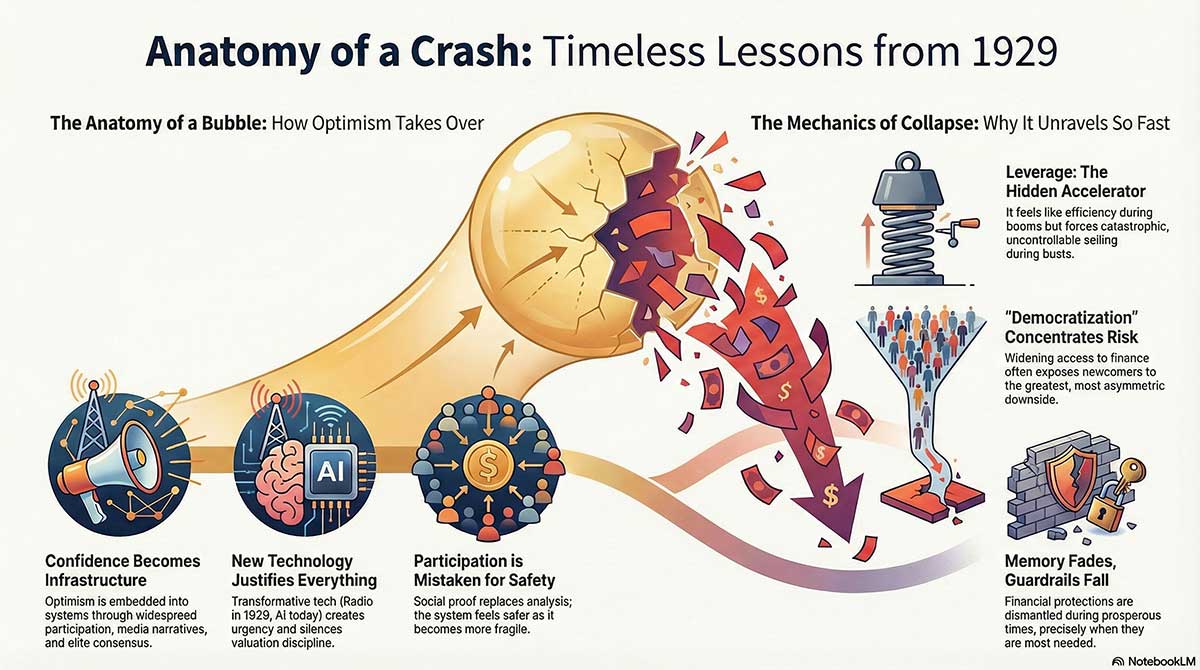
What moved me most in revisiting 1929 through this conversation was not how different the world looks today — but how familiar the reasoning feels.
Each era believes it has better tools, better data, better safeguards. And in many ways, it does. But the underlying human impulses — optimism, fear of missing out, trust in momentum, discomfort with restraint — remain remarkably consistent.
This imaginary conversation is not meant to leave readers anxious or cynical. It is meant to invite humility. To remind us that understanding history is not the same as being immune to it, and that awareness alone does not prevent repetition.
If there is value here, it is not in predicting what comes next, but in recognizing how easily confidence can become structure, how participation can be mistaken for safety, and how quickly reasonable explanations can harden into assumptions.
The past does not ask us to fear the future.
It asks us to pay attention while things still feel normal.
Short Bios:
Andrew Ross Sorkin
Andrew Ross Sorkin is a journalist, author, and co-anchor of CNBC’s Squawk Box, best known for his character-driven reporting on financial crises. His books, including Too Big to Fail and 1929, focus on the human decisions, incentives, and conversations that shape economic turning points.
Charlie Mitchell
Charles E. Mitchell was the president of National City Bank (later Citigroup) and one of the most influential bankers of the 1920s. Known as “Sunshine Charlie” for his relentless optimism, he helped popularize margin lending and became a central figure in the speculative boom preceding the 1929 crash.
Thomas W. Lamont
Thomas Lamont was a senior partner at J.P. Morgan & Co. and one of the most powerful financial intermediaries of his era. A master negotiator and political connector, he worked behind the scenes with presidents and global leaders to preserve financial confidence during periods of instability.
Carter Glass
Carter Glass was a U.S. Senator from Virginia and a leading critic of speculative banking practices in the 1920s. A principal author of the Glass-Steagall Act, he believed unchecked financial excess threatened both democracy and economic stability.
Ben Bernanke
Ben Bernanke is an economist and former Chairman of the Federal Reserve, widely recognized for his leadership during the 2008 financial crisis. A scholar of the Great Depression, he emphasized the dangers of financial inaction and the importance of decisive policy responses.
Ray Dalio
Ray Dalio is the founder of Bridgewater Associates and a leading thinker on debt cycles and systemic risk. His work focuses on recurring economic patterns driven by leverage, incentives, and human behavior across history.
Robert Shiller
Robert Shiller is a Nobel Prize–winning economist known for his research on market psychology and speculative bubbles. He introduced the concept of “narrative economics,” explaining how stories and social contagion influence financial behavior.
1929 Federal Reserve Governor (Composite)
This composite character represents senior Federal Reserve officials of the late 1920s, operating within a young and politically vulnerable institution. Their caution reflected fears of political backlash, institutional survival, and unintended consequences.
2025 Financial Regulator (Composite)
This composite figure represents modern regulatory authorities navigating complex financial systems shaped by shadow banking, global capital flows, and political pressure. The role reflects the challenge of balancing innovation, access, and systemic stability.
Retail Investor Advocate (2025)
This voice represents contemporary advocates for individual investors, emphasizing transparency, fairness, and informed participation. The perspective highlights tensions between market access, risk disclosure, and trust in financial systems.
Leave a Reply