

Introduction by Kazuo Ishiguro
When I first imagined The Remains of the Day, I wished to explore the quiet devastations of an ordinary life. Not tragedy in the sense of wars and grand betrayals, but tragedy found in the silences between two people, in the choices made not from malice but from loyalty, restraint, and fear of vulnerability.
At the center stands Stevens, a man who defines himself entirely through duty. His idea of dignity is the complete erasure of self. And yet, around him, the world shifts: history turns, reputations crumble, and love — unspoken, unacknowledged — slips quietly away.
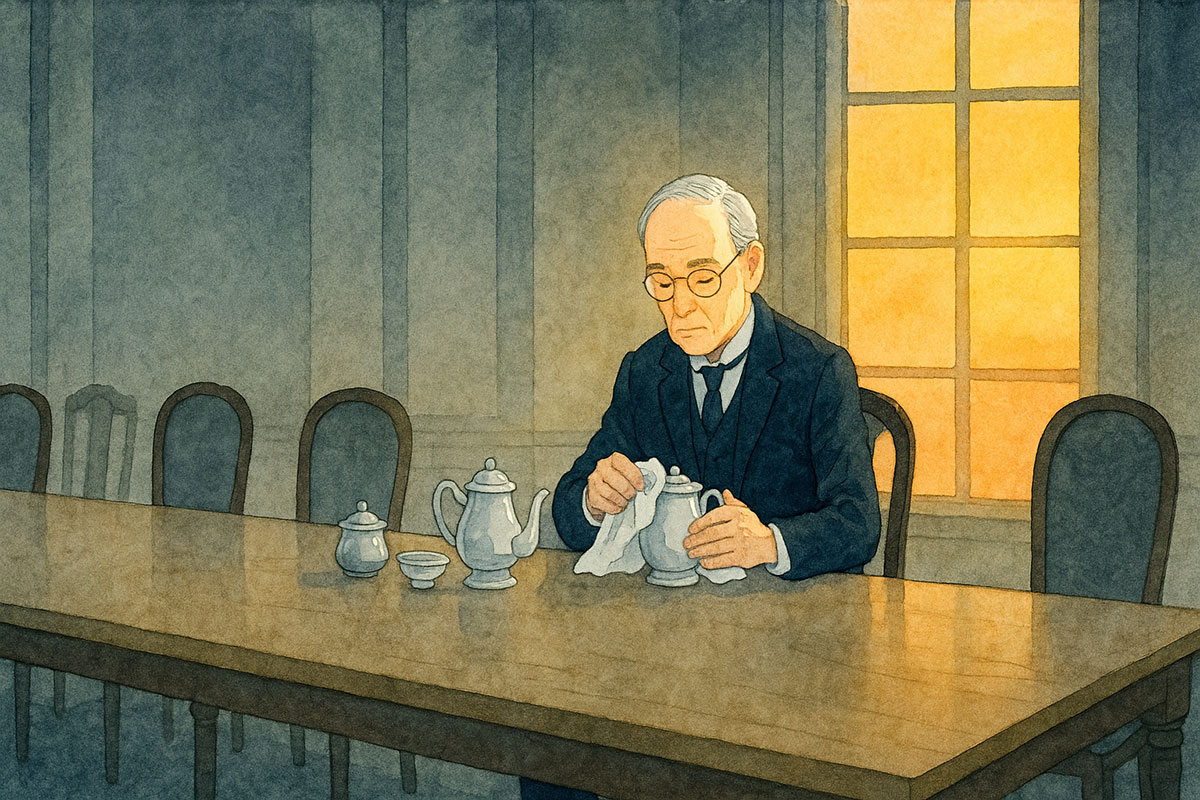
Theatre has a way of making silence visible. A pause, a hand hovering over a glass, a table fragment glowing under a single light — these things can express what cannot be spoken. In this adaptation, silence becomes its own kind of language. And in that silence, I invite you to listen, not just to Stevens, but to the lives that brushed against his and remained unanswered.
(Note: This is an imaginary conversation, a creative exploration of an idea, and not a real speech or event)

Act I, Scene 1 — Ritual of Service

Setting (brief, minimal):
A single long table gleams under cold light. Silver and glass catch every reflection. Stevens polishes quietly at one end. The space feels vast, empty.
Miss Kenton (entering softly): Mr. Stevens.
Stevens (without looking up): Miss Kenton.
(Pause. He continues polishing a spoon with mechanical care. She stands, watching. Silence lingers.)
Miss Kenton: You’ve been at that same spoon for quite some time.
Stevens (clipped, precise): Perfection requires patience.
Miss Kenton (half-smiling): Perfection also requires knowing when to stop.
Stevens: I assure you, Miss Kenton, one cannot be too diligent in matters of duty.
(She crosses to the table, straightens a vase slightly. He looks up sharply.)
Stevens: That vase was already placed correctly.
Miss Kenton (calm): It was leaning.
Stevens: It was aligned.
Miss Kenton: Sometimes alignment and balance aren’t the same thing.
(Silence. She picks up a polished spoon, inspects it.)
Miss Kenton (teasing): I can see myself in it. You’ve outdone yourself, Mr. Stevens.
Stevens (flat): Reflection is the purpose.
Miss Kenton (gently): Not always. Sometimes the purpose is company.
(He doesn’t respond. She studies him, her expression softening.)
Miss Kenton: Tell me, do you never tire of this endless polishing?
Stevens: Tire? No. A servant of true dignity does not consider fatigue.
Miss Kenton (with a sigh): Dignity, always dignity. You speak of it as though it were oxygen.
Stevens (firm): Dignity is the essence of our profession. Without it, we are nothing more than carriers of trays.
Miss Kenton (gently, almost wistful): And with too much of it, perhaps we are nothing at all.
(Long silence. Stevens freezes for a moment, then resumes polishing. A distant echo of laughter and men’s voices is heard, faint, as if from another room. Both glance briefly toward the sound, then look back at each other.)
Miss Kenton (lowering her voice): They laugh so easily in there.
Stevens (quietly, controlled): It is not our place to laugh.
Miss Kenton: No, of course not. Our place is to be invisible.
(She leans closer across the table, voice softer, more personal.)
Miss Kenton: Tell me, Mr. Stevens, are you always invisible? Even when no one is watching?
(He looks up at her sharply, as though she’s crossed a boundary. He says nothing. She waits, then lets out a small laugh, not unkind.)
Miss Kenton: Forgive me. I’ve said too much.
Stevens (measured): Indeed.
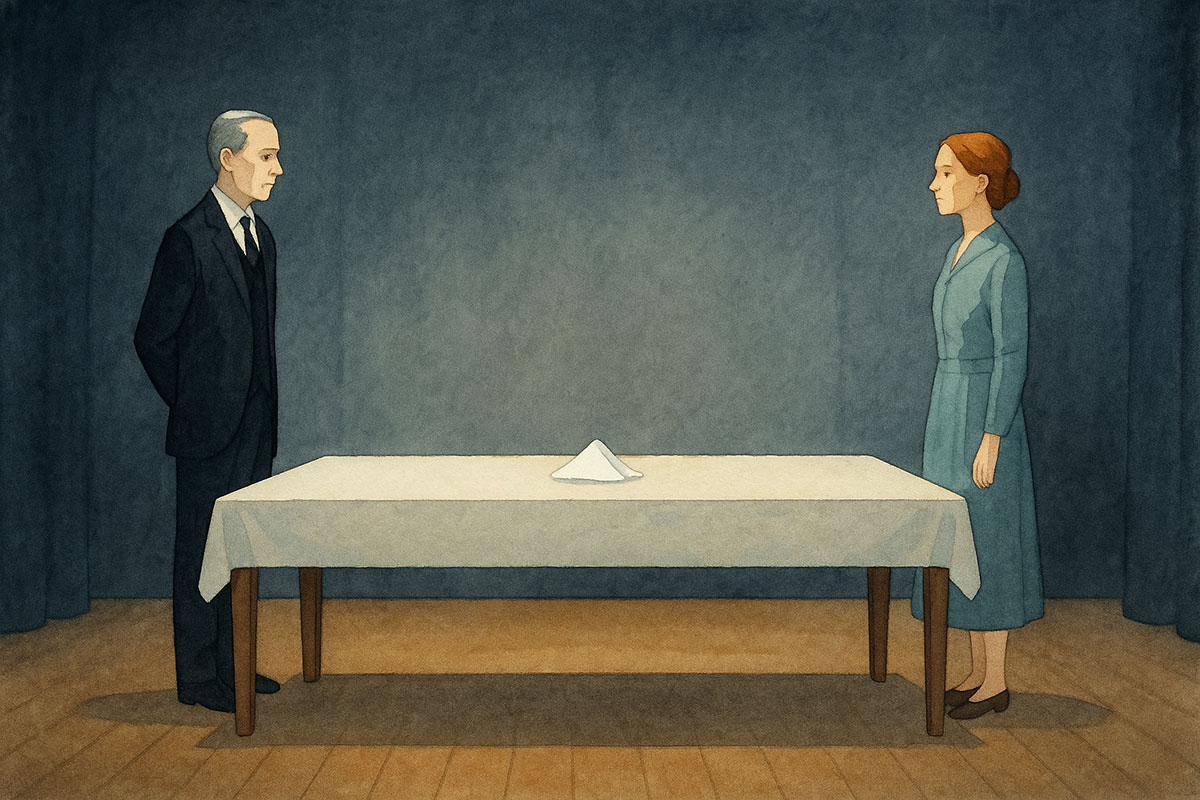
(She folds a napkin carefully, lays it on the table before him, aligning it with precision. He stares at it, silent. She withdraws her hand slowly.)
Miss Kenton (softly): Then let this one be perfect.
(Another long silence. She picks up her tray, begins to exit. At the door, she stops, glances back at him. He does not look up, only continues polishing. She leaves. The faint sound of glasses clinking and voices toasting fills the silence. Stevens sets down the spoon, stares at the napkin she left, then resumes polishing another piece of silver.)
Blackout.
Act I, Scene 2 — Miss Kenton Enters
Setting (brief):
The same long dining table dominates the space. Polished silver gleams under cold light. A vase of flowers sits slightly crooked at the far end.
Miss Kenton (entering briskly, carrying napkins): Mr. Stevens.
Stevens (polishing, without looking up): Miss Kenton.
Miss Kenton (crossing toward the far end, noticing the vase): This vase has been left crooked.
Stevens (sharply, glancing up): It was placed correctly.
Miss Kenton (straightening it slightly): It was leaning.
Stevens (defensive): It was aligned.
Miss Kenton (half-smile): Aligned and balanced are not always the same thing.
(Pause. She arranges the napkins carefully, but her movements have an ease he lacks. He watches briefly, then resumes his polishing.)
Stevens: Your attention to such details is commendable, Miss Kenton.
Miss Kenton: And yours, Mr. Stevens, borders on obsession.
Stevens (clipped): Diligence is never obsession.
Miss Kenton: Tell me, do you ever allow yourself a moment where the world is not perfectly aligned?
Stevens (flat): A professional does not indulge in such moments.
Miss Kenton: Professional. Always professional. Do you never wish to be simply—yourself?
Stevens (after a beat, cold): Myself is a butler.
(Silence. She sets a folded napkin at his end of the table, aligning it with care. Their hands almost brush, but he withdraws. She notices.)
Miss Kenton (gentle): And if I wished to speak to you not as a butler, but as a man?
Stevens (stiff): That would be most improper.
Miss Kenton (sighs, almost laughing): Improper. Yes, I should have expected that answer.
(The sound of men’s voices and laughter filters faintly from offstage. Both pause, listening. She shakes her head slightly, then returns her gaze to Stevens.)
Miss Kenton: They seem to laugh easily, don’t they?
Stevens: It is not our place to laugh.
Miss Kenton: No. Our place is to keep the glasses shining.
(She reaches for a glass, polishes it briskly, sets it down with a flourish.)
Miss Kenton (playful): There. Perfect.
Stevens (after inspecting): Acceptable.
Miss Kenton (teasing): Acceptable? I believe it shines brighter than yours.
Stevens (firm): I do not compete with my staff, Miss Kenton.
Miss Kenton (leaning closer, lowering voice): Perhaps you should, just once. You might enjoy the game.
(He turns to her finally, their eyes meet. The silence is heavy, charged. He looks away first.)
Stevens: It is not a game. It is duty.
Miss Kenton (soft, with disappointment): And duty is all you allow yourself.
(She gathers the remaining napkins, folds one more slowly, places it precisely before him.)
Miss Kenton: Then at least let this one be perfect.
(She pushes it toward him. He stares at it, unmoving. She watches him, waiting for a flicker of response. None comes. She exhales, gathers her tray, and turns toward the exit.)
Miss Kenton (at the door, gently): Good evening, Mr. Stevens.
Stevens (quiet, formal): Good evening, Miss Kenton.
(She exits. The voices of men and clinking glasses swell briefly, mocking the silence. Stevens picks up the napkin she left, adjusts its corner a fraction, then sets it down again. He resumes polishing with rigid calm.)
Blackout.
Act I, Scene 3 — Shadows of Power

Setting (brief):
The long table remains, partially set with glasses and decanters. No guests are visible, but their voices and laughter drift faintly from offstage. A faint projection of silhouettes—men raising glasses—appears against the back wall.
(Stevens is aligning glasses with meticulous care. Miss Kenton enters carrying a tray of decanters. She sets it down at the far end. For a while, only the voices of men are heard in the background: indistinct, polite, echoing.)
Miss Kenton (softly, with hesitation): Mr. Stevens.
Stevens (without looking up): Miss Kenton.
Miss Kenton (pausing, listening to the voices): They’ve been speaking for hours.
Stevens (flat): The gentlemen are engaged in important matters.
Miss Kenton: Yes… but do you hear them? What they’re saying?
Stevens (clipped): It is not my duty to hear, only to serve.
Miss Kenton (shaking her head): They speak of Germany. Of sympathy, of dignity. Does it not trouble you?
Stevens (measured, firm): Our place is not to trouble ourselves with political matters. It is to ensure that when the gentlemen raise a glass, it shines.
Miss Kenton (with quiet disbelief): A glass shining while the world darkens. That is enough for you?
Stevens: That is dignity.
(Pause. The voices grow louder—phrases emerge from the din: “The Treaty… too harsh…” “Sympathies must be shown…” “Fairness to Germany…” Miss Kenton listens, troubled. Stevens remains impassive.)
Miss Kenton (lowering her voice, almost to herself): Fairness to Germany. While others speak of danger.
Stevens (calm, unyielding): Lord Darlington is a gentleman. He seeks what is just.
Miss Kenton (looking at him intently): And you trust him without question?
Stevens (simply): I serve him without question.
(Long silence. Miss Kenton studies him. He continues aligning the glasses, precise to the millimeter.)
Miss Kenton (gently, but firm): Sometimes, Mr. Stevens, I think you hide behind that word—duty.
Stevens (defensive, clipped): It is not hiding. It is the foundation of this house.
Miss Kenton (quietly): And what of truth? What of conscience?
Stevens (pausing briefly, then steady): Conscience lies in perfect service.
(Another silence. She walks to the end of the table, straightens a decanter deliberately off-center. He notices instantly, moves to correct it. Their hands nearly touch. She withdraws first, watching him restore the alignment.)
Miss Kenton (soft, with bite): Even the glass must not speak out of line.
Stevens (firm, without irony): Correct. Order is dignity.
(A sudden swell of voices: “To Lord Darlington!” Glasses clink loudly, the toast echoing. The silhouettes on the wall raise their glasses in projection. Miss Kenton flinches slightly at the sound. Stevens straightens, proud, hands at his sides.)
Miss Kenton (after a long pause, her voice faint): They toast him as if he were a savior.
Stevens (with quiet pride): He is a man of principle.
Miss Kenton (whispered, almost breaking): Or a man who cannot see the danger in front of him.
(He turns sharply to her. Their eyes meet for the first time in the scene. His gaze is steady, hers filled with unease. The voices of the men fade slowly, leaving silence.)
Stevens (calm, final): Miss Kenton, it is not our place to judge the gentlemen.
Miss Kenton (holding his gaze, quiet but firm): Then who will?
(The silence after this hangs heavy. Stevens turns back to his polishing, unshaken. Miss Kenton lingers in the half-light, her disappointment clear, then turns away. The faint projection of raised glasses fades. Only the two of them remain, divided by the gleaming table.)
Blackout.
Act II, Scene 1 — The Road Trip Begins

Setting (minimal):
The long dining table has been broken into scattered fragments. They form a jagged path across the stage, like a country road. At center sits a single wooden chair facing diagonally — Stevens’ “car.” Projections of blurred countryside drift faintly across the back wall, dreamlike.
(Stevens enters slowly, adjusting his gloves, and sits in the chair. He places his hands neatly on an invisible steering wheel. The hum of an engine is faint in the background.)
Stevens (to himself, calm, measured): Mr. Farraday insisted. “Take the car, Stevens,” he said. “See the country. A little holiday will do you good.”
(pause)
A holiday… from duty.
(He allows himself a faint smile, then quickly smooths it away.)
Stevens (continuing): Of course, one must remain dignified even on the road. A gentleman’s butler does not simply… idle.
(A pause. The countryside projection flickers, blending briefly with an image of the dining hall. He blinks, unsettled, then shakes his head. A servant’s voice from memory drifts faintly: “The glasses must be polished before the dinner, Mr. Stevens…”)
Stevens (sharply, as if correcting the memory): Yes. Yes, they were. Every glass. Every chair. Nothing out of place.
(Silence. He adjusts his cuffs, settles back in the chair.)
(Suddenly, Miss Kenton’s voice echoes from memory, gentle and teasing, as though from the back seat.)
Miss Kenton (voice, remembered): Do you never tire, Mr. Stevens? Do you never sit without duty?
Stevens (straightening, firm): I tire, Miss Kenton, but I do not let it show. That is dignity.
Miss Kenton (voice, softer now): And if no one were watching?
(He glances toward the empty passenger seat beside him. Silence. He swallows, then speaks.)
Stevens (measured, to the empty chair): Even then. Especially then.
(The countryside projection brightens briefly — rolling hills, hedgerows. The hum of the engine steadies. For a moment, peace seems possible. Then the projection flickers again: blurred silhouettes of men in suits around a table, raising glasses. The toast: “To Lord Darlington!” echoes faintly.)
Stevens (tensing): Lord Darlington was a man of honor. History will… remember him kindly.
(A pause. The toast echoes again, louder. Stevens grips the wheel tightly, jaw clenched. He tries to ignore it.)
(Miss Kenton’s voice returns, overlapping faintly with the echoes of the toast.)
Miss Kenton (voice, firm): You trust him too much. You serve him too blindly.
Stevens (raising his voice slightly, to silence her): I serve with discretion. That is my duty.
Miss Kenton (voice, almost sorrowful): And what of your heart, Mr. Stevens? Where does that serve?
(He shuts his eyes, silence stretching. When he opens them, the projection has returned to countryside again — but fragmented, blurred, as though memory and present are inseparable.)
Stevens (quieter now, almost confessing): Perhaps… this journey will allow reflection.
(pause)
Perhaps… it is not too late to ask…
(He stops himself abruptly, straightens in the chair. His face regains composure. The hum of the engine fades slowly. He adjusts his gloves once more, his voice returning to formality.)
Stevens (measured, final): The important thing is to remain dignified. A butler must never be carried away by sentiment.
(Silence. The countryside projection dims, leaving him alone in half-light, seated upright, hands fixed on the wheel.)
Blackout.
Act II, Scene 2 — Memories with Miss Kenton

Setting (minimal):
Downstage: a small table with two cups of tea — the staff room.
Upstage: Older Stevens stands apart in a dim pool of light, observing.
The sound of a clock ticking faintly underlines the scene.
(Younger Stevens sits at the table, polishing his gloves even while seated. Miss Kenton enters with a tray, sets down a cup, and sits opposite him. Older Stevens watches in silence.)
Miss Kenton (light, teasing): Mr. Stevens, do you never allow yourself to sit without duty?
Younger Stevens (calm, clipped): Duty does not cease when one sits, Miss Kenton.
Miss Kenton (smiling faintly): Of course. I should have known you’d say that.
Younger Stevens: A professional must be ready at all times.
Miss Kenton (leaning forward): Ready for what? To polish another spoon? To align another vase?
Younger Stevens (measured): To serve with dignity.
Miss Kenton (gaze softening, voice lower): And what of conversation? What of… companionship?
Younger Stevens (unmoved): Companionship is secondary to responsibility.
(Silence. She stirs her tea, watching him. He avoids her eyes. Older Stevens takes a step forward, watching intently. The ticking clock grows louder.)
Miss Kenton (after a pause): You are a difficult man, Mr. Stevens. Difficult, because you refuse to see what is plainly before you.
Younger Stevens: What is before me is my duty.
Miss Kenton (frustrated but soft): And nothing more?
(Silence again. She looks at him with quiet hope. He sips his tea without answering. The moment dies. Older Stevens closes his eyes briefly, as if in pain.)
(The scene begins to replay. Miss Kenton’s same line returns, but now Older Stevens speaks, overlapping his younger self.)
Miss Kenton (again): Mr. Stevens, do you never allow yourself to sit without duty?
Older Stevens (softly, breaking): I wanted to say… yes. That sometimes I did. That sometimes I wished for company, for your company.
Younger Stevens (simultaneously, calm): Duty does not cease when one sits, Miss Kenton.
(The contrast is stark. Miss Kenton lowers her gaze, disappointment clear. Older Stevens whispers as if trying to rewrite the past.)
Older Stevens: I wanted to say I admired you. That I looked for you when you left a room. That the house was… brighter when you were in it.
(Younger Stevens remains silent, polishing his gloves. Miss Kenton’s face hardens slightly, resignation creeping in.)
Miss Kenton (quietly, almost pleading): Tell me, Mr. Stevens… do you never long for something more?
Younger Stevens (after a pause, firm): Longing clouds judgment.
Older Stevens (overlapping, aching): Yes. I longed. I still long.
(But his words echo unheard. Younger Stevens finishes his tea, places the cup down neatly. Miss Kenton looks at him one last time, then rises. She gathers her tray, hesitates, then leaves slowly. The door closes softly behind her.)
(Older Stevens takes a step toward the empty chair she left. He reaches out, his hand trembling as if to touch the cup still warm from her hand. He stops short, clenching his fist, withdrawing. The clock ticks louder, then fades.)
Older Stevens (whisper, almost broken): I said nothing. I did nothing. And now… only silence remains.
(He bows his head. The staff room table fades into darkness, leaving only Older Stevens in dim light. His face is projected above, close-up — dignified, but filled with regret.)
Blackout.
Act II, Scene 3 — Lord Darlington’s Shadow

Setting (minimal):
The dining table fragments have been rearranged into a long diagonal across the stage, like a conference table. Several empty chairs sit around it. No actors play the guests — only disembodied voices. Projections of blurred silhouettes (men raising glasses) flicker faintly on the back wall.
(Younger Stevens moves along the table, aligning glasses, placing decanters. His movements are precise, almost ceremonial. Miss Kenton enters with a tray. Voices of aristocratic men echo faintly: polite, overlapping, indistinct.)
Voice 1 (offstage, polite): “The Treaty was too harsh. Germany must not be humiliated.”
Voice 2 (echoing faintly): “We must show sympathy. They are reasonable men.”
(Miss Kenton pauses, listening. She sets the tray down, frowning.)
Miss Kenton (softly): Do you hear them, Mr. Stevens?
Younger Stevens (without looking up): I hear the gentlemen, yes.
Miss Kenton: Do you hear what they’re saying?
Younger Stevens (firm, clipped): It is not my duty to interpret their words.
Miss Kenton (measured): They speak of sympathy. Of appeasement. Does that not concern you?
Younger Stevens (calm): The gentlemen deliberate. Our concern is to serve with discretion.
Miss Kenton (quietly, pressing): And if their deliberations invite disaster?
Younger Stevens (steady): Then it is not our place to decide.
(Long silence. The voices swell faintly — fragments louder now.)
Voice 3 (booming, confident): “The future of Europe rests on fairness. England must extend her hand.”
(Miss Kenton turns to Stevens, urgent.)
Miss Kenton: Mr. Stevens, do you not see the danger in these words?
Younger Stevens (pauses, then firmly): I see glasses that require polishing. That is my duty.
(She stares at him, frustrated. He continues with his task, impassive. The voices dim briefly, leaving the silence thick between them.)
Miss Kenton (lower, almost pleading): You cannot spend your life aligning glasses while the world collapses outside.
Younger Stevens (measured, unflinching): I can, Miss Kenton. Because that is what dignity requires.
Miss Kenton (with quiet anger): Dignity, yes. But what of conscience? What of truth?
Younger Stevens: Conscience lies in perfect service. Truth lies in loyalty.
(She steps closer, lowering her voice.)
Miss Kenton: And if loyalty serves a lie?
(He finally looks up at her. Their eyes meet. The silence stretches, heavy. Then he turns away, correcting a misaligned glass.)
Younger Stevens (firm, final): A butler does not question the master.
(A sudden swell of voices — louder, almost celebratory.)
Voice 1: “To Lord Darlington!”
Voices (in unison): “To Lord Darlington!”
(The sound of clinking glasses echoes unnervingly. The silhouettes on the wall raise their hands in a toast. Miss Kenton flinches. Stevens straightens, proud, hands clasped behind his back, posture immaculate.)
Miss Kenton (soft, bitter): They toast him as if he were a savior.
Younger Stevens (quiet pride): He is a man of principle.
Miss Kenton (voice breaking slightly): Or a man blind to what stands before him.
(Their eyes meet again. She is searching, desperate for him to waver. He remains stone.)
Miss Kenton (whisper, final): And you are blind with him.
(The toast echoes one last time, then fades. Miss Kenton gathers her tray and exits slowly, her footsteps heavy. Stevens remains, perfectly still, his gaze fixed forward. The silhouettes dissolve. Only the gleaming glasses remain.)
Blackout.
Act II, Scene 4 — Letters from Miss Kenton
Setting (minimal):
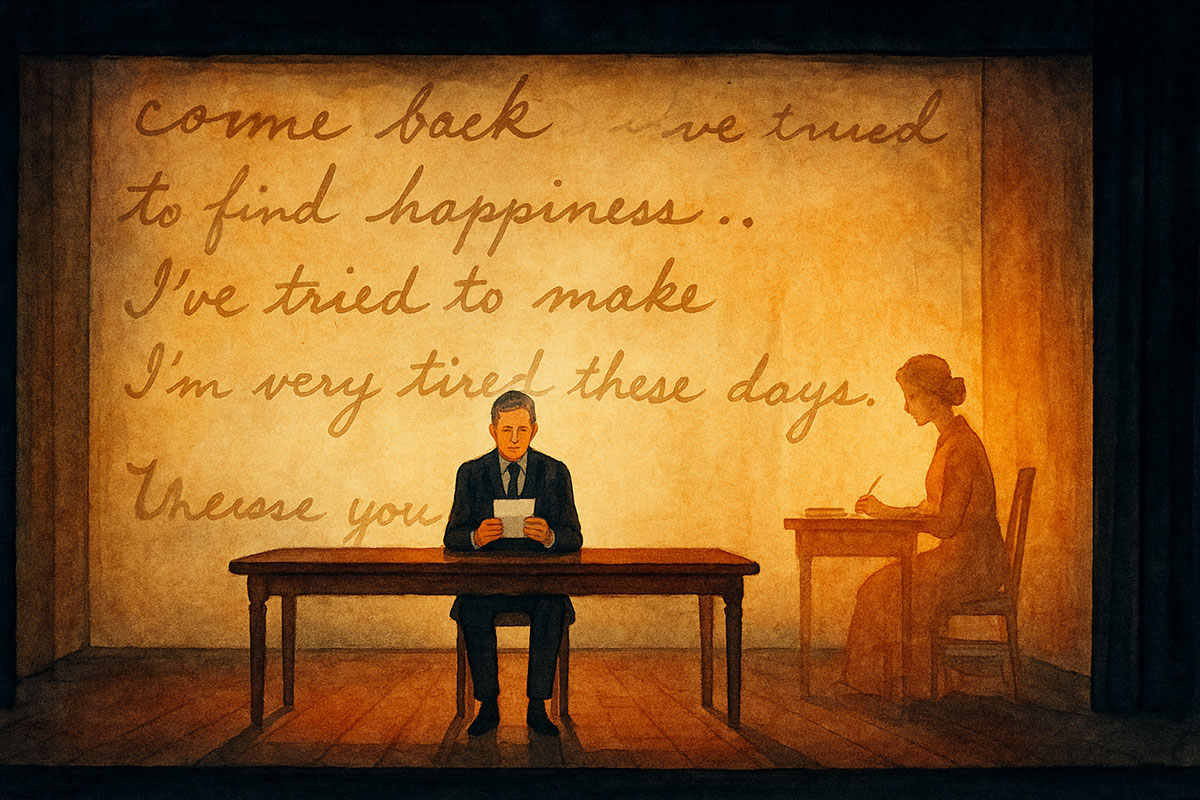
At center: Stevens sits at a small table in his “car” chair, holding an unfolded letter.
Stage left: a second table with a warm lamp — Miss Kenton’s absent presence.
On the back wall: projections of handwriting — looping script fading in and out.
(Stevens unfolds the letter with careful precision. His hands tremble slightly, though his face remains composed. He begins to read silently. A woman’s voice — Miss Kenton’s — enters as voiceover, warm but restrained.)
Miss Kenton (voiceover):
“Dear Mr. Stevens,
I find myself often thinking of Darlington Hall, and of the days we spent in its service. Demanding days, yes, but filled with purpose. At times, late in the evening, I wonder what path life might have taken had I chosen differently.”
(Stevens exhales softly, folding the corner of the page neatly. He speaks as though responding aloud, though only to himself.)
Stevens (measured, distant):
Miss Kenton writes with clarity. She seems… content. It would be improper to read more into her words.
Miss Kenton (voiceover, firmer):
“There are evenings when I imagine another kind of companionship. A life of conversation, of laughter, not bound by duty. But such thoughts are shadows, Mr. Stevens, and best left as they are.”
(He stiffens. His hand tightens around the letter. After a pause, he speaks again, quietly but controlled.)
Stevens:
Shadows are not substance. She has made her life. I… have mine.
(Stage left: Miss Kenton appears briefly in soft light, seated at the second table. She writes with a fountain pen, her face calm but wistful. Her voice continues, not reading now, but as though thinking aloud.)
Miss Kenton (softly):
Do you ever think of it, Mr. Stevens? Of what was unsaid?
Stevens (turning slightly, as if he almost hears her):
I do not permit myself such indulgence.
Miss Kenton (pen pausing, whisper):
But I permitted myself. I thought of you.
(Older Stevens closes his eyes for a moment, steadying himself. He lowers the letter, then addresses the empty space as if she were across from him.)
Stevens (aching, restrained):
I wanted to say… that your presence lightened every corridor of the house. That I searched for you without realizing. That I… cared.
(But the voiceover returns, drowning him out.)
Miss Kenton (voiceover, final):
“I wish you well, Mr. Stevens. Truly. Whatever paths we did not take, I remain grateful for the ones we did.”
(Silence. He folds the letter carefully, aligning the edges. His face is calm, dignified — but the camera projection above shows a flicker of moisture in his eyes. He does not wipe it away.)
(Younger Stevens suddenly appears downstage, sitting at the staff table with Miss Kenton in memory. She looks at him expectantly. He stirs his tea, silent. She waits, then lowers her gaze, disappointed. The tableau freezes.)
Older Stevens (whisper, breaking):
I should have spoken. I should have reached across the table.
(He steps toward the frozen tableau, but stops short. His hand hovers, trembling, then falls. The image fades into darkness. He remains alone, holding the folded letter.)
Stevens (final, quiet):
Miss Kenton is content. She is Mrs. Benn now.
That must… be enough.
(He replaces the letter in his breast pocket, adjusts his jacket, and sits perfectly upright once more. The light on Miss Kenton’s writing desk fades. Only Stevens remains, dignified, alone.)
Blackout.
Act III, Scene 1 — The Meeting with Miss Kenton

Setting (minimal):
The stage is nearly bare. A few broken table fragments remain far apart, leaving a gulf of emptiness.
Stevens enters stage left, hat and gloves in hand. Miss Kenton (now Mrs. Benn) enters stage right, holding a handbag lightly. They meet at center but keep a respectful distance.
Stevens (bowing slightly, steady): Mrs. Benn.
Miss Kenton (gentle, warm but tired): Mr. Stevens. It has been… many years.
(Silence. They study each other. Both search for traces of their former selves.)
Stevens: You seem well.
Miss Kenton (faint smile): I am well. My husband is kind. We have a quiet life.
Stevens (measured): I am pleased to hear it. Truly.
(Pause. She watches him, waiting for more. He says nothing. She sighs, soft.)
Miss Kenton: Do you still walk the halls of Darlington? Polishing, aligning?
Stevens (with quiet pride): Darlington Hall remains a house of dignity. Yes.
Miss Kenton (sad smile): Dignity. Always dignity.
(Another silence. She clasps her handbag tighter.)
Miss Kenton (tentative, voice trembling): There was a time… when I thought perhaps… we might have had a life together.
(Stevens stiffens. He looks at her, lips parting, but no words come. He folds his gloves carefully, buying time.)
Stevens (after a pause, voice even): Your happiness now is what matters.
Miss Kenton (earnest, stepping closer): Happiness is… complicated. There are moments I ask myself what might have been, had I chosen differently.
Stevens (steady, but softer): We all ask ourselves such questions.
Miss Kenton (whispering, almost breaking): But we do not all live with silence in place of an answer.
(They stand close now, yet the gulf between them feels vast. She studies him, desperate for him to falter. He remains composed, though his eyes flicker.)
Stevens (after a long pause): Miss Kenton—
Miss Kenton (interrupting, gently): Mrs. Benn.
(The correction lands heavy. Silence stretches.)
Stevens (bowing his head slightly): Mrs. Benn. Then I shall not speak what is improper.
Miss Kenton (voice trembling): And so you will say nothing. As always.
(She turns slightly away, regaining composure. Then she looks back at him, voice softer, almost tender.)
Miss Kenton: You were the most loyal man I ever knew. But I sometimes wished you had been… a little less loyal. And a little more human.
Stevens (measured, almost whispering): Humanity… clouds judgment.
Miss Kenton (firm, final): Humanity is the only thing that gives judgment meaning.
(Silence. She exhales, then places her hand lightly on the nearest table fragment — a gesture of memory. She withdraws it, steadies herself, and turns to leave.)
Miss Kenton (quiet, with finality): Goodbye, Mr. Stevens.
Stevens (soft, almost breaking): Goodbye… Miss Kenton.
(She stops briefly, glances back, but he does not move. She exits into shadow. He remains frozen. His projected face fills the back wall: calm, dignified, but devastated. After a moment, he lowers his eyes. His gloves slip slightly from his hand, but he does not bend to pick them up.)
Blackout.
Act III, Scene 2 — The Final Realization
Setting (minimal):
The stage is almost empty.
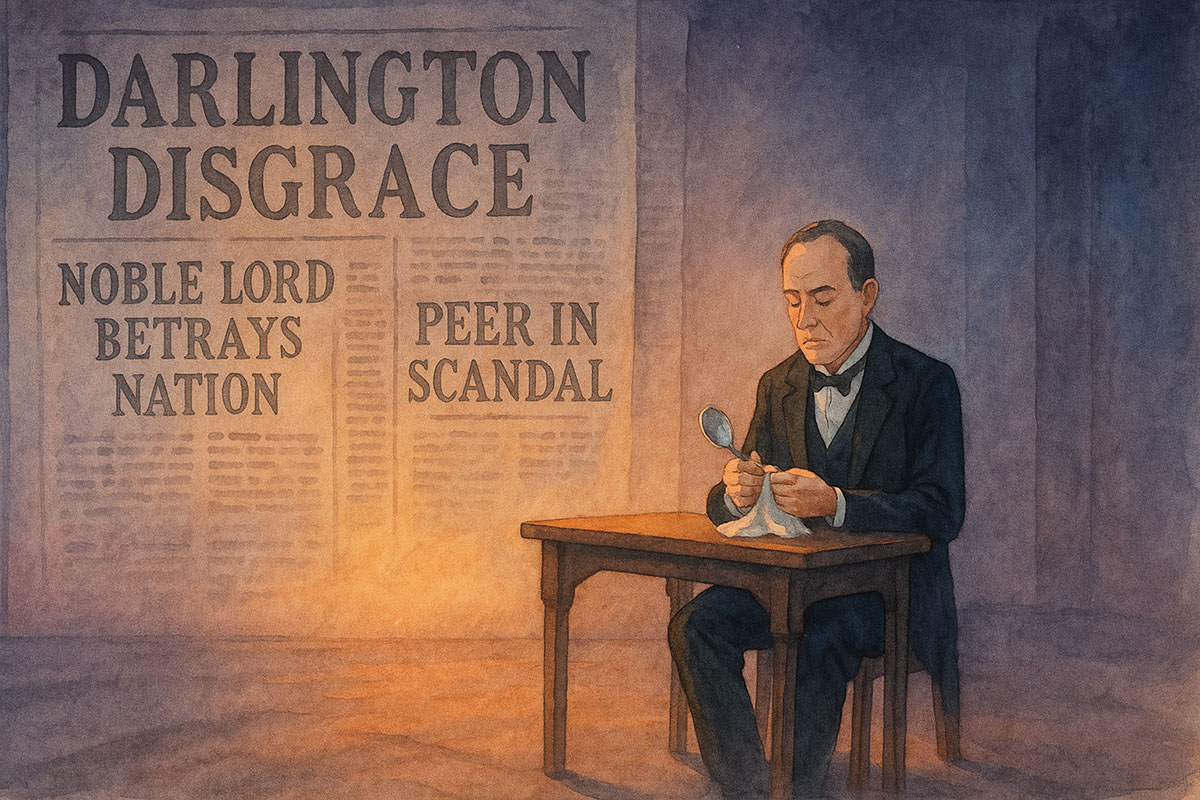
At center: a single table fragment with one silver spoon gleaming under a narrow light.
Stevens enters slowly, hat and gloves in hand.
(He sets the gloves down neatly on the table, sits, and picks up the spoon. He polishes it with ritual precision. His voice begins low, measured, almost as if narrating to himself.)
Stevens (measured): Lord Darlington was a gentleman. He believed in fairness, in dignity. He sought only to give Germany the respect it deserved.
(Pause. He keeps polishing. A projection flickers on the back wall: headlines — “Lord Darlington’s Reputation in Ruin”, “Nazi Sympathizer”. He does not look at them.)
Stevens (firmer, louder): He was misled, yes. Misguided, perhaps. But he was not dishonorable.
(The headlines flicker again, then fade. Silence. He lowers the spoon, stares at it.)
Stevens (softer, voice faltering slightly): And I… I gave my life to his service. I thought it was enough.
(He resumes polishing, slower now. His hand trembles. The spoon gleams under the light.)
Stevens (after a long pause, quieter): I told myself it was dignity. That silence was strength. That loyalty was virtue.
(He sets the spoon down, perfectly aligned, and clasps his hands together. His voice drops to almost a whisper.)
Stevens: But what if silence was cowardice? What if loyalty was blindness?
(Long silence. He stares straight ahead, rigid. Then his voice breaks slightly, the first crack in his composure.)
Stevens (whispering): I should have spoken. Not only to Lord Darlington… but to her.
(A faint echo of Miss Kenton’s voice overlaps, soft, haunting: “There was a time when I thought perhaps… we might have had a life together.” He shuts his eyes, breathing deeply.)
Stevens (strained, almost confessing): I wanted to say yes. Yes, I longed for that life. Yes, I cared. Yes, I… loved.
(But he stops himself. Silence. His body stiffens again, hands folding neatly in his lap.)
Stevens (measured, forcing calm): It is too late now. The day is done.
(Another pause. He lifts the spoon once more, polishes it slowly, almost reverently.)
Stevens (final, whisper): Only remains… remain.
(He sets the spoon back on the table, perfectly aligned. He folds his hands in his lap, upright, composed. His projected face fills the back wall: dignified mask intact, but his eyes glisten with devastation. The light fades until only the spoon gleams. Then darkness.)
Blackout.
Act III, Scene 3 — Curtain Image

Setting (minimal):
The stage is empty except for a single table fragment and the polished silver spoon.
Stevens sits upright beside it, hands folded. A faint dusk glow fades slowly toward darkness.
(He sits in silence for a long moment. Then, almost as if speaking to no one, his voice breaks the stillness.)
Stevens (quiet, steady): The day is done.
(Pause. He lifts the spoon, gazes at it, then sets it back perfectly aligned.)
Stevens (whispering, softer): The remains… are all that remain.
(A faint echo of Miss Kenton’s voice, almost inaudible, drifts: “Do you never long for something more?” He closes his eyes, breath sharp, but does not answer. Silence swallows the echo.)
Stevens (last words, trembling but calm): Dignity… yes. But at what cost?
(He sits motionless. The spoon gleams faintly. His projected face fills the back wall: dignified mask intact, but his eyes shine with devastation. The light contracts until only the spoon glows, then fades into darkness.)
Blackout. Curtain.
Final Thoughts by Miss Kenton / Mrs. Benn
I gave much of my life to Darlington Hall. To duty. To routine. To Stevens. And yet, what lingers most in my memory are not the grand dinners or the polished silver, but the words we never spoke.
He believes silence is strength. Perhaps it was. But I have come to believe that silence is also the heaviest burden to carry. For in every corridor, in every letter, in every quiet moment of my life, there is the echo of what might have been said — and what never was.
So if you leave this theatre carrying anything, let it not be only Stevens’ dignity, but also my question to you: who waits for words you have not yet spoken? A father, a child, a friend, a lover? Do not let your own life become a house of silences. Speak while the day is still before you.
Because in the end, the remains of the day are not polished spoons or perfect napkins — they are the words we dared to speak, and the love we dared to claim.
Short Bios:
Kazuo Ishiguro
Nobel Prize–winning British novelist known for his subtle, emotionally powerful works exploring memory, dignity, and regret. His novels include The Remains of the Day, Never Let Me Go, and Klara and the Sun, each weaving themes of silence, duty, and what it means to be human.
Stevens (Character)
The butler at Darlington Hall, whose life is defined by duty, restraint, and unwavering loyalty. His dignity lies in service, but it costs him love, truth, and freedom. A tragic figure whose silence becomes his greatest regret.
Miss Kenton / Mrs. Benn (Character)
The housekeeper at Darlington Hall, intelligent, warm, and quietly strong. She longs for connection with Stevens but is met with silence. Her letters later reveal both contentment in her chosen life and the lingering ache of what might have been.
Lord Darlington (Character)
An English aristocrat who, with good intentions but poor judgment, becomes entangled with pro-German sympathies in the years leading to World War II. His downfall mirrors the collapse of Stevens’ faith in loyalty without conscience.
Ivo van Hove (Director, suggested)
Acclaimed Belgian theatre director known for his minimalist yet emotionally explosive stagecraft. His adaptations often strip settings down to their essence, using silence, multimedia projections, and psychological intensity to draw out hidden truths.
Leave a Reply