
|
Getting your Trinity Audio player ready...
|
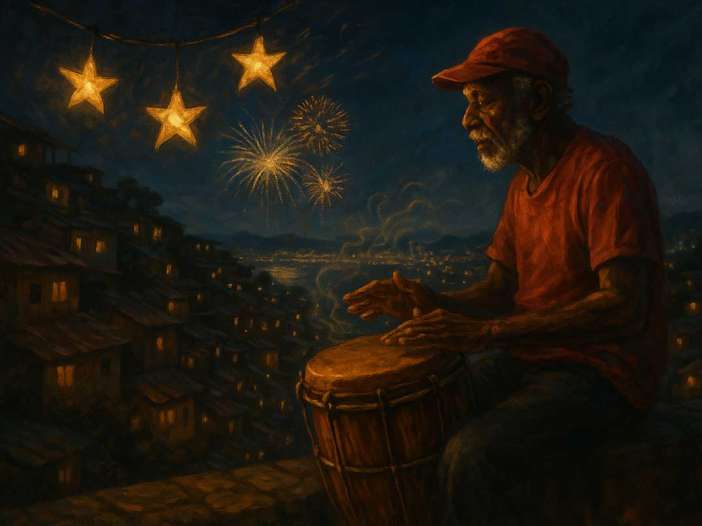
On Christmas Eve, Rio de Janeiro pulsed like a heartbeat — distant fireworks over Copacabana, laughter echoing through alleys, warm night air scented with grilled queijo coalho and the salty breath of the Atlantic. But high above the beaches, far from the glamorous postcards, sat Morro da Providência, one of Rio’s oldest favelas.
Up here, life was louder.
Sharper.
More alive.
Children played soccer barefoot in the alleys, shouting and spinning like shooting stars. Teenagers blasted funk carioca from speakers, and families gathered around tiny TVs showing old Christmas specials. But one sound rose above them all:
The steady beat of a drum.
A deep, warm, ancient rhythm that seemed older than Rio itself.
The drummer was an elderly man with a grey beard, brown skin weathered like soft leather, and eyes that carried oceans. He wore a faded red cap, shorts, and sandals — nothing to distinguish him except the way the air shifted when he played.
No one knew he was Santa in Disguise.
They only called him Tio Batuque — Uncle Drumbeat.
Every year on Christmas Eve, he sat at the top of the favela where the homes met the stars and played rhythms that were part samba, part samba-reggae, part heartbeat of the Earth.
Tonight, three souls would find their way to him.
1. The Dancer Who Lost Her Spark
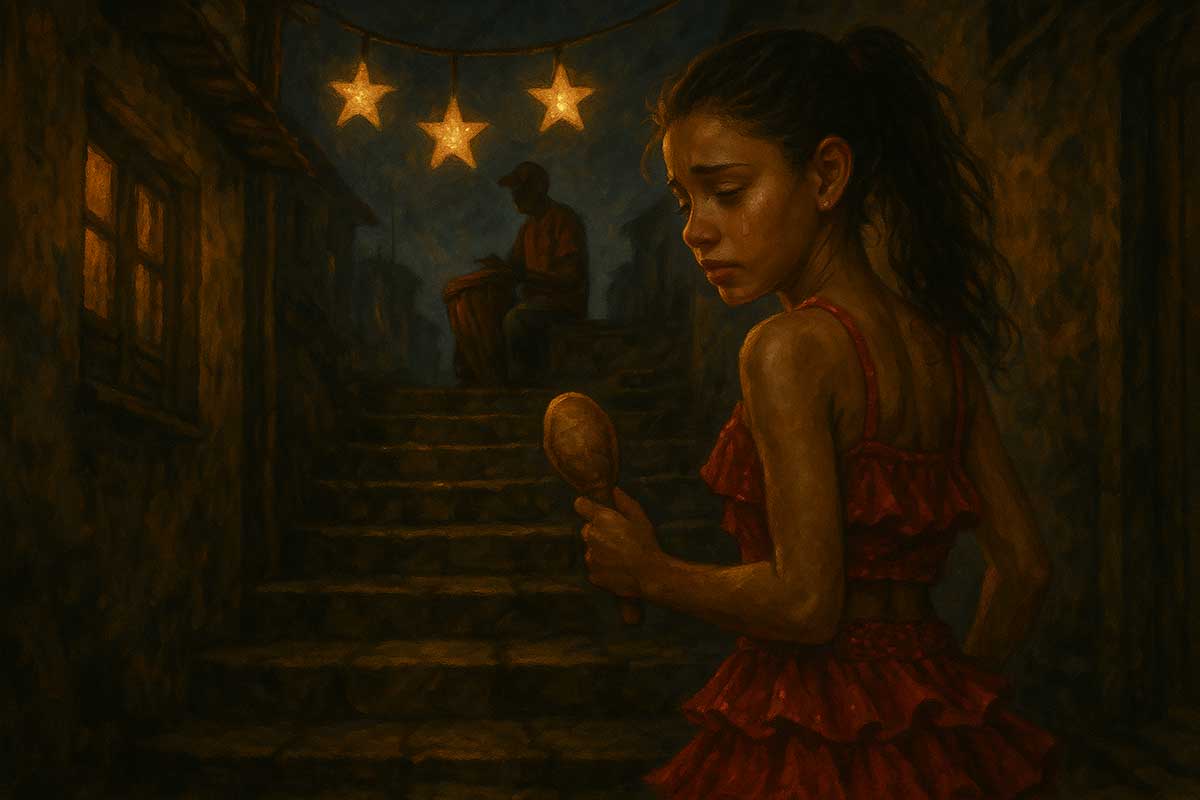
The first visitor was Luana, a 17-year-old samba prodigy who had been chosen to dance in the front row of her escola de samba for Carnival. Everyone said she was born for the spotlight. Her feet moved like water. Her smile lit up the night.
But three weeks ago her father, a beloved mechanic in the favela, fell ill and lost his job. Money tightened. Stress filled the house like smoke.
Luana hadn’t danced since.
She climbed toward the drumbeats, her sandals slapping softly against the concrete steps.
When she reached the top, Tio Batuque didn’t stop playing. He just nodded, as if he’d been waiting.
“You are heavy tonight,” he said.
Luana tried to smile. “It’s nothing.”
He tapped the drum once — a low, knowing thud.
“Nothing doesn’t walk up my hill.”
She sat beside him, hugging her knees. “I can’t dance anymore.”
“You’re hurt?”
“No,” she whispered. “I’m afraid if I dance while things are bad at home… it means I don’t care.”
The drummer smiled gently. “Girl… when the world hurts, that is exactly when you must dance.”
Her eyes filled with tears.
“I feel guilty being happy,” she said.
He struck a slow rhythm — soft, steady, like footsteps in sand.
“Happiness is not betrayal,” he said. “It is medicine.”
He let the rhythm thrum for a moment, letting it settle into her bones.
“You dance,” he said, “so your family remembers joy. You dance so your father remembers strength. When you move, the whole favela breathes easier.”
Luana covered her mouth, tears falling.
“I don’t know if I can still do it.”
He handed her a small wooden shaker — a simple ganza, carved by hand.
“Shake it,” he said.
She did — timid at first, then stronger.
The rhythm joined his, weaving into something alive.
As they played together, something inside her chest loosened — a knot untied by rhythm.
When they finished, he leaned close.
“Tomorrow,” he said, “you dance in your living room. Even if it’s just for ten seconds. Your father will hear it. And he will start healing.”
She nodded, clutching the ganza to her chest.
“Obrigada, Tio.”
“Vai com luz,” he whispered. “Go with light.”
And she descended the hill lighter than she had climbed it.
2. The Tourist Running From Grief
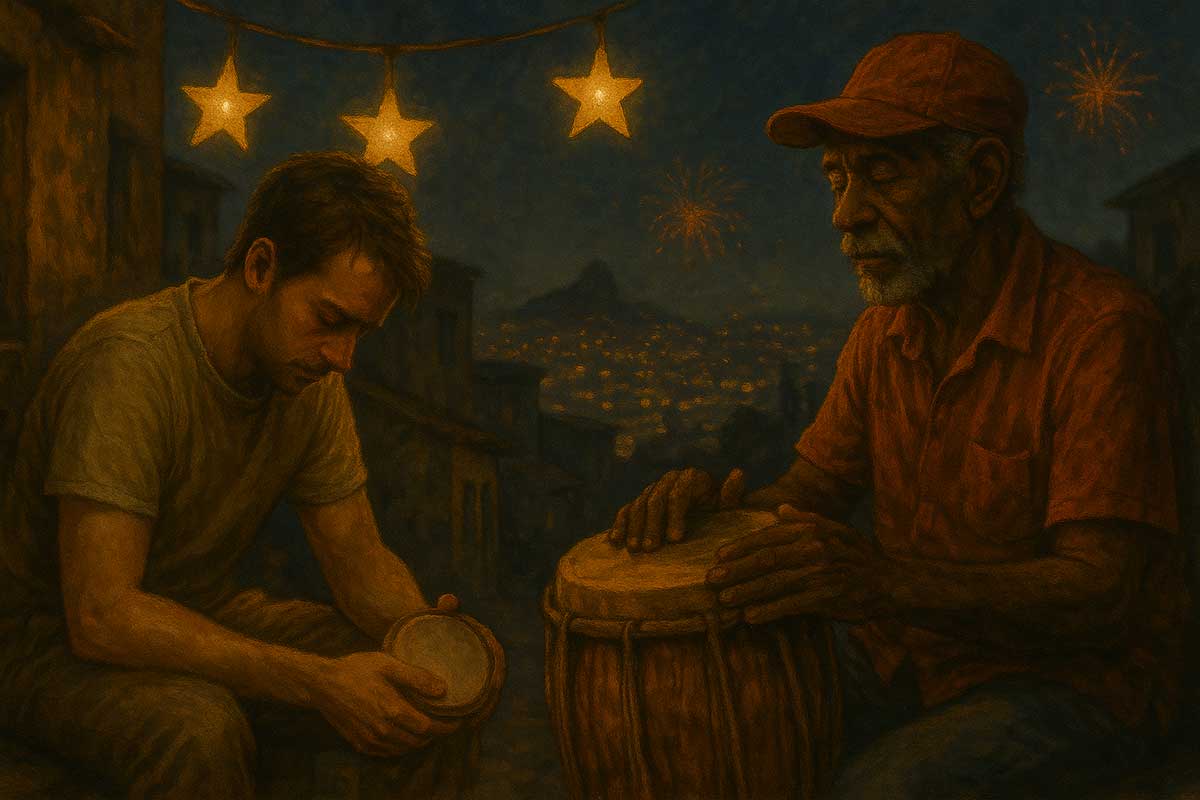
The second visitor was Ethan, a tourist from Canada who had come to Rio alone. Six months earlier, he lost his younger sister in a car accident. During December, grief pressed against him so hard he could barely breathe.
He walked the beaches, the markets, the crowded celebrations — hoping noise might drown his loneliness. It didn’t.
On Christmas Eve, he followed the distant sound of drums up into the favela, not knowing why.
He found Tio Batuque sitting under string lights shaped like stars.
The drummer didn’t turn.
“You’re carrying a ghost,” he said.
Ethan froze. “I— sorry. I should go—”
“No,” the drummer said. “Ghosts climb too. Let us honor yours.”
Ethan sat slowly, unable to speak.
The drummer played a gentle rhythm, like waves brushing the shore.
“Tell me,” he said softly.
“My sister loved music,” Ethan whispered. “We used to play duets. After she died… I can’t touch my guitar. It feels wrong.”
“Wrong to play?” the drummer asked.
Ethan nodded. “Like it dishonors her. Like I’m leaving her behind.”
Tio Batuque played a single heartbeat on the drum — boom.
“Music does not leave people,” he said. “Music carries them.”
Ethan swallowed hard.
The drummer reached behind him and handed Ethan a small hand drum, polished smooth with age.
Ethan shook his head. “I can’t—”
“Play,” the drummer said firmly.
His hands trembled as he touched the drumhead.
“Just one beat,” the drummer whispered.
Ethan struck the drum.
A soft sound. Barely audible.
But something cracked open. His eyes filled.
“It’s the first sound she’s heard from you in months,” the drummer said.
Ethan sobbed.
Through tears, he struck it again.
And again.
And again.
Each beat softer, warmer, fuller.
When he finished, he looked at the drummer helplessly.
“What do I do now?”
“Play one note every day,” the drummer said. “Even if you cry while doing it. Especially if you cry.”
He placed a hand on Ethan’s shoulder.
“Grief is not a goodbye,” he said. “It is a rhythm learning to change.”
Ethan nodded, clutching the drum as if it were life itself.
3. The Street Boy Searching for a Future
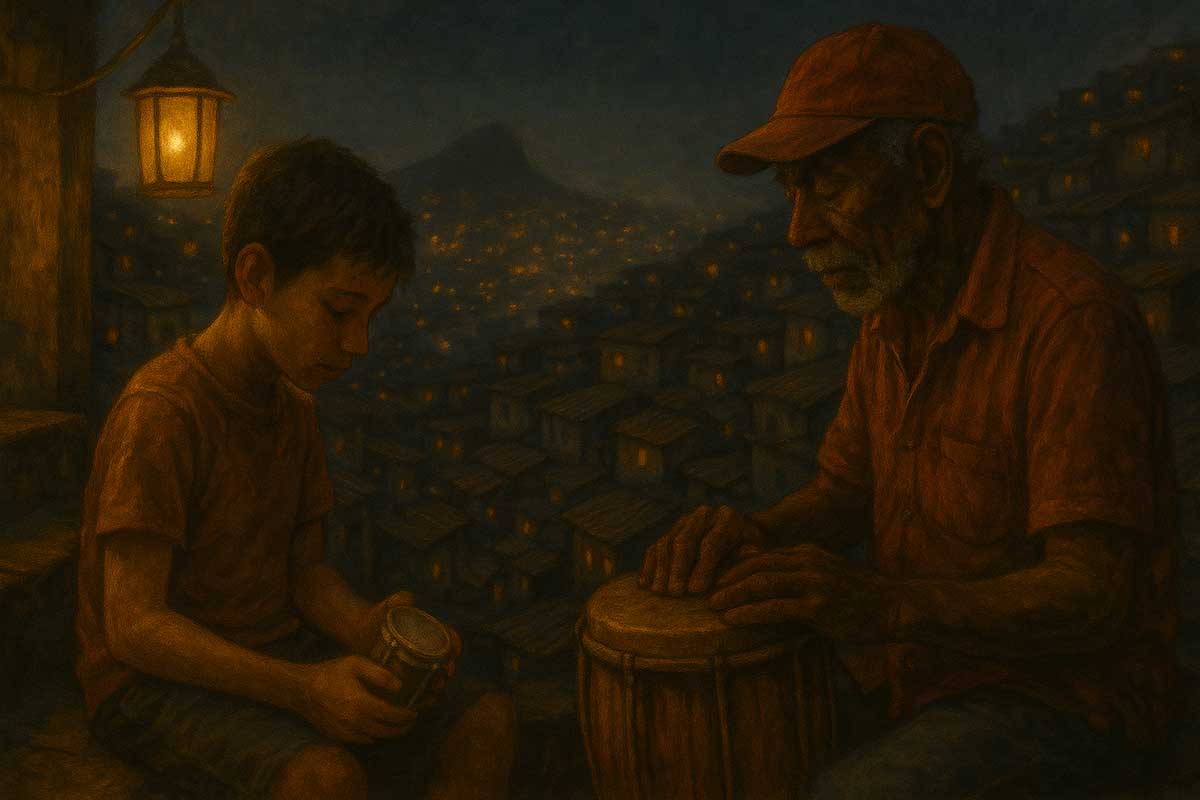
The final visitor was Paulo, a 12-year-old boy who sold water bottles to tourists near Lapa. His mother worked two jobs. His father was gone. He dreamed of becoming a musician but had no money for lessons, no instrument, no idea where to begin.
Tonight he wandered up the hill because he heard the drums.
He stood shyly at a distance.
Tio Batuque beckoned him with a tilt of his chin.
“You, menino — come.”
Paulo approached, eyes wide. “I didn’t want to bother you.”
“You breathe,” the drummer said. “So you are never a bother.”
Paulo sat beside him and whispered, “How do you become someone? Somebody important?”
The drummer looked at him for a long time.
“By choosing your rhythm,” he said. “Not the one forced on you. Not the one that scares you. The one that is already inside.”
Paulo’s eyes shone. “But I have nothing. No money. No classes.”
The drummer smiled and handed him a tiny repiquezinho — a miniature samba drum, worn but lovingly kept.
“This was mine when I was your age,” he said. “Now it’s yours.”
Paulo gasped. “I can’t take this!”
“You can,” the drummer said. “And you will. Because you are going to start practicing every morning. Slow. Soft. But steady.”
Paulo hugged the drum to his chest.
“You do that,” the drummer continued, “and in ten years, you won’t be asking how to become someone. People will be asking how you became you.”
Paulo beamed — a smile so bright it could have lit the entire favela.
“Thank you, Tio,” he whispered.
“Vai, pequeno,” the drummer said. “Start your life.”
Santa’s Departure
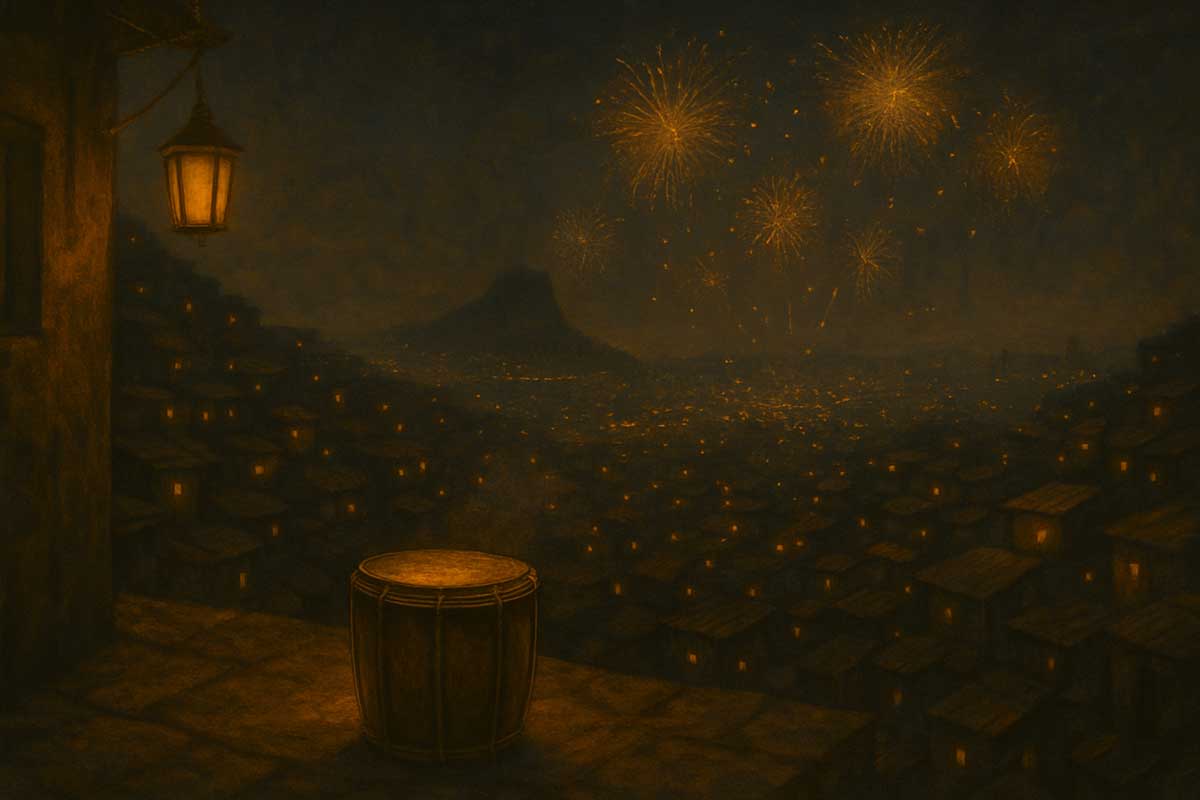
When midnight passed and fireworks lit the bay below, Tio Batuque stood, stretched his back, and smiled at the glowing city.
“You did well tonight, Rio,” he murmured. “Your beats carry farther than mine.”
He placed his drum gently on the ground.
When the next wave of fireworks burst, lighting the hilltop in gold…
…he vanished.
Only the drum remained, still warm.
Only the hill echoed with the faint heartbeat of rhythm.
And somewhere in the favela, music awakened in three different homes —
each one touched by the same quiet miracle.
Short Bios:
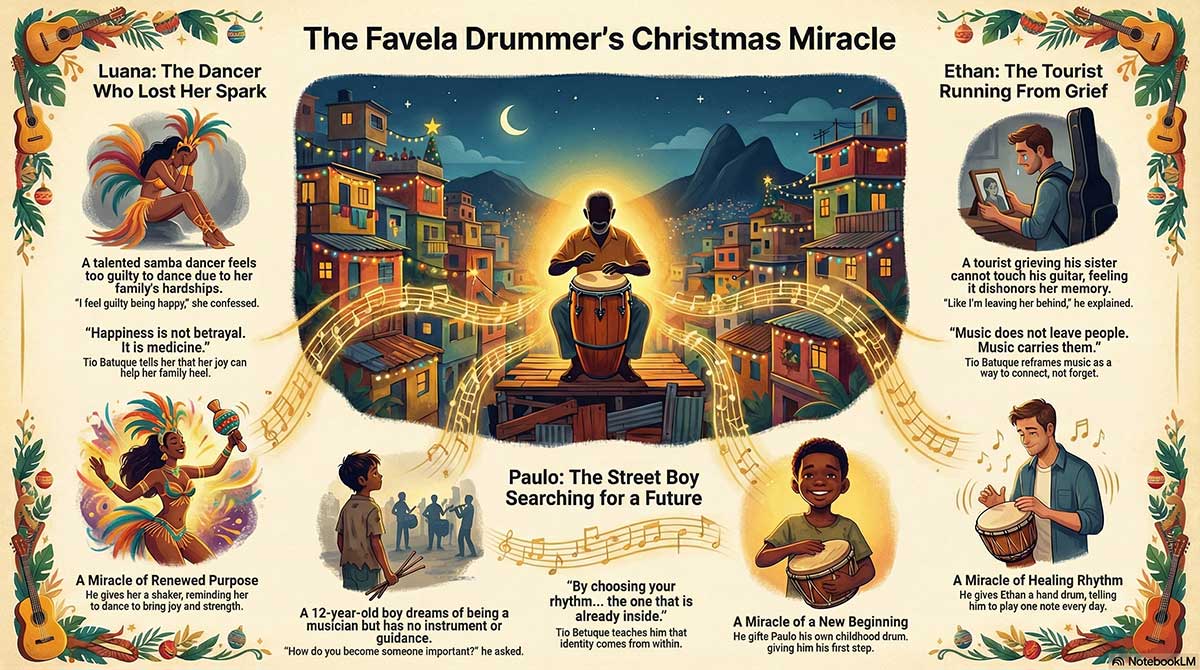
Tio Batuque (The Favela Drummer / Santa in Disguise)
An elderly drummer who sits atop Morro da Providência each Christmas Eve, Tio Batuque carries deep wisdom and a rhythm older than Rio itself. Seen by locals as a gentle uncle figure, he is in truth Santa in Disguise, guiding lost souls through music, presence, and quiet miracles.
Luana – The Dancer Who Lost Her Spark
A 17-year-old samba prodigy chosen for the front row of her escola de samba, Luana’s joy collapses under the weight of family hardship. She climbs the favela hill burdened with guilt for feeling happy, rediscovering her purpose through rhythm and compassion.
Ethan – The Tourist Running From Grief
A visitor from Canada grieving the loss of his younger sister, Ethan wanders Rio searching for distraction but finds only deeper loneliness. Drawn to the drummer’s hilltop, he confronts his grief through music, learning that remembrance is not abandonment.
Paulo – The Street Boy Searching for a Future
A 12-year-old boy selling water bottles near Lapa, Paulo dreams of becoming a musician despite poverty and uncertainty. When Tio Batuque gifts him a small repiquezinho, Paulo receives not just an instrument, but the beginning of a future shaped by his own rhythm.
Leave a Reply