• Skip to main content
  • Skip to primary sidebar
  • Skip to footer
ImaginaryTalks.com
  • Spirituality and Esoterica
    • Afterlife Reflections
    • Ancient Civilizations
    • Angels
    • Astrology
    • Bible
    • Buddhism
    • Christianity
    • DP
    • Esoteric
    • Extraterrestrial
    • Fairies
    • God
    • Karma
    • Meditation
    • Metaphysics
    • Past Life Regression
    • Spirituality
    • The Law of Attraction
  • Personal Growth
    • Best Friend
    • Empathy
    • Forgiveness
    • Gratitude
    • Happiness
    • Healing
    • Health
    • Joy
    • Kindness
    • Love
    • Manifestation
    • Mindfulness
    • Self-Help
    • Sleep
  • Business and Global Issues
    • Business
    • Crypto
    • Digital Marketing
    • Economics
    • Financial
    • Investment
    • Wealth
    • Copywriting
    • Climate Change
    • Security
    • Technology
    • War
    • World Peace
  • Culture, Science, and A.I.
    • A.I.
    • Anime
    • Art
    • History & Philosophy
    • Humor
    • Imagination
    • Innovation
    • Literature
    • Lifestyle and Culture
    • Music
    • Science
    • Sports
    • Travel
You are here: Home / Christmas / Christmas Story in Rio: The Favela Drummer’s Miracle

Christmas Story in Rio: The Favela Drummer’s Miracle

December 7, 2025 by Nick Sasaki Leave a Comment

Christmas-story-Rio

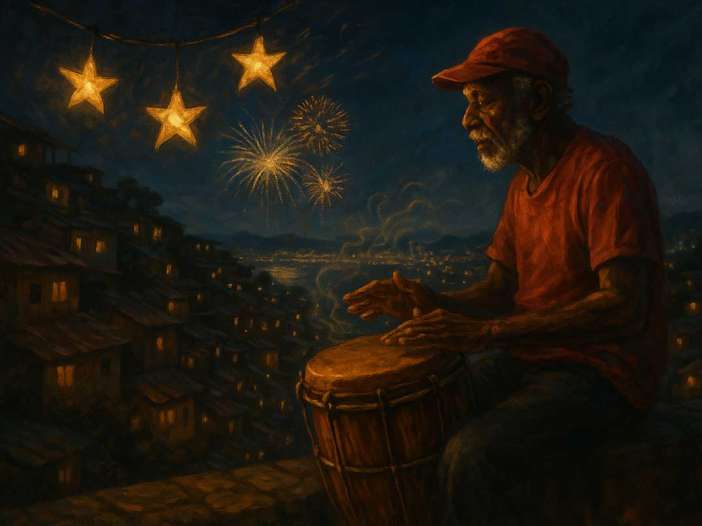
On Christmas Eve, Rio de Janeiro pulsed like a heartbeat — distant fireworks over Copacabana, laughter echoing through alleys, warm night air scented with grilled queijo coalho and the salty breath of the Atlantic. But high above the beaches, far from the glamorous postcards, sat Morro da Providência, one of Rio’s oldest favelas.

Up here, life was louder.
Sharper.
More alive.

Children played soccer barefoot in the alleys, shouting and spinning like shooting stars. Teenagers blasted funk carioca from speakers, and families gathered around tiny TVs showing old Christmas specials. But one sound rose above them all:

The steady beat of a drum.

A deep, warm, ancient rhythm that seemed older than Rio itself.

The drummer was an elderly man with a grey beard, brown skin weathered like soft leather, and eyes that carried oceans. He wore a faded red cap, shorts, and sandals — nothing to distinguish him except the way the air shifted when he played.

No one knew he was Santa in Disguise.

They only called him Tio Batuque — Uncle Drumbeat.

Every year on Christmas Eve, he sat at the top of the favela where the homes met the stars and played rhythms that were part samba, part samba-reggae, part heartbeat of the Earth.

Tonight, three souls would find their way to him.

1. The Dancer Who Lost Her Spark
The-Dancer-Who-Lost-Her-Spark

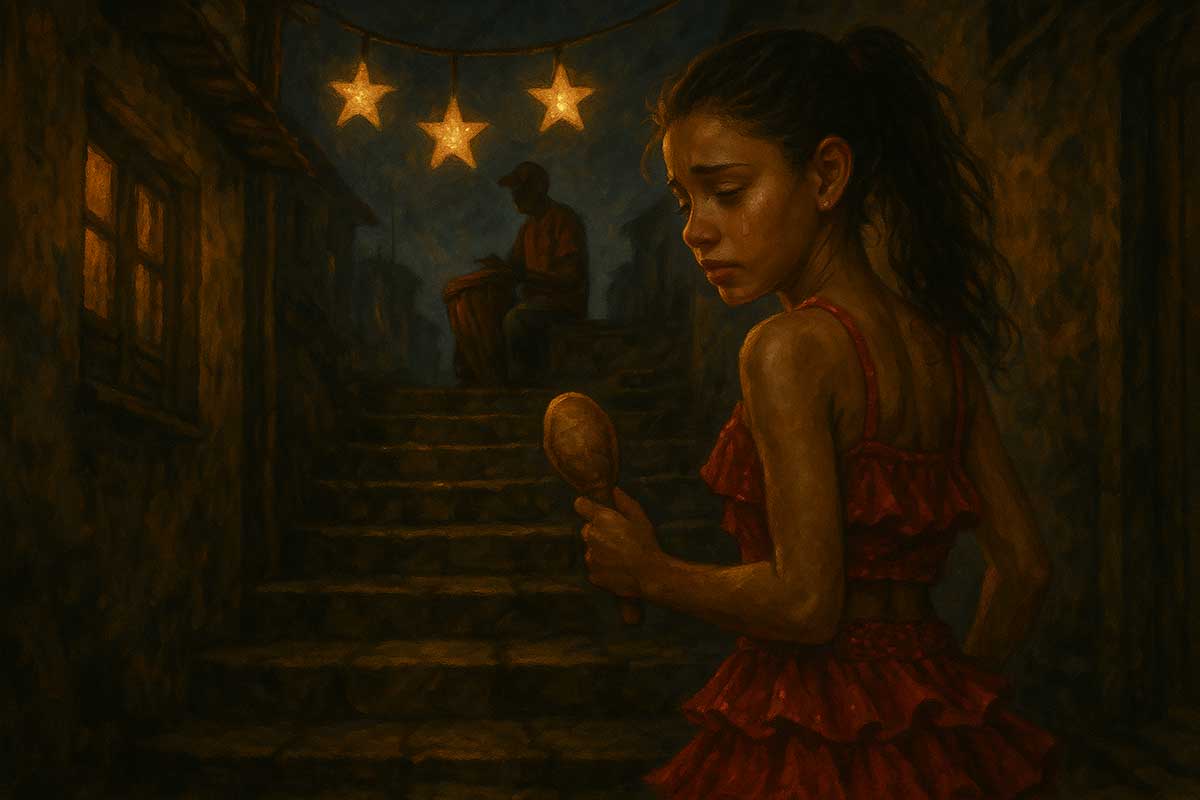
The first visitor was Luana, a 17-year-old samba prodigy who had been chosen to dance in the front row of her escola de samba for Carnival. Everyone said she was born for the spotlight. Her feet moved like water. Her smile lit up the night.

But three weeks ago her father, a beloved mechanic in the favela, fell ill and lost his job. Money tightened. Stress filled the house like smoke.

Luana hadn’t danced since.

She climbed toward the drumbeats, her sandals slapping softly against the concrete steps.

When she reached the top, Tio Batuque didn’t stop playing. He just nodded, as if he’d been waiting.

“You are heavy tonight,” he said.

Luana tried to smile. “It’s nothing.”

He tapped the drum once — a low, knowing thud.

“Nothing doesn’t walk up my hill.”

She sat beside him, hugging her knees. “I can’t dance anymore.”

“You’re hurt?”

“No,” she whispered. “I’m afraid if I dance while things are bad at home… it means I don’t care.”

The drummer smiled gently. “Girl… when the world hurts, that is exactly when you must dance.”

Her eyes filled with tears.

“I feel guilty being happy,” she said.

He struck a slow rhythm — soft, steady, like footsteps in sand.

“Happiness is not betrayal,” he said. “It is medicine.”

He let the rhythm thrum for a moment, letting it settle into her bones.

“You dance,” he said, “so your family remembers joy. You dance so your father remembers strength. When you move, the whole favela breathes easier.”

Luana covered her mouth, tears falling.

“I don’t know if I can still do it.”

He handed her a small wooden shaker — a simple ganza, carved by hand.

“Shake it,” he said.

She did — timid at first, then stronger.

The rhythm joined his, weaving into something alive.

As they played together, something inside her chest loosened — a knot untied by rhythm.

When they finished, he leaned close.

“Tomorrow,” he said, “you dance in your living room. Even if it’s just for ten seconds. Your father will hear it. And he will start healing.”

She nodded, clutching the ganza to her chest.

“Obrigada, Tio.”

“Vai com luz,” he whispered. “Go with light.”

And she descended the hill lighter than she had climbed it.

2. The Tourist Running From Grief
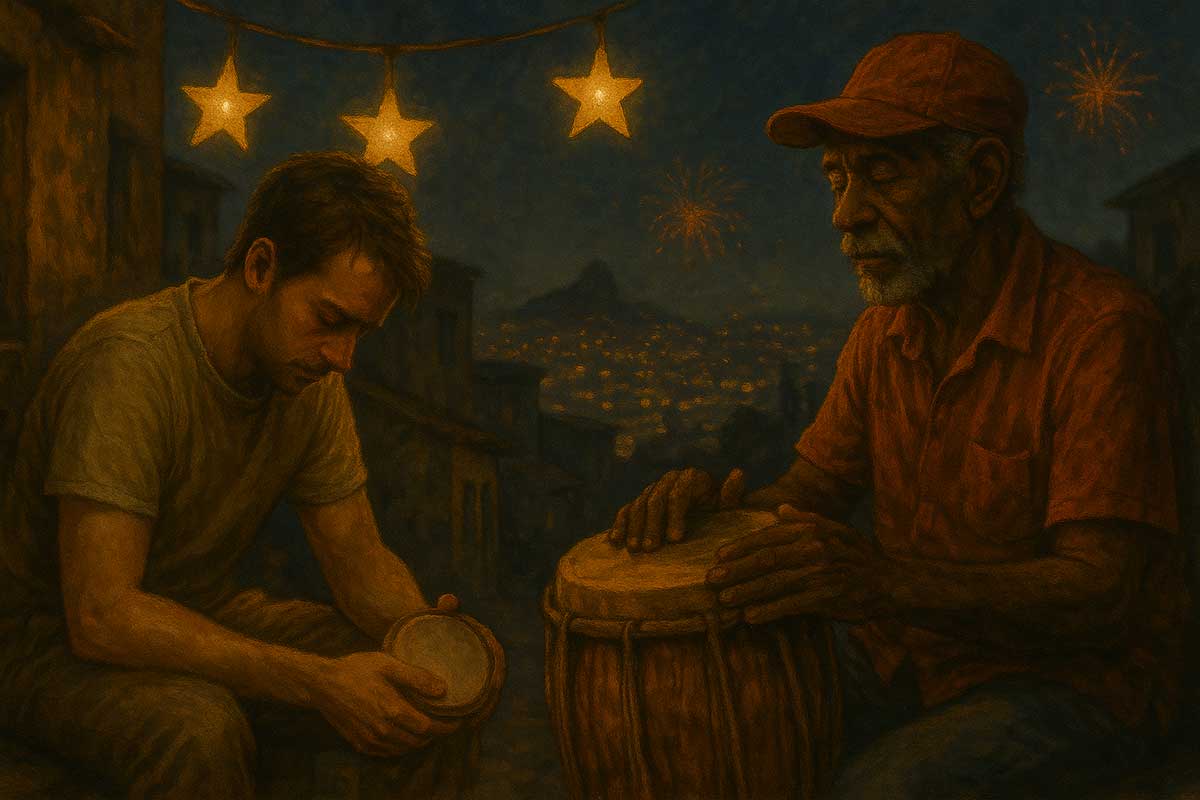
The second visitor was Ethan, a tourist from Canada who had come to Rio alone. Six months earlier, he lost his younger sister in a car accident. During December, grief pressed against him so hard he could barely breathe.

He walked the beaches, the markets, the crowded celebrations — hoping noise might drown his loneliness. It didn’t.

On Christmas Eve, he followed the distant sound of drums up into the favela, not knowing why.

He found Tio Batuque sitting under string lights shaped like stars.

The drummer didn’t turn.

“You’re carrying a ghost,” he said.

Ethan froze. “I— sorry. I should go—”

“No,” the drummer said. “Ghosts climb too. Let us honor yours.”

Ethan sat slowly, unable to speak.

The drummer played a gentle rhythm, like waves brushing the shore.

“Tell me,” he said softly.

“My sister loved music,” Ethan whispered. “We used to play duets. After she died… I can’t touch my guitar. It feels wrong.”

“Wrong to play?” the drummer asked.

Ethan nodded. “Like it dishonors her. Like I’m leaving her behind.”

Tio Batuque played a single heartbeat on the drum — boom.

“Music does not leave people,” he said. “Music carries them.”

Ethan swallowed hard.

The drummer reached behind him and handed Ethan a small hand drum, polished smooth with age.

Ethan shook his head. “I can’t—”

“Play,” the drummer said firmly.

His hands trembled as he touched the drumhead.

“Just one beat,” the drummer whispered.

Ethan struck the drum.

A soft sound. Barely audible.

But something cracked open. His eyes filled.

“It’s the first sound she’s heard from you in months,” the drummer said.

Ethan sobbed.

Through tears, he struck it again.
And again.
And again.

Each beat softer, warmer, fuller.

When he finished, he looked at the drummer helplessly.

“What do I do now?”

“Play one note every day,” the drummer said. “Even if you cry while doing it. Especially if you cry.”

He placed a hand on Ethan’s shoulder.

“Grief is not a goodbye,” he said. “It is a rhythm learning to change.”

Ethan nodded, clutching the drum as if it were life itself.

3. The Street Boy Searching for a Future
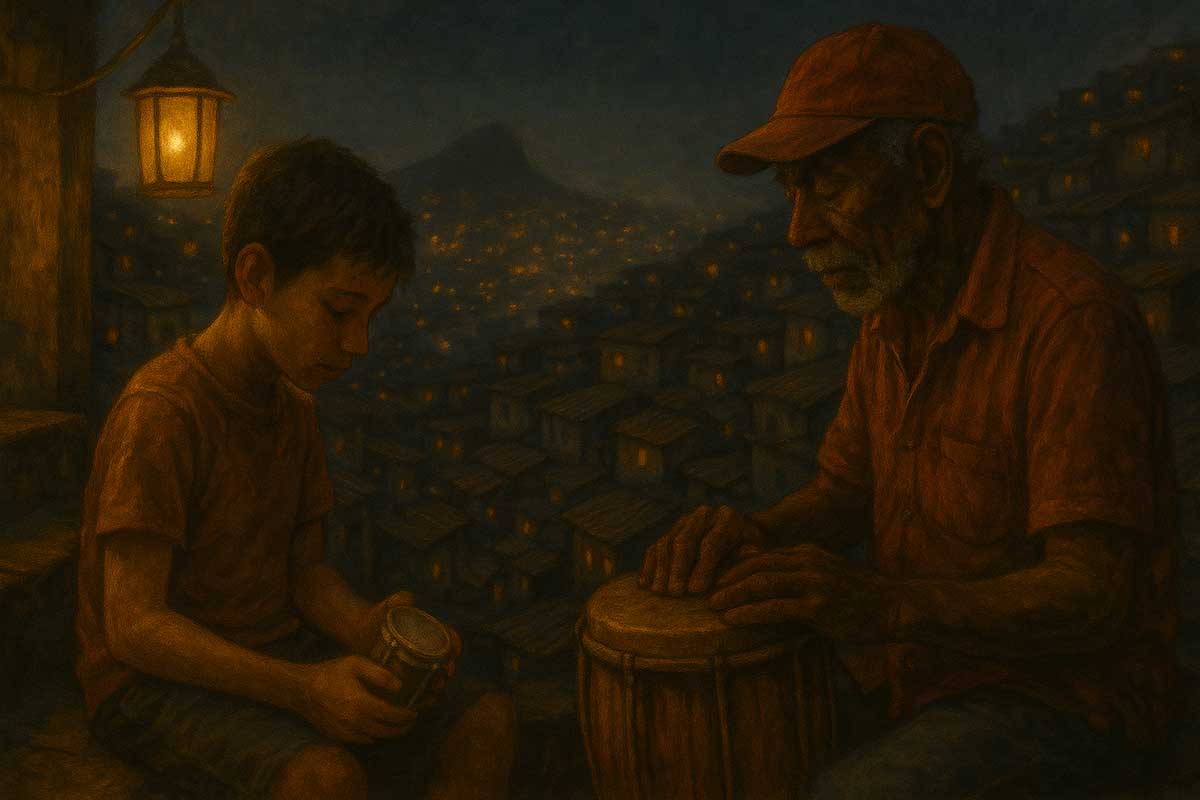
The final visitor was Paulo, a 12-year-old boy who sold water bottles to tourists near Lapa. His mother worked two jobs. His father was gone. He dreamed of becoming a musician but had no money for lessons, no instrument, no idea where to begin.

Tonight he wandered up the hill because he heard the drums.

He stood shyly at a distance.

Tio Batuque beckoned him with a tilt of his chin.

“You, menino — come.”

Paulo approached, eyes wide. “I didn’t want to bother you.”

“You breathe,” the drummer said. “So you are never a bother.”

Paulo sat beside him and whispered, “How do you become someone? Somebody important?”

The drummer looked at him for a long time.

“By choosing your rhythm,” he said. “Not the one forced on you. Not the one that scares you. The one that is already inside.”

Paulo’s eyes shone. “But I have nothing. No money. No classes.”

The drummer smiled and handed him a tiny repiquezinho — a miniature samba drum, worn but lovingly kept.

“This was mine when I was your age,” he said. “Now it’s yours.”

Paulo gasped. “I can’t take this!”

“You can,” the drummer said. “And you will. Because you are going to start practicing every morning. Slow. Soft. But steady.”

Paulo hugged the drum to his chest.

“You do that,” the drummer continued, “and in ten years, you won’t be asking how to become someone. People will be asking how you became you.”

Paulo beamed — a smile so bright it could have lit the entire favela.

“Thank you, Tio,” he whispered.

“Vai, pequeno,” the drummer said. “Start your life.”

Santa’s Departure

When midnight passed and fireworks lit the bay below, Tio Batuque stood, stretched his back, and smiled at the glowing city.

“You did well tonight, Rio,” he murmured. “Your beats carry farther than mine.”

He placed his drum gently on the ground.

When the next wave of fireworks burst, lighting the hilltop in gold…

…he vanished.

Only the drum remained, still warm.
Only the hill echoed with the faint heartbeat of rhythm.
And somewhere in the favela, music awakened in three different homes —
each one touched by the same quiet miracle.
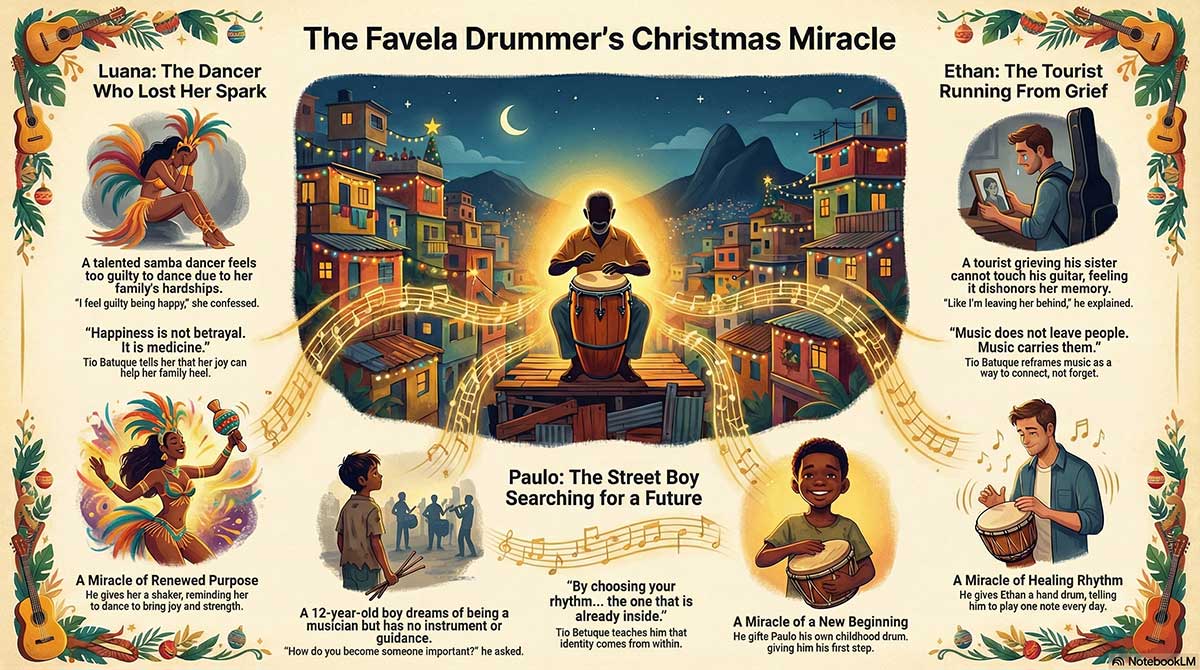
the-favela-drummers-christmas-miracle

Short Bios:

Tio Batuque (The Favela Drummer / Santa in Disguise)
An elderly drummer who sits atop Morro da Providência each Christmas Eve, Tio Batuque carries deep wisdom and a rhythm older than Rio itself. Seen by locals as a gentle uncle figure, he is in truth Santa in Disguise, guiding lost souls through music, presence, and quiet miracles.

Luana – The Dancer Who Lost Her Spark
A 17-year-old samba prodigy chosen for the front row of her escola de samba, Luana’s joy collapses under the weight of family hardship. She climbs the favela hill burdened with guilt for feeling happy, rediscovering her purpose through rhythm and compassion.

Ethan – The Tourist Running From Grief
A visitor from Canada grieving the loss of his younger sister, Ethan wanders Rio searching for distraction but finds only deeper loneliness. Drawn to the drummer’s hilltop, he confronts his grief through music, learning that remembrance is not abandonment.

Paulo – The Street Boy Searching for a Future
A 12-year-old boy selling water bottles near Lapa, Paulo dreams of becoming a musician despite poverty and uncertainty. When Tio Batuque gifts him a small repiquezinho, Paulo receives not just an instrument, but the beginning of a future shaped by his own rhythm.

Related Posts:

  • Karma Exchanger: A Novel of Pain, Rebirth, and Mercy
  • The Fall of Man: Adam, Eve, and the Lost Garden
  • The House With the Black Stone: A Korean Family Saga
  • Grimm Fairy Tale Universe: The Complete Grimmverse Book One
  • S. Y. Agnon in 2026: An Imagined Novel of Belonging
  • Ultimate Pilgrimage in Israel: When the Bible Comes Alive

Filed Under: Christmas, Spirituality Tagged With: Brazilian Christmas tale, Brazilian festive miracles, Christmas Eve Brazil, Christmas miracles Brazil, Christmas story Rio, emotional Christmas stories, favela drummer story, favela narrative fiction, healing Christmas fiction, heartwarming Rio stories, holiday magic Rio, inspirational Christmas tale, Rio cultural storytelling, Rio de Janeiro short stories, Rio favela Christmas, Rio holiday fiction, Rio storytelling 2025, samba Christmas magic, samba rhythm story, Santa in disguise Rio

Reader Interactions

Leave a Reply Cancel reply

Your email address will not be published. Required fields are marked *

Primary Sidebar

RECENT POSTS

  • grapes of wrath questionsThe Grapes of Wrath Explained: 5 Questions Readers Still Ask
  • the grapes of wrath john steinbeckThe Grapes of Wrath: When Does “Me” Become “We”?
  • Stand With Jesus: What If People Tried to Stop the Crucifixion?
  • East of Eden Today: 5 Stories About Breaking Family Cycles
  • john steinbeck east of edenEast of Eden: Does Timshel Still Make Sense Today?
  • East of Eden: Are We Born Bad or Free to Choose?
  • Convenience Store Woman: 5 American Stories About Marriage and Freedom
  • convenience-store-women-analysis-Convenience Store Woman: Is the New Normal Really Normal?
  • convenience store womenConvenience Store Woman: Who Decides What Is Normal?
  • sayaka murata imaginary friendsSayaka Murata Imaginary Friends: The Mystery Behind Her Inner World
  • Social Health Stories: 5 Ways We Lost Our Sense of Belonging
  • Social Health: Why Modern Life Is Making Us Lonely
  • nickel-boys-modern-stories-The Nickel Boys: 5 Modern Stories About Truth, Trauma and Hope
  • coloson whitehead the nickel boys discussionThe Nickel Boys: What Kind of Hope Survives Injustice?
  • the nickel boys colson whiteheadThe Nickel Boys: Elwood and Turner on Justice, Survival and Truth
  • AI Resource Consumption: Can AI Give More Than It Takes?
  • madeline-miller-circe-modern-stories-5 Modern Stories Inspired by Circe by Madeline Miller
  • Circle-Madeline-Miller-analysis-Circe Explained: Myth, Meaning, and Madeline Miller
  • Madeline Miller Circle CharactersMadeline Miller Circe: What If No One Ever Chose You?
  • 5 Modern Stories Inspired by Keigo Higashino’s Silent Parade
  • could japanese culture succeed where religion has failedCould Japanese Culture Succeed Where Religion Has Failed?
  • keigo-Higashino-when-love-becomes-too-much-5 Modern Stories Inspired by The Devotion of Suspect X
  • The Devotion of Suspect X Explained by Psychologists: Is Ishigami’s Love Really Love?
  • the devotion of suspect xThe Devotion of Suspect X Explained: Was Ishigami’s Sacrifice Really Love?
  • 5 Modern Midnight Library Stories About Regret, AI, and Choice
  • Matt Haig The Midnight LibraryThe Midnight Library Explained by Scholars and Matt Haig
  • The-Midnight-Library-explainedThe Midnight Library Explained Through Its Characters
  • 5 Modern Siddhartha Stories About Wisdom, Love, AI, and Choice
  • Siddhartha explained by leading scholarsSiddhartha Explained by Leading Hermann Hesse Scholars
  • Siddhartha explainedSiddhartha Explained Through Its Characters: Love, Loss, and Enlightenment
  • before-the-names-are-carved-Before the Names Are Carved: Five Connected Stories
  • The Scholars and the Unworn ShoesHan Kang Human Acts Explained by Leading Scholars
  • Han Kang Human Acts: An Imaginary Conversation with the Dead
  • The Years We Thought We Had: A Story of Love and Waiting in Japan
  • snow-country-analysis-Snow Country Analysis: Kawabata Scholars Explain It
  • snow-country-was-their-love-realSnow Country Explained Through Its Characters
  • the-man-who-never-took-the-day-off-The Man Who Never Took the Day Off: A Modern Ishiguro Story
  • The Remains of the Day Explained by Leading Ishiguro Scholars
  • the-remains-of-the-day-imaginary-talks-The Remains of the Day Explained Through Its Characters
  • the-pastor-who-couldnt-be-forgiven-The Pastor Who Couldn’t Be Forgiven: A Modern Story of Grace
  • disgrace-j-m-coetzee-Disgrace Explained Through Its Characters
  • disgrace-explained-leading-jm-coetzee-scholarsDisgrace Explained by Leading J. M. Coetzee Scholars
  • Forty-One Could Live. Nine Had to Die.
  • The Gospel According to Jesus Christ explainedThe Gospel According to Jesus Christ Explained Through Its Characters
  • SARAMAGO’S GOSPEL EXPLAINEDThe Gospel According to Jesus Christ Explained by Top Scholars
  • the last safe floorThe Last Safe Floor: A Modern Lord of the Flies Story for 2026
  • william golding explained by top scholarsWilliam Golding Explained by Top Scholars: Evil, Faith, and Redemption
  • lord-of-flies-character-conversation-Lord of the Flies Explained Through Its Characters: Is the Beast Inside Us?
  • never complain never explainNever Complain Never Explain: Henry Ford & Disraeli
  • The Empty Chair: A Modern Brothers Karamazov Story
  • the brothers karamazov explained top dostoevsky scholarsThe Brothers Karamazov Explained by Top Dostoevsky Scholars
  • Brothers Karamazov explainedThe Brothers Karamazov Explained Through Its Characters
  • before yesBefore Yes: A Modern American Story Inspired by Albert Camus
  • The Stranger Explained by Top Albert Camus Scholars
  • the stranger explainedAlbert Camus’s The Stranger Explained Through Its Characters
  • What is Worth Saving?The Last Store on Main Street: Inspired by The Sound and the Fury
  • The Sound and the Fury Scholar discussionThe Sound and the Fury Explained by Top William Faulkner Scholars
  • The Sound and the Fury Family SpokenThe Sound and the Fury Explained by Its Characters
  • The Building That Stopped Seeing | Modern Camus Story
  • The Plague Explained by Top Albert Camus Scholars
  • albert camus the plague explainedThe Plague explained by its characters
  • the last good sentenceThe Last Good Sentence: A Story About Fame and Loneliness
  • hemingway scholars debateThe Old Man and the Sea Explained by Top Scholars
  • The Old Man and the Sea Explained by Its Characters
  • the new meaning of survivalThe New Meaning of Survival: Top Scholars on Human Flourishing
  • true meanig of survivalThe True Meaning of Survival: Living, Not Just Existing
  • the last affordable roadThe Last Affordable Road: A Modern Grapes of Wrath Story
  • the-grapes-of-wrath-explained-by-top-scholars-The Grapes of Wrath Explained: Top Steinbeck Scholars
  • the grapes of wrath conversationThe Grapes of Wrath Explained Through Its Characters
  • the white silenceThe White Silence: A Japanese Novel of Loneliness
  • jose-saramago-blindness-explained-Blindness Explained by Top Scholars | José Saramago’s Greatest Warning
  • José-Saramago-Blindness-Explained-Blindness Explained Through Its Characters and José Saramago
  • Can the Bhagavad Gita Still Guide Humanity in 2026?
  • The Crown of AshesThe Crown of Ashes: A Modern Shakespearean Tragedy
  • the-fourth-bowl-If Toni Morrison Wrote a Japanese Family Novel: The Fourth Bowl
  • Beloved Ending Explained: 25 Questions Answered by Morrison Scholars
  • Toni-Morrison-Beloved-Explained-Beloved Explained Through Its Characters and Toni Morrison
  • house with the black stoneThe House With the Black Stone: A Korean Family Saga
  • Be Kind to Your Mother Before It’s Too LateBe Kind to Your Mother Before It’s Too Late
  • Gabriel-García-Márquez-one-hundred-years-of-solitude-explained-One Hundred Years of Solitude Explained by Top Scholars
  • one-hundred-years-of-solitude-explained-One Hundred Years of Solitude Explained
  • are-any-lives-truly-ordinary-Hateship Friendship Courtship Loveship Marriage explained
  • The Overstory explainedThe Overstory Explained: Themes, Ending, and Meaning
  • Demon Copperhead Explained: Barbara Kingsolver’s Pulitzer-Winning Novel
  • can you judge trump by his enemiesCan You Judge Donald Trump by His Enemies?
  • The Warmth of Other Suns Explained
  • America Iran strategyCan America Prevent a Wider Middle East War?
  • Lincol in the BardoLincoln in the Bardo Ending Explained:
  • God-as-Original-Parent-If God Created Man and Woman, Is God Our Original Parent?
  • can creation reveal godDoes Creation Reveal the Nature of God? Five Great Thinkers Discuss
  • Are Therapists to Blame for the Rise of Adults Cutting Off Their Parents?
  • your seventh year is changingJoel Osteen’s Seventh Year: When Suffering Is Not the Final Chapter
  • Joel Osteen’s Best Messages: Hope, Favor, and Faith
  • Hilary Mantel Wolf-Hall ending explainedWolf Hall Ending Explained: Can a Good Man Survive Political Power?
  • i-never-said-i-was-god-What If Jesus Never Claimed to Be God?
  • did-jesus-say-he-was-god-Did Christianity Reverse the Message of Jesus?
  • The Unseen World Liz MooreThe Unseen World Analysis: Memory, AI, and Identity
  • gilead ending explainedGilead Ending Explained: Can Grace Reach the Person We Judge Most?
  • Elena Ferrante My Brilliant FriendMy Brilliant Friend Ending Explained: Who Was Brilliant?
  • The-Underground-Railroad-ending-explained--The Underground Railroad Ending Explained

Footer

Recent Posts

  • The Grapes of Wrath Explained: 5 Questions Readers Still Ask August 31, 2026
  • The Grapes of Wrath: When Does “Me” Become “We”? August 30, 2026
  • Stand With Jesus: What If People Tried to Stop the Crucifixion? August 30, 2026
  • East of Eden Today: 5 Stories About Breaking Family Cycles August 29, 2026
  • East of Eden: Does Timshel Still Make Sense Today? August 29, 2026
  • East of Eden: Are We Born Bad or Free to Choose? August 29, 2026

Pages

  • About Us
  • Contact Us
  • Disclaimer
  • Earnings Disclaimer
  • Privacy Policy
  • Terms and Conditions

Categories

Copyright © 2026 Imaginarytalks.com