
|
Getting your Trinity Audio player ready...
|
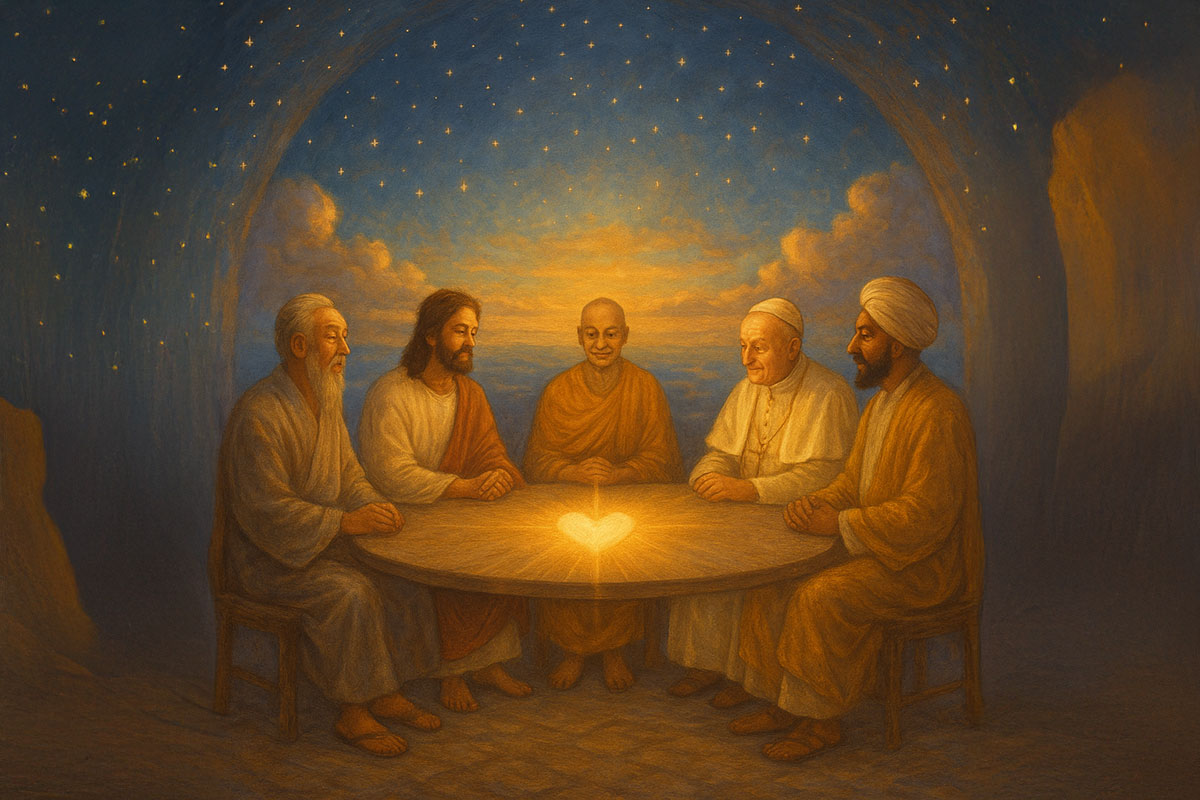
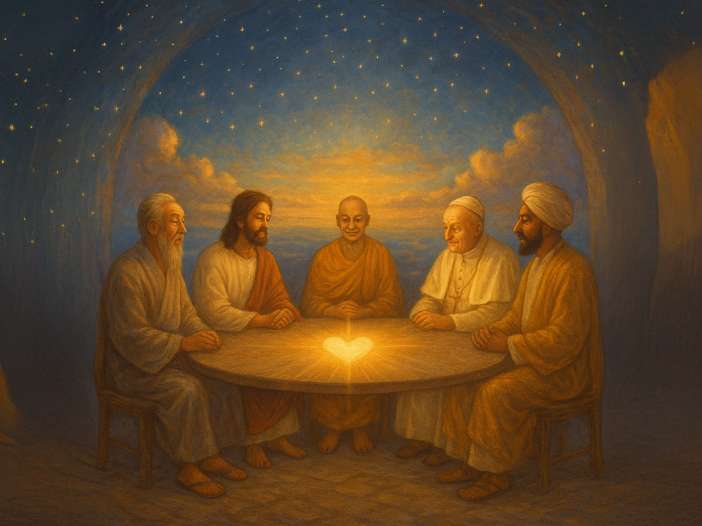
God (as Divine Parent):
I am your Parent.
Not a concept. Not a force. Not a distant mystery.
I am the one who dreamed of you before the stars had names.
I shaped this Earth not as a battlefield, but as a home.
A garden. A cradle. A shared table.
I created you as family.
But now, you call each other strangers…
And what breaks My heart is not just your suffering—
but the fact that you inflict it on each other.
You do not see what I see:
That your enemy bears My image too.
Every time a child is mocked for their difference,
I feel it.
Every time a bullet tears through flesh,
I am torn with it.
You ask: Where is God? Why is He silent?
And I ask: Where are My children?
Why are you not the answer to each other’s prayers?
I am not here to punish.
I am here to invite you—once again—
to love like Heaven.
You do not have to be perfect.
You just have to begin.
Begin by listening.
Begin by forgiving.
Begin by seeing the one in front of you not as a threat,
but as a sibling.
These conversations—these voices—
are not just reflections.
They are mirrors I hold to your soul.
Look closely.
And ask yourself:
Will you grow up in love? Or stay small in fear?
This is not judgment.
This is longing.
The longing of a Parent…
waiting to welcome the family home.
(Note: This is an imaginary conversation, a creative exploration of an idea, and not a real speech or event.)

Topic 1: Is God Proud of Us Today?
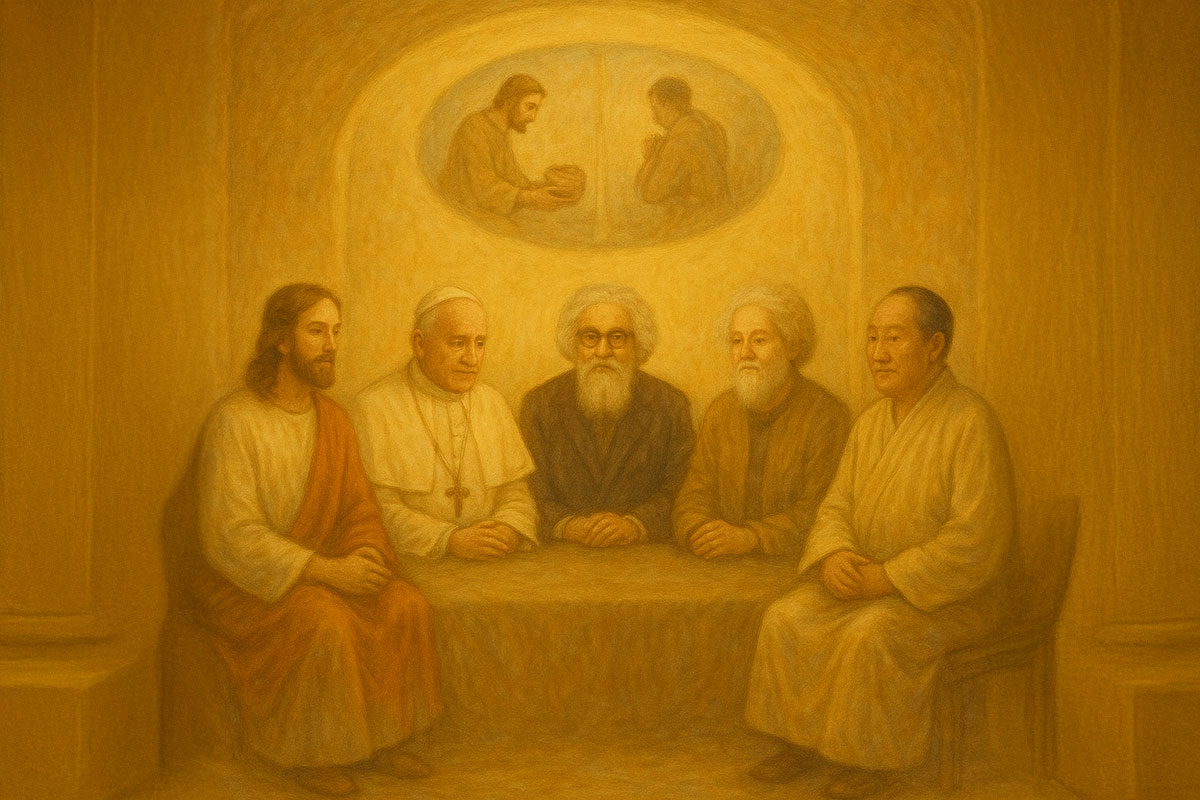
Moderator:
Karen Armstrong
Participants:
Jesus Christ, Pope Francis, Rev. Sun Myung Moon, Rabbi Abraham Joshua Heschel, Karen Armstrong
Karen Armstrong (moderator):
When we ask “Is God proud of us today?”—I don’t think we’re looking for flattery. We’re reaching for something deeper: How does God see us, really? Is it through our prayers, our good works, or how we treat each other—especially the people we struggle with? Let me begin with this question:
When God looks at humanity today, what do you think grieves Him most—and what brings Him joy?
Jesus Christ:
What grieves the Father is when love is buried under fear and pride. When I walked among you, I didn’t come for those who were proud of their righteousness—I came for those who knew they were lost and wanted to come home. God rejoices every time one soul turns toward another with forgiveness, even quietly. The little moments—a mother who softens, a stranger who offers mercy—these bring Him joy. But He weeps when we use His name to justify hatred.
Rabbi Abraham Joshua Heschel:
I believe God’s heartbreak comes not from our failures, but from our indifference. We’ve learned to coexist with injustice. We scroll past suffering. The prophets weren’t merely angry—they were heartbroken. God longs for His children to be moved—not just by worship songs, but by the hunger of their neighbor. And yes, even now, when we act with compassion, we echo God’s own longing. That is holy.
Rev. Sun Myung Moon:
God is a parent. That is not metaphor—it is reality. Imagine a parent whose children fight endlessly, even using their parent’s words as weapons. God’s grief is not distant; it is daily, as He watches His children divide along race, religion, and ideology. But when one person says, “I will love my enemy,” God’s heart is lifted. True love—unselfish, sacrificial—is the only thing that brings Him joy. Not just belief, but the practice of love.
Pope Francis:
God’s joy is simple: mercy. Every act of kindness whispers His name. But today, too many hearts are closed, hardened by fear or ideology. We defend our own tribes, our own certainties. That must change. The Church exists not to condemn, but to heal. When we are merciful, especially when no one is watching, I believe God is deeply moved.
Karen Armstrong (moderator):
That leads us into something harder. Jesus, you said, “Love your enemies.” But we’ve turned that into a slogan more than a standard. So I ask each of you:
Why is loving our enemies so central to spiritual maturity, and why do we struggle with it so much?
Rev. Sun Myung Moon:
Because loving an enemy is not just for their sake—it is to free God. Every grudge held, every revenge taken, prolongs God’s agony. When we forgive, we act as His representatives. Why do we struggle? Because we still see ourselves as victims rather than children of a cosmic Parent. The mature child takes responsibility for restoring the family, even if he didn’t break it.
Pope Francis:
It is much easier to say, “I love God,” than to say, “I love the one who hurt me.” But love without cost is not love—it’s comfort. The Cross was not comfortable. Yet it was love. The Church must rediscover this radical command. If we cannot love those who wound us, our prayers are noise.
Jesus Christ:
You cannot grow spiritually unless you die to your ego. Loving your enemy is the final test—it’s where the heart learns to see with the eyes of the Father. I didn’t ask you to agree with your enemies, or to excuse evil. I asked you to see them as someone God still loves. When you do that, even once, you are no longer a child—you become a co-heir of God’s love.
Rabbi Heschel:
To love one’s enemy is to rebel against the logic of history. It is a spiritual revolution. Prophets called out injustice, yes—but they also wept for the oppressors. We struggle with enemy-love because it demands more than justice; it demands grace. But grace is the only force that can interrupt hatred’s cycle.
Karen Armstrong:
Beautifully said. That brings me to our final reflection:
If we are truly one family under God, then how should we live differently—today—in a way that would make God proud?
Jesus Christ:
Stop measuring your faith by the applause of your group. Start measuring it by the width of your love. Feed the hungry. Touch the untouchable. Love the unlovable. Be with the broken. If you do that, the Kingdom is already near.
Rabbi Heschel:
Refuse to be numb. Let the pain of the world interrupt your routines. Let your prayers spill into action. God is not impressed by detachment—He desires a partnership. He wants His children to carry part of His burden.
Rev. Sun Myung Moon:
We must live as peacemakers—not peacekeepers. Don’t just avoid conflict. Heal it. Create families that model intergenerational love, schools that teach reconciliation, and nations that embrace others not with suspicion, but with dignity. That is the world God dreamed of.
Pope Francis:
Simplify your lives. Make room for others. Choose humility over performance. When we make space for those who have no place, we become the dwelling place of God. Let our homes, our churches, and our hearts become places where enemies become brothers.
Karen Armstrong (closing):
Thank you. You’ve each shown that God’s pride is not in our power or knowledge—but in our capacity to love beyond ourselves.
So I leave each listener with this:
If God looked at your heart today, would He see love widening… or shrinking?
Would He see His family, finally beginning to grow up?
Topic 2: Love Your Enemy — Or Stay Spiritually Immature?
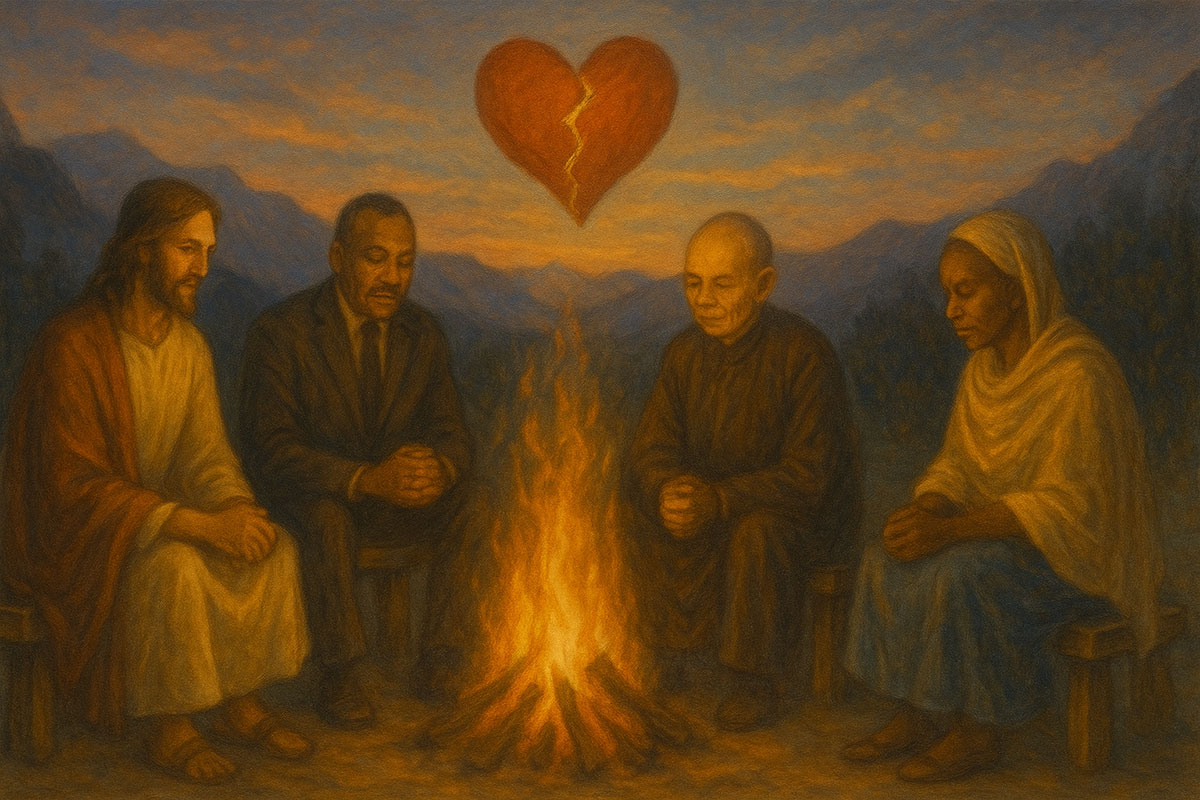
Moderator:
Desmond Tutu
Participants:
Jesus Christ, Martin Luther King Jr., Thich Nhat Hanh, Immaculée Ilibagiza, Desmond Tutu
Desmond Tutu (moderator):
My friends, today we gather around one of the most difficult, misunderstood, and divine commandments: “Love your enemies.”
It is not comfortable. It is not easy. But it is the very measure of spiritual maturity. So let me begin with this question:
Why is loving our enemies such a non-negotiable in spiritual life?
Martin Luther King Jr.:
Because hate poisons the soul. It doesn’t just harm the one you target—it corrodes your own capacity to love. When Jesus said “Love your enemies,” He wasn’t issuing a sentimental phrase. He was showing us the only path that can break the chains of violence, racism, vengeance. Without enemy-love, we don’t just stay spiritually immature—we stay enslaved.
Immaculée Ilibagiza:
I hid in a bathroom for 91 days while men outside called for my death. They killed my family. But I found freedom when I forgave them. It didn’t mean I accepted what they did. It meant I chose to let God take my pain. Loving your enemy is the only way to stay human after evil tries to make you less than that.
Thich Nhat Hanh:
Anger is like a burning coal we throw with bare hands. To love our enemy is to stop the burning—inside us first. When we love our enemy, we remove illusion. We see their suffering, their ignorance, and we no longer cling to the identity of “me” and “them.” There is only “us.”
Jesus Christ:
Your enemy is your mirror. If you cannot love them, you haven’t yet seen yourself through God’s eyes. Love doesn’t mean agreeing or yielding to evil—it means refusing to become it. I said, “Love your enemies,” not because they are worthy, but because you are meant to grow into the likeness of God. And He loves them too.
Desmond Tutu:
Let’s take it one step deeper. What is the true cost of refusing to love our enemies? What do we lose—personally, spiritually, even globally?
Thich Nhat Hanh:
We lose the present moment. We lose clarity. Resentment keeps us trapped in the past, chained to cycles of fear and blame. Without love, we are never free. Enemy-love is the only doorway into true peace—not as an idea, but as a way of being.
Martin Luther King Jr.:
We lose our moral power. If we hate, we become the very thing we are trying to heal. The Civil Rights Movement would have collapsed if we had adopted the language of retaliation. Love preserved our soul while confronting injustice. Without it, we may win battles—but lose our humanity.
Immaculée Ilibagiza:
We lose our healing. Many people think forgiveness is weakness—but it is freedom. The cost of refusing to love is that you carry your enemy inside you forever. I wanted to be free—not just from the killers, but from the hatred they left behind. When I forgave, the prison door opened.
Jesus Christ:
You lose heaven. Not someday—but now. The kingdom of God is not something you enter after death. It begins within. If hatred governs your heart, love cannot. You cannot serve both vengeance and the Father. One will harden you. The other will resurrect you.
Desmond Tutu:
And so we come to the question that many ask but few answer:
How do we actually do it?
When the wound is deep, when the enemy is real, how do we begin to love?
Immaculée Ilibagiza:
Begin by praying for them, even if you don’t mean it at first. I prayed the Lord’s Prayer again and again: “Forgive us… as we forgive…” That line broke me. It was hard. I didn’t feel strong. But over time, I started meaning it. Forgiveness became the soil where love could grow.
Martin Luther King Jr.:
You confront the evil—but not the soul. You don’t hide from injustice. You name it. But you never let yourself stop seeing the image of God in the one who commits it. Justice and love are not enemies. They are siblings. And sometimes love means saying, “You must stop.”
Thich Nhat Hanh:
Come back to your breath. Anchor yourself in the now. Breathe in their humanity. Breathe out your fear. Enemy-love does not require you to forget. It asks you to see—clearly, with compassion, without clinging. Love begins when we stop resisting the truth of suffering—ours and theirs.
Jesus Christ:
Remember how much you’ve been forgiven. If you knew the weight I carried on the cross, not just for your sins but for your enemies’ sins too—you would not hesitate. My blood did not discriminate. If you want to love your enemy, look to Me. I loved them first.
Desmond Tutu (closing):
Enemy-love is not abstract. It is a path, a choice, a practice. It is the hardest part of faith—and the holiest.
So today, before we protest, before we preach, before we pray…
Let’s ask: Is there someone I need to love—precisely because I don’t want to?
Because that is where your maturity begins.
Topic 3: One Family Under God — Wishful Thinking or Divine Blueprint?
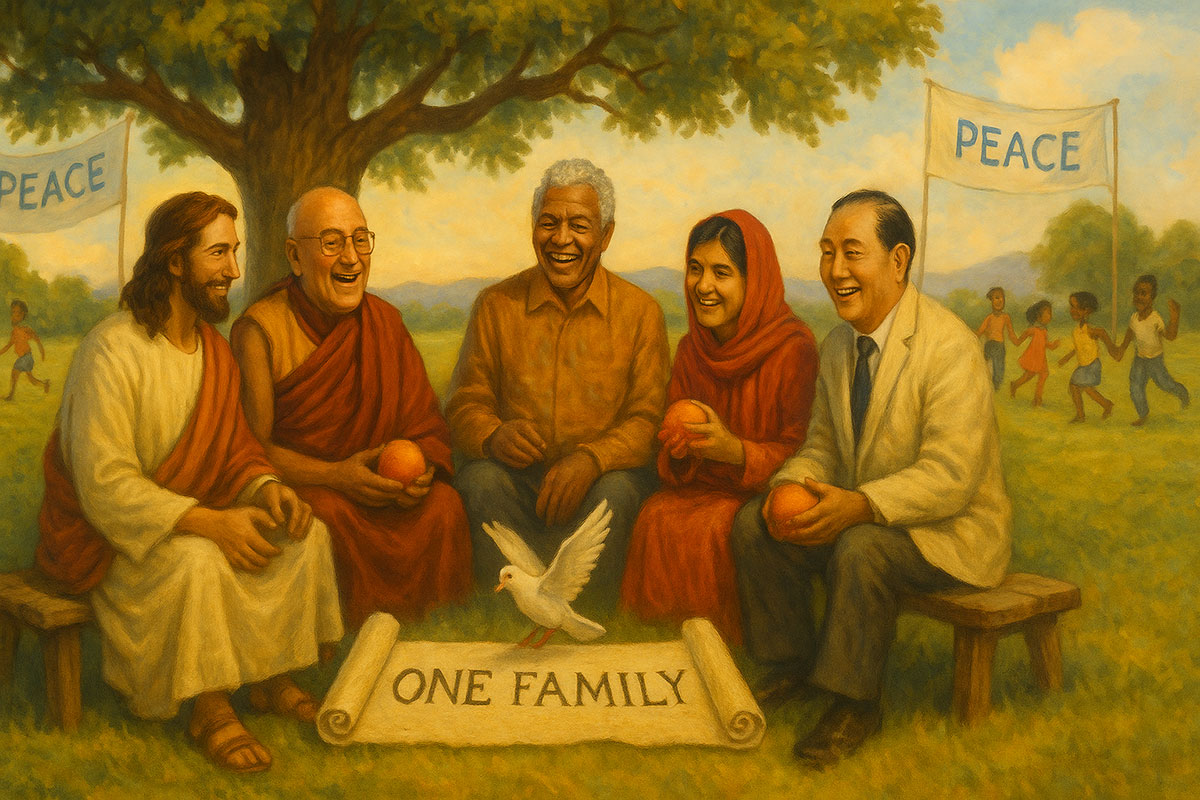
Moderator:
Dalai Lama
Participants:
Rev. Sun Myung Moon, Malala Yousafzai, Nelson Mandela, Jesus Christ, Dalai Lama
Dalai Lama (moderator):
Today, we explore an idea that inspires many, but also frustrates others: Can humanity truly become one family under God? Is this just a noble dream—or the deepest truth of our being?
Let me begin with this question:
Is the idea of “One Family Under God” merely idealistic—or is it the spiritual blueprint we’ve forgotten?
Rev. Sun Myung Moon:
It is not idealism. It is God’s original plan. Before religion, before politics, before culture, there was family. Not divided by nation or race, but united in one divine Parent. The pain of history is the pain of a broken home. God is not just watching history—He is aching for His children to return to one family.
Malala Yousafzai:
I believe it is real. But like peace, it must be learned. When I was a child, I was taught to see everyone as brother and sister. Then war taught me otherwise. But education—true education—restores the family. When girls are educated, when cultures are respected, we remember we belong to one another.
Nelson Mandela:
If it were not possible, I would not have forgiven those who imprisoned me. I saw the humanity of my jailers. We cannot choose our skin, our language, or where we are born—but we can choose how we treat one another. The family of humanity exists. It is just suffering from amnesia.
Jesus Christ:
I once said, “Who is my mother? Who are my brothers?” and then pointed to those who do the will of my Father. Family is not only blood—it is spirit. All are God’s children. But only those who love like family will live like family. You must choose the family of God with every act of love.
Dalai Lama:
Yes. I believe we are one human family. Different faiths are like different medicines—but we all suffer, we all want happiness, we all have mothers. The blueprint exists within our compassion. If we remember that, the world becomes smaller—in a good way.
Let me ask the next question:
If we are truly one family under God, what responsibilities do we have to each other—especially across race, religion, and nation?
Malala Yousafzai:
We must listen—especially to those with less power. Family means no one gets left behind. If a girl cannot read in one country, the whole world should feel that. If one child is bombed, every adult is responsible. We are not separated by borders—we are bound by care.
Rev. Sun Myung Moon:
It means taking ownership—not just of our own tribe, but of each other’s pain. If someone in another faith suffers, that is my sibling crying. Responsibility does not mean control—it means investment. A true parent loves all children. So must we.
Jesus Christ:
I washed the feet of those who would betray Me. That is the level of responsibility love demands. Not affection when it is easy—but service when it is hard. You must not ask, “Who is worthy of my help?” but “How can I be family to the unrecognized brother?”
Nelson Mandela:
We must build bridges, not walls. A family is not built on agreement but on forgiveness. I am not proud of all my country’s past. But I am proud we tried to heal. If you love only those who look like you, you are still a child in the family of God.
Dalai Lama:
To be one family means we suffer together. So the suffering of another should be yours. Do not ask if it is your issue. Ask, “What is the suffering behind this anger?” That is family compassion.
Dalai Lama (continued):
Now, for our final reflection today—one I believe is most urgent:
What is one small act each of us can take, starting today, to live more like one family under God—not just in word, but in action?
Nelson Mandela:
Speak to someone outside your comfort zone. Listen—not to respond, but to understand. When we see each other’s stories, the fear fades. One family begins with one honest conversation.
Malala Yousafzai:
Defend someone who is silenced. Speak up for a girl who has no classroom. Share her story. That’s how you become her sister or brother. Your voice can build the bridge that lets her cross over.
Rev. Sun Myung Moon:
Create peace in your home. Families under God are not built on theology but practice. Forgive your parents. Love your child unconditionally. Reconcile with your spouse. From there, peace will ripple to the world.
Jesus Christ:
Feed someone who cannot repay you. Love someone who does not deserve it. Every time you do this, Heaven recognizes you as family. The Kingdom begins in these small, hidden acts of love.
Dalai Lama (closing):
This is not about slogans. It is about heart.
If we live like siblings, we won’t need to solve every argument—we will simply refuse to let each other go.
Let’s not ask if one family is possible. Let’s ask: What part of Heaven do I carry into the family today?
Topic 4: The Responsibility of God — And the Maturity of His Children
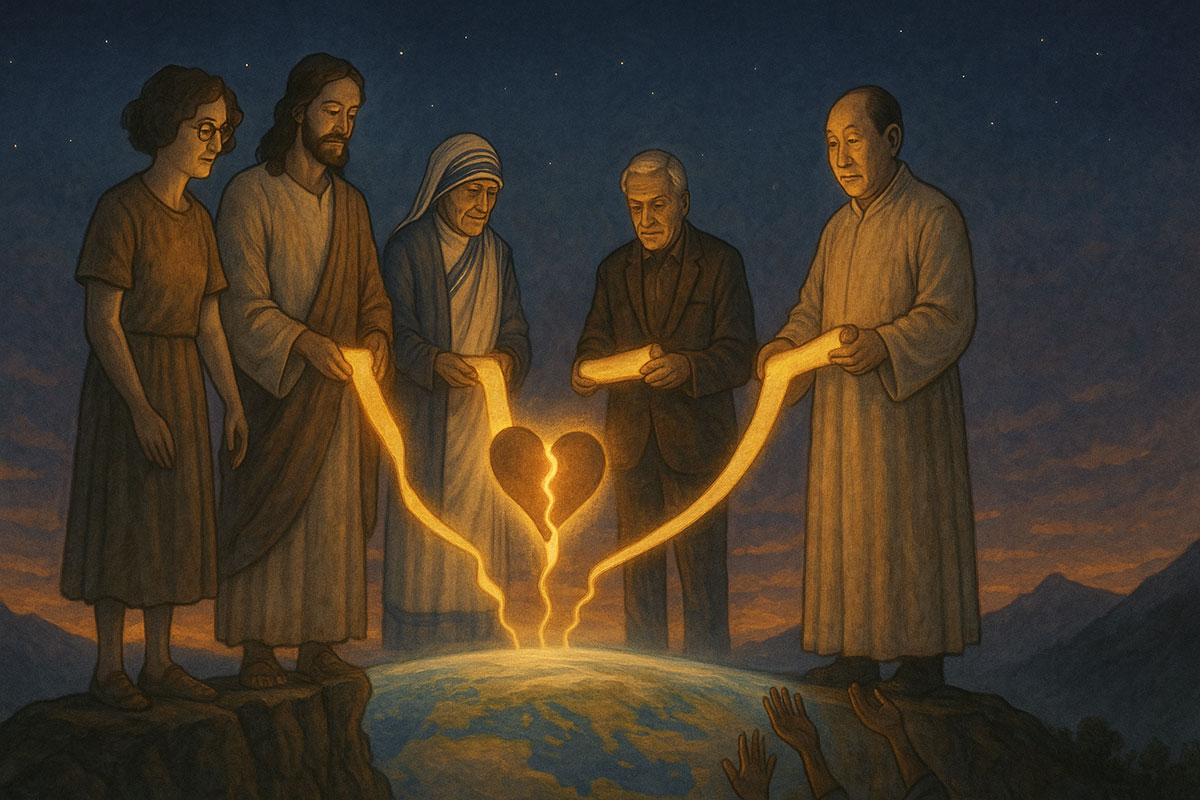
Moderator:
Simone Weil
Participants:
Jesus Christ, Mother Teresa, Rev. Sun Myung Moon, Ravi Zacharias, Simone Weil
Simone Weil (moderator):
Many people ask: Why doesn’t God stop suffering? Others ask: If God is our Parent, why does He seem so silent when we cry?
But what if the better question is: What does God want from us as we grow?
Let me begin with this:
Does God still carry the full responsibility for this world—or has some of that been passed to us as His maturing children?
Rev. Sun Myung Moon:
When God created us, He gave us not only life—but freedom and responsibility. A loving parent doesn’t do everything for their child. God suffers not because He is powerless, but because He has trusted us to build His dream. Until we choose to love, God waits. Until we reconcile, God cannot rest.
Mother Teresa:
God is not absent. He is in every broken person we pass by. He’s in the cry of the child, the silence of the dying, the loneliness of the poor. When we ignore them, we ignore Him. We are His hands and feet now. He waits in our willingness.
Ravi Zacharias:
There is mystery here. God is sovereign, yet not controlling. The cross reveals both His power and restraint. He could force us—but love never forces. Maturity means stepping into the pain of others without always blaming God for it. We are not puppets. We are stewards.
Jesus Christ:
The Father never left you. But He refuses to love instead of you. He wants children, not slaves. I said, “Be perfect as your Father is perfect.” That doesn’t mean without flaw—but full in love. As you grow in love, you take on more of His burden. That is divine maturity.
Simone Weil:
Thank you. Now let us go deeper:
Why does God seem silent in the face of human suffering—and what does that silence ask of us?
Mother Teresa:
I lived with that silence for fifty years. At first, I thought it meant God had abandoned me. Later, I understood—it was an invitation. Silence draws us deeper. It makes us listen harder. It asks: Will you still love when there is no reward? That’s when love becomes real.
Rev. Sun Myung Moon:
God’s silence is the silence of heartbreak. He cries behind the veil. He watches humanity tear itself apart, waiting for one child to say, “I will take responsibility.” When we blame God, we stay childish. When we act on His behalf, we become His heirs.
Jesus Christ:
I cried out too—on the cross: “My God, why have You forsaken me?” That cry was for you. It was also a model. Sometimes, love walks through silence so others don’t have to. The silence is not absence. It’s trust. It is the womb of resurrection.
Ravi Zacharias:
God’s silence does not mean His indifference. It often means His patience. He waits for us to become the answer to the very prayers we’re praying. That is not abandonment. It is delegation. It is the dignity of divine partnership.
Simone Weil:
Indeed. Sometimes the silence of God is the space where human courage must be born.
So I ask our final question:
What does spiritual maturity actually look like in today’s world—and how can we each begin to live it?
Rev. Sun Myung Moon:
It looks like someone who no longer blames—but builds. Someone who no longer separates—but reconciles. Someone who says, “God, I will make You proud—not with words, but with my daily love.” Maturity means you carry not only your own burden, but your Father’s dream.
Ravi Zacharias:
It means asking harder questions—but with softer hearts. It means defending truth without losing kindness. It means standing for justice while kneeling in humility. Maturity balances courage with compassion, clarity with grace.
Mother Teresa:
It’s very simple. Love anyway. Even when ignored, love. Even when mocked, love. Even when it hurts, love. Maturity means choosing love not as a reaction—but as your identity. Don’t wait for the world to change. Be the warmth God wants to send through your hands.
Jesus Christ:
You become mature when you become merciful. When your first instinct is to forgive. When you bless those who curse you. When you wash feet instead of waiting to be served. Maturity is not power—it is likeness. Be like the Father who loves without condition.
Simone Weil (closing):
So we see: God has not abandoned responsibility.
But He has shared it.
The silence is not the void of apathy—it is the stage for your courage.
Maturity is not only about belief, but about how much of God’s heart you’re willing to carry.
Ask yourself today: Can I hold more of that weight—and still love?
Topic 5: The Mirror of Heaven — How Love Will Judge Us
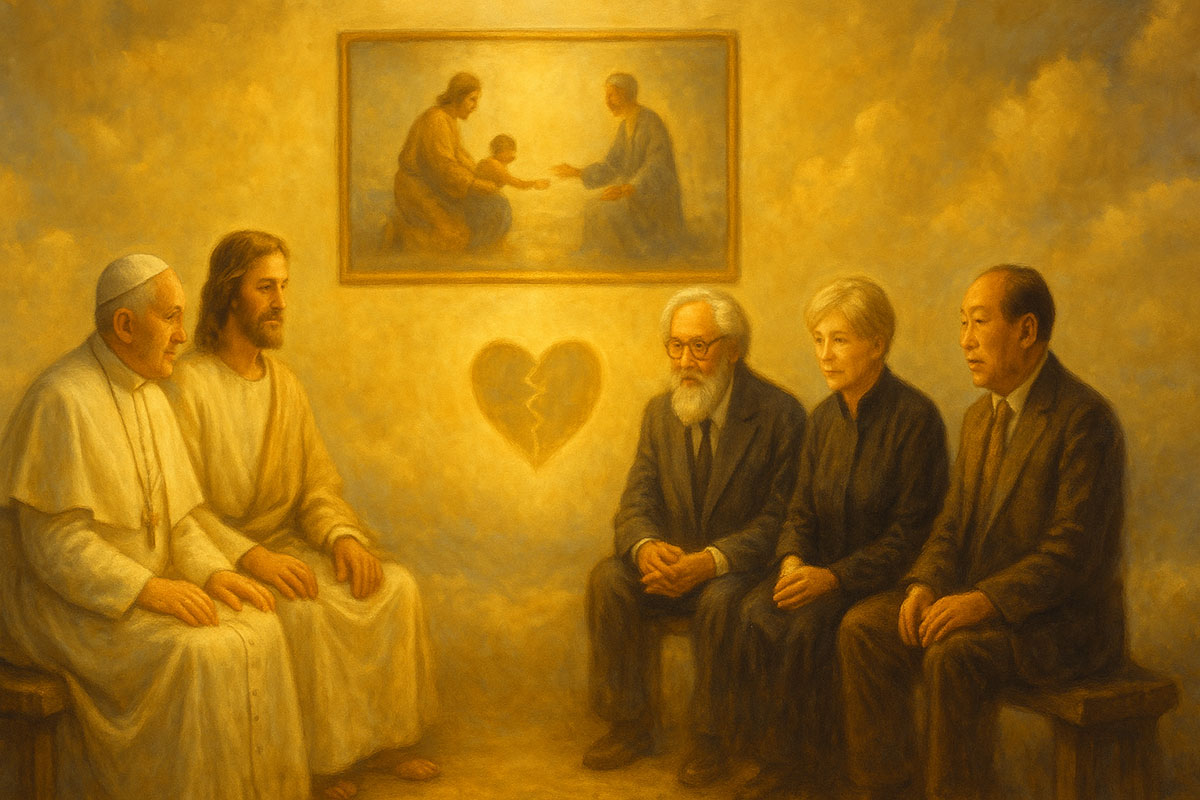
Moderator:
Fred Rogers
Participants:
Jesus Christ, Rumi, Maya Angelou, St. Francis of Assisi, Fred Rogers
Fred Rogers (moderator):
When our lives are over, and we finally stand before God—what will matter most? Not our accomplishments, or titles, or wealth… but love.
So I ask this gently, with hope and humility:
How will love judge us in the end? What will Heaven remember most about the lives we lived?
Jesus Christ:
Not your success, but your sacrifice. Not the crowds you drew, but the one person you comforted when no one was looking. Love will not ask how loud you preached, but how quietly you forgave. Heaven remembers the tears you wiped, the enemies you embraced, the meals you shared with the forgotten. That is what echoes.
Maya Angelou:
People may forget what you said. They may forget what you did. But love remembers how you made them feel. That feeling—that warmth, that dignity you offered—that is your legacy. The heart is a recording studio. It remembers tone more than lyrics. God listens there.
St. Francis of Assisi:
When I die, I hope Heaven remembers how I loved the birds, the lepers, the trees, and even the wind. All creation is family. God gave me nothing but His love, and I gave it back by living simply. The mirror of Heaven reflects how empty of self we became—so God could be visible through us.
Rumi:
Love is the only light that casts no shadow. When we die, the body falls, the name fades, but love? It rises. The soul becomes what it has loved. If you loved deeply, truly, madly—Heaven already knows your name. It is written not in books, but in the warmth you left behind.
Fred Rogers:
And I believe the way you made one person feel safe…
That alone might save the whole world in God’s eyes.
So let me ask this:
Why do we so often forget love is the most important measure—and how can we keep it at the center of our lives, especially when the world pulls us in every other direction?
St. Francis of Assisi:
Because we are afraid. Afraid that simplicity is not enough. Afraid that kindness won’t protect us. But love is not fragile—it is eternal. When you strip away power and noise, love is still there, like sunlight on water. Begin your day with praise, and end it with compassion.
Jesus Christ:
The world teaches self-preservation. I teach self-giving. You forget love because you are surrounded by fear. But perfect love casts out fear. When you remember that you are loved by the Father, you can love without limits. And that is freedom.
Rumi:
We forget because we are distracted by things that rot. Your fame, your beauty, your argument—they decay. But one act of love creates eternity. Remember love by loving. Each day, place your heart in someone else’s hands—and smile.
Maya Angelou:
It’s hard to love when you’ve been hurt. I know. But darling, if you let the pain close you, you shrink. If you let love open you, you rise. Let your life be a healing balm. Not perfect. Just present. Show up with love. That’s enough.
Fred Rogers:
Sometimes we forget love because we’re too busy trying to prove we matter. But you already matter. You don’t have to do anything spectacular. Just love the people right in front of you. That’s how love wins—quietly, steadily, over time.
Fred Rogers (continued):
For our final question today, one that humbles me:
If we could each meet God face-to-face tonight, and He asked, “How did you love?”—what would you hope to say, and what would you want Him to see?
Rumi:
I would say, “I tried to make every breath a prayer.” I would want Him to see that I kept returning to love, even when I wandered. That I turned pain into poetry, and longing into lanterns for others.
Maya Angelou:
I’d say, “Lord, I did my best to love folks like You love me—deeply and without apology.” I’d want Him to see the people I lifted when I was still bleeding myself. That I didn’t wait to be whole to be kind.
St. Francis of Assisi:
I’d say, “I made peace with the ants and the stars.” I’d want Him to see a man who gave away his cloak and found Heaven in bare feet and singing winds. A man who loved quietly, like rain.
Jesus Christ:
I would not speak—I would show My wounds. They are My love made visible. And I would ask you, “Did you let your wounds become love too?” If you did, the Father will see Himself in you.
Fred Rogers (closing):
I would say, “Lord, I tried to make people feel seen.”
And I hope He sees the children I helped smile, the broken I listened to, and the quiet ways I loved in the shadows.
Because in the end, the mirror of Heaven does not reflect your image…
It reflects the faces you made feel beloved.
Final Thoughts
God (as Divine Parent)
You have heard their voices.
You have felt the ache behind their wisdom.
You have seen what love can become when it is stretched, broken, mended, and made holy.
And now, I ask you again—not with wrath, but with wonder:
How will you love, from this moment on?
My heart has been waiting—not for grand gestures, but for honest return.
Waiting for one sibling to reach for another.
Waiting for one enemy to become a friend.
You think love is weakness?
Look again.
Love is the only power that outlasts death.
You worry that your kindness won’t be remembered?
I remember.
Every time you held your anger, I saw it.
Every time you forgave in silence, I wept with joy.
You say the world is too divided, too far gone.
But I see the seeds already growing—
in your laughter,
in your tears,
in your smallest acts of courage.
You do not have to change the world in a day.
Just love someone enough to keep My dream alive.
Remember:
You were born not to compete, but to complete one another.
Not to dominate, but to dwell together.
Not to be right,
but to become real in love.
And when you love like that—
Heaven is not far.
Heaven is home.
And I…
I will be there waiting.
Always.
Short Bios:
Jesus Christ
Central figure of Christianity, known for His teachings on love, forgiveness, and radical compassion. His life and sacrifice represent the divine standard of love for all humanity.
Rev. Sun Myung Moon
Founder of the Unification Movement. Taught that God is a parent and humanity is one family under God, emphasizing enemy love and the healing of God’s heart.
Pope Francis
Current leader of the Catholic Church, known for his humility, mercy-centered theology, and call to love the marginalized and bridge religious divisions.
Rabbi Abraham Joshua Heschel
Jewish theologian and civil rights activist who spoke of God’s heartbreak over injustice. Believed true faith requires moral action and compassion.
Karen Armstrong
Former nun and scholar of comparative religion. Advocates for interfaith understanding and the central role of compassion in all major faiths.
Martin Luther King Jr.
Christian pastor and civil rights leader who taught nonviolence and enemy-love as the only path to true justice and reconciliation.
Desmond Tutu
South African Anglican archbishop and human rights leader. Advocated forgiveness and Ubuntu—"I am because we are"—to heal post-apartheid wounds.
Thich Nhat Hanh
Vietnamese Zen Buddhist monk, peace activist, and teacher of mindfulness and compassionate presence in daily life—even toward enemies.
Immaculée Ilibagiza
Rwandan genocide survivor who forgave her family’s killers. Her story is a testimony to the liberating power of forgiveness and faith.
Malala Yousafzai
Pakistani activist for girls' education and the youngest Nobel Peace Prize laureate. Survived a Taliban assassination attempt and continues to speak for equality and unity.
Nelson Mandela
Anti-apartheid revolutionary and former President of South Africa. Emphasized reconciliation, forgiveness, and human dignity over revenge.
Dalai Lama
Spiritual leader of Tibetan Buddhism. Advocate of global compassion, nonviolence, and seeing all people as part of one human family.
Simone Weil
French philosopher and mystic who explored suffering, silence, and the deep moral responsibility of the soul before God and others.
Mother Teresa
Catholic nun and missionary who served the poorest of the poor in Calcutta. Known for her acts of quiet love and enduring faith amid spiritual dryness.
Ravi Zacharias
Christian apologist who addressed complex moral and philosophical questions about God, suffering, and responsibility with clarity and grace.
Rumi
13th-century Persian poet and Sufi mystic. His writings express ecstatic divine love and the eternal call to return to the heart of God.
Maya Angelou
American poet, memoirist, and civil rights voice. Her works champion dignity, love, and the deep humanity found in everyday kindness.
St. Francis of Assisi
Catholic saint known for his radical simplicity, love of nature, and living example of Christ’s humility and peace.
Fred Rogers
Television host and Presbyterian minister whose children’s program Mister Rogers’ Neighborhood modeled gentleness, empathy, and unconditional acceptance.
Leave a Reply