
|
Getting your Trinity Audio player ready...
|

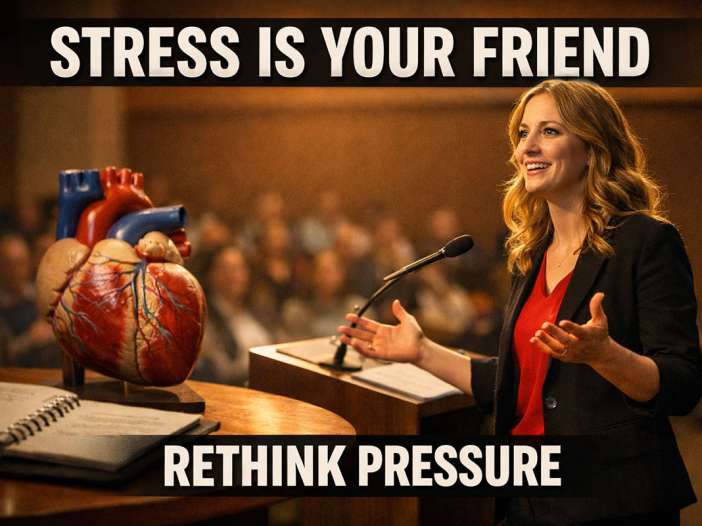
What if Kelly McGonigal guided high-performance thinkers through the real science of stress?
Introduction by Kelly McGonigal
When we talk about stress, most of us imagine something harmful — something to reduce, escape, or eliminate. We’ve been told for decades that stress is the enemy of health, productivity, and happiness. And for many people, that belief feels true. Stress feels overwhelming. It feels exhausting. It feels dangerous.
But what if part of the harm isn’t stress itself — but the story we’ve been telling about it?
In my research and teaching, I’ve discovered something that surprised even me: how we think about stress changes how it affects us. When we believe stress is harmful, our bodies respond differently. When we see stress as a sign that something matters — as energy preparing us to meet a challenge — our biology shifts in measurable ways.
Stress is not simply anxiety. It is not weakness. It is your body mobilizing resources. Your heart beats faster to deliver oxygen. Your breathing changes to fuel action. Hormones are released to sharpen focus and strengthen connection.
The question is not “How do I avoid stress?”
The question is “How do I relate to it?”
In this conversation, we explore what stress really is, how mindset transforms its impact, why connection is one of its most powerful effects, and how meaning can turn pressure into purpose.
Stress is not your enemy. It may be your body’s way of saying: This matters.
(Note: This is an imaginary conversation, a creative exploration of an idea, and not a real speech or event.)
Topic 1: Stress Isn’t the Enemy — The Mindset That Changes Outcomes

Moderator: Daniel Kahneman
Participants: Kelly McGonigal, Alia Crum, Robert Sapolsky, Lisa Feldman Barrett, Martin Seligman
The setting is a quiet lecture hall after hours, the kind with soft amber lights left on for the custodial staff. Five chairs form a half-circle facing a small round table with water glasses and a stack of blank notepads. No slides. No performance. Just the honest, slightly charged feeling of people about to re-learn something they thought they already knew.
Daniel Kahneman sits in the moderator’s chair with the gentle seriousness of someone who knows how easily the mind turns uncertainty into certainty. Kelly McGonigal is beside him, calm and alert. Across from her sit Alia Crum, Robert Sapolsky, Lisa Feldman Barrett, and Martin Seligman—a group that spans mindset research, neuroendocrinology, constructed emotion, and positive psychology.
Daniel Kahneman: Let’s begin with a puzzle that should not be a puzzle. Two people experience heavy stress. One collapses—health worsens, mood worsens, life shrinks. The other stays functional, sometimes even grows. If stress can harm us, why do some people under heavy stress remain healthy—and others don’t?
Kelly McGonigal: The story people tell themselves about stress is often the hidden variable. Stress is not one thing; it’s a response that can be mobilizing or corrosive depending on context, duration, and meaning. When people believe stress is toxic, they tend to respond to stress sensations with fear, shame, and avoidance. That adds a second layer of distress on top of the original stressor. But when people see stress as a signal—“this matters”—they often engage more constructively. They seek support, prepare, and persist. That doesn’t make stress “good,” but it changes how the body and mind carry it.
Alia Crum: I’d add that mindset influences the stress response itself. When people hold a “stress-is-enhancing” mindset, they’re more likely to experience stress as energizing and performance-supportive. They also show different physiological patterns under pressure—more adaptive cardiovascular responses and better recovery, in many contexts. The key is not pretending life is easy; it’s changing how the body interprets demands. Two people can face similar stressors, but their interpretation changes downstream biology and behavior.
Robert Sapolsky: I want to protect the integrity of the problem. Some people “do better” under stress because their stressors are episodic and solvable, and they have resources—control, social support, safety, money, time. Others face chronic, inescapable stress with low control: poverty, discrimination, unstable housing, caregiving without respite. That kind of stress is biologically punishing. So yes, belief matters—but resources and control matter enormously. If we turn this into “just reframe it,” we risk blaming people for the harm done by circumstances.
Lisa Feldman Barrett: I agree with Rob, and I’ll connect it to how the brain works. The brain is constantly predicting and regulating the body. It makes meaning from sensations using past experience and culture. If your history has taught you that arousal signals danger, your brain will categorize that arousal as anxiety or threat and allocate resources accordingly. If your history has taught you that arousal can mean readiness, your brain may build a different experience, one that supports action. But your brain is also constrained by your body’s budget—sleep, nutrition, safety, predictability. Chronic stress depletes the budget, making it harder to construct resilient states.
Martin Seligman: From the lens of learned helplessness and explanatory style, one major divider is whether people believe they can act effectively. Under stress, those who feel agency—who believe their actions matter—are less likely to become depressed and more likely to problem-solve. Those who feel helpless often spiral into passivity and rumination. Optimism isn’t cheerfulness. It’s the belief that there are routes forward. When stress arrives, the question becomes: “Is there something I can do?” If the answer is consistently “no,” the system breaks down.
Daniel Kahneman: So we’re hearing a layered answer: meaning and mindset matter, but so do control, resources, and the body’s budget. Let’s go deeper into mechanisms. What exactly changes in the body when someone believes “stress is dangerous” versus “stress is helpful”?
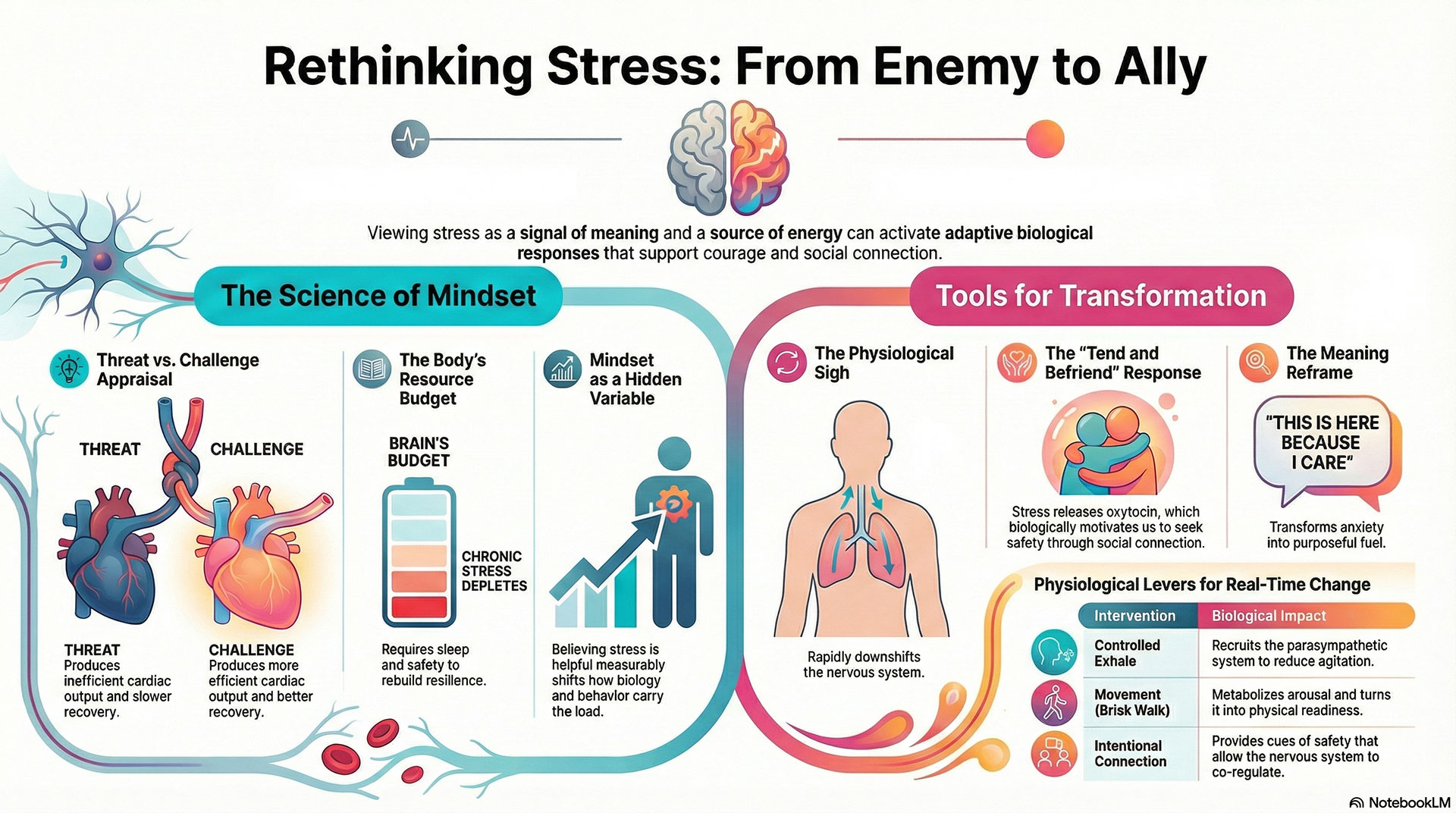
Alia Crum: Beliefs shape the stress response along multiple pathways. If you believe stress is harmful, you’re more likely to interpret stress sensations as signs of breakdown—“I can’t handle this”—which increases threat appraisal. Threat appraisal tends to produce a more constricted cardiovascular pattern, greater vigilance, and behaviors like avoidance or shutdown. If you believe stress can help, you’re more likely to experience arousal as readiness. That aligns with challenge appraisal—more efficient cardiac output, less vascular resistance, and more approach behavior. It’s not that the stressor disappears. It’s that the body responds as if it’s preparing to meet a demand rather than being overwhelmed by it.
Kelly McGonigal: And subjectively, the difference is huge. The same pounding heart can become “I’m about to fail” or “My body is giving me fuel.” That interpretation changes whether people show up. It changes whether they ask for help. It changes whether they treat stress as evidence they should quit or evidence they care enough to try. Even recovery changes. When people stop fighting their own stress response, they often spend less energy on internal conflict, which reduces the cascade of secondary stress.
Robert Sapolsky: Mechanistically, the stress system is designed for acute challenges. Hormones like adrenaline and cortisol mobilize energy. That’s useful briefly. But if the belief “stress is dangerous” makes you catastrophize, you can keep the system turned on longer and more often—more rumination, more anticipatory anxiety, more chronic activation. Over time, chronic activation contributes to inflammation, metabolic issues, immune changes. But again, belief isn’t the only driver of chronic activation—environment is. The body doesn’t care whether the stress is from a predator, a boss, or a rent notice; the chemistry is similar.
Lisa Feldman Barrett: I’d phrase it as: belief changes categorization, and categorization changes regulation. Your brain is an organ of prediction. If it predicts danger, it prepares you for danger. That preparation is expensive. It reallocates resources, changes heart rate, changes breathing, changes attention. If it predicts challenge, it still prepares—but with a different profile that supports engagement. These are not separate emotions floating in the air. They are brain-made experiences built from body signals plus meaning. And you can train meaning through language and repeated experiences of “I can do this.”
Martin Seligman: Also, belief changes what people do next. Even if physiology were identical—which it’s not—belief influences coping. A person who believes stress is harmful may avoid challenges, isolate, or self-medicate. A person who believes stress can be useful may seek social support, practice, and persist. Those choices compound. Over months and years, the “belief → behavior → outcome” loop can be decisive.
Daniel Kahneman: That loop is important. Belief changes appraisal, appraisal changes physiology, physiology and belief both change behavior, and behavior changes long-run outcomes.
He pauses, then shifts to the ethical line everyone worries about.
Daniel Kahneman: Where’s the boundary between empowering reframes and ignoring real chronic stress caused by life conditions? In other words: how do we keep this from becoming a comforting story that papers over harsh realities?
Robert Sapolsky: The boundary is simple: never use reframe as a substitute for justice or for structural change. If someone is being crushed by chronic stressors—poverty, unsafe environments, discrimination—telling them to “change their mindset” without changing conditions is morally wrong and scientifically shallow. Reframe can be a tool for survival, yes. But the primary intervention must be reducing the chronic stressor or increasing control and support.
Kelly McGonigal: I’m with Rob. My goal is not to romanticize stress or to tell people to tolerate the intolerable. The empowering reframe is meant for moments when stress is unavoidable or when stress arises because you are doing something meaningful—parenting, caregiving, building a career, speaking up. But it should also help people recognize when stress is signaling harm—when boundaries are needed, when help is needed, when systems need changing. Befriending stress includes listening to what it’s telling you, not overriding it.
Alia Crum: In research and in practice, I like to say: reframe is not denial. It’s interpretation in service of action. If the stressor is unjust, a healthy mindset might increase your capacity to respond—advocate, seek resources, build community—rather than collapse. The question becomes: “What belief helps me take effective action here?” Sometimes that means “I can handle this.” Sometimes it means “This is not acceptable and I will seek change.” Mindset can support both resilience and resistance.
Lisa Feldman Barrett: I’d add that environments shape brains. If we repeatedly place people in situations that deplete their body budgets, we are setting them up for suffering, regardless of mindset. We should not individualize what is structurally produced. But at the same time, people live in bodies now, today, and helping them build skills—like emotional granularity, reframing, and social support—can reduce suffering and increase agency. The ethical approach is both/and: improve conditions and build skills.
Martin Seligman: Exactly. We can honor reality and still cultivate agency. The danger is moralizing. When reframing becomes “If you’re stressed, you’re doing it wrong,” we’ve simply replaced one single story with another. The healthier message is: there are tools that change how you experience stress, but you also deserve conditions that don’t grind you down. Optimism should never be used to silence complaint. It should be used to enlarge possibility.
Daniel Kahneman: That’s a clean boundary. Reframing is a tool, not a verdict. It supports action, not denial. And it must never replace the work of changing harmful conditions.
He closes his notebook, as if to signal: we’ve built the foundation.
Daniel Kahneman: So Topic 1 gives us the spine of the whole series. Stress is not a single thing. Belief and meaning can shift physiology and behavior, but resources, control, and environment remain decisive. If we do this responsibly, we offer people a skill without blaming them for the burdens they carry.
Kelly McGonigal: And we also return stress to its rightful place—as a sign of engagement, not a sign of failure.
Alia Crum: As a signal that can be shaped.
Lisa Feldman Barrett: As an experience the brain constructs with meaning.
Robert Sapolsky: As biology that needs both compassion and structural realism.
Martin Seligman: As a challenge that can build strength when agency and support exist.
Daniel Kahneman: Next, we move from belief into the body itself—threat versus challenge, and how to steer the stress response in real time.
Topic 2: The Biology of Stress — Threat vs Challenge

Moderator: Andrew Huberman
Participants: Kelly McGonigal, Wendy Suzuki, Stephen Porges, David Spiegel, Kelly Lambert
The lecture hall subtly transforms into a working lab classroom—still warm, still human, but more instrument-ready. On a side table sits a simple anatomical heart model and a few clipboards with blank forms. A metronome ticks softly, more like a reminder of rhythm than pressure. Everyone is seated as if they’re about to turn stress into something you can actually operate—not just “feel.”
Andrew Huberman moderates with practical intensity. Kelly McGonigal is present, calm and engaged. The panel includes Stephen Porges, Wendy Suzuki, and David Spiegel—a blend of nervous system theory, neuroscience of movement and mood, and clinically-tested tools for attention and stress regulation.
Andrew Huberman: Let’s build from Topic 1. People hear “stress can help you,” and immediately ask: How? In the body, what’s the fastest way to shift from threat physiology to challenge physiology in real time—something you could actually do before a meeting, a speech, or a hard conversation?
Kelly McGonigal: The fastest shift begins with interpretation paired with one physical cue. I tell people: notice the stress sensations and say, “My body is helping me meet this.” That line matters because it changes how you relate to the arousal. Then do something that signals safety and agency—lengthen your exhale, relax your jaw, or stand in a grounded posture. You’re telling your nervous system: “We’re not trapped. We’re preparing.”
David Spiegel: I’d go straight to the breath as a lever. The simplest actionable move is extending exhale relative to inhale. It’s a way to recruit the parasympathetic system. If you can’t think your way out of threat, you can breathe your way toward regulation. Another fast move is what many people call physiological sighing—two quick inhales followed by a long exhale. That can reduce agitation quickly because it changes gas exchange and calms the body.
Wendy Suzuki: I’d add movement, even micro-movement. Threat often locks the body. A short burst of physical action—walking briskly, a set of stairs, even shaking out your hands—can metabolize arousal and turn it into readiness. The brain interprets movement as “I’m doing something,” which changes the emotional outcome. People forget: the stress response wants an outlet. Give it one.
Stephen Porges: The “fastest” shift depends on whether the nervous system is in a state where it can access social engagement. When people are deeply in threat, they often lose that access—they become rigid, defensive, shut down. The pathway back is through cues of safety: prosody in your voice, warm facial expression, gentle eye gaze, a sense of connection. Even briefly making contact with a trusted person—hearing a calm voice—can downshift threat. The nervous system does not regulate in isolation as easily as we pretend it does.
Andrew Huberman: So, real-time shift is: reinterpret sensations as support, use breath as a direct lever, move to discharge arousal, and use cues of safety—especially social cues—when available.
He flips to the next question, more granular.
Andrew Huberman: Which parts of the stress response are actually performance-enhancing—and which parts become damaging? People hear adrenaline and cortisol and think “bad.” But that’s not accurate.
Kelly McGonigal: Exactly. Adrenaline is often performance-enhancing. It increases energy, focus, and readiness. Faster heart rate can improve blood flow to muscles and brain. Even that “butterflies” feeling can sharpen attention. The damaging part is prolonged activation without recovery, or activation combined with the belief “this is killing me,” which adds fear and rumination. Stress helps you rise—then you need to come down.
Wendy Suzuki: In the brain, moderate stress can increase alertness and support memory formation in certain contexts. But chronic stress impairs the hippocampus and prefrontal cortex—systems involved in learning, working memory, and emotional regulation. That’s why people under chronic stress feel foggy, reactive, and exhausted. The difference is dosage and duration, and whether the person has recovery and social support.
David Spiegel: I’d say the helpful part is focused arousal. The harmful part is uncontrolled arousal plus narrowing that becomes panic or rumination. Techniques like self-hypnosis—really, focused attention plus mental imagery—can reduce the harmful narrowing. People can learn to shift attention deliberately, rather than be pulled around by stress. That’s what keeps the stress response from becoming a loop.
Stephen Porges: Physiologically, the stress response isn’t “bad” until it becomes a persistent state where the system cannot return to regulation. If you live in threat, your body behaves as if danger is constant: digestion, immune function, and restorative processes suffer. Performance in the short term may still happen, but the long-term cost is high. The key is flexibility—moving between states rather than getting stuck.
Andrew Huberman: Flexibility is the word. Stress as a wave you ride, not a place you live.
He leans into the most useful question for your readers.
Andrew Huberman: If someone changes only one habit to improve stress resilience, what should it be—and why? One habit, not a laundry list.
David Spiegel: I’d choose a daily practice of deliberate downshifting through breath—two minutes, consistent. Not for relaxation as a luxury, but as training your nervous system to return to baseline. You’re building a reliable “off switch.” Without that, resilience is wishful thinking.
Wendy Suzuki: I choose daily movement. Even 10–20 minutes of brisk walking. Exercise is one of the most robust interventions we have for stress resilience because it changes brain chemistry, mood, sleep quality, and cognitive flexibility. It makes the stress system better at turning on and turning off.
Stephen Porges: I choose intentional social connection—one meaningful, safe interaction daily. The nervous system co-regulates. A supportive conversation, warm eye contact, laughter, even singing. These are not sentimental extras; they are biological interventions. Connection is a cue of safety.
Kelly McGonigal: I choose meaning-making in the moment: when stress appears, practice one sentence—“This is here because I care.” It transforms the relationship with stress. And it stops the secondary stress of self-judgment. It’s not enough alone, but it’s powerful because it changes what you do next.
Andrew Huberman: I’ll add one that integrates all of these: consistent sleep timing. But if I must pick one habit that most people underestimate, it’s breath training because it’s portable and fast. Still, movement and social connection may be the biggest levers for many people.
He pauses, then sums up with the kind of clarity people can actually remember.
Andrew Huberman: So Topic 2 gives us mechanics. Threat versus challenge is not an abstract idea—it’s state. You can shift state with breath, posture, movement, and cues of safety. Stress enhances performance when it’s acute, meaningful, and followed by recovery. It becomes damaging when it’s chronic, stuck, and paired with helplessness. And resilience grows from a single dependable habit practiced daily.
Kelly McGonigal: And when people learn to steer their state, stress becomes less terrifying.
Wendy Suzuki: Because your brain regains flexibility.
Stephen Porges: Because your nervous system regains safety.
David Spiegel: Because attention becomes a skill, not a hostage.
Andrew Huberman: Next, we move into something many people don’t expect: stress doesn’t only prepare you to fight or flee. It can also prepare you to connect.
Topic 3: Stress Makes Us Social — The “Tend and Befriend” Advantage

Moderator: Brené Brown
Participants: Kelly McGonigal, Shelley Taylor, Naomi Eisenberger, Julianne Holt-Lunstad, Vivek Murthy
The lab classroom softens into a warm community room—chairs in a circle, a small table with tea, water glasses, and a bowl of oranges. There’s the kind of quiet that feels like permission. Stress tends to make people feel alone; this room feels like the opposite. The lighting is gentle, and the mood says: you don’t have to be impressive here.
Brené Brown moderates with grounded compassion and clear edges. Kelly McGonigal is present, calm and engaged. The panel includes Shelley Taylor, Naomi Eisenberger, and Vivek Murthy—people who understand that connection is not a luxury, it’s biology.
Brené Brown: Most of us were taught the stress story as fight or flight. But Kelly, you’ve talked about stress making us social—tend and befriend. So let’s start there. Why does stress sometimes push us toward connection, and other times push us toward isolation, irritability, or shutdown?
Kelly McGonigal: Stress amplifies what we’re already trained to do. Biologically, there are pathways that push us toward connection—oxytocin, caregiving instincts, seeking safety in others. But psychology and culture can override that. If someone believes “I’m a burden,” they isolate. If they’ve learned that vulnerability is dangerous, they shut down. If they’ve been repeatedly hurt in relationships, stress can trigger defense rather than reaching out. So the biology offers the possibility of connection, but experience and meaning decide which door we walk through.
Shelley Taylor: Exactly. Tend and befriend is an adaptive response—particularly when fighting or fleeing isn’t optimal. Under stress, many people are motivated to protect, to seek allies, to nurture. That’s not weakness; it’s strategy. But if someone lacks safe social bonds, or if their environment is unpredictable, the same stress response can shift toward vigilance and irritability. In short: the social response depends on whether the nervous system believes connection is safe.
Naomi Eisenberger: And the brain treats social threat as real threat. Rejection, exclusion, humiliation—these can activate neural systems overlapping with physical pain. Under stress, people become more sensitive to social cues. If you already feel uncertain about belonging, stress can make you interpret neutral faces as judgment. That leads to withdrawal or defensiveness. But if you feel supported, stress can push you toward others because the brain expects relief and safety there.
Vivek Murthy: I’ll add the public health lens: modern life has weakened our relational infrastructure. People are stressed, but they don’t have built-in community buffers. When connection isn’t readily available, the stress response has nowhere to go but inward. That’s how stress becomes loneliness, and loneliness becomes a compounding health risk. We’re dealing with a mismatch: intense demands paired with thin social support.
Brené Brown: That’s the heartbreak. Stress could push us toward each other, but shame and disconnection reroute it into isolation.
She leans forward slightly—gentle, but pointed.
Brené Brown: Let’s talk about the skill of support. When people finally reach out, they often do it in a way that backfires—vague venting, apologizing for needs, or asking for everything at once. How do we ask for support in a way that actually helps, without guilt, shame, or conflict?
Vivek Murthy: Specificity changes everything. “Can you listen for five minutes?” “Can you help me think through options?” “Can you sit with me while I calm down?” People want to help, but they don’t know what to do. When the request is clear, it reduces misfires. Also, choose the right person—support isn’t one-size-fits-all. Some friends are great for empathy, some for practical help, some for perspective.
Kelly McGonigal: I teach a simple phrase: “I’m having a hard moment, and I don’t need you to fix it. I just need you to be with me.” That eliminates the fear that your pain is a project. It also reduces shame because you’re not presenting your need as a problem. You’re presenting it as human. And when you do need problem-solving, say so directly. The clarity is protective.
Naomi Eisenberger: There’s also a nervous system component. If you’re asking while flooded, your request may come out as accusation or panic. One step before asking is regulation: one slow exhale, a hand on the chest, a brief pause—anything that lowers threat just enough to speak cleanly. Then your tone and face provide cues of safety, which make the other person more receptive.
Shelley Taylor: And I’ll add that giving support is part of receiving it. When you approach someone with mutuality—“I’d love your help, and I’m here for you too”—it strengthens bonds. People often fear being a burden, but relationships are built through reciprocity, not perfection. Asking for support can increase closeness when it’s framed as trust.
Brené Brown: That’s so important. Asking is not burdening. It’s trusting.
Her voice softens for the third question, because it’s where people confuse goodness with self-erasure.
Brené Brown: Kelly often says helping others during stress can improve health outcomes. But a lot of people—especially caregivers—slide from service into self-sacrifice. Can helping others during stress improve health, and what’s the difference between service and self-sacrifice?
Kelly McGonigal: Yes, helping can improve health because it creates meaning, connection, and agency. But service is not martyrdom. Service comes from strength and choice. Self-sacrifice comes from fear, guilt, or the belief that your needs don’t matter. If you’re helping while resenting, while depleted, while ignoring your limits, the body doesn’t interpret that as nourishing connection. It interprets it as continued threat.
Shelley Taylor: Service is aligned with care and boundaries. Self-sacrifice is care without boundaries. Biologically, supportive caregiving can be protective, but chronic caregiving without support is one of the most potent stressors we see. So yes, altruism can be beneficial, but it must be embedded in a network of mutual care and realistic limits.
Naomi Eisenberger: From the brain’s standpoint, connection is soothing when it’s safe and mutual. If you are helping in a way that erases you, it doesn’t produce safety. It can even increase social pain because you feel unseen. Healthy helping includes being seen and valued, not just being useful.
Vivek Murthy: From a societal view, we need to stop romanticizing burnout as virtue. Service should be supported by systems—time off, community help, fair policies—so individuals aren’t carrying everything alone. When we ask people to be endlessly self-sacrificing, we’re turning compassion into exploitation.
Brené Brown: That last line matters. Compassion should never be a doorway to exploitation.
She pauses, letting the room hold the point without drama.
Brené Brown: So Topic 3 gives us a different stress story: stress can be a push toward connection, not just survival. The social stress response depends on whether connection feels safe and available. Asking for help works best when it’s specific, regulated, and framed as trust—not shame. And helping others can heal when it’s service with boundaries, not self-sacrifice.
Kelly McGonigal: Befriending stress includes befriending other people—letting yourself be held, and holding others wisely.
Shelley Taylor: Connection is biology.
Naomi Eisenberger: Belonging is safety.
Vivek Murthy: And community is prevention.
Brené Brown: Next, we take stress into the arena—pressure, performance, and how to turn anxiety into fuel without losing yourself.
Topic 4: Pressure Performance — Turning Anxiety into Fuel
Moderator: Angela Duckworth
Participants: Kelly McGonigal, Anders Ericsson, Amy Cuddy, Steven Kotler, Carol Dweck
The community room becomes a rehearsal space—simple stage, a mic stand, a few rows of empty chairs. Off to the side: a water bottle, a towel, and a quiet corner where someone could breathe before stepping into the spotlight. It feels like the place where confidence is earned, not declared.
Angela Duckworth moderates with calm focus. Kelly McGonigal sits ready, practical and encouraging. The panel includes Carol Dweck, Anders Ericsson, and Amy Cuddy—growth mindset, deliberate practice, and presence. The tone is warm but serious: nobody here is selling “fearless,” they’re teaching “capable.”
Angela Duckworth: People say, “I want to be calm.” But in real life, pressure shows up and your body reacts. So let’s ask the most useful question first. Right before a high-pressure moment, what’s the best internal script—“calm down,” “get excited,” or something else entirely?
Kelly McGonigal: “Calm down” often backfires because it implies you shouldn’t feel aroused. But arousal is normal. A better script is: “This is my body helping me.” Or even more simply: “I’m ready.” Sometimes “I’m excited” works because excitement and anxiety share the same high arousal. The goal is to shift from avoidance to approach. You don’t need less energy—you need to stop interpreting energy as danger.
Carol Dweck: I’d frame it as: “This is a challenge moment, not a judgment moment.” When people believe stress means “I’m being evaluated,” they tighten and protect their ego. If they believe stress means “I’m growing,” they open up and learn. The script is a cue for mindset: “This is practice in real time.” That reduces the fear of being exposed.
Amy Cuddy: I like scripts that reconnect you to intention: “Be here.” “Connect.” “Speak one clear truth.” Pressure scatters attention into self-monitoring—“How am I doing?”—and that fuels anxiety. Intention pulls attention outward. And then your body follows. If your posture is open and grounded, the script lands deeper because your physiology isn’t contradicting it.
Anders Ericsson: Scripts matter, but reliability comes from preparation. Under pressure, you fall back on your training. The best script is the one that directs attention to the next practiced cue: “Start strong.” “Slow down.” “First sentence.” “First rep.” It’s not motivational. It’s operational. Anxiety often comes from uncertainty. Practice reduces uncertainty.
Angela Duckworth: So the best script isn’t one-size-fits-all, but it shares a theme: reinterpret arousal as readiness, shift from judgment to growth, anchor in intention, and direct attention to the next practiced step.
She moves into the deeper problem—why people “know” things and still freeze.
Angela Duckworth: How do you train so stress becomes a cue for execution, not a cue for panic? What changes in training—or in how we approach practice?
Anders Ericsson: You must practice under conditions that resemble performance. People often practice in comfortable environments and then expect it to hold up under pressure. Performance requires deliberate practice: clear goals, immediate feedback, repetition at the edge of ability. Add pressure gradually—timed drills, simulated audiences, stakes, evaluation—so the nervous system learns that stress signals “do the routine,” not “escape.”
Carol Dweck: And you must normalize mistakes as data. Panic often comes from the belief that mistakes mean you’re failing as a person. If you train with a growth mindset, mistakes mean you’re learning. That changes how you respond mid-performance. Instead of spiraling, you adjust. A resilient performer doesn’t avoid errors—they recover from them.
Kelly McGonigal: I’d add that you can train your relationship with stress itself. Practice welcoming the sensations. During training, intentionally notice your heart rate and say, “Yes, this is the feeling of effort.” When the body learns that arousal is safe and useful, it stops triggering alarm. Then stress becomes a familiar companion rather than a threat signal.
Amy Cuddy: Training also includes social safety. People perform better when they don’t feel humiliated for imperfection. If you practice in environments where feedback is respectful, your nervous system stays in a state where learning is possible. If practice is shame-based, you’ll associate stress with social threat, and your body will panic under evaluation.
Angela Duckworth: That’s key: pressure becomes manageable when training includes realistic simulation, respectful feedback, a learning orientation, and a practiced relationship with arousal.
She leans in for the third question, the one your readers will want as a “before I walk in the room” protocol.
Angela Duckworth: Give me a practical three-minute routine. Someone is about to walk into a high-stakes meeting or step on stage. What do they do to convert stress into performance?
Amy Cuddy: Start with the body. Stand grounded. Feet steady. Shoulders relaxed but open. Jaw unclenched. One slow inhale, longer exhale. Then set an intention: “Be clear.” “Be kind.” “Be present.” Your posture and breath create the physiological conditions for that intention.
Kelly McGonigal: Add meaning and approach. One line: “I care, and that’s why I feel this.” Then a second line: “Use this energy.” If it helps, label it as excitement. Not forced happiness—just an approach state. Finally, look outward: what do you want to give? A message, a contribution, a service. Outward focus reduces self-conscious panic.
Anders Ericsson: Do a micro-rehearsal of the first 10–20 seconds. The start is where many people derail. If you stabilize the beginning—first sentence, first movement—the nervous system settles. Then you can rely on practiced sequences rather than improvising under fear.
Carol Dweck: And remind yourself: “This is not a verdict on me.” It’s a moment of learning and contribution. When people make performance into identity, the stakes become existential. Reduce it back to process. That’s how you keep your mind available.
Angela Duckworth: Body, breath, intention, meaning, outward focus, micro-rehearsal, process mindset. That’s a real routine—not mystical, not fragile.
She pauses and looks at the quiet stage, as if imagining the person about to step forward.
Angela Duckworth: Let’s close Topic 4 with a truth that people forget. Stress is not the opposite of confidence. Stress is often the price of caring. When you train well, interpret arousal as readiness, and focus on process and contribution, pressure becomes fuel.
Kelly McGonigal: And you stop avoiding the rooms where your life could expand.
Carol Dweck: You become the kind of person who grows under challenge.
Anders Ericsson: You build skill that holds.
Amy Cuddy: And you show up with presence, not perfection.
Angela Duckworth: Next, we go to the deepest question: if stress keeps showing up, what might it be pointing to—meaning, courage, and a life you actually want.
Topic 5: Meaning, Courage, and the “Good Stress” Life

Moderator: Viktor Frankl
Participants: Kelly McGonigal, Irvin Yalom, Tara Brach, Ryan Holiday, Arthur Brooks
The rehearsal space fades into something simpler: a quiet morning room with a single wooden table near a window. Early light spills across the surface like a promise you didn’t ask for but needed anyway. There are no props here—no lab tools, no stage, no performance cues—because this final conversation isn’t about tactics. It’s about the reason you’d bother using tactics at all.
Viktor Frankl moderates with a calm steadiness that makes the air feel more honest. Kelly McGonigal sits near the window, thoughtful. With them are Irvin Yalom, Tara Brach, and Arthur Brooks—meaning, mortality, compassion, and the science of flourishing.
Viktor Frankl: We have spoken of mindset, biology, connection, performance. Yet stress continues to visit human life. Now I ask the question beneath all the others: If stress points to what we value, how do we tell the difference between meaningful stress and destructive stress?
Kelly McGonigal: Meaningful stress is usually connected to values—love, growth, responsibility, purpose—while still leaving room for recovery. It comes with a sense of “This matters,” even if it’s hard. Destructive stress often carries helplessness, chronic overwhelm, and a shrinking of life. It’s the kind of stress that makes you numb, cynical, or constantly braced. A helpful test is: does this stress pull me toward something I care about, or does it trap me in something that erodes me?
Irvin Yalom: I would add that destructive stress often masks an existential truth you’re avoiding—mortality, freedom, isolation, meaninglessness. People busy themselves into panic to avoid facing deeper decisions. But meaningful stress is different: it is the tension of choosing. It is the discomfort of becoming more honest. Destructive stress is frequently the discomfort of living a life that is misaligned.
Tara Brach: In the body, meaningful stress can feel intense but not poisonous. There is aliveness in it. With destructive stress, there’s contraction—an ongoing sense of threat, shame, or unworthiness. If you bring mindful attention, you can feel the difference. Meaningful stress says, “Pay attention.” Destructive stress says, “You’re not safe.” The path is to listen kindly: what is this asking for—care, boundaries, help, rest, truth?
Arthur Brooks: I’d make it practical. Meaningful stress serves something chosen. Destructive stress is often unchosen or poorly bounded. A person may choose to build a business, care for a parent, raise children, fight for justice—meaningful stress. But if the boundaries collapse—no sleep, no community, no rest, no delegation—meaningful stress can become destructive. So the difference isn’t only the mission; it’s the structure around the mission.
Viktor Frankl: So meaningful stress is tension in service of values; destructive stress is tension without agency, without recovery, and often without truth.
He asks the next question with gentle firmness.
Viktor Frankl: What does it look like to live bravely without turning your life into constant pressure? Many people confuse courage with perpetual strain.
Arthur Brooks: Brave living requires rhythm. People think happiness is excitement. But a good life is built with balance: work, love, friendship, rest, faith or philosophy—whatever your anchor is. If someone’s bravery becomes nonstop output, they are not brave; they are addicted to achievement. Courage includes the humility to rest and to be ordinary sometimes.
Kelly McGonigal: I love that. Befriending stress doesn’t mean worshiping stress. It means not fearing it. Brave living includes choosing what’s worth stress and letting the rest go. It means practicing “selective yes.” Stress becomes constant when everything feels urgent, when you try to earn your worth through busyness. Bravery is often the willingness to disappoint expectations that don’t match your values.
Irvin Yalom: And it includes confronting mortality. When you remember that your time is limited, you stop chasing every demand. You choose more deliberately. People often fill their lives with pressure because pressure makes them feel necessary. But necessity is not meaning. Meaning is intimacy, authenticity, and what you’re willing to stand for.
Tara Brach: Brave living includes self-compassion. Without it, courage becomes self-violence. The deepest bravery is staying present with discomfort without making yourself wrong for feeling it. You learn to be with fear, to hold it kindly, and then act from wisdom rather than reactivity. That kind of courage is sustainable.
Viktor Frankl: So bravery without constant pressure is discernment, rhythm, compassion, and choosing what is worthy.
He pauses, then asks the final question—simple, but it goes straight to daily life.
Viktor Frankl: What daily practice helps people befriend stress long-term, without needing motivation in the moment?
Tara Brach: A daily returning. Even two minutes. Pause, feel the body, place a hand on the heart, and offer a kind phrase: “This is hard.” “I’m here.” “May I be kind.” This practice trains the nervous system to stop treating stress as an emergency and start treating it as an experience you can meet with care.
Arthur Brooks: I’d say friendship and service—daily acts that move you out of self-absorption. Call someone. Encourage someone. Help someone in a bounded way. People are happier when they love, not when they obsess about themselves. Stress shrinks when life expands into connection and purpose.
Irvin Yalom: I recommend honest conversation. Tell the truth to one trusted person regularly. Not drama. Truth. Stress becomes destructive when it becomes secret. When you speak it aloud, you reclaim agency. And you remember you’re not alone, which reduces existential terror.
Kelly McGonigal: My practice is a single reframe: “This is stress, and it means I care.” I use it like a doorway. Then I ask, “What is the next helpful step?” Sometimes it’s action. Sometimes it’s rest. Sometimes it’s reaching out. Befriending stress is not one decision; it’s a relationship you renew daily.
Viktor Frankl: And I would offer this: choose a meaning worthy of your suffering. Then your suffering becomes bearable, even transforming. The human being can endure much when the “why” is clear.
The morning light continues its quiet work. Nobody is pretending the world is easy. They are simply refusing to live at war with their own humanity.
Viktor Frankl: We conclude. Stress is not proof you are failing. It may be proof you are alive to values, to love, to responsibility. But it must be guided by rhythm, compassion, and truth. Meaningful stress enlarges life. Destructive stress shrinks it. Your task is not to eliminate stress, but to choose what is worth it—and to build a life that allows recovery and connection.
Kelly McGonigal: Befriending stress is ultimately befriending your own heart—what it cares about, what it fears, and what it is capable of.
Irvin Yalom: And it is choosing authenticity over avoidance.
Tara Brach: And presence over resistance.
Arthur Brooks: And love over self-obsession.
Viktor Frankl: And meaning over despair.
Final Thoughts by Kelly McGonigal
If you remember only one thing, let it be this: your stress response is not broken.
It evolved to help you rise.
When your heart pounds before a presentation, that is not failure — it is readiness. When you feel tension before a difficult conversation, that is not weakness — it is care. When you feel pressure in the face of responsibility, that is often a signal of purpose.
The science is clear: believing that stress can help you changes how your body responds. Instead of constricting blood vessels in fear, your cardiovascular system can shift toward a healthier, challenge-oriented state. Instead of isolating you, stress can increase oxytocin — the hormone that motivates connection and courage.
Stress becomes toxic when we feel alone and powerless.
It becomes transformative when we see meaning and choose connection.
You cannot eliminate stress from a meaningful life. But you can transform your relationship with it.
The next time you feel your heart racing, try this simple shift:
“This is my body preparing me to rise.”
Because often, the presence of stress means you are standing at the edge of growth.
And growth is rarely comfortable — but it is always alive.
Short Bios:
Kelly McGonigal — Health psychologist and Stanford lecturer known for her research on stress mindset and resilience. Author of The Upside of Stress, she explores how beliefs about stress transform biology, performance, and well-being.
Daniel Kahneman — Nobel Prize–winning psychologist whose research on judgment, cognitive bias, and decision-making reshaped behavioral economics and our understanding of how humans interpret uncertainty and risk.
Alia Crum — Stanford researcher whose work demonstrates how mindset—especially beliefs about stress—directly influences physiological responses, health outcomes, and performance.
Robert Sapolsky — Neuroendocrinologist and author of Why Zebras Don’t Get Ulcers, known for explaining how chronic stress affects the brain, hormones, and long-term health.
Lisa Feldman Barrett — Neuroscientist and author of How Emotions Are Made, known for the theory of constructed emotion and how the brain interprets bodily signals under stress.
Martin Seligman — Founder of positive psychology and researcher of learned helplessness and optimism, focusing on how belief systems shape resilience and well-being.
Andrew Huberman — Neuroscientist and Stanford professor studying stress physiology, neuroplasticity, and practical tools for regulating the nervous system.
Stephen Porges — Creator of Polyvagal Theory, explaining how the autonomic nervous system shifts between safety, connection, and threat states.
Wendy Suzuki — Neuroscientist specializing in the impact of exercise and lifestyle on mood, cognition, and stress resilience.
David Spiegel — Stanford psychiatrist and researcher known for clinical work on hypnosis, attention, breath regulation, and stress reduction.
Brené Brown — Research professor and author on vulnerability, shame resilience, and how courage and connection buffer stress.
Shelley Taylor — Social psychologist known for the “tend-and-befriend” stress response model, highlighting how stress can increase caregiving and connection.
Naomi Eisenberger — Neuroscientist whose research shows that social rejection activates pain-related neural pathways, linking belonging directly to stress biology.
Vivek Murthy — Physician and former U.S. Surgeon General who emphasized loneliness and social disconnection as major public health stressors.
Angela Duckworth — Psychologist and author of Grit, studying perseverance, sustained effort, and performance under pressure.
Carol Dweck — Psychologist known for growth mindset theory, showing how beliefs about ability influence response to challenge and stress.
Anders Ericsson — Researcher of deliberate practice, explaining how structured training builds expertise and stress-resilient performance.
Amy Cuddy — Social psychologist known for work on presence, body language, and how physical posture influences confidence and stress response.
Viktor Frankl — Psychiatrist and Holocaust survivor; founder of logotherapy, teaching that meaning is the primary antidote to despair and existential stress.
Irvin Yalom — Existential psychiatrist exploring mortality, freedom, isolation, and meaning as central drivers of human stress and growth.
Tara Brach — Psychologist and meditation teacher known for compassion-based practices that help transform fear and reactivity into mindful awareness.
Arthur Brooks — Social scientist and author focused on happiness, meaning, and flourishing, emphasizing love and service as buffers against destructive stress.
Leave a Reply