

|
Getting your Trinity Audio player ready...
|

Introduction: A Song That Became a Bridge Between Worlds
To most people, “엄마야 누나야 강변 살자” is a gentle Korean lullaby—a pastoral dream of living simply by the riverside with loved ones. But for Reverend Sun Myung Moon, this song was never just about rivers or reeds. It was a portal. A fragile melody through which he could return—if only for a moment—to the warmth of his mother’s embrace and the joyful laughter of his sisters.
Born in what is now North Korea, Reverend Moon never had the chance to reunite with his family after the peninsula was divided. Though he built a global movement and walked among presidents and prisoners alike, there remained an unhealed ache: the small, sacred life he had once imagined—of family, of home, of peace—had been taken from him by war.
When he sang this song, he wasn’t simply recalling childhood.
He was reaching across decades and barbed wire,
speaking through melody what could never be said in letters.
It was a hymn to the life that never was.
The first poem, “A River I Can Only Sing To,” imagines Reverend Moon in life—his voice trembling with the weight of absence, each lyric a silent prayer for reunion. The second, “By the River, At Last,” is the answer to that prayer: a vision of what may have awaited him in the spirit world, where separation dissolves and love, at long last, is made whole.
Together, these poems form a bridge—
between what was lost on Earth
and what may be found again in Heaven.
Between longing… and peace.
(Note: This is an imaginary conversation, a creative exploration of an idea, and not a real speech or event.)

A River I Can Only Sing To
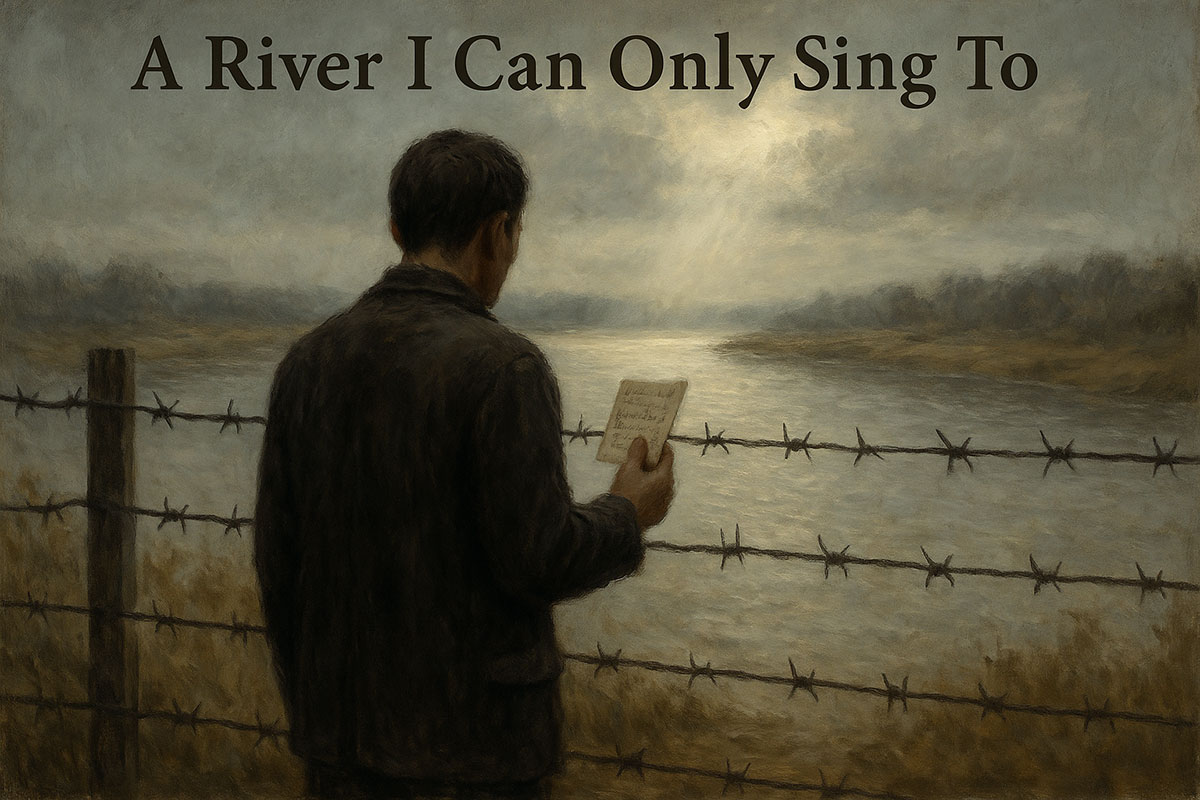
Reverend Sun Myung Moon
(softly humming…)
엄마야… 누나야… 강변 살자…
It’s just a song, they say.
A children’s lullaby.
But when I sing it,
I see my mother’s hands in the cold river water,
wringing out my childhood with every rinse.
I see my sister’s braid bouncing
as she runs to call me home for barley rice.
That river—we once lived by it.
Now, it flows only in my memory.
They are there.
North of the line.
Still waiting, perhaps…
Or maybe long gone.
And I am here.
South of everything.
Too far to touch, too close to forget.
People hear me sing and smile.
But I sing because I cannot cry.
I sing because the war stole
what I never had the courage to say.
That I would give all I’ve built—
every mission, every mountain climbed—
for one more day
to sit by that river,
to lay in the grass,
to laugh with my sisters,
and feel my mother’s hand on my face.
I built a world for peace.
But some wounds…
only Heaven can touch.
So I sing.
엄마야… 누나야…
I’m still calling.
Can you hear me from the other side of history?
Wait for me by the river.
One day, I’ll come home.
By the River, At Last

From Reverend Moon, after reuniting with his mother and sister in spirit
I opened my eyes,
and there was no barbed wire.
No line on a map.
No sorrow holding back my feet.
Only light.
And the river.
The same one from my childhood dreams—
gentler now,
as if it too had been waiting for me.
And there—
there she was.
My mother.
Still with the same worn apron,
hands as soft as I remembered,
yet glowing with peace I had never seen.
She looked at me, not surprised.
Only smiling.
As if I had just come back from playing outside.
And my sister—
grown and ageless all at once.
Her laughter—the same as when we were young—
rushed into me like spring wind.
We didn’t speak at first.
We just held each other,
long enough to erase the years.
Then she said,
“You took the long road, little brother.”
And I wept.
Not for the pain anymore—
but for the joy of a promise kept.
For every hymn I sang alone,
now echoed in three-part harmony.
We sat by the river, finally together.
No war could touch us.
No country could divide us.
Only Heaven,
only love,
only time redeemed.
And I whispered:
“엄마야, 누나야…
I’m home now.
Let’s live by the river.”
What the Riverside Meant to Me

It wasn’t just a river.
It was where my mother hummed as she washed clothes,
where my sister chased dragonflies under the spring sun,
where I ran barefoot, not knowing the world could break.
When I left,
I thought I’d return someday.
But the war drew a line in the earth,
and in that line,
my family was left behind.
I crossed once.
But never again.
Still, the river never left me.
I carried it in my prayers,
in the hymns I sang to keep from crying,
in every word I spoke about peace and home.
It became more than memory.
It became a promise.
“Let’s live by the riverside,” I used to say—
not just to my mother and sister,
but to all of you.
Because the riverside I longed for wasn’t just mine.
It was yours too.
A place where we return to what is pure,
where no one is left out,
where love has roots deeper than sorrow.
Now I stand here—
by that river.
My mother is beside me.
My sister too.
My wife, holding my hand.
And around us, thousands—
from every corner of the world,
smiling, whole,
looking out across the water.
Not mourning the past—
but watching for those still on the way.
Come.
Come live by the riverside.
I’ve been waiting for you.
Short Bios:
Reverend Sun Myung Moon
Founder of the Unification Movement, Reverend Moon was born in 1920 in what is now North Korea. Separated from his family during the Korean War, he carried a deep longing for reunion throughout his life. His teachings emphasized God as a loving Parent and humanity as one family. He devoted his life to world peace, interfaith harmony, and the restoration of family.
Hak Ja Han Moon
The wife and spiritual partner of Reverend Moon, she is often referred to as the “True Mother” within the Unification Movement. Together, they promoted global peace initiatives and emphasized the role of the family in realizing God's love. After Reverend Moon’s passing in 2012, she continued their mission of unifying humanity under God’s parenthood.
Reverend Moon’s Mother
A devout Christian woman who supported her son’s early spiritual path. Though separated from him after the division of Korea, her memory remained a source of strength and longing throughout his life.
Reverend Moon’s Sister(s)
Reverend Moon was one of several siblings. His sisters, like his mother, were among the family members he could not see again after fleeing South during the Korean War. Their memory was often evoked in his messages and hymns of family and home.
The Children of God
(Symbolic)
In the final poem, “Come Home, My Children,” the countless individuals from all nations, ages, and backgrounds represent humanity at large—seen through the eyes of a divine Parent calling everyone back to love, unity, and home.
Leave a Reply