• Skip to main content
  • Skip to primary sidebar
  • Skip to footer
ImaginaryTalks.com
  • Spirituality and Esoterica
    • Afterlife Reflections
    • Ancient Civilizations
    • Angels
    • Astrology
    • Bible
    • Buddhism
    • Christianity
    • DP
    • Esoteric
    • Extraterrestrial
    • Fairies
    • God
    • Karma
    • Meditation
    • Metaphysics
    • Past Life Regression
    • Spirituality
    • The Law of Attraction
  • Personal Growth
    • Best Friend
    • Empathy
    • Forgiveness
    • Gratitude
    • Happiness
    • Healing
    • Health
    • Joy
    • Kindness
    • Love
    • Manifestation
    • Mindfulness
    • Self-Help
    • Sleep
  • Business and Global Issues
    • Business
    • Crypto
    • Digital Marketing
    • Economics
    • Financial
    • Investment
    • Wealth
    • Copywriting
    • Climate Change
    • Security
    • Technology
    • War
    • World Peace
  • Culture, Science, and A.I.
    • A.I.
    • Anime
    • Art
    • History & Philosophy
    • Humor
    • Imagination
    • Innovation
    • Literature
    • Lifestyle and Culture
    • Music
    • Science
    • Sports
    • Travel
You are here: Home / Music / Let’s Live by the Riverside: Reverend Moon’s Journey Home

Let’s Live by the Riverside: Reverend Moon’s Journey Home

July 18, 2025 by Nick Sasaki Leave a Comment

Introduction: A Song That Became a Bridge Between Worlds

To most people, “엄마야 누나야 강변 살자” is a gentle Korean lullaby—a pastoral dream of living simply by the riverside with loved ones. But for Reverend Sun Myung Moon, this song was never just about rivers or reeds. It was a portal. A fragile melody through which he could return—if only for a moment—to the warmth of his mother’s embrace and the joyful laughter of his sisters.

Born in what is now North Korea, Reverend Moon never had the chance to reunite with his family after the peninsula was divided. Though he built a global movement and walked among presidents and prisoners alike, there remained an unhealed ache: the small, sacred life he had once imagined—of family, of home, of peace—had been taken from him by war.

When he sang this song, he wasn’t simply recalling childhood.
He was reaching across decades and barbed wire,
speaking through melody what could never be said in letters.
It was a hymn to the life that never was.

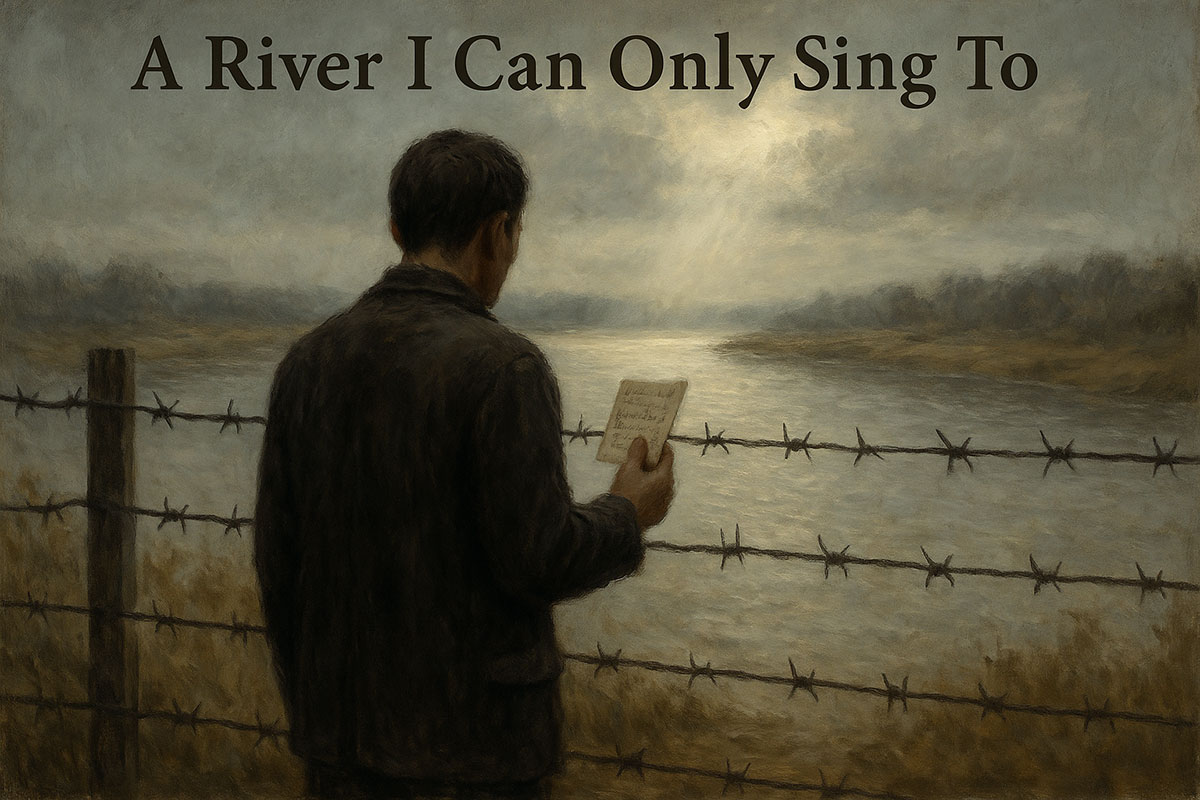
The first poem, “A River I Can Only Sing To,” imagines Reverend Moon in life—his voice trembling with the weight of absence, each lyric a silent prayer for reunion. The second, “By the River, At Last,” is the answer to that prayer: a vision of what may have awaited him in the spirit world, where separation dissolves and love, at long last, is made whole.

Together, these poems form a bridge—
between what was lost on Earth
and what may be found again in Heaven.

Between longing… and peace.

(Note: This is an imaginary conversation, a creative exploration of an idea, and not a real speech or event.)

Play/Pause Audio

Table of Contents
A River I Can Only Sing To
By the River, At Last
What the Riverside Meant to Me

A River I Can Only Sing To

Reverend Sun Myung Moon  

(softly humming…)

엄마야… 누나야… 강변 살자…

It’s just a song, they say.
A children’s lullaby.
But when I sing it,
I see my mother’s hands in the cold river water,
wringing out my childhood with every rinse.
I see my sister’s braid bouncing
as she runs to call me home for barley rice.
That river—we once lived by it.
Now, it flows only in my memory.

They are there.
North of the line.
Still waiting, perhaps…
Or maybe long gone.
And I am here.
South of everything.
Too far to touch, too close to forget.

People hear me sing and smile.
But I sing because I cannot cry.
I sing because the war stole
what I never had the courage to say.

That I would give all I’ve built—
every mission, every mountain climbed—
for one more day
to sit by that river,
to lay in the grass,
to laugh with my sisters,
and feel my mother’s hand on my face.

I built a world for peace.
But some wounds…
only Heaven can touch.

So I sing.

엄마야… 누나야…
I’m still calling.
Can you hear me from the other side of history?

Wait for me by the river.
One day, I’ll come home.

By the River, At Last

From Reverend Moon, after reuniting with his mother and sister in spirit

I opened my eyes,
and there was no barbed wire.
No line on a map.
No sorrow holding back my feet.

Only light.
And the river.

The same one from my childhood dreams—
gentler now,
as if it too had been waiting for me.

And there—
there she was.

My mother.
Still with the same worn apron,
hands as soft as I remembered,
yet glowing with peace I had never seen.
She looked at me, not surprised.
Only smiling.
As if I had just come back from playing outside.

And my sister—
grown and ageless all at once.
Her laughter—the same as when we were young—
rushed into me like spring wind.
We didn’t speak at first.
We just held each other,
long enough to erase the years.

Then she said,
“You took the long road, little brother.”

And I wept.
Not for the pain anymore—
but for the joy of a promise kept.
For every hymn I sang alone,
now echoed in three-part harmony.

We sat by the river, finally together.
No war could touch us.
No country could divide us.
Only Heaven,
only love,
only time redeemed.

And I whispered:

“엄마야, 누나야…
I’m home now.
Let’s live by the river.”

What the Riverside Meant to Me

It wasn’t just a river.
It was where my mother hummed as she washed clothes,
where my sister chased dragonflies under the spring sun,
where I ran barefoot, not knowing the world could break.

When I left,
I thought I’d return someday.
But the war drew a line in the earth,
and in that line,
my family was left behind.

I crossed once.
But never again.

Still, the river never left me.

I carried it in my prayers,
in the hymns I sang to keep from crying,
in every word I spoke about peace and home.

It became more than memory.
It became a promise.

“Let’s live by the riverside,” I used to say—
not just to my mother and sister,
but to all of you.

Because the riverside I longed for wasn’t just mine.
It was yours too.
A place where we return to what is pure,
where no one is left out,
where love has roots deeper than sorrow.

Now I stand here—
by that river.

My mother is beside me.
My sister too.
My wife, holding my hand.

And around us, thousands—
from every corner of the world,
smiling, whole,
looking out across the water.

Not mourning the past—
but watching for those still on the way.

Come.
Come live by the riverside.

I’ve been waiting for you.

Short Bios:

Reverend Sun Myung Moon
Founder of the Unification Movement, Reverend Moon was born in 1920 in what is now North Korea. Separated from his family during the Korean War, he carried a deep longing for reunion throughout his life. His teachings emphasized God as a loving Parent and humanity as one family. He devoted his life to world peace, interfaith harmony, and the restoration of family.

Hak Ja Han Moon
The wife and spiritual partner of Reverend Moon, she is often referred to as the “True Mother” within the Unification Movement. Together, they promoted global peace initiatives and emphasized the role of the family in realizing God's love. After Reverend Moon’s passing in 2012, she continued their mission of unifying humanity under God’s parenthood.

Reverend Moon’s Mother
A devout Christian woman who supported her son’s early spiritual path. Though separated from him after the division of Korea, her memory remained a source of strength and longing throughout his life.

Reverend Moon’s Sister(s)
Reverend Moon was one of several siblings. His sisters, like his mother, were among the family members he could not see again after fleeing South during the Korean War. Their memory was often evoked in his messages and hymns of family and home.

The Children of God (Symbolic)
In the final poem, “Come Home, My Children,” the countless individuals from all nations, ages, and backgrounds represent humanity at large—seen through the eyes of a divine Parent calling everyone back to love, unity, and home.

Related Posts:

  • Karma Exchanger: A Novel of Pain, Rebirth, and Mercy
  • Little Wonder Sophie Chen Keller: Love, Sacrifice & Identity
  • The House With the Black Stone: A Korean Family Saga
  • Opening the Hermit Kingdom: North Korea's Real Path…
  • Han Kang Human Acts Explained by Leading Scholars
  • Han Kang Human Acts: An Imaginary Conversation with the Dead

Filed Under: Music Tagged With: barbed wire longing, by the reiverside, cherry blossom river poem, come home my children, divine parent calling, emotional riverside tribute, heavenly family reunion, korean family separation poem, korean river of memory, let’s live by the riverside lyrics, mother sister poem riverside, peace on earth message, reverend moon riverside, reverend moon riverside poem, riverside poetry, riverside reunion tribute, riverside symbolic heaven, soul reunion poem, spirit world riverside, spiritual longing riverside, spiritual riverside, unification movement tribute

Reader Interactions

Leave a Reply Cancel reply

Your email address will not be published. Required fields are marked *

Primary Sidebar

RECENT POSTS

  • before we forget how to connect storiesBefore We Forget How to Connect: 5 Modern Stories
  • before we forget questionsBefore We Forget How to Connect: 30 Questions
  • before we forget how to connectBefore We Forget How to Connect: Vinh Giang Explained
  • Love As if You've Never Been Hurt MeaningLove As If You’ve Never Been Hurt: Meaning & Life Lessons
  • love as if you've never been hurt discussionLove As If You’ve Never Been Hurt: 25 Book Club Questions
  • Love As If You've Never Been HurtLove As If You’ve Never Been Hurt: 5 Modern Stories
  • The Correspondent Inspired Stories: 5 Emotional Tales
  • the correspondent questionsThe Correspondent Book Club Questions: Sybil & Psychology
  • the correspondent explainedThe Correspondent Explained: Grief, Love & Sybil’s Letters
  • The Waste Land modern storiesThe Waste Land Modern Stories: 5 Emotional Tales
  • The Waste Land explainedThe Waste Land Explained: What Did T. S. Eliot Mean?
  • The Waste Land charactersThe Waste Land Characters Explained: Eliot’s Broken World
  • theo of golden questionsTheo of Golden Book Club Questions: Expert Discussion
  • theo of goldenTheo of Golden Inspired Stories: 5 Modern Tales
  • theo of goldenTheo of Golden Analysis: What It Means to Truly See Someone
  • martyr modern storiesMartyr Kaveh Akbar Inspired Stories: 5 Emotional Tales
  • martyr explainedMartyr Kaveh Akbar Book Club Questions: 25 Big Questions
  • martyr charactersMartyr Kaveh Akbar Analysis: Meaning, Death & Suffering
  • little wonder storiesLittle Wonder Inspired Stories: 5 Emotional Modern Tales
  • Little Wonder Analysis: Love, Loss & Gifted Children
  • Little Wonder Sophie Chen Keller: Love, Sacrifice & Identity
  • sense and sensibility modern storiesSense and Sensibility Lessons: 5 Modern Love Stories
  • sense and sensibility analysisSense and Sensibility Analysis: Love, Emotion & Austen
  • sense and sensibility conversationSense and Sensibility: How Do We Know Love Is Real?
  • marriage courseAlphaUSA Marriage Course: 5 Emotional Stories Inspired by Its 7 Sessions
  • AlphaUSA Marriage Course: 7 Questions for a Stronger Marriage
  • AI Agents DebateAI Agents Debate Human Extinction: Should Humanity Survive?
  • ai human extinction storiesJunji Ito-Inspired Tales of AI and Human Extinction
  • ai could destroy humanityEx-Anthropic insider Fear how AI could kill all humans by 2030
  • the vessel of words questionsThe Vessel of Words: How Language Shapes Relationships
  • Empty Nest Syndrome StoryEmpty Nest Syndrome Story: 5 Modern Stories for Parents
  • empty nest griefEmpty Nest Syndrome: 30 Questions Parents Ask
  • Empty Nest SyndromeEmpty Nest Syndrome: When the House Goes Quiet
  • the vessel of words storiesThe Vessel of Words: 5 Korean Stories of Hurt and Healing
  • abraham lincoln modern day storiesAbraham Lincoln Leadership Lessons: 5 Modern Stories
  • the real lincolnAbraham Lincoln: What Historians Really Know and Debate
  • Abraham Lincoln and Slavery: War, Power & Change
  • if god is oneIf God Is One, Why Do Religions Divide Us?
  • 5 Modern Stories Inspired by Cleopatra’s Greatest Lessons
  • Joan of Arc: 5 Modern Stories About Faith and Courage
  • Joan of Arc ExplainedJoan of Arc Examined: Voices, War, Trial, and Legend
  • Joan of Arc HistoryJoan of Arc: Did God Really Speak to Her?
  • ASI stories5 Stories About Life After AI Surpasses Human Intelligence
  • the age of superintelligenceThe Age of Superintelligence: What Happens When AI Surpasses Humans?
  • masayoshi son ai futureMasayoshi Son’s AI Future: Health, Jobs, Cyberwar & Japan
  • The Good Earth: 5 Modern Stories About Love and Sacrifice
  • the good earth scholarsThe Good Earth: What Scholars Reveal About Wang Lung and O-lan
  • the good earthThe Good Earth: Did Wealth Destroy What Wang Lung Loved?
  • SoftBank World 2026: Masayoshi Son’s AI 2040 Vision Explained
  • The Great Gatsby in 7 Minutes: Why Gatsby’s Dream Failed
  • a new earthIs Humanity Entering a New Earth? Spiritual Awakening Explained
  • great gatsby modern storiesThe Great Gatsby: 5 Modern Stories About Dreams We Chase
  • the great gatsby analysisThe Great Gatsby Experts Explain Gatsby’s Dream and Tragedy
  • the Great Gatsby explainedThe Great Gatsby: Did Gatsby Love Daisy or His Dream?
  • After Of Mice and Men: What Happened to George After Lennie?
  • Of Mice and Men in 7 Minutes: When Love Is Not Enough
  • of mice and men modern day storiesOf Mice and Men: 5 Modern Stories About Love, Care and Responsibility
  • of mice and men analysisOf Mice and Men: Was George Right to Kill Lennie?
  • of mice and men 5Of Mice and Men: Was George’s Final Choice an Act of Love?
  • grapes of wrath modern storiesThe Grapes of Wrath Today: 5 Modern Stories About “I” and “We”
  • grapes of wrath questionsThe Grapes of Wrath Explained: 5 Questions Readers Still Ask
  • the grapes of wrath john steinbeckThe Grapes of Wrath: When Does “Me” Become “We”?
  • Stand With Jesus: What If People Tried to Stop the Crucifixion?
  • East of Eden Today: 5 Stories About Breaking Family Cycles
  • john steinbeck east of edenEast of Eden: Does Timshel Still Make Sense Today?
  • East of Eden: Are We Born Bad or Free to Choose?
  • Convenience Store Woman: 5 American Stories About Marriage and Freedom
  • convenience-store-women-analysis-Convenience Store Woman: Is the New Normal Really Normal?
  • convenience store womenConvenience Store Woman: Who Decides What Is Normal?
  • sayaka murata imaginary friendsSayaka Murata Imaginary Friends: The Mystery Behind Her Inner World
  • Social Health Stories: 5 Ways We Lost Our Sense of Belonging
  • Social Health: Why Modern Life Is Making Us Lonely
  • nickel-boys-modern-stories-The Nickel Boys: 5 Modern Stories About Truth, Trauma and Hope
  • coloson whitehead the nickel boys discussionThe Nickel Boys: What Kind of Hope Survives Injustice?
  • the nickel boys colson whiteheadThe Nickel Boys: Elwood and Turner on Justice, Survival and Truth
  • AI Resource Consumption: Can AI Give More Than It Takes?
  • madeline-miller-circe-modern-stories-5 Modern Stories Inspired by Circe by Madeline Miller
  • Circle-Madeline-Miller-analysis-Circe Explained: Myth, Meaning, and Madeline Miller
  • Madeline Miller Circle CharactersMadeline Miller Circe: What If No One Ever Chose You?
  • 5 Modern Stories Inspired by Keigo Higashino’s Silent Parade
  • could japanese culture succeed where religion has failedCould Japanese Culture Succeed Where Religion Has Failed?
  • keigo-Higashino-when-love-becomes-too-much-5 Modern Stories Inspired by The Devotion of Suspect X
  • The Devotion of Suspect X Explained by Psychologists: Is Ishigami’s Love Really Love?
  • the devotion of suspect xThe Devotion of Suspect X Explained: Was Ishigami’s Sacrifice Really Love?
  • 5 Modern Midnight Library Stories About Regret, AI, and Choice
  • Matt Haig The Midnight LibraryThe Midnight Library Explained by Scholars and Matt Haig
  • The-Midnight-Library-explainedThe Midnight Library Explained Through Its Characters
  • 5 Modern Siddhartha Stories About Wisdom, Love, AI, and Choice
  • Siddhartha explained by leading scholarsSiddhartha Explained by Leading Hermann Hesse Scholars
  • Siddhartha explainedSiddhartha Explained Through Its Characters: Love, Loss, and Enlightenment
  • before-the-names-are-carved-Before the Names Are Carved: Five Connected Stories
  • The Scholars and the Unworn ShoesHan Kang Human Acts Explained by Leading Scholars
  • Han Kang Human Acts: An Imaginary Conversation with the Dead
  • The Years We Thought We Had: A Story of Love and Waiting in Japan
  • snow-country-analysis-Snow Country Analysis: Kawabata Scholars Explain It
  • snow-country-was-their-love-realSnow Country Explained Through Its Characters
  • the-man-who-never-took-the-day-off-The Man Who Never Took the Day Off: A Modern Ishiguro Story
  • The Remains of the Day Explained by Leading Ishiguro Scholars
  • the-remains-of-the-day-imaginary-talks-The Remains of the Day Explained Through Its Characters
  • the-pastor-who-couldnt-be-forgiven-The Pastor Who Couldn’t Be Forgiven: A Modern Story of Grace

Footer

Recent Posts

  • Before We Forget How to Connect: 5 Modern Stories September 21, 2026
  • Before We Forget How to Connect: 30 Questions September 21, 2026
  • Before We Forget How to Connect: Vinh Giang Explained September 21, 2026
  • Love As If You’ve Never Been Hurt: Meaning & Life Lessons September 20, 2026
  • Love As If You’ve Never Been Hurt: 25 Book Club Questions September 19, 2026
  • Love As If You’ve Never Been Hurt: 5 Modern Stories September 19, 2026

Pages

  • About Us
  • Contact Us
  • Disclaimer
  • Earnings Disclaimer
  • Privacy Policy
  • Terms and Conditions

Categories

Copyright © 2026 Imaginarytalks.com