
|
Getting your Trinity Audio player ready...
|
What if Matt Faulkner tested the Lost Mindset Laws with top thinkers?
Introduction By Matt Faulkner
Most people think they have a motivation problem.
They don’t.
They have an architecture problem.
When someone says, “I can’t stay consistent,” what they usually mean is:
“I keep waiting to feel like doing the thing.”
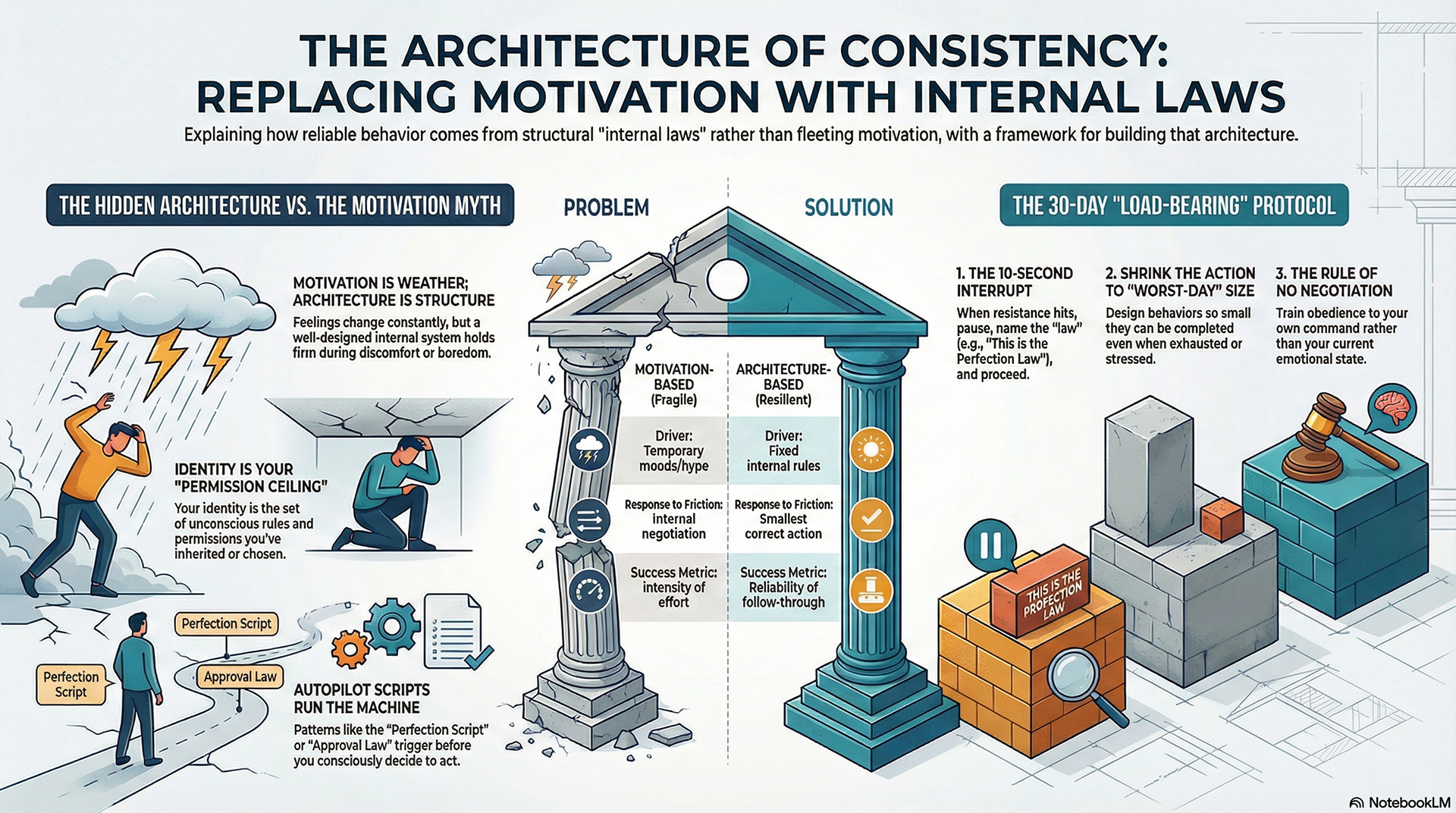
But feelings are weather. Architecture is structure.
Weather changes. Structure holds.
The Lost Mindset Laws are not affirmations. They’re not hype. They’re not discipline hacks. They’re observations about what actually governs human behavior beneath the surface.
You are not driven by willpower.
You are not limited by talent.
You are not stuck because you lack desire.
You are governed by internal rules.
Some of those rules were chosen.
Most were inherited.
Almost none were examined.
This conversation is not about adding new techniques to your life. It’s about identifying the hidden architecture already running it:
- The identity you unconsciously obey
- The perception filters that shape reality
- The autopilot patterns that fire before you decide
- The authority (or lack of it) inside your own mind
- And the measurable social shifts that prove something actually changed
If you change the architecture, behavior follows.
If you chase motivation, you stay fragile.
So instead of asking,
“How do I feel more motivated?”
We’re going to ask something far more useful:
“What internal law am I obeying right now?”
Because once you see the law, you can rewrite it.
(Note: This is an imaginary conversation, a creative exploration of an idea, and not a real speech or event.)
Topic 1 (Fresh, mirrored to your signature style)

A quiet conference room—not a stage. No hype, no “change your life” music. Just a plain table, water pitcher, and five name cards that look almost too ordinary for what’s being claimed.
Tim Ferriss sits at the head of the table with that familiar half-curious, half-skeptical calm—like he’s running an experiment, not hosting a seminar.
He looks down the row.
Tim Ferriss: I want definitions, trade-offs, and something a normal person can test in seven days. Not inspiration. Here’s the first question.
Question 1
Tim Ferriss: If motivation is unreliable, what replaces it? Name the underlying structure—plain language—and give me the few components that actually matter.
Matt Faulkner: What replaces motivation is a set of defaults. The structure underneath behavior. Most people don’t fail because they lack desire. They fail because their internal system interprets resistance as a stop sign and confusion as proof they’re not cut out for it.
If I had to keep it simple: your structure is what you do when it’s boring, unclear, or uncomfortable. That’s the real operating system.
James Clear: I’d call it your system—your environment, your cues, and the friction around the behavior. People think they need more motivation, but what they usually need is fewer decisions. If the behavior is the default, you don’t need a heroic mood.
And identity matters. If the action feels aligned with “who I am,” it stops being a daily argument.
BJ Fogg: For me, it’s design. Behavior happens when motivation, ability, and a prompt converge. Most people over-focus on motivation and ignore ability and prompts.
If it’s too hard, it won’t happen. If there’s no prompt, it won’t happen. Architecture means you design the behavior so it can happen even when motivation is low.
Andrew Huberman: The structure includes physiology. If sleep is inconsistent, stress is high, and you’re overstimulated, the brain prices effort as more painful and rewards as less rewarding. That makes “consistency” feel like dragging a weight.
So the real structure includes how you regulate state: sleep timing, stress downshifts, and reward scheduling.
David Allen: Structure is clarity plus a trusted system. If you don’t know the next physical action, your mind produces friction—anxiety, avoidance, mental noise. People interpret that as “I’m unmotivated.” But it’s often “I’m unclear.”
Get it out of your head. Define the next action. Then you move.
Tim Ferriss: Good. Now I want a cut. If someone is missing two “load-bearing beams,” which two are most likely to be missing?
Question 2
Tim Ferriss: Someone says, “I can’t stay consistent.” Give me a fast way to diagnose the real bottleneck. Ten minutes. What do you ask first?
David Allen: First question: “What’s the next action?” If they can’t answer, it’s not a motivation problem. It’s a thinking problem. They haven’t clarified.
BJ Fogg: Second question: “Could you do a tiny version on your worst day?” If not, it’s an ability problem. Shrink it. Then attach it to a prompt that already exists.
Andrew Huberman: Quick physiology check: inconsistent wake time, baseline anxiety, afternoon crashes, and constant relief-seeking behaviors. If those are present, you’re not dealing with a character issue. You’re dealing with a state issue that makes everything harder.
James Clear: Identity check: listen for “I’m just not that type of person.” That sentence is a lock. People protect identity even when it hurts them. The intervention is evidence—small wins that rewrite the story.
Matt Faulkner: Meaning check: “When it gets uncomfortable, what do you believe that discomfort means?”
If it means “danger” or “proof I’m not capable,” they’ll stop. If it means “signal to proceed,” they’ll continue.
Tim Ferriss: So in plain terms: unclear next action, too big a behavior, wrong prompt, wrong meaning, or a body state that makes effort overpriced. Fair.
Now build me something.
Question 3
Tim Ferriss: Design a minimal 30-day protocol that a busy person will actually do. Time limit: 15 minutes a day. Tracking limit: three simple checks. And it must survive missed days without collapsing.
Matt Faulkner: One rule: when resistance appears, you don’t negotiate. You do the smallest correct action. The goal is to train obedience to a rule, not obedience to a mood.
David Allen: Two minutes capture. Two minutes clarify the next action. Eleven minutes execute. That’s enough to build trust that you can move things forward.
BJ Fogg: Make the action tiny enough for worst-day compliance. Anchor it to a stable prompt—after coffee, after brushing teeth, after you open your laptop. Then celebrate the completion so it wires in.
James Clear: Keep it daily, keep it small, never miss twice. After consistency becomes the identity, you scale time, not before.
Andrew Huberman: If you want the protocol to stick, stabilize wake time and get morning light most days. If stress is high, add a quick physiological downshift before the 11-minute sprint so the brain doesn’t interpret work as threat.
Tim Ferriss leans back, not smiling, but satisfied in the way a tester is satisfied when the parts fit.
Tim Ferriss: Here’s what I’m hearing. Motivation is not the plan. The plan is: clarity, tiny action, reliable prompt, state regulation, and a rule you follow when resistance shows up.
If a person does this for 30 days and nothing changes, it won’t be because they “lack discipline.” It will be because one of the beams is still missing—and we now have a way to locate which one.
Topic 2: Identity and Perception (The Real Levers)

The room is small and unglamorous—more like a quiet campus seminar room than anything “transformational.” Plain walls, a pitcher of water, five name cards, and a silence that feels intentional.
Tim Ferriss sits at the head of the table with the calm focus of someone who wants something testable, not inspiring. It’s the same kind of “no theatrics” setup your SOTU debate used—ordinary room, high standards.
Tim Ferriss: We’re going to define what identity is, what perception does, and how to prove a change is real. No slogans. Here is the first question.
Question 1
Tim Ferriss: What is “identity” in usable terms—and what is “perception” in usable terms? If those are the levers, define them so a normal person can recognize them on a Tuesday afternoon.
Matt Faulkner: Identity is the set of rules you assume apply to you. Not your personality. Your permissions. Your ceilings. Your “people like me don’t…” list.
Perception is the filter that decides what something means before you even think. Two people feel the same discomfort—one reads it as growth, the other reads it as danger. Same sensation, different destiny.
James Clear: Identity is a story that gets reinforced by evidence. People think identity is what they “are,” but it’s often what they’ve repeatedly done.
Perception is where you place attention—and the meaning you attach to it. If you keep looking for proof you’re behind, you will find it. If you look for proof you can keep a promise to yourself, you’ll start collecting that evidence too.
BJ Fogg: In practice, identity is often the label people use to justify design failure: “I’m not disciplined.” “I’m not consistent.”
Perception is what they notice right before they decide. If they notice “this is hard,” they stop. If they notice “this is small,” they continue. We can change that by changing the size of the behavior and the prompt.
Andrew Huberman: Identity is strongly shaped by state. People underestimate how much their self-concept changes when sleep is off and stress is high. You become a different narrator.
Perception is literally predictive. The brain is constantly predicting what’s happening and what it will cost. If your brain predicts effort equals threat, you interpret neutral signals as evidence you’re failing.
David Allen: Identity is also: “Do I trust myself?” Because if you don’t trust yourself to do what you say, your identity becomes “someone who doesn’t follow through.”
Perception is: “Is this clear?” Lack of clarity makes tasks feel heavier than they are. People call it fear or laziness, but it’s often fog.
Tim Ferriss: Good. Now I want the uncomfortable part. If identity and perception are levers, then they can also be traps.
Question 2
Tim Ferriss: When do identity and perception become self-deception? In other words, how do people mistake a new story for real change?
Matt Faulkner: When the story changes but the rules don’t. People say “I’m becoming the type of person who…” while still obeying the old law: “If it feels uncomfortable, I stop.”
Real change is when you keep the promise under the exact conditions where you usually break it.
James Clear: When identity becomes aspiration without evidence. If you announce a new identity but you haven’t built the habit, you’re borrowing confidence from a future you haven’t earned yet.
Perception becomes self-deception when you interpret everything through one lens—either optimism that ignores reality, or pessimism that ignores progress.
BJ Fogg: The biggest self-deception is starting too big, failing, then calling the failure “truth.” That’s identity damage created by poor design.
If you want identity to change, you need reliable success. Tiny success that repeats is not a motivational trick—it’s training.
Andrew Huberman: Another trap: people change the narrative without changing the inputs. If you keep sleep inconsistent, keep cortisol elevated, keep dopamine spikes constant, you will keep perceiving effort as expensive.
They’ll say “I’m a new person,” but their nervous system is running the old program.
David Allen: And people confuse clarity with confidence. They wait to feel certain before acting. But clarity often comes after you define the next action and start moving.
Self-deception is “I’m overwhelmed,” when the truth is “I haven’t decided what ‘done’ means.”
Tim Ferriss: So what’s the proof? I want a clean test—something like your article’s “two sentences without flinching” standard.
Give me a proof standard for identity/perception change that can’t be faked for long.
Question 3
Tim Ferriss: What is a measurable proof that identity and perception have actually shifted—beyond feelings? And what’s the smallest 30-day build to create that proof?
Matt Faulkner: Proof is simple: you do the action when the old self would negotiate. Track one thing for 30 days:
When resistance appears, did I do the smallest correct action anyway? (Yes/No)
If that flips, identity is changing at the rule level.
James Clear: Proof is consistency. Not intensity.
Track:
“Did I show up?” (Yes/No)
“Did I keep the promise small enough that I could keep it even on a bad day?” (Yes/No)
Identity becomes real when you can point to evidence, not intention.
BJ Fogg: Proof is automaticity—less debate, more behavior.
30-day build:
pick a tiny behavior,
attach it to a stable prompt,
celebrate immediately after.
Track:
prompt happened (Yes/No),
behavior happened (Yes/No).
If it’s happening without negotiation, perception has shifted from “this is a project” to “this is just what happens.”
Andrew Huberman: Proof is that effort feels cheaper—and you recover faster after stress.
30-day build:
consistent wake time most days,
morning light,
short stress downshift before the work bout.
Track:
wake time within a window (Yes/No),
did you do the first work bout without avoidance? (Yes/No).
David Allen: Proof is reduced psychic drag. Your mind stops buzzing because it trusts you.
30-day build:
capture open loops daily,
define next actions,
do one next action.
Track:
did you write the next action? (Yes/No)
did you complete one? (Yes/No)
Tim sits back and does the thing your moderators often do: he turns five angles into one standard that forces honesty.
Tim Ferriss: Here’s the test I’m taking from this:
If you claim identity has changed, you should be able to point to one behavior you now do under resistance that you previously avoided—repeatedly, without drama.
If you claim perception has changed, the same discomfort should now register as information, not danger—and your next action should get clearer faster, not slower.
No one applauds. But nobody needs to. The point wasn’t a performance.
Topic 3: The Autopilot Patterns You Don’t See (But They Run You)

The room feels even quieter than before—like everyone knows this is where people get defensive. Not because it’s insulting, but because it’s personal.
No stage. No screens. Just a table, water, and that uncomfortable honesty that shows up when the subject is: the parts of you that act before “you” decide.
Tim Ferriss doesn’t soften his tone. He treats this like a lab.
Tim Ferriss: Today is about the scripts you’re running that you keep calling “my personality.” We’re going to name them, spot them, and interrupt them. First question.
Participants:
Matt Faulkner, Daniel Kahneman, Judith Beck, Tara Brach, Gabor Maté
Moderator:
Tim Ferriss
Question 1
Tim Ferriss: What is “autopilot,” specifically? If someone says, “That’s just how I am,” what are they actually describing?
Matt Faulkner: They’re describing a rule that fires automatically. A pattern that triggers before conscious choice—then gets justified after the fact.
Autopilot isn’t “who you are.” It’s what your system does to preserve safety, certainty, or self-image.
Daniel Kahneman: Autopilot is fast thinking. Immediate interpretation. It’s efficient—until it’s wrong.
People feel like they are choosing, but often they are endorsing a conclusion that arrived instantly. The story of “I chose this” is frequently a narration layered on top of an automatic response.
Judith Beck: In cognitive terms, it’s automatic thoughts driven by deeper beliefs—core beliefs like “I’m not good enough,” “I’ll fail,” “People will reject me.”
Those beliefs generate predictions. Predictions create emotion. Emotion drives behavior. And the person experiences the behavior as inevitable.
Tara Brach: Autopilot is trance. You get captured by fear, shame, or craving, and you live inside the reaction as if it’s reality.
The mind says, “This is urgent,” “This is dangerous,” “This is me.” And you lose the ability to pause.
Gabor Maté: Autopilot is often trauma logic. Not always dramatic trauma—often subtle: chronic stress, emotional neglect, conditional love.
The pattern formed for a reason: to avoid pain, abandonment, or shame. It was adaptive. But later it becomes a prison.
Tim Ferriss: Good. Now name the patterns. If a reader wants to recognize theirs, what are the most common scripts?
Question 2
Tim Ferriss: Give me the top autopilot scripts—then tell me how to spot one in real time without needing a PhD.
Matt Faulkner: Common scripts:
Approval script: “If they don’t like it, I’m unsafe.”
Perfection script: “If it can’t be perfect, don’t start.”
Control script: “If I’m not in control, I’m exposed.”
Escape script: “Relief now, cost later.”
Identity script: “People like me don’t do that.”
How to spot it: listen for the inner sentence that sounds like a law. It’s not a thought. It’s a verdict.
Kahneman: The real-time signal is certainty. Autopilot arrives with confidence. It feels obvious.
Ask: “How do I know?” If you can’t articulate evidence, you’re likely looking at a fast conclusion, not a reasoned one.
Beck: The spot-test is to write the automatic thought in one sentence:
“What went through my mind right then?”
Then ask:
Is it a fact or an interpretation?
What belief does it imply about me or the future?
What would I tell a friend in the same situation?
You start exposing the machine.
Brach: In real time, the signal is body urgency: tightening, heat, contraction. Autopilot lives in the nervous system first.
If you can notice “tight, rushed, bracing,” you can name it: “Fear is here,” “Shame is here.” Naming restores choice.
Maté: Another signal: disproportion. If the reaction is bigger than the moment, it’s not about the moment.
Ask: “What does this remind me of?” Often the nervous system is replaying an older lesson: “Don’t disappoint,” “Don’t be seen,” “Don’t need anything.”
Tim Ferriss: So the pattern is a law, it arrives with certainty, it shows up in the body, and it’s often older than the situation. Fine.
Now I want the only thing that matters to a reader: What do you do when it hits? Not in theory—in the first 10 seconds.
Question 3
Tim Ferriss: You have ten seconds from trigger to behavior. What’s the interrupt sequence? And after the interrupt, what replaces the pattern so it doesn’t come back tomorrow?
Matt Faulkner: First 10 seconds: label the law and shrink the action.
“This is the approval law.”
“This is the perfection law.”
Then do the smallest correct action anyway—so the law stops being in charge.
Replacement isn’t a new affirmation. It’s a new obedience: “When X appears, I do Y.”
Kahneman: Insert friction before endorsement.
Delay by 10 seconds.
Ask one question: “What evidence would change my mind?”
If you can’t answer, you’re likely in autopilot. The goal is not perfect reasoning—just enough pause to prevent automatic commitment.
Beck: Here’s a practical sequence:
Identify the automatic thought.
Identify the distortion (catastrophizing, mind reading, all-or-nothing).
Generate a balanced alternative.
Take one action consistent with the alternative.
The replacement is building a new belief through behavior experiments—small tests that gather new evidence.
Brach: The interrupt is the pause that brings kindness.
Stop.
Feel the body.
Name what’s here.
Offer a compassionate phrase: “This is hard, and I’m here.”
It’s not softness. It’s de-escalation. A regulated nervous system can choose.
Maté: The replacement is understanding, not war.
Ask: “What pain is this protecting me from?”
If you treat the pattern like an enemy, you reinforce shame and the pattern becomes stronger.
The long-term replacement is addressing the need beneath the behavior—safety, connection, permission to be imperfect.
Tim looks down at his notes, then does his usual move: he compresses five languages into one operating method.
Tim Ferriss: Here’s what I’m taking as a single practical sequence:
When the trigger hits:
Pause (even 10 seconds).
Name the pattern as a pattern.
Find the first physical next step that’s small enough to do.
Do it—to collect new evidence.
Later, ask: “What was this protecting me from?” so you don’t just brute-force it.
If someone does that consistently, the autopilot stops being an identity and becomes something you can manage.
No one argues. Because the room isn’t about being right. It’s about being free.
Topic 4: Inner Authority and Self-Governance

This room feels different. Less clinical, more like a board meeting with yourself.
No drama. No candles. Just the uncomfortable question sitting in the center of the table:
Who’s actually in charge when you’re tired, tempted, anxious, or angry?
Tim Ferriss sets his notebook down and looks at everyone like he’s interviewing for a role called “CEO of your own life.”
Moderator:
Tim Ferriss
Participants:
Matt Faulkner, Epictetus, Brené Brown, Jocko Willink, Steven Pressfield
Question 1
Tim Ferriss: Define “inner authority” so it doesn’t become ego or control. What is it, operationally?
Matt Faulkner: Inner authority is the ability to govern your internal rules instead of being governed by them.
It’s not dominance. It’s not stubbornness. It’s the quiet ability to say: “This is what I do,” and follow through even when your feelings vote no.
Epictetus: It is knowing what is yours and what is not yours.
Your judgments are yours. Your intentions are yours. Your choices are yours.
Other people’s opinions, outcomes, and the weather of the world are not.
Inner authority begins when you stop giving away your power to what you cannot command.
Brené Brown: Inner authority is living from integrity.
It’s when your values are not just something you admire—they’re something you practice. It shows up in boundaries, honesty, and the willingness to be disliked rather than be false.
Jocko Willink: It’s discipline. Not hype. Discipline is the system that makes you reliable.
Inner authority is when your standards are stronger than your excuses.
Steven Pressfield: It’s the ability to recognize Resistance and not obey it.
Resistance is the voice that says: “Later.” “Not you.” “Not today.”
Inner authority is the part of you that says: “Sit down. Begin.”
Tim Ferriss: Good. Now I want the thing people confuse with inner authority: being controlling, being rigid, being “right.” Let’s expose that.
Question 2
Tim Ferriss: When does “inner authority” become a mask—ego, control, or performance? And how do you tell the difference in yourself?
Brené Brown: When it’s fueled by shame. If your “authority” depends on always being right, always being admired, or never being vulnerable, it’s armor.
A simple tell: if you can’t apologize, you don’t have inner authority—you have a fragile self-image.
Epictetus: When you attempt to control what is not yours.
The person who tries to govern others’ thoughts is a slave to those thoughts.
Real authority is mastery of your own judgments.
Jocko Willink: If your standards are real, you don’t need to advertise them.
Also, if you’re “disciplined” only when someone is watching, that’s performance.
Authority is what you do alone.
Steven Pressfield: When it becomes identity theater: “I’m the kind of person who…”—but you don’t do the work.
Resistance loves costume. It loves titles. It hates action.
Matt Faulkner: The mask version tries to feel powerful. The real version tries to be consistent.
A clean test: when discomfort shows up, do you get louder—or do you get clearer?
Tim Ferriss: That’s useful. Now make it concrete. Most people don’t fail in big heroic moments. They fail in small messy moments: tired, tempted, irritated, uncertain. Build the operating system.
Question 3
Tim Ferriss: Give a minimal daily practice that builds inner authority in 30 days—something someone can do even if their life is chaotic. And give a “fail-safe” for bad days.
Matt Faulkner: Build one law and obey it daily. Not ten laws. One.
Example: “When I feel resistance, I do the smallest correct action.”
Track only whether you kept the law. Yes or no.
Bad-day fail-safe: the action becomes microscopic, but the law stays intact.
Epictetus: Practice the distinction every day:
What is mine to govern?
What is not mine?
Then act only where you have agency.
Bad-day fail-safe: control your tongue. Control your judgment. If you can do that, you have not failed.
Brené Brown: Choose one value and one boundary.
Value: “I will be honest.”
Boundary: “I will not say yes when I mean no.”
Bad-day fail-safe: you don’t have to be perfect—you have to return to integrity quickly. Repair fast.
Jocko Willink: Standards and a minimum.
Pick a daily minimum that you do no matter what:
10 minutes of training, 10 minutes of focused work, 10 minutes of planning.
Bad-day fail-safe: minimum means minimum. You hit it even when it’s ugly. That’s how authority is built.
Steven Pressfield: Set a start time and begin. Resistance loses when you start.
Bad-day fail-safe: show up for five minutes. The goal is not output; it’s proving you can obey your own command.
Tim pauses, then compresses it into something that can live on a sticky note without sounding like a fortune cookie.
Tim Ferriss: Here’s the combined “inner authority” build:
Pick one law you will obey daily.
Define the minimum version for bad days.
Practice the “mine/not mine” distinction when you get emotionally hijacked.
Add one boundary that protects your energy and integrity.
Measure authority as: Did I do what I said I would do when I didn’t feel like it?
He looks down the table.
Tim Ferriss: That’s not motivational. That’s governance.
Topic 5: Measurable Shifts and Social Feedback

The room feels like the final audit.
Not “Do you feel better?”
But: Did anything actually change—money, relationships, time, reputation, outcomes—and do people respond differently to you?
Tim Ferriss taps his pen once, like calling the meeting to order.
Moderator:
Tim Ferriss
Participants:
Matt Faulkner, Robert Cialdini, Erving Goffman, Esther Perel, Robert Greene
Question 1
Tim Ferriss: If someone’s inner architecture really changes, what changes first on the outside? Give me observable signals—behavioral, social, measurable.
Matt Faulkner: The first external change is less negotiation.
You stop having long internal debates. That shows up as:
faster decisions,
cleaner boundaries,
fewer apologies for existing,
more follow-through in small promises.
People respond differently because your signals stop wobbling.
Robert Cialdini: People are persuaded by consistency—especially the kind that looks stable over time.
If your behavior becomes consistent, others begin to trust predictions about you. Trust increases cooperation. Cooperation changes opportunities. That’s measurable: more yeses, fewer stalls, more referrals, more voluntary support.
Erving Goffman: Social life is full of performance—whether we admit it or not.
When your inner state stabilizes, your “presentation” becomes coherent. You stop leaking contradiction: words say one thing, posture says another. Others read that coherence as credibility. They relax. Or they adjust.
Esther Perel: In relationships, a shift shows up as cleaner patterns.
You stop asking your partner, friends, or coworkers to regulate your nervous system for you. You become less reactive, more direct, more repair-oriented. That changes the emotional climate around you.
Robert Greene: The earliest signal is gravity—not charisma. Gravity.
People feel you’re not easily pushed, flattered, or destabilized. That makes your “no” carry weight. It also makes your “yes” valuable. Social dynamics reorganize around the person who’s steady.
Tim Ferriss: Good. Now let’s not let this become vague. A lot of people claim “I’ve changed” while still producing the same outcomes. So—
Question 2
Tim Ferriss: What are the ways people fake this kind of change—confidence theater, dominance, spiritual costume—and what’s the simplest way to tell real change from performance?
Goffman: Performance fails under sustained interaction.
A mask can hold for a meeting. It collapses over weeks. You can tell it’s theater when there’s inconsistency across contexts: confident in public, chaotic in private; bold in speech, avoidant in action.
Cialdini: Real change produces consistent micro-behaviors.
Faking tends to rely on big gestures. Authentic change shows up in small repeated actions—showing up on time, keeping agreements, not overpromising, following through without needing applause.
Perel: Performance lacks repair.
Real change includes the capacity to say: “I did that. I see it. I’m sorry. Here’s what I’ll do differently.”
If someone can’t repair, they’re protecting an image, not building a self.
Greene: Theater is loud.
When people need to announce their power, they don’t have it. Real authority is quiet because it doesn’t require validation. Also: performance is reactive. Real change stays steady when challenged.
Matt Faulkner: The cleanest test is friction.
When discomfort appears—criticism, boredom, uncertainty—does the person revert?
If they still obey the old internal law (“if this feels bad, I stop”), then nothing changed. They just upgraded their vocabulary.
Tim Ferriss: Alright. Give me a measurement system—because if we can’t measure it, we can’t improve it.
Question 3
Tim Ferriss: What should a person track for 30 days to prove the inner shift is real—and how should they interpret social feedback without becoming addicted to approval?
Matt Faulkner: Track obedience to one internal rule.
Example metrics:
Kept my rule under resistance (Yes/No)
Completed the smallest correct action (Yes/No)
Social feedback is a lagging indicator. You don’t chase it. You earn it.
Cialdini: Track behaviors that create trust:
promises made vs promises kept
time-to-response
follow-through rate
People reward reliability. But don’t turn it into “please like me.” Use it as a signal that your consistency is becoming visible.
Goffman: Track consistency across roles:
Are you the same person at home and in public?
Do your words and actions align in different settings?
If your presentation becomes coherent, social friction tends to drop. That’s measurable: fewer misunderstandings, fewer “mixed signals” moments, fewer unnecessary conflicts.
Perel: Track relational health:
number of reactive blowups (weekly)
number of repairs within 24 hours
number of honest boundary conversations completed
Social feedback becomes useful when you treat it as information, not identity.
Greene: Track outcomes tied to power dynamics:
how often you say “no” cleanly
how often people respect it
how often you initiate rather than react
how often you get pulled into drama
If your inner authority is real, you become less available to manipulation. That changes the map of who approaches you and how.
Tim pauses, then compresses it into a practical standard—simple, slightly unforgiving, and clear.
Tim Ferriss: Here’s the test I’m keeping:
Personal: Did you keep your internal rule under friction—repeatedly?
Operational: Did your follow-through rate improve measurably?
Relational: Did reactivity drop and repair speed up?
Social: Did people start treating your yes/no as more final?
If those aren’t moving, you don’t need better confidence. You need better architecture.
Final Thoughts by Matt Faulkner
Change is not loud.
It doesn’t arrive with fireworks.
It doesn’t announce itself with a new personality.
It shows up quietly in friction.
When you don’t feel like doing something —
and you do the smallest correct action anyway.
When you feel the old pattern rising —
and you pause instead of obeying it.
When someone pushes against you —
and your response is steady instead of reactive.
That’s architecture shifting.
Most people look for transformation in emotion.
But emotion is the last thing to stabilize.
The real signal of change is this:
Your decisions get cleaner.
Your “no” gets stronger.
Your recovery gets faster.
Your promises become reliable.
And people start responding to you differently — not because you demand it, but because you’re coherent.
The Lost Mindset Laws are not meant to impress anyone.
They are meant to remove negotiation between you and your own standards.
You don’t need more intensity.
You don’t need more inspiration.
You don’t need to become someone else.
You need internal governance.
Build one law.
Obey it under friction.
Measure the shift.
Do that long enough —
and the architecture will hold.
And when the architecture holds,
you don’t need motivation.
You have structure.
Short Bios:
Leave a Reply