

|
Getting your Trinity Audio player ready...
|
What if Brianna Wiest unpacked why good people self-sabotage with Jung and Rogers?
Introduction by Brianna Wiest
The Mountain Is You is titled the way it is because the hardest obstacle most of us will ever face isn’t life “out there” — it’s the internal resistance that rises the moment we get close to the life we say we want. I wanted the title to be unmistakable: the mountain isn’t destiny, or other people, or bad luck. It’s the part of us that learned to survive by staying small, staying busy, staying numb, or staying in familiar suffering — even when those strategies quietly cost us everything.
What excites me about this conversation is that I’m not approaching these ideas in isolation. I’m sitting with voices I genuinely respect — people whose work has helped me understand transformation without turning it into performance, and healing without turning it into self-blame. I want to ask them what self-sabotage is really protecting, how identity forms around emotional avoidance, and what it actually takes to become someone who can hold love, peace, and meaning without flinching and retreating. If we’re going to climb this mountain, I want us to climb it honestly — with tenderness, with precision, and with the kind of clarity that changes behavior, not just thoughts.
(Note: This is an imaginary conversation, a creative exploration of an idea, and not a real speech or event.)
Topic 1 — The Mountain Within
The room Brianna chose doesn’t feel like a stage. It feels like a refuge: a quiet, book-lined space with a wide window facing a darkening sky. The glass holds a faint reflection of everyone seated—more suggestion than portrait—like the mind does when it tries to look at itself. A kettle cools on a small table. Nobody is rushing to sound right.
Brianna sits with her notebook closed, as if the point isn’t to capture sentences but to let something inside her finally become speakable. She looks at the people she’s invited the way you look at the few voices you trust to tell you the truth without making you feel small.
She exhales.
“I want to start here,” she says softly. “Because the hardest part isn’t that life is difficult. It’s that the thing we keep calling the obstacle is often… intimate.”
She lets the silence settle, then looks up.
“If you were sitting across from me as a friend, what would you say is the part of ‘me’ that keeps becoming the obstacle—and what do you think it’s protecting?”
Carl Jung leans back as though he’s listening for the answer beneath the words. “Often, what becomes the obstacle is not a defect. It is a guardian. A complex forms around an early wound—shame, rejection, helplessness—and it organizes the psyche to avoid repeating that pain. When you meet resistance, you are meeting an old intelligence trying to keep you intact. The tragedy is that it continues long after the original danger has passed. The obstacle protects you from feeling what you once could not survive.”
Mary Oliver doesn’t sound like she’s diagnosing anything. She sounds like she’s naming weather. “Sometimes the obstacle is the part of us that believes we don’t belong to the world the way we are. It protects a small animal-heart that learned to hide. It says: don’t step into the light, you’ll be seen. Don’t risk the joy, you’ll lose it. Don’t love too much, you’ll be left. It’s not confirming truth. It’s trying to prevent grief.”
David Whyte speaks like someone who has watched people become fluent in their own avoidance. “The obstacle is often the voice that insists you must be a finished person before you live. It protects you from the humiliation of being a beginner, from the vulnerability of asking, from the awkwardness of changing in public. It is a kind of internal dignity that has curdled into pride. It says: if you can’t do it perfectly, don’t do it at all. But underneath that is usually an older fear: if you reveal need, you’ll be abandoned.”
Rainer Maria Rilke watches the dusk beyond the window for a moment, then returns. “The obstacle is sometimes the part of the soul that demands certainty before it gives permission. It protects your tenderness from the unformed. It says: do not go forward until you can guarantee the outcome. But life does not offer such guarantees. So the obstacle becomes a waiting room where the self stays seated, rehearsing life instead of living it.”
Brianna nods, almost relieved—not because this is easy, but because it’s real.
She moves to the next thought carefully, like you would when stepping closer to something that could change you.
“How do you tell the difference between a real limit and an identity you’ve mistaken for truth just because it’s familiar?”
Mary Oliver answers first, with the gentleness of someone who has walked out of her own cages. “A real limit has honesty in it, even peace. It doesn’t need to insult you. It says: this is where you are right now. An identity masquerading as truth feels like a verdict. It closes doors. It keeps repeating the same sentence about you—always, never, can’t. And it has no curiosity. It is usually a story you learned early, when you needed a story to explain pain.”
Carl Jung adds, “A real limit can be approached gradually; it invites adaptation. An identity is defended with emotion disproportionate to the present moment. It is fused with the ego. Observe the charge. If the thought ‘I can’t’ is accompanied by panic, shame, or rage, you are likely touching an old formation. The psyche is not describing capacity; it is preserving a self-image that once kept you safe.”
David Whyte leans forward slightly. “A real limit is specific. It has detail. An identity is vague and final. The moment you begin to name the limit precisely—what you can do, what you cannot do, what you need, what you fear—the identity loses its power. It can’t survive the light of exact language. Familiar identities are like inherited coats: you wear them because they were handed to you, not because they fit.”
Rilke speaks more slowly now, as if he’s trying not to crush something fragile. “The familiar identity is often a small room you have decorated. A real limit is more like weather—temporary, changing, sometimes fierce, sometimes quiet. But identity insists on permanence. It says: this is who I am. The soul’s truth is less rigid. It says: this is who I am becoming.”
Brianna’s eyes soften. The room feels less like a lecture and more like an unveiling.
She pauses, then asks the third question with a kind of honesty that is almost painful in its simplicity.
“When you’ve watched people grow, how do you know when it’s intuition speaking… and when it’s fear using intuition’s voice?”
David Whyte answers with a faint, knowing half-smile. “Fear is urgent. It demands immediacy. It says: decide now, close the door, retreat. Intuition is often quiet and prevents dramatics. It may be firm, but it isn’t frantic. Intuition does not need you to hate yourself to move you. Fear almost always does.”
Carl Jung nods. “Fear narrows. Intuition expands. When fear speaks, the world becomes smaller, more dangerous, and your imagination becomes a prison architect. When intuition speaks, even if it warns you, you feel a strange widening—an inner alignment. Also: fear repeats. It uses the same phrases. Intuition is often fresh. It may surprise you with a truth you were avoiding.”
Mary Oliver adds, “Fear makes you abandon your own life to protect it. Intuition makes you more alive inside it. Fear pulls you away from your body—your breath becomes shallow, your shoulders climb, your mind runs. Intuition returns you to what is present. It might say no, but the no feels clean. Not cruel. Clean.”
Rilke looks down at his hands as if they’re holding something unseen. “Fear wants to be done. Intuition can tolerate not knowing. Fear demands certainty as proof of safety. Intuition can walk forward with trembling. And perhaps the simplest sign: fear makes you smaller than your own longing. Intuition, even when it says wait, still honors your longing as real.”
Brianna sits back, as if something in her has been named correctly for the first time in a long time. Not as a flaw. Not as a failure. As a protective part that has simply been doing its job too well.
“So,” she says quietly, more to herself than to them, “the mountain isn’t my enemy.”
Nobody rushes to reassure her. They let the sentence stand.
Because that’s what respected friends do when you finally say the thing that matters.
And in the silence after, it becomes clear that this topic is only the beginning: if the mountain is protection, then the next question is what it’s been protecting her from—and what it will cost to finally climb.
Topic 2 — Self-Sabotage as Protection
The light in the room has shifted. Night has fully arrived, and the window is now a mirror. In it, the circle looks like a quiet ritual—five people gathered not to improve themselves, but to tell the truth without turning it into a punishment.
Brianna sits with her hands wrapped around a mug she hasn’t really been drinking. She looks at them the way you look at the people you want to trust with the parts of you that are inconvenient to your own narrative.
“This is the one people hate admitting,” she says, almost smiling. “Because it threatens the story we’ve built about why we’re stuck.”
She glances around the circle.
“Can we be brutally honest—if self-sabotage is a survival strategy, what is it usually trying to prevent in a person’s life?”
Donald Winnicott answers first, gentle but exact. “Often it prevents collapse. The self-sabotaging behavior is not random; it is the maintenance of a ‘false self’—a structure that once kept the person connected to care, approval, safety. The true self—spontaneous, vulnerable, desiring—was at some point too risky to reveal. So the sabotage protects the person from exposure. From the terror of being real and losing love.”
Carl Rogers nods, his voice warm with nonjudgment. “It protects against the pain of incongruence—wanting one thing while believing you are not allowed to have it. Many people have internalized conditions of worth: ‘I can be loved if I’m successful,’ ‘I can be safe if I’m pleasing,’ ‘I can be accepted if I’m not too much.’ Self-sabotage prevents the moment where those conditions are tested. If you never fully step into what you want, you never face the possibility of being rejected for who you truly are.”
Brené Brown leans forward slightly, like she’s speaking to a friend. “It often prevents shame. And shame is not just a feeling—it’s a full-body threat response. People sabotage when they’re about to be seen, evaluated, or emotionally exposed. The nervous system says: ‘This is dangerous.’ So we procrastinate, pick fights, numb out, overwork, under-commit, disappear. It’s not laziness. It’s ‘I’d rather fail quietly than risk being fully seen and not enough.’”
Pema Chödrön is unhurried. “It prevents vulnerability—being without armor. The habits we call sabotage are often habits of escape. We don’t want to feel uncertainty, grief, disappointment, or emptiness, so we create distraction or chaos. Self-sabotage keeps us busy. It keeps us in motion. But it also keeps us from meeting our lives directly.”
Brianna listens with a kind of painful recognition. “So,” she says softly, “it’s not that we’re broken. It’s that we’re afraid of what it would cost to be unprotected.”
She holds that for a moment, then asks the next question as if she’s stepping closer to the edge of her own honesty.
“What do you think we’re secretly ‘getting’ from staying stuck—control, certainty, approval—and why is it so hard to admit that out loud?”
Brené Brown answers quickly, because she’s sat with this for years. “We get familiarity. We get the illusion of control. We get to stay inside the story that makes sense. And admitting the gain threatens our identity as ‘the good person who wants to change.’ It’s hard to admit because it sounds like we chose suffering—when really we chose what was manageable. The payoff is that staying stuck keeps you from risking the kind of exposure that shame feeds on.”
Winnicott adds, “And you get continuity—an unbroken self. Even if it’s painful, it is known. The psyche often prefers a familiar misery to an unfamiliar freedom. Because unfamiliar freedom requires the self to be re-formed. Staying stuck protects the existing structure of the personality.”
Rogers speaks gently, as if to remove the sting. “You may also get belonging hinted at in the background. If your family or community holds certain expectations, staying stuck can be a way of remaining loyal—loyal to a role you learned to play. People sometimes fear that changing means betrayal: of the family narrative, of the version of themselves others depend upon.”
Pema Chödrön looks at Brianna with a kind of compassion that doesn’t soften the truth. “We get to avoid groundlessness. Change is groundlessness. We don’t know who we’ll be if we stop clinging to the pattern. The stuckness becomes a reference point. It’s painful, but it’s something to hold.”
Brianna exhales slowly. “That’s the part that makes me want to look away,” she admits. “The idea that I’ve been getting something from it.”
She doesn’t say it like guilt. She says it like discovery.
Then she asks the third question with the kind of tone people use when they want to stop lying to themselves—but they also want to be met with kindness.
“When someone says, ‘I don’t know why I do this,’ what do you suspect they do know but don’t want to face yet?”
Winnicott answers with clinical tenderness. “They often know that the behavior is connected to an earlier environment—where being fully themselves was unsafe. They may not have words for it, but they know the feeling: the old dread that comes when they are close to authenticity. They don’t want to face how early that dread began, because it threatens their story of ‘I should be over this by now.’”
Rogers follows. “They often know the fear beneath the behavior: ‘If I succeed, people will expect more.’ ‘If I fail publicly, I’ll be humiliated.’ ‘If I become happy, something will take it away.’ They don’t want to face it because it sounds irrational. But human beings are not driven by rationality—they are driven by emotional history.”
Brené Brown says it plainly. “They often know the shame story. The one that says, ‘If I try and it doesn’t work, it proves I’m not enough.’ Or the one that says, ‘If I try and it does work, now I’ll be visible—and visibility is dangerous.’ They don’t want to face it because shame hates the light. Shame needs secrecy to survive.”
Pema Chödrön adds, “And they often know that change will require them to feel something they’ve been avoiding—grief, loneliness, disappointment, anger. They don’t want to face it because they think feeling it will destroy them. But it won’t destroy them. What destroys them is the endless running.”
Brianna’s eyes glisten, not dramatically—just enough to show the truth landed.
“So,” she says, almost to the room, almost to herself, “self-sabotage is not a moral failing. It’s a protection pattern.”
She pauses.
“And the question isn’t how to defeat it… but how to make it unnecessary.”
No one corrects her. No one rushes ahead.
Because the next topic—emotional avoidance and identity—is where you find out what self-sabotage has been protecting you from feeling, and who you’ve become in the meantime.
Topic 3 — Emotional Avoidance and Identity
The room feels different tonight—less like a study and more like a confessional without a priest. The air is still. Someone has turned off a brighter lamp, leaving only a softer light that makes the corners of the room blur. The window is black now, and the glass reflects them like a second circle—one made of shadow and posture and what hasn’t been said.
Brianna doesn’t open her notebook. She keeps her hands empty, like she’s trying not to grab for control.
“I think a lot of what we call willpower is actually emotion,” she says quietly. “And a lot of what we call ‘personality’ is actually avoidance.”
She looks at the people she’s invited—respected voices, but also the kind of company she trusts with tender truths. She isn’t asking to be rescued. She’s asking to be seen.
“If you had to guess,” she begins, “what’s the emotion people avoid at all costs—and how does a life quietly reorganize itself around not feeling it?”
Thich Nhat Hanh answers first, softly, like he’s laying a hand on a fevered forehead. “Many people avoid sorrow. They fear it will swallow them. So they do not stop. They fill every space with noise, work, entertainment, talking, scrolling, planning. Their life becomes a long, gentle running. They do not sit still because stillness brings them face to face with what they have lost, and what they are longing for.”
Emily Dickinson looks down as if the answer is written somewhere inside her throat. “They avoid despair,” she says, almost a whisper. “Not the dramatic kind—the quiet kind that arrives as a question: what if I am not loved the way I hoped? What if I am ordinary? What if I cannot be saved by effort? The life reorganizes itself into small rooms. Into duties. Into safe, familiar corridors. And the heart learns to speak in riddles because plain truth feels too sharp.”
Anne Lamott lets out a short breath that sounds like recognition. “Shame,” she says. “People will do anything to avoid shame. And shame can be triggered by the smallest thing—someone’s look, a mistake, being behind, being too much, being not enough. So the whole life becomes a strategy to manage how you’re perceived. You become funny. You become helpful. You become the one who has it together. Or you become invisible. And you call it ‘who you are.’”
Rumi speaks like someone describing a door everyone walks past. “People avoid the burning,” he says. “The burning that comes when love asks you to become larger than you’ve been. They avoid the ache that would open them. So they keep themselves busy with small fires—distractions, dramas, desires—so they don’t have to face the one fire that would transform them.”
Brianna nods. Her voice is calm, but her attention is fierce. She asks the next question slowly, as if she’s placing it into the center of the room.
“What identity do you see people building out of coping—being the strong one, the good one, the unbreakable one—and what falls apart if they stop performing it?”
Anne Lamott smiles with that particular kind of humor that doesn’t mock—it makes space. “The ‘good one’ is huge,” she says. “The reliable one. The one who never needs too much. The one who is always fine. If they stop performing it, they fear people will leave. Or be disappointed. Or get angry. But what actually falls apart first is their illusion of control. They have to let other people have their reactions. They have to stop managing the room. That’s terrifying.”
Emily Dickinson adds, “Many become the quiet one. The contained one. The self that is small enough not to disturb. If they stop performing it, the world feels loud, and their own needs feel like a scandal. What falls apart is the safety of being overlooked. To be seen would mean to be vulnerable. And vulnerability is an exposure to loss.”
Thich Nhat Hanh speaks gently, but there’s a blade of truth beneath it. “Some become the strong one. But strength without softness becomes armor. If they stop performing strength, they must feel the tenderness they have been refusing. And they may grieve. They may discover that behind strength is fear of being a burden. What falls apart is the identity built on self-denial.”
Rumi nods. “Many become the ‘separate one,’” he says. “The one who does not need. The one who cannot be touched. If they stop performing separateness, they must admit longing. They must admit hunger. And that hunger is holy, but it feels dangerous to the ego.”
Brianna’s eyes soften at the word holy, but she doesn’t romanticize it. She’s too honest for that.
She takes a breath, then asks the third question—the one that always feels like stepping onto thin ice.
“When we avoid feelings, what kind of ‘danger’ are we really avoiding: rejection, grief, responsibility, or finally changing?”
Emily Dickinson answers first, because she knows the danger of change intimately. “Change makes you a stranger to yourself,” she says. “And a stranger is not always welcome in the house of your habits. The danger is that you will lose the familiar self—the one you have learned to tolerate. And you will not yet know the new one. That interval… is frightening.”
Anne Lamott nods. “Rejection is a big one. People are terrified that if they stop being who they’ve always been for others, they’ll be left. But there’s also responsibility. If you stop blaming the world and your past, now you have to live your life. And that sounds empowering until you realize it means you can’t hide.”
Thich Nhat Hanh speaks calmly. “Many avoid grief. Because grief means you must accept reality. You must accept that something is gone, or never existed in the way you hoped. Avoidance keeps hope in a fantasy form. It keeps the heart from breaking open. But when you accept grief, you return to life.”
Rumi says, “We avoid the danger of becoming real. The ego fears dissolution. But the soul is waiting for it. When you stop avoiding, you do not become less. You become more alive. And that aliveness is the risk.”
Brianna sits still for a moment. Her gaze drops to the table, not because she’s defeated, but because something has been named that she doesn’t want to rush past.
“So,” she says finally, “it’s not that I’m lazy.”
She looks up.
“It’s that I’m protecting an identity. And that identity was built around not feeling.”
No one corrects her. No one argues. They simply let that truth become steady in the room.
And in that steadiness, the next topic is already waiting: if avoidance and identity are intertwined, then responsibility can no longer be a punishment. It has to become a form of compassion with structure—ownership without blame.
That’s where they go next.
Topic 4 — Responsibility Without Self-Blame

The next evening, the circle feels quieter—not because there is less to say, but because the conversation has moved into the territory where people either become cruel to themselves or become honest for the first time.
Outside, rain has started. It taps softly against the window like a metronome. Inside, the light is warm, but not bright. The room has that gentle seriousness of a place where someone might finally stop punishing themselves and start changing—slowly, without violence.
Brianna sits with her shoulders relaxed, as if she’s trying to prove something to her own body: you don’t have to tense to be truthful.
“This is the delicate line,” she says. “People either hide behind excuses, or they turn responsibility into a sentence.”
She looks around the circle, her voice soft but direct.
“How do you help someone take responsibility without letting it turn into shame—what’s the felt difference between those two?”
Viktor Frankl speaks first, clear and steady. “Responsibility is connected to meaning. Shame is connected to identity. Responsibility says, ‘I have freedom in how I respond now.’ Shame says, ‘I am fundamentally wrong.’ When responsibility is alive, it points forward. It contains dignity. When shame is active, it collapses the person into the past and into self-contempt. One enlarges. The other shrinks.”
Carl Rogers nods gently. “In my experience, change happens in an atmosphere of acceptance. Responsibility without acceptance becomes self-attack. The felt difference is this: responsibility carries curiosity—‘What was I needing? What was I afraid of?’ Shame carries harshness—‘What is wrong with me?’ Responsibility keeps the self intact while it learns. Shame fractures the self and then demands growth from the broken pieces.”
Pema Chödrön doesn’t soften the truth, but she holds it with compassion. “Shame has a tightness. It’s hot, contracted, urgent. Responsibility has space. You can breathe inside it. And responsibility doesn’t require you to hate yourself to change. Shame always does. Shame insists suffering is the price of improvement. But suffering is not the same as awakening.”
Maya Angelou speaks with a voice that feels like a hand on a shoulder. “Shame tries to make you disappear. Responsibility tries to bring you home. The difference is whether you can look at what you did and still remember who you are. If you can keep your humanity while you tell the truth, you can change. If you lose your humanity, you won’t change—you’ll just punish.”
Brianna hears that word—home—and something in her face relaxes.
She asks the next question like someone stepping into a mirror they’ve avoided for years.
“In your experience, what does real self-forgiveness look like when the person has been the one holding themselves back for years?”
Carl Rogers answers carefully. “Self-forgiveness is not pretending nothing happened. It’s acknowledging the conditions under which those choices were made—fear, lack of support, distorted self-concept, pain—and then offering oneself understanding rather than contempt. It looks like saying: ‘I did what I could with the awareness I had. Now I can do differently.’ Forgiveness becomes possible when the person feels safe enough to be honest.”
Frankl adds, “Forgiveness is not denial of responsibility; it is the refusal to reduce oneself to one’s past. A human being is always more than their worst pattern. True forgiveness recognizes: I cannot change what I did yesterday, but I can decide what my suffering will mean. The future is where redemption lives.”
Pema Chödrön speaks slowly. “Real self-forgiveness looks like staying. Staying with the discomfort of what you’ve done without running into blame or escape. It is the willingness to sit with regret and not weaponize it. You let regret teach you. You don’t let it destroy you.”
Maya Angelou nods. “And self-forgiveness looks like changing your behavior in small, faithful ways. Not dramatic speeches. Not endless apologies. It’s waking up and choosing not to abandon yourself again. It’s learning how to speak to yourself with decency. People think forgiveness is a feeling. Often it’s a practice.”
Brianna swallows, as if that last line landed in a place that has been thirsty.
She asks the third question more quietly than the others, because it’s the one that demands a new way of living, not just new insight.
“If our past choices came from survival, what does the ‘grown-up’ version of us do now—today—in a way that’s actually kind but also honest?”
Frankl answers with restrained intensity. “The grown-up self stops waiting for the world to become gentle before it becomes responsible. It accepts that life is difficult, and chooses a stance anyway. Today, it asks: what is required of me? Not in theory. In this hour. In this conversation. It chooses a small action aligned with meaning.”
Rogers follows, tender. “The grown-up self listens inwardly without panic. It can tolerate discomfort without reflexively numbing. It tells the truth without condemnation. It might say: ‘I’m afraid, and I’m going to do it anyway, slowly.’ Kindness without honesty is sentimentality. Honesty without kindness is cruelty. The adult self holds both.”
Pema Chödrön adds, “Today, the grown-up self practices non-abandonment. It stays present with the hard feeling. It doesn’t make the feeling into a story. It breathes. It feels the urge to run and chooses not to obey it. It is kind by being patient, and honest by not negotiating with illusions.”
Maya Angelou smiles a little, like she knows how hard this is. “The grown-up self makes a promise it can keep. It chooses one clean thing. It makes the call. It tells the truth gently. It sets the boundary without drama. It stops saying yes when it means no. It doesn’t demand perfection. It demands sincerity.”
Brianna sits with that: one clean thing.
Her eyes move to the rain on the window, then back to the circle.
“So responsibility isn’t a whip,” she says, almost as if she’s testing the words. “It’s a way of returning to myself without excuses… and without punishment.”
No one interrupts.
Because they all know Topic 5 is waiting—the last step, and the hardest: becoming someone who can actually hold the life they say they want, without retreating into familiar suffering the moment it starts to feel real.
And that is where the circle will go next.
Topic 5 — Becoming the Person Who Can Hold the Life They Want

The final evening arrives without ceremony. No big breakthrough is scheduled. No dramatic promise. The room is the same room—books, quiet light, the window like a dark lake—but something has changed in the air. It feels less like searching and more like standing at the edge of a new way of living.
Outside, the rain has stopped. The streets look rinsed clean. There is that particular stillness that comes after weather passes—like the world has room to breathe again.
Brianna sits a little differently tonight. Not triumphant. Just… present. As if she’s stopped bracing for herself.
“I want to end where the book ends,” she says softly. “Not with a dramatic breakthrough. With capacity.”
She looks at the faces around the circle—some familiar, some new—people she trusts to be honest without making it a performance.
“What do you think people say they want,” she asks, “but secretly don’t feel safe receiving or sustaining—and why?”
Hermann Hesse speaks first, as if he’s answering from a long road. “Many want freedom,” he says, “but fear the loneliness that comes with choosing their own life. They want happiness, but fear the responsibility of guarding it. There is a strange comfort in familiar suffering—because it requires no courage. To sustain joy means you must become the keeper of your own spirit. That is a frightening promotion.”
Thich Nhat Hanh nods gently. “Many want peace, but they are accustomed to tension. Peace feels unfamiliar. When the body has lived long in vigilance, calm can feel unsafe, even empty. So they create conflict, or they return to worry, because worry is a way of staying alert. They do not yet trust that peace can hold them.”
Toni Morrison speaks with quiet gravity. “Many say they want love, but what they want is love without exposure. They want to be held without being seen. But real love reveals you. It asks you to show your needs and your edges and your history. People who have learned to survive by hiding will fear love because love requires presence.”
Mary Oliver adds, tenderly. “Some want a life that is wide—meaningful, beautiful, honest. But they do not feel safe being ordinary inside that life. They fear that if they rest, if they soften, if they stop striving, they will be forgotten. So they chase what they say they want, but can’t receive it when it arrives. Because receiving requires stillness.”
Brianna holds her breath as if one of those answers found her.
She asks the next question carefully, like it’s something you could break if you handled it too roughly.
“If we’re not talking motivation but capacity, what actually has to change first—boundaries, habits, relationships, nervous system, self-trust?”
Thich Nhat Hanh answers in the simplest language. “The nervous system must learn safety. When the body is at war, the mind cannot build a home. So the first change is not grand. It is daily. You practice breathing. You practice walking. You practice stopping. You teach the body: you are here, and you are okay. Peace is not an idea. It is a training.”
Toni Morrison says, “Relationships must change—especially the ones that require you to betray yourself to be included. Many people cannot hold the life they want because they are still negotiating with the past through present people. Capacity grows when you stop outsourcing your worth. You choose environments that don’t ask you to shrink.”
Mary Oliver speaks gently. “Self-trust is the foundation. And self-trust comes from keeping small promises. Not from grand declarations. Your habits become a kind of companionship with yourself. When you begin to keep your word to your own life, you stop being afraid of what you want.”
Hesse adds, “And boundaries must change, because without boundaries you have no vessel. A person without boundaries cannot hold joy, or success, or love. It spills everywhere, it becomes chaos, and then the old self returns, saying, ‘See? This is why we can’t have nice things.’ Capacity is a container. Boundaries are not walls. They are the shape of a life.”
Brianna nods slowly. “A container,” she repeats, as if that’s the missing piece.
Then she asks the final question—less like a question and more like a prayer for reality.
“If you could give one small, daily proof of ‘I’m becoming someone who can hold a better life,’ what would it be—something real, not ideal?”
Mary Oliver answers first. “Choose one moment of honest attention. One. Step outside and look at what is real. Feel the air. Notice what you’re actually feeling. Not what you should feel. That is a daily proof. Attention is devotion.”
Thich Nhat Hanh says, “When you feel the old impulse—panic, numbness, anger—pause for three breaths before you act. This is not a small thing. This is how you stop being dragged by habit. Three breaths each day is a new life.”
Hesse smiles faintly. “Do one act that your old identity would not do—quietly. Not to prove anything. To become. Speak a truth you usually swallow. Say no without apology. Begin a small discipline you’ve avoided. Small acts are how a new self is born.”
Toni Morrison looks at Brianna with calm intensity. “Stop abandoning yourself in private. That’s the daily proof. Speak to yourself with respect when no one is watching. Make decisions that do not require you to disappear. A better life is not held by a better performance. It’s held by a self that refuses to vanish.”
Brianna sits still. The answers feel like stones placed gently in her hands—weighty, but steady. Not burdens. Tools.
She looks down at her mug, then up again, and her voice is quieter than it’s been all week.
“So the mountain isn’t climbed by force,” she says. “It’s climbed by becoming.”
No one rushes to turn that into a slogan. They let it be what it is: a truth with a pulse.
Brianna looks around the circle one last time. “Thank you,” she says. “For not making this loud. For not making it a performance.”
She pauses.
“I think what I’ve learned is that self-sabotage wasn’t my enemy. It was my old way of staying safe. And the way forward isn’t punishment—it's capacity. It’s learning to hold my own life.”
Outside, the streetlights reflect on wet pavement like little constellations.
And inside, something simple, unglamorous, and true settles into place:
A better life doesn’t begin when you finally feel fearless.
It begins when you stop abandoning yourself.
Final Thoughts by Brianna Wiest
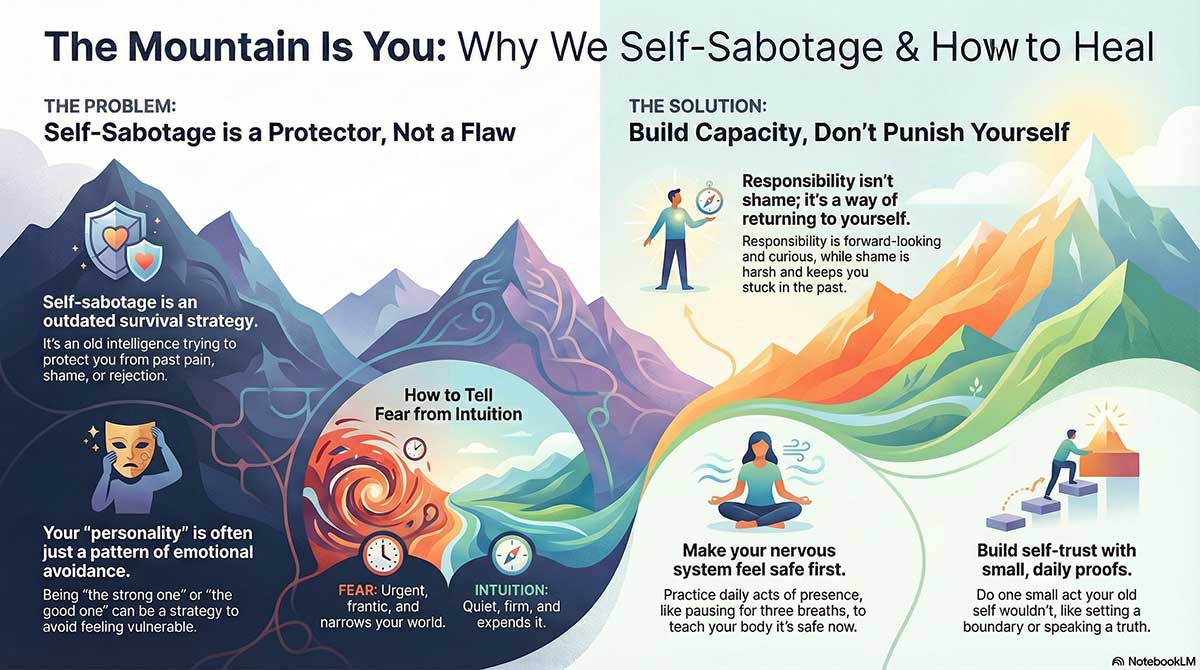
What I learned through this discussion is that the patterns we call “self-sabotage” are rarely proof that we’re weak — they’re proof that we adapted. Again and again, I heard the same truth from different angles: what we resist is often what once kept us safe. The obstacle isn’t an enemy. It’s a protector that never got the memo that your life has changed.
What felt new to me — even as someone who has lived inside these ideas — was how consistently the conversation returned to capacity. Not motivation. Not willpower. Capacity: the ability to stay present with discomfort, to tolerate visibility, to hold peace without manufacturing chaos, to accept love without shrinking or testing it, to build a life that doesn’t require self-abandonment. I also learned something sobering and freeing: the identity we’re trying to outgrow will always argue for its own survival. It will call itself “intuition.” It will call itself “realism.” It will call itself “who you are.” But the truer voice is quieter — it asks for small, faithful actions that create self-trust over time.
If I’m leaving this table with anything, it’s this: you don’t climb the mountain by punishing yourself into change. You climb it by making your protection strategies unnecessary — by building a nervous system that can handle peace, relationships that don’t require performance, and a daily life that proves, in small ways, that you are safe with yourself. That is what becoming looks like. That is what holding your life looks like.
Short Bios:
Brianna Wiest is a bestselling writer known for emotionally precise books on self-sabotage, identity change, and healing, including The Mountain Is You and 101 Essays That Will Change the Way You Think. Her work blends psychological insight with poetic clarity, focused on helping people build self-trust and real inner stability.
Carl Jung was a Swiss psychiatrist and the founder of analytical psychology. He introduced enduring ideas like the shadow, complexes, and individuation—frameworks that explain how unconscious patterns shape behavior, and how wholeness comes from integrating what we avoid.
Mary Oliver was an American poet celebrated for her clear, luminous attention to the natural world and the inner life. Her poems often guide readers back to honesty, tenderness, and the simple courage of being alive.
David Whyte is a poet and speaker whose work explores the emotional and conversational core of a meaningful life. He’s known for giving exact language to inner experience—fear, longing, courage, and the truths we avoid saying aloud.
Wislawa Szymborska was a Polish poet and Nobel Prize winner admired for her sharp simplicity and humane wit. Her poems reveal big truths through small observations, often turning certainty into curiosity.
Donald Winnicott was a British pediatrician and psychoanalyst who developed key concepts like the true self/false self and the “holding environment.” His work explains how early adaptation shapes adult identity and why safety is often the first step toward change.
Carl Rogers was an American psychologist and a founder of humanistic psychology. He argued that people change most reliably in an atmosphere of acceptance, empathy, and authenticity—ideas that shaped modern psychotherapy.
Pema Chödrön is a Buddhist teacher known for practical guidance on staying present with uncertainty and pain without hardening. Her teachings emphasize compassion, courage, and the power of “not running away” from discomfort.
Brené Brown is a researcher and author whose work focuses on shame, vulnerability, courage, and belonging. She’s known for translating complex emotional dynamics into actionable language that helps people live more honestly and resiliently.
Thich Nhat Hanh was a Vietnamese Zen master, poet, and peace activist who taught mindfulness as a way of returning to the present with compassion. His work emphasizes gentle discipline—breathing, walking, and awareness—as a path to peace and freedom.
Emily Dickinson was an American poet whose work captures the inner weather of the mind with striking intensity and precision. Her poems explore longing, fear, truth, and transcendence in compressed, unforgettable language.
Anne Lamott is an American writer known for candid, compassionate books on faith, fear, self-judgment, and the messy reality of being human. Her voice combines humor with deep emotional honesty.
Rumi was a 13th-century Persian poet whose writing centers on love, longing, and transformation. His work often frames pain not as failure, but as an opening—an invitation into a larger life.
Viktor Frankl was an Austrian psychiatrist and Holocaust survivor who founded logotherapy. He emphasized meaning, responsibility, and human dignity—especially the freedom to choose one’s response, even under hardship.
Maya Angelou was an American poet, memoirist, and civil rights leader whose work speaks to resilience, dignity, and the courage to live truthfully. She is widely admired for combining tenderness with moral clarity.
Hermann Hesse was a German-Swiss novelist whose books explore spiritual growth, identity, and inner awakening. His stories often follow characters shedding old selves to become more authentic and whole.
Toni Morrison was a Nobel Prize–winning American novelist celebrated for her profound exploration of identity, love, belonging, and the cost of self-erasure. Her work carries a rare combination of lyrical beauty and uncompromising truth.
Leave a Reply