

|
Getting your Trinity Audio player ready...
|
What if Mike Dooley sat with skeptics, scientists, and monks to test his own idea?
Main Introduction by Mike Dooley
For years, I’ve shared a simple idea with the world: Thoughts become things.
Some people heard empowerment.
Some heard exaggeration.
Some heard a promise I never intended to make.
This series exists because that phrase deserves to be understood—not repeated.
I never meant that a single thought overrides chance, cancels effort, or guarantees outcomes. I meant something quieter and, I believe, far more powerful: that the way we think shapes how we meet life, what we notice, what we dare to do, and what we allow ourselves to receive.
Across these conversations, we don’t try to defend a slogan. We slow it down. We examine belief as an operating system, emotion as momentum, action as participation, and time as a collaborator we don’t control but can learn to trust.
If there is a promise here, it’s not that life will obey you.
It’s that life will respond when you show up—honestly, patiently, and with curiosity.
This is not about mastering the universe.
It’s about remembering your place within it.
(Note: This is an imaginary conversation, a creative exploration of an idea, and not a real speech or event.)
Topic 1 — Do Thoughts Create Reality… or Select It?

Manifestation, perception, and probability
Introduction — Karen Armstrong
KAREN ARMSTRONG
For as long as humans have reflected on their place in the universe, we have wrestled with a single haunting question: How much of reality do we shape, and how much shapes us?
Mike Dooley’s phrase “Thoughts Become Things” has inspired millions, yet it also provokes resistance. Some hear it as empowerment. Others hear magical thinking. Still others fear it places moral weight on suffering.
Tonight, we will not try to defend or dismantle the idea. Instead, we will slow it down. We will ask whether thoughts create reality, select among possibilities, or simply influence how reality is experienced and navigated.
Let us begin where confusion most often starts.
Karen Armstrong
If thoughts truly shape reality, why do people with similar intentions, values, and effort experience radically different outcomes in life?
Daniel Kahneman
When people ask this question, they are often underestimating how much randomness governs outcomes. Two people can think similarly, act similarly, and still diverge dramatically due to chance, timing, and external variables beyond awareness.
Our minds are uncomfortable with randomness, so we construct narratives. We say, “She succeeded because she believed harder.” This comforts us, but it is often false. Outcomes are not clean reflections of intention; they are messy intersections of probability, environment, and opportunity.
The danger arises when belief becomes a moral explanation for results. That leads us to blame individuals for outcomes that were never fully under their control.
Mike Dooley
I agree with the concern—but I want to clarify something important. “Thoughts become things” was never meant to imply that belief overrides all randomness or guarantees outcomes.
Thoughts influence direction, not certainty. Two people may hold similar visions, but one might act when a door opens, while the other hesitates. One may notice opportunities the other doesn’t.
The universe doesn’t reward belief like a vending machine. It responds by arranging possibilities—and then waits for participation.
Nassim Nicholas Taleb
I would go further. Most success stories are survivorship bias dressed up as spirituality. We hear from those who “manifested,” not from the thousands who believed just as strongly and failed.
This doesn’t mean intention is useless. It means we must separate inner clarity from external outcome claims. Belief may improve decision-making or persistence, but it does not cancel Black Swan events.
Confusing narrative coherence with causal power is one of humanity’s oldest errors.
Joe Dispenza
What I find missing from this framing is the role of internal state. When people maintain coherent emotional and neurological patterns, they do not control outcomes—but they do change probability distributions.
We are not speaking about wishful thinking. We are speaking about training the nervous system to expect new experiences. That expectation alters behavior at micro-levels—tone of voice, posture, choices—that compound over time.
This does not eliminate randomness. It influences how one dances with it.
Donald Hoffman
From a perceptual standpoint, the question itself assumes we see reality as it is. We don’t. We experience a user interface shaped by evolution, not truth.
Two people may share intentions, but they are not inhabiting the same experienced world. Their perceptions highlight different affordances—different possibilities for action.
So outcomes diverge not only because of randomness, but because reality itself is filtered uniquely for each observer.
Karen Armstrong
That leads us naturally to the next inquiry.
Are thoughts actively shaping the external world—or are they primarily filtering what we notice, pursue, and act upon?
Donald Hoffman
I would argue strongly for the latter. Perception is not a mirror; it is a dashboard. Thoughts change the icons on that dashboard. They do not directly manipulate the engine of the universe.
When thoughts change, what becomes salient changes. Certain opportunities suddenly appear obvious, while others fade into irrelevance.
This alone can create the illusion that thoughts “created” events, when in fact they changed the interface through which events were selected.
Mike Dooley
I actually think that description supports my message more than contradicts it. If thoughts alter perception and perception alters action, then thoughts absolutely influence lived reality.
The universe doesn’t need us to micromanage atoms. It needs us to recognize doors when they appear.
What people call manifestation is often alignment—being in the right place mentally to respond when life whispers instead of shouts.
Daniel Kahneman
The danger lies in post-hoc reasoning. After success, people trace a straight line backward and conclude, “My thoughts caused this.”
They ignore near-misses, forgotten failures, and alternative paths that never materialized.
This doesn’t negate the value of optimism. It simply demands humility about causality.
Joe Dispenza
But humility does not require passivity. When individuals repeatedly rehearse new internal states, they reduce unconscious self-sabotage.
They interrupt habitual reactions that previously closed doors. Over time, this creates patterns that look like causation, even if they are technically selection effects.
The nervous system learns safety in the unknown—and that changes everything.
Nassim Nicholas Taleb
I’m comfortable with that framing as long as we do not overclaim. The problem is not belief; it is certainty.
When people believe their thoughts guarantee outcomes, they underestimate risk. When they see thoughts as tools for orientation rather than control, wisdom emerges.
Antifragility comes from engagement, not illusion.
Karen Armstrong
Let us then face the most difficult boundary.
Where does conscious creation realistically end—and where must we surrender to uncertainty, chance, and forces beyond our control?
Nassim Nicholas Taleb
It ends the moment we mistake influence for dominance. The world is vastly more complex than any internal narrative.
Surrender is not spiritual defeat; it is statistical literacy. The wise actor prepares, adapts, and accepts volatility without demanding explanation.
Mike Dooley
Surrender, to me, is trust without passivity. You choose your focus, your attitude, your next step—and then you release attachment to how and when.
Thoughts are invitations, not commands.
Life responds creatively, not obediently.
Donald Hoffman
From a scientific perspective, reality may not even exist independently of observation in the way we imagine. If that’s true, then humility is not optional—it is structural.
We participate in reality, but we do not author it alone.
Daniel Kahneman
Psychologically, surrender protects us from cruelty toward ourselves. When we accept uncertainty, we reduce unnecessary shame.
We stop asking, “What did I think wrong?” and begin asking, “What can I learn next?”
Joe Dispenza
And biologically, surrender allows the body to exit survival mode. Only then does creativity emerge.
Control constricts. Coherence opens.
Final Reflection — Karen Armstrong
What emerges here is neither blind manifestation nor helpless randomness. It is participation without illusion.
Thoughts may not command reality—but they shape how we meet it. They influence perception, readiness, courage, and meaning.
Perhaps the deepest truth is this: we are not creators standing above the universe, nor victims trapped beneath it. We are collaborators—learning, moment by moment, how to listen, respond, and trust without certainty.
And that may be the most human power of all.
Topic 2 — Belief as the Hidden Operating System

Why desire fails but expectation quietly succeeds
Introduction — Karen Armstrong
KAREN ARMSTRONG
Across spiritual traditions, belief has rarely been treated as a simple opinion. It is closer to an orientation of the heart—a lens through which reality is interpreted and possibility is either allowed or refused.
Mike Dooley often reminds us that we do not attract what we merely want, but what we expect. This distinction unsettles many people. Desire feels virtuous. Expectation feels risky.
Tonight, we will examine belief not as a slogan, but as an operating system—one that runs silently beneath intention, shaping what we permit ourselves to imagine, attempt, and receive.
Karen Armstrong
If belief is more powerful than desire, how can we identify beliefs we don’t consciously know we’re holding?
Bruce Lipton
Most beliefs are formed before conscious reasoning develops. They are absorbed, not chosen. By adulthood, the subconscious is running the show while the conscious mind believes it’s in charge.
You can identify hidden beliefs by watching results. Repeated patterns—especially unwanted ones—reveal subconscious programming far more reliably than introspection alone.
Your life is a printout of your unconscious assumptions.
Mike Dooley
That’s why affirmations frustrate people. They’re trying to override decades of conditioning with surface-level statements.
Belief shows up not in what we say, but in what we assume is “realistic.” When someone says, “I want abundance, but…”—the belief is already speaking.
The key is gentleness. Resistance softens when we stop arguing with ourselves.
Byron Katie
I would add that beliefs announce themselves through stress. Any thought that causes suffering is a belief asking to be questioned.
People often say, “I don’t know what I believe.” But the moment they feel anxious, defensive, or ashamed, a belief is active.
Inquiry is not about replacing beliefs. It’s about seeing whether they are true.
Carol Dweck
From a psychological standpoint, beliefs are self-protective. A fixed mindset isn’t stupidity—it’s safety.
If someone believes their ability, worth, or success is limited, that belief reduces risk. Failure becomes less threatening if you never fully try.
Changing belief often feels like removing armor before entering uncertainty.
Neville Goddard
Belief is not something you convince yourself of. It is something you assume.
When an assumption feels natural, the mind no longer argues. The world rearranges itself around what feels already true.
Struggle is a sign of divided assumption.
Karen Armstrong
This raises an uncomfortable question.
Why do affirmations and positive thinking often fail—even when practiced faithfully?
Mike Dooley
Because people are using them as negotiations rather than recognitions.
An affirmation spoken with hope but shadowed by doubt simply reinforces the doubt. The universe doesn’t hear words; it reads expectation.
Affirmations work best when they soothe rather than force—when they stretch belief just beyond resistance.
Bruce Lipton
From a biological angle, repetition without emotional congruence does nothing. The subconscious learns through emotion, imagery, and repetition under relaxed states.
If affirmations are practiced while the nervous system is tense, they are filtered out.
Belief change requires safety, not effort.
Carol Dweck
Many affirmations also threaten identity. If someone affirms “I am successful” while holding a belief that success leads to rejection or pressure, the mind resists.
The conflict isn’t intellectual—it’s emotional.
Progress comes from affirming process rather than outcome: learning, growth, curiosity.
Byron Katie
Affirmations fail when they bypass honesty.
If you say, “I am loved,” while believing “People always leave,” the mind knows the difference. Inquiry begins where the lie hurts.
Truth doesn’t need repetition.
Neville Goddard
Affirmations are tools, not causes. The cause is assumption.
When the inner conversation shifts from “Will this work?” to “Of course,” effort dissolves.
The test is not repetition, but naturalness.
Karen Armstrong
Let us go deeper.
Can belief be changed directly—or does it only shift indirectly through experience, inquiry, and time?
Byron Katie
Belief dissolves when questioned sincerely. Not replaced—seen through.
When a belief collapses, reality rushes in to fill the gap.
Experience follows clarity, not the other way around.
Bruce Lipton
Biologically, belief changes most effectively in states of reduced analytical resistance—play, love, meditation, hypnosis.
Direct confrontation triggers defense. Indirect exposure allows rewiring.
We change not by force, but by repetition in safety.
Carol Dweck
Experience is essential. Small wins matter.
When people act in ways that contradict old beliefs—and survive—the belief weakens.
Growth mindsets are built through evidence, not exhortation.
Neville Goddard
Experience follows assumption.
If you wait for proof before believing, you will wait forever. The inner shift must come first—even if it feels imaginary.
Reality mirrors the state you occupy most naturally.
Mike Dooley
I see belief as elastic. It stretches through exposure, curiosity, and kindness toward oneself.
You don’t leap from doubt to certainty. You move from impossible to possible to probable.
That’s enough. The universe can work with “maybe.”
Final Reflection — Karen Armstrong
What emerges is not a call to blind faith, nor to endless self-correction. It is an invitation to humility.
Beliefs are not moral failures. They are survival strategies learned early and reinforced often. To change them is not an act of willpower, but of patience and compassion.
Perhaps belief is not a switch we flip, but a soil we tend. When the ground softens, new possibilities root themselves quietly—without struggle, without force.
And in that quiet shift, desire finally finds a place to land.
Topic 3 — Emotion as the Engine of Manifestation

Why feeling moves reality faster than thought
Introduction — Karen Armstrong
KAREN ARMSTRONG
Across cultures, emotion has been treated with suspicion. Reason was crowned king, while feeling was viewed as weakness or distraction. Yet spiritual traditions quietly preserved another truth: transformation rarely begins with thought alone. It begins with felt experience.
Mike Dooley often emphasizes that thoughts without emotion are inert. Tonight, we examine emotion not as decoration, but as propulsion—asking why fear seems to manifest so efficiently, why gratitude alters trajectory, and why suppressed feeling may quietly undo conscious intention.
Karen Armstrong
Why do emotionally charged states—especially fear—seem to shape outcomes faster than calm or hopeful thoughts?
Antonio Damasio
From a neurological perspective, emotion precedes cognition. The brain evolved to prioritize survival signals, not abstract optimism. Fear mobilizes attention, memory, and action immediately.
When emotion is intense, it narrows focus and accelerates decision-making. This creates feedback loops—people notice confirming evidence faster and act more decisively, even if unconsciously.
What feels like manifestation is often amplified behavioral momentum.
Mike Dooley
That’s why people say, “I didn’t want this, but I kept worrying about it—and here it is.”
Emotion isn’t a moral judgment; it’s energy. Fear is powerful because it is focused. Hope often feels diffuse. The lesson isn’t to fear fear—but to understand its mechanics.
When joy and gratitude become emotionally vivid, they gain the same traction.
Esther Hicks
Emotion is guidance. Fear feels powerful because resistance is strong. The mind is fixated, even if negatively.
But alignment feels lighter, not louder. People mistake intensity for effectiveness.
Relief—not effort—is the doorway. When emotion softens toward relief, the path opens.
Gabor Maté
I would caution against glamorizing fear’s “effectiveness.” Fear shapes outcomes because it constricts choice. It narrows behavior into familiar survival patterns.
Trauma teaches the body what to expect. When expectation is embedded somatically, it recreates familiar pain—not because the universe punishes, but because the body seeks predictability.
Unfelt emotion doesn’t disappear. It governs from the shadows.
Brené Brown
Emotion also governs vulnerability. Fear manifests quickly because it discourages exposure. People protect themselves, avoid risk, and then interpret avoidance as fate.
Hope requires openness. Openness feels dangerous without emotional safety.
So fear wins by default—until courage becomes emotionally tolerable.
Karen Armstrong
This leads naturally to gratitude—a concept often repeated, but rarely examined deeply.
Is gratitude effective because it is morally virtuous—or because it signals expectation and safety to the mind and body?
Mike Dooley
Gratitude works because it says, “I trust life.”
When you’re grateful, you’re no longer scanning for threats or deficiencies. That shift alone changes behavior—tone, posture, timing, receptivity.
The universe doesn’t reward politeness. It responds to readiness.
Antonio Damasio
Gratitude activates neural pathways associated with coherence and long-term planning. It reduces stress hormones and widens cognitive scope.
This allows people to see more options, make better decisions, and delay impulsive reactions.
Calling this “manifestation” is poetic—but the mechanism is measurable.
Esther Hicks
Gratitude is alignment with what already is.
It removes the contradiction between desire and resistance. You can’t feel thankful and needy simultaneously.
The power is not the words “thank you,” but the emotional state of enoughness.
Brené Brown
Gratitude also counters shame. Shame narrows possibility. Gratitude restores worthiness.
When people believe they are worthy of good things, they show up differently. They ask, receive, and persist.
Expectation is not arrogance—it’s belonging.
Gabor Maté
But gratitude must be honest. Forced gratitude can become emotional bypassing.
If grief, anger, or fear are suppressed in the name of positivity, they reappear somatically—as anxiety, illness, or sabotage.
True gratitude includes space for pain.
Karen Armstrong
That brings us to a final, delicate question.
Can suppressed or unprocessed emotions quietly sabotage conscious intention—no matter how positive one’s thinking appears?
Gabor Maté
Absolutely. The body does not forget what the mind avoids.
Suppressed emotion creates internal conflict. One part of the psyche moves toward growth; another pulls back to maintain safety.
The result looks like fate, but it is often fragmentation.
Antonio Damasio
Emotion is not optional. It is the language of value.
If intention is cognitive but emotion signals danger, the nervous system will override conscious goals.
Alignment requires coherence—not optimism.
Mike Dooley
This is where compassion matters most. People blame themselves for “doing it wrong” when the real work is listening.
You don’t fix emotion—you honor it. Once acknowledged, it releases its grip.
Manifestation is less about control and more about integration.
Brené Brown
Vulnerability is the bridge. When emotion is named, it loses secrecy.
People often say, “I tried positivity and it failed.” What failed was avoidance, not hope.
Courage allows emotion to move instead of harden.
Esther Hicks
Emotion is guidance, not obstruction.
Resistance dissolves when allowed, not managed.
Alignment feels like relief—again and again.
Final Reflection — Karen Armstrong
What we see here is not an argument for emotional intensity, but for emotional honesty.
Emotion shapes reality not because it is mystical, but because it organizes perception, action, and meaning. Fear narrows. Gratitude opens. Suppression fractures. Presence integrates.
Perhaps the most radical shift is this: rather than trying to feel “better,” we learn to feel fully. And in that fullness, life responds—not obediently, but generously.
Emotion, then, is not the enemy of reason. It is the engine of participation.
Topic 4 — Action, Effort, and the Myth of “Just Think It”

Where manifestation breaks—and where it becomes real
Introduction — Karen Armstrong
KAREN ARMSTRONG
Every spiritual movement eventually confronts the same danger: the temptation to replace effort with belief, and responsibility with hope. When this happens, faith becomes fantasy, and intention becomes avoidance.
Mike Dooley has repeatedly warned against this misunderstanding, yet it persists. Tonight, we examine the role of action—not as a contradiction of manifestation, but as its expression. We ask where effort belongs, how to recognize inspired action, and whether waiting for signs can quietly become fear in disguise.
Karen Armstrong
If thoughts shape reality, why does effort still matter? Why can’t clarity alone be enough?
Mike Dooley
Because clarity without movement is rehearsal, not participation.
Thoughts don’t replace action—they inform it. When people say “I believed, but nothing happened,” I often ask, “What did you do differently?”
The universe doesn’t reward certainty. It responds to engagement.
James Clear
From a behavioral standpoint, identity is revealed through action, not intention.
People overestimate the power of single decisions and underestimate the compounding effect of small behaviors. Thinking differently without acting differently produces minimal change.
Reality responds to systems, not wishes.
Steven Pressfield
There’s a reason resistance shows up right after clarity. Insight threatens identity.
People mistake inspiration for completion. But inspiration is only the invitation. The work begins when discomfort starts.
Manifestation fails when people refuse the labor of becoming who the vision requires.
Cal Newport
Effort matters because value is created through depth.
Thinking may orient direction, but focused effort transforms raw potential into something real. Without sustained attention, ideas decay into noise.
The fantasy of “effortless success” is one of the most corrosive myths of modern spirituality.
Viktor Frankl
Meaning is discovered through responsibility.
Even when circumstances are constrained, action remains possible. Not grand action—chosen action.
Without responsibility, intention remains abstract and powerless.
Karen Armstrong
This raises a subtle distinction.
How can we tell the difference between inspired action and forced hustle driven by fear or comparison?
Mike Dooley
Inspired action feels lighter—not easier, but cleaner. There’s a sense of rightness even when effort is required.
Forced action feels frantic. It’s motivated by “should,” not curiosity.
The difference is not energy level—it’s emotional tone.
Steven Pressfield
I’d caution against romanticizing inspiration. Discipline often precedes clarity.
Inspired action doesn’t always feel good at first. It feels necessary.
Fear-driven hustle is frantic because it seeks validation. Inspired action seeks expression.
James Clear
You can often tell by consistency.
Inspired action integrates into daily life. Forced hustle burns hot and collapses.
Long-term alignment reveals itself through repeatable behavior, not emotional spikes.
Cal Newport
Another signal is attention quality.
Inspired action draws you into focus. Hustle fragments attention and multiplies distractions.
Depth is a better indicator than enthusiasm.
Viktor Frankl
And finally, meaning clarifies the difference.
When action is connected to purpose, suffering becomes bearable. When action is disconnected, even success feels hollow.
Inspired action carries meaning, not urgency.
Karen Armstrong
There is one more pitfall worth examining.
Can “waiting for signs” or “trusting the universe” become a sophisticated form of avoidance or fear?
Steven Pressfield
Yes. Constantly.
Resistance is cunning. It disguises itself as patience, humility, even faith.
When waiting becomes permanent, fear is in control.
Mike Dooley
Trust does not mean inactivity.
If you’re truly aligned, movement will follow. Even small movement.
The universe can’t steer a parked car.
James Clear
From a practical angle, clarity often comes after action, not before.
People wait for certainty when experimentation would teach faster.
Action is feedback.
Cal Newport
Waiting for signs often substitutes sensation for substance.
Real progress rarely announces itself dramatically. It accumulates quietly.
Faith without practice becomes entertainment.
Viktor Frankl
Avoidance is not always obvious.
It often appears as overthinking, endless preparation, or spiritual rationalization.
Meaning requires risk. Without risk, intention remains unrealized.
Final Reflection — Karen Armstrong
What we uncover here is not a rejection of thought, but its maturation. Thought finds dignity when it moves the body. Belief becomes credible when it bears responsibility.
Action, then, is not proof of faith—it is faith made visible. Not frantic, not performative, but chosen.
Perhaps the deepest misunderstanding of manifestation is the belief that effort negates trust. In truth, effort is how trust enters the world.
To act is to say, quietly and without guarantees: I am willing to participate.
Topic 5 — Time, Delay, and Trust in the Unseen

Why manifestation rarely arrives on our schedule
Introduction — Karen Armstrong
KAREN ARMSTRONG
Few experiences trouble the human spirit more than waiting without explanation. We can endure hardship, loss, even uncertainty—but prolonged delay quietly erodes trust.
Mike Dooley often reminds readers that unseen variables are always at work. Yet this idea can feel unsatisfying, even evasive, when hopes remain unfulfilled. Tonight, we examine delay not as punishment or proof of failure, but as a teacher—asking what time reveals, what impatience conceals, and whether trust can exist without certainty.
Karen Armstrong
When manifestation appears delayed, how can we tell whether something is wrong—or whether unseen coordination is still unfolding?
Mike Dooley
Most people assume delay means resistance or error. Often it simply means scale.
Big outcomes require more moving parts—people, timing, conditions beyond our awareness. When we rush interpretation, we collapse patience into self-judgment.
Delay is not denial. It’s choreography we can’t yet see.
Naval Ravikant
From a systems perspective, outcomes compound invisibly for long periods and then surface suddenly.
People dramatically underestimate lag time. They expect linear progress in non-linear systems.
Delay doesn’t mean nothing is happening. It often means leverage is building quietly.
Alan Watts
The mind mistakes time for failure because it wants reassurance.
But life is not goal-oriented in the way humans imagine. Growth happens in cycles, not schedules.
When we demand timing, we treat existence as a machine instead of a process.
Robert Greene
History shows that power accumulates through patience.
Those who master timing outlast those who rush visibility. Delay refines intention and exposes weak commitment.
Impatience often reveals desire untested by reality.
Pema Chödrön
Emotionally, delay activates fear of unworthiness. People ask, “What’s wrong with me?”
But waiting is where humility and gentleness are learned.
The pause teaches us how to stay present without reward.
Karen Armstrong
This raises a deeper question.
How much control do we truly have over timing—and where must surrender replace strategy?
Naval Ravikant
You control inputs, not outputs.
You choose effort, learning, consistency—but timing belongs to the system.
Wise strategy acknowledges uncertainty rather than fighting it.
Mike Dooley
I often say: choose the end, not the calendar.
When people obsess over timing, they introduce anxiety into alignment.
Trust isn’t passive—it’s relaxed readiness.
Alan Watts
Control over timing is an illusion born from anxiety.
Life unfolds like music. You don’t rush a note without ruining the melody.
Surrender is not resignation; it’s participation without resistance.
Robert Greene
There is a discipline to waiting.
Surrender does not mean inactivity. It means strategic patience—preparing while allowing conditions to ripen.
Those who force timing often expose themselves prematurely.
Pema Chödrön
Surrender means staying open when certainty is unavailable.
It is the willingness to remain tender without answers.
Timing teaches trust not through reward, but through endurance.
Karen Armstrong
Finally, we arrive at the most personal inquiry.
Can impatience itself quietly cancel manifestation—not because the universe punishes it, but because it fractures presence?
Pema Chödrön
Impatience pulls us out of the present moment.
When we abandon now in pursuit of later, we miss what life is offering.
Manifestation doesn’t fail—attention does.
Mike Dooley
Impatience doesn’t anger the universe. It distracts us from it.
When we’re busy checking the clock, we miss the door opening beside us.
Presence is the real point of power.
Naval Ravikant
Impatience leads to premature conclusions.
People quit too early, pivot too fast, or overcorrect based on incomplete data.
Time rewards those who can wait without stagnating.
Robert Greene
Every long game punishes impatience.
Those who master delay gain disproportionate advantage.
Timing is the final test of wisdom.
Alan Watts
Impatience arises from imagining life as somewhere else.
But there is no elsewhere.
The future arrives only as the present.
Final Reflection — Karen Armstrong
Across these conversations, a quieter truth has emerged. Thought matters. Belief matters. Emotion matters. Action matters. But time humbles them all.
Delay is not a flaw in the universe. It is a mirror, revealing where we grasp, where we trust, and where we confuse control with care.
Perhaps the deepest lesson of manifestation is not how to get what we want—but how to remain present while life becomes what it must.
Trust, then, is not certainty about outcomes. It is intimacy with the unfolding. And in that intimacy, meaning arrives—often before the thing itself ever does.
Final Thoughts by Mike Dooley
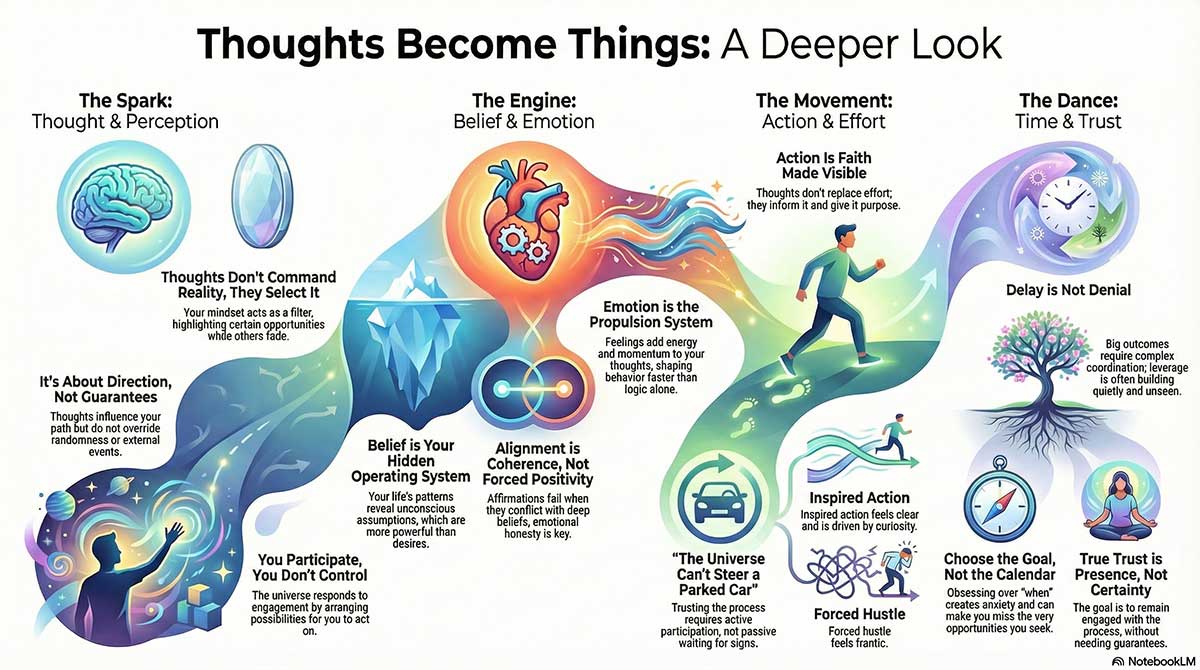
If there’s one thing I hope you take from this journey, it’s this: you were never meant to control life—only to dance with it.
Thoughts don’t snap fingers and rearrange reality on demand. But they do shape the lens through which reality is perceived. Beliefs quietly set boundaries around what feels possible. Emotions add momentum or resistance. Action brings ideas into form. Time humbles us all—and teaches trust when answers don’t arrive on schedule.
When people say manifestation “doesn’t work,” what they usually mean is that life didn’t follow their timeline or their script. But life has never been a vending machine. It’s a creative partner.
I’ve learned that clarity without kindness becomes pressure.
That patience without movement becomes stagnation.
And that trust without presence becomes fantasy.
What does work—what has always worked—is participation. Showing up with intention, taking the next step when it appears, listening when life whispers instead of waiting for it to shout.
So if something hasn’t arrived yet, don’t rush to blame your thoughts.
Ask instead: Am I still engaged? Am I still curious? Am I still willing?
Because the moment you are—life is already responding.
And that, to me, is what “Thoughts Become Things” has always meant.
Short Bios:
Mike Dooley
Author of Thoughts Become Things and creator of Notes from the Universe, Mike Dooley is a leading voice in modern personal development, known for translating metaphysical ideas into practical, empowering insight.
Karen Armstrong
Former nun and acclaimed historian of religion, Karen Armstrong is known for her deep, compassionate explorations of faith, myth, and meaning across cultures, emphasizing humility and shared human understanding.
Daniel Kahneman
Nobel Prize–winning psychologist and author of Thinking, Fast and Slow, Daniel Kahneman reshaped modern understanding of decision-making, cognitive bias, and the limits of human rationality.
Nassim Nicholas Taleb
Philosopher, statistician, and author of The Black Swan, Taleb focuses on uncertainty, randomness, and how humans misunderstand risk, probability, and success.
Donald Hoffman
Cognitive scientist and author of The Case Against Reality, Hoffman studies perception and argues that reality is not perceived as it truly is, but as a functional interface shaped by evolution.
Joe Dispenza
Neuroscientist and author exploring the intersection of brain science, emotion, and personal change, Dispenza focuses on how mental and emotional states influence behavior and potential.
Bruce Lipton
Cell biologist and author of The Biology of Belief, Lipton examines how subconscious beliefs influence biology, behavior, and long-term patterns of health and success.
Byron Katie
Spiritual teacher and creator of The Work, Byron Katie is known for her method of self-inquiry that questions stressful thoughts and reveals the peace beneath rigid belief systems.
Carol Dweck
Stanford psychologist and author of Mindset, Dweck’s research on fixed and growth mindsets transformed understanding of learning, motivation, and personal development.
Neville Goddard
Mystical teacher and author whose work emphasized imagination and assumption as creative forces, influencing generations of manifestation and consciousness teachings.
Antonio Damasio
Neuroscientist and author of Descartes’ Error, Damasio’s work highlights the essential role of emotion in reasoning, decision-making, and human consciousness.
Esther Hicks
Spiritual teacher known for presenting the Law of Attraction teachings attributed to Abraham, focusing on emotional alignment and vibrational awareness.
Gabor Maté
Physician and author exploring trauma, addiction, and emotional health, Maté emphasizes the role of suppressed emotion in shaping behavior and long-term wellbeing.
Brené Brown
Research professor and author known for her work on vulnerability, courage, and shame, Brown explores how emotional honesty strengthens connection and resilience.
James Clear
Author of Atomic Habits, Clear focuses on how small behavioral changes, systems, and identity-based habits create lasting transformation.
Steven Pressfield
Author of The War of Art, Pressfield writes about creative resistance, discipline, and the inner battles that accompany meaningful work.
Cal Newport
Computer scientist and author of Deep Work, Newport explores focus, craftsmanship, and the value of sustained effort in a distracted world.
Viktor Frankl
Psychiatrist and Holocaust survivor, Frankl authored Man’s Search for Meaning and emphasized purpose, responsibility, and choice even in the face of suffering.
Naval Ravikant
Entrepreneur and philosopher known for his insights on wealth, leverage, happiness, and long-term thinking, blending rational analysis with contemplative wisdom.
Alan Watts
Philosopher and speaker who introduced Eastern philosophy to Western audiences, Watts explored the illusion of control, time, and separation with clarity and humor.
Robert Greene
Author of The 48 Laws of Power and Mastery, Greene examines strategy, patience, and the psychology of long-term success.
Pema Chödrön
Buddhist nun and author whose teachings focus on compassion, uncertainty, and staying present in difficulty without hardening the heart.
Leave a Reply