

|
Getting your Trinity Audio player ready...
|
What if the most influential minds of the 20th century—who warned us decades ago—were finally allowed to speak to our moment?
Introduction by Nick Sasaki
I didn’t create this series to explain philosophy.
I created it because something felt off—not just politically, not just culturally, but existentially. Conversations everywhere felt louder, faster, more certain, and somehow emptier at the same time. People were talking constantly, yet listening less. Arguing fiercely, yet understanding almost nothing.
It felt as if we were surrounded by opinions but starved of judgment.
ImaginaryTalks was born from a simple question:
What would happen if we slowed things down enough for real thinking to occur again?
These are imaginary conversations, yes—but the problems they confront are painfully real. Truth feels unstable. Power feels invisible. Identity feels both overdefined and fragile. Technology promises connection while quietly hollowing out meaning. Democracy feels exhausted. And the individual—once celebrated as free—now feels shaped, managed, and quietly overwhelmed.
I didn’t want experts lecturing.
I didn’t want hot takes.
I wanted friction—between ideas that cannot be easily reconciled.
That’s why this series brings together thinkers who would not agree, who would challenge one another, interrupt one another, and expose the limits of their own positions. Not to win arguments, but to reveal what becomes visible only when certainty breaks down.
Each topic in this series asks a question we tend to avoid—not because we lack answers, but because the answers demand something from us. Responsibility. Attention. Courage. Humility.
You won’t find solutions here. That’s intentional.
What you may find instead is something rarer:
a space where complexity is not flattened,
where disagreement does not collapse into hostility,
and where thinking is treated as an ethical act.
I invite you to read these conversations slowly. Not to agree with them. Not even to admire them. But to let them unsettle you just enough to ask better questions of yourself, your assumptions, and the systems you move within every day.
If these dialogues succeed, they will not tell you what to think.
They will remind you that thinking still matters—
and that in a fractured world, that may be the most radical act left.
(Note: This is an imaginary conversation, a creative exploration of an idea, and not a real speech or event.)
Topic 1 — Truth Is Fragmenting: Can Society Survive Without a Shared Reality?

Moderator: Hannah Arendt
The room is quiet in the way that precedes serious thought. No screens. No audience. Just five thinkers seated around a long wooden table, the kind used for decisions that cannot be reversed. Hannah Arendt opens not with urgency, but with gravity.
She reminds them that societies do not collapse first through violence, but through confusion—when people no longer know what is real, what is fabricated, or what can be trusted at all.
She looks around the table.
First question
When facts lose authority and narratives begin to replace reality, what happens to responsibility—both personal and political?
Karl Popper speaks first, his tone precise but not cold.
“When facts lose authority,” he says, “responsibility does not disappear—it becomes urgent. The danger is not disagreement; it is immunity from correction. A society survives not because it agrees on everything, but because it allows claims to be tested and proven wrong. When narratives are insulated from falsification, responsibility dissolves because no one can be held accountable. Power thrives where error is protected.”
He pauses.
“Truth is not sacred because it is perfect. It is sacred because it is corrigible.”
Jean-François Lyotard leans back slightly, unfazed.
“The very phrase ‘facts lose authority’ assumes they once possessed it universally,” he counters. “What we are witnessing is not collapse, but exposure. Grand narratives—scientific, political, moral—promised coherence and delivered domination. Responsibility does not vanish when truth fragments; it relocates. It becomes local, contextual, provisional. The mistake is believing that one shared reality ever governed us without violence.”
Thomas Kuhn enters more cautiously.
“I would say responsibility becomes unstable,” he offers. “Facts only function within paradigms. When paradigms fracture—as they are doing now—people are not lying more than before; they are inhabiting different worlds of meaning. The crisis is not moral failure but paradigm conflict. Responsibility requires shared standards, and those standards are precisely what are shifting.”
Richard Rorty smiles faintly.
“I’m less alarmed,” he says. “Responsibility doesn’t come from metaphysical truth; it comes from loyalty to one another. When narratives replace reality, the question becomes practical: which stories help us reduce cruelty? Which allow cooperation? Truth is not something we mirror—it’s something we use. The danger isn’t narrative; it’s narratives that stop conversation.”
Arendt listens carefully, then speaks—not as a judge, but as a witness.
“When factual truth collapses,” she says, “what disappears first is not accuracy, but the space between people. Politics becomes theater. Responsibility becomes impossible because action loses consequences. A lie believed by all is no longer a lie—it becomes the ground of reality itself. That is how evil becomes ordinary.”
Second question
Is truth something societies must protect as a shared foundation—or something they inevitably negotiate through power, culture, and language?
This time, Kuhn begins.
“Truth is both protected and negotiated,” he says. “Normal science protects its paradigm fiercely. Revolutionary moments renegotiate it entirely. The error is imagining a permanent foundation. Truth functions historically. What matters is whether societies can survive transitions without turning disagreement into annihilation.”
Lyotard responds immediately.
“Protection is precisely the problem,” he says. “Every protected truth becomes a weapon. Language does not reveal reality; it organizes power. What you call a shared foundation often silences what does not fit. Negotiation is not corruption—it is honesty.”
Popper shakes his head slightly.
“Negotiation without standards is surrender,” he replies. “Yes, truths emerge historically—but they improve through criticism. Power corrupts truth when it shields ideas from challenge. A society that abandons the idea of objective error correction does not become pluralistic—it becomes manipulable.”
Rorty leans forward.
“Objective according to whom?” he asks gently. “What we call ‘standards’ are agreements among communities. I’m not denying facts—I’m denying their authority outside human purposes. The goal isn’t to protect truth; it’s to protect freedom to revise our descriptions when they cause harm.”
Arendt interjects, her voice quieter now.
“Truth cannot rule politics,” she says, “but politics collapses without truth. Factual truth is not opinion. It does not ask for loyalty—only acknowledgment. Once everything becomes negotiable, power fills the vacuum. And power does not negotiate.”
Third question
Can democracy survive disagreement about reality itself—or only disagreement within a shared sense of what is real?
The room grows still.
Popper answers without hesitation.
“Democracy cannot survive disagreement about reality,” he says. “It survives disagreement about policy, values, and priorities—on the condition that facts remain contestable but not optional. Without shared reality, elections become rituals, science becomes propaganda, and law becomes spectacle.”
Rorty counters calmly.
“I think democracy survives as long as people keep talking,” he says. “Shared reality is overrated; shared hope is not. Democracies don’t need epistemology—they need solidarity. When disagreement becomes lethal, it’s not because reality fractured, but because empathy did.”
Kuhn adds nuance.
“Democracies survive paradigm pluralism only if institutions slow down conflict,” he says. “When paradigm shifts accelerate faster than social adaptation, fear replaces deliberation. The danger is speed, not disagreement.”
Lyotard speaks last among the guests.
“Democracy has always been a fiction sustained by narratives,” he says. “What is collapsing is not democracy, but the illusion of consensus. The task is not to restore a shared reality, but to invent forms of coexistence without it.”
All eyes turn to Arendt.
She does not answer immediately.
“Democracy,” she says at last, “is not the rule of truth, nor the rule of opinion. It is the fragile space where people appear to one another as equals. That space requires a common world—a table between us. If that table disappears, we do not disagree. We shout into separate voids.”
She looks around the table once more.
“A society can survive lies,” she concludes softly. “It cannot survive the loss of reality itself.”
The conversation ends without resolution—but not without revelation. No one leaves convinced. Everyone leaves unsettled.
And that, perhaps, is the only honest beginning.
Topic 2 — Power Everywhere: Are We Free… or Only Think We Are?

Moderator: Michel Foucault
The setting feels deliberately ordinary: a simple room, neutral walls, no symbols of authority. And yet, that absence itself feels intentional—as if power has already learned not to announce its presence.
Michel Foucault does not open with a question. He opens with an observation.
“Power no longer needs to shout,” he says calmly. “It whispers. It recommends. It optimizes. And most dangerously—it convinces us that we chose it.”
Only then does he look to the others.
First question
If power shapes language, norms, and even desire itself, where does genuine freedom begin—if it begins at all?
Jean-Paul Sartre responds first, his voice firm, almost defiant.
“Freedom begins where excuses end,” he says. “You may be shaped by systems, watched by institutions, influenced by culture—but none of that absolves you. To say ‘power made me do it’ is already a choice. Even refusing to act is an act. Freedom is not comfort. It is the unbearable responsibility of knowing you are never fully determined.”
Herbert Marcuse shakes his head slightly.
“That answer belongs to an earlier stage of domination,” he replies. “Today, power does not repress—it satisfies. People do not feel constrained; they feel fulfilled. Desire itself has been engineered. Freedom cannot begin where alternatives are invisible. When the system produces both the problem and the pleasure that masks it, responsibility becomes psychologically unrealistic.”
Jean Baudrillard smiles faintly, almost amused.
“You are both assuming something remains behind the system,” he says. “But power no longer dominates reality—it replaces it. Freedom, repression, resistance—these are simulations we circulate to reassure ourselves that something real is happening. The individual believes they are choosing, but they are only navigating pre-scripted signs. Freedom is part of the display.”
Gilbert Ryle clears his throat, unimpressed by the theatrical tone.
“I think much of this confusion comes from bad metaphors,” he says. “We speak as if the self were a ghost trapped inside a machine called ‘society.’ But agency is not a hidden substance—it is a pattern of behavior. People are free when they can learn, revise, and act competently within practices. The question isn’t whether power exists, but whether individuals retain the capacity to understand what they are doing.”
Foucault listens, hands folded.
“Freedom,” he says, “does not exist outside power. It exists inside relations of power—as resistance, as refusal, as reconfiguration. The danger is not that power shapes us. It always has. The danger is when we stop noticing how.”
Second question
Is resistance still possible when control feels comfortable rather than coercive—when domination comes disguised as convenience and care?
This time, Marcuse begins.
“When domination becomes pleasant,” he says, “resistance looks irrational. Comfort anesthetizes critique. People defend the system not because they fear punishment, but because the system has merged with their identity. Resistance then requires not rebellion, but awakening—and awakening is painful.”
Sartre responds sharply.
“Pain is not an excuse,” he says. “If comfort numbs resistance, then comfort is chosen. Bad faith thrives on blaming structures for what is ultimately fear. The individual always knows—at some level—that they are surrendering their freedom for ease.”
Baudrillard interrupts softly.
“You speak as if awakening reveals truth,” he says. “But awakening itself has become a genre. The rebel aesthetic is absorbed, sold, and neutralized. Resistance no longer threatens power—it feeds it. The system thrives on critique because critique confirms that something is still at stake, even when nothing is.”
Ryle responds with restrained impatience.
“This language inflates abstraction,” he says. “People resist all the time—by changing habits, questioning rules, learning new skills. Not all resistance is dramatic. Freedom isn’t an explosion; it’s competence within constraints. The idea that comfort erases agency misunderstands how humans actually live.”
Foucault interjects.
“Resistance is never pure,” he says. “It is always entangled with what it resists. But that does not make it meaningless. Power is not a monolith—it is a network. And networks can be rerouted. The most dangerous domination is not comfort, but normalization—when no alternative can even be imagined.”
Third question
Do modern individuals internalize power more efficiently than any external authority ever could—and if so, who is responsible?
A long silence follows.
Baudrillard speaks first, almost gently.
“There is no longer a ‘who,’” he says. “Responsibility dissolves into systems without authors. Surveillance no longer needs cameras; people volunteer themselves. Control no longer needs force; it needs participation. The subject becomes both prisoner and guard—without noticing the switch.”
Marcuse nods.
“Yes,” he says. “Repression has been outsourced to the psyche. People police themselves according to norms they mistake for personal values. Responsibility becomes tragic because the individual feels free while being deeply conditioned.”
Sartre straightens in his chair.
“No,” he says firmly. “Responsibility does not dissolve. To say ‘there is no who’ is the final alibi. Even internalized power is accepted. The individual may be constrained, but they are never an object. To deny responsibility is to deny humanity.”
Ryle adds a quieter note.
“We should avoid dramatizing responsibility into something mystical,” he says. “People learn roles. They internalize expectations. That doesn’t erase accountability—it explains it. The question is whether societies cultivate reflective agents or passive performers.”
All eyes return to Foucault.
He pauses longer than before.
“Power succeeds,” he says slowly, “when it becomes invisible—when it passes through us rather than over us. Responsibility, then, is shared but uneven. Institutions shape possibilities. Individuals choose within them. The tragedy is not that people are controlled, but that they are told they are free without being taught how.”
He looks around the table.
“Freedom is not the absence of power,” he concludes. “It is the practice of critically engaging the forces that shape us. And that practice, today, is rare—not because it is impossible, but because it is inconvenient.”
The discussion ends without applause, without certainty.
What lingers is an uncomfortable realization:
that power may no longer need to dominate us—
because it has learned how to live inside us.
And the question that remains unspoken is the most unsettling of all:
If this is true… what would freedom actually require now?
Topic 3 — Identity, Oppression, and Responsibility: Who Owes What to Whom?

Moderator: Iris Murdoch
The room feels more intimate than before. The table is smaller. The light softer. Iris Murdoch has arranged the setting deliberately—not to reduce tension, but to make evasion harder.
“This conversation,” she begins, “fails the moment we treat people as abstractions. Identity is not a slogan. Responsibility is not a weapon. Justice is not a performance. So let us proceed slowly—and try to see one another.”
She pauses, then offers the first question.
First question
How do we acknowledge structural injustice without dissolving personal responsibility—or turning responsibility into blame?
W. E. B. Du Bois speaks first, his voice measured, reflective.
“Structural injustice,” he says, “is not an excuse—it is a context. To deny it is to deny reality. Double consciousness is the lived experience of carrying both the self you know and the self imposed upon you. Responsibility cannot be understood without recognizing that some people are asked to answer for conditions they did not create. Justice begins by naming that asymmetry honestly.”
Frantz Fanon follows, more forcefully.
“Responsibility,” he says, “has been used as a moral cudgel against the oppressed. Colonized people are told to be patient, reasonable, responsible—while violence structures their lives. Structural injustice is not an atmosphere; it is an assault. To demand personal responsibility without dismantling the system is to moralize oppression.”
John Rawls responds calmly.
“Justice must distinguish explanation from excuse,” he says. “Structural conditions explain unequal outcomes, but they do not erase agency. A fair society corrects unjust starting positions so responsibility can operate meaningfully. Without fairness, responsibility becomes punitive. Without responsibility, fairness becomes empty.”
Simone de Beauvoir leans in slightly.
“Oppression shapes possibilities,” she says, “but it does not write destinies. Women, like all marginalized people, are made—not born—into conditions. Responsibility exists, but it exists within constraint. The danger is pretending either that freedom is total or that it is nonexistent. Both lies serve power.”
Murdoch listens, then speaks quietly.
“The moral task,” she says, “is to resist the pleasure of blame. Structural analysis must deepen compassion, not replace it. Responsibility that becomes accusation ceases to be moral. And compassion that erases agency ceases to respect the person.”
Second question
When does identity become a necessary lens for truth—and when does it become a prison that limits moral imagination?
de Beauvoir begins this time.
“Identity is necessary because neutrality is often a mask,” she says. “Those who claim to speak from nowhere usually speak from privilege. Identity reveals perspective. But when identity hardens into destiny, it becomes a cage. Liberation requires remembering that no identity exhausts the human being.”
Du Bois nods.
“Identity can awaken truth,” he says. “Double consciousness revealed what dominant culture could not see. But I have also seen identity weaponized—used to divide, to police authenticity, to silence deviation. Identity must illuminate injustice without becoming its own orthodoxy.”
Fanon speaks next, his tone sharp.
“For the colonized, identity is imposed before it is chosen,” he says. “Reclaiming identity is an act of survival. But it must be a transitional identity. If it calcifies, it reproduces the same psychic prison the colonizer built. The goal is not eternal identity—but human freedom.”
Rawls offers a more abstract perspective.
“From the standpoint of justice,” he says, “identity should be morally arbitrary. No one deserves advantage or disadvantage because of it. But societies must address identity precisely because they fail to treat it as arbitrary. The challenge is correcting injustice without reifying the very categories that caused it.”
Murdoch intervenes gently.
“Identity becomes a prison,” she says, “when it replaces attention. Moral imagination requires the capacity to see others as more than representatives of a group—including one’s own. When identity tells us what to see before we look, love becomes impossible.”
Third question
Is justice primarily a matter of transforming systems, cultivating moral character, or changing how we perceive one another—and what happens when these aims collide?
A longer silence follows.
Rawls speaks first.
“Justice requires just institutions,” he says. “Good intentions cannot compensate for unfair structures. Character matters, perception matters—but without systemic fairness, they are insufficient. Institutions shape incentives, expectations, and life chances. Justice must be built, not hoped for.”
Fanon responds sharply.
“Institutions built by violence cannot be reformed gently,” he says. “When systems dehumanize, moral appeals ring hollow. Liberation often demands rupture. Character formation is a luxury for those already recognized as human.”
Du Bois offers a bridging perspective.
“Systems matter,” he says, “but so does the soul. A society can change laws and still retain contempt. Without moral transformation, injustice mutates rather than disappears. Justice must be structural and spiritual.”
de Beauvoir adds nuance.
“Oppression persists,” she says, “when systems excuse bad faith and individuals excuse themselves. Ethics is lived. One cannot outsource justice entirely to institutions without surrendering moral responsibility.”
All eyes return to Murdoch.
She speaks slowly, choosing each word.
“Justice without vision becomes bureaucratic,” she says. “Character without awareness becomes self-righteous. Perception without action becomes sentimental. These aims collide because we prefer simple answers. But goodness is not simple. It is patient, attentive, and unglamorous.”
She looks around the table.
“The deepest injustice,” she continues, “is the refusal to see another person as real. Systems matter because they encode vision. Character matters because it resists cruelty. But perception—loving attention—is what prevents justice from becoming another form of domination.”
The conversation draws to a close, not with agreement, but with exhaustion—the honest kind that follows moral seriousness.
No one claims victory. No one offers a slogan.
What remains is a difficult truth:
That justice demands more than correct opinions.
That responsibility cannot be reduced to guilt or denied through theory.
That identity can reveal truth—and also obscure it.
And perhaps most unsettling of all:
That the work of justice begins not in outrage,
but in the quiet, disciplined effort to see another human being clearly.
The table remains.
The question remains.
And the responsibility—shared, uneven, unavoidable—remains with us.
Topic 4 — Technology vs Meaning: Are Humans Becoming Accessories?

Moderator: Martin Heidegger
The room is spare—no devices, no screens, no clocks. Heidegger insisted on it. “Technology,” he says at the outset, “is most powerful when it does not appear as technology at all.” The table is set for a conversation beneath convenience, beneath efficiency, beneath optimism.
He looks at the five guests and opens the inquiry.
First question
Does technology merely extend human capacity—or does it quietly redefine what it means to be human?
Edmund Husserl begins, careful and exacting.
“Technology extends capacity only insofar as it preserves the primacy of lived experience,” he says. “The danger arises when tools interpose themselves between consciousness and the world, replacing presence with mediation. When experience becomes data, the human being risks forgetting how meaning originates—in intentional, embodied awareness.”
Henri Bergson follows, animated.
“Technology does not merely extend us,” he says. “It spatializes time. It turns duration—living, flowing time—into units, schedules, metrics. In doing so, it reshapes intuition itself. Creativity suffers not because machines are strong, but because life is forced to imitate them.”
John Dewey leans forward.
“Tools are not the problem,” he counters. “The problem is how they are integrated into experience. Technology redefines humanity only when it is severed from democratic purpose and education. When tools serve growth, inquiry, and shared problem-solving, they deepen meaning rather than erase it.”
Hannah Arendt enters with concern.
“We must distinguish making from acting,” she says. “Technology elevates fabrication—means and ends—above action, which is unpredictable, relational, and political. When efficiency replaces judgment, humans become operators rather than citizens. That is not extension; it is reduction.”
José Ortega y Gasset adds a sociological note.
“Technology redefines humanity by redefining expectation,” he says. “The mass individual comes to believe that comfort is a right and effort an injustice. When life is organized around ease, the self loses its sense of vocation—of having something to become.”
Heidegger listens, then offers a framing.
“Technology,” he says, “is not a tool but a way of revealing. When the world shows up only as resource, the human shows up only as function.”
Second question
What is lost when efficiency replaces reflection as the highest value—and can that loss be recovered?
Bergson answers first.
“What is lost is freedom of attention,” he says. “Reflection requires patience with uncertainty. Efficiency despises hesitation. Once speed becomes virtue, depth becomes defect. Recovery is possible only if we relearn how to wait—without anxiety.”
Dewey responds with cautious optimism.
“Efficiency becomes tyrannical only when detached from ends worth pursuing,” he says. “Reflection can be recovered through education that treats thinking as a habit, not a luxury. The danger is cultural, not technological.”
Arendt is less hopeful.
“What is lost,” she says, “is the capacity for judgment. Reflection is not mere thinking; it is weighing consequences in a shared world. When speed dominates, responsibility evaporates. Recovery is difficult because judgment cannot be automated.”
Husserl adds a deeper concern.
“What is lost is meaning’s origin,” he says. “Efficiency values results without asking how they are constituted. Reflection reminds us that meaning is not found—it is constituted through conscious acts. Without this, knowledge becomes empty success.”
Ortega y Gasset offers a sharp observation.
“Efficiency flatters mediocrity,” he says. “It allows people to live comfortably without understanding the systems that sustain them. What is lost is gratitude—and with it, responsibility. Recovery would require reintroducing effort as a virtue.”
Heidegger summarizes quietly.
“What is lost is dwelling—the capacity to be at home in the world rather than merely using it.”
Third question
Can meaning survive in a world optimized for speed, productivity, and constant optimization—or must resistance take a different form?
A long pause.
Arendt speaks first.
“Meaning survives only through spaces protected from optimization,” she says. “Politics, art, friendship—these require time that cannot be justified by output. Resistance begins by refusing to treat all time as production.”
Dewey reframes the issue.
“Optimization is not the enemy,” he says. “Unquestioned optimization is. Meaning survives when communities democratically decide what to optimize for. Without participation, speed serves power, not people.”
Husserl returns to first principles.
“Meaning survives only if consciousness remains central,” he says. “When optimization dictates attention, intentionality collapses. Resistance is phenomenological: returning again and again to lived experience as the source of truth.”
Bergson adds a poetic warning.
“Life cannot be optimized,” he says. “It can only be lived. Meaning survives where creativity interrupts routine. Resistance may look inefficient—but inefficiency is where life breathes.”
Ortega y Gasset concludes with a cultural diagnosis.
“A society obsessed with optimization forgets why it exists,” he says. “Meaning survives when individuals feel summoned by something higher than convenience. Without that call, speed becomes emptiness.”
All eyes turn to Heidegger.
He does not rush.
“Meaning does not disappear because machines advance,” he says slowly. “It disappears when humans accept a single way of revealing the world. Resistance is not rebellion against technology—it is openness to other ways of being.”
He looks around the table.
“To save meaning,” he concludes, “we must learn to pause—not because we are inefficient, but because we are human.”
The conversation ends without prescriptions, without apps, without solutions.
What remains is a quiet unease:
That the greatest danger of technology is not what it does to us—
but what it convinces us we no longer need to do ourselves.
Reflection.
Judgment.
Attention.
Dwelling.
These cannot be optimized.
And perhaps that is precisely why they matter now.
Topic 5 — Can We Still Live Together? Democracy, Dialogue, and Collapse
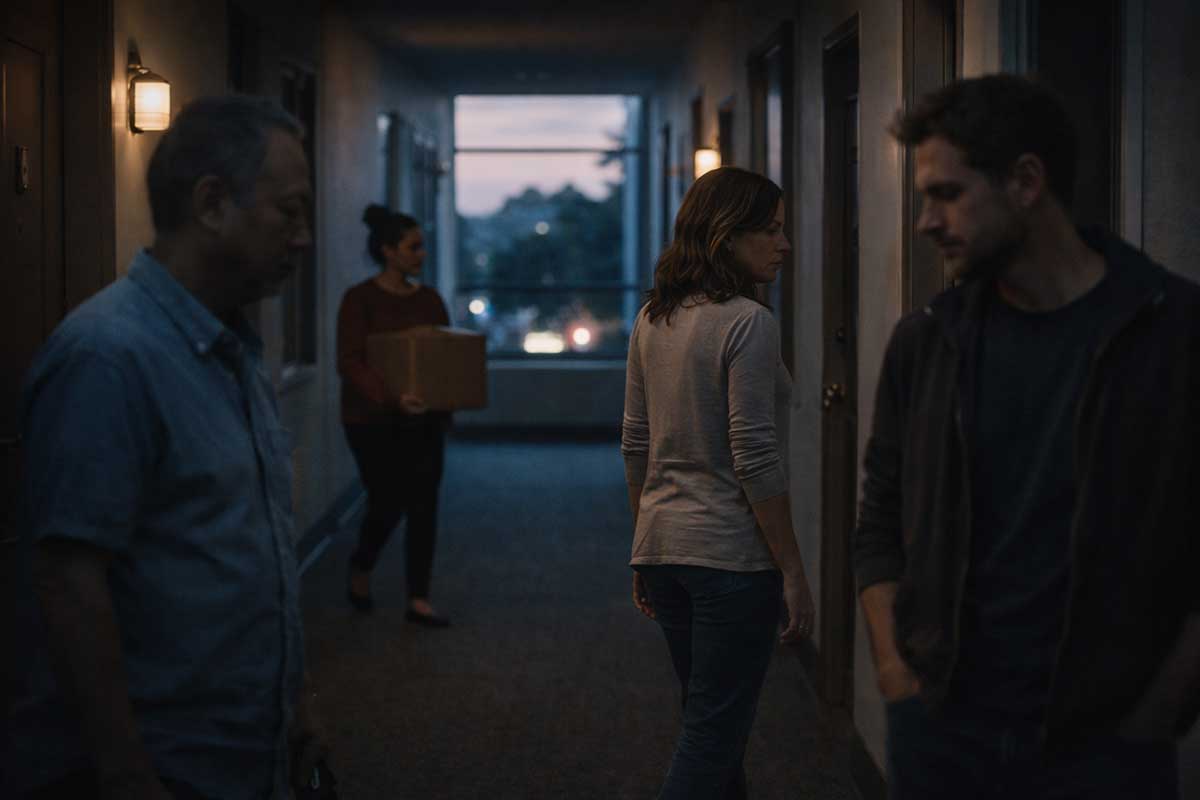
Moderator: Jane Addams
The room is arranged differently this time. No long table, no sense of opposition. Chairs form a wide circle. Jane Addams insisted on it. “Democracy,” she says quietly, “does not begin with agreement. It begins with proximity.”
She looks around at the five thinkers gathered here—each skeptical, each concerned in different ways—and opens the conversation not with alarm, but with care.
First question
Can dialogue survive in a culture shaped by outrage, performance, and permanent disagreement—or has conversation itself become obsolete?
Hans-Georg Gadamer speaks first, gently.
“Dialogue survives only when participants accept that they may be changed by it,” he says. “What we see today is not dialogue but parallel monologues. People speak to confirm themselves, not to understand others. Conversation collapses when listening becomes strategic rather than receptive.”
Theodor Adorno responds with skepticism.
“Dialogue is already compromised,” he says. “The culture industry trains people to perform opinions, not to examine them. Outrage is profitable. Speech is commodified. Under such conditions, dialogue becomes another spectacle—appearing free while reproducing conformity.”
Karl Popper enters firmly.
“Dialogue survives only where criticism is protected,” he says. “Outrage replaces argument when people fear being proven wrong. A free society depends not on harmony, but on institutions that allow ideas to fail without punishing the speaker. Without that, conversation degenerates into tribal signaling.”
Richard Rorty offers a softer angle.
“I think we overestimate rational dialogue,” he says. “Societies hold together through stories, loyalties, and shared hopes. Conversation survives not because people seek truth, but because they want to live together. When outrage dominates, it’s because people feel unseen—not because dialogue is impossible.”
Addams listens, then speaks.
“Dialogue becomes impossible,” she says, “when people no longer share consequences. When speech costs nothing—or costs everything—it ceases to heal. Democracy requires spaces where disagreement is safe, personal, and unfinished.”
Second question
What obligations do citizens owe one another beyond tolerance—and what happens when tolerance becomes the highest moral ideal?
Gadamer begins again.
“Tolerance without engagement is indifference,” he says. “Understanding requires effort—entering another’s horizon without abandoning one’s own. When tolerance replaces interpretation, we coexist without communion.”
Popper sharpens the point.
“Unlimited tolerance destroys itself,” he says. “A democratic society must defend the conditions that make tolerance possible. This includes resisting movements that reject dialogue altogether. Tolerance is a rule, not a virtue.”
Adorno interjects critically.
“Tolerance often masks power,” he says. “The dominant tolerate the marginalized while remaining untouched. What is owed is not tolerance, but justice. Without addressing material and cultural domination, appeals to tolerance become moral cosmetics.”
Rorty reframes.
“People don’t want tolerance,” he says. “They want recognition. They want to feel that their suffering matters. The obligation citizens owe one another is not agreement, but solidarity—the willingness to say ‘your pain counts even when I don’t share your beliefs.’”
Addams reflects before responding.
“Democracy fails,” she says, “when tolerance replaces responsibility. We owe one another participation—showing up, staying present, and refusing the comfort of withdrawal. Tolerance is passive. Citizenship is active.”
Third question
Is democracy primarily a structure of laws and institutions—or a moral relationship that must be continually renewed?
A longer silence follows.
Popper speaks first.
“Democracy requires institutions,” he says. “Without the rule of law, freedom collapses into force. Moral intentions are not enough. Systems matter because people are fallible.”
Adorno counters sharply.
“Institutional democracy can coexist with deep unfreedom,” he says. “When economic domination persists, political choice becomes hollow. Democracy without emancipation is administration.”
Gadamer offers a mediating voice.
“Institutions endure only when animated by trust,” he says. “Law cannot replace legitimacy. Democracy is renewed through dialogue that reaffirms a shared world.”
Rorty leans forward.
“I think democracy is a habit,” he says. “A habit of compromise, irony, and restraint. It survives not because it’s true, but because people prefer it to cruelty. Moral relationships matter more than philosophical foundations.”
All eyes return to Jane Addams.
She speaks slowly, drawing from lived experience.
“Democracy is not a machine that runs once built,” she says. “It is a relationship that weakens when neglected. Laws protect us from tyranny. Institutions coordinate action. But democracy lives only where people practice sympathy across difference.”
She looks around the circle.
“When citizens retreat into purity, performance, or despair,” she continues, “democracy does not collapse dramatically—it erodes quietly. People stop expecting one another to care.”
The conversation ends without resolution.
No one claims democracy is safe.
No one declares it doomed.
What remains is a difficult recognition:
That living together requires more than correct positions.
More than tolerance.
More than institutions.
It requires the courage to stay in conversation
when outrage would be easier,
withdrawal more comfortable,
and certainty more seductive.
The circle remains open.
And the question lingers—not as theory, but as invitation:
Are we still willing to live together
as unfinished, disagreeing, responsible human beings?
Because democracy, if it survives at all,
will survive there.
Topic 6 — Meaning Is Draining Away: Can a Culture Survive Without Depth?

Moderator: Simone Weil
The room is almost bare. No decorations. No slogans. No music. Simone Weil asked for it this way. “If meaning still exists,” she said before the others arrived, “it will not survive noise.”
The five thinkers sit quietly, not facing an audience, but facing one another. Weil does not open with a thesis. She opens with a demand.
“Attention,” she says softly. “Not agreement. Not performance. Attention.”
Only then does she speak the first question.
First question
What happens to a society that loses the capacity for attention—and can meaning exist without it?
George Santayana speaks first, his voice calm, almost elegiac.
“A society without attention becomes amnesiac,” he says. “It forgets not only its past, but why its values existed at all. Meaning is not invented each morning—it is inherited, refined, remembered. When attention collapses, tradition becomes caricature, and culture becomes decoration. Such a society survives materially, but not spiritually.”
Roland Barthes follows, sharper, more ironic.
“What we call attention today,” he says, “is merely consumption slowed down. Images flash, meanings dissolve, and myth replaces depth. The problem is not distraction—it is saturation. Signs multiply until none can be taken seriously. Meaning suffocates under excess.”
Ludwig Wittgenstein speaks quietly, almost reluctantly.
“When language loses its grounding in life,” he says, “words continue, but sense disappears. Attention is not focus—it is use. Meaning exists only where words are woven into forms of life. When speech becomes detached from lived practice, we do not lose meaning dramatically; we lose it silently.”
Jacques Derrida tilts his head slightly.
“We should be careful with nostalgia for presence,” he says. “Meaning was never fully present to begin with. It has always deferred itself. What has changed is not the absence of depth, but the exposure of its instability. Attention today encounters not emptiness, but undecidability.”
Simone Weil responds—not as a referee, but as a witness.
“Meaning cannot survive without attention,” she says. “Not attention as stimulation, but attention as consent to reality. The soul starves when it is fed only impressions. What is undecidable still demands reverence. Without attention, even truth becomes noise.”
Second question
Is irony a defense against disappointment—or has it become a slow erosion of seriousness and moral depth?
Barthes begins immediately.
“Irony protects us from naïveté,” he says. “In a world of manufactured myths, seriousness is often manipulation. Irony allows distance. It unmasks power pretending to be natural. The danger is not irony itself—but irony without responsibility.”
Santayana replies with restraint.
“Irony has its place,” he says, “but when it becomes a permanent posture, it hollows character. A culture that cannot kneel before anything—truth, beauty, suffering—will eventually kneel before nothing. Irony dissolves commitment. Meaning requires loyalty.”
Wittgenstein interjects gently.
“Irony confuses language games,” he says. “It says one thing and means another, endlessly. Used sparingly, it clarifies. Used constantly, it corrodes trust. When every utterance carries quotation marks, sincerity becomes unintelligible.”
Derrida smiles faintly.
“But sincerity itself is unstable,” he says. “Irony reveals that meanings are never fully owned. It resists closure. What you call erosion may be openness—the refusal to let seriousness harden into dogma.”
Weil listens carefully, then speaks.
“Irony is not humility,” she says. “It often masquerades as wisdom while protecting the self from obligation. The soul needs gravity. Without it, suffering becomes spectacle and evil becomes clever. Irony without love is cruelty with a smile.”
Third question
Can the sacred—or something like it—exist in a culture that no longer knows how to wait, listen, or endure silence?
A long silence follows. Weil does not interrupt it.
Santayana speaks first.
“The sacred survives only as memory,” he says. “Rituals without belief, symbols without reverence. A culture that cannot wait cannot worship. It replaces the sacred with nostalgia or kitsch. What remains is sentimentality, not devotion.”
Barthes offers a counterpoint.
“The sacred has not disappeared,” he says. “It has migrated. Brands, celebrities, narratives—they command reverence, sacrifice, repetition. The sacred persists, but in disguised, commercialized forms. Silence is not required—only belief.”
Wittgenstein adds a different angle.
“The sacred is not an object,” he says. “It is shown, not said. It appears in how life is lived. A culture that cannot endure silence loses not the sacred, but the capacity to recognize it. Waiting is not inactivity—it is orientation.”
Derrida speaks slowly.
“The sacred has always been haunted,” he says. “Presence is never pure. But the trace of the sacred remains—in the demand that meaning matters even when it cannot be secured. Silence does not guarantee depth, but without silence, nothing interrupts the endless deferral.”
All eyes turn again to Simone Weil.
She does not raise her voice.
“The sacred exists wherever attention consents to reality without trying to dominate it,” she says. “Silence is not empty. It is the condition under which truth dares to appear. A culture that cannot wait demands satisfaction instead of meaning. It confuses stimulation with life.”
She pauses.
“To wait,” she continues, “is to accept vulnerability. That is why silence terrifies us. But without vulnerability, there is no depth—only surfaces touching other surfaces.”
The conversation does not end with reconciliation.
It ends with something rarer:
a shared stillness.
No one denies that meaning is fragile.
No one claims it can be engineered.
No one offers a program.
What remains is a hard recognition:
That meaning does not disappear because it is disproven.
It disappears because it is neglected.
Because attention is outsourced.
Because irony replaces reverence.
Because silence is treated as failure.
And perhaps the most unsettling truth of all:
That depth is not lost by accident.
It is surrendered—slowly, willingly—
each time we choose noise over attention,
speed over patience,
cleverness over care.
The room remains quiet.
And in that quiet, something still waits.
Topic 7 — Who Shapes the Individual Now: Self, Society, or System?

Moderator: Karl Jaspers
The room feels different from the others. Less severe than Heidegger’s, less ascetic than Weil’s. A room meant for crisis—not emergency, but existential crisis. Karl Jaspers chose it deliberately. “The self,” he says quietly, “reveals itself most clearly when it reaches its limits.”
He looks around the table. These thinkers do not agree on what shapes the individual—but each, in his or her own way, has diagnosed why modern people feel both free and trapped at the same time.
He begins.
First question
How much of the modern self is freely chosen—and how much is quietly engineered by social, economic, and ideological systems?
José Ortega y Gasset speaks first, measured and direct.
“The self is neither fully chosen nor fully imposed,” he says. “I am myself and my circumstances. The modern error is believing one can be authentic while ignoring the forces that shape expectation, desire, and ambition. Engineering occurs when circumstances pretend to be neutral. Freedom begins when one becomes conscious of one’s situation and responds to it deliberately.”
Louis Althusser responds sharply.
“Consciousness is not enough,” he says. “The individual is constituted by ideology before they ever reflect. People do not simply encounter systems—they are produced by them. Education, media, family, law: these do not constrain a preexisting self; they create the conditions under which a self can even appear. What you call ‘choice’ often occurs within invisible limits.”
Bertrand Russell pushes back.
“That risks erasing moral agency altogether,” he says. “Yes, systems influence us. But individuals still reason, still doubt, still dissent. History is filled with people who resisted prevailing ideologies at great cost. To deny agency is to excuse conformity. Freedom may be difficult, but it is not fictional.”
Philippa Foot adds quietly.
“We must distinguish influence from determination,” she says. “Character is formed over time through habits, choices, and moral education. Systems matter, but they do not absolve individuals from becoming certain kinds of people. The danger today is treating character as irrelevant—as if ethics were merely structural.”
Arne Næss offers a broader frame.
“The modern self is engineered by its isolation,” he says. “We imagine the individual as separate from community, nature, and future generations. This narrow self is easier to manage. A deeper self—an ecological self—resists reduction because it identifies beyond the system that seeks to shape it.”
Jaspers nods slowly.
“The crisis,” he says, “is not that systems shape us. It is that we experience ourselves as free without knowing how we were formed. That ignorance is itself a form of unfreedom.”
Second question
Are people responsible for who they become within systems they did not design—or does responsibility require conditions that no longer exist?
A heavier silence settles.
Althusser speaks first.
“Responsibility presupposes freedom,” he says. “And freedom presupposes material and ideological conditions that allow genuine alternatives. When choices are structured to reproduce the system, holding individuals responsible becomes moral theater. Blame replaces analysis.”
Russell responds firmly.
“Responsibility does not require ideal conditions,” he says. “It requires the capacity to reflect and act differently. Even under unjust systems, people make moral choices. To deny this is to deny the very concept of ethics. The existence of constraint does not eliminate responsibility—it complicates it.”
Foot builds on this.
“Responsibility is not all-or-nothing,” she says. “It is graduated. Systems can diminish responsibility without erasing it. A just society recognizes this complexity. A cruel society pretends either that individuals are fully free—or fully determined—depending on which is more convenient.”
Ortega y Gasset reframes the tension.
“Modern people suffer from a false innocence,” he says. “They blame systems for their emptiness while refusing the effort required to shape a life. Circumstances do not choose for us—but they demand a response. Responsibility lies in how one answers the situation one is given.”
Arne Næss offers a quieter critique.
“Responsibility collapses when the self is too small,” he says. “If I see myself only as an isolated individual, responsibility feels overwhelming or meaningless. But when identity expands—to community, ecology, future life—responsibility becomes natural rather than punitive.”
Jaspers listens carefully, then speaks.
“Existential responsibility,” he says, “does not mean guilt for everything. It means refusing to lie to oneself about one’s situation. Even when choices are constrained, truthfulness about one’s limits is itself a form of freedom.”
Third question
Does real individuality arise through comfort and self-expression—or through confrontation with limits, failure, and existential crisis?
This time, Jaspers allows the silence to linger before anyone answers.
Russell speaks first.
“Comfort does not produce individuality,” he says. “It produces conformity with preferences. Individuality emerges when reason challenges habit, when conscience resists convenience. Crisis is not required—but challenge is.”
Foot agrees, but with nuance.
“Character is forged through difficulty,” she says. “Not dramatic crisis, but sustained moral effort. Comfort weakens virtue when it removes the need for judgment. Self-expression without discipline becomes indulgence, not individuality.”
Ortega y Gasset sharpens the point.
“The mass individual seeks comfort and calls it freedom,” he says. “The authentic individual accepts burden and calls it destiny. Individuality is not self-expression—it is self-demand.”
Althusser responds skeptically.
“We romanticize crisis,” he says. “For many, crisis destroys rather than liberates. Individuality cannot depend on suffering alone. Without structural change, appeals to existential awakening risk blaming individuals for systemic failures.”
Arne Næss reframes again.
“Crisis awakens individuality only when the self is connected to something larger,” he says. “Otherwise, crisis collapses inward into despair. A deep self can endure limits because it does not experience them as annihilation.”
All eyes turn back to Karl Jaspers.
He speaks slowly, as if diagnosing something fragile.
“Individuality does not arise from comfort,” he says, “nor from suffering alone. It arises from boundary situations—moments when we encounter failure, guilt, death, or uncertainty and cannot escape into systems, roles, or excuses.”
He looks around the table.
“In such moments,” he continues, “the individual either dissolves into conformity—or awakens to existence. Crisis does not guarantee freedom. But without confronting limits, the self remains shallow, borrowed, and unexamined.”
The conversation ends not with synthesis, but with exposure.
No one denies the power of systems.
No one denies the weight of circumstance.
No one pretends individuality is easy.
What remains is an uncomfortable truth:
That the modern self is shaped—deeply—by forces it did not choose.
But also that freedom does not disappear because shaping exists.
It disappears when people stop asking
who they are becoming
and why.
The room empties slowly.
And the question lingers—not as philosophy, but as demand:
Are we individuals because we express ourselves?
Or because we confront the limits that reveal who we are?
Because in an age that explains everything,
the rarest act may be this:
To refuse the comfort of explanation
and choose responsibility anyway.
Final Thoughts by Nick Sasaki

When I began this series, I didn’t know where it would end.
I only knew that something essential was missing from the conversations we keep having—online, in media, even in ourselves. We talk constantly about outcomes, sides, identities, and solutions, but rarely about how we think, why we believe, or what kind of people our thinking is turning us into.
These imaginary conversations didn’t give me answers.
They gave me something better: clarity about the questions that matter.
What became clear is this:
our crisis is not primarily political, technological, or cultural.
It is existential.
We are living inside systems that move faster than judgment, reward certainty over curiosity, and confuse expression with understanding. In that environment, it becomes easy to outsource responsibility—to algorithms, ideologies, institutions, or history itself.
But responsibility cannot be outsourced without cost.
What these thinkers—often disagreeing sharply—revealed together is that freedom does not disappear all at once. It erodes when we stop paying attention, when we trade thinking for belonging, and when we accept explanations that excuse us from choosing who we are becoming.
ImaginaryTalks exists to slow that erosion.
Not by nostalgia.
Not by preaching.
But by creating spaces where complexity is allowed to breathe.
If you finished this series feeling unsettled, that’s a good sign. It means you didn’t consume it—you encountered it. Thinking, after all, is not meant to comfort us. It’s meant to wake us up.
The most dangerous idea today is not a false belief.
It is the belief that thinking no longer matters.
It does.
And if this series has done its work, it hasn’t told you what to think.
It has reminded you that thinking itself is an act of responsibility—and perhaps the most human one we have left.
Thank you for entering this conversation.
The world we share depends on whether we continue it.
Short Bios:
Edmund Husserl
Founder of phenomenology, focused on how consciousness structures experience and meaning. He matters today because he reminds us that before data, systems, or ideology, reality begins with lived human experience.
Jane Addams
Pragmatist philosopher and social reformer who linked democracy, ethics, and community life.. She matters today because she showed that ethics and democracy only work when grounded in everyday care, community, and action.
Henri Bergson
Explored intuition, creativity, and lived time (duration) against mechanistic views of reality. He matters today because he challenged mechanical thinking and defended intuition, creativity, and lived time in an algorithmic age.
John Dewey
Pragmatist thinker who emphasized education, experience, and democracy as lived practices. He matters today because he treated democracy as a living practice, not a system that runs on autopilot.
George Santayana
Cultural critic and philosopher of materialism, skepticism, and aesthetic values. He matters today because he warned that forgetting history and culture leaves societies spiritually hollow.
W. E. B. Du Bois
Pioneering sociologist and philosopher of race, double consciousness, and social justice. He matters today because he named the psychological cost of living in divided identities long before modern race discourse.
Bertrand Russell
Logician and philosopher who shaped analytic philosophy, logic, and philosophy of language. He matters today because he combined clear thinking with moral courage in the face of political madness.
José Ortega y Gasset
Known for perspectivism and the idea that selfhood is inseparable from circumstance. He matters today because he argued that individuals are shaped by circumstance—but still responsible for choice.
Karl Jaspers
Existential thinker who examined boundary situations, freedom, and philosophical faith. He matters today because he showed how crisis, suffering, and uncertainty can awaken genuine freedom.
Ludwig Wittgenstein
Revolutionized philosophy of language, meaning, and ordinary language use. He matters today because he revealed how many human conflicts are caused by language confusing itself.
Martin Heidegger
Explored Being, time, and authenticity; deeply influenced continental philosophy. He matters today because he warned that technology can erase meaning if humans forget how to dwell, reflect, and be.
Herbert Marcuse
Critical theorist who analyzed consumer society, repression, and one-dimensional thought. He matters today because he exposed how comfort, consumption, and entertainment can quietly replace freedom.
Gilbert Ryle
Critiqued Cartesian dualism and clarified concepts of mind and behavior. He matters today because he dismantled simplistic ideas about mind and self that still dominate popular psychology.
Hans-Georg Gadamer
Developed philosophical hermeneutics, emphasizing dialogue and historical understanding. He matters today because he taught that understanding grows through dialogue, not domination.
Karl Popper
Proposed falsifiability as the basis of scientific knowledge and defended open societies. He matters today because he defended open societies against dogma, conspiracy, and ideological certainty.
Theodor Adorno
Frankfurt School thinker who critiqued mass culture, instrumental reason, and domination. He matters today because he warned that culture itself can become a tool of control rather than liberation.
Jean-Paul Sartre
Existentialist writer who emphasized freedom, responsibility, and self-creation. He matters today because he insisted that even in oppressive systems, humans remain responsible for their choices.
Hannah Arendt
Analyzed totalitarianism, power, and the nature of political action and responsibility. She matters today because she explained how ordinary people can enable evil without intending to.
Simone de Beauvoir
Pioneer of feminist philosophy and existential ethics, author of The Second Sex. She matters today because she showed that identity is shaped—not fixed—and therefore open to transformation.
Simone Weil
She matters today because she treated attention, compassion, and suffering as spiritual and political acts.
Arne Næss
Founder of deep ecology, emphasizing ecological interdependence and intrinsic value of nature. He matters today because he reframed environmentalism as a question of identity, not policy.
Roland Barthes
Semiotician who analyzed culture, myth, authorship, and textual meaning. He matters today because he revealed how media and myths quietly shape what we believe is “natural.”
Louis Althusser
Structural Marxist who reinterpreted ideology, power, and social structures. He matters today because he explained how ideology works invisibly through institutions, not force alone.
Iris Murdoch
Ethicist and novelist who emphasized moral attention, love, and the reality of goodness. She matters today because she argued that moral clarity begins with learning how to truly see others.
Philippa Foot
Revived virtue ethics and reshaped moral philosophy through naturalistic ethics. She matters today because she restored ethics to character, responsibility, and lived moral judgment.
John Rawls
Developed A Theory of Justice, centering fairness, equality, and social contracts. He matters today because he offered a moral framework for fairness in deeply unequal societies.
Thomas Kuhn
Introduced paradigm shifts as the engine of scientific revolutions. He matters today because he showed that truth often changes not by facts alone, but by shifts in worldview.
Jean-François Lyotard
Defined postmodernism as skepticism toward grand narratives. He matters today because he explained why people no longer trust grand explanations or absolute narratives.
Frantz Fanon
Explored colonialism, violence, race, and psychological liberation. He matters today because he exposed how oppression damages both the oppressed and the oppressor psychologically.
Michel Foucault
Analyzed power, knowledge, institutions, and the shaping of the modern self. He matters today because he revealed how power hides inside norms, language, medicine, and “common sense.”
Jean Baudrillard
Examined simulation, hyperreality, and media-constructed worlds. He matters today because he anticipated a world where simulations feel more real than reality itself.
Jacques Derrida
Founded deconstruction, questioning meaning, presence, and textual stability. He matters today because he showed how meaning is never final—and why certainty often masks power.
Richard Rorty
Pragmatist thinker who rejected objective truth in favor of conversation and solidarity. He matters today because he replaced the search for absolute truth with solidarity, humility, and conversation.
Leave a Reply