
|
Getting your Trinity Audio player ready...
|
What if Warren Buffett and top thinkers revealed why the rich get paid differently?
Introduction by Nick Sasaki
What if the biggest mistake in modern money thinking is not laziness, low intelligence, or lack of ambition, but starting from the wrong side of the game?
Many people spend decades trying to earn more, save more, and work harder, yet still feel that real freedom stays far away. They do what they were told. They build skills. They stay responsible. They try to avoid major mistakes. And yet something still feels off. The system seems to move one way for workers and another for owners. One side gets taxed early, squeezed early, and interrupted early. The other side seems to gain time, flexibility, and room to let wealth grow.
This conversation begins there, but it does not stay there.
It asks why ownership changes the financial story so deeply. It asks why quiet businesses may offer more freedom than glamorous ones. It asks why cash flow matters more than applause, why buying a small business may be far more realistic than most people think, and why some families turn wealth into something lasting while others only experience it briefly.
At the center of all five topics is one deeper question:
What kind of thinking must change before a person stops living only from effort and starts building a life shaped by ownership, patience, structure, and long-term control?
This is not only a conversation about money.
It is a conversation about how people see the future, how they measure success, and how they may be working hard inside a game that was never built to make them free.
(Note: This is an imaginary conversation, a creative exploration of an idea, and not a real speech or event.)
Topic 1: Why do workers pay first and owners pay later?

Opening
Nick Sasaki:
Welcome to Topic 1. This question touches something many people feel long before they can explain it. A worker gets paid, taxes come out fast, bills come out fast, and what is left often feels too small to build real momentum. Yet people who own businesses, stock, real estate, or other assets seem to live in a different financial world. Their gains grow more quietly, their taxes often arrive later, and their options seem wider at every stage.
So tonight, I want to begin here: why does the system seem to reward ownership differently from labor, and what does that difference do to the lives of ordinary people?
Question 1
What is the real difference between earning money through labor and building wealth through ownership?
Warren Buffett:
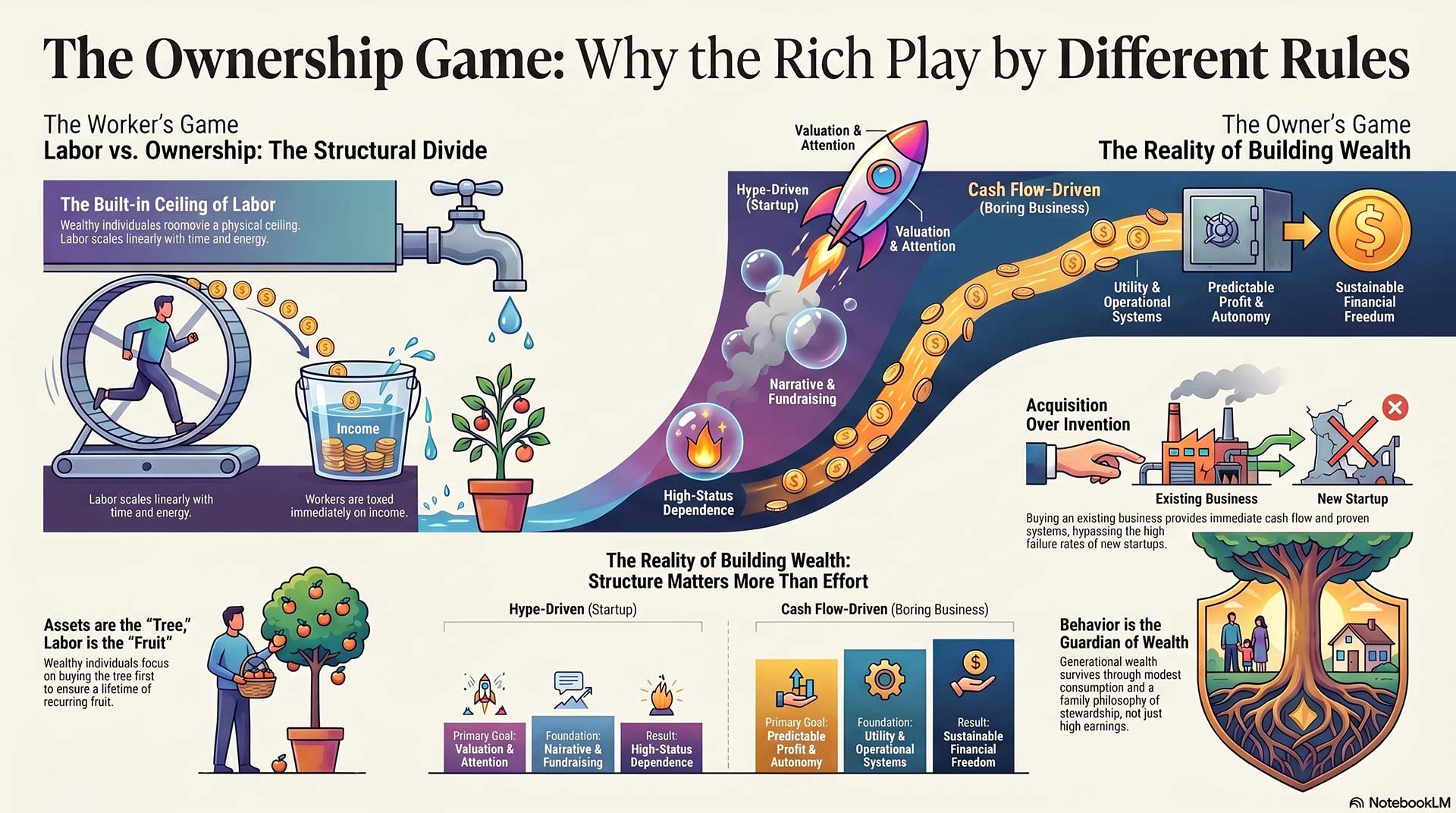
Labor is honorable, necessary, and often highly skilled. But labor has a built-in ceiling. Most people can only sell so many hours, so much energy, so many years of their life. Ownership is different because it separates income from the direct use of your own body and time. If you own a good business, that business can keep producing after you go home. If you own a productive asset, it may keep compounding without needing you every minute. That is the real difference. A worker must keep showing up to restart the machine. An owner is trying to own the machine.
Naval Ravikant:
The deepest difference is leverage. A worker usually has little leverage beyond skill and effort. An owner has code, media, capital, systems, people, distribution, or equity working on their behalf. That changes the scale of results. The person selling time gets paid once. The person owning the asset can keep getting paid again and again. Once you see that, you start to understand why the path to wealth is almost never just “work harder.” It is usually “build or buy something that works when you are not there.”
Morgan Housel:
I think the emotional difference matters too. Labor feels fair because it is visible. You worked eight hours, so you were paid for eight hours. Ownership feels strange to people because the reward can look disconnected from visible effort in the moment. Someone who owns a great business or asset may earn more in a year than another person earns in decades, even though the daily strain is less obvious. That creates moral confusion for many people. But wealth is rarely about visible effort alone. It is about what you control, what you can keep, and what keeps growing after the work is done.
Thomas Sowell:
A worker is usually paid for current usefulness. An owner is rewarded for control over production, capital allocation, and future output. That is why the two categories live under different incentives. The worker is compensated for what he does now. The owner benefits from what a system continues to produce later. Many complaints about inequality begin with a failure to distinguish those two realities. The market does not only reward effort. It rewards scarcity, structure, timing, ownership, and judgment.
Robert Kiyosaki:
Most people are taught to chase earned income first, then maybe save a little, then maybe invest someday. The wealthy often reverse the direction. They focus on buying assets first. That is why workers stay busy and owners get richer. A worker’s paycheck is the fruit. An asset is the tree. If you spend your life polishing fruit, you stay in the same cycle. If you spend your life buying trees, your future starts to change.
Question 2
How does the tax system quietly shape who gets ahead and who stays stuck?
Thomas Sowell:
Tax systems reveal what a society chooses to burden and what it chooses to encourage. If labor income is taxed quickly and capital gains are often taxed later, then one should not be surprised when ownership becomes a more powerful route to wealth accumulation. This is not mysterious. Incentives matter. When one activity is drained immediately and another can compound before taxation, the second activity has a structural advantage. That does not require conspiracy. It requires arithmetic.
Morgan Housel:
The timing is everything. People often focus on tax rates, but timing can matter just as much as rates. If your money compounds untouched for years before taxes arrive, you are playing a different game from someone whose income is shaved down the moment it appears. That gap seems small in one year and enormous across twenty or thirty. Many people underestimate how much wealth is built in the quiet period before interruption.
Warren Buffett:
Deferred taxation can act like an interest-free partner in compounding. If a gain stays inside an investment and is not interrupted, it has more capital to keep growing. That is one reason patient ownership can be so powerful. The trouble is that many people never reach the stage where they own enough productive assets for this advantage to matter. They live in a world where income is consumed by life before compounding has much chance to begin.
Robert Kiyosaki:
That is why I have always said the rich know the rules of money and the middle class is often trained to follow the rules of employment. A worker earns, gets taxed, and spends what is left. An owner buys or builds assets, gets cash flow or appreciation, and often decides when taxable events happen. Those are two different financial worlds. If people never learn that, they think wealth is mainly about effort. It is not. It is about structure.
Naval Ravikant:
I would go one step further. The system rewards people who can delay gratification, delay consumption, and delay realization. That is very hard for someone living paycheck to paycheck. So this is not just about tax law. It is about access. The person with margin can wait. The person without margin is forced into immediacy. The ability to wait is one of the hidden luxuries of wealth.
Question 3
Why do many hardworking people still fall behind even after years of discipline and effort?
Naval Ravikant:
They are trying to win a nonlinear game with linear tools. Hard work matters, but hard work by itself scales badly. You can double your effort for a while, but you cannot multiply yourself forever. If your model depends only on your hours, you may become more exhausted without becoming much freer. Many people are sincere, disciplined, and trapped inside low-leverage systems.
Robert Kiyosaki:
They were given the wrong map. Go to school, get a job, work hard, save money, stay safe. That map may produce stability for some people, but it often does not produce freedom. Inflation rises, taxes take a share, expenses grow, and savings alone struggle to keep up. So people blame themselves, when in many cases the deeper issue is that they built their life around earned income instead of asset income.
Thomas Sowell:
Many hardworking people fall behind because effort and reward are not distributed according to moral worth. That is a painful truth, yet still a truth. Effort must be joined to good judgment, scarce value, and favorable structure. A person may work very hard in a field with little leverage, little ownership, and little pricing power. Another person may work fewer visible hours yet sit in a far stronger position. Sentiment does not erase economics.
Morgan Housel:
I would add that life happens in the middle of all this. People do not live inside clean spreadsheets. They face illness, divorce, bad timing, layoffs, children, fear, temptation, and comparison. A hardworking person may do many things right and still lose years to one event or one structural disadvantage. That is why money discussions must stay humble. Wealth is part math, part behavior, part luck, part endurance.
Warren Buffett:
Discipline is essential, but discipline alone cannot overcome a bad system of personal finance. If a person never moves from income to assets, from consumption to ownership, from activity to compounding, he may remain honorable and diligent yet still not build much lasting wealth. The lesson is not that hard work is foolish. The lesson is that hard work needs a destination. Ownership gives effort a place to accumulate.
Closing
Nick Sasaki:
This first topic reveals something uncomfortable but freeing at the same time. Many people think the main problem is that they have not worked hard enough. But tonight, what keeps coming up is that the deeper divide may be structural. Workers are usually paid for time already spent. Owners are rewarded through control over assets that keep producing into the future. One side is taxed early, interrupted early, and consumed by daily life. The other side often has more room to delay, compound, and choose.
That does not mean labor has no dignity. It means labor alone often has limits that ownership does not. And once people see that, the real question changes. It is no longer only, “How can I earn more?” It becomes, “How can I own more of what keeps growing without me?”
That shift may be where financial freedom truly begins.
Topic 2: Why might boring businesses beat sexy startups for real freedom?

Opening
Nick Sasaki:
Welcome to Topic 2. In modern business culture, attention tends to flow toward the dramatic. Startups raise money, make headlines, talk about disruption, and promise explosive growth. They carry status. They sound bold at dinner tables and on podcasts. But in the quieter corners of the economy, there are businesses that clean buildings, move freight, fix plumbing, manage storage, print signs, remove junk, handle payroll, repair roofs, and keep ordinary life functioning every day. They rarely look glamorous. Yet many of them produce steady cash flow, survive for decades, and give their owners something a flashy company often cannot: control, resilience, and a life that is actually livable.
So tonight, I want to ask a simple but deep question: why might an ordinary, overlooked business create more real freedom than the kind of company everyone dreams about?
Question 1
Why are people drawn to glamorous businesses when simple cash-flow businesses may create a better life?
Codie Sanchez:
People are drawn to glamorous businesses for the same reason they are drawn to glamorous lifestyles. They want identity, status, and the feeling that they are part of the future. A startup can make someone feel important before it makes any money. A boring business does the opposite. It often makes money before anyone thinks it is interesting. That is why I like them. They force you to separate ego from economics. A laundromat or pest control company may not impress your friends, but it might buy back your time much faster than a company built mainly to look ambitious.
Charlie Munger:
The crowd is often attracted to narratives that flatter its vanity. It is more pleasant for many people to imagine themselves as innovators in a fashionable field than as disciplined owners of an unglamorous enterprise. But the world does not pay according to excitement alone. It pays according to utility, scarcity, dependability, and rational purchase price. Many fortunes have been built by people content to be bored when others needed entertainment.
Nick Huber:
A lot of people want the story more than the business. They want to say they are building the next big thing. They want followers, headlines, and a cool identity. The problem is that attention can become a substitute for cash flow. A boring business does not give you much social credit, so you have to face the numbers. That can actually be healthy. You find out fast whether customers care, whether margins work, and whether the thing supports your life.
Walker Deibel:
The startup world often sells possibility. Small business ownership sells probability. That is a huge emotional difference. Many people would rather chase a tiny chance of a giant outcome than patiently operate something with a high chance of steady returns. But probability is where real buyers often win. If you acquire a functioning company with customers, systems, and cash flow, you are starting from reality, not from aspiration alone.
John Warrillow:
There is also a control issue. In many glamorous ventures, the founder ends up building for investors, market expectations, or endless growth targets. In a quieter business, the owner may have far more power to shape the company around lifestyle, profitability, and an eventual exit. That can be less exciting to talk about, but much more meaningful to live.
Question 2
What kind of freedom can a boring business create that a high-status startup often cannot?
John Warrillow:
A good boring business can create freedom through predictability. Predictability is underrated. It lets an owner plan, hire more carefully, sleep better, and build toward a company that can one day run without them. That is the kind of business that becomes valuable in a sale. Freedom is not only about upside. It is about whether the business becomes transferable instead of staying trapped inside the founder’s daily stress.
Nick Huber:
A boring business can give you the freedom of cash flow without needing constant reinvention. A lot of startups require nonstop storytelling, fundraising, hiring drama, and pressure to prove momentum. But a business that solves a plain human need can be refreshingly direct. Customers need it, they pay for it, you improve operations, and money comes in. That simplicity can create a cleaner life. You do not need the world to believe a dream. You need customers to keep needing what you do.
Charlie Munger:
Freedom often comes from reducing fragility. The more a company depends on fashion, speculative enthusiasm, or outside financing, the more exposed it becomes to changing sentiment. A plain business serving durable demand is often sturdier. Sturdiness has great practical value. It allows compounding to continue. Many people sacrifice enduring advantage because they are too enchanted by rapid expansion.
Walker Deibel:
There is another kind of freedom: speed to ownership. With a startup, many founders spend years building without meaningful personal liquidity. With an acquired boring business, cash flow may exist on day one. That changes the owner’s life much sooner. It allows debt to be paid down, systems to be improved, and options to appear. The founder of a startup may be rich on paper and still trapped. The owner of a steady company may look unimpressive and quietly have far more control over their time.
Codie Sanchez:
I think the real freedom is psychological. Once you stop needing the business to make you look exceptional, you can ask a better question: does this business make my life better? Does it put money in my pocket? Does it allow me to hire well, live well, and build more? Sexy startups often promise one giant future payoff. Boring businesses often reward you in the present. That matters more than people think.
Question 3
How can someone tell whether a simple business is quietly strong or just slowly dying?
Walker Deibel:
You start with fundamentals. Is revenue recurring or highly erratic? Are customers staying? Are margins stable? Is the owner carrying the whole thing personally, or are there real systems? Is demand durable, or is the business only alive from habit? A boring business is attractive only when the boring part comes from the industry, not from a lack of health. A company can be quiet and strong, or quiet and decaying. You have to know the difference.
Codie Sanchez:
I look for businesses that people need again and again, where demand is not based on trends and where the next owner can make operational improvements. The key is whether it is neglected or broken. Neglected can be wonderful. Broken can ruin you. A lot of these businesses are not bad companies. They are just old-school companies with weak marketing, outdated systems, poor follow-up, or retiring owners. That can be opportunity. But if the economics are weak, the labor issues are constant, and the market is disappearing, then boring is just a polite word for trouble.
John Warrillow:
I would ask whether the company can exist independently of one heroic operator. If the owner is the brand, the salesperson, the problem-solver, and the keeper of all relationships, then the buyer may simply be purchasing a demanding job. A strong business has some transferability. Customers trust the company, processes exist, and value does not vanish the moment one person leaves. That distinction matters tremendously.
Nick Huber:
I like businesses where the service is unsexy but necessary, where customers are not making emotional purchases, and where there is room to out-execute lazy competitors. But you still have to check the obvious things people skip: employee churn, bad reviews, weak pricing, messy books, customer concentration, weird local risks. Simplicity should not make you careless. Some businesses are boring in the best way. Others are boring because nobody wanted to deal with the problems.
Charlie Munger:
The wise buyer asks whether the business possesses an enduring practical advantage. Not a fashionable advantage, a practical one. Does it meet recurring need? Can it raise prices reasonably? Can it retain customers without constant drama? Can an intelligent operator improve it without requiring genius? A sound plain business can be a marvelous thing. A weak plain business can consume years of life under the illusion of safety.
Closing
Nick Sasaki:
This topic reveals a tension that runs deep in modern ambition. Many people are drawn to businesses that look exciting, important, or visionary. But what keeps emerging tonight is the possibility that freedom may come from something much less dramatic. A boring business does not always offer applause. It may offer something harder to see and more valuable to keep: steady demand, cash flow, transferability, and a life with less dependence on hope and hype.
The deeper issue may be this: people often choose businesses the way they choose identities. They ask what sounds impressive, what feels big, what looks like success from the outside. But a wiser question may be: what kind of business quietly gives me control over my time, my money, and my future?
That is where boring starts to look less boring. It starts to look practical, durable, and strangely liberating.
Topic 3: Why does cash flow matter more than hype?

Opening
Nick Sasaki:
Welcome to Topic 3. By now, a pattern is starting to appear. In the first topic, we saw that ownership often changes the financial game. In the second, we saw that quiet, ordinary businesses may create more freedom than glamorous ones. Now we come to a question that cuts even deeper: what actually makes a business healthy?
In our culture, it is easy to confuse attention with strength. A company gets press, followers, big promises, fast growth, and people assume it must be winning. But behind the image, many businesses are starving for cash, drowning in pressure, or living on borrowed time. Meanwhile, another business with no spotlight may be paying its bills, serving loyal customers, and quietly making its owner freer every year.
So tonight, I want to ask: why does cash flow matter more than hype, and what happens when people build businesses for appearance instead of durability?
Question 1
Why do so many people chase valuation, attention, and image instead of cash flow and control?
Sam Zell:
People chase valuation and attention because paper success is seductive. It gives you the feeling of victory before the business has truly earned it. You can look rich, sound important, and raise more money without facing the hard question of whether the company actually produces real economic value. Cash flow is less glamorous because it is honest. It does not flatter your story. It tells you whether the business works.
Jason Fried:
A lot of founders get pulled into performance. They start building a company and end up building a public identity. Once that happens, the business begins serving the story instead of the customer. Growth becomes theater. Busyness becomes theater. Fundraising becomes theater. Cash flow is quieter. It asks whether customers care enough to pay, whether the company can stand on its own feet, and whether the business is giving you a life you actually want.
Mark Cuban:
Attention is addictive. Once people start praising your momentum, it is easy to think momentum is the same thing as strength. But if the money going out keeps beating the money coming in, that praise can disappear fast. The scoreboard in business is not how impressed people are. The scoreboard is whether the company can survive, adapt, and keep producing. A company with real cash flow buys itself time. Time is one of the most valuable things in business.
Andrew Wilkinson:
A lot of people want the image of entrepreneurship more than the mechanics of it. They want to say they are scaling, disrupting, building, raising. But a healthy business is often much less dramatic than that. It is disciplined, repetitive, operational, and maybe even a little boring. Cash flow matters because it turns business from fantasy into reality. It lets you choose rather than beg. It lets you act from strength instead of dependence.
MJ DeMarco:
Many people are still infected with the idea that if something looks big, it must be wealth. But revenue is not wealth, followers are not wealth, valuation is not wealth. If the owner cannot take money out, cannot breathe, cannot step away, and cannot trust the thing to hold itself up, then much of that success is cosmetic. Cash flow is what makes the business serve the owner instead of the owner becoming a servant of the business.
Question 2
At what point does growth become a trap instead of a path to freedom?
Jason Fried:
Growth becomes a trap when it stops being chosen and starts being obeyed. There is a big difference between healthy expansion and compulsory expansion. Once a business starts serving outside expectations, comparison, ego, or a story about what success is supposed to look like, it can lose its center. Then growth no longer supports freedom. It starts eating it.
Sam Zell:
Growth becomes dangerous when it outruns economics. If every new step requires more capital, more pressure, more complexity, and less margin for error, then size itself becomes risk. People talk about growth as if it is automatically good, but growth without discipline can magnify weakness just as easily as strength. Bigger is not always better. Sometimes bigger just means harder to survive.
Mark Cuban:
It becomes a trap when you can no longer tell whether the business is growing or just consuming more fuel. Plenty of companies grow revenue and still get weaker. If the owner needs more staff, more spending, more debt, and more optimism just to keep the machine moving, that is not freedom. A business should not just expand. It should strengthen as it expands.
MJ DeMarco:
A lot of people think they want scale, but what they really want is autonomy. Those are not always the same thing. If scale makes you more stressed, more dependent, more exposed, and less in control, then it is possible you scaled the wrong thing. Freedom comes when a business gives you leverage over life. Trap comes when the business becomes a giant mouth that must keep being fed.
Andrew Wilkinson:
The trap often appears when the founder can no longer enjoy the company they built but feels unable to slow down. At that point, the business owns them emotionally. They may still look successful from the outside, but inside they are reacting all day long. Real growth should create options. If it removes them, something has gone wrong.
Question 3
What does a truly healthy business look like when you strip away hype, ego, and headlines?
Andrew Wilkinson:
A healthy business is understandable. You know how it makes money, why customers stay, where the risks are, and what would improve it. It does not depend on mystery. It does not depend on fantasy. It can pay people fairly, reward the owner, and continue functioning without constant panic. Clarity is part of health.
Mark Cuban:
A healthy business knows its customer cold and solves a real problem well enough that people keep coming back. It watches costs, protects margin, and stays flexible. It is not trying to impress everybody. It is trying to serve somebody really well. From there, everything gets simpler. The owner can make decisions based on facts instead of noise.
Sam Zell:
I would say a healthy business produces dependable cash, maintains sensible leverage, and does not require heroic assumptions to justify its existence. It stands in contact with reality. It does not need a perfect economy, perfect sentiment, or perfect timing just to survive. The stronger the business, the less it depends on wishful thinking.
Jason Fried:
A healthy business lets the people inside it live like human beings. They are not always sprinting, not always performing urgency, not always pretending chaos is ambition. That matters. If a company can make money only by exhausting everyone inside it, then the model is weaker than it appears. Calm can be a sign of strength.
MJ DeMarco:
A healthy business gives its owner movement toward freedom. That does not always mean instant escape. It means the business creates surplus, options, and leverage. It can be sold, delegated, systemized, or expanded without destroying the person who owns it. That is when the business becomes an asset instead of just another demanding job with a fancy title.
Closing
Nick Sasaki:
This topic brings the conversation back to something almost embarrassingly simple: a business must eventually work in real life. It must bring in more than it burns. It must help the owner gain room, not just status. It must build strength, not just spectacle.
What stands out tonight is how easy it is to confuse visibility with value. Hype can make a weak business look strong. Cash flow can make a strong business look ordinary. But over time, reality wins. The company that can pay, endure, adapt, and create options has something far more valuable than excitement. It has substance.
So the deeper lesson may be this: the healthiest business is often not the one that gets the most attention, but the one that quietly gives its owner control, resilience, and a future that does not depend on applause.
Topic 4: Is buying a small business one of the most realistic paths to wealth now?

Opening
Nick Sasaki:
Welcome to Topic 4. For many people, the path to wealth has been framed in only a few familiar ways: get a good job, climb the ladder, save carefully, invest over time, or build a startup from scratch and hope it becomes something huge. But there is another path that still feels strangely invisible to most ordinary people: buying a business that already exists.
That idea changes the emotional starting point. Instead of inventing from nothing, you begin with customers, revenue, habits, systems, and a real place in the market. Instead of waiting years to find out whether anyone will pay, you inherit proof that someone already does. And yet most people never seriously consider this path. They may dream of freedom, but they do not imagine acquisition. They may admire wealth, but they do not realize how often wealth is built by taking over something stable, improving it, and holding it well.
So tonight, I want to ask: is buying a small business one of the most realistic paths to wealth now, and why do so few people think of it that way?
Question 1
Why do so few people think of buying a business when they dream about financial freedom?
Walker Deibel:
Most people never think of buying a business because nobody teaches it as a normal option. They are taught to start something, join something, or apply for something. Acquisition sounds advanced, expensive, or reserved for private equity. So the average person places it mentally in another category, even when the business down the street may be far more reachable than they assume. What is missing is not only money. It is imagination.
Carl Allen:
I think many people have been conditioned to believe ownership must begin with invention. They assume that if they did not create the business, then it somehow is not truly theirs or not entrepreneurial enough. But buying a healthy company can be one of the smartest entrepreneurial acts there is. You are stepping into something proven and asking how to make it stronger. That is not less entrepreneurial. In many cases, it is more rational.
Codie Sanchez:
There is also a class story around this. People know how to dream about houses, jobs, and sometimes startups. They do not know how to dream about buying a plumbing company, a laundromat, a tree service business, or a niche service company. That kind of ownership feels too plain to be glamorous and too unfamiliar to feel possible. So people miss one of the clearest doors right in front of them.
Jim Collins:
Part of it is cultural prestige. Many societies praise creation more than stewardship. Starting something new sounds visionary. Running something solid sounds ordinary. But history shows that disciplined stewardship can be a powerful form of greatness. Taking a modest enterprise and making it stronger, healthier, more enduring, and more valuable is serious work. The problem is that seriousness rarely markets itself with the same energy as novelty.
Andrew Carnegie:
Men often overlook opportunities that do not flatter their vanity. Many would rather be seen attempting something grand than quietly controlling something profitable. Yet the latter often builds the stronger future. Wealth has never depended only on brilliance or invention. It has often depended on seeing value where others fail to look.
Question 2
What makes an ordinary local business a hidden wealth vehicle instead of just another job?
Codie Sanchez:
The difference is whether the business produces cash flow and can improve without depending entirely on your labor. A small business becomes a wealth vehicle when it gives you ownership over recurring demand, pricing power, and operational upside. If you buy a company and every dollar still depends on you personally doing the work all day, then yes, you may have bought yourself a job. But if you can install systems, improve marketing, hire better, raise standards, and create something that earns beyond your direct time, that changes everything.
Walker Deibel:
I would say the key is transferability and structure. If customers belong to the company, not just to one personality, and if operations can be understood, measured, and improved, then the business has asset qualities. That is what people miss. They look at a local company and see routine. A buyer sees systems, contracts, cash flow, and future options. The more the company can stand apart from a single human being, the more it starts becoming wealth rather than employment.
Carl Allen:
A hidden wealth vehicle is usually sitting in plain sight. It may be unglamorous, but it serves recurring needs and is often under-optimized. That means there is room to create value fast: cleaner books, better follow-up, stronger online presence, smarter hiring, better pricing, tighter operations. You do not always need a revolutionary idea. Sometimes you need ordinary competence applied consistently in a business that has been neglected for years.
Jim Collins:
There is another element: endurance. A true wealth vehicle is not merely profitable this quarter. It possesses the possibility of durable excellence. That means it serves a real need, can withstand leadership transition, and improves through discipline rather than luck. Great enterprises are often not built on drama. They are built on repeatability, clarity, and a culture that can continue beyond one charismatic founder.
Andrew Carnegie:
What turns enterprise into wealth is retained advantage. A business must do more than pay the owner today. It must secure a stream of future value. The hidden power of a modest company lies in its ability to yield income, grow in worth, and become something that can later be sold, expanded, or handed onward. That is when one moves beyond wages into capital.
Question 3
What mindset shift must happen before someone can see acquisition as possible for them?
Jim Collins:
The first shift is from romance to responsibility. One must stop asking, “What sounds exciting?” and begin asking, “What can I understand, improve, and hold with discipline?” Great outcomes often begin when ambition becomes steadier and more concrete. Acquisition demands that a person respect reality. They must study economics, leadership, and endurance more than image.
Walker Deibel:
A person has to stop thinking like only a consumer of businesses and start thinking like a buyer of systems. Most people walk into a company and ask, “Would I enjoy this?” A buyer asks, “How does this work, where does value come from, what breaks, what can improve, and what would this look like under stronger management?” That is a major shift. You begin seeing businesses as structures that can be evaluated instead of mysterious things owned by other people.
Codie Sanchez:
They also have to stop assuming they need to be rich first. That belief blocks people before they even begin. Yes, deals take money, relationships, and skill. But many acquisitions are built through creative structures, seller financing, partnerships, earned trust, and disciplined searching. The first inner move is believing this is learnable. Once someone sees that ordinary people really do buy businesses, a new category opens in the mind.
Carl Allen:
I think the mindset shift is this: you are not asking for permission to become an owner. You are preparing to become one. Many people wait until they feel fully qualified, fully funded, fully confident. That day rarely arrives. Buyers grow into the role by learning how to assess, negotiate, structure, and operate. Ownership often begins before comfort does.
Andrew Carnegie:
A man advances when he ceases to think of wealth as something granted by position and begins to think of it as something assembled by judgment. To purchase enterprise wisely, one must believe that value may be recognized, organized, and increased by one’s own faculties. Without that confidence, opportunity passes unseen.
Closing
Nick Sasaki:
This topic reveals how invisible a realistic path can remain when a culture does not name it clearly. Many people know how to imagine getting hired. Some know how to imagine founding something bold. But far fewer know how to imagine stepping into an existing business, strengthening it, and letting ownership do its quiet work over time.
What stands out tonight is that acquisition is not only a financial move. It is a psychological one. A person has to stop seeing small businesses as background scenery and start seeing them as living structures of value: customers, systems, cash flow, trust, and potential. That shift alone can change what feels possible.
So the deeper lesson may be this: one of the most realistic paths to wealth may not be inventing the next giant idea, but recognizing the hidden value in something already working, then having the discipline to own it well.
Topic 5: What keeps rich families rich across generations?

Opening
Nick Sasaki:
Welcome to Topic 5. By now, the conversation has moved through labor and ownership, boring businesses and glamorous ones, cash flow and hype, and the hidden path of buying something that already works. All of that leads naturally to one final question: why do some families build wealth that lasts, while others earn well for a season and still fail to create something enduring?
This question touches more than money. It touches memory, behavior, identity, inheritance, fear, discipline, and the invisible habits that shape what people do once wealth has arrived. Many families work incredibly hard to reach security, yet by the next generation, the structure weakens. The income may have been real, but the mindset was not passed on. The assets may have been built, but the patience was not. The wealth may have appeared, but the deeper culture required to preserve it never took root.
So tonight, I want to ask: what actually keeps wealth alive across generations, and why is money alone so often not enough?
Question 1
What habits and structures help wealth survive past the first generation?
Thomas J. Stanley:
The strongest families often look less rich than they could afford to look. That restraint matters. Wealth usually survives when it is protected by ordinary habits: modest consumption, careful spending, steady investing, and a refusal to confuse visible luxury with actual security. Families that last often normalize discipline rather than display. They build a culture where money is managed quietly, not performed publicly.
Warren Buffett:
I think survival depends on aligning assets with sound judgment. A family may inherit money, but if it does not inherit decision-making ability, the capital is vulnerable. Good structure matters too: clear planning, tax awareness, sensible diversification, and people who understand stewardship rather than entitlement. Wealth tends to endure when it is treated as something to allocate wisely, not merely something to enjoy.
Morgan Housel:
A family needs emotional habits, not only financial ones. Patience is a habit. Humility is a habit. The ability to live below one’s means is a habit. The ability to avoid comparison is a habit. Many fortunes disappear for psychological reasons long before they disappear for mathematical ones. If the emotional culture inside a family becomes fragile, money alone cannot save it.
Naval Ravikant:
Leverage also matters. Families that stay wealthy often own things that scale beyond labor: businesses, equity, real estate, intellectual property, systems. But those assets need a philosophy around them. The family must understand why ownership matters, how risk works, and when to hold versus when to consume. Without that mental model, inherited assets can become temporary windfalls rather than long-term engines.
Jim Rohn:
The treasure is not only what parents leave behind. It is what they leave within. If children inherit money without inheriting discipline, perspective, and self-command, then the inheritance may become a test they are not prepared to pass. Lasting wealth is often built twice: once in the bank account, and once in the character of the people who will handle it next.
Question 2
Why do many people who earn a lot still fail to build lasting family wealth?
Morgan Housel:
Earning a lot and building lasting wealth are related, but they are not the same. Income is what comes in. Wealth is what stays, compounds, and survives your own impulses. Many people increase lifestyle every time income rises, so the family experiences the appearance of success without the structure of it. The outside may look prosperous, but the inside may still be fragile.
Thomas J. Stanley:
Many high earners become high consumers. They live in expensive zip codes, buy status goods, and absorb social pressure until their financial lives quietly lose margin. A family can earn a great deal and still fail to create true wealth if spending keeps pace with income. Lasting wealth usually requires a gap between what one can spend and what one chooses to spend.
Warren Buffett:
Another issue is confusion between market success and family preparedness. A person may be brilliant in business and still do a poor job preparing heirs. Good investing does not automatically produce good transition. If children are not educated in values, judgment, and responsibility, then money may reach them without wisdom reaching them. That is an unstable handoff.
Jim Rohn:
Many people spend decades chasing income and almost no time shaping a family philosophy. They work hard, provide well, and hope that example alone will be enough. Sometimes it is not. Children do not absorb values only from what parents earn. They absorb them from what parents praise, tolerate, repeat, and embody. Wealth without teaching often becomes comfort without direction.
Naval Ravikant:
A lot of people are still trapped in earned-income thinking, just at a higher level. They may earn very large amounts, but they still have not built systems that work independently of them. So when the person slows down, the engine slows down too. That is not generational wealth. That is high-functioning dependence disguised as success.
Question 3
What matters more in the long run: income, ownership, behavior, or patience?
Warren Buffett:
Ownership and patience, working together, are extraordinarily powerful. Income can begin the process, but ownership is what allows compounding to continue beyond immediate effort. Patience allows that process to mature. Yet behavior governs both. A family with strong assets but weak behavior can still destroy what it has. So if forced to choose, I would say behavior is the guardian that protects ownership and patience from being wasted.
Morgan Housel:
I agree. Behavior often outruns knowledge. Many people know what they should do with money. Far fewer can keep doing it under pressure, envy, fear, boredom, or success. Patience sounds simple until years go by. Ownership sounds wise until markets drop. Good behavior is what keeps a family from sabotaging itself in emotional moments. It is hard to separate long-term wealth from long-term temperament.
Thomas J. Stanley:
I would place behavior first too, especially behavior that rejects status competition. The family that keeps wealth is often the family that does not feel compelled to advertise it. Quietness is underrated. So is self-restraint. Without those, ownership may still be sold too early, income may still be consumed too quickly, and patience may collapse under social pressure.
Naval Ravikant:
Ownership is still the engine. If a family never owns scalable assets, then discipline alone may preserve modest security but not build much beyond that. But once ownership exists, behavior becomes the operating system. Patience becomes the time horizon. So I would say income starts the game, ownership powers the game, behavior stabilizes the game, and patience multiplies the outcome.
Jim Rohn:
That is well said. A family must learn to become the kind of people who can hold what they have built. Money changes form. Markets change. Opportunities change. But character remains central. In the end, what lasts is often not the amount first earned, but the wisdom with which it was handled year after year.
Closing
Nick Sasaki:
This final topic brings the whole conversation into focus. Wealth does not usually disappear in one dramatic moment. More often, it fades through habits, assumptions, and attitudes that quietly weaken the structure holding it up. A family may inherit money, yet fail to inherit restraint. It may receive assets, yet fail to receive judgment. It may enjoy comfort, yet never learn stewardship.
What stands out tonight is that lasting wealth seems to rest on several layers at once: ownership that can compound, behavior that can protect, patience that can endure, and a family culture that treats money as something to manage wisely rather than consume quickly. In that sense, generational wealth is never only financial. It is moral, psychological, and practical all at once.
So the deeper lesson may be this: rich families stay rich not simply because they have more money, but because they build ways of thinking, choosing, and holding that allow money to outlive the moment that first created it.
Final Thoughts by Nick Sasaki
What stayed with me most from this entire discussion is how often people blame themselves for problems that are partly structural.
A worker may feel behind and assume the answer is more discipline. An entrepreneur may chase scale and think the answer is more speed. A high earner may assume income alone will secure the family’s future. But again and again, this conversation pointed somewhere deeper. The real divide is often not between hardworking and lazy people. It is between those who remain tied to labor alone and those who learn how to own, hold, improve, and keep.
Ownership changes timing.
Cash flow changes pressure.
Acquisition changes what feels possible.
Patience changes what can compound.
Behavior changes whether wealth survives.
That is why the whole conversation feels bigger than business advice. It is really about learning to see differently. To stop asking only, “How do I make more?” and start asking, “What do I control? What can outlast my hours? What can keep working after today? What kind of structure gives my effort a place to accumulate?”
For many people, that may be the turning point.
Freedom may not begin when a person finally works hard enough to win the worker’s game.
It may begin when they finally see that there was another game all along.
Short Bios:
Nick Sasaki
Moderator of the conversation, guiding the discussion toward the deeper moral, psychological, and practical questions behind wealth, ownership, and freedom.
Thomas Sowell
Economist, social theorist, and writer known for his sharp analysis of incentives, systems, and the hidden forces that shape economic outcomes.
Warren Buffett
Legendary investor and chairman of Berkshire Hathaway, widely respected for his long-term approach to ownership, compounding, and rational capital allocation.
Robert Kiyosaki
Entrepreneur and author of Rich Dad Poor Dad, known for popularizing the contrast between earned income, asset ownership, and financial education.
Morgan Housel
Writer and investor best known for The Psychology of Money, exploring how behavior, emotion, and time shape financial outcomes.
Naval Ravikant
Entrepreneur, investor, and thinker known for his insights on leverage, wealth creation, judgment, and freedom through ownership.
Codie Sanchez
Investor, entrepreneur, and educator known for promoting ownership of cash-flowing “boring businesses” as a path to financial freedom.
Charlie Munger
Investor and longtime vice chairman of Berkshire Hathaway, admired for his disciplined thinking, practical wisdom, and deep respect for durable business models.
John Warrillow
Entrepreneur and author focused on building sellable businesses, with a strong emphasis on transferability, value creation, and exit readiness.
Walker Deibel
Investor, acquisition entrepreneur, and author known for teaching how ordinary buyers can acquire existing businesses instead of starting from scratch.
Nick Huber
Entrepreneur and operator known for championing simple, practical, cash-flow-focused businesses over flashy startup culture.
Sam Zell
Real estate billionaire and investor known for his blunt realism, disciplined dealmaking, and sharp understanding of value, risk, and cash generation.
Jason Fried
Co-founder of Basecamp and writer known for advocating calmer, simpler, more human-centered business building.
Mark Cuban
Entrepreneur and investor known for his practical, direct approach to business, competition, cash flow, and operational strength.
Andrew Wilkinson
Entrepreneur and investor known for buying and holding durable businesses, with a focus on steady value over startup hype.
MJ DeMarco
Entrepreneur and author of The Millionaire Fastlane, known for challenging conventional financial thinking and emphasizing control, scale, and asset creation.
Carl Allen
Entrepreneur and business acquisition educator known for teaching deal structure, creative financing, and business buying strategies.
Jim Collins
Business thinker and author of Good to Great, known for his work on enduring companies, disciplined leadership, and lasting performance.
Andrew Carnegie
Industrialist and philanthropist whose life and writings continue to shape discussions about wealth, enterprise, stewardship, and legacy.
Thomas J. Stanley
Researcher and author of The Millionaire Next Door, known for showing that lasting wealth often comes from restraint, discipline, and quiet habits.
Jim Rohn
Entrepreneur, speaker, and personal development teacher known for his reflections on character, discipline, responsibility, and long-term success.
Leave a Reply