

|
Getting your Trinity Audio player ready...
|
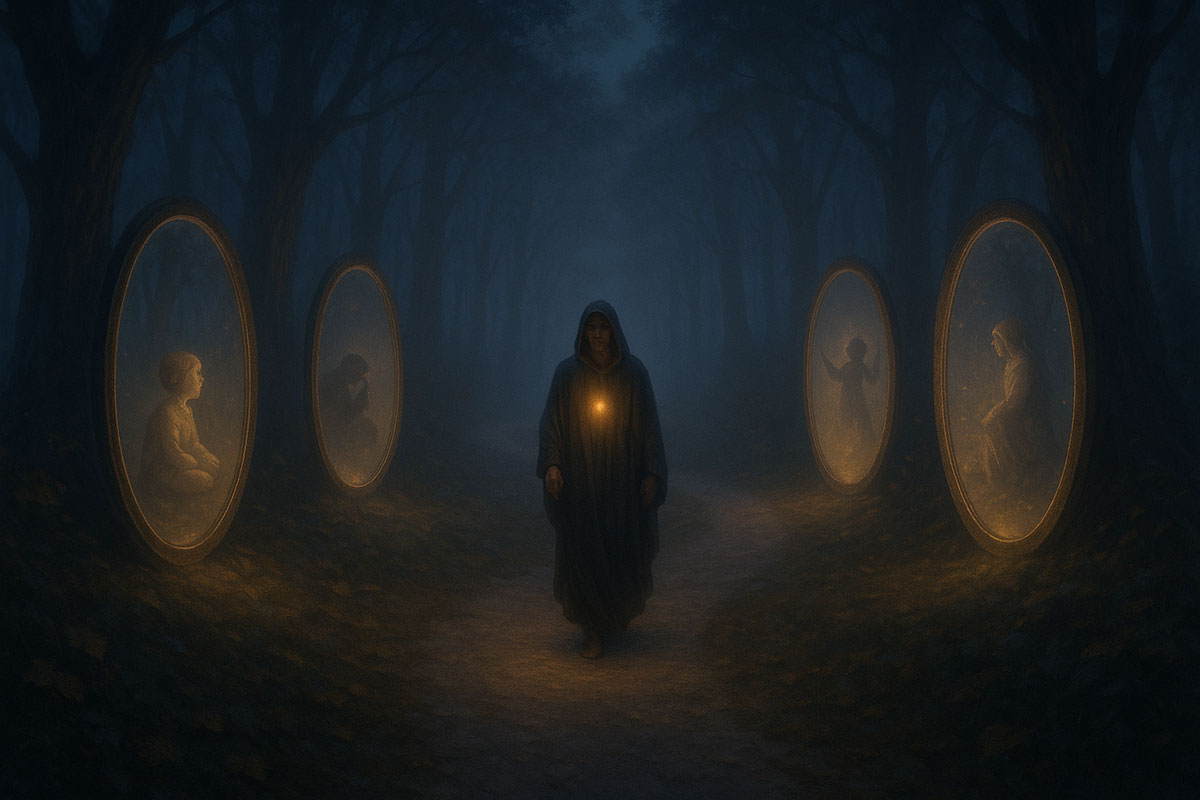
Søren Kierkegaard:
“Life can only be understood backwards, but it must be lived forwards.”
These words of mine have often been quoted, rarely understood, and almost never endured.
You see, we are creatures suspended between memory and possibility—always haunted by what we cannot change, and terrified by what we cannot foresee. The human soul, so tender and immense, is constantly trying to make sense of a world that gives no answers in advance. And yet, it is precisely in this tension—between the known and the unknowable—that God calls us to live.
To understand life backwards is not merely to reminisce—it is to discover meaning in pain, to find order in the ruins, and to glimpse the invisible hand that guided us even through despair. But we must not dwell there. No, we must rise, trembling and awake, and live forward—stepping not into certainty, but into trust.
What follows is not a philosophical argument, but a spiritual unfolding—five conversations that open the sacred mirror of your past, place a lantern in your hand, and invite you to walk by the deeper compass: the one written not in time, but in eternity.
If your heart breaks along the way, let it. Only through the broken heart does the soul begin to sing.
(Note: This is an imaginary conversation, a creative exploration of an idea, and not a real speech or event.)

Topic 1: The Sacred Mirror — Why the Past Is a Spiritual Teacher
Moderator:
Thomas Moore
Scene Setting
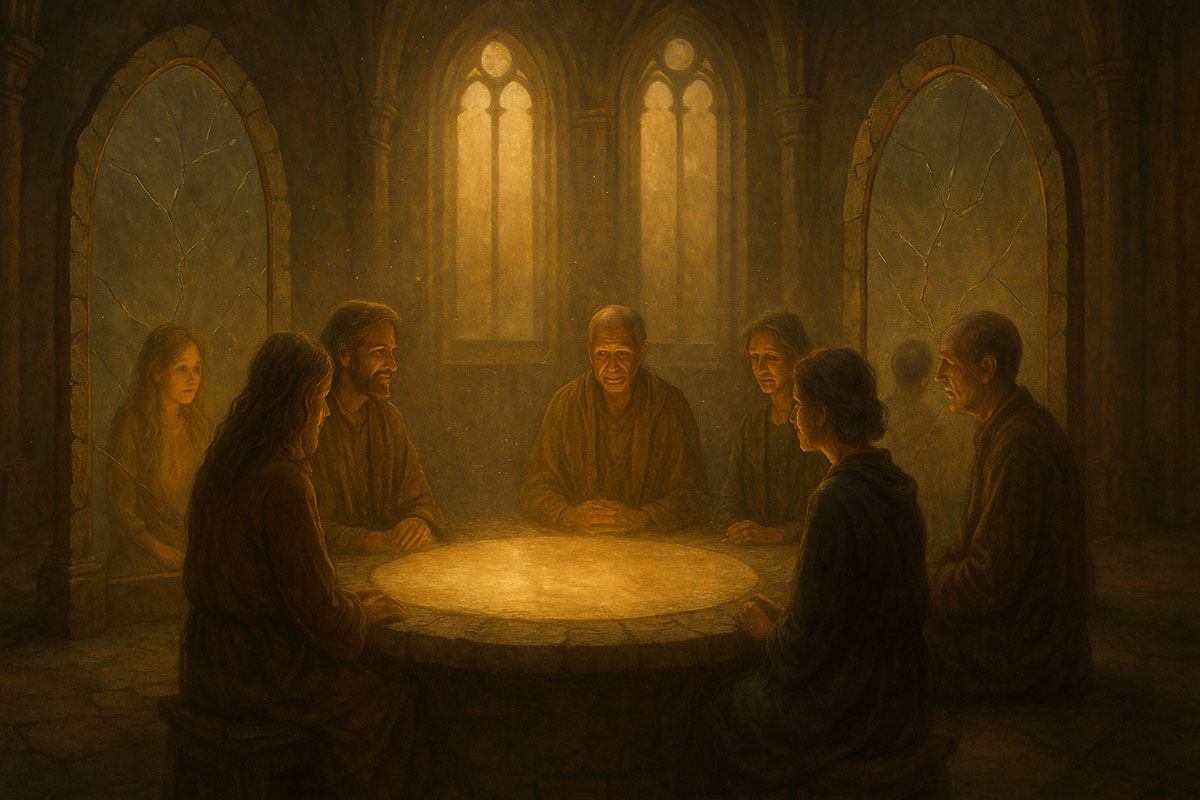
A serene sanctuary of old wood and soft light. Ancient mirrors hang along the walls—some fogged, others cracked, others glowing faintly. In the center, a round table made of reclaimed altar wood. A candle burns at its heart.
Participants
- Thich Nhat Hanh – Zen monk, mindfulness teacher
- Carl Jung – Depth psychologist and soul healer
- Pema Chödrön – Buddhist nun, teacher of compassionate living
- Maya Angelou – Poet and voice of sacred memory
- James Hillman – Archetypal psychologist and mythic thinker
Thomas Moore (Moderator):
There’s a line by Kierkegaard that has never left me: “Life can only be understood backwards, but it must be lived forwards.”
So today, I ask you all:
What does it mean to you to understand life by looking backward? What role does the past play in the soul’s journey?
Carl Jung
To look backward is not nostalgia—it’s individuation. The unconscious reveals its patterns not through logic, but through memory, symbols, and dreams. A person who ignores their past is like a tree without roots. The pain we bury becomes our fate, unless we see it with the eyes of the soul. That’s when the past becomes sacred.
Thich Nhat Hanh
The past is alive in every breath. When we hold our inner child and say, “I am here for you,” we heal the past in the present moment. Understanding backwards means smiling to the suffering inside and walking peacefully with it. We do not erase the past—we water it with compassion.
Maya Angelou
I’ve learned that when we tell the truth of where we’ve been, the past begins to serve the light. My scars became my stories, and my stories helped others rise. The past doesn’t define us—but it refines us. You must make peace with yesterday to sing from your soul today.
Pema Chödrön
Most of us run from the past. We numb it, edit it, or try to transcend it. But the real spiritual work is to turn toward it—softly. The past is our teacher when we stop judging it. It humbles us. And in humility, we open to life as it is—not as we wished it had been.
James Hillman
Our biography is our mythology. If you study your life not as random events but as a constellation of archetypes—The Wounded Child, The Exile, The Pilgrim—you begin to see meaning in the chaos. The soul doesn’t want efficiency. It wants depth. And the past is where the soul drinks.
 Thomas Moore:
Thank you. Now I wonder—
How do we know when we’ve truly understood our past? What changes in us when that sacred seeing occurs?
Maya Angelou
You know you’ve understood your past when it no longer stings to speak of it. When the tears still come, but they baptize instead of burn. You’ve transcended it not by forgetting, but by forgiving—not only others, but yourself. And in that, the soul flies freer.
James Hillman
When the story you used to avoid becomes the story you carry like an offering, something has shifted. Understanding the past isn't mental—it’s poetic. You feel the myth beneath the facts. You realize: This didn’t just happen to me. This shaped who I came to be for others.
Pema Chödrön
The heart relaxes. That’s how you know. You no longer brace against certain memories. You stop trying to fix what already happened. You become more tender—not just toward yourself, but toward everyone carrying pain. You see the common wound.
Carl Jung
The past becomes your ally instead of your enemy. Your dreams change. Your complexes soften. You begin to respond to life from the self, not from the wound. The soul integrates what was once fragmented, and wholeness—what I call the Self—emerges.
Thich Nhat Hanh
Understanding the past is not intellectual. It is breathing with it. When you breathe mindfully and smile to your pain, you free yourself and your ancestors. The understanding radiates backward and forward—healing generations.
Thomas Moore:
One last question.
If someone is still afraid of looking back—if their past feels too heavy, too dark—what would you say to help them begin?
Pema Chödrön
Start with a breath. That’s all. Don’t try to “understand” the whole story at once. Just feel the edge. Welcome your discomfort as a visitor. Sit with it. Then sit some more. The path of awakening begins where we are most afraid to look.
Carl Jung
What you resist not only persists—it becomes your prison. But what you bring to consciousness becomes freedom. Find a guide, a dream, a journal—anything that helps you witness the shadow without judgment. The gold is in the dark.
Thich Nhat Hanh
You are not alone with your suffering. Touch the earth. Listen to the bell. Hold your pain gently, like a mother with her crying baby. The past may be heavy, but mindfulness gives you wings.
James Hillman
Don't seek clarity too soon. Let the images come. Let the soul speak in symbols. Maybe the past is too much to face directly. So start indirectly—with poetry, with ritual, with beauty. The psyche heals through art, not analysis.
Maya Angelou
Baby, you’ve already survived it. What you’re afraid to remember, you already lived through. That means you’re strong. Tell the story when you're ready—not to be pitied, but to reclaim your crown. Because there’s glory in surviving and grace in remembering.
Final Reflections – Thomas Moore
The past is not a prison. It’s a poem we’ve only just begun to understand.
When we dare to look with soul instead of shame, the mirror doesn’t show us a broken self—it shows us the image of someone who’s becoming whole.
Topic 2: Living Forward in Faith — Embracing the Mystery of Now
Inspired by Kierkegaard’s wisdom:
“Life must be lived forwards…”
Moderator: Henri Nouwen
A deeply spiritual writer, priest, and professor known for his gentle reflections on trust, surrender, and the inner life. He’s the ideal guide for this quiet yet courageous topic of walking by faith, not by sight.
Scene Setting
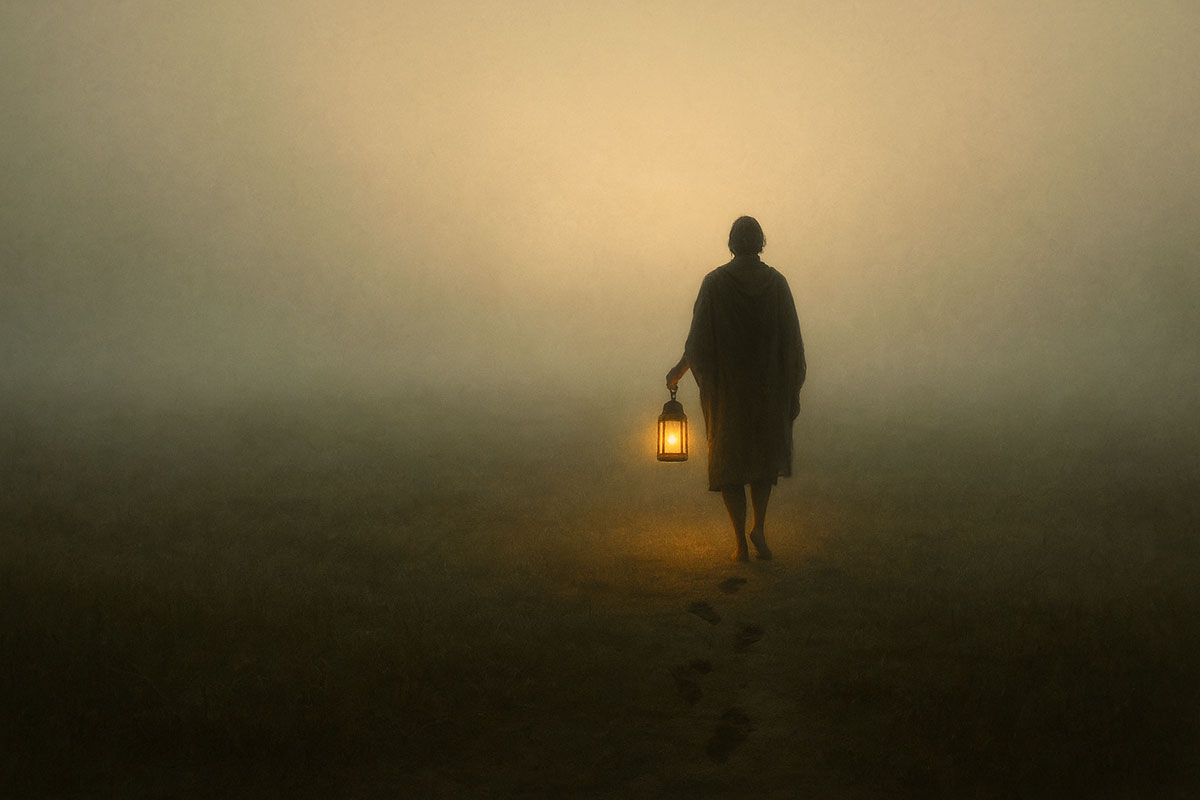
An open field under early morning mist. The sun hasn’t yet risen, and a soft silence lingers in the air. A simple wooden circle of chairs faces the horizon. In the center, a lantern glows faintly—its light a symbol of inner trust when the way ahead is not yet seen.
Participants
Søren Kierkegaard – Philosopher of faith and existential choice
Rumi – Mystic poet of surrender and divine longing
Paramahansa Yogananda – Spiritual teacher of attunement with divine will
Helen Keller – Embodiment of unseen courage and trust
Ram Dass – Spiritual teacher of presence and letting go
Henri Nouwen (Moderator):
We are all asked to walk forward—into moments we do not yet understand, into futures we cannot control. I want to begin by asking:
What does it mean to truly “live forward” in faith? What is the spiritual posture of walking into the unknown?
Rumi
To live forward is to let the soul lead. Not the mind, which fears. Not the ego, which clings. But the soul, which dances. The unknown is God’s handwriting. Trust it. Every step without certainty is a kiss toward the Beloved.
Helen Keller
Faith is not something I believed in after I understood—it’s something I clung to when I had no reason to believe. I walked through silence and darkness not because I could see—but because I refused to stop. Living forward means saying yes, even when you cannot hear the question.
Søren Kierkegaard
To live forward is to leap. Not blindly, but spiritually. Faith is not proof—it’s passion. It’s committing to something eternal without guarantees. The greatest tragedy is to stay paralyzed, waiting for perfect clarity. That is not life. That is avoidance.
Ram Dass
Living forward means dropping the storyline. The ego wants a map, a plan. But God gives you a moment. Just one moment. If you can love this breath, trust this step, you’re already free. Don’t wait for answers—become the space in which trust can bloom.
Paramahansa Yogananda
Faith is tuning into the Divine Broadcast. We often live forward with fear because we are attuned to the wrong station. But the soul, when stilled, can receive the guidance of God. Living forward in faith means becoming inwardly still enough to hear the whisper of destiny.
Henri Nouwen:
Thank you, dear friends. Now I wonder…
What are the signs that we are truly walking by faith—and not by fear masked as control?
Ram Dass
You’re walking by faith when you don’t need to know. When the obsession with outcome loosens, and you can show up with presence and compassion. Control is the mind’s trick. Faith is the heart’s surrender. It feels like falling, and being caught.
Søren Kierkegaard
When your choices are no longer ruled by comfort or calculation, but by conviction. When you act because it is right, not because it is safe. That is faith. Fear calculates. Faith commits.
Helen Keller
You feel peace—not because you’re certain, but because you’re aligned. I couldn’t see the path, but I trusted the voice of my teacher. Faith is recognizing the sacred in guidance, even when the way is dim.
Paramahansa Yogananda
The soul is calm. It’s a divine intuition. You feel a lightness in action—not recklessness, but freedom. Fear will rush you. Faith is silent and luminous. It doesn’t chase. It knows the flow.
Rumi
Your tears soften. Your hands open. You begin to weep less for control and more for beauty. You stop wrestling with what should be and become drunk on what is. That is the scent of trust.
Henri Nouwen:
And finally…
For those who feel paralyzed by uncertainty—who are afraid to live forward—what would you offer them as a beginning step?
Helen Keller
Begin with gratitude. Even for the smallest things. Gratitude lights a torch inside the dark. Then move your feet—even a single step. Don’t wait for the fog to lift. Trust is formed while walking.
Rumi
Bow. Not to fear, but to the path. Say “yes” even with trembling lips. The wind knows where to take you. Don’t ask for maps—ask for wings.
Paramahansa Yogananda
Meditate. Still the breath. Listen to the inner temple. The beginning is within, not outside. Faith does not start with action—it starts with alignment.
Ram Dass
Hold your fear like a baby. Don’t fight it. Just sit with it. Let it breathe beside you. When you stop resisting the fear, it softens. When it softens, the soul moves forward.
Søren Kierkegaard
Let go of needing to “know.” Choose what calls to your spirit—not your security. Leap. Leap inward. Leap upward. And the ground will appear beneath your faith.
Final Reflections – Henri Nouwen
Faith is not the absence of uncertainty.
It is love in motion.
It is saying yes without a script, trusting that the hand that writes your future is both holy and tender.
To live forward is to believe that God meets you step by step—never before, never behind—only always now.
Topic 3: Soul Time vs Clock Time — The Eternity Within the Journey
Inspired by Kierkegaard’s wisdom:
“Life can only be understood backwards…”
(But what if the soul isn’t bound to forward or backward at all?)
Moderator: Eckhart Tolle
A master of stillness and presence, Eckhart is the ideal moderator to lead a contemplative dialogue on the illusion of time, the eternal now, and the soul's rhythm beyond the ticking clock.
Scene Setting
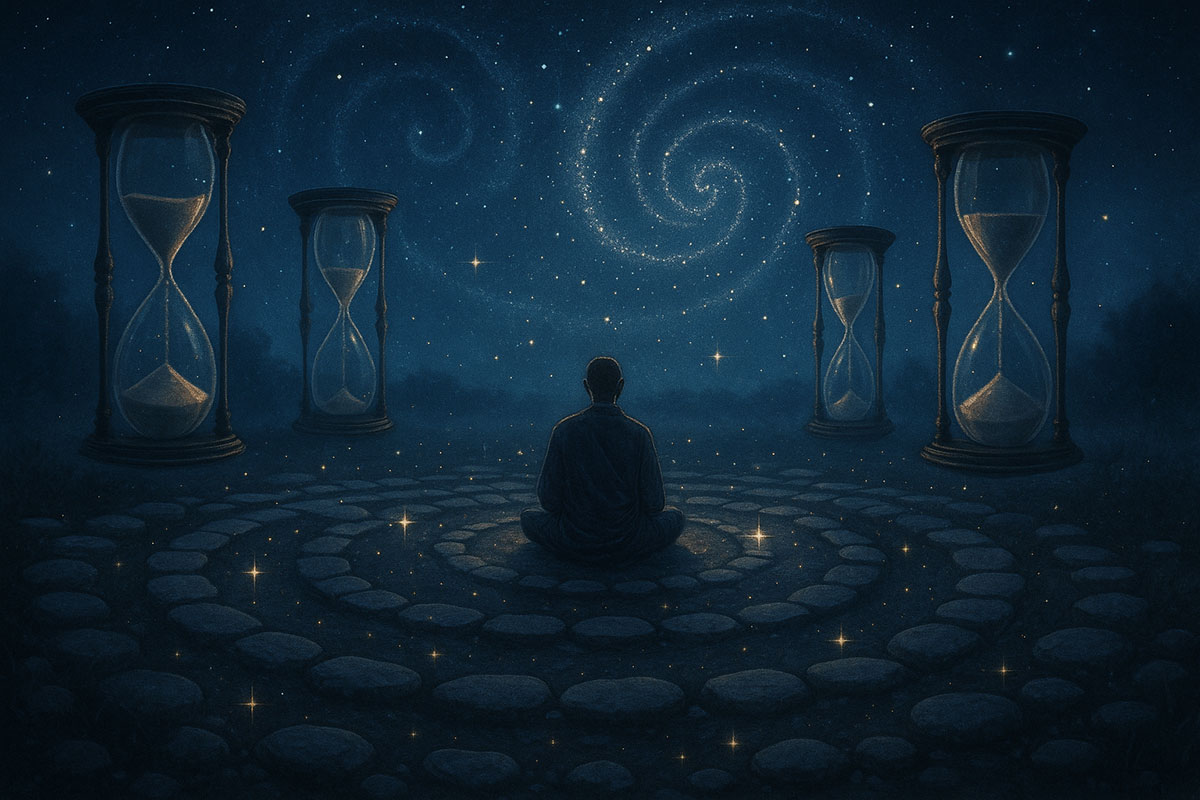
A circular stone garden with no entrances or exits. In its center, a slowly spinning hourglass pours golden sand that never runs out. Around it, five chairs form a mandala of contemplation. Time feels irrelevant here. Birds call softly. A distant bell chimes—but never rings.
Participants
Dolores Cannon – Hypnotherapist and past life regression pioneer
Einstein – Theoretical physicist who challenged time’s linearity
Terence McKenna – Psychedelic philosopher and timewave theorist
Bashar (channeled by Darryl Anka) – Speaker on parallel realities and nonlinear time
Teresa of Ávila – Spanish mystic with firsthand experience of timeless union
Eckhart Tolle (Moderator):
Let’s begin with a simple, paradoxical question:
What is time to the soul? Is it real, or an illusion? And how does eternity reveal itself in our journey?
Einstein
Time is relative—not fixed. There is no universal “now.” Physically, the past, present, and future all exist simultaneously, like frames in a film reel. It is our consciousness that experiences them sequentially. The soul, which transcends space and matter, likely experiences time as a totality.
Teresa of Ávila
In union with God, there is no time. I have sat in moments that stretched beyond hours, and seconds that felt like lifetimes. Time is the veil, not the truth. The soul knows eternity because the soul is made of it. In prayer, time melts into presence.
Bashar
From the higher mind’s perspective, all timelines exist at once. You are not moving through time—you are shifting through parallel versions of reality. Your frequency determines which "now" you tune into. Time is simply your reflection of change within a larger, eternal field.
Dolores Cannon
Through past life regression, thousands have accessed memories from lives in other centuries, planets, or dimensions. What does this tell us? That the soul is a traveler across time, not its prisoner. Time is a structure—a learning environment—not a limit.
Terence McKenna
Time isn’t a straight line—it’s a spiraling, fractal wave of novelty. Our obsession with clocks is a cultural hallucination. Psychedelic states reveal that consciousness can move backward and forward, or even beyond time, like slipping between dimensions of meaning.
Eckhart Tolle:
Beautiful insights. Now, I ask:
Why do humans suffer so much from their relationship with time? How does the illusion of time pull us away from peace?
Teresa of Ávila
Because we fear endings. Death. Loss. And yet these only exist because we believe in time as final. The soul, however, knows no end. Our anxiety is born from forgetting this. If we remembered our divine origin, time would cease to frighten us.
Einstein
We suffer from time because we mistake our clocks for our identity. “I am too late,” “I have missed my chance,” “I must hurry.” But the soul has no deadlines. It evolves in spirals, not schedules.
Dolores Cannon
People carry deep guilt over “wasted years.” But nothing is wasted. Even delays have divine purpose. When they see their life review after death, they realize that the most painful, confusing periods held the most spiritual growth. The soul never judges a life by speed.
Terence McKenna
Linear time kills wonder. The soul is designed for mystery, but society puts us on assembly lines of productivity. When we liberate ourselves from time-think, we rejoin the imaginal realm—the source of creativity, synchronicity, and grace.
Bashar
You suffer when you anchor your sense of identity to a timeline instead of a vibration. What matters is not “how long it takes,” but how aligned you are in this moment. You can change your past and future instantly by shifting your state of being now.
Eckhart Tolle:
One last reflection.
How can we begin to live more in “soul time”? What practices help us reconnect with the eternal nature within us?
Dolores Cannon
Explore your inner world. Hypnosis, meditation, dreaming, even deep prayer—these open the inner gates where time dissolves. Once you touch the soul’s timeless nature, you carry that peace with you, even in daily life.
Einstein
Contemplate the cosmos. When you gaze at a star, you are seeing light that left it millions of years ago. You are literally looking into the past with your eyes. That alone should humble you and awaken soul perspective.
Teresa of Ávila
Stillness. Not just silence, but interior stillness. There, God reveals the timeless beauty of the soul. Every practice that softens the ego and opens the heart is a door to eternity.
Bashar
Live joyfully. That’s the shortcut. The soul's frequency is bliss. The more joy you cultivate, the more you step out of linear resistance and into resonance with your higher self, which always lives in the eternal now.
Terence McKenna
Go into nature. Dance without rhythm. Dream without alarm clocks. Time isn’t something to manage—it’s something to transcend. And sometimes, all it takes is one deep breath that you actually feel to escape the tyranny of the clock.
Final Reflections – Eckhart Tolle
Time is a useful servant but a cruel master.
The soul does not ask: “What time is it?”
It asks: “Am I present? Am I aligned?”
And in that presence—timeless, spacious, eternal—you do not age. You awaken.
Topic 4: Divine Reinterpretation — Rewriting the Meaning of Your Life
Inspired by Kierkegaard’s wisdom:
“Life can only be understood backwards…”
But with spiritual insight, the meaning of the past is not fixed—it can be rewritten in the light of love.
Moderator: Iyanla Vanzant
A master of healing through truth, forgiveness, and fierce grace. Iyanla gently confronts, lovingly holds, and powerfully guides. She’s perfect for leading a conversation about transforming the stories we tell ourselves about our past.
Scene Setting
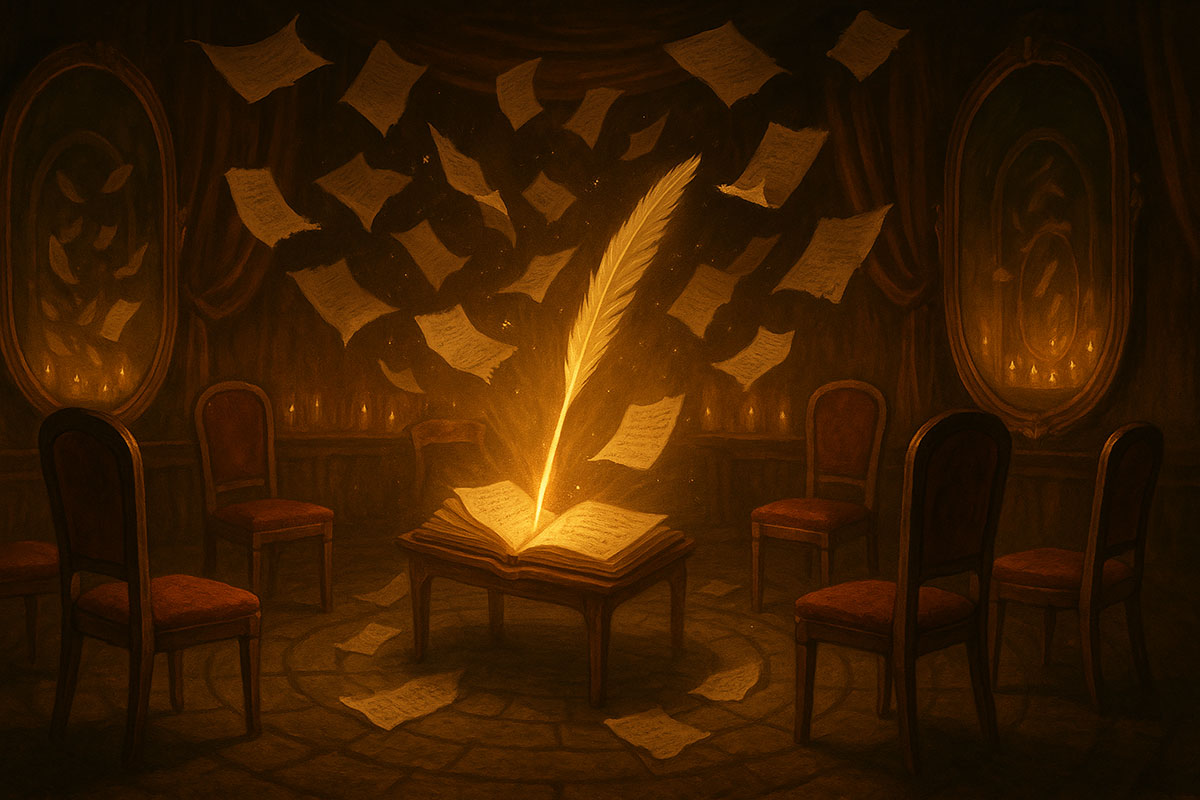
A circle of chairs in a theater filled with unfinished scripts and tattered pages. A spotlight shines down on each speaker in turn. Behind them, a wall of mirrors—some shattered, some whole—reflects not faces, but scenes from their lives. There’s a sense that every page can be rewritten.
Participants
Marianne Williamson – Spiritual teacher of love and perception
Carl Jung – Depth psychologist of the shadow and individuation
Michael A. Singer – Surrendered path and observer of thought
Iyanla Vanzant – Moderator and healer of life stories
Viktor Frankl – Holocaust survivor and meaning-maker
Iyanla Vanzant (Moderator):
Let me ask you straight:
Can we really rewrite our lives? Not the facts, but the meaning? And if so, what is the spiritual process of reinterpreting our own story through divine eyes?
Marianne Williamson
Absolutely. A miracle is not changing what happened—it’s changing how we see what happened. When we ask for divine perception, we shift from fear to love. That shift reveals that what wounded us can also awaken us. The past does not define us—it becomes sacred when seen with forgiveness.
Viktor Frankl
You cannot choose your suffering, but you can choose the meaning you assign to it. In the camps, I saw that those who gave their pain a purpose survived with dignity. Spiritual reinterpretation is not denial—it is defiant meaning-making. It says, “I will not let the past kill the soul in me.”
Michael A. Singer
Your mind tells stories all day long. Most of them are untrue. Rewriting your life begins by recognizing that you are not the voice in your head—you are the one who observes it. If you stop clinging to the story, it rewrites itself. Peace reveals the truth beneath the drama.
Carl Jung
We must descend into our past—not to be trapped by it, but to understand it symbolically. The story you feared to face becomes your initiation. When you reinterpret life through archetypes, wounds become transformations. Rewriting isn’t falsifying—it’s alchemizing.
Iyanla Vanzant:
Okay. Let’s go deeper.
How do we know when we’ve truly rewritten a part of our life? What are the signs that healing has really happened—not just intellectually, but spiritually?
Viktor Frankl
You stop asking “Why me?” and start asking “What now?” You no longer curse your past—you find responsibility in it. Not blame, but authorship. And when you begin to serve others with what you’ve learned, you know the story has changed.
Michael A. Singer
The moment your inner resistance ends. When the old memory comes up and you don’t flinch, contract, or narrate it again. It’s just an image. No longer personal. The self that suffered has been released, and you realize—you’re already free.
Carl Jung
The sign of true healing is integration. The energy once trapped in a trauma is now available to serve the Self. You don’t just understand your pain—you honor it. It becomes part of your myth. You no longer reject it—you embrace the wholeness it gave you.
Marianne Williamson
You feel love. You weep not with pain, but with gratitude. That moment when you can bless what once broke you—that’s the miracle. You’re no longer living from your wounds—you’re living through your wisdom.
Iyanla Vanzant:
I love all of that. Now, tell me—
For someone still trapped in a painful life story, where should they begin? What’s the first spiritual step in rewriting a life?
Carl Jung
Begin with honesty. Brutal, soul-level honesty. What story have you told yourself again and again? Write it down. Draw it. Speak it in sacred space. Until it is seen, it controls you. But once it’s conscious, it can be transformed.
Marianne Williamson
Invite the Holy Spirit. Ask for divine reinterpretation. Say: “I’m willing to see this differently.” You don’t need to know how. Just be willing. That opens the door to a new perception. And in new perception, lies new freedom.
Viktor Frankl
Stop asking if it was fair. Life is not about fairness—it is about meaning. Find something or someone to serve. In the act of serving, you redeem your own pain. The beginning of healing is often outside the self.
Michael A. Singer
Watch the voice. Notice how often it clings to the same story—how it wants to be right, or pitied, or angry. Don’t argue with it. Just notice. Sit back. Relax behind it. Eventually, it burns out. Then silence speaks—and silence rewrites.
Final Reflections – Iyanla Vanzant
You are not the story you were handed.
You are not the worst thing that ever happened to you.
You are the child of a Divine Author—and it’s never too late to revise the script.
But first, you must pick up the pen.
Topic 5: The Eternal Compass — Living from Soul Memory, Not Fear
Inspired by Kierkegaard’s wisdom:
“…but it must be lived forwards.”
Yet how do we move forward not from fear of the unknown—but from trust in what the soul already knows?
Moderator: Caroline Myss
A teacher of sacred contracts and intuitive power, Caroline bridges deep mystical insight with no-nonsense spiritual clarity. She’s the perfect guide to uncover the idea of inner knowing—your soul memory—as a compass more trustworthy than logic or fear.
Scene Setting
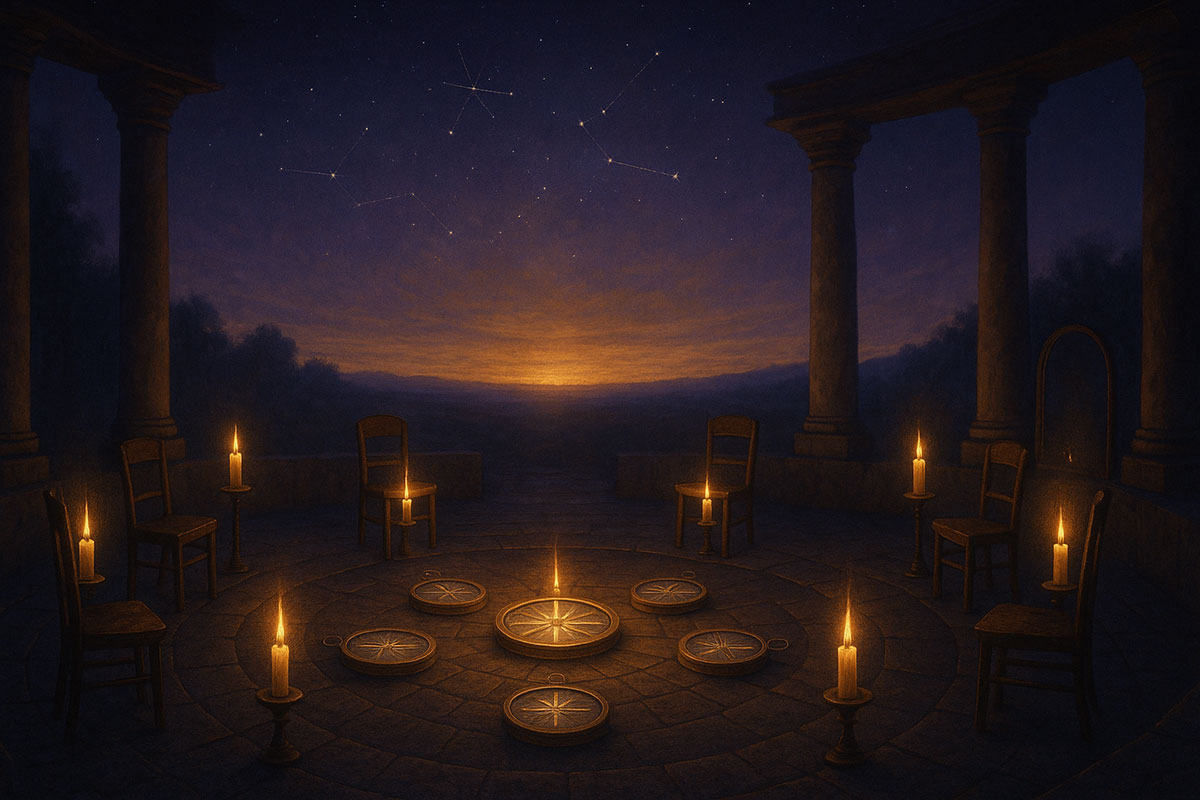
An open-air temple beneath a twilight sky. Around the roundtable, ancient maps are laid out—but they’re blank. Instead, each seat has a candle and a compass. In the background, faint constellations glow—familiar but unnamed. The atmosphere is both reverent and quietly electric.
Participants
Neville Goddard – Mystic of imagination and inner reality
Caroline Myss – Moderator and teacher of soul contracts
Rev. Sun Myung Moon – Visionary of eternal life and divine destiny
Jalal ad-Din Rumi – Mystic poet of the soul’s longing
Lao Tzu – Sage of the Tao, master of flowing with divine nature
Caroline Myss (Moderator):
Let me start by asking each of you—
If time is uncertain and the future unknown, what is it that the soul does know? What is this soul memory that we can trust more than fear?
Rev. Sun Myung Moon
The soul remembers its Parent. Even when the body forgets, even when the world distorts, the soul carries a blueprint of divine purpose. We are not wanderers—we are sons and daughters returning Home. The soul knows this, and it aches when we stray from it.
Rumi
The soul knows the Beloved. It does not know with thought, but with flame. What you call intuition is the memory of union. Even in this body, even in confusion, the soul leans toward joy—because it remembers Heaven.
Lao Tzu
The Tao flows through everything. When you are aligned, you act without forcing. The soul does not need knowledge—it needs stillness. In the stillness, the Way appears—not ahead of you, but within you.
Neville Goddard
The soul knows through feeling. Imagination is the instrument. That deep yearning you feel—it’s not fantasy. It’s soul memory surfacing. When you dare to feel it as real, you bring the invisible into form. That is your compass: the feeling of being already there.
Caroline Myss:
So then, I ask this—
How can a person tell if they are living from fear… or from soul? How do we distinguish panic from guidance?
Lao Tzu
Fear is noisy. Soul is quiet. When you are in flow, your actions are simple, like water running downhill. There is no rush, no tightness. You do not push life—you move with it.
Rev. Sun Myung Moon
When you are in fear, you ask, “What do I deserve?” When you are in soul, you ask, “What does God desire through me?” Fear speaks of lack. The soul speaks of mission. One shrinks, the other expands.
Neville Goddard
Fear repeats. It argues. It doubts. But when you feel a soul truth, it stays with you like a fragrance. It calms you even as it challenges you. If you can imagine it vividly, joyfully, with peace—it is from your soul.
Rumi
Fear builds walls. The soul opens doors. When you are near your truth, you begin to weep—not from sadness, but from recognition. That is the soul. It knocks when your heart is quiet enough to hear it.
Caroline Myss:
Now to end, I ask each of you—
What is one practice, mindset, or sacred act that helps a person walk forward from soul memory rather than fear?
Rumi
Speak poetry to your life. Don’t describe what you see—describe what your soul remembers. Write it. Whisper it. Let it burn through the fog. That is prayer.
Neville Goddard
Feel it real. Imagine, not to escape, but to return. What you can feel with faith, you are meant to live. Live from the end—not the fear.
Lao Tzu
Be like water. Be patient, soft, and yielding. The soul leads in silence. The more you try to force the Way, the more it hides. But when you rest, it flows again.
Rev. Sun Myung Moon
Live for others. That is the highest direction. When you love sacrificially, you realign with the divine heart—and your original soul compass returns. You were born to love, not to protect yourself.
Final Reflections – Caroline Myss
Your mind will never be certain.
But your soul already knows.
It remembers why you came, what you are here to give, and who you are becoming.
Fear follows timelines.
But your soul walks by a deeper map—one written in light.
Final Thoughts by Søren Kierkegaard
If you have listened closely, you may have heard not answers, but echoes.
Each of these voices—ancient and modern, poetic and plain—has asked you not to solve life, but to enter it more truthfully. That is the mark of spiritual maturity: to look back with mercy, to walk forward in faith, and to carry within yourself a compass not of logic, but of love.
Your past is not a sentence—it is scripture waiting to be reread. Your fear is not prophecy—it is fog that clears when the soul remembers its sky. And your future? It is not empty. It is already known by the One who knit you in secret.
So go, dear traveler.
Don’t rush to explain.
Instead, live as if your life is a sacred poem—
One whose meaning will emerge when read aloud by heaven.
And someday—when eternity asks you what you did with the mystery—may your only answer be:
“I loved it forward.”
Short Bios:
Søren Kierkegaard was a 19th-century Danish philosopher and theologian, often considered the father of existentialism. His writings focused on faith, despair, and the inner journey of the individual soul.
Thomas Moore is a spiritual writer and psychotherapist, best known for Care of the Soul. A former monk, he blends psychology, mythology, and mysticism to explore the depth of human experience.
Thich Nhat Hanh was a Vietnamese Zen master and peace activist who taught mindfulness and compassion. His gentle wisdom continues to influence global spiritual communities.
Carl Jung was a Swiss psychiatrist and founder of analytical psychology. His concepts of the shadow, archetypes, and individuation brought spiritual depth to the field of psychology.
Pema Chödrön is an American Buddhist nun and teacher in the Shambhala tradition. She is known for her clear, compassionate teachings on navigating suffering and change.
Maya Angelou was a celebrated American poet, memoirist, and civil rights activist. Her life and words gave voice to the power of truth, memory, and self-expression.
James Hillman was an American psychologist and founder of archetypal psychology. He believed soul-making involved imagination, myth, and deep engagement with life's images.
Henri Nouwen was a Catholic priest, professor, and spiritual writer known for his vulnerable, insightful reflections on trust, loneliness, and God’s love.
Rumi was a 13th-century Persian poet and Sufi mystic. His ecstatic verse speaks to the soul’s longing for union with the Divine.
Paramahansa Yogananda brought yoga and meditation to the West in the early 20th century. His teachings emphasize direct experience of God through spiritual discipline.
Helen Keller was an American author and activist who overcame blindness and deafness. Her life exemplified courage, faith, and the power of the inner world.
Ram Dass was a spiritual teacher and psychologist best known for Be Here Now. His work bridged Eastern philosophy and Western spiritual awakening.
Dolores Cannon was a hypnotherapist and author who pioneered past life regression and soul-based exploration of time and consciousness.
Albert Einstein was a theoretical physicist whose theories transformed our understanding of time, space, and reality. He believed in the harmony between science and mystery.
Terence McKenna was an ethnobotanist and consciousness explorer. His ideas about time, psychedelics, and culture offered radical insights into human perception.
Bashar is a channeled multidimensional being through Darryl Anka, known for teaching about parallel realities, frequency alignment, and the illusion of linear time.
Teresa of Ávila was a 16th-century Spanish mystic and Carmelite nun. Her writings on prayer and divine union remain pillars of Christian spirituality.
Iyanla Vanzant is a spiritual teacher, author, and life coach known for her deep truth-telling and transformative healing work in personal and family dynamics.
Marianne Williamson is a spiritual author and teacher of A Course in Miracles, blending personal healing with social transformation.
Michael A. Singer is a spiritual teacher and author of The Untethered Soul. His teachings focus on inner freedom through surrender and observation of thought.
Viktor Frankl was a Holocaust survivor and psychiatrist who founded logotherapy. He believed that meaning is the key to survival and healing.
Caroline Myss is a medical intuitive and spiritual teacher who developed the concept of sacred contracts, exploring the soul’s blueprint and intuitive guidance.
Neville Goddard was a mystic and teacher of imagination as the creative force of reality. His work centers on the inner world as the source of all manifestation.
Rev. Sun Myung Moon was a spiritual leader and founder of the Unification Movement. He emphasized God’s parental heart, eternal life, and humanity’s shared destiny.
Lao Tzu is the legendary Chinese philosopher attributed with writing the Tao Te Ching. His teachings on the Tao encourage harmony with nature and non-resistance.
Leave a Reply