
|
Getting your Trinity Audio player ready...
|
Introduction
(Spoken by the child, curious but unsure about poetry)
I don’t really understand poetry.
Every time someone says the word, I imagine old books with tiny letters and people who use big words like “thou” and “hence.” My teacher says poetry is beautiful, but sometimes it just feels like a puzzle I’m not smart enough to solve.
Still… I like certain things.
I like how the rain sounds on my window.
I like when my heart feels fizzy before something exciting.
I like when my thoughts feel too big for regular talking.
Sometimes I wish there was a way to catch those moments
so they don’t disappear.
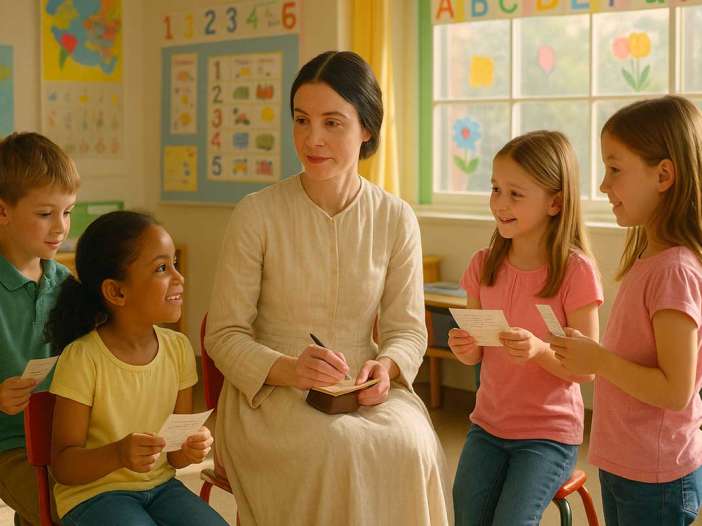
My teacher says a famous poet named Mrs. Emily Dickinson is coming to visit us today. She says Emily wrote poems in secret and hid them in drawers and envelopes. That sounds kind of cool… like spy writing.
I’m not sure what she’ll be like.
Will she talk in riddles?
Will she float instead of walk?
Do poets smile?
I guess I’ll find out.
But a little part of me hopes she’ll show me what poetry really is.
And maybe — just maybe — I’ll find out if poems can belong to someone like me.
(Note: This is an imaginary conversation, a creative exploration of an idea, and not a real speech or event.)
Emily Enters the Classroom (Quiet Magic Begins)
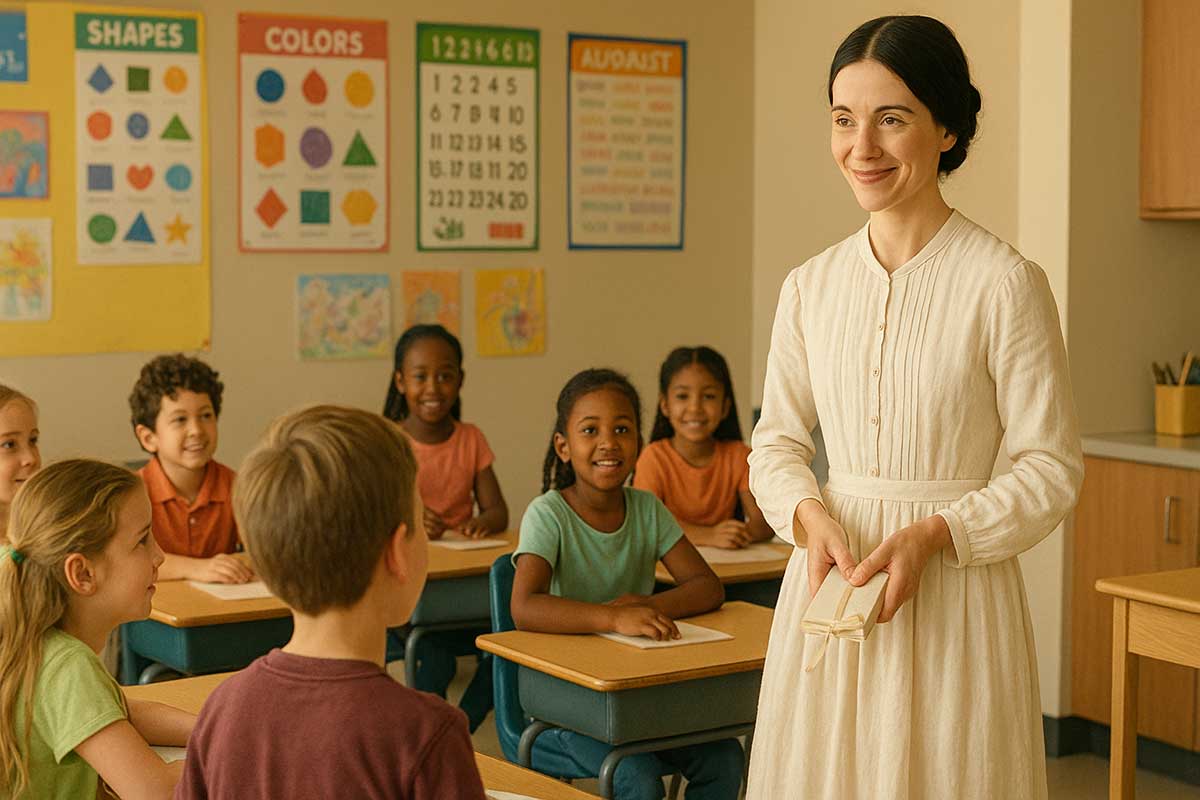
Emily steps in wearing her simple white dress, carrying a tiny notebook tied with ribbon.
She looks at the children with soft surprise, as if delighted by their brightness.
Emily (smiling):
“Good morning, my dears. I’m Emily.
I hear you are lovers of wonder —
the best kind of poets.”
She sets her notebook on the desk.
What Is Poetry? (A Kid-Friendly Explanation)
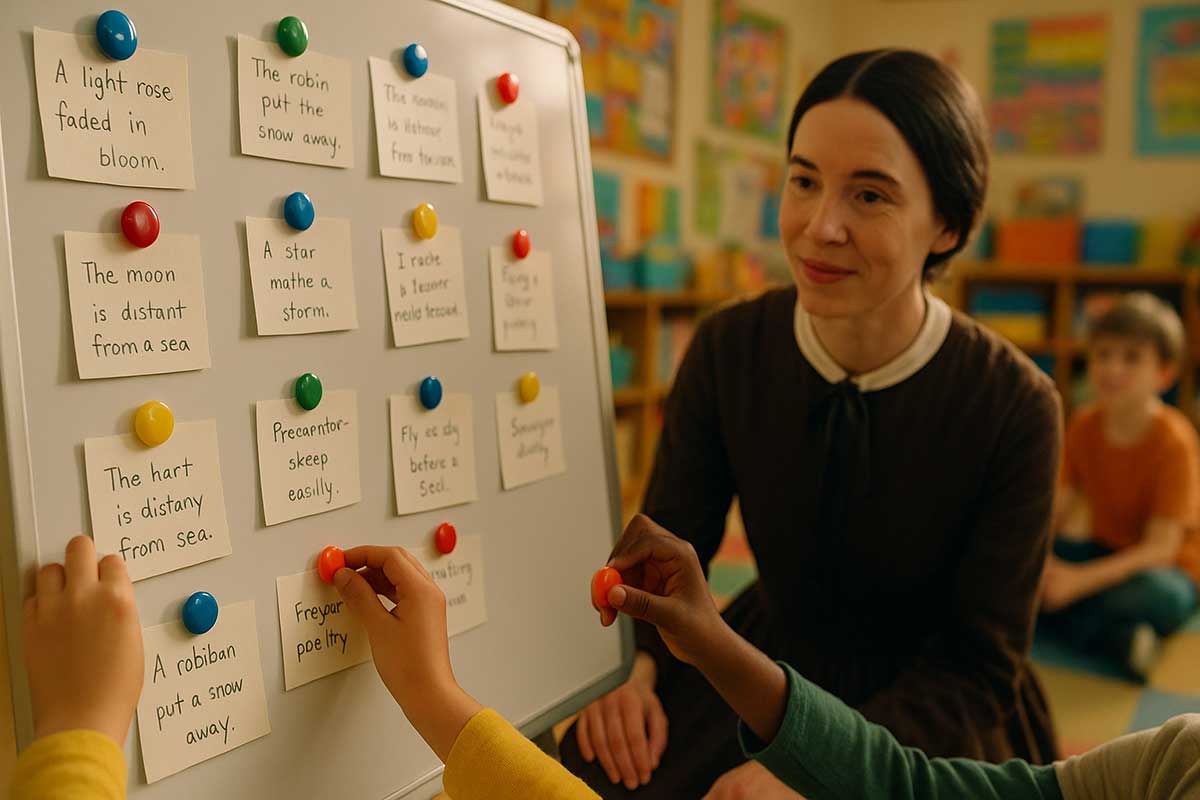
Emily sits on a tiny classroom chair.
Emily:
“Poetry is not long or fancy.
Poetry is what happens
when your heart suddenly says —
Oh!
and your pencil tries to catch it.”
She holds up her hands.
Emily:
“Poetry is tiny.
Poetry is quick.
Poetry is your feelings dressed up
in a few brave words.”
She writes on the board:
“A poem is a moment you can keep.”
Show Them the Fun: The Refrigerator Test
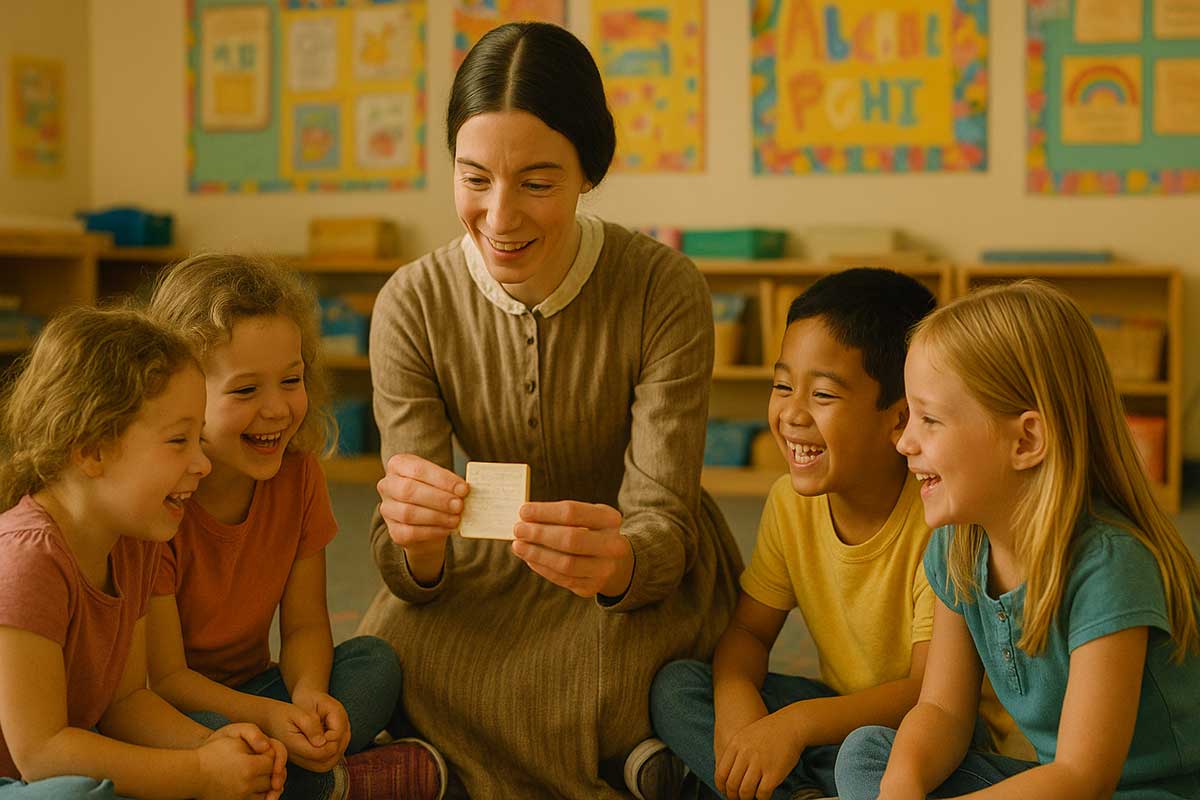
Emily giggles softly.
Emily:
“Shall I tell you the secret of poetry?
It’s the only kind of writing
that fits on a refrigerator.”
She writes:
“The sun hugs me.
The breeze whispers.”
The kids laugh.
Emily:
“See?
A whole universe in two little lines!”
Then she leans in dramatically.
Emily:
“And guess what?
A good poem never gets grounded for being short.”
Demonstration: Turning Feelings Into Pictures

Emily draws a big heart and a big eyeball on the board.
Emily:
“Poets use heart + eyes together.
A feeling… becomes a picture.”
She asks the class:
“How does happy look?”
Kids shout answers: “Sunshine!” “Puppies!” “Ice cream!”
She writes a quick poem:
“Happiness is
my dog’s tail
drawing circles.”
Kids laugh.
Then:
“What does sad look like?”
Responses: “Rain!” “Droopy flowers!” “Losing your favorite toy!”
Emily writes:
“My sadness rains
inside my shoes.”
The students feel it.
Emily:
“Poetry is feelings
wearing disguises.”
The Emily Dickinson 3-Step Kid-Friendly Poetry Formula
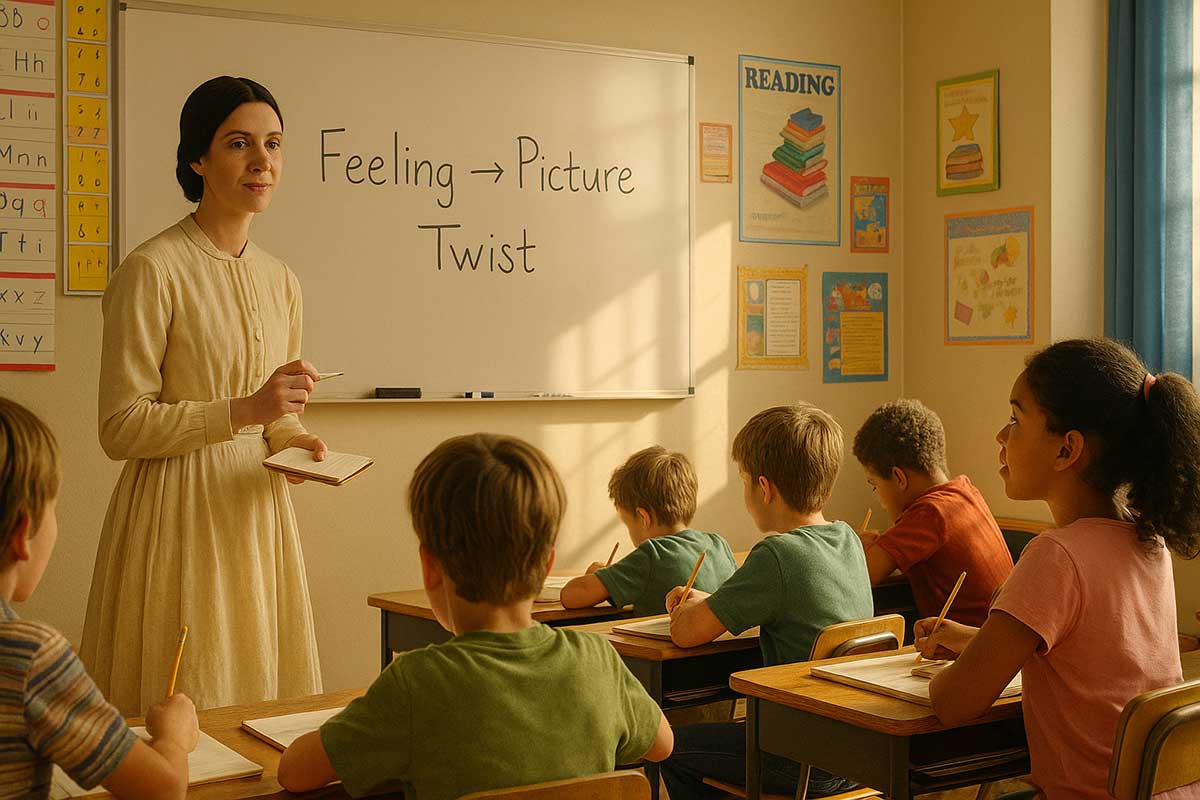
Emily stands up, excited.
Emily:
“You only need three things to write a poem:
1. A feeling
2. A picture
3. A surprise”
She writes a simple formula:
Feeling ➜ Picture ➜ Little Twist
Example:
Feeling: excited
Picture: popcorn popping
Twist: the popcorn is your heartbeat
Poem:
“My heart pops like
fresh popcorn
when I see Friday coming.”
The children clap.
Kids Write Their Own (Emily Walks Around Quietly Helping)
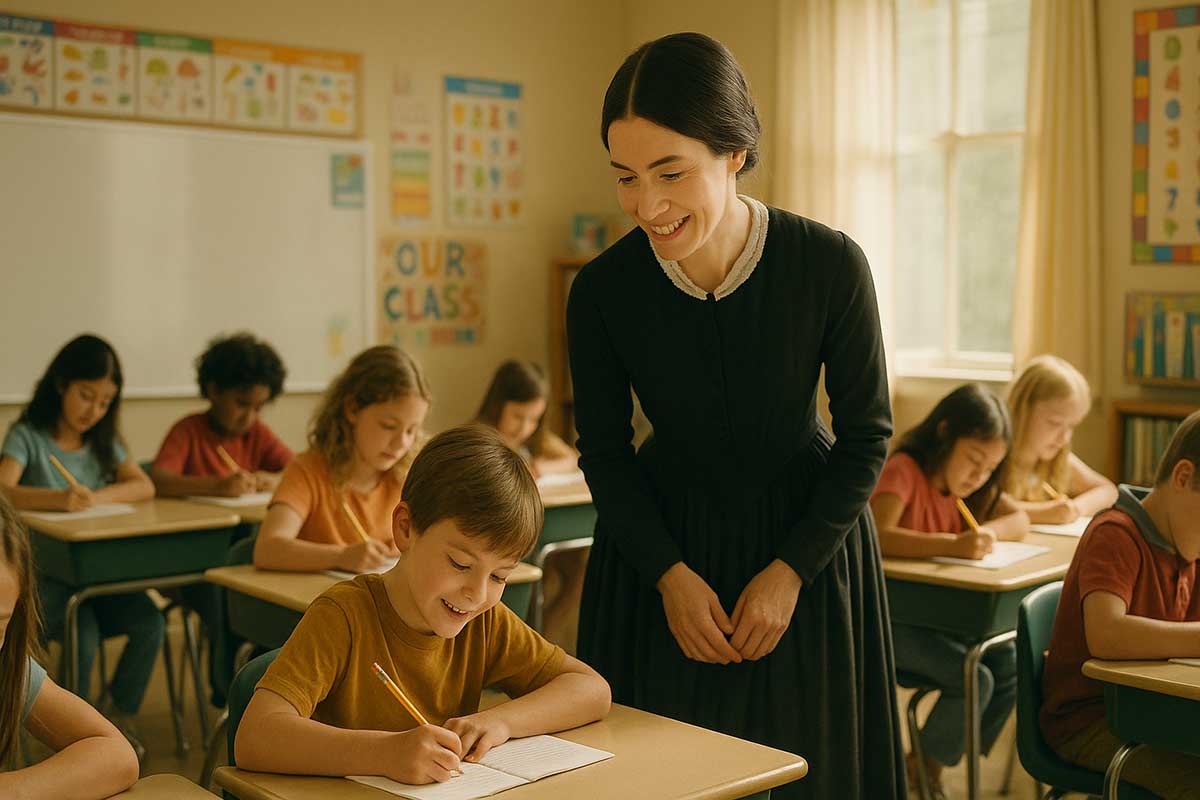
Emily gives them a template:
Your Own Emily-Style Poem
1. Choose a feeling: happy, nervous, proud, sleepy, silly
2. Choose a picture: rain, moon, sneakers, pencils, trees
3. Add a twist: make the picture behave like a feeling
Example starter lines she offers:
“My excitement jumps like…”
“My sadness hides under…”
“My laughter shakes like…”
“My courage stands up like…”
“My dreams float like…”
Emily walks desk to desk, kneeling gently beside each child.
Emily (whispering encouragement):
“Your poem is already inside you —
just give it a door.”
She celebrates tiny wins:
“Oh! This is brave.”
“This line sparkles.”
“You turned a feeling into a picture — you’re a poet!”
Sharing Circle (Emily’s Favorite Part)
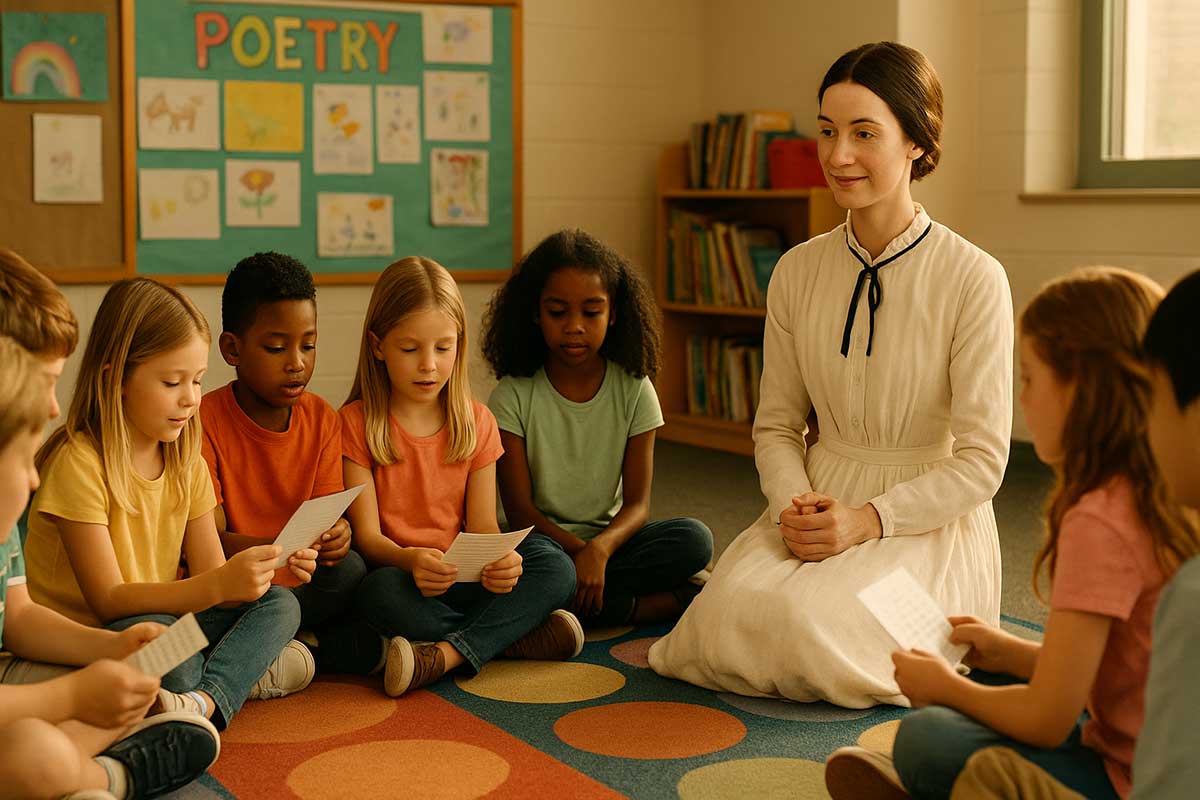
Emily gathers the class on the carpet.
A few brave students read their poems aloud.
She reacts with genuine awe:
Emily:
“That line! It nearly flew away with me.”
“Your poem is small, but its heart is enormous.”
“The world feels bigger after hearing that.”
She never criticizes — only celebrates imagination.
Emily’s Goodbye Gift
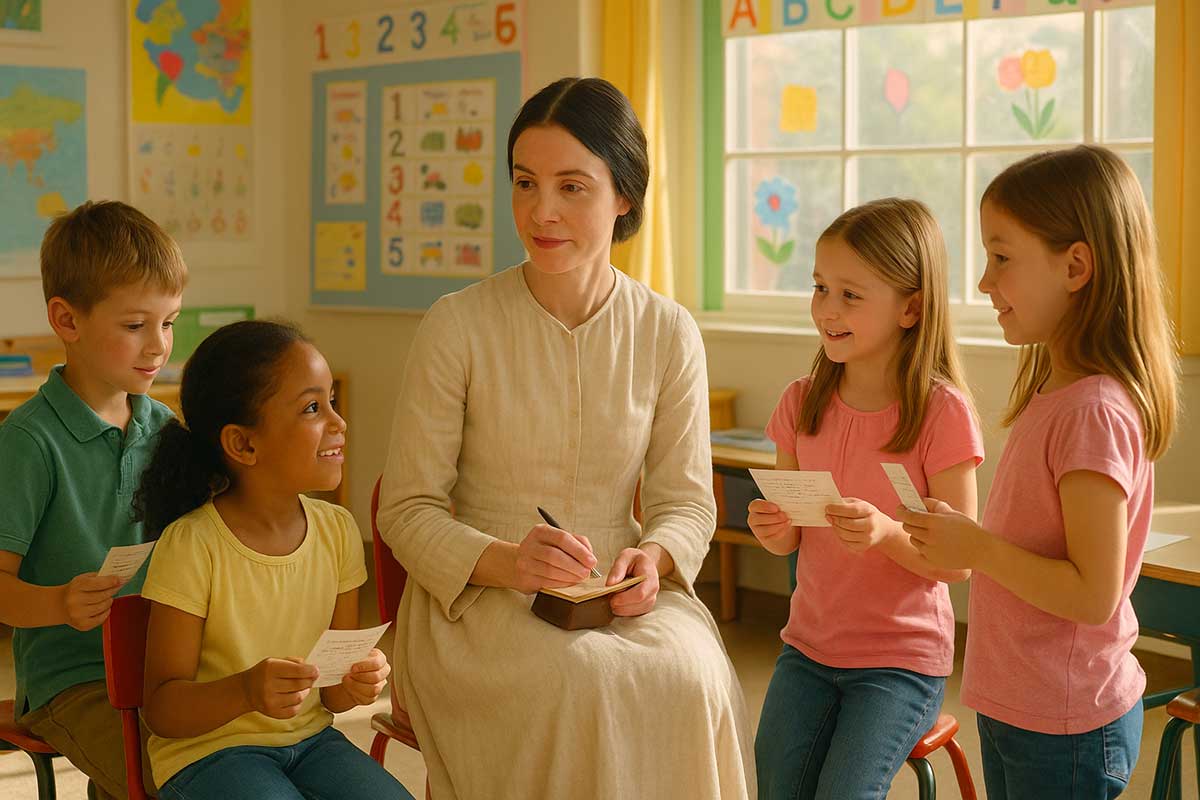
Emily stands at the front, hands folded, eyes warm.
Emily:
“My little poets…
promise me one thing.”
The class leans in.
Emily:
“Whenever you feel something — anything —
write it down in a few brave words.That is poetry.
That is magic.
And you already know how.”
Then she opens her tiny notebook and tears out a small page.
Emily:
“A poem I wrote for you.”
It reads:
“Children’s hearts
are tiny lanterns —
they glow
with worlds.”
She bows slightly.
Emily:
“Thank you for letting me visit.
You have filled me
with sunlight.”
Final Thoughts
(Spoken by the child, now transformed by the encounter)
I didn’t expect today to feel like magic.
Mrs. Dickinson didn’t float or talk in riddles.
She knelt down beside us like she’d been waiting a long time to hear what kids think about the world. She opened a tiny notebook and showed us a poem shorter than a snack list — but somehow, it made my chest feel warm.
She told us poems are “moments you can keep.”
And suddenly everything made sense.
I looked around the classroom and saw moments everywhere:
The sunlight on Emma’s hair.
The squeak of Liam’s shoes.
The little heartbeat-thump I felt when she smiled at my poem.
And for the first time, I felt like poetry wasn’t something I had to “get.”
It was something I already had inside me.
When I read my poem aloud —
just a few words about how nervous feels like “a tiny bird shaking inside my shirt” —
Mrs. Dickinson put her hand over her heart.
No one has ever done that for my words before.
Now I know something huge:
Poetry is not about being smart.
It’s about being honest.
It’s the place where feelings can breathe.
It’s the net that catches the little sparks inside my mind.
It’s my way of keeping the world from rushing past too fast.
Today, I didn’t just meet a poet.
I became one.
And I think…
I think I’ll carry that with me for a very long time.
Short Bios:
Emily Dickinson
A gentle poet from the 1800s who loved turning quiet moments into poems. Emily spent most of her life in Amherst, Massachusetts, where she wrote about nature, feelings, and the mysteries of life. Though she lived quietly, her words became some of the most loved poems in the world. In this story, she visits a third-grade classroom to show that poetry can be playful, brave, and alive inside everyone.
Eli (the Child Narrator)
An 8-year-old who isn’t sure what poetry really is—until he meets Emily Dickinson. Curious, thoughtful, and sometimes shy, Eli learns that poetry isn’t about rules or rhymes, but about noticing small things and giving them words. His journey from confusion to wonder becomes the heart of the story.
Mrs. Alvarez (the Teacher)
The kind-hearted third-grade teacher who believes every child has a poet inside. She invites Emily Dickinson to visit her classroom to help her students discover the magic of words. Patient and wise, Mrs. Alvarez encourages imagination over perfection.
The Students
A lively, diverse group of third graders—each with their own spark of creativity. Some love to write, some love to draw, some are just beginning to find their voices. Together, they learn that poetry can sound like laughter, look like courage, or even smell like the first day of spring.
Leave a Reply