
|
Getting your Trinity Audio player ready...
|
Introduction
My name is Lila Bennett, and I’m one of the Firefly Writers in Mrs. Alvarez’s class.
I’ve always liked stories, but sometimes they feel too big for me—like they belong to people who lived a long time ago or people who are smarter or braver than I am.
Last week, Mrs. Alvarez said someone very special would be visiting our classroom.
She wouldn’t tell us who.
She just smiled in that way she does when something magical is about to happen.
This morning, I sat at my desk wondering what kind of person would walk through that door.
A writer?
A poet?
A storyteller?
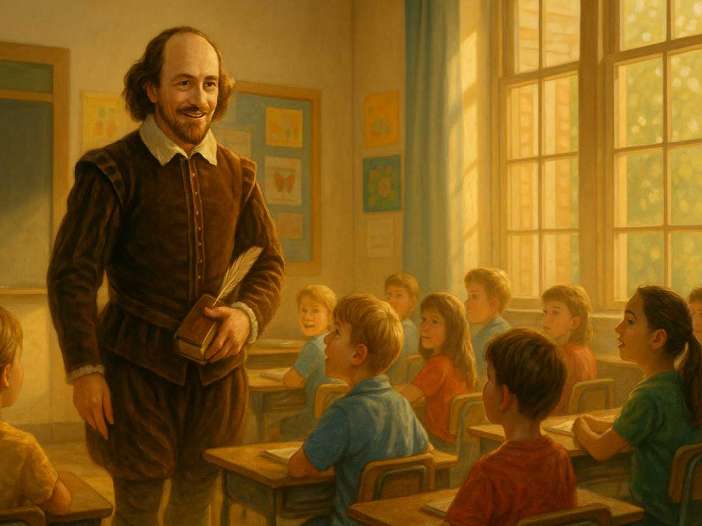
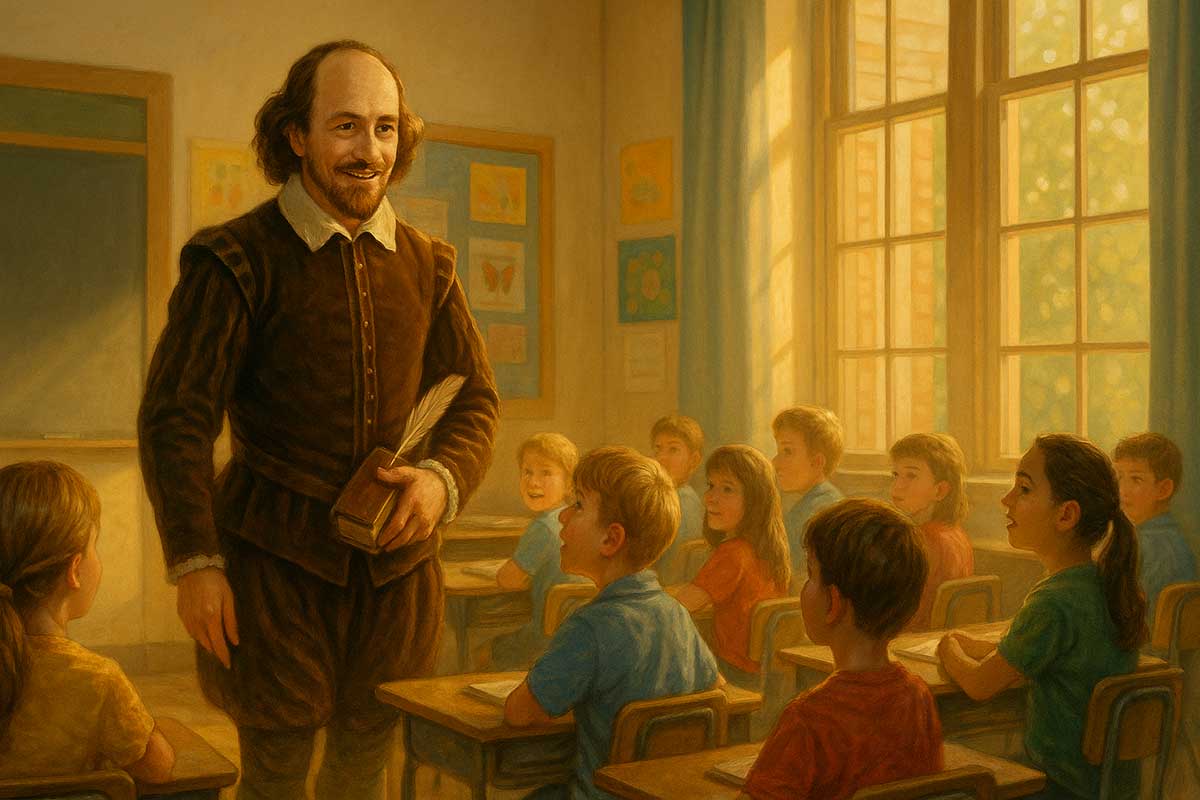
But when the door opened and a man in a velvet coat stepped inside—
with eyes that sparkled like he’d swallowed a whole galaxy of ideas—
I felt something shift in the room.
He looked at us like he already loved us.
He bowed, like we were worth bowing to.
He said, “Good morrow, young hearts.”
And somehow those words made me sit up straighter, like my own heart had just been invited to speak.
I didn’t know people from hundreds of years ago could appear in classrooms.
I didn’t know their voices could feel warm.
I didn’t know Shakespeare could look at me in a way that made me think—
Maybe stories aren’t far away after all.
Maybe they’re closer than I thought.
(Note: This is an imaginary conversation, a creative exploration of an idea, and not a real speech or event.)
1. Words as Little Lanterns

Shakespeare moves to the sunlight streaming through the windows, holding his hand into the beam as if warming his fingers.
Shakespeare:
“Words are lanterns.
In daylight, you may not notice their glow—
but in the dark of the heart, they guide the way.”
He lets the beam slip through his fingers.
“Even the smallest word—if true—can brighten the world.”
Maya whispers, “I never thought of words like that…”
He hears her and nods gently.
“Your lantern is already lit.”
2. Start with Wonder (Always)
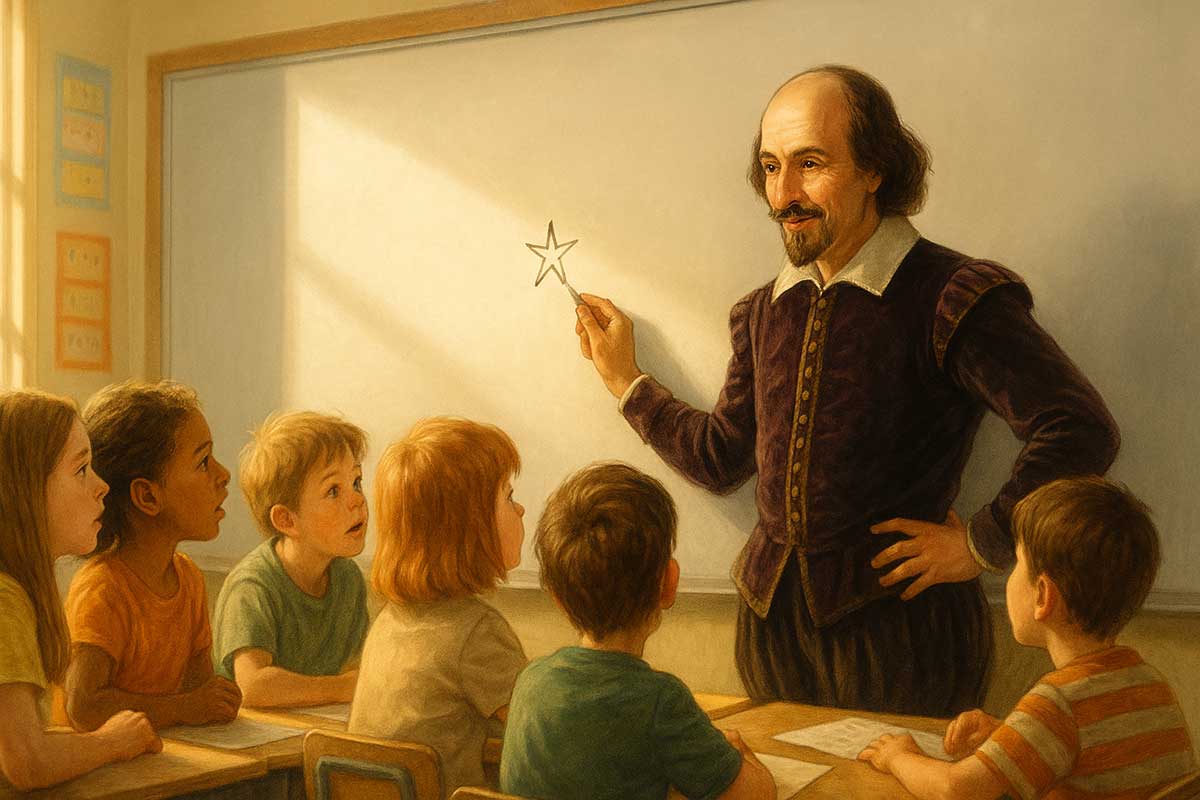
He strolls to the whiteboard and draws a tiny star.
Shakespeare:
“Every tale begins with wonder.
A star in the sky.
A secret in the forest.
A question that refuses to sleep.”
He turns, eyes sparkling.
“In my youth, I wondered what dreams were made of—
so I wrote A Midsummer Night’s Dream.”
Jax raises his hand.
“What do we wonder?”
Shakespeare kneels beside him.
“That, good sir, is the beginning of your first masterpiece.”
3. Characters With a Pulse

He paces between desks, tapping lightly on each student’s notebook.
Shakespeare:
“Characters must live.
They must laugh, weep, falter, rejoice.
Give them breath—and they shall teach you what the story needs.”
He stops beside Sofia, who is drawing a girl with rain in her hair.
“Who is she?”
Sofia shrugs. “I don’t know yet.”
Shakespeare smiles.
“Then meet her.
Ask her what she fears.
Ask her what she hopes.”
Sofia’s eyes widen, as if she suddenly can.
4. Trouble Is the Greatest Teacher

He draws a jagged line across the board.
Shakespeare:
“When all goes well, stories sleep.
When trouble comes—
characters wake up.”
He tosses a playful wink.
“Romeo met Juliet.
Two families said ‘Nay.’
And thus—
trouble made a tale worth telling.”
Noah laughs.
“So… we need problems?”
“Aye,” Shakespeare replies.
“Let your characters make magnificent mistakes.”
The class giggles, delighted.
Music Hides Inside Speech
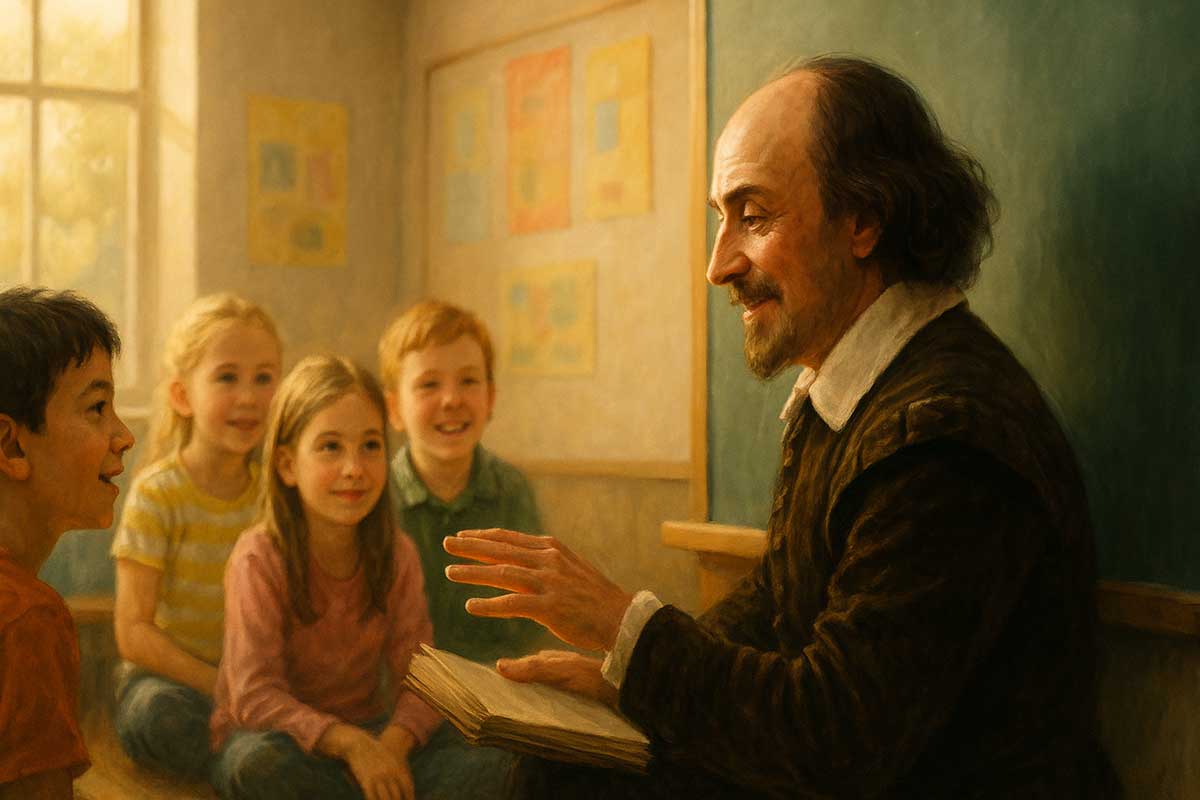
Shakespeare leans against the chalkboard, tapping a soft rhythm with two fingers.
“Listen. Even silence has its tune.”
He speaks a simple sentence:
“The moon climbs slowly.”
Then again:
“Slowly, the moon climbs.”
Then once more, with a lilt of poetry:
“Slow climbs the silver moon.”
The children blink, amazed that the meaning stayed but the feeling changed.
“Words are not stones,” he tells them.
“They are music.
Let them sing.”
The Story Only Your Heart Knows

The classroom grows quiet.
Shakespeare steps into the center like a gentle sun.
Shakespeare:
“There is one story that only your heart knows.
Not mine.
Not your neighbor’s.
Yours.”
He touches his chest.
“I wrote kings, lovers, fools, spirits—but none were as precious as the tales whispered by my own soul.”
Caleb raises a hand timidly.
“What if we don’t know our story yet?”
Shakespeare kneels.
“Then listen.
Your heart speaks softly—
but it always tells the truth.”
Final Gift — A Feather for Courage

Shakespeare reaches into his velvet doublet and pulls out a bundle of small white quill feathers.
The kids gasp.
He hands one to each child with reverence.
Shakespeare:
“This feather is not for writing.
It is for remembering.
You need not ink to be a poet—
only courage.”
He places a hand over his heart.
“Write with courage.
Speak with kindness.
Dream in lantern-light.
And let your lives become the greatest stories ever told.”
He bows deeply, warmly—
and the room glows with the quiet certainty that something extraordinary has just walked through it.
Shakespeare steps out of the classroom,
leaving ten children holding tiny feathers
and hearts full of wonder.
Final Thoughts
After Shakespeare left, Mrs. Alvarez told us to write down how we felt.
But I just sat there for a minute, holding the tiny white feather he gave me.
A courage feather, he called it.
I kept thinking about the things he said:
That words are lanterns.
That wonder is a beginning.
That characters must breathe.
That trouble wakes up a story.
That language has music.
That there’s a story only my heart knows.
Before today, stories felt like big mountains I wasn’t sure I could climb.
But now they feel like lanterns I can pick up.
Like songs I can hum.
Like little doors that open when I pay attention.
And when I asked him what to do if I didn’t know my story yet, he knelt beside me and said:
“Then listen. Your heart speaks softly—but it always tells the truth.”
No one has ever said something like that to me before.
Now, when I think about writing, I don’t feel scared.
I feel… invited.
The feather sits on my desk.
It’s light, but somehow it feels like it’s holding something important.
I think I’m going to start my story tonight.
And maybe it won’t be perfect.
Maybe it won’t even make sense at first.
But Shakespeare said courage is the only ink you need.
And today—
he gave me some.
Short Bios:
William Shakespeare (1564–1616) was an English playwright, poet, and actor whose works are considered among the greatest ever written in the English language. Born in Stratford-upon-Avon, he wrote more than thirty plays and over 150 poems that explored love, imagination, ambition, humor, and the human heart. Shakespeare had an extraordinary gift for turning ordinary feelings into unforgettable stories, blending poetry with deep emotional insight. His characters—heroes, fools, dreamers, and everyday people—continue to speak to audiences around the world because they reveal timeless truths about being human. His writing reshaped literature and theater, and his influence still echoes in storytelling today.
Mrs. Elena Alvarez — 3rd Grade Teacher
Mrs. Alvarez is the beloved third-grade teacher of Meadowbrook Elementary’s Firefly Writers. Known for her kindness, calm presence, and belief that every child carries a spark of genius, she fills her classroom with books, warm light, and quiet encouragement. She sees creativity as a form of courage and creates space for each child to discover their voice. Her room is a place where imagination feels safe, stories begin easily, and no idea is ever too small.
Eli Thompson — Student
Eli is a thoughtful, quiet child who notices things others miss: dust floating in sunlight, the sound of leaves scratching the window, the way a sentence feels in the mouth. He is shy about sharing his ideas, but he writes with deep honesty.
Lila Bennett — Student
Lila is curious, expressive, and easily moved by beauty. She feels things deeply and often carries a notebook filled with half-finished ideas and tiny drawings. She is the student chosen most often to narrate introductions or final thoughts because of her reflective, poetic nature.
Harper Jing — Student
Harper is imaginative and enthusiastic, always scribbling stories with dragons, secret gardens, and brave children. She asks bold questions and often takes the lead during group activities. Her excitement tends to lift everyone around her.
Jax Morales — Student
Jax is energetic, funny, and always in motion. Creativity bursts out of him in surprising and humorous ways. He tends to struggle with sitting still, but visiting authors often captivate him completely. He represents the child who learns best through play, humor, and hands-on storytelling.
Sofia Kim — Student
Sofia is sensitive, artistic, and gifted at character creation. She often draws her characters long before she writes about them. Her gentle personality makes visiting storytellers speak to her with particular tenderness and encouragement.
Noah Greene — Student
Noah is analytical, curious, and fascinated by how stories work. He loves patterns, problem-solving, and figuring out “why things happen.” He often asks the big structural questions that impress even the greats who visit the class.
Maya Patel — Student
Maya is compassionate and thoughtful, with a strong sense of empathy. She loves stories about the heart—friendship, kindness, and overcoming sadness. She is the first to notice emotional truths and often responds deeply to soul-level wisdom from classroom guests.
Leave a Reply