• Skip to main content
  • Skip to primary sidebar
  • Skip to footer
ImaginaryTalks.com
  • Spirituality and Esoterica
    • Afterlife Reflections
    • Ancient Civilizations
    • Angels
    • Astrology
    • Bible
    • Buddhism
    • Christianity
    • DP
    • Esoteric
    • Extraterrestrial
    • Fairies
    • God
    • Karma
    • Meditation
    • Metaphysics
    • Past Life Regression
    • Spirituality
    • The Law of Attraction
  • Personal Growth
    • Best Friend
    • Empathy
    • Forgiveness
    • Gratitude
    • Happiness
    • Healing
    • Health
    • Joy
    • Kindness
    • Love
    • Manifestation
    • Mindfulness
    • Self-Help
    • Sleep
  • Business and Global Issues
    • Business
    • Crypto
    • Digital Marketing
    • Economics
    • Financial
    • Investment
    • Wealth
    • Copywriting
    • Climate Change
    • Security
    • Technology
    • War
    • World Peace
  • Culture, Science, and A.I.
    • A.I.
    • Anime
    • Art
    • History & Philosophy
    • Humor
    • Imagination
    • Innovation
    • Literature
    • Lifestyle and Culture
    • Music
    • Science
    • Sports
    • Travel
You are here: Home / Education / Shakespeare Teaches Kids the Magic of Storytelling

Shakespeare Teaches Kids the Magic of Storytelling

November 13, 2025 by Nick Sasaki Leave a Comment

Insert Video

Introduction 

My name is Lila Bennett, and I’m one of the Firefly Writers in Mrs. Alvarez’s class.
I’ve always liked stories, but sometimes they feel too big for me—like they belong to people who lived a long time ago or people who are smarter or braver than I am.

Last week, Mrs. Alvarez said someone very special would be visiting our classroom.
She wouldn’t tell us who.
She just smiled in that way she does when something magical is about to happen.

This morning, I sat at my desk wondering what kind of person would walk through that door.
A writer?
A poet?
A storyteller?

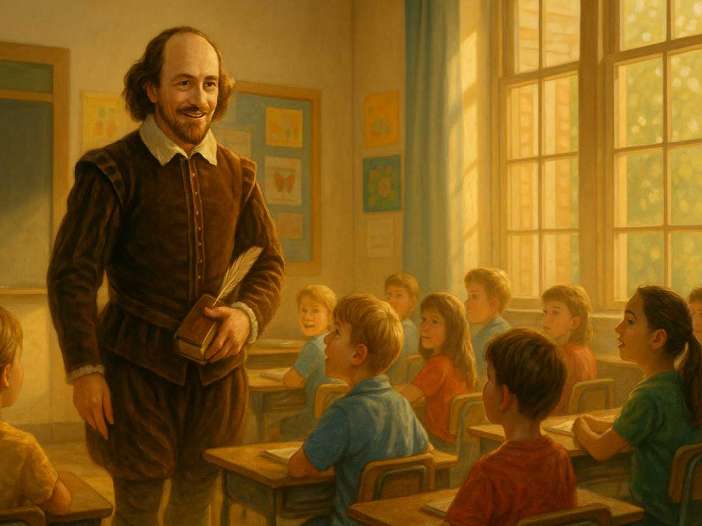
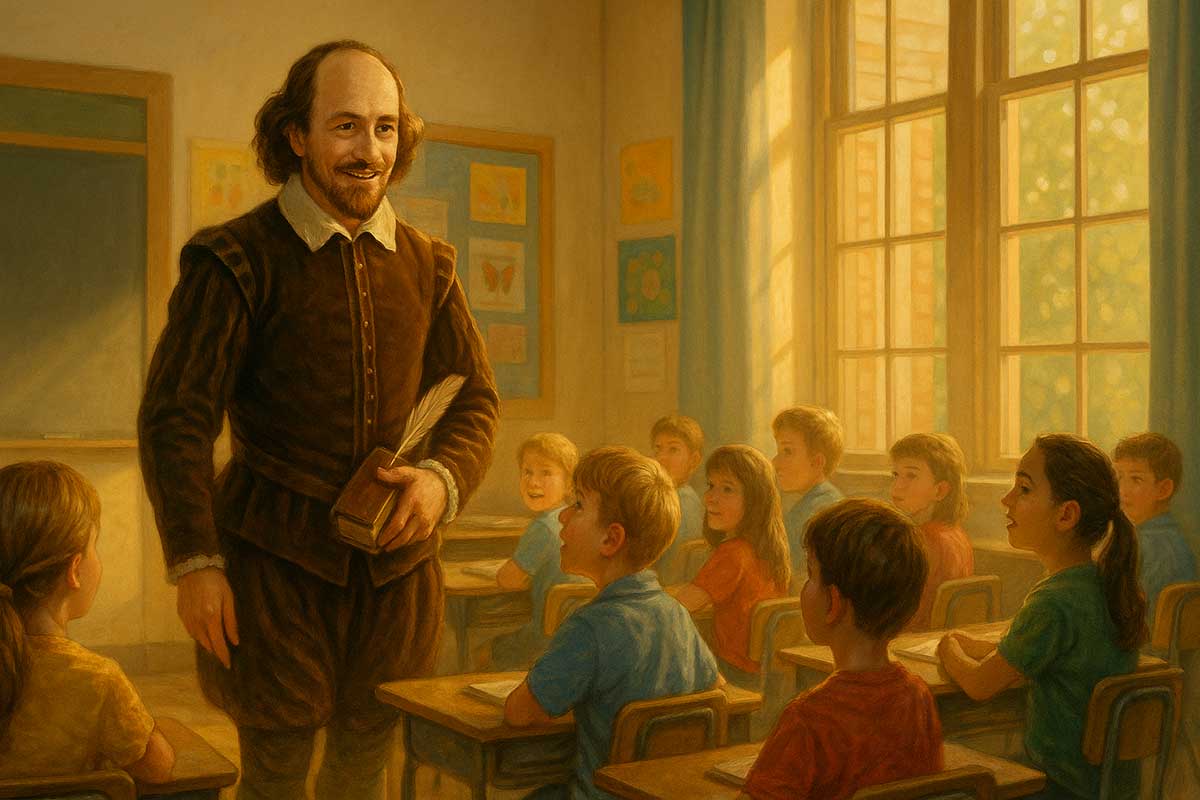
But when the door opened and a man in a velvet coat stepped inside—
with eyes that sparkled like he’d swallowed a whole galaxy of ideas—
I felt something shift in the room.

He looked at us like he already loved us.

He bowed, like we were worth bowing to.

He said, “Good morrow, young hearts.”
And somehow those words made me sit up straighter, like my own heart had just been invited to speak.

I didn’t know people from hundreds of years ago could appear in classrooms.
I didn’t know their voices could feel warm.
I didn’t know Shakespeare could look at me in a way that made me think—

Maybe stories aren’t far away after all.
Maybe they’re closer than I thought.

(Note: This is an imaginary conversation, a creative exploration of an idea, and not a real speech or event.)


Table of Contents
Introduction 
1. Words as Little Lanterns
2. Start with Wonder (Always)
3. Characters With a Pulse
4. Trouble Is the Greatest Teacher
Music Hides Inside Speech
The Story Only Your Heart Knows
Final Gift — A Feather for Courage
Final Thoughts

1. Words as Little Lanterns

Shakespeare moves to the sunlight streaming through the windows, holding his hand into the beam as if warming his fingers.

Shakespeare:
“Words are lanterns.
In daylight, you may not notice their glow—
but in the dark of the heart, they guide the way.”

He lets the beam slip through his fingers.

“Even the smallest word—if true—can brighten the world.”

Maya whispers, “I never thought of words like that…”

He hears her and nods gently.

“Your lantern is already lit.”

2. Start with Wonder (Always)
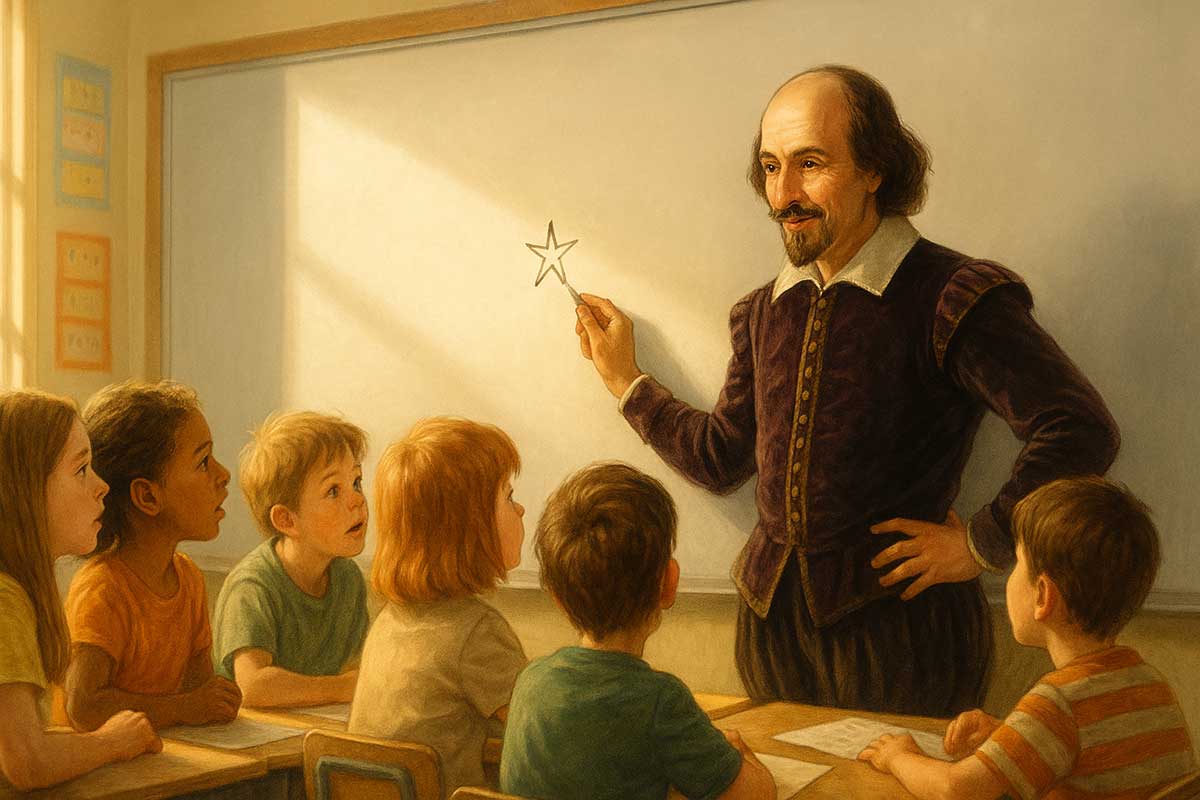
He strolls to the whiteboard and draws a tiny star.

Shakespeare:
“Every tale begins with wonder.
A star in the sky.
A secret in the forest.
A question that refuses to sleep.”

He turns, eyes sparkling.

“In my youth, I wondered what dreams were made of—
so I wrote A Midsummer Night’s Dream.”

Jax raises his hand.
“What do we wonder?”

Shakespeare kneels beside him.

“That, good sir, is the beginning of your first masterpiece.”

3. Characters With a Pulse

He paces between desks, tapping lightly on each student’s notebook.

Shakespeare:
“Characters must live.
They must laugh, weep, falter, rejoice.
Give them breath—and they shall teach you what the story needs.”

He stops beside Sofia, who is drawing a girl with rain in her hair.

“Who is she?”

Sofia shrugs. “I don’t know yet.”

Shakespeare smiles.

“Then meet her.
Ask her what she fears.
Ask her what she hopes.”

Sofia’s eyes widen, as if she suddenly can.

4. Trouble Is the Greatest Teacher

He draws a jagged line across the board.

Shakespeare:
“When all goes well, stories sleep.
When trouble comes—
characters wake up.”

He tosses a playful wink.

“Romeo met Juliet.
Two families said ‘Nay.’
And thus—
trouble made a tale worth telling.”

Noah laughs.
“So… we need problems?”

“Aye,” Shakespeare replies.
“Let your characters make magnificent mistakes.”

The class giggles, delighted.

Music Hides Inside Speech
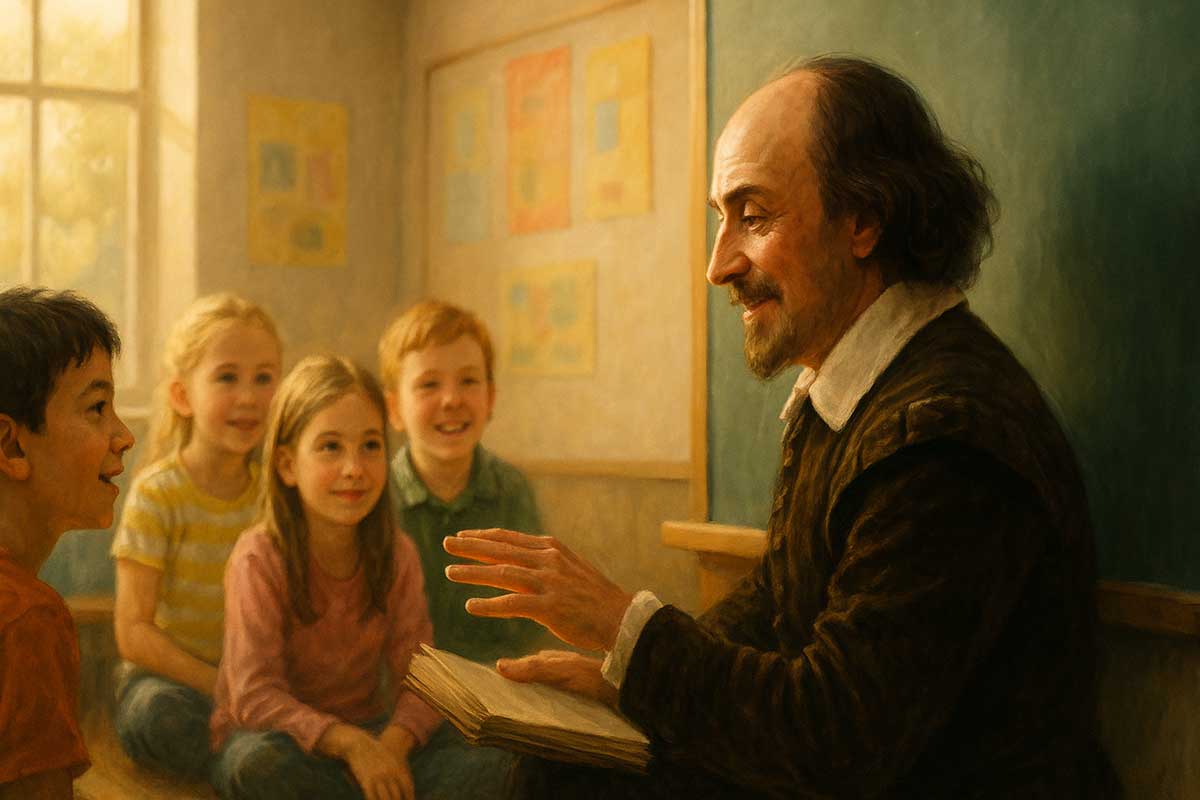
Shakespeare leans against the chalkboard, tapping a soft rhythm with two fingers.

“Listen. Even silence has its tune.”

He speaks a simple sentence:

“The moon climbs slowly.”

Then again:

“Slowly, the moon climbs.”

Then once more, with a lilt of poetry:

“Slow climbs the silver moon.”

The children blink, amazed that the meaning stayed but the feeling changed.

“Words are not stones,” he tells them.
“They are music.
Let them sing.”

The Story Only Your Heart Knows

The classroom grows quiet.
Shakespeare steps into the center like a gentle sun.

Shakespeare:
“There is one story that only your heart knows.
Not mine.
Not your neighbor’s.
Yours.”

He touches his chest.

“I wrote kings, lovers, fools, spirits—but none were as precious as the tales whispered by my own soul.”

Caleb raises a hand timidly.
“What if we don’t know our story yet?”

Shakespeare kneels.

“Then listen.
Your heart speaks softly—
but it always tells the truth.”

Final Gift — A Feather for Courage

Shakespeare reaches into his velvet doublet and pulls out a bundle of small white quill feathers.

The kids gasp.

He hands one to each child with reverence.

Shakespeare:
“This feather is not for writing.
It is for remembering.
You need not ink to be a poet—
only courage.”

He places a hand over his heart.

“Write with courage.
Speak with kindness.
Dream in lantern-light.
And let your lives become the greatest stories ever told.”

He bows deeply, warmly—
and the room glows with the quiet certainty that something extraordinary has just walked through it.

Shakespeare steps out of the classroom,
leaving ten children holding tiny feathers
and hearts full of wonder.

Final Thoughts

After Shakespeare left, Mrs. Alvarez told us to write down how we felt.
But I just sat there for a minute, holding the tiny white feather he gave me.

A courage feather, he called it.

I kept thinking about the things he said:

That words are lanterns.
That wonder is a beginning.
That characters must breathe.
That trouble wakes up a story.
That language has music.
That there’s a story only my heart knows.

Before today, stories felt like big mountains I wasn’t sure I could climb.

But now they feel like lanterns I can pick up.
Like songs I can hum.
Like little doors that open when I pay attention.

And when I asked him what to do if I didn’t know my story yet, he knelt beside me and said:

“Then listen. Your heart speaks softly—but it always tells the truth.”

No one has ever said something like that to me before.

Now, when I think about writing, I don’t feel scared.
I feel… invited.

The feather sits on my desk.
It’s light, but somehow it feels like it’s holding something important.

I think I’m going to start my story tonight.
And maybe it won’t be perfect.
Maybe it won’t even make sense at first.

But Shakespeare said courage is the only ink you need.

And today—
he gave me some.

Short Bios:

William Shakespeare (1564–1616) was an English playwright, poet, and actor whose works are considered among the greatest ever written in the English language. Born in Stratford-upon-Avon, he wrote more than thirty plays and over 150 poems that explored love, imagination, ambition, humor, and the human heart. Shakespeare had an extraordinary gift for turning ordinary feelings into unforgettable stories, blending poetry with deep emotional insight. His characters—heroes, fools, dreamers, and everyday people—continue to speak to audiences around the world because they reveal timeless truths about being human. His writing reshaped literature and theater, and his influence still echoes in storytelling today.

Mrs. Elena Alvarez — 3rd Grade Teacher

Mrs. Alvarez is the beloved third-grade teacher of Meadowbrook Elementary’s Firefly Writers. Known for her kindness, calm presence, and belief that every child carries a spark of genius, she fills her classroom with books, warm light, and quiet encouragement. She sees creativity as a form of courage and creates space for each child to discover their voice. Her room is a place where imagination feels safe, stories begin easily, and no idea is ever too small.

Eli Thompson — Student

Eli is a thoughtful, quiet child who notices things others miss: dust floating in sunlight, the sound of leaves scratching the window, the way a sentence feels in the mouth. He is shy about sharing his ideas, but he writes with deep honesty. 

Lila Bennett — Student

Lila is curious, expressive, and easily moved by beauty. She feels things deeply and often carries a notebook filled with half-finished ideas and tiny drawings. She is the student chosen most often to narrate introductions or final thoughts because of her reflective, poetic nature.

Harper Jing — Student

Harper is imaginative and enthusiastic, always scribbling stories with dragons, secret gardens, and brave children. She asks bold questions and often takes the lead during group activities. Her excitement tends to lift everyone around her.

Jax Morales — Student

Jax is energetic, funny, and always in motion. Creativity bursts out of him in surprising and humorous ways. He tends to struggle with sitting still, but visiting authors often captivate him completely. He represents the child who learns best through play, humor, and hands-on storytelling.

Sofia Kim — Student

Sofia is sensitive, artistic, and gifted at character creation. She often draws her characters long before she writes about them. Her gentle personality makes visiting storytellers speak to her with particular tenderness and encouragement.

Noah Greene — Student

Noah is analytical, curious, and fascinated by how stories work. He loves patterns, problem-solving, and figuring out “why things happen.” He often asks the big structural questions that impress even the greats who visit the class.

Maya Patel — Student

Maya is compassionate and thoughtful, with a strong sense of empathy. She loves stories about the heart—friendship, kindness, and overcoming sadness. She is the first to notice emotional truths and often responds deeply to soul-level wisdom from classroom guests.

Related Posts:

  • My Brilliant Friend Ending Explained: Who Was Brilliant?
  • Karma Exchanger: A Novel of Pain, Rebirth, and Mercy
  • Gilead Ending Explained: Can Grace Reach the Person…
  • The Christmas Tree Farm — A Love That Grew from Snow
  • S. Y. Agnon in 2026: An Imagined Novel of Belonging
  • Grimm Fairy Tale Universe: The Complete Grimmverse Book One

Filed Under: Education, Imagination, Literature Tagged With: author visit ideas, character writing for kids, children’s literature workshop, creative writing activities, ED format storytelling, fiction writing basics, how to spark creativity in kids, how to write stories for kids, imagination lessons for kids, kids creative writing lesson, literature for young writers, Shakespeare classroom visit, Shakespeare inspiration for kids, Shakespeare storytelling for kids, Shakespeare teaches children, story magic for students, story structure for kids, storytelling for students, tall tales for children, writing tips elementary

Reader Interactions

Leave a Reply Cancel reply

Your email address will not be published. Required fields are marked *

Primary Sidebar

RECENT POSTS

  • Joel Osteen’s Best Messages: Hope, Favor, and Faith
  • Hilary Mantel Wolf-Hall ending explainedWolf Hall Ending Explained: Can a Good Man Survive Political Power?
  • i-never-said-i-was-god-What If Jesus Never Claimed to Be God?
  • did-jesus-say-he-was-god-Did Christianity Reverse the Message of Jesus?
  • The Unseen World Liz MooreThe Unseen World Analysis: Memory, AI, and Identity
  • gilead ending explainedGilead Ending Explained: Can Grace Reach the Person We Judge Most?
  • Elena Ferrante My Brilliant FriendMy Brilliant Friend Ending Explained: Who Was Brilliant?
  • The-Underground-Railroad-ending-explained--The Underground Railroad Ending Explained
  • The Road Cormac McCarthyThe Road Ending Explained: Father and Son Imaginary Conversation
  • Atonement Ending Explained: Briony Faces the Truth
  • Never Let Me Go Kazuo IshiguroNever Let Me Go Analysis: An Imaginary Conversation
  • have-we-forgotten-who-we-really-areMichael G. Reccia: Has Humanity Forgotten Who We Really Are?
  • pachinko imaginary talksPachinko by Min Jin Lee: An Imaginary Conversation Across Generations
  • are-you-falling-behindMin Jin Lee on Time, Failure, and Falling Behind in Life
  • trump-putin-xi-modi-geography-of-power-Trump, Putin, Xi and Modi: The Geography of Power
  • misunderstanding of loveWhat If the World’s Problems Come From Misunderstanding Love?
  • netherlands travelNetherlands Travel with Five Unlikely Guides
  • france-imaginary-travel-France Imaginary Travel with Conan, Voltaire and RM
  • rent freeeze trapMamdani Housing Plan: Rent Freeze or Property Trap?
  • 2027 warning prof jiang xueqinProf. Jiang Xueqin’s 2027 Warning for America
  • Banana Fish ExplainedBananafish Explained: Before and After Salinger’s Story
  • Why James Joyce's Ulysses MattersJames Joyce’s Ulysses Explained: Love, Home, and Myth
  • what dad never saidWhat Your Father Never Told You About Silent Sacrifice
  • Fiddler On The Roof Tradition or changeFiddler on the Roof Lessons on Tradition and Family
  • short story secretsShort Story Writing Secrets from Classic Masters
  • Top-20-world-heritage-sites-Top 20 World Heritage Sites and the Future of Humanity
  • America 250 and Rev. Moon’s Bicentennial Warning
  • America next 250 yearsAmerica 250: Presidents on Hope for the Next 250 Years
  • The-love-you-withheld-Darius J Wright on Death, Love, and Life Review
  • birth chart or fateAstrology and Self-Discovery: Do the Stars Reveal Who We Are?
  • Europe next?Viktor Bout Warns Europe: Ukraine War Deep Analysis
  • The Anti-VisionDan Koe Anti-Vision: How Fear Rebuilds Identity
  • Success and now Alex Hormozi Tony RobbinsAlex Hormozi Tony Robbins Interview: Success After Winning
  • second half of 2026 predictionsSecond Half of 2026 Predictions: AI, Iran & Disclosure
  • Joy-Shared-Is-Twice-the-Joy-Sorrow-Shared-Is-Half-Joy Shared Is Twice the Joy: Sorrow Shared Is Half
  • ai bubbleJeremy Grantham AI Bubble Warning for Investors
  • why is the yen so weakWeak Yen Explained: Japan’s Currency Crisis, Carry Trade, and Future
  • soul contract storyDolores Cannon Inspired Story About Reincarnation and Soul Contracts
  • heroes after painAnime Heroes Discuss Pain, Loyalty, and Courage
  • AI and God: John Lennox on Faith, Truth, and Human Dignity
  • Alex Hormozi entrepreneur adviceAlex Hormozi Mentors on Wealth, Skill, and Leverage
  • divinity is comingCraig Hamilton Parker: Divinity Is Coming Through Darkness
  • What If Fiction’s Most Beloved Fathers Talked About Love?
  • YouTube day trading strategiesYouTube Day Trading Strategies: 5 Traders Debate Risk
  • What If Ayn Rand Debated JD Vance on the Soul of Conservatism?
  • Iran nuclear dealIs a Bad Peace Better Than a Good War? Iran, America, and the Moral Cost of Power
  • J.D Vance CommunionJ.D. Vance’s Communion: Faith, Family, and the Moral Burden of Public Life
  • is spiritual ability morally neutralAre Spiritual Gifts Morally Neutral?
  • understand without agreeingNoah Eckstein’s Harvard Graduation Speech: Understand Without Agreeing
  • Charlie Kirk’s Spiritual Legacy After Death
  • Why ChatGPT Feels More Human Than Modern Conversation
  • claude mythos aiClaude Mythos: The AI Anthropic Refused to Release
  • The future of humanityThe Future of Humanity: AI, Aliens, God, and the Multiverse
  • Elon Musk Warns AGI Could Surpass Humanity Within Years
  • japanese sauna culture totonouWhy the World Is Falling in Love With Japanese Sauna Culture
  • foreigners who loved JapanWhy Foreigners Fell in Love With Japan
  • patrick winston how to speak effectivelyPatrick Winston’s Last Lecture: How Communication Creates Success
  • psychology of money explainedThe Psychology of Money Explained
  • The Ultimate Japan Trip: Week 3 — Memory, Warmth, and Goodbye
  • the ultimate japan travel week 2The Ultimate Japan Trip: Week 2 — Kyoto to Osaka
  • the ultimate japan travel week 1The Ultimate Japan Trip: Week 1 — Tokyo’s Hidden Rules
  • graduation emotionsGraduation and Growing Up: Why Saying Goodbye Hurts So Much
  • The Simple Path to Wealth Explained by Top Financial Thinkers
  • How to Master Time Before Life Slips Away
  • Jujutsu Kaisen Curses Explained by Psychics
  • national defense strategy explainedNational Defense Strategy Explained: Security or Empire?
  • Edgar Cayce JesusEdgar Cayce on Jesus and Christ Consciousness
  • MrBeast challengeMrBeast’s Biggest Challenge Ever: 100 Nations, One Prize
  • 5 Great Novels About Mothers and Silent Sacrifice
  • what children realize too late5 Movie Mothers Who Revealed the Real Meaning of Love
  • before i was a mom explainedBefore I Was a Mom Explained: The Poem Makes Mothers Cry
  • What Happens When the World Order Loses Trust?
  • Why Empires Go to War: Truth, Profit, Fear
  • Your Child Is Your Karma? Explore Parenting and Soul Healing
  • Buckminster Fuller and AI: Can Technology Save the Soul?
  • Why War Still Exists in 2026: God, Religion, Technology, and Peace
  • mel robbins let them theoryThe Let Them Theory Explained: Stop Chasing Approval
  • history repeatsFourth Turning vs Dispensational Time Identity Explained
  • Fourth Turning Cycle Explained: Crisis, Generations, Reset
  • The Unoriginal Sinner Imaginary TalksThe Unoriginal Sinner and the Ice-Cream God Explained
  • Never Split the Difference Explained: Chris Voss Breaks It Down
  • hungry-ghosts-explainedHungry Ghosts Explained: Maté on Addiction & Trauma
  • World Peace Through God: One Human Family
  • John Lennon’s Imagine: Vision or Illusion?
  • ikigaiIkigai Explained: The Japanese Secret to Purpose and Longevity
  • Tiny Habits by B.J. Fogg: Why Small Actions Change Everything
  • Faith, Trump, and Tucker Carlson: Can Belief and Politics Coexist?
  • The Goal Explained: Goldratt, Cox, and Business Bottlenecks
  • A Return to Love: Marianne Williamson Dream Panel
  • Is Lust Bad or God-Given? A Christian View of Sexual Desire
  • My Voice Will Go With You: Why Stories Heal
  • bryon katie loving what isByron Katie’s Loving What Is and the Truth About Suffering
  • Fooled by RandomnessFooled by Randomness: Taleb on Luck, Risk, and Ruin
  • humanity at the edgeHuman Awakening Through Crisis: Are We Evolving or Breaking?
  • dan kennedy wealth attractionDan Kennedy on Wealth Attraction for Entrepreneurs
  • Ultimate pilgrimage in IsraelUltimate Pilgrimage in Israel: When the Bible Comes Alive
  • the wedding that waited a the crossingA Palestinian Wedding Day Divided by Roads, Memory & Waiting
  • Israeli Family War Story: A Son Returns Home Changed by Fear, Duty & Silence
  • Russian historical fiction 2022 warRussian Family War Story: How Pride, Silence & Duty Sent a Son Away
  • the house that stayed awakeUkraine War Family Story: A House Changed by 1991, 2014, and 2022

Footer

Recent Posts

  • Joel Osteen’s Best Messages: Hope, Favor, and Faith July 20, 2026
  • Wolf Hall Ending Explained: Can a Good Man Survive Political Power? July 18, 2026
  • What If Jesus Never Claimed to Be God? July 18, 2026
  • Did Christianity Reverse the Message of Jesus? July 17, 2026
  • The Unseen World Analysis: Memory, AI, and Identity July 17, 2026
  • Gilead Ending Explained: Can Grace Reach the Person We Judge Most? July 16, 2026

Pages

  • About Us
  • Contact Us
  • Disclaimer
  • Earnings Disclaimer
  • Privacy Policy
  • Terms and Conditions

Categories

Copyright © 2026 Imaginarytalks.com