

|
Getting your Trinity Audio player ready...
|
What if Lisa Nichols gathered today’s greatest minds to expand Abundance Now?
Introduction by Lisa Nichols
Abundance Now was never meant to be a promise of someday. It was an invitation to recognize who you are before the evidence arrives. For years, I watched people work harder, visualize longer, and wait patiently—yet still feel disconnected from the life they said they wanted. Not because they weren’t trying, but because they were asking the wrong question.
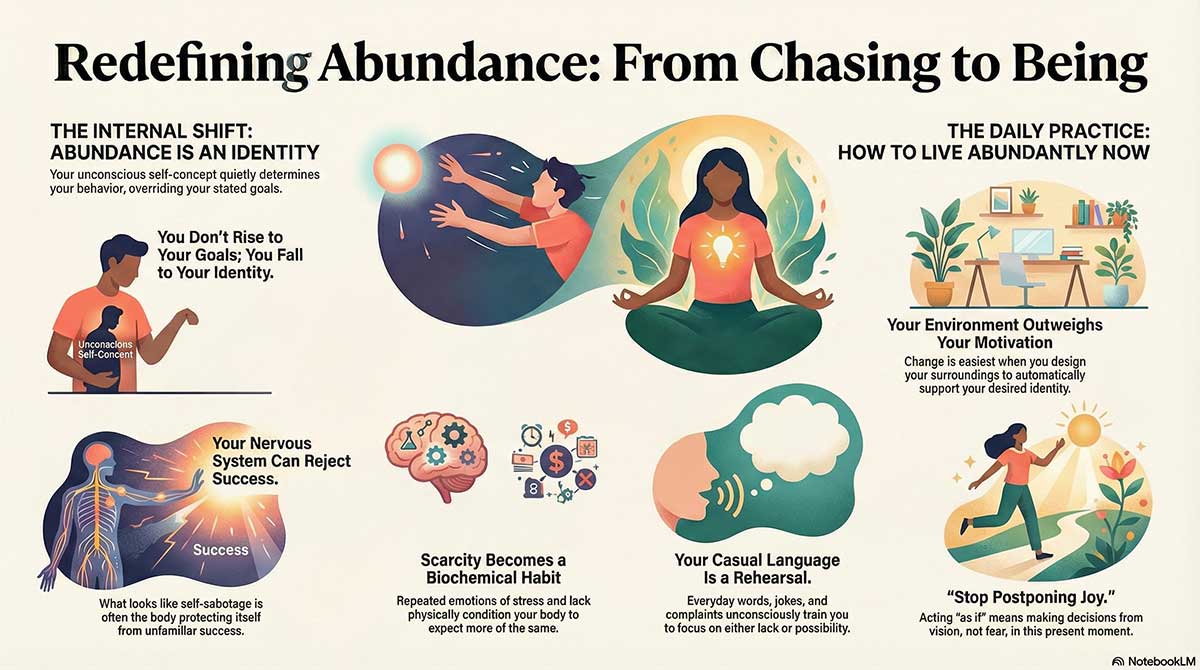
Abundance is not a destination. It’s an identity.
In these conversations, you’ll hear many brilliant minds speak about habits, emotions, biology, language, and action. But beneath every insight is one unifying truth: what you allow, what you tolerate, what you believe you deserve—quietly decides what stays in your life.
This roundtable is not about doing more.
It’s about being more honest.
More present.
More available to your own becoming.
If you listen closely, you may discover that abundance isn’t missing. It’s been waiting for your permission.
(Note: This is an imaginary conversation, a creative exploration of an idea, and not a real speech or event.)
Topic 1 — Abundance as Identity: Who Are You Being When No One Is Watching?

Moderator: Nick Sasaki
Panelists: Lisa Nichols, James Clear, Brené Brown, Naval Ravikant, Michael Beckwith
Opening by Nick Sasaki
Nick Sasaki:
Before we talk about money, success, or manifestation, I want to start somewhere quieter. Most people say they want abundance—but their private habits, inner dialogue, and unobserved choices tell a different story. Tonight, I want to explore abundance not as something we chase, but as someone we are. So let me begin here.
First Question
Nick Sasaki:
Many people say they want abundance, yet unconsciously identify as someone who merely “gets by.” What subtle identities keep people loyal to scarcity—even when opportunities are present?
Lisa Nichols:
Scarcity often hides behind identities that sound noble. “I’m humble.” “I don’t want to be greedy.” “I’m just realistic.” But underneath those labels is usually an old agreement made during pain—an agreement that says, If I don’t want too much, I won’t be disappointed. When someone grows up watching struggle, they often decide that wanting more is dangerous. So they shrink their identity to stay emotionally safe. They don’t reject abundance—they reject the version of themselves who might be visible, judged, or rejected for having it.
James Clear:
Identity is reinforced by evidence, and most people unknowingly gather evidence for scarcity every day. If you repeatedly say, “I’m bad with money,” you’ll notice every mistake and ignore every small win. The subtle identity isn’t “I lack abundance”—it’s “I’m the kind of person who struggles.” Once that identity is in place, behaviors line up automatically. People don’t rise to their goals; they fall to their identity.
Naval Ravikant:
Scarcity identities persist because they reduce responsibility. If you see yourself as someone who “gets by,” you don’t have to make hard choices about leverage, ownership, or risk. Scarcity becomes a philosophical position instead of a temporary condition. The most dangerous identity is not “I have little,” but “This is just who I am.”
Brené Brown:
Shame plays a quiet role here. Many people associate abundance with being unrelatable or morally suspect. They fear crossing an invisible line where belonging is revoked. So they cling to identities that keep them acceptable to their family, community, or past version of themselves. Scarcity becomes a way to stay connected.
Michael Beckwith:
From a spiritual perspective, scarcity identities form when we forget our source. When someone believes their supply comes only from effort or circumstance, they contract. But when identity reconnects to something infinite—call it God, consciousness, or life itself—scarcity loses its grip. The loyalty to scarcity is really loyalty to a limited self-concept.
Second Question
Nick Sasaki:
At what moment does abundance stop being something you chase and become something you embody—and how can someone recognize that shift in themselves?
Naval Ravikant:
The shift happens when decision-making changes. When you stop asking, “What’s the safest move?” and start asking, “What’s the most aligned move?” Chasing abundance is anxious. Embodying it feels calm. You recognize the shift when patience replaces urgency.
Brené Brown:
I see the shift when people stop proving and start choosing. Chasing is loud—it’s performative. Embodiment is quiet. Someone embodying abundance doesn’t need permission or applause. They make decisions that honor their values even when no one claps.
Lisa Nichols:
You know the shift has happened when your self-talk changes during disappointment. When abundance is embodied, a setback doesn’t collapse your worth. You might grieve, but you don’t spiral into self-betrayal. You stay present. You stay kind to yourself. That’s identity-level abundance.
Michael Beckwith:
Embodiment begins when gratitude precedes results. When someone can feel whole before the manifestation arrives, abundance has moved from pursuit to presence. At that point, life becomes a cooperative process rather than a struggle.
James Clear:
From a behavioral lens, embodiment shows up as consistency without drama. When abundance is embodied, habits no longer depend on motivation. You do the work because it’s who you are, not because you’re trying to become someone else.
Third Question
Nick Sasaki:
If abundance is an identity, what daily behaviors quietly confirm it—and what behaviors silently contradict it?
James Clear:
Identity-confirming behaviors are often boring. Showing up on time. Keeping small promises to yourself. Designing an environment that supports your future instead of your impulses. Contradictions happen when people say they value abundance but repeatedly choose convenience over alignment.
Lisa Nichols:
Abundance is confirmed by how you speak to yourself when you’re tired, afraid, or unseen. Do you rush yourself? Diminish yourself? Or do you honor your capacity? Scarcity shows up when people abandon themselves to meet external expectations.
Michael Beckwith:
Daily practices of presence—meditation, prayer, reflection—quietly affirm abundance by reconnecting you to source. Contradiction happens when we live in reaction instead of intention, allowing circumstances to define us.
Brené Brown:
Boundaries are a major signal. People embodying abundance protect their energy without apology. Scarcity identities over-explain, over-give, and over-tolerate. They confuse self-sacrifice with virtue.
Naval Ravikant:
Time use tells the truth. If someone claims abundance but rents out every hour of their life, something is off. Abundance identities invest time in learning, leverage, and rest. Scarcity identities trade time for short-term relief.
Closing Reflection by Nick Sasaki
Nick Sasaki:
What I’m hearing is this: abundance isn’t loud. It doesn’t announce itself with numbers or titles. It reveals itself in private decisions, in self-respect, in patience, and in the courage to outgrow old identities—even when no one is watching.
If this first conversation does anything, I hope it gently disrupts the idea that abundance begins with having. Tonight, it begins with being.
Topic 2 — The Emotional Economy: Can You Receive What You Don’t Feel Safe Having?

Moderator: Marci Shimoff
Panelists: Gabor Maté, Esther Perel, Peter Levine, Louise Hay, Saito Hitori
Opening by Marci Shimoff
Marci Shimoff:
In the first conversation, we explored abundance as identity. Now I want to move one layer deeper—into the emotional body. Because so often, people attract opportunity, love, or success… and then quietly push it away. Tonight, I want to ask a more tender question: not what we want, but what we feel safe receiving.
First Question
Marci Shimoff:
Why do so many people sabotage abundance right after progress begins—especially in money, love, or visibility?
Gabor Maté:
Sabotage is rarely conscious. It’s the nervous system protecting an old sense of belonging. If someone learned early that love came with instability, neglect, or pressure, then success can feel unsafe. The body remembers what the mind tries to override. When abundance threatens the familiar emotional landscape, the nervous system pulls the brakes.
Peter Levine:
What looks like self-sabotage is often incomplete survival responses. When life improves, the body may still be bracing for danger. Without resolving that stored tension, growth triggers activation. People then retreat, dissociate, or create chaos—not because they don’t want abundance, but because their body hasn’t learned it’s safe to stay.
Esther Perel:
There’s also an identity tension. Success changes relational dynamics. When someone becomes more visible, more powerful, or more fulfilled, it can disrupt familiar roles. People sabotage abundance to preserve connection—to remain recognizable to partners, family, or even to themselves.
Louise Hay:
At the heart of it is worthiness. Many people were taught, directly or indirectly, that good things must be earned through suffering. When joy arrives easily, they don’t trust it. So they correct it. Healing begins when we tell ourselves, gently and repeatedly, “I deserve good.”
Saito Hitori:
Sometimes people don’t realize they’re arguing with happiness. They say things like, “This won’t last,” or “Something bad will happen next.” Those words sound casual, but they train the heart to stay guarded. Abundance doesn’t like to visit a house where it’s constantly suspected.
Second Question
Marci Shimoff:
How does emotional safety—or the lack of it—determine what someone can sustain, not just attract?
Peter Levine:
Attraction is a spike of energy. Sustainability is regulation. If the nervous system can’t settle while holding more—more responsibility, more love, more visibility—it will seek relief by releasing what was gained. Safety isn’t about comfort; it’s about capacity.
Gabor Maté:
People often ask how to grow bigger lives. I ask how safe they feel inside their own body. Without internal safety, expansion feels like threat. The body doesn’t care about vision boards—it cares about survival.
Louise Hay:
Emotional safety grows through self-talk. When someone becomes a kind inner companion instead of a harsh critic, the body relaxes. Only then can abundance stay. Love is the soil that allows good things to take root.
Esther Perel:
In relationships, emotional safety determines whether success brings closeness or distance. Some couples thrive as one partner grows; others fracture. The difference isn’t ambition—it’s whether growth feels like abandonment or shared evolution.
Saito Hitori:
I think of safety like a warm room. If your heart feels cold, abundance won’t take off its coat. But when you smile, speak kindly, and allow yourself joy without apology, abundance feels welcome. It stays longer.
Third Question
Marci Shimoff:
What practices help someone expand their nervous system’s capacity to receive more—without overwhelm or guilt?
Louise Hay:
Start small and speak kindly. Allow small pleasures without justification. Compliment yourself. These gentle acts retrain the body to accept goodness without fear.
Peter Levine:
Slow down success. Let the body catch up. Pause, breathe, notice sensations. Expansion must be paced, not forced. Capacity grows through titration, not pushing.
Gabor Maté:
Inquiry helps. Ask, “What am I afraid will happen if this goes well?” Often the answer reveals an old wound that needs compassion, not correction.
Esther Perel:
Create relational safety. Share your growth with trusted others. Let abundance be witnessed without being managed or diminished. Receiving is easier when it’s shared.
Saito Hitori:
Say thank you—to life, to yourself, to small moments. Gratitude stretches the heart gently. It doesn’t force change. It invites it.
Closing Reflection by Marci Shimoff
Marci Shimoff:
What I’m hearing tonight is that abundance isn’t just about desire—it’s about capacity. And capacity grows through kindness, safety, and patience with the body. When we stop asking, “How do I get more?” and start asking, “Can I receive more gently?” abundance no longer feels like a threat. It feels like home.
Topic 3 — Thought, Energy, and Biology: Is Abundance Learned or Conditioned?

Moderator: Joe Dispenza
Panelists: Bruce Lipton, Gregg Braden, Candace Pert, Andrew Huberman, Lisa Feldman Barrett
Opening by Joe Dispenza
Joe Dispenza:
We’ve talked about identity and emotional safety. Now I want to ask a deeper question—one that often confuses people. If abundance were simply a mindset, changing thoughts would be enough. But many people think positively and still feel stuck. So tonight, we explore whether abundance is learned through conscious effort, or conditioned into the body through repetition, emotion, and biology.
First Question
Joe Dispenza:
To what extent is abundance a learned belief versus a conditioned biological pattern—and where do most people misunderstand the problem?
Bruce Lipton:
Most people believe genes control their destiny, but that’s outdated science. Biology responds to perception. If someone perceives the world as unsafe or scarce, their cells behave defensively. Abundance isn’t blocked by lack of knowledge—it’s blocked by cellular conditioning that hasn’t been updated.
Lisa Feldman Barrett:
The brain is a prediction machine. It doesn’t seek truth; it seeks efficiency. If someone has lived in scarcity, the brain predicts scarcity and prepares the body accordingly. New beliefs don’t automatically overwrite old predictions. That’s where people misunderstand change—they think insight equals transformation.
Candace Pert:
Emotions are stored chemically. They’re not abstract. Repeated emotional states create peptide patterns that reinforce familiar experiences. If scarcity has been emotionally rehearsed for years, the body will crave it unconsciously—even if the mind wants something else.
Andrew Huberman:
From a neural perspective, repetition wires expectation. Dopamine doesn’t respond to reward—it responds to prediction. If someone predicts disappointment, even success can feel uncomfortable. This isn’t personal failure; it’s conditioning.
Gregg Braden:
Ancient traditions always said the body remembers. Modern science is finally catching up. Abundance isn’t blocked at the level of thought—it’s filtered through the nervous system’s memory of what feels safe.
Second Question
Joe Dispenza:
How do repeated thoughts and emotional states physically train the body to expect either scarcity or overflow?
Candace Pert:
Every thought paired with emotion sends chemical instructions through the body. Over time, cells become addicted to certain emotional states—fear, struggle, urgency. Scarcity becomes a biochemical habit.
Andrew Huberman:
When stress is chronic, cortisol dominates. That narrows focus and reduces creative thinking. Abundance requires exploration, but stress conditions the brain to conserve and protect. This is why people under chronic pressure struggle to see opportunity.
Bruce Lipton:
Cells in protection mode don’t grow—they survive. When the body perceives threat, abundance becomes biologically irrelevant. Growth only happens in a state of safety.
Lisa Feldman Barrett:
The brain constructs experience based on past data. If abundance hasn’t been part of someone’s lived reality, the brain categorizes it as unfamiliar—and unfamiliar often equals unsafe. That’s why change feels exhausting at first.
Gregg Braden:
Heart coherence changes the signal. When emotion and intention align, the body shifts from survival to creation. This isn’t mysticism—it’s measurable physiology.
Third Question
Joe Dispenza:
What shifts faster: changing thoughts, changing emotional states, or changing habits—and why?
Andrew Huberman:
Habits shift fastest because they create external structure. Behavior can lead emotion. Small actions repeated consistently recalibrate the nervous system without requiring belief first.
Lisa Feldman Barrett:
Emotion shifts fastest when context changes. Environment, language, and social cues can alter emotional prediction more quickly than affirmation alone.
Bruce Lipton:
Beliefs change biology when they’re embodied. Thought alone is weak. Thought plus emotion plus repetition—that’s what reprograms the system.
Candace Pert:
Emotion is the bridge. Without emotional engagement, habits remain mechanical and thoughts remain superficial. Healing happens when emotion is allowed, not suppressed.
Gregg Braden:
The fastest shift occurs when thought, emotion, and behavior align. When one changes, the others follow—but coherence accelerates transformation.
Closing Reflection by Joe Dispenza
Joe Dispenza:
What we’re seeing is this: abundance isn’t blocked by ignorance—it’s conditioned by familiarity. The body doesn’t resist abundance because it’s wrong. It resists it because it’s new. And the work, then, is not forcing belief—but training the body to feel safe living a different reality.
Topic 4 — Language, Gratitude, and Environment: What Are You Practicing Without Realizing It?

Moderator: Saito Hitori
Panelists: James Clear, Marshall Rosenberg, Thich Nhat Hanh, Robin Sharma, Lisa Nichols
Opening by Saito Hitori
Saito Hitori:
People often think abundance changes with big decisions. But I’ve noticed something simpler. Most of life is shaped by what we repeat casually—our words, our tone, the places we sit, the people we listen to. Tonight, I want to look at what we’re practicing without realizing it… and how small things quietly decide big outcomes.
First Question
Saito Hitori:
How does everyday language—complaints, jokes, or “just being realistic”—quietly program someone’s relationship with abundance?
Marshall Rosenberg:
Language reveals needs. When people complain habitually, they’re often expressing unmet needs without awareness. Over time, this trains the mind to focus on lack rather than possibility. It’s not that complaining is bad—it’s that unconscious language becomes a rehearsal for scarcity.
Lisa Nichols:
Many people joke themselves into limitation. They laugh while saying, “That’s just how I am,” or “Money and I don’t get along.” The body doesn’t know it’s a joke. It receives the message as instruction.
James Clear:
Words act like cues. If your language constantly points to obstacles, your attention will search for them. Over time, language becomes an identity signal: this is what people like me experience.
Thich Nhat Hanh:
Mindful speech is a form of care. When we speak harshly—even casually—we water seeds of suffering. When we speak gently, we water seeds of peace. Abundance grows where peace is practiced daily.
Robin Sharma:
High performers guard their language fiercely. They know words become internal commands. “I have to” drains energy. “I choose to” restores it. That difference compounds over years.
Second Question
Saito Hitori:
Why does gratitude work even when circumstances haven’t changed—and what makes it ineffective when forced?
Thich Nhat Hanh:
Gratitude brings us into the present moment. In the present, there is always something enough. Forced gratitude fails because it bypasses awareness. True gratitude arises naturally when we slow down and truly see.
Lisa Nichols:
Gratitude works when it’s honest. Saying “I’m grateful” while suppressing frustration creates inner conflict. But naming both—this is hard, and I’m still grateful—creates integration.
James Clear:
Gratitude shifts attention. The brain notices what it looks for. When practiced sincerely, gratitude changes what data you collect about your life.
Marshall Rosenberg:
Gratitude is powerful when it’s specific. “I’m grateful for this conversation” lands differently than vague positivity. Specific gratitude meets real needs.
Robin Sharma:
Gratitude becomes ineffective when it’s performative. Real gratitude energizes action. Fake gratitude pacifies ambition. The difference is intention.
Third Question
Saito Hitori:
How much does a person’s environment—people, media, routines—matter compared to mindset, and where should change begin first?
James Clear:
Environment beats motivation. If your surroundings constantly cue distraction, scarcity thinking will follow. The simplest way to change identity is to change what’s easy to do.
Robin Sharma:
Your environment is a vote for your future. High-achievers don’t wait to “feel ready”—they design surroundings that pull them forward automatically.
Lisa Nichols:
People underestimate relational environments. Being around those who normalize struggle can quietly normalize limitation. Growth often requires renegotiating proximity.
Marshall Rosenberg:
Psychological environment matters too. Inner dialogue is an environment. If it’s hostile, abundance will feel unsafe no matter how good the outer world looks.
Thich Nhat Hanh:
Change begins where you are. One mindful breath can change the inner environment. From there, the outer world follows.
Closing Reflection by Saito Hitori
Saito Hitori:
What we practice becomes who we are. Not once, but every day. Abundance doesn’t wait for dramatic change—it responds to small kindnesses, gentle words, and environments that say, you are welcome here. When life feels heavy, perhaps we don’t need more effort. Perhaps we need more awareness.
Topic 5 — Living Abundance Now: What Would Change If You Stopped Waiting?

Moderator: Nick Sasaki
Panelists: Tony Robbins, Seth Godin, Eckhart Tolle, Naval Ravikant, Oprah Winfrey
Opening by Nick Sasaki
Nick Sasaki:
We’ve talked about who we are, what we feel safe receiving, how our bodies are conditioned, and what we practice daily. So tonight, I want to end with a simple but uncomfortable question. If abundance isn’t something we earn later, why do so many of us keep postponing it? What are we waiting for—and what would change if we stopped?
First Question
Nick Sasaki:
Why do people delay living abundantly until a future milestone—and what does that delay quietly cost them?
Eckhart Tolle:
Waiting is a strategy of the mind. It says, “When conditions improve, I will be at peace.” But peace—and abundance—only exist in the present. The cost of waiting is life itself, because the present moment is never repeated.
Naval Ravikant:
People wait because clarity feels safer than action. But clarity comes from action, not thinking. The delay costs leverage. Time compounds either learning or regret.
Tony Robbins:
Most people tie abundance to achievement. “When I earn more, when I lose weight, when I’m recognized.” But state precedes strategy. If you don’t train yourself to feel abundant now, no milestone will fix that.
Seth Godin:
Waiting is often disguised fear of shipping. Living abundantly requires choosing—not perfect certainty, but forward motion. The cost of delay is creative contribution that never happens.
Oprah Winfrey:
I’ve seen people postpone joy until permission arrives. It doesn’t. When you delay abundance, you delay presence, gratitude, and service. And the world feels that absence.
Second Question
Nick Sasaki:
What does “acting as if abundance is already here” actually look like in grounded, responsible daily life?
Tony Robbins:
It looks like making decisions from vision, not fear. Investing in growth. Saying no to what drains you. Acting abundant doesn’t mean reckless—it means intentional.
Seth Godin:
It looks like generosity without applause. Doing work that matters before it’s validated. Showing up as a contributor, not a consumer.
Naval Ravikant:
Acting abundant means valuing your time. Choosing long-term games. Building assets—skills, relationships, reputation—instead of chasing short-term wins.
Eckhart Tolle:
It looks like presence. When you stop arguing with the moment, abundance reveals itself quietly. Nothing dramatic—just enoughness.
Oprah Winfrey:
It looks like gratitude in action. How you treat people. How you listen. How you give credit. Abundance shows itself in how you move through ordinary moments.
Third Question
Nick Sasaki:
If abundance is meant to flow outward—not just inward—how does contribution, service, or generosity complete the abundance cycle?
Seth Godin:
Generosity creates trust. Trust creates connection. Connection creates opportunity. This isn’t charity—it’s systems thinking.
Oprah Winfrey:
When abundance circulates, it multiplies. When it’s hoarded, it stagnates. Service keeps abundance alive.
Tony Robbins:
Contribution is the highest human need. When you give, you expand identity beyond self-protection. That’s where fulfillment lives.
Naval Ravikant:
Giving without depletion requires leverage. Build systems that allow generosity to scale—knowledge, tools, platforms.
Eckhart Tolle:
True giving arises from presence. When there is no inner lack, generosity is effortless. It is simply the natural movement of life through you.
Closing Reflection by Nick Sasaki
Nick Sasaki:
Across these five conversations, one thing has become clear. Abundance isn’t waiting on the other side of certainty. It isn’t hiding behind achievement. It’s revealed through identity, safety, conditioning, practice—and finally, choice.
Perhaps abundance begins the moment we stop postponing who we already are.
Final Thoughts by Lisa Nichols
What I hope you take from this series is not motivation—but permission.
Permission to stop postponing joy until you are thinner, richer, calmer, or more certain. Permission to stop negotiating with your worth. Permission to let abundance meet you where you are, not where you think you should be.
Abundance doesn’t require perfection. It requires presence.
It doesn’t demand confidence. It responds to honesty.
And it doesn’t arrive all at once—it grows where it’s welcomed.
If something shifted in you while reading these conversations, honor that. Let it be small. Let it be real. Let it change how you speak to yourself tomorrow morning, how you sit in your body, how you choose your next step.
Because abundance isn’t something you earn later.
It’s something you practice now.
And you, my friend, are already enough to begin.
Short Bios:
Lisa Nichols
Motivational speaker and transformational coach known for teaching self-worth, resilience, and personal empowerment. Author of Abundance Now and a mentor of Your Year of Miracles.
Nick Sasaki
Founder of ImaginaryTalks, writer and curator of thought-provoking imaginary roundtables that bridge wisdom, psychology, and modern life.
Marci Shimoff
Author, teacher, and happiness expert focused on emotional well-being and sustainable joy. Best known for Happy for No Reason.
Joe Dispenza
Neuroscientist and researcher exploring the intersection of neuroscience, meditation, and human potential. Author of Breaking the Habit of Being Yourself.
James Clear
Writer and speaker on habits, decision-making, and personal growth. Author of the global bestseller Atomic Habits.
Brené Brown
Research professor and storyteller studying vulnerability, courage, and shame. Author of Daring Greatly.
Naval Ravikant
Entrepreneur and philosopher known for insights on wealth, freedom, and leverage. Best known through The Almanack of Naval Ravikant.
Michael Beckwith
Spiritual teacher and founder of the Agape International Spiritual Center. Author of Spiritual Liberation.
Gabor Maté
Physician and trauma expert exploring the connection between stress, illness, and emotional health. Author of The Body Keeps the Score (collaborative field influence) and When the Body Says No.
Esther Perel
Psychotherapist and relationship expert focusing on intimacy, desire, and modern relationships. Author of Mating in Captivity.
Peter Levine
Psychologist and founder of Somatic Experiencing, specializing in trauma healing through the body. Author of Waking the Tiger.
Louise Hay
Pioneer of self-healing and positive affirmations. Author of the classic You Can Heal Your Life.
Saito Hitori
Japanese entrepreneur and spiritual teacher emphasizing gratitude, language, and joyful living. Author of The Power of Words.
Bruce Lipton
Cell biologist known for linking belief systems with biology. Author of The Biology of Belief.
Gregg Braden
Researcher and author bridging science, spirituality, and ancient wisdom. Author of The Divine Matrix.
Candace Pert
Neuroscientist known for discovering the opiate receptor and exploring emotions in the body. Author of Molecules of Emotion.
Andrew Huberman
Neuroscientist and professor focused on habits, behavior, and brain optimization. Known for the Huberman Lab Podcast.
Lisa Feldman Barrett
Neuroscientist and psychologist specializing in emotions and the predictive brain. Author of How Emotions Are Made.
Marshall Rosenberg
Psychologist and founder of Nonviolent Communication. Author of Nonviolent Communication: A Language of Life.
Thich Nhat Hanh
Zen Buddhist monk, poet, and peace activist teaching mindfulness and compassion. Author of Peace Is Every Step.
Robin Sharma
Leadership expert and performance coach focused on daily discipline and purpose. Author of The Monk Who Sold His Ferrari.
Tony Robbins
Life strategist and business coach helping people master mindset and performance. Author of Awaken the Giant Within.
Seth Godin
Entrepreneur and marketing thinker focused on creativity, leadership, and contribution. Author of Purple Cow.
Eckhart Tolle
Spiritual teacher emphasizing presence and consciousness. Author of The Power of Now.
Oprah Winfrey
Media leader and philanthropist known for elevating conversations on purpose and growth. Author of What I Know for Sure.
Leave a Reply