
|
Getting your Trinity Audio player ready...
|
What if Nassim Nicholas Taleb and top thinkers confronted why luck keeps disguising itself as genius?
Introduction by Nick Sasaki
What makes Fooled by Randomness so unsettling is that it does not just criticize bad thinking. It attacks something more personal: our need to believe that success proves merit, that explanation proves understanding, and that survival proves wisdom. Nassim Nicholas Taleb wrote the book as a challenge to the stories people tell about markets, probability, and luck, but its deeper force reaches much farther. It questions the flattering myths people build around careers, reputations, institutions, and even their own identities.
What happens when a trader, a CEO, a forecaster, or an expert succeeds under conditions they did not fully understand? What happens when the world rewards confidence more than caution, polish more than depth, and survival more than truth? Taleb’s argument is not that skill does not exist. It is that human beings are dangerously eager to see skill where luck has played a much larger role than anyone wants to admit. That error then spreads outward. It distorts how society rewards people, how institutions assign trust, how history gets narrated, and how individuals interpret their own lives.
This conversation gathers five minds whose tensions make Taleb’s world clearer. Taleb brings the moral force, the suspicion of fraud, and the insistence that hidden risk matters more than visible performance. Benoit Mandelbrot brings the mathematics of rough reality, where extreme events can dominate everything and where ordinary models fail to grasp the world’s true shape. Daniel Kahneman brings the psychology of bias, hindsight, and overconfidence, showing how the mind turns uncertainty into fake coherence. Friedrich Hayek adds the social and institutional dimension, warning that systems too easily reward the pretense of knowledge. Michel de Montaigne brings the oldest and perhaps most human voice in the room: humility before fortune, skepticism toward vanity, and a refusal to confuse life with self-congratulation.
Across these five topics, the discussion moves from luck and survival to fat tails, expert failure, narrative addiction, and the challenge of living well in a world that does not owe us fairness. What emerges is not just a deeper reading of Taleb’s book. It is a harsher and more honest portrait of modern life itself. We live among outcomes we do not fully understand, institutions that often reward the wrong traits, and stories that comfort us at the price of truth. The question is not whether randomness shapes our lives. It clearly does. The real question is whether we can become wise enough, humble enough, and steady enough not to be fooled by it so easily.
(Note: This is an imaginary conversation, a creative exploration of an idea, and not a real speech or event.)
Topic 1 — Being Fooled by Luck
Opening
Nick Sasaki:
Welcome, everyone. We begin with one of the hardest truths in Fooled by Randomness: people do not merely misunderstand luck once in a while. They build identities on it. They turn survival into proof, profit into genius, applause into wisdom, and one good run into a philosophy of life. Nassim, this first topic goes straight to the heart of your book. Why are human beings so ready to worship outcomes without asking what invisible role chance played in producing them?
Nassim Nicholas Taleb:
They do it for the same reason people prefer cosmetics to health. The visible is easier to consume than the hidden. A man makes money in the market for three years and people treat him like a prophet. They do not ask what kind of world he happened to be born into, what hidden risks he took, what dead competitors are no longer around to speak, or how much of his success depends on a string of outcomes that could easily have gone the other way. Humans do not like randomness because it insults their vanity. So they edit it out. They create a biography where there was only a lucky sequence. They replace probability with narrative. That is the fraud.
Benoit Mandelbrot:
And one must add that the fraud deepens in domains where outcomes are not distributed in a mild, orderly fashion. In wild domains, a few large events dominate the record. This makes the winner appear more skilled than he is, and the loser more foolish than he is. In truth, the underlying process may be far rougher, far more jagged, than people imagine. The observer looks at the final result and sees a smooth line of merit. The structure underneath may be nothing like that.
Daniel Kahneman:
The mind is built for coherence, not truth in the strict statistical sense. Once an outcome is known, people rewrite the path that led to it. They tell themselves it was predictable. They overvalue confidence. They confuse plausibility with proof. Then they reward the person who can tell the cleanest story. This is one reason hindsight is so dangerous. It does not merely distort memory. It also manufactures fake lessons.
Friedrich Hayek:
This does not remain a private error. It becomes social doctrine. Institutions promote people who appear successful under conditions they did not control. Then others imitate them, not seeing that what is copied is often surface and timing rather than principle. Whole systems can begin rewarding theatrical certainty rather than sober judgment.
Michel de Montaigne:
Man is a creature very fond of decorating himself with causes after fortune has done its work. We are ashamed to say, “I was carried.” We prefer to say, “I steered.” Pride writes the memoir before wisdom has entered the room.
Question 1
Why do people treat survival as proof of skill when the cemetery is full of those who used the same strategy and failed?
Taleb:
Since the dead do not lecture, the living monopolize the lesson. That is the first problem. The second is that people cannot bear the insult of silent evidence. The man who survives a dangerous strategy becomes a teacher. The ninety-nine who vanished leave no seminar behind them. So history is full of fraudulent mentors. Survival by itself proves very little in a world with randomness. Yet people take it as the highest credential. They do this in finance, business, politics, warfare, medicine, everywhere. The survivor says, “Look at me.” The graveyard says nothing. And people, being fools for visible evidence, listen to the survivor.
Kahneman:
There is also a cognitive comfort in using the survivor as the model. A dead archive of failed cases is abstract. A living winner is concrete, vivid, and easy to imitate. The mind loves what it can picture. It is much harder to build judgment from missing cases, unseen alternatives, and probabilistic reasoning than from one charismatic example.
Mandelbrot:
In many environments, success clusters in ways that badly mislead the observer. One sees a survivor and assumes the path was sound. Yet the distribution may permit long runs of apparent mastery before collapse. In such worlds, the sample of survivors is badly contaminated. The observer is studying the residue of luck and mistaking it for structure.
Hayek:
There is a political version of this. Societies often take those who rose during one set of conditions and assume they possess universal wisdom. Then these people are handed more authority than the evidence warrants. This confuses adaptation to a local moment with genuine knowledge.
Montaigne:
A man standing on shore after a storm grows philosophical very quickly. He tells us what the sea respects. One should ask him how many sailors believed the same thing and sank before he returned to speak.
Taleb:
Exactly. The issue is moral as much as statistical. Once you mistake survival for proof, you invite fraud into the structure of respect itself. You build a culture that admires outcomes without asking about fragility, hidden leverage, or the cost paid by the invisible losers.
Question 2
Why are human beings so easily hypnotized by visible winners and so blind to silent evidence?
Kahneman:
Visibility carries emotional force. A winner is available to memory, easy to imagine, easy to admire. Silent evidence demands abstraction. It asks the mind to represent what is absent. That is hard work. Most people do not do it naturally. They fill the gap with a story. Then confidence attaches to the story.
Taleb:
People are not merely lazy thinkers. They are seduced by display. The visible winner offers theater: confidence, polish, neat language, retrospective wisdom. Silent evidence offers arithmetic and humility. Which do you think the crowd chooses? A society that rewards performance over depth will always be fooled by luck, since luck can dress itself like skill for long enough to collect applause.
Mandelbrot:
The mistake grows larger in settings with extreme inequality of outcomes. A few visible winners dominate attention out of all proportion to what can safely be inferred from them. Their existence tells you less than people think. Yet human beings cannot resist inferring general laws from extreme cases.
Hayek:
This is tied to imitation. Human beings are social learners. They look for examples. That is often useful. Yet once the example is detached from the hidden conditions that made it possible, imitation turns foolish. A civilization of copycats can quickly become a civilization of delusions.
Montaigne:
We look upward with appetite and backward with poor memory. The successful flatter our hopes. The unseen dead inconvenience them. So we edit the record to spare our ambition.
Taleb:
And then comes the final corruption: winners themselves start believing the myth. That is the most dangerous moment. A lucky man who knows he is lucky is tolerable. A lucky man who thinks he is an oracle becomes a public hazard.
Question 3
What habits protect a person from mistaking a lucky streak for personal greatness?
Taleb:
First, ask what would have happened under a slightly different history. Not a fantasy, just a neighboring world. Would your method still stand? Second, study blowups, not merely winners. Third, distrust any success that hides downside. Fourth, prefer people who have paid for their errors. Fifth, cultivate a taste for being less wrong rather than being admired. These habits are defensive. They do not make you omniscient. They merely reduce your chances of becoming ridiculous.
Mandelbrot:
I would add respect for scale. Ask whether the environment is mild or wild. In a mild one, repeated success may say more. In a wild one, repeated success may still conceal fragility. The habit is not merely skepticism. It is learning the shape of the world you are in.
Kahneman:
A practical safeguard is to separate outcome from process. A good result can come from a poor decision. A poor result can come from a sound decision. Without that distinction, learning becomes impossible. Another protection is keeping a record of what you believed before the outcome was known. That weakens hindsight and reduces self-flattery.
Hayek:
Humility before complexity is indispensable. One should avoid speaking with total confidence about systems too intricate for any single mind to grasp fully. The person least likely to be fooled by luck is often the one least eager to claim full authorship of success.
Montaigne:
Keep company with thoughts that insult your vanity. Remember how much in your life was given, timed, arranged, delayed, denied, or spared without consulting your merit. Gratitude can sometimes do what intelligence fails to do: it can puncture self-importance.
Taleb:
Yes. The aim is not self-humiliation. It is self-defense. Once a man begins to treat his good fortune as proof of essence, he becomes fragile in soul. He cannot learn, since learning would require admitting contingency. Better to remain suspicious of your victories. Better to keep a part of yourself unconvinced by your own legend.
Closing
Nick Sasaki:
What strikes me here is that this is not just a warning about markets or careers. It is a warning about identity. A person can be lucky in work, love, timing, health, reputation, even in the kinds of mistakes they were allowed to survive. The danger begins when that luck hardens into self-interpretation. Then a whole life can be built on false credit. Nassim, this opening topic feels like the foundation stone for everything that follows.
Taleb:
It is. Once you fail to distinguish luck from skill, every other error grows out of it. You will trust the wrong experts, imitate the wrong models, reward the wrong institutions, and tell the wrong story about yourself. The first discipline is simple, but unpleasant: never let success speak alone. Make it answer questions. Make it answer for the invisible dead. Make it answer for the alternative histories that did not happen. Then perhaps you reduce the odds of becoming one more fool decorated by randomness.
Nick Sasaki:
And from there, the conversation has to deepen. Once luck is mistaken for skill, the next issue is what kind of world makes that confusion so dangerous in the first place—a world where rare shocks matter far more than normal days. That leads us straight into Topic 2: fat tails and the disasters people call impossible.
Topic 2 — Fat Tails and the Disasters People Call Impossible
Opening
Nick Sasaki:
In the first topic, we looked at how people mistake lucky survival for skill. Now we move into the kind of world that makes that mistake far more dangerous: a world where a single extreme event can wipe out years of apparent success. Nassim, one of the deepest shocks in your work is that many people live as if the future will stay within ordinary range, then act stunned when one violent exception changes everything. Why do human beings keep building their confidence on a picture of reality that excludes what hurts them most?
Nassim Nicholas Taleb:
Since they are trained by comfort. Most people inherit models from classrooms, offices, economists, consultants, and other merchants of false calm. These models work beautifully in a tame world. The problem is that much of real life is not tame. In many domains, the event that matters is not the average event. It is the outlier. It is the blowup. It is the exception that arrives after a long stretch of boredom and destroys the people who confused the absence of visible danger with safety. People do not prepare for these events since preparation looks excessive during calm periods. Then ruin comes and everyone starts speaking of bad luck, as if the problem were surprise rather than stupidity.
Benoit Mandelbrot:
That is exactly the issue. In mild domains, fluctuations stay within a manageable range and averages carry meaning. In wild domains, the largest deviations dominate the whole picture. One cannot treat the two worlds as if they were the same. Yet much of official thinking does exactly that. It takes tools built for the mild and imposes them on the wild. Then people wonder why their confidence collapses during stress.
Daniel Kahneman:
The mind also has trouble respecting rare events that have not happened recently. Repetition creates emotional comfort. A long calm period does not merely lower caution. It also creates the feeling that caution was foolish from the start. People start punishing prudence. They reward the ones who appear efficient, bold, and unafraid. In that setting, vulnerability can build for a long time before anyone notices.
Friedrich Hayek:
There is a further issue. Institutions grow attached to measures, forecasts, and procedures that give the impression of control. Once those measures are accepted, the organization begins protecting the appearance of order. This makes it even harder to admit that the structure may be exposed to forces outside the official frame.
Michel de Montaigne:
Man loves a quiet week so much that he mistakes it for a promise. A season of calm persuades him that storms have retired from the earth. Then he calls the storm unreasonable when it returns to do what storms have always done.
Question 1
Why do people keep using models that work in ordinary times when ruin comes from what sits outside the model?
Taleb:
Since the model gives them social comfort. A bad model with a clean chart is more welcome in polite society than a true warning that sounds rude, excessive, or unquantified. People want a manageable world. So they reduce reality until it fits their tools. Then they defend the tools as if the universe had signed a contract with their spreadsheet. The great error is not merely technical. It is moral and psychological. People prefer a false sense of control to an honest sense of exposure.
Mandelbrot:
And in many cases the tools are not merely incomplete. They are deeply misleading. A model built for mild variation may seem useful for long stretches. That is what gives it prestige. Yet when the largest movements arrive, the model reveals that it never understood the environment to begin with. This is not a minor flaw. It means the structure of risk was misread from the start.
Kahneman:
Humans also learn the wrong lesson from repeated normality. Each uneventful period feels like evidence that the model is sound. This creates reinforcement. Confidence grows, then spreads socially. It becomes harder for people inside the system to question the frame since the frame has already been rewarded many times.
Hayek:
There is a political attraction to tidy models. They make administration easier. They allow officials, executives, and planners to act with visible decisiveness. A leader who says, “The system is more uncertain than our instruments can capture,” rarely sounds as reassuring as the one who offers exact forecasts. Yet the second man may be more dangerous.
Montaigne:
Men often become servants of their methods. Once they have named a thing, measured it, and arranged it in a small table, they feel they have domesticated it. Reality then takes offense.
Taleb:
Yes. The deeper insult is that people start treating what lies outside the model as unreal. That is how ruin enters. It enters not only from ignorance, but from organized refusal to imagine what does not fit the official picture.
Question 2
What kinds of fragility stay hidden during calm years and appear only when it is too late?
Taleb:
Leverage is the classic one. Hidden debt, hidden dependence, hidden concentration, hidden interconnection. Anything that creates a smooth surface during normal times by storing danger underneath it. Fragility loves long quiet periods since people mistake the silence for proof of strength. In truth, the silence may just mean the structure has not yet been tested. A thing can look efficient for years and still be one shock away from humiliation.
Mandelbrot:
A system exposed to large deviations may look stable under ordinary sampling. This is exactly why one must study extremes, not merely central tendencies. Fragility is often invisible if you examine only the middle of the record. It announces itself at the edges.
Kahneman:
Another hidden weakness is overconfidence produced by a successful run. The people inside the system change psychologically. They stop asking hard questions. They dismiss dissent more quickly. They treat caution as backwardness. So the technical fragility becomes joined to mental fragility.
Hayek:
Centralization can hide weakness too. A highly concentrated system may appear elegant, coordinated, and efficient. Yet once strain arrives, the lack of distributed resilience becomes obvious. Too much dependence on one channel, one authority, one supplier, one doctrine, or one set of assumptions can turn convenience into danger.
Montaigne:
Character may also grow fragile in prosperity. A person unused to interruption becomes offended by reality itself. He calls ordinary misfortune an injustice since his comfort trained him to treat continuation as natural.
Taleb:
That is well put. People think fragility means visible weakness. Usually it means the reverse: something polished, respected, and optimized so tightly that it has lost the margin needed to survive disorder. The fragile often looks impressive right before it breaks.
Question 3
How should a sane person act in a world where one extreme event can erase a thousand small successes?
Taleb:
First, avoid ruin. That sounds trivial, but most people do not live by it. They chase small gains while exposing themselves to terminal losses. Second, build margin. Third, mistrust strategies that collect pennies in front of hidden catastrophe. Fourth, favor structures that can survive shocks, not just impress observers during ordinary days. Fifth, accept that boredom is often the price of durability. The sane person does not ask, “How do I look smart every month?” He asks, “How do I stay standing when the event comes that rearranges the map?”
Mandelbrot:
One must learn respect for scale and discontinuity. A wise actor does not assume that tomorrow’s movement will resemble yesterday’s simply since yesterday was calm. He keeps space in his thinking for violent jumps.
Kahneman:
There is also a discipline of decision hygiene. Separate what feels safe from what is safe. Many dangerous strategies feel safe precisely since nothing bad has happened yet. One must resist learning only from recent emotional experience.
Hayek:
A sane order, whether personal or institutional, leaves room for adaptation. It avoids false precision. It does not pretend to eliminate uncertainty. It arranges itself so that errors are containable rather than system-wide. Survival often belongs to the structure that is less elegant but more forgiving.
Montaigne:
There is wisdom in living with some looseness around the soul. A man who expects all things to proceed according to plan becomes the slave of surprise. Better to travel with some inward readiness for interruption.
Taleb:
Exactly. The goal is not prophecy. It is posture. You do not need to predict the exact shock. You need to avoid the kind of life, portfolio, institution, or identity that one shock can destroy. People waste too much effort trying to name the next disaster and too little effort refusing to be broken by it.
Closing
Nick Sasaki:
What stays with me here is that the real danger is not just that extreme events happen. It is that calm periods train people to trust what should never have been trusted. A person can look prudent, a company can look efficient, an expert can look precise, and a system can look stable right up to the moment a single shock exposes that all the apparent strength was built on a narrow picture of reality.
Taleb:
Yes. That is the fraud of the ordinary. It lulls people into worshiping what has not yet been tested. In a world shaped by fat tails, one should not ask only what works on average. One should ask what survives the blow that matters. Everything else is decoration.
Nick Sasaki:
That takes us straight into the next problem. Once a society misunderstands luck and ignores fat tails, it begins handing authority to the wrong people—those who sound certain, look polished, and carry no real downside when they fail. So next we move to Topic 3: experts without downside.
Topic 3 — Experts Without Downside
Opening
Nick Sasaki:
In the first topic, we saw how people confuse luck with skill. In the second, we saw how extreme events expose the weakness hidden beneath ordinary calm. Now we come to one of the most morally charged questions in Taleb’s world: why are so many people given authority in uncertain domains when they bear so little personal cost for being wrong? Nassim, this feels like one of the places where your argument moves from epistemology into ethics. Why does this problem anger you so much?
Nassim Nicholas Taleb:
Since it is not merely an intellectual error. It is a civic obscenity. I can tolerate ignorance. I cannot tolerate people who make decisions, issue forecasts, prescribe interventions, and expose others to harm while paying nothing for failure. That is not expertise. That is a disguised transfer of risk. The person gets status on the upside and escapes pain on the downside. In any sane order, this should disqualify him. Instead, modern society often rewards him. We let men play with systems they do not understand and call them sophisticated when the bill goes to someone else.
Benoit Mandelbrot:
In wild domains, this becomes especially serious. When outcomes are driven by large deviations, a forecaster may appear competent for a long time before the environment reveals his ignorance. This delay protects reputation. The structure of the domain itself can shield fragile expertise from judgment.
Daniel Kahneman:
And social systems are not good at detecting this. Confidence, fluency, institutional affiliation, and professional polish all create a strong impression of credibility. Once a person is publicly established as an expert, people often interpret later evidence through that frame. Failure gets explained away. Doubt arrives slowly.
Friedrich Hayek:
A society that overestimates formal knowledge will almost inevitably produce this kind of figure. It grants authority to people who speak in the language of control, forecasts, and system design. Yet the complexity of real life is often beyond any single planner, theorist, or administrator. The pretense of knowledge is very often more dangerous than ignorance itself.
Michel de Montaigne:
There is vanity in the audience as well. Men like experts since they wish to borrow certainty without earning wisdom. The oracle is useful to those who would rather obey a polished answer than live with doubt.
Question 1
Why do societies keep trusting experts who can be wrong for years and still keep their status?
Taleb:
Since status is sticky and reality is slow. A fool with credentials can survive a very long time if the consequences of his foolishness are delayed, dispersed, or hard to trace back to him. Most systems are built exactly this way. The expert makes a forecast, writes a paper, appears on television, gives advice to institutions, and when reality refuses to cooperate, the failure is either forgotten or blamed on circumstances. Then he returns next week with a new forecast. It is theater without punishment.
Kahneman:
There is also a deep human tendency to confuse confidence with competence. Someone who speaks smoothly and decisively is often judged more favorably than someone who speaks cautiously, even when the cautious person is more accurate. This creates a systematic bias in favor of overconfident experts.
Mandelbrot:
The problem is amplified when the environment allows long periods of apparent success. In a domain shaped by rare large events, many weak models survive ordinary variation. This means the world may fail to expose error for years. By the time exposure comes, the expert may already be institutionally protected.
Hayek:
Bureaucracies and large organizations often preserve authority through formal position rather than demonstrated insight. Once a person occupies a recognized role, criticism must overcome layers of prestige, procedure, and professional solidarity. That is one reason intellectual error can persist socially long after it becomes visible privately.
Montaigne:
A man endorsed by many acquires a borrowed dignity. Others then fear to question him, since they suspect the shame of contradiction might fall on them. So reputation becomes self-protecting, like ivy covering a rotten wall.
Taleb:
Yes, and one should add that the public is often a willing accomplice. People say they want truth, but often they want reassurance wrapped in authority. The expert provides this. He does not need to be right. He needs to sound official.
Question 2
What is the difference between real knowledge and polished performance under uncertainty?
Taleb:
Real knowledge begins with respect for what one does not know. Performance begins with the need to look informed. The first is cautious about hidden exposure. The second is eager to produce visible certainty. A serious thinker asks what could destroy his view. A performer asks how to defend his image. Under uncertainty, the difference becomes moral. The knowledgeable person is disciplined by the possibility of being wrong. The fraud is disciplined only by the need to remain impressive.
Kahneman:
A useful distinction is that real knowledge often sounds less absolute. It makes room for error, base rates, unknowns, and alternative explanations. Performance strips that away. It offers narrative completeness. It gives the listener the emotional reward of closure.
Mandelbrot:
One might also say that real knowledge is shaped by the structure of the domain. It does not force a tidy framework onto rough reality. Performance, by contrast, often simplifies until the audience can absorb the story comfortably. In wild domains, this simplification can become grossly misleading.
Hayek:
True knowledge respects distributed information. It knows that many forms of practical order emerge from local adaptation rather than central design. Polished performance often does the reverse: it overstates how much can be known from above, from theory, or from statistical abstraction detached from lived complexity.
Montaigne:
The man who truly knows is often interrupted by modesty. The man who performs has learned to remove that interruption. He has polished away the visible signs of inward hesitation, which is why fools take him for wise.
Taleb:
That is well said. People misunderstand humility. They think it is softness. In uncertain domains, humility is often a sign that the person has actually met reality. Bravado is frequently a sign that he has met only his own reflection.
Question 3
How would our institutions change if people had to pay for the harms caused by the risks they recommend to others?
Taleb:
Half the experts would disappear by Friday. Entire professions would become quieter, more hesitant, less ornamental. Forecasting would lose much of its theatrical confidence. Policy advice would become less hygienic and more human. The central principle is simple: no opinion without exposure. If you tell others to accept a risk, you should share its downside. Without that, your advice is morally incomplete. It is cheap speech.
Hayek:
This would restore a connection between judgment and consequence that many modern institutions have badly weakened. Systems function better when those making decisions are not fully insulated from the results. Once insulation becomes too great, one gets irresponsibility disguised as administration.
Kahneman:
There would also be a psychological change. People would become more attentive to uncertainty if uncertainty could injure them personally. Many errors persist now since the mind is free to enjoy the rewards of confidence without incurring the costs of overconfidence.
Mandelbrot:
And methods would change. In domains exposed to large discontinuities, people would likely become more conservative about tail risk if they knew they themselves would suffer from model failure. This would not eliminate error, but it would reduce the casual use of fragile assumptions.
Montaigne:
One should trust advice more when it is spoken by someone standing near the edge with you. Counsel from a balcony always sounds cleaner than counsel from the battlefield.
Taleb:
Exactly. Skin in the game is not a slogan. It is a filter for seriousness. It does not guarantee wisdom, but it removes a great deal of ornamental nonsense from public life. Once a man must bear the wound, his language changes. He starts speaking less like a brochure and more like a mortal.
Closing
Nick Sasaki:
What emerges here is that the problem is bigger than bad forecasting. It is a moral architecture problem. Systems can be built in such a way that prestige flows upward, risk flows downward, and the people making the biggest claims are the least exposed to the consequences. In that kind of order, error is not corrected quickly. It is protected.
Taleb:
Yes. And once error is protected, it starts reproducing itself institutionally. The wrong people become models for the next generation. Their language becomes official speech. Their incentives spread. A society that fails to punish downside-free expertise will eventually confuse polished fraud with wisdom.
Nick Sasaki:
Which brings us to the next layer of the problem. Once people trust the wrong experts, they also start explaining the world through stories that feel satisfying rather than true. That moves us into Topic 4: narrative fallacy and the addiction to explanation.
Topic 4 — Narrative Fallacy and the Addiction to Explanation
Opening
Nick Sasaki:
So far, we have seen how people mistake luck for skill, then hand authority to experts who often bear little downside for being wrong. Now we come to a deeper human habit underneath both errors: the hunger to turn a messy reality into a neat story. Nassim, this feels central to Fooled by Randomness. People do not just want events to make sense. They want themselves to look sensible inside those events. Why is this appetite for explanation so dangerous?
Nassim Nicholas Taleb:
Since explanation is often counterfeit understanding. People see an outcome, then rush backward to manufacture a story that makes it feel necessary. After the fact, everything starts looking coherent: the winner had vision, the loser had flaws, the market sent signals, history was moving in that direction, the signs were all there. Nonsense. Most of the time, people are taking the raw fact of an outcome and dressing it in causal language so they can endure the insult of uncertainty. The danger is not that the story is comforting. The danger is that it is mistaken for knowledge.
Benoit Mandelbrot:
And the trouble worsens in environments with irregular, discontinuous movements. When reality has roughness, jumps, and extreme events, neat storytelling becomes especially deceptive. The more uneven the structure underneath, the more tempting it is for observers to smooth it out afterward into a pattern they can tolerate.
Daniel Kahneman:
The mind strongly prefers coherence. Once an event occurs, we reconstruct the past in a way that makes the outcome appear more predictable than it was. This creates the impression that the world is more orderly and understandable than it truly is. The story reduces discomfort. It also creates overconfidence in future judgment.
Friedrich Hayek:
There is a social temptation here as well. Institutions reward intelligible narratives. They do not easily reward a statement such as, “The causes are too dispersed, the knowledge too fragmented, and the system too complex for tidy explanation.” Yet that may often be the most honest conclusion.
Michel de Montaigne:
Man is not content to be carried by events. He insists on becoming their author after the fact. He cannot bear a world in which much happens without requesting his interpretation.
Question 1
Why do people invent neat stories after the fact and then call that understanding?
Taleb:
Since they cannot stand opacity. A bare outcome is too offensive to the ego. It leaves too much unresolved. So people narrate. They take the survivor and turn him into a genius. They take the collapse and turn it into a morality play. They take randomness and translate it into intention. This allows them to feel that the world is manageable. But the story usually contains far more confidence than evidence. In many cases, explanation is simply memory edited for vanity.
Kahneman:
Hindsight plays a large role. Once we know what happened, we find it hard to recreate our earlier uncertainty. The actual openness of the situation disappears from view. We then build a causal chain that feels obvious. The fact that it feels obvious is often misread as proof that it is true.
Mandelbrot:
There is also a structural simplification. Real processes often contain many small interactions, hidden conditions, and a few dominating shocks. A narrative cannot easily preserve that roughness. So it compresses the complexity into a manageable line. The very act of telling the story removes what may have mattered most.
Hayek:
Human beings have limited cognitive bandwidth. That makes some simplification unavoidable. Yet the danger begins when simplification becomes overclaim. One moves from saying, “This is a useful summary,” to saying, “This is what really happened.” The latter is where false mastery enters.
Montaigne:
A polished account of events often tells us more about the storyteller’s appetite than about the event itself. He wants the world to look as if it had intentions shaped for his comprehension.
Taleb:
Yes. People confuse narrative compression with explanation. The cleaner the sentence, the more suspicious you should be, especially in domains where causation is layered, nonlinear, and partly hidden.
Question 2
Why is a clean explanation so often more socially rewarded than an honest admission of uncertainty?
Kahneman:
Since certainty is emotionally attractive. It lowers anxiety, creates closure, and makes the speaker appear competent. Uncertainty, by contrast, can sound weak or incomplete, even when it is the more accurate posture. Social systems often favor the person who resolves tension quickly.
Taleb:
And modern life is full of performers who understand this. They know that if they speak in firm tones, simplify the world into digestible causes, and remove visible hesitation, they will be rewarded. The honest man says, “I do not fully know.” The fraud says, “Here is what happened.” Guess which one gets invited back onto television.
Hayek:
Organizations often require decisiveness, at least in appearance. This creates a built-in bias toward explanation that is administratively useful, rhetorically neat, and easy to circulate. Honest uncertainty does not travel through institutions as easily as official narrative.
Mandelbrot:
The irony is that rough reality often punishes those neat explanations later. Yet in the short term, simplicity carries prestige. People prefer a theory that fits on a slide to one that faithfully reflects a jagged process.
Montaigne:
Confession of uncertainty asks humility from the listener as well. He must accept that he will not receive the comfort of final interpretation. Many people would rather be soothed by a false answer than left with an unfinished truth.
Taleb:
That is exactly it. A clean explanation is often a narcotic. It calms the listener, flatters the speaker, and damages judgment. The price is usually paid later, when people start acting on stories that were never entitled to such confidence in the first place.
Question 3
Can a person live with dignity without turning randomness into fake meaning and fake order?
Taleb:
He must. Otherwise he becomes a hostage to illusion. The point is not to live in paralysis or nihilism. The point is to refuse counterfeit clarity. A dignified person can act without claiming that the world has made itself transparent to him. He can choose, build, love, and endure without inventing a grand story every time chance humiliates his plans. In fact, this restraint is a form of strength.
Montaigne:
Yes. One may live fully without pretending to govern the hidden architecture of events. A modest relation to reality does not make life empty. It often makes it more human. We need not force meaning into every corner. Some portion of life must be borne rather than decoded.
Kahneman:
Psychologically, that is difficult but possible. It requires tolerating ambiguity and resisting the mind’s urge to close the gap too quickly. People who can pause before story-making often judge better, though they may feel less comfortable in the moment.
Hayek:
There is wisdom in accepting limits. Civilized life depends in part on recognizing that not all order is visible to us, and not all disorder can be reduced by explanation. Maturity lies in acting responsibly within those limits rather than pretending to have overcome them.
Mandelbrot:
One can respect structure without forcing smoothness upon it. Reality may have form without being simple. That distinction matters. One need not choose between total chaos and false clarity.
Taleb:
Exactly. The choice is not between explanation and despair. It is between honest partial understanding and fraudulent total understanding. I would rather live with a few open questions than with a polished lie that invites ruin.
Closing
Nick Sasaki:
This topic feels unsettling in the best way. It suggests that many of the stories people rely on are not windows into reality but emotional repairs applied after the fact. The cleaner the story, the more likely something important has been edited out: uncertainty, luck, hidden variables, alternative paths, silent evidence.
Taleb:
Yes. Narrative is often the taxidermy of chance. It takes a living, messy, unpredictable event and turns it into a static display that flatters the observer. Useful stories exist, of course. But once stories start pretending to be certainty, they become dangerous. They stop helping thought and start replacing it.
Nick Sasaki:
And that brings us to the last step. If luck misleads us, fat tails humble us, experts often fail us, and stories distort us, then one final question remains: how should a person actually live? That takes us into Topic 5: how to live in a world that does not owe you fairness.
Topic 5 — How to Live in a World That Does Not Owe You Fairness
Opening
Nick Sasaki:
We’ve moved through luck mistaken for skill, rare shocks mistaken for impossibility, experts who carry little downside, and stories that make uncertainty look cleaner than it is. Now we arrive at the question beneath all the others: once a person really accepts Taleb’s view of reality, how should he live? Nassim, your work can sound merciless to readers at first. It strips away illusions, false confidence, and fake explanations. But beneath that severity, there is still a life question. If the world does not owe us fairness, what kind of person can live well inside it?
Nassim Nicholas Taleb:
First, by refusing infantilism. The world was never under contract to reward effort proportionally, honor virtue on schedule, or distribute pain according to our moral preferences. Once a person accepts that, he becomes harder to manipulate. He stops expecting reality to flatter him. Then he can focus on what is within reach: reducing ruin, building strength, keeping dignity, choosing exposures wisely, and not turning disappointment into self-pity. The mature person is not the one who gets what he wants. It is the one who does not collapse when the world refuses his script.
Benoit Mandelbrot:
And one must add that living well under uncertainty does not mean living randomly. It means respecting the roughness of the environment. A good life is partly a matter of fitting one’s habits, commitments, and risks to the shape of a world in which large deviations matter.
Daniel Kahneman:
There is a psychological adjustment here. People suffer more when they carry hidden assumptions that life should be more coherent, more legible, and more just than it is. Once those assumptions are challenged, the pain is not only from events themselves, but from violated expectations. Better expectations often produce better judgment.
Friedrich Hayek:
Freedom also requires living without the fantasy that uncertainty can be fully removed by experts, institutions, or systems. A mature society is composed of people who accept limited knowledge and still act responsibly. The same is true of a mature person.
Michel de Montaigne:
A man lives more peacefully once he stops prosecuting reality for being reality. Complaint often begins where vanity has mistaken preference for entitlement.
Question 1
What kind of character can stay steady when effort, virtue, and reward do not line up?
Taleb:
A person with inner accounting rather than public accounting. If your worth depends on visible reward, randomness will own you. If you need the world to constantly confirm that your labor, goodness, or restraint have been properly compensated, you will live in permanent resentment. Steadiness comes from shifting the center of gravity inward: Did I avoid stupidity? Did I preserve dignity? Did I take risks I could survive? Did I act in a way that does not disgust me afterward? That matters more than whether the crowd handed you a trophy.
Montaigne:
Yes. The soul must learn to stand a little apart from outcome. Otherwise every insult of fortune becomes an insult to identity. A man who demands visible justice in every chapter of life will be wounded daily. One who seeks self-command suffers less from irregular reward.
Kahneman:
This does not mean indifference to results. It means being careful about what one allows results to mean. People often make global judgments about themselves from outcomes shaped partly by chance. That is psychologically corrosive. A steadier character distinguishes process, effort, values, and luck more carefully.
Hayek:
There is also wisdom in modesty about merit. Much that people call deserved success rests on conditions they did not create alone. Recognizing that does not destroy achievement. It tempers self-righteousness and makes disappointment less metaphysical.
Mandelbrot:
In uneven environments, large outcomes may be produced by distributions too rough to support clean moral inference. One should be very slow to infer total worth from visible payoff.
Taleb:
Exactly. The person who stays steady is not blind to injustice. He simply refuses to build his entire mental life around the fantasy that the score will always be settled in public view.
Question 2
How can a person prepare for uncertainty without becoming timid, paranoid, or bitter?
Taleb:
By learning the difference between caution and fear. The goal is not to tremble before randomness. The goal is to structure your life so randomness does not get too many opportunities to end you. Keep margin. Avoid hidden cliffs. Stay away from dependencies that make you fragile. Do not confuse recklessness with courage. At the same time, do not confuse obsession with prudence. A good life requires some exposure, some risk, some appetite. What matters is the asymmetry: you want risks that can help you without destroying you.
Mandelbrot:
That is an important point. Respect for roughness does not require total withdrawal. It requires proportion. One can remain open to opportunity without pretending that all uncertainty is benign.
Kahneman:
Psychologically, bitterness often comes from treating uncertainty as a personal insult. When people expect more predictability than reality can offer, every shock feels targeted. A healthier posture is to see uncertainty as part of the structure of the world, not a private offense.
Hayek:
Timidity can also grow from the false hope that one day all exposure will be removed. It will not. Human life requires acting under incomplete knowledge. What matters is to create arrangements where error is survivable and correction remains possible.
Montaigne:
A person may travel with awareness of danger and still enjoy the road. Trouble begins when foresight turns into permanent inward rehearsal of catastrophe. Prudence should prepare the spirit, not imprison it.
Taleb:
Yes. Many people become neurotic since they try to predict what cannot be predicted. Better to put energy into resilience than into clairvoyance. The first is possible. The second is mostly vanity.
Question 3
What does wisdom look like once you admit that luck has written far more of your life than your ego wants to confess?
Taleb:
It looks like humility without passivity. Gratitude without softness. Courage without self-mythology. It means understanding that much in your life was contingent—timing, health, mentors, opportunities, accidents avoided, blows survived. That realization should make you less arrogant, less moralistic about winners and losers, less eager to lecture others from the luxury of outcomes you partly inherited. But it should not make you inert. You still build, choose, refuse, endure. You simply do it without worshiping your own biography.
Montaigne:
I would say wisdom begins when a man’s story about himself becomes lighter. He ceases to carry his identity as a grand proof. He becomes more permeable to irony, more patient with uncertainty, and less eager to convert fortune into self-glorification.
Kahneman:
It also means learning to speak about your life with more calibration. People often overstate how much they foresaw, chose, or controlled. A wiser person allows room in memory for accident, context, and unknowns.
Hayek:
There is social value in this too. Citizens who recognize contingency are less tempted by totalizing visions of mastery. They are more likely to respect limits, dispersed knowledge, and the complexity of both personal and collective life.
Mandelbrot:
One might say wisdom is statistical modesty made personal. The world contains far more irregularity than the ego prefers. To live wisely is to stop editing that irregularity out of one’s self-conception.
Taleb:
Yes. Once luck is admitted, cruelty should decrease. Vanity should decrease. Hollow confidence should decrease. What remains, ideally, is a tougher and cleaner relation to reality. You become less intoxicated by praise, less shattered by reversal, and less likely to mistake your current position for an eternal verdict on your worth.
Closing
Nick Sasaki:
What I hear at the end of this book-length conversation is that Taleb’s realism is severe, but not empty. It strips away sentimentality, fake fairness, counterfeit expertise, and narrative vanity. But what remains is not despair. It is a harder kind of freedom: live with margin, act without illusion, distrust easy stories, respect hidden risk, and refuse to let success or failure become your final theology.
Taleb:
That is right. The point is not to become cold. It is to become unfooled, or at least less easily fooled. Life under uncertainty need not make a person cynical. It can make him cleaner in judgment, more restrained in self-interpretation, more skeptical of fraud, and more serious about what can actually be controlled. The world owes you nothing. But once you stop demanding that it flatter your ego, you can begin relating to it with some dignity.
Nick Sasaki:
And that closes this roundtable on Fooled by Randomness. What began as a book about chance and misjudgment turns out to be a deeper challenge: how to become less vain before luck, less trusting of appearances, less dependent on false certainty, and more worthy of reality as it is.
Final Thoughts by Nick Sasaki
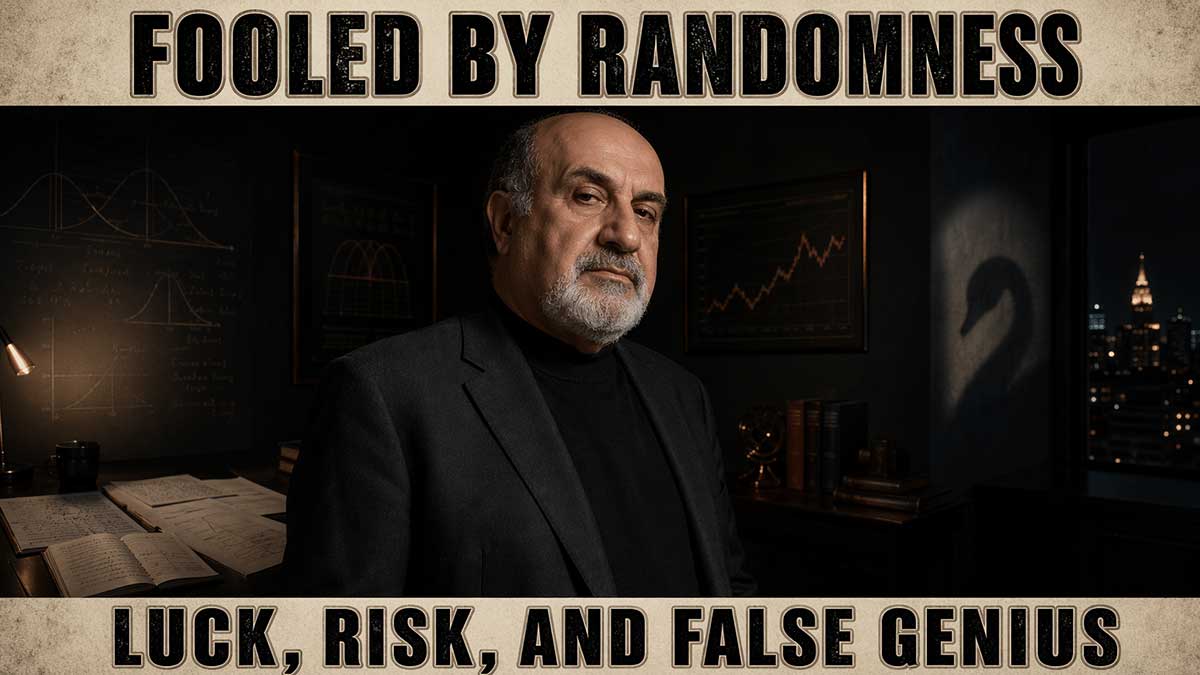
What stayed with me most in this conversation is that Taleb’s challenge is not merely intellectual. It is moral, psychological, and deeply personal. It asks us to stop giving automatic reverence to visible winners. It asks us to mistrust systems that reward people for risk they do not bear. It asks us to question stories that arrive too neatly after the fact. And perhaps hardest of all, it asks us to loosen the grip of ego on the story of our own lives.
Many people want books about uncertainty to end with a method that restores comfort. Taleb does not offer that kind of comfort. He offers something sterner. He offers a way of seeing that strips away flattering illusions. You may not be as skilled as your victories suggest. Your explanations may be cleaner than reality deserves. The institutions you trust may be held together by polished performance more than true wisdom. And much of what you call your path may have been shaped by contingency, timing, exposure, and accidents you survived without noticing.
But there is something freeing in that severity. Once a person stops demanding that the world behave like a fair and legible machine, he can live with more realism and less vanity. He can seek resilience instead of applause. He can value sound judgment over social display. He can become slower to worship success, slower to condemn failure, and slower to confuse narrative with truth. That kind of life may be less glamorous, but it is harder to fool.
In the end, Fooled by Randomness is not just a book about markets, probability, or cognitive error. It is a book about self-deception in every domain where human beings confuse outcome with essence. It is about the fragility of pride, the seduction of certainty, and the strange dignity that can emerge when a person finally admits how much of life was never fully under his control. Perhaps that is Taleb’s deepest gift to the reader. He does not hand us a safer world. He hands us a cleaner relationship to the world as it is.
Short Bios:
Nassim Nicholas Taleb
Nassim Nicholas Taleb is a scholar, risk thinker, and former options trader best known for his Incerto series, including Fooled by Randomness, The Black Swan, Antifragile, and Skin in the Game. His work focuses on uncertainty, probability, hidden risk, fragility, and the many ways human beings mistake neat models for reality.
Benoit Mandelbrot
Benoit Mandelbrot was a mathematician famous for developing fractal geometry and for showing how roughness, irregularity, and extreme events shape many parts of the natural and financial world. His influence on Taleb was profound, especially in understanding fat tails and the limits of conventional statistical assumptions.
Daniel Kahneman
Daniel Kahneman was a psychologist whose work on judgment, bias, and decision-making transformed modern thinking about how people reason under uncertainty. Best known for Thinking, Fast and Slow, he explored hindsight bias, overconfidence, and the mental shortcuts that make human judgment both powerful and unreliable.
Friedrich Hayek
Friedrich Hayek was an economist and social philosopher known for his critique of centralized planning and his defense of spontaneous order. His work stressed the limits of human knowledge in complex systems and warned against the dangerous illusion that society can be fully understood or controlled from above.
Michel de Montaigne
Michel de Montaigne was a French Renaissance essayist celebrated for his honesty, skepticism, and humane wisdom. His essays explored self-knowledge, vanity, uncertainty, and the instability of human judgment, making him a fitting companion for any conversation about luck, pride, and the limits of certainty.
Leave a Reply