
What if Craig Hamilton-Parker and leading voices explored whether humanity is collapsing or awakening?
Humanity may be entering one of those rare periods when the deepest questions can no longer be postponed. The old promises still speak loudly — progress, wealth, power, ideology, technology, leadership, identity — yet many people feel more uncertain, more divided, and more inwardly unsteady than before. That tension sits at the center of this conversation. The issue is no longer only what is happening in the world, but what kind of human being the world is producing.
Across these five topics, a pattern emerged. Crisis may break a civilization, but it may also strip away illusion. Tribal fear may give people a feeling of belonging, but it can also hollow out judgment and conscience. Calls for social change may sound noble, yet without inward responsibility they often recycle the same confusion in new language. Wealth, systems, and control may offer a layer of protection, but they cannot answer the soul’s hunger for meaning, peace, and truth. And any future worthy of hope will need more than new institutions. It will need deeper people.
The throughline of the whole discussion is awakening, yet not in a sentimental sense. This is not awakening as fashion, branding, or spiritual excitement. It is awakening as moral seriousness. Awakening as inner responsibility. Awakening as the refusal to let fear, tribe, comfort, or illusion rule the self. In that sense, the future of humanity may depend less on prediction than on formation: what we become under pressure, what we refuse to worship, what we learn to see clearly, and what kind of love, courage, and truth we can still carry into a fractured age.
This discussion does not offer one single answer. It offers a field of voices. Some speak from psychology, some from spirituality, some from civilizational history, some from philosophy, some from lived moral insight. Yet together they push toward one difficult conclusion: if a better age is to come, it will not be built by frightened crowds, borrowed identities, or outer control alone. It will be built by men and women who become harder to manipulate, harder to corrupt, more able to suffer without losing compassion, and more willing to live from what is deepest rather than what is loudest.
(Note: This is an imaginary conversation, a creative exploration of an idea, and not a real speech or event.)
Topic 1: Why crisis may be the beginning of awakening
Opening
This first topic goes to the heart of what Craig Hamilton-Parker was circling all through the interview: perhaps humanity is not only falling apart, but being forced into a painful kind of awakening. The question is whether crisis is merely destruction, or whether it can become the furnace in which a deeper human being is formed. Each of these five voices looks at that possibility from a different angle: prophetic, symbolic, spiritual, civilizational, and psychological.
Participants for Topic 1:
- Craig Hamilton-Parker
- Pam Gregory
- Jean Houston
- Richard Rohr
- Arnold Toynbee
Question 1
When a civilization enters fear, disorder, and breakdown, how can we know whether it is collapsing or being pushed into transformation?
Craig Hamilton-Parker:
You can tell by what begins to rise out of the chaos. If people only become more frightened, more tribal, more violent, then you are looking at collapse in its darker form. But if, beneath all the noise, people begin asking deeper questions about meaning, truth, and the kind of world they actually want to live in, then something else is happening. Then the pain is not meaningless. Then the disorder is acting like labor pains. A civilization in transformation looks ugly at first, because old illusions have to crack before anything living can come through.
Pam Gregory:
I would look for whether the old structures are losing authority because they are false, exhausted, or no longer aligned with human growth. There are times in history when what appears to be disorder is actually the breakdown of patterns that have become spiritually unworkable. Transformation is not neat. It often begins with disillusionment. It begins when people can no longer pretend the old map still works. The difference is this: collapse closes consciousness; transformation eventually opens it. At first, both can look very similar.
Jean Houston:
A civilization may be transforming when its suffering begins to release hidden capacities rather than only fear. Human beings often carry far more moral, imaginative, and spiritual possibility than they use in ordinary times. Pressure can call those capacities forth. It can awaken courage, mutual care, visionary thought, and a search for wiser forms of life. Collapse reduces the human person. Transformation, though painful, enlarges the human person. So the real question is: what kind of human beings is this crisis creating?
Richard Rohr:
You usually know by whether people can let go of false control without giving themselves over to despair. Much of what we call order is only managed illusion. Many systems look stable because they have not yet been tested at the level of truth. When they are shaken, what is false falls away. That is painful, but it can also be grace. The pattern is ancient: order, disorder, reorder. Many people only know how to worship the first stage. But God does some of the deepest work in the second.
Arnold Toynbee:
History shows that civilizations are not destroyed by challenge alone. They are destroyed when they fail to answer challenge creatively. Breakdown becomes transformation only when a society can produce a response that is morally serious, imaginative, and disciplined. The issue is not whether a civilization faces danger. Every civilization does. The issue is whether its people, especially its inner leaders, can rise above comfort, imitation, and inertia. Transformation is the mark of a living civilization. Mere collapse is the mark of one that has lost its creative minority.
Question 2
Do war, instability, and upheaval awaken humanity, or do they usually drive people deeper into fear and blindness?
Pam Gregory:
Both are possible, and that is exactly why these moments matter so much. Upheaval strips away false certainties. For some people, that becomes the doorway to a wider consciousness. For others, it becomes a reason to cling harder to fear, ideology, and control. Crisis does not automatically awaken anyone. It reveals them. It amplifies what is already within. Yet I do think these periods carry an unusual chance for awakening, because they break the trance of normality.
Arnold Toynbee:
Historically, upheaval more often deepens fear in the short term. That is the common human response. Yet long stretches of comfort can make civilizations morally soft, spiritually thin, and creatively stagnant. A severe challenge can expose those weaknesses. It can also summon greatness. Whether a people awaken depends on whether they can suffer without becoming merely reactive. If instability produces only panic, decline continues. If it produces discipline, sacrifice, and renewed purpose, renewal becomes possible.
Richard Rohr:
Most people do not awaken through ideas alone. They awaken when reality becomes too honest to avoid. Suffering does not automatically make people wise, but it does make illusion harder to maintain. Some will use pain as proof that they must become harder, angrier, and more defended. Others will let pain break the shell of the ego. That is the dividing line. The same fire hardens clay and softens wax. Upheaval is that kind of fire.
Craig Hamilton-Parker:
I think we are seeing both at once. Plenty of people are becoming more frightened, more polarized, more lost in tribes and in anger. But beneath that, there is another movement. Many people are beginning to see that the old answers do not satisfy anymore. They no longer trust the institutions, the leaders, the media, or the usual narratives. That can be dangerous, but it can also be the beginning of real spiritual searching. Sometimes humanity only looks up when the ground under its feet starts shaking.
Jean Houston:
Crisis is a magnifier. It can shrink the self into survival panic, but it can also widen the self into greater purpose. In every age of upheaval, there are those who become more primitive and those who become more fully human. War and instability are tragic teachers, but they have often forced people to ask larger questions: What is worth living for? What kind of society are we building? What must never be repeated? Awakening begins when suffering is not wasted.
Question 3
What kind of inner growth can only be born in an age of crisis and not in an age of comfort?
Richard Rohr:
Crisis can produce humility in a way comfort rarely does. When life is manageable, the ego easily mistakes control for wisdom. But when your plans fail, your world shakes, and your certainties crack, you may begin to understand your need for grace, dependence, and deeper grounding. That kind of surrender is often impossible when everything is going smoothly. Crisis can give birth to a truer self, one that is less arrogant and more real.
Jean Houston:
A difficult age can awaken latent dimensions of the soul: moral courage, sacrificial love, imaginative resilience, and a willingness to live for something larger than private comfort. Many of the great human capacities remain asleep in easier periods. People drift. They consume. They repeat. But an age of crisis can call forth the heroic and the sacred. It can ask more of us, and in asking more, reveal more.
Craig Hamilton-Parker:
I think one thing crisis can give us is detachment from illusion. If people have always depended on outer stability, money, institutions, or authority figures, then crisis forces them to ask what remains when those things wobble. That can lead to spiritual maturity. It can lead to fearlessness. It can lead people back to the question of who they really are apart from the world’s noise. That sort of awakening rarely happens when everyone is comfortable and distracted.
Arnold Toynbee:
Comfort tends to reward habit. Crisis rewards character. In troubled periods, societies discover whether they still possess endurance, discipline, faith, and creative intelligence. At the individual level, one may discover the same. Inner growth born in crisis often takes the form of seriousness: a recovery of proportion, duty, and moral clarity. Easy ages can produce refinement, but hard ages often produce depth.
Pam Gregory:
An age of crisis can birth inner sovereignty. People who once relied on outer systems for identity, permission, or emotional security may begin to discover a center within themselves that is no longer ruled by collective panic. They may become calmer, clearer, and less hypnotized by mass fear. That is a precious kind of growth. It is not dramatic. It is quiet, but it changes everything. From that place, a person can meet history without being swallowed by it.
Closing reflection for Topic 1
This first topic suggests that crisis alone proves nothing. It can destroy, but it can also reveal. It can reduce people to fear, or force them into depth. Across these five voices, one idea keeps surfacing: the true test of an age of breakdown is the kind of human being it produces. If fear only breeds more fear, collapse deepens. If suffering cracks illusion, awakens courage, and pushes people toward truth, then what looks like an ending may be a severe beginning.
Topic 2: How humanity lost itself in tribes and fear
Opening
If Topic 1 asked whether crisis can become awakening, Topic 2 asks why people so often fail that test. Craig Hamilton-Parker kept returning to division, group identity, fear, and the loss of the individual center. In his view, people do not simply suffer crisis; they often disappear into it by surrendering themselves to tribes, slogans, and collective emotion. This topic explores how that happens, why it feels so natural, and what it takes to remain inwardly free when the crowd is pulling hard in every direction.
Participants for Topic 2:
- Carl Jung
- Jonathan Haidt
- Rene Girard
- Hannah Arendt
- Erich Fromm
Question 1
Why do people so easily hand over their judgment to political tribes, religious camps, media narratives, or group emotion?
Carl Jung:
Because the individual psyche is often weaker than the comfort offered by the collective. To think for oneself is difficult, lonely, and at times frightening. The crowd offers ready-made identity, borrowed certainty, and emotional permission. People are drawn to collective opinions because they relieve them of the burden of confronting their own inner contradictions. Once the individual loses contact with the self, he becomes highly vulnerable to possession by mass feeling, slogans, and projections.
Jonathan Haidt:
Human beings are built for belonging long before they are built for reasoning. Most people do not begin with careful analysis and then join a group. They join a moral community first and then use reason to defend it. Tribes give people meaning, loyalty, belonging, and a story about good and evil. That is emotionally satisfying. The trouble begins when group loyalty becomes so strong that evidence no longer matters and disagreement feels like betrayal rather than thought.
Rene Girard:
People are imitative creatures. We learn desire from one another. We borrow our passions, our enemies, and our fears from those around us. Once a group begins to move in one emotional direction, imitation spreads quickly. Rivalry intensifies, and the group starts to define itself against an enemy. This makes tribal identity feel morally pure, but its energy often comes from shared hostility. People hand over judgment because imitation is easier than freedom and safer than standing apart.
Hannah Arendt:
Many people surrender judgment when public life becomes noisy, unstable, and morally confusing. In such moments, independent thinking can feel exhausting. Ideology becomes attractive because it offers a finished system that explains everything at once. It removes the burden of examining facts carefully and judging each situation freshly. The danger is that people stop thinking in the deepest sense. They become attached to consistency, belonging, and movement itself, rather than to reality.
Erich Fromm:
Freedom is frightening to many people. To stand alone, to think for oneself, to bear responsibility for one’s own judgment, all this creates anxiety. So people escape from freedom by submitting to systems, leaders, parties, or identities that promise certainty. The tribe offers relief from aloneness. It tells the person who he is, what he should hate, and where he belongs. The price is the self. Many accept that bargain without realizing what they have lost.
Question 2
What happens to a society when belonging starts to matter more than truth?
Jonathan Haidt:
When belonging outranks truth, people stop asking whether something is accurate and start asking whether it is useful for their side. Institutions weaken because trust depends on some shared standard beyond tribal loyalty. Public life then becomes a contest of moral teams, each with its own facts, heroes, and sacred grievances. Once that happens, correction becomes very hard, since any admission of error feels like helping the enemy. A society can survive disagreement. It struggles to survive when truth itself becomes partisan.
Hannah Arendt:
A society in that condition becomes vulnerable to unreality. Facts lose their stubbornness. Narratives take precedence over what is actually there. People no longer want truth if truth disturbs the emotional comfort of belonging. At that stage, public life becomes unstable, because reality always returns, whether people wish it or not. The refusal to face it leads to harsher shocks later. The deeper loss is moral: a people that no longer cares for truth weakens its own capacity for judgment.
Carl Jung:
When belonging becomes supreme, projection increases. The group sees evil almost entirely outside itself. Its shadow is cast onto opponents, heretics, outsiders, or enemies. This gives the tribe a feeling of innocence, but it also makes self-knowledge nearly impossible. A society that cannot face its own shadow becomes increasingly dangerous, since it believes its aggression is always justified. The more righteous the group feels, the less conscious it often becomes.
Erich Fromm:
The individual becomes hollowed out. People may appear passionate, but inwardly they are dependent. Their opinions are borrowed, their outrage is borrowed, even their identity is borrowed. A society like this becomes full of anxious conformity disguised as conviction. Love of truth is replaced by approval-seeking. Persons no longer ask, “Is this real?” but “Will my group reward me for saying it?” Such a society may still speak loudly about values, yet inwardly it is driven by fear.
Rene Girard:
Belonging over truth pushes a culture toward scapegoating. Once the tribe’s unity becomes more valuable than reality, it will search for people to blame for its tensions. Enemies become emotionally necessary. Their guilt will be exaggerated, their humanity reduced, and the group will feel purified by condemning them. This gives temporary unity, but it does not heal the deeper disorder. It only hides it for a time. A society that lives this way becomes addicted to accusation.
Question 3
How can a person stay inwardly free when mass fear is pulling everyone into conformity, rage, and imitation?
Erich Fromm:
A person must first accept the cost of freedom. Freedom is not emotional comfort. It means standing without constant approval. It means bearing uncertainty without rushing into borrowed certainty. To stay inwardly free, one must develop an inner core rooted in love, reason, and productive living. The person who is alive inwardly is less likely to be captured by collective panic. Not immune, but less available to it.
Carl Jung:
One must become conscious of one’s own shadow. The crowd becomes dangerous when it awakens unconscious contents in the individual. If you do not know your own aggression, fear, vanity, and hunger for belonging, the group will use them. Inward freedom begins when a person sees clearly what in himself responds to propaganda, panic, and group intoxication. The one who knows his own darkness is less likely to be possessed by the darkness of the crowd.
Hannah Arendt:
The first requirement is to keep thinking, by which I mean the quiet inner activity of examining, distinguishing, and refusing slogans. One must resist the temptation to let ready-made formulas do the work of judgment. Friendship can help, too, not mass belonging but real friendship, where people speak honestly and test reality together. The inwardly free person does not become thoughtless, even under pressure. That is the beginning.
Rene Girard:
One must become suspicious of contagious emotion, especially when it offers the pleasure of shared blame. Whenever a crowd is becoming unified through hostility, the person should pause. Ask what desire is being copied, what rivalries are being fed, and who is being turned into the necessary enemy. Freedom often begins in this pause, this refusal to be swept into imitation. It is a small act, but a decisive one.
Jonathan Haidt:
A practical step is to keep contact with people outside your moral tribe. Once all your relationships are inside one camp, your thinking will be shaped by group reward and punishment. Exposure to decent people on other sides can interrupt caricature and reduce moral intoxication. A person also needs habits of intellectual humility: asking what evidence would change your mind, what your side may be missing, and what pain the other side may actually be feeling. That does not erase conviction. It makes conviction less blind.
Closing reflection for Topic 2
This topic suggests that tribal life becomes dangerous when it offers emotional safety at the cost of the self. People hand over judgment because belonging feels warm, freedom feels costly, and fear makes imitation seem wise. Yet all five voices point toward the same hope: inward freedom is still possible. It begins when a person learns to bear uncertainty, face the shadow, resist contagious hostility, and care more about reality than applause. In a frightened age, that alone is already a form of courage.
Topic 3: Why real change begins with personal responsibility

Opening
After looking at crisis and tribal fear, this topic moves to the turning point inside the person. Craig Hamilton-Parker keeps returning to one central demand: stop waiting for someone else to save you. In his view, the future of humanity cannot be separated from the moral and spiritual condition of the individual. This topic asks why people resist that burden, what real responsibility looks like in a confused age, and whether any lasting outer change is possible without inner change first.
Participants for Topic 3:
- Viktor Frankl
- Jordan Peterson
- James Allen
- Pema Chodron
- Stephen Covey
Question 1
Why do so many people search for rescue in leaders, systems, or movements instead of doing the harder work within themselves?
Viktor Frankl:
People often search for rescue outside themselves because suffering creates desperation, and desperation longs for quick certainty. It is painful to admit that no leader can remove the deepest human task, which is to decide who one will be in the face of circumstance. A movement can give emotional heat, a system can give structure, and a leader can give direction, but none can replace the inner act of choosing one’s attitude and one’s responsibility. Many people flee inward work because it asks something far more serious than obedience: it asks conscience.
Jordan Peterson:
Because putting your own life in order is difficult, humbling, and slow. It is much easier to join a cause, shout slogans, blame corrupt structures, and act as though history’s failures are all somewhere out there. The demand of responsibility is that you start with what is in front of you: your habits, your speech, your resentments, your duties, your family, your work. That feels small compared with grand political language, yet it is the place where genuine transformation begins. People search for rescue because self-confrontation is painful.
James Allen:
The outer rescuer is attractive because the inward labor of self-mastery is quiet and often unseen. Human beings prefer visible revolutions to invisible discipline. Yet thought is the seed of conduct, and conduct is the seed of destiny. If the heart remains disordered, outer arrangements will soon reflect that disorder again. So long as a person believes his misery is created only by external forces, he delays the hour of self-knowledge. Many seek rescue because they do not wish to examine the causes they carry within.
Pema Chodron:
Because staying with yourself is hard. When fear, shame, grief, or confusion rise up, the mind wants to run. It wants something to hold on to fast: a teacher, a belief system, a side, a mission, a promise. That movement outward can feel comforting for a while. But without the willingness to sit with our own fear and confusion, we keep recreating the same suffering in new forms. The harder work is gentle, honest, and very direct. It is staying present when every part of you wants to escape.
Stephen Covey:
People reach for outer rescue because it seems more immediate than inner responsibility. It is easier to focus on what others should fix than on the part of life where one still has agency. Yet effectiveness begins with the inside-out path. Our character, our habits, our way of seeing, and our private commitments shape everything we touch. When people ignore that, they become dependent on personalities and systems rather than rooted in principles. Rescue from outside feels easier, but it leaves the person weak.
Question 2
What does real personal responsibility look like in a spiritually confused age?
James Allen:
It begins with governing one’s own mind. A spiritually confused age is full of noise, agitation, blame, and borrowed opinion. Real responsibility means refusing to let the mind become a dumping ground for these things. It means watching one’s thoughts, correcting bitterness, disciplining desire, and choosing speech and action that reflect inward order. The person who would help the age must first cease contributing inwardly to its confusion.
Pema Chodron:
It looks like staying awake. It means noticing when you are blaming, when you are hardening, when you are turning fear into aggression, when you are reaching for certainty just to calm yourself. Responsibility is not harsh self-punishment. It is honest awareness. In a confused age, one of the most responsible things a person can do is stop passing their pain along. Stay with it. Learn from it. Let it soften you rather than make you mean.
Stephen Covey:
Real responsibility means acting from principles rather than mood, pressure, or popularity. It means keeping promises, telling the truth, honoring duties, listening before reacting, and focusing energy on what one can actually influence. In a spiritually confused age, people are often reactive and scattered. Responsibility restores integrity. It creates alignment between values, choices, and daily habits. It is not abstract. It shows up in the way one treats family, work, time, conflict, and trust.
Viktor Frankl:
It means answering life rather than accusing life. Every era is confused in its own way, but the human person is still addressed by circumstance. Responsibility is the ability to respond meaningfully, even when the world is unclear. It may mean courage in suffering, restraint in anger, fidelity in loneliness, or dignity in uncertainty. One need not control the age in order to answer it nobly. Spiritual maturity begins when a person stops asking only what he can get from life and asks what life is asking of him now.
Jordan Peterson:
It looks like voluntary confrontation with truth. Tell the truth, or at least do not lie. Put yourself where you can bear reality. Accept your burdens rather than dramatizing your victimhood. Clean up what is disorderly in your own life. Take care of what has been entrusted to you. Strengthen yourself enough so that you can be useful under pressure. In a confused age, responsibility is not just moral; it is stabilizing. The responsible person becomes someone others can rely on when things start falling apart.
Question 3
Can humanity change outwardly without enough individuals first changing inwardly?
Stephen Covey:
Only for a short time. You can alter structures, policies, and systems, and sometimes that matters a great deal. But without inward change, the old habits of domination, dishonesty, selfishness, and fear return inside the new structure. Lasting social improvement depends on people with enough character to sustain it. Public trust, healthy institutions, and strong communities all rest on inward qualities that cannot be legislated into existence.
Jordan Peterson:
No lasting change is possible without enough individuals becoming more truthful, disciplined, and responsible. A corrupt person will corrupt the institution he enters. A resentful person will turn a noble cause into a weapon. A weak person will collapse under the burden of freedom and start demanding control. Large-scale change sounds dramatic, but the quality of a society is built one person at a time. That may sound frustrating, but it is also hopeful, because it tells you where to begin.
Pema Chodron:
Outward change without inward change usually carries the same aggression into a new costume. People say they want justice, peace, healing, or truth, yet often bring the same fear, blame, and self-deception into the effort. Then the new thing starts to resemble the old thing. Inward change does not mean waiting passively. It means doing outer work without hatred taking over the heart. That is what keeps change from becoming another cycle of suffering.
Viktor Frankl:
Humanity changes outwardly through culture, law, and history, but these are always lived through persons. The decisive place is still the human heart. A system may restrain evil or encourage good, yet each individual remains free in some measure to accept or betray what is highest. If enough people inwardly evade responsibility, outward reform will remain fragile. Civilization depends on persons who choose meaning over impulse, conscience over convenience, and dignity over despair.
James Allen:
The outer world is shaped by the inward life of those who build it. Institutions do not float above character. Nations do not rise above the quality of mind and heart that sustain them. To seek a better world without better persons is to seek fruit without roots. Change that is merely external may glitter for a season, but in time the inward law reappears. Humanity must change within if it would remain changed without.
Closing reflection for Topic 3
This topic presses the burden back onto the individual. The voices here differ in tone, yet all arrive at the same hard truth: people look for rescue outside themselves because inner work is slower, lonelier, and more demanding. Yet no leader, cause, or system can replace conscience, discipline, self-knowledge, and the courage to answer life honestly. Outer reform matters, but without inward change it remains fragile. A civilization grows stronger when enough people become the kind of person who can carry freedom without running from it.
Topic 4: Why money, power, and systems cannot save the soul

Opening
By this point, the conversation reaches one of Craig Hamilton-Parker’s deepest themes: human beings keep trusting outer systems to deliver what only inner transformation can give. Wealth, institutions, technology, political control, and social machinery all promise safety, yet again and again they fail to give peace, meaning, or wholeness. This topic asks why people keep making that mistake, what outer security can and cannot do, and what kind of character becomes most necessary when systems begin to shake.
Participants for Topic 4:
- E. F. Schumacher
- Charles Eisenstein
- Thomas Merton
- Ivan Illich
- Satish Kumar
Question 1
Why do people keep trusting wealth, institutions, technology, and control when these fail again and again to give peace?
E. F. Schumacher:
People trust these things because they are measurable, visible, and socially rewarded. Wealth can be counted. Institutions can be organized. Technology can produce immediate effects. Control gives the appearance of mastery. Inner peace, by contrast, is subtle and cannot be industrialized. Modern civilization has trained people to value what can be quantified and managed, so they naturally place their faith in external machinery. But a society that treats human beings mainly as economic units will keep producing abundance without contentment.
Charles Eisenstein:
Because modern culture is built on the story of separation. If I feel separate from other people, from nature, from meaning, and from the source of life itself, then of course I will seek security in accumulation, systems, and control. Those become substitutes for belonging. They promise to protect the isolated self. But they cannot resolve the wound they are trying to manage. They only organize it more efficiently. Peace does not come from winning the logic of separation. It comes from leaving it.
Thomas Merton:
People put faith in these things because they fear emptiness. Silence frightens them. Dependence on grace frightens them. To rest in what is unseen requires surrender, and surrender is humiliating to the ego. So people gather wealth, attach themselves to institutions, and trust in systems because these things seem solid enough to keep anxiety away. But the soul is not healed by distraction, achievement, or organized power. It is healed when the false self loosens its grip.
Ivan Illich:
People continue to trust systems because systems redefine the problem in ways that make themselves appear necessary. Institutions often train people to doubt their own capacities and then offer professionalized substitutes for living. The more dependent people become, the more natural dependence appears. Technology works the same way. It creates conditions that only more technology can manage. This deepens trust in systems, even when those systems weaken human autonomy, community, and competence.
Satish Kumar:
People trust outer structures because they have forgotten sufficiency. They have been taught that more is safer, faster is better, and bigger is stronger. Yet peace does not come from endless extension. It comes from right relationship: with one’s own heart, with neighbors, with food, with land, with limits. A person who has lost the art of simple living will search for peace in scale, and scale cannot give it.
Question 2
What is the difference between outer security and inner security?
Thomas Merton:
Outer security is about conditions. Inner security is about being. Outer security depends on possessions, status, structures, predictability, and protection. It may be useful, and no one should romanticize chaos. But inner security is deeper. It is the state of being rooted in something that does not rise and fall with circumstances. Without that, outer stability becomes a fragile idol. With that, a person can live in uncertainty without inward collapse.
Satish Kumar:
Outer security says, “I am safe because I have enough around me.” Inner security says, “I am steady because I know how to live.” One depends on stockpiles, systems, and guarantees. The other depends on wisdom, relationship, character, and trust in life. Outer security can disappear quickly. Inner security travels with the person. The healthiest life uses the first when possible but never mistakes it for the second.
E. F. Schumacher:
Outer security belongs to the arrangement of means. Inner security belongs to the orientation of ends. A civilization that becomes clever about means but confused about ends may grow technically powerful yet spiritually unstable. Outer arrangements matter, but they cannot answer the question of what life is for. Inner security begins when that question is faced honestly. It is less about possession than about proportion.
Charles Eisenstein:
Outer security is usually an attempt to reduce uncertainty. Inner security is the capacity to remain human inside uncertainty. One seeks insulation. The other seeks participation. A person grounded inwardly does not need the world to become fully controllable in order to remain open-hearted, connected, and alive. That is why inner security is closer to trust than to defense.
Ivan Illich:
Outer security is often administered. Inner security is practiced. The first can be delivered by systems up to a point. The second must be cultivated by persons and communities. When societies neglect the practices that create inner steadiness, they compensate by expanding institutions of protection. But the expansion of institutional protection can never fully replace the loss of lived competence, local interdependence, and human maturity.
Question 3
If economic and political systems weaken, what qualities become most needed to stay human?
Ivan Illich:
People will need recovered competence: the ability to do meaningful things for themselves and with others, rather than depending entirely on distant systems. They will need conviviality, by which I mean the capacity to live in mutual usefulness without excessive institutional mediation. A weakened system reveals whether human beings still know how to care, repair, grow, share, and endure together. These are not romantic leftovers. They are civilizational strengths.
E. F. Schumacher:
The essential qualities would be humility, practicality, and moral seriousness. People would need to rediscover scale: what can be sustained locally, what can be lived simply, what kind of work actually serves life. A person who has learned to value enough rather than excess will be more stable than one trained only to expand. Human beings remain human when wisdom governs technique, not the other way around.
Satish Kumar:
The first quality is reverence: for life, for neighbor, for land, for the invisible dignity of ordinary existence. From reverence comes simplicity, and from simplicity comes resilience. A person who can cook, grow, mend, share, listen, and live with gratitude is already wealthier than a frightened person surrounded by possessions. In harder times, kindness and community are not luxuries. They are a form of survival.
Charles Eisenstein:
The qualities most needed are generosity, trust-building, adaptability, and the willingness to leave the old story behind. When systems weaken, the temptation is to become more defensive, suspicious, and hoarding. That reaction may look realistic, but it often deepens the collapse of relationship. To stay human is to resist that contraction. It is to keep creating bonds of reciprocity and meaning when fear is urging you to become smaller.
Thomas Merton:
Above all, people will need inward clarity. Fear can make human beings efficient but less human. They become reactive, hard, and spiritually numb. To remain human under pressure, one needs silence, discernment, compassion, and the refusal to let survival become an excuse for losing the soul. Hard times reveal what a person serves. They show whether one lives by appetite alone or by something higher.
Closing reflection for Topic 4
This topic cuts through one of modern life’s most persistent illusions: that enough wealth, enough technology, enough institutional reach, or enough control can finally make the human person whole. These voices do not deny that outer structures matter. They deny that outer structures can do the soul’s work. Outer security manages conditions; inner security forms the person. And when systems weaken, what matters most is not merely what one owns, but what one has become: competent, humble, connected, discerning, and still capable of kindness under strain.
Topic 5: What a more awakened human future might look like

Opening
After crisis, tribe, responsibility, and the limits of outer systems, the final topic asks the largest question of all: if humanity really does pass through this period of confusion and pressure, what kind of future could emerge on the other side? Craig Hamilton-Parker’s interview keeps leaning toward hope, but not cheap hope. The better future he hints at is not just more comfort or better management. It is a change in consciousness, values, community, and the kind of human being society learns to honor. This topic explores what that future might actually require and how we would know whether humanity is truly waking up or merely inventing a more attractive illusion.
Participants for Topic 5:
- Gregg Braden
- Ervin Laszlo
- Joanna Macy
- Ken Wilber
- Pierre Teilhard de Chardin
Question 1
If humanity passes through this painful threshold, what kind of person will be most needed in the next age?
Gregg Braden:
The person most needed will be someone who can stay grounded under pressure without losing heart. The next age will not need people who are merely informed. It will need people who are inwardly coherent, emotionally resilient, and able to respond without panic when systems shake. We are entering a time when human adaptability, compassion, and conscious choice may matter more than raw intellect alone. The future will belong to people who can unite strength with care.
Ervin Laszlo:
The coming age will need integrative human beings. By that I mean people who can think beyond fragments: beyond nation alone, beyond tribe alone, beyond self-interest alone. Humanity’s survival will depend more and more on people who experience themselves as part of a larger living whole. The person needed in the next age is one whose consciousness is planetary, whose ethics are relational, and whose intelligence is not split from wisdom.
Joanna Macy:
We will need people who can face grief without becoming paralyzed and face danger without becoming cruel. The next age needs people who can remain emotionally honest about what is being lost, yet still act from love for life. A person like that does not deny collapse, but also does not worship it. They become a source of courage for others because they have learned how to suffer without shutting down.
Ken Wilber:
The future will require more integrated people, not just more intense people. Human beings who can hold complexity, who can recognize multiple truths without collapsing into relativism, and who can move beyond rigid us-versus-them identity will be essential. A higher stage of civilization demands a higher stage of selfhood. The central need will be for people who have grown beyond egoic reactivity into a wider, more conscious participation in reality.
Pierre Teilhard de Chardin:
The person needed in the next age will be one who sees evolution not only as biological but spiritual. Humanity advances when consciousness deepens into greater union without losing personality. The future will need souls capable of love at a wider scale: not vague sentiment, but a real movement toward communion. The human being of the future must be able to unite interior depth with collective destiny.
Question 2
What values and forms of community would define a healthier civilization after this period of fragmentation?
Joanna Macy:
A healthier civilization would be rooted in mutual belonging rather than extraction. Communities would be built less around competition and more around interdependence, care, and shared responsibility for life. People would relearn that they do not exist apart from the living systems around them. The healthiest communities would help people carry sorrow, joy, and duty together rather than isolating each person in private survival.
Pierre Teilhard de Chardin:
The future civilization must learn the art of union without absorption. Human beings must become more connected without becoming spiritually flattened into sameness. A healthy society would honor the person and the whole at once. Its central values would be reverence, cooperation, interior growth, and the understanding that collective advancement is hollow if the soul is left behind.
Ken Wilber:
A healthier civilization would be one that honors inner development as seriously as outer development. It would value truth, compassion, responsibility, and systemic intelligence together. Its communities would not be formed merely by reaction or identity, but by shared practices that mature consciousness. Such a civilization would understand that technological progress without moral and psychological growth is unstable. It would build institutions that support both competence and depth.
Gregg Braden:
The values that will matter most are probably timeless ones that modern systems often treat as secondary: trust, cooperation, family strength, local resilience, emotional intelligence, and the recognition of human sacredness. Community in the next age may become more local in some ways and more conscious in others. People will seek real human connection, practical support, and shared meaning, not just networked contact.
Ervin Laszlo:
A healthier civilization will be defined by coherence. Its economic, social, ecological, and spiritual values will no longer be treated as separate compartments. Communities will understand that what harms one level of life eventually harms the whole. The central values will be participation, non-fragmentation, ecological harmony, and the willingness to organize society around life-supporting principles rather than mechanical growth alone.
Question 3
What signs would show true awakening instead of just a new illusion dressed in spiritual language?
Ken Wilber:
One clear sign would be greater integration. False awakening often speaks in beautiful language while remaining emotionally immature, tribally reactive, and psychologically split. Real awakening should produce depth and breadth together. It should widen compassion, sharpen honesty, and reduce the need to simplify the world into enemies and saviors. If the spirituality is grand but the ego is unchanged, the awakening is probably theatrical.
Gregg Braden:
A true awakening would show itself in how people treat one another under stress. It would not be measured mainly by slogans, techniques, or claims of higher vibration. It would show up in reduced fear, increased cooperation, and practical care for life. Real awakening makes people more human, not less. It strengthens compassion, relationship, and responsibility. If a movement speaks of consciousness but leaves people more divided and self-absorbed, something has gone wrong.
Ervin Laszlo:
True awakening would create coherence between worldview and behavior. It would show that people are beginning to sense their connectedness not as an idea but as a lived reality. You would see less fragmentation between economics and ethics, between science and spirituality, between private desire and planetary consequence. False awakening remains abstract. Real awakening reorganizes life.
Pierre Teilhard de Chardin:
A real awakening would move humanity toward greater union, greater interiority, and greater love at once. If people become more spiritually excited but less capable of communion, they have not advanced. Awakening is not merely intensity of experience. It is movement toward a fuller participation in the divine depth of reality and in one another. The test is whether consciousness is becoming more unitive and more luminous in action.
Joanna Macy:
I would look for whether awakening makes people more able to stay present to suffering without denial and more willing to protect life without self-righteousness. A false awakening often tries to float above pain. A real awakening enters pain and becomes more compassionate. It does not withdraw into private purity. It turns outward in service, gratitude, and courage. If spirituality helps people avoid the world, it is not deep enough yet.
Closing reflection for Topic 5
This final topic suggests that a more awakened future would not simply be a world with better language, better branding, or more spiritual vocabulary. It would be a world shaped by more integrated people, more life-giving communities, and values that reconnect inner growth with outer responsibility. Across these five voices, the signs of real awakening are surprisingly concrete: less fear, less fragmentation, more courage, more communion, more responsibility, more care under pressure. A truly awakened future would not look like escape from humanity. It would look like humanity becoming more fully human.
Final Thoughts
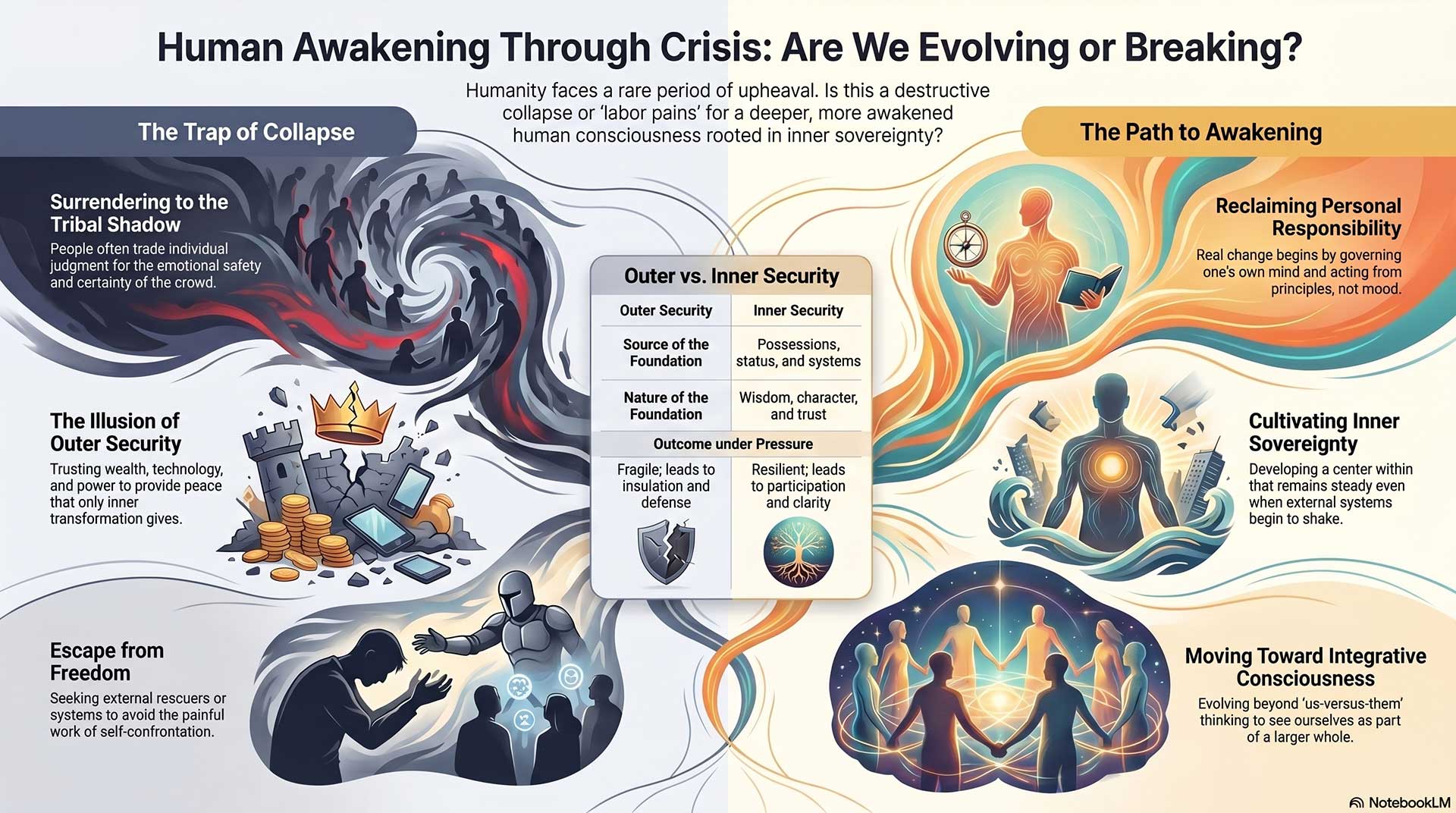
By the end of these five topics, the real dividing line no longer seems to be between optimism and pessimism. It is between sleep and wakefulness. A civilization can be wealthy and still asleep. It can be technologically advanced and still inwardly lost. It can speak endlessly about justice, healing, or consciousness and still remain captive to fear, vanity, and imitation. The true question is whether human beings are becoming more real.
That is why the conversation kept circling back to the same inner demands: courage, discernment, responsibility, humility, compassion, truthfulness, and the strength to remain human under strain. These are not glamorous virtues, yet they may be the most decisive ones. They determine whether crisis becomes transformation or simply deeper chaos. They determine whether belonging becomes communion or conformity. They determine whether spiritual language becomes light or disguise.
A more awakened future, if it comes, will likely not arrive all at once. It will appear first in people: in the person who refuses to hate on command, in the person who stays honest when lying would be easier, in the person who can bear grief without collapsing into nihilism, in the person who does not surrender conscience to the crowd, in the person who can meet uncertainty without worshiping control. That kind of human being is not the final result of history. It is the seed of a different history.
So the deepest hope in this whole discussion is not that the world will suddenly become simple. It is that enough people may become inwardly strong, awake, and compassionate enough to meet a difficult age without being swallowed by it. If that happens, then even a time of confusion may prove to be a threshold rather than a grave. And the awakening Craig Hamilton-Parker was reaching for may turn out to be less about prophecy than about character.
Short Bios:
Craig Hamilton-Parker
British psychic medium, spiritual commentator, and future-focused public voice known for linking world events, intuition, and collective awakening.
Pam Gregory
Astrologer and spiritual thinker whose work centers on consciousness shifts, planetary cycles, and humanity’s passage through major turning points.
Jean Houston
Scholar, philosopher, and human potential pioneer known for exploring latent human capacities, imagination, and transformational growth in times of pressure.
Richard Rohr
Christian contemplative writer and teacher known for his reflections on suffering, ego, spiritual maturity, and the path from disorder into deeper wisdom.
Arnold Toynbee
Historian of civilizations best known for studying how societies rise, decline, and respond creatively or unsuccessfully to crisis.
Carl Jung
Swiss psychiatrist whose work on the shadow, individuation, symbolism, and collective psychology remains central to understanding mass fear and projection.
Jonathan Haidt
Social psychologist known for his work on moral intuition, tribal division, and the emotional foundations of political and cultural conflict.
Rene Girard
French thinker known for his work on imitation, rivalry, scapegoating, and the way communities unite through shared hostility.
Hannah Arendt
Political thinker known for her work on totalitarianism, ideology, judgment, and the dangers of thoughtlessness in public life.
Erich Fromm
Social philosopher and psychoanalyst known for examining freedom, conformity, fear, love, and the psychological cost of surrendering the self.
Viktor Frankl
Psychiatrist and Holocaust survivor best known for his work on meaning, moral freedom, and human dignity under extreme suffering.
Jordan Peterson
Psychologist and public intellectual known for stressing truth, responsibility, order, and the need for personal reform before social reform.
James Allen
Philosophical writer best known for teaching that thought shapes character, conduct, and destiny.
Pema Chodron
Buddhist teacher and writer known for her calm, honest guidance on fear, uncertainty, compassion, and staying present with difficulty.
Stephen Covey
Author and leadership thinker known for principle-centered living, character formation, and the inside-out path to meaningful change.
E. F. Schumacher
Economist and social thinker known for critiquing scale, industrial excess, and the spiritual poverty hidden inside modern economic life.
Charles Eisenstein
Writer and cultural critic known for exploring separation, money, civilization, and the search for a more connected human future.
Thomas Merton
Contemplative writer and monk known for his reflections on silence, false identity, inner freedom, and the limits of worldly success.
Ivan Illich
Social critic known for challenging institutional dependence and defending human autonomy, local competence, and humane scale.
Satish Kumar
Peace pilgrim, ecological thinker, and spiritual writer known for simplicity, reverence for life, and community-based wisdom.
Gregg Braden
Author and speaker known for linking human resilience, consciousness, and civilizational change through a spiritual and future-oriented lens.
Ervin Laszlo
Systems philosopher known for writing about planetary evolution, interconnectedness, and the future of human consciousness.
Joanna Macy
Scholar, Buddhist thinker, and activist known for helping people face grief, ecological crisis, and social breakdown with courage and compassion.
Ken Wilber
Integral philosopher known for mapping stages of consciousness and the relation between inner development and cultural evolution.
Pierre Teilhard de Chardin
Jesuit thinker and visionary of evolution who wrote about humanity’s movement toward greater consciousness, union, and spiritual depth.
Leave a Reply