
|
Getting your Trinity Audio player ready...
|
What if top deception researchers debated how to spot a liar in real life?
Introduction — by Pamela Meyer
How to spot a liar is not about becoming a human lie detector or memorizing a checklist of suspicious gestures. It is about understanding human behavior — including our own.
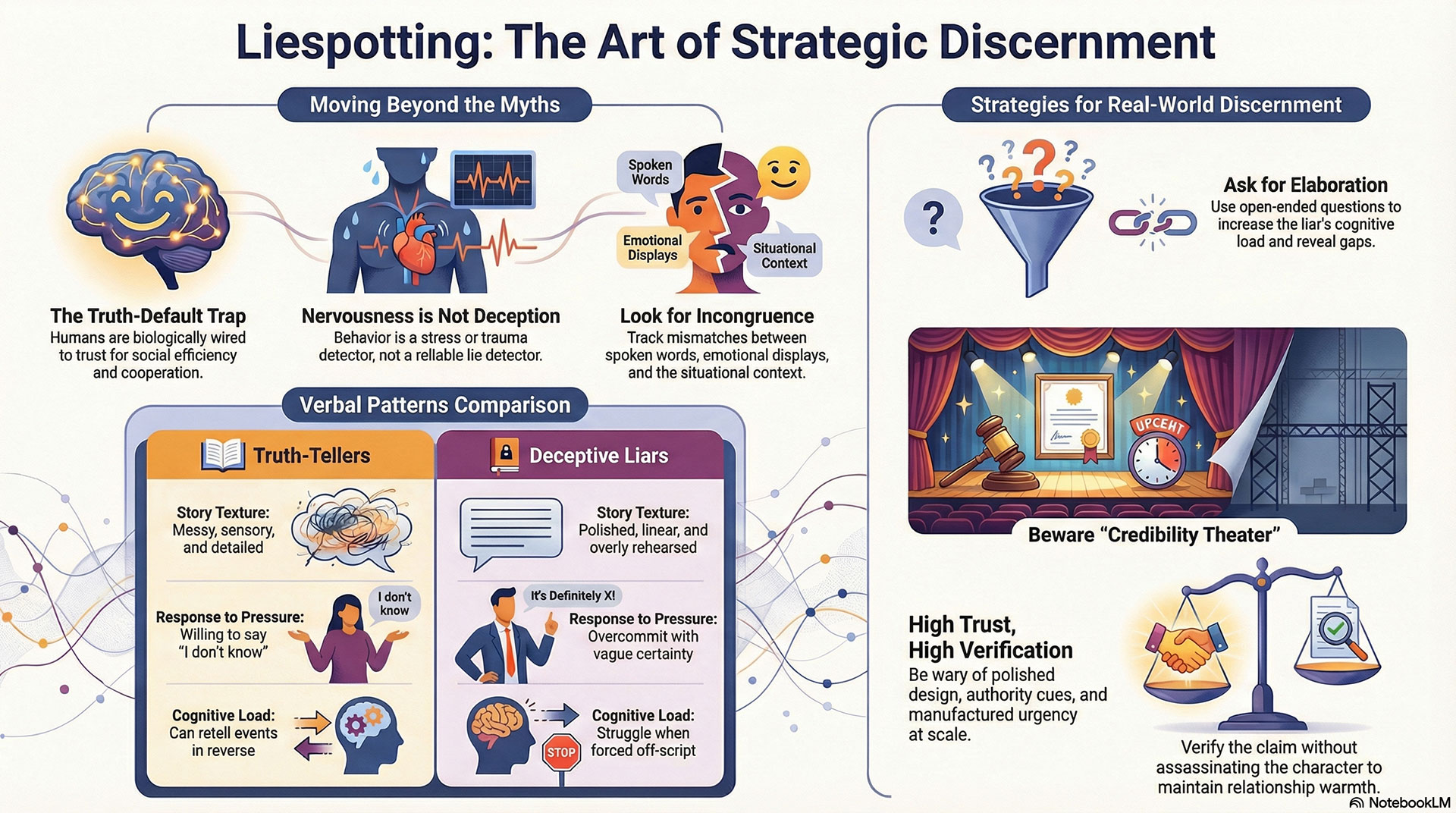
We are wired for trust. Most of the time, that wiring serves us well. It allows relationships to form, businesses to function, and societies to cooperate. But that same instinct, what researchers call the “truth-default,” is also why deception works.
In this conversation, we explore something deeper than body language myths. We examine why we miss lies, why a single “tell” is unreliable, how better questioning changes everything, and how to verify without becoming cynical.
Because the goal is not suspicion.
The goal is discernment.
And discernment is a skill.
(Note: This is an imaginary conversation, a creative exploration of an idea, and not a real speech or event.)
Topic 1: The Truth-Default Trap

Moderator:
Tim Levine
Panel (5):
Pamela Meyer, Bella DePaulo, Aldert Vrij, Saul Kassin, Paul Ekman
A small studio space that feels half classroom, half living room. Soft lights, a round table, water glasses, and a stack of plain index cards. No dramatic music, no “gotcha” energy. The mood is calm, practical, and a little wary, like everyone knows how easily this topic can turn into paranoia.
Tim Levine sits with an easy, steady posture, the kind of person who’s seen the data and doesn’t need to shout. Pamela Meyer is beside him, alert and warm, ready to translate science into real-life “Monday morning” decisions. Across the table are Bella DePaulo, Aldert Vrij, Saul Kassin, and Paul Ekman.
Tim Levine: Most people think spotting lies is about becoming a human lie detector. But the research points to something simpler and more uncomfortable. We’re wired to believe. Why do humans default to believing, and when does that become dangerous?
Pamela Meyer: The truth-default is basically a social survival feature. If we treated every statement like a potential scam, we’d never get through a grocery line. Trust is efficient. The danger shows up when we apply that default in high-stakes settings where the incentives to deceive are strong. The workplace, money, romance, conflict, politics. In those moments, we keep using everyday trust rules on situations that demand verification.
Bella DePaulo: And it’s not just efficiency. Trust is relational. Most of us want to see ourselves as fair, open, and decent. Doubting someone can feel like being rude. So we ignore the little internal alarms because we don’t want to become the kind of person who suspects. The truth-default becomes dangerous when it overrides your ability to protect yourself, especially when someone is skilled at presenting sincerity.
Aldert Vrij: The truth-default is also encouraged by the fact that most statements are true. In daily life, people lie less than we imagine. So our system works most of the time. The problem is that it fails exactly where it matters: situations with asymmetric consequences. One lie in a contract, one lie in a relationship, one lie in a legal context. When the cost of a single deception is high, the truth-default is a vulnerability.
Saul Kassin: I’d add that the truth-default isn’t only about kindness. It’s about cognitive load. Skepticism requires mental effort, and people are busy. So they accept what they hear and move on. It becomes dangerous in interrogation settings too, where investigators believe they can spot lies and then interpret everything through that lens. They trust their own judgments too much. That’s a different kind of truth-default: trusting the system, trusting your gut, trusting the story you’ve already formed.
Paul Ekman: And there’s an emotional layer. We believe because we want to believe. We want the world to be predictable. We want the person in front of us to be who they claim they are. The danger rises when a liar exploits that desire by acting like someone who deserves your trust, especially when you’re under stress or eager for a certain outcome.
Tim Levine: So the truth-default is normal, even healthy. But it becomes a blind spot in high-stakes situations, especially when we want something badly, or when the cost of being wrong is huge.
He taps one of the index cards with his finger, as if to keep the conversation grounded.
Tim Levine: Let’s make it concrete. What do we reliably know about how often people lie, why they do it, and who lies most effectively?
Bella DePaulo: People lie for many reasons, but the biggest bucket is social smoothing. Little lies to avoid conflict, protect feelings, manage impressions. But there’s a smaller group of people who lie more often and more strategically. The distribution isn’t equal. Most people lie occasionally. A minority lies a lot. That’s why anecdotes can be misleading. You might meet one high-frequency liar and feel like the world is full of them.
Pamela Meyer: In my experience, motivations cluster around advantage and avoidance. Gain money, gain status, gain control. Or avoid consequences, avoid shame, avoid responsibility. And some people lie as a lifestyle because it has worked for them. They’ve learned they can shape reality by shaping perception. The tricky part is that “effective” liars aren’t always the slick ones. Sometimes the most effective liars are the ones who seem ordinary and consistent, who sprinkle truth throughout, who appear reasonable, who don’t overperform.
Aldert Vrij: This is where we need to be careful. People often ask, “Who lies best?” But deception success depends on the situation and the receiver. Someone can lie effectively if the listener is distracted, polite, or untrained, and if there is no verification. Lying is often successful because people do not check. Also, liars who prepare and keep their stories simple often do better than those who improvise. Complexity creates inconsistencies.
Tim Levine: I’ll underline something. Most people are not master liars. Most lies are not brilliantly crafted. The reason deception works is not that liars are geniuses. It’s that truth-tellers don’t suspect and don’t verify. Frequency also varies. Some people lie rarely. Some people lie constantly. We should stop treating “people” as one average liar.
Saul Kassin: In legal contexts, there’s another complication. Some people appear deceptive when they’re innocent. Stress, anxiety, cultural differences, neurodiversity. A person can look guilty simply because they’re scared. Meanwhile a practiced liar can look calm. That’s why “who lies most effectively” cannot be reduced to confidence. Confidence is not accuracy.
Paul Ekman: The most effective liars are often those who experience less guilt or fear about lying. Emotion leaks are a big part of what makes lying detectable. If someone feels little conflict, there’s less leakage. That doesn’t mean you can’t detect deception, but it changes the game. You have to rely less on the classic notion of “nervous tells” and more on inconsistencies and context.
Tim Levine: So we have a few reliable points. Most people lie occasionally, often for social reasons. A minority lies a lot. Effectiveness isn’t about looking confident. And the biggest driver of success is often the listener’s lack of verification.
He looks at Pamela as if handing her the practical baton.
Tim Levine: That leads us to the question everyone wants answered in one sentence. If you had to teach one first rule that prevents being fooled, what is it?
Pamela Meyer: My first rule is simple. Don’t hunt for a tell. Hunt for a reason. Ask yourself: what is at stake for this person, and what do they gain or avoid if you believe them? When you understand incentives, you stop being hypnotized by performance. Then you verify, gently and appropriately, instead of accusing. The goal is not to catch. The goal is to clarify.
Aldert Vrij: I’ll give a practical research-based rule: focus on the content, not the nerves. Nervousness is not a reliable indicator of lying. Instead, listen for whether the story makes sense, whether it remains consistent over time, whether details match what can be checked. And create opportunities for elaboration. Liars often struggle more when asked to provide details they did not prepare.
Bella DePaulo: My first rule is: respect your discomfort. People often sense something is off but talk themselves out of it because they want to be nice. You don’t need to label someone a liar. You just need to take your uncertainty seriously enough to slow down. When you slow down, you stop handing out trust like candy.
Saul Kassin: I would warn against the illusion of expertise. The first rule is: don’t trust your gut as a lie detector. Trust procedures. Corroborate. Seek independent evidence. In law enforcement, the most damaging errors come from overconfidence and tunnel vision. In personal life, it’s similar. You form a story, then everything becomes proof. Resist that. Keep your mind open, and let evidence lead.
Paul Ekman: My first rule is: look for incongruence. Not one twitch. Not one glance away. Incongruence between words and actions, between what someone says and what the situation requires, between emotions and context. And even then, don’t jump to “lie.” Jump to “something needs checking.” Suspicion is a cue to verify, not a license to accuse.
Tim Levine: That’s a good place to land. The first rule isn’t “be suspicious.” It’s “be appropriately curious.” Understand incentives. Verify when stakes are high. And don’t confuse nervousness with deception.
Pamela nods, and you can feel the tone of the series sharpening into something usable.
Tim Levine: Next we’ll tackle the myth that there’s one magic tell, one trick, one facial twitch that reveals everything. The reality is more boring and more empowering. If you want to spot deception, you need patterns, not superpowers.
Topic 2: The Myth of “One Tell” and What Actually Works

Moderator:
Aldert Vrij
Panel (5):
Pamela Meyer, Paul Ekman, Bella DePaulo, Maria Konnikova, Tim Levine
A brighter room this time, like a workshop space. A whiteboard on the wall, a few chairs pulled into a circle, coffee cups on a side table. No spotlight. No stage. Just a practical setup where people can disagree without performing. On the table are a few printed pages with intentionally blanked-out sections, like props for training, not evidence.
Aldert Vrij moderates with the calm precision of someone who’s spent decades studying what actually works. Pamela Meyer sits as a participant, slightly leaned in, ready to turn theory into action. Across from them are Paul Ekman, Bella DePaulo, Maria Konnikova, and Tim Levine.
Aldert Vrij: People love the idea of a single tell, a quick trick, a facial twitch that reveals everything. It makes deception feel manageable. So let’s start right there. Why are single tells so seductive, and why do they fail so often in the real world?
Pamela Meyer: Because a single tell feels like control. It turns a messy human problem into a simple rule. People want certainty without doing the harder work of context, conversation, and verification. The problem is that behavior is not a lie detector. Behavior is a stress detector, a personality detector, a culture detector, sometimes a trauma detector. So if you treat a crossed arm or a glance away as “liar,” you end up convicting the anxious and missing the practiced deceiver.
Tim Levine: Also, most people are truth-tellers most of the time. That means when you rely on a single tell, you’re creating false positives. You will label honest people as liars because they’re nervous, awkward, or different from you. Single tells fail because deception doesn’t have one behavioral fingerprint. It’s not like smoke always means fire. Sometimes smoke is a fog machine.
Bella DePaulo: There’s another seduction. Tells let you feel morally superior. If you “know” the secret signs, you can imagine you’re immune. But the truth is, people get fooled because they want to believe, because they’re busy, because they’re kind, because they’re lonely. Single tells offer an escape from that vulnerability. They fail because they let you avoid the real question: why do I want to believe this person?
Paul Ekman: I’ve spent my life studying expression, and I’ll say it plainly. Microexpressions exist, but they are not magic. They are brief, involuntary facial movements that can occur when someone is trying to conceal an emotion. But concealed emotion is not the same as lying. People conceal emotion for many reasons: embarrassment, fear, privacy, politeness. A microexpression can indicate emotion leakage, not deception. The seduction is that people want a shortcut. The failure is that they confuse emotion with intent.
Maria Konnikova: And storytelling culture makes it worse. We love narratives where the detective spots one detail and the case is solved. We want lie detection to be cinematic. But real life is probabilistic. You’re stacking small signals, not harvesting one big revelation. Single tells fail because they ignore the fact that humans are complicated and that context changes everything.
Aldert Vrij: Good. So the seduction is simplicity and certainty. The failure is that behavior doesn’t map cleanly onto deception. Now let’s deal with the most misused tool in this space. If microexpressions and body language matter, what can they do and what can’t they do?
Paul Ekman: They can help you notice emotional states that don’t match the story being told. For instance, a flash of fear while making a confident claim, or contempt leaking during a supposedly respectful statement. But again, that’s emotion. It doesn’t automatically indicate lying. It can prompt curiosity. It can tell you that something is being managed. What they cannot do is deliver a verdict. They’re not courtroom evidence. They’re a signal to ask better questions.
Pamela Meyer: Exactly. In Liespotting, the goal is not to turn people into judges. It’s to turn them into better observers and better questioners. Body language can tell you someone is uncomfortable, guarded, or overcontrolled. But discomfort can come from being falsely accused, from trauma, from cultural norms, from power imbalance. So body language is useful to help you regulate the conversation. It tells you when to slow down, when to create safety, when to clarify. It’s not a stamp that says “liar.”
Aldert Vrij: From research, the strongest point is this: nonverbal cues alone are generally weak indicators. People are better off focusing on what is said and how it is structured. Nonverbal cues can add color, but they are rarely decisive. What body language can do is alert you to cognitive load or emotion, which may be relevant. What it can’t do is reliably separate liars from truth-tellers across contexts.
Tim Levine: I’d add that a liar can learn to manage body language, but they have more difficulty managing reality. That’s why content and verification are so important. A calm person can be lying. A nervous person can be honest. Body language can’t carry the weight people want it to carry.
Bella DePaulo: Also, people project. They see what they fear. If you’re looking for tells, you will find them everywhere. If you’re anxious, everyone looks suspicious. So the “can’t” is important. Body language can’t protect you from your own biases. It can actually amplify them.
Maria Konnikova: And in the real world, you rarely have clean conditions. You’re not studying a person in a lab. You’re in a relationship, a workplace, an email thread. People try to apply body language myths to situations where they don’t even have body language. So we need tools that travel well across mediums, not just face-to-face settings.
Aldert Vrij: That leads perfectly into the third question. If single tells don’t work and body language is limited, what should people track instead? Baselines, clusters, context, and content are the usual candidates. What’s your best answer?
Pamela Meyer: Track patterns and incentives. Start with context: what’s at stake, what does this person want, what do they risk? Then track consistency: does the story stay stable across time and across different angles? Look for clusters: multiple small indicators that converge, especially contradictions between words, timeline gaps, and evasive answers. And always remember, your goal is not to diagnose deception. Your goal is to decide what needs verification.
Aldert Vrij: I agree. From a practical standpoint, focus on verbal content and strategic questioning. Ask for more detail. Ask for the story in reverse order. Ask for unexpected specifics. Truth-tellers can usually elaborate because they are drawing from memory. Liars can elaborate too, but they are more likely to stumble when forced off-script. That’s not perfect, but it’s more useful than staring at someone’s eyes.
Tim Levine: My answer is: track the situation and verify where it matters. The best lie detection is often situational, not psychological. If you’re doing something high-stakes, build verification into the process. In business, that’s audits and double-checks. In relationships, that’s clarity and time. Deception thrives when there’s no structure. So create structure.
Bella DePaulo: Track the mismatch between what someone says and what they do over time. One conversation can mislead you. A pattern reveals itself. Most people get fooled because they ignore patterns, not because they miss a microexpression. And track your own emotions. If you feel rushed, flattered, pressured, or isolated, those are contexts where deception works better.
Paul Ekman: I’d say track incongruence and leakage, but in a disciplined way. Not “he looked away.” Incongruence between the emotion displayed and the message, between the words and the situation. Then follow up with questions. The skill is not spotting. The skill is what you do next without escalating the interaction into accusation.
Maria Konnikova: And I’ll add narrative coherence. When stories are fabricated, they often lack the texture of real experience. They may be too polished, too linear, too perfect. Real memories are messy. But again, you don’t use that to accuse. You use it to slow down and gather more data.
Aldert Vrij: That’s the theme of this topic. Stop searching for magic. Start building a method. Deception is best handled with a combination of context, content, and verification.
Pamela looks relieved, like this is exactly the kind of grounded takeaway she wants people to have.
Aldert Vrij: Next, we’ll get into the most practical skill of all. How to ask questions that reveal the truth without turning you into a paranoid interrogator. Because if you can’t have the conversation, no amount of “spotting” matters.
Topic 3: Questions That Reveal the Truth

Moderator:
Pamela Meyer
Panel (5):
Saul Kassin, Julia Shaw, Aldert Vrij, Tim Levine, Gavin de Becker
A quiet, neutral meeting room with a round table and soft daylight. The kind of place where difficult conversations can happen without anyone feeling cornered. A small clock sits on a shelf, not dramatic, just present. On the table are a few blank notepads, a pitcher of water, and a stack of index cards with sample questions written in marker, but the writing is turned face-down so no one is tempted to perform.
Pamela Meyer moderates this one. She looks focused, practical, and calm, like someone who’s seen how quickly “lie detection” can turn into mistrust if you don’t handle it with care. Around the table sit Saul Kassin, Julia Shaw, Aldert Vrij, Tim Levine, and Gavin de Becker.
Pamela Meyer: Topic three is where this becomes useful. Spotting isn’t just noticing. It’s what you do next. So I want to start with a question that’s more about conversation than confrontation. What question styles increase accuracy without turning the interaction hostile?
Aldert Vrij: The key is to ask questions that encourage elaboration rather than yes or no answers. Open-ended prompts like, “Walk me through what happened,” or “Tell me the story from the beginning.” Then ask for details that are hard to fabricate on the spot: timelines, sensory details, sequences. Not aggressively. Just patiently. Liars often prepare a simple narrative. Truth-tellers can usually add detail because they are drawing from memory.
Tim Levine: And keep your tone normal. People think accuracy comes from intensity. It doesn’t. Accuracy comes from creating conditions where truth-tellers can speak and liars have to maintain consistency. If you sound accusatory, honest people get defensive and deceptive people get better at managing you. So question style matters, but so does emotional temperature.
Saul Kassin: I’ll emphasize avoiding confirmation bias. Many hostile interactions happen because the questioner already decided the answer. They ask leading questions designed to trap someone. That’s dangerous, especially in investigative settings. Questions should be information-seeking, not confession-seeking. The style should communicate, “I’m trying to understand,” rather than, “I’m trying to prove you wrong.”
Julia Shaw: There’s also the memory factor. People confuse memory gaps with deception. A trauma memory, an old memory, or a stressful event can be fragmented. So question style should avoid forcing specificity where the person can’t provide it. If you push too hard, you can actually create false memories or distort recall. A good style is gentle, chronological, and allows “I don’t know” to be an acceptable answer.
Gavin de Becker: From a safety perspective, I like questions that test reality without escalating risk. If someone is manipulating you, they rely on urgency, vagueness, and emotional pressure. So your questions should slow the pace: “What’s the exact next step?” “Who else is involved?” “What happens if we wait 24 hours?” The liar often hates time and clarity. The honest person can tolerate both.
Pamela Meyer: That’s a strong pattern. Ask for elaboration. Keep tone calm. Avoid leading questions. Respect that memory isn’t perfect. And use time and clarity as tools.
She flips one of the index cards over, then smiles slightly, like she’s about to warn everyone about the most common mistake.
Pamela Meyer: Second question. How do memory errors and suggestion blur the line between lying and being wrong? Because in real life, people often say, “They lied,” when what they mean is, “They were incorrect.”
Julia Shaw: This is crucial. Memory is reconstructive. It’s not a recording. People fill in gaps without realizing it. They can misremember details confidently. They can adopt suggestions from other people, media, or repeated retelling. So an inconsistency might reflect normal memory processes, not deception. If you assume “inconsistent equals liar,” you will misjudge honest people constantly.
Saul Kassin: And in legal contexts, this becomes catastrophic. Investigators can inadvertently shape accounts through repeated questioning, feedback, or presenting evidence in a way that suggests the desired answer. People want to be cooperative. They can end up endorsing inaccurate statements. That’s not lying. That’s compliance, confusion, or memory distortion. The line blurs because we wrongly treat confidence as truth.
Aldert Vrij: From an interviewing standpoint, it means you have to test consistency in a way that accounts for normal memory variability. Minor inconsistencies are common in truth-telling. Liars may be overly consistent because they rehearsed. Or they may be inconsistent because they are fabricating. So you don’t treat inconsistency as proof. You treat it as a prompt for follow-up: “Help me understand this part,” rather than, “Got you.”
Tim Levine: Also, people lie less than we think, but they are wrong all the time. And many situations reward optimism or self-presentation rather than accuracy. So someone might “remember” their performance better than it was. That’s self-deception more than deception. If you label everything a lie, you become cynical and you lose the ability to see ordinary human error.
Gavin de Becker: I’d add a practical note. Manipulators exploit this blur. They will claim, “I never said that,” or “You misunderstood,” or “You’re remembering wrong,” to destabilize you. So while we must respect memory limitations, we also must track patterns. If “misunderstanding” always benefits one person and harms the other, that’s not a random memory glitch. That’s a tactic.
Pamela Meyer: That’s the point. We need a method that is both fair and protective. Memory can be wrong without being a lie. But patterns of distortion can also be weaponized.
She sets the index cards down and leans in a little, like she’s talking to someone who needs this in their real life, not in a lab.
Pamela Meyer: Now the third question. People want a practical approach that doesn’t make them sound paranoid. What is a usable conversation script for testing consistency over time without turning the relationship into an interrogation?
Tim Levine: I’ll start with tone. The script begins with your own humility: “I might be misunderstanding, so I want to make sure I’ve got this right.” Then you ask for a clear sequence: “Can you walk me through what happened?” Then you check later: “Last time I heard X, today I’m hearing Y. Help me connect those.” You’re not accusing. You’re inviting clarification.
Aldert Vrij: Add structured recall prompts. Ask them to retell in a different order: “Tell me what happened, but start from the end and work backward.” Or ask for a more detailed version: “Tell me the same story again, but include what you were doing right before and right after.” Truth-tellers can usually do this. Liars can too, but it increases cognitive load and can reveal gaps.
Julia Shaw: Include permission for uncertainty. “It’s okay if you don’t remember, just tell me what you’re sure about and what you’re not sure about.” That reduces pressure and the risk of forced confabulation. It also makes it harder for a liar to hide behind fake certainty. A liar often overcommits. An honest person is willing to say, “I’m not sure.”
Saul Kassin: And resist the “confession mindset.” Don’t push for admissions. Focus on corroboration: “Is there anything that can confirm this?” “Who else might have seen it?” “What documents exist?” Not as a threat, but as normal verification. In high-stakes settings, verification should be routine, not personal.
Gavin de Becker: My version is blunt but polite. “I don’t make big decisions quickly.” “I need to verify.” “If it’s real, it will still be real tomorrow.” Those sentences protect you from urgency manipulation. Also, ask reality-check questions that force specificity: “What exactly do you need from me?” “What happens next?” “What is your full name and role?” In everyday life, liars hate specifics because specifics can be checked.
Pamela Meyer: I love how all of this points to one principle. High trust, high verification. You don’t have to become suspicious. You become structured.
She pauses, then gives the room a practical landing.
Pamela Meyer: If you take one thing from topic three, let it be this. The goal is not to catch someone. The goal is to reduce ambiguity. Ask open questions. Ask for detail. Revisit later. Verify what matters. And keep your tone respectful. Because the moment you turn lie-spotting into a personality, you lose the plot.
She glances around the table, and the mood shifts slightly toward the next danger zone.
Pamela Meyer: Next, we’ll talk about deception at scale. At work, online, in media, in persuasion. Not one person lying to one person, but systems engineered to borrow your trust and sell it back to you.
Topic 4: Deception at Work, Online, and in the Attention Economy

Moderator:
Claire Wardle
Panel (5):
Pamela Meyer, Robert Cialdini, Shoshana Zuboff, Maria Konnikova, Aldert Vrij
A media literacy lab, bright and clean. A wall of screens is turned off, leaving dark rectangles like silent mirrors. The room smells faintly like coffee and dry-erase markers. On the table are a few printed examples of headlines, ad layouts, and “official-looking” web pages, but every brand name is taped over. The point is patterns, not targets.
Claire Wardle moderates with the steady confidence of someone who has watched misinformation evolve from sloppy rumor into a professional product. Around the table sit Pamela Meyer, Robert Cialdini, Shoshana Zuboff, Maria Konnikova, and Aldert Vrij.
Claire Wardle: In the earlier topics we talked about person-to-person deception. But now we need to talk about deception designed at scale. Not just lies, but systems that manufacture belief. How is deception engineered today to hijack trust in media, marketing, and platforms?
Shoshana Zuboff: It’s engineered through asymmetry. Platforms extract behavioral data, build predictive models, and then use those models to shape what you see, feel, and do. The deception isn’t always a false statement. Often it’s the hidden manipulation of attention and emotion. You think you’re freely choosing, but your choices are being steered. Trust gets hijacked because the system learns what triggers you, then feeds you that trigger repeatedly.
Robert Cialdini: And it’s engineered through influence shortcuts. Humans rely on heuristics: authority, social proof, scarcity, liking, reciprocity, consistency. These tools are not inherently bad, but they can be weaponized. At scale, persuasion becomes industrial. You’re not being convinced by one person. You’re being nudged by a machine that tests what works on millions of people. The hijack happens because the cues look familiar: “experts say,” “everyone’s doing it,” “limited time,” “just for you.” The brain relaxes and the guardrails drop.
Maria Konnikova: I’d add that modern deception is also narrative engineering. It gives you a story that flatters your identity and then recruits you to protect that story. A lie that insults you doesn’t spread. A lie that makes you feel seen spreads like wildfire. Platforms reward engagement, and engagement is often driven by outrage, fear, and belonging. So deception is engineered to feel emotionally true even when it’s factually false.
Pamela Meyer: This is exactly where “liespotting” becomes about literacy. In the attention economy, deception often shows up as credibility theater. It’s the performance of legitimacy: polished design, confident tone, selective statistics, testimonials, official language. The “engineering” is not always the content. It’s the packaging and the emotional pacing. It’s urgency, certainty, and the subtle message: “If you doubt this, you’re not one of us.”
Aldert Vrij: And from the detection standpoint, scale changes everything. You rarely have access to the person behind the message. So you can’t rely on behavior cues. You have to rely on content analysis, source validation, and consistency checks. Deception at scale is often designed to be hard to verify quickly. It spreads faster than correction. The engineering is speed plus ambiguity.
Claire Wardle: That’s a useful summary. It’s not just lies. It’s asymmetric systems, influence heuristics, identity narratives, credibility theater, and speed.
She flips a page with examples of “credible-looking” claims.
Claire Wardle: Second question. What are the most common manipulation patterns used to borrow credibility? Not just in news, but in business, social media, and persuasion.
Robert Cialdini: Borrowed authority is number one. A logo that implies endorsement. A person in a lab coat. A quote that sounds like an institution. Then social proof: “Millions served,” “everyone’s switching,” “people like you.” Then scarcity: “only today,” “limited seats,” “act now.” Manipulators stack these cues together to create a sense of inevitability. Your brain reads it as safety.
Pamela Meyer: Another pattern is forced binary thinking. “Either you believe this, or you’re ignorant.” “Either you support this, or you’re the enemy.” That shuts down nuance and makes skepticism feel like betrayal. There’s also testimonial laundering, where anecdotes replace evidence, and the emotional impact makes people stop asking, “Is this verifiable?”
Maria Konnikova: I’d add “context stripping.” A true fact is removed from its context and placed into a misleading story. That’s one of the most effective manipulations because debunking feels like nitpicking. Another pattern is “confidence without accountability.” The language is absolute, but the claims are slippery. They make statements that cannot be falsified, or they shift the goalposts when challenged.
Aldert Vrij: There’s also the pattern of overprecision. People assume that specific numbers equal truth. A manipulator may provide exact figures, timelines, or details that look research-based. But specificity can be fabricated. It’s not the presence of detail that matters, it’s whether the detail can be checked independently.
Shoshana Zuboff: And the biggest pattern is invisibility. The most powerful manipulation is the one you don’t notice, the one built into the interface. Frictionless sharing, default autoplay, recommendation loops, emotional reinforcement. Credibility is borrowed through repetition. When you see something repeatedly, it starts to feel true, even if you never verified it.
Claire Wardle: Repetition, authority cues, social proof, binary framing, context stripping, overprecision, and interface-level manipulation. That’s the modern toolkit.
She pauses and then leans forward slightly, like she’s about to hand people something they can actually use tomorrow.
Claire Wardle: Third question. Give me a simple checklist that helps someone spot credibility theater before it hooks them. Something fast, something repeatable.
Pamela Meyer: Here’s my quick checklist, designed to slow your brain down.
First, ask: What is the claim, in one sentence, stripped of emotion?
Second, ask: What is the incentive here? Who benefits if I believe this?
Third, ask: What would count as disproof? If nothing could disprove it, it’s persuasion, not evidence.
Fourth, ask: What is being asked of me? Money, attention, outrage, loyalty, urgency?
Fifth, ask: What can I verify independently in five minutes? If the answer is “nothing,” pause.
Robert Cialdini: I’ll add a protective move. When you feel urgency, treat it as a cue to slow down. Scarcity can be real, but it’s also the most common lever. The checklist question is: “If this is legitimate, will it still be legitimate after I verify?” If the system punishes verification, that’s a red flag.
Maria Konnikova: Include identity awareness. Ask: “Is this flattering me?” “Is it activating my anger?” “Is it recruiting me into a tribe?” If yes, your brain is in story mode. Story mode is where you share. Verification mode is where you pause. Your checklist should flip you into verification mode.
Aldert Vrij: Add the consistency check. Does the story remain consistent across sources? Are there gaps in the timeline? Are there contradictions in the claim? And watch for vague language paired with confident tone. That combination is common in deception. Precision is verifiable. Vague certainty is theater.
Shoshana Zuboff: And don’t ignore the system. Ask: “Why am I seeing this?” Is it recommended because it’s true, or because it keeps you engaged? Your checklist should include the platform’s incentive, not only the speaker’s incentive.
Claire Wardle: That’s a usable toolkit. Strip the claim, identify incentives, define disproof, resist urgency, check identity activation, verify across sources, and remember the platform’s incentive.
She looks around the table, then closes her folder softly.
Claire Wardle: Next, we finish with the part everyone struggles with. How do you get better at spotting deception without becoming cynical, suspicious, or cold? Because if the price of wisdom is bitterness, it’s too expensive.
Topic 5: Spotting Lies Without Becoming Cynical

Moderator:
Brené Brown
Panel (5):
Pamela Meyer, Robert Waldinger, Paul Bloom, Bella DePaulo, Tim Levine
A warm, quiet room that feels like the end of a long day. Not a stage, not a lab, more like a living room with soft lighting and a few chairs pulled close. A throw blanket draped over the arm of a chair. A mug that’s gone lukewarm. The atmosphere is gentle, because the goal now is not sharper suspicion. The goal is wiser trust.
Brené Brown moderates with her familiar mix of directness and compassion. Around the table sit Pamela Meyer, Robert Waldinger, Paul Bloom, Bella DePaulo, and Tim Levine.
Brené Brown: If we do this wrong, lie-spotting turns into armor. People start calling “boundaries” what is really fear. I want to do it right. How do you raise your accuracy without losing warmth and connection?
Pamela Meyer: You make it about clarity, not control. The healthiest version of liespotting is respectful verification. You don’t accuse. You don’t perform suspicion. You create conditions where truth can breathe. That means asking calm questions, watching for patterns over time, and verifying when the stakes are high. If you keep the goal as “I want to understand,” you stay warm. If the goal becomes “I want to catch,” you become brittle.
Tim Levine: I’d frame it as maintaining the truth-default but being ready to exit it when the situation demands. Most people are honest most of the time, and treating everyone like a suspect will destroy your relationships. So accuracy improves when you learn situational triggers: high stakes, misaligned incentives, secrecy, urgency, and inconsistency. You don’t become colder. You become more precise about when to verify.
Bella DePaulo: Warmth also comes from remembering that lying is human. That doesn’t excuse harmful deception, but it prevents moral grandstanding. People lie for social reasons, for fear, for shame, sometimes for habit. If you treat every lie as evil, you become hard. If you treat lies as signals of needs, incentives, and character, you can respond with both boundaries and compassion.
Paul Bloom: I’ll add a skeptic’s warning. People often think becoming “good at spotting lies” means trusting their intuition more. That’s a mistake. The way to keep warmth is to rely less on gut judgments about a person and more on evidence about a claim. Warmth stays intact when you verify facts rather than condemn character.
Robert Waldinger: And the relational piece matters. The strongest protection against deception is not constant suspicion. It’s having relationships where honesty is normal and repair is possible. In healthy relationships, people can say, “I wasn’t fully truthful,” and the relationship doesn’t collapse, because there’s a foundation. In fragile relationships, one lie is catastrophic. So warmth is built long before you need it.
Brené Brown: I love that distinction. Verify claims, don’t assassinate character. Stay truth-default, but with situational wisdom. Don’t turn this into armor.
She takes a breath, then shifts into the deeper part.
Brené Brown: Second question. What habits create high-trust, high-verification relationships in families and teams?
Robert Waldinger: Regular check-ins. Not crisis-only communication. People hide more when relationships are thin. So build thickness. Weekly meals, routine conversations, shared activities. And create a norm of transparency that’s not punitive. If disclosure always gets punished, people conceal. If disclosure is met with curiosity and boundaries, people tell the truth more.
Pamela Meyer: I’d add explicit agreements. In teams, trust collapses because expectations are unspoken. “What does honesty look like here?” “What do we do if we discover an error?” “How do we handle conflicts of interest?” When you normalize verification processes, it doesn’t feel like accusation. It feels like professionalism. In families, it’s similar: “We can talk about hard things without humiliating each other.”
Tim Levine: Build verification into the structure. In business, audits and second signatures aren’t insults. They’re safety. In families, it might be shared calendars, clear money rules, or transparency around big decisions. When verification is routine, liars have fewer gaps to exploit, and honest people feel protected, not judged.
Bella DePaulo: Also, reduce power imbalances where possible. People lie upward when they feel unsafe telling the truth. Kids lie when punishment is unpredictable or humiliating. Employees lie when leaders punish honesty and reward appearances. High-trust cultures make it safe to tell small truths early so they don’t become big lies later.
Paul Bloom: And remember that people are not great at reading each other’s minds. So clarify. A habit of asking, “What did you mean by that?” prevents the kind of misunderstanding that later gets labeled as lying. Verification isn’t only checking facts. It’s checking interpretations.
Brené Brown: That’s huge. A lot of “lies” are actually unspoken expectations colliding. Okay.
She leans forward slightly.
Brené Brown: Third question. What does integrity look like when telling the truth costs you something?
Pamela Meyer: Integrity is truth with courage. It’s saying the uncomfortable thing before the situation forces it out. It’s correcting the record even when no one would have noticed. It’s not perfection. It’s repair. People with integrity don’t never lie. They own their distortions and they come back to truth quickly.
Tim Levine: Integrity also means not using truth as a weapon. Some people confuse “I’m just being honest” with cruelty. Real integrity is accurate and kind. It aims to solve problems, not to dominate. And it recognizes that truth without context can mislead as much as a lie.
Bella DePaulo: Integrity is also about consistency across audiences. The person who is one way in private and another in public is living a kind of split. When truth costs you something, integrity is choosing the version of yourself you can live with. It’s choosing reality over image.
Paul Bloom: I’d define it as commitment to reality. When truth costs you, you might be tempted to bend it. Integrity is holding the line, especially in small moments. And it includes epistemic humility: being willing to say, “I was wrong.” That’s one of the hardest truths to tell.
Robert Waldinger: From an end-of-life perspective, integrity often looks like repair and presence. People regret the truths they withheld more than the truths they spoke. Integrity is the willingness to have the hard conversation while you still can. It’s saying, “I’m sorry.” It’s saying, “I love you.” It’s saying, “This isn’t working,” before resentment becomes your personality.
Brené Brown: That’s the ending I want. Integrity as repair, humility, and courage.
She looks around the circle, then speaks with the tone of someone trying to leave the door open, not slam it shut.
Brené Brown: Here’s what I’m taking from all five topics. Lie-spotting is not a personality. It’s a skill in service of love and safety. You can keep your warmth and still verify. You can be trusting and still be wise. And you can demand honesty without humiliating people.
Pamela nods, quietly satisfied, like the series came back to its center.
Pamela Meyer: If people remember one thing, I hope it’s this. The goal isn’t suspicion. The goal is reality. Because reality is where trust can actually live.
Final Thoughts by Pamela Meyer
Enter your text here...
Short Bios:
Pamela Meyer — Author of Liespotting and a globally recognized expert on deception detection. Her TED Talk on spotting lies is one of the most viewed on the topic. She focuses on behavioral patterns, questioning techniques, and “high trust, high verification” leadership.
Tim Levine — Communication scholar and creator of Truth-Default Theory. His research challenges common myths about lie detection and explains why humans tend to believe others by default.
Bella DePaulo — Social psychologist known for her groundbreaking research on everyday lying. She has studied when, why, and how often people lie in daily life.
Aldert Vrij — Leading researcher in investigative interviewing and deception detection. He specializes in cognitive load techniques and evidence-based interviewing methods.
Saul Kassin — Psychologist and expert on false confessions and interrogation psychology. His work explores how pressure and suggestion can distort truth.
Paul Ekman — Psychologist known for research on facial expressions and microexpressions. His work helped popularize the study of emotional leakage and nonverbal behavior.
Maria Konnikova — Author and psychologist who writes about critical thinking, confidence, and the psychology of deception. She bridges research with practical application.
Julia Shaw — Memory scientist specializing in false memories and suggestion. Her work shows how easily memory can be reshaped without intentional lying.
Gavin de Becker — Security expert and author of The Gift of Fear. He emphasizes intuition, behavioral threat assessment, and trusting warning signals.
Claire Wardle — Researcher and misinformation expert focusing on media literacy and how deception spreads online at scale.
Robert Cialdini — Author of Influence. His work explains persuasion principles often used in manipulation and credibility theater.
Shoshana Zuboff — Scholar known for analyzing surveillance capitalism and how digital systems shape behavior and perception.
Brené Brown — Researcher and author focused on vulnerability, trust, and courage. Her work explores how transparency and empathy build stronger relationships.
Robert Waldinger — Psychiatrist and director of the Harvard Study of Adult Development. He studies trust, relationships, and long-term well-being.
Paul Bloom — Psychologist and author who studies morality, empathy, and human nature, often challenging overly simplistic emotional reasoning.
Leave a Reply