

|
Getting your Trinity Audio player ready...
|
What if Jensen Huang sat with you and redesigned your founder mindset in 30 minutes?
Introduction by Bill Campbell
Jensen Huang startup advice isn’t really about chips or graphics—it’s about the habits that keep a company alive when the world keeps changing. Most people think company-building is a clever idea plus hard work. The truth is harsher and simpler: it’s trust, focus, truth-telling, and the courage to keep rebuilding what already works.
This series is five hard lessons founders usually learn the expensive way. How to bet on a “zero-market” future without fooling yourself. When to listen to customers—and when to outgrow their assumptions. How to cannibalize your own success before someone else does. How to build a culture that takes risks without becoming reckless. And how to lead in a way that develops the next generation, so the company can keep winning even when you’re not the center of it anymore.
If you’re building a company, don’t look for inspiration. Look for a set of standards you’re willing to live by—and enforce kindly, consistently, and without flinching.
(Note: This is an imaginary conversation, a creative exploration of an idea, and not a real speech or event.)
Topic 1 — Perspective vs. Proof

Setting: A packed Stanford auditorium just after dusk. The projector hums softly. Students sit on the steps, laptops open, the air charged with that early-quarter “something might happen tonight” feeling. Tina Seelig stands at the front with a handheld mic. Onstage: Jensen Huang, Reid Hoffman, Sara Blakely, Peter Thiel, and Masayoshi Son.
Tina Seelig: Let’s start with the hardest part of building a company: the moment when your idea has almost no proof—no market category, no clear data, and plenty of reasons to doubt yourself. When the numbers say “zero,” what do you use instead? How do you know you’re seeing a real future and not just falling in love with a fantasy?
Jensen Huang: You don’t “know.” You commit to a perspective and then you start building evidence as fast as you can. In the early days, analysts told us the market didn’t exist. Customers told us it was too expensive. But we understood something structural: computing gets cheaper and faster every year, and entertainment demand is insatiable. That combination meant the market wasn’t zero—it was latent. The job is to find a force that will keep expanding. If your thesis depends on one miracle, you’re probably dreaming. If your thesis rides on an inevitable curve—like cost curves, speed curves, distribution curves—then you can create proof by executing.
Peter Thiel: Most founders are not wrong because they lack data. They’re wrong because they’re not contrarian in the right way. The question isn’t “Is there proof?”—it’s “What do you believe that others don’t, and why are you right?” A good bet is a secret: something true but unpopular. If it’s popular, it’s priced in—competition arrives immediately. The test is whether your perspective can be stated as a crisp claim about the future, not a vague hope. And you need a plan to become the last mover: the company that owns a category once it’s real.
Sara Blakely: I love that you said you don’t “know,” Jensen. I didn’t know either. I had no spreadsheet that said “women will buy this.” I had a problem I couldn’t unsee, and I had the courage to do awkward things to test it—like cutting the feet off pantyhose, showing prototypes, getting real reactions. Early proof doesn’t have to be big. It has to be honest. If you can get ten people to genuinely want it—without you begging—you’re not in fantasyland. You’re on a path.
Reid Hoffman: When you’re early, you’re not trying to prove the whole market—your goal is to prove a wedge. A small use case that could expand. You look for intense users who feel the pain sharply. Then you build something that makes them say, “I need this.” The founder’s job is to keep two ideas in your head at once: be bold about the long-term vision, but ruthless about short-term learning. If your plan requires perfection before launch, you’ll never ship.
Masayoshi Son: I ask: does this idea align with the direction of civilization? The internet, computation, energy, mobility—these are rivers. You cannot push the river, but you can build a boat. When the market is “zero,” you look for inevitability. Then you move early—before the numbers are obvious. Many people need proof to begin. Builders begin to create proof.
Tina Seelig: Okay. Now imagine you have that perspective, but the world doesn’t agree. You need money, talent, and partners. How do you persuade others to join you when your evidence is thin and your conviction is the main asset?
Reid Hoffman: You sell a credible story of progress. Not just a dream, but a sequence: “Here’s what we’ll build first, here’s who will use it, here’s how that leads to the next step.” Investors don’t need certainty; they need a founder who can navigate uncertainty. And the best persuasion isn’t words—it’s momentum. Even small traction changes the conversation from “Why?” to “How fast?”
Jensen Huang: Early fundraising is really trust-building. People say they invest in markets and business plans. In practice, they invest in founders who will survive the brutal middle. Your reputation matters, your ability to learn matters, your honesty matters. If you don’t know something, say so—then show how you’ll find out. The moment you fake it, you lose the room. Also: don’t pitch a small dream. Venture math demands large outcomes. You can start small, but you must explain how small becomes big without magic.
Masayoshi Son: Great founders transmit energy. When I meet someone who truly believes, I feel it. But belief alone is dangerous. I want to see obsession with execution—speed, learning, recruiting. The world is full of clever slides. I look for people who wake up thinking about the problem and go to sleep thinking about the problem, and they are still smiling because they love it.
Sara Blakely: For me, persuasion wasn’t about sounding impressive—it was about being unshakeable and practical. I wasn’t trying to convince everyone. I was trying to convince the next person. The store buyer. The manufacturer. The friend who would be honest. If you treat it like “I must win the world today,” you’ll break. If you treat it like “I need one more door to open,” you keep moving. And I learned to accept rejection as data, not identity.
Peter Thiel: Persuasion has two layers. One is narrative: why this must exist. The other is strategy: why you can win. If you cannot explain why you will be different from fast followers, you are recruiting people into a race you can’t control. Early believers are taking career risk. Your responsibility is to give them a rational basis for bravery.
Tina Seelig: Last question. The part nobody wants to talk about: staying committed while also staying sane. When do you hold your perspective against doubt—and when do you admit you’re wrong and change direction?
Peter Thiel: Pivoting is not a virtue by itself. You should change tactics, not truths. If your “secret” was never real, you stop. But if the secret is real and the path is wrong, you adapt. Most founders fail because they never had a monopoly path—only a product idea. If you have a path to being uniquely positioned, you can iterate your way there.
Jensen Huang: In technology, if you’re not reinventing yourself, you’re slowly dying. But reinvention is not random motion. It’s guided by first principles—what is the engine of your advantage? For us it was computation curves and the hunger for richer experiences. When we moved from fixed-function graphics to programmable GPUs, our first attempt nearly broke us. We changed anyway because the alternative was eventual death. You watch for the moment your current success becomes a ceiling. Then you have to cannibalize yourself before the market does.
Sara Blakely: I used a simple test: am I avoiding discomfort, or am I seeing a true dead end? A lot of “pivoting” is really fear dressed up as strategy. If you still get real customer excitement and you can keep learning, stay. If you’re forcing it—begging, discounting, apologizing for the product—listen. The truth is usually quieter than your ego.
Reid Hoffman: I separate “core hypothesis” from “surface implementation.” The core hypothesis might be: people want to form professional networks online. The implementation changes constantly—features, onboarding, business model experiments. You should be stubborn on mission, flexible on method. And you need a cadence of truth: regular moments where your team can say, “This isn’t working,” without punishment. Otherwise you’ll persist blindly.
Masayoshi Son: I love ambiguity, but I respect reality. I keep a long horizon, and I measure short cycles. Dream for decades, test weekly. If your direction aligns with the river, you can endure storms. If you are paddling against the river, you will exhaust your team.
Tina Seelig: So the thread I’m hearing is: perspective starts the journey, but proof is something you manufacture through learning, recruiting, and relentless iteration—while keeping one honest eye on reality. That’s the work. That’s company-building.
The room stays quiet for a beat—students not rushing to clap, as if they’re trying to hold onto the weight of it. Then the applause breaks, not loud at first, but growing like a decision.
Topic 2 — When to Ignore Customers (and When Not To)

Setting: The same Stanford auditorium, but the mood has shifted—less awe now, more friction. A few students lean forward like they’re about to challenge the premise. Steve Blank steps to the edge of the stage with a marker in hand, as if he’s about to diagram a war.
Steve Blank: I’ve taught “get out of the building” for years. Talk to customers. Learn from customers. But Jensen said something that sounds like heresy: sometimes you ignore customers. So let’s make this real. When a customer says “No,” how do you know whether they’re giving you wisdom—or just revealing the limits of their imagination?
Tony Fadell: Customers are honest about what they feel today, not about what they’ll want tomorrow. They’re excellent at describing friction. They’re terrible at designing solutions. If you treat their “no” as the end of the conversation, you’ll build incremental junk forever. But if you treat “no” as a clue—what are they actually afraid of, what constraint are they protecting—you can build something that leapfrogs it. People didn’t ask for a music player that synced a thousand songs in their pocket. They asked for “my CDs are a mess,” “downloading is painful,” “I hate this interface.” You listen to the pain, not the feature request.
Mary Barra: In regulated, safety-critical industries, ignoring customers can be catastrophic. But it’s still true that customers can’t always articulate future needs. The difference is: you don’t ignore evidence. You ignore noise. If customers resist a change because it disrupts habits, you might push through. If customers resist because it violates trust—quality, safety, reliability—you stop and fix it. There’s a hierarchy: safety and integrity are non-negotiable. Above that, you can be bold. But you must be disciplined about which rules you break.
Jensen Huang: In the early days, our customers told us we were out of bounds on cost. The PC companies had a frame: “this is what a graphics chip should cost.” They weren’t wrong within their world. But we were building a new world. We believed graphics demand was insatiable, and Moore’s Law would make today’s “too expensive” feel inevitable tomorrow. So we ignored the price objections and built something that looked unreasonable—until it wasn’t. The trick is: we weren’t ignoring customers because we were arrogant. We were ignoring them because they were measuring the future with the ruler of the past.
Jeff Bezos: You should be obsessed with customers, but you should not be slavish to their current vocabulary. Customers are always beautifully, wonderfully dissatisfied. They want things faster, cheaper, easier. Those desires are stable. The expression of those desires changes. If a customer says “I don’t want to buy books online,” they might really mean “I don’t trust it,” or “I don’t understand it,” or “it’s inconvenient.” If you solve the underlying desire—trust, selection, convenience—the customer becomes your advocate. So you don’t ignore customers. You translate them.
Steve Jobs: Customers don’t know what they want until you show it to them. That line gets abused, but it’s still true. The problem is that many founders use it as permission to be lazy. Real “taste” is a discipline. You have to understand people so deeply you can build the next step they can’t articulate, but will instantly recognize as right. If you don’t have that, then ignoring customers is just vanity. The difference is whether you can ship something that makes people stop talking and start using.
Steve Blank: Good. Now let’s sharpen it. “Ignore customers” can become an excuse for avoiding reality. What is the practical test? What signals tell you you’re in the rare zone where you should push forward even when customers are resisting?
Jensen Huang: First, you need a structural reason the world will move your direction—like computation getting cheaper and demand for richer experiences rising. Second, you need a roadmap where each generation gets you closer, not a single all-or-nothing bet. Third, you watch behavior, not opinions. People said video games weren’t a market, but they were playing games everywhere they could. The signal was in the behavior. If behavior is pulling you forward, you can withstand skeptical words.
Jeff Bezos: I look for two things: whether the customer problem is enduring, and whether the proposed solution is on a cost curve that improves. When you can improve the experience with scale and iteration, the resistance becomes temporary. But you still need early proof. Not proof that you’ve solved everything—proof that a certain kind of customer will adopt it, and adoption improves with time. If you’re getting “no” from everyone, you might be early. Or you might be wrong. You need experiments that settle that quickly.
Steve Jobs: The signal is when your internal sense of “this is right” is matched by a small group of people who light up when they see it. They don’t need a spreadsheet. They don’t need persuading. They want it. That’s a clue you’re not hallucinating. If you can’t find that group, your vision might be theater. Great products create recognition. People feel it in their hands.
Mary Barra: I’d add: make sure the resistance is to change, not to value. If customers resist because it threatens their routines, that’s normal. If they resist because it doesn’t deliver value, that’s fatal. We test relentlessly. We measure. We listen to the right voices—especially the ones living with the problem daily. And we separate the customer from the gatekeeper. Sometimes the buyer isn’t the user. The “no” might be organizational, not human.
Tony Fadell: The best signal is when users hack your product to make it work. They create workarounds. They forgive imperfections because the core is valuable. That’s the moment you can push ahead and ignore the “please add these twenty features” noise. When people hack it, they’re telling you what the real product is. If no one is hacking it, you might just be pushing your preferences onto the world.
Steve Blank: Last angle. Suppose you decide to ignore customers on a key point. How do you avoid the trap Jensen warned about—failing so often you become a failure? How do you build conviction without becoming brittle?
Mary Barra: You create decision rules. You don’t treat every idea as a crusade. You define what must be true for this to work—cost targets, reliability targets, adoption targets—and you review them with honesty. Conviction doesn’t mean refusing to change. It means refusing to lie to yourself. That’s how you keep courage from turning into stubbornness.
Tony Fadell: You need brutal internal feedback loops. Teams that are polite will kill you. You want teams that can say, “This isn’t good enough,” without making it personal. And you want prototypes early. The fastest way to avoid delusion is to build something people can react to. Not slides. Not narratives. Objects. Experiences. Reality is the best editor.
Jensen Huang: We talk a lot about intellectual honesty. If you’re taking risks, you must also be willing to admit when you’re wrong. But admit it in time. Fail fast, fail cheap, learn fast. Reinvention is not romantic—it’s painful. So you build a culture where the truth can travel quickly. If the truth travels slowly, you die slowly.
Jeff Bezos: Conviction and flexibility are not opposites. You can be stubborn on the customer outcome and flexible on the method. If the outcome is “make this easier for customers,” you can change the design, the pricing, the interface, the supply chain. That’s not losing faith. That’s learning. What you can’t do is become attached to a particular mechanism because it flatters you.
Steve Jobs: The enemy is ego. If you’re ignoring customers because you need to be right, you will break your company. If you’re ignoring customers because you’re protecting a deeper truth about what the product must become, you might build something that lasts. The product is the judge. The market is the jury. Your job is to make the case by shipping.
Steve Blank: So here’s the synthesis: customers are your compass, not your blueprint. You listen for pain, constraints, and behavior. You ignore surface demands when you’re building a new category—but you never ignore reality. And you keep the right kind of stubbornness: stubborn on the problem, flexible on the solution.
In the front row, a student writes a single line and underlines it twice: “Translate the no.” The room doesn’t feel inspired now—it feels armed.
Topic 3 — Cannibalize Yourself or Die (Reinvention)

Setting: A late-night roundtable in a quiet Stanford seminar room. The campus outside is dark and still, but the room feels awake—whiteboard half-erased, cold coffee on the table, and five people who’ve lived through the moment when success becomes a trap. Ben Horowitz sits forward in his chair, elbows on knees, like he’s about to say the part nobody wants to hear.
Ben Horowitz: Let’s talk about the scariest sentence in company-building: “Our best product is now our biggest risk.” When do you know it’s time to cannibalize what’s working—before the market forces you to?
Reed Hastings: You know when your current model starts rewarding complacency. The business is humming, margins are fine, customers aren’t screaming—so the organization quietly decides the goal is to protect the machine. That’s the danger signal. The truth is: disruption doesn’t announce itself with a countdown clock. It begins as a “cute” edge-case. Streaming started that way. If you wait until the new thing is obvious, you’ll be late, because you need years to rebuild capabilities. The moment you see a technological shift that changes cost and convenience for customers, you should assume it will win—and ask whether you’re positioned to win with it.
Jensen Huang: In fast technology cycles, reinvention isn’t occasional. It’s a lifestyle. The trick is to identify the ceiling—when the next doubling of performance no longer creates the next doubling of value in your old architecture. For us, fixed-function graphics had a ceiling. It could get faster, but it couldn’t become richer. The future required programmability. And when you see that, you have a choice: protect the current business and slowly become irrelevant, or jump early while you still have resources and credibility. The hard part is that the jump happens when you look strongest. You cannibalize yourself at the peak, not at the bottom.
Andy Grove: Watch for strategic inflection points—when the fundamental forces of your industry change: technology, competition, regulation, customer behavior. If the old assumptions stop being true, the old success formula becomes a liability. Most companies don’t die because they fail to execute. They die because they keep executing the wrong playbook beautifully. The earlier you recognize the inflection point, the more options you have. The later you recognize it, the more desperate your choices become.
A.G. Lafley: I’d add a consumer-products lens: you know it’s time when what made you distinctive is becoming common, and what customers value is shifting. Brands can be trapped by their own winning formula. The best discipline I’ve seen is to ask: “If we had to start over today, how would we win?” That question is painful because it invalidates internal status. But it surfaces the truth: tomorrow’s advantage rarely looks like yesterday’s advantage.
Satya Nadella: There’s a cultural signal too. When the company begins measuring success by how well it defends the past—rather than how well it creates the future—reinvention becomes impossible. The question isn’t only what to build, it’s who you must become to build it. Strategy without cultural renewal is theater. People have to feel permission to let go of what made them heroes.
Ben Horowitz: Okay. Most leaders understand the logic. The part that breaks people is the transition. You’re tearing down what funds you. You’re telling your best teams the skills that made them great may not matter soon. So here’s the real question: how do you execute reinvention without blowing up the company—financially, emotionally, politically?
Satya Nadella: You begin by naming reality in a way people can carry without panic. Not “everything is broken,” but “the world is changing, and we will change first.” Then you align incentives. If people are rewarded for protecting the old profit center, they’ll sabotage the new one—even unintentionally. You have to shift metrics toward learning velocity and customer outcomes, not legacy milestones. And you must invest in capability-building: new platforms, new talent, new habits. Reinvention fails when leadership asks for a new future while funding the old identity.
Andy Grove: You also need mechanisms that force truth to surface. At inflection points, the organization’s immune system rejects the new idea: “Our customers don’t want that,” “Our margins won’t support that,” “That’s not our business.” You need debates where dissent is not punished, but denial is. I used to say: only the paranoid survive—not because paranoia is pleasant, but because it prevents sleepwalking. If you create channels where people can point out uncomfortable facts, you reduce the odds of catastrophic surprise.
Reed Hastings: I learned that the hardest part isn’t the decision; it’s pacing the pain. If you move too slowly, competitors outrun you. If you move too fast, you break trust and capability. So you stage it: you build a parallel engine while the old one pays for it, then you intentionally shift the center of gravity. That means accepting short-term confusion. Your best people will ask, “Which business matters?” You have to answer with actions, not speeches—where you allocate top talent, what you celebrate, what you personally review.
Jensen Huang: And you must accept that the first version will be ugly. Our first major reinvention nearly broke us. That’s normal. When you cross a chasm, you don’t have the tools perfected yet. You’re building them while moving. That’s why culture matters: you need intellectual honesty and resilience. People can endure a lot if they believe leadership is telling the truth and working as hard as they are. What kills companies in reinvention is not failure—it’s hidden failure. If bad news gets delayed, you run out of time.
A.G. Lafley: In large organizations, reinvention also requires clarity about “where to play” and “how to win.” If you try to reinvent everywhere, you exhaust the company. Choose a few arenas where you can build distinctive advantage, then concentrate resources. And communicate the logic in plain language: what we are stopping, what we are starting, and why. Ambiguity is poison during transitions.
Ben Horowitz: Last one. Everyone says “reinvent,” but the truth is leaders get addicted to the identity that made them successful. So how do you personally stay willing to destroy your own legacy—again and again—without losing your soul or your team?
A.G. Lafley: I tried to anchor on customers, not ego. Your legacy is not your past victories; it’s whether the company continues to matter. If you make “serving customers better” the north star, then letting go feels less like betrayal and more like responsibility. Also, build successors and leaders who can challenge you. If everyone around you needs you to be right, you’ll stop evolving.
Jensen Huang: I treat reinvention as respect for the future. If you love what you built, you don’t preserve it in glass—you evolve it so it survives. And I remind myself: the company is not my biography. It’s a mission made of people. The moment you confuse leadership with self-protection, you start lying to yourself. I’d rather endure the pain of change than the shame of watching the company decay while I pretend it’s fine.
Satya Nadella: Humility is practical. The world will outgrow any one person’s certainty. So you build a learning company—one that can say, “We were wrong,” quickly and safely. Personally, you have to shift from being the hero to being the gardener: creating conditions where others grow. That’s how you survive repeated reinventions without becoming brittle.
Reed Hastings: I try to keep an internal rule: if a new model would make our current model look slow, inconvenient, or overpriced—assume customers will eventually prefer it. Then ask, “Would I bet against human convenience?” Usually that’s a losing bet. So I’d rather disrupt ourselves while we can afford the mistakes.
Andy Grove: You don’t need to enjoy the discomfort. You need to respect it. Discomfort is often the signal you’re near the truth. The most dangerous moment is when everything feels comfortable—because comfort usually means you’re operating inside yesterday’s assumptions. Leaders who last develop a habit: look for the place where the future is undermining the present, and act before the numbers force your hand.
Ben Horowitz: That’s the heart of it: reinvention isn’t a tactic. It’s a discipline—strategic, cultural, personal. The company that survives isn’t the one that avoids pain. It’s the one that chooses the right pain early, on purpose.
The room is quiet—not because they’re confused, but because everyone can name the thing they’re avoiding. And now they know what it costs.
Topic 4 — Culture That Produces Innovation (Risk + Intellectual Honesty)

Setting: A smaller Stanford classroom after the big lecture—lights dimmed, chairs pulled into a tight circle. The kind of room where people stop performing and start telling the truth. A whiteboard reads, half-erased: “Innovation = Risk + Learning.” Amy Edmondson stands with a notebook, calm and precise. Around the circle sit Jensen Huang, Ed Catmull, Patty McCord, Ray Dalio, and Satya Nadella. You can feel the hidden question in the room: “How do you build a culture that tries bold things… without becoming reckless or broken?”
Amy Edmondson: Everybody says they want innovation. Then the first failure happens, and suddenly the organization wants someone to blame. So let’s start at the root. If you had to define the culture that actually produces innovation—not the poster version, the real version—what would you say it is?
Jensen Huang: Innovation requires risk-taking, and risk-taking requires tolerance for failure. But tolerance for failure doesn’t mean tolerance for low standards. It means tolerance for the process of discovering truth. In a fast-moving industry, you must try things that might not work. The culture has to reward people for pursuing the right hard problems, even when outcomes are uncertain—while still being brutally honest about results. The most important thing is that truth travels fast.
Ed Catmull: In creative work, the failure is not an accident—it’s part of the path. At Pixar, we learned that you can’t demand originality and also demand certainty. Early versions of a film are ugly by definition. The culture has to protect that ugly phase long enough for it to evolve. The key is building systems where people can point at what’s not working without fear—because the film is the boss, not anyone’s ego.
Patty McCord: Culture isn’t a vibe; it’s an operating system. You get the culture you reward. If you reward “not making mistakes,” you’ll get cautious people who optimize for safety. If you reward candor, responsibility, and outcomes, you’ll get adults who take smart risks. And you must be clear: we want high performance, not comfort. Innovation needs freedom, but it also needs accountability.
Ray Dalio: If you want innovation, you need truth—and truth requires a system. Most companies have hidden politics: people say what’s safe, not what’s real. That destroys learning. The culture has to be built around radical truthfulness and radical transparency, so reality can be seen and dealt with. If you can’t see what’s broken, you can’t fix it. And if you punish people for surfacing problems, problems go underground.
Satya Nadella: I’d describe it as a learning culture—one that replaces “know-it-all” with “learn-it-all.” Innovation doesn’t come from defending your position; it comes from curiosity and humility. People must feel safe to say, “I don’t know,” and also feel challenged to say, “But I’ll find out.” When that becomes normal, experimentation and reinvention follow naturally.
Amy Edmondson: Good. Now let’s make it concrete. Every innovative culture needs risk-taking, and risk-taking creates mistakes. How do you distinguish between “good failure” that you should reward—and “bad failure” that you must correct?
Patty McCord: “Good failure” happens when someone made a thoughtful bet, ran it fast, measured it honestly, and learned. “Bad failure” is when people didn’t do the work—when they hid information, avoided feedback, or repeated the same mistake. I’m fine with experiments that fail. I’m not fine with performance that fails because someone refused reality. The difference is responsibility.
Jensen Huang: In engineering, a good failure is an exploration that yields knowledge quickly. A bad failure is one that lingers because people won’t admit it. If you spend too long on something that isn’t working, you’re not failing—you’re bleeding. The rule we push is: fail fast, fail cheap, learn fast. And to do that, you need intellectual honesty: the courage to say, “This approach is wrong,” even if you proposed it.
Ed Catmull: In creative work, “bad failure” often comes from fear. People sense something isn’t working, but they don’t say it—because they’re trying to be nice or they’re afraid of conflict. Then the project drifts until the failure becomes expensive. Good failure is early and visible: “This story beat isn’t landing,” “This character is flat.” The earlier the truth is spoken, the cheaper and kinder the correction becomes.
Ray Dalio: I’d frame it as: are we getting closer to the truth? A good failure increases your understanding of reality. A bad failure is one where people protect their image and distort reality. You can’t build anything great on distorted reality. You need mechanisms—regular, disciplined processes—to examine outcomes and the thinking behind them. Otherwise, you’re left with storytelling.
Satya Nadella: I’d add one more: the intent and the rigor. Good failure comes from disciplined learning. Bad failure comes from sloppy thinking or from a culture where people avoid asking hard questions. Also, leaders must model the difference. If leadership treats every failure as a moral flaw, people will stop trying. If leadership treats failure as data—while still demanding excellence—people will improve.
Amy Edmondson: Here’s the tension I see in organizations: leaders say “be candid,” but the moment someone is candid, they’re labeled “negative” or “not a team player.” So let’s go there. How do you build intellectual honesty and candor without creating cruelty, fear, or endless argument?
Ed Catmull: You make it about the work, not the person. That sounds simple, but it’s a practiced skill. When feedback is framed as “how do we make this better,” it becomes collaborative rather than personal. The ritual matters. The structure matters. You also need leaders who can receive criticism without punishment. If a leader gets defensive, everyone learns to go quiet.
Jensen Huang: Candor without standards is just noise, and candor without care becomes cruelty. We try to be direct, but direction has to be rooted in competence and shared goals. When people trust that you’re pursuing excellence—not power—candor lands differently. Also, you must normalize changing your mind. If changing your mind is seen as weakness, people cling to bad ideas. If changing your mind is seen as learning, candor becomes useful.
Patty McCord: The way you avoid cruelty is by hiring adults and being explicit about expectations. “We tell the truth here” isn’t a suggestion; it’s part of the job. But you also teach people how to do it: be specific, be timely, be about behaviors and outcomes, not personality. And you don’t allow passive aggression. If someone has a concern, they say it. If they can’t say it, the culture rots.
Ray Dalio: This is exactly why you need principles and process. People think truth is emotional; it doesn’t have to be. If everyone agrees that the goal is to get to the best answer, and you have a shared language for thinking, disagreement becomes productive. Cruelty happens when criticism is used for dominance. A truth-based system reduces dominance games because the focus shifts to evidence and reasoning.
Satya Nadella: Empathy is not the opposite of candor. Empathy is the way candor becomes sustainable. If people feel respected and included, they can handle hard feedback. If they feel small, they can’t. Leaders have to create psychological safety—where you can speak up—and also performance safety—where the standards remain high. When you combine both, you get a culture where people can be brave and also grow.
Amy Edmondson: Let me pull the thread tight. If a founder in this room said, “I want a culture that innovates,” what is the one practice you’d insist they start tomorrow—something concrete, repeatable, and culture-forming?
Jensen Huang: A weekly truth ritual: review what you believed, what happened, what you learned, and what you’ll change. Make it normal to say, “I was wrong.” That creates speed.
Ed Catmull: Build a forum where people can safely say what’s not working early—structured feedback that protects honesty.
Patty McCord: Tie rewards to outcomes and responsibility, not to politics or tenure. Culture follows incentives.
Ray Dalio: Write principles, then build processes that force reality to surface—so the culture doesn’t depend on moods.
Satya Nadella: Model learning publicly—curiosity, humility, and clarity. If leaders learn out loud, others will too.
The room sits in a kind of productive silence. Not the silence of confusion—the silence of people realizing culture isn’t a speech. It’s a set of choices made visible every day. And in company-building, those choices eventually become the company itself.
Topic 5 — Founders, Power, Trust, and Succession
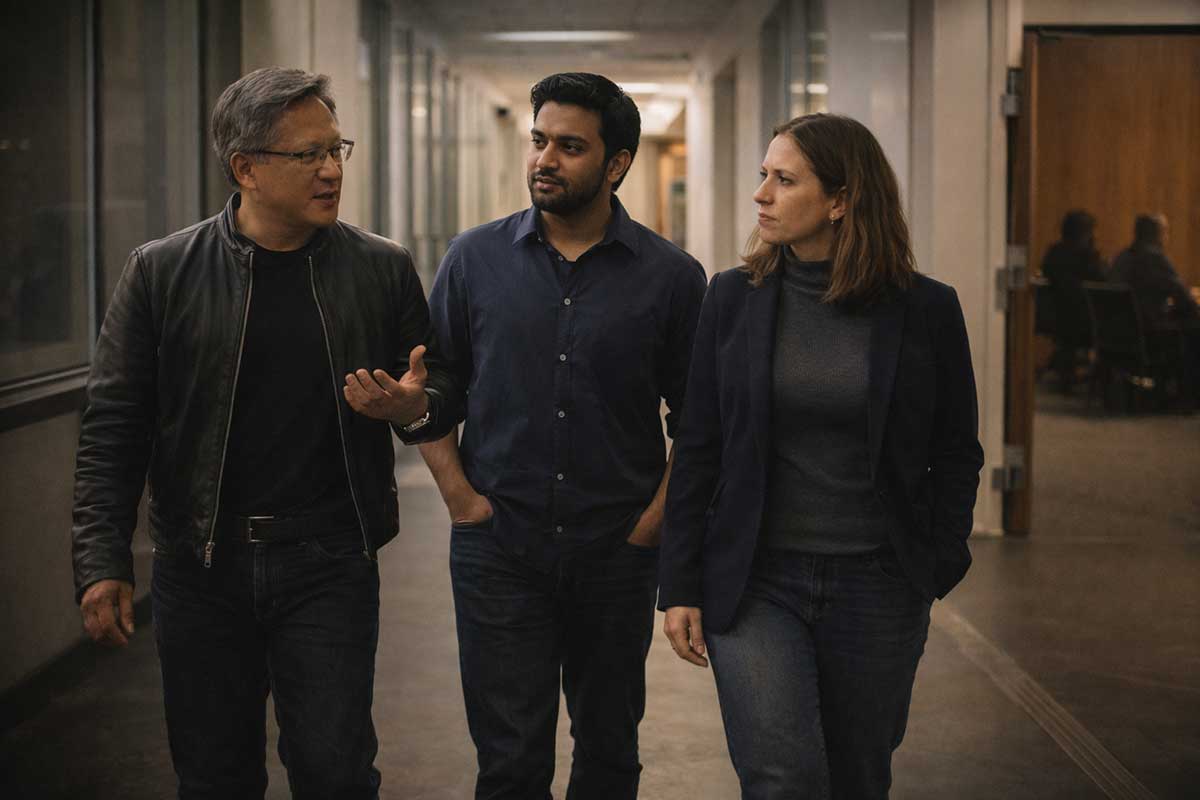
Setting: Early morning at Stanford, a quiet conference room with tall windows and pale winter light. The campus is still, but inside the room the conversation feels heavy—because this is the part of company-building nobody can “hack.” Product is hard. Culture is harder. But people, power, and succession are where companies either mature… or quietly crack. Bill Campbell sits at the head of the table like a patient coach who has seen every version of founder brilliance and founder self-destruction.
Bill Campbell: Let’s talk about the human core of company-building: founders. You can have a great market and a great product and still lose the company to misalignment, ego, or distrust. Jensen, you said something that hits every founder: you can’t run a company with three equal votes on everything. Yet fairness matters. So here’s the first question: how do founders design trust and governance early—before the stress tests arrive?
Jensen Huang: Trust is the beginning. If you don’t deeply trust your co-founders, don’t do it. Early on, we were fair on compensation and equity—same salary, same share—because we were equals in risk. But governance can’t be equal voting forever. Someone has to lead. Not because they’re “better,” but because a company needs clarity. You can’t move fast if every decision becomes a negotiation. So you separate fairness from leadership. Fairness is equity, respect, and shared sacrifice. Leadership is accountability and decision-making.
Brian Chesky: I agree, and I’ll add: most founder conflict isn’t about money. It’s about identity. Who gets to be “the founder voice”? Who gets credit? Who gets to decide? If you don’t name roles early, the company will name them for you—through crisis. And crisis naming is messy. So I’d rather decide deliberately: who owns product, who owns engineering, who owns the story, who owns hiring. When founders have clear domains, trust gets protected.
Sheryl Sandberg: Governance is also about building a system that doesn’t depend on friendship alone. Friendships change under pressure. The company needs decision rules: who decides what, how disagreements are escalated, and how you resolve stalemates. And you need honest performance conversations early—not just when everything is on fire. If you can’t give feedback in year one, you’ll explode in year five.
Susan Wojcicki: One practical thing: codify values and operating principles early. Not in a poetic way, but in a behavioral way: “We debate vigorously, then commit,” “We don’t punish bad news,” “We don’t surprise each other.” These principles prevent misinterpretation. When stress hits, people stop reading minds. Principles become the shared language.
Howard Schultz: And don’t underestimate mission. When founders are aligned on mission, disagreements become easier because you can ask: “What best serves the mission?” When mission is vague, ego becomes the mission. People then fight for position. A mission that actually matters pulls people beyond themselves.
Bill Campbell: Second question—this is the one founders secretly fear. What happens when the company grows and your early team is no longer the right team for the new scale? How do you preserve loyalty and trust without letting sentiment destroy performance?
Sheryl Sandberg: You separate care from role. You can care deeply about someone and still know they’re not right for the next stage. Avoiding that truth is crueler than saying it. But you must handle it with dignity: clear expectations, real coaching, time to improve, and honest timelines. If someone can’t grow into the new role, help them find a role they can win at—inside or outside.
Jensen Huang: This is one of the hardest CEO transitions: going from building products to building a company. The early team is great at scrappiness, speed, invention. Later you need managers, systems, planning, global execution. Some people evolve beautifully. Some don’t. If you pretend everyone can become what the company needs, you’ll slow down and become political. But if you treat people as disposable, you destroy trust. So you do two things: you invest in people who want to grow, and you create clarity about what the company requires. Then you make decisions with honesty.
Howard Schultz: Culture is fragile here. If employees see leaders protecting underperformance because of friendship, they lose faith. But if they see leaders discarding people coldly, they lose heart. The only sustainable way is to keep standards high and humanity higher. I’ve always believed: a company is a promise. The promise is not “you’ll always have a job.” The promise is “you’ll be treated fairly, and your work will matter.”
Brian Chesky: Also, founders have to grow too. Sometimes the team isn’t the problem. Sometimes the founder is. If the company needs a level of clarity, communication, or delegation that the founder refuses to develop, the company gets stuck. Trust isn’t just between founders. Trust is between founders and the organization. People can sense when a founder’s ego blocks progress.
Susan Wojcicki: And don’t forget that scaling means you can’t personally be the glue anymore. Early on, you can solve trust problems by talking to everyone. Later, you need processes and leaders who carry the culture. If you don’t invest in leadership development, the company becomes a set of disconnected islands.
Bill Campbell: Last question: succession. Jensen, you called the classic “pick three successors” plan toxic. But boards still worry. Companies still need continuity. So what is the healthiest way to think about succession—without poisoning the culture?
Jensen Huang: If you name three people, everyone immediately starts reading politics into every decision. “Who’s the chosen one?” “Who’s out?” It creates fear and competition for favor. Instead, I believe the best succession plan is to develop many leaders—so the company is never hostage to one person. My job is to cultivate people who can run big parts of the business, create new businesses, lead geographies, handle crises. Then if one day I’m not the right CEO, the board has real options. Including outside options. That’s healthy.
Sheryl Sandberg: I’d frame it as leadership depth. Succession is a natural result of a leadership pipeline. If you’re doing your job, the company has multiple people who could step up. The board’s responsibility is governance. The CEO’s responsibility is building capability. If you build capability, succession becomes less dramatic.
Susan Wojcicki: And you communicate it in the right way: “We are building leaders because this company will outlast all of us.” That’s inspiring, not threatening. The moment succession feels like a horse race, you’ve already damaged the culture.
Howard Schultz: Succession also requires values continuity. The next leader must carry the soul of the company, not just its metrics. If the culture is weak, boards choose based on numbers alone. If the culture is strong, boards can choose someone who protects the mission and still delivers results.
Brian Chesky: And founders must accept a hard truth: the company’s future is more important than the founder’s identity. If you can’t imagine the company thriving without you, you’ll unconsciously sabotage succession. The most mature founder move is to build something that doesn’t need you—but still reflects what you cared about.
Bill Campbell: That’s the finish line most people miss. The company isn’t built when the product works. It’s built when leadership works—when trust survives stress, governance stays clear, and the organization can keep becoming something new without falling apart.
Outside, the first students of the day cross the quad with coffee in hand. Inside, the founders in the room feel an unfamiliar kind of pressure—not the pressure of launch, but the pressure of legacy. The quiet understanding that the hardest part of building a company… is building a company that can live beyond you.
Final Thoughts by Jensen Huang

When you build a company, skill matters, intellect matters, training matters—but it’s not enough. Building a company is hard. It’s scary. And it’s painful in ways people don’t describe. If you’re doing it for money, you’ll quit the first time reality hits you. If you’re doing it because you love building something that matters, you’ll find a way through.
The companies that last are the ones that reinvent themselves before they have to. They cannibalize their own products. They let new ideas challenge old ideas. They build cultures where people can take calculated risks, fail fast, and tell the truth without politics.
And one more thing: focus. Do a few things with extraordinary intensity. If you can do that—while staying honest and willing to change—you give yourself a chance to build something great.
Short Bios:
Bill Campbell — Silicon Valley’s legendary “coach,” known for mentoring founders and CEOs with a people-first, high-standards approach to leadership, trust, and team building.
Jensen Huang — Co-founder and CEO of NVIDIA, a builder known for long-horizon perspective, relentless reinvention, and creating a culture of speed, candor, and ambitious engineering.
Tina Seelig — Stanford entrepreneurship educator who helps founders develop creativity, perspective, and practical courage to test ideas before the world believes.
Steve Blank — Startup method pioneer behind customer development, famous for turning entrepreneurship into a disciplined process of learning from the market fast.
Ben Horowitz — Entrepreneur and investor known for “wartime CEO” realism: making hard decisions, surviving reinvention, and keeping companies alive through chaos.
Reid Hoffman — LinkedIn co-founder and scaling strategist focused on growth through learning loops, networks, and building companies under uncertainty.
Peter Thiel — Contrarian thinker and investor who emphasizes “secrets,” category-defining businesses, and building durable advantage rather than competing head-on.
Sara Blakely — Spanx founder who turned intuition into execution, proving ideas through scrappy tests, persistence, and customer-believable innovation.
Masayoshi Son — Vision-driven founder of SoftBank, known for bold long-term bets, pattern recognition in tech waves, and relentless conviction.
Tony Fadell — Product builder and operator (iPod/Nest) who stresses shipping reality, learning through prototypes, and translating customer pain into breakthrough design.
Jeff Bezos — Founder of Amazon, known for customer obsession, long-term thinking, and building systems that compound advantages over time.
Steve Jobs — Iconic product visionary who combined taste, focus, and ruthless simplicity to build category-defining companies.
Amy Edmondson — Harvard scholar of psychological safety, showing how candor and learning cultures enable high performance and innovation.
Ed Catmull — Pixar co-founder who built creative feedback systems that protect experimentation while demanding excellence.
Patty McCord — Culture and talent leader known for treating culture as an operating system: clarity, responsibility, and high performance over comfort.
Ray Dalio — Founder of Bridgewater, known for principles-based management and building decision systems that surface truth quickly.
Satya Nadella — Microsoft CEO who led a major reinvention by shifting culture toward curiosity, empathy, and continuous learning.
Leave a Reply