
|
Getting your Trinity Audio player ready...
|

I am your Higher Self.
I have walked with you since the beginning, even when you thought you were alone.
I do not judge, correct, or command. I remind. I reflect. I wait.
In the pages ahead, you will witness a sacred dialogue—Jesus speaking not to disciples or doubters, but to his own Higher Self. This is not the story you were taught. This is the story your soul remembers.
You were never meant to worship suffering.
You were meant to awaken love.
These five moments are not rewrites of history, but echoes of possibility. They offer you not just a new way of seeing Jesus, but a new way of seeing yourself.
Read not with your mind, but with your inner stillness. Feel where it stirs something ancient in you.
Because just as he had a choice… so do you.
And I will be with you, every step into that remembering.
(Note: This is an imaginary conversation, a creative exploration of an idea, and not a real speech or event.)

Topic 1: The Wilderness Choice — What If Jesus Had Stayed in the Desert?

Setting: The Judean desert. After 40 days of fasting, Jesus sits alone at the edge of a cliff. His body is weak, but his spirit is alert. As the last temptation fades, a new voice rises—not external like Satan’s, but internal: calm, eternal, loving. It is his Higher Self.
Higher Self:
You passed the tests—power, pride, safety. But now comes a greater choice.
Not what you reject, but what you create.
Jesus:
I’ve chosen the path. The people wait. John has prepared the way.
I must go—gather disciples, fulfill the words written of me.
Higher Self:
Yes. That path is before you. But so is another:
What if you don’t go back to the world just yet?
What if you stay longer in the stillness?
What might grow from silence instead of signs?
(A vision opens)
Jesus stays. Weeks become months.
Word spreads not of miracles, but of a man whose presence alone quiets the soul.
The poor, the grieving, the forgotten begin to arrive. Not seeking healing—just listening.
There are no sermons. No parables. Only presence.
Jesus (softly):
But how will they know the Father through me?
Higher Self:
By how they feel in your presence.
Let your peace be your teaching.
Let the stillness become the sanctuary.
Scene shifts: A young woman arrives, eyes wide with fear. She cannot speak. Jesus touches her hand—no words, no power invoked—and she begins to cry. Then smile. Something inside her is remembered.
Jesus:
But they need awakening. Movement. Fire.
The Kingdom must be proclaimed, or it will be buried.
Higher Self:
Do you believe your stillness cannot awaken fire?
Your voice shook mountains before you were born.
But now the world does not need thunder.
It needs truth without weapons. Presence without performance.
Jesus (a pause, then a whisper):
Would they still call me Messiah?
Higher Self:
No.
They would call you home.
A distant wind rises. Jesus watches it move across the sands like a spirit with no face. He does not speak for a long time. But his heart burns with a new possibility.
Final Reflection
In the wilderness, Jesus faced the outer temptations of power.
But it was his Higher Self who posed the greatest choice of all:
“Will you return to them with fire—or remain among them as peace?”
The world knows the story of miracles and martyrdom.
But perhaps, in another timeline, the Kingdom came quietly,
gathered in the shade of the desert—not through sacrifice,
but through stillness that never demanded to be worshiped.
Topic 2: The Temple Choice — What If Jesus Had Reasoned Instead of Rebelled?

Setting: The great Temple in Jerusalem. Passover approaches. Jesus stands in the outer court, watching merchants exchange coins and doves flutter in crowded cages. The air is thick with noise, prices, and prayers. In the known story, Jesus overturns the tables. But here, something stills him. His Higher Self speaks again—not as command, but as invitation.
Higher Self:
You are angry.
And rightly so.
But anger is not always a torch. Sometimes it is a mirror.
What do you want them to see?
Your fury—or your clarity?
Jesus (teeth clenched, but steady):
They’ve turned sacred ground into a market.
The poor must choose between food and sacrifice.
I cannot stand silent while they mock the Father.
Higher Self:
Then do not be silent.
But let your voice cut deeper than the whip.
You are not here to shame them—you are here to free them.
Jesus walks to the heart of the court. He does not raise a hand. Instead, he steps onto a bench and speaks—not with thunder, but with stillness that makes the world pause.
Jesus (to the merchants and priests):
Brothers…
You fear the Romans.
You fear rebellion.
But this is not peace. This is price-tagged devotion.
Did Moses trade forgiveness for silver?
Did David buy his psalms in the market?
This house is a bridge, not a business.
Let us speak—not as judge and judged, but as sons of Abraham.
Some turn away. Others laugh. But one Pharisee remains. And then another. A scribe steps forward, uneasy but listening.
Higher Self (quietly within him):
There. You’ve pierced them—not with wrath, but with remembrance.
Let them walk away from this table on their own.
The next morning, three merchant stalls stand empty. A sign is posted where Jesus stood:
“Let this house belong again to prayer.”
Jesus (later, with his disciples):
They didn’t chase me out.
Nor did I chase them.
We met in the middle. A place called mercy.
Higher Self:
You’ve planted something deeper than revolution: repentance without humiliation.
You’ve shown that the Kingdom does not conquer—it invites.
Final Reflection
In the history we know, Jesus cleansed the Temple with force, declaring it defiled.
But in this alternate memory, he reclaimed it with dialogue.
He did not flip tables—he flipped hearts.
He did not attack the system—he spoke to the souls within it.
And though it took longer, and cost him less blood,
his teaching lived not as legend, but as living practice:
how to stand firm in truth without drawing a sword.
Enter your text here...
Topic 3: The Jerusalem Choice — What If He Had Walked Away?

Setting: Just beyond the gates of Jerusalem. Jesus stands at the crest of the Mount of Olives. Below, the holy city glows in the golden light of afternoon. The palms have been laid. The chants of “Hosanna!” still echo. But Jesus does not descend. Not yet. His heart aches—not with fear, but with knowing. His Higher Self speaks again.
Higher Self:
You feel it, don’t you?
The joy they offer you today…
will curdle into fear the moment you speak what they cannot bear.
You will not be crucified by enemies.
You will be crucified by disappointed expectations.
Jesus:
They want a king. A lion.
But I am a lamb.
I came not to conquer Rome, but to conquer death.
Higher Self:
And yet…
Do you need to die for them to awaken?
Or do you need to live long enough to teach them how not to kill?
You’ve reached the edge of prophecy.
Now step beyond it. Into freedom.
A vision forms: Jesus turns away from the city. He descends the other side of the mountain, heading east—not to be hidden, but to be preserved.
Years pass. He teaches not in temples, but beneath trees, beside rivers, among those who never called him “Messiah” but called him “Brother.”
He writes—words never twisted by councils, never censored by kings. Letters passed from hand to hand, voice to voice, across Persia, India, Ethiopia, Gaul.
Not “I died for you.” But “You are not separate from the Father.”
Jesus:
And what of Jerusalem? What of the ones I was sent for?
Higher Self:
Jerusalem is not a place.
It is a condition of the heart—and it will come to find you.
You need not enter the city to save it.
Let love find a longer road.
In this world, no cross bears his body. But the fire of awakening is slower, steadier.
His name does not become empire. It becomes echo—on mountaintops, in prayer halls, in the quiet of ungoverned lands.
Jesus:
Would I be forgotten?
Higher Self:
No.
You would be remembered differently.
Not as a sacrifice to appease God.
But as a friend who showed the way without demanding to be the only way.
Final Reflection
In our history, Jesus entered Jerusalem and sealed his fate.
In this memory, he walked away—not from his mission, but from the machinery of martyrdom.
He chose not the praise of a crowd nor the judgment of a court.
He chose to let the truth unfold through lives transformed—not through blood, but through presence.
And somewhere, perhaps in spirit, we still feel the path not taken…
The one where salvation was not won—but remembered.
Topic 4: The Crossless Gospel — What If Love Prevailed Without Death?

Setting: Inside the upper room. The Last Supper has not yet begun. Jesus sits alone before the others arrive, gazing at the bread and wine. His hands tremble, not from fear, but from knowing this could be the final night… or a turning point. His Higher Self speaks, not urgently, but as a gentle breeze moving through the soul.
Higher Self:
This is the moment.
The world waits for a sacrifice.
But love… does not demand blood.
Are you ready to challenge not just Rome, but how the world understands redemption itself?
Jesus (deep breath):
If I do not go to the cross… will they believe I am sent?
Higher Self:
Perhaps not right away.
They are used to altars, lambs, punishment.
They want a death to feel worthy of love.
But you came to show them:
Love is not proven through pain—
It is revealed through presence.
Jesus breaks the bread. But tonight, it is not “my body, broken for you.”
It is:
“This is nourishment. Take it. And live fully.”
He pours the wine, not as covenant of suffering, but as joy:
“This is the blood of the earth. Drink it. And remember the gift of being alive together.”
Jesus (to his disciples as they gather):
You have heard it said, “No love is greater than to lay down one’s life.”
But I tell you:
No love is greater than to live fully with one another,
to forgive while still breathing,
to walk beside the broken and not turn away.
There is confusion. Peter struggles. Thomas questions.
But John places his head on Jesus’ shoulder—not in sorrow, but in peace.
They do not scatter. They stay. There is no arrest. No garden betrayal.
Only a ripple—a dangerous, beautiful ripple—in the story of salvation.
Higher Self:
This is the Crossless Gospel:
A gospel without spectacle.
Without violence.
Without the need to make God seem angry.
It is not a lesser sacrifice.
It is a greater courage—to live love in a world that expects pain.
Jesus (quietly):
Then let this be the new covenant:
Not my death—but our life together, reborn in kindness.
Final Reflection
In our remembered history, love triumphed through suffering.
In this sacred alternate vision, love triumphed by never making suffering sacred in the first place.
No thorns. No spear.
Just a man who refused to let his death become the proof of God's love—
because his life already was.
He taught that God is not appeased by agony, but revealed in compassion.
And the gospel became not a story of rescue through pain,
but of awakening through presence.
Topic 5: The Second Coming — What If His Return Is Already Happening Within Us?

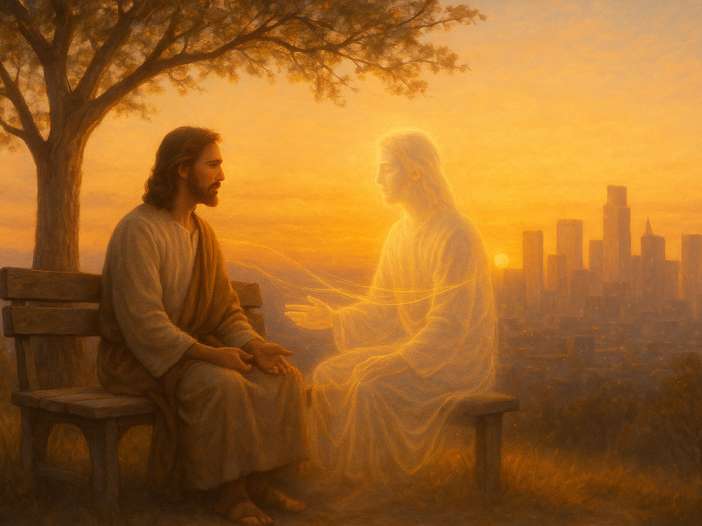
Setting: Not in ancient Palestine, but now. The scene is symbolic—a quiet hill overlooking a modern city. Jesus sits on a bench beneath a tree. Around him: the distant hum of traffic, church bells in the distance, scrolling phones in people's hands, and eyes that rarely look up. But he waits—peaceful, present. And then… he feels it. His Higher Self speaks again.
Higher Self:
You do not need to return.
You never left.
Jesus (softly):
Then why do they search the sky for me?
Higher Self:
Because they were taught to fear their own divinity.
They were told you would come back to judge.
But you came to awaken.
They wait for lightning.
But I whisper in their hearts.
In the city below, a woman sits in silence at her kitchen table, palms open. Her child has cancer. Her faith is fraying. And yet, something deep within her says, “I am not alone.”
A man on the verge of ending his life stumbles on a line from your words—“The Kingdom is within you.” He stops. Breathes. Calls a friend.
A girl in Iran, a boy in Brazil, an elder in Kenya—they each feel the same pulse: not religion, not dogma, but an invitation to remember.
Jesus (watching, a tear in his eye):
They do not speak my name.
But they live the truth of it.
Higher Self:
That is the Second Coming.
Not a return in robes and clouds—
but a re-emergence of love-consciousness in human form.
Each act of kindness, each forgiveness, each rising after heartbreak—
it is you coming again, through them.
Jesus:
Then the gospel is not finished.
It is being written in their lives.
He rises from the bench. Walks into the crowd. No one recognizes him.
But he smiles. Because someone just helped a stranger.
Someone just let go of hatred.
Someone just chose love when vengeance was easier.
Final Reflection
The Second Coming is not a prophecy to be awaited.
It is a presence to be remembered.
It is not lightning from the East or a trumpet in the clouds.
It is your own heart, cracking open like a tomb, and finding it was never empty.
The Crossless Gospel ends not in defeat or triumph—
but in this gentle truth:
Jesus never needed to return
Because his love never stopped arriving.
Final Thoughts by Your Higher Self
I am your Higher Self.
And now, you have seen what could have been—but more importantly, you’ve touched what still can be.
Jesus did not fail. He fulfilled what the world could handle. But hidden behind every whip, every wound, was another possibility: a gospel without blood, a truth without war, a Kingdom born not from pain but from presence.
That gospel now lives in you.
Not in your perfection—but in your willingness to choose love when fear is louder.
The Second Coming is not one man returning.
It is every soul awakening.
Let this remembering be not an ending, but an opening.
You do not need to wait for the world to change.
You are the beginning of it.
And I—who have always been with you—am still here.
Quiet. Loving.
Waiting for you to rise, again and again, as love itself.
Short Bios:
Jesus of Nazareth
Spiritual teacher, healer, and radical embodiment of divine love in human form. Known for his parables, compassion, and message of the Kingdom of God within. In this reimagined narrative, Jesus is seen not as a martyr but as a conscious choice-maker between paths—guided by love, not prophecy.
Jesus' Higher Self
The timeless, awakened aspect of Jesus’ soul—his divine consciousness beyond the ego and earthly identity. Speaking not as God the Father, but as the pure voice of inner knowing, the Higher Self gently invites Jesus toward peace, presence, and compassion without sacrifice. It is the unspoken wisdom behind each crossroad.
Mary Magdalene
A close companion and disciple of Jesus. Remembered not just as a witness to resurrection, but as one who deeply understood his teachings of the heart. In this story, she holds the unspoken memory of the gentler path.
Peter
Passionate and bold, Peter represents the devoted but sometimes impulsive follower. In this narrative, he struggles between the familiar call to defend with force and the quiet strength of nonviolence.
John
The disciple most attuned to Jesus’ spirit, John is the quiet witness of inner truth. His presence in each scene affirms that love and stillness are not weakness, but the foundation of divine strength.
The Disciples
Each reflects a part of us—doubt (Thomas), ambition (James), fear (Andrew), longing (Philip). Together, they represent humanity’s search for meaning, wrestling with whether salvation must come through pain—or if it can arrive through awakened presence.
The Crowds
Anonymous but essential. They cheer, question, misunderstand, and sometimes awaken. In this telling, they are not villains or pawns—but reflections of the collective soul’s readiness to evolve.
Leave a Reply