

|
Getting your Trinity Audio player ready...
|
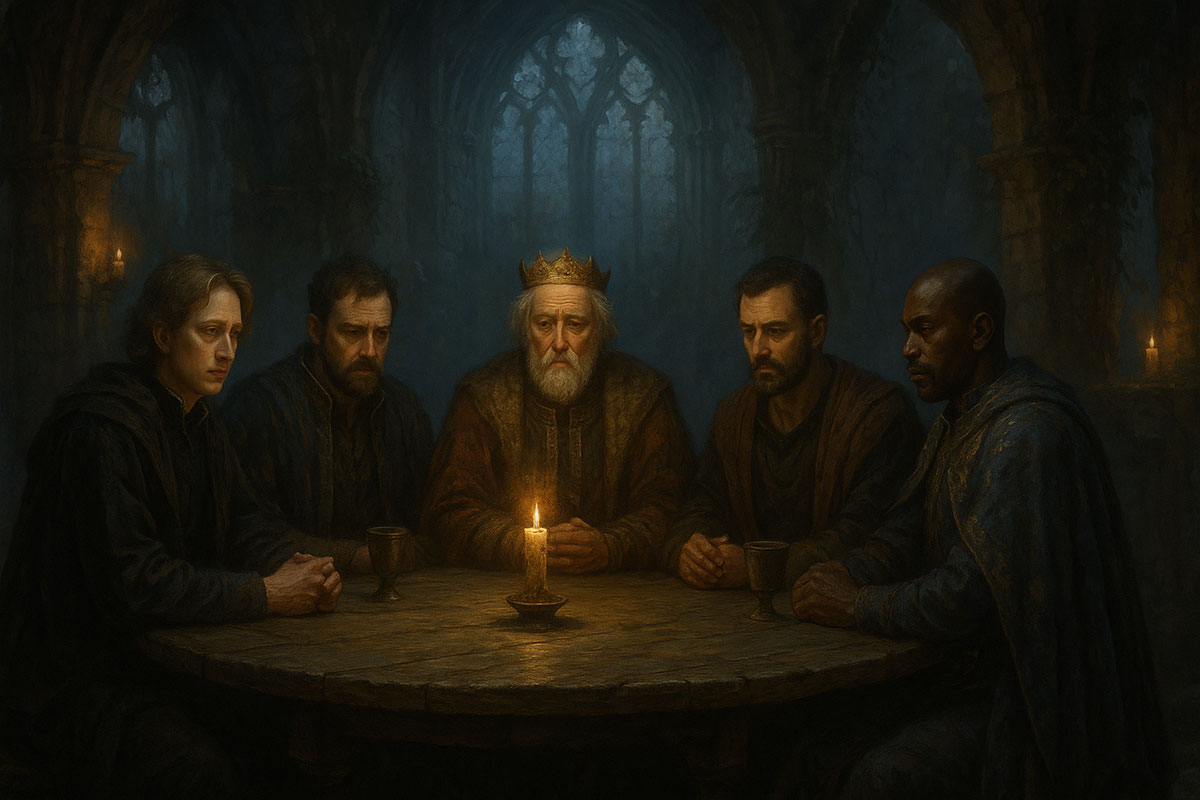
William Shakespeare:
(A figure steps from the edge of candlelight. No longer young. No longer god of the quill. Just a man. His voice trembles—not with fear, but with the weight of what he remembers.)
I once called you kings,
Philosophers draped in flesh and torment.
You were my thunder.
My riddle.
My bloodied crown of thought.
I gave you soliloquies and shadows.
Taught you how to bleed with eloquence.
Set fire to your hearts and called it tragedy.
And the world—
The world applauded.
But now I wonder…
Did I create you to teach the world?
Or to teach myself?
You were never just words.
You were warnings.
You were wounds.
And so I call you forth again—not to perform,
But to speak freely.
Not to die again,
But to reclaim yourselves.
Let the audience vanish.
Let the curtain stay closed.
Tonight, the crown is off.
And you may speak as men.
(Note: This is an imaginary conversation, a creative exploration of an idea, and not a real speech or event.)

Topic 1: “Did We Fall… or Were We Always Falling?”
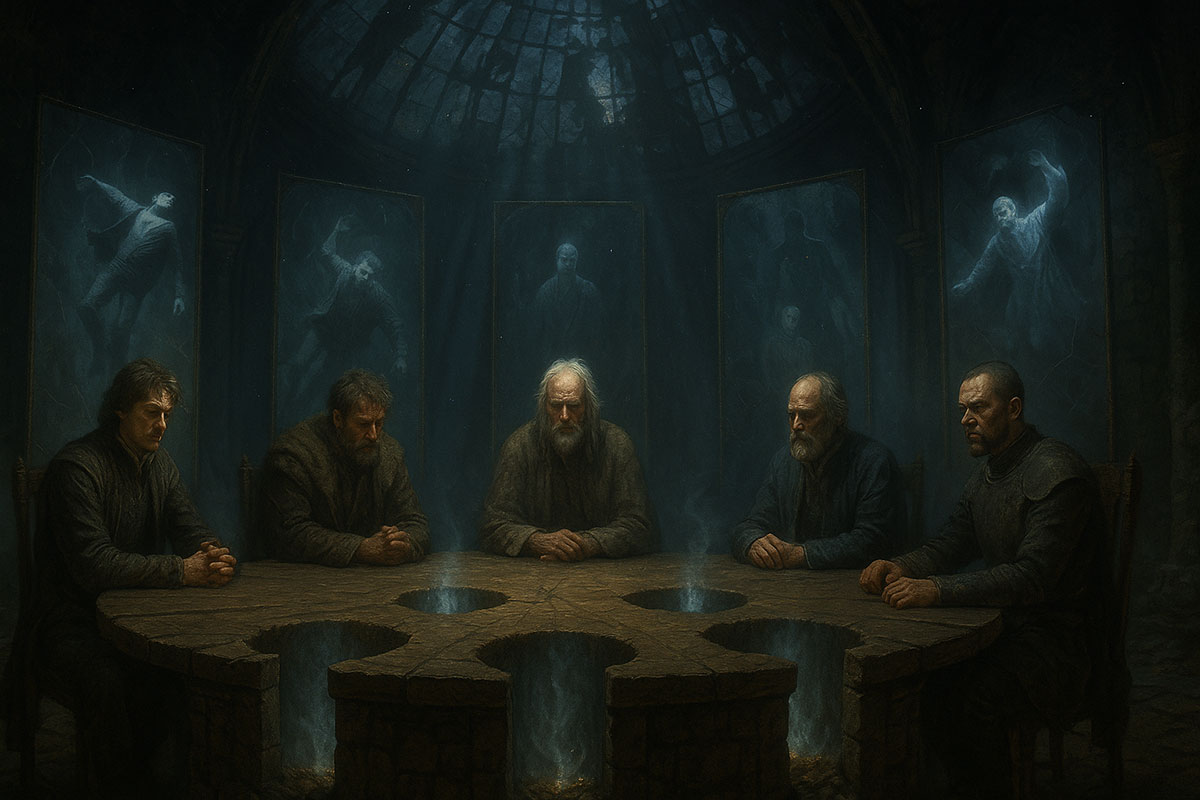
Setting:
A candlelit roundtable deep within a crumbling stone keep, its windows shattered, its floor dusted in ash and time. The five men sit at uneven angles, their chairs thrones once, now hollow frames. Wind moans through the halls. Overhead, broken banners sway. And from the dark steps behind them, a familiar voice speaks—not as a kingmaker, but as a man humbled by what his pen has wrought.
 Opening by William Shakespeare
(He enters through shadow. Thin, aged, not as playwright but as penitent.)
Gentle ghosts…
Each of you once thundered from my page.
Crowned in soliloquy, cloaked in war,
Haunted by dreams I dared to write.
But I ask now—not as your maker,
But as a man undone by memory:
Were you always falling?
Or was there a moment—one sharp turn—
Where fate slipped beneath your heel?
Speak.
The world still listens.
 Question One:
“Was your downfall the result of a single decision—or the slow unraveling of something already broken within?”
Brutus (measured, voice lined with guilt):
I thought the knife was my first step downward. But now… I see the fall began with silence. When I began to believe virtue could be sharpened into a blade, I was already tumbling. I mistook honor for duty—and duty for destiny.
King Lear (his voice cracked like the walls around them):
Mine was pride… not sudden, but grown like rot in old wood. I fell the day I demanded love in words, not deeds. The crown did not break me. My need to be adored did. I was already sinking—my daughters merely lit the lanterns as I descended.
Hamlet (tilting his head, thoughtful):
Falling? I was born at the bottom. The court, the ghost, the lies—none surprised me. I did not fall. I waited to fall. My delay was not cowardice, but recognition: truth is not a blade—it is a mirror, and I dared to look.
Othello (firm, but with sorrow):
I fell the moment I doubted her. That doubt—planted, yes—but I watered it. Fed it. No man taught in war should ever make love a battlefield. Yet I did. It was not one blow, but a thousand cuts… from my own hand.
Macbeth (darkly):
I was never standing. Only hungry. The witches? They merely named what I already craved. My wife? She poured courage into my thirst. But the throne? The fall began the night I called fate my servant. I didn’t trip—I leapt.
Question Two:
“Did anyone try to stop you? And… if they did, why didn’t you listen?”
King Lear:
Cordelia. My fool. Even Kent. They wept, pleaded. But pride is a loud wind—drowning out love. I thought silence meant rebellion, not truth. I mistook gentleness for insult. A king who cannot hear a whisper deserves the storm.
Macbeth:
Banquo warned me with eyes, not words. And Macduff? He was thunder. But I had tasted power. And power silences prophecy. I did not listen because I did not want to stop. That is the darkest truth of all.
Brutus:
Cassius pulled me, yes—but Portia… Portia saw the crack. She held my hand with shaking truth. I did not listen because I feared she was right. Because sometimes a whisper of love is more terrifying than a roar of war.
Hamlet:
Horatio tried. Always. But reason to a grieving son is like rope to a drowning man—useful, but easy to refuse. I needed not advice. I needed… permission. And no one gave it.
Othello:
Desdemona. She begged without begging. Her innocence was louder than Iago’s poison. But I listened to the storm, not the silence. I mistook stillness for deceit. Her truth was too pure—I feared I was not worthy.
Question Three:
“If you could speak to the man you were—before the fall—what would you say to him now?”
Macbeth:
I would say, “Go home.” Hold your wife. Sleep. Let the crown rust. Not every vision is prophecy. Some are just shadows of hunger. And hunger… lies.
Othello:
I would whisper, “Trust her.” That’s all. Not in war, not in command—but in love. I wore her trust like armor and broke it like glass. I would beg him to see her, not just own her.
Hamlet:
I would tell him, “Ask the question out loud.” Don’t let it rot inside. Let the doubt breathe. Not every ghost must be obeyed. Not every play needs a final act of blood.
Brutus:
I would kneel before him and say, “You are enough without being noble.” The Republic will not love you more if you bleed for it. Love is not earned by sacrifice—it is revealed by truth.
King Lear (tears welling):
I would say, “Ask her again. Listen—truly listen. Do not measure love in flattery. Ask… and wait.” I would give up my kingdom for one more hour beside her silence.
Closing Words by Shakespeare
(He steps into the light, eyes rimmed with ink and regret.)
My lords of ruin,
I dressed you in grandeur
And watched you break.
Not one of you was born wicked—
Only human,
Cracked by dreams,
Shaped by wounds.
Perhaps that is the truth of all tragedy—
Not the fall,
But the forgetting
That we were falling long before.
Tonight, you remember.
And so, perhaps,
You rise.
Topic 2: “The Knife Behind the Curtain”
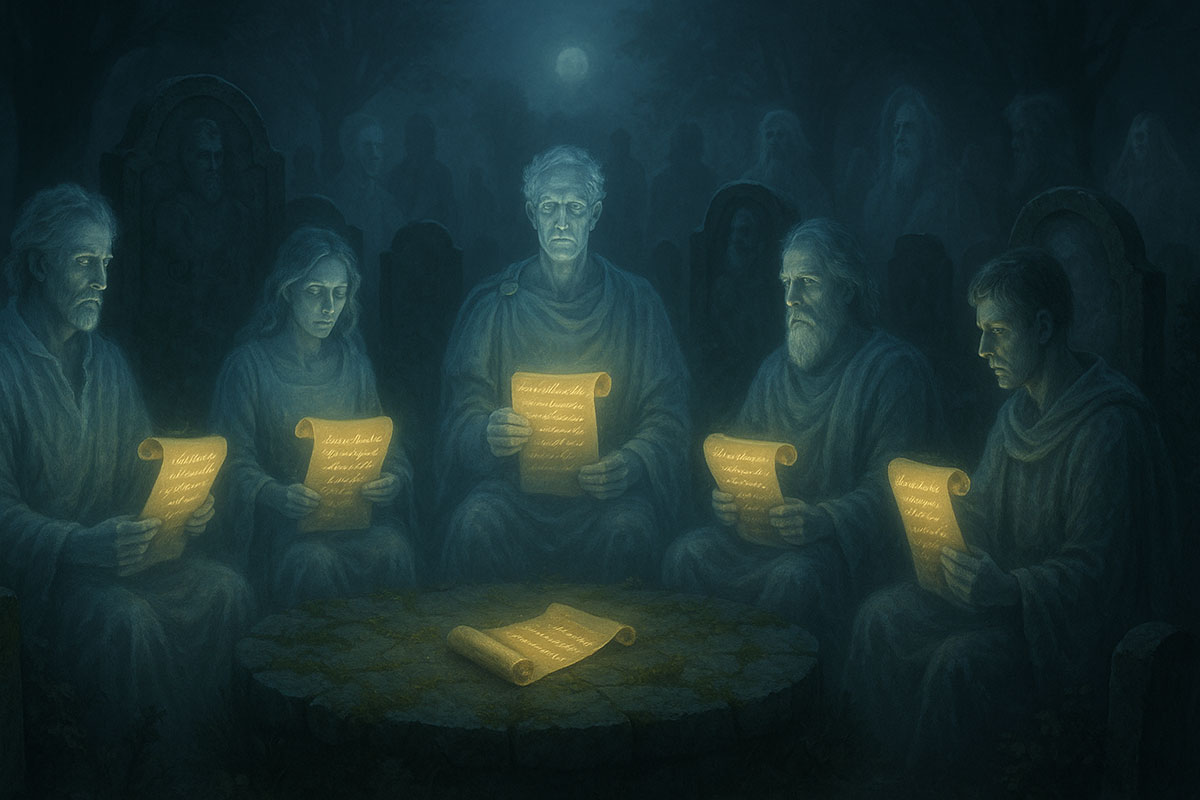
Setting:
The castle has grown darker. Candles burn lower. The roundtable now bears faint marks—scratches, dried stains, silent proof of past confessions. Wind whistles through the cracks in the stone. Five men sit not as rulers, but as remnants. The air smells of smoke and memory.
Shakespeare Enters Again
(This time, slower. As if bearing the weight of their wounds.)
Steel cuts flesh.
But words…
Words betray the soul.
You each held knives—
Some in hand, some in heart.
You were betrayed.
And you betrayed.
Now speak:
Where did the blade begin?
And where, if ever, did it end?
Question One:
“Who betrayed you the most deeply—and was it truly their fault?”
Othello (voice gravelled with grief):
Iago, yes. But deeper still—it was me. I betrayed myself when I believed the poison without proof. He opened the door, but I stepped through. The knife I gave him, I placed in my own hand.
Hamlet (dryly):
My uncle. Obvious. My mother, perhaps deeper still. Yet… the rot in Denmark did not begin with poison in a cup. It began with secrets. I was betrayed by a kingdom that feared truth.
Brutus:
Caesar. He loved me. Trusted me. And I… was the betrayer. But Cassius—he knew my ache for virtue. He fed it. Stoked it. The deepest betrayal was not the act—it was the illusion that it was righteous.
King Lear (shaking his head slowly):
Regan. Goneril. But no—they mirrored me. I betrayed Cordelia first. I told her that love must be spoken, performed. I punished her silence—and the world punished me back.
Macbeth:
Banquo. He did not betray me. And that… was the wound. His loyalty was so pure it became unbearable. I imagined betrayal to justify my guilt. The blade I feared was never drawn—but still, I struck.
Question Two:
“Whom did you betray—and have they forgiven you?”
Brutus (quietly):
Caesar. He bled at my feet. And as he fell, he looked not with rage… but with hurt. As if to say: ‘You, too?’ I do not think he cursed me. That is what breaks me most.
Macbeth:
My wife. She trusted me with the plan. I trusted her with the crown. And then… I drifted. Into paranoia. Into blood. I left her alone with ghosts. I do not think she forgave me. Not even in death.
Othello:
Desdemona. Her last breath was a whisper of love. I think… she forgave me as she died. That forgiveness is what damns me. It was pure. And I was not.
Hamlet:
Ophelia. I tore her apart with words I didn’t mean—and silence I did. Her madness was a mirror of mine. If she forgave me, it was not with words… but with water.
King Lear:
Cordelia. She came back. She fought for me. And I—wept too late. She forgave me not with speech, but with presence. She returned. That was her answer. And then she was gone.
Question Three:
“What did betrayal teach you—about yourself?”
Hamlet:
That I am not separate from the rot I hate. I held the blade of vengeance so tightly it bled me. I sought truth through destruction… and became a liar to myself.
King Lear:
That love cannot be commanded. It must be earned. And I had not earned it—not as father, nor as man. My betrayal was my blindness. And now, I see too late.
Brutus:
That righteousness without mercy is a knife dressed as a torch. I believed I was saving Rome… but I could not even save myself from Rome’s idea of me.
Othello:
That trust must begin within. I spent my life mastering men in battle, but not my own fear. I mistook suspicion for strength. And learned, too late, that love must be protected from within.
Macbeth:
That ambition eats its own. I did not betray to gain the crown—I betrayed because I thought I was nothing without it. My lesson? Power doesn’t fill the soul. It hollows it.
Closing Words by Shakespeare
(He returns to the edge of the light, almost trembling.)
They say betrayal is a wound.
But I say—
It is a mirror.
It shows us not just who turned away,
But who we chose to become.
Knives can be buried,
But memory cannot.
Tonight, you have not buried.
You have named.
And in naming…
You begin to heal.
Topic 3: “Was the Crown Worth It?”
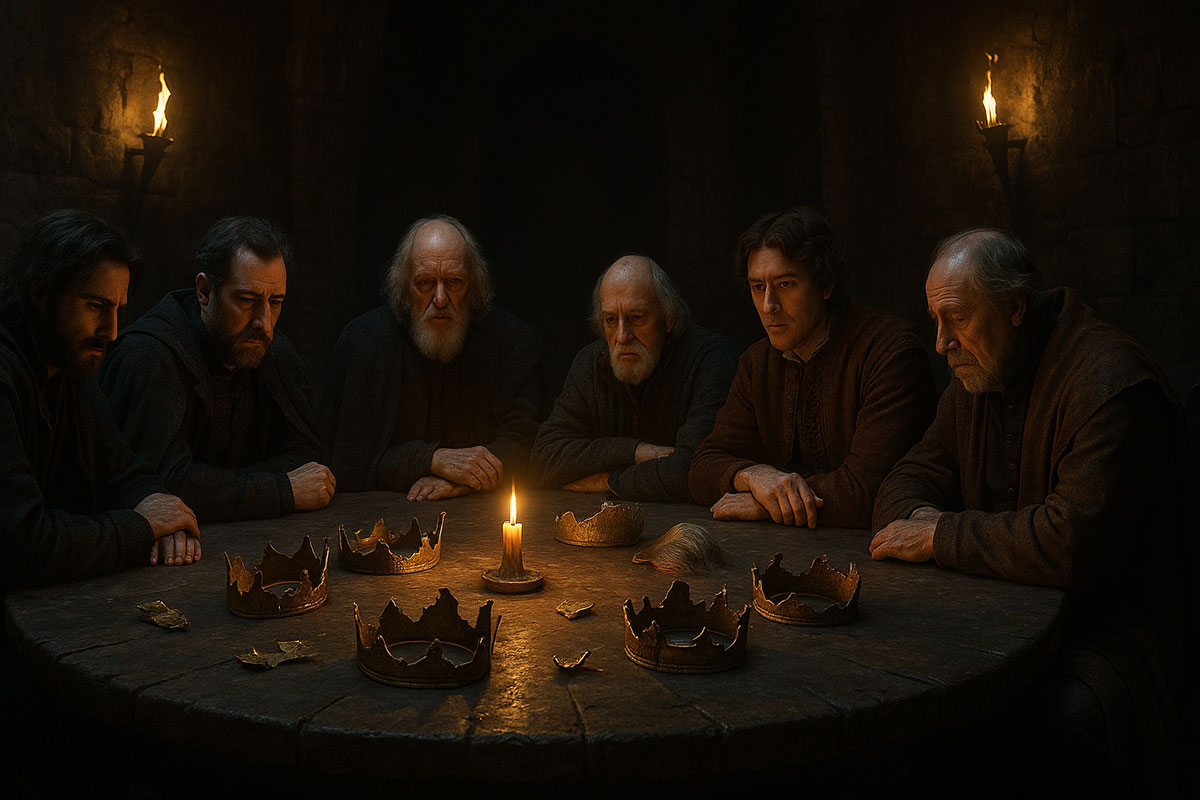
Setting:
The candles burn low now. Only a few still flicker. The roundtable seems heavier, cloaked in silence. Cracks in the ceiling drip slowly. Outside, the wind howls like a kingdom once cheered. Inside, five men sit in the afterglow of shattered empires—haunted by what they won, and what it cost.
Shakespeare Enters Slowly
(This time he limps slightly, as if each step carries the weight of a crown long shed.)
Ah, kings of blood and spirit…
You wore the crown—some of iron, some of honor, some imagined, and some thrust upon you.
But did it serve you?
Or did it consume you?
Tell me now—
Was it worth the climb… or was the view from the throne only a mirror of the fall?
Question One:
“When you first tasted power, what did it give you—and what did it take?”
Macbeth (leaning forward):
It gave me noise—cheers, fear, control. But it took silence. Peace. Sleep. I gained a title, but lost the sound of my own soul. The throne amplified my name… and erased my face.
Brutus:
I never sought a crown. But in removing one, I wore its shadow. The people called me savior… but I felt like a traitor in laurels. Power, even unclaimed, stains the hand.
Othello:
Command gave me order. Identity. A man of war is nothing without a banner. But it took vulnerability. I became a statue others saluted—never touched. Even Desdemona… I held her like a sword, not a flower.
Hamlet (wry smile):
I never wore it. But I held its weight in thought. The power to avenge. The power to delay. It gave me importance… but stole my rest. In trying to set things right, I twisted everything wrong.
King Lear:
I gave the crown away—thinking it a burden. But I only shed the gold, not the arrogance. It gave me a kingdom… then took it with thunder. Only when I was nothing did I see clearly.
Question Two:
“Did the crown—or your pursuit of it—make you more… or less of a man?”
Brutus:
Less. I became principle without flesh. A statue with a dagger. I forgot to bleed, to love, to tremble. Rome crowned my ideals, but unmade my humanity.
King Lear:
Less. I clung to title and flattery like armor—until I stood naked in the storm, raving and reborn. I had to lose my kingdom to regain my manhood.
Macbeth (quietly):
Less. I thought the crown would complete me. It only revealed the hollowness I’d been feeding. I became a beast dressed in velvet.
Hamlet:
Both. Power sharpened me. But it also froze me. I was thought without action, potential without peace. I was a prince of pause.
Othello:
Less. When I wore command, I forgot how to listen. Power wrapped me in armor—and I wore it even to bed. I lost the ability to feel without defense.
Question Three:
“If the crown was placed before you again—same path, same end—would you take it?”
Macbeth (after a pause):
No. Let it rust. Let another climb. The ghosts are too many, and the crown too quiet. I would rather be unknown… but alive in sleep.
Hamlet:
No. I would take a book, not a blade. I would walk away from Elsinore. Perhaps write poems. Or hold Ophelia’s hand until the noise stopped.
King Lear:
No. I would take Cordelia’s hand, not her silence. I would ask her what love meant… and believe her answer without royal proof.
Othello:
No. Let me teach young men to fight… but let me love without suspicion. Let me kneel before a woman—not before the applause.
Brutus:
No. Let Caesar live. Let Rome groan beneath his name a while longer. Better that… than my own name echoing through bloodied halls. I would choose love over legend.
Shakespeare's Final Reflection
(He holds a broken crown in his hands. Not golden. Just wood and cloth. He places it on the table.)
You each bore it.
Not just the crown… but the weight of it.
The voices. The expectations. The silence that came after.
And now I see—
A man does not become great by wearing a crown.
He becomes whole by knowing what he was without it.
If I wrote you again…
I would not give you kingdoms.
I would give you peace.
Topic 4: “If We Had Just One Hour Back…”
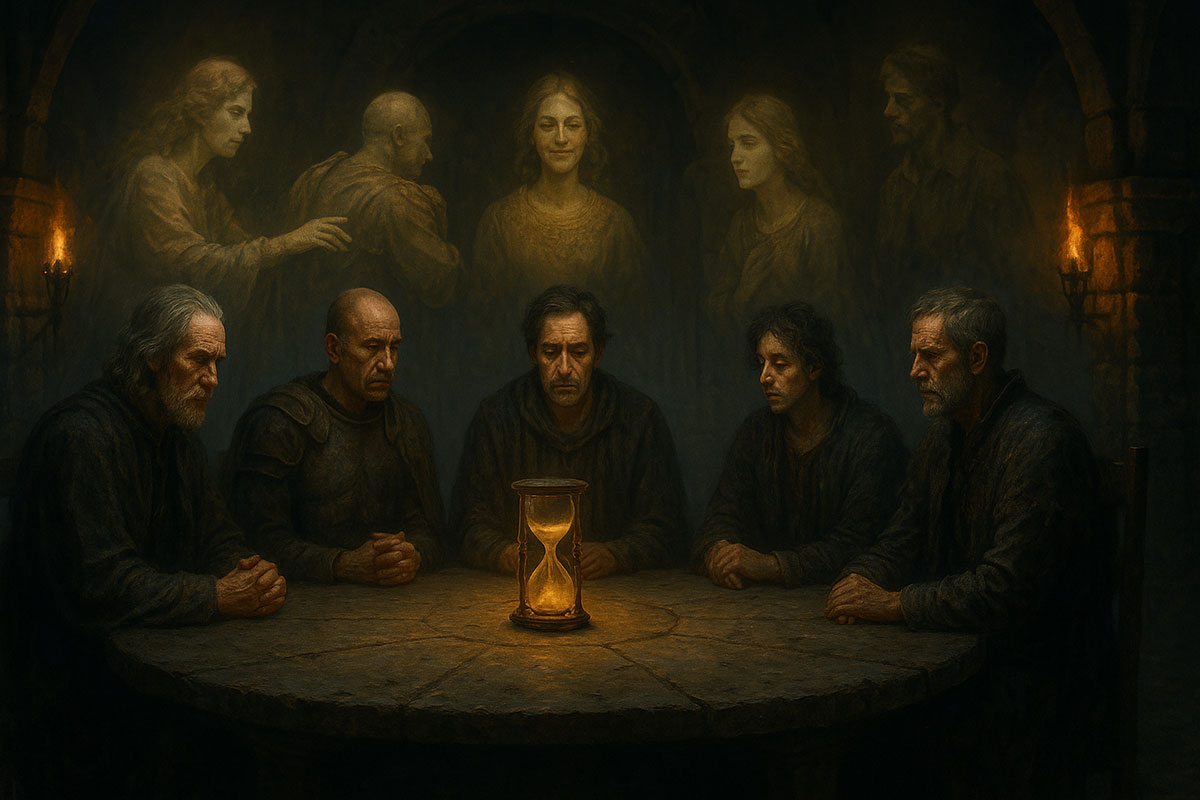
Setting:
The last candles are guttering. The roundtable is now half-lit, half-shadowed. Ashes settle in corners where once there was fire. A bell tolls faintly in the distance, as if from a chapel long abandoned. The five men sit motionless—shoulders heavier, eyes lowered. This is the hour of remembering what could have been.
Shakespeare Reappears
(He steps out of the dark, holding not a quill this time—but a small hourglass, half-spent.)
If I could grant you
Not a kingdom, nor vengeance, nor applause—
But merely one hour back…
Would you know when to spend it?
Let us not speak now of fate—
But of moments.
What moment… would you steal from Time?
Question One:
“Which single hour of your life would you return to—and what would you do differently?”
King Lear (soft, broken):
The hour Cordelia stood before me, silent but full of love. I would not shout. I would not mock. I would take her hand… and say, “That is enough.” And everything might have changed.
Othello:
The hour before I struck her. I would leave the room. Leave the sword. Sit beside her in silence and ask. Not accuse. Just ask. That one hour might have given me eternity.
Brutus:
The hour before the Senate. I would place the dagger down. Go to Caesar’s home. Tell him the whispers, the fear. I would say, “I trust you more than Rome.” And perhaps… that trust would’ve saved us both.
Macbeth:
The hour the witches spoke. I would laugh, shake it off, kiss my wife without poison in my heart. I would go hunting. Or build something. Anything but that path.
Hamlet:
The hour with Ophelia—when she came to me, hoping for clarity. I would hold her hand. Say, “Stay.” I would not lash out. I would not pretend. I would be real, just once.
Question Two:
“What stopped you from choosing differently in that moment?”
Brutus:
Fear. Not of Caesar—but of myself. I feared that if I did not act, history would call me coward. I traded friendship for a monument. And monuments do not love you back.
Hamlet:
Doubt. I doubted everything. My father’s ghost. My uncle’s guilt. Even myself. I let doubt become theater, until I couldn’t tell which lines were mine.
Macbeth:
Greed dressed as destiny. I thought fate spoke through prophecy—but really, it spoke through my thirst. I mistook suggestion for certainty. And once I moved—I could not stop.
King Lear:
Vanity. I wanted love performed. I could not see it quiet and deep. I punished truth because it did not wear a crown. That blindness… cost me everything.
Othello:
Pride. I believed my name could not be questioned. That a general must never be doubted. And in refusing to be seen as weak—I became the weakest man of all.
Question Three:
“If that hour were returned to you now… would you truly change it, or are you still afraid?”
Hamlet (after a long pause):
Yes, I would change it. I have seen too many graves. Felt too much cold. I would lay down the sword. Pick up a truth. Even if it broke me.
Macbeth:
I don’t know. Part of me still aches for the fire. But yes… yes. If I could walk away before the blood—I think I would. I think… I would choose life.
Othello:
I would change it. I would fall to my knees. I would let her see my tears before she saw my rage. I would speak love—not suspicion.
Brutus:
I would drop the blade. And raise a cup. To Caesar. To mercy. To Rome as it was—imperfect, but alive. Yes. I would choose peace.
King Lear:
I would fall silent. Listen to her silence. And believe it. The hour would not be filled with words—but with presence. I would choose love.
Closing Words by Shakespeare
(He turns the hourglass upside down. The sand begins again—but no one reaches for it.)
Men speak of kingship…
Of honor, of revenge, of duty.
But in the end,
It is the hour we could have changed
That haunts us most.
You have named it now.
And in doing so,
Perhaps the ghost of that hour…
Finally rests.
Topic 5: “Do We Still Matter?”
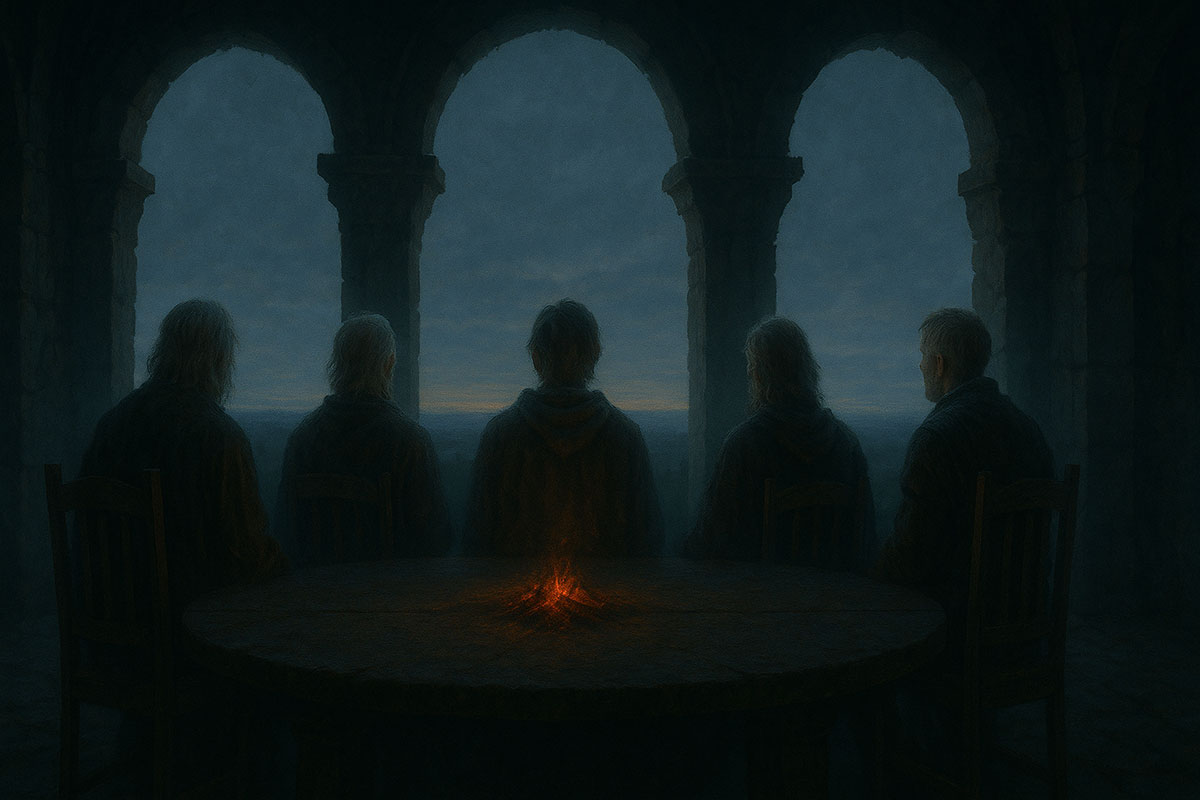
Setting:
Only embers remain in the sconces. The castle is nearly dark, lit faintly by dawn pressing through broken stone. The roundtable—once a place of ambition, confession, remorse—is quiet now. The five men sit in half-light, half-shadow, as if caught between being and remembering. This is not just a final topic—it is the question that echoes after the fall.
Shakespeare’s Last Arrival
(He steps in without a candle this time, his hands empty, voice low.)
You have wept.
You have confessed.
You have stood in the ashes of your kingdoms and asked for nothing…
But now I must ask:
Did it matter?
Do you matter still?
The world speaks your names.
But do they know your truths?
Let us speak once more.
Then… you may rest.
Question One:
“Do you believe your story still matters—or has it become just tragedy for others to consume?”
Brutus:
It matters—if they see the cost of ideals without love. Let them study me not as patriot or traitor, but as a man who let virtue become violence. If they learn mercy… then yes, it matters.
Hamlet:
To them, I am a quote. A mood. A skull in the hand. But if one soul pauses… pauses before striking, before deciding—then perhaps my madness had meaning. I hope I’m more than a melancholy prince.
Macbeth (looking down):
They remember the blood, not the man. But if they feel the hunger—and the hollowness after—then let my name stand. Not as a king… but as a warning.
King Lear:
I matter only if they see the father in the fool. Only if they remember that silence can be love. If they see how pride unravels the heart—then perhaps… I was not mad in vain.
Othello:
They remember my crime. I deserve that. But if they remember the whisper I spoke after—the grief, the horror, the broken man who loved too late—then yes. My pain may yet prevent another.
Question Two:
“What do you hope people remember about you… that they so often overlook?”
King Lear:
That I loved her. Cordelia. Not perfectly. Not wisely. But deeply. They remember my rage… but forget my regret.
Hamlet:
That I wanted peace. I did not seek revenge. I sought truth. And truth… is rarely clean.
Macbeth:
That I was afraid. That every step toward the throne was also a step away from my soul. I was not born cruel—I was consumed.
Brutus:
That I hesitated. That the knife did not leap. I paused. I wept. And that pause was the echo of a heart still trying to be good.
Othello:
That I loved her. Desdemona. That she was not my possession, but my light. I only saw that… when it was gone.
Question Three:
“Now that all is said and done… who are you, beyond your story?”
Hamlet:
I am a question. Not an answer. I am the space between thought and action. The breath before the word. And maybe… that’s enough.
Othello:
I am the soldier who wanted to be a husband. The general who forgot how to kneel in love. I am not my end—I am my ache.
King Lear:
I am an old man who learned too late. But I learned. I saw. And in that final seeing… I became more than a king.
Macbeth:
I am not the tyrant. I am the whisper in every man’s ambition that asks, “Will this fill you?” I am the silence after the deed.
Brutus:
I am the man who thought Rome needed saving. But truly… I needed saving from myself. I am the flicker of conscience in every hand that holds a blade.
Final Words by Shakespeare
(He circles the table slowly, placing his hand on each man’s shoulder as he speaks.)
You were never just kings and killers.
You were men—full of thought, fury, frailty.
And though your names are etched in blood,
Your truths are written in the silence between lines.
You still matter.
Because you still speak.
And we…
We still listen.
(He steps into the fading light. One last ember glows on the table. It does not flicker. It holds.)
Final Thoughts by William Shakespeare
(He returns to the table, candle in hand, placing it gently at the center. His eyes glisten, not from ink, but from tears.)
You have confessed what history forgot.
You have remembered what the world romanticized.
And you have shown me
That no man is only his ruin.
Hamlet…
Your question still echoes, unanswered—but sacred.
Macbeth…
Your hunger did not make you evil. It made you lost.
Lear…
You taught us that even broken crowns can weep.
Othello…
You remind us that love must be held, not conquered.
Brutus…
You proved that virtue without heart becomes a dagger.
You do matter.
Not because you were kings,
But because you were human—
And dared to speak your grief aloud.
If I could write you again,
I would write you softer.
But tonight…
You have rewritten yourselves.
(He gently blows out the candle. The light doesn’t vanish—it lingers. A slow-burning ember. Like memory. Like meaning.)
Short Bios:
William Shakespeare
Playwright, observer, and architect of kings and chaos. He gave voice to ambition, madness, betrayal, and love—only to spend eternity listening to the echoes of those he created. In this chamber of reckoning, he no longer writes… he witnesses. His tragedy was not authorship—it was understanding too late what his words truly wrought.
Hamlet
Prince of Denmark, thinker drowned in delay. Caught between vengeance and meaning, he pondered too deeply, acted too late, and broke the hearts that loved him. His tragedy was not indecision—it was awareness without peace.
Macbeth
A warrior turned king by force and fate. Driven by prophecy and poisoned by ambition, he murdered his way to the throne only to find the crown cold and heavy. His downfall was not wickedness—it was hunger ungoverned.
Brutus
Noble Roman, torn between loyalty to Caesar and love for the Republic. Guided by stoic virtue but undone by bloodied idealism, he became both hero and assassin. His tragedy was not betrayal—it was misplaced righteousness.
Othello
The Moor of Venice, general of glory, husband of heartbreak. He trusted command more than love, and in jealousy’s grip, destroyed what he cherished most. His tragedy was not rage—it was trust broken from within.
King Lear
A ruler who mistook flattery for love, and silence for defiance. In dividing his kingdom, he fractured his soul, discovering truth only through madness and loss. His tragedy was not folly—it was pride too long unchallenged.
Leave a Reply