
|
Getting your Trinity Audio player ready...
|

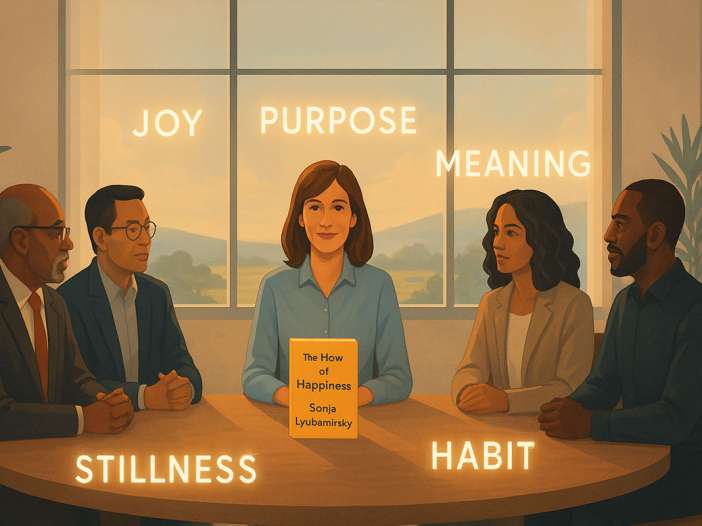
Sonja Lyubomirsky:
When I first began studying happiness, I never imagined it would become a global conversation. Back then, people believed happiness was mostly a matter of genetics or good luck—something you either had or didn’t.
But science tells a different story.
Decades of research—including my own—show that while 50% of your happiness is determined by your genetic set point, and 10% by life circumstances, the remaining 40% is within your control. That 40% is where intention lives. Where choice lives. Where transformation lives.
Happiness isn’t something we stumble into. It’s something we build—through gratitude, kindness, purpose, resilience, and connection. And yet, this pursuit isn’t just personal. When we become happier, we become more generous, more patient, and more resilient. Happiness radiates. It’s contagious.
So in these five conversations, I’ve invited brilliant minds—from economists to monks, psychologists to activists—to help us answer five essential questions:
- Is happiness a responsibility?
- Why doesn't wealth make us happy?
- Can we be happy in a broken world?
- What blocks happiness today?
- And finally, is lasting happiness truly possible?
Together, we’ll explore what gets in the way—and what brings us closer to the joyful, meaningful lives we’re capable of living.
(Note: This is an imaginary conversation, a creative exploration of an idea, and not a real speech or event.)

Topic 1: Is Happiness a Moral Responsibility?
Participants:
- Sonja Lyubomirsky (moderator)
- Dalai Lama
- Viktor Frankl
- Oprah Winfrey
- Rutger Bregman
Introduction (Sonja Lyubomirsky):
“Before we begin, let me share three core findings from my research. First, happiness is not a luxury—it’s linked to better health, stronger relationships, and greater productivity. Second, although 50% of our happiness is set by genetics and 10% by circumstances, a full 40% is shaped by our daily thoughts and behaviors. Lastly, happiness spreads—it’s contagious. When you’re happier, others tend to be, too.
So I ask: If we can choose to be happier—and it benefits others—do we have a moral responsibility to pursue it?”
❓“Does happiness carry a moral obligation—not just for ourselves, but for others?”
Dalai Lama:
“Yes, because genuine happiness cultivates compassion. A calm mind is less likely to hurt others. When you are happy, you reduce suffering in the world—first in yourself, then naturally in those around you.”
Oprah Winfrey:
“Absolutely. I’ve seen how personal joy lights a path for others. When you own your light, you give permission for others to do the same. It’s not indulgence—it’s stewardship of your energy.”
Viktor Frankl:
“No one can be ordered to be happy, but we all have a duty to seek meaning. In that search, happiness may emerge. Responsibility begins with asking not what we expect from life, but what life expects from us.”
Rutger Bregman:
“Yes, especially for the privileged. If your basic needs are met, then choosing cynicism or apathy is lazy. We have the tools to build a better society, and personal happiness fuels that effort.”
❓“If someone is deeply unhappy, do they owe it to others to try and heal—or is that unfair pressure?”
Oprah Winfrey:
“Healing is personal, but it affects everyone around you. You don’t owe people happiness—but you owe them your willingness to grow. Unchecked pain spills onto others. Choosing joy is also choosing peace for your circle.”
Viktor Frankl:
“It’s not about pressure, but invitation. Even in Auschwitz, I saw that those who held onto inner dignity helped others survive. The will to find light—even in darkness—is what binds us to each other.”
Dalai Lama:
“You cannot pour from an empty cup. First, you must nurture your own heart. Then, naturally, kindness flows outward. Effort is required, yes—but with compassion, not judgment.”
Rutger Bregman:
“We should support, not shame. But the data is clear—loneliness and despair are not just personal tragedies; they’re social costs. A society that encourages healing is investing in its collective future.”
❓“What would a world look like where happiness was treated as a shared social duty?”
Viktor Frankl:
“It would look like responsibility—where each person asks, ‘What am I here to contribute?’ Happiness would be a byproduct of living in service of something greater than the self.”
Dalai Lama:
“A compassionate world. Schools would teach emotional hygiene. Governments would protect mental well-being. Happiness would be seen not as soft, but strong.”
Rutger Bregman:
“We’d have universal basic income, shorter workweeks, and cities built for connection—not just profit. A society where we value well-being over endless growth.”
Oprah Winfrey:
“That world begins when we stop performing happiness and start practicing it. When we hold space for joy and for pain—because both are part of being human. The duty is not perfection, but presence.”
Closing Thoughts (Sonja Lyubomirsky):
“What I’ve learned is this: happiness isn’t selfish. It radiates. Choosing to be happier—through gratitude, kindness, purpose—is not just self-care, it’s moral care. We may not always feel joy, but we can always act in ways that increase it. And in that, we serve each other.”
Topic 2: Why Doesn’t Wealth Guarantee Happiness?
Participants:
- Sonja Lyubomirsky (moderator)
- Daniel Kahneman
- Naval Ravikant
- Morgan Housel
- Elizabeth Dunn
Introduction (Sonja Lyubomirsky):
“One of the most persistent myths is that more money equals more happiness. But research—including mine—shows that after a certain income threshold, the correlation weakens significantly. This doesn't mean money is irrelevant, but that its power is often overestimated.
So let’s ask: Why doesn’t wealth guarantee happiness—and what actually does?”
❓“Why do so many wealthy people still feel unfulfilled?”
Naval Ravikant:
“Because they chase freedom, but end up with golden handcuffs. Wealth without inner peace is just leverage on your neuroses. The real game is escaping the endless wanting—not winning it.”
Elizabeth Dunn:
“Wealth often shifts focus inward. But happiness thrives on connection. If your money isn’t helping you spend time with loved ones or do meaningful things, it becomes emotionally sterile.”
Daniel Kahneman:
“Our brains adapt quickly. What once thrilled you becomes background noise. That’s the hedonic treadmill. Without intentional effort—like gratitude or savoring—wealth offers diminishing emotional returns.”
Morgan Housel:
“People think money buys happiness, but what it really buys is options. If you’re not using those options to build a life you enjoy—calm mornings, meaningful work, trusted friends—then it’s just numbers.”
❓“Is there a right way to spend money to be happier?”
Daniel Kahneman:
“Yes—spend it on experiences, not things. And spend it in ways that reduce daily hassles and increase autonomy.”
Elizabeth Dunn:
“Our research shows five ‘happy money’ principles: Buy experiences, make it a treat, buy time, pay now–consume later, and invest in others. Giving money away, even a little, boosts happiness far more than expected.”
Morgan Housel:
“Spend in alignment with your values. If you love simplicity, don’t buy complexity. The mismatch between spending and identity causes emotional friction.”
Naval Ravikant:
“Buy back your time. Outsource what drains you. But don’t forget—no amount of money can buy presence, joy, or self-respect. Those are inner practices.”
❓“If money doesn’t buy happiness, what does?”
Morgan Housel:
“Sufficiency. When you stop needing to prove or impress, contentment grows. Peace comes from knowing what’s enough—and walking away from what isn’t.”
Naval Ravikant:
“Happiness is the default state when you remove suffering—not something to be acquired. Meditation, health, love, creative expression—those are wealth.”
Elizabeth Dunn:
“Purpose. And people. The quality of your relationships and the meaning in your work far outweigh any windfall.”
Daniel Kahneman:
“Time affluence—having control over your schedule—is one of the strongest predictors of well-being. That, and positive anticipation. Looking forward to something is undervalued.”
Closing Thoughts (Sonja Lyubomirsky):
“Wealth can offer comfort, but not necessarily joy. What matters most is how we relate to money—whether we use it to deepen connections, free up time, and align with our true values. Pursuing happiness through internal shifts, rather than external acquisitions, is not only more reliable—it’s more human.”
Topic 3: Can You Be Happy in a Broken World?
Participants:
- Sonja Lyubomirsky (moderator)
- Greta Thunberg
- Desmond Tutu (posthumous)
- Brené Brown
- Jonathan Haidt
Introduction (Sonja Lyubomirsky):
“I’m often asked, ‘Is it selfish to focus on happiness when the world is in crisis?’ From climate change to injustice, many feel a burden to stay alert, even angry. But research shows happiness fuels resilience, empathy, and action. It’s not about tuning out the world—it’s about showing up stronger.
So today I ask: Can we—should we—pursue happiness in a broken world?”
❓“Is it ethical to focus on personal happiness while others suffer?”
Greta Thunberg:
“It depends what kind of happiness you mean. If it’s comfort that numbs you to injustice—no. But if it’s the joy that gives you strength to fight? Then yes, that kind of happiness is essential.”
Desmond Tutu:
“Joy is a form of resistance. In my country’s darkest days, laughter and hope were how we endured. You cannot pour justice from an empty soul.”
Jonathan Haidt:
“If we let the suffering of the world drown us in despair, we become useless to it. Moral emotions like compassion and awe help us act—but chronic outrage paralyzes us.”
Brené Brown:
“Happiness and heartbreak can coexist. You don’t have to choose one or the other. In fact, cultivating joy amidst pain is the bravest act of all.”
❓“How can we stay emotionally healthy without becoming numb to suffering?”
Desmond Tutu:
“By practicing sacred outrage. Not rage that burns to destroy, but a fire that warms and illuminates. We must stay soft in our hearts and firm in our steps.”
Brené Brown:
“Boundaries. You can care deeply without collapsing. Ground yourself daily. Limit your media intake. Cry, dance, pray, laugh. Protect your ability to feel.”
Greta Thunberg:
“For me, it’s action. Despair comes from watching and doing nothing. When I act, even in small ways, I feel human again. It gives meaning to my fear.”
Jonathan Haidt:
“Perspective. We must zoom in to act and zoom out to breathe. Read history. There has always been darkness—and progress. Don’t drown in today’s fire without seeing tomorrow’s sunrise.”
❓“What role does happiness play in creating a better world?”
Greta Thunberg:
“Sustainable activism requires emotional sustainability. If we don’t protect our joy, we burn out—and the movement dies with us.”
Brené Brown:
“Happiness fuels courage. People with joy in their lives are more willing to speak truth, take risks, and build bridges. Cynicism is the easy way out.”
Desmond Tutu:
“The world doesn’t just need our anger—it needs our delight in what could be. Hope is a choice. And hope, like love, is contagious.”
Jonathan Haidt:
“Happy people donate more, volunteer more, and vote more consistently. Happiness doesn’t mean you’re blind—it means you have the strength to see and still care.”
Closing Thoughts (Sonja Lyubomirsky):
“Happiness in a broken world isn’t denial—it’s devotion. When we nurture inner well-being, we show up fuller, calmer, and stronger for the world around us. Your joy is not betrayal—it’s fuel. Keep your heart open. Let your happiness be a light, not a shield.”
Topic 4: What Gets in the Way of Happiness Today?
Participants:
- Sonja Lyubomirsky (moderator)
- Cal Newport
- Tristan Harris
- Jay Shetty
- Johan Hari
Introduction (Sonja Lyubomirsky):
“Despite having more comfort and convenience than ever, modern societies face rising anxiety, loneliness, and dissatisfaction. My research suggests that many of us unknowingly sabotage our happiness—through comparison, overthinking, digital distraction, and disconnection from purpose.
So today I ask: What exactly is standing between us and happiness in today’s world?”
❓“What is the biggest modern obstacle to happiness?”
Tristan Harris:
“Our attention is being hijacked. Technology has become an attention economy, and our minds are the currency. When we’re constantly distracted, we lose the depth, presence, and stillness that happiness requires.”
Jay Shetty:
“Comparison. Social media has made it a daily habit to measure your life against filtered illusions. That constant ‘I’m not enough’ message corrodes joy from the inside.”
Johan Hari:
“Disconnection. From nature, meaningful work, and community. The modern world is built for consumption, not connection—and that starves the human spirit.”
Cal Newport:
“Shallow living. When every moment is filled with noise, we forget how to be alone, how to think deeply, how to feel wonder. Digital overwhelm is eroding our capacity for happiness.”
❓“How can we protect ourselves from these modern happiness traps?”
Cal Newport:
“We need to reclaim solitude and depth. Schedule time for deep work and deep play. Delete apps that rob attention. Happiness needs focus, and focus needs silence.”
Johan Hari:
“Redesign society to prioritize connection. Universal basic services, shared spaces, longer time off work. Personal change matters, but we also need systemic change.”
Tristan Harris:
“Start by noticing the design. Disable autoplay, silence non-human notifications, use grayscale. Small digital choices shape big mental outcomes.”
Jay Shetty:
“Build inner habits that create space—meditation, gratitude journaling, daily reflection. These tools realign you with who you are, not who you're supposed to be.”
❓“What’s one thing we can each do today to move closer to lasting happiness?”
Jay Shetty:
“Start your day with intention, not reaction. Don’t reach for your phone first. Reach inward. Even 10 minutes of quiet creates a different trajectory for your day.”
Cal Newport:
“Pick one part of your digital life to simplify. It could be deleting TikTok, muting email after work, or reading a real book. That small act is a vote for a deeper life.”
Tristan Harris:
“Relearn boredom. It’s where imagination and emotional repair happen. Sit in silence. Let your mind wander. That’s where happiness has room to breathe.”
Johan Hari:
“Call a friend. Not a text—call. One real conversation is more effective than ten hours of scrolling for connection.”
Closing Thoughts (Sonja Lyubomirsky):
“Modern life tugs at our attention, our time, and our values. But we are not powerless. With small but intentional steps—toward connection, presence, and meaning—we can reclaim the joy that has always been within reach. The greatest obstacle to happiness isn’t the world out there—it’s what we forget to guard in ourselves.”
Topic 5: Is Long-Term Happiness a Habit or a Myth?
Participants:
- Sonja Lyubomirsky (moderator)
- James Clear
- Dan Gilbert
- Carol Dweck
- Sharon Salzberg
Introduction (Sonja Lyubomirsky):
“One of the most common doubts I hear is, ‘Sure, I can feel happy for a while—but it never lasts.’ And that’s partly true—our minds adapt quickly, and life throws us curveballs. But science shows that with consistent, intentional action, we can elevate and sustain our well-being.
So the real question is: Can long-term happiness become a habit—or is it just a myth we chase and never hold?”
❓“Is lasting happiness realistic—or are we just built to return to our baseline?”
Dan Gilbert:
“We’re wired for adaptation. What thrills us today bores us tomorrow. But that doesn’t make happiness a myth—it just means we need to keep renewing it. Like love, happiness isn’t constant, but it’s sustainable.”
Carol Dweck:
“If you believe happiness is fixed, you’ll stop trying. But if you treat it like a mindset—something to cultivate—it becomes more stable. Growth applies to joy, not just intelligence.”
Sharon Salzberg:
“Happiness isn’t a permanent state—it’s a skill. Through mindfulness, we can retrain the mind to come home to peace more often, even in the storm.”
James Clear:
“It’s all about systems. You don’t rise to the level of your goals; you fall to the level of your habits. The same goes for happiness. The more joy-friendly habits you build, the more naturally happiness follows.”
❓“What practices or habits have the strongest effect on long-term happiness?”
James Clear:
“Identity-based habits. Don’t just ‘do’ gratitude—become someone who notices beauty daily. When your actions align with who you believe you are, the habit sticks—and happiness follows.”
Sharon Salzberg:
“Lovingkindness meditation. It softens the inner critic, deepens connection, and anchors you in compassion. Small daily doses have compounding effects.”
Carol Dweck:
“Embracing challenges. People who find happiness in growth—rather than outcomes—experience deeper satisfaction. Struggle becomes meaningful, not something to avoid.”
Dan Gilbert:
“Anticipation. Planning a vacation can bring more happiness than the trip itself. Build things to look forward to. It sustains your emotional well-being over time.”
❓“What’s one thing people misunderstand about the pursuit of happiness?”
Carol Dweck:
“That it’s supposed to feel good all the time. Happiness is not the absence of pain—it’s the presence of meaning, curiosity, and resilience.”
Dan Gilbert:
“People assume they’ll be happy when. But our predictions are often wrong. You can be just as happy in a smaller house, different job, or even after loss—because happiness is less about conditions, more about interpretation.”
Sharon Salzberg:
“That happiness is selfish. In truth, a peaceful mind is a generous mind. When we practice inner well-being, we show up more compassionately for others.”
James Clear:
“That it takes huge change. It doesn’t. It’s brushing your mind the way you brush your teeth—regularly, without drama. Tiny joyful rituals compound faster than people think.”
Closing Thoughts (Sonja Lyubomirsky):
“Happiness is not a destination—it’s a way of engaging with the world. It doesn’t mean never feeling sadness, fear, or doubt. It means cultivating the habits, thoughts, and practices that make joy more likely to return. Long-term happiness isn’t a myth—it’s a muscle. And each day, with small actions, we can strengthen it.”
Final Thoughts by Sonja Lyubomirsky
After hearing from these remarkable voices, one thing becomes clear: happiness is not a luxury or a selfish indulgence—it’s a profound human strength.
In every topic, from global suffering to digital distraction, the answer wasn’t to look away—it was to look deeper. To see that happiness doesn’t require perfect circumstances, but a daily willingness to align with what matters: kindness, presence, contribution, and meaning.
And yes, happiness is fragile. It requires tending. But it’s also renewable. It lives in small, repeated acts: calling a friend, pausing in gratitude, forgiving, savoring, helping. These things may seem ordinary—but they shape your life.
So I leave you with this: Your happiness matters. Not just for you, but for everyone your life touches.
Tend to it with care, with compassion, and with courage.
Short Bios:
Sonja Lyubomirsky: Professor of psychology at the University of California, Riverside, and author of The How of Happiness. She researches how intentional activities can sustainably increase personal well-being.
Dalai Lama: Spiritual leader of Tibetan Buddhism and Nobel Peace Prize laureate, known for his teachings on compassion, inner peace, and the ethical pursuit of happiness.
Viktor Frankl: Austrian neurologist, psychiatrist, and Holocaust survivor. Author of Man’s Search for Meaning and founder of logotherapy, focused on finding purpose in adversity.
Oprah Winfrey: American media icon and philanthropist who has dedicated her career to emotional healing, personal growth, and spiritual empowerment.
Rutger Bregman: Dutch historian and author of Humankind, advocating for optimism, universal basic income, and a belief in human decency.
Daniel Kahneman: Nobel Prize–winning psychologist and co-author of Thinking, Fast and Slow, known for research on decision-making and the limits of wealth on well-being.
Naval Ravikant: Indian-American entrepreneur and thinker who speaks on wealth, freedom, and happiness as states of mind rather than external achievements.
Morgan Housel: Financial writer and author of The Psychology of Money, exploring the emotional and behavioral side of wealth and decision-making.
Elizabeth Dunn: Canadian social psychologist and co-author of Happy Money, known for research showing how spending choices can increase happiness.
Greta Thunberg: Swedish environmental activist and founder of the global school strike for climate movement, known for her emotional clarity and moral urgency.
Desmond Tutu: South African Anglican bishop, anti-apartheid activist, and Nobel Peace Prize winner, known for preaching joy, forgiveness, and social justice.
Brené Brown: American research professor and author focusing on vulnerability, courage, and emotional resilience as keys to meaningful living.
Jonathan Haidt: American social psychologist and author of The Righteous Mind, exploring morality, tribalism, and the emotional roots of belief.
Cal Newport: American computer science professor and author of Digital Minimalism, advocating for focused, distraction-free living in a tech-saturated world.
Tristan Harris: Technology ethicist and former Google design ethicist, co-founder of the Center for Humane Technology, warning against the hijacking of human attention.
Jay Shetty: British author and former monk who teaches ancient wisdom through modern tools, focused on purpose, mindfulness, and practical joy.
Johan Hari: British journalist and author of Stolen Focus and Lost Connections, examining the systemic causes of depression, loneliness, and distraction.
James Clear: Author of Atomic Habits, specializing in identity-based behavior change and the power of small, consistent actions to transform lives.
Dan Gilbert: Harvard psychologist and author of Stumbling on Happiness, known for showing how people mispredict what will bring them joy.
Carol Dweck: Stanford psychologist and author of Mindset, best known for her work on the growth mindset and how beliefs shape learning and well-being.
Sharon Salzberg: American meditation teacher and author, co-founder of the Insight Meditation Society, who teaches lovingkindness and mindfulness as paths to inner peace.
Leave a Reply