

|
Getting your Trinity Audio player ready...
|
What if Sue Morter could sit with Carl Jung and Bessel van der Kolk to debate healing?
Introduction by Sue Morter
For much of my life, I believed healing meant fixing something that was broken.
Like many of you, I studied the body, the nervous system, and the mind in great detail. I learned how patterns form, how trauma shapes behavior, and how emotions influence our health. And yet, no matter how much we understood, something essential often remained untouched.
What changed everything for me was realizing that we are not problems to be solved — we are intelligence learning how to inhabit itself.
The Energy Codes were not born as a philosophy. They emerged through experience: moments when presence returned to the body, when breath softened without effort, when awareness settled into places it had once avoided. In those moments, healing did not feel like work. It felt like remembering.
This series of conversations explores that remembering from many angles. We ask whether trauma lives in the body or in consciousness itself. Whether emotions simply inform us or quietly shape our reality. Whether the ego dissolves, matures, or learns to serve. Whether the body limits us — or grants us access to a deeper intelligence. And finally, whether healing is something we do alone, or something that unfolds between us.
These are not questions meant to be answered quickly. They are invitations to listen — not just with the mind, but with the body.
If you feel yourself slow down as you read, that is not coincidence. That is intelligence returning home.
(Note: This is an imaginary conversation, a creative exploration of an idea, and not a real speech or event.)
Topic 1 — Is Trauma Stored in the Body—or in Consciousness Itself?

Moderator: Bessel van der Kolk
The room is quiet before anyone speaks. Not tense—attentive. As if everyone present understands that whatever is said next will not be theoretical. Trauma does not live in ideas alone.
Bessel van der Kolk leans forward slightly, hands relaxed, voice measured.
First Question
When people say they feel trauma in their chest, gut, or spine, are we talking about a physical memory—or something consciousness itself is expressing through the body?
Gabor Maté
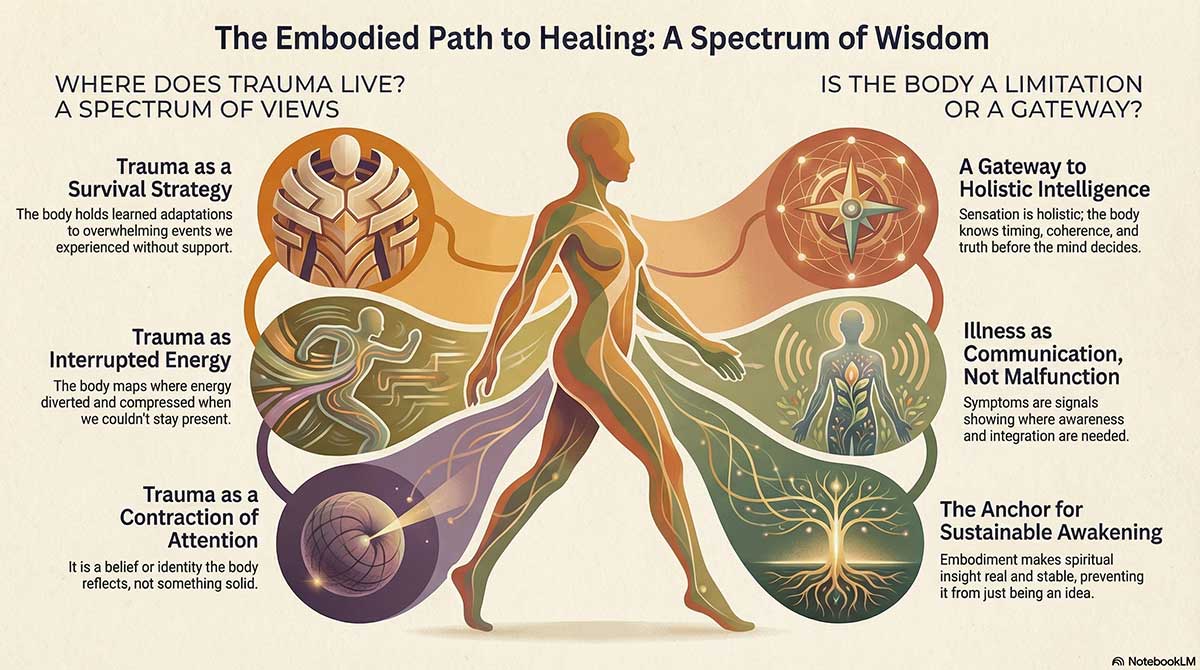
I don’t experience trauma as an event stored in tissue like a fossil. Trauma is what happens inside us when something overwhelming occurs and we have no support. The body remembers because the body is where our adaptations live. The tightening of the chest, the vigilance in the nervous system—these are learned survival responses. Whether you call that physical memory or consciousness expressing itself, the key is that the body learned a strategy to survive love’s absence.
Sue Morter
From my perspective, the body isn’t holding trauma so much as it is holding interrupted energy. Consciousness is always whole. But when an experience overwhelms our capacity to stay present, energy diverts, compresses, and reorganizes. The body becomes the map of that diversion. When we bring awareness back into those places—not to fix them, but to inhabit them—the pattern begins to unwind on its own.
Joe Dispenza
What we see neurologically is repetition. The body becomes the unconscious mind because it’s been trained through emotional rehearsal. When trauma occurs, elevated emotion stamps a memory into the nervous system. Over time, the body doesn’t just remember—it predicts. So whether consciousness or chemistry comes first, the body ends up running the program until something interrupts it.
Dr. David R. Morter
In chiropractic, long before we had these conversations, we observed that certain tensions returned no matter how often you adjusted the spine. Something deeper was organizing the pattern. I didn’t call it trauma back then—I called it interference. The body isn’t confused. It’s responding faithfully to an instruction it once received and never got permission to release.
Rupert Spira
From the standpoint of consciousness, nothing is ever truly stored. What we call trauma is a contraction of attention around a memory, a belief, an identity. The body reflects that contraction because it is inseparable from experience. When awareness rests without resistance in sensation, the sense of a wounded self often dissolves—not because it was healed, but because it was never solid to begin with.
Van der Kolk nods slowly, not in agreement, but in recognition of the range.
Second Question
If awareness is brought fully into a traumatic sensation, is healing something that happens—or something that’s remembered?
Sue Morter
In my experience, it’s remembered. Not intellectually—somatically. When awareness stabilizes in the body, the system recalls its original coherence. Healing looks like something changing, but what’s actually happening is reintegration. The body remembers how to self-regulate when we stop abandoning it.
Bessel van der Kolk
Clinically, I see change. People sleep again. Their digestion improves. Their startle response quiets. But I’ve also learned that force doesn’t heal. When people are curious about sensation rather than terrified of it, the nervous system reorganizes naturally. Whether you call that remembering or relearning may depend on your language, but the process requires presence.
Rupert Spira
Nothing truly happens. What ceases is resistance. When attention stops avoiding sensation, the belief “this should not be here” relaxes. In that relaxation, suffering dissolves. The body then mirrors the ease of awareness. Healing appears to occur, but only ignorance has ended.
Joe Dispenza
I’d say both. Awareness changes gene expression. We can measure it. But what’s being activated is latent capacity. When someone feels safe enough to stay present with sensation, they’re stepping out of survival chemistry and into growth chemistry. The body responds quickly once the signal changes.
Gabor Maté
I’m cautious with the idea that nothing happens. For many people, something very real happens: compassion enters where shame once lived. When awareness is paired with kindness, the nervous system finally receives what it lacked during the original wound. That’s not bypassing—it’s repair.
Van der Kolk pauses longer this time before continuing.
Third Question
How do we know trauma has truly resolved—when symptoms disappear, or when a deeper sense of safety and presence returns?
Dr. David R. Morter
Symptoms can vanish and still come back. I’ve seen that for decades. What doesn’t return is a pattern once the body no longer anticipates danger. True resolution feels like ease—not excitement, not relief—just a quiet readiness to respond to life.
Gabor Maté
Safety is the marker. Not the absence of pain, but the absence of self-rejection. When someone can feel anger, sadness, or fear without losing connection to themselves or others, trauma no longer governs their life.
Sue Morter
Presence is unmistakable. People stop managing themselves. Their breath deepens. Their posture changes. They’re no longer bracing for the next moment. Healing isn’t dramatic—it’s stabilizing.
Joe Dispenza
From a data standpoint, coherence increases. Heart rate variability improves. Brainwave patterns shift. But subjectively, people report something simpler: they feel like themselves again, without effort.
Rupert Spira
Resolution is the absence of a separate sufferer. When experience unfolds without a center that needs protection, trauma has no place to land. The body then expresses the peace of that understanding.
Van der Kolk leans back. The room is quiet again—but this time, softer.
He speaks, not as a moderator now, but as someone who has listened carefully.
“Perhaps,” he says, “the body keeps the score only until consciousness is willing to read it without fear.”
Topic 2 — Are Emotions Messengers—or Architects of Reality?

Moderator: Antonio Damasio
The atmosphere shifts subtly from the previous discussion. Less weight, perhaps—but not less consequence. Emotions may feel lighter than trauma, yet they quietly govern every decision, every belief, every action.
Antonio Damasio sits with the calm confidence of someone who has spent decades listening to the body speak through data.
First Question
Are emotions simply messages telling us what’s happening inside us—or are they actively shaping what happens next in our lives?
Lisa Feldman Barrett
From my research, emotions are not things we have; they are processes we construct. The brain is constantly predicting, using past experience to make sense of the present. What we call an emotion is the brain’s best guess about what’s happening and what to do next. In that sense, emotions don’t just report reality—they participate in creating it by guiding perception and action.
Sue Morter
I experience emotions as frequencies moving through the body. They inform us, yes—but they also organize our state of being. When a frequency stabilizes, it becomes a lens through which life responds. So emotions begin as messengers, but when they’re repeated and embodied, they become architects. They literally shape how energy flows into form.
Joe Dispenza
Emotion is the glue between thought and physiology. When you feel an emotion strongly enough and often enough, the body begins to believe it’s living in that future or past. The nervous system doesn’t distinguish imagination from reality. So emotions are not passive. They are instructions.
Antonio Damasio
From a biological standpoint, emotions evolved to regulate life. They guide us toward survival and well-being. But regulation implies influence. An emotion alters the internal milieu—heart rate, hormones, immune response—and that internal shift affects how we engage the world. Whether architect or messenger, emotion always changes the terrain.
Esther Perel
I’d add that emotions are relational. They don’t just arise in isolation; they emerge between people. Desire, fear, shame—these are shaped by context. So emotions can build realities together, not just individually. The question isn’t only what emotions do inside us, but what they co-create between us.
Damasio nods, folding his hands, then continues.
Second Question
If emotions are constructed or conditioned, how do we explain their powerful physical and energetic effects across cultures and individuals?
Joe Dispenza
Conditioned doesn’t mean weak. Repetition wires the brain and conditions the body. When an emotion is practiced long enough, it becomes a trait. The body memorizes it. That’s why people feel the same anxiety in different situations—the chemistry is familiar. Energy follows attention, and attention follows emotion.
Lisa Feldman Barrett
Universality doesn’t require fixed emotion circuits. Humans share similar bodies and similar predictive needs. The brain uses culture and experience to label sensations, but the sensations themselves—arousal, tension, warmth—are biological. The power comes from meaning layered onto those sensations.
Sue Morter
I’d say the physical effects happen because energy is real, even if we don’t always measure it directly. When consciousness organizes around a particular emotion, the body aligns with that organization. Across cultures, humans experience coherence and incoherence similarly because the body is a shared instrument of consciousness.
Esther Perel
Emotions feel powerful because they touch attachment and belonging. A raised voice can accelerate the heart not because of the words, but because of what they signal relationally. The body reacts to threat or connection long before the mind interprets it.
Antonio Damasio
The nervous system doesn’t wait for interpretation. It responds to patterns it has learned to associate with danger or opportunity. Emotion sits at the crossroads of biology and meaning. Its effects are consistent because the body’s imperative—to maintain life—is consistent.
Damasio pauses, then leans slightly forward.
Third Question
What changes when emotions are fully felt without being acted upon—does reality change, or only our relationship to it?
Sue Morter
When emotions are fully felt, energy completes its circuit. That completion often changes reality because our state changes. We respond differently. We attract different interactions. The outer world mirrors inner coherence.
Lisa Feldman Barrett
From my view, what changes first is interpretation. When you don’t act immediately, you give the brain time to generate alternative predictions. That flexibility alone can shift behavior and outcomes, which then appear as changes in reality.
Joe Dispenza
This is where transformation happens. When you feel an emotion without reacting, you break the feedback loop. The body exits the past. New neural pathways open. People often describe life changing, but what’s really changed is who’s showing up to meet it.
Esther Perel
Emotion without action creates choice. In relationships, this is everything. When someone can feel jealousy, fear, or longing without collapsing into it, intimacy deepens. Reality becomes more spacious because reactivity no longer dominates it.
Antonio Damasio
I would say both change. The internal environment stabilizes, and that stability alters perception, decision-making, and interaction. Over time, those altered interactions reshape life. Emotion felt consciously becomes wisdom rather than impulse.
The room settles again—not quiet with heaviness, but with clarity.
Damasio offers a final reflection.
“Perhaps emotions are neither merely messengers nor sole architects,” he says. “They are translators—between body and mind, past and present, self and world. And how well we listen determines what they build.”
Topic 3 — Does the Ego Ever Truly Dissolve—or Only Mature?

Moderator: Carl Jung
The atmosphere changes again. This time, the tension is subtler but sharper. Ego is a word everyone uses—often as an accusation, sometimes as a goal, rarely as something understood.
Carl Jung sits with a composed gravity, eyes attentive, as though listening not only to the room, but to something behind it.
First Question
Is the ego something that must disappear for awakening to occur, or something that must grow strong enough to serve a larger consciousness?
Eckhart Tolle
The ego dissolves not by attack, but by disidentification. When awareness recognizes itself as awareness, the ego loses its grip. It may still function practically, but it no longer defines who you are. Awakening is not about improving the ego—it’s about seeing through it.
Sue Morter
I see ego as unintegrated energy rather than an enemy. When awareness fully inhabits the body, the ego reorganizes naturally. It stops trying to control and starts cooperating. In that sense, it matures—not because we fix it, but because it no longer has to protect us from being present.
Richard Schwartz
From an Internal Family Systems perspective, there is no single ego to eliminate. There are parts—protectors, managers, exiles. When these parts feel safe and seen, they relax. What people call ego dissolution often feels like parts trusting the Self enough to step back.
Ken Wilber
Developmentally speaking, ego transcendence without ego development leads to problems. You can access non-dual states temporarily, but if the ego hasn’t matured, it can’t integrate them. Awakening stabilizes only when stages of development are respected. Otherwise, you get what I’ve called “spiritual bypass.”
Carl Jung
The ego is not the enemy of the Self; it is its necessary instrument. Without a coherent ego, consciousness cannot be lived in the world. Individuation is not the destruction of the ego, but its alignment with something larger than itself.
Jung pauses briefly, letting that land.
Second Question
What happens when spiritual practices bypass unresolved psychological wounds—does transcendence become fragmentation?
Richard Schwartz
Absolutely. Parts don’t disappear just because someone has a spiritual insight. In fact, they may hide. A traumatized protector can adopt spiritual language to avoid pain. That’s why compassion and curiosity are essential—otherwise spirituality becomes another defense.
Sue Morter
When the body isn’t included, bypassing happens easily. People think they’ve transcended something, but the nervous system hasn’t caught up. Embodiment brings honesty. The body doesn’t pretend. If energy hasn’t integrated, it will show up as tension, illness, or emotional reactivity.
Eckhart Tolle
Presence exposes what has not been integrated. If psychological pain arises, it is not a failure of awakening—it is an invitation to bring awareness into form. Avoidance is the issue, not transcendence itself.
Ken Wilber
This is where map confusion causes damage. States are mistaken for stages. Someone experiences a glimpse of unity and assumes they are finished. Meanwhile, their shadow remains unexamined. The result can be narcissism disguised as enlightenment.
Carl Jung
The shadow does not disappear when ignored—it grows autonomous. What is unconscious will be lived out as fate. Spiritual insight without psychological integration risks inflation, which is among the most dangerous psychic conditions.
The room grows still. Jung’s words carry weight, not judgment.
Third Question
Can a mature ego act as a bridge between the personal self and something larger, rather than an obstacle?
Sue Morter
Yes. A mature ego becomes transparent. It organizes daily life while allowing intuition to move freely. It doesn’t lead, but it listens. In that state, embodiment and consciousness work together seamlessly.
Ken Wilber
At later stages of development, ego becomes a functional center rather than an identity. It can translate insight into action. That’s when awakening stops being private and becomes ethical, creative, and useful.
Richard Schwartz
In IFS terms, when parts trust the Self, they become resources. Protectors transform into allies. That’s a bridge—between survival and wisdom.
Eckhart Tolle
The ego as a bridge exists only when it is no longer taken personally. It becomes a tool. But the moment identity reattaches, suffering returns. Vigilance is gentle but necessary.
Carl Jung
The individuated person does not dissolve into the collective nor retreat into isolation. They stand between worlds—rooted in the personal, open to the transpersonal. The ego, properly oriented, allows the Self to be lived rather than imagined.
Jung closes his notebook—not to end the discussion, but to signal something quieter.
“Where the ego once said ‘I am,’” he reflects, “let it now say, ‘I serve.’”
Topic 4 — Is the Body a Limitation—or a Gateway to Higher Intelligence?
Moderator: Moshe Feldenkrais
The room feels different now. Less conceptual. More immediate. Chairs shift slightly as if the body itself is listening.
Moshe Feldenkrais does not rush. He looks around the room with the patience of someone who trusts sensation more than explanation.
First Question
What intelligence becomes available only when attention is placed inside sensation rather than thought?
Sue Morter
When attention enters the body, a deeper organizing principle reveals itself. Thought is linear, but sensation is holistic. In sensation, you feel timing, coherence, and truth simultaneously. This is where intuition lives—not as a voice, but as alignment. The body knows before the mind decides.
James Nestor
Breath is the fastest way there. When people slow their breathing and feel it instead of controlling it, cognition changes. Creativity increases. Anxiety drops. It’s not mystical—it’s physiological intelligence waking up. The body starts solving problems the mind couldn’t.
Thomas Myers
From a fascial perspective, sensation reveals connection. Fascia isn’t just structure; it’s communication. When you feel inside, you sense continuity—how tension in the jaw relates to the pelvis, how emotion travels through tissue. That awareness changes movement and meaning at the same time.
Dr. David R. Morter
In practice, I saw that when patients sensed rather than analyzed, their bodies reorganized faster. The intelligence wasn’t something I applied—it emerged. The nervous system stopped asking for instruction and began self-correcting. That’s when healing became reliable.
Moshe Feldenkrais
Thinking is useful, but sensation tells the truth of how you are organized right now. When awareness enters sensation, learning occurs without effort. You don’t impose change; you discover better options. That discovery is intelligence in action.
He lets the silence linger, as if encouraging everyone to feel their posture before moving on.
Second Question
If the body were truly intelligent, how might illness or chronic tension be understood—as malfunction, or as communication?
Thomas Myers
Chronic tension often reflects compensation, not failure. The body adapts brilliantly—sometimes too well. Pain appears when adaptation reaches its limit. From this view, symptoms are messages saying, “This strategy has gone as far as it can.”
Sue Morter
I see illness as an interruption in energy flow that’s asking for integration. The body isn’t betraying us—it’s signaling where awareness left. When we bring presence back into those places, the system often recalibrates without force.
Dr. David R. Morter
In chiropractic, we never assumed the body was broken. We assumed it was responding to interference. Remove the interference, and intelligence expresses itself again. Symptoms weren’t enemies—they were clues.
James Nestor
Even breathing disorders tell a story. Mouth breathing, for example, is often a response to stress or early trauma. The body finds a way to survive, even if that way creates long-term problems. When you restore nasal breathing, you’re not just fixing mechanics—you’re restoring a forgotten pattern.
Moshe Feldenkrais
When something hurts, people want to correct it directly. But pain is rarely local. It reflects how the whole self is organized. If you listen to the discomfort without trying to eliminate it, it often reveals a more efficient way of moving and being.
Feldenkrais shifts slightly in his chair, demonstrating without demonstration.
Third Question
Does embodiment slow spiritual awakening—or is it what makes awakening real and sustainable?
Sue Morter
Without embodiment, awakening floats. It inspires, but it doesn’t stabilize. The body is the anchor that allows consciousness to live here, now, consistently. Embodiment doesn’t slow awakening—it completes it.
James Nestor
Many spiritual traditions emphasize breath for a reason. Breath ties awareness to the body moment by moment. Without that tether, insight fades. With it, insight becomes habit.
Thomas Myers
You can’t separate awakening from structure. How you stand, walk, and breathe shapes perception. When structure supports flow, higher states become accessible without effort. When it doesn’t, people chase transcendence to escape discomfort.
Dr. David R. Morter
I’ve seen people have profound realizations and still suffer physically because the body wasn’t included. When the nervous system integrates insight, posture changes, breath deepens, and life becomes simpler. That’s when awakening stays.
Moshe Feldenkrais
Awareness that cannot be lived is imagination. Embodiment is not a spiritual obstacle—it is the laboratory. When learning occurs in the body, it does not need reinforcement. It becomes who you are.
Feldenkrais pauses, then offers a final reflection.
“We do not become free by leaving the body,” he says quietly. “We become free by inhabiting it so fully that no part of us is left behind.”
Topic 5 — Are We Here to Heal Ourselves—or to Remember Each Other?
Moderator: Martin Buber
The room feels less like a circle now and more like a field. Something shared, something already happening before anyone speaks.
Martin Buber does not look at notes. He looks at faces. When he begins, his voice is gentle, almost conversational.
First Question
Is healing something that happens privately within us, or something that unfolds between us?
Sue Morter
From my experience, healing begins internally but completes relationally. We can regulate our nervous system alone, but coherence deepens when it’s shared. Presence stabilizes faster in relationship. We remember who we are more easily when someone else is holding the same frequency.
Daniel Siegel
Neurobiology supports that. The brain develops and heals in relationship. Integration—within the mind and between people—is the basis of well-being. We don’t regulate in isolation; we borrow regulation until it becomes internalized. Healing is both an inner and interpersonal process.
Iain McGilchrist
Our culture has overemphasized the isolated self. The right hemisphere understands meaning as relational, contextual, alive. Healing occurs when we re-enter relationship—with others, with nature, with reality itself. The idea of purely private healing is a left-brain abstraction.
David Bohm
Fragmentation creates suffering. We divide self from other, inner from outer, healer from healed. But consciousness is a whole movement. Healing happens as fragmentation dissolves—not inside one person, but in the shared field of understanding.
Martin Buber
I would say healing is born in the between. The “I” becomes whole only in relation to a “Thou.” Without genuine encounter, the self hardens into an object. Healing requires presence that meets presence.
Buber lets the word between hang in the air.
Second Question
Can coherence, safety, or awareness spread between people—not through teaching, but through presence alone?
Daniel Siegel
Yes. We see it in resonance, attunement, mirror neurons. One regulated nervous system can calm another. Presence isn’t passive—it’s biologically active. Children learn emotional regulation this way, and adults never stop needing it.
Sue Morter
Energy fields entrain. When someone embodies coherence, others feel it without explanation. That’s why people feel calmer in the presence of someone grounded. No words are necessary. The body recognizes safety before the mind understands it.
David Bohm
This is dialogue at its deepest level. Not conversation, but shared meaning unfolding. When people suspend assumptions together, coherence emerges naturally. Thought reorganizes. Conflict dissolves—not by persuasion, but by contact.
Iain McGilchrist
Presence communicates wholeness implicitly. The right hemisphere perceives this immediately—tone, posture, rhythm. It’s why animals calm around certain humans. Safety is sensed, not argued.
Martin Buber
Presence is not something we do; it is something we allow. When we truly meet another without agenda, transformation occurs quietly. This is not influence—it is recognition.
The silence that follows feels companionable, not empty.
Third Question
If awakening or healing is real, does it carry responsibility—and if so, responsibility to whom?
Iain McGilchrist
Responsibility arises naturally from perception. When we see reality as interconnected, care follows without moralizing. The danger is abstraction—when responsibility becomes ideology instead of relationship.
Sue Morter
Responsibility isn’t obligation; it’s responsiveness. As awareness stabilizes, choices naturally change. You listen more. You interrupt less. You act in ways that preserve coherence—not because you should, but because it feels aligned.
Daniel Siegel
Integration brings ethics with it. When the brain integrates, empathy increases. Responsibility then extends to self, others, and the larger system. It’s not imposed—it emerges.
David Bohm
Responsibility is to the whole movement of life. When thought fragments, harm follows unintentionally. When awareness widens, action becomes more intelligent. Responsibility is simply seeing clearly enough to act without distortion.
Martin Buber
Responsibility is to the Thou before you. Not to humanity in abstraction, but to the living presence you encounter now. When we respond genuinely, the world is repaired moment by moment.
Buber closes his eyes briefly, then opens them again.
“We are not here merely to heal ourselves,” he says softly. “We are here to remember one another—so that the self does not forget it was never alone.”
Final Thoughts by Sue Morter
As these conversations come to rest, I don’t want to offer conclusions.
What I want to offer is a pause.
Healing is not an achievement. It is a state of coherence that arises when we stop leaving ourselves behind. When awareness settles into the body, when breath moves without control, when relationship replaces isolation, something fundamental reorganizes.
You may notice that the most powerful moments in these dialogues are not the answers, but the silences between them. That is where integration happens. That is where the nervous system recalibrates. That is where the body remembers its original safety.
We are not here to perfect ourselves.
We are here to inhabit ourselves.
And when we do, healing becomes less about effort and more about alignment.
Less about becoming someone new, and more about allowing who we already are to arrive fully.
If this series leaves you with anything, let it be this:
You are not late.
You are not broken.
You are not missing anything.
You are already whole — and learning how to stay.
That is the work.
That is the remembering.
And that is where life begins to respond differently.
Short Bios:
Sue Morter
A consciousness teacher and founder of The Energy Codes, Sue Morter integrates neuroscience, embodiment, and energetic awareness to help people heal, regulate, and live from deeper coherence.
Bessel van der Kolk
A psychiatrist and trauma researcher best known for The Body Keeps the Score, van der Kolk has reshaped modern understanding of how trauma lives in the nervous system and body.
Antonio Damasio
A neuroscientist and author of Descartes’ Error, Damasio explores how emotions, bodily states, and consciousness shape decision-making and human experience.
Carl Jung
A pioneering psychologist and founder of analytical psychology, Jung introduced concepts such as individuation, the shadow, and the collective unconscious, emphasizing integration over elimination.
Moshe Feldenkrais
A physicist and movement educator, Feldenkrais developed a method of learning through awareness that uses gentle movement to reorganize the nervous system and restore natural intelligence.
Martin Buber
A philosopher best known for I and Thou, Buber emphasized relationship, dialogue, and presence as the foundation of meaning, healing, and spiritual life.
Gabor Maté
A physician and author focused on trauma, addiction, and authenticity, Maté views illness and suffering as adaptive responses shaped by early emotional environments.
Joe Dispenza
A researcher and educator bridging neuroscience and meditation, Dispenza studies how intentional awareness and emotional coherence can reshape the brain and body.
Richard Schwartz
The creator of Internal Family Systems therapy, Schwartz reframed the psyche as an ecosystem of parts, guided by an innate core Self characterized by calm and compassion.
Dr. David R. Morter
A chiropractor and early pioneer in energetic assessment, Dr. Morter emphasized the body’s innate intelligence and deeply influenced Sue Morter’s embodied approach to healing.
Leave a Reply