

|
Getting your Trinity Audio player ready...
|
What if Marci Shimoff gathered timeless guides to help you reset your life?
Introduction — by Marci Shimoff
There comes a moment in life when effort stops working.
You’ve done the inner work. You’ve read the books. You’ve tried to stay positive. And yet something still feels heavy, noisy, or out of alignment. If that’s where you are, I want you to know this first: nothing is wrong with you.
Often, what we call “being stuck” is simply being overloaded—emotionally, mentally, energetically. We’re carrying stories, stress, expectations, and old pain that were never meant to stay this long. And when our inner world is crowded, even joy has trouble finding us.
The Miracles Energetic Reset is not about fixing yourself or striving to become someone new. It’s about gently clearing what no longer belongs, tuning back into what’s true for you, and allowing life to meet you with more ease than you may have thought possible.
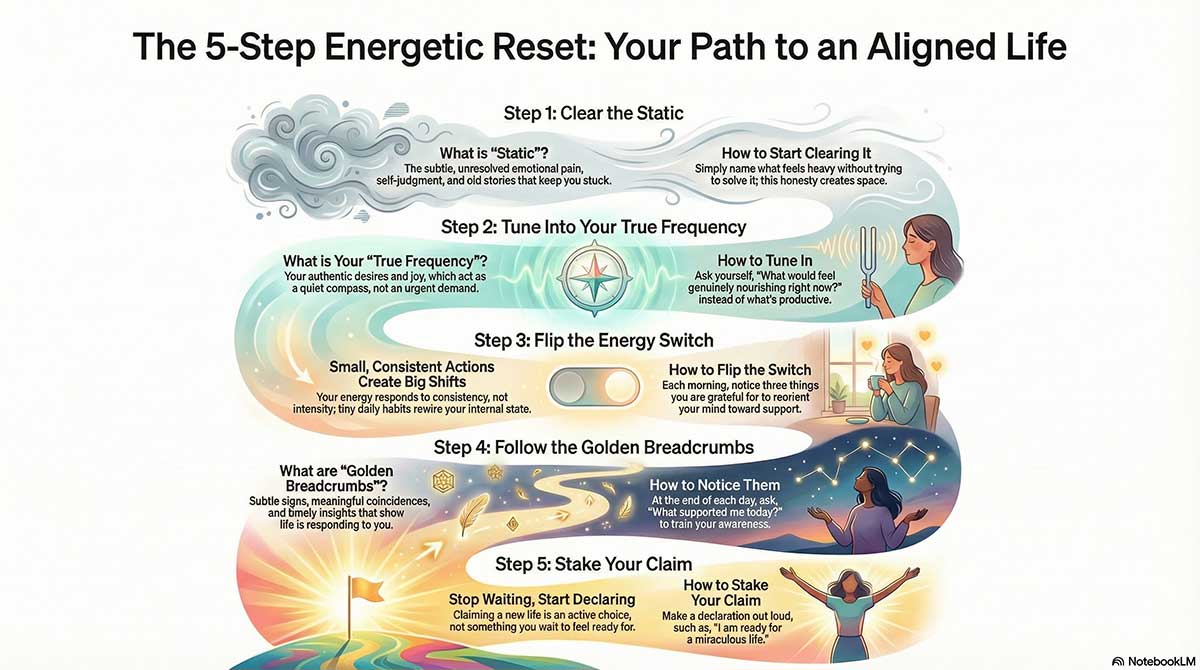
Over these five steps, you’ll explore how to release emotional static, reconnect with your true frequency, establish small daily practices that shift your energy, recognize the quiet guidance already present in your life, and—most importantly—claim your right to live with joy, trust, and meaning.
Miracles don’t arrive because we deserve them or work hard enough for them. They arrive when we’re available. When our hearts are open. When we’re willing to partner with life again.
This is an invitation to begin that partnership—one gentle step at a time.
(Note: This is an imaginary conversation, a creative exploration of an idea, and not a real speech or event.)
Topic 1 — Clear the Static

Moderator: Marie Forleo
Participants: Dr. Joe Dispenza, Dr. Gabor Maté, Byron Katie, Peter Levine, Bessel van der Kolk
The room feels calm but alive. Not a stage, not a studio—more like a shared living room where honesty is welcome. Marie Forleo sits forward slightly, relaxed, attentive. Around her are faces that have spent decades listening to human suffering—and possibility.
Marie smiles gently before speaking.
Opening — Marie Forleo
Marie Forleo:
Before we talk about creating anything new—miracles, joy, alignment—I want to start with something quieter. Something most of us skip. Clearing. Letting go.
So I want to begin here. Many people feel “off,” heavy, or stuck, but they don’t always know why. From where you sit, what is this static really made of—and why does it block so much more than we realize?
She turns first to Marci.
Question 1
What is the “static” that blocks clarity and miracles—and why does it have so much power?
Marci Shimoff:
What I see again and again is that the static isn’t loud. It’s subtle. It’s the quiet self-judgment we’ve learned to live with. The disappointments we never fully felt. The pressure to be “fine” when something inside us is still hurting.
People think miracles disappear when life gets hard. They don’t. Our ability to receive them just gets muffled. When the heart is heavy, even joy feels far away. Clearing the static isn’t fixing yourself—it’s removing what was never meant to be carried this long.
Dr. Joe Dispenza:
From a biological perspective, unresolved emotional experiences keep the body in a state of survival. Stress hormones stay elevated. The brain keeps firing the same circuits.
When someone lives in guilt, resentment, or regret, the body believes the past is still happening. And when you’re chemically addicted to the past, you can’t perceive a new future. The static isn’t just emotional—it’s neurological.
Dr. Gabor Maté:
Much of what we call static is actually unacknowledged pain. We learned early that certain emotions weren’t welcome—anger, sadness, fear—so we pushed them down.
But what is suppressed doesn’t disappear. It shows up as anxiety, disconnection, illness, or numbness. The block isn’t weakness. It’s protection that stayed too long.
Byron Katie:
I see the static as unquestioned thoughts. A single belief—“I’m not enough,” “This shouldn’t have happened,” “They ruined my life”—can generate enormous suffering.
We don’t suffer because of events. We suffer because we believe the story we tell about them. When the mind argues with reality, it loses every time. That argument is static.
Peter Levine:
The body plays a huge role here. When an experience overwhelms our capacity to cope, the nervous system doesn’t complete its natural response. The energy stays trapped.
People say, “I don’t know why I feel this way.” Often the body knows, even if the mind doesn’t. Static is unfinished business in the nervous system.
Bessel van der Kolk:
Trauma isn’t the event—it’s what happens inside the body when the event isn’t processed. The brain regions responsible for logic and time go offline. The body holds the memory as if it’s still present.
That’s why people feel hijacked by emotions that don’t seem to match the moment. The static is the past living in the present.
Marie nods slowly, letting the weight of that land.
Question 2
Why do people resist clearing this static—even when it’s painful to carry?
Marie Forleo:
Here’s something I see all the time. People say they want relief, but they hesitate to let go. Why is release so hard, even when holding on hurts?
Dr. Gabor Maté:
Because pain becomes familiar. And familiar feels safer than the unknown. Letting go can feel like betrayal—of our parents, our past, or even our identity.
There’s also shame. People think, “If I’m still affected by this, something must be wrong with me.” Compassion dissolves resistance faster than force ever will.
Marci Shimoff:
Yes. And many people believe that letting go means minimizing what happened. It doesn’t. Releasing pain doesn’t dishonor your story—it honors your life now.
I’ve watched people carry guilt or regret for decades, believing it keeps them responsible or good. But guilt doesn’t make us better. It just keeps us stuck.
Byron Katie:
The ego loves familiar suffering. It says, “At least I know who I am here.” Question the thought, and suddenly the ground shifts.
Freedom can feel disorienting at first. But peace is what remains when the argument with reality ends.
Dr. Joe Dispenza:
From the brain’s perspective, change is dangerous. The familiar emotional state—no matter how painful—has predictable chemistry. Letting go means stepping into uncertainty.
That’s why awareness is so important. When people see that holding on is literally keeping their body in survival, they become willing to change.
Peter Levine:
Another reason is that release doesn’t happen by force. If the body isn’t ready, pushing can retraumatize.
Gentleness is essential. When people learn they can let go without reliving everything, safety returns—and resistance softens.
Bessel van der Kolk:
Many people have never had the experience of being supported while releasing pain. Healing requires relationship—inside and out.
When the nervous system senses safety, it can finally complete what was interrupted. Without safety, holding on feels necessary.
Marie exhales softly.
Question 3
What is one simple, humane way people can begin clearing the static—starting now?
Marie Forleo:
Let’s make this practical. If someone listening feels heavy but overwhelmed by all of this, where can they begin—gently?
Marci Shimoff:
Begin by naming what’s heavy. Just naming it. You don’t need to solve it today.
When you say, “This has been hard,” something inside relaxes. That honesty alone starts clearing space. Miracles respond to truth.
Dr. Joe Dispenza:
Pause. Close your eyes. Notice the emotion without judgment. Ask, “What am I feeling?”
That moment of awareness moves you from reaction into observation—and observation is the doorway to change.
Byron Katie:
Write the thought that hurts. Then ask, “Is it true?” Not to force an answer—but to open space.
Inquiry isn’t about positive thinking. It’s about seeing what’s real when the story loosens.
Dr. Gabor Maté:
Offer yourself compassion. Place a hand on your body and acknowledge the pain without trying to fix it.
Healing begins when the body feels understood.
Peter Levine:
Track sensation. Feel your feet. Notice your breath. Let the body know it’s here, now, and safe.
Small orienting movements tell the nervous system the danger has passed.
Bessel van der Kolk:
Remember: healing happens in pieces. No one clears everything at once.
Each small release gives the body evidence that change is possible.
Closing — Marci Shimoff
Marci Shimoff:
What I want everyone to hear is this: you don’t need to be lighter, happier, or more evolved to deserve miracles.
You just need to stop carrying what was never meant to be permanent. When you clear even a little static, life rushes in to meet you. I’ve seen it too many times to doubt it.
Marie smiles, eyes warm.
Marie Forleo:
That feels like the perfect place to pause. Not fixed. Not finished. Just a little more space than before.
The room feels quieter now. Not empty—clear.
Topic 2 — Tune Into Your True Frequency

Moderator: Nick Sasaki
Participants: Mike Dooley, Abraham Hicks, Danielle LaPorte, Vishen Lakhiani, Michael Bernard Beckwith
The setting feels open, lighter than before. Large windows. Natural light. A sense of possibility after the clearing that came in Topic 1. Nick Sasaki sits quietly for a moment, letting the group settle—not rushing the conversation forward.
He speaks gently.
Opening — Nick Sasaki
Nick Sasaki:
After we clear emotional noise, something interesting happens. There’s space—but also uncertainty. People often ask, “If I’m not chasing what I used to chase, what am I listening for now?”
So I’d like to begin here. Once the static quiets, how do we recognize our true frequency—the desires and directions that actually belong to us?
He looks first to Marci.
Question 1
What is “true frequency,” and how is it different from goals shaped by pressure or expectation?
Marci Shimoff:
True frequency feels different in the body. It’s lighter. Quieter. There’s a sense of rightness rather than urgency.
So many people are exhausted because they’re chasing lives they inherited—from parents, culture, or fear. Your true frequency doesn’t shout. It gently draws you forward.
Mike Dooley:
Desires aren’t random. They’re clues. When something excites you, it’s life saying, “This direction fits.”
The universe doesn’t respond to effort—it responds to alignment. When you follow what lights you up, you send a clear energetic signal.
Abraham Hicks:
Your frequency is simply how you feel. When you feel relief, interest, curiosity, or appreciation, you’re aligned.
Struggle is feedback—not failure. It’s guidance telling you you’re pushing against yourself.
Danielle LaPorte:
Most people confuse success with satisfaction. But the soul speaks in feelings, not outcomes.
Your true frequency is revealed by how you want to feel—free, peaceful, radiant—not by what you think you should achieve.
Vishen Lakhiani:
We live inside invisible rules—what I call “brules.” Society hands us scripts for success, but they often disconnect us from joy.
True frequency emerges when you question those scripts and consciously design your inner experience.
Michael Bernard Beckwith:
The soul already knows. Alignment isn’t something you create—it’s something you remember.
When your desire serves life, rather than ego validation, it carries a resonance that opens doors naturally.
Nick nods slowly.
Question 2
Why do people mistrust what lights them up—and dismiss it as unrealistic or selfish?
Nick Sasaki:
Many people feel guilty wanting what they want. Why is trusting joy so hard?
Danielle LaPorte:
Because we were taught that responsibility equals sacrifice. That pleasure is indulgent.
But joy isn’t a luxury—it’s intelligence. When you ignore it, you disconnect from your guidance system.
Mike Dooley:
People worry they’re being irresponsible by following excitement. But the universe is efficient.
The things you’re excited about often already contain the skills, timing, and connections you need.
Abraham Hicks:
Selfishness is misalignment. Joy is alignment. When you feel good, you uplift everything around you.
You’re not meant to justify your happiness.
Vishen Lakhiani:
Fear of judgment plays a huge role. If you follow your truth, you may outgrow familiar identities.
But growth always disrupts comfort before it delivers fulfillment.
Michael Bernard Beckwith:
We mistake ego desire for soul desire. Ego wants to be seen. The soul wants to be expressed.
When desire arises from wholeness, it benefits the collective.
Marci Shimoff:
I’ve seen this again and again. People think miracles require struggle. They don’t.
They require alignment. Joy is not a distraction from your purpose—it’s the compass.
Question 3
What is one gentle way people can begin tuning into their true frequency right now?
Nick Sasaki:
If someone feels disconnected from what they want, what’s a simple starting point?
Marci Shimoff:
Ask yourself, “What would feel nourishing right now?” Not productive. Not impressive. Nourishing.
That question alone begins the realignment.
Danielle LaPorte:
Choose a guiding word—how you want to feel this season. Let decisions pass through that filter.
Clarity grows from consistency.
Mike Dooley:
Notice what energizes you instead of drains you. Energy is feedback.
Follow the spark, even if you don’t know the destination.
Abraham Hicks:
Reach for the next better-feeling thought—not the perfect one. Alignment happens incrementally.
Relief is progress.
Vishen Lakhiani:
Create space. Silence is where your authentic signal gets louder.
Design moments without noise.
Michael Bernard Beckwith:
Treat desire as sacred. Sit with it. Listen. Let it mature.
True frequency unfolds—it doesn’t rush.
Closing — Marci Shimoff
Marci Shimoff:
When you tune into your true frequency, life doesn’t suddenly become perfect—but it becomes cooperative.
Effort softens. Synchronicity increases. And miracles stop feeling distant. They start feeling natural.
Nick smiles quietly.
Nick Sasaki:
And maybe the bravest thing isn’t chasing more—but listening more closely.
The light in the room feels warmer now. Direction has replaced pressure.
Topic 3 — Flip the Energy Switch

Moderator: Marie Forleo
Participants: Dr. Sue Morter, James Clear, Andrew Huberman, Jon Kabat-Zinn, Gregg Braden
The room feels different now. Grounded. Awake. There’s less searching in the air and more readiness. Marie Forleo notices it immediately—the subtle shift that happens when understanding begins to ask for movement.
She leans in.
Opening — Marie Forleo
Marie Forleo:
So far, we’ve cleared what was heavy and listened for what’s true. But here’s where many people stall. They feel inspired… and then life kicks back in.
So I want to talk about practice. Not discipline in a harsh way—but the tiny choices that actually flip us from survival mode into something more alive.
What does it really mean to “flip the energy switch”—and why do small daily actions matter more than big intentions?
She looks to Marci.
Question 1
What does it actually mean to “flip the energy switch,” and why do small practices work?
Marci Shimoff:
People often think transformation requires huge effort. But energy responds to consistency, not intensity.
When you choose even a five-minute practice, you’re telling your system, “I’m available for change.” That signal alone begins to shift your internal state.
Dr. Sue Morter:
Energy lives in the body first. If the body doesn’t feel safe, present, and connected, no amount of positive thinking will stick.
Small embodied practices—breath, posture, attention—bring coherence back online. That’s when the switch flips.
James Clear:
Habits aren’t about motivation; they’re about identity. Every small action casts a vote for the kind of person you believe yourself to be.
When practices are simple, they become sustainable—and sustainability is what changes lives.
Andrew Huberman:
From a neuroscience perspective, short, repeated practices rewire neural circuits more effectively than occasional long ones.
Even two minutes of focused breathing or gratitude can shift the nervous system out of stress and into regulation.
Jon Kabat-Zinn:
Practice is simply showing up for this moment as it is. You don’t need to improve the moment—just inhabit it fully.
When attention becomes intentional, life starts to feel less automatic.
Gregg Braden:
The heart is a powerful regulator. When the heart and brain come into coherence, the body moves out of emergency mode.
Small daily practices restore that communication—and with it, clarity and resilience.
Marie nods, smiling.
Question 2
Why do people resist daily practices—even when they know they help?
Marie Forleo:
This is something I see constantly. People want change, but they struggle to keep practices simple and consistent. Why?
James Clear:
Because people overestimate what they should do and underestimate what works.
When practices feel too big, the brain resists. Simplicity lowers friction—and friction is the real enemy of change.
Andrew Huberman:
Stress narrows perception. When people are overwhelmed, they default to familiar patterns—even unhealthy ones—because they feel predictable.
Practices work best when they’re designed to fit real life, not ideal life.
Dr. Sue Morter:
There’s also fear of stillness. When you slow down, sensations and emotions surface.
But avoidance keeps the system stuck. Gentle presence allows release.
Jon Kabat-Zinn:
Many people think they’re doing it wrong. But mindfulness isn’t about performance—it’s about awareness.
You can’t fail at noticing.
Gregg Braden:
We were taught to seek external solutions. Inner practices can feel invisible, so people doubt their power.
But the most profound changes happen beneath the surface first.
Marci Shimoff:
I also see perfectionism get in the way. People think, “If I miss a day, I’ve failed.”
But miracles don’t require perfection. They respond to willingness.
Marie lets that land.
Question 3
What is one simple practice that almost anyone can start today?
Marie Forleo:
Let’s ground this. If someone listening wants to flip the switch today, what would you suggest?
Marci Shimoff:
Gratitude. Not forced positivity—simple noticing. Three things. Every morning.
Gratitude gently reorients the mind toward support rather than lack.
Dr. Sue Morter:
Heart-focused breathing. Two minutes. One hand on the chest.
This brings the body back into coherence faster than almost anything else.
James Clear:
Attach your practice to something you already do. After brushing your teeth. Before opening your phone.
Consistency beats complexity.
Andrew Huberman:
Physiological sigh breathing—two short inhales through the nose, one long exhale through the mouth.
It’s one of the fastest ways to calm the nervous system.
Jon Kabat-Zinn:
Pause once a day and simply ask, “What is happening right now?”
Presence itself is transformative.
Gregg Braden:
Speak a word that represents how you choose to live—out loud.
Sound carries intention into the body.
Closing — Marci Shimoff
Marci Shimoff:
What I love about this step is how kind it is. You don’t need to overhaul your life.
You just need to show up—briefly, consistently, and with heart. That’s when energy begins to cooperate. And when energy cooperates, miracles don’t feel so far away.
Marie smiles warmly.
Marie Forleo:
Small actions. Big shifts. That’s a message I think we can all carry into tomorrow.
The room feels steady now. Not rushed. Not striving. Just awake.
Topic 4 — Follow the Golden Breadcrumbs

Moderator: Nick Sasaki
Participants: Lynne Twist, Deepak Chopra, Caroline Myss, Elizabeth Gilbert, James Redfield
The atmosphere feels spacious now. Less effort. More listening. The earlier intensity has softened into something quieter—attentive, receptive. Nick Sasaki waits a moment before speaking, allowing the silence to do some of the work.
Opening — Nick Sasaki
Nick Sasaki:
After people clear emotional noise, align with what’s true, and establish daily practices, something subtle begins to happen. Life starts responding differently. Not always loudly—but meaningfully.
So I want to explore this idea of golden breadcrumbs. The small signs, coincidences, and moments of support that seem to guide us forward.
What are these experiences really—and how do we learn to recognize them without drifting into fantasy or wishful thinking?
He turns first to Marci.
Question 1
What are “golden breadcrumbs,” and how do they actually show up in everyday life?
Marci Shimoff:
Golden breadcrumbs are often gentle. A timely conversation. A sudden insight. A sense of calm where there used to be anxiety.
People expect miracles to arrive with fireworks, but guidance usually whispers. When you’re aligned, life feels responsive. You feel accompanied.
Lynne Twist:
I experience breadcrumbs as invitations into integrity. When we’re living in alignment with our deepest values, support appears—not to rescue us, but to partner with us.
These signs don’t remove responsibility. They clarify direction.
Deepak Chopra:
Synchronicity is the universe revealing its intelligence. When awareness is present, coincidence dissolves into meaning.
You’re not forcing events to happen—you’re participating in a larger flow of consciousness.
Caroline Myss:
Breadcrumbs often come through intuition and symbol. A phrase that won’t leave you. A pattern repeating until you notice.
The key is discernment. Guidance never feels frantic. It carries a calm authority.
Elizabeth Gilbert:
In creative life, breadcrumbs show up as curiosity. A pull toward something you can’t fully explain yet.
You don’t need certainty—just willingness to follow what feels alive.
James Redfield:
These experiences become visible when energy shifts. When attention is present, you notice the subtle connections already happening.
Meaningful coincidences increase when people act from authenticity rather than fear.
Nick nods.
Question 2
Why do people doubt or dismiss these signs—even when they’re clearly helpful?
Nick Sasaki:
Many people experience these moments… and then talk themselves out of them. Why?
Caroline Myss:
Because trusting intuition requires self-trust. And many people were taught to doubt their inner knowing.
But intuition isn’t emotional impulse—it’s perception refined through honesty.
Deepak Chopra:
The analytical mind wants linear proof. Synchronicity doesn’t operate linearly—it operates holistically.
Doubt arises when we try to control meaning instead of allowing it.
Elizabeth Gilbert:
There’s also fear of disappointment. People think, “If I believe this matters and I’m wrong, I’ll feel foolish.”
So they protect themselves by dismissing magic before it can matter.
Lynne Twist:
I see people fear that trusting guidance means losing control. But true guidance doesn’t override your agency—it deepens it.
You’re still choosing. You’re just choosing with awareness.
James Redfield:
When people are locked into survival thinking, perception narrows.
Breadcrumbs require openness. You can’t see them if you’re bracing against life.
Marci Shimoff:
I also see people waiting for permission—to trust themselves, to trust life.
But the moment you acknowledge even one small sign, confidence begins to grow. Evidence multiplies.
Nick lets the quiet settle.
Question 3
How can someone begin noticing and trusting golden breadcrumbs without overthinking them?
Nick Sasaki:
For someone listening who wants to relate to life with more trust—but stay grounded—what’s a simple way to begin?
Marci Shimoff:
Start by asking each evening, “What supported me today?”
Even one small answer retrains your awareness toward partnership instead of isolation.
Lynne Twist:
Notice what brings a sense of rightness rather than relief alone.
True guidance aligns you with your values, not just your comfort.
Deepak Chopra:
Practice presence. Awareness is the gateway through which meaning enters.
When you’re present, life communicates continuously.
Caroline Myss:
Keep a record. Write down what you notice. Patterns reveal themselves over time.
Discernment grows through reflection.
Elizabeth Gilbert:
Follow curiosity lightly. You don’t need a lifelong commitment—just the next step.
Breadcrumbs don’t show the whole path. They show this step.
James Redfield:
Act on small insights. Action keeps energy moving.
When you respond to guidance, more arrives.
Closing — Marci Shimoff
Marci Shimoff:
What I love about this step is that it restores relationship. You stop feeling like life is happening to you.
You begin to feel that life is responding with you. And that sense of partnership—of not walking alone—is where miracles begin to feel natural.
Nick smiles softly.
Nick Sasaki:
Not certainty. Not control. Just a growing sense of being guided.
The room feels quietly luminous now—like something invisible has been acknowledged and welcomed.
Topic 5 — Stake Your Claim on a Miraculous Life

Moderator: Marie Forleo
Participants: Lisa Nichols, Tony Robbins, Mel Robbins, Brené Brown, Neville Goddard
The room feels charged now—not intense, but steady. Something has been building across the conversations, and everyone can sense it. This isn’t about learning anymore. It’s about crossing a line.
Marie Forleo sits forward, grounded, present.
Opening — Marie Forleo
Marie Forleo:
We’ve cleared what was heavy. We’ve listened for what’s true. We’ve practiced, trusted, and followed guidance.
And yet—this is where many people hesitate. Right at the edge. Because choosing a new life isn’t just a decision. It’s an identity shift.
So I want to start here. What does it really mean to stake your claim on a miraculous life—not someday, but now?
She turns first to Marci.
Question 1
What does it mean to “stake your claim” on a miraculous life?
Marci Shimoff:
To stake your claim is to stop waiting for permission. It’s the moment you say, “I’m available for joy. I’m available for support. I’m available for miracles.”
It’s not arrogance. It’s alignment. Life responds when you choose yourself with love.
Lisa Nichols:
It means using your voice. Out loud. With conviction.
When you speak your intention, your body listens. Your nervous system listens. And so does life. Silence keeps you safe—but voice sets you free.
Tony Robbins:
Nothing changes until identity changes. People don’t get what they want—they get who they are.
Staking your claim means deciding, “This is who I am now,” and backing it with action. Emotion fuels decision. Decision shapes destiny.
Brené Brown:
This step requires courage. Not bravado—courage.
Choosing a fuller life means risking disappointment, judgment, and vulnerability. But not choosing costs far more. It costs your aliveness.
Mel Robbins:
Most people are waiting to feel ready. That’s the trap.
You don’t feel ready before you act. You feel ready after you act. Claiming your life means moving even while fear is present.
Neville Goddard:
To assume is to become. When you declare from the end—“I am”—the world rearranges itself to reflect that assumption.
You don’t wait for proof. You are the proof.
Marie smiles softly.
Question 2
Why do people hesitate at this final step—even after doing so much inner work?
Marie Forleo:
This is often the hardest moment. Why do people stall here?
Brené Brown:
Because belonging matters. When you change, you risk outgrowing familiar relationships.
Standing in your truth can feel lonely at first. But self-betrayal is lonelier.
Mel Robbins:
Fear of regret plays a huge role. People think, “What if I choose this and it doesn’t work?”
But not choosing is also a choice—with consequences.
Tony Robbins:
People confuse certainty with readiness. They think they need guarantees.
But life rewards commitment, not hesitation. Energy moves when you move.
Lisa Nichols:
I see people worry they’ll disappoint others by becoming more of themselves.
But shrinking doesn’t protect relationships. It erodes self-trust.
Neville Goddard:
Doubt arises when imagination is weak. Strengthen the assumption, and doubt dissolves.
Live from the end—and the bridge of events appears.
Marci Shimoff:
I also see people think they need to clear everything first.
But miracles don’t require completion. They respond to willingness.
Marie lets the silence hold.
Question 3
What is one powerful way someone can stake their claim today?
Marie Forleo:
Let’s make this real. What’s one thing someone can do today to cross that inner line?
Marci Shimoff:
Make a declaration. Say it out loud. “I am ready to live a miraculous life.”
Feel it in your body. Let it land. That moment matters.
Lisa Nichols:
Stand up. Physically. Change your posture. Speak your truth with breath behind it.
Your voice is a muscle. Use it.
Tony Robbins:
Change your state. Move your body. Raise your energy.
Emotion creates motion—and motion creates change.
Mel Robbins:
Take one visible action that aligns with the life you’re claiming.
Send the email. Make the call. Say yes. Momentum follows action.
Brené Brown:
Name your fear—and choose anyway.
Courage isn’t the absence of fear. It’s the decision that something else matters more.
Neville Goddard:
Fall asleep tonight assuming the wish fulfilled.
Imagination is the womb of reality.
Closing — Marci Shimoff
Marci Shimoff:
What I want everyone to remember is this: your miraculous life isn’t something you earn later.
It’s something you allow now. When you choose it—clearly, kindly, and consistently—life meets you there. I’ve seen it too many times to doubt it.
Marie’s voice is gentle, resolute.
Marie Forleo:
Then let this be the moment you stop standing at the doorway… and step inside.
The room feels complete now. Not finished—but claimed.
Final Thoughts by Marci Shimoff
If there’s one thing I hope you take with you from this journey, it’s this: your miraculous life is not somewhere ahead of you. It’s not waiting for you to be better, calmer, or more healed.
It begins the moment you choose to relate to yourself—and to life—with kindness and trust.
Clearing the static doesn’t mean erasing your past. Tuning into your true frequency doesn’t mean having all the answers. Following guidance doesn’t mean you’ll never feel uncertain again. And staking your claim on a miraculous life doesn’t mean fear disappears.
It means you stop walking alone.
When you release what weighs you down, life responds. When you listen to what lights you up, life cooperates. When you practice presence, trust grows. And when you choose—clearly and compassionately—to live from possibility rather than protection, miracles feel less like rare events and more like natural companions.
I’ve witnessed this transformation in thousands of people, and I’ve lived it myself. Life meets us at the level of our openness.
So let this be the moment you soften your grip, lift your gaze, and say yes—to support, to joy, and to the quiet miracle of being fully alive.
You don’t have to rush.
You don’t have to be perfect.
You only have to be willing.
And that willingness is more powerful than you know.
Short Bios:
Marci Shimoff
Marci Shimoff is a New York Times bestselling author and co-creator of Your Year of Miracles. She has spent decades helping people cultivate happiness, emotional freedom, and a deep trust in life’s unfolding.
Marie Forleo
Marie Forleo is a life coach, entrepreneur, and host of MarieTV. Known for her warm, practical approach, she helps people turn fear into clarity and aligned action.
Nick Sasaki
Nick Sasaki is the founder of ImaginaryTalks and a longtime marketer and storyteller. He moderates reflective conversations that bridge emotional honesty, spiritual insight, and everyday life.
Topic Participants (Series)
Dr. Joe Dispenza
Dr. Joe Dispenza is a neuroscientist and author who explores how emotional patterns and brain chemistry shape behavior—and how they can be changed.
Dr. Gabor Maté
Dr. Gabor Maté is a physician and bestselling author known for his compassionate work on trauma, addiction, and emotional healing.
Byron Katie
Byron Katie is the creator of The Work, a method of self-inquiry that helps people question stressful thoughts and experience mental clarity.
Peter Levine
Peter Levine is a psychologist and founder of Somatic Experiencing, a body-based approach to releasing trauma and nervous-system stress.
Bessel van der Kolk
Bessel van der Kolk is a psychiatrist and author of The Body Keeps the Score, known for his research on how trauma is stored and healed through the body.
Mike Dooley
Mike Dooley is an author and speaker known for translating Law of Attraction principles into practical, everyday guidance.
Abraham Hicks
Abraham Hicks teaches the concept of emotional alignment and the guidance system of feelings through the Law of Attraction framework.
Danielle LaPorte
Danielle LaPorte is a writer and teacher known for the Core Desired Feelings approach to goal-setting and soulful living.
Vishen Lakhiani
Vishen Lakhiani is the founder of Mindvalley and a thought leader on conscious living and redefining success.
Michael Bernard Beckwith
Michael Bernard Beckwith is a spiritual teacher and founder of the Agape International Spiritual Center, focused on conscious awakening and purpose.
Dr. Sue Morter
Dr. Sue Morter is an expert in embodied energy practices, teaching how the body becomes a gateway to healing and awareness.
James Clear
James Clear is the author of Atomic Habits, known for his work on small daily actions that create lasting change.
Andrew Huberman
Andrew Huberman is a neuroscientist and professor who studies how the brain and nervous system shape behavior and well-being.
Jon Kabat-Zinn
Jon Kabat-Zinn is the founder of Mindfulness-Based Stress Reduction and a pioneer in bringing mindfulness into modern life.
Gregg Braden
Gregg Braden is a researcher and author exploring the intersection of science, spirituality, and human potential.
Lynne Twist
Lynne Twist is a global activist and author known for her work on integrity, service, and conscious leadership.
Deepak Chopra
Deepak Chopra is a physician and author who explores consciousness, healing, and the relationship between mind and body.
Caroline Myss
Caroline Myss is a spiritual teacher and author focused on intuition, symbolic awareness, and personal power.
Elizabeth Gilbert
Elizabeth Gilbert is an author known for her insights into creativity, curiosity, and living a meaningful life.
James Redfield
James Redfield is the author of The Celestine Prophecy, exploring synchronicity and spiritual awareness in everyday life.
Lisa Nichols
Lisa Nichols is a motivational speaker and author who teaches the power of voice, declaration, and self-belief.
Tony Robbins
Tony Robbins is a strategist and author known for his work on identity, decision-making, and peak performance.
Mel Robbins
Mel Robbins is an author and speaker focused on personal agency, courage, and taking action despite fear.
Brené Brown
Brené Brown is a researcher and author known for her work on vulnerability, courage, and wholehearted living.
Neville Goddard
Neville Goddard was a spiritual teacher whose work centers on imagination, assumption, and conscious creation.
Leave a Reply