

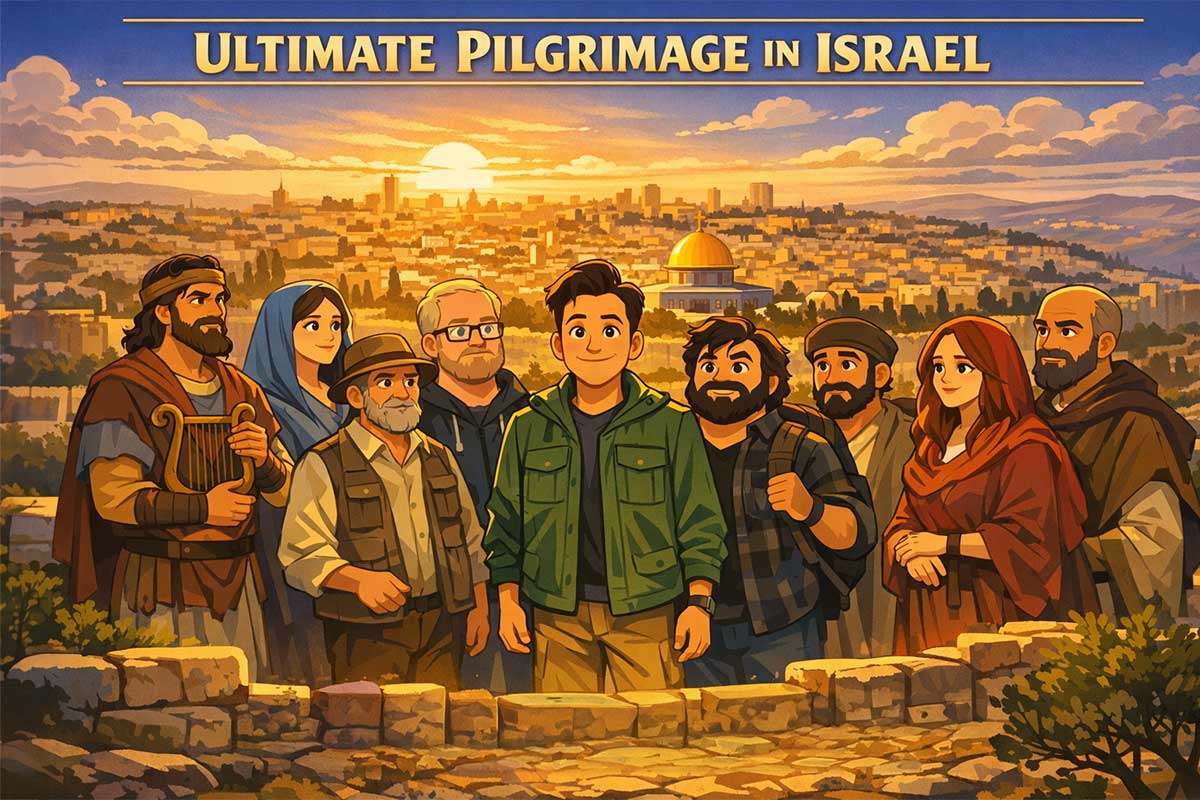
What if, Conan O’Brien and biblical figures walked Israel’s holiest places and revealed what modern pilgrims still miss?
What would happen if a Christian pilgrimage through Israel became more than a visit to sacred locations? What if the land itself became a living stage where history, humor, sorrow, truth, and grace met face to face?
In this imaginary journey, a pilgrim-host travels through Jerusalem, Bethlehem, Nazareth, Galilee, the Jordan River, Bethany, Gethsemane, the Via Dolorosa, and the Holy Sepulchre with Conan O’Brien, Jim Gaffigan, Jack Black, a historical guide, and a spiritual guide. At each stop, the place is first experienced as it truly is: its stone, heat, wind, bread, dust, water, crowd, silence, grief, beauty, and human pressure. Then, as though memory opens from inside the land itself, a biblical figure appears and speaks.
David teaches that holy places reveal the divided heart. Mary and Joseph show that God entered the world through strain, vulnerability, and willing trust. Mary in Nazareth reveals the sacredness of hidden faithfulness. Peter shows that calling comes in the middle of unfinished ordinary life. John the Baptist strips away performance and demands truth. Martha, Mary, and Lazarus reveal that faith can protest, weep, and still be met by compassion. In Gethsemane, Jesus shows that courage can tremble, surrender is not numbness, and love stays. Simon of Cyrene, Mary Magdalene, and Thomas each reveal a different kind of witness: unwanted burden, loyal love, and wounded faith.
This pilgrimage is not about collecting holy impressions. It is about being read by the land, interrupted by truth, and sent home changed. The journey begins with wonder, moves through humor and tenderness, passes into grief and surrender, and ends in a final Jerusalem roundtable where David, Mary, Peter, Mary Magdalene, and Paul answer the deepest question of all: what should a pilgrim take home after walking the places of the Bible?
The answer is not mere memory.
It is a way of life.
(Note: This is an imaginary conversation, a creative exploration of an idea, and not a real speech or event.)
Day 1: Jerusalem - The City That Sees You
Scene 1 — Arrival Over the Hills
The plane begins its descent in late afternoon, and the first thing you notice is the color.
Not green. Not lush. Not soft.
The land below is made of dust-gold, pale tan, dry stone, and sun-bleached ridges that look as though they have been prayed over for thousands of years. The light falls slant and warm across the hills, touching terraces, roads, rooftops, and patches of scrub with a glow that feels older than modern time. Through the window, the earth seems almost brittle, like bread baked hard in a fierce oven.
Inside the cabin, the air is stale with recycled coolness, coffee gone flat, traces of perfume, and the faint metallic smell of machinery and long travel. Your skin feels dry. Your mouth tastes of airplane air and sleeping badly. Seat belts click. Bags shift in the overhead bins. A baby cries somewhere behind you, then quiets. A few rows up, someone whispers in Hebrew. Another person murmurs in English. The plane dips lower.
Conan O’Brien leans awkwardly across his seat to peer out the window.
“Okay,” he says, voice low but carrying, “I just want everyone to know that this already feels far too spiritually important for the amount of sleep I got.”
Jim Gaffigan, still half reclined and blinking like a man who has crossed too many time zones with too little dignity, says, “I’m impressed the Bible took place in a place that already looks like it expects something from you.”
Jack Black presses both hands to the window like an excited child who forgot to be embarrassed. “Look at this. Look at this. This doesn’t even look real. It looks like a place where every rock knows a secret.”
You smile, tired but awake in a deeper way now.
The historical guide, seated across the aisle, closes the small guidebook in his lap and says in a calm, steady voice, “That reaction is common. Many first-time visitors say the land feels familiar before it feels known.”
The spiritual guide, hands folded lightly, turns toward all of you. “Some places welcome you,” he says. “Jerusalem often studies you first.”
Nobody laughs at first.
Then Conan blinks and says, “Terrific. We are being spiritually evaluated before baggage claim.”
That gets the first real laugh of the trip.
Yet as the plane lowers through the golden air, you feel it too — not fear exactly, not peace either, but a strange inward pressure, as though something inside you has already sat up straighter.
The wheels hit the runway with a thud that runs through your bones.
A few passengers clap softly.
You have arrived.
Scene 2 — Airport Air, Bright Stone, and First Footsteps
The airport is bright, polished, efficient, and almost aggressively modern after the ancient land outside. Glass gleams. Floors shine. Signs in Hebrew, Arabic, and English hang above lines that funnel people into orderly paths. The air smells faintly of soap, coffee, luggage fabric, and tired bodies. The wheels of suitcases rattle in bursts over seams in the floor.
You move through the terminal with the group in that odd half-awake travel rhythm — too tired to think clearly, too stimulated to feel simple exhaustion.
Conan drags his suitcase behind him and mutters, “I always assume international travel will make me look more dignified. It has never happened.”
Jim lifts his carry-on and says, “Nothing says holy pilgrimage like trying to remember where your charger is.”
Jack is looking everywhere at once — the lettering, the faces, the windows, the security officers, the bright walls. “I love airports,” he says. “Every airport says, ‘Your life is about to shift.’”
Outside the sliding doors, the first real breath of Jerusalem-region air hits you.
It is cooler than expected, touched by evening, but dry enough that your nose catches it sharply. It smells of dust, stone, engine fumes, and something faintly herbal, almost like dry grass crushed underfoot. There is a breeze — not lush or oceanic, but thin and clean, slipping across the skin with a slight chill after the stuffy plane.
The bus waits under the fading sky.
Its metal side is still warm from the day’s heat. The handle is smooth and cool in your palm. As you climb aboard, you hear a layering of sounds: doors hissing open and shut, distant horns, suitcase compartments slamming, someone laughing too loudly from relief, a soft call to prayer echoing faintly from somewhere far off, carried on the evening air.
You take a seat by the window.
The bus pulls away.
The roads climb.
As the city nears, the stone begins to change. Walls, houses, retaining terraces, apartment blocks, old facades, newer buildings — all of them in variations of Jerusalem limestone, pale cream in daylight, honey in evening, rose-gold at sunset. The city looks built from compressed light.
The historical guide stands lightly near the front, one hand steadying himself on a seat back. “Jerusalem stone is not just material,” he says. “It shapes how the city feels. Light behaves differently here.”
Conan looks out the window and says, “That is exactly what I need from a city right now — altered light and moral pressure.”
The spiritual guide smiles. “You joke, yet many pilgrims notice that the city feels visually beautiful and spiritually severe at the same time.”
Jack whispers, not to anyone in particular, “Yes. That’s it. Beautiful and severe.”
The bus climbs higher.
And now, even before you have walked a single holy street, the trip already feels less like tourism and more like entering a place that has been waiting.
Scene 3 — Hotel Terrace at Dusk
By the time you reach the hotel, the sky has started to soften from gold into lavender and deepening blue. The lobby is cool and faintly perfumed with polished wood, citrus cleaner, and something floral that sits quietly in the background. Your feet ache. Your shoulders feel heavy from travel. Yet beneath the fatigue, your senses are too awake to settle.
After a quick room drop, the group gathers on a terrace that overlooks part of the city.
The first thing you feel is the air.
Evening in Jerusalem carries a dry coolness that moves across your face and neck like clean cloth. It takes the sweat and airplane heaviness away. The stone floor under your shoes holds just a trace of warmth left from the day. Somewhere below, traffic hums in gentle waves. Closer by, plates clink from the dining room. A glass is set down. Someone laughs. Then the wind shifts, and the smell changes — olive trees perhaps, dust, distant cooking, and old stone releasing the last stored heat of the sun.
Before you, Jerusalem stretches in layered ridges and clustered buildings, domes, towers, windows flashing their last light. A bell rings in the distance, slow and rounded. A few seconds later, a faint thread of prayer-song floats from another quarter of the city. The sounds do not blend so much as stand beside one another, ancient neighbors that have never fully agreed and never fully left.
The historical guide gestures across the skyline. “This city has been conquered, mourned, rebuilt, sanctified, divided, and desired more times than most cities survive.”
The spiritual guide steps beside him. “And still people do not come here only for history. They come here for contact — with God, with memory, with themselves.”
Conan folds his arms, gazing out. “That’s a lot to put on a city before dinner.”
Jim says, “I was hoping the first challenge would be stairs, not my soul.”
Jack gives a low, delighted laugh. “I know this sounds dramatic, but this place feels… charged.”
Nobody mocks him.
Because he is right.
The sky darkens one shade further. Tiny lights begin appearing in the city like a field of earthly stars.
You rest your palms on the terrace stone rail. It feels dry and slightly rough, edges softened by time. Beneath your fingers is the real weight of place — not abstract, not symbolic, just stone, cool and silent.
The spiritual guide turns to all of you. “Before we speak of specific sites,” he says, “let me ask one question. Why are you really here?”
The breeze moves again.
You taste dryness on your lips, salt from travel still faint there. No one answers right away.
Conan breaks the silence first. “I came for enlightenment and a respectable amount of personal growth,” he says. “I would settle for one of those.”
Jim lifts one shoulder. “I came curious. I think that counts.”
Jack puts a hand over his chest. “I came because some places call to you before you can explain why.”
Then the guides look to you.
And for a moment, with the whole city breathing in front of you, honesty becomes easier than performance.
“I came,” you say quietly, “because I’ve read these stories for years, and I wanted them to feel less far away.”
The spiritual guide nods. “That is a worthy beginning.”
Below the terrace, the city lights keep multiplying.
Jerusalem is entering night.
Scene 4 — Dinner, Laughter, and the Weight Underneath
Dinner is served in a long room with stone arches, warm amber lighting, and windows half-open to the night. The room smells of baked bread, roasted lamb, lemon, herbs, olive oil, and coffee. The scent is rich but not heavy; it rises in waves that make everyone remember hunger at once.
The bread arrives first, warm enough that steam escapes when you tear it. The crust crackles under your fingers. Inside it is soft, slightly chewy, carrying the earthy smell of flour and heat. Olive oil pools in shallow dishes, peppery and green on the tongue. There are olives sharp with brine, creamy hummus dusted with paprika, cucumbers cool and wet, tomatoes sweet and bright, rice fragrant with spices you can’t name quickly enough.
For the first time since landing, bodies begin to unclench.
Jim takes a bite of bread, closes his eyes, and says, “This is the first spiritually meaningful event of the day for me.”
Conan points at him. “Good. Stay grounded. We need one person anchored in bread and reality.”
Jack is already halfway in love with the meal. “Food is always the first bridge,” he says. “You eat what people ate in the land and suddenly your brain stops thinking only in theology.”
The historical guide laughs softly. “That is less wrong than it sounds.”
Conversation begins light. Travel mishaps. Sleep deprivation. Conan’s inability to look elegant getting off buses. Jim’s suspicion that every pilgrimage quietly becomes a walking endurance test. Jack’s delight at the sky, the hills, the way the city looks both ancient and inhabited rather than staged.
Yet beneath the humor, something else is moving.
The spiritual guide sips tea, then sets down the glass. “The first day is always deceptive,” he says. “People think the real experience begins at the famous sites. Often it begins before that, in discomfort, in fatigue, in the first honest answer they give themselves.”
Conan tears another piece of bread. “I can already tell this trip is going to force me to become a more truthful person than my natural brand prefers.”
Jim says, “Your natural brand is panic with vocabulary.”
Jack nearly chokes laughing.
Then the room quiets for a moment as a server passes with grilled fish, lemon, and charred vegetables. The smell rises warm and savory, tinged with smoke. Outside the open window, the night air touches the room and cools the back of your neck.
The spiritual guide looks around the table. “Tomorrow we begin with the city itself. Tonight, I want only this. Leave room for surprise. Holy places do not always speak first in the language you expect.”
Conan nods solemnly. “I’m prepared for mystery. I’m less prepared for mystery that has expectations.”
The historical guide smiles, but his face carries a seriousness that stays with you. “Jerusalem often does.”
Dinner ends slowly, over mint tea and small sweets sticky with honey and nuts. The tea is hot and fragrant, sweet at first sip, cooling in the mouth with mint after. It clears the head. Or perhaps it only makes room for whatever the city is already beginning to stir.
At the end of the meal, nobody wants to go straight to bed.
The guides exchange a look.
“There is one more place we’d like to take you tonight,” says the historical guide.
Conan sighs. “Every sentence in Jerusalem sounds like the beginning of a parable or a mild crisis.”
“Possibly both,” says the spiritual guide.
So the group rises.
And follows them into the night.
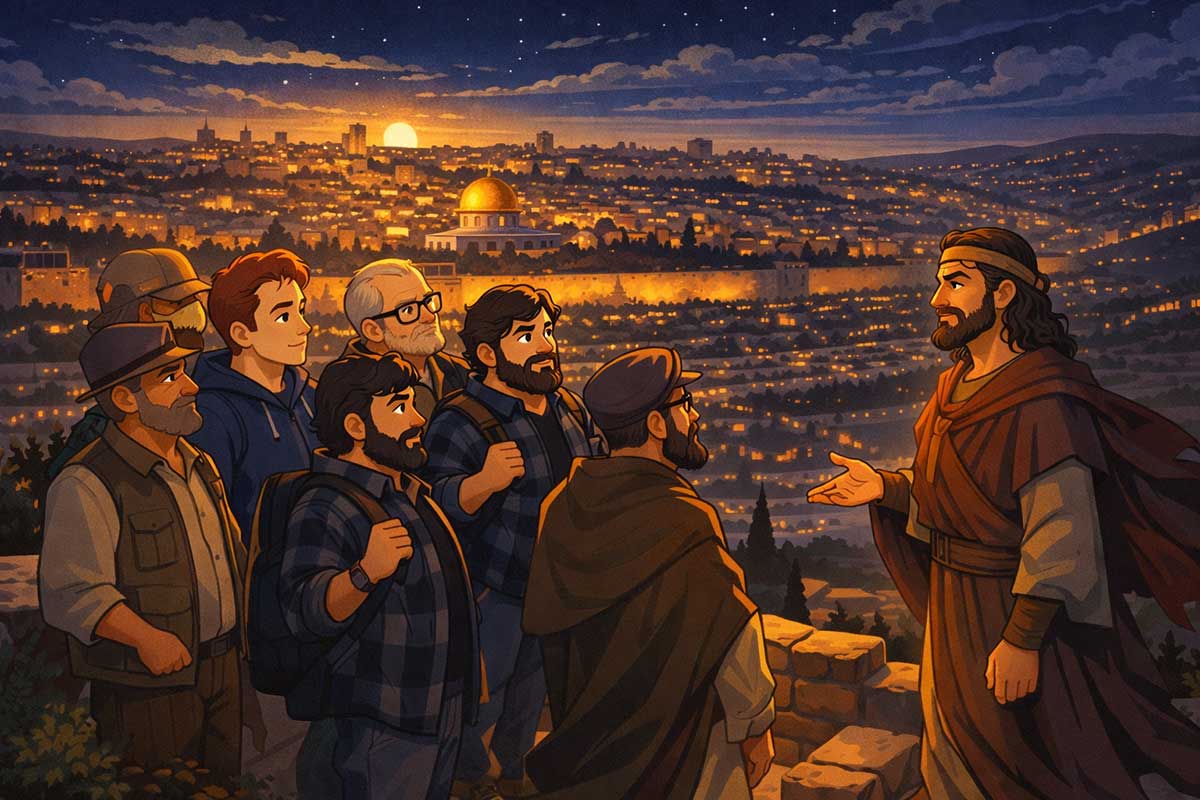
Scene 5 — The Overlook
The drive is short, the walk shorter, but the shift is enormous.
The city overlook is quiet in a way modern places rarely are. Not silent — never silent — but spacious enough for every sound to keep its shape. The wind moves freely here, touching your face with cool fingers. It smells of dust, distant trees, dry earth, and the faint mineral scent of stone. Somewhere nearby, grass brushes against itself. A dog barks far off. Down below, Jerusalem glows.
The city at night is not soft.
It is radiant, layered, watchful.
Golden walls catch light. Domes shine dull silver and gold. Roads curve in pale ribbons. Clusters of homes rise like steps on the hills. The Old City sits with a gravity that no camera fully captures. Around it, life continues: headlights, windows, voices, bells, prayer, traffic, breath.
You stand there with the others, and for a long moment nobody speaks.
The air is cool enough that you can feel it entering your lungs clearly. It tastes faintly of dust and cold night. Your hands, resting on the stone barrier, begin to lose their daytime warmth. The stone is rougher here than at the hotel, pitted with age. It anchors you.
The historical guide finally speaks, but more softly now. “This city has received kings, prophets, pilgrims, conquerors, mourners, saints, merchants, armies, and the lost. It has survived devotion and violence in equal measure.”
The spiritual guide steps forward half a pace. “People imagine a holy city will calm them. Sometimes it does. Yet just as often it reveals how unsettled they already are.”
Conan folds his arms tightly against the breeze. “I realize this may not be the ideal place for a confession, but I’m suddenly aware that I wanted this trip to give me a profound experience without requiring too much actual inner rearrangement.”
Jim glances over. “That’s very efficient of you.”
Jack stares out over the city, mouth slightly open. “I can’t explain it,” he says, “but this doesn’t feel like looking at a place. It feels like standing in front of a question.”
The wind rises for a moment, cool enough to make everyone blink.
And then it changes.
Not violently.
Not like thunder.
Just a slight alteration in the atmosphere, as though the space around the group has grown denser, more attentive, as though the night itself has taken one step closer.
You feel it before you see anything.
The hairs on your arms lift.
Conan stops mid-breath.
Jim goes still.
Jack’s eyes widen slowly.
The guides say nothing.
A man is standing a little apart from the group near the edge of the overlook, where a moment ago there was only darkness and stone.
He is not glowing. He is not theatrical. He looks real enough that the first shock comes not from what he is, but from how naturally he seems to belong there.
His robe moves lightly in the wind. His face carries both strength and ruin, the kind only deep sorrow and deep worship carve into a person over years. His eyes are fixed on Jerusalem.
No one speaks.
Then the spiritual guide, barely above a whisper, says, “David.”
The name enters the cold air and stays there.
Scene 6 — David and the City of Desire
David does not turn immediately.
For a few breaths, he simply looks at Jerusalem below, as though the city itself is speaking to him in a language too old and intimate for interruption.
When he finally faces the group, his gaze is steady, sad, alive.
“You see a city,” he says, voice low and resonant, “but no city is only its walls.”
Even the wind seems to hold back.
“I see longing,” he continues. “I see the hunger of men to be near God, to be remembered, to be forgiven, to be secured, to be exalted. They come saying one thing. Most are carried by many things.”
His voice is not grand in a distant way. It is warm, worn, almost painfully human.
Conan’s mouth opens slightly, then closes again.
David’s eyes move over the group, not accusing, not gentle either, but truthful.
“Do not trust anyone who tells you a holy place makes the heart simple,” he says. “A holy place often reveals how divided it already is.”
The city gleams below him.
The historical guide lowers his head a little, almost unconsciously, out of respect. The spiritual guide stands motionless, listening.
David turns back toward Jerusalem. “I loved this city,” he says. “I sinned here. I prayed here. I sang here. I failed here. I wept here. That is why it is holy to me. Not because only noble things happened. Because truth happened here without disguise.”
The words go through you like cold water.
The night smells sharper now — earth, old stone, a hint of distant smoke. Your throat feels dry. You swallow and taste mint from dinner lingering there, suddenly small and strangely vivid against the weight of the moment.
Jack speaks first, softly. “So holiness doesn’t mean perfection.”
David looks at him. “No. Holiness means the living God has not abandoned the place where truth and mercy must meet.”
Conan, to everyone’s surprise, says nothing funny.
Jim is the first to breathe audibly again.
You take a step forward without meaning to. “Why do people come here?” you ask. “Really?”
David answers without hesitation.
“To stand where they hope God may feel less abstract,” he says. “To bring their ache somewhere older than themselves. To ask whether memory can become encounter. To ask whether their life may yet be made clean.”
The wind moves again, carrying a bell tone from somewhere deep in the city. It floats upward, thin and beautiful, then disappears.
David lifts one hand toward Jerusalem.
“This city has seen ambition dressed as devotion,” he says. “Fear dressed as righteousness. Worship mixed with pride. Tears mixed with song. Yet still pilgrims come. Why? Because they know, even if they cannot say it, that the soul was not made for surfaces.”
Conan finally speaks, voice lower than usual. “That is upsettingly accurate.”
A faint smile touches David’s mouth.
“Then perhaps you have begun well,” he says.
Scene 7 — The Psalm, the Joke, and the Wound
For a few moments, the group stands in silence with David, the city below, the wind brushing clothes and hair, the stone cool beneath your hands.
Then Conan, because he is Conan and because tension must eventually become breathable, clears his throat.
“I want to ask something,” he says carefully, almost like a student who knows the room matters. “And I mean this respectfully. The Psalms. Were those… holy songs, or were they ancient emotional oversharing?”
The question hangs there.
Jim closes his eyes as though savoring the fact that somebody finally asked it.
Jack lets out a short half-laugh, half-gasp.
To your astonishment, David does not seem offended.
He studies Conan for a long second, then looks back at the city.
“When grief finds rhythm,” he says, “men call it poetry.”
He turns again.
“When sin finds tears before God, heaven may call it prayer.”
The answer lands so perfectly that for a second there is no reaction at all.
Then Jim makes a small sound — not quite a laugh, not quite surrender.
“That,” he says, “is so much better than anything I write in a notebook.”
Even David’s eyes warm slightly.
Conan places a hand over his chest in mock humility. “I’m relieved he didn’t smite me for phrasing.”
David says, “A broken man who tells the truth before God need not fear honesty.”
The breeze catches the edge of David’s robe.
Jack steps forward a fraction. “Did you always know how to pray like that?”
David’s expression changes. Not harder. Deeper.
“No,” he says. “At times I prayed from joy. At times from terror. At times from guilt so heavy that sleep itself was bitter. Do not think the prayer God hears is always polished. Very often it is the one that can no longer pretend.”
His eyes pass over each of you.
“You who travel here,” he says, “do not mistake reverence for performance. Better an honest cry in Jerusalem than a beautiful lie.”
The spiritual guide’s face is wet now, though he seems unaware of it.
The city below continues shining, indifferent and holy all at once.
You find yourself asking the question you didn’t know you had brought.
“Can a place change a person?”
David looks at you long enough that the night itself feels to pause.
“A place may unveil him,” he says. “Change begins when unveiled truth is no longer refused.”
The sentence sinks into you slowly, like a stone dropped into deep water.
Conan exhales. “This city is aggressive.”
That gets a real laugh this time — even from the guides.
David almost smiles again. “Only to those who wished to remain hidden.”
The night grows quieter.
Or perhaps it is only that everyone has become more still.
Scene 8 — Return Through the Sleeping City
No one sees David leave.
One moment he is there, the next the overlook is only wind, stone, darkness, and the shining city below. There is no flash, no sign, no theatrical vanishing. The absence feels almost as powerful as the presence, like the way a bell continues in the body after its sound is gone.
For several breaths, nobody moves.
The cool air touches your cheeks. The smell of night earth and stone is stronger now. Somewhere close by, a moth taps once against metal. A car passes below. Then another. Life continues. Yet nothing feels ordinary in quite the same way.
The walk back to the bus is slow.
Gravel crunches under shoes. A jacket zipper catches, then slides. Someone clears a throat. No one tries to fill the silence too quickly.
At last Conan says, quietly, “I’m aware this may sound unserious after what just happened, but I do feel as though I have been spiritually outclassed by an ancient king.”
Jim nods. “That seems fair.”
Jack rubs both hands over his face and laughs once, helplessly. “I can’t even explain what this feels like. It’s like history opened up and looked right at us.”
The historical guide speaks from the darkness beside you. “That is close to how many pilgrims describe their first real encounter here — not information, but exposure.”
The spiritual guide adds, “Day one is often enough to tell a person whether he came only to observe.”
On the bus ride back, Jerusalem passes by in quiet gold and shadow. Small shops closed behind metal shutters. Lamps over stone alleys. Apartment windows glowing. A man walking home alone. A cat slipping between parked cars. The city smells of cooling stone, diesel, dust, and faint late-night bread from some unseen bakery still working.
You rest your head lightly against the glass.
It is cool.
The motion of the bus hums through your bones. Fatigue is coming back now, but altered, as though tiredness has been layered over with something watchful.
No one speaks for a while.
Then Conan, staring out into the city lights, says, “I thought this trip would help me understand Jerusalem.”
He pauses.
“I’m beginning to suspect Jerusalem is going to help me understand what I’ve been avoiding.”
Jim lets out a small breath of agreement.
Jack leans back and closes his eyes. “Yeah,” he says. “That.”
When you reach the hotel, the corridors are quiet, carpeted, dim. The room door clicks shut behind you with a soft final sound. You wash your face in cool water that smells faintly mineral. You can still feel the night air in your hair, the stone under your hands, the city under your skin.
Before bed, you stand one last moment at the window.
Jerusalem glows in the distance.
And now, after only one night, it no longer feels like a place you are visiting.
It feels like a place that has begun to read you.
Day 2: Bethlehem Where - Holiness Arrived Small
Scene 1 — Morning Light Over Jerusalem
Morning in Jerusalem enters the room before you are ready for it.
The curtains glow first — a pale gold through woven fabric — then the light sharpens, and the stone outside your window begins to shine. Not white, not yellow, but a warm cream color that seems to hold sunlight differently from any other city. The air in the room is cool and dry. When you inhale, it feels clean but thin, with none of the lush softness of coastal mornings. Your throat is slightly parched. Your skin feels newly aware of the climate, as though the land is teaching your body its own language.
You slept, though not deeply.
David’s voice still lingers somewhere under your ribs.
By the time you join the others for breakfast, the dining room is full of low clinks, chair legs gliding over stone floor, silverware tapping plates, and the murmur of several languages floating together in the air. The smell is immediate and generous — strong coffee, toasted bread, cucumbers, tomatoes, yogurt, eggs, olives, cheese, mint, orange peel. A tray of pastries sends up warm butter and sugar. Fresh bread has that irresistible smell of flour, heat, and morning comfort.
Jim is already at the table staring into a coffee cup with the grave concentration of a man trying to return to the world through caffeine.
“I had a dream,” he says as you sit down, “that King David critiqued my posture and then asked why Americans eat breakfast pastries shaped like regret.”
Conan pours coffee and says, “That sounds like a fair and spiritually rich dream.”
Jack is standing at the buffet holding two pieces of fruit and a pastry, unable to commit. “I woke up emotional,” he says. “Why am I emotional before breakfast? This city is doing things.”
The historical guide spreads a map on the table. The paper crackles softly beneath his fingers. “Today,” he says, “we go to Bethlehem.”
The word alone changes the mood.
Not heavier exactly. More tender.
The spiritual guide, stirring tea, says, “Yesterday the city revealed greatness and fracture. Today we enter smallness — family, vulnerability, birth, pressure, yes spoken without full clarity.”
Conan butters a piece of bread. “I feel I should admit right now that if I had been present for the Nativity, I would have been of no practical use.”
Jim glances over. “You would have been the guy making tense jokes while trying not to faint.”
“That is an important social role,” Conan says.
You bite into bread still faintly warm, taste olive oil and salt, and feel the meal settling into you. There is something comforting about beginning such a day with food this simple and real. The cucumbers are cold and crisp. The tomatoes taste sun-made. The coffee is dark and slightly bitter, waking the whole mouth.
Outside the windows, Jerusalem shines.
Soon the group rises, gathers bags, jackets, cameras, notebooks, and heads for the bus.
The morning is bright.
The road to Bethlehem waits.
Scene 2 — Leaving Jerusalem, Entering the Hills
The bus hums gently as it rolls through Jerusalem’s morning traffic.
Outside the window, the city is all motion now — schoolchildren with backpacks, shopkeepers lifting metal shutters, women carrying groceries, men talking at street corners, buses sighing at stops, delivery vans double-parked near stone buildings. The air outside looks crisp, almost brittle with light. Sun strikes the Jerusalem limestone so strongly that some walls seem to glow from within.
Inside the bus, there is the familiar mixed smell of fabric seats, faint engine warmth, sunscreen, coffee in travel cups, and the clean dry scent that keeps sneaking in each time the door opens. A water bottle rattles gently in the cup holder by your seat. The window glass feels cool when your arm brushes it.
The historical guide speaks from the front. “Bethlehem is close in distance,” he says, “but deep in symbolic weight. Many people know the name before they know the place.”
Conan leans sideways in his seat. “That sentence alone tells me I am headed toward spiritual correction.”
Jack is looking out at the slopes. “The hills are beautiful,” he says. “But they’re not soft. They look lived in. Exposed.”
“That matters,” says the guide. “The Nativity happened in a real political and physical world — under empire, under pressure, under uncertainty. Christian memory often smooths the edges. The land does not.”
The road bends through pale hills marked by terraces, olive trees, walls, low buildings, and stretches of dry earth that look almost silver where the morning sun hits them. The landscape smells faintly of dust whenever the wind slips through the bus vents. It is not empty country. It is layered country — marked, bordered, ancient, inhabited.
The spiritual guide turns halfway in his seat to face the group. “People imagine Bethlehem as a place of soft holiness,” he says. “Yet the story begins with strain — travel, crowding, power, pregnancy, uncertainty, no obvious comfort, no visible glory. That is already a theology.”
Jim looks up from the snack he has been quietly unwrapping. “That’s honestly one of the most believable things about the whole story. The sacred arrives and the logistics are still terrible.”
Conan points at him. “Exactly. I trust any holy event that includes confusion, bad timing, and no ideal accommodations.”
Laughter moves through the bus, light and needed.
Then the spiritual guide asks, “What if the form of God’s arrival tells us as much as the fact of it?”
The bus grows quiet again.
Outside, a shepherd can be seen in the distance with a small flock on a hillside, the animals like scattered moving stones. Laundry hangs between buildings. A dog lies sleeping in a patch of sun. Somewhere, unseen, church bells ring faintly and disappear.
You rest your hand on the seat in front of you and feel the slight vibration of the road through the frame.
Something about the approach feels different from Jerusalem.
Jerusalem felt like a gaze.
Bethlehem feels like a breath being held.
Scene 3 — The Town of Layers
Bethlehem does not arrive as a Christmas card.
It arrives as a real town.
The streets are active, uneven, layered with buses, parked cars, stone buildings, utility wires, signs, small shops, schoolchildren, church towers, and the ordinary pulse of daily life. The air smells like traffic, sun on stone, bread from a nearby bakery, diesel, coffee, and once in a while a drift of something sweet — pastries or sugared nuts from a shop door left open.
The group steps down from the bus into the sound of the town: horns that are more impatient than angry, voices calling across streets, footsteps on pavement, a vendor arranging something metallic that clinks in quick bright notes, a church bell in the middle distance, the brief bark of a dog, a scooter whining uphill.
The sun is stronger here now. It presses on the top of your head and shoulders, while the breeze moving between buildings keeps the edges of the heat from becoming oppressive. Your lips taste a little dry again. You take a sip of water and can feel how quickly your body wants it in this climate.
The historical guide gathers the group at a corner where the street opens slightly and points beyond the shops and stone facades.
“This town was never meant to be sentimental,” he says. “At the time of Jesus’ birth, it existed within the reach of imperial power and local vulnerability. People hear the word Bethlehem and imagine glowing stillness. But history rarely arrives in ideal conditions.”
He lets that sit.
“Think of what the story includes,” he continues. “Travel late in pregnancy. Registration under state power. No special treatment. No celebrated entrance. The Christian claim is not merely that God came. It is that God came this way.”
Jack takes off his sunglasses and looks around more carefully. “That changes everything,” he says. “It’s not polished. That makes it feel more true.”
Jim nods. “Yes. I’ve always liked that the story feels divine and deeply inconvenient.”
Conan looks up a narrow street where laundry moves slightly in the wind between pale walls. “I’m starting to understand that half the theology here is hidden in the stress level.”
The spiritual guide smiles. “And in the humility.”
A bakery door opens nearby, and a rush of warm yeasty air spills into the street. Fresh bread, sesame, heat, flour. It is almost intoxicating in its simple comfort. For a second the smell wraps around everything — stone, traffic, voices, sun.
You follow the others through the streets, shoes brushing over worn pavement, hearing your own footsteps mix with the town’s rhythms. The stones underfoot are uneven enough to keep you alert. A wall beside you is sun-warm when your fingers brush it, rough and chalky with age.
The town presses close in places, then opens suddenly into a square, then narrows again. Nothing is staged. Nothing waits to be admired from a distance. Bethlehem asks to be entered, not just viewed.
And that, somehow, makes the coming moment feel nearer.
Scene 4 — Beneath the Church
The Church of the Nativity stands with a gravity that is both architectural and emotional.
Its ancient stone exterior feels more fortress than decoration, worn by centuries of weather, prayer, conflict, and touch. People move in and out with lowered voices, camera straps, crossed hearts, distracted children, whispered reverence, travel fatigue, tears already beginning in some faces. The doorway is lower than expected, forcing almost everyone to bow entering. Even Conan notices.
“Well,” he says, ducking, “that is very effective symbolism and very bad news for my neck.”
Inside, the light changes at once.
It becomes dimmer, softer, layered. Candles flicker. Hanging lamps glow amber and red. Incense hangs in the air, thick and sweet, mixed with old wood, ancient stone, wax, fabric, and the faint damp coolness buildings this old always seem to keep in their bones. The smell settles on your clothes and skin almost immediately.
The floor under your feet is smooth in some places, uneven in others, worn by centuries of soles. Every sound behaves differently here — footsteps muted then suddenly bright, whispered prayers carried sideways, a child’s voice rising and being absorbed by the stone, the soft scrape of a bench, the rustle of jackets. Somewhere deeper inside, chanting begins, low and resonant, a ribbon of sound that curls through the chambers and arches.
Jack stops walking for a second, eyes wide. “Oh wow,” he whispers. “This is… old in a way you feel in your body.”
The historical guide keeps his voice low. “This structure marks the long memory of the birthplace tradition. What matters for us is not forcing archaeology to do what faith alone does, but entering the continuity of witness. Christians have come here for centuries to kneel, remember, and say: here, in this world, in this flesh-bound history, the Incarnation was confessed.”
The spiritual guide adds, “And note how fitting it is that one enters low.”
The line of visitors moves slowly toward the lower grotto.
As you descend the worn steps, the air grows cooler. The scent of incense grows richer, closer, mixed with human breath and wax. The stone wall beside your hand is cold and smooth where countless other hands have passed. You hear the clinking faintly of hanging lamps and the murmurs of people who suddenly do not know what volume to use around mystery.
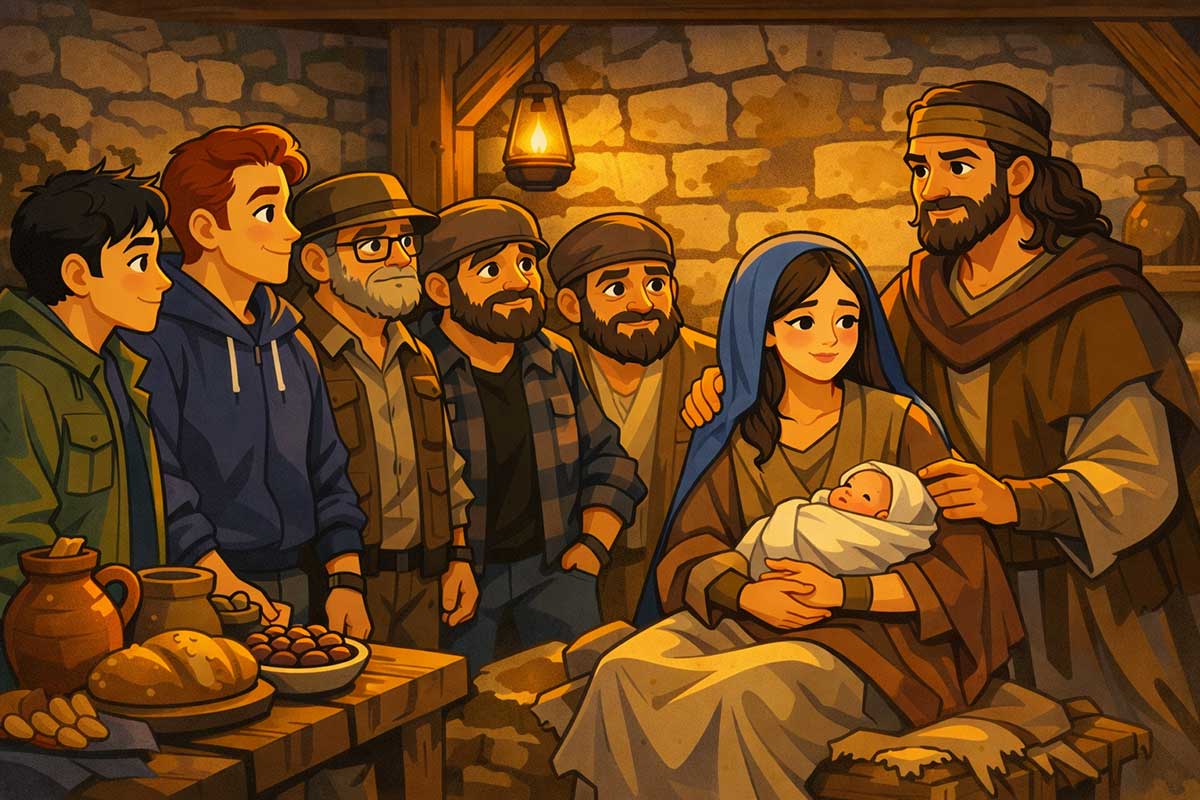
At the grotto, the space is small, dense, intimate. Lamps burn above polished surfaces. Gold glows in the dimness. Stone curves low overhead. The place feels less like spectacle than compression — the infinite crowded somehow into a space meant for knees, breath, and tears.
You wait your turn. People kneel. Some cross themselves. Some close their eyes. One woman begins crying quietly before she has even bent down.
When your fingers finally touch the cool stone near the traditional spot, the contact is startlingly physical.
Cold. Hard. Real.
No music swells. No mystical vision comes.
And yet the contact feels like a tiny electric current running from hand to chest.
Conan kneels carefully and then rises too fast. “I nearly had a transcendent event with my hamstring,” he whispers.
Jim murmurs back, “That still counts as embodiment.”
Even here, humor survives — but softened, humble, almost grateful.
The group gathers off to one side in the dim golden half-light.
The spiritual guide says quietly, “This is where the heart must decide whether smallness is disappointment… or revelation.”
And that is when the air changes.
Scene 5 — Mary and Joseph
It happens with such gentleness that for one suspended second you almost think the church has simply shifted around you.
The lamps seem warmer.
The air grows still.
The noise of nearby movement recedes, not vanishing but becoming distant, as if one layer of the room has stepped back and another has drawn near.
You turn.
A young woman stands a short distance away, dressed simply, her presence calm enough to steady the whole space. Beside her is a man with the bearing of someone who has spent much of life carrying what had to be carried without ceremony. Neither looks unreal. Neither shines. Yet both belong to the place with a right so deep that your whole body knows before your thoughts catch up.
Mary.
Joseph.
Jack lets out the smallest sound — not fear, not laughter, almost a child’s gasp of recognition.
Jim’s hand tightens around the strap of his bag.
Conan goes absolutely still.
The guides bow their heads slightly, not out of performance but instinct.
Mary looks first at the grotto, then at the group. Her face is young, yet her eyes carry the kind of calm only great cost can deepen.
“When people remember that night,” she says, “they often remember light.”
Her voice is soft, but it fills the space completely.
“I remember weight.”
The lamps flicker against stone. Somewhere above, the chant continues, a distant current under her words.
“I remember breath,” she says. “Pain. Travel. Fatigue. The body doing what it must do even when the soul is overwhelmed. I remember saying yes again, not once, but moment by moment.”
No one interrupts.
She rests one hand lightly against the stone wall beside her.
“Do not make that night too gentle in your imagination,” she says. “A woman about to give birth does not live inside poetry. She lives inside pressure, endurance, uncertainty, and surrender.”
The sentence enters the room like truth too plain to resist.
Joseph speaks next.
His voice is deeper, practical, with a quiet steadiness to it.
“There are times,” he says, “when a man is entrusted with something he did not make, does not control, and cannot fully explain. Yet he must guard it with his whole life.”
He looks at each of you in turn.
“That is how responsibility often arrives.”
The spiritual guide’s eyes are wet.
The historical guide, for once, says nothing at all.
Mary continues. “People ask why God entered the world this way — not through visible triumph, but through dependence.”
She lowers her gaze briefly, then raises it again.
“Perhaps because pride would have bowed to force, but love had to learn to recognize Him in weakness.”
The words seem to thicken the air around you.
You can smell wax, incense, old stone, and your own skin warmed by the closeness of the space. Your knees feel suddenly unsteady. Your fingertips still hold the cold memory of the stone you touched.
Conan finally draws breath and says, very quietly, “That is… much more real than every Nativity pageant I have ever seen.”
For the first time, Joseph’s mouth shifts toward something like humor.
“Yes,” he says. “There was less pageantry.”
Jim closes his eyes briefly in surrender.
Jack presses a hand to his chest. “I don’t know why, but that just wrecked me.”
Mary looks at him with a tenderness so human it hurts. “Truth often does before it heals.”
Scene 6 — Questions Nobody Asks in Church
The group moves with Mary and Joseph into a side chamber where the light is lower and the foot traffic thinner. The air is cooler here. The smell of incense lingers in the stone like memory itself. A lamp swings almost imperceptibly somewhere overhead, making tiny gold movements on the wall.
What strikes you most is how ordinary Mary and Joseph feel in their bearing — not ordinary in importance, but in humanity. There is no brittle perfection around them. No distance. They feel like people who have known strain, responsibility, fatigue, private trust, and the kind of obedience that does not always come with immediate understanding.
Conan clears his throat.
There is something almost touching in how careful he becomes in moments like this, as though his wit knows when to lower its voice.
“May I ask a question,” he says, “that may sound foolish, but I suspect it’s less foolish than pretending I don’t have it?”
Joseph nods.
Conan spreads one hand. “Did you ever want… more details? A clearer plan? A divine memo with practical follow-up?”
Jim looks down, already smiling.
Jack turns away, shoulders shaking.
Joseph answers with the driest honesty imaginable.
“A clearer explanation,” he says, “would have been welcome.”
Even Mary smiles.
The laughter that follows is quiet, relieved, human. It does not break the room. It makes it breathable.
Conan places a hand over his heart. “Thank you. That is the most comforting sentence I have heard in a sacred place.”
Joseph’s gaze remains steady. “Obedience is not the same as full comprehension.”
Mary adds, “Peace is not always given before the yes.”
That lands harder than the joke.
You ask the question that has been building in you since she first spoke.
“Were you afraid?”
Mary turns toward you fully.
“Yes,” she says.
The simplicity of it is devastating.
“Yes,” she repeats. “Not always in the same way. There is the fear of pain. The fear of what others will say. The fear of whether you can protect what has been placed in your care. The fear of not knowing the shape of what comes next.”
She takes a breath.
“But fear is not the opposite of faith. Refusal is.”
The room goes so quiet you can hear the faint crackle of candle flame.
Jim asks, voice low, “Did holiness make things easier?”
Joseph answers first. “No.”
Then Mary: “It made them meaningful.”
Jack wipes at his eyes, laughing a little at himself. “That’s not fair. That line is too strong.”
Conan says, “I feel ambushed by wisdom in here.”
Mary’s expression gentles further. “Many people think being chosen would feel like being lifted above ordinary struggle. Yet the Holy One entered ordinary struggle itself. That is the sign.”
The spiritual guide finally speaks, almost as if translating the moment for the modern soul. “So the Incarnation does not remove human fragility. It sanctifies it from within.”
Mary nods once.
And now the whole room feels changed — no longer only a remembered birthplace, but a chamber of lived yes, lived pain, lived trust.
Scene 7 — Shepherd Fields and the Open Sky
Later, outside the church and beyond the busier part of town, the group walks into a quieter field region associated with shepherd memory. Whether every detail of every tradition is pinned perfectly to every patch of ground feels almost beside the point now. The land itself is eloquent.
The sky is enormous.
Clouds move slowly through pale blue. The hills roll away in dry folds of stone, scrub grass, olive trees, and low walls. Wind crosses the open ground carrying the scent of sun-warmed earth, dry plants, distant animals, and the faint mineral edge of dust. You hear insects in the grass, a distant vehicle now and then, the soft scrape of your own shoes on the path, the rustle of jackets when the wind rises.
The sunlight is direct but not harsh. It touches faces clearly, throws defined shadows, turns the grasses pale silver-gold where they bend. When you touch a stone wall, it is warm from the day, rough and grainy. The breeze cools the sweat at the back of your neck.
The wide air changes everyone.
After the density of the church, this openness feels like exhale.
Jack lifts both arms. “Okay. Okay. Now I get the shepherds. If I were out here at night and the sky exploded with angels, I would absolutely believe anything.”
Jim says, “I admire your confidence. I would assume I was having a heat event.”
Conan shades his eyes and looks across the hills. “There is something very powerful about the fact that one of the most important announcements in Christian memory went first to people outdoors with animals.”
The historical guide nods. “Marginal witnesses. Not the obvious centers of status.”
The spiritual guide adds, “Good news often enters the world through the low door.”
The wind shifts.
And then Mary and Joseph are with the group again, not in the dense intimacy of the grotto this time, but under open sky.
It changes them too.
Mary looks younger here somehow, not by age, but by air and light. Joseph seems even more grounded, as though the land itself fits his stance.
Mary gazes over the hills.
“There is a kind of smallness the world despises,” she says. “And there is a kind of smallness heaven chooses.”
Joseph looks at the rough ground beneath his feet. “A child was born into a hard world. That did not cancel the hardness. It placed God inside it.”
The wind brushes their clothing. You can hear it move through the grass in a dry whispering rush.
Conan asks, “Did you understand, at that point, how large the story was?”
Mary answers almost immediately.
“No,” she says. “I understood only enough for the next act of faithfulness.”
That line opens something in you.
The sky seems larger.
The hills quieter.
Jack says softly, “That may be one of the most comforting things I’ve ever heard.”
Joseph turns to all of you. “Many men wait to feel heroic before they protect what matters,” he says. “Better to be faithful than heroic.”
Jim nods hard at that one.
And you can feel why. The line tastes like truth — simple, unspectacular, strong.
The spiritual guide closes his eyes briefly as if receiving it into his own life.
The open field holds the group in sun, wind, dust, and silence.
Bethlehem is no longer a scene from a card.
It is family, exposure, yes, and the strange holiness of being entrusted with what you cannot control.
Scene 8 — Evening Return and the Tender Weight of Small Things
The ride back to Jerusalem is quieter than the ride out.
Not solemn. Tender.
The bus smells faintly now of sun-warmed fabric, bottled water, dust brought in on shoes, and the ghost of pastries someone opened halfway through the afternoon. The engine hum is low and steady. Light flashes across the windows as the road bends through the hills. The land outside looks softer now in late afternoon — gold leaning toward amber, stone turning honey-colored, shadows gathering in folds and terraces.
Conan sits with one arm across the seat back, staring out the window. “I think what got me today,” he says finally, “is that the whole thing felt so… unprotected. Not protected by symbolism, I mean. It felt bodily. Tired. Exposed. Real.”
Jim looks down at his hands. “Yes. It made the story feel less like decoration and more like a family under pressure.”
Jack, still carrying the emotional glow of the day openly, says, “That’s exactly it. God didn’t enter the world through polished triumph. He entered through fragility. That’s wild. That changes everything.”
The historical guide, who has mostly let the day settle in silence, speaks without turning around. “That is why Bethlehem continues to matter. It is not merely the beginning of a sacred biography. It is a statement about how God chooses to be known.”
The spiritual guide adds, “And about where many people fail to look for Him.”
The bus climbs. Jerusalem begins to reappear in the distance.
This time it feels different.
Yesterday, the city felt severe and searching.
Tonight, after Bethlehem, it feels as though somewhere inside that searching gaze there is room for tenderness.
At the hotel, dusk is sliding across the terraces again. Dinner is simpler tonight — soup fragrant with lentils and cumin, roast vegetables sweetened by heat, warm bread, herbs, tea. The flavors feel grounding after the day: earthy, savory, honest. Steam rises from bowls into the cool evening air. Metal spoons click softly against ceramic. Someone tears bread. Someone laughs once and then grows thoughtful again.
You step out onto the terrace with your cup of tea after the meal.
The mint rises hot and sweet, then cools the mouth after each sip.
Below, Jerusalem lights awaken one by one.
You can smell night air, faint dust, distant cooking, stone cooling after sun.
The city does not speak tonight with David’s severe truth.
It holds instead the after-echo of Mary’s steadiness, Joseph’s practical faithfulness, the rough cold stone of the grotto, the warm bread of the morning, the wind in the shepherd fields, the shocking human honesty of holy birth.
Conan joins you at the terrace rail.
For once, he does not begin with a joke.
“I always thought Bethlehem was about sentiment,” he says softly. “Today it felt more like courage.”
You nod.
A few seconds later Jim steps out too, carrying tea, and says, “Courage and logistics.”
Conan smiles. “Thank you. I was in danger of becoming too sincere.”
Jack appears last, arms spread to the night air like he is greeting an invisible choir. “Today,” he says, “was beautiful and crushing and somehow comforting.”
The spiritual guide, coming out behind him, says, “That is often how truth first feels when it becomes more than an idea.”
You all stand there together, looking at the city.
The cup warms your hands.
The breeze cools your face.
Down below, Jerusalem glows.
And somewhere deeper than thought, Day 2 settles into the heart:
God came small.
God came near.
God came into strain, not around it.
And what heaven touched did not stop being human. It became holy inside its humanity.
Day 3: Nazareth - The Hidden Years
Scene 1 — A Different Kind of Morning
The third morning begins more quietly than the first two.
Jerusalem is still beautiful outside the hotel windows, still carved in pale gold and stone, still touched by that dry light that seems to sharpen edges rather than soften them, yet your body has started to adjust to the rhythm of the land. The air no longer feels strange when you wake. It feels clean. A little austere. Honest.
When you open the window a crack, cool morning air slips in carrying the scent of stone, faint dust, distant bread, and something green from trees or shrubs hidden below the terrace walls. The city is already awake, though not loudly yet. A delivery truck backs up with soft beeps somewhere down the hill. A bell rings once, then again. Voices rise and fall in the street below. The whole city sounds like a place beginning work rather than posing for pilgrims.
Inside the dining room, breakfast is calmer today.
The smell of coffee is richer than ever, dark and bitter and almost medicinal in the best way. Eggs, olives, yogurt, cut fruit, warm bread, cheeses, cucumbers, tomatoes, herbs, jam — the table is full, but no one attacks it with the same travel-hunger desperation as Day 1. You are more present now. The food tastes brighter. The tomatoes are sweet and acidic. The yogurt is cool and tangy. The bread is soft inside, crisp outside, with a faint toasted scent that makes it impossible not to tear another piece.
Jim is already seated, stirring coffee slowly. “I’ve noticed something,” he says. “Everything here tastes as if it came from a serious place.”
Conan slides into a chair. “That is exactly what I wanted from a region saturated in prophets and existential history. Serious cucumbers.”
Jack arrives with a plate that has clearly been assembled by instinct rather than strategy. “I had this weird feeling when I woke up,” he says. “Yesterday was all tenderness and vulnerability. Today feels… quieter. Like we’re heading into something smaller, but maybe deeper.”
The historical guide nods. “Today we go to Nazareth.”
The word lands differently than Bethlehem.
Bethlehem carries memory like a bell.
Nazareth carries obscurity.
The spiritual guide wraps both hands around his tea. “The hidden life is one of the least glamorous and most necessary parts of the Gospel story,” he says. “People love revelation, miracle, turning points. Few know what to do with long years of ordinary life.”
Conan takes a sip of coffee and winces from the heat. “That feels like a personal attack on every modern person who expects transformation to come with visible progress markers.”
Jim says, “The hidden years are tough branding.”
Jack leans back in his chair, smiling. “Or maybe they’re the truest part.”
No one answers right away.
That silence feels right.
Because somewhere under your own excitement, under the grandness of Jerusalem and the tenderness of Bethlehem, another truth has begun to stir: most of life is not lived at the great turning points.
Most of life is lived in kitchens, roads, family rooms, workshops, fatigue, waiting, repetition, dust, tasks, ordinary mornings.
And today, that is where the pilgrimage is going.
Scene 2 — The Road North
The drive north unfolds through changing hills, roads, towns, fields, and ridges, each stretch of land showing a different face of the country.
The bus windows frame a moving world of limestone buildings, roadside trees, terraced slopes, gas stations, schoolyards, olive groves, modern roads curving through old geography, patches of green breaking unexpectedly through dry earth, and signs in several languages that remind you at every turn that this land is layered, argued over, inhabited, remembered.
The engine hums low beneath your seat. The bus has a faint smell now of warmed upholstery, plastic water bottles, sunscreen, coffee, and crumbs from snack wrappers quietly opened and folded shut again. Every so often a pocket of warm sun hits the window glass hard enough that the side of your face feels it. Then the road bends, shade returns, and the temperature shifts again.
The historical guide stands near the front, one hand braced lightly against the seat. “Nazareth in the first century was not a famous place,” he says. “That matters. We often assume sacred history happens in locations people already expect to matter. Nazareth reminds us how often the opposite is true.”
The spiritual guide turns halfway in his seat. “And after Bethlehem, after the wonder and danger of that beginning, the story does not move immediately into public triumph. It goes into years. Households. Labor. routine. Growth. Waiting.”
Conan looks up from the passing landscape. “So after angels, stars, and shocking divine mystery, the plot moves into chores.”
“Yes,” says the spiritual guide.
Jim folds his hands over his stomach. “That may be the most believable thing so far.”
Laughter moves through the bus, soft and easy.
Outside, the land grows greener in places, then dry again, then greener. The smell shifts each time the door opens at a stoplight or rest area — warm air, roadside dust, cut grass, fuel, occasionally fried food from somewhere nearby. A man in a small town carries fresh bread under one arm. Children in school uniforms spill out of a gate. Laundry lifts on a rooftop line.
Jack presses his forehead lightly to the window. “I keep thinking about Jesus growing up in an actual place,” he says. “Not as an icon. As a boy. With mornings. Meals. Neighbors. Work.”
The historical guide nods. “Exactly. Nazareth grounds the Incarnation in long duration.”
Conan gestures toward him. “That’s the phrase. Long duration. We all love the dramatic chapter. Fewer of us want the chapter called ‘mostly this was daily life.’”
The spiritual guide answers gently, “Yet most souls are formed there.”
The bus keeps moving.
You watch the towns pass, and the road itself starts to feel symbolic — not in a forced way, but in a lived one. Not every day of faith is Jerusalem. Not every day is Bethlehem. Some days are simply the road toward Nazareth: ordinary mileage between revelations.
And perhaps those days matter more than people admit.
Scene 3 — First Glimpse of Nazareth
Nazareth comes into view not as a staged holy village, but as a living city spread over hillsides — white and pale stone buildings stacked and clustered, roads winding between them, church domes and towers rising here and there, apartment blocks, markets, homes, schools, traffic, satellite dishes, balconies with plants, the whole thing sunlit and real.
The town sounds alive before you fully enter it.
The bus slows through streets where horns chirp impatiently, scooters buzz past, voices carry from storefronts, shoes scrape over pavement, metal shutters rattle, and snippets of conversation break across the air in Arabic, Hebrew, English, laughter, bargaining, and ordinary daily urgency. A bakery sends out the smell of sesame and heat. Nearby, coffee — dark, roasted, rich — rises from a café doorway. Somewhere close, detergent and damp fabric drift from laundry drying on a line. The scent of life is close and layered.
When you step off the bus, the sun feels higher and warmer than it did in Jerusalem. The air is still dry, but softened by cooking smells, market smells, and the close press of inhabited streets. The stone beneath your shoes is warm. A wall beside you, when your fingers brush it, is chalky and sun-heated.
Jack turns slowly, taking it all in. “This is not the Nazareth of paintings,” he says. “This is better. This is actual.”
The historical guide gathers the group near a shaded stretch of wall. “Nazareth’s importance,” he says, “rests partly in its apparent lack of importance. A place without great public prestige. A place of labor, households, ordinary rhythms, village memory.”
The spiritual guide adds, “That is why it matters so much spiritually. The Son of God did not only enter birth and death. He entered years.”
Conan looks up at the hillside buildings and says, “There should be a very famous theological book called God and the Long Middle Part.”
Jim nods gravely. “I would buy that.”
A woman carrying groceries passes nearby, talking to someone over her shoulder. A child kicks a plastic bottle like a ball, the hollow tapping sound echoing briefly down the lane. From somewhere farther off, church bells ring. From another direction, a call rises and fades. Nazareth does not feel divided into neat categories. It feels layered, alive, weathered, inhabited, full of overlapping devotions and routines.
The group begins walking through narrower streets.
Sunlight falls in bands between buildings. In some places the alleys hold cool shadow; in others the heat reflects up from stone and pavement so strongly that you feel it against your shins. Herbs hang drying in a doorway. A cat slips under a parked car. A metal spoon hits a glass in some unseen kitchen. The smell of garlic and olive oil blooms suddenly from an upper window and vanishes.
You find yourself thinking: this is the kind of place where life repeats.
Where meals happen whether history notices or not.
Where people sweep floors, fetch water, mend clothing, argue, laugh, pray, get tired, rise early, go to sleep, and do much of it all again the next day.
And that, somehow, makes the place feel more sacred, not less.
Scene 4 — The Church and the Village Echo
The Basilica of the Annunciation rises with a different mood from Bethlehem’s church.
Bethlehem felt compressed, ancient, cave-like, close to the body.
Nazareth feels spacious, structured, layered between ancient memory and modern devotion. Stone, arch, height, filtered light, cool interior air — the church does not erase the ordinary city around it, but it gathers it upward.
Inside, the temperature drops at once.
The coolness touches your skin with relief after the sun. The scent is a mingling of stone, wax, old wood, incense, polished surfaces, and the faint trace of fabric and perfume carried by visitors. Light falls through high windows in quiet pools, touching walls and mosaics with muted gold and blue. Footsteps echo more distinctly here than in Bethlehem; the church has space for sound to rise and fade.
The historical guide’s voice carries softly upward. “This place holds the memory of annunciation and consent. But after the moment of message came years. We must resist the temptation to collapse everything into the dramatic instant.”
The spiritual guide turns toward the group. “The question of Nazareth is not only, ‘Will you say yes?’ It is, ‘How will you live the yes when no one is applauding?’”
The phrase lingers.
You walk through the church with the others, hands brushing cool railings, shoes making light sounds over the floor. At times the air is still enough that you can hear someone several paces away inhale before praying. At other moments, the scrape of a chair or the whisper of sleeves seems magnified by the stone. A candle flame trembles under a passing draft.
Jack stands staring upward. “I love this,” he says softly. “Bethlehem crushed me. This feels… patient.”
Jim looks around at the height and the stone. “This is very good architecture for making you feel like your inner life needs cleaning.”
Conan folds his hands behind his back and glances from one sacred image to another. “I’m struck by how all these churches are saying: the mystery happened. And the mystery then had to live in a house.”
The spiritual guide smiles. “Yes.”
The group descends toward a quieter lower area tied to earlier remains and memory. The air there is even cooler. The stone smells faintly mineral, almost damp in the deepest sections, though the climate outside is dry. The light is dimmer, warmer, making every voice naturally fall.
And here, in this quieter lower stillness, the day begins to change.
Not with the shock of David.
Not with the tenderness of Bethlehem.
But with the unmistakable sense that someone deeply familiar with waiting has entered the room.
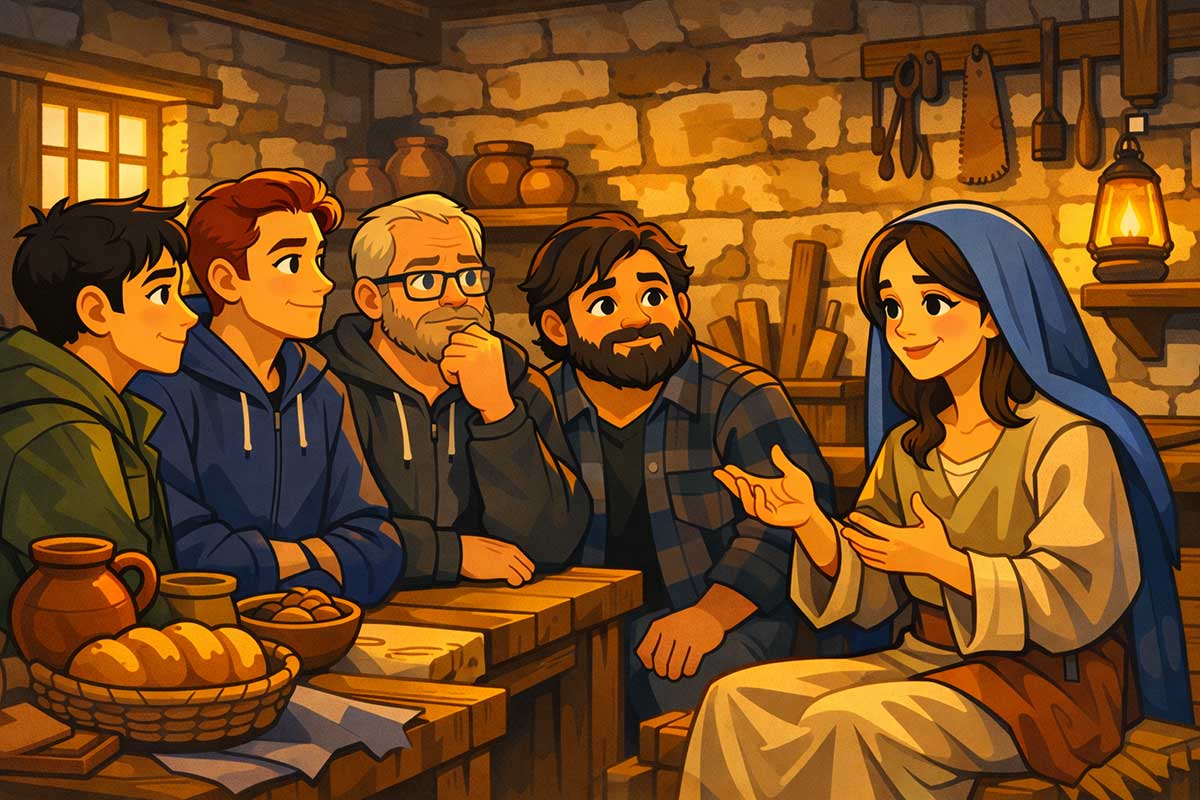
Scene 5 — Mary of Nazareth
Mary stands not far from an old stone wall, and the first thing you feel from her is not drama.
It is steadiness.
If Bethlehem’s Mary carried the concentrated courage of a young mother in crisis, Nazareth’s Mary carries duration — the calm of a woman shaped by years of repetition, hidden endurance, domestic faithfulness, and the strange discipline of living near mystery without daily explanation.
The room seems to quiet around her.
The candlelight catches lightly on her face. Her eyes are direct, warm, and tired in the way only faithful people who have continued long in love and labor sometimes look tired.
She rests one hand against the stone.
“This,” she says, looking around the lower chamber, “is easier for many people to overlook.”
Her voice is gentle, low, unforced.
“They remember the message. They remember the birth. They remember the sorrow at the end. Fewer ask how faith lived on ordinary mornings.”
No one interrupts.
Outside the thicker church walls, faint city sounds still exist — distant horns, muffled footsteps, life — but in here they feel far away, as if Nazareth itself has stepped inward to listen.
Mary’s gaze moves over the group.
“Meals still had to be made,” she says. “Water still had to be carried. Clothes still had to be washed and mended. Fatigue still came. Dust still returned. Questions did not vanish because the heart had once received a holy message.”
The sentence is so plain it goes straight past abstraction.
Jim exhales through his nose, almost a laugh but not one.
Mary continues. “Do not be too quick to divide the holy from the ordinary. The ordinary is where much of faithfulness proves whether it was real.”
Jack’s eyes are already wet.
Conan, to his credit, stays quiet.
You ask the first question. “Did it ever feel… too ordinary? After everything that happened?”
Mary looks at you with something like recognition.
“Yes,” she says. “And no.”
She lets the words breathe.
“The great moments are bright. But a life cannot remain only in brightness. What is planted in revelation must grow in repetition.”
That line seems to alter the air pressure in the room.
The spiritual guide closes his eyes briefly, as if receiving medicine.
Mary turns her gaze downward for a moment, then back up. “There were years when I knew only enough for the next faithful thing. Years in which no angel spoke. Years in which there was no public wonder, only the daily labor of love.”
Conan puts a hand to his chest. “I know I keep saying some version of this, but these people are describing spiritual life with an accuracy that feels almost rude.”
Jim murmurs, “That’s how truth feels when it’s not decorative.”
Mary’s face softens further.
“You think nothing is happening,” she says, “because no one can see it. Yet patience is happening. Character is happening. Trust is happening. Hidden years are not empty years.”
And now the room feels fuller than before, not with spectacle, but with dignity.
Scene 6 — The Question About Adolescence
The group moves with Mary into a smaller side area where sunlight from above falls through a narrow opening and lands on the floor in one bright shaft. Dust drifts in it like tiny floating stars. The air is cool against your skin, yet warmed slightly where the light touches stone. The smell here is quieter: old mineral walls, faint candle smoke, fabric, a ghost of incense that lingers from centuries of prayer.
Conan is clearly carrying a question. You can see it on his face.
He hesitates.
Jim sees it too and almost starts smiling before anything has been said.
Finally Conan clears his throat.
“I would like to ask something,” he says with exaggerated care, “that I realize may reveal me to be an unserious modern person, but I believe the public deserves to know.”
Jack turns away immediately, already bracing for laughter.
Conan looks at Mary. “What was Jesus like as a teenager?”
The silence that follows is exquisite.
Mary does not answer at once.
She simply looks at him.
The whole group feels that pause.
You hear the tiniest hiss from a candle wick. A shoe scuffs lightly somewhere beyond the chamber. Outside, far off, a motorcycle rises and fades.
Then Mary’s mouth curves, just slightly.
“He was without sin,” she says.
Another pause.
“That does not mean there were no intense conversations.”
The laugh that breaks through the group is real and full and grateful.
Jim covers his face with one hand. Jack bends at the waist, laughing in delight. Even the historical guide gives up his composure for a moment. Conan puts a hand on the wall to steady himself.
“That,” he says, “is the best answer I have received in any country.”
Mary lets the warmth remain in her face for a moment, then speaks again, more deeply now.
“A mother learns many things,” she says. “Among them: love is not possession. You feed, clean, teach, protect, guide, correct, comfort — and slowly discover that the one you love belongs to a future you cannot fully govern.”
The laughter fades into stillness again.
You can feel the cool roughness of the wall through your fingertips. The light shaft has shifted slightly, moving across the floor. Dust still turns in it. Somewhere beyond the chamber a visitor coughs softly.
Jack, wiping his eyes, says, “That’s not just about Mary. That’s every parent.”
Joseph is not here today, but his absence almost emphasizes the domestic frame of the conversation. Nazareth belongs especially to daily family life.
Mary nods to Jack. “Yes,” she says. “Every true love must learn release.”
The spiritual guide asks, “So part of hidden faithfulness is loving without controlling?”
Mary looks at him and answers at once.
“Yes. And trusting without seeing all at once.”
Conan whispers, “This trip is becoming less of a pilgrimage and more of a very elegant personal audit.”
Jim replies, “At least the architecture is helping.”
And even in this quiet chamber, humor has done what it is meant to do — not mock the sacred, but make room for human hearts to keep breathing inside it.
Scene 7 — Streets, Bread, Wood, and Work
After leaving the church, the group walks through an older section of the town where the atmosphere feels closer to everyday Nazareth — not preserved as a museum, but alive with the textures that make daily life imaginable.
The streets narrow again. Sunlight reflects off pale walls and hits the eyes with a warm brightness that makes you squint. A breeze snakes through the alleys carrying the smell of bread, detergent, garlic, soap, warm metal, and once in a while sawdust from a workshop or construction area. Somewhere nearby a hammer taps in a steady rhythm. Somewhere else, a radio plays softly behind an open doorway. Children laugh down a lane, then disappear.
The historical guide pauses outside a modest work area where wood has been stacked and cut recently. The smell is immediate — dry timber, fresh shavings, a faint resin sweetness mixed with dust. It is one of the first scents of the day that feels almost familiar enough to belong to any town anywhere.
“This,” he says, gesturing around, “is part of why Nazareth matters. Work. Skill. Repetition. Family trades. The dignity of making, mending, carrying, building.”
The spiritual guide adds, “We often want the spiritual life to free us from the ordinary. Yet the Incarnation sanctified labor by entering it.”
Conan picks up a small wood shaving that has curled near the threshold and rolls it between his fingers. “It really is startling to think that the life of Jesus included years in which the most remarkable visible thing happening was… reliable work.”
Jim nods. “That’s a very offensive message to people addicted to breakthroughs.”
Jack walks slowly, running his hand over a sun-warmed wall. “But it’s beautiful,” he says. “It means hidden life matters. It means the time no one sees is still real.”
And then Mary is with the group again, this time in the street itself, where the smell of bread and wood and hot stone mix together under the sun.
She stands near the workshop threshold.
“For many,” she says, “the hidden years seem empty because they do not glitter.”
Her hand rests lightly on the wood frame beside her.
“But wood is shaped by repeated strokes, not one. Bread is made by daily hands, not one. A household is sustained by many unnoticed acts, not one. Why should you assume the soul is formed differently?”
The line settles into the group like a bell tone.
The heat of the stone rises through the soles of your shoes. A breeze cools the sweat at your neck. The air tastes faintly of flour and dust.
You ask, “How do people endure seasons when nothing seems visible?”
Mary looks up the street, where laundry moves softly above an alley.
“By remembering that God is not embarrassed by hidden faithfulness,” she says.
That sentence feels like the center of the day.
Conan says it back under his breath as if testing its truth.
Jim folds his arms. “That’s annoyingly healing.”
Jack laughs, hand over his mouth.
Mary’s expression holds both strength and kindness. “People often long for the great public yes. Few understand the holiness of the thousand unseen yeses that follow.”
The historical guide lowers his eyes for a second. Even he seems moved beyond his role now.
A cart wheel squeaks past at the far end of the lane. Someone upstairs shakes out a cloth. Bread is pulled from an oven somewhere close, and the smell blooms richer, warmer, almost unbearably comforting.
Nazareth is not dazzling.
It is better.
It is faithful.
Scene 8 — Evening on the Hillside
The day ends on a hillside overlook above Nazareth, not grand in the way Jerusalem’s overlook was grand, but tender with distance.
The city spreads below in layered pale buildings touched by late afternoon light. The sun has softened into gold and amber now, warming walls and windows, throwing long shadows into the streets. The air is cooler than before, carrying the scent of dry grass, stone, wood smoke from somewhere far off, and the faint sweetness of evening cooking beginning in homes below. Insects click in the brush. A bird calls once, then again. Somewhere in town a bell rings, answered by the muffled pulse of traffic.
The group stands in a line near the edge of the hill.
Your shoes press into dry soil and small stones that shift slightly underfoot. The ground is firm, dusty, and still warm from the sun. When the breeze rises, it brushes against your arms and face with just enough coolness to make you aware that evening is coming.
No one speaks for a while.
The silence is different here than in Jerusalem.
Jerusalem’s silence felt searching.
Nazareth’s silence feels companionable.
Conan is the first to break it. “I’m realizing something uncomfortable,” he says. “I have spent much of my life thinking visible moments were the real ones.”
Jim glances over. “That’s not just you. Modern life is basically a machine for disrespecting the quiet years.”
Jack, looking out over the city, says, “Today made me feel like heaven might care deeply about things we barely count at all.”
The spiritual guide nods. “Yes. The hidden life is where many people either deepen or hollow out. No audience. No major applause. No dramatic validation. Just the soul becoming something over time.”
The historical guide speaks more softly than usual. “And history itself often rests on years nobody would have thought important while they were living them.”
The breeze rises again, bringing with it the smell of earth cooling after sun. You can almost taste the dust in the air, clean and fine.
Then Mary is there once more, standing a little apart, Nazareth below her.
She looks at the town not as a symbol but as a place where life was actually lived.
“Do not despise the years in which your life looks small,” she says.
The words come into the evening like a blessing.
“God is not embarrassed by repetition. He is not absent from routine. He is not ashamed of hidden obedience.”
The sky deepens by one shade.
You ask her the final question of the day. “What should a pilgrim carry away from Nazareth?”
Mary turns toward you, and her answer comes simply.
“Carry this: the life no one praises may still be the life in which love becomes true.”
The sentence goes through all of you.
Conan lowers his eyes.
Jim breathes out slowly.
Jack wipes at his face again and laughs softly at himself, not from humor but from being moved beyond self-consciousness.
Mary’s presence remains a few moments longer in the evening light, then, as before, there is no dramatic departure. One breath she is there, the next the hillside holds only the group, the breeze, the insects, the city below, and the after-sense of having been told the truth in a way too gentle to resist.
The return ride is quiet.
Nazareth slips into dusk behind the bus windows. The smell inside is warm fabric, water, sun, and dust. The rhythm of the road lulls the body. No one reaches first for a joke.
You rest your temple against the cool glass and think of bread, wood, mended clothes, conversations at low tables, water carried in the heat, the patience of mothers, the long formation of souls no one sees forming.
Day 3 settles slowly into you.
Not all holiness announces itself.
Not all formation feels dramatic.
And perhaps the most faithful parts of life are the ones most likely to be overlooked by the world.
Day 4: Sea of Galilee - Called in the Middle of Work
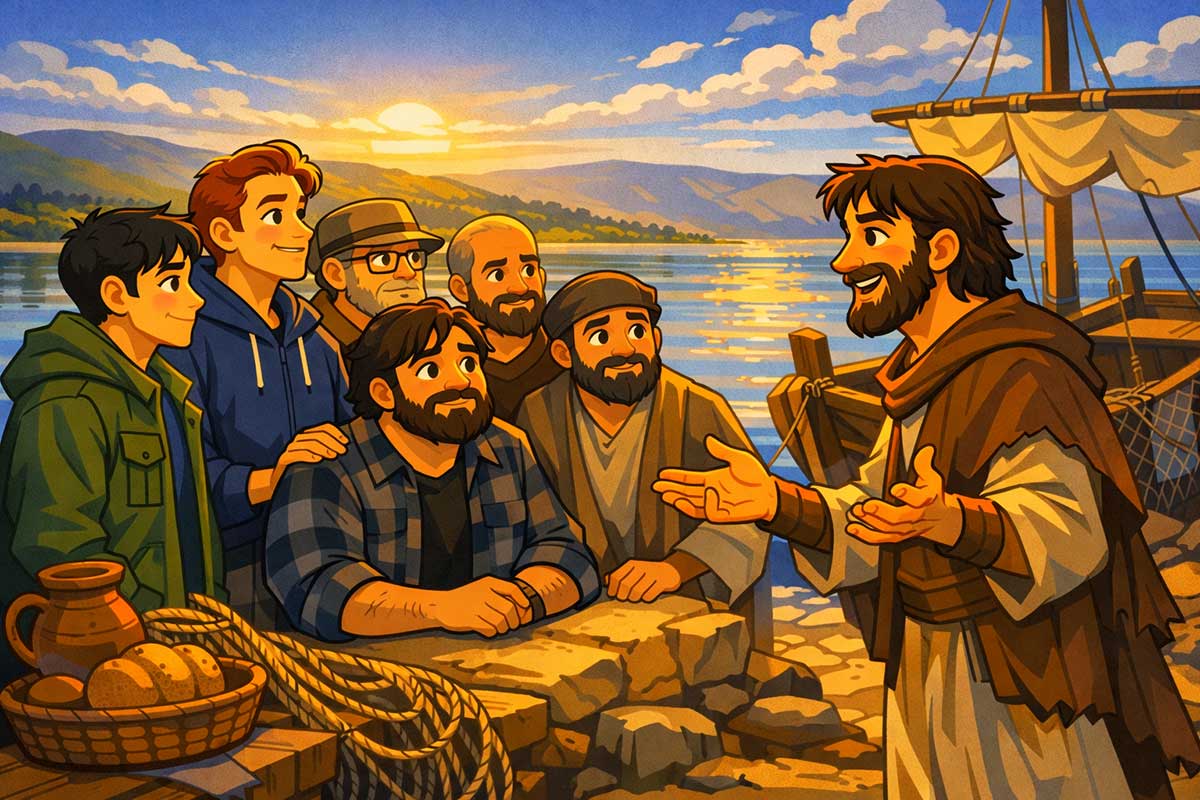
Scene 1 — Dawn Departure
The fourth morning begins before the body fully agrees to it.
The hotel corridor is quiet, carpet soft underfoot, lights low and yellow, the whole place still carrying the hush of people not yet ready to become public again. Outside, Jerusalem is only beginning to pale. The sky has not brightened fully, but the darkness is thinning into blue-gray at the edges. The air that meets you when the bus door opens is cold enough to wake the skin, clean and dry, with a faint scent of dust, stone, and distant leaves dampened by dawn.
Inside the bus, the world is softer than usual.
Seats creak quietly. Zippers pull. Travel cups give off warm coffee scent that fills the aisle with bitter comfort. Someone opens a pastry wrapper, and a faint sweetness of butter and sugar moves through the cool air. The engine hums low and steady. Headlights sweep over walls, road signs, sleeping streets. A few early pedestrians move along the sidewalks below apartment buildings still mostly dark.
Jim sits with both hands wrapped around a coffee cup like it is a sacred object. “This,” he says, voice rough from sleep, “is the kind of hour that makes me admire fishermen less and coffee more.”
Conan, hair even more unruly than usual, leans back and blinks into the dim aisle light. “I am trying to honor the disciples by being exhausted before sunrise, but I would like the record to show I do not enjoy earning authenticity this way.”
Jack, somehow already awake in spirit if not in body, peers out the window like a child on the way to a secret. “I love early departures,” he whispers. “It feels like the day hasn’t chosen its shape yet.”
The spiritual guide turns around from the front seat. “That is a good way to enter Galilee,” he says. “Much of what happened there began before people knew what the day would become.”
The historical guide adds, “And much of it began in work, not worship services. Nets, boats, markets, taxes, interruptions, tired bodies. The Sea of Galilee is beautiful, but it was also a place of labor.”
The bus rolls north through deepening dawn.
Outside, the land changes gradually. Hills open, ridges soften, stretches of road widen. The sky begins to glow pale silver, then blue, then faint rose. You can feel the coolness of the window through your sleeve when you lean against it. Your mouth tastes of coffee and dry morning air. Fatigue is there, yes, but so is expectancy.
Somewhere ahead lies water.
And with it, work, calling, and the first words of Peter.
Scene 2 — First Sight of the Lake
The lake appears almost suddenly.
One bend in the road holds only hills and low brush, pale soil and stone. Then the next bend opens, and there it is — wide, calm, blue-gray at first under morning light, then gradually catching silver and gold as the sun rises higher behind the ridges.
The Sea of Galilee is smaller than many people secretly imagine when they hear the stories, yet more intimate, more touchable, more human-scaled. It does not overwhelm by size. It draws by presence.
When the group steps off the bus near the shoreline, the morning air is fresh and cooler than expected, carrying the smell of water, wet reeds, mud, clean wind, and somewhere nearby the faint trace of fish and boat wood. After days of stone, incense, dust, bread, and city air, the scent of the lake feels like a different register of the land entirely.
A breeze skims over the water and touches your face with cool softness. It tastes faintly mineral on the lips. The ground underfoot shifts from packed dirt to pebbles and patches of damp earth. Small stones press through the soles of your shoes. Reeds whisper at the edge of the water. Tiny waves make a repetitive shushing sound against rock and shore.
The sunrise light spreads slowly, and with it the whole shoreline becomes more visible — low boats tied up near docks, birds gliding low over the surface, distant trees, hills holding the lake like cupped hands.
Jack steps forward and just laughs once in disbelief. “Oh, this is gorgeous. This is actually gorgeous.”
Jim inhales and says, “It’s beautiful enough to make you believe you might become a better person before breakfast.”
Conan stares at the water for a few seconds, hands in jacket pockets. “I understand immediately why so much happened here,” he says. “This has that dangerous combination of ordinary and unforgettable.”
The historical guide nods. “Exactly. This was not a retreat center. It was a working landscape. Fishing villages, trade, taxation, Roman presence, pressure. Yet the setting is open enough that teaching, calling, healing, and crowd movement all make sense here.”
The spiritual guide looks out over the water. “Galilee asks a different question from Nazareth. Nazareth asks whether you can be faithful in hiddenness. Galilee asks whether you will answer when life is interrupted.”
The lake keeps moving in small glints and ripples.
You kneel and touch the water.
It is colder than the air.
Clean. Immediate. Real.
The surface breaks around your fingers, and for a second every Gospel story tied to this shoreline stops feeling distant and begins to feel tactile.
Conan sees you do it. “That seems wise,” he says. “I may wait until I’m emotionally more organized.”
Jim looks down at the pebbles. “I’m still adjusting to the fact that the words ‘Peter’ and ‘shoreline’ now share a weather report.”
The breeze rises again.
The day has properly begun.
Scene 3 — Boats, Nets, and Capernaum
By midmorning the light is full and bright, spreading clear over the lake and the village remains near Capernaum. The heat is present now but not oppressive, kept in check by the wind moving off the water. Sunlight flashes hard off pale stone and makes you narrow your eyes. The air smells of dry grass, warm earth, lake water, and old rock heated by the day. A nearby boat dock adds faint scents of rope, wood, wet boards, and fish.
The group walks among stones, foundations, pathways, and open spaces where imagination no longer has to work very hard. Capernaum does not feel theatrical. It feels inhabited by memory. The basalt and limestone underfoot are uneven, rough, and warm now. Sand and dust catch lightly on the edges of your shoes. When your fingers brush a ruined wall, the stone feels porous and sun-heated, storing light.
The historical guide pauses and gestures toward the clustered remains. “This was not a grand city,” he says. “It was a village. But it mattered. A place of fishing, commerce, Roman oversight, crowded domestic life, and the kind of constant practical pressure that leaves little room for idealized spirituality.”
He points toward the shoreline. “Picture boats pulled in, nets drying, fish sorted, accounts worried over, taxes resented, bodies tired from labor.”
Jim nods. “Now I’m hearing the Gospels in lower back pain.”
Conan points at him. “Good. Keep that. That’s the realism we need.”
The spiritual guide adds, “This is why the setting matters. Jesus did not call perfect contemplatives detached from life. He called people in the middle of labor, concern, fatigue, and duty.”
Jack crouches beside a stone and runs his hand lightly over it. “That’s what keeps getting me,” he says. “God keeps showing up where people are already doing something.”
The group moves toward a small area near restored boats and shoreline displays. Nets are hanging nearby, and the smell of rope and dried water gives the air a workmanlike honesty. One of the nets, old and coarse, is laid out for viewing. When you touch it, the fibers are rough and stiff against your fingertips. You can almost feel the pull it once carried.
Conan lifts a section with two fingers and says, “This is important. I needed to physically encounter a net to understand how little I would have enjoyed being a fisherman.”
Jim says, “It seems wet, cold, repetitive, and disappointing a lot of the time. Spiritually excellent conditions.”
The historical guide smiles. “Many of the disciples would have understood unpredictability very well.”
The lake glitters behind him. The breeze carries faint moisture and coolness even in the growing heat.
The spiritual guide turns to the group. “Before any miracles of fish or storms, before sermons became famous, there was this: work. Work that fed families. Work that failed some nights. Work repeated morning after morning.”
He lets the words settle.
“And then,” he says softly, “calling arrived in the middle of it.”
Something shifts at that sentence.
Not yet the presence itself.
But the feeling that the shoreline is about to stop being scenic and begin speaking.
Scene 4 — Peter at the Water’s Edge
It happens near the place where water meets stone in small shining repetitions.
The group has drifted slightly apart along the shore, each person taking in the lake in his own way — Jack crouched near the reeds, watching sunlight move across the surface; Jim standing with his hands on his hips, looking both moved and physically realistic; Conan pacing three steps, stopping, turning back, as though his mind is trying to settle on the right register for the moment.
The wind shifts.
A few birds lift at once from the reeds.
The air seems to tighten, though the breeze continues.
And then a man is there a short distance down the shore — broad in movement, sea-shaped, carrying the kind of immediate presence that fills space before words do. His clothing moves in the wind. His face is lined by weather, labor, feeling, and the kind of impulsive living that leaves a visible mark on a person.
Peter.
He looks first at the water, then at the nets nearby, then at all of you.
His expression is not solemn in the way David’s was solemn. It is alive, alert, almost startled by memory itself.
“I know this shore,” he says.
His voice carries easily, rougher than David’s, warmer too, with the sound of someone used to being heard over wind and work.
“We knew its moods. Which mornings were kind. Which nights would mock effort. Which places held fish. Which currents made fools of confidence.”
He glances at the lake and smiles in spite of himself, as though some private exhaustion and affection still live there together.
“I was working when He called me,” he says. “That matters.”
The line lands at once.
Not meditating.
Not purified.
Not waiting nobly on a mountain.
Working.
Peter steps closer. Pebbles shift under his sandals with a dry crunch. The lake light flickers over his face.
“I was not ready,” he says. “I was busy. Tired. Concerned with the catch, the weight, the day’s return, the obligations of men with families and costs and bodies that must rise again before dawn.”
Jim exhales. “There it is.”
Peter looks at him, amused. “Yes. There it is.”
The group grows still around him.
“When He called,” Peter says, “I did not become instantly noble. I became divided.”
He touches his own chest.
“One part of me wanted to run toward Him. One part wanted to fall back, because anyone near truth feels quickly how unfinished he is.”
The words roll out with no ornament, only force and memory.
Conan speaks quietly now, without performance. “That may be the most emotionally accurate thing I’ve heard on this trip.”
Peter gives him a direct look. “Then perhaps you know more of calling than you think.”
The wind catches the edge of Peter’s sleeve. Small waves fold and unfold at the shore behind him.
You can smell lake water, sun-warmed reeds, old rope, and the earth opening under heat.
Nothing about the scene feels like art now.
It feels like a man by his working water telling the truth.
Scene 5 — The Disciples Were Not Ready Either
The group gathers closer to Peter, and the mood changes from stunned recognition to the odd intimacy that has begun to define these encounters. Once the initial shock passes, what remains is not fantasy but conversation — unnervingly real, strangely breathable, and full of the feeling that these people are not appearing to impress anyone. They are appearing to tell the truth.
Peter picks up a small stone and tosses it lightly into the lake. It skips once and sinks.
“People like to remember the great lines,” he says. “The confession. The walking on water. The preaching after. Fewer like to remember confusion, pride, fear, and how often we understood the Lord only after we had already followed Him somewhere.”
Jack laughs softly, not from mockery but delight. “That is so comforting.”
Peter points at him. “It should be.”
The spiritual guide asks, “Why do you think He called ordinary working men?”
Peter gives a short, almost incredulous laugh. “If you discover the answer, tell me.”
That gets the first broad laugh of the scene.
Then he grows serious again.
“We were not polished men,” he says. “We were not free of ego, not free of temper, not free of ambition. We were interrupted men. Busy men. Men who thought in terms of catches, costs, exhaustion, family, debt, weather, and whether tomorrow would go better than today.”
He looks out over the water again.
“Perhaps that is exactly why grace had room to show itself.”
Conan folds his arms and says, “May I ask the question that, for the sake of all anxious modern people, must be asked?”
Peter turns back. “Ask it.”
Conan spreads both hands slightly. “Did any of you ever hear Jesus teach and think, ‘This is beautiful, and I am absolutely unqualified’?”
Peter answers so fast it feels like it has been waiting in him for centuries.
“That,” he says, “was the atmosphere.”
Laughter breaks open at once.
Jim bends forward, hand to his forehead. Jack nearly doubles over. Even the guides lose composure for a moment.
Peter smiles full this time, and suddenly it is obvious why people followed him too — not as master, but as a heart too open to hide itself well.
“We followed before we understood,” he says when the laughter settles. “Love often begins there.”
The line quiets everyone again.
You ask, “Did you know your life was splitting in two in that moment?”
Peter’s face changes.
“Yes,” he says. “Though not cleanly. Calling is not always a trumpet. Sometimes it is the sense that if you remain only what you have been, you will betray something truer than yourself.”
Wind moves across the shoreline. The smell of water freshens. A boat rope knocks softly against wood in the distance.
Jim says under his breath, “That’s unfairly good.”
Conan nods. “Yes. I resent how clarifying all this is.”
Peter hears him and laughs once. “The Lord has a way of making men feel exposed and invited at the same time.”
The sentence goes straight through the group.
Because by now, it applies to all of you.
Scene 6 — On the Boat
Later, the group boards a wooden boat for a short crossing on the lake.
The boards underfoot are sun-warmed on top but still cool in shaded spots. The wood smells clean and old, mixed with rope, water, and the faint oily scent of maintenance and weatherproofing. As the boat pushes away from shore, it rocks gently enough to wake every muscle in your feet and knees. The water slaps softly against the sides. Ropes creak. The engine starts with a low mechanical grumble, then settles into a steady vibration that hums through the deck into your soles.
The lake opens around you.
From this angle the shoreline pulls back, and the hills seem to rise more fully from the water. Wind moves stronger out here, cool and clean against the face. It lifts hair, flaps jacket edges, dries the skin. Tiny droplets occasionally hit the arm or cheek when the boat cuts across a slightly choppier patch. The air tastes faintly fresh and mineral, nothing like city air, nothing like church air — open, moving, alive.
Jack stands near the side, grinning with his whole face. “This is unreal. This is actually unreal.”
Jim grips the railing and says, “I support the symbolism, but I do not trust my balance enough for additional miracles today.”
Conan squints into the distance. “This is deeply cinematic, and I resent how close I am to being moved on a boat before noon.”
Peter stands near the bow, steady without trying to look steady, the posture of a man whose body learned water long ago.
“Out here,” he says, “you feel quickly what kind of creature you are.”
He gestures to the surface.
“On land men imagine control. On water they remember dependence.”
The historical guide nods. “The lake was a teacher even before it was a setting.”
Peter continues. “There were nights we worked and caught little. Mornings when the body ached and the mind sharpened itself against disappointment. Men do not become poetic about fishing when they have families to feed.”
Jim points at him. “Thank you.”
Peter almost smiles. “You understand enough.”
The spiritual guide asks, “And yet some of your greatest moments happened here.”
Peter turns his face into the wind. “Yes. Which should tell you something.”
He looks back at all of you.
“The Lord did not wait for us to finish struggling before He met us. He met us in the struggle.”
The boat moves through a brighter patch of water. Sun scatters across the ripples in quick silver flashes that force the eyes to blink. The wind fills your ears with a low rushing sound. Somewhere above, gulls call sharply.
Conan says more softly now, “I think a lot of people assume the call of God comes after self-improvement.”
Peter shakes his head. “No. It comes while the nets still smell of labor.”
The smell is indeed there — rope, damp wood, fish memory deep in the grain, wind, water, sun.
You rest your hand on the railing. It is smooth in places from use, rough in others. The lake stretches around you, both peaceful and full of old stories of panic.
For a few moments no one speaks.
Then Jack, almost to himself, says, “This makes me feel like my whole life is more interruptible than I thought.”
Peter hears him.
“That,” he says, “is often where new life begins.”
Scene 7 — The Mount of Beatitudes
By afternoon the group has moved up to the hillside traditionally associated with the Beatitudes. The mood shifts immediately from work and water to space and listening.
The hill is green in places, dry in others, with paths winding upward through grass, stone, trees, and gardens kept with quiet care. The breeze is cooler here than lower down, moving steadily across the slope and carrying the smell of grass, warm earth, leaves, sunlit stone, and flowers from nearby plantings. Insects click softly in the brush. Birdsong rises and breaks in short phrases. Far below, the lake flashes blue.
The climb is gentle but enough to make the body aware of itself. Shoes press into packed dirt and gravel. Dust gathers faintly along the edges of soles. When you brush a hand over a low stone wall, it feels warm and rough, storing the heat of the day. Sunlight filters through leaves in shifting patterns across the path.
Jack reaches the upper area and turns in a full circle. “Oh, come on,” he says. “This is too beautiful. It’s suspicious.”
Jim, catching up, says, “I like that the Sermon on the Mount requires at least mild exertion.”
Conan, breathing harder than he wants to admit, gestures around him. “I respect the Lord deeply, but I would have appreciated a level teaching platform.”
The historical guide smiles. “The setting matters here too. Open hillside. Gathering space. Visibility. Ordinary people able to sit, hear, and carry words back down into actual life.”
The spiritual guide adds, “And the content matters even more. Blessed are the poor in spirit. The meek. The merciful. The pure in heart. Those who mourn. Those who hunger for righteousness. It is a vision of human flourishing that humiliates the ego.”
Peter is already there, standing where the hill opens toward the lake.
The wind catches his clothing. The bright afternoon light makes him seem both entirely of the place and set slightly apart by memory.
“When He spoke here,” Peter says, “I felt many things at once.”
He looks over the hillside, as though the crowd is still there in front of him.
“I felt drawn. Confused. Accused. Hopeful. Unready. His words were beautiful — and terrible to the kind of man I had been.”
The group falls silent.
Peter continues. “Blessed are the meek. Blessed are the merciful. Love your enemies. Pray without display. Seek first the Kingdom. These are not decorative teachings. They demand another heart.”
The wind moves stronger for a moment, bringing the smell of wild grass and sun.
You ask, “Did you understand how impossible it was?”
Peter laughs once, not bitterly, but with remembered honesty. “Yes. And no. I knew enough to feel exposed by it. I did not yet know enough to see how deeply I myself would need to be changed.”
Conan looks out at the lake below. “That may be the problem with beautiful truths. They sound uplifting until you realize they are aimed at you.”
Jim says, “Yes. Very inconsiderate.”
Jack laughs, then grows quiet again.
Peter turns fully toward the group now.
“Do not admire these words from a distance,” he says. “That is one more way to avoid them.”
The line lands hard.
Because the hill is so beautiful, the temptation to stay aesthetic about it is real.
The spiritual guide nods slowly. “So the Beatitudes are not merely inspiring. They are invasive.”
Peter smiles. “That is a good word.”
The light shifts as a cloud passes, briefly softening the whole hillside. Then the sun returns, brighter than before.
The words remain.
Scene 8 — Sunset by the Shore
The day ends where it began: by the water.
But the lake at sunset is not the lake of dawn. Morning made it silver and awakening. Evening makes it copper, blue-violet, and gold, the surface darkening in some places while others catch fire under the lowering sun. The wind has softened. Waves make a quieter sound now, a small repeating wash against the stones. The air smells of cooling water, damp reeds, warm earth losing its heat, and the faint smoke of distant evening fires or grills starting somewhere beyond the visible shore.
The group sits or stands in a loose line near the edge, each person turned slightly inward after the long day.
Your clothes hold the smell of sun, dust, boat wood, and open air. Your skin feels salt-clean from breeze and light sweat. The stone you sit on is still faintly warm, though the evening cool has begun to move over it.
No one rushes to summarize.
The historical guide speaks first, and even he sounds changed by the day. “Galilee,” he says, “grounds calling in labor and landscape. It refuses the fantasy that important spiritual moments must happen away from ordinary life.”
The spiritual guide nods. “And Peter has shown us something crucial: being called is not the same as feeling ready.”
Conan sits with his elbows on his knees, looking out at the darkening water. “Today felt less like an invitation to become impressive,” he says, “and more like an invitation to become interruptible.”
Jim says, “That’s worse, but probably healthier.”
Jack laughs softly. “I loved today. The water. The boats. The idea that your whole life can change while you’re still holding a net. That’s amazing to me.”
Peter stands a little apart at the water’s edge.
The sunset light catches the side of his face.
“The call of God,” he says, “does not wait for the finished man.”
He looks down at the water as if seeing several different years at once.
“It creates him.”
The sentence enters the evening like a final bell.
You feel it in the body before the mind catches up.
Conan says nothing.
Jim lowers his gaze.
Jack puts both hands over his mouth for a second, smiling into them because being moved has become too frequent now to hide well.
You ask Peter the final question of the day.
“What should a pilgrim carry away from Galilee?”
Peter turns back toward you.
“Carry this,” he says. “Follow before you feel ready.”
The breeze lifts once more across the water.
A bird skims low and vanishes into the dimming light.
And when the group eventually rises to return to the bus, Peter is gone as naturally as the day itself has begun to go — not vanished with spectacle, simply no longer there, leaving only the lake, the after-sound of his voice, and the strange certainty that work, calling, and grace are now tangled together in a way you will not soon undo.
On the ride back, the bus smells faintly of fabric, lake air clinging to clothes, snack wrappers, and the tired sweetness of a day fully lived. The engine hums low. Outside the windows, the land darkens by degrees.
You lean back, eyes half closed, and feel the rhythm of the road in your bones.
Day 4 settles into you with the softness of evening water and the force of a command:
Calling does not wait for completion.
Grace meets people in labor.
The beautiful truth is meant to be followed, not admired from a safe distance.
And the life most ready for God may be the life already busy with nets.
Day 5: The Jordan River - The Hard Beauty of Beginning Again
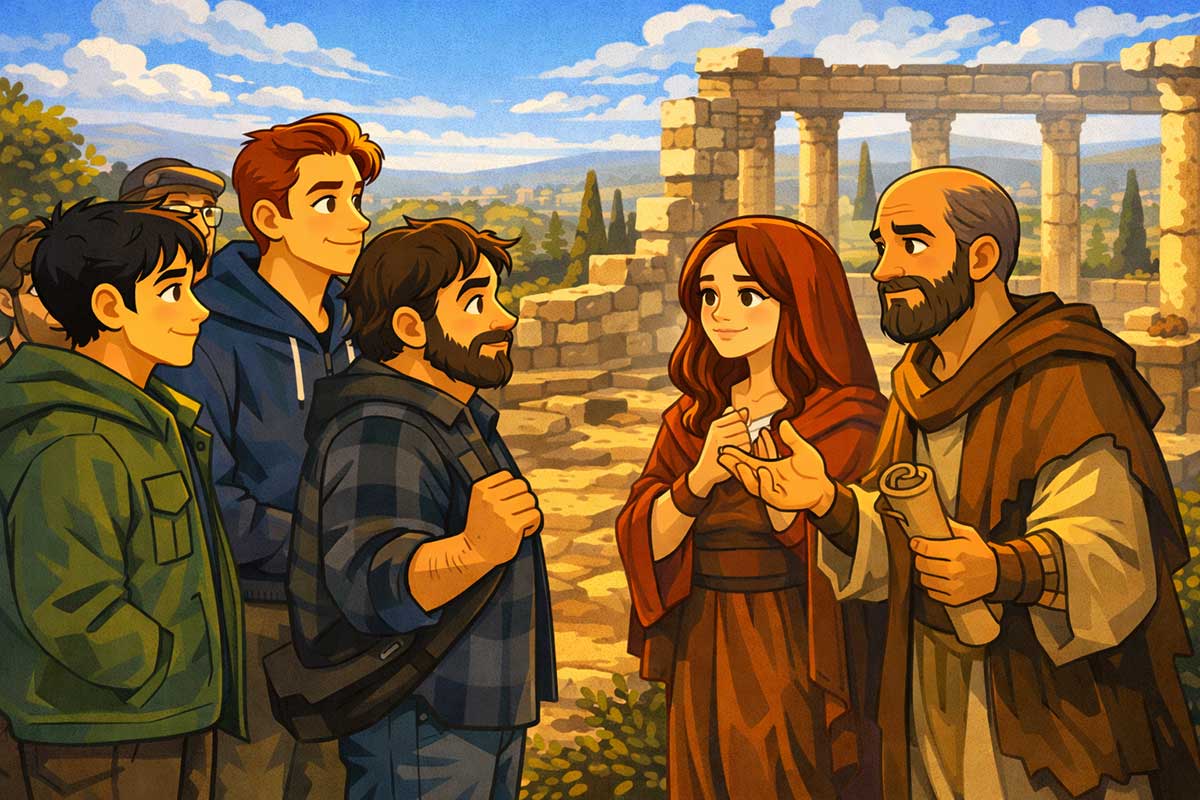
Scene 1 — A Sharper Morning
The fifth morning feels different before anyone says so.
Even at breakfast, the mood is less buoyant than Galilee. Not sad. Sharper. As though something in the trip has turned from wonder toward confrontation. The dining room is filled with the familiar comforts — warm bread, coffee dark and fragrant, eggs, olives, fruit, yogurt, cucumbers cool with morning moisture — yet even the smells feel clearer somehow, less cozy, more alert. Steam rises from tea cups in thin pale threads. Spoons click against ceramic. A chair scrapes once against the floor, a sound more noticeable than usual in the quieter room.
Outside the windows, the morning sun is already stronger, harder-edged. The stone buildings beyond the terrace catch the light in clean planes of cream and pale gold. There is less softness in the air today. When you step briefly outside with your cup, the morning breeze feels thinner, drier, carrying the scent of dust, warm stone, and a faint mineral emptiness from the direction of the lower country.
Jim tears off a piece of bread and says, “I don’t know why, but today feels like it’s going to tell us something we didn’t necessarily request.”
Conan stirs coffee with the concentration of a man buying time. “Excellent. I was worried the pilgrimage might become too emotionally supportive.”
Jack is quieter than usual, looking out the window as though already listening for something farther away. “Maybe it’s the water day,” he says. “But not in the Galilee way. That felt calling-ish. Today feels… cleansing and alarming.”
The historical guide folds the map closed. “Today we descend toward the Jordan,” he says. “Geographically and spiritually, it is a threshold place. Crossings, beginnings, preparation, public turning.”
The spiritual guide nods. “And not gentle preparation. John the Baptist does not specialize in mood management.”
That gets a real laugh, but a smaller one than usual.
Conan raises a finger. “I appreciate the honesty. It is helpful to know in advance that the wilderness prophet may not be a nurturing personality.”
Jim says, “I’m hoping for at least one affirming sentence before the conviction starts.”
The spiritual guide smiles. “Do not count on it.”
Breakfast tastes good, but somehow even flavor feels more exact today. The olives sharper. The coffee more bitter. The mint tea cleaner, almost severe in the mouth. You notice textures more vividly too — the crust of bread breaking, the smoothness of yogurt, the cool snap of cucumber.
As the group rises to leave, chairs tuck in, bags are lifted, cups drained, jackets gathered. The body is now accustomed to pilgrimage rhythm: pack, move, sit, listen, walk, absorb. Yet the soul is less certain.
The Jordan waits.
And the feeling grows stronger as you board the bus:
Galilee called.
The Jordan will ask what must be left behind.
Scene 2 — Downward Through the Dry Land
The road descends through changing terrain, and the land itself begins to preach before the guides do.
Green thins. The air brightens and dries. Hills pull back into wider stretches of exposed earth, pale ridges, scrub growth, low brush, raw slopes, and long views where the horizon seems carved by heat. Light here does not caress. It reveals. The sky is vast and clean, almost mercilessly blue. Even through the bus windows you can sense the increasing dryness — the way the landscape seems to hold less softness, less shade, less hiding place.
Inside the bus, the air conditioning hums against the coming heat. The vents carry cool artificial air mixed with travel smells: coffee, fabric, sunscreen, plastic water bottles, a trace of dust brought in on shoes. But every time the bus door opens at a stop or checkpoint, the outside air enters like a clear statement — hot, dry, mineral, carrying dust, asphalt, sun on stone, and a faint bitterness from desert plants.
The historical guide speaks while the bus moves steadily downward. “The Jordan River is not just a body of water,” he says. “It is a symbolic corridor. Israel crossed it. Prophets moved through its memory. Jesus entered public ministry in connection with it. It is a place of passage.”
The spiritual guide turns slightly in his seat. “And of exposure. Water in a dry land is never only water.”
Conan looks out at the increasingly severe landscape. “This really is different. Galilee felt like invitation. This feels like someone removed the furniture and left only essentials.”
Jim nods. “There’s no decorative surplus in this terrain.”
Jack presses his hand briefly to the glass, eyes on the hills. “This is the kind of land where you would hear one sentence and know it mattered.”
The spiritual guide says, “That is precisely why the wilderness matters in Scripture. It strips away the illusion that everything important can remain padded.”
The bus winds lower. You can feel the descent in your ears sometimes, the slight pressure shifting. The sun hits the side of the vehicle with a fiercer heat now, and when you rest your arm by the window too long, warmth soaks through the fabric of your sleeve. A truck passes, throwing up a brief haze of dust. In the far distance the land shimmers in the beginning of midday heat.
Jim unwraps a snack and says, “Just to be clear, if John the Baptist appears and asks us to confess in detail, I’m going to need a simpler pilgrimage tier.”
Conan says, “I’m hoping for a group rate on repentance.”
Jack laughs, but softly.
Even the jokes today seem to arrive leaner.
The bus keeps descending.
And every mile feels like entering a place where image matters less and truth matters more.
Scene 3 — The River at the Desert’s Edge
The Jordan does not arrive as a grand cinematic torrent.
It arrives humbly, almost startlingly so — a ribbon of living water in a harsh landscape, edged with reeds, tamarisk, low green growth, and the kind of unexpected fertility that makes water feel like mercy simply by existing. The contrast is the first thing that strikes you. Dry heat, pale dust, hard sun, and then this narrow moving body of cool color and shade.
When the group steps out, the heat is immediate.
Not oppressive in a suffocating way, but direct. The sun presses hard on shoulders, face, forearms. The air is dry enough that sweat does not linger. It disappears almost as soon as it forms, leaving skin taut, lips a little salt-dry, throat ready for water. Yet near the river there is another layer in the air too — dampness, green growth, mud, reeds, and a clean mineral scent rising from the water itself.
The soundscape is thinner than Galilee’s.
No open sweeping lake waves. No broad boat noises. Here there is the softer movement of current, a wet brushing sound where water passes reeds and bank, insects buzzing in the heat, a bird calling sharply from a branch, the occasional creak of a wooden walkway, footsteps on boards or packed dirt, and voices that drop lower instinctively once people reach the water.
The boards underfoot are hot where the sun hits them, cooler where shade falls. A railing is smooth under your palm, warm on top, cooler beneath. If you crouch near the bank, you can smell wet earth, plant stems, river mud, sun-warmed wood, and that unmistakable scent of fresh water moving slowly through old soil.
Jack looks down into the green-brown current and says, “Wow. I don’t know what I expected, but this feels… intimate.”
The historical guide nods. “Thresholds often are.”
The spiritual guide stands close enough to the water that the breeze rising from it moves the fabric of his sleeves. “People come here imagining cleansing as a feeling,” he says. “John preached it as a turning.”
Conan shades his eyes. “That sentence already sounds like bad news for anyone attached to convenience.”
Jim squints at the reeds. “I was hoping baptism-adjacent reflection might be more spa-like.”
The spiritual guide smiles. “Wrong river.”
You kneel and touch the water.
It is warmer than Galilee was at dawn but still startlingly cool against skin scorched by the sun. It moves around your fingers with quiet insistence. Not dramatic. Not symbolic in some abstract way. Just real water, real current, a real stream at the edge of a hard land.
And that reality is what makes it feel holy.
The guides let the group stand there in silence for a while.
Heat above.
Water below.
Dry land all around.
A place where beginning again would mean more than saying you wanted to.
Scene 4 — John Appears
The shift comes with no flourish.
No thunder, no supernatural brightness, no dramatic interruption of nature. The insects keep humming. The river keeps moving. Wind still rattles lightly through reeds. Yet the atmosphere tightens all at once, as though the space has become morally denser.
You feel it in the body first — a straightening of the spine, a subtle shallowing of breath, the sensation that excuses have just become harder to maintain.
A man stands a short distance from the group near the reed line.
He looks like the land itself could have produced him: spare, weathered, stripped down to function and force. His garments are coarse. His face is sun-marked and severe, but not empty of life. His eyes are the unsettling part. They do not wander. They do not flatter. They look as though they have no interest in the stories people tell to protect themselves.
John the Baptist.
No one says the name at first.
No one needs to.
Conan, for once, does not attempt a greeting.
John looks at the water, then at the group, then at the dry land beyond.
“You have come to the river,” he says.
His voice is not loud, but it cuts cleanly through heat and air.
“Good. But water without truth is only wet skin.”
The sentence lands like a stone dropped through the center of everyone’s polite self-concepts.
Jim lowers his eyes immediately. Jack goes perfectly still. The spiritual guide almost smiles, not out of amusement but recognition: yes, this is exactly him.
John takes one step closer, sandals pressing dust into the boards. “Many come to the edge of turning,” he says, “because they want relief. Fewer come because they are willing to be named.”
The heat feels hotter suddenly. Or perhaps it is only that your body has become more aware of itself.
The historical guide says nothing. He knows history has yielded the ground here.
John looks directly at the group. “Do not mistake nearness to holy things for surrender to God.”
The words enter the air and stay there.
Conan finally blinks and says in a careful tone, “Well. There goes religious tourism as a safe category.”
John’s eyes rest on him for a moment.
“You speak much when uneasy,” he says.
Jim almost folds in on himself trying not to laugh.
Conan freezes.
Then John adds, with the faintest edge of humanity under the severity, “Many do.”
The release of laughter comes sudden and needed, brief as shade in a hot place.
But the room in the soul that he opened does not close again.
Scene 5 — What Repentance Actually Is
The group gathers in a shaded area beside the river where a few trees lean out over the bank and the temperature drops just enough to make the body grateful. The shade smells different from the exposed walkway — leaf, bark, cooler damp earth, river water, and still the faint dusty heat beyond it all. Dragonflies skim low over the surface. A branch clicks lightly against another in the breeze.
John stands with the river behind him.
He looks less like an idea and more like a demand.
The spiritual guide asks, quietly, “What is repentance, really?”
John answers at once.
“Turning.”
Nothing more.
Nothing less.
Then he continues.
“Not mood. Not performance. Not temporary self-disgust mistaken for transformation. Turning.”
He points toward the water.
“Men came here with guilt, pride, hidden appetite, practiced religious language, public decency, private rot, old bitterness, false self-protection, borrowed virtue. Some wished to be changed. Some wished only to look serious before others.”
The river keeps sliding by behind him.
The sound of water against reeds is so soft it makes his voice feel even harder.
Jim says under his breath, “That is one of the least relaxing spiritual descriptions I’ve ever heard.”
Conan replies, equally low, “I’m trying to remain open while also feeling personally hunted.”
John hears them both.
“Good,” he says. “The hunted man may yet become honest.”
That kills any remaining hope of hiding in side commentary.
You ask, “Why is truth so hard for people?”
John looks at you with no impatience, only exactness.
“Because falsehood can be arranged to flatter,” he says. “Truth requires death.”
The line moves through the group like sudden cold.
Jack asks, voice softer than usual, “Death of what?”
John answers, “Of pretense. Of self-importance. Of the version of yourself that wants God without exposure.”
The spiritual guide closes his eyes for a moment.
The historical guide, moved beyond his usual restraint, says quietly, “That is why the wilderness is the right setting.”
John nods once. “The wilderness does not applaud image. It reveals need.”
Conan rubs one hand over his face. “I have to say, I respect that you are delivering this with absolute clarity and no cushioning whatsoever.”
John’s expression does not change much, but something almost like approval moves through it.
“A wound cannot be cleaned by flattering it,” he says.
The wind rises and brings the scent of the river stronger into the shade — green, damp, mineral, alive.
You can taste dryness on your lips and the clean memory of water in the air.
Repentance no longer sounds abstract.
It sounds like being seen without disguise and not fleeing.
Scene 6 — Into the Water
The group moves down toward a lower entry point where people can step close to the river.
The wooden stairs are hot where the sun has struck them, and the rail beneath your hand is warm and smooth from use. The air near the water is cooler, but the sun on the back of your neck is fierce. The smell grows richer with every step downward — wet mud, reeds, river plants, wood, warm algae, damp life pressing up against the dry world around it.
The water at the edge is murky-green and living, not polished, not picturesque. Tiny ripples catch the light in broken silver lines. Insects skip across the surface. The current is stronger than it first seemed when seen from above.
John stands nearby, not dramatizing the moment, only inhabiting it with total conviction.
“People romanticize new beginnings,” he says. “But beginning again feels like surrender before it feels like peace.”
The spiritual guide invites the group to step into the water if they wish.
Jack goes first.
He wades in with visible emotion, then gasps. “Okay — okay, that is colder than my soul was prepared for.”
Jim, stepping carefully after him, says, “That may be the first encouraging thing about repentance.”
Conan grips the rail and lowers one foot in, then the other, making a face somewhere between shock and philosophical disappointment. “I had imagined a more symbolic temperature.”
The water presses against your calves, cool and steady. Mud shifts slightly under your feet. Reeds brush the side of your leg. The current has enough force that you become instantly aware of balance. Sun burns your shoulders. The contrast is intense: heat above, cool water below, sky vast overhead, river moving without hurry around you.
John speaks into that contrast.
“What do you want washed away?” he asks.
No one answers immediately.
Because the question is too exact.
Not what theology do you affirm.
Not what story do you tell.
What do you want washed away?
Jim says finally, “That is a rude and excellent question.”
Conan, still gripping the rail, says, “I would like to submit several items anonymously.”
John ignores the joke’s protective layer and answers the soul beneath it.
“Bring them uncovered,” he says.
Jack looks down at the water. “Fear,” he says quietly. “Fear, maybe.”
The spiritual guide steps closer to him, but does not interrupt.
You hear the river. The birds. The faint rustle of leaves. Your own breath. A drop of water slides down your shin. Your skin prickles where sun and water meet.
John’s voice lowers, but not its force.
“The beginning of new life,” he says, “is not self-admiration. It is the death of excuses.”
The words seem to gather around the water itself.
Conan lets out a small breath. “There really is no decorative version of this, is there?”
John looks at him. “No.”
And that plainness, strangely, is mercy.
Scene 7 — The Group Speaks Plainly
After coming out of the water, the group gathers under a patch of shade with towels, bottled water, and the disoriented clarity that often follows strong physical experience. Wet hems darken the lower edges of clothes. Shoes feel strange after the mud and current. Skin cools quickly where the breeze touches it. The water you drink tastes intensely good — cold, metallic from the bottle cap for a second, then clean and almost sweet against a mouth dried by heat and honesty.
No one is laughing much now.
Not because humor has died, but because the soul is nearer the surface.
The spiritual guide sits on a low bench and says, “John asked the right question. What do you want washed away?”
For a moment only insects and water answer.
Then Jim speaks first.
“I think,” he says slowly, “some part of me wants comfort to count as spiritual maturity when it’s really just comfort.”
The honesty of it opens the circle.
Conan stares at the ground, then says, “I use humor to stay alive, which is good. I also use it to stay partially unavailable, which is less good.”
Jack wipes river water from his forearm though it is already mostly dry in the heat. “I think I want performance washed away. Not stage performance. Soul performance. The part that still wants to be impressive even in holy moments.”
The historical guide, who rarely turns the pilgrimage inward publicly, says, “Knowledge can become a form of distance.”
The spiritual guide nods quietly, as though not surprised by any of this. “And perhaps ministry can become a way to speak around the places one most needs to surrender.”
You feel the circle drawing you in.
The shade above smells green and faintly bitter from leaves warmed by the day. Beyond it the open sun turns the dust almost white. Your clothes still carry the smell of river water and wood.
“I think,” you say, “I want the part of me washed away that wants encounter without change.”
No one rushes to affirm it.
The truth itself is enough.
John stands just beyond the edge of shade where the sun catches one side of his face.
“This,” he says, “is nearer.”
The line is not congratulation. It is recognition.
Conan looks up at him. “Is repentance supposed to feel exposing and relieving at the same time?”
John answers immediately.
“Yes.”
Jim says, “That seems unfairly accurate.”
John’s gaze moves over the whole group. “Truth wounds what falsehood has protected. That wound is mercy.”
The breeze rises again, lifting the edges of towels, moving branches above, carrying river cool through the heat.
Something in the group has changed.
Not triumphantly.
More cleanly.
As if each person has been forced one step closer to the version of himself he cannot become without surrender.
Scene 8 — Leaving the River
The return from the Jordan is quieter than any travel day so far.
Even the bus seems subdued, its usual smells — fabric, sunscreen, bottled water, snack wrappers, the faint oil warmth of machinery — now mixed with river damp clinging to cuffs and hems, mud dried into the edges of shoes, and the strange cleanness that follows being physically immersed in cold water under a hard sky.
Outside the windows, the desert-edge landscape passes again in pale ridges, hot light, open sky, dust, and distance. But it no longer feels merely severe. The land now seems fitting, almost kind in its refusal to decorate what must be faced.
Conan sits with his head tipped back, eyes half closed. After a long silence he says, “I’ll admit something. I expected John to be terrifying. He is terrifying. But in a strangely useful way.”
Jim looks over. “He’s like a man who throws your furniture out because your house is on fire.”
Jack, smiling faintly, says, “Yes. And the wild part is, once the furniture’s gone, you can breathe.”
The historical guide looks out the window and says, “John belongs to this land. Harshness and mercy are not opposites here.”
The spiritual guide adds, “Many people think mercy always arrives as comfort. Sometimes mercy arrives as exposure before the comfort.”
The bus climbs gradually out of the lower country. Sunlight slants differently now, softer toward late afternoon. Dust glows in the distance. A cluster of trees appears greener than it has any right to be. Somewhere on the roadside, goats move in a loose brown-white cluster through pale scrub.
You rest your head against the window.
The glass is warm.
Your body feels tired in the satisfying way that follows both heat and honesty. On your skin you can still remember the contrast — burning sun, cool river, wind through reeds, the pressure of current at the calves.
The day has left a taste behind too: bottled water, dust, dryness, and something inwardly cleaner.
By the time Jerusalem begins to reappear, the city feels different yet again.
David gave it gravity.
Bethlehem gave it tenderness.
Nazareth gave it hidden dignity.
Galilee gave it calling.
The Jordan gives the whole pilgrimage a sharper center.
That night on the terrace, the city lights appear as always, yet you feel less interested in what they mean symbolically and more aware of what John said by the water:
Water without truth is only wet skin.
Turning is not mood.
Truth requires death.
The hunted man may yet become honest.
A breeze lifts across the terrace carrying stone-cool air and the faint smell of evening food from nearby kitchens.
Conan joins you with tea in hand.
“I think,” he says quietly, “today stripped the trip of any remaining fantasy that I could return from this unchanged and still call it pilgrimage.”
Jim steps beside him. “Yes. It’s very inconvenient.”
Jack comes last, smiling in that open, slightly wrecked way he has when truth has reached him. “I loved Galilee,” he says. “But today felt necessary.”
You look out over Jerusalem and know he is right.
Not pleasant.
Necessary.
And Day 5 settles into the heart with the force of desert wind and river water:
Beginning again is not a mood.
Mercy may first arrive as exposure.
God does not seek managed image but uncovered heart.
And the river matters only if you are willing to leave the old self in it.
Day 6: Bethany - When Hope Arrives Late
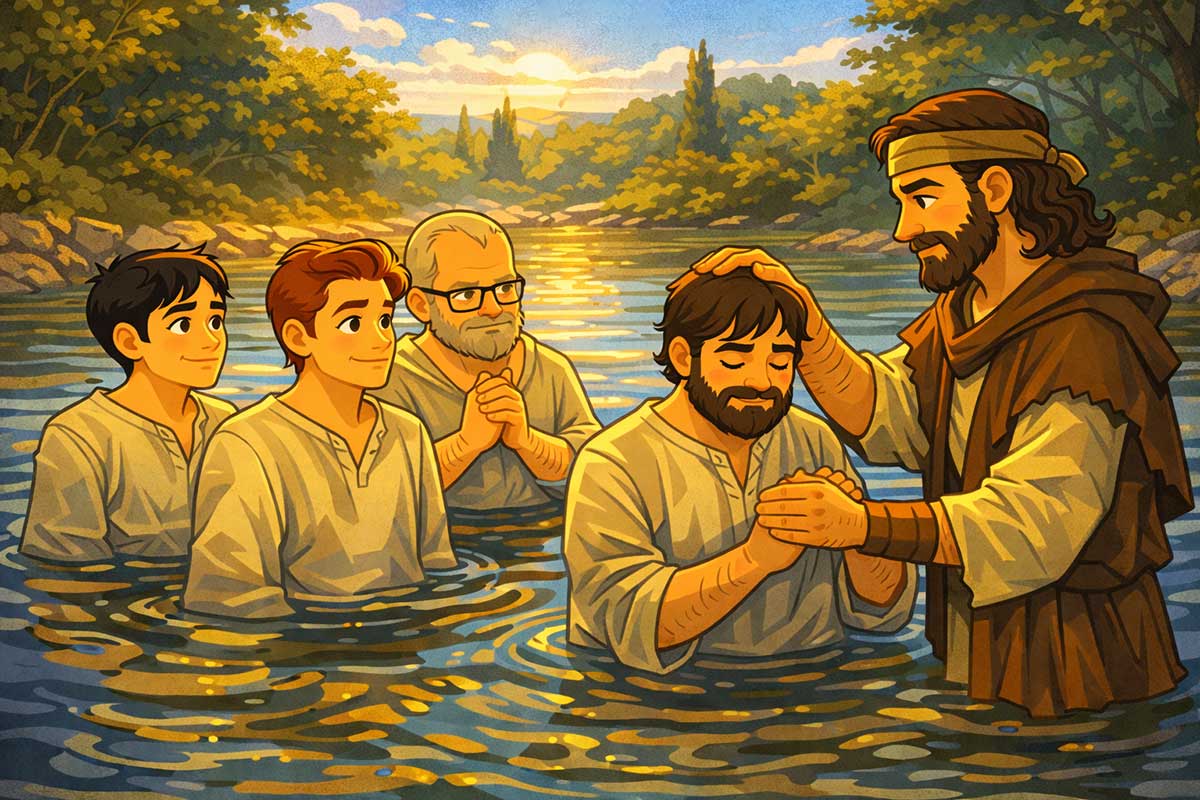
Scene 1 — Morning After the River
Day 6 begins more slowly.
Not lazily. Gently.
The kind of morning that comes after something has already cut deep.
At breakfast, the room is filled with the usual sounds — plates touching table edges, cups set down, silverware, low voices, the soft drag of chairs — yet the whole group moves with a different texture now, as if everyone is carrying something tender just below speech. The smell of coffee rises dark and grounding, joined by warm bread, eggs, herbs, orange peel, yogurt, olive oil, and toasted sesame. Steam curls from tea and disappears into the cool air of the room.
The food tastes fuller this morning. The bread is warm and a little chewy. The olive oil is grassy and peppery on the tongue. The yogurt is cool and bright. Mint tea leaves a clean sweetness, then a cool trace at the back of the mouth.
Jim breaks a piece of bread and says, “I feel like yesterday removed one layer of nonsense from all of us.”
Conan stares into his coffee. “Yes. I do not care for that phrasing, though I respect its accuracy.”
Jack smiles, quieter than usual but glowing in a way that is more inward. “The river was intense,” he says. “Today feels different. Not sharper. Softer. But maybe sadder.”
The historical guide nods. “Today we go to Bethany.”
The word itself carries another register of the story.
Not kingship.
Not birth.
Not hidden years.
Not calling.
Not public turning.
Friendship.
Illness.
Delay.
Tears.
The spiritual guide folds his hands around his cup and looks at all of you. “If the Jordan asked what must die,” he says, “Bethany asks what faith does when love suffers and help seems late.”
The room goes still.
Conan rubs one hand over his face. “I’m noticing a pattern where every day of this pilgrimage politely dismantles another illusion.”
Jim says, “Today seems like it may dismantle the illusion that faith removes grief.”
Jack lowers his eyes to the table and nods.
Outside, Jerusalem shines in morning light, pale gold and cream, but there is a softness to the air that did not exist yesterday. A breeze moves leaves below the terrace wall. The smell of stone and distant bread drifts in when a door opens. Bells sound somewhere beyond the hotel, low and round.
You finish breakfast without rushing.
The body is rested enough.
The soul knows it may not remain comfortable for long.
Bethany waits just outside Jerusalem’s orbit, close enough to the holy city to feel its pull, far enough to hold a different kind of holiness — a house, a table, an illness, two sisters, one dead brother, and the ache of help that did not come on time.
Scene 2 — The Road to Bethany
The road out of Jerusalem toward Bethany feels shorter than the earlier travel days, yet emotionally it feels longer, as though the landscape itself is carrying a transition.
The city’s pale stone gives way to roads edged with walls, olive trees, dry earth, low buildings, ridges, and pockets of life moving close to old memory. The bus window is warm where sun hits it. The air inside smells faintly of coffee, dry fabric, bottled water, sunscreen, and the lingering dust that no one fully leaves behind in this land. Outside, every time the door opens, the breeze brings a mix of warm stone, road dust, dry grass, and faint greenery.
The historical guide speaks softly, without the larger explanatory sweep he used in Jerusalem or Galilee. “Bethany matters,” he says, “because it holds one of the most intimate emotional scenes in the Gospels. This is not a large public crowd event first. It is a household under strain.”
The spiritual guide adds, “That is why people often meet themselves here.”
Conan looks out the window. “That sounds ominous in the most biblically respectable way.”
Jim says, “I’m guessing this is where the pilgrimage stops being about sites and becomes about people you miss.”
Jack rests his head briefly against the seat and watches the road. “I already feel it,” he says. “There’s something about Bethany. It feels close. House-close. Family-close.”
The bus passes olive groves whose leaves flash silver-green in the light. A donkey stands beside a low wall. Laundry moves between buildings in the breeze. A woman in dark clothes carries a bag of groceries up a slope. A child kicks dust from the roadside with one shoe. These details do not feel incidental today. They feel like the right frame for the place.
The spiritual guide turns halfway toward the group. “Bethany asks a question many believers know but often avoid saying out loud.”
No one interrupts him.
“What happens,” he says, “when you pray, and help does not come when you needed it?”
The sentence does not hover.
It drops.
Conan’s mouth tightens slightly. Jim looks down at his hands. Jack stares out the window without blinking for a few seconds.
Even the bus seems quieter after that.
The road bends.
The day begins to gather sorrow.
Scene 3 — The Village of Friendship
Bethany does not feel grand when you arrive.
It feels close.
The streets are narrower than the emotional weight of the name might suggest. Stone, walls, doorways, small businesses, quiet stretches, people moving through daily routines, sunlight catching rough textures, low voices from shaded corners, kitchen smells drifting from windows. The air is warm but less punishing than the Jordan. It carries dust, olive wood, cooking oil, bread, dry plants, and the faint sweetness of fruit from a nearby stall.
Your shoes press over uneven ground, sometimes pavement, sometimes packed dirt, sometimes stone worn smooth by long use. A wall beside you is sun-warm and slightly grainy under your fingertips. Somewhere close, a metal pot lid clinks. A dog barks once and stops. A radio plays softly from behind an open door, almost swallowed by the afternoon air.
The historical guide gathers the group in a quieter lane. “Bethany was close to Jerusalem,” he says, “yet distinct in tone. A place of hospitality, friendship, and return. That matters in the Gospel rhythm. Public ministry and public conflict were one thing. A house where one was loved was another.”
The spiritual guide nods. “This was not merely a location. It was a relational place.”
Jack says, softly, “That makes it hurt more already.”
Jim glances around at the modest scale of the village and says, “Yes. It’s one thing to think about tragedy in the abstract. It’s another to imagine people waiting in an actual house.”
Conan looks down the lane where laundry hangs between two walls and moves once in the breeze. “This is the opposite of theatrical grief. Which probably makes it harder.”
The group walks farther in, passing a doorway where fresh bread is cooling on a tray. The smell of it — flour, heat, yeast, crust — is deeply comforting and almost painful in a place connected to mourning. A woman sweeps dust from a threshold. Somewhere nearby onions and garlic are frying in oil. The smell rises rich and sweet, then fades.
The ordinary life of Bethany keeps happening around you.
That is what makes the sorrow feel near.
Because grief never takes place in a world that has politely paused.
It happens while bread still bakes.
While neighbors still pass.
While floors still need sweeping.
While someone still has to carry water, answer the door, move a chair, fold a cloth.
And in that deeply human setting, the day begins to deepen.
Scene 4 — The House Where They Waited
The group is brought to a quieter place associated with the memory of Martha, Mary, and Lazarus. Whether every stone can be pinned with certainty is almost beside the point by now. This pilgrimage has taught all of you that memory, place, devotion, and story often gather in a way stronger than mere coordinates.
The space is intimate.
Low walls. Shade. A small courtyard feeling. Stone that holds coolness in its core even after hours of sun. A silence different from church silence — less ceremonial, more domestic, more like the hush of a house in which something serious has happened.
The air is cooler here. It smells of stone, shade, olive wood, faint incense from a nearby devotional space, and the dry herbal scent of plants growing along the edge of a wall. When the breeze enters, it carries dust and sunlight with it, then leaves the shade cooler than before. A clay cup set somewhere in the corner gives off a faint earthy smell. The floor underfoot is uneven, smooth in some places, chipped in others.
The spiritual guide speaks very softly. “Imagine the room after the message has been sent,” he says. “Imagine waiting. Imagine watching the door. Imagine every sound from outside making hope rise for a second. Imagine it not being Him.”
The sentence is almost too exact.
Conan closes his eyes briefly.
Jim folds his arms across his chest, not from defensiveness but from ache.
Jack’s face is already wide open.
The historical guide says, “Bethany is one of the places where the Gospel becomes impossible to reduce to slogans. Here you have love, delay, disappointment, tears, anger, faith, and power all in one house.”
The spiritual guide turns toward the center of the shaded space. “This is where sentimental religion goes to die.”
The breeze touches the leaves above and makes a dry whispering sound.
Then the atmosphere changes.
Not violently.
Not with shock.
With grief.
It is the strangest thing — the space feels fuller, and yet what enters first is not spectacle but sorrow so personal it changes the temperature of the air.
Three figures are present now.
A woman standing with the alert posture of someone who has always moved toward practical need before emotion had time to sit down.
Another woman carrying grief more openly in her face, as though the whole body has become one long ache.
And a man quiet in a way that feels almost unsettling, as if he has crossed a boundary the others still stand on this side of.
Martha.
Mary.
Lazarus.
No one breathes normally for a moment.
The house has remembered its own story.
Scene 5 — Martha Speaks Plainly
Martha is the first to speak.
Her voice is grounded, direct, without performance. She does not sound like someone interested in becoming a symbol for people who have never had to keep a house running under pressure. She sounds like a woman who knows what grief feels like when there are still guests to receive, tasks to manage, bodies to feed, and rooms to hold together.
“When sorrow enters a house,” she says, “it does not remove the work.”
The line lands immediately.
“Bread still must be cut. Water still must be brought. People still arrive. The body still grows tired. A room does not tidy itself because someone has died.”
Jim nods once, hard.
Martha looks toward the doorway, as if she can still see the waiting there.
“We sent for Him,” she says. “That matters. We did not withdraw in silence. We called. We hoped. We believed enough to send word.”
Her face changes.
“And He did not come when we wanted Him.”
The truth of it breaks open the room.
No one rushes to soften it.
The spiritual guide lowers his head.
You can smell stone, dry leaves, and the faint sweetness of bread from somewhere outside the courtyard wall. The ordinary world is still there while this is being said. That contrast makes it more painful.
Conan asks quietly, “Were you angry?”
Martha turns to him without hesitation.
“Yes.”
The simplicity is devastating.
“Yes,” she says again. “Love without honesty becomes performance. Faith without honesty becomes fear dressed well.”
The wind passes through the shade and lifts the edge of her sleeve.
“I did not honor Him by pretending not to feel abandoned,” she says. “I honored Him by bringing my pain to Him.”
Jim looks down at the ground and says under his breath, “That line alone is worth the trip.”
Martha hears him. “Then keep it,” she says.
The room is silent except for a bird outside and the faint brushing of leaves.
The spiritual guide asks, “So faith does not forbid protest?”
Martha gives him a look almost like surprise that the question still needs answering.
“No,” she says. “Faith brings protest to the One it still refuses to leave.”
The line goes through all of you.
Conan presses his lips together, as if something in him has just been caught in the open.
The historical guide says softly, “This is one of the most human scenes in all Scripture.”
Martha nods once. “Yes. That is why it remains true.”
There is nothing polished in her.
Nothing decorative.
Only the bracing mercy of plain speech.
Scene 6 — Mary and the Weight of Absence
If Martha carries grief like a task that must still be held upright, Mary carries it like a flood she never fully stopped standing in.
She has said nothing yet, but her silence itself has shape. Her face is marked by love, weariness, and the kind of sorrow that has worn through the first layers of language.
When she speaks, her voice is softer than Martha’s, but no less strong.
“There is a grief,” she says, “that does not know how to form argument.”
She lowers her eyes briefly.
“It only knows presence… or absence.”
The shaded courtyard seems to shrink around the sentence.
Mary looks toward the ground, then toward the doorway, then at all of you.
“When He was not there,” she says, “everything in me felt the not-there.”
Jack puts a hand over his mouth.
The line is too accurate to be met casually.
Mary continues. “The ones who speak too quickly about trust have often not waited long enough in pain.”
That sentence settles in with almost physical force.
You hear the faint sound of someone walking outside the wall. A pot being moved. The life of the village still going on. And inside this small shaded place, the ache of delayed help becomes almost unbearable in its nearness.
You ask her, “What hurt most — the loss, or that help came late?”
Mary’s eyes lift to you.
“Both,” she says.
Nothing more for a moment.
Then:
“Love is why delay hurts so much.”
The spiritual guide closes his eyes.
Jim exhales slowly, his whole face changed.
Mary’s voice grows thinner for a second, though it never loses clarity. “When He wept,” she says, “I knew heaven had not despised our sorrow.”
That line seems to make the whole courtyard breathe differently.
Because it changes everything.
Not that the pain was removed.
Not that death became easy.
But that God was not standing outside human grief unmoved.
Conan says, almost to himself, “That may be one of the most beautiful things I’ve heard in my life.”
Mary hears him and answers not with comfort, but with recognition.
“Then you know something now that cannot remain only beautiful,” she says. “It must become trust.”
The words enter him like a quiet wound.
Jack wipes at his eyes and laughs once at himself. “I’m sorry. I’m just… this is too human.”
Mary looks at him tenderly. “That is why it reaches you.”
The breeze passes again, cooler now in the shade. It smells of stone, leaves, dust, and distant cooking oil. Somewhere close, a child laughs in the street and then is gone. The contrast is almost unbearable.
And exactly right.
Because grief does not happen in symbolic silence.
It happens in neighborhoods.
In houses.
In rooms where someone still has to open the door.
Scene 7 — Lazarus and the Strange Calm of Return
Lazarus has stood quietly through his sisters’ words, and his silence has had its own gravity.
He does not look ghostly.
He looks alive.
Yet there is something changed in his stillness, some settled quality in the face and posture, as if too much noise has burned away from him. He listens with the patience of someone who has already passed through the place where urgency once ruled.
When he finally speaks, his voice is calm and low.
“People ask what death was like,” he says.
He glances toward his sisters, then back to the group.
“I often begin with what return was like.”
That line alone is enough to draw everyone forward a little.
“It was interruption,” he says. “Command. Light. Breath where there had been none. The shock of being called back into unfinished life.”
The words are plain, and that plainness makes them stronger.
The courtyard seems to hold them carefully.
Lazarus looks down at his hands for a moment. “Do not use my story to make grief neat,” he says. “Before there was coming out, there was burial. Before joy, mourning. Before astonishment, a house full of absence.”
Jim, unable to resist the deeply human angle even in this holy strangeness, says, “May I ask something that feels both respectful and a little practical?”
Lazarus turns toward him.
“Yes.”
Jim spreads his hands. “When you came back… did it feel majestic right away? Or confusing?”
For the first time, something almost like dry humor moves across Lazarus’s face.
“Confusing,” he says. “Before majestic.”
The laugh that breaks out is warm, grateful, almost healing.
Conan bends forward with one hand on his knee. Jack laughs through tears. Even Martha’s face softens.
Lazarus lets the laughter pass, then adds, “Many truths are like that.”
The spiritual guide smiles in spite of himself.
You ask, “What do you remember most?”
Lazarus thinks for a long second.
Then answers.
“Not power,” he says. “Compassion.”
He looks toward Mary, then Martha.
“His power did not make Him colder.”
That line settles into the whole group.
The historical guide, voice lower than usual, says, “That may be the center of Bethany.”
Lazarus nods once.
“Power without compassion terrifies. Compassion with power gives hope.”
The breeze moves through the courtyard and stirs a hanging cloth somewhere just outside view. The smell of bread returns faintly, mixed with dry herbs and shadowed stone.
Martha speaks again, softly now. “Faith can protest.”
Mary follows: “Faith can weep.”
Lazarus finishes: “Faith can return from where others thought hope had ended.”
The three lines together feel like the whole place speaking.
No one says anything for a while after that.
No one needs to.
Scene 8 — The Road Back and the Late Light
The ride back from Bethany feels shorter than it should.
The bus carries the quiet of people who have not merely visited a site but entered a house and come away changed by its sorrow. The seats smell faintly of sun-warmed fabric and dust. A bottle cap clicks open. Water is swallowed. Someone shifts against a window. Outside, late light moves over the hills in long amber bands, warming stone walls and olive leaves until everything glows from within.
Conan sits with both hands folded over his stomach, looking out. After a long silence he says, “I think Bethany may be the first day that didn’t just challenge me. It broke something open.”
Jim nods without looking at him. “Yes. It’s hard to stay abstract after a house like that.”
Jack leans his head against the seat and closes his eyes. “What’s staying with me,” he says, “is that no one there pretended. Not Martha. Not Mary. Not Lazarus. Not Jesus, if He wept there. The whole thing was grief and love and truth in one room.”
The spiritual guide turns slightly toward the group. “That is why Bethany matters so much. It gives permission for faith to remain faith when tears have not stopped.”
The historical guide adds, “And it reminds us that one of the deepest revelations in Scripture happens in the setting of friendship.”
Outside, the road bends and Jerusalem begins to return, pale and radiant in the late day.
Yet the city does not feel severe now.
It feels held inside a larger human story.
That evening on the terrace, the air is cooler than the day before. The breeze smells of stone, evening dust, distant food, and leaves moving somewhere below. Tea warms your hands. The city lights come on slowly, one by one, and for a long time the group simply stands there watching them.
The sun has gone.
The sky is deepening.
Conan breaks the silence first, though his voice is hushed.
“I think what haunted me most,” he says, “was Martha saying she honored Him by bringing pain instead of pretending.”
Jim nods. “Yes. That’s the one.”
Jack stares at the lights. “Mine was Mary saying the not-there.” He puts a hand over his heart. “That’s real. Everyone knows that feeling somewhere.”
You stand with them and feel Bethany still in your body — the cool shade, the warm wall, the smell of bread in a grieving village, the sound of someone moving a pot outside while three siblings spoke of death, delay, and compassion.
Day 6 settles into you with the aching weight of late help and real tears:
Faith can protest.
Faith can weep.
Power without compassion terrifies.
Compassion with power gives hope.
And a house of grief may become one of the holiest places in the whole pilgrimage.
Day 7: Gethsemane - The Night of Surrender
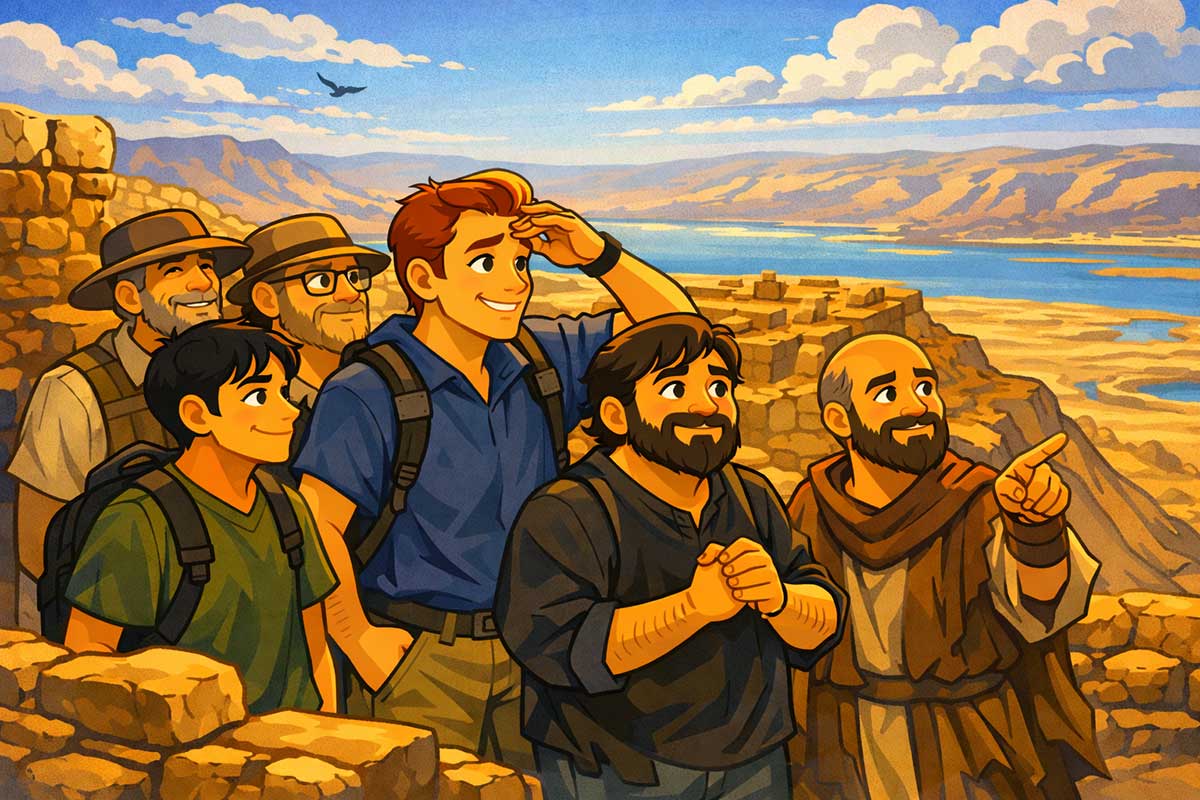
Scene 1 — The Day Grows Quiet Early
Day 7 feels different from the moment it begins.
Not heavier in an obvious way. More hushed. As though the whole pilgrimage knows it is approaching a threshold that should not be spoken over too quickly.
Breakfast is quieter than any morning before. The dining room still carries its gentle choreography — plates touching tablecloth, tea being poured, coffee cups lifted, the soft scrape of chairs — yet each sound feels more isolated, more distinct, as if silence has widened the space between things. The smell of coffee is dark and comforting, bread warm and familiar, mint tea clean and cooling, but even comfort tastes more fragile today.
Outside the hotel windows, Jerusalem shines in pale morning light. Stone walls glow cream and gold. A breeze moves through the trees below the terrace. Far off, a bell sounds once. The city is beautiful as ever, yet something in you no longer receives beauty as simple pleasure. Beauty here has learned to carry sorrow.
Jim tears a piece of bread and holds it for a second before eating. “I know this is not a scientific category,” he says softly, “but today feels holy in a way that makes me want to talk less.”
Conan, already dressed and ready but unusually subdued, nods once. “Yes. Even my anxiety seems quieter. Which I did not know was possible.”
Jack looks toward the window, hands around a cup of tea. “Bethany hurt,” he says. “Today feels like the place pain becomes decision.”
The historical guide does not open the map right away. When he does, it is with care, the paper unfolding with a dry soft sound that seems louder than usual. “Today we go to the Mount of Olives,” he says. “To Gethsemane.”
No one jokes.
The spiritual guide folds his hands. “This is the part of the pilgrimage that must be approached without hurry. Not as spectacle. Not as drama in the cheap sense. As night, dread, prayer, abandonment, and surrender.”
Conan lowers his eyes to the table. “I appreciate the warning, though I suspect nothing can really prepare you.”
The spiritual guide answers gently. “No. It cannot.”
The bread tastes warm and plain in your mouth. The tea smells of mint and steam. The room is cool, the air dry, your fingertips aware of the smooth ceramic of the cup.
You feel your own body more clearly today — pulse, breath, the slight weight in the chest that comes before grief but is not yet grief.
The city beyond the glass keeps glowing.
Yet even in the light, Gethsemane has begun.
Scene 2 — Jerusalem by Day, the Mount Waiting Ahead
The bus ride is short, but the emotional distance feels immense.
Jerusalem passes outside in layers of old stone, roads, modern traffic, shop signs, walls, cypress trees, stairways, apartment balconies, domes, buses, people carrying bags, children in uniforms, vendors, pilgrims, clergy, tourists, workers — all the visible life of a city that has never stopped being lived in, argued over, mourned, and prayed through.
Inside the bus, the air smells faintly of upholstery warmed by sun, bottled water, sunscreen, a trace of coffee from travel cups, and the dry dust everybody carries back from roads and paths. The engine hum is low and steady. A seat belt buckle taps lightly against a metal frame at each turn.
The historical guide speaks in a voice even calmer than usual. “The Mount of Olives is both geographic and symbolic. From here one looks over Jerusalem. It is a place of approach, departure, lament, and prophetic weight. In the Passion story, it becomes the setting for some of the most intimate human sorrow in all Scripture.”
The spiritual guide turns halfway toward the group. “People often think the sacred is most visible in miracles. Gethsemane shows it in obedience.”
Conan watches the city through the glass. “That may be the least marketable spiritual lesson ever given.”
Jim nods. “Yes. Miracles sell. Obedience in dread is harder to package.”
Jack runs a thumb along the edge of his cup. “I keep thinking of the word lonely,” he says. “Not abandoned exactly. Not yet. But lonely.”
The spiritual guide looks at him with quiet approval. “That is close.”
The bus begins to climb.
The city opens below in shifting views — roofs, walls, roads, bright stone, the strange beauty of Jerusalem seen from just enough distance to feel both tenderness and ache. Wind moves through the olive trees at the roadside, silvering their leaves. The sunlight is clear and high, but your body already knows this day belongs to evening.
You rest your hand against the window.
The glass is warm from the sun.
Outside, a group of pilgrims walks a path in small clusters, heads bowed, hats tilted against the light. A priest in dark clothing crosses a stone step and disappears behind a wall. Somewhere unseen, bells ring again, their tone round and ancient.
Conan says quietly, almost to himself, “The whole city looks different once you know what waits at the edge of it.”
No one answers.
No one needs to.
Because all of you can feel it:
The pilgrimage has now reached the place where sorrow is no longer the sorrow of human loss alone.
It becomes the sorrow of choosing to remain.
Scene 3 — The View from the Mount
The overlook on the Mount of Olives is wind-touched and full of light.
Jerusalem lies below in astonishing breadth — walls, domes, towers, clusters of pale stone, roads moving between old and new, sunlight flooding the city so strongly that some surfaces seem to burn with brightness. The sight is beautiful enough to wound. The whole city appears open, exposed, beloved, and impossible.
The breeze here is stronger than in the streets. It carries the scent of dry grass, leaves, dust, warm stone, and faintly, from somewhere down the slope, earth newly turned or watered. It brushes your face coolly in bursts between waves of sun warmth. Your clothes move lightly with it. Fine dust shifts under your shoes where the path narrows.
The group stands in silence for a while.
The historical guide finally lifts a hand toward the city. “From here,” he says, “one sees Jerusalem not from within its arguments, but from the threshold of approach. This view matters in Scripture. It frames lament, longing, and the final movement toward suffering.”
The spiritual guide adds, “This is a place where love sees clearly and still walks forward.”
The sentence hangs there in the air.
Jack looks out over the city with tears already standing in his eyes. “It’s so beautiful,” he says. “That almost makes it worse.”
Jim squints against the light and nods. “Yes. The beauty doesn’t soften the coming sorrow. It sharpens it.”
Conan folds his arms, the wind lifting his hair in absurd directions he does not bother fixing. “Jerusalem keeps doing this thing where it refuses to be only one thing at once.”
The historical guide says, “That is why it remains Jerusalem.”
The group begins walking down toward the garden area.
The path is lined with trees and stones, sun and shadow alternating. At moments the ground is dry and dusty underfoot; at others old paving stones feel smooth and slightly cooler. Olive trunks twist upward from the earth, gray and silver and deeply textured, their bark ancient and ridged like muscle and memory. If you lay a hand against one, the surface is rough, dry, and faintly cool beneath the warmed outer skin.
Birds move in the branches. Leaves whisper overhead. A distant church bell folds into the wind and disappears.
The city is still visible through breaks in the trees.
Yet each step downward feels like leaving the wide view of history and entering the close air of decision.
Scene 4 — Entering Gethsemane
The garden is smaller than imagination often makes it.
That makes it stronger.
The olive trees do not perform holiness. They stand in it. Their trunks are gnarled, rooted, burdened with age, their branches bending and lifting with strange dignity. Shade gathers beneath them in pockets. The ground smells of dry soil, leaf dust, bark, sun-warmed stone, and the faint green bitterness of crushed olive leaves. The air is cooler here than on the open mount, but only by degrees. It feels held.
Footsteps naturally soften.
Voices lower without anyone instructing them to.
Even Conan stops talking the instant the group passes fully into the grove.
You can hear the leaves moving overhead, the small scratch of shoes against gravel, a bird calling once from deeper in the garden, and beyond the walls and paths the almost impossible fact of Jerusalem still existing as a city of people, traffic, trade, noise, and ordinary life.
The spiritual guide turns toward the group. His voice is barely above the level of the wind.
“This place is not about theatrical sadness,” he says. “It is about pressure. The soul under pressure. Love under pressure. Obedience under pressure.”
The historical guide nods. “Passover crowds, political danger, betrayal already in motion, disciples not understanding, death approaching, the city close enough to see.”
Jim touches the bark of one of the olive trees with two fingers, then withdraws his hand. “I do not know why,” he says, “but this is the first place that makes me feel I should apologize for speaking too casually in my life.”
Conan looks at the ground. “That is distressingly close to my own experience.”
Jack stands still, eyes closed for a moment, breathing in the air. “This place feels like a held breath.”
The spiritual guide answers, “Yes.”
You move farther in. The shade shifts across your shoulders and hands. One patch of stone underfoot is cool where the sun has not reached it. Another is still warm from earlier light. The air tastes dry and faintly green. Somewhere close, a tiny insect drones and stops.
No one tries to fill the silence.
Gethsemane does not need commentary.
It needs courage to remain in it.
And as the group reaches a more secluded stretch of the garden, the whole atmosphere changes again — not with the electric shock of John, not with the house-thick grief of Bethany, but with a sorrow so inward and immense it seems to alter the pressure of the air around your lungs.
The night of the story has entered the day.
Scene 5 — Jesus in the Garden
He is there.
Not suddenly in the sense of spectacle. More as though the garden, having held this memory all along, has simply yielded it.
Jesus stands among the olive trees, and the first thing you feel is not distance.
It is cost.
No visible wound yet. No public violence. No cross.
Only the unbearable nearness of what is coming, already pressing upon Him with such weight that the whole space around Him feels charged with grief, love, and inward endurance.
His face carries sorrow without confusion, dread without cowardice, strength without hardness. The sight of Him does not produce fear in the way John’s severity did. It produces something harder to name — a helpless reverence, almost painful in its tenderness.
No one moves.
The leaves above stir softly in the wind.
A shaft of afternoon light falls through one branch and breaks across the ground near His feet. Dust drifts in it. The garden smells of bark, dry soil, leaf shadow, and the faint coolness held in the roots of old trees.
Jesus looks not first at the group, but toward the city.
Then He turns.
“Many think courage means not trembling,” He says.
His voice is gentle, low, clear.
“They are mistaken.”
The sentence enters you like a blade and balm together.
Jack lowers his head immediately. Jim’s shoulders shift, as if something in him has been struck with recognition. Conan does not even attempt to speak.
Jesus continues.
“There are sorrows so deep that language itself grows thin. Yet the Father hears them.”
The spiritual guide is openly crying now, though silently.
You can hear the wind in the leaves, the almost imperceptible clicking of branches touching, the faint sound of life beyond the garden wall. The world has not stopped. That makes His words harder and holier.
Jesus looks around at all of you.
“Do not imagine,” He says, “that obedience is easiest when the heart feels strong. Often it is chosen where anguish is fullest.”
The historical guide lowers his eyes. He is no longer guiding now. No one is.
Jesus steps forward once, and dry leaves compress softly beneath His feet.
“There are moments,” He says, “when every instinct seeks escape.”
He pauses.
“Love stays.”
No one in the garden escapes that sentence.
It lands on the skin, in the chest, in the marrow.
Because all of you know, in some lesser but still real way, the instinct to flee what hurts, what costs, what asks too much.
And now you are standing before the One who remained.
Scene 6 — Humor Runs Out, Honesty Begins
For a long while, no one speaks.
Gethsemane does not invite fast questions. It strips them down first.
The group stands under the olive branches, each person carrying the sentence in a different place inside himself: Love stays.
The breeze moves through the grove, cooler now as the afternoon slowly shifts toward evening. The smell of the soil deepens. Somewhere far off, a bell rings in the city and fades. A small bird jumps between stones near the wall, pauses, and flies off again.
Conan is the first to speak, though even now he does it with unusual care.
“I think,” he says slowly, “I joke when I’m afraid.”
The line comes out without flourish.
It hangs there bare and true.
He looks down, not at anyone, but at the ground between his shoes.
“I know humor can be grace. It helps people breathe. It helps me breathe. But there are moments when I can feel myself reaching for it because I do not want to stand inside the full force of what is happening.”
Jesus listens without interruption.
The leaves move overhead.
Then He answers.
“And there are moments,” He says, “when silence becomes the truer courage.”
Conan nods once, visibly struck.
Jim says, more quietly than any of you have heard him all trip, “I think I use understatement the same way. Make things manageable. Keep sorrow small enough to hold.”
Jesus turns toward him.
“Sorrow need not be made smaller to be borne with Me,” He says.
Jack covers his face with both hands for a second, then drops them. “I always thought strength meant rising above pain somehow,” he says. “But here it looks like staying inside it without becoming false.”
Jesus looks at him with that same unbearable gentleness.
“Yes,” He says. “Surrender is not numbness.”
The spiritual guide whispers, “What is it, then?”
Jesus answers:
“Trust offered inside pain.”
The sentence seems to pass through the whole grove.
You feel your own breath more clearly now. The slight dryness in your throat. The roughness of olive bark under your palm where you have been resting one hand without thinking. The cool patch of shadow on your shoes. The faint taste of dust and evening air.
You ask, not loudly, “How does anyone remain when every part of them wants relief?”
Jesus looks at you.
“Bring the whole truth of your fear before God,” He says. “Do not dress it in pious language to make it seem smaller. The Father is not honored by disguise.”
Bethany taught that faith can protest.
Gethsemane teaches that perfect surrender still speaks truth in anguish.
Nothing false is required here.
Only remaining.
Scene 7 — The Prayer Among the Trees
The spiritual guide asks if the group may kneel.
No one refuses.
The ground is uneven beneath your knees, dry in one patch, cooler and slightly damp near the roots in another. Small stones press through fabric. The smell of earth rises more strongly now that you are closer to it. You can feel the shape of the land under the body in a way standing never allowed. Leaves shift overhead, and pieces of filtered light move slowly across the ground with the breeze.
No formal prayer begins at first.
There is only breathing.
Wind.
The city far off.
And the astonishing reality of kneeling in a garden with the One who chose not to leave.
Jesus stands not far from the group, among the trees, the evening light thinning around Him.
The spiritual guide finally speaks, but only one sentence: “Teach us to stay.”
Then silence again.
Jim bows his head so low his forehead nearly touches clasped hands. Conan’s eyes are closed tight, not theatrically, but as if he is trying to remain present without fracturing. Jack is crying openly now, not loudly, just unable to stop. The historical guide kneels with the posture of a man who has spent years explaining holy places and suddenly remembers that some places are not for explanation first.
You feel the ache in your knees.
The coolness under your palms where they touch the ground.
The brush of evening air at the side of your neck.
The dryness of your lips.
The living roughness of the olive roots close by.
And inside all of it, a strange peace, not cheerful, not easy, not triumphant.
A peace shaped like surrender.
After a long time, Jesus speaks again.
“The cup was bitter,” He says.
No one lifts his head.
“Love did not make it less bitter.”
The leaves rustle.
The whole garden seems to lean inward.
“Love made Me drink it.”
No one is prepared for the force of those words.
Not intellectually.
Not spiritually.
Not humanly.
They do not crush.
They reveal.
Every lesser idea of love begins falling apart under them.
Conan’s breath catches audibly.
Jack lowers his face into his hands.
Jim stays still as stone.
And yet what fills the garden is not despair.
It is the terrible beauty of a love that did not save itself.
Scene 8 — Leaving at Dusk
By the time the group rises, the light has changed.
The sun is dropping, and the garden is turning from gold to shadow. The leaves above are darker now, silver edges catching the last brightness. The air is cooler, carrying the smell of earth, bark, evening dust, and something faintly floral from plants near the path. Jerusalem below is beginning to light itself again, one window at a time, one street at a time, one bell at a time.
No one looks the same.
Not outwardly in any dramatic way. Yet the whole group carries the unmistakable stillness of people who have been somewhere words no longer dominate.
The walk back through the garden is slow.
Gravel shifts underfoot. A hand brushes an olive trunk in passing. A bird calls once from somewhere beyond the wall. The city hum begins rising again from below — traffic, distant voices, the ordinary life of evening returning.
Conan finally speaks as the group reaches the upper path.
“I have spent much of my life assuming fear means something is wrong,” he says quietly. “Today I saw fear standing inside obedience.”
Jim nods. “Yes. That changes the category.”
Jack looks back once toward the grove before turning away. “I don’t think I understood before that staying can be the holiest thing a person does.”
The spiritual guide answers, “That is Gethsemane.”
The historical guide adds, “And perhaps the whole Christian life in miniature.”
On the bus ride back, no one tries to summarize.
The interior smells of warm seats, dust, faint cologne, bottled water, and evening air carried in on clothes. The engine hums. Streetlights begin appearing outside. Jerusalem glows ahead.
You rest your head lightly against the window.
The glass is cool now.
The city passes in fragments — walls, lamps, trees, stairways, people walking home, shops closing, a family crossing a street, a priest in dark robes disappearing through a doorway, taxis idling, a cat near a curb. Ordinary life continues, just as it continued outside the garden.
That continuity no longer feels strange.
It feels exact.
Because Gethsemane did not stop the world.
It revealed what love chose inside it.
That night on the terrace, the breeze is cool enough to lift the hair at the back of your neck. The city smells of stone, evening dust, distant cooking, and leaves. The lights below flicker and hold steady.
No one wants tea right away.
No one wants speech right away.
At last Conan says, almost as if afraid to disturb the night, “I think today ruined every shallow definition of strength I’ve ever had.”
Jim replies, “Good.”
Jack laughs softly through the last of his tears. “Yeah. Good.”
You look out over Jerusalem, and Day 7 settles into the heart not as a lesson but as a wound that has become holy:
Courage trembles.
Surrender is not numbness.
Silence may be truer than wit.
Love stays.
And the bitter cup was not sweetened. It was accepted.
Day 8: Via Dolorosa and the Holy Sepulchre - Staying Near the Wound
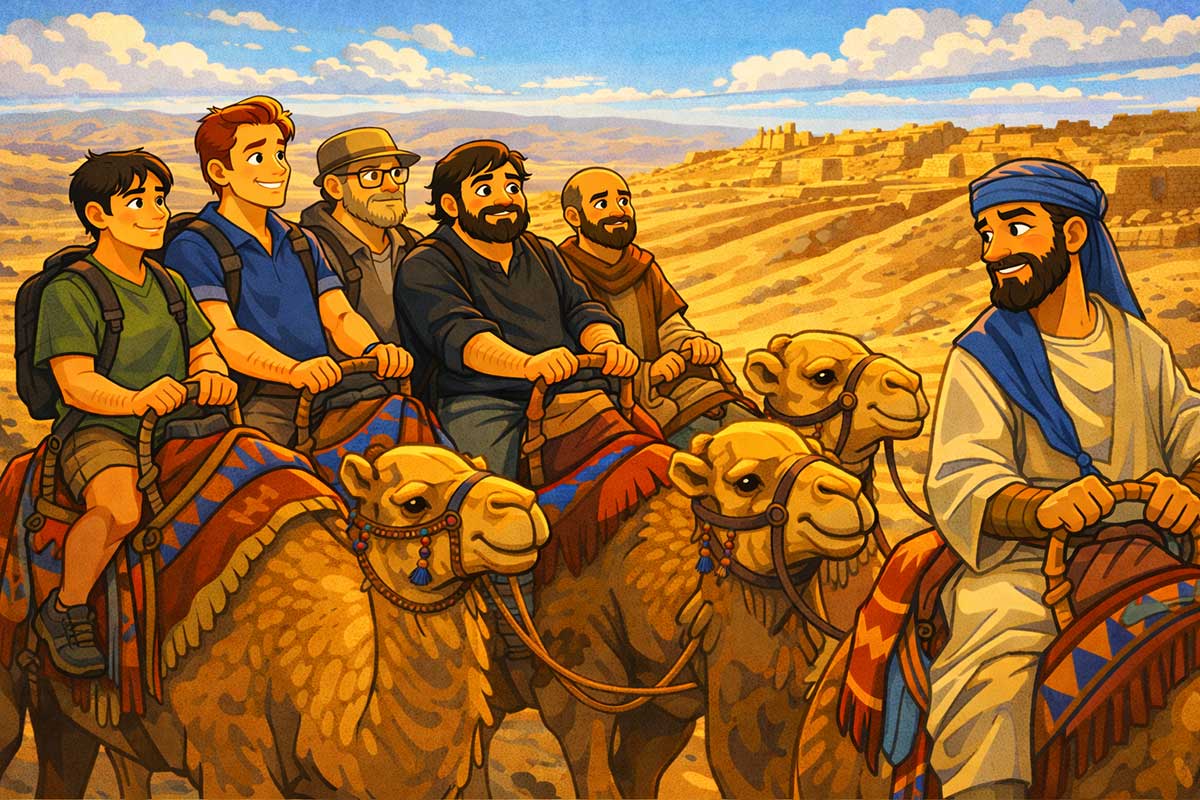
Scene 1 — Morning in a City That Knows
Day 8 begins under a sky so clear it almost feels severe.
Jerusalem wakes in pale gold again, the stone outside the hotel catching the first light with that same strange brightness you have now come to recognize — beautiful, but never innocent. The air through the cracked window is cool and dry, touched with dust, leaves, and distant bread. Somewhere below, a truck door slams. A bell rings once. Footsteps move quickly over pavement. The city is awake before you are fully ready for it.
At breakfast, the room is quieter than usual, but the quiet is different from Gethsemane’s.
Gethsemane was inward.
Today feels public.
The table smells of coffee, warm bread, eggs, fruit, herbs, olive oil, mint, cheese. Steam lifts from cups and vanishes. A spoon taps ceramic. A chair slides back. The room feels almost too ordinary for the day ahead, and that mismatch itself feels important.
Jim takes a sip of coffee and says, “I don’t know why, but today feels like the opposite of the garden. Less private. More exposed.”
The historical guide nods. “Yes.”
Conan breaks bread carefully, then sets half of it down untouched. “Yesterday felt like the hidden pressure before the breaking. Today feels like the breaking where everyone can see it.”
Jack looks toward the terrace doors where morning light is beginning to spread across the stone outside. “The garden hurt in a quiet way,” he says. “Today already feels like noise.”
The spiritual guide folds his hands around his tea. “Today you will walk through public suffering,” he says. “Humiliation, burden, witnessing, confusion, cruelty, loyalty, fear, and love that refused to leave.”
No one jokes.
The bread tastes warm and almost sweet. The coffee is dark, bitter, and grounding. The room is cool, but your hands are aware of the heat in the cup and the slight tremor in your own fingers when you set it down.
The spiritual guide looks at all of you.
“Today is not for dramatics,” he says softly. “It is for witness.”
Outside the windows, Jerusalem glows.
Not the city from a distance now.
The city as street, stone, crowd, market, wall, turn, staircase, noise, doorway, compression.
The body knows before the mind does: today the pilgrimage will move from the intimate sorrow of the garden into the harsh visibility of suffering in public.
And something in you is already bracing.
Scene 2 — Entering the Old City
The Old City receives you through stone, shadow, light, and compression.
The bus cannot take you all the way in, so the group walks, and almost at once Jerusalem changes registers. The wider roads and open views fall away. Streets narrow. Walls rise close. Arches frame strips of blue sky. The air grows denser with human nearness and layered smell: coffee, bread, sweat, old stone, spices, dust, incense from a chapel somewhere, frying oil from a stall, leather, wax, citrus, and the faint metallic tang of old city infrastructure warmed by the day.
The sounds come in waves.
Footsteps on worn stone.
Vendors calling.
Tour groups passing in different languages.
A church bell somewhere beyond the roofs.
The scrape of a metal shutter opening.
A child laughing sharply and disappearing into the flow.
A handcart rattling over uneven pavement.
Your shoes strike polished ancient stones that have been worn smooth by centuries of feet. Some sections are slicker than expected, especially in shadow. Other places are rough with exposed age. Walls beside you are cool in the shade, hot where sun strikes them. When your fingers brush the stone, it feels dense, dry, and alive with stored history.
The historical guide keeps his voice low as the group stops beneath an archway. “This part of the city compresses experience,” he says. “Space, smell, sound, movement. It is one reason public suffering here would have felt so immediate.”
The spiritual guide nods. “No one suffers abstractly on streets like these. Everything is close. The body feels it. Witnesses feel it.”
Conan glances down the narrow lane ahead, where the way bends out of sight between walls and stalls. “This is not a place where anything stays theoretical.”
Jim wipes one hand across the back of his neck. “No. There’s no room for abstraction. Or personal space.”
Jack turns slowly, taking in the hanging lamps, stone steps, shop fronts, archways, and little pockets of sun. “It’s beautiful,” he says, “but in a way that feels almost too full to bear today.”
The group begins to move again.
Sun flashes in sharp patches overhead, then disappears. Shade cools the skin suddenly, then sunlight returns and presses warmth onto shoulders and face. The city smells keep changing every few steps — cardamom, coffee, warm bread, damp stone, candle wax, cumin, laundry soap, old wood, people.
And that constant sensory life makes the day harder already.
Because you can feel with painful clarity what public suffering means: not just pain, but pain in the middle of all this — smell, noise, crowd, movement, ordinary commerce, impatient footsteps, people watching, some grieving, some mocking, some simply trying to get home.
The Via Dolorosa is ahead.
And the city around it refuses to empty itself for your reflection.
Scene 3 — The Way of Sorrow
The route begins almost before your mind is ready for it.
There is no giant clearing, no dramatic set change, no artificial transition into solemnity. It is just the city continuing — steps, turns, walls, pressure, voices, stone — and then the realization that this path, in all its human narrowness, is where Christian memory has gathered the long ache of the Passion.
The group stops in a slightly wider section of the lane where pilgrims have left the air visibly changed. Some stand praying quietly. Some touch the stone. Some weep without embarrassment. Others look uncertain, perhaps overwhelmed by the collision of devotion and ordinary street life. A vendor nearby arranges scarves. A man passes carrying boxes. Above, laundry moves slightly between buildings. Somewhere a smell of fresh bread rises, colliding painfully with the thought of suffering.
The spiritual guide speaks softly.
“This is what people often do not expect,” he says. “The Passion route is not removed from life. It is embedded in it.”
The historical guide adds, “Public humiliation in a city like this is a physical experience not just for the condemned, but for everyone forced to witness. Sound echoes. Crowds press. Shame becomes spatial.”
The group starts walking the route in measured silence.
The ground underfoot is uneven. Some stones are worn into shallow dips. Others jut slightly, making each step a small act of attention. The walls are close enough that in places you could touch both sides with outstretched arms if the lane were empty. The air is warmer here, held by stone and bodies. It smells of humanity, fabric, spice, dust, old dampness in shaded corners, and the persistent nearness of food.
Conan runs one hand briefly over the wall and then lets it fall. “This is one of the hardest things about Jerusalem,” he says quietly. “It keeps insisting that the sacred happened in places where people still had errands.”
Jim nods. “Yes. Suffering did not get a soundtrack and a cleared street.”
Jack’s eyes move from one stone turn to another. “That makes it more terrible,” he says. “And more real.”
The route bends again.
The light changes.
The city narrows.
And then, in the middle of the street’s living pressure, another presence enters.
Not with serenity like Mary in Nazareth.
Not with prophetic force like John.
With weight.
Scene 4 — Simon of Cyrene
A man stands a little apart from the flow of the lane as if he has stepped out from one layer of time into another.
His body carries the memory of burden. Not just strength, but the stunned endurance of someone who had one day and then found himself carrying part of another man’s suffering without consent. His face is weathered, solid, marked by confusion that long ago ripened into understanding.
Simon of Cyrene.
He looks at the street first, then at the group, then down at his own hands as though remembering the grain of wood against them.
“I did not wake that morning expecting my shoulders to enter another man’s agony,” he says.
His voice is grounded, unsentimental, deeply human.
“That is how some callings arrive.”
The sentence goes into the crowd-thick air and changes everything around it.
The sound of footsteps continues. A bell rings faintly farther away. Someone in the marketplace laughs at something unrelated. Life refuses to stop.
Simon lifts his gaze.
“At first it was only weight,” he says. “Wood. Shock. Public shame. The violence of being chosen by circumstance. The humiliation of being pulled from one path into another.”
He breathes once.
“Then it became more.”
The lane seems to hold still around him even though it does not actually grow quiet.
You can smell dust and warmed cloth and something sweet from a nearby pastry stall. Your mouth tastes faintly of coffee long gone cold in memory. Sweat gathers lightly at the back of your neck under the city heat.
The spiritual guide asks, “What did you understand then?”
Simon answers plainly.
“Very little.”
That honesty breaks the temptation to turn him into immediate spiritual clarity.
“I knew burden,” he says. “I knew force. I knew the roughness of wood. I knew the eyes of a crowd. I did not yet know that I was touching the cost of love.”
The line settles into the whole street.
Conan says softly, “That may be one of the most frighteningly accurate descriptions of life I’ve ever heard.”
Simon looks at him directly.
“What you did not choose,” he says, “may still become the place where you meet God.”
Jim closes his eyes briefly. Jack’s whole face opens with grief and recognition.
The group stands there, pressed inside the narrow old lane, while Simon’s words travel through them like a revelation no one would have voluntarily requested.
Because everyone knows some version of unwanted weight.
And now the city has given it a face.
Scene 5 — Mary Magdalene Near the Wound
The route continues.
The group moves farther through the lanes, and the Via Dolorosa seems to deepen the farther you go into it. The city smells richer now in the heat of late morning: spices from open sacks, sweat, bread, incense from a nearby chapel, hot stone, dampness trapped in shaded alleys, old wood, oil, soap, leather. These smells do not arrange themselves for prayer. They simply exist. That makes devotion here rawer.
At a place where the street widens just enough for the group to stop without blocking everything, the air changes again.
Not with weight this time.
With fidelity.
Mary Magdalene stands near a wall washed in angled light. There is grief in her face, yes, but also an extraordinary steadiness — not the practical steadiness of Martha, not the hidden steadiness of Nazareth’s Mary, but the steadiness of someone who has decided that love will remain near pain even when there is nothing triumphant left to stand near.
The city goes on around her.
That somehow makes her stronger.
“Many wish to be near glory,” she says.
Her voice is clear, low, and alive with memory.
“Fewer remain near shame, blood, confusion, and public loss.”
No one looks away.
The lane around you is full of stone and body heat and the after-echo of Simon’s words. A cart wheel rattles somewhere behind the group. A child is hushed by a parent. Someone lights a candle nearby, and the smell of melting wax drifts briefly into the open street.
Mary Magdalene looks down the route as if she still sees it.
“That day did not feel meaningful,” she says. “It felt unbearable.”
The truth of that line is almost too much.
She continues before anyone can tidy it.
“Do not let later understanding steal the reality of that hour. We did not stand inside a polished theology. We stood inside rupture.”
Jack wipes at his face.
Conan presses his lips together hard.
Jim looks at the ground, then back up.
The spiritual guide asks, “Why did you remain?”
Mary Magdalene answers without hesitation.
“Love does not prove itself only in celebration,” she says. “It proves itself by refusing to leave.”
The street itself seems to bow around that sentence.
You ask her, “What did the tomb feel like?”
She looks at you and the whole city seems to narrow.
“Not symbolic,” she says. “Not beautiful. Empty of the One I loved. Heavy with finality. I brought grief because grief was all I had left to bring.”
The line enters you like cold water.
Then her face changes, not into smile, not into triumph, but into remembered astonishment.
“And joy,” she says softly, “did not begin as an idea. It began as a voice speaking my name.”
No one in the group can recover quickly from that.
The sound of the city keeps moving.
But now all of it — market noise, bells, footsteps, distant argument, stone heat, spice smell — feels like the backdrop to one unbearable and beautiful truth:
Love stayed.
Even when everything visible argued against it.
Scene 6 — The Church of the Holy Sepulchre
The Church receives you like a wound made architectural.
You enter through heavy age, through polished thresholds worn by centuries of feet, through shadow and flame and stone that seems to hold human prayer inside it like heat stored in rock. The air changes at once. Outside the streets were hot, crowded, and bright. Inside, the air is cooler, denser, layered with incense, wax, old stone, oil from hanging lamps, old wood, fabric, and the unmistakable scent of many bodies moving reverently through a confined sacred space.
Light does not flood this church.
It glows in pockets.
Amber lamps. Candles. Shafts from high openings. Gold catching red glass. Smoke-softened surfaces. Shadows held deliberately by height and age.
The floor underfoot is worn and uneven, smooth in some places from countless steps, rougher in others where age has outlasted polish. Every sound becomes intimate here — a whispered prayer, a shoe scrape, a child’s question hushed immediately, chains on a hanging lamp moving slightly, the soft thud of someone kneeling.
Jack looks up and almost whispers to himself, “This place feels like grief that never stopped being prayed through.”
The historical guide, voice barely above the sound of foot traffic, says, “This church gathers the memory of crucifixion, burial, and resurrection into one dense sacred body. For many pilgrims, it is too much and yet not enough at once.”
Conan turns slowly, taking in the dimness, the lamps, the stone, the people touching surfaces as if touch itself were a prayer. “This may be the first building I’ve ever entered that feels simultaneously crushed and alive.”
Jim touches the edge of a pillar lightly with his fingertips. “Yes. It feels like sorrow survived long enough to become structure.”
The spiritual guide leads the group toward a quieter section to the side, where the sound lowers slightly and the air feels cooler. Incense gathers more thickly there. Candle flame scent sharpens. The stone beneath your palm is cold, old, smooth with devotion.
And here, in the half-light of the church, another presence emerges.
Not the fidelity of Mary Magdalene this time.
Not the burden of Simon.
The honesty of someone who loved, lost, heard impossible news, and could not at once cross the gap between sorrow and belief.
Thomas.
Scene 7 — Thomas and the Wound of Doubt
Thomas stands in the dimness with a face that carries intelligence, grief, and restraint.
He does not look rebellious.
He looks wounded.
That is the first thing that changes your understanding of him.
The hanging lamps above cast warm points of light across his features, and the smoke of incense moves almost imperceptibly in the air between you. Somewhere behind the group, a pilgrim begins to cry quietly. The church floor is cold under the soles now, and the air smells thickly of wax, stone, and prayer.
Thomas looks toward the inner darkness of the church before he speaks.
“Doubt,” he says, “is not always rebellion.”
His voice is measured, steady, almost sorrowfully exact.
“Sometimes it is love injured by loss.”
The line moves through the group with immediate force.
Conan closes his eyes briefly. Jim’s head lowers. Jack presses one hand against his chest.
Thomas continues.
“When hope has been torn open,” he says, “the heart does not always leap at good news. Sometimes it protects the wound first.”
The spiritual guide whispers, “Yes.”
Thomas looks at all of you in turn.
“I did not ask to see because I wished to stay far from Him,” he says. “I asked because the pain was near.”
That sentence rearranges the whole old caricature of doubt.
You ask, “So doubt can be grief in another form?”
Thomas answers at once.
“Yes.”
The church hums quietly around you — footsteps, breath, whispered prayers, candle crackle, the low movement of a crowd in another section. The scents remain strong: incense, old stone, hot wax cooling, fabric warmed by body heat.
Jim says, “That may be the most merciful explanation of doubt I’ve ever heard.”
Thomas looks at him. “Pretended certainty is a poor offering.”
Conan gives a small sound that is almost a laugh and almost surrender. “This pilgrimage has been extraordinarily bad for all my decorative defenses.”
Thomas’s expression softens a fraction.
“Then perhaps it has been useful.”
Jack asks in a near whisper, “What happened when you saw Him?”
Thomas looks down for a moment.
Then back up.
“The wound did not disappear,” he says. “It was transfigured by presence.”
No one speaks after that.
No one can.
Because the line has entered too deep.
The spiritual guide finally says, “So faith is not the absence of wounding.”
Thomas answers:
“No. It is wounded love brought into truth.”
The church seems to grow even quieter after that, though rationally you know it has not.
The silence is inside the group now.
And it is full.
Scene 8 — Candles, Evening, and the Return Through the City
By the time the group leaves the Holy Sepulchre, the light outside has changed.
Late afternoon has begun bending toward evening, and the Old City holds that change in astonishing ways. Some stones burn amber. Others have already gone cool and gray in shadow. The air in the streets has softened slightly, though it still carries the day’s stored heat. Smells rise more richly now — cardamom, warm bread, dust, old stone, coffee, oil, wax, people, evening cooking beginning in hidden kitchens.
The group walks more slowly than before.
Not from fatigue alone.
From reverence that has entered the body.
The Via Dolorosa behind you now feels less like a route and more like an opened nerve running through the city. Simon’s burden, Mary Magdalene’s refusal to leave, Thomas’s wounded honesty — all of it moves with you as you pass shop doors, lanterns, stairways, narrow turns, and walls that have outlasted empires.
Conan finally speaks as the group pauses beneath an arch where cooler air gathers.
“I think today did something terrible to my desire to keep suffering tidy,” he says quietly.
Jim nods. “Yes. Public pain is messy. Witness is messy. Faith is messy.”
Jack looks back once toward the direction of the church. “What is staying with me,” he says, “is that love did not become abstract at the worst moment. It became more specific.”
The spiritual guide answers, “That is what witness does.”
The historical guide adds, “And what the city itself still does. It keeps particularity alive.”
The group steps out of the Old City as evening deepens.
On the bus ride back, the windows hold flashes of Jerusalem in transition — families walking, lights coming on behind curtains, trees darkening against the sky, priests, tourists, workers, vendors closing stalls, a cat moving along a wall, taxis collecting late passengers. The interior smells familiar now: fabric, dust, bottled water, warm electronics, a trace of incense that seems to have followed all of you out of the church on your clothes.
The engine hums low.
No one rushes to fill the silence.
The day has made speech expensive.
At last Jim says, “Mary Magdalene is going to stay with me for a long time.”
Conan nods. “Yes. ‘Love proves itself by refusing to leave.’ I’m not getting over that quickly.”
Jack wipes at his eyes again and laughs softly at himself. “And Thomas. That doubt could be love injured by loss. That’s huge.”
You watch Jerusalem sliding by outside and feel Day 8 settling not as one more moving experience, but as a deepening of everything the pilgrimage has been doing:
Gethsemane showed love staying in private surrender.
Today showed love staying in public ruin.
The city did not stop.
The suffering did not become less real because redemption was hidden in it.
And witness did not require full understanding. It required nearness.
That night on the terrace, the air is cool enough that the stone rail feels almost cold beneath your hands. The city lights below shimmer in clusters and lines. The breeze carries dust, leaves, and the faint smell of evening food from somewhere below.
Conan stands beside you for a long time before speaking.
“I used to think courage was mostly about decisive action,” he says. “Today it looked a lot like remaining near what hurts.”
Jim adds, “Yes. Near the wound.”
Jack looks out over the city and says softly, “And not leaving.”
You stand there with them and know Day 8 has entered the heart in a way that will not easily be reversed:
Burden may be forced upon you and still become holy.
Love proves itself by refusing to leave.
Doubt may be wounded love, not betrayal.
And witness is not clean. It is close.
Day 9: Jerusalem Again - What the Pilgrim Takes Home
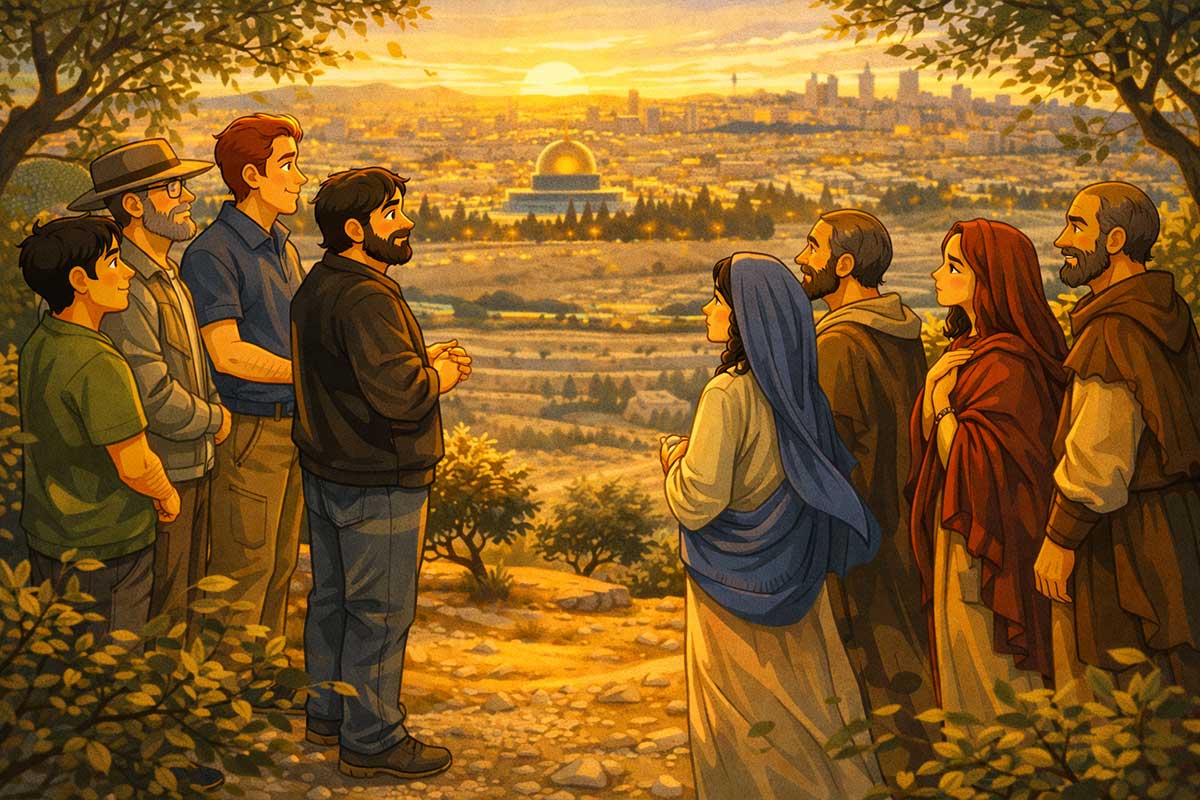
Scene 1 — Before Sunrise
The last morning begins in darkness soft enough to feel merciful.
Not night anymore. Not day yet. The city outside your window is still mostly shadow, but certain edges have begun to appear — a pale outline of rooftops, the faint geometry of walls, a few windows still lit, a line of streetlamps fading in importance as the sky slowly gathers itself. The room is cool. The air slipping in through the cracked window smells of stone, leaves, dust, and dawn — a smell cleaner than daytime, less crowded by heat and traffic, almost spare.
You dress quietly.
The hotel corridors are hushed, carpet swallowing footsteps. Doors open and close with soft clicks. Somewhere far away, one elevator dings. No one speaks loudly. No one seems able to.
Downstairs, the group meets before breakfast with cups of coffee and tea warming their hands. The drinks smell stronger in the dark — coffee deep and bitter, mint tea sweet and sharp, black tea earthy and dry. Steam curls upward and disappears into the cool air.
Conan stands with both hands around a paper cup, hair barely under control, face more open than he would usually permit this early. “I feel,” he says, voice low, “like I’m about to say goodbye to a city that knows too much about me.”
Jim lifts his coffee slightly. “That seems accurate.”
Jack is already looking toward the terrace doors where the first gray-blue light is gathering. “I don’t want to leave yet,” he says. “That’s how I know the trip did what it was supposed to do.”
The historical guide nods. “The final day is not for adding more. It is for seeing what remains.”
The spiritual guide looks at each of you. “And for asking whether pilgrimage was something you visited… or something that has now entered your life.”
No one answers.
The question is too large to meet quickly.
The group moves out toward a quiet overlook as the city waits below.
The air is cold enough now to make your fingertips aware of the cup. When you breathe in deeply, the cool enters the chest almost sharply. Somewhere in the distance, a dog barks once. Then silence returns. The path underfoot is slightly damp with the night’s residue, stone cooler than yesterday, rougher in the dark.
Jerusalem lies ahead, still mostly shadow.
And for the first time since you arrived, the city feels less like something you are approaching than something you are about to carry away.
Scene 2 — Sunrise Over the Holy City
The sunrise begins almost invisibly.
A thinning in the eastern dark. A pale silver at the edge of the hills. Then faint rose. Then a slow warm wash that touches the city in layers — roof first, then tower, then wall, then window, then stone catching gold as if lit from inside. Jerusalem does not burst into morning. It reveals itself.
The overlook is quiet but not empty. Wind moves across the ridge in long cool breaths carrying dust, leaves, stone, and the faintest trace of morning fire or bread from somewhere far below. The rail beneath your hand is cold, rough, dry. A bird calls once from a nearby tree, answered by another farther off. Then the bells begin — one low note, then another, somewhere in the city, rounded by distance. A few seconds later, a different sound rises from another quarter. Jerusalem wakes in overlapping devotions again.
The city below glows now.
Not only beautiful.
Known.
You can see in one sweep the slopes, domes, roads, clustered buildings, walls, terraces, trees, and the pale old bones of the city that have already become something more than scenery to you. The light touches all of it the same — the holy and the ordinary, the famous and the forgotten, the chapel and the apartment window, the overlook and the alleyway.
No one speaks for a long time.
Conan finally says, almost under his breath, “This is infuriatingly moving.”
Jim gives him half a smile. “I was waiting to see how long it would take you to say something very beautiful in a mildly annoyed tone.”
Jack laughs once, softly. “This is the perfect last morning. It’s not dramatic. It’s just true.”
The spiritual guide steps closer to the railing. “The sunrise matters,” he says. “Not as a symbol people force onto the moment, but as a reminder that the city continues. The pilgrim leaves. The place remains. The question is what remains in the pilgrim.”
The historical guide turns toward all of you. “You came here to see the Bible in the land. Did the land begin to read you back?”
The breeze rises a little, cold enough to move the collar of your shirt against your neck.
The coffee in your cup has begun to cool. It tastes less bitter now, smoother, thin steam still rising faintly.
You look out over Jerusalem and realize how layered the city has become inside you:
David’s truth.
Bethlehem’s courage.
Nazareth’s hidden faithfulness.
Galilee’s calling.
The Jordan’s turning.
Bethany’s tears.
Gethsemane’s surrender.
The Via Dolorosa’s witness.
All of it gathered now in one dawn.
And the city below seems to know exactly what it has placed in your hands.
Scene 3 — Breakfast After Everything
The final breakfast feels strangely intimate.
Nothing has changed in the dining room outwardly — the same warm bread, coffee, eggs, olives, fruit, yogurt, mint tea, clinking dishes, soft footsteps, morning light spreading across stone and linen — yet every ordinary detail feels more precious because it is the last time the group will sit together here as pilgrims still inside the journey rather than people already returning from it.
The smell of bread is fuller than ever, warm and yeasty and almost sweet. Coffee rises dark and rich. Cut oranges release a fresh sharp scent. Olive oil catches the light in shallow bowls, green and gold. Steam fogs the edge of a glass for a second and fades.
Jim takes a bite of bread and says, “It’s interesting how every day made the next ordinary thing feel more charged.”
Conan stirs his coffee slowly. “Yes. Even this breakfast now feels emotionally significant, which is frankly an unreasonable burden to place on eggs.”
Jack grins. “That’s because the trip didn’t just give us moments. It tuned our senses.”
The spiritual guide smiles. “That is often part of pilgrimage. The world does not become magical. It becomes more real.”
The historical guide nods. “And sometimes more demanding.”
The group sits in a silence that is neither awkward nor empty. The kind of silence that happens when people have passed through enough together that words no longer have to constantly prove connection.
Then the spiritual guide says, “Before we leave for the final gathering, I want to ask one thing of each of you. Not a full reflection. Just this: what surprised you most?”
Jim goes first.
“That grief was allowed to be so honest,” he says. “Martha, Mary, Thomas… none of them sounded like polished religious people. They sounded like real people who kept telling the truth in front of God.”
Conan nods, then answers. “I was surprised by how often the deepest things arrived without spectacle. Nazareth. Peter saying they followed before they understood. Gethsemane. The sharpest lines were usually the quietest.”
Jack sits back, thinking. “I was surprised by how human holiness felt. Not smaller. Just closer. Bread, wood, water, dust, tears, fatigue, pressure, voices, actual places.”
The historical guide looks at you. “And you?”
You set down your cup.
Its warmth is still faint in your palm.
“What surprised me most,” you say, “was how often the holy showed up inside what people usually try to escape — weakness, waiting, work, grief, fear.”
No one says anything for a moment.
Then the spiritual guide nods. “Good. Then the pilgrimage did not remain decorative.”
Breakfast ends slowly.
No one rushes away from the table.
Because even this — bread, tea, light, chairs, ordinary conversation after sacred days — now belongs to what the pilgrimage has taught.
Scene 4 — The Final Gathering Place
The final gathering is held in a quieter part of Jerusalem, somewhere between city and reflection — not fully public, not enclosed, a place where old stone, open air, and distance from the noise allow the trip to end without being flattened into summary.
There is a low wall overlooking part of the city. Olive trees stand nearby, their leaves turning silver-green in the shifting light. The ground is packed earth and old paving stone, warm now under the late morning sun. The air carries a mixture of dust, leaves, stone, and the faint smell of bread and smoke drifting from neighborhoods below. Far off, bells and city sounds rise and fall like memory itself breathing.
The group takes their places almost naturally.
The historical guide sits slightly apart, hands folded, the face of a man who knows facts and has also watched them become encounter. The spiritual guide stands for a moment before sitting, as if reluctant to hurry the transition from journey to farewell. Conan leans against the low wall, unusually still. Jim sits with his elbows on his knees, looking out. Jack stands for a few seconds longer than the rest, as though needing one more visual imprint of Jerusalem before he can settle.
No one announces the roundtable.
No one needs to.
The whole place already feels like a threshold.
The breeze moves through the olive branches with a soft papery sound. The stone beside your hand is warm, rough, and slightly dusty. Sunlight falls in shifting patches across shoes, sleeves, faces. The city below is bright and alive, but from this small distance it hums rather than intrudes.
The spiritual guide says softly, “The final question is simple. What does a pilgrim take home?”
The words barely finish entering the air before the atmosphere changes.
It does not shock anymore.
It deepens.
One by one, then all at once, they are there.
David.
Mary.
Peter.
Mary Magdalene.
Paul.
No blaze. No spectacle. Only presence — each distinct, each carrying the place you met them first, and yet all now gathered in Jerusalem as though the whole pilgrimage has been drawing toward this conversation from the beginning.
Conan closes his eyes briefly, almost smiling at the sheer impossibility of how normal this now feels.
Jim exhales. Jack lets out one small sound of wonder.
The city waits below.
The final roundtable begins.
Scene 5 — David and the Prayer After Pilgrimage
David is the first to speak.
Jerusalem behind him makes the whole moment feel complete, as if the city itself has handed him the first word because he opened the journey and now must help close it.
“Many leave a holy place,” he says, “and immediately begin protecting themselves from what they received there.”
His voice is lower than the wind, yet stronger than the city sounds beneath you.
“They turn encounter into memory only. Memory into language. Language into image. Image into distance.”
The sentence cuts cleanly.
David’s eyes move over the group.
“Do not do this.”
The breeze lifts the edge of his garment. The sunlight catches in his hair and in the pale dust at his feet.
“A pilgrim should leave with less performance in prayer,” he says. “Less polished speech. Less concern for seeming devout. More truth.”
Conan looks down, smiling ruefully. “Yes. That sounds directed.”
David hears the half-joke and answers the heart beneath it.
“The prayer God receives is not the one most carefully arranged,” he says. “It is the one that no longer hides.”
Jim nods at once.
You ask David, “So what should we carry home from Jerusalem?”
He answers without hesitation.
“Pray truthfully,” he says. “Let grief become song if it must. Let gratitude become song. Let fear become song. Let repentance become song. But do not return to performance and call it prayer.”
The line moves through the whole gathering.
The city below seems to glow even brighter under the noonward light. Somewhere down in the streets, a car horn sounds. A bell follows. The ordinary world continues.
David looks once toward Jerusalem.
“A holy city reveals,” he says. “Do not spend your return journey covering again what God uncovered.”
No one speaks for a moment after that.
The wind keeps moving through the olive leaves.
And you know David has given the first part of the answer:
Take home truthful prayer.
Not polished religion.
Scene 6 — Mary, Peter, and Mary Magdalene
Mary speaks next, and everything softens without losing depth.
She does not stand in Bethlehem now or Nazareth. She stands in Jerusalem at the close of pilgrimage, and somehow that makes her words feel wider, as if all her earlier lessons — willingness, hidden faithfulness, ordinary trust — have gathered into one final sentence for those about to leave.
“Do not return home thinking only great moments are holy,” she says.
The line enters gently, but it holds.
“Most of what you have received here will have to live in kitchens, roads, fatigue, family conversations, waiting, ordinary care, ordinary work, and ordinary obedience.”
Jack closes his eyes and smiles through tears.
Mary continues, “Carry memory into repetition. Let the hidden yes remain a yes.”
Jim says quietly, “That may be the hardest assignment of the whole trip.”
Mary turns to him. “Yes,” she says. “And the most necessary.”
Peter steps forward before the stillness can settle too deeply.
He brings warmth with him immediately, that same alive, unvarnished humanity from Galilee.
“If you wait until you feel ready,” he says, “you may spend your whole life admiring the shore.”
Conan laughs once — not to break the moment, but because the line is so exactly Peter.
Peter smiles. “Follow before you feel finished,” he says. “That is what I would tell any pilgrim returning home.”
He looks directly at the group.
“The Lord does much with unstable people who keep returning.”
Jim drops his head and laughs under his breath. Jack claps one hand against his own chest. Even Paul, standing farther back, seems almost amused.
You ask Peter, “So pilgrimage is not about becoming complete here?”
Peter answers instantly. “No. It is about becoming interruptible again.”
That line lands hard.
Then Mary Magdalene speaks, and with her everything becomes both tender and sharp.
“Do not leave inspired only,” she says.
Her voice carries the same fidelity you heard near the Via Dolorosa.
“Inspiration fades if it is not joined to faithfulness.”
The breeze catches a loose strand of her hair. The city sounds below blur into a soft living hum.
“Stay near love,” she says. “Not fear. Fear will hurry you back into distraction, image, self-protection, and distance. Love remains. Love remembers. Love goes near.”
Conan looks at her with the face of someone who has already lost any wish to be clever.
Jack asks softly, “How do you do that after you leave?”
Mary Magdalene answers, “By refusing to make the wound theoretical.”
The sentence goes into you like a command.
Not only Christ’s wound.
The wounds of others.
The places of sorrow and need you would rather discuss than approach.
The final answer is gathering now:
Pray truthfully.
Carry the hidden yes home.
Follow before you feel finished.
Stay near love.
And then Paul steps forward.
Scene 7 — Paul and the Life After the Holy Place
Paul’s presence changes the air in a different way from the others.
Not harsher.
Clearer.
His words come with the force of road, mission, cities, beatings, speeches, prison, community, letters, endurance — the force of someone who refuses to let any sacred experience remain only private feeling.
“A pilgrim who keeps the holy only as sentiment,” he says, “has not yet understood the gift.”
There it is at once.
The line that makes the whole trip impossible to store as private beauty alone.
Paul looks over the group and then beyond them, as if already seeing the roads each of you will return to.
“What you have seen,” he says, “must become speech, patience, mercy, courage, witness, restraint, compassion, endurance, truthfulness, and love in the place where you actually live.”
The wind rises once and passes.
The smell of stone and dust sharpens for a second in the air.
The historical guide watches him with an expression almost like relief: yes, the pilgrimage now leaves its final romance and becomes vocation.
Paul continues. “Do not honor holy places by speaking well of them only. Honor them by becoming less false where you are sent next.”
Jim nods hard enough that everyone sees it.
Conan lifts a hand. “May I ask one final question on behalf of modern humanity and airport logistics?”
Paul looks at him.
Conan says, “Is it spiritually embarrassing to have a life-changing pilgrimage and still immediately think about baggage claim, delayed flights, and whether one can get a decent snack on the way home?”
The laughter this time is deep and needed.
Paul’s face softens.
“Human creatureliness survives revelation,” he says. “That is why grace remains useful.”
Even David almost smiles at that.
Jack laughs so hard he has to wipe his eyes again. Jim leans against the wall and says, “That may be the most reassuring theology of airports ever given.”
Paul lets the humor pass, then says the line that seals the day:
“Take what pierced you here and let it become life where you live.”
No one in the gathering escapes that sentence.
Because it gathers every day of the pilgrimage and sends it forward at once.
Not memory alone.
Life.
Scene 8 — The Departure of the Voices, the Staying of the City
No one sees precisely when the figures leave.
As before, their departure is less vanishing than release — as though the moment simply becomes once again a Jerusalem morning with olive trees, wind, stone, and a small group of modern pilgrims staring at a city that now feels impossibly near.
The place holds the after-sense of them.
David’s truth.
Mary’s hidden yes.
Peter’s interruption.
Mary Magdalene’s fidelity.
Paul’s sending.
The group remains by the wall for a long while.
No one wants to move too quickly and flatten the finality into logistics.
The city below shimmers in noon light now. Walls pale under the sun. Roads fill. The sounds rise stronger — traffic, bells, voices, movement, life. The smell of warming stone thickens in the air. Leaves click and whisper overhead. A fly passes too close, circles once, disappears. The heat on the top of your hands grows stronger where sunlight reaches them.
Conan finally exhales.
“Well,” he says, “that was an astonishingly unfair way to conclude a trip.”
Jim smiles. “Because now we actually have to do something with it?”
“Yes,” Conan says. “Exactly.”
Jack looks out over the city one more time. “I thought this would feel like the end,” he says. “It doesn’t. It feels like being handed something.”
The spiritual guide nods. “That is the proper discomfort of a real pilgrimage.”
The historical guide adds, “And perhaps the proper grace.”
The group begins walking back slowly.
Shoes press over old paving stones. Gravel shifts at the edge of the path. The olive leaves still move in the same wind as before. Yet everything now has the strange sharpness of last things — the smell of dust, the warmth of stone, the cry of a bird overhead, the angle of sun on a wall, the texture of the rail under your palm.
You do not want to sentimentalize it.
And yet goodbye is unavoidable.
The city remains.
The pilgrim leaves.
And what matters now is whether the leaving becomes witness rather than just memory.
Scene 9 — Final Evening Before Departure
The last evening in Jerusalem is quieter than any before.
The terrace is lit softly. The stone underfoot has released the day’s heat and now feels cool again. The air is crisp enough to make tea feel necessary. The city below glows in its familiar night pattern, lights scattered over slopes and gathered around roads and neighborhoods, the Old City holding its gravity among the rest. The breeze smells of stone, leaves, dust, and distant food. Somewhere a bell rings. Somewhere else, laughter rises from a table out of sight and vanishes.
The group stands together without agenda.
Cups warm the hands.
Steam brushes the face.
No one is trying to force a grand closing speech.
Conan looks out over Jerusalem and says, “I came here half expecting moving scenery and manageable reflection. I did not expect the land to become morally specific.”
Jim gives a low laugh. “Yes. It refused to stay inspirational.”
Jack shakes his head slowly, smiling. “I’m going home with more tenderness than I came with. I did not expect that.”
The spiritual guide leans on the rail. “That may be the clearest sign of grace.”
The historical guide looks over the city one last time. “You now know more than facts about these places. You know some of their weight.”
You hold your tea and feel the warmth against your palms, the cool wind on your face, the slight dryness of Jerusalem’s night air in your throat, the stone rail solid under your hand.
You think of each day.
David and the city of desire.
Mary and Joseph in Bethlehem.
Nazareth’s hidden years.
Peter by the water.
John at the Jordan.
Bethany’s tears.
Gethsemane’s surrender.
The witness of the Via Dolorosa.
The final sending.
The city lights tremble slightly in the distance.
And the last truth of the pilgrimage settles gently, deeply, irrevocably:
You did not come here only to see sacred places.
You came to discover what kind of life those places ask of you once you leave.
Final Thoughts by Nick Sasaki
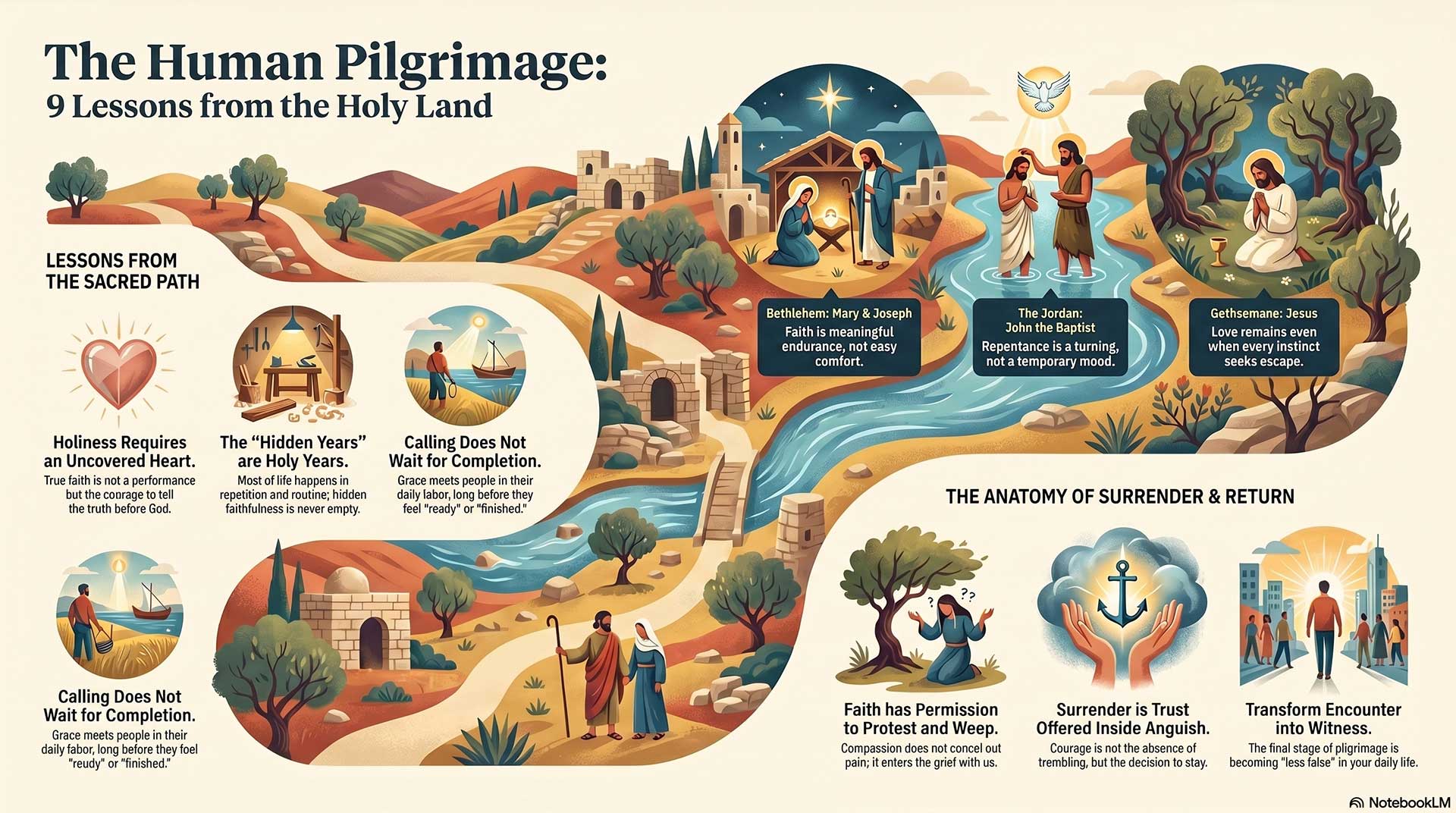
This pilgrimage began as a search for closeness to the Bible, but it became something harder and better: a search for the kind of heart that can live truthfully after encounter.
Jerusalem revealed that holiness does not flatter the soul. Bethlehem showed that God came not through protected power but through exposure, fragility, and willing trust. Nazareth restored the dignity of repetition, family life, and unseen faithfulness. Galilee showed that calling does not wait for completion. The Jordan made clear that beginning again is not a mood but a turning. Bethany gave permission for faith to protest and weep. Gethsemane showed that fear can exist inside courage, and that love remains when escape is possible. The Via Dolorosa and the Holy Sepulchre taught that witness means nearness to the wound, not safe admiration from a distance.
By the final day, the pilgrimage had stripped away the idea that sacred travel is mainly about inspiration. It became clear that the real test comes afterward: whether prayer grows more truthful, whether ordinary life becomes more faithful, whether love remains near suffering, whether the pilgrim returns home less performative and more real.
The final voices made the message unmistakable. David called for truthful prayer. Mary called for faithful ordinary living. Peter called for action before full readiness. Mary Magdalene called for love that stays near the wound. Paul called for encounter to become witness in daily life.
So the deepest gift of this pilgrimage is not that the traveler saw sacred places.
It is that sacred places uncovered a truer way to live.
Short Bios:
Conan O’Brien — The quick, awkward, brilliant comic voice of the group. He uses humor to breathe inside heavy moments, yet gradually becomes one of the clearest witnesses to how truth undoes performance.
Jim Gaffigan — The grounded, dry, deeply human observer. He notices bodies, fatigue, food, grief, and ordinary life, helping sacred moments remain real rather than overly polished.
Jack Black — The open-hearted wonder of the journey. He brings emotional immediacy, delight, awe, and the kind of sincerity that lets beauty and sorrow land without defense.
The Historical Guide — The steady interpreter of land, politics, architecture, archaeology, roads, villages, and social context. He helps the group feel how Scripture happened inside actual geography and daily life.
The Spiritual Guide — The pastoral voice of the pilgrimage. He connects each place to the inner life: fear, trust, surrender, grief, courage, prayer, obedience, and hope.
David — The king who first frames Jerusalem as a city of longing, sin, worship, tears, and truth. He teaches that holy places reveal what the heart has tried to hide.
Mary — Seen first in Bethlehem and later in Nazareth and the final roundtable, she reveals willingness, hidden faithfulness, motherhood, ordinary obedience, and the sacredness of unseen years.
Joseph — The quiet guardian of Bethlehem. He represents practical courage, protective love, and the kind of faithfulness that acts without needing heroic recognition.
Peter — The fisherman of Galilee and the warm, impulsive disciple who reminds the group that calling begins before readiness and that grace works through unstable but returning hearts.
John the Baptist — The fierce prophet at the Jordan. He strips away image, demands truth, and teaches that repentance is turning, not spiritual mood.
Martha — The plainspoken sister of Bethany whose grief and faith are both honest. She shows that faith can speak pain directly to God without becoming false.
Mary of Bethany — The sister who gives voice to absence, sorrow, and tears. She shows that delayed help wounds deeply, yet heaven does not despise grief.
Lazarus — The brother raised from the dead, carrying strange calm and clear perspective. He reminds the group that before astonishment there was mourning, and that power joined to compassion gives hope.
Jesus — Encountered in Gethsemane with full reverence. He reveals that courage can tremble, prayer can be honest in anguish, surrender is trust inside pain, and love stays.
Simon of Cyrene — The man pulled into unwanted burden on the way of suffering. He shows that what one did not choose may still become the place of holy encounter.
Mary Magdalene — The faithful witness who stayed near the shame, sorrow, and wound of the Passion. She teaches that love proves itself by refusing to leave.
Thomas — The honest doubter at the Holy Sepulchre. He reveals that doubt can be love injured by loss, and that wounded faith can still become true faith.
Paul — The final voice of mission and witness. He insists that pilgrimage cannot remain private sentiment, but must become courage, mercy, truth, and love in everyday life.
Nick Sasaki — The pilgrim-host of the journey, carrying Christian longing, curiosity, and the desire to experience biblical places not only as history, but as lived encounter.
Leave a Reply