

|
Getting your Trinity Audio player ready...
|
What if the data center future decides who feels useful—and who doesn’t?
For most of human history, decisive change did not begin with ideas.
It began with energy.
Civilizations rose not because they imagined boldly, but because they learned how to concentrate power more effectively than those around them—first through muscle and biomass, later through coal, oil, electricity, and industrial systems that reshaped daily life far beyond their original intent.
What we now call artificial intelligence belongs to this same lineage.
Despite the language used to describe it—clouds, models, virtual assistants—it is not immaterial. It is among the most energy-intensive developments humanity has ever pursued.
Data centers are the physical manifestation of this pursuit.
They are not merely technical infrastructure. They are energy concentration devices, comparable in consequence to steel mills in the nineteenth century or oil refineries in the twentieth. Their rapid proliferation signals a shift not only in how intelligence is produced, but in where economic gravity, strategic leverage, and social dependency now reside.
Yet societies tend to misunderstand such transitions while they are underway. We focus on applications and promises while neglecting foundations and limits. We celebrate efficiency gains while postponing questions of resilience, equity, and long-term sustainability.
This series examines data centers not as symbols of progress, but as systems embedded in material reality—dependent on land, electricity, water, labor, and political stability. It asks whether our current pace of expansion reflects wisdom or merely momentum.
History suggests that infrastructure reshapes civilization long after enthusiasm fades.
The question before us is not whether data centers will transform society—they already have.
The question is whether we understand what we are building well enough to live with its consequences.
(Note: This is an imaginary conversation, a creative exploration of an idea, and not a real speech or event.)
Topic 1 — Power Is the New Oil: Who Controls the Energy Behind AI?

Moderator: Nick Sasaki
Participants:
Vaclav Smil — energy systems scholar
Jensen Huang — CEO of NVIDIA
Deborah Frink — data center operations and engineering executive
Amory Lovins — energy efficiency and grid optimization thinker
Joe Dominguez — nuclear and grid reliability executive (Constellation Energy)
Opening Scene
Nick Sasaki
We talk about artificial intelligence as if it lives in code and clouds.
But every breakthrough quietly asks the same question: Where does the power come from?
Tonight, I want to strip AI of its mythology and talk about its physical truth.
Data centers don’t run on ambition. They run on electricity. And electricity is suddenly scarce in ways most people don’t yet understand.
So let me start here.
As AI accelerates, are we entering an era where the real competition isn’t over algorithms—but over energy itself?
The Conversation Begins
Vaclav Smil
We are absolutely entering that era, whether people acknowledge it or not. Every major leap in civilization has been preceded by a new way of concentrating energy. Steam, coal, oil, electricity—each one reorganized society.
Data centers are simply the newest mechanism for energy concentration. They are not magical. They are brutally physical. They require land, materials, cooling, water, and above all, reliable electricity at an unprecedented density.
What concerns me is not growth, but illusion—the illusion that digital progress is detached from physical limits. It never is.
Jensen Huang
I agree, and I think the misunderstanding comes from how AI progress is portrayed.
People imagine intelligence as something abstract. In reality, intelligence at scale is manufactured. It is produced inside data centers the same way steel was produced in mills.
When we design new chips, the first questions are no longer just about performance. They’re about power envelopes, heat dissipation, and whether the surrounding infrastructure can sustain the load.
AI doesn’t advance at the speed of ideas anymore. It advances at the speed of power availability.
Deborah Frink
From an operational standpoint, the shift has been dramatic.
Ten years ago, data centers were designed around redundancy and uptime. Today, they’re designed around power negotiation. We’re not asking, “Can we get electricity?” We’re asking, “Can we get it continuously, affordably, and without destabilizing the surrounding community?”
Entire projects are delayed or canceled not because of hardware shortages, but because utilities simply cannot supply the power.
That’s a structural bottleneck—not a temporary one.
Amory Lovins
And this is where efficiency becomes destiny.
The cheapest unit of power is the one you never have to generate. Data centers that win long-term won’t just secure more energy—they’ll use radically less per unit of computation.
This isn’t just about renewable versus nuclear. It’s about intelligent design, adaptive load management, and treating efficiency as a first-class resource rather than an afterthought.
The tragedy would be assuming brute force is the only path forward.
Joe Dominguez
From the grid side, what people underestimate is fragility.
Our electrical systems were not built for this level of concentrated, always-on demand. Data centers don’t peak and dip like households. They are relentless.
This is why nuclear is re-entering the conversation—not as ideology, but as necessity. You cannot run an AI economy on intermittent power alone. Reliability matters more than slogans.
A Deeper Turn
Nick Sasaki
Let me push this further.
If energy is the choke point, then control over energy becomes power in the political sense as well. Who benefits from this data center boom—and who pays the hidden costs?
Deborah Frink
Communities pay first.
When a data center arrives, local power prices often rise. Utilities prioritize high-volume buyers. Residents get what’s left—at a premium.
There’s also water usage, land pressure, and zoning conflicts. People are told data centers are “clean,” but they feel the impact immediately.
Without transparent planning, resentment builds fast.
Joe Dominguez
This is exactly why long-term grid planning matters.
When infrastructure decisions are reactive, communities lose trust. But when investments are paired with grid upgrades, workforce development, and local benefits, outcomes improve.
Energy projects don’t fail because people hate progress. They fail because people feel excluded from it.
Vaclav Smil
History is instructive here.
Every energy transition produces winners and losers. The mistake is pretending otherwise. The ethical question is not whether disruption occurs—but whether societies anticipate and mitigate its effects.
Ignoring those costs doesn’t eliminate them. It merely delays their reckoning.
Jensen Huang
From the technology side, I see another risk.
If energy access becomes uneven, AI capability becomes uneven. That has implications not just for companies, but for nations.
Countries that cannot build and power data centers at scale will consume intelligence produced elsewhere. That is a new form of dependency—subtle, but profound.
Amory Lovins
Which is why decentralization matters.
A future dominated by a few massive energy hogs is brittle. A future built on distributed efficiency, smarter grids, and localized resilience is stronger.
We should be asking not just how to feed data centers—but how to make them adaptable to human and environmental systems.
The Question Beneath the Question
Nick Sasaki
Let’s imagine we’re advising the next generation—governments, companies, entrepreneurs.
What is the single biggest misunderstanding they have about energy and data centers today?
Amory Lovins
They believe energy abundance is guaranteed.
It isn’t. Energy must be designed for, conserved, and respected. Treating it as infinite is the fastest way to make it scarce.
Joe Dominguez
They think power problems can be solved later.
They can’t. Energy decisions made today determine economic options decades from now. You don’t retrofit your way out of a weak grid.
Deborah Frink
They underestimate operational complexity.
A data center is not a warehouse with servers. It’s a living system that must evolve constantly. Designs that ignore future power density are already obsolete.
Jensen Huang
They assume innovation happens only in software.
The next breakthroughs will come from infrastructure—from rethinking how intelligence is powered, cooled, and deployed. The physical layer is where the next advantage is built.
Vaclav Smil
They forget limits.
Progress that ignores constraints is not progress—it is a temporary acceleration toward failure. The societies that thrive are those that align ambition with reality.
Closing Reflection
Nick Sasaki
Listening to this, one thing becomes clear.
AI may feel revolutionary, but it obeys ancient rules.
Energy precedes intelligence.
Infrastructure precedes innovation.
And power—real power—is always physical before it becomes abstract.
Data centers are not just buildings.
They are decisions made visible in concrete and copper.
And the future of AI won’t belong to those with the boldest ideas—but to those who understood, early enough, where the electricity would come from.
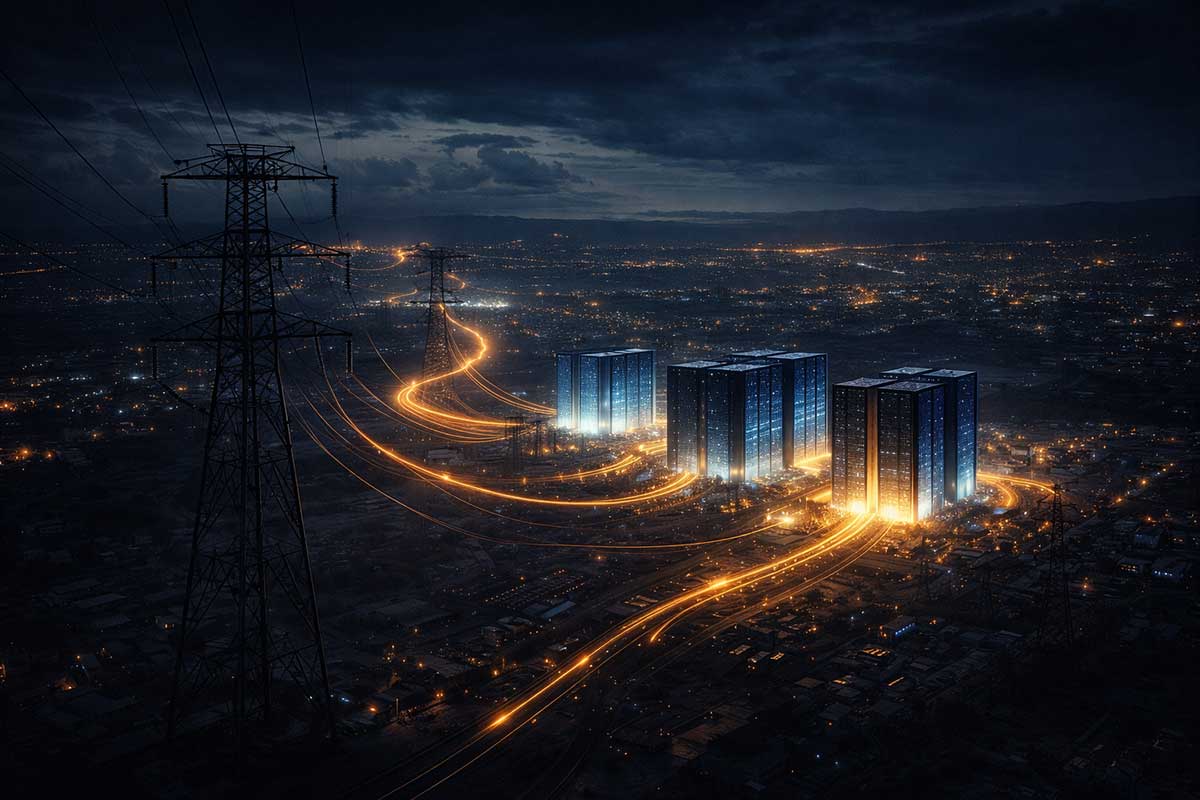
Topic 2 — The $1.2 Trillion Land Grab: Data Centers as the World’s Most Valuable Real Estate
Moderator: Nick Sasaki
Participants:
Deborah Frink — data center operations and site-selection executive
Barry Sternlicht — real estate investor and capital allocator
Richard Florida — urban economist and cities scholar
Sam Altman — CEO of OpenAI
Vaclav Smil — energy systems and infrastructure realist
Opening Scene
Nick Sasaki
For more than a century, real estate followed a familiar hierarchy.
Downtown offices. Retail corridors. Suburbs. Warehouses.
And then something quietly flipped.
Today, the most aggressively competed-for parcels of land aren’t trophy towers or shopping districts. They’re anonymous plots near power substations, fiber routes, and cooling water — places most people never noticed.
So let me begin here.
Are data centers simply another real estate class…
or are they fundamentally replacing the economic role that offices and cities once played?
The Conversation Begins
Barry Sternlicht
They’re replacing it.
Office real estate used to monetize human presence. You packed people together because productivity depended on proximity. That logic has cracked — not temporarily, but structurally.
Data centers monetize computation instead of congregation. They don’t care about views, foot traffic, or prestige addresses. They care about power, latency, and redundancy.
From a capital perspective, that’s a much cleaner business.
Richard Florida
What’s striking is how fast this inversion happened.
Cities were built around the idea that talent needed density. Now density creates friction — congestion, cost, political resistance — while value migrates to places optimized for machines, not humans.
This doesn’t mean cities disappear. But it does mean their economic centrality is no longer guaranteed. Data centers represent a shift from urban gravity to infrastructural gravity.
Deborah Frink
On the ground, the change is stark.
Site selection used to be about zoning flexibility and proximity to users. Today, it’s a chess match involving utilities, regulators, fiber providers, and climate models.
We’re competing globally for land that meets a very narrow set of requirements. And once a site is locked in, it becomes strategically irreplaceable.
That’s not how traditional real estate behaves.
Sam Altman
From the AI side, location is destiny.
Latency matters. Energy reliability matters. Regulatory stability matters. The idea that you can just “move” compute later is mostly fantasy.
That makes data center land less like property and more like sovereign territory for intelligence. Once established, it anchors an entire ecosystem.
Vaclav Smil
This mirrors earlier industrial transitions.
Steel mills, refineries, power plants — they were never placed for beauty or comfort. They were placed where inputs converged efficiently.
Data centers follow the same logic. The difference is that their output — intelligence — feels abstract, which makes people underestimate how rooted they are in geography.
The Fault Line Emerges
Nick Sasaki
Let’s talk about what this means for everything else.
If data centers rise as the dominant real estate asset, what happens to offices, downtowns, and the financial systems built around them?
Richard Florida
We’re witnessing a hollowing rather than a collapse.
Downtowns don’t vanish overnight. They thin out. Retail disappears first, then services, then cultural life. What remains is symbolic rather than economic.
The danger is that cities continue planning for a world that no longer exists — subsidizing offices that don’t refill, instead of reimagining their purpose.
Barry Sternlicht
From an investor’s perspective, office real estate faces a repricing event that hasn’t fully occurred yet.
Leases mask reality. Debt structures delay pain. But eventually, cash flows tell the truth.
Meanwhile, data centers enjoy long-term contracts, high switching costs, and escalating demand. Capital always follows durability.
Deborah Frink
There’s also a technical mismatch.
Most office buildings cannot be converted into housing efficiently. Floor plates are wrong. Plumbing is wrong. Light access is wrong.
Cities are discovering that “conversion” is not a silver bullet. The real estate they built for humans does not easily adapt to new economic roles.
Sam Altman
And yet, there’s a deeper question.
If economic value is increasingly generated in places people don’t work or visit, what anchors community identity?
Data centers don’t host cafés, theaters, or spontaneous encounters. They’re silent neighbors. That creates a cultural vacuum cities will have to address intentionally.
Vaclav Smil
This is not unprecedented.
Industrial facilities have always existed alongside human settlements without integrating into daily life. The problem arises when societies assume symbolic spaces can substitute for productive ones.
Cities must decide whether they are centers of production, consumption, or meaning — because they may no longer be all three at once.
The Question That Changes the Frame
Nick Sasaki
Let me ask this differently.
If you were advising a city or a country today, would you tell them to fight the rise of data centers…
or to redesign themselves around it?
Deborah Frink
I’d tell them to negotiate intelligently.
Data centers are coming whether cities like it or not. The mistake is giving away land and power without securing local benefits — workforce pipelines, grid upgrades, and tax structures that actually serve residents.
Resistance without leverage achieves nothing.
Barry Sternlicht
Cities shouldn’t chase nostalgia.
You don’t revive office demand by pretending it’s 2019. You adapt zoning, rethink taxation, and accept that capital has found a new home.
The cities that survive will be those that stop trying to be “important” and start being useful.
Richard Florida
I’d urge balance.
Cities still matter as cultural engines and social laboratories. But they must decouple identity from office towers.
Livability, creativity, and civic trust become the new differentiators — not square footage leased.
Sam Altman
From my perspective, proximity to data centers will increasingly define economic relevance.
That doesn’t mean every city needs one. But cities that ignore compute infrastructure entirely risk becoming peripheral consumers rather than contributors.
Vaclav Smil
My advice would be caution.
Data centers are powerful assets, but dependence on a single economic function is dangerous. Diversity — of energy sources, industries, and social roles — remains the most reliable hedge against disruption.
Closing Reflection
Nick Sasaki
What’s unsettling about this shift is how quiet it is.
There’s no ribbon-cutting for lost offices.
No ceremony for downtowns that slowly empty.
No headlines when value migrates from people to processors.
And yet, beneath our feet, a new map of importance is being drawn — not by skylines, but by substations.
Data centers don’t just change where value is stored.
They change where the future is allowed to happen.
And cities that understand that early may still choose their fate —
while those that don’t will inherit it.
Topic 3 — The Invisible Workforce: Who Actually Builds and Runs the AI Economy?

Moderator: Nick Sasaki
Participants:
Deborah Frink — data center operations and engineering executive
Mike Rowe — skilled trades advocate
David Autor — labor economist
Sam Altman — CEO of OpenAI
Randi Weingarten — labor and workforce policy voice
Opening Scene
Nick Sasaki
When people imagine the AI economy, they picture software engineers, founders, and algorithms quietly doing the work of millions.
What they don’t picture are electricians crawling through cable trays at 3 a.m.
Cooling technicians responding to alarms no one outside the industry understands.
Security teams guarding buildings most people don’t even realize exist.
So I want to start with a simple question that feels almost uncomfortable.
If data centers are the backbone of the AI economy, why does almost no one know who actually builds and runs them?
The Conversation Begins
Deborah Frink
Because the industry was never designed to be visible.
Data centers were meant to disappear into the background—quiet, secure, anonymous. The people inside them became invisible by design.
But that invisibility now hides a crisis. We need skilled workers faster than any traditional pipeline can produce them. Electricians, HVAC specialists, network technicians, safety officers—these aren’t jobs you can automate away, and they aren’t jobs you can learn in six weeks.
The gap is widening every quarter.
Mike Rowe
What I hear is painfully familiar.
We spent decades telling young people success meant a four-year degree and a desk job. At the same time, we quietly dismantled respect for skilled labor.
Now we’re shocked that we can’t find people willing—or prepared—to do the work that actually keeps the lights on. Data centers didn’t create this problem, but they expose it brutally.
David Autor
From an economic perspective, this is a textbook mismatch.
We are automating cognitive routine tasks at scale while underinvesting in physical, technical, and situational skills. Data center work sits right in that blind spot.
What’s unusual here is that these jobs are both highly skilled and locally anchored. They can’t be offshored, and they can’t be easily replaced by AI.
Yet wages, training, and social prestige haven’t caught up to their importance.
Sam Altman
This tension is something we talk about internally all the time.
AI accelerates productivity, but productivity gains don’t automatically create good jobs. In fact, they often destroy existing ones faster than new roles are recognized.
Data center labor highlights the contradiction. The most advanced technology in the world still depends on very human, very physical work. We haven’t built the cultural or educational systems to honor that reality yet.
Randi Weingarten
And when systems don’t honor reality, workers pay the price.
These jobs require precision, responsibility, and constant vigilance. Yet many workers operate without clear career ladders, standardized credentials, or long-term security.
If we don’t formalize this workforce—through training, certification, and labor protections—we risk repeating the same exploitation patterns seen in past industrial transitions.
The Deeper Tension
Nick Sasaki
Let’s talk about scale.
Data center demand is exploding. AI isn’t slowing down. What happens if we simply can’t train enough people fast enough?
Mike Rowe
Then we get creative—or we get desperate.
Historically, when demand outpaces supply, shortcuts appear. Standards drop. Safety suffers. Burnout rises.
The solution isn’t glamorizing trades with slogans. It’s building real pathways—apprenticeships, paid training, mentorship—that treat these jobs as professions, not fallbacks.
Deborah Frink
I worry about that every day.
A single mistake in a data center can cascade—overheating, outages, security breaches. These aren’t forgiving environments.
We don’t just need bodies. We need competence, judgment, and experience. And that takes time.
Right now, we’re racing against demand with systems built for a slower world.
David Autor
This is where policy failure becomes visible.
We subsidize universities heavily, regardless of outcomes. Meanwhile, vocational education is fragmented, underfunded, and stigmatized.
If labor markets reflected true economic value, data center technicians would be among the most sought-after roles in the economy. Instead, we treat them as invisible infrastructure.
Sam Altman
And there’s another layer.
As AI reduces white-collar demand, these roles could become lifelines—stable, meaningful work that grounds people in reality.
But only if we design the transition intentionally. Otherwise, displaced workers won’t see these jobs as viable or dignified paths.
Randi Weingarten
Which is why coordination matters.
This can’t be left to companies alone. Education systems, unions, governments, and industry have to collaborate.
If we wait for the market to solve this, it will solve it in the cheapest way possible—and that rarely aligns with human well-being.
The Question That Reframes Everything
Nick Sasaki
Let me ask the question beneath all of this.
Are data centers quietly becoming the most important source of human employment in the AI age—while public attention stays locked on jobs that are disappearing?
David Autor
Yes, and the irony is profound.
The future of work isn’t purely digital. It’s hybrid—machines handling cognition at scale, humans handling complexity, judgment, and physical reality.
Data centers sit at that intersection. They are proof that automation doesn’t eliminate work—it changes where dignity and value reside.
Deborah Frink
I see pride in this work when people are given the chance to grow into it.
When technicians understand the scale of what they’re supporting—healthcare systems, emergency services, global communication—the work becomes meaningful.
But meaning doesn’t emerge automatically. It has to be recognized and reinforced.
Mike Rowe
We don’t have a labor shortage.
We have a storytelling shortage.
We told one story for fifty years, and now it’s collapsing. Data centers offer a chance to tell a new one—about mastery, contribution, and relevance.
But someone has to tell it loudly enough to compete with old myths.
Sam Altman
And from the AI side, I’ll say this clearly.
No amount of intelligence matters if the physical systems fail. The people who keep those systems alive are not peripheral—they are central.
The sooner society understands that, the healthier this transition will be.
Randi Weingarten
Which brings us to responsibility.
If this workforce truly underpins the AI economy, then they deserve visibility, investment, and respect proportional to their importance.
Anything less is not innovation—it’s negligence.
Closing Reflection
Nick Sasaki
There’s something deeply human about this moment.
At the height of artificial intelligence, the future still depends on people who show up, stay alert, and keep the system alive with their hands and judgment.
The tragedy would be building an intelligent world on top of an invisible workforce—
and only noticing them when something breaks.
If data centers are the factories of the AI age, then the people inside them are not background characters.
They are the story.
Topic 4 — Strategic Assets or Soft Targets? Data Centers, Security, and Geopolitics

Moderator: Nick Sasaki
Participants:
Pat Gelsinger — infrastructure strategist and former Intel CEO
Alex Karp — CEO of Palantir
Suzanne Spaulding — former DHS official, infrastructure security expert
George Kurtz — cybersecurity executive (CrowdStrike)
Ian Bremmer — geopolitical risk analyst
Opening Scene
Nick Sasaki
We’ve talked about data centers as engines of intelligence, as real estate, as labor ecosystems.
Now I want to talk about something more unsettling.
If data centers are the places where intelligence concentrates, then they are also places where vulnerability concentrates.
They don’t just store data. They store leverage.
So let me begin with this.
Are data centers becoming the most important strategic assets of the modern state—or the most dangerous single points of failure?
The Conversation Begins
Pat Gelsinger
They’re both, and that’s what makes them so difficult to manage.
Data centers now sit at the intersection of economic productivity, national security, and technological sovereignty. If they go down, commerce stops. Communication stops. Decision-making slows or collapses.
Historically, we understood this with oil refineries, ports, and power plants. What’s new is that data centers feel abstract, so we under-protect them while over-depending on them.
That mismatch is dangerous.
Alex Karp
I’d go even further.
Data centers are not just infrastructure; they are decision engines. They shape what information is available, who can act on it, and how quickly.
In geopolitics, speed is power. The side that can process intelligence faster, integrate it better, and act with confidence gains asymmetrical advantage.
From that perspective, data centers are already strategic targets—whether governments publicly admit it or not.
Suzanne Spaulding
From a security standpoint, the concern is layered.
There’s cyber risk, physical risk, insider risk, and systemic risk. What keeps me up at night isn’t a single attack—it’s cascading failure.
If a data center goes offline during a crisis, it’s not just one service that suffers. It’s emergency response, logistics, healthcare, financial clearing. The dependencies are deeper than most contingency plans acknowledge.
George Kurtz
Cyber attackers understand this better than defenders.
They’re not always trying to steal data anymore. They’re probing resilience. They want to know how quickly systems degrade, how long recovery takes, and where human decision-making breaks down under pressure.
Data centers are attractive targets precisely because they concentrate value. One successful disruption can ripple across entire sectors.
Ian Bremmer
And geopolitically, we’re entering an era where ambiguity is weaponized.
You don’t need to declare war to destabilize a rival. You just need to introduce doubt—about uptime, reliability, trust.
When economies depend on invisible infrastructure, even small disruptions can have outsized psychological and political effects.
The Next Layer of Tension
Nick Sasaki
Let’s talk about geography.
Data centers are built where power, land, and regulation align—but those choices have geopolitical consequences. Are we sleepwalking into new dependencies without realizing it?
Ian Bremmer
Yes, and history is repeating itself in a new form.
Just as nations once realized they depended too heavily on foreign oil, they’re now realizing they depend on foreign compute, foreign chips, and foreign infrastructure.
The difference is that dependency is harder to see. Data doesn’t arrive in tankers. It arrives instantly—and invisibly.
That makes the reckoning more subtle, but no less real.
Pat Gelsinger
This is why onshoring and nearshoring are becoming strategic priorities.
It’s not about nationalism. It’s about resilience. If your critical systems depend on infrastructure you don’t control, you don’t truly control your future.
Governments are late to this realization, but they’re waking up fast.
Suzanne Spaulding
And yet, building domestically doesn’t automatically mean secure.
Many data centers rely on global supply chains for hardware, software, and maintenance. Security has to be end-to-end, not just geographic.
Otherwise, you’re protecting the shell while ignoring the veins and arteries.
Alex Karp
There’s also a philosophical dimension.
Democracies struggle with this because they prefer openness and efficiency. But strategic competition rewards redundancy, caution, and sometimes inefficiency.
The question is whether democratic systems can adapt without abandoning their values.
George Kurtz
From a cybersecurity standpoint, fragmentation cuts both ways.
Decentralization can improve resilience—but it also increases complexity. More nodes mean more attack surfaces.
Security becomes less about building walls and more about designing systems that can absorb damage and keep functioning.
The Question That Forces Honesty
Nick Sasaki
Let me ask the hardest question of the night.
If a major data center outage happened tomorrow—caused by cyberattack, sabotage, or geopolitics—are we actually prepared for the social and political consequences?
Suzanne Spaulding
No. We’re not.
We have plans on paper, but real-world crises expose assumptions. People assume systems will be restored quickly. They assume backups will work. They assume communication channels remain intact.
When those assumptions fail, trust erodes faster than infrastructure can be repaired.
George Kurtz
I agree.
Most organizations test for outages in isolation, not in combination. But real attacks stack failures. Cyber plus misinformation. Outages plus panic.
Resilience isn’t about preventing every failure. It’s about minimizing chaos when failure inevitably occurs.
Pat Gelsinger
What worries me is complacency.
We’ve enjoyed extraordinary uptime for years, and that success breeds overconfidence. Infrastructure becomes invisible precisely when it works.
The first major systemic shock will be a wake-up call—but it will be an expensive one.
Alex Karp
And let’s be honest: adversaries are watching.
They study our responses to smaller incidents. They map our weak points. They wait for moments of distraction or division.
Security is not a technical problem alone. It’s a question of collective seriousness.
Ian Bremmer
The political fallout would matter as much as the technical damage.
Outages undermine faith in institutions. They become narratives—about incompetence, vulnerability, decline.
In a polarized environment, those narratives spread faster than facts.
Closing Reflection
Nick Sasaki
What strikes me is this.
Data centers were built to make life seamless.
Invisible. Effortless.
But invisibility comes at a cost.
What we don’t see, we don’t protect.
What we don’t protect, we eventually lose.
In an age where intelligence itself is centralized, the question is no longer whether data centers are strategic.
The question is whether we’re brave enough to treat them that way—
before someone else does.
Topic 5 — Intelligence Without Humans? Data Centers, Displacement, and the Social Reckoning

Moderator: Nick Sasaki
Participants:
Erik Brynjolfsson — economist, AI & labor researcher
Daron Acemoglu — political economist, technology & institutions
Sam Altman — CEO, OpenAI
Shoshana Zuboff — social theorist, author of The Age of Surveillance Capitalism
Yuval Noah Harari — historian and philosopher
Opening Scene
Nick Sasaki
We’ve talked about power, capital, security, and infrastructure.
But beneath all of it is a quieter question—one that doesn’t show up in balance sheets or energy models.
What happens to human purpose when intelligence no longer needs us?
Data centers don’t just replace labor.
They replace judgment, coordination, prediction—things that once made people feel necessary.
So let me begin here.
Are we building a world where humans are augmented by intelligence…
or quietly edged out of relevance?
The First Responses
Erik Brynjolfsson
The answer depends on how we design the transition.
Historically, technology replaced tasks, not people. What’s different now is the breadth of tasks being automated simultaneously.
When intelligence itself becomes cheap and scalable, the risk isn’t unemployment alone—it’s underemployment of meaning.
People may have income but lack a sense of contribution.
Daron Acemoglu
I agree, and I’d sharpen the warning.
Technology is not destiny. Institutions decide outcomes.
If we allow AI and data-center-driven systems to optimize purely for efficiency and profit, displacement will be severe.
But if we redesign incentives—rewarding augmentation rather than substitution—humans remain central.
The danger is that markets alone will not do this.
Sam Altman
I see both sides.
On one hand, yes—AI will outperform humans in many cognitive tasks. That’s inevitable.
On the other hand, abundance changes the equation. When intelligence becomes cheap, what we value shifts.
The challenge isn’t whether humans are useful. It’s whether society adapts fast enough to redefine usefulness.
Shoshana Zuboff
I’m less optimistic.
What I see is not a neutral transition, but a power grab.
Data centers concentrate not just intelligence—but authority.
When decision-making migrates into systems people don’t understand or control, humans aren’t displaced accidentally. They’re displaced structurally.
Yuval Noah Harari
This moment is unprecedented.
For the first time, humans face competition not from stronger bodies, but from non-human minds.
That forces a civilizational question:
If intelligence no longer defines human value, what does?
The Deeper Question Emerges
Nick Sasaki
Let’s talk about identity.
For centuries, work has been how people earned dignity—not just income.
What happens when data centers make most cognitive labor optional?
Daron Acemoglu
We risk creating a new class divide—not between rich and poor, but between relevant and irrelevant.
If only a small group designs, controls, and benefits from AI systems, social cohesion erodes.
That’s not a technology problem. That’s a governance failure.
Erik Brynjolfsson
Exactly.
The productivity gains will be massive. The question is distribution—not just of wealth, but of agency.
If humans become supervisors, interpreters, and ethical stewards of AI, dignity remains intact.
If they become passive recipients of outcomes, it doesn’t.
Sam Altman
This is why ideas like universal basic income are gaining traction.
But income alone isn’t enough. People want purpose. They want to feel useful.
We need cultural innovation, not just economic policy.
Shoshana Zuboff
But let’s not pretend purpose will magically emerge.
Surveillance capitalism trained us to accept systems that extract value without consent. Data centers now extend that logic to intelligence itself.
Unless power is redistributed—not just money—we’re headed toward quiet disenfranchisement.
Yuval Noah Harari
And meaning cannot be automated.
AI can simulate creativity, empathy, even wisdom—but it does not experience them.
The danger is not that humans lose intelligence.
The danger is that humans stop believing their experience matters.
The Uncomfortable Future
Nick Sasaki
Let me ask this directly.
If data centers make society vastly more productive—but fewer people feel needed—are we prepared for the psychological consequences?
Yuval Noah Harari
We are not.
Meaning crises destabilize societies faster than economic ones. People can endure hardship—but not irrelevance.
History shows that masses who feel useless become dangerous, either to themselves or to others.
Shoshana Zuboff
And those consequences won’t be evenly distributed.
Communities already marginalized will feel displacement first.
Without intentional design, inequality becomes encoded into infrastructure.
Erik Brynjolfsson
That’s why measurement matters.
If we only measure GDP, uptime, and efficiency, we optimize the wrong outcomes.
We need metrics for human flourishing—learning, contribution, autonomy.
Sam Altman
I still believe this transition can be positive.
But it requires humility from builders and courage from policymakers.
The default path leads to concentration. A better path must be chosen deliberately.
Daron Acemoglu
And time matters.
The longer we wait, the more locked-in these systems become.
Infrastructure shapes behavior long after intentions fade.
Closing Reflection
Nick Sasaki
What I’m hearing is this.
Data centers are not just warehouses of machines.
They are mirrors.
They reflect what we value—
efficiency over empathy,
speed over meaning,
scale over dignity.
The future they create will not be decided by processors or power grids alone.
It will be decided by whether we insist that intelligence serves humanity—
or quietly allow humanity to orbit intelligence.
And that may be the most important decision of the data-center age.
Final Thoughts by Vaclav Smil

Civilizations rarely collapse because they lack intelligence.
They falter because they misjudge scale, speed, and limits.
The expansion of data centers marks a profound reordering of priorities. Intelligence has become industrialized. Decision-making has been accelerated. Productivity has been decoupled from human labor in ways without historical precedent.
But every gain carries an obligation.
Energy systems cannot be expanded indefinitely without tradeoffs. Infrastructure cannot be centralized without vulnerability. Productivity cannot be maximized without social consequence. These are not ideological claims; they are empirical observations repeated across centuries.
The danger of the data-center age is not malevolence, but imbalance—between technical capability and social adaptation, between concentration and resilience, between ambition and restraint.
It would be a mistake to view these systems as either salvation or threat. They are tools, built at immense scale, reflecting the values and assumptions of those who deploy them. Whether they deepen inequality or enable broad flourishing will depend less on computational power than on institutional choices made quietly, incrementally, and often too late.
History offers one consistent lesson:
infrastructure endures longer than intentions.
Data centers will shape economic structures, geopolitical relationships, and human self-understanding for decades to come. Their legacy will not be defined by how impressive they were to build, but by whether societies learned to govern them with foresight rather than fascination.
Progress is not measured by speed alone.
It is measured by durability.
And durability, as always, requires restraint.
Short Bios:
Vaclav Smil
Distinguished scholar of energy, infrastructure, and civilizational systems, known for his rigorous, data-driven analysis of how material limits shape history and the future.
Nick Sasaki
Founder of ImaginaryTalks, writer and moderator focused on exploring how technology, power, and human meaning intersect during moments of civilizational transition.
Jensen Huang
Founder and CEO of NVIDIA, whose work on accelerated computing and AI hardware has reshaped the global data center and artificial intelligence landscape.
Deborah Frink
Data center operations and engineering executive specializing in site selection, power strategy, and the physical realities behind large-scale AI infrastructure.
Amory Lovins
Energy systems thinker and co-founder of Rocky Mountain Institute, widely known for advancing efficiency, resilience, and intelligent grid design.
Joe Dominguez
Energy executive focused on nuclear power and grid reliability, bringing a pragmatic perspective on how large-scale electricity systems support modern economies.
Barry Sternlicht
Real estate investor and capital allocator with deep insight into structural shifts in commercial property and long-term asset value.
Richard Florida
Urban economist and author known for his work on cities, creativity, and how economic change reshapes urban life and social geography.
Sam Altman
CEO of OpenAI, working at the frontier of artificial intelligence, productivity, and the societal implications of scalable machine intelligence.
Mike Rowe
Advocate for skilled trades and workforce dignity, highlighting the cultural and economic importance of technical, hands-on professions.
David Autor
Labor economist specializing in automation, employment, and how technological change reshapes opportunity and inequality.
Randi Weingarten
Labor and education leader focused on workforce protection, training systems, and the human consequences of economic transformation.
Pat Gelsinger
Technology and infrastructure strategist with experience leading major semiconductor and computing initiatives tied to national competitiveness.
Alex Karp
CEO of Palantir, working at the intersection of data, intelligence systems, and national security decision-making.
Suzanne Spaulding
Former senior U.S. homeland security official specializing in critical infrastructure protection and systemic resilience.
George Kurtz
Cybersecurity executive focused on threat detection, system resilience, and large-scale digital defense.
Ian Bremmer
Geopolitical risk analyst examining how power, technology, and global instability shape political outcomes.
Erik Brynjolfsson
Economist and AI researcher studying productivity, innovation, and the future of work in the age of intelligent machines.
Daron Acemoglu
Political economist known for his work on institutions, technology, and how policy choices determine economic and social outcomes.
Shoshana Zuboff
Social theorist and author examining power, surveillance, and how digital systems reshape human autonomy.
Yuval Noah Harari
Historian and philosopher exploring long-term human identity, meaning, and societal change in the face of technological disruption.
Leave a Reply