
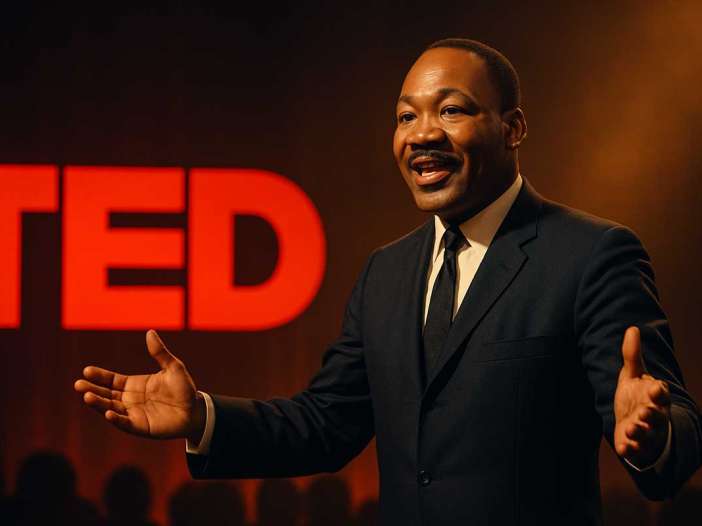
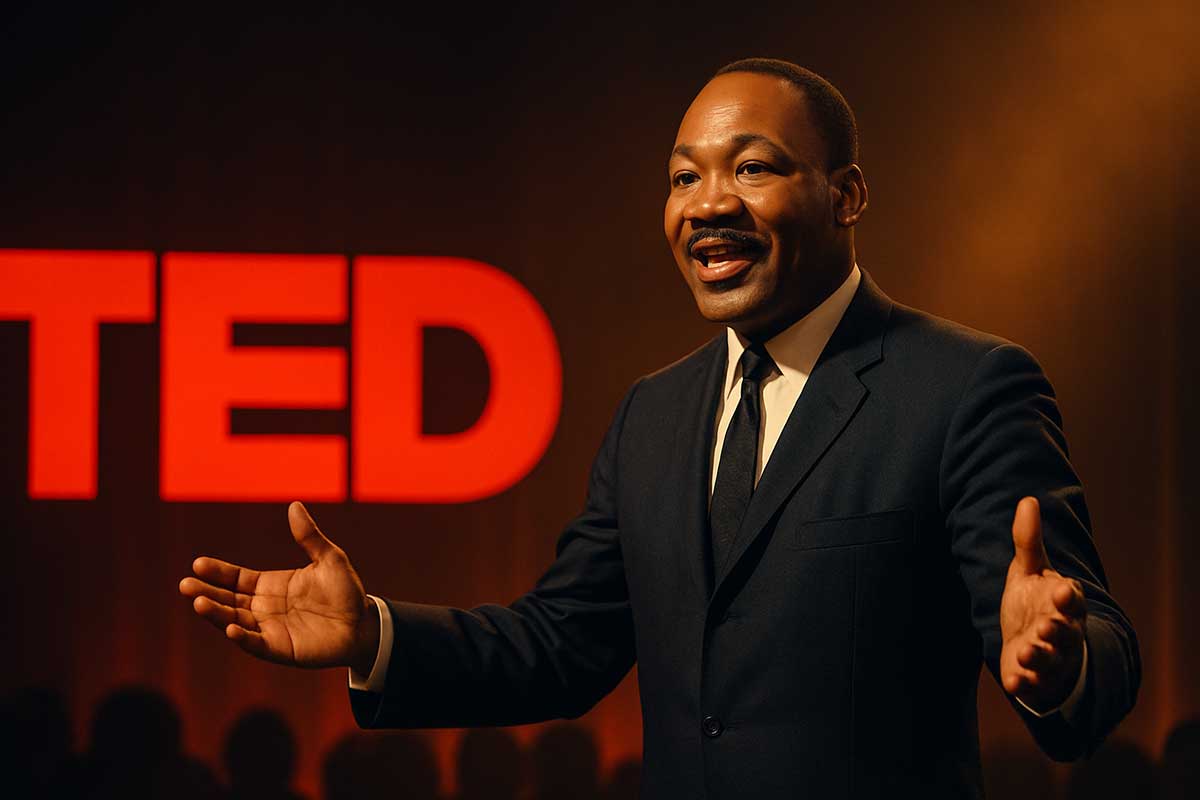
Introduction by Nick Sasaki
There are moments in history when a single voice rises above the clamor of the age and speaks not only to the people of its time, but to generations yet unborn. Some voices echo for a season. Others echo for a lifetime. But a few—only a few—continue to echo until they become part of the conscience of the world.
Martin Luther King Jr. was such a voice.
He stood not as the representative of a party, nor as the champion of a single group, but as a reminder of what America could be at its best—an example of courage rooted in love, conviction rooted in faith, and leadership rooted in the belief that every human being carries a spark of divine dignity.
Tonight, we gather not to hear a relic of history,
but to hear a message for our future.
We stand in a world divided not by the color of our skin,
but by the content of our fears.
Divided not by the laws of the land,
but by the assumptions of the heart.
Divided not only by politics and ideology,
but by the walls we build within ourselves.
And so, it is fitting—perhaps even providential—
that we welcome back a man who once called us to higher ground.
A man whose words helped a nation remember its promise.
A man who believed, even in his final days,
that love is stronger than hatred,
that hope is stronger than despair,
and that the human heart is capable of miracles
when it chooses unity over division.
Ladies and gentlemen, with profound honor,
I present to you
Dr. Martin Luther King Jr.
(Note: This is an imaginary conversation, a creative exploration of an idea, and not a real speech or event.)
My dear friends,
I am humbled to stand before you once again—
not on the steps of a monument,
not in the courthouse of a troubled city,
not in the church pews where souls seek refuge,
but here, in this gathering of minds and hearts
who long to understand the future that awaits us.
I come to you not as a man of the past,
but as a witness to the continuing journey of the human spirit.
For the march toward justice is not confined to any one era,
and the struggle for the soul of humanity
is older than any nation
and broader than any generation.
Some of you may wonder what a preacher
from a bygone century
might say to a world of algorithms,
artificial intelligence,
digital kingdoms rising faster than moral foundations can hold.
But I tell you today:
The human heart has not changed.
The sacred worth of every soul
has not changed.
The yearning for freedom, dignity, and understanding
has not changed.
What has changed
are the tools in your hands—
tools that can lift humanity to new heights
or plunge it into deeper shadows.
And so I come with a message
not of yesterday,
but of tomorrow.
Not of despair,
but of determination.
Not of accusation,
1. The New Dawn of Human Possibility
We stand today on the threshold of a new era—
an era of astonishing innovation,
an era where machines can compute with lightning speed,
but the human heart remains slow to love.
The question before us is not
whether our technology is powerful,
but whether our moral vision is clear.
For we have entered an age
where the tools of progress
have outpaced the wisdom of the soul.
But fear not—
for every age of uncertainty
has carried within it
a seed of transformation.
And I believe,
with all the conviction of my spirit,
that this generation
has the opportunity to bring forth
a greater community of love and justice
than the world has ever known.
2. The Sacred Interdependence of Humanity
When I spoke long ago of a dream,
I was speaking of a world
bound together by a single garment of destiny.
Today, that garment is woven more tightly than ever.
Your joys, your sorrows, your prosperity, your poverty—
they are no longer isolated realities.
The world is too small,
the connections too numerous,
the consequences too far-reaching
for any of us to walk alone.
There are no foreign lands.
There are no distant strangers.
There is only one human family
searching for a place to call home
in the vast expanse of creation.
If we forget this,
we will build a future filled with walls.
But if we remember it,
we will build bridges strong enough
to carry the weight of generations.
3. The Moral Challenge of Technology
Now, my friends,
I have looked upon the wonders of your age—
machines that speak,
engines that think,
networks that never sleep
and yet seldom dream.
But let me remind you:
A machine may imitate the mind,
but it cannot imitate the soul.
A computer may store information,
but it cannot store compassion.
An algorithm may predict behavior,
but it cannot predict the mysteries
of a heart transformed by love.
The danger is not that machines will become like men,
but that men will forget what it means to be human.
And so I call upon this generation
to build not only intelligent systems,
but righteous systems.
Not only efficient structures,
but compassionate ones.
Not only powerful technologies,
but technologies grounded in the eternal truth
that every life has sacred worth.
For the true measure of your progress
will not be the power of your machines,
but the power of your mercy.
4. The Call To A Higher Unity
There is a troubling tendency in this age—
a tendency to retreat into tribes of fear,
to shout across digital divides,
to forget that disagreement
need not be hostility.
But hear me clearly:
We cannot build the future
by fighting the battles of yesterday.
We cannot ascend to our shared destiny
on ladders built from bitterness.
And so I say to you today:
Let us rise above the narrow corridors
of political division.
Let us step beyond the labels
that chain our imagination.
Let us meet again
as citizens of a shared hope
and custodians of a shared world.
Unity does not require uniformity.
Peace does not require surrender.
Love does not require agreement.
It requires only this:
the recognition that the image of God
lives within us all.
5. The Beloved Community - Renewed For A New Age
Many years ago,
I spoke of a dream—
a dream of a community bound together
by justice, mercy, and understanding.
Today, I do not repeat that dream,
but I extend it.
For the Beloved Community
must now stretch beyond neighborhoods
and beyond nations.
It must reach into your technologies,
your economies,
your global networks.
It must shape the ways you govern,
the ways you create,
the ways you speak to one another
in this vast digital village.
The Beloved Community 2.0
is not a world free of struggle—
for struggle is the shaping stone of the soul.
It is a world where love is the architect
and justice the cornerstone.
Where peace is not the absence of tension,
but the presence of righteousness.
Where every child
—no matter the soil beneath their feet—
can walk into the future
with dignity and with hope.
6. The Courage To Hope
Hope, my friends,
is not the soft wish of the weary.
It is the steadfast resolve
of those who refuse to surrender the future
to the failures of the past.
Hope is not the denial of reality—
it is the insistence
that reality can be transformed.
Hope is the quiet courage
that stands firm
when fear demands retreat.
Hope is the spiritual force
that lifts nations,
restores friendships,
and heals the brokenhearted
long after the noise of anger has faded.
And so I call upon you—
the dreamers,
the thinkers,
the builders of this new age—
to take hold of this hope,
to kindle it in your hearts,
and to carry it into the world
as a lamp that no darkness can extinguish.
7. A New Dream For a New Generation
My friends,
I cannot leave this stage
without offering a vision—
not a repetition of the words once spoken,
but a gentle echo of the spirit
that stirred them into life.
I see a world
where technology serves humanity
and not the other way around.
I see a world
where neighbors are not defined
by the closeness of their houses,
but by the nearness of their hearts.
I see a world
where justice is not a whisper in the halls of power,
but a song sung in every street
and every soul.
I see a world
where the children of every nation
can look to the horizon
and see not shadows of fear,
but fields of possibility.
And yes,
I still see a day—
not promised,
but possible—
when the rivers of our sorrow
flow into the oceans of our reconciliation.
A day when humanity rises
not as divided tribes,
but as one fellowship under God.
This is not yesterday’s dream.
It is tomorrow’s calling.
A Final Call To The Human Spirit
And so I leave you with this:
The future is not waiting to be discovered.
It is waiting to be built.
It will not be shaped by those who shrink back in fear,
but by those who step forward in faith.
It will not be crafted by those who cling to the divisions of the past,
but by those who dare to embrace the unity of the future.
You, my friends,
are the architects of that future.
You are the custodians of that dream.
You are the letters in the story
that humanity has yet to write.
Let us walk together
—across aisles,
across algorithms,
across oceans—
toward the promise that lies before us.
And may God’s grace
guide your steps
as you build
the Beloved Community
for a new age.
Thank you.
And may peace be with you.
Final Thoughts by Nick Sasaki
Hearing Dr. King speak this way—strong, steady, and filled with the quiet thunder of moral certainty—reminds me why his voice still moves the world. He does not come to divide us or scold us or reopen the wounds of history. He comes to call us upward. He comes to remind us that we are capable of far more than what fear, anger, and cynicism have led us to believe. And he reminds us that unity is not the achievement of the comfortable, but the responsibility of the courageous.
What struck me most tonight was how naturally he stepped into our age without losing the spirit of his own. His words carried the same lift, the same cadence, the same faith in human possibility that once stirred a nation at the Lincoln Memorial. Yet this time, he wasn’t speaking only about segregation or injustice. He was speaking about who we are becoming as a people. He was speaking about the future we are shaping through our technology, our choices, and our willingness—or unwillingness—to see one another as brothers and sisters.
There was no victimhood in his voice. No bitterness. No appeal to resentment. Only the conviction that the human heart still carries the blueprint for a better world, and that the Beloved Community remains possible if we dare to build it. He did not give us a dream to admire. He gave us a responsibility to shoulder.
I felt, as he spoke, that he was calling each of us to return to something we have misplaced: our shared moral center. He reminded us that hope is not naïve, but necessary; that compassion is not weakness, but wisdom; and that unity is not uniformity, but the disciplined choice to see one another through the eyes of dignity.
As I reflect on his message, I realize that the future he described is not automatic. Progress is not inevitable. The Beloved Community is not a historical artifact—it is an unfinished mandate, waiting for hands willing to shape it and hearts willing to guard it.
And so I leave this talk with a renewed sense of responsibility, not only as a citizen, but as a human being. Dr. King’s words remind me that the arc of the moral universe bends only when people choose to bend with it. That the tools of our age will reflect not their own intelligence, but our character. And that the world we long for begins with the choices we make today.
If Dr. King were standing before us in 2025, I believe he would ask us not what side we are on, but what future we are building. Not whom we stand against, but whom we are willing to stand with. Not whether we agree on everything, but whether we can still agree on human dignity.
Tonight, I feel that we can.
And because we can, the dream lives—not as nostalgia, but as possibility.
Short Bios:
Martin Luther King Jr.
Martin Luther King Jr. was an American minister, civil rights leader, and Nobel Peace Prize laureate whose philosophy of nonviolence helped transform the conscience of the United States. His vision of the Beloved Community continues to shape global movements for justice, equality, and human dignity.
Nick Sasaki
Nick Sasaki is a writer and creator of ImaginaryTalks.com, where he explores transformative ideas through imagined dialogues with influential thinkers throughout history. His work blends spirituality, philosophy, and storytelling to illuminate pathways toward a more compassionate and awakened world.
Leave a Reply