• Skip to main content
  • Skip to primary sidebar
  • Skip to footer
ImaginaryTalks.com
  • Spirituality and Esoterica
    • Afterlife Reflections
    • Ancient Civilizations
    • Angels
    • Astrology
    • Bible
    • Buddhism
    • Christianity
    • DP
    • Esoteric
    • Extraterrestrial
    • Fairies
    • God
    • Karma
    • Meditation
    • Metaphysics
    • Past Life Regression
    • Spirituality
    • The Law of Attraction
  • Personal Growth
    • Best Friend
    • Empathy
    • Forgiveness
    • Gratitude
    • Happiness
    • Healing
    • Health
    • Joy
    • Kindness
    • Love
    • Manifestation
    • Mindfulness
    • Self-Help
    • Sleep
  • Business and Global Issues
    • Business
    • Crypto
    • Digital Marketing
    • Economics
    • Financial
    • Investment
    • Wealth
    • Copywriting
    • Climate Change
    • Security
    • Technology
    • War
    • World Peace
  • Culture, Science, and A.I.
    • A.I.
    • Anime
    • Art
    • History & Philosophy
    • Humor
    • Imagination
    • Innovation
    • Literature
    • Lifestyle and Culture
    • Music
    • Science
    • Sports
    • Travel
You are here: Home / Christmas / Silent Night 1914: A Christmas Truce Story of Human Grace

Silent Night 1914: A Christmas Truce Story of Human Grace

December 8, 2025 by Nick Sasaki Leave a Comment

Silent-Night-1914

1. The Frozen Trenches of Flanders

Snow fell in thin, hesitant flakes over the trenches of Flanders, drifting down as if unsure whether it truly wanted to touch the earth below. The flakes met mud, vanished instantly, and the world returned to its colorless churn of brown and gray. Evening was crawling in, slow and heavy, and the smell of wet iron and smoke clung to everything like a second skin.

Private Thomas Whitford rubbed his gloved hands together, trying to coax life back into them. At twenty, he had expected adventure, heroism, something glorious. What he had instead was mud in his boots, rats in his blankets, and a quiet, gnawing ache in his chest that had nothing to do with hunger or cold.

“You’re starin’ again,” said Jenkins beside him, a wiry man with a laugh too loud for the trenches and a heart too soft for war. “What’s in that pocket of yours that you keep touching? A love letter? A bit of cake you didn’t share?”

Thomas shook his head and pulled the small wooden carving from inside his tunic. “Just this.”

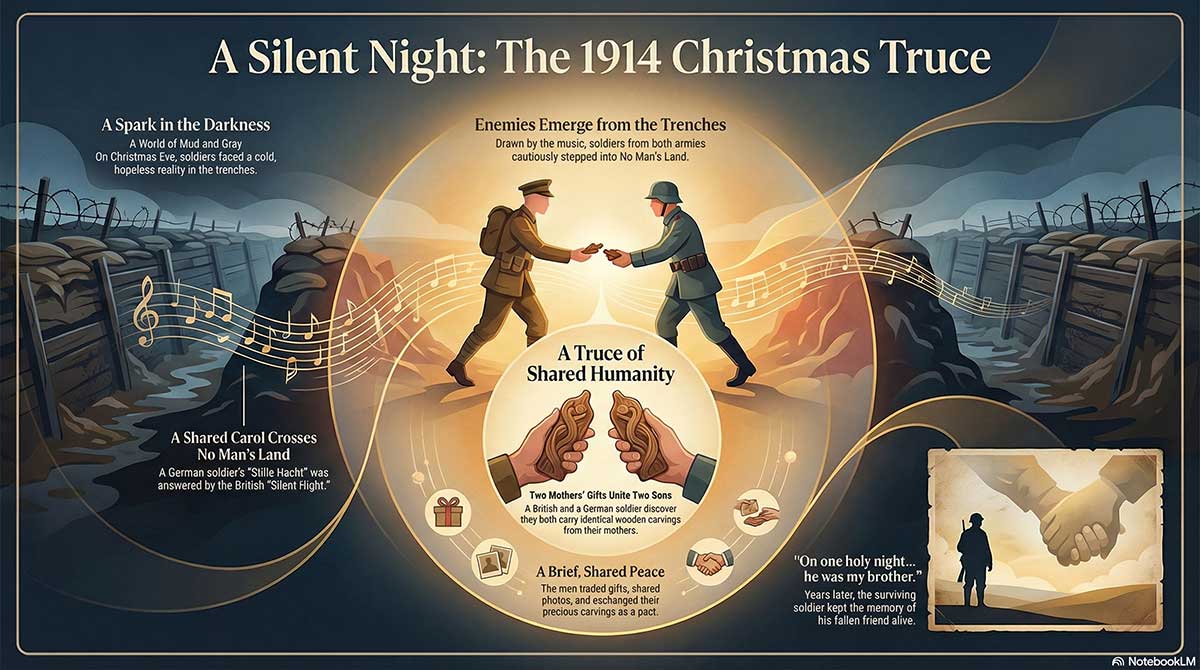
It rested in his palm: Mary holding the infant Jesus, carved with gentle but imperfect strokes. His mother had made it for him when he was a boy, during a winter when their entire cottage had felt like a single breath frozen in the air.

Jenkins leaned closer. “Your mother made that?”

“Aye,” Thomas murmured. “Said it would keep me safe. Said it was a reminder that peace can start anywhere—even a stable.”

Jenkins snorted softly. “Well, we’re halfway there. We’ve got the animals.”

Thomas smiled in spite of himself.

A distant shell exploded, shaking the ground beneath them. The smile vanished.

“Christmas Eve,” Jenkins said after a moment, voice quiet. “Hard to believe.”


Table of Contents
1. The Frozen Trenches of Flanders
2. A Christmas Eve Without Hope
3. The First Steps Toward Peace
4. A Shared Night Beyond War
5. The War Continues, but the Memory Endures

2. A Christmas Eve Without Hope

Hard to believe, indeed. Back home, the church bells would be ringing. Families would be crowded inside small, warm rooms. Mothers would be pulling puddings from the oven, fathers pouring the last of the year’s ale. And someone—always someone—would begin singing Silent Night a half-tone too high, and the whole congregation would follow anyway.

Thomas tightened his grip on the carving. He had never missed home more.

Across No Man’s Land, in a trench not so different from Thomas’s own, Lukas Huber, a German private with a gentle face and the posture of a boy raised in quiet countryside, sat polishing his rifle for the ninth time that day. He hated the rifle. Hated the war. Hated waking each morning not knowing whether the day would be his last.

Yet in his breast pocket, pressed close to his heart, he carried a wooden carving almost identical to Thomas’s. His mother had sent it in her last parcel—Mary with the infant Jesus. The same pose. The same simple tenderness.

“Thinking of home again?” asked Becker, the older soldier beside him, thick mustache bristling in the cold.

Lukas nodded.

“You pray someone sends us home tomorrow?” Becker asked.

Lukas didn’t answer. Instead, he looked out over the stretch of dead, churned earth between them and the British lines.

“Tomorrow,” he said softly, “is Christmas.”

Becker huffed. “And what of it? You think the English will give us a gift? A bullet in a nice red bow?”

But Lukas only shook his head. “My mother used to say Christmas is the only day of the year when heaven leans close enough to listen.”

Becker stared at him. “You’re a strange lad, Lukas.”

“Maybe,” Lukas whispered. “But I want heaven to hear us. Especially here.”

Night fell completely, swallowing the last strip of bruised daylight. Lanterns were prohibited—too visible, too dangerous—so the trenches slipped into a darkness broken only by the faint glow of cigarettes and the glint of bayonets.

The guns quieted somewhat. Not completely, but enough to make the men aware of the silence beneath the noise. A tense, delicate silence, like thin ice forming atop a pond.

Thomas shifted, blowing warm breath into his cupped hands. Jenkins pressed close to him for warmth, muttering curses about the weather, about officers, about boots that leaked.

Somewhere down the line, a British soldier began humming. Softly at first.

Jenkins elbowed Thomas. “Is that…?”

Thomas listened.

It was.

A melody older than any man here. A tune sung in hundreds of languages, whispered by mothers to children, sung around firelit churches and cold hearths.

Silent Night.

The humming grew louder, voices joining in hesitantly. It was clumsy, out of tune, breathless—yet unmistakably full of longing.

Then something astonishing happened.

Across the empty darkness of No Man’s Land, a voice answered.

In German.

Stille Nacht.

The same melody.

Lukas hadn’t meant to sing. The note had slipped out of him like breath escaping a wound. But once it began, he couldn’t stop. He sang the words his mother had always sung, the words she said would keep him gentle even in a violent world.

Other German voices joined him. A harmony formed—not perfect, but achingly human. The song drifted across the frozen battlefield like a fragile bridge woven of nothing but hope.

3. The First Steps Toward Peace

Thomas felt something inside him crack open. Against all reason, all training, all fear, he rose to his feet.

“Tom, what are you doing?” Jenkins hissed.

“They’re singing,” Thomas whispered. “The same song.”

He climbed the ladder and stepped out over the edge of the trench.

“Bloody idiot!” Jenkins crawled after him. “If you get shot, I’ll tell everyone it was your idea!”

But no shots came.

Instead, Thomas heard a shout from the German side: “No shoot! No shoot!”

A figure rose, hands high.

Then another.

And another.

For a long moment, neither side moved. Snow drifted between them, catching the moonlight like floating ash.

Thomas swallowed hard, then took a single step forward.

So did Lukas.

They walked toward each other, slowly, cautiously, hearts pounding loud enough to drown the distant muffled thunder of artillery. When they finally stood mere feet apart, both men froze.

Thomas spoke first.

“Merry Christmas.”

Lukas nodded. “Frohe Weihnachten.”

Both reached into their pockets at the same time.

Both withdrew a carving.

They stared.

Two carvings. Two mothers. Two young men who never should have met. And yet here they stood, the pieces fitting together as if carved from the same block of wood.

Jenkins arrived, panting, muttering every curse he knew—yet even he fell silent when he saw the scene.

4. A Shared Night Beyond War

Silent-Night-1914

Around them, soldiers emerged cautiously into the open. Cigarettes were exchanged. Chocolate, tobacco, biscuits, photos of sweethearts. Someone rolled out a football, and suddenly men who had been aiming rifles at each other hours before were laughing as they chased it across the frozen mud.

Thomas and Lukas sat together on an overturned ammunition crate. They passed the carvings back and forth, comparing the details.

“My mother made this,” Lukas said quietly.

“So did mine,” Thomas replied.

They both laughed—soft, disbelieving.

“I think,” Lukas said, glancing at the sky, “our mothers would like tonight.”

Thomas nodded. “Aye. I think they would.”

For the first time in months, Thomas felt warm. Not from the cold, weak fire someone had dared to light, but from the simple, impossible miracle unfolding around them.

Heaven was listening after all.

The truce lasted until dawn.

Officers shouted. Threatened. Barked orders. But most men returned to their trenches slowly, reluctantly, like children forced back indoors from a rare snowfall.

Before Lukas turned away, he held out his carving.

“Trade?” he asked.

Thomas blinked. “Trade?”

“If one of us…” Lukas hesitated. “If one of us does not survive the war, the carving will still live. Someone will remember this night.”

Thomas felt tears sting unexpectedly. He nodded.

They exchanged carvings.

“Take care, Thomas.”

“You too, Lukas.”

They parted—each carrying the other’s fragment of peace.

5. The War Continues, but the Memory Endures

The war resumed its roar by midday.

Shells screamed overhead. Rifles cracked. The fragile thread of Christmas night snapped under the weight of returning chaos.

Thomas kept the German carving pressed to his chest. In moments of terror, he clutched it like a lifeline.

But miracles cannot protect everyone.

In the spring of 1915, during a bombardment that shook the earth as if the world were being broken in two, Thomas’s regiment was ordered over the top.

He ran. He stumbled. He kept the carving inside his tunic, close to his heart.

A shell exploded nearby.

The world went white.

Years later, in a quiet German village, a little boy stood before a fireplace studying the objects on the mantelpiece: a photo of a young soldier, a folded letter, a medal—and two wooden carvings, side by side.

He lifted one. It was smoother now, edges worn by time.

“Papa,” the boy asked, “why do we have two Marys?”

Lukas stepped behind him, placing strong, gentle hands on his son’s shoulders. His hair was gray now, eyes lined with years, but his voice warmed easily.

“One was carved by your grandmother,” he said. “The other belonged to a friend.”

“Where is he?” the boy asked.

Lukas stared at the carvings for a long time. “He sleeps in France now,” he said quietly. “But for one night—one holy night—he was my brother.”

The boy frowned. “But… he was on the other side.”

Lukas shook his head. “On Christmas Eve,” he murmured, “there were no sides.”

Outside, snow fell silently over the village. Inside, the carvings rested together, two small symbols of a peace that had bloomed for a single impossible night.

A night when heaven leaned close enough to listen.

A night when soldiers remembered they were sons.

A night when two mothers’ gifts met across a battlefield.

And somewhere—across time, across nations, across memory—
Silent Night was still being sung.
Short Bios:

Thomas Whitford is a 20-year-old British infantryman from a small countryside village in Yorkshire. Raised in a modest home by a devout and tender-hearted mother, Thomas carries a wooden carving of Mary and the infant Jesus she made for him as a child. Sensitive, introspective, and quietly hopeful, he enters the war yearning for purpose but finds only mud, fear, and disillusionment—until the Christmas Truce reveals to him a moment of humanity he thought impossible on a battlefield.

Lukas Huber is a young German soldier from a peaceful rural village near the Bavarian Alps. Gentle by nature and uncomfortable with violence, he clings to a matching wooden carving carved by his own mother. Lukas believes deeply in simple goodness and in the idea that Christmas is a moment when heaven draws close to listen. His courage to step forward on Christmas Eve becomes the spark that bridges two opposing worlds.

Jenkins is a wiry British soldier with a loud laugh and a soft heart, serving alongside Thomas in the trenches. Though he hides his fear behind humor and endless grumbling about the cold, officers, and boots that never seem to fit, he cares deeply for his fellow soldiers. His disbelief turns to awe when he witnesses Thomas crossing No Man’s Land during the Christmas Truce.

Becker is an older, battle-worn German infantryman with a stern exterior and a bristling mustache. Practical and skeptical, he has learned to suppress hope as a form of survival. Yet despite his gruffness, he watches over Lukas like an older brother. The unexpected singing on Christmas Eve shakes even his hardened assumptions about the enemy.

Lukas’s son, a curious and tender-hearted child, grows up far removed from the horrors of war. His innocent question about the two wooden carvings on the mantelpiece allows Lukas to recount the miracle of the Christmas Truce, ensuring that the memory of his fallen friend—and the fragile peace of that night—lives on in the next generation.

Related Posts:

  • Karma Exchanger: A Novel of Pain, Rebirth, and Mercy
  • Ultimate Pilgrimage in Israel: When the Bible Comes Alive
  • The House With the Black Stone: A Korean Family Saga
  • S. Y. Agnon in 2026: An Imagined Novel of Belonging
  • Grimm Fairy Tale Universe: The Complete Grimmverse Book One
  • The Last Good Sentence: A Story About Fame and Loneliness

Filed Under: Christmas, History & Philosophy, War Tagged With: battlefield Christmas tale, Christmas Eve miracle, Christmas historical fiction, Christmas Truce story, emotional Christmas fiction, historic truce story, human connection in war, human kindness in war, peace in wartime, Silent Night 1914, Silent Night narrative, soldiers Christmas ceasefire, soldiers peace story, touching Christmas tale, wartime brotherhood story, wartime miracles, WWI frontline story, WWI humanity moment, WWI short story, WWI truce narrative

Reader Interactions

Leave a Reply Cancel reply

Your email address will not be published. Required fields are marked *

Primary Sidebar

RECENT POSTS

  • grapes of wrath questionsThe Grapes of Wrath Explained: 5 Questions Readers Still Ask
  • the grapes of wrath john steinbeckThe Grapes of Wrath: When Does “Me” Become “We”?
  • Stand With Jesus: What If People Tried to Stop the Crucifixion?
  • East of Eden Today: 5 Stories About Breaking Family Cycles
  • john steinbeck east of edenEast of Eden: Does Timshel Still Make Sense Today?
  • East of Eden: Are We Born Bad or Free to Choose?
  • Convenience Store Woman: 5 American Stories About Marriage and Freedom
  • convenience-store-women-analysis-Convenience Store Woman: Is the New Normal Really Normal?
  • convenience store womenConvenience Store Woman: Who Decides What Is Normal?
  • sayaka murata imaginary friendsSayaka Murata Imaginary Friends: The Mystery Behind Her Inner World
  • Social Health Stories: 5 Ways We Lost Our Sense of Belonging
  • Social Health: Why Modern Life Is Making Us Lonely
  • nickel-boys-modern-stories-The Nickel Boys: 5 Modern Stories About Truth, Trauma and Hope
  • coloson whitehead the nickel boys discussionThe Nickel Boys: What Kind of Hope Survives Injustice?
  • the nickel boys colson whiteheadThe Nickel Boys: Elwood and Turner on Justice, Survival and Truth
  • AI Resource Consumption: Can AI Give More Than It Takes?
  • madeline-miller-circe-modern-stories-5 Modern Stories Inspired by Circe by Madeline Miller
  • Circle-Madeline-Miller-analysis-Circe Explained: Myth, Meaning, and Madeline Miller
  • Madeline Miller Circle CharactersMadeline Miller Circe: What If No One Ever Chose You?
  • 5 Modern Stories Inspired by Keigo Higashino’s Silent Parade
  • could japanese culture succeed where religion has failedCould Japanese Culture Succeed Where Religion Has Failed?
  • keigo-Higashino-when-love-becomes-too-much-5 Modern Stories Inspired by The Devotion of Suspect X
  • The Devotion of Suspect X Explained by Psychologists: Is Ishigami’s Love Really Love?
  • the devotion of suspect xThe Devotion of Suspect X Explained: Was Ishigami’s Sacrifice Really Love?
  • 5 Modern Midnight Library Stories About Regret, AI, and Choice
  • Matt Haig The Midnight LibraryThe Midnight Library Explained by Scholars and Matt Haig
  • The-Midnight-Library-explainedThe Midnight Library Explained Through Its Characters
  • 5 Modern Siddhartha Stories About Wisdom, Love, AI, and Choice
  • Siddhartha explained by leading scholarsSiddhartha Explained by Leading Hermann Hesse Scholars
  • Siddhartha explainedSiddhartha Explained Through Its Characters: Love, Loss, and Enlightenment
  • before-the-names-are-carved-Before the Names Are Carved: Five Connected Stories
  • The Scholars and the Unworn ShoesHan Kang Human Acts Explained by Leading Scholars
  • Han Kang Human Acts: An Imaginary Conversation with the Dead
  • The Years We Thought We Had: A Story of Love and Waiting in Japan
  • snow-country-analysis-Snow Country Analysis: Kawabata Scholars Explain It
  • snow-country-was-their-love-realSnow Country Explained Through Its Characters
  • the-man-who-never-took-the-day-off-The Man Who Never Took the Day Off: A Modern Ishiguro Story
  • The Remains of the Day Explained by Leading Ishiguro Scholars
  • the-remains-of-the-day-imaginary-talks-The Remains of the Day Explained Through Its Characters
  • the-pastor-who-couldnt-be-forgiven-The Pastor Who Couldn’t Be Forgiven: A Modern Story of Grace
  • disgrace-j-m-coetzee-Disgrace Explained Through Its Characters
  • disgrace-explained-leading-jm-coetzee-scholarsDisgrace Explained by Leading J. M. Coetzee Scholars
  • Forty-One Could Live. Nine Had to Die.
  • The Gospel According to Jesus Christ explainedThe Gospel According to Jesus Christ Explained Through Its Characters
  • SARAMAGO’S GOSPEL EXPLAINEDThe Gospel According to Jesus Christ Explained by Top Scholars
  • the last safe floorThe Last Safe Floor: A Modern Lord of the Flies Story for 2026
  • william golding explained by top scholarsWilliam Golding Explained by Top Scholars: Evil, Faith, and Redemption
  • lord-of-flies-character-conversation-Lord of the Flies Explained Through Its Characters: Is the Beast Inside Us?
  • never complain never explainNever Complain Never Explain: Henry Ford & Disraeli
  • The Empty Chair: A Modern Brothers Karamazov Story
  • the brothers karamazov explained top dostoevsky scholarsThe Brothers Karamazov Explained by Top Dostoevsky Scholars
  • Brothers Karamazov explainedThe Brothers Karamazov Explained Through Its Characters
  • before yesBefore Yes: A Modern American Story Inspired by Albert Camus
  • The Stranger Explained by Top Albert Camus Scholars
  • the stranger explainedAlbert Camus’s The Stranger Explained Through Its Characters
  • What is Worth Saving?The Last Store on Main Street: Inspired by The Sound and the Fury
  • The Sound and the Fury Scholar discussionThe Sound and the Fury Explained by Top William Faulkner Scholars
  • The Sound and the Fury Family SpokenThe Sound and the Fury Explained by Its Characters
  • The Building That Stopped Seeing | Modern Camus Story
  • The Plague Explained by Top Albert Camus Scholars
  • albert camus the plague explainedThe Plague explained by its characters
  • the last good sentenceThe Last Good Sentence: A Story About Fame and Loneliness
  • hemingway scholars debateThe Old Man and the Sea Explained by Top Scholars
  • The Old Man and the Sea Explained by Its Characters
  • the new meaning of survivalThe New Meaning of Survival: Top Scholars on Human Flourishing
  • true meanig of survivalThe True Meaning of Survival: Living, Not Just Existing
  • the last affordable roadThe Last Affordable Road: A Modern Grapes of Wrath Story
  • the-grapes-of-wrath-explained-by-top-scholars-The Grapes of Wrath Explained: Top Steinbeck Scholars
  • the grapes of wrath conversationThe Grapes of Wrath Explained Through Its Characters
  • the white silenceThe White Silence: A Japanese Novel of Loneliness
  • jose-saramago-blindness-explained-Blindness Explained by Top Scholars | José Saramago’s Greatest Warning
  • José-Saramago-Blindness-Explained-Blindness Explained Through Its Characters and José Saramago
  • Can the Bhagavad Gita Still Guide Humanity in 2026?
  • The Crown of AshesThe Crown of Ashes: A Modern Shakespearean Tragedy
  • the-fourth-bowl-If Toni Morrison Wrote a Japanese Family Novel: The Fourth Bowl
  • Beloved Ending Explained: 25 Questions Answered by Morrison Scholars
  • Toni-Morrison-Beloved-Explained-Beloved Explained Through Its Characters and Toni Morrison
  • house with the black stoneThe House With the Black Stone: A Korean Family Saga
  • Be Kind to Your Mother Before It’s Too LateBe Kind to Your Mother Before It’s Too Late
  • Gabriel-García-Márquez-one-hundred-years-of-solitude-explained-One Hundred Years of Solitude Explained by Top Scholars
  • one-hundred-years-of-solitude-explained-One Hundred Years of Solitude Explained
  • are-any-lives-truly-ordinary-Hateship Friendship Courtship Loveship Marriage explained
  • The Overstory explainedThe Overstory Explained: Themes, Ending, and Meaning
  • Demon Copperhead Explained: Barbara Kingsolver’s Pulitzer-Winning Novel
  • can you judge trump by his enemiesCan You Judge Donald Trump by His Enemies?
  • The Warmth of Other Suns Explained
  • America Iran strategyCan America Prevent a Wider Middle East War?
  • Lincol in the BardoLincoln in the Bardo Ending Explained:
  • God-as-Original-Parent-If God Created Man and Woman, Is God Our Original Parent?
  • can creation reveal godDoes Creation Reveal the Nature of God? Five Great Thinkers Discuss
  • Are Therapists to Blame for the Rise of Adults Cutting Off Their Parents?
  • your seventh year is changingJoel Osteen’s Seventh Year: When Suffering Is Not the Final Chapter
  • Joel Osteen’s Best Messages: Hope, Favor, and Faith
  • Hilary Mantel Wolf-Hall ending explainedWolf Hall Ending Explained: Can a Good Man Survive Political Power?
  • i-never-said-i-was-god-What If Jesus Never Claimed to Be God?
  • did-jesus-say-he-was-god-Did Christianity Reverse the Message of Jesus?
  • The Unseen World Liz MooreThe Unseen World Analysis: Memory, AI, and Identity
  • gilead ending explainedGilead Ending Explained: Can Grace Reach the Person We Judge Most?
  • Elena Ferrante My Brilliant FriendMy Brilliant Friend Ending Explained: Who Was Brilliant?
  • The-Underground-Railroad-ending-explained--The Underground Railroad Ending Explained

Footer

Recent Posts

  • The Grapes of Wrath Explained: 5 Questions Readers Still Ask August 31, 2026
  • The Grapes of Wrath: When Does “Me” Become “We”? August 30, 2026
  • Stand With Jesus: What If People Tried to Stop the Crucifixion? August 30, 2026
  • East of Eden Today: 5 Stories About Breaking Family Cycles August 29, 2026
  • East of Eden: Does Timshel Still Make Sense Today? August 29, 2026
  • East of Eden: Are We Born Bad or Free to Choose? August 29, 2026

Pages

  • About Us
  • Contact Us
  • Disclaimer
  • Earnings Disclaimer
  • Privacy Policy
  • Terms and Conditions

Categories

Copyright © 2026 Imaginarytalks.com