
Introduction by Nick Sasaki
When we speak of world leaders, we often imagine power measured in armies, wealth, or influence. But there are rare individuals whose power came not from force, but from the refinement of their own character. Mahatma Gandhi was one of those rare individuals. His life was a demonstration that moral courage can move entire nations, and that the quiet strength of one person’s conscience can alter the direction of history.
Today, our world is louder than ever — crowded with opinions, demands, conflicts, and an endless stream of reactions. Many feel pressured to answer aggression with more aggression, division with more division, fear with more fear. In this climate, the idea of nonviolence is often misunderstood, dismissed as idealistic or impractical.
But Gandhi never approached nonviolence as a tactic. For him, it was a discipline of the soul — a way of seeing the world, and a fearless commitment to creating change without losing one’s own humanity in the process. His message does not belong to the past; it belongs urgently to this moment.
We live in a time where the inner life is neglected, yet every outward conflict traces back to an inward imbalance. Gandhi challenges us to look within not as an escape, but as the most direct path to transformation. He calls us to rebuild the foundations of peace through courage, restraint, compassion, and self-mastery. He reminds us that the world changes only when we do.
Tonight, Gandhi joins us not as a distant historical figure, but as a mirror — reflecting back to us the kind of human beings we must become if we wish for civilization to endure with dignity.
It is my deep honor to welcome Mahatma Gandhi.
(Note: This is an imaginary conversation, a creative exploration of an idea, and not a real speech or event.)
The Courage to Be Peaceful in a World Addicted to Strife
My friends,
I come to you today not as a leader of nations, not as a symbol of a movement, but as a fellow seeker of truth. I have always believed that each of us contains a spark of the same infinite light — and that our task on this earth is to keep that light clear, steady, and brave.
I am aware that your world in 2025 is troubled by noise, conflict, and an ever-growing sense of unease. Many feel that civilization is moving too quickly for the human heart to keep pace. Many feel overwhelmed by anger, uncertainty, and an invisible pressure to take sides in every matter. Many feel that peace is a luxury for calm times, and that the age you live in demands a harder, more forceful response to the world's problems.
But I did not come here to give you comfort.
I came to give you courage.
Peace is not the absence of conflict; it is the presence of fearlessness. It is the presence of truth. And truth — even when whispered — has a power greater than the loudest shout of anger.
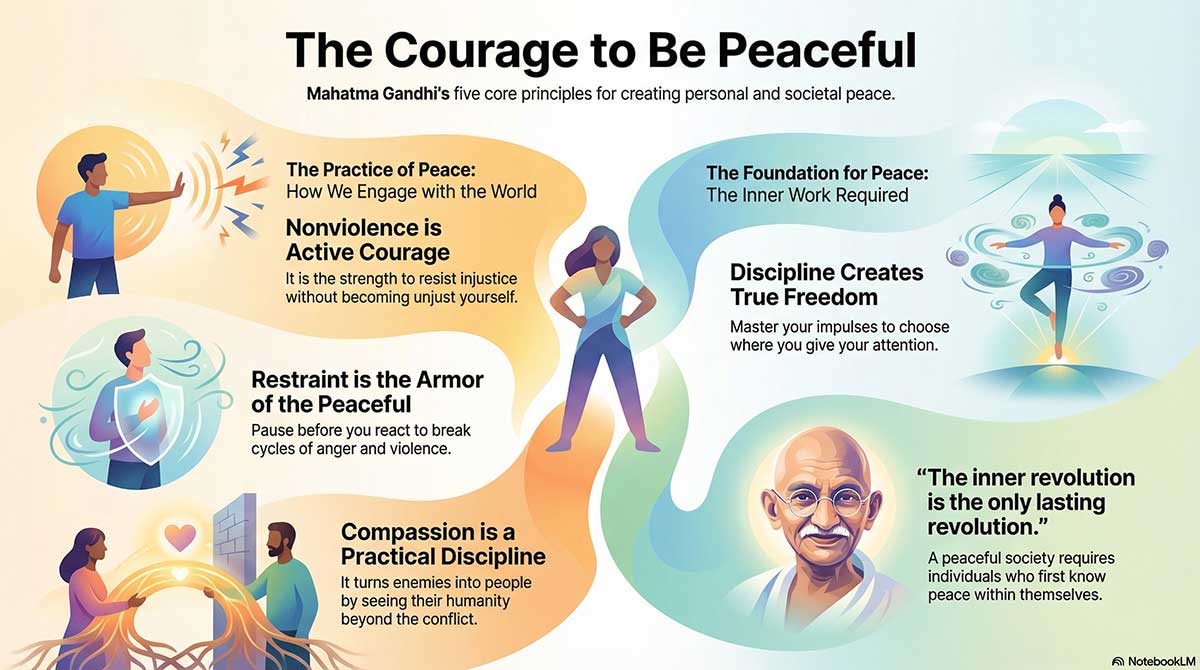
I wish to speak to you about five things that are essential for the survival of humanity:
courage, restraint, compassion, discipline, and the inner revolution.
Let us begin with the first.
I. Courage: The Real Meaning of Nonviolence
When people speak of nonviolence, they often imagine a passive posture, a refusal to act, a quiet withdrawal from the struggle of life. But nonviolence, in its true form, is an active force. It is an energy that demands bravery even greater than that of the soldier on the battlefield.
To resist hatred without hatred is courage.
To meet injustice without becoming unjust is courage.
To stand firm without raising your hand is courage.
To speak truth without entering the marketplace of insults is courage.
To refuse to imitate the very thing that wounds you is the highest courage of all.
The world you live in today rewards the loud, the outraged, the impatient. It rewards reaction over reflection. But if you build your society on reaction, you will only multiply the very forces you fear. Reaction breeds more reaction. Anger feeds more anger. Violence summons more violence.
I learned this long ago:
If you strike me and I strike you back, we are both injured. But if you strike me and I do not return the blow, then only one of us is injured — and the cycle ends with me.
That is not weakness.
It is mastery.
It is self-rule.
It is courage in its purest form.
For your world to heal, you must cultivate this courage. You must resist the temptation to answer harshness with harshness, blame with blame, suspicion with suspicion. Whenever you dehumanize your opponent — you lose your own humanity first.
II. Restraint: The Forgotten Virtue
In my time, I saw empires fall, nations divide, and communities torn apart by the smallest ember of hatred. Each time, I found that the most dangerous force is not violence itself, but the failure to restrain the impulses that lead to violence.
Your age celebrates expansion, acceleration, expression, indulgence. You are taught that to restrain yourself is to diminish yourself. Yet every great civilization has known that restraint is the root of dignity. A society without restraint quickly becomes a prison of its own excess.
If you want peace in your time, you must learn the art of slowing down your reactions. Pause before you respond. Listen before you speak. Observe before you judge.
This is not timidity.
This is self-governance.
One who cannot govern his own tongue, his own appetite, his own anger, cannot hope to govern a nation or influence the world for good.
Restraint is the armor of the peaceful.
It is the shield of the wise.
It is the vessel in which truth survives the heat of conflict.
III. Compassion: The Most Practical Tool in a Divided World
Compassion is not a feeling; it is a discipline.
It requires effort, commitment, and patience.
In my understanding, compassion means this:
I refuse to act in a way that wounds your spirit, even if I disagree with your mind.
Compassion does not demand that we erase our differences.
It demands that we refuse to let differences erase our humanity.
Today, your world is full of divisions — social, political, cultural, economic. But the roots of division are always the same: fear and misunderstanding. When fear grows, compassion must grow twice as quickly. When misunderstanding spreads, compassion must become a bridge.
Compassion has one magnificent power:
it turns enemies into fellow travelers.
It reminds us that every person is fighting a battle you cannot see.
When you choose compassion, you are not choosing softness; you are choosing clarity. You are seeing the whole person, not just the moment of conflict. And once you see the whole person, you can no longer justify hatred.
Compassion is, in this sense, profoundly practical. It is the most effective method for transforming conflict without creating new conflict in its place.
IV. Discipline: Freedom’s Most Essential Partner
Freedom is a word spoken loudly in every land, every generation. Yet very few understand that freedom without discipline quickly becomes chaos. Discipline without freedom becomes tyranny. The balance between the two is the foundation of a peaceful society.
Many imagine self-discipline as a restriction of the soul. But it is precisely the opposite. When you master your body, your thoughts, your impulses, your desires, you do not shrink — you expand. You become capable of greater influence, deeper compassion, more profound clarity.
I have often said:
If you want to change the world, begin by changing yourself.
Self-discipline is the engine of that transformation.
The world you inhabit tempts you with constant stimulation — endless noise, endless content, endless urgency. This is not freedom; it is captivity of another form. True freedom is the ability to choose what you will give your attention to. True freedom is the ability to be still when the world demands reaction.
Discipline gives you that freedom.
It builds the strength to hold peace within even when storms rage without.
V. The Inner Revolution: Where All Change Begins
Many imagine that revolutions are fought in streets, in parliaments, in courts, in public squares. But the greatest revolution is fought internally — in the mind, in the heart, in the depths of one's conscience.
It is the revolution against fear.
Against hatred.
Against ego.
Against unconscious living.
Your world today is full of external upheavals, but the inner life of many is neglected. The result is outward conflict with weak inward stability. No matter how many systems you build, no matter how many reforms you enact, no society will know peace until individuals know peace within themselves.
The inner revolution is the only lasting revolution.
It asks you to examine your motives, your desires, your resentments, your attachments.
It asks you to relinquish what poisons your spirit.
It asks you to root yourself in truth.
Truth is not what aligns with your preference; truth is what remains when all preferences are stripped away.
A person committed to truth becomes unshakable, because truth does not change with emotion. He becomes fearless, because truth has no enemies except illusion. He becomes peaceful, because truth removes every reason for conflict.
The inner revolution is not dramatic, not visible, not applauded. But it is the quiet fire that purifies society from the inside out.
VI. The Courage to Love Without Naivety
Love is often misunderstood as sentiment, softness, or romantic idealism. But I tell you: the love that transforms the world is neither delicate nor naïve. It is a force of great intensity, forged through discipline and clarity.
To love in a world that rewards cynicism is courage.
To love when you have been wounded is courage.
To love the person you disagree with is the highest courage.
Love must not be confused with agreement.
Love does not avoid conflict; it purifies it.
Love does not ignore injustice; it confronts it without hatred.
If your world is to survive its growing polarization, it will not be through power, arguments, or victories — but through a form of love that holds firm without striking, that disciplines without shaming, that speaks truth without humiliating.
Such love is not the property of saints. It is the birthright of all human beings — waiting to be chosen.
VII. What Humanity Must Choose in This Century
Your technology has given you tools I could never have imagined. You have the power to communicate across continents in the span of a heartbeat. You have the ability to broadcast ideas to millions at once. You have machines capable of learning, systems capable of predicting, and networks capable of linking the human family more closely than at any time in history.
But connection is not unity.
Speed is not progress.
Power is not wisdom.
You must choose what kind of world you will build with these capabilities. Will you allow your tools to amplify your hatred, or your compassion? Will you let them extend your ego, or your humility? Will they reinforce your fears, or empower your courage?
The world is not undone by destructive forces; it is undone by the failure to counter them with inner strength. What humanity lacks today is not intelligence or resources — it is spiritual clarity.
If you cultivate courage, restraint, compassion, discipline, and the inner revolution, then this century will be remembered not for its dangers, but for its awakening.
VIII. Closing Reflection: The Long Road to Peace
Peace is not a destination; it is a lifelong apprenticeship. Each day you must practice it. Each day you must recommit. Each day you must choose it again.
If I have learned anything, it is this:
When you change yourself, you change the world — not by force, but by resonance.
The vibration of truth in one heart can awaken truth in many others.
The light within one soul can illuminate a thousand more.
The courage of one person can steady the fears of an entire nation.
You carry within you the power to begin this awakening.
Do not wait for your society to change.
Do not wait for others to set the example.
Do not wait for the right moment.
Begin now.
Begin with yourself.
Begin with the courage to be peaceful — even when peace seems unreasonable.
The future of humanity will not be decided in great halls or grand speeches, but in the quiet choices made by ordinary people who refuse to surrender their humanity to the forces that divide them.
Let that be your contribution to the world:
a heart that does not react, but responds;
a mind that does not fear, but discerns;
a will that does not force, but steadies;
a spirit that does not harden, but expands.
The world does not need more powerful people.
It needs more peaceful people.
Not passive people — peaceful people.
People who carry truth like a flame that does not burn, but illuminates.
May you become such a person.
May you kindle such a flame.
And may your flame ignite a future worthy of the human soul.
Thank you.
Final Thoughts by Nick Sasaki
Listening to Gandhi speak, I am reminded that peace is not something we wait for; it is something we practice. His words challenge the comfortable assumption that the world’s problems are “out there,” belonging to leaders, governments, or systems beyond our reach. Instead, he brings the responsibility directly back to each of us — to the way we speak, the way we think, the way we respond to conflict, the way we carry ourselves through the world.
Gandi’s message is disarming because of its simplicity. The principles he teaches — courage, restraint, compassion, discipline, inner transformation — appear almost modest in comparison to the vast machinery of global politics and technology. Yet history continues to show that the most enduring revolutions begin in the places no one sees: the private decisions of individuals who choose to live with integrity.
This talk is a reminder that peace is not passivity. It is a mastery of self so profound that external chaos cannot uproot inner clarity. It is a discipline that demands strength greater than anger, and patience deeper than fear. In a time when the world rushes toward reaction, Gandhi invites us back to reflection. In a time when violence is justified as necessity, he reveals it as a failure of imagination. In a time when social fragmentation feels inevitable, he reminds us that unity begins with the willingness to see the humanity in those we do not understand.
What stays with me most is his challenge: to become peaceful people, not perfect people. To practice peace the way one practices a craft — daily, imperfectly, courageously. Gandhi leaves us with a truth both humbling and empowering: that the destiny of the world is shaped not by the loudest voices, but by the most disciplined hearts.
The question that remains is whether we are willing to become such hearts.
Short Bios:
Mahatma Gandhi
Mahatma Gandhi was a spiritual and political leader whose philosophy of nonviolence reshaped the struggle for human freedom in the 20th century. Through disciplined self-mastery, moral courage, and an unwavering commitment to truth, he demonstrated that lasting change begins within the individual. His teachings on restraint, compassion, and peaceful resistance continue to guide those seeking unity in an age of division.
Nick Sasaki
Nick Sasaki is the creator of ImaginaryTalks.com, where he brings together influential voices from history to illuminate the challenges and possibilities of the modern world. Through imaginative dialogue and thoughtful curation, he seeks to inspire personal transformation and a deeper sense of global responsibility.
Leave a Reply