• Skip to main content
  • Skip to primary sidebar
  • Skip to footer
ImaginaryTalks.com
  • Spirituality and Esoterica
    • Afterlife Reflections
    • Ancient Civilizations
    • Angels
    • Astrology
    • Bible
    • Buddhism
    • Christianity
    • DP
    • Esoteric
    • Extraterrestrial
    • Fairies
    • God
    • Karma
    • Meditation
    • Metaphysics
    • Past Life Regression
    • Spirituality
    • The Law of Attraction
  • Personal Growth
    • Best Friend
    • Empathy
    • Forgiveness
    • Gratitude
    • Happiness
    • Healing
    • Health
    • Joy
    • Kindness
    • Love
    • Manifestation
    • Mindfulness
    • Self-Help
    • Sleep
  • Business and Global Issues
    • Business
    • Crypto
    • Digital Marketing
    • Economics
    • Financial
    • Investment
    • Wealth
    • Copywriting
    • Climate Change
    • Security
    • Technology
    • War
    • World Peace
  • Culture, Science, and A.I.
    • A.I.
    • Anime
    • Art
    • History & Philosophy
    • Humor
    • Imagination
    • Innovation
    • Literature
    • Lifestyle and Culture
    • Music
    • Science
    • Sports
    • Travel
You are here: Home / Christmas / Christmas Story in Istanbul: The Spice Bazaar Storyteller

Christmas Story in Istanbul: The Spice Bazaar Storyteller

December 5, 2025 by Nick Sasaki Leave a Comment

A-Christmas-Story-in-ISTANBUL

ISTANBUL — The Storyteller of the Spice Bazaar

Istanbul had always been a city of thresholds — a place where continents shook hands, where the old whispered to the new, where stories drifted through the air the way cinnamon and cardamom drifted through the Spice Bazaar. It was a city with one foot in memory and the other stepping into tomorrow.

On Christmas Eve, the market was quieter than usual, its arching ceilings glowing with soft amber lanterns. The usual crowds had thinned, leaving only a scattering of late shoppers, night workers, and wanderers following their own troubled thoughts.

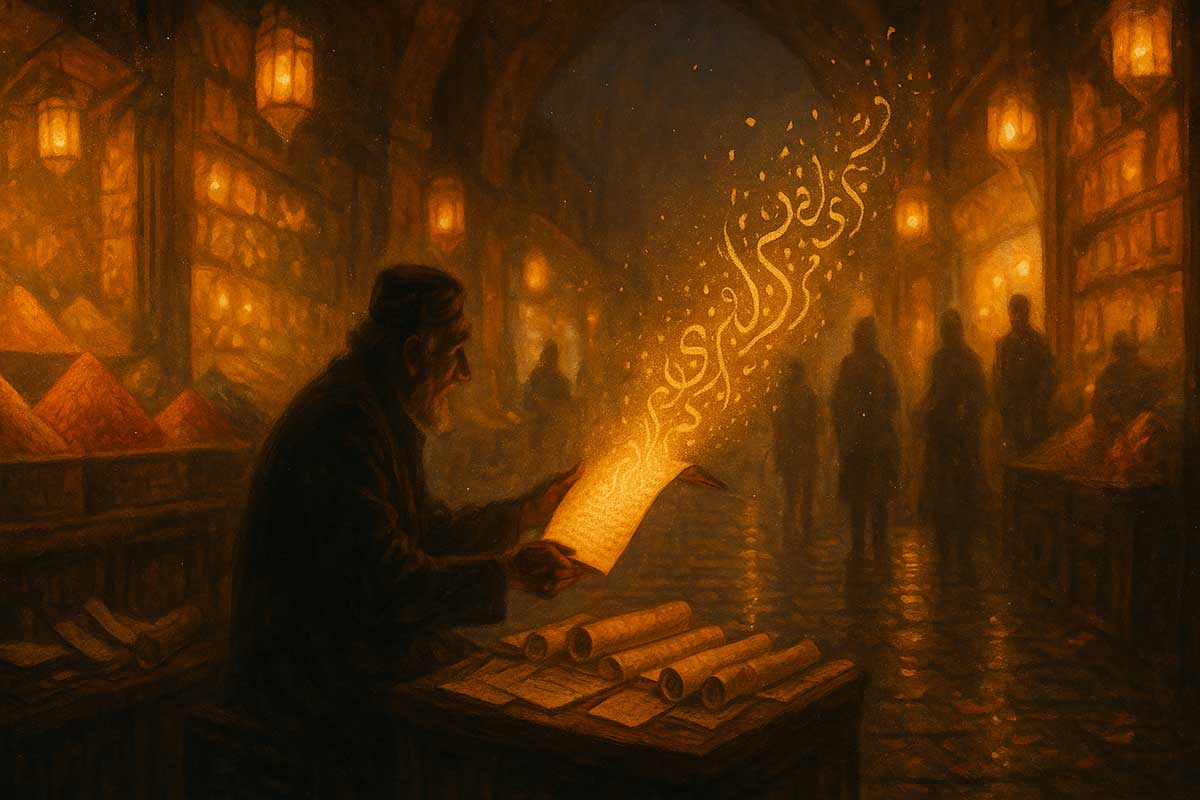
At the far end of the bazaar sat a small stall filled not with spices, but with scrolls.

Long, narrow, rolled-up scrolls tied with bits of red thread.

The stall owner was an elderly man with a white beard, bright eyes, and a deep maroon shawl draped over his shoulders. His accent was impossible to place. His hands worked slowly, tying and untying threads, rolling paper with patience that felt older than the stones beneath the bazaar.

No one knew he was Santa in Disguise.

They only knew him as Masal Baba — the Story Father.

Legend said that if you were given one of his scrolls, it told not a story you wanted to hear, but the one you needed.

Tonight, three souls would receive exactly that.

1. The Heartbroken Calligrapher

The first visitor was Leyla, a young calligrapher whose shop was just outside the bazaar. Her fiancé had broken off their engagement two weeks before, returning her ring in silence. Since then, every stroke of her pen felt brittle. Every line looked wrong. Every prayer she wrote seemed to falter halfway across the page.

She entered the bazaar to buy saffron for her mother.

But instead, she wandered toward Masal Baba’s stall.

He didn’t look up as she approached. He simply held out a scroll.

“For hearts cracked, not broken,” he said softly.

Leyla frowned. “How do you—”

“Take it.”

She hesitated, then accepted.

She untied the red thread carefully and unrolled the paper.

Inside were just four words:

“Ink flows after tears.”

Her breath caught.
Her fingers trembled.

“How did you know?” she whispered.

Masal Baba finally looked up. His eyes were warm and impossibly kind.

“When calligraphers cry,” he said, “their hands shake not with weakness, but with truth. Your art will change because you are changing.”

She looked back at the scroll. The words were simple, but something in them cracked open a frozen place inside her.

“I’m scared,” she admitted.

“Of losing him?”

“No. Of losing myself.”

He smiled. “You are not lost. You are simply returning to the page.”

Leyla covered her mouth, tears filling her eyes.

“How do I begin again?” she whispered.

Masal Baba placed a small vial in her hand.

“Saffron ink,” he said. “For restoration. Write one word tonight. Any word. Just begin.”

She nodded, tears slipping down her cheeks as she held the scroll to her chest.

She left the bazaar differently than she entered — not healed, but healing.

2. The Exhausted Syrian Father

The second visitor was Bilal, a Syrian refugee who worked long hours unloading crates at the docks. He lived with his wife and two children in a small shared room near Balat. His Turkish was improving, but loneliness still pressed against him like a second skin.

Tonight he was buying cinnamon for his wife.

But as he turned a corner, a scroll rolled off Masal Baba’s stall and landed at his feet.

He bent to pick it up.

“Ah,” Masal Baba said, “that one chose you.”

Bilal shook his head. “I’m sorry — I don’t have money for stories.”

“Stories are not for sale,” Masal Baba replied. “They are for giving.”

He motioned for Bilal to open it.

Inside, written in looping script, were these words:

“You carried your home with you.”

Bilal stared.

His hands trembled.

Tears welled unexpectedly — hot, sudden, uninvited.

“How… how do you know?” he whispered.

Masal Baba gestured gently. “Tell me.”

Bilal swallowed. “Some nights I wake because I smell Aleppo. The bread. The jasmine. The dust after rain. I’ve been trying so hard to build a life here that I’ve forgotten who I was there.”

“You did not forget,” Masal Baba said. “You survived. That is remembering in its hardest form.”

Bilal’s voice cracked. “My children will not know the songs. They will not know our stories.”

Masal Baba reached under his table and pulled out a small notebook bound in dark red leather.

“For your children,” he said. “Write them one memory each night. Just one. A street. A smell. A celebration. A face.”

Bilal pressed the notebook to his heart. “Thank you,” he whispered. “I didn’t realize how much I needed this.”

“You needed permission,” Masal Baba replied. “Now you have it.”

Bilal bowed deeply before walking away, wiping his tears with the sleeve of his work jacket.

3. The Young Woman Searching for Her Future

The final visitor came just before closing.

Mina, a 25-year-old woman from South Korea, was traveling alone for the first time. Her parents wanted her to return home and become a teacher. Mina wanted to explore the world, but guilt tugged at her constantly. She had arrived in Istanbul hoping for clarity.

She found confusion instead.

She wandered the market in a haze of scents — coriander, rose, sugar, cumin. But her thoughts were louder than the bazaar.

When she reached Masal Baba’s stall, she froze.

He was already holding a scroll for her.

She approached cautiously.

“This one is heavy,” he warned. “Truth always is.”

She unrolled it slowly.

Inside she found seven words:

“You are allowed to choose your life.”

Her knees weakened.

“I…” she whispered, swallowing hard, “I don’t know how.”

“Most people don’t,” he said gently. “We learn by stepping.”

“But what if I disappoint my parents?”

“Then you disappoint them,” he answered. “And then you love them until they understand why.”

Her breath shook.

“What if I choose wrong?”

Masal Baba gave a quiet laugh.

“There is no wrong. There is only living. And living requires choosing.”

Mina stared at the scroll as if trying to absorb it into her bones.

“Your parents want safety for you,” he continued. “But your heart wants something wider. Both can be respected. But only one can be lived fully.”

Tears spilled down her face.

“I’m scared,” she whispered.

“You are supposed to be,” he said. “Courage is simply fear with its shoes on.”

She laughed through tears.

Masal Baba lifted a lantern shaped like a pomegranate and handed it to her.

“This is for new beginnings,” he said. “When you feel lost, light it. The flame will not show you the future. It will show you your heart. That is enough.”

Mina clutched the lantern, bowing deeply.

“Thank you,” she said softly.

“You are welcome,” he replied. “Now go. Istanbul waits for no one, but she rewards the brave.”

Santa’s Departure

After the bazaar emptied and the lanterns dimmed, Masal Baba sat alone among his scrolls.

He listened to the market breathing — the faint rattle of metal doors, the distant call to prayer echoing beautifully through the night, the lingering laughter of families walking home.

He smiled softly.

“You have done well tonight, Istanbul,” Santa whispered. “Your stories travel farther than I do.”

He rolled one last scroll, tied it with red thread, and placed it on his stall.

It read:

“For the one who needs the light next.”

Then he stood, wrapped his maroon shawl tighter, and disappeared into the winding alleys of the city…

…leaving behind only the faint scent of cloves
and the warmth of stories
that never stop finding the people who need them most.

Short Bios:

Masal Baba — The Story Father (Santa in Disguise)

Known throughout the bazaar as Masal Baba, he is an elderly scroll-maker whose stall sits quietly at the end of the Spice Bazaar. With a maroon shawl, ancient patience in his hands, and a voice soft as old parchment, he gives out scrolls that reveal not what people want to hear, but what they need. No one suspects he is Santa, working through stories instead of gifts, guiding hearts back to themselves with wisdom wrapped in red thread.

Leyla — The Heartbroken Calligrapher

Leyla is a gifted young calligrapher whose fiancé ended their engagement without explanation, leaving her artistry shaken and her identity fractured. Once confident with ink and prayer, she now feels brittle and uncertain. Masal Baba’s scroll — four words that quietly restore her courage — reminds her that grief doesn’t break an artist; it transforms her. Leyla carries both her tears and her craft into a new beginning, one slow, healing stroke at a time.

Bilal — The Exhausted Syrian Father

Bilal is a refugee and dockworker supporting his wife and children in a new country while carrying the weight of the one he left behind. He misses Aleppo — its scents, songs, and memories — but worries his children will never know the stories that shaped him. Masal Baba’s scroll reveals a truth he had forgotten: home lives inside him. Given a notebook to preserve his memories, Bilal rediscovers the strength and heritage he thought he had lost.

Mina — The Young Woman Searching for Her Future

Mina is a 25-year-old traveler from South Korea torn between her parents’ expectations and her own longing for a wider life. Burdened by guilt, fear, and uncertainty, she wanders Istanbul hoping for clarity but finding only confusion — until Masal Baba gives her a scroll that grants her permission to choose her own path. With a pomegranate lantern for new beginnings, Mina steps into her future with trembling courage and a heart finally allowed to lead.

Related Posts:

  • Karma Exchanger: A Novel of Pain, Rebirth, and Mercy
  • Grimm Fairy Tale Universe: The Complete Grimmverse Book One
  • Ultimate Pilgrimage in Israel: When the Bible Comes Alive
  • S. Y. Agnon in 2026: An Imagined Novel of Belonging
  • 100 Geniuses on Humanity’s Future
  • Strangers in Time Summary & Ending Explained (Baldacci)

Filed Under: Christmas, SID Tagged With: Christmas in Turkey, Christmas Story Istanbul, Christmas storyteller, Christmas storytelling, emotional Christmas story, festive Istanbul market, heartwarming Christmas tale, holiday inspiration Istanbul, Istanbul Christmas tale, Istanbul folklore, Istanbul holiday magic, Istanbul legends, Istanbul night market, Istanbul travel winter, Istanbul winter market, magical Istanbul tale, mystical bazaar story, Spice Bazaar story, Turkey festive season, Turkish Christmas stories

Reader Interactions

Leave a Reply Cancel reply

Your email address will not be published. Required fields are marked *

Primary Sidebar

RECENT POSTS

  • grapes of wrath questionsThe Grapes of Wrath Explained: 5 Questions Readers Still Ask
  • the grapes of wrath john steinbeckThe Grapes of Wrath: When Does “Me” Become “We”?
  • Stand With Jesus: What If People Tried to Stop the Crucifixion?
  • East of Eden Today: 5 Stories About Breaking Family Cycles
  • john steinbeck east of edenEast of Eden: Does Timshel Still Make Sense Today?
  • East of Eden: Are We Born Bad or Free to Choose?
  • Convenience Store Woman: 5 American Stories About Marriage and Freedom
  • convenience-store-women-analysis-Convenience Store Woman: Is the New Normal Really Normal?
  • convenience store womenConvenience Store Woman: Who Decides What Is Normal?
  • sayaka murata imaginary friendsSayaka Murata Imaginary Friends: The Mystery Behind Her Inner World
  • Social Health Stories: 5 Ways We Lost Our Sense of Belonging
  • Social Health: Why Modern Life Is Making Us Lonely
  • nickel-boys-modern-stories-The Nickel Boys: 5 Modern Stories About Truth, Trauma and Hope
  • coloson whitehead the nickel boys discussionThe Nickel Boys: What Kind of Hope Survives Injustice?
  • the nickel boys colson whiteheadThe Nickel Boys: Elwood and Turner on Justice, Survival and Truth
  • AI Resource Consumption: Can AI Give More Than It Takes?
  • madeline-miller-circe-modern-stories-5 Modern Stories Inspired by Circe by Madeline Miller
  • Circle-Madeline-Miller-analysis-Circe Explained: Myth, Meaning, and Madeline Miller
  • Madeline Miller Circle CharactersMadeline Miller Circe: What If No One Ever Chose You?
  • 5 Modern Stories Inspired by Keigo Higashino’s Silent Parade
  • could japanese culture succeed where religion has failedCould Japanese Culture Succeed Where Religion Has Failed?
  • keigo-Higashino-when-love-becomes-too-much-5 Modern Stories Inspired by The Devotion of Suspect X
  • The Devotion of Suspect X Explained by Psychologists: Is Ishigami’s Love Really Love?
  • the devotion of suspect xThe Devotion of Suspect X Explained: Was Ishigami’s Sacrifice Really Love?
  • 5 Modern Midnight Library Stories About Regret, AI, and Choice
  • Matt Haig The Midnight LibraryThe Midnight Library Explained by Scholars and Matt Haig
  • The-Midnight-Library-explainedThe Midnight Library Explained Through Its Characters
  • 5 Modern Siddhartha Stories About Wisdom, Love, AI, and Choice
  • Siddhartha explained by leading scholarsSiddhartha Explained by Leading Hermann Hesse Scholars
  • Siddhartha explainedSiddhartha Explained Through Its Characters: Love, Loss, and Enlightenment
  • before-the-names-are-carved-Before the Names Are Carved: Five Connected Stories
  • The Scholars and the Unworn ShoesHan Kang Human Acts Explained by Leading Scholars
  • Han Kang Human Acts: An Imaginary Conversation with the Dead
  • The Years We Thought We Had: A Story of Love and Waiting in Japan
  • snow-country-analysis-Snow Country Analysis: Kawabata Scholars Explain It
  • snow-country-was-their-love-realSnow Country Explained Through Its Characters
  • the-man-who-never-took-the-day-off-The Man Who Never Took the Day Off: A Modern Ishiguro Story
  • The Remains of the Day Explained by Leading Ishiguro Scholars
  • the-remains-of-the-day-imaginary-talks-The Remains of the Day Explained Through Its Characters
  • the-pastor-who-couldnt-be-forgiven-The Pastor Who Couldn’t Be Forgiven: A Modern Story of Grace
  • disgrace-j-m-coetzee-Disgrace Explained Through Its Characters
  • disgrace-explained-leading-jm-coetzee-scholarsDisgrace Explained by Leading J. M. Coetzee Scholars
  • Forty-One Could Live. Nine Had to Die.
  • The Gospel According to Jesus Christ explainedThe Gospel According to Jesus Christ Explained Through Its Characters
  • SARAMAGO’S GOSPEL EXPLAINEDThe Gospel According to Jesus Christ Explained by Top Scholars
  • the last safe floorThe Last Safe Floor: A Modern Lord of the Flies Story for 2026
  • william golding explained by top scholarsWilliam Golding Explained by Top Scholars: Evil, Faith, and Redemption
  • lord-of-flies-character-conversation-Lord of the Flies Explained Through Its Characters: Is the Beast Inside Us?
  • never complain never explainNever Complain Never Explain: Henry Ford & Disraeli
  • The Empty Chair: A Modern Brothers Karamazov Story
  • the brothers karamazov explained top dostoevsky scholarsThe Brothers Karamazov Explained by Top Dostoevsky Scholars
  • Brothers Karamazov explainedThe Brothers Karamazov Explained Through Its Characters
  • before yesBefore Yes: A Modern American Story Inspired by Albert Camus
  • The Stranger Explained by Top Albert Camus Scholars
  • the stranger explainedAlbert Camus’s The Stranger Explained Through Its Characters
  • What is Worth Saving?The Last Store on Main Street: Inspired by The Sound and the Fury
  • The Sound and the Fury Scholar discussionThe Sound and the Fury Explained by Top William Faulkner Scholars
  • The Sound and the Fury Family SpokenThe Sound and the Fury Explained by Its Characters
  • The Building That Stopped Seeing | Modern Camus Story
  • The Plague Explained by Top Albert Camus Scholars
  • albert camus the plague explainedThe Plague explained by its characters
  • the last good sentenceThe Last Good Sentence: A Story About Fame and Loneliness
  • hemingway scholars debateThe Old Man and the Sea Explained by Top Scholars
  • The Old Man and the Sea Explained by Its Characters
  • the new meaning of survivalThe New Meaning of Survival: Top Scholars on Human Flourishing
  • true meanig of survivalThe True Meaning of Survival: Living, Not Just Existing
  • the last affordable roadThe Last Affordable Road: A Modern Grapes of Wrath Story
  • the-grapes-of-wrath-explained-by-top-scholars-The Grapes of Wrath Explained: Top Steinbeck Scholars
  • the grapes of wrath conversationThe Grapes of Wrath Explained Through Its Characters
  • the white silenceThe White Silence: A Japanese Novel of Loneliness
  • jose-saramago-blindness-explained-Blindness Explained by Top Scholars | José Saramago’s Greatest Warning
  • José-Saramago-Blindness-Explained-Blindness Explained Through Its Characters and José Saramago
  • Can the Bhagavad Gita Still Guide Humanity in 2026?
  • The Crown of AshesThe Crown of Ashes: A Modern Shakespearean Tragedy
  • the-fourth-bowl-If Toni Morrison Wrote a Japanese Family Novel: The Fourth Bowl
  • Beloved Ending Explained: 25 Questions Answered by Morrison Scholars
  • Toni-Morrison-Beloved-Explained-Beloved Explained Through Its Characters and Toni Morrison
  • house with the black stoneThe House With the Black Stone: A Korean Family Saga
  • Be Kind to Your Mother Before It’s Too LateBe Kind to Your Mother Before It’s Too Late
  • Gabriel-García-Márquez-one-hundred-years-of-solitude-explained-One Hundred Years of Solitude Explained by Top Scholars
  • one-hundred-years-of-solitude-explained-One Hundred Years of Solitude Explained
  • are-any-lives-truly-ordinary-Hateship Friendship Courtship Loveship Marriage explained
  • The Overstory explainedThe Overstory Explained: Themes, Ending, and Meaning
  • Demon Copperhead Explained: Barbara Kingsolver’s Pulitzer-Winning Novel
  • can you judge trump by his enemiesCan You Judge Donald Trump by His Enemies?
  • The Warmth of Other Suns Explained
  • America Iran strategyCan America Prevent a Wider Middle East War?
  • Lincol in the BardoLincoln in the Bardo Ending Explained:
  • God-as-Original-Parent-If God Created Man and Woman, Is God Our Original Parent?
  • can creation reveal godDoes Creation Reveal the Nature of God? Five Great Thinkers Discuss
  • Are Therapists to Blame for the Rise of Adults Cutting Off Their Parents?
  • your seventh year is changingJoel Osteen’s Seventh Year: When Suffering Is Not the Final Chapter
  • Joel Osteen’s Best Messages: Hope, Favor, and Faith
  • Hilary Mantel Wolf-Hall ending explainedWolf Hall Ending Explained: Can a Good Man Survive Political Power?
  • i-never-said-i-was-god-What If Jesus Never Claimed to Be God?
  • did-jesus-say-he-was-god-Did Christianity Reverse the Message of Jesus?
  • The Unseen World Liz MooreThe Unseen World Analysis: Memory, AI, and Identity
  • gilead ending explainedGilead Ending Explained: Can Grace Reach the Person We Judge Most?
  • Elena Ferrante My Brilliant FriendMy Brilliant Friend Ending Explained: Who Was Brilliant?
  • The-Underground-Railroad-ending-explained--The Underground Railroad Ending Explained

Footer

Recent Posts

  • The Grapes of Wrath Explained: 5 Questions Readers Still Ask August 31, 2026
  • The Grapes of Wrath: When Does “Me” Become “We”? August 30, 2026
  • Stand With Jesus: What If People Tried to Stop the Crucifixion? August 30, 2026
  • East of Eden Today: 5 Stories About Breaking Family Cycles August 29, 2026
  • East of Eden: Does Timshel Still Make Sense Today? August 29, 2026
  • East of Eden: Are We Born Bad or Free to Choose? August 29, 2026

Pages

  • About Us
  • Contact Us
  • Disclaimer
  • Earnings Disclaimer
  • Privacy Policy
  • Terms and Conditions

Categories

Copyright © 2026 Imaginarytalks.com