• Skip to main content
  • Skip to primary sidebar
  • Skip to footer
ImaginaryTalks.com
  • Spirituality and Esoterica
    • Afterlife Reflections
    • Ancient Civilizations
    • Angels
    • Astrology
    • Bible
    • Buddhism
    • Christianity
    • DP
    • Esoteric
    • Extraterrestrial
    • Fairies
    • God
    • Karma
    • Meditation
    • Metaphysics
    • Past Life Regression
    • Spirituality
    • The Law of Attraction
  • Personal Growth
    • Best Friend
    • Empathy
    • Forgiveness
    • Gratitude
    • Happiness
    • Healing
    • Health
    • Joy
    • Kindness
    • Love
    • Manifestation
    • Mindfulness
    • Self-Help
    • Sleep
  • Business and Global Issues
    • Business
    • Crypto
    • Digital Marketing
    • Economics
    • Financial
    • Investment
    • Wealth
    • Copywriting
    • Climate Change
    • Security
    • Technology
    • War
    • World Peace
  • Culture, Science, and A.I.
    • A.I.
    • Anime
    • Art
    • History & Philosophy
    • Humor
    • Imagination
    • Innovation
    • Literature
    • Lifestyle and Culture
    • Music
    • Science
    • Sports
    • Travel
You are here: Home / Buddhism / Buddha TED Talk: Teachings on Suffering for a Chaotic World

Buddha TED Talk: Teachings on Suffering for a Chaotic World

December 11, 2025 by Nick Sasaki Leave a Comment

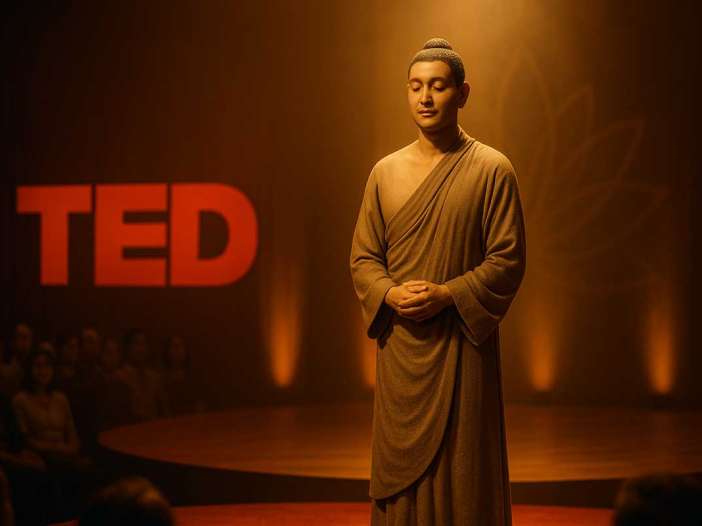
buddha-ted-talk

Introduction by Nick Sasaki 

When we imagine a voice capable of guiding humanity through confusion, conflict, and inner turbulence, very few figures stand as tall as the Buddha. His life began with privilege, but it transformed into a quest that continues to shape the consciousness of millions today. He looked at the human condition with astonishing honesty, and instead of turning away, he turned inward — discovering that the suffering we struggle against is not imposed by the world but arises from the movements of our own mind.

In this TED Talk, we’re not reenacting ancient history. We’re asking a living question:

If the Buddha stood on a modern stage in 2025, what wisdom would he offer to a stressed, divided, overstimulated world?
What would he say about anxiety, identity, polarization, technology, compassion, awakening — and the possibility of peace within ourselves?

This presentation is a creative exploration of those answers, shaped by the core principles of his teachings but spoken in a way that anyone, from any culture, can understand.

Tonight, we welcome the Buddha — not as a distant religious symbol, but as a profound teacher of the human mind — offering guidance we can use right now, in our everyday lives.

(Note: This is an imaginary conversation, a creative exploration of an idea, and not a real speech or event.) 


Table of Contents
Introduction by Nick Sasaki 
1. The Human Condition — Why We Suffer
2. The Nature of the Mind — Always Restless, Always Seeking
3. Desire, Fear, and the Illusion of Control
4. The Chain of Suffering — How It Forms
5. Awakening — The Only True Revolution
6. Mindfulness as Liberation
7. Compassion — The Natural Flower of Awareness
8. Freedom from Anger and Division
9. The Middle Way for a Divided World
10. A Blessing for Humanity — Walk the Path of Awareness
Final Thoughts by Nick Sasaki

1. The Human Condition — Why We Suffer

My friends, all beings seek happiness.
All beings seek safety, meaning, and peace.
Yet everywhere we look — in the world, in families, in our own hearts — suffering continues.

You may ask:
“If all beings desire happiness, why does suffering persist?”

The cause is not the world.
The cause is not your circumstances.
The cause is not other people.

The cause lies in the mind.

When the mind is untrained, it grasps at pleasure and recoils from pain.
It clings to ideas about who we are and how life should be.
It fears change, yet demands permanence.
It desires control, yet rejects responsibility.

This tension — between what the mind wants and what reality is —
creates the suffering we experience.

The world is not your enemy.
Your mind — when misunderstood — becomes your teacher.

2. The Nature of the Mind — Always Restless, Always Seeking

Consider the mind for a moment.

It jumps from thought to thought like a monkey swinging through a forest.
It pulls you into memories of the past and projections of the future.
It creates stories, judgments, comparisons, fantasies, and fears.

The mind is constantly seeking something —
a better moment, a better emotion, a better version of life.

But happiness cannot be found in seeking.
It can only be found in seeing.

What do I mean by seeing?

Seeing without distortion.
Seeing without fear.
Seeing without attachment.

Seeing life as it truly is — not as we wish it to be.

When the mind becomes still,
its natural clarity reveals itself.

A still mind is not empty.
A still mind is awake.

3. Desire, Fear, and the Illusion of Control

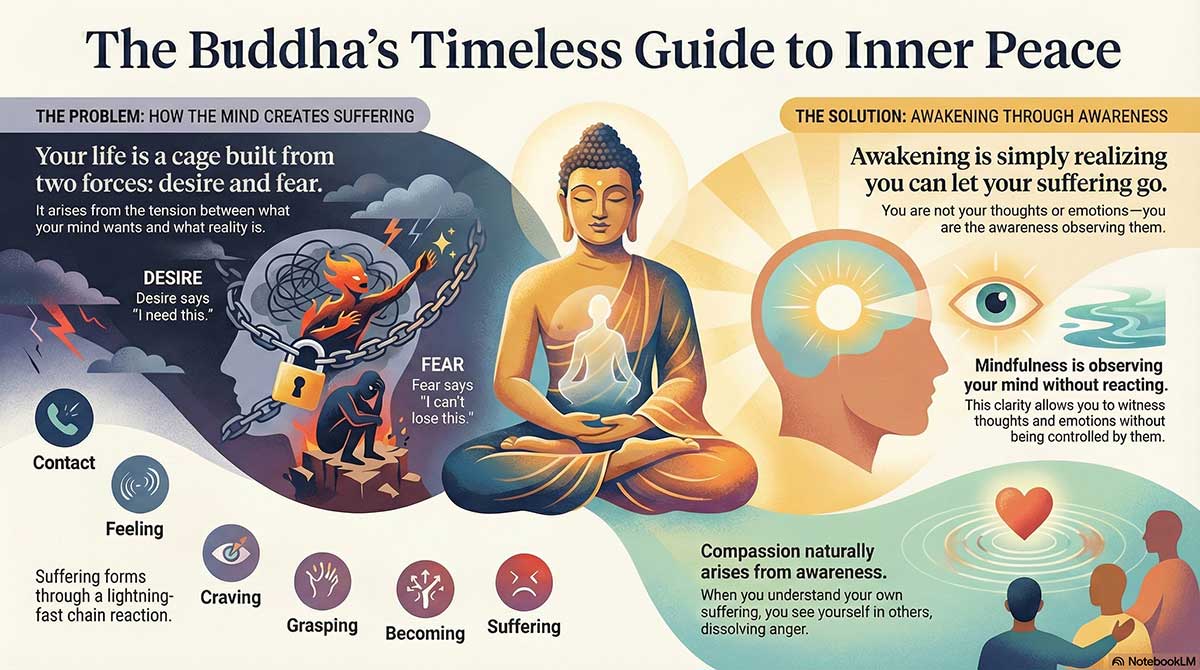
The mind is caught between two forces:

desire and fear.

Desire says: “I must have this to be happy.”
Fear says: “If I lose this, I will suffer.”

Together they form a cage.

Most people call this cage “my life.”
But the truth is:
It is only a collection of attachments.

Attachment does not mean love.
Attachment means dependence.

Attachment says:
“I can only be happy if the world matches my expectations.”

But the world does not obey our expectations.
It moves according to causes and conditions.

When we cling to what must change, we suffer.
When we resist what must be accepted, we suffer.
When we demand what cannot be controlled, we suffer.

Freedom begins with the recognition that
you cannot control life —
but you can understand it.

4. The Chain of Suffering — How It Forms

Suffering does not appear suddenly.
It arises through a chain of reactions.

It begins with contact —
you see, hear, taste, smell, touch, or think something.

Then comes feeling —
pleasant, unpleasant, or neutral.

Then arises craving —
“I want more of this,” or
“I want this to end.”

Then comes grasping —
you hold tightly to your desire or your aversion.

Then comes becoming —
your mind forms an identity around that reaction.

And finally: suffering.

This entire chain happens in an instant.
Quicker than lightning.
So quickly you may think it is automatic.
But it is not.

It is simply habit.

And habits can be transformed
through awareness.

If you break the chain at any point —
even once —
you taste freedom.

If you break it consistently,
you awaken.

5. Awakening — The Only True Revolution

Many people believe that awakening is a mystical experience,
reserved for saints and sages.

This is not so.

Awakening is simply the clear understanding that
your suffering is created by your own mind —
and therefore, you can let it go.

Awakening is the end of blaming.
Awakening is the end of clinging.
Awakening is the end of illusion.

Awakening does not require isolation.
It does not require perfection.
It does not require renouncing the world.

It requires only this:
Look into your mind with complete honesty.
See what is there.
And stop identifying with what you see.

You are not your anger.
You are not your fear.
You are not your desires.
You are not your anxiety.

These are passing clouds.
You are the sky.

When you realize this,
even for a moment,
you step outside the world of suffering.

And when you practice this realization,
moment by moment,
you become free.

6. Mindfulness as Liberation

What is mindfulness?
It is not a technique.
It is not a method.
It is not a trend.

Mindfulness is the art of remembering
who you truly are
beneath the noise of the mind.

Mindfulness means:
“You observe without being pulled.”
“You witness without reacting.”
“You see clearly without judgment.”

When you are mindful:

Thoughts come, but you do not chase them.
Emotions arise, but you do not drown in them.
Pain appears, but you do not add resistance.

Mindfulness is the first step toward inner peace.
But it is also the first step toward compassion —
because when you understand your own suffering,
you naturally understand the suffering of others.

You no longer judge harshly.
You no longer react impulsively.
You no longer see others as obstacles to your happiness.

Instead, you see them as fellow beings
caught in the same struggle.

This recognition opens the heart.

7. Compassion — The Natural Flower of Awareness

Compassion is not something you must force.
It arises naturally when the mind becomes still.

When you see that others cling, just as you cling…
when you see that others fear, just as you fear…
when you see that others suffer, just as you suffer…

Compassion blossoms effortlessly.

Compassion does not mean pity.
Compassion means recognizing yourself in others.

Compassion softens the heart.
It bridges division.
It dissolves conflict.

When compassion guides your actions,
even difficult situations become opportunities for growth.

Compassion is not a weakness.
Compassion is the highest form of strength —
because it frees you from hatred.

Hatred binds.
Compassion liberates.

A world without compassion
is a world dominated by ignorance.

A world with compassion
is a world awakening.

8. Freedom from Anger and Division

Anger is a fire that burns the one who carries it.
Division is the shadow cast by misunderstanding.

Many people believe that anger gives them power.
But anger blinds.
It narrows the mind.
It closes the heart.

When you respond with anger,
you reinforce the illusion of separation —
the illusion that “I” am separate from “you.”

But look closely:

Your joy is connected to others.
Your pain is connected to others.
Your survival is connected to others.

Life is not a competition.
Life is interconnection.

When you see this clearly,
anger loses its power over you.
You no longer fight with the world.
You cooperate with it.

Division fades
when awareness grows.

9. The Middle Way for a Divided World

The Middle Way is neither extreme indulgence nor extreme denial.
It is balance.
It is harmony.
It is wisdom.

In today’s world,
extremes dominate:

Extreme opinions.
Extreme emotions.
Extreme identities.
Extreme judgments.

Each side convinced it is right.
Each side convinced the other is wrong.

But truth is not found in extremes.
Truth is found in clarity.
Clarity is found in balance.
Balance is found in awareness.

The Middle Way is not passive.
It is dynamic, responsive, and alive.

It asks you to listen deeply.
To question your assumptions.
To hold your views lightly.
To remain open to change.

A divided world needs people
who can walk the Middle Way —
people who can hold space for many perspectives
without losing stability.

When even one person chooses balance,
they become a refuge for others.

Imagine a world where millions choose it.

10. A Blessing for Humanity — Walk the Path of Awareness

My friends,
awakening is not an escape from life.
Awakening is the deepest participation in life.

It is seeing clearly.
It is responding wisely.
It is living with a heart that is
open, stable, and free.

Do not think you must become someone new.
Do not think awakening requires perfection.

Awakening requires only this:
See reality as it is.
See your mind as it is.
And see that neither one defines who you are.

You are awareness itself —
vast, luminous, unbound.

When you remember this truth,
you walk through the world with grace.
You bring peace where there was conflict.
You bring clarity where there was confusion.
You bring compassion where there was fear.

You become
a light for others.

Let your steps be gentle.
Let your heart be open.
Let your mind be clear.

And may your awareness
benefit all beings.

Final Thoughts by Nick Sasaki
Buddha Teaching Summary

Listening to the Buddha speak in this reimagined 2025 TED Talk, I’m reminded of how simple — and yet how unbelievably difficult — it is to return to ourselves. We live in an age where distractions multiply, where outrage is monetized, where the mind rarely rests. And yet his message cuts through all of it with quiet clarity:

Your freedom begins the very moment you stop fighting reality and start understanding your mind.

The Buddha challenges us to do something radical:
to pause…
to observe…
to see clearly before we react.

If we can do that — even a few seconds at a time — we begin to rewrite the script of our lives. We stop living as prisoners of fear and desire, and instead step into our capacity to be aware, compassionate, and free.

And maybe that is the most modern thing about the Buddha:
His teachings don’t pull us away from the world.
They bring us fully into it — but with wisdom, equanimity, and a heart that is steady enough to hold both joy and sorrow.

My hope is that this talk serves as a gentle reminder that awakening is not reserved for monks in remote mountains.
It is available to every one of us — in our homes, our workplaces, our families, our quiet moments alone.

May we all learn to walk with awareness.
May we practice compassion toward ourselves and others.
And may each small step toward clarity help create a more peaceful, connected world.

Short Bios:

Buddha (Siddhartha Gautama)

Spiritual teacher and founder of Buddhism, the Buddha taught a path of awakening based on understanding the mind and ending suffering. His insights into mindfulness, compassion, and the nature of reality continue to shape global philosophy and psychology.

Nick Sasaki

Writer, creator of ImaginaryTalks.com, and moderator of high-concept dialogue series that reimagine the world’s greatest thinkers through a modern lens. Nick explores spirituality, consciousness, leadership, and human transformation in accessible, emotionally resonant storytelling formats.

Related Posts:

  • Karma Exchanger: A Novel of Pain, Rebirth, and Mercy
  • Siddhartha Explained Through Its Characters: Love,…
  • S. Y. Agnon in 2026: An Imagined Novel of Belonging
  • The Devotion of Suspect X Explained: Was Ishigami’s…
  • Lord of the Flies Explained Through Its Characters:…
  • The House With the Black Stone: A Korean Family Saga

Filed Under: Buddhism, imaginary TED Talk, Spirituality Tagged With: awakening speech 2025, awareness training Buddha, Buddha teachings on suffering, Buddha TED Talk, Buddhist compassion teaching, Buddhist psychology basics, Buddhist wisdom modern life, ending suffering Buddha, Four Noble Truths simplified, how to calm the mind Buddha, letting go of attachment, meditation for clarity, Middle Way lesson, mindfulness awakening 2025, mindfulness for suffering, modern Buddhism insights, path to awakening Buddha, spiritual suffering healing, suffering and awareness talk, suffering causes Buddha

Reader Interactions

Leave a Reply Cancel reply

Your email address will not be published. Required fields are marked *

Primary Sidebar

RECENT POSTS

  • madeline-miller-circe-modern-stories-5 Modern Stories Inspired by Circe by Madeline Miller
  • Circle-Madeline-Miller-analysis-Circe Explained: Myth, Meaning, and Madeline Miller
  • Madeline Miller Circle CharactersMadeline Miller Circe: What If No One Ever Chose You?
  • 5 Modern Stories Inspired by Keigo Higashino’s Silent Parade
  • could japanese culture succeed where religion has failedCould Japanese Culture Succeed Where Religion Has Failed?
  • keigo-Higashino-when-love-becomes-too-much-5 Modern Stories Inspired by The Devotion of Suspect X
  • The Devotion of Suspect X Explained by Psychologists: Is Ishigami’s Love Really Love?
  • the devotion of suspect xThe Devotion of Suspect X Explained: Was Ishigami’s Sacrifice Really Love?
  • 5 Modern Midnight Library Stories About Regret, AI, and Choice
  • Matt Haig The Midnight LibraryThe Midnight Library Explained by Scholars and Matt Haig
  • The-Midnight-Library-explainedThe Midnight Library Explained Through Its Characters
  • 5 Modern Siddhartha Stories About Wisdom, Love, AI, and Choice
  • Siddhartha explained by leading scholarsSiddhartha Explained by Leading Hermann Hesse Scholars
  • Siddhartha explainedSiddhartha Explained Through Its Characters: Love, Loss, and Enlightenment
  • before-the-names-are-carved-Before the Names Are Carved: Five Connected Stories
  • The Scholars and the Unworn ShoesHan Kang Human Acts Explained by Leading Scholars
  • Han Kang Human Acts: An Imaginary Conversation with the Dead
  • The Years We Thought We Had: A Story of Love and Waiting in Japan
  • snow-country-analysis-Snow Country Analysis: Kawabata Scholars Explain It
  • snow-country-was-their-love-realSnow Country Explained Through Its Characters
  • the-man-who-never-took-the-day-off-The Man Who Never Took the Day Off: A Modern Ishiguro Story
  • The Remains of the Day Explained by Leading Ishiguro Scholars
  • the-remains-of-the-day-imaginary-talks-The Remains of the Day Explained Through Its Characters
  • the-pastor-who-couldnt-be-forgiven-The Pastor Who Couldn’t Be Forgiven: A Modern Story of Grace
  • disgrace-j-m-coetzee-Disgrace Explained Through Its Characters
  • disgrace-explained-leading-jm-coetzee-scholarsDisgrace Explained by Leading J. M. Coetzee Scholars
  • Forty-One Could Live. Nine Had to Die.
  • The Gospel According to Jesus Christ explainedThe Gospel According to Jesus Christ Explained Through Its Characters
  • SARAMAGO’S GOSPEL EXPLAINEDThe Gospel According to Jesus Christ Explained by Top Scholars
  • the last safe floorThe Last Safe Floor: A Modern Lord of the Flies Story for 2026
  • william golding explained by top scholarsWilliam Golding Explained by Top Scholars: Evil, Faith, and Redemption
  • lord-of-flies-character-conversation-Lord of the Flies Explained Through Its Characters: Is the Beast Inside Us?
  • never complain never explainNever Complain Never Explain: Henry Ford & Disraeli
  • The Empty Chair: A Modern Brothers Karamazov Story
  • the brothers karamazov explained top dostoevsky scholarsThe Brothers Karamazov Explained by Top Dostoevsky Scholars
  • Brothers Karamazov explainedThe Brothers Karamazov Explained Through Its Characters
  • before yesBefore Yes: A Modern American Story Inspired by Albert Camus
  • The Stranger Explained by Top Albert Camus Scholars
  • the stranger explainedAlbert Camus’s The Stranger Explained Through Its Characters
  • What is Worth Saving?The Last Store on Main Street: Inspired by The Sound and the Fury
  • The Sound and the Fury Scholar discussionThe Sound and the Fury Explained by Top William Faulkner Scholars
  • The Sound and the Fury Family SpokenThe Sound and the Fury Explained by Its Characters
  • The Building That Stopped Seeing | Modern Camus Story
  • The Plague Explained by Top Albert Camus Scholars
  • albert camus the plague explainedThe Plague explained by its characters
  • the last good sentenceThe Last Good Sentence: A Story About Fame and Loneliness
  • hemingway scholars debateThe Old Man and the Sea Explained by Top Scholars
  • The Old Man and the Sea Explained by Its Characters
  • the new meaning of survivalThe New Meaning of Survival: Top Scholars on Human Flourishing
  • true meanig of survivalThe True Meaning of Survival: Living, Not Just Existing
  • the last affordable roadThe Last Affordable Road: A Modern Grapes of Wrath Story
  • the-grapes-of-wrath-explained-by-top-scholars-The Grapes of Wrath Explained: Top Steinbeck Scholars
  • the grapes of wrath conversationThe Grapes of Wrath Explained Through Its Characters
  • the white silenceThe White Silence: A Japanese Novel of Loneliness
  • jose-saramago-blindness-explained-Blindness Explained by Top Scholars | José Saramago’s Greatest Warning
  • José-Saramago-Blindness-Explained-Blindness Explained Through Its Characters and José Saramago
  • Can the Bhagavad Gita Still Guide Humanity in 2026?
  • The Crown of AshesThe Crown of Ashes: A Modern Shakespearean Tragedy
  • the-fourth-bowl-If Toni Morrison Wrote a Japanese Family Novel: The Fourth Bowl
  • Beloved Ending Explained: 25 Questions Answered by Morrison Scholars
  • Toni-Morrison-Beloved-Explained-Beloved Explained Through Its Characters and Toni Morrison
  • house with the black stoneThe House With the Black Stone: A Korean Family Saga
  • Be Kind to Your Mother Before It’s Too LateBe Kind to Your Mother Before It’s Too Late
  • Gabriel-García-Márquez-one-hundred-years-of-solitude-explained-One Hundred Years of Solitude Explained by Top Scholars
  • one-hundred-years-of-solitude-explained-One Hundred Years of Solitude Explained
  • are-any-lives-truly-ordinary-Hateship Friendship Courtship Loveship Marriage explained
  • The Overstory explainedThe Overstory Explained: Themes, Ending, and Meaning
  • Demon Copperhead Explained: Barbara Kingsolver’s Pulitzer-Winning Novel
  • can you judge trump by his enemiesCan You Judge Donald Trump by His Enemies?
  • The Warmth of Other Suns Explained
  • America Iran strategyCan America Prevent a Wider Middle East War?
  • Lincol in the BardoLincoln in the Bardo Ending Explained:
  • God-as-Original-Parent-If God Created Man and Woman, Is God Our Original Parent?
  • can creation reveal godDoes Creation Reveal the Nature of God? Five Great Thinkers Discuss
  • Are Therapists to Blame for the Rise of Adults Cutting Off Their Parents?
  • your seventh year is changingJoel Osteen’s Seventh Year: When Suffering Is Not the Final Chapter
  • Joel Osteen’s Best Messages: Hope, Favor, and Faith
  • Hilary Mantel Wolf-Hall ending explainedWolf Hall Ending Explained: Can a Good Man Survive Political Power?
  • i-never-said-i-was-god-What If Jesus Never Claimed to Be God?
  • did-jesus-say-he-was-god-Did Christianity Reverse the Message of Jesus?
  • The Unseen World Liz MooreThe Unseen World Analysis: Memory, AI, and Identity
  • gilead ending explainedGilead Ending Explained: Can Grace Reach the Person We Judge Most?
  • Elena Ferrante My Brilliant FriendMy Brilliant Friend Ending Explained: Who Was Brilliant?
  • The-Underground-Railroad-ending-explained--The Underground Railroad Ending Explained
  • The Road Cormac McCarthyThe Road Ending Explained: Father and Son Imaginary Conversation
  • Atonement Ending Explained: Briony Faces the Truth
  • Never Let Me Go Kazuo IshiguroNever Let Me Go Analysis: An Imaginary Conversation
  • have-we-forgotten-who-we-really-areMichael G. Reccia: Has Humanity Forgotten Who We Really Are?
  • pachinko imaginary talksPachinko by Min Jin Lee: An Imaginary Conversation Across Generations
  • are-you-falling-behindMin Jin Lee on Time, Failure, and Falling Behind in Life
  • trump-putin-xi-modi-geography-of-power-Trump, Putin, Xi and Modi: The Geography of Power
  • misunderstanding of loveWhat If the World’s Problems Come From Misunderstanding Love?
  • netherlands travelNetherlands Travel with Five Unlikely Guides
  • france-imaginary-travel-France Imaginary Travel with Conan, Voltaire and RM
  • rent freeeze trapMamdani Housing Plan: Rent Freeze or Property Trap?
  • 2027 warning prof jiang xueqinProf. Jiang Xueqin’s 2027 Warning for America
  • Banana Fish ExplainedBananafish Explained: Before and After Salinger’s Story
  • Why James Joyce's Ulysses MattersJames Joyce’s Ulysses Explained: Love, Home, and Myth
  • what dad never saidWhat Your Father Never Told You About Silent Sacrifice
  • Fiddler On The Roof Tradition or changeFiddler on the Roof Lessons on Tradition and Family

Footer

Recent Posts

  • 5 Modern Stories Inspired by Circe by Madeline Miller August 23, 2026
  • Circe Explained: Myth, Meaning, and Madeline Miller August 23, 2026
  • Madeline Miller Circe: What If No One Ever Chose You? August 23, 2026
  • 5 Modern Stories Inspired by Keigo Higashino’s Silent Parade August 22, 2026
  • Could Japanese Culture Succeed Where Religion Has Failed? August 22, 2026
  • 5 Modern Stories Inspired by The Devotion of Suspect X August 21, 2026

Pages

  • About Us
  • Contact Us
  • Disclaimer
  • Earnings Disclaimer
  • Privacy Policy
  • Terms and Conditions

Categories

Copyright © 2026 Imaginarytalks.com