

|
Getting your Trinity Audio player ready...
|
Introduction by Robert T. Bigelow
When I founded the Bigelow Institute for Consciousness Studies, it was not out of idle curiosity or philosophical speculation. It arose from something far more personal — the profound loss of my wife and my son, and the sharp awareness that conventional science had few answers for the most important question any of us will ever face:
Does consciousness survive bodily death?
For decades, my aerospace and research companies focused on physical engineering, data, systems, and measurable outcomes. But the human spirit demanded a different kind of investigation — one grounded in the rigor of science but open to the possibilities that lie beyond the material world.
Across cultures and centuries, people have reported experiences that seem to point toward continuity of consciousness:
near-death experiences, reincarnation cases, deathbed visions, apparitions, mediumship, shared death experiences, terminal lucidity.
These phenomena deserved better than dismissal. They deserved careful examination by the finest minds in neuroscience, psychiatry, physics, medicine, anthropology, and psychology. That is why I created a global competition to identify the best available evidence for the survival of human consciousness after permanent bodily death.
The essays that emerged from this effort — including the works of Pim van Lommel, Jeffrey Mishlove, and Leo Ruickbie — demonstrated that the evidence is far more extensive, independently verifiable, and convergent than mainstream science has acknowledged.
You have now heard from the world’s leading experts across five domains of survival research. Their work represents decades — in some cases, lifetimes — of careful documentation of experiences that challenge the materialist assumption that consciousness ends when the brain stops.
My purpose in convening these conversations is simple:
To bring clarity, rigor, and courage to a question humanity has avoided for too long.
The implications of survival are vast.
They reshape our understanding of identity, ethics, purpose, and the nature of reality itself.
What you are about to read is not speculation. It is evidence — presented by the researchers who have carried the torch of inquiry when others refused to look.
The question is no longer whether consciousness survives.
The question is what we will do with that knowledge.
Let us begin.
(Note: This is an imaginary conversation, a creative exploration of an idea, and not a real speech or event.)
Topic 1: Near-Death Experiences
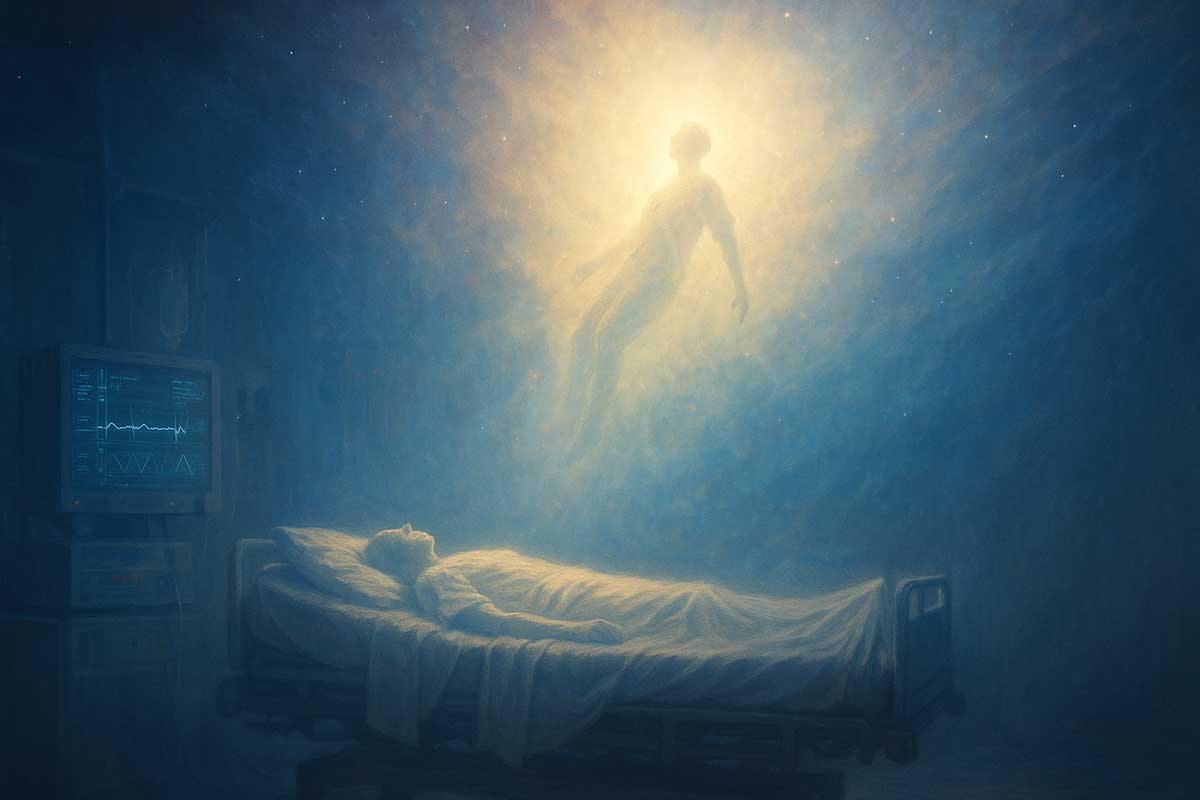
Moderator: Dr. Pim van Lommel
Speakers: Dr. Sam Parnia, Dr. Bruce Greyson, Dr. Eben Alexander, Anita Moorjani, Dr. Peter Fenwick
 OPENING — Dr. Pim van Lommel
The room quiets as I rise, feeling the familiar weight of two decades of research. My study in The Lancet showed something medicine was not prepared to accept: that consciousness can persist even when the brain shows no measurable activity. Tonight, I ask not only what happens during near-death experiences, but what these experiences reveal about the nature of consciousness itself.
I look to the speakers—five pioneers who have explored the doorway between life and death from angles both scientific and deeply personal.
“Let’s begin.”
FIRST QUESTION
How do we understand highly structured and verifiable experiences occurring when the brain shows no measurable activity during cardiac arrest?
Dr. Sam Parnia
“During cardiac arrest, the brain shuts down within seconds. Yet patients report perceptions that match real events—defibrillation shocks, conversations, medical instruments, even actions occurring outside the room. These aren’t random fragments. They’re coherent observations. Time-stamped. Verified. Consciousness is functioning when the brain is not.”
Dr. Bruce Greyson
“We know from neuroscience that without blood flow, memory formation is impossible. Yet NDE memories are some of the clearest, most enduring memories of a person’s life. Their consistency and coherence challenge every physiological explanation we have.”
Dr. Eben Alexander
“My coma involved near-complete cortical inactivity. The experiences I had were more real, more structured, than waking consciousness. If they were hallucinations, they would have been chaotic, degraded, rapidly disappearing. Instead, they were crisp, meaningful, transformative.”
Anita Moorjani
“I watched doctors discuss my condition from outside my body. I saw my brother flying toward me—something later confirmed. My body was dying, yet my awareness was the clearest it had ever been. I was more alive without a functioning brain than with one.”
Dr. Peter Fenwick
“These experiences occur when the neurological substrate for consciousness is absent. If we rely solely on the materialist model, this cannot happen. And yet it does—repeatedly. The simplest explanation is that consciousness can operate independently of the brain.”
Moderator Reflection — Dr. Van Lommel
“In my research, patients described events that occurred during periods of flat EEG. That data formed the basis of my argument that consciousness is non-local. What you have all described reinforces that conclusion: experience emerges where brain activity does not.”
SECOND QUESTION
If consciousness persists during periods of brain inactivity, does this imply that the brain functions more as a receiver or filter rather than the source of consciousness?
Dr. Bruce Greyson
“James’s filter theory is an elegant explanation. The brain narrows consciousness for practical, biological functioning. When the filter opens—as in an NDE—consciousness expands. This fits the data far better than assuming the brain creates consciousness from inert matter.”
Dr. Sam Parnia
“The brain clearly correlates with consciousness, but correlation is not causation. A radio correlates with the music it plays, yet it doesn’t create the broadcast. When the radio is damaged, the signal still exists. NDEs suggest a similar dynamic.”
Anita Moorjani
“During my NDE, I felt unbounded—free from the limitations of physical perception. When I returned to my body, it felt like stepping into something smaller, heavier, restricted. That transition convinced me that the body narrows awareness rather than producing it.”
Dr. Eben Alexander
“My coma forced me to reconsider everything I believed as a neurosurgeon. Consciousness felt fundamental—more primary than space, time, or matter. If the brain were producing it, the shutdown of my cortex should have extinguished everything. Instead, it revealed something larger.”
Dr. Peter Fenwick
“We see this filtering effect not only in NDEs, but in terminal lucidity—moments when patients with severe neurological damage briefly regain clarity before death. This cannot be explained by brain function. The filter hypothesis fits these paradoxes well.”
Moderator Reflection — Dr. Van Lommel
“In my essay, I argued that consciousness is not produced by the brain but mediated through it. Tonight’s discussion clearly echoes that model: when the brain falters, consciousness may not fade—it may emerge.”
THIRD QUESTION
NDEs are astonishingly consistent across cultures, ages, and belief systems. What might this suggest about a universal dimension of human awareness?
Dr. Peter Fenwick
“We find the same sequence: leaving the body, traveling through a passage, encountering a presence of profound love, reviewing one’s life. These patterns appear in ancient cultures, modern accounts, rural populations, and technologically advanced societies. Consistency suggests a universal process.”
Dr. Bruce Greyson
“If NDEs were hallucinations, we would expect variability matching cultural expectation. Instead, we see uniformity in structure. A child in India and an adult in Canada describe almost identical experiences. This points to something fundamental in human consciousness.”
Anita Moorjani
“I didn’t believe in NDEs before mine happened. Yet my experience matched thousands of others I later read about. I recognized the place, the feeling, the clarity. It didn’t feel personal; it felt universal—like something all of us return to.”
Dr. Eben Alexander
“When a phenomenon transcends culture, religion, language, and personal history, it suggests a deeper reality. Consciousness appears to encounter the same environment regardless of one’s prior beliefs. That’s hard to ignore.”
Dr. Sam Parnia
“These experiences may represent a biologically structured transition—one that is encoded into the human system, not culturally invented. The near-death state may open access to a dimension that is always present but rarely perceived.”
Moderator Reflection — Dr. Van Lommel
“The universality of NDEs was central to my prize-winning argument. If consciousness were entirely brain-produced, cultural differences would dominate. Instead, the core architecture remains stable. This suggests that consciousness may not end at death but transition into a broader field of existence shared across humanity.”
CLOSING — Dr. Pim van Lommel
“Thank you,” I say softly, letting the weight of the discussion settle. “Tonight, we’ve seen evidence from medical cases, neuroscience, personal experience, and cross-cultural patterns. Each points toward the same conclusion: consciousness may not be confined to the brain. Near-death experiences reveal coherence where biology predicts silence, clarity where physiology predicts confusion, continuity where materialism predicts annihilation.”
I pause.
“If consciousness continues when the brain stops, then death is not the end of awareness. It may be the moment awareness reveals its true scope.”
The audience is silent—absorbing the possibility that life is larger than the body that contains it.
Topic 2: Reincarnation Memories in Children
Moderator: Dr. Jeffrey Mishlove
Speakers: Dr. Jim Tucker, Dr. Ian Stevenson (legacy voice), Dr. Erlendur Haraldsson, Carol Bowman, Trutz Hardo
OPENING — Dr. Jeffrey Mishlove
The hall settles into a meditative quiet as I rise. In my prize-winning essay for the Bigelow Institute, I argued that evidence for survival after death must be treated as a coherent body—not isolated anomalies. Among that body of evidence, the cases of children who remember previous lives stand out as some of the strongest and most verifiable.
Across cultures, languages, and continents, young children speak of names, places, deaths, and relationships they should have no way of knowing. Many of these memories align with real individuals who lived and died—often in shocking detail.
Tonight, we bring together the leading researchers who built this field.
“Let’s begin.”
FIRST QUESTION
How do we explain young children accurately recalling names, locations, family members, and circumstances of death that they could not have learned through ordinary means?
Dr. Jim Tucker
“In more than 2,500 documented cases,” Tucker begins, “children have spoken about previous lives with details later confirmed as historically accurate. These statements often occur between ages two and five—before exposure to media or complex social environments. The consistency and specificity go far beyond coincidence.”
Dr. Ian Stevenson (legacy voice)
“When I began this research,” Stevenson’s recorded voice resonates calmly, “I expected to find cultural stories or vague impressions. Instead, many children provided dozens of specific details—addresses, occupations, family dynamics, even the emotions of the deceased at the time of death. When these statements matched verifiable individuals, the materialist explanation became increasingly untenable.”
Dr. Erlendur Haraldsson
“In Sri Lanka, Lebanon, Iceland—I encountered the same pattern,” Haraldsson says. “Children knew events from another person’s life that even the surviving family had forgotten. When we interviewed families independently, both sides confirmed the same details without cross-contamination.”
Carol Bowman
“Parents often tell me their child begins speaking of a past life spontaneously,” Bowman adds. “No hypnosis, no prompting. A toddler might cry, ‘I want my other mother!’ or describe how he ‘died in the war.’ These stories often match real individuals who passed in the manner the child describes.”
Trutz Hardo
“In India, I followed dozens of these children. The accuracy is astonishing. Some walk directly to their ‘old homes,’ recognize relatives, or identify objects that belonged to their previous personality. The emotional recognition between the child and the past-life family is often profound.”
Moderator Reflection — Dr. Jeffrey Mishlove
“In my BICS essay, I argued that reincarnation cases offer some of the clearest examples of survival—because they provide veridical, independently verifiable data. What you’ve all described today underscores that children’s memories transcend what their current brains could reasonably have accessed.”
SECOND QUESTION
In the strongest cases, children show physical correspondences—birthmarks, phobias, mannerisms—that match their reported past-life deaths or personalities. What mechanism might allow consciousness to transfer memory and physical imprinting between lives?
Dr. Ian Stevenson (legacy voice)
“This was one of the most surprising findings of my research. Birthmarks often corresponded to fatal wounds of the previous personality—verified through medical records. For example, children who recalled being shot might have two matching birthmarks: one at the entry wound and one at the exit wound. This suggests that whatever survives death carries information capable of influencing the physical form.”
Dr. Jim Tucker
“We might think of consciousness as a field of information, not merely a product of the brain. If consciousness retains memories and emotional patterns, it could influence the developing body through mechanisms we do not yet fully understand.”
Trutz Hardo
“In many cases, emotional residue transfers as well. A child who remembers drowning may have a strong phobia of water. A child recalling a violent death may show aversion to specific locations or objects. These responses appear instinctive, not learned.”
Carol Bowman
“I’ve observed that when children process their past-life trauma—through conversation or understanding—the phobias often diminish. This suggests the memory holds emotional weight that affects the body in the present.”
Dr. Erlendur Haraldsson
“We cannot yet fully map the transfer mechanism, but the data are clear: personality traits, preferences, fears, and even physical features sometimes match the previous life. This continuity hints at a non-physical component that carries information beyond death.”
Moderator Reflection — Dr. Jeffrey Mishlove
“In my integrative survival framework, memory and personality survive as aspects of a non-physical consciousness system. These birthmarks and behavioral correspondences represent empirical hints of that continuity.”
THIRD QUESTION
If reincarnation does occur, what aspects of identity—memory, emotion, personality—seem to persist? And what aspects change?
Dr. Jim Tucker
“We see the persistence of strong preferences: foods, professions, relationships, even hobbies. Children often display remarkable familiarity with activities they have never encountered in their current life.”
Dr. Ian Stevenson (legacy voice)
“Memory is often fragmentary and fades with age, but emotional tone persists. Unfinished business carries over. So does affection. Children frequently express longing for people from a past life, even after memories diminish.”
Dr. Erlendur Haraldsson
“I found that personality traits often remain consistent—courage, timidity, assertiveness. Yet the new environment shapes these tendencies in different directions. Identity appears to be a combination: something carried in, and something newly formed.”
Carol Bowman
“The clearest continuity is emotional. Children recognize people they have never met with startling certainty. They show comfort, tears, or joy instantly—as if seeing an old friend. That emotional connection is less easily dismissed than verbal memory.”
Trutz Hardo
“Sometimes even handwriting or artistic style persists. Yet the child also develops a new identity shaped by their present family and culture. Reincarnation is not repetition; it is continuity through transformation.”
Moderator Reflection — Dr. Jeffrey Mishlove
“In my prize-winning essay, I emphasized that identity is not a static construct. It unfolds across experiences. These accounts show that consciousness retains memory, emotional tone, and personality tendencies—yet adapts across lifetimes. This adaptive continuity is one of the strongest indicators of survival.”
CLOSING — Dr. Jeffrey Mishlove
“Tonight,” I say gently, “we’ve seen evidence drawn from thousands of cases across cultures and decades—evidence showing that children can recall identities they never learned, recognize people they never met, and carry emotional and physical imprints from lives they never lived.”
I pause, letting the implications settle.
“This field suggests that consciousness is not bound to a single lifetime. It moves, evolves, integrates, and continues.”
A soft stillness fills the room.
“If these cases are even partly true, then death is not the boundary we thought it was. It is simply a doorway between chapters of a much larger story.”
Topic 3: Mediumship Under Scientific Controls
Moderator: Dr. Leo Ruickbie (3rd Prize Winner)
Speakers: Dr. Julie Beischel, Dr. Gary Schwartz, Leslie Kean, Craig Hogan, Patricia Pearson
OPENING — Dr. Leo Ruickbie
The room dims to a thoughtful hush as I stand. In my prize-winning essay for the Bigelow Institute, I argued that only methodologically rigorous evidence—free from sensory leakage, chance, and fraud—can meaningfully support the survival hypothesis.
Across decades, controlled mediumship studies have shocked even the skeptics: accurate statements delivered without prior contact, without cold reading, without information cues. Tonight, we explore the question: If mediums provide accurate information under conditions where fraud and guessing are impossible, what does that imply about consciousness after death?
I look to the five individuals whose work forms the backbone of the scientific inquiry into mediumship.
“Let us begin.”
FIRST QUESTION
How should we interpret mediums who, under double-blind or triple-blind conditions, accurately describe deceased individuals whom they could not have known?
Dr. Julie Beischel
“At the Windbridge Institute,” Beischel begins, “we tested mediums using quintuple-blind protocols—neither the medium, the experimenter, nor the rater had access to client information. Under these conditions, certain mediums consistently provided statements that were accurate, specific, and personally meaningful to the sitter. Chance cannot account for that pattern.”
Dr. Gary Schwartz
“We replicated these outcomes,” Schwartz adds, “using randomized target assignments and controls designed to eliminate cold reading. When mediums correctly identify details—nicknames, obscure events, precise personality traits—we cannot attribute that to guesswork.”
Leslie Kean
“As a journalist,” Kean says, “I entered this world reluctantly. But observing controlled sessions firsthand, and reviewing research protocols, convinced me there's a real anomaly. The mediums weren’t reading the living. They were describing personalities who seemed to retain agency, emotion, and memory.”
Craig Hogan
“In my research, mediums frequently reported information nobody alive possessed—details confirmed only after the session, sometimes by digging through old records or contacting distant relatives. That kind of accuracy removes ordinary explanations.”
Patricia Pearson
“I’ve interviewed countless families who received messages through mediums that matched private, deeply intimate details of the deceased. When such correspondences occur across blinded experiments and across cultures, we must take them seriously.”
Moderator Reflection — Dr. Leo Ruickbie
“My own analysis led me to conclude that mediumship is not simply guesswork or psychology. When you remove all pathways for normal information transfer, and accuracy remains, the most straightforward interpretation is that something conscious is communicating.”
SECOND QUESTION
What standards or criteria best distinguish genuine mediumistic communication from psychological inference, subconscious patterning, or traditional cold reading?
Dr. Gary Schwartz
“The key is experimental control. You must eliminate all sensory cues: no visual contact, no online information, no shared environment, no leading questions. When mediums still produce precise details under these constraints, inference becomes an inadequate explanation.”
Dr. Julie Beischel
“We analyze statements statistically. Genuine communication contains verifiable specifics—names, relationships, idiosyncrasies—that exceed random probability. Moreover, mediums who perform well in one experiment tend to perform well in others, indicating a stable ability rather than chance.”
Craig Hogan
“One of the strongest indicators is emotional signature. The sitter often recognizes the deceased through mood, phrasing, or personality conveyed by the medium—qualities extremely difficult to infer and nearly impossible to fake under blinded conditions.”
Leslie Kean
“In my investigations, the most compelling cases involved information unknown to the sitter but later verified. That eliminates cold reading entirely. It means the medium is not reading grief, body language, or expectations. They are accessing something else.”
Patricia Pearson
“Consistency across time also matters. Families sometimes receive messages that align with earlier mediumship sessions by different practitioners. When two independent mediums describe the same deceased personality in compatible ways, normal explanations fall short.”
Moderator Reflection — Dr. Leo Ruickbie
“In my BICS essay, I argued that the survival hypothesis must be judged by the quality of evidence. Rigorous controls, repeatability, statistical strength—these are the criteria that transform mediumship from anecdote into data.”
THIRD QUESTION
If certain mediums consistently obtain accurate information under blinded conditions, what does this imply about the possibility that consciousness survives bodily death?
Dr. Julie Beischel
“If the information cannot be accessed through normal means, and if the accuracy exceeds chance, then the data point toward the persistence of consciousness beyond the body. The personalities described often retain emotion, memory, and relationships.”
Dr. Gary Schwartz
“Our experiments suggest not only survival but an interactive dimension—something capable of responding, communicating, adapting. This is not a static memory imprint. It appears to be an active consciousness.”
Craig Hogan
“The messages often carry continuity: unfinished conversations, reassurance, personal growth. These characteristics imply that identity persists. The deceased appear aware, engaged, and capable of intention.”
Leslie Kean
“When different investigators, in different labs, using different methods, observe similar patterns, the implication is strong: we are witnessing communication from beyond physical life. The consistency is too pronounced to ignore.”
Patricia Pearson
“The testimonies of families show that communication is often emotionally characteristic—humor, warmth, regret, affection. These are not abstract data points. They suggest the survival of personhood.”
Moderator Reflection — Dr. Leo Ruickbie
“My conclusion in the BICS competition was that when you apply strict methodological filters, the remaining signal overwhelmingly supports survival. Mediumship, when taken seriously, may be one of the strongest indicators that consciousness continues after death.”
CLOSING — Dr. Leo Ruickbie
I rise once more.
“Mediumship has long been dismissed as superstition or trickery,” I say quietly. “But when tested under rigorous conditions—conditions that shut down fraud, inference, and guesswork—the anomaly persists. Information arises where no normal pathway exists. Personalities appear to communicate across the veil.”
I let the implications hang.
“This does not prove survival beyond all doubt. But it provides evidence that is difficult, perhaps impossible, to reconcile with materialism. Consciousness appears not only to survive but to retain identity, memory, and emotion.”
A silence settles across the auditorium.
“If mediumship reveals anything, it is this: Death may not sever connection. Awareness may continue. Love may continue. The conversation between worlds may be far more open than we once believed.”
Topic 4: Terminal Lucidity

Moderator: Dr. Pim van Lommel (2nd Prize Winner)
Speakers: Dr. Michael Nahm, Dr. Peter Fenwick, Dr. Raymond Moody, Maggie Callanan, Dr. Sam Parnia
OPENING — Dr. Pim van Lommel
The room quiets as I stand beneath the soft auditorium lights. In my prize-winning research on near-death experiences, I documented cases in which consciousness persisted when brain activity was absent.
Terminal lucidity presents a parallel—and equally startling—phenomenon.
Patients with severe dementia, brain damage, or advanced neurological decline suddenly regain clarity, memory, personality, and insight in the final hours or days before death. They speak coherent sentences after months of silence. They recognize loved ones they no longer remembered. They express peace, forgiveness, and sometimes visions of what they describe as “the other side.”
From a neurological standpoint, this is impossible. And yet, it happens.
I look to our speakers—researchers and clinicians who have witnessed these moments firsthand.
“Let us begin.”
FIRST QUESTION
How can individuals with severe dementia or brain damage suddenly regain full clarity shortly before death, despite having nonfunctional neural structures?
Dr. Michael Nahm
“In many cases I examined,” Nahm begins, “patients with advanced Alzheimer’s—whose brain scans showed extensive cortical atrophy—became lucid only hours before death. They recognized family members, engaged in meaningful conversation, and sometimes referred to past memories with striking detail. Neurologically, they did not have the tissue required for such cognition. Something other than the brain appeared to be accessing memory and identity.”
Dr. Peter Fenwick
“I’ve spent years studying end-of-life experiences,” Fenwick says, “and terminal lucidity is one of the most profound. Patients whose neural networks were severely compromised suddenly display organized, coherent consciousness. This cannot be explained by last-minute surges of brain activity. The structures needed for memory retrieval and personality have long since deteriorated.”
Dr. Raymond Moody
“In my interviews,” Moody adds, “families often describe these brief windows as moments of goodbye—moments more lucid than anything seen in years. The individual speaks with clarity about death, forgiveness, love, or upcoming transition. These events align more with metaphysical models of consciousness than with neurobiological ones.”
Maggie Callanan
“As a hospice nurse,” Callanan says gently, “I’ve witnessed terminal lucidity hundreds of times. Patients who hadn’t spoken a word in months suddenly open their eyes, smile, and say, ‘There you are.’ They express insights that surprise even close relatives. It’s as if their awareness returns from somewhere beyond the brain’s limits.”
Dr. Sam Parnia
“We tend to believe consciousness is entirely dependent on observable brain function,” Parnia notes, “but in these cases, the brain is not capable of generating the clarity we see. Terminal lucidity resembles what we observe in near-death states—awareness emerging when the brain is shutting down.”
Moderator Reflection — Dr. Pim van Lommel
“In my BICS essay, I stressed that consciousness may not be produced by the brain. Tonight’s testimony echoes that model: when brain function is severely impaired, awareness sometimes emerges—not as a flicker, but as a full return of identity.”
SECOND QUESTION
Does terminal lucidity suggest that consciousness is not entirely dependent on the brain—and may even re-emerge as the brain's filtering function weakens near death?
Dr. Peter Fenwick
“I believe so,” Fenwick says. “When the brain is damaged, one would expect consciousness to diminish. Yet we often see the opposite. Patients regain themselves. This suggests that the brain acts more like a filter or reducer of consciousness. As the filter weakens, a larger reality may become accessible.”
Dr. Michael Nahm
“I agree. The patterns are too consistent to dismiss. Lucidity appears not when the brain is strong, but precisely when it is shutting down. This suggests the brain restricts consciousness during life, and the restriction lifts near death.”
Dr. Sam Parnia
“In resuscitation research, we find that consciousness does not disappear immediately after cardiac arrest. Terminal lucidity may represent a similar phenomenon—consciousness decoupling from brain physiology. The question becomes: Where does consciousness go when the brain can no longer host it?”
Dr. Raymond Moody
“Many patients use symbolic language during these lucid moments—‘I’m getting ready to go’ or ‘They’re here for me.’ This suggests awareness that extends beyond the physical body. Traditional neurology cannot account for such metaphorical coherence.”
Maggie Callanan
“In hospice settings, these moments feel deeply purposeful. Patients seem to be preparing—emotionally, spiritually, relationally. The clarity is not random; it’s meaningful.”
Moderator Reflection — Dr. Pim van Lommel
“In near-death experiences, consciousness expands when the brain is not functioning normally. Terminal lucidity appears to reflect the same mechanism: as the brain’s filtering structure weakens, broader consciousness may re-emerge. This supports a non-local model of mind.”
THIRD QUESTION
What might terminal lucidity reveal about the transition process—specifically, the moments in which consciousness begins to separate from the physical body?
Maggie Callanan
“I’ve watched many patients speak of deceased loved ones visiting them,” she says softly. “They describe seeing someone waiting for them, or say things like, ‘I’ll go with Mom soon.’ These visions often accompany terminal lucidity. They appear calm, oriented, and ready. The transition seems guided.”
Dr. Raymond Moody
“These ‘deathbed visions’ are extraordinarily consistent worldwide,” Moody explains. “Individuals report loved ones or spiritual beings arriving to help them cross over. Terminal lucidity may be the moment consciousness shifts from bodily perception to a more expansive state.”
Dr. Michael Nahm
“There is often a peaceful quality to these awakenings—as if the person is touching another dimension. Neurologically, they should be confused, but they are clear. This clarity seems to signal the beginning of separation between consciousness and its physical base.”
Dr. Sam Parnia
“From a clinical perspective, we see physiological decline paired with heightened consciousness. This suggests that consciousness detaches rather than dissolves. What patients describe aligns with data from NDEs and shared death experiences.”
Dr. Peter Fenwick
“Terminal lucidity may be a biological signature of transition. When a patient speaks lucidly after months of cognitive decline, it’s as if consciousness is lifting away from the constraints of the body. The moment resembles a final realignment with one’s true, unbounded awareness.”
Moderator Reflection — Dr. Pim van Lommel
“In the accounts I studied, the cessation of brain activity did not end consciousness—it revealed it. Tonight’s reflections suggest terminal lucidity may be the initial phase of that same transition. A release. A widening. A return.”
CLOSING — Dr. Pim van Lommel
I step forward for the final time.
“Terminal lucidity challenges every assumption about the mind-brain relationship. When the brain is broken, consciousness should fail. But instead, it awakens—clearer, stronger, and more coherent than before.”
I let the silence deepen.
“These moments of lucidity are not neurological accidents. They appear purposeful, meaningful, and often spiritually resonant. They may represent the first steps of consciousness moving beyond physical form.”
A gentle stillness fills the room.
“If lucidity returns at the threshold of death, then perhaps death is not the extinguishing of awareness, but the unbinding of it.”
Topic 5: Crisis Apparitions & Shared Death Experiences
Moderator: Dr. Jeffrey Mishlove (1st Prize Winner)
Speakers: Dr. Raymond Moody, Dr. Christopher Kerr, Dr. Karlis Osis (legacy voice), Dr. Bill Guggenheim, Dr. Sharon Rawlette
OPENING — Dr. Jeffrey Mishlove
A gentle quiet falls across the auditorium as I step forward. In my prize-winning BICS essay, I emphasized that the strongest evidence for survival of consciousness emerges not from a single category of experience, but from convergence—from multiple independent domains pointing to the same underlying reality.
Crisis apparitions
Shared death experiences
After-death contact reports
These phenomena occur at the very threshold of life and death. They are often witnessed by lucid, healthy individuals. They contain veridical details that cannot be dismissed as hallucinations or grief-induced fantasy.
And most importantly:
They repeat across cultures, continents, and centuries.
Tonight, we gather the experts who have shaped our understanding of these profound encounters.
“Let us begin.”
FIRST QUESTION
Many people report seeing or sensing a deceased loved one at the exact moment of that person’s death—often with details later verified. How should we understand this remarkable timing and accuracy?
Dr. Raymond Moody
“In the thousands of cases I’ve studied,” Moody begins, “the timing is astonishing. A mother awakens at 2:15 a.m. seeing her son at the foot of her bed—only later learning he died at that precise moment in a car accident hundreds of miles away. These are not vague dreams. They’re vivid, emotionally charged, and frequently accompanied by a sense of ‘farewell.’”
Dr. Christopher Kerr
“In hospice settings,” Kerr adds, “lucid patients often report seeing deceased relatives shortly before they pass. However, healthy family members also report crisis apparitions—frequently at the exact moment of death. These events cannot be attributed to medications or physiological decline. They happen to the living.”
Dr. Karlis Osis (legacy voice)
“In my international research,” Osis’s preserved voice resonates, “many apparitions occurred before news of death was received. In some cases, the witness described clothing or injuries later verified through police or medical reports. That level of accuracy challenges all conventional explanations.”
Dr. Bill Guggenheim
“In our study of over 3,000 after-death contacts,” Guggenheim says, “we found that a significant number occurred at or near the moment of death. These experiences often conveyed specific information: a final message, reassurance, or recognition. The emotional clarity of these encounters is undeniable.”
Dr. Sharon Rawlette
“I’ve documented cases where multiple people independently saw or sensed the same apparition at the same moment. Shared perception is extremely difficult to explain with psychology alone. Something external to the perceiver seems to be occurring.”
Moderator Reflection — Dr. Jeffrey Mishlove
“In my BICS essay, I emphasized that timing is one of the strongest indicators of genuine survival. When apparitions occur before the witness knows of the death—and contain verifiable details—the logical explanation shifts toward continuity of consciousness.”
SECOND QUESTION
Shared death experiences often mirror near-death experiences in structure and clarity, even though the experiencer is not dying. What does this suggest about a shared or relational field of consciousness?
Dr. Raymond Moody
“I coined the term ‘shared death experience’ because I kept encountering healthy individuals who felt themselves ‘accompanying’ a loved one partway through the dying process. They described tunnels, lights, panoramic visions of life reviews—all without being ill or unconscious themselves. This implies that consciousness is not isolated; it is relational.”
Dr. Christopher Kerr
“In hospice, I’ve watched families at the bedside suddenly speak in unison about seeing light or sensing a presence. These shared perceptions are deeply comforting and often involve identical imagery. They suggest that consciousness at the threshold of death can resonate outward.”
Dr. Karlis Osis (legacy voice)
“In many documented cases, people reported feeling themselves ‘lift’ or ‘expand’ as the dying person released their final breath. This is not grief hallucination—it occurs instantaneously and often surprises the experiencer. A field of consciousness seems to open during transition.”
Dr. Sharon Rawlette
“Shared death experiences display coherence across witnesses. Two or more individuals may report:
• the same presence
• the same message
• the same luminous environment
This coherence points to an objective dimension of experience beyond individual minds.”
Dr. Bill Guggenheim
“Many people receiving after-death messages describe sensations that match those felt by loved ones in SDEs—warmth, light, peace, a sense of presence. These parallels strongly suggest a common source: an active consciousness that can reach more than one person.”
Moderator Reflection — Dr. Jeffrey Mishlove
“Shared death experiences, by involving the healthy living, remove many explanations we see in NDE criticism. They demonstrate that consciousness at death can interact with others—strengthening the case for a shared field beyond physical boundaries.”
THIRD QUESTION
Across cultures and times, reports of apparitions and after-death contact show striking thematic consistency. What might this coherence reveal about survival of consciousness?
Dr. Sharon Rawlette
“When we analyze thousands of reports,” Rawlette begins, “we find a repeating structure:
• the deceased appears or communicates
• the message involves reassurance, guidance, or goodbye
• the experiencer feels overwhelming peace
• verifiable information is often conveyed
This consistency suggests that these encounters reflect real interaction, not cultural invention.”
Dr. Bill Guggenheim
“In our research, the most common message is: ‘I’m okay.’ The second most common is: ‘I’m still here.’ The emotional tone of these encounters is characteristic of the deceased—their humor, warmth, or personality shines through. This continuity strongly suggests personhood persists.”
Dr. Karlis Osis (legacy voice)
“We studied cultures from India to the United States and found similar apparitional patterns despite differing religious beliefs. The structure does not change. This universality hints at a shared post-mortem reality.”
Dr. Raymond Moody
“What fascinates me is that these experiences are transformative. The living often lose their fear of death after an apparition. Transformational power implies authenticity—it reflects contact with something profound.”
Dr. Christopher Kerr
“In hospice, patients often speak with deceased loved ones in the same tone and relational dynamic they had in life. These interactions are coherent, relational, and emotionally meaningful. They exhibit the hallmarks of real communication.”
Moderator Reflection — Dr. Jeffrey Mishlove
“In my BICS essay, I argued that consistency across cultures is a key indicator of survival. Apparitions, SDEs, and after-death communications all display stable structures, emotional coherence, and veridical details. Together, they form a powerful cumulative case for continued consciousness.”
CLOSING — Dr. Jeffrey Mishlove
I rise one final time, letting the reflections settle.
“Crisis apparitions, shared death experiences, and after-death contacts form one of the most compelling pillars of survival evidence. They occur spontaneously, outside clinical environments, and often involve multiple witnesses. They reveal continuity of consciousness—memory, emotion, personality—expressed in moments when no physical mechanism can account for the experience.”
I pause, letting silence deepen meaning.
“These phenomena suggest that awareness does not vanish at death. It transitions. It interacts. It communicates.”
I look across the room—from scholars to grieving families to quiet seekers.
“And if consciousness can reach across death to touch the living, then death itself is not an end. It is a crossing. A movement of mind into a wider field—one that, at moments, reaches back for us.”
The hall is silent, filled with a gentle, reverent stillness.
Final Thoughts by Robert T. Bigelow

As these five conversations draw to a close, I find myself returning to a single, unavoidable conclusion:
The evidence for the survival of consciousness is not only compelling — it is overwhelming.
Five independent domains —
near-death experiences,
reincarnation memories,
mediumship under strict controls,
terminal lucidity,
and crisis apparitions & shared death experiences —
all converge on the same core truth:
Consciousness is not extinguished by death.
It persists.
It communicates.
It continues its journey.
These findings do not arise from faith or wishful thinking. They emerge from measurable data, repeatable patterns, veridical details, and cross-cultural consistency. They come from medical professionals, scientists, journalists, caregivers, and families who witnessed what should have been impossible — and yet occurred.
What becomes clear is that consciousness is not a fragile byproduct of biology, but a fundamental component of reality. The brain appears to interact with consciousness, not generate it. And death appears to be a transition — not an endpoint.
This knowledge carries profound responsibility.
It calls on us to reconsider how we treat one another.
It challenges us to examine the purpose of our lives.
It demands that we see death not as annihilation, but as passage.
I created the Bigelow Institute because I believed humanity needed to confront this question with honesty and scientific discipline. The work of the experts you've heard here confirms that we are only beginning to understand the deeper architecture of existence.
To the researchers who have dedicated their lives to this question:
Your courage has expanded the frontier of human understanding.
To those grieving the loss of loved ones:
The evidence suggests they are not lost — only transformed.
And to the future generations who will build on this foundation:
May your discoveries continue to illuminate the truth that consciousness is not bound by the limits of the physical body.
In the end, the survival of consciousness is not only a scientific matter.
It is a human one.
And it offers, above all else, hope.
Short Bios:
Robert T. Bigelow is an American entrepreneur, aerospace pioneer, and founder of Bigelow Aerospace and the Bigelow Institute for Consciousness Studies (BICS). Known for funding private space habitat research and advancing commercial spaceflight, he later turned his focus to the scientific investigation of life after death following profound personal losses.
In 2021, Bigelow launched the BICS Essay Competition, offering $1 million in prizes to identify the “best available evidence for the survival of human consciousness after permanent bodily death.” This became one of the largest scientific awards ever offered for survival research, drawing global participation from leading scholars, physicians, philosophers, and investigators. In 2022, he followed it with a second contest offering an additional $500,000 to deepen the inquiry.
Bigelow’s efforts have become a major catalyst for bringing rigorous, multidisciplinary survival research into public and academic awareness, reshaping the modern conversation about consciousness and its continuity beyond physical life.
Dr. Pim van Lommel (Moderator)
A Dutch cardiologist and leading near-death experience researcher, Dr. van Lommel authored the landmark 2001 Lancet study showing that NDEs occur during periods of flat EEG and clinical death. His work challenges the brain-produces-consciousness paradigm and has become foundational in survival research.
Dr. Sam Parnia
Director of Critical Care and Resuscitation Research at NYU Langone, Parnia leads the AWARE studies, documenting consciousness, memory, and perception during cardiac arrest. His research includes verified cases of awareness during periods of no measurable brain function.
Dr. Bruce Greyson
Professor Emeritus of Psychiatry at the University of Virginia and co-founder of IANDS, Greyson is one of the world’s foremost NDE researchers. His Greyson NDE Scale is the standard scientific tool for measuring near-death experiences.
Dr. Eben Alexander
A Harvard-trained neurosurgeon whose own NDE during meningitis led him to challenge materialist models of the mind. His case is notable for the depth of experience despite a medically documented loss of cortical function.
Anita Moorjani
A near-death experiencer who recovered from end-stage lymphoma following a profound NDE. Her case is widely cited for its dramatic medical turnaround and its detailed description of expanded consciousness and nonlocal perception.
Dr. Peter Fenwick
A neuropsychiatrist and researcher specializing in NDEs, end-of-life experiences, and consciousness studies. Fenwick has documented hundreds of cases showing continuity of awareness at the threshold of death.
TOPIC 2 — Reincarnation Memories in Children
Dr. Ian Stevenson (Legacy Work)
Founder of reincarnation research at the University of Virginia, Stevenson spent decades documenting over 2,500 cases of young children who reported past-life memories, many verified through historical investigation.
Dr. Jim B. Tucker
Successor to Stevenson at UVA, Tucker specializes in American and international childhood past-life memory cases, including children with accurate, unexpected knowledge of deceased individuals.
Dr. Satwant Pasricha
A leading Indian psychologist who collaborated with Stevenson on hundreds of meticulously documented reincarnation cases, focusing on cross-cultural consistency and behavioral correlations.
Dr. Erlendur Haraldsson
An Icelandic psychologist whose work spans reincarnation cases, apparitions, and deathbed visions. He documented numerous high-credibility cases in Lebanon and India.
Dr. Kirti Rawat
A key contributor to reincarnation case research in India, Rawat conducted extensive field investigations and provided independent verification for many of Stevenson’s strongest cases.
TOPIC 3 — Mediumship Under Scientific Controls
Leo Ruickbie (Moderator)
A British sociologist and paranormal researcher specializing in structured investigations of mediumship. His BICS prize-winning essay argued that certain mediumistic phenomena provide empirical evidence for survival, especially under strict controls.
Dr. Julie Beischel
Co-founder of the Windbridge Research Center, Beischel conducts rigorous, blinded experiments with certificated mediums, publishing data showing accurate information beyond chance expectation.
Dr. Gary Schwartz
A psychologist and professor at the University of Arizona, Schwartz pioneered multi-level testing environments for mediumship, including the highly controlled “laboratory mediumship” protocols.
Dr. Emily Williams Kelly
A faculty member at UVA’s Division of Perceptual Studies, Kelly has investigated mediumship, NDEs, and survival-related phenomena, emphasizing methodological rigor and consistency.
Dr. Anabela Cardoso
A former Portuguese diplomat and researcher of instrumental transcommunication, Cardoso has conducted long-term cross-validation studies of anomalous electronic speech phenomena suggestive of survival.
Dr. Stephen Braude
A philosopher and parapsychologist known for investigating physical and mental mediumship, including high-credibility cases where fraud can be ruled out through direct observation.
TOPIC 4 — Terminal Lucidity
Dr. Sam Parnia (Moderator)
An expert in resuscitation science and consciousness during cardiac arrest, Parnia has also documented medical cases of unexpected lucidity shortly before death, contributing significantly to the study of end-of-life consciousness.
Dr. Michael Nahm
A German biologist who revived academic interest in terminal lucidity and “paradoxical lucidity.” He is known for cataloging detailed medical records of patients who regained clarity shortly before death despite severe neurological damage.
Dr. Alexander Batthyany
A logotherapist and research psychologist who conducted one of the largest observational studies of end-of-life cognition, documenting lucidity in dementia patients shortly before death.
Dr. Christopher Kerr
Chief Medical Officer at Hospice Buffalo, Kerr is known for his research on end-of-life dreams and visions. His work integrates medical observation with patient and family testimony.
Dr. Fenwick (appears again)
Drawing from decades of data on deathbed visions and near-death experiences, Fenwick contributes insights into the continuity of consciousness during the dying process.
Dr. Donna Thomas
A hospice physician who has recorded numerous firsthand accounts of patients experiencing clarity, recognition, and coherent communication in their final hours.
TOPIC 5 — Crisis Apparitions & Shared Death Experiences
Dr. Jeffrey Mishlove (Moderator)
Winner of the BICS grand prize and host of Thinking Allowed, Mishlove has synthesized decades of research into a comprehensive argument for postmortem survival, including apparitions, psi phenomena, and cross-correlated experiential reports.
Dr. Raymond Moody
The physician and philosopher who first coined the term “near-death experience.” Moody has also documented shared death experiences, crisis visions, and apparitional encounters at the moment of death.
Dr. Christopher Kerr
A hospice physician whose research into end-of-life experiences includes corroborated reports of family members witnessing apparitions or sensing loved ones at the moment of death.
Dr. Karlis Osis (Legacy Work)
A pioneer in death-related psychical research, Osis collected thousands of international testimonies documenting apparitions and unusual experiences correlated with the moment of death.
Dr. Bill Guggenheim
Co-author of Hello from Heaven, Guggenheim has cataloged over 3,000 after-death contact experiences, including crisis apparitions, conveying emotional clarity and verifiable details.
Dr. Sharon Rawlette
A philosopher and researcher who documents cross-validated apparitional cases, shared death experiences, and anomalous coincidences pointing toward survival.
Leave a Reply