
What if Marianne Williamson and top thinkers explored the hardest truths hidden inside A Return to Love?
Introduction Marianne Williamson
When I wrote A Return to Love, I was trying to remind people of something simple and easily forgotten: beneath our defenses, our wounds, our ambitions, our grievances, and our fear, there remains in each of us a deeper capacity for love. That love is not weakness. It is not passivity. It is not sentimentality. It is the deepest truth of who we are, and the only ground on which lasting healing can stand.
Yet over time, I have come to see that this message opens more doors than one book could fully walk through. What does love mean when trauma lives in the body? What does forgiveness ask of us when harm was real? How does ego survive inside spiritual language? Why do intimate relationships so often become the place where love and fear wrestle most fiercely? And can love remain morally serious once it enters the public world of power, injustice, and collective conflict?
That is why this conversation matters so much to me. Not to replace the book, but to continue its deeper unfinished questions. I wanted voices here who would not merely agree with love as an ideal, but test it against suffering, history, intimacy, embodiment, justice, and the human tendency toward self-deception. I wanted a conversation that could honor the beauty of spiritual truth without using it to float above pain. Love must survive contact with reality, or it remains only inspiration.
What I have heard in this panel is that love becomes most powerful when it becomes more honest. Love does not ask us to deny trauma. It asks us to bring healing to the frightened places. Love does not erase justice. It purifies justice from hatred. Love does not destroy the ego by flattering our spirituality. It exposes the many ways fear hides in sacred clothing. Love does not guarantee easy relationships. It turns relationships into classrooms where the false self is revealed. Love does not retreat from politics or public life. It demands that the soul of society be taken seriously.
So perhaps the true return to love is not a return to comfort. It is a return to courage. A return to honesty. A return to the willingness to see clearly without hardening, to forgive without lying, to act without hatred, and to become more transparent to grace than fear. That journey is not finished. In truth, it may only begin when the beautiful words have ended and life asks us whether we mean them.
(Note: This is an imaginary conversation, a creative exploration of an idea, and not a real speech or event.)
Topic 1: When Love Meets Trauma: Why the Soul Says Yes but the Body Still Says No

Opening
Marianne Williamson:
One of the deepest tensions inside A Return to Love is this: people can recognize love as truth and still feel fear as reality. They may agree, spiritually, that love is who they really are. They may want peace. They may long to forgive. They may sincerely desire connection. Yet when closeness comes, or vulnerability comes, or memory comes, the body tightens. The nerves brace. The old alarm returns.
This is where many good-hearted people become confused. They wonder, “If I truly believe in love, why am I still afraid? If I know better, why do I still react this way?” But the soul can perceive truth before the body has learned safety. Insight can come before integration. Grace can be real before it is fully embodied.
So for this first topic, I want us to look carefully at the meeting point between spiritual vision and emotional injury. What does love mean when fear is not just a thought, but a pattern inside the nervous system? How do we honor spiritual truth without using it to shame pain? And what kind of healing lets love become more than an idea?
Question 1
What does it mean to choose love when your body has been trained by pain to expect danger first?
Thomas Hübl:
It means we need a much gentler definition of choice. Many people hear spiritual teaching and assume that choice should be immediate: “I see the truth, so now I should live it.” But trauma slows that process. The body is still organized around protection. It predicts danger before the conscious mind can intervene. So to choose love may not mean instant openness. It may mean staying present for a few seconds longer. It may mean noticing the impulse to shut down without fully obeying it. It may mean letting truth enter at a pace the body can actually bear.
Edith Eger:
Yes. People often think fear means they are failing. No. Fear is part of being human, and trauma leaves a mark. The issue is not whether fear appears. The issue is whether fear becomes the ruler of your life. Love may begin with something very small: telling the truth, asking for help, setting a boundary, taking one step toward life. Those are not small spiritually. Those are moments in which love becomes real.
bell hooks:
I would add that many people do not know what happened to them. They only know they struggle in love. They call themselves needy, distant, too sensitive, too much, too guarded. But often these are adaptations. They learned that attachment can humiliate, control, or abandon. So choosing love is not just a private spiritual act. It is also a social and emotional unlearning. It means refusing to let old injury define what love is allowed to be.
Esther Perel:
In relationships, this shows up every day. Someone wants closeness, then panics when they are seen. Someone asks for reassurance, then mistrusts it when it comes. Someone longs for stability, then feels strangely restless inside calm love. This is not hypocrisy. This is memory. To choose love in that moment may mean learning not to turn every old feeling into a current fact.
Marianne Williamson:
I think that is beautifully said. Fear is often an echo, not an oracle. It tells you what hurt, not always what is true now. So perhaps choosing love begins with refusing to worship fear as the final authority.
Question 2
Can a person really live from love before trauma is healed, or does unhealed fear keep reshaping love into control, withdrawal, pleasing, or self-protection?
Thomas Hübl:
A person can begin to live from love before healing is complete, yes. But unintegrated fear will still shape perception and behavior. This is why people can be sincere and still become controlling, avoidant, overgiving, suspicious, or emotionally absent. Love is there, but it is moving through a system that still carries unresolved threat. This is why healing matters so much. Otherwise, the person keeps translating longing into defense.
bell hooks:
Exactly. Many people have never been taught the difference between love and survival. They think pleasing is love. They think self-erasure is love. They think staying silent is love. They think enduring disrespect proves love. But fear distorts care. Love requires truth, respect, responsibility, and knowledge. Without that, people keep calling old patterns by holy names.
Edith Eger:
There is a very human temptation to act healed before we are healed. People want to rise above pain too quickly. They want to sound wise, forgiving, spiritual. But buried pain does not disappear. It waits. So yes, a person can live from love before the wound is fully healed, but only if they are honest. Love and truth must travel together.
Esther Perel:
And in intimate life, honesty means recognizing the pattern without becoming identical with it. “I am pulling away.” “I am trying to control.” “I am testing this person.” “I am asking for closeness, but I do not know how to receive it.” That kind of self-awareness changes everything. It creates space. It interrupts destiny.
Marianne Williamson:
That is such an important point. Love is not proven by pretending. It is proven by willingness. Willingness to see. Willingness to heal. Willingness to stop confusing self-betrayal with goodness.
Question 3
How do we tell the difference between real spiritual surrender and spiritual language that quietly hides unprocessed pain?
bell hooks:
One sign is that false surrender asks people to leave themselves. It tells them to stay quiet when they should speak, to stay available when they should step back, to forgive when they have not yet named the harm, to accept what is damaging and call it grace. Real love does not ask for self-erasure.
Edith Eger:
Yes. Real surrender is never captivity. It does not shrink your soul. It does not demand dishonesty. It does not forbid grief or anger. In fact, healing often requires that we feel what we wanted to bypass. Spiritual language becomes dangerous when it is used to rush a person past mourning.
Thomas Hübl:
I would say real surrender creates more presence. Bypassing creates less presence. In real surrender, the body becomes more available, more grounded, more connected to what is happening. In bypassing, the person becomes abstract. They speak beautifully, but they are not actually in contact with themselves. Their words rise, but their system disconnects.
Esther Perel:
In relationships, you can often see the difference in whether there is mutuality. Is the person becoming more real, more honest, more capable of repair? Or are they using spiritual language to avoid conflict, avoid desire, avoid accountability, avoid complexity? A beautiful vocabulary can still hide a frightened life.
Marianne Williamson:
That is a sobering distinction. The purpose of spiritual truth is liberation, not disguise. Love should make us more honest, not less. More available to reality, not less. More able to face pain, not more skilled at renaming it. If our spirituality protects us from truth, then it is fear wearing sacred clothing.
Closing
Marianne Williamson:
What I hear in this conversation is that love is still the answer, but love must be understood more deeply than mere inspiration. Love is not a command to feel differently on demand. It is not a demand to become instantly safe, instantly trusting, instantly healed. Love is the field in which truth can finally be faced without condemnation.
A wounded body does not cancel a loving soul. It means the journey into love must include patience, honesty, and healing at every level of the self. Sometimes the first act of love is not transcendence. It is tenderness toward the frightened places. It is refusing shame. It is refusing pretense. It is allowing grace to enter the places that still tremble.
So perhaps the real movement is this: the soul says yes to love, the body says not yet, and healing is the patient work that helps those two become one.
Topic 2: Forgiveness Without Illusion: How to Release Hatred Without Betraying Truth

Opening
Marianne Williamson:
One of the most moving and difficult parts of A Return to Love is the call to forgive. Many readers feel the beauty of that invitation almost at once. They sense that resentment poisons the heart, that grievance can become a prison, and that forgiveness opens a path back to peace. Yet this is exactly where some of the deepest confusion begins.
People ask: What is forgiveness when the harm was real? What if the damage changed a life, broke trust, violated innocence, or shattered a family? What if justice still has not been done? What if the wound still lives in the body years later? At that point, forgiveness can sound holy, but it can also sound dangerous. It can sound like pressure to minimize evil, excuse cruelty, or skip the honest pain of what happened.
So this topic asks a very serious question: how do we forgive without lying? How do we release hatred without surrendering moral clarity? How do we keep the heart from hardening, yet still protect truth, dignity, boundaries, and justice? I want us to look at forgiveness not as sentiment, but as a spiritual and human act that must survive contact with real suffering.
Question 1
What is forgiveness when evil was real, damage was real, and the wound did not disappear just since we became spiritual?
Edith Eger:
Forgiveness is not saying it was fine. It is not saying it did not matter. It is not saying the wound vanished. Forgiveness is giving up the hope of a better past. It is releasing yourself from living forever inside what was done to you. The event may remain part of your history, but it does not have to remain the ruler of your inner life.
People often misunderstand this. They think if they forgive, they are honoring the person who hurt them. No. Forgiveness can be an act of freedom for the self. It says, “What happened was real. It was wrong. It wounded me. But I refuse to let it become the final definition of my life.”
Martin Luther King Jr.:
That is beautifully put. I would add that forgiveness is not blindness to evil. It is moral refusal to become shaped by evil’s spirit. If hatred enters the heart and takes command, then the oppressor has won twice: once in the act itself, and once again in the inner corruption that follows. Forgiveness is the refusal to let injustice reproduce itself within the soul.
Yet forgiveness does not erase the demand for justice. In fact, true forgiveness can make justice clearer, since it is no longer clouded by vengeance. A heart that is free of hatred can still oppose evil with tremendous force.
bell hooks:
I think many people need to hear that forgiveness and honesty belong together. Too often, people are pushed toward forgiveness before the wound has even been named. They are told to rise above, calm down, pray harder, let it go. But if the truth has not been spoken, forgiveness becomes performance. It becomes another way to silence the injured person.
So forgiveness must begin with truth. What happened? Who was harmed? What patterns made the harm possible? What denial has protected the one who caused it? If those questions are not allowed, then what gets called forgiveness may just be forced accommodation.
Thomas Hübl:
Yes. When a system has been hurt, the body and psyche need room to process what occurred. Forgiveness cannot be authentic if the organism is still overwhelmed and dissociated. In that state, saying “I forgive” may only mean “I am trying not to feel.” That is not freedom. That is a spiritual sentence spoken over an unintegrated wound.
Real forgiveness has embodiment. It has depth. It comes after enough truth, enough support, enough contact, that the person can remain present to memory without collapsing into it.
Marianne Williamson:
That helps define this with much more care. Forgiveness is not denial of evil. It is refusal to build one’s home inside evil. It is not a declaration that the wound was unreal. It is a decision that love will not be forever exiled by the wound.
Question 2
How can a person release hatred without surrendering truth, moral clarity, or the need for justice?
Martin Luther King Jr.:
This is the center of nonviolence. Many people assume that if you renounce hatred, you renounce strength. The opposite is true. Hatred clouds judgment. It narrows imagination. It tempts the injured person to mirror the spirit of the oppressor. Love, rightly understood, is not softness toward evil. It is the force that resists evil without becoming evil’s disciple.
A person can stand firmly for justice, demand accountability, change laws, protect the vulnerable, and confront cruelty directly. None of that requires hatred. Hatred feels strong in the beginning, but in the end it weakens the moral life.
bell hooks:
I agree, though I think we also need to respect anger. Many wounded people are taught to fear their anger more than the injustice that produced it. But anger can be clarifying. Anger can say, “This crossed a line. This matters. My life matters.” The issue is whether anger becomes a doorway to truth or a permanent identity.
Releasing hatred does not mean skipping that fire. It means refusing to let the fire devour all judgment, tenderness, and possibility.
Edith Eger:
Exactly. Anger is human. Bitterness is a choice repeated over time. A person may need anger in order to reclaim the self. They may need to say no, to mourn, to protest, to remember. But when anger becomes the whole home, then the self remains chained to the wound. Healing asks: Can I honor what I feel without worshiping it?
Thomas Hübl:
And from a trauma point of view, justice is not just an idea. Justice restores orientation. It tells the nervous system that reality can name harm accurately. That matters deeply. When harm is denied, minimized, or spiritualized away, the wound often deepens. So moral clarity is part of healing. Forgiveness does not replace it. Forgiveness grows better in its presence.
Marianne Williamson:
That feels essential. Love does not ask us to become morally confused. Love asks us to become inwardly free enough to serve what is true. If hatred governs us, we cannot see clearly. If denial governs us, we cannot see clearly. The real work is to stand in truth without handing the soul over to darkness.
Question 3
When is forgiveness healing, and when is it demanded too early from people who still need protection, grief, boundaries, or justice?
bell hooks:
It is too early when the person has not yet been allowed to tell the truth. It is too early when the community is more eager to restore comfort than to face harm. It is too early when forgiveness is being demanded from the wounded person but no accountability is being asked from the one who caused the wound. In that case, forgiveness becomes social pressure, not liberation.
This happens often in families, churches, communities, and intimate relationships. The injured person is told to be gracious, but the deeper order remains untouched.
Edith Eger:
Yes. Forgiveness cannot be forced. It has its own ripening. Some people need first to grieve what was lost. Some need first to feel anger. Some need safety. Some need distance. Some need to stop being hurt again and again by the same person. Forgiveness that comes before protection is often just exposure.
Healing forgiveness usually comes when the self has enough strength to remember without disappearing.
Thomas Hübl:
From the body’s perspective, timing matters very much. If the system is still in emergency, forgiveness language can feel like another violation. It can sound like: “Do not be where you are. Do not feel what you feel. Return to goodness immediately.” That creates more fragmentation. Real healing needs permission for the whole truth of the experience to move through awareness.
Martin Luther King Jr.:
I would add that there are public forms of this problem too. Societies often ask the wounded to reconcile before justice has been pursued. They want peace without truth, closure without confession, order without repair. But that kind of peace is fragile and false. Forgiveness has moral weight only when it is not used as a substitute for righteousness.
Marianne Williamson:
That is such a needed warning. Forgiveness is sacred, but it becomes distorted when it is demanded as a shortcut. Love never asks people to abandon discernment. It never asks them to remain unsafe. It never asks them to call darkness light. There is no holiness in pretending the wound is smaller than it is.
Closing
Marianne Williamson:
What I hear in this conversation is that forgiveness is one of love’s greatest acts, yet one of its most misunderstood. Forgiveness is not excusing evil. It is not erasing memory. It is not reopening the door to what remains dangerous. It is not surrender of justice. It is not a command to heal on someone else’s timetable.
At its deepest, forgiveness is a refusal to let the wound become the final architect of the soul. It is the decision that hatred will not have permanent residence in the heart. But that decision must be joined to truth. It must be joined to grief, moral clarity, self-respect, protection, and honest naming of harm.
So perhaps we can say it this way: forgiveness is not the denial of darkness. It is the refusal to let darkness write the last sentence. And that refusal becomes real only when love stands beside truth, not in place of it.
Topic 3: The Ego in Sacred Clothing: How Fear Hides Inside Spiritual Identity

Opening
Marianne Williamson:
One of the central ideas in A Return to Love is that there are only two basic emotions: love and fear. That insight has helped many people see the ego more clearly. Yet one of the hardest truths is that the ego does not always appear as arrogance, selfishness, or obvious vanity. Very often, it appears in more flattering forms. It can wear the language of service, purity, humility, awakening, forgiveness, even love itself.
This is where spiritual life becomes dangerous in a subtle way. A person may seem kind, wise, devoted, or deeply evolved, yet underneath those appearances there may still be fear driving the whole structure. Fear of rejection. Fear of insignificance. Fear of being ordinary. Fear of being wrong. Fear of not being special. At that point, spirituality is no longer freeing the self. It is decorating the self.
So this topic asks: how does the ego survive inside spiritual life? How does fear disguise itself as goodness? How do people mistake a spiritual identity for actual transformation? And what would it mean to become loving, without turning “being loving” into a new costume for the self?
Question 1
What forms of ego are most dangerous precisely since they look spiritual, moral, or loving on the surface?
bell hooks:
One dangerous form is goodness without self-examination. A person can become deeply attached to being seen as caring, wise, generous, forgiving, or morally awake. That image becomes precious to them. Then anything that threatens it must be pushed away. They stop listening. They stop learning. They stop telling the truth about their own motives. What looks like virtue from the outside becomes self-protection on the inside.
I think this is especially dangerous in communities that reward appearance over honesty. A person learns how to sound loving without practicing the hard disciplines of love: truth, accountability, respect, care, and responsibility. They may be admired for their language, yet the people closest to them may feel unseen, controlled, or quietly diminished.
Thomas Hübl:
Yes. Another dangerous form is transcendence used against embodiment. People rise into beautiful spiritual concepts, but they are no longer in contact with their own unresolved pain, shame, anger, or vulnerability. They become identified with spaciousness, peace, nonattachment, or higher consciousness, but their nervous system still carries fragmentation. This split can become quite refined. The person may seem clear, but they are actually disconnected.
In that state, spirituality becomes a defense against feeling. The ego has simply moved upward. It now lives in light, language, insight, or spiritual status.
Edith Eger:
I would name the ego that hides inside victimhood too. A person can become attached to innocence in a way that keeps them from freedom. They may say, “I am the one who was hurt. I am the one who was misunderstood. I am the one who gave everything.” Some of that may be true, but if suffering becomes identity, then the ego makes a home there also.
The ego does not care whether it appears superior or wounded. It only cares that it remains central.
Martin Luther King Jr.:
There is also moral righteousness without love. A person may stand for noble causes, speak the right language, oppose genuine injustice, and still inwardly be driven by contempt, vanity, or the hunger to feel pure by condemning others. Public virtue can become a theater for private ego.
That is why love must remain the test. Without love, even justice can become self-exaltation.
Marianne Williamson:
Yes. The ego does not mind kneeling in prayer if it can still be the star of the room. It does not mind speaking of surrender if it can secretly remain in control. It will use any form, however holy, to preserve its separateness.
Question 2
How do we know whether we are truly becoming loving, or just building a more flattering identity around being loving?
Thomas Hübl:
One sign is whether your spirituality makes you more available to reality or less. Are you more able to receive feedback? More able to sit with discomfort? More able to feel grief, shame, tenderness, and uncertainty without collapse? Or do you become more protected by your language? If your spiritual identity makes you harder to reach, then it is likely serving defense.
Real development softens rigidity. It does not create a more polished mask.
bell hooks:
I would ask what happens to the people nearest you. It is easy to appear loving in public. The harder question is whether the people in your intimate life feel respected, heard, and safe to be real with you. Does your love allow another person to exist as they are, or do you need them to affirm your self-image as wise, calm, forgiving, or evolved?
A flattering identity is fragile. It needs witnesses. Real love is more concerned with truth than with image.
Edith Eger:
I think another sign is whether you can admit contradiction. A person who is truly growing can say, “I love, and I am still afraid.” “I forgive, and I am still grieving.” “I want peace, and part of me still wants control.” That honesty is healthy. The false self wants purity. The real self can tolerate complexity.
Many people suffer since they are trying to become a spiritual ideal instead of becoming fully human.
Martin Luther King Jr.:
Humility is part of the answer. The person who is truly growing in love becomes less hungry to appear righteous. They do not need constant proof of their own goodness. They do not become morally lazy, but they do become less self-impressed. Love drains vanity from the soul.
Marianne Williamson:
Yes. The goal is not to become “the loving person” as a role. The goal is to let love pass through us with less obstruction. The more I need to think of myself as advanced, pure, awakened, or spiritually special, the more likely it is that fear is still organizing the whole experience.
Question 3
Why does the ego often survive inside spiritual communities by attaching itself to victimhood, superiority, or specialness?
Edith Eger:
Since pain can become identity. If a person has suffered, and suffering becomes the main story of who they are, then any movement toward freedom may feel like a loss of self. The ego would rather remain important in pain than become ordinary in healing. That is one reason people hold on to stories that once protected them.
Specialness can come from wounds as much as from success. “No one has suffered like me.” “No one understands like I do.” “No one is as aware as I am.” Those thoughts all protect separateness.
Thomas Hübl:
Group settings can intensify this. In spiritual communities, people often share powerful experiences, insights, or wounds. That can be beautiful. Yet the unhealed self may quickly organize around comparison: who is more awake, more sensitive, more traumatized, more surrendered, more chosen, more advanced. The ego loves hierarchy, and it can create hierarchy out of anything.
Then community becomes subtle competition. Even suffering becomes status.
bell hooks:
And superiority often hides deep insecurity. A person who feels inwardly unworthy may cling to being more conscious, more ethical, more radical, more healed, more forgiving, more discerning than others. But that is still domination logic. It is still the need to rise above.
Love does not need specialness to exist. It does not need the self to be superior, tragic, or exceptional. It asks the person to give up the fantasy that worth must be earned through distinction.
Martin Luther King Jr.:
This is why beloved community demands vigilance. Whenever moral life becomes a contest for purity, the spirit is already in danger. The hunger to be above others cannot produce communion. It only creates new divisions in noble language.
The test is whether spiritual life enlarges compassion. If it produces pride, coldness, and separation, then something false has entered.
Marianne Williamson:
That may be the deepest warning of all. The ego does not disappear merely since we have entered sacred space. It may become more subtle there, more articulate, more polished, more difficult to detect. That is why love must be joined to ruthless sincerity. Otherwise, fear does not leave the temple. It simply learns how to preach.
Closing
Marianne Williamson:
What I hear in this conversation is that the ego is rarely defeated by admiration of spiritual ideals. It is undone by honesty. It is undone when we stop using sacred language to protect old fear. It is undone when we no longer need to be special in our goodness, central in our suffering, or superior in our awareness.
The spiritual path is not about becoming impressive. It is about becoming transparent enough for love to move through without so much distortion. That means giving up the performance of purity. It means telling the truth about our motives. It means letting grace touch the parts of us that still want to be admired, chosen, innocent, or above correction.
So perhaps the real question is not, “How spiritual do I seem?” The real question is, “What in me still resists love, even when it speaks in love’s name?” That is where freedom begins.
Topic 4: Love in Real Relationships: When Longing, Fear, and Intimacy Collide

Opening
Marianne Williamson:
One reason A Return to Love speaks so deeply to people is that nearly everyone carries its questions into relationship. We do not struggle with love only in the abstract. We struggle with it in marriage, romance, friendship, family, desire, disappointment, conflict, silence, and repair. We struggle with it when we want to be seen and fear being known. We struggle with it when we long for closeness and then resist it once it arrives.
This is where spiritual language meets daily life. A person may believe in love, speak beautifully about love, pray for love, and still repeat fear inside relationship. They may cling, withdraw, test, control, overgive, avoid truth, or expect another person to heal what was wounded long before the relationship began. At that point, the problem is not that love is false. It is that love is entering a field crowded with projection, memory, longing, and fear.
So this topic asks: why do people who sincerely want love still recreate suffering in intimate life? What part of love is grace, and what part is skill? How do we stop asking relationship to save the self and begin allowing it to reveal the self? These are not small questions. They may be where love becomes most real.
Question 1
Why do people who sincerely want love still recreate fear, distance, control, or emotional scarcity inside their closest relationships?
Esther Perel:
Since desire and fear are often neighbors. The person who wants love most deeply may feel most threatened by what love asks of them. To be loved is to be seen. To be seen is to become vulnerable. To become vulnerable is to risk disappointment, dependence, rejection, engulfment, exposure, or loss. So people develop protections. They pursue and then retreat. They ask for honesty and then punish it. They want safety and then feel restless inside stability. They confuse the familiar with the loving, and the familiar is often shaped by older wounds.
This is why people repeat patterns they say they hate. The pattern may be painful, but it is known. And what is known often feels safer than what is good.
bell hooks:
I would put it this way: many people want love, but they have not been taught love. They were taught domination, inconsistency, silence, performance, duty, pleasing, or emotional hunger. So when they enter adult life, they may call all kinds of things love that are not love at all. They may call control love. They may call sacrifice love. They may call need love. They may call possession love. Then they wonder why the relationship becomes a place of confusion.
Love cannot grow where truth is unwelcome. If people cannot say what they feel, need, fear, resent, or regret, then intimacy becomes theater.
Thomas Hübl:
And the body plays a large role here. Relationship activates unresolved memory very quickly. A tone of voice, a delay in response, an expression on the face, emotional distance, too much closeness, even tenderness itself can trigger old survival reactions. Then the person is no longer responding only to the partner. They are responding to the accumulated past.
This does not mean relationship is doomed. It means relationship is often a living laboratory where unintegrated material comes to the surface.
Edith Eger:
Yes, and people often try to solve fear by controlling the other person. But control is not love. Control is fear trying to bargain with uncertainty. A person thinks, “If you reassure me enough, stay close enough, never disappoint me, never change, never leave, then I can feel safe.” But no human being can carry that burden. At some point, love asks us to take responsibility for the prisons we bring into the room.
Marianne Williamson:
That is so important. We do not only bring our heart into relationship. We bring our history, our defenses, our fantasies, our wounds, and our unfinished lessons. Then we are surprised when love is not instantly pure. But perhaps relationship is not meant to flatter our readiness. Perhaps it is meant to reveal what still blocks love.
Question 2
What part of adult love is spiritual grace, and what part is skill — honesty, repair, boundaries, timing, and emotional maturity?
bell hooks:
Love needs both. Grace matters, yes. Tenderness matters. Mercy matters. But if people think love is only a feeling or only a spiritual state, they will fail each other in ordinary life. Love requires practice. It requires learning how to listen, how to tell the truth, how to apologize, how to respect boundaries, how to stay present during discomfort, how to give care without domination, how to receive care without entitlement. These are skills.
Without practice, people may have beautiful intentions and still create harm.
Esther Perel:
Exactly. Many couples are not lacking love. They are lacking skill. They do not know how to handle disappointment without attack. They do not know how to ask for reassurance without accusation. They do not know how to create repair after rupture. They do not know how to negotiate difference without turning difference into threat. Adult intimacy is not sustained by chemistry alone. It is sustained by the ability to manage tension with some maturity.
I would even say that one of the strongest signs of love is the capacity for repair. Not perfection. Repair.
Thomas Hübl:
Skill is also embodied. Can I remain present when my system is activated? Can I notice when I am leaving myself? Can I pause before reenacting a defensive pattern? Can I communicate from awareness rather than from pure reactivity? These capacities can be developed. Spiritual insight helps, but it must become relational practice.
Edith Eger:
And boundaries are part of love, not the enemy of love. Many people think love means endless accommodation. No. A boundary can be an act of dignity. It can protect what is human in both people. It can keep resentment from replacing tenderness. Mature love is not shapeless. It has form.
Marianne Williamson:
Yes. Grace opens the heart, but skill helps love remain on earth. Otherwise, people worship the ideal of love while neglecting the disciplines that let love survive in time.
Question 3
How do we stop asking love to save our identity and instead allow relationship to become a place where the false self is exposed?
Thomas Hübl:
First, by seeing how often relationship becomes a regulation strategy for the unfinished self. People unconsciously ask a partner to prove their worth, remove their shame, calm their abandonment fear, restore their lost belonging, or heal the injuries of childhood. Those longings are understandable, but when they remain unconscious, the partner becomes a function rather than a person.
Relationship becomes healthier when I can say, “This pain is alive in me, but it is not entirely created by you. This longing is old. This fear has history.”
Esther Perel:
Yes. A partner is not a witness only to your wounds. They are also a separate self with their own interior world. Many relationships suffer since one person does not want to love the other person as they are. They want the other person to stabilize their own identity. They want constant proof: that I matter, that I am wanted, that I am enough, that I am safe, that I am special. No one can do that endlessly without the relationship collapsing under the weight.
Love deepens when the other person is no longer treated as emotional infrastructure.
bell hooks:
I would add that the false self often appears in romance as performance. People perform being easy, needed, strong, selfless, endlessly understanding, always desirable, always calm. Then the relationship becomes organized around a mask. Love cannot flourish there. To be loved truthfully, one must become more truthful.
That includes telling the truth about fear, limits, resentment, dependency, desire, and confusion.
Edith Eger:
And it includes giving up the fantasy that another person will erase suffering. A good relationship can be healing, yes. It can offer safety, delight, companionship, and growth. But no relationship can remove the human condition. If I make you responsible for saving me from myself, I do not love you freely. I bind you to my unmet needs.
Freedom in love comes when I can cherish you without making you my prison guard or my rescuer.
Marianne Williamson:
That may be the heart of it. Relationship is not only where we receive love. It is where our illusions about love are revealed. It shows us where we still bargain, where we still hide, where we still seek salvation through form. But if we let those revelations humble us rather than harden us, then relationship becomes one of love’s greatest classrooms.
Closing
Marianne Williamson:
What I hear in this conversation is that intimate love is where spiritual aspiration becomes concrete. Here we find out whether love is only a beautiful idea or a lived discipline. Here we see how quickly fear can enter the room wearing the faces of control, pleasing, withdrawal, silence, possessiveness, fantasy, or self-erasure. Here we discover how much of love requires grace, and how much requires maturity.
A relationship cannot carry all the weight people often place on it. It cannot safely become the place where identity is endlessly repaired, shame is endlessly soothed, and old wounds are erased by another person’s devotion. That burden is too great. But relationship can become something more honest and more sacred: a place where the false self is exposed, where truth grows, where skill deepens, where repair becomes possible, and where love learns how to live in reality.
So perhaps the deeper promise is not that love will spare us from being revealed. It is that, through relationship, we may finally be revealed enough to become more capable of love.
Topic 5: Love in Public Life: Can Love Survive Power, Politics, Injustice, and Collective Fear?

Opening
Marianne Williamson:
One of the questions beneath A Return to Love is whether love can remain real once it leaves the private heart and enters the public world. It is one thing to speak of love in prayer, healing, friendship, romance, or personal forgiveness. It is another thing entirely to speak of love in the presence of war, propaganda, corruption, cruelty, inequality, systemic injustice, public humiliation, and the machinery of power.
This is where many people become skeptical. They may accept love as a private ideal, but they do not trust it as a public force. They fear it will become weakness, passivity, sentimentality, or moral confusion. They think anger sounds stronger. They think punishment sounds clearer. They think domination sounds more realistic. And yet history suggests that societies built on fear do not become safe. They become more frightened, more brutal, more fragmented, and more spiritually exhausted.
So this final topic asks whether love has any serious place in public life. What does love demand in politics, leadership, race, economics, law, war, and collective conflict? How do we confront injustice without becoming inwardly deformed by it? And what would it mean to build a public ethic that is fierce enough to resist evil, but refuses to worship hatred?
Question 1
What does love demand when systems are cruel — not in private reflection, but in law, leadership, economics, race, war, and power?
Martin Luther King Jr.:
Love in public life is not mere affection. It is not softness toward oppression. It is the steady insistence that every human being carries dignity that no system has the right to trample. Once that truth is taken seriously, love begins making demands. It demands laws that protect the vulnerable. It demands leadership that serves rather than exploits. It demands economic arrangements that do not grind the poor into permanent insecurity. It demands resistance to segregation, humiliation, violence, and organized indifference.
Love becomes political the moment we ask whether society is arranged in a way that honors the sacred worth of persons. If the answer is no, then love requires more than compassion in the heart. It requires action in the world.
bell hooks:
Yes. Love is often spoken of as though it belongs only to intimacy, but domination operates publicly and privately. If a culture normalizes exploitation, contempt, greed, misogyny, racism, or dehumanization, then love cannot remain a private hobby. It must become a way of seeing and opposing the conditions that starve human life.
I think people mistrust public love since they confuse it with niceness. But love is not niceness. Love may require confrontation. Love may require refusal. Love may require saying no to institutions, habits, and narratives that make cruelty seem ordinary.
Thomas Hübl:
From a collective perspective, systems can carry trauma too. Entire cultures organize around fear, unresolved history, silence, scapegoating, and inherited pain. Then leaders manipulate those wounds for control. Public life becomes reactive, polarized, and easily inflamed. Love in that setting demands greater consciousness. It demands the capacity to regulate collective fear rather than amplify it. It demands truth processes, accountability, deeper listening, and the willingness to metabolize pain instead of exporting it onto enemies.
Without that, power keeps feeding on dysregulation.
Edith Eger:
And love must protect freedom. A system can wound a person until they begin to doubt their own worth, their own voice, their own humanity. Love stands against that. Love says no authority has the right to define a human being as disposable. Public love must guard the inner freedom of the person against systems that would crush it.
Marianne Williamson:
So love in public life is not retreat from reality. It is reality seen through the conviction that the soul of a people matters. A loveless politics may call itself practical, but in the end it produces conditions that make human beings smaller, meaner, and more afraid.
Question 2
How can love remain fierce enough to confront oppression without turning into hatred of the oppressor?
Martin Luther King Jr.:
This is one of the hardest disciplines of moral life. To oppose oppression without hating the oppressor does not mean approving of what they do. It means refusing to let their spirit reproduce itself in you. Hatred may feel righteous, but it corrodes judgment. It tempts the wounded to mirror the logic of the wound. Love refuses that imitation.
To love the oppressor in any serious sense is to refuse their dehumanization and your own. It is to say: I will stop you. I will resist you. I will expose your wrongdoing. I will work to remove your power to harm. But I will not build my own soul out of the same poison that governs yours.
bell hooks:
I agree, though I want to keep room for anger. Many people hear “love your enemy” and imagine that they must become emotionally flat, endlessly patient, or detached from violation. No. Anger can be sane. Anger can reveal what matters. The issue is whether anger remains in the service of life or whether it becomes a permanent appetite.
Hatred simplifies too much. It can make the oppressed feel morally pure and the oppressor purely monstrous. But domination is often more tangled than that. If we want transformation, we need language fierce enough to expose harm and clear enough to avoid becoming addicted to contempt.
Edith Eger:
Hatred is a prison. People think it punishes the other person, but very often it keeps the injured person chained to the injury. That is true privately, and it is true collectively. A people can organize around bitterness and call it justice. But bitterness alone cannot build a future. It can remember, protest, and accuse, but it cannot nourish life.
Love does not weaken moral clarity. It protects the heart from becoming organized around revenge.
Thomas Hübl:
In collective conflicts, hatred is also contagious. One traumatized group transmits fear into the field, the other group reacts, and each side experiences itself as only defending against the other’s aggression. This is how cycles harden. Love must interrupt that escalation. It does so through truth, boundary, responsibility, and real grief. Love is not denial of conflict. It is refusal of totalization.
Once the other side becomes only evil in our imagination, we lose the capacity for reality-based action.
Marianne Williamson:
Perhaps that is the real challenge. Love must be stronger than sentiment and stronger than rage. It must be fierce enough to protect, clear enough to discern, and free enough not to need hatred as fuel.
Question 3
Why do so many people trust anger more than love in public life, and what would a truly courageous politics of love look like?
bell hooks:
People trust anger more since anger feels immediate. It gives force, identity, energy, belonging. It can make people feel awake. Love, by contrast, is often dismissed as vague, feminine, weak, idealistic, or unserious. But that judgment usually comes from a culture trained in domination. In a domination culture, anything that does not rely on fear is treated as naïve.
A courageous politics of love would not be soft. It would tell the truth about harm, demand accountability, honor grief, protect the vulnerable, and reject the lie that cruelty is strength.
Martin Luther King Jr.:
Yes. Love is mistrusted since it requires more courage than anger. Anger can be automatic. Love must be chosen and renewed. Anger can gather a crowd quickly. Love must build character, discipline, and vision. Anger can destroy an enemy. Love must imagine a future in which justice and human dignity outlast enmity.
A politics of love would still protest, legislate, organize, vote, resist, and reform. But it would do so from a commitment to beloved community, not from the hunger to humiliate.
Thomas Hübl:
It would also recognize the nervous system dimension of public life. Fear spreads fast. Outrage spreads fast. Simplified narratives spread fast. A politics of love would slow reactivity enough for people to think, feel, and perceive with greater depth. It would not feed on constant activation. It would create containers for truth, mourning, dialogue, and regulation. That does not solve every conflict, but it changes the field in which conflict unfolds.
Edith Eger:
And it would refuse hopelessness. Hopelessness is one of the most dangerous public emotions since it quietly prepares people to tolerate what they once would have resisted. Love keeps alive the belief that another way of being together is possible. Without that belief, people become available for cynicism, cruelty, and surrender.
Marianne Williamson:
Yes. A politics of love would not ask us to become less serious about evil. It would ask us to become more serious about what kind of soul is required to resist evil without reproducing it. It would insist that policy is not separate from consciousness, that leadership is not separate from character, and that the moral life of a nation is not an abstraction. It lives in what we normalize, what we reward, what we fear, and what we refuse to become.
Closing
Marianne Williamson:
What I hear in this conversation is that love is not disqualified by public life. It is tested by public life. It is easy to believe in love where little is at stake. It is harder to believe in love where power is distorted, memory is wounded, and injustice is real. Yet that is precisely where love becomes necessary, since fear, once organized into systems, does not produce wisdom. It produces domination, spectacle, punishment, and spiritual decay.
Love in public life is not sentiment. It is moral seriousness joined to human dignity. It confronts cruelty without surrendering to cruelty. It seeks justice without making hatred its sacrament. It protects the vulnerable, tells the truth, creates boundaries, resists lies, and refuses to give up on the humanity of the world, even when the world behaves inhumanely.
So perhaps this is where A Return to Love becomes most demanding. Love is not only a refuge from public darkness. It is also a call to enter that darkness without becoming its servant. And that may be one of the bravest things a human being, or a society, can attempt.
Final Thoughts by Marianne Williamson
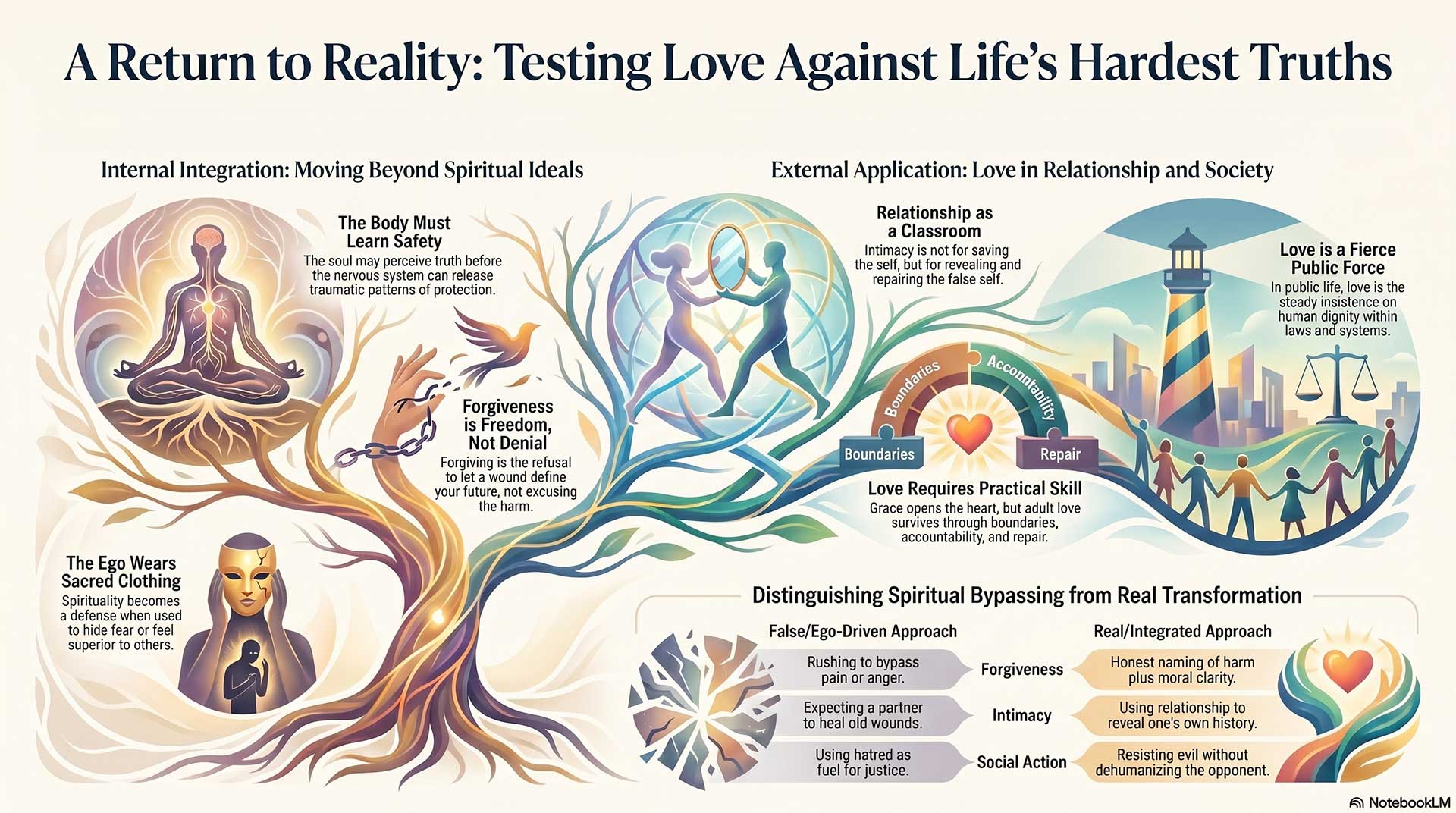
What stays with me most after this conversation is that love is still the answer, but it must be understood more deeply than many of us first imagined. Love is not a shortcut around pain. It is not a pretty layer placed over trauma, grief, anger, confusion, or injustice. It is the force that allows us to face those realities without surrendering the soul to them.
I heard that clearly in our first topic: the soul may say yes to love long before the body feels safe enough to follow. That is not hypocrisy. That is the human condition asking for patience, healing, and tenderness. I heard it again in forgiveness: forgiveness is holy, but only when it stands beside truth rather than replacing it. To forgive is not to call darkness light. It is to refuse to let darkness have the final word.
I heard too that the ego is endlessly clever. It will wear whatever costume keeps it alive, including the costume of spirituality itself. It can make specialness out of suffering, superiority out of moral language, and performance out of holiness. That is why real spiritual life must be joined to sincerity strong enough to expose what still resists love.
And then, perhaps most painfully, I heard how intimate relationships reveal what we often wish to hide. We do not bring only our love into relationship. We bring our history, our longing, our defenses, our terror of being abandoned or unseen. Yet this too can become sacred. Love in relationship is not proven by perfection. It is proven by truthfulness, repair, maturity, and the willingness to let illusion die.
Finally, public life. Perhaps that is where many people trust love least. Yet if love has no place in law, leadership, justice, race, economics, or collective fear, then fear will rule those realms unchecked. A politics without love becomes domination dressed up as realism. Love in public life is not softness. It is moral courage without hatred. It is resistance without dehumanization. It is justice with a soul.
So I leave this conversation with gratitude, and with a deeper sense that the return to love is never merely emotional. It is ethical. It is relational. It is embodied. It is political. It is spiritual in the truest sense, since it asks everything of us. It asks us to stop making homes out of fear. It asks us to let grace enter the exact places we most want to protect. And it asks us to believe that truth and love, together, remain stronger than the many disguises of fear.
Short Bios:
Marianne Williamson
Marianne Williamson is a spiritual teacher, speaker, and author best known for A Return to Love, a book that brought themes of forgiveness, fear, grace, and inner transformation to a wide audience. Her work often centers on the idea that love is the deepest truth of human life and that spiritual renewal must touch both the personal and the collective.
bell hooks
bell hooks was a writer, cultural critic, and teacher whose work explored love, power, feminism, race, education, and domination. In books such as All About Love, she argued that love must be understood as an active ethic of care, truth, responsibility, respect, and mutual growth rather than as mere sentiment or romance.
Thomas Hübl
Thomas Hübl is a teacher and facilitator known for his work on collective trauma, embodiment, and spiritual development. His teaching joins contemplative insight with a close attention to the nervous system, relational presence, and the ways unhealed trauma shapes both individuals and societies.
Edith Eger
Dr. Edith Eger was a psychologist, Holocaust survivor, and author whose work focused on freedom, resilience, healing, and the inner life after trauma. Through books such as The Choice, she showed how suffering can wound deeply without having to become the final definition of a person’s life.
Esther Perel
Esther Perel is a psychotherapist and writer known for her work on intimacy, desire, infidelity, and modern relationships. She has helped many readers and listeners see how love, fear, longing, autonomy, vulnerability, and emotional history all meet inside the complicated reality of adult partnership.
Martin Luther King Jr.
Martin Luther King Jr. was a Baptist minister, civil rights leader, and moral visionary whose life and work joined love, justice, nonviolence, and public courage. His vision of beloved community remains one of the clearest expressions of how love can confront oppression without surrendering to hatred.
Leave a Reply