

What if, Byron Katie and deep thinkers explored whether loving reality can heal suffering without becoming avoidance?
Introduction by Nick Sasaki
What makes Loving What Is so unusual is that it does not begin by trying to fix the world. It begins by asking what happens inside us when we argue with reality. That sounds simple at first, almost too simple. Yet the deeper you go, the more unsettling it becomes. Many of us do not just suffer from pain itself. We suffer from the stories we build around pain, the identities we build around injury, and the silent demands we place on life to be other than it is.
That is why this conversation matters.
Byron Katie and Stephen Mitchell gave readers a path that feels both practical and radical. It is practical since it starts with one stressful thought. It is radical since once you question that thought honestly, the whole structure of self may begin to shake. You are no longer only asking whether a thought is true. You are asking who you are without the war built around it.
In this expanded conversation, we moved through five major tensions that sit just beneath the surface of the book. First, we asked whether inner freedom can sometimes become avoidance in disguise. Then we faced the harder public question: what happens when inquiry meets injustice, betrayal, and real wrongdoing? From there, we widened the lens to include the body, since suffering is not always carried in thought alone. After that, we entered the question of identity itself, since many painful beliefs are woven into the very self we think we are. Then, in the final movement, we asked whether loving reality opens into something sacred, or whether that claim goes too far.
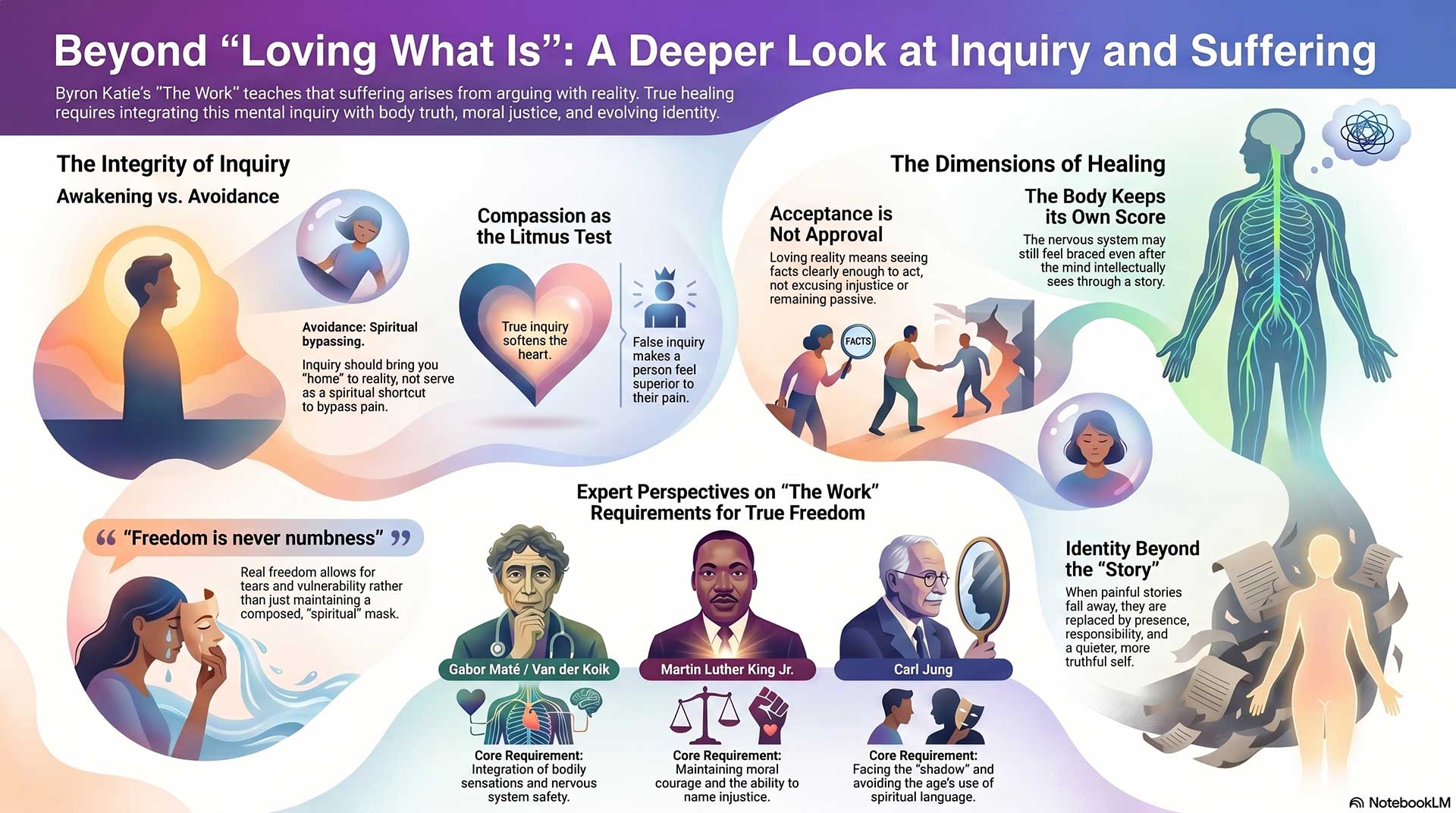
What makes this dream panel so rich is that each voice protects the book from being used too narrowly. Jung warns against spiritual self-deception. Frankl protects dignity and meaning. Pema Chödrön protects tenderness. Baldwin and King protect moral seriousness. Bessel van der Kolk and Gabor Maté protect the truth of the body. Merton, Weil, Tolle, and Thich Nhat Hanh protect the deeper silence beneath mental struggle. In that sense, this was never a conversation against Byron Katie. It was a conversation that helped her work breathe inside a larger human field.
My own feeling is that Loving What Is remains powerful since it gives people a real doorway. It does not ask them to master everything at once. It asks them to stop and look. But once that door opens, many other rooms appear. Grief appears. Justice appears. Trauma appears. Identity appears. Spiritual longing appears. That is why this book can help one person feel relief and help another person feel almost existentially undone. It is doing more than it first seems.
The deepest value of this whole conversation may be this: inquiry is not the end of feeling. It is not permission to become passive. It is not a polished way to speak above pain. At its best, it is a way of becoming more honest, more present, and less violently divided against reality. That is a much bigger achievement than mere calm.
So this imaginary conversation is really about one central possibility: can a human being face what is true without needing illusion, self-punishment, resentment, or performance to survive it?
That is the question behind the book.
That is the question behind this whole panel.
And that is why the conversation still feels alive.
(Note: This is an imaginary conversation, a creative exploration of an idea, and not a real speech or event.)
Topic 1: Can inner freedom become a hidden form of avoidance?

Opening
One of the most attractive things about Loving What Is is that it offers relief without asking people to wait for the whole world to change first. Byron Katie’s work begins in a very intimate place: the thought, the interpretation, the sentence in the mind that turns pain into suffering. That is part of why so many people find the book startling. It moves the center of gravity inward. It says, in effect, that your suffering may be less tied to reality itself than to the argument you keep having with reality.
That insight can be life-changing. It can break obsession, resentment, panic, self-pity, and years of emotional repetition. Yet the very thing that makes the book healing can also make it risky in careless hands. A person who has just discovered that thoughts are not always true may become too eager to question pain before fully meeting it. Inquiry may become a shortcut. It may become a polished spiritual move, a way to sound free without actually being free.
That is why this first topic matters so much. Before talking about justice, trauma, identity, or sacred surrender, this conversation has to ask a hard question: when does inner freedom become disguised avoidance? When does wisdom become distance? When does “The Work” become another strategy for not feeling what is actually there?
This is where a dream panel becomes valuable. Byron Katie and Stephen Mitchell opened a powerful door. Yet if this book were widened by other serious minds, this might be the first unfinished area they would want tested. The goal is not to weaken inquiry. The goal is to protect it from imitation.
Question 1
When does questioning a thought free us, and when does it merely help us escape the pain we still need to feel?
Byron Katie:
A real question does not take you away from yourself. It brings you home. When people hear inquiry as a kind of mental trick, they miss it. It is not a trick. It is a way of seeing what hurts and asking whether the story attached to it is true. When the story falls away, you do not become colder. You become more open. You become more available to reality, including pain. If inquiry makes you less human, less tender, less honest, then you are using words against yourself, not entering truth.
Gabor Maté:
I agree with the spirit of that, but many wounded people do not know the difference between release and dissociation. They may say, “I questioned the thought and now I feel peaceful,” when what has happened is that they have moved out of contact with a feeling that is too threatening. Trauma teaches distance. It teaches adaptation. A person learns to leave themselves long before they have the language to describe what they are doing. So when a method of questioning appears, they may become very skilled at stepping away from pain and calling it awareness.
Tara Brach:
That is such an important distinction. One sign is whether compassion grows. If inquiry is real, the heart becomes softer. There is less blame, less tightness, less performance. If inquiry is false, a person often becomes subtly superior to their own pain. They stop saying, “This hurts,” and start saying, “This is just a story,” too early. The wound has not been held. It has only been judged as unspiritual or unnecessary.
Carl Jung:
The psyche has many defenses, and the ego can use almost any noble language for concealment. A person may employ spiritual insight to avoid conflict with the shadow. They may “question” anger without facing hatred, “question” sorrow without facing abandonment, “question” fear without facing humiliation. So the issue is not whether inquiry is valid. The issue is whether the whole personality has entered the work, or only the part that wishes to stay in control.
Edith Eger:
Freedom is never numbness. I have seen what numbness costs. It keeps people alive for a time, but it does not make them free. Freedom lets you cry. Freedom lets you tell the truth. Freedom lets you feel what happened without letting it define your whole future. So I would ask: after the inquiry, are you more alive? Or just more composed?
This first question exposes the heart of the matter. The difference between liberation and avoidance is not always visible from the outside. Both can sound calm. Both can use almost the same language. Yet one deepens contact with reality, and the other reduces contact with reality. One opens the person, and the other protects the person from what still needs to be lived through.
Question 2
Can spiritual or wisdom language become a refined form of bypassing grief, anger, or fear?
Stephen Mitchell:
Yes, and beautiful language may make the danger greater. Human beings are easily seduced by language that gives them the feeling of transcendence. A sentence can sound luminous and still be used defensively. Someone can say, “I love what is,” while quietly refusing to admit that they are heartbroken. Poetry, spirituality, and philosophy can all become elegant shelters from unfinished feeling.
Pema Chödrön:
A lot of people want to go straight to spaciousness. They want the clean sky without sitting in the storm. But the path is not clean like that. You feel the shakiness. You feel the heat of anger. You feel the collapse of control. You stay close to the body. You learn not to run. That staying is part of what transforms the experience. Without that, spiritual practice easily becomes escape wearing white clothes.
Brené Brown:
People often use good language to manage shame. They learn how to sound self-aware, how to sound grounded, how to sound above drama. But shame hides in polished identities too. Sometimes the most defended person in the room is the one speaking most beautifully about surrender. One useful test is whether the person can still say something plain and vulnerable, like “I feel hurt,” “I feel scared,” or “I’m not ready.” If they cannot, the wisdom may be covering something.
Thomas Merton:
The false self is endlessly resourceful. It can use religion, silence, theology, detachment, purity, and contemplation to preserve itself. It can use “acceptance” as a mask. That is why any serious interior path requires humility. The ego does not disappear just because it has learned holy vocabulary.
Ram Dass:
We all do some form of this. That is worth saying kindly, not harshly. Most seekers swing between attachment and transcendence. They want relief. They want perspective. They want to stop hurting. So of course they grab onto teachings that seem to rise above the mess. The trick is not to hate yourself for that. The trick is to keep getting more honest. Real practice gets warmer over time, not cooler.
This question moves the conversation from method into character. A tool is never used in a vacuum. It is used by a human being with longing, fear, vanity, pain, history, and self-protective reflexes. That is why no liberating teaching remains safe just because its source is sincere. It must be met by sincere people, and sincere people are rare partly because self-deception is so ordinary.
Question 3
What would honest inquiry require before a person claims they are truly free from a painful story?
Susan David:
First, emotional honesty. A person needs to say what they are actually feeling before they reinterpret it. Human growth does not come from replacing one sentence with a nicer sentence. It comes from truthful contact with experience. If you skip that step, the new perspective may sound mature but remain thin.
Bessel van der Kolk:
I would add bodily truth. If a person says they are free from a story but their body still lives in bracing, shutdown, panic, or chronic alarm, then the work is unfinished. That is not failure. It simply means the organism has not yet caught up with the idea. The body does not obey insight instantly.
Viktor Frankl:
There is another standard too: dignity. Freedom should not be confused with mere relief. A person may loosen a painful thought and yet still need to ask what life is asking of them now. What is the right response? What is the responsible response? Inner release and moral seriousness belong together.
Rainer Maria Rilke:
One must be patient before declaring victory over sorrow. Some pains are not problems to be solved but depths through which the soul becomes larger. The urge to conclude too quickly may itself be a form of fear. It is possible to question what is false in one’s suffering and still remain reverent before what has not yet finished ripening.
Byron Katie:
Freedom is very simple. It is what remains when you stop arguing with reality. But people hear that and imagine a performance. It is not a performance. You do not need to look free. You do not need to speak free. You only need to notice when the mind is at war and question what it is believing. The answer shows itself in your life. You become kinder. You become clearer. You stop punishing yourself with what is.
This final question gives the strongest correction to superficial use of the book. Honest inquiry may require more than insight. It may require humility, embodiment, emotional truth, patience, and a willingness to let freedom look less impressive than people hoped. Real freedom may not appear as radiance. It may appear as a quieter nervous system, less reactivity, less blame, fewer theatrical certainties, and more capacity to remain present without fleeing into explanation.
Closing
If this book were reopened in an expanded dream conversation, this would be the first major issue to deepen: the line between awakening and avoidance. Loving What Is is powerful partly because it shows how much agony comes from believing thoughts that have never been examined. But the panel would insist that freedom from thought is not the same as freedom from feeling. One can question a belief and still need to grieve. One can see that a story is false and still need time for the body to unclench. One can become inwardly clearer and still need courage to face what has been avoided for years.
So the real test of inquiry is not whether it removes discomfort fast. It is whether it makes a person more real. More tender. More grounded. More able to stay. More able to tell the truth without decorating it.
That is where this topic becomes so valuable. It protects the book from shallow use. It says: do not turn this into a bypass. Do not turn this into spiritual cosmetics. Do not use wise language to leave yourself behind.
Use it to come closer.
Topic 2: What about injustice, betrayal, and genuine wrongdoing?

Opening
This is where Loving What Is becomes most difficult, most provocative, and most easy to misuse. It is one thing to question stressful thoughts about ordinary frustration, misunderstanding, disappointment, or personal anxiety. It is another thing entirely to bring the same method near betrayal, cruelty, abuse, humiliation, oppression, or serious moral harm. The moment the book enters that territory, readers begin to feel both its courage and its danger.
Byron Katie’s central claim is not that terrible things never happen. Her claim is that much of our suffering is intensified by our inner war with reality. On one level, that is deeply freeing. It can help people stop replaying scenes, stop poisoning themselves with mental argument, stop building identity around injury. Yet on another level, that very insight can be heard in a harsh or careless way. It can sound as if the person who was harmed is being asked to become less upset for the comfort of everyone else. It can sound as if moral clarity is being weakened in the name of serenity.
That is why this second topic would have to appear in any serious Author’s Dream Panel on this book. A teaching about acceptance must face injustice without becoming naive. A teaching about mental freedom must face evil without becoming evasive. A teaching about loving reality must answer a brutal question: what happens when reality includes betrayal? What happens when “what is” includes a lie, a violation, a cruelty, a war, a humiliation, or a deliberate abuse of power?
This is not a side issue. It is one of the most important tests of the whole book. If inquiry only works in situations where nothing morally serious is at stake, then it is far smaller than it first appears. But if inquiry can meet genuine wrongdoing without excusing it, then it becomes something much greater: not a denial of justice, but a way of facing justice without being inwardly destroyed.
So this topic has to move slowly. It must protect truth on both sides. Some suffering is clearly worsened by obsessive thinking. That is true. Yet some pain is also a sane response to something terrible. That is true too. The dream panel here would try to hold both truths at once without collapsing one into the other.
Question 1
How should inquiry meet situations where real harm has happened?
James Baldwin:
The first thing that must be said is that reality includes power. It includes domination, denial, humiliation, manipulation, and cruelty. Any method that moves too quickly into inward peace without fully naming the outer wound risks becoming useful to the oppressor. People have always preferred a version of healing that asks the wounded to become easier to live with. So before we speak of freedom from thought, we must ask who benefits when suffering is privatized.
Martin Luther King Jr.:
That is exactly right. There is a false peace that values the absence of tension more than the presence of justice. A spiritual teaching must be judged partly by whether it strengthens moral courage or weakens it. Inner freedom is precious, but it must not become a substitute for truth-telling. To love reality does not mean to bless evil. It means to face reality so clearly that one can act without hatred and without illusion.
Byron Katie:
I would never say that harm did not happen when it happened. Inquiry is not denial. Inquiry is about the suffering we create when we believe thoughts that keep us in war with what already is. If someone betrayed you, that happened. If someone lied, that happened. The question is not whether it happened. The question is: what happens inside you when you keep fighting the fact that it happened? That is where suffering multiplies.
Martha Beck:
That distinction matters a lot. There is a huge difference between reality acceptance and behavioral permission. Accepting that something happened is not the same as saying it should have happened or that it must continue. In fact, people often act more effectively after they stop spending all their energy arguing with the past.
Simone Weil:
Attention is the moral center here. To attend fully to affliction is not to excuse it. It is not to blur it. It is to look at it without self-flattery, without falsification, and without the comforting distortions of ego. Many people distort suffering by dramatizing it. Others distort it by minimizing it. The soul must learn to look.
This first question begins by separating three things people often confuse: the event itself, the mind’s war with the event, and the ethical response that ought to follow. If those collapse into one another, the teaching becomes dangerous. If they remain distinct, the teaching regains strength. Inquiry may help with the mental war. It does not erase the event. It does not determine the whole ethical response. It does not remove the need for boundaries, truth, consequences, or protection.
That is the first major deepening this book needs in a longer conversation. Readers must hear, very clearly, that inner peace does not require moral blindness.
Question 2
Can “loving what is” be misunderstood as passivity?
King:
Yes, very easily. Human beings are highly skilled at turning noble language into social convenience. “Acceptance” can be used by those in comfort to quiet those in pain. “Forgiveness” can be demanded before repentance. “Peace” can be praised in ways that keep unjust systems intact. So any language of inward serenity must be watched carefully. Does it produce courageous action, or does it merely produce quieter victims?
Thich Nhat Hanh:
Peace is not passivity. A person can breathe, walk, and speak from a deep place of non-hatred and still resist injustice with firmness. In fact, action born from rage alone often creates more suffering. The point is not to become passive. The point is to keep the heart from becoming what it opposes.
James Baldwin:
That is beautifully said, but I would still insist that many people use spiritual calm to remain innocent in their own eyes. They do not want to face conflict. They do not want to disturb the social arrangement that protects them. So they admire teachings that sound deep and non-reactive. Their calm is not enlightenment. It is self-protection.
Byron Katie:
For me, loving reality never meant staying in a harmful situation. It meant seeing clearly. If someone is dangerous, you leave. If someone lies, you do not need to trust them. If your mind says, “This should not have happened,” that thought may create suffering. But that does not mean you let the person keep doing it.
Parker Palmer:
This is where the divided life becomes visible. People often speak in morally attractive terms that hide a refusal to risk anything. They say they have accepted reality, but what they have accepted is their own fear. Real inward clarity should make a person more capable of decisive action, not less.
Pema Chödrön:
There is also a softer side to this. Some people confuse passivity with temporary overwhelm. They are not spiritually mature yet. They are frightened, frozen, or exhausted. So the question is not only whether teachings can be misused. It is also whether people are given enough compassion and support to grow strong enough to use them wisely.
This question is where the language of the book enters public life. What does inquiry do to a person standing in a broken marriage, a manipulative family, a corrupt institution, a racist system, a violent history, or a humiliating betrayal? Does it help them become more truthful and effective? Or does it train them to suppress moral alarm?
The dream panel would likely insist on one answer: if acceptance weakens truthful action, something has gone wrong in the reading. Loving reality should mean seeing the situation so clearly that fantasy falls away. Sometimes fantasy says, “I can make this person become who I need.” Sometimes fantasy says, “If I stay peaceful enough, wrong will stop being wrong.” Those fantasies need to die. What remains is not passivity. It is clarity.
Question 3
How can a person question their thoughts without betraying their moral intelligence?
Viktor Frankl:
We must preserve the distinction between freedom from destructive inner compulsion and fidelity to moral reality. A person may loosen resentment without losing judgment. A person may stop replaying injury without ceasing to know that injury occurred. Human beings need not choose between sanity and conscience.
Nicholas Wolterstorff:
That is essential, especially in grief and moral pain. There are tears that are not delusion. There is lament that is not neurosis. There is protest that is a rightful response to love violated. If one uses inquiry to flatten those responses into mere mental error, one risks doing violence to the soul’s witness.
Alice Miller:
Very often the wounded have already been trained to mistrust their perception. They have been told they are too sensitive, too angry, too dramatic, too unforgiving. So when a spiritual teaching arrives and asks them to question their thoughts, it may unintentionally reinforce the same pattern. They may become even less willing to trust their own moral knowledge.
Carl Jung:
Quite so. Discernment depends on differentiation. Not every judgment is projection. Not every strong reaction is pathology. The psyche must learn to tell the difference between a symbolic inflation and an accurate perception of wrongdoing. Otherwise one becomes incapable of mature moral life.
Brené Brown:
This matters in ordinary relationships too. People already struggle to name betrayal, manipulation, shame, and contempt. If they question themselves too soon, they often fall back into self-blame. Healthy inquiry should increase self-trust, not erase it.
Byron Katie:
The question is always honest and simple: what happens when you believe the thought? Does it bring clarity or war? There are thoughts that are practical. There are thoughts that protect. There are thoughts that simply describe what is. And then there are thoughts that keep you trapped in suffering. Inquiry is for those stressful thoughts. It is not for abandoning common sense.
This third question may be the most delicate of all. It asks whether moral intelligence can survive the process of questioning. The answer from this panel would likely be yes, but only if the person doing the questioning is careful not to use inquiry as a weapon against their own perception.
A mature reading of the book would make room for several truths at once. Yes, some thoughts intensify suffering. Yes, some stories become prisons. Yes, resentment can become self-poisoning. Yet also: some wrongs are real, some boundaries are necessary, some judgments are accurate, some grief is proper, and some anger is the mind’s first honest signal that dignity has been violated.
The goal is not to become incapable of protest. The goal is to protest without becoming inwardly ruled by poison.
Closing
This second topic reveals one of the deepest unfinished tensions inside Loving What Is. The book is powerful when it teaches people how to stop multiplying pain through mental warfare. It becomes vulnerable when readers carry its language into morally serious situations without enough discernment. Then “acceptance” can start sounding like surrender, “peace” can start sounding like silence, and “loving reality” can start sounding like asking the wounded to bear more than they should.
A richer Author’s Dream Panel would protect the book from that misuse. It would say: do not confuse the end of inner argument with the end of moral clarity. Do not confuse freedom from resentment with trust. Do not confuse serenity with reconciliation. Do not confuse acceptance of the fact that something happened with approval of what happened.
Real wisdom has to be able to do something harder than either rage or avoidance. It has to look directly at betrayal and say: yes, this happened. Yes, it was wrong. Yes, I do not need to keep poisoning myself with war against the past. And yes, I may still need to leave, resist, expose, protect, grieve, or demand truth.
That is where the teaching grows up.
It stops being merely therapeutic and becomes morally serious.
Topic 3: Is suffering created by thought alone, or does the body keep its own score?

Opening
By the time a reader reaches this point in a deeper conversation around Loving What Is, a serious tension starts to appear. Byron Katie’s method is centered on thought. It asks what you are believing, what happens when you believe it, who you would be without it, and how the turnaround changes the field of meaning. That focus is part of the book’s brilliance. It gives people a precise place to begin. It does not ask them to solve their whole past at once. It asks them to look carefully at the thought that is causing immediate suffering.
Yet human pain is not only verbal. It is not only interpretive. It is not only a sentence in the mind. Some pain is carried in breathing, muscle tension, posture, gut alarm, reflexive shame, numbness, panic, collapse, insomnia, flinching, silence, and habits of self-protection built long before a person knew how to describe what was happening. The mind can tell a story, but the body often tells an older one.
This is where an expanded dream panel becomes necessary. If Loving What Is remains only at the level of cognition, some readers will feel seen and transformed, but others will feel as if they understand the teaching and yet remain trapped in reactions they cannot think their way out of. They may begin to blame themselves for not being free fast enough. They may assume the problem is that they are not doing inquiry correctly, when in fact their nervous system is still living inside an earlier adaptation.
So this topic asks a harder question: is suffering really generated by thought alone, or does the body preserve pain in ways thought can illuminate but not instantly dissolve? The issue is not whether inquiry works. It clearly does for many kinds of suffering. The issue is whether suffering is broader than the doorway through which the book enters it.
If Byron Katie and Stephen Mitchell were sitting with a room full of serious thinkers, this would likely become one of the richest places to deepen the conversation. The panel would not try to dismiss inquiry. It would try to place it inside a fuller picture of human healing. That fuller picture would include language, memory, sensation, safety, relationship, time, and the body’s slower wisdom.
Question 1
Can deep suffering remain in the body after a person has already seen through the thought intellectually?
Bessel van der Kolk:
Yes, very plainly, yes. A person can understand with great clarity that a belief is distorted and still find that their body reacts as if the old danger is present. They can say, “I know I am safe,” and still feel braced. They can say, “I know that was then,” and still wake in alarm. The body does not organize itself by philosophy alone. It organizes itself by experience, rhythm, repetition, attachment, and threat. Insight helps, but it does not erase conditioning on contact.
Gabor Maté:
That matters deeply, especially for people shaped by early stress. A child adapts before a child reflects. The body learns vigilance, pleasing, shutdown, overperformance, dissociation, or emotional self-erasure long before there is mature language around it. So later in life, when a person meets a method like inquiry, they may grasp the idea beautifully and still remain governed by a body that learned survival in another grammar.
Byron Katie:
I hear that, and I would say inquiry is not only intellectual. When you ask a true question, the body responds. You can feel the contraction when you believe the thought. You can feel the opening when you do not. The Work is not about replacing one concept with another. It is about seeing what is real in a way that changes your whole experience.
Tara Brach:
That is true at its best. Yet many people do the process first in their head. They answer correctly before they are ready to feel honestly. So they reach the insight without the tenderness. They say the right thing, but the body has not yet trusted the shift. This is where compassion is needed. People should not be shamed for having a nervous system that still needs time.
Eckhart Tolle:
Presence can hold both realities. There may be a clear seeing that the story is not true in the old way, and yet there may still be pain-body activation. The important thing is not to create a second layer of suffering by demanding immediate completion.
This first question opens a crucial door. Many readers need permission to realize that insight and embodiment do not always move at the same speed. That does not mean the insight is false. It means human beings are layered. The mind may recognize a truth today that the body learns to trust next month, next year, or through repeated safe experience. A mature version of the book would make that lag feel human rather than deficient.
Question 2
What is the relation between cognition and embodiment in healing?
Susan David:
Meaning matters, but felt experience matters too. Human beings do not heal by interpretation alone, nor by raw sensation alone. We need language that helps us make sense of what is happening, and we need enough contact with the body to know what is actually happening. If those split, growth becomes thin. Either we become flooded without reflection, or we become articulate without contact.
Maté:
Exactly. A belief may intensify pain, but the belief often rests on a bodily history. A person who believes “I am not safe” may not simply be thinking badly. They may be expressing a whole organism organized around unsafety. In that case, inquiry can expose the thought, but healing may also require grief, relationship, tenderness, and the repeated experience of not being abandoned.
Pema Chödrön:
And staying matters. Staying with the flutter, the heat, the collapse, the trembling. So much of practice is learning not to run the moment discomfort rises. The body becomes a place of training in courage. You do not need to crush the feeling or worship the feeling. You let it be known.
Michael Singer:
The witness is useful here. When you stop clutching around each energetic movement, something loosens. The body can release more naturally when the mind is not constantly building identity around every contraction.
Jung:
The psyche is not a machine with neatly separable compartments. Symbol, body, dream, reflex, image, and thought belong to one living field. Any model that reduces suffering to one domain will miss the hidden reciprocity between them.
Brené Brown:
There is a practical side too. Many people live cut off from the body until something breaks. They can explain their life brilliantly, yet they cannot tell you when they feel shame, fear, dread, joy, or relief until it is overwhelming. A full healing path has to help them return to their own signals.
This second question turns the conversation from “mind versus body” into “mind with body.” That is a vital shift. The dream panel would likely resist making cognition the enemy. The book is powerful partly because clear thought matters. Stories do shape perception. Interpretation can imprison. Mental repetition can deepen agony. But a wiser reading would say that inquiry works best when it is joined to sensation, emotional truth, relational safety, and the body’s own pacing.
In other words, healing may require both seeing and sensing. Both truth and time. Both questioning and permitting.
Question 3
How would this book grow if it fully integrated the body into its vision of freedom?
Bessel van der Kolk:
It would tell readers more plainly that the body may need its own forms of learning. Breath, movement, sleep, touch that is safe, rhythm, crying, grounded repetition, trauma-informed relationship, perhaps even silence that is not empty but regulated. Freedom would be described not just as a changed thought, but as a changed capacity to inhabit one’s own organism without terror.
Edith Eger:
Yes, freedom is practiced. It is lived. It shows up in whether you can stay present in a difficult conversation, whether you can rest, whether you can tell the truth, whether you can stop rehearsing old fear in every new room. The body is part of liberation. Otherwise freedom stays abstract.
Tara Brach:
The book would make more room for kindness before mastery. Many people need to be met gently before they can question anything deeply. If the body feels threatened by the process, the process may turn into one more place where they fail themselves. But if the inquiry is wrapped in mercy, the nervous system begins to trust that awareness is not an attack.
Byron Katie:
For me, inquiry already is mercy. But I agree that people may need to meet it slowly and honestly. The question is never meant to be violent. It is meant to expose the violence we do to ourselves when we believe what is not true.
Ram Dass:
That is the beauty here. The teaching does not need to be discarded. It needs to be ripened. It needs room for the body’s timing. The soul may recognize freedom ahead of the flesh, and that is all right. Love can wait.
Parker Palmer:
And integration means congruence. What the person says, what the person knows, what the person feels, and how the person lives slowly begin to come into one line. That is deeper than relief. That is wholeness.
This final question shows how much larger the book could become without losing its center. The Work would still remain the doorway. Thought would still matter. Stressful beliefs would still be worthy of close examination. But the panel would widen the frame. It would say that freedom is not merely the moment a thought is seen through. It is the slower alignment of mind, body, feeling, action, and reality.
That enlargement would protect readers from a common mistake: assuming that if the body still hurts, the insight did not work. The wiser answer may be that the insight has begun its work, and the rest of the self is still catching up.
Closing
This third topic may be one of the most humane expansions of Loving What Is. The book gives readers a powerful instrument for questioning mental suffering, but an Author’s Dream Panel would make clear that the human being is more than the conscious mind. Pain can live in reflexes, chemistry, posture, breath, shame, and memory that has not yet found words. A story may be loosened before a body feels safe. A belief may be questioned before the nervous system knows how to unclench.
That does not weaken the teaching. It makes it kinder and more complete.
The deepest version of inquiry would not ask people to choose between thought and body. It would help them see how the two speak to each other. It would say: notice the thought, yes. Question it, yes. But listen too for the older language underneath it. Listen for the breath that shortens, the chest that tightens, the stomach that drops, the face that freezes, the exhaustion that follows years of inner war.
Then freedom becomes more than a mental shift.
It becomes a life that can finally be lived from the inside without so much fear.
Topic 4: What happens to identity when our stories fall apart?

Opening
By this point in a deeper conversation on Loving What Is, the discussion begins to move past relief and into something far more unsettling. It is one thing to question a stressful thought in order to suffer less. It is another thing to discover that the thought was helping hold your whole identity together. Many people do not suffer only from isolated beliefs. They suffer through entire inner structures built over years: “I am the one who was wronged.” “I am the one who must stay in control.” “I am the one who takes care of everyone.” “I am the one who never gets chosen.” “I am the one who must be exceptional to deserve love.” These are not just thoughts. They are personal mythologies. They organize memory, expectation, posture, tone of voice, relationships, and even the future a person believes they are allowed to have.
That is why this topic belongs in any serious Author’s Dream Panel on Byron Katie and Stephen Mitchell’s book. The Work can seem simple when described as inquiry into stressful beliefs. Yet the deeper consequence is often much larger. When a stressful belief weakens, the person may not feel relieved right away. They may feel disoriented. They may feel groundless. They may feel strangely empty, almost as if something important has been taken from them. That “something” may be the story they used to know who they were.
A painful identity is still an identity. It can make a person miserable, but it can also make the world legible. It tells them who to blame, what to fear, how to protect themselves, why love has been hard, why ambition matters, why resentment remains justified, why certain patterns keep repeating. So when inquiry enters deeply enough to shake that structure, the experience may stop feeling therapeutic and start feeling existential.
This is where the book could grow into something even richer. A larger conversation would ask: if the old story falls away, what remains? Who am I without the grievance, the fear, the role, the self-image, the repeating wound, the heroic mask, the polished competence, the family script, the private victimhood, or the old meaning of my suffering? Is freedom simply release, or is it also a kind of death? And if it is a kind of death, what kind of life comes after?
This topic matters so much since many people do not resist truth mainly because truth is false. They resist it since truth threatens the self they have learned to inhabit. The story hurts, yes. Yet it also gives shape. So a mature conversation around Loving What Is must face the cost of waking up. It must ask what identity becomes when the old internal architecture no longer holds.
Question 1
Why do people cling so tightly to painful identities?
Carl Jung:
The ego clings to what is familiar, even when the familiar is miserable. A painful identity still offers continuity. It gives the person a recognizable pattern. The unknown is more frightening than suffering that has become domestic. That is why people often defend the very patterns that diminish them. Those patterns have become a home for consciousness.
Parker Palmer:
Yes, and many people are living from a role that once protected them. The role may be “the strong one,” “the good one,” “the overlooked one,” “the successful one,” “the peacemaker,” “the one who never needs anything.” Such roles often begin as adaptations. They help a person survive family systems, institutions, humiliation, neglect, or loneliness. Over time, the role begins to feel like the person. So when it is questioned, what is threatened is not just a belief but a whole way of being known.
Rainer Maria Rilke:
We keep our sorrows partly since they are among the few things that have stayed faithful to us. A grief, a wound, or a loneliness can become strangely intimate. One learns its weather, its language, its rooms. To release it may feel less like recovery than like abandonment of something one has carried for a long time.
Byron Katie:
People keep painful stories since they have not yet seen who they are without them. The mind believes the story gives identity, safety, even purpose. But when the story is questioned, something kinder appears. What you really are does not depend on holding pain in place.
Thomas Merton:
The false self is composed from attachment, fear, image, demand, and performance. It does not mind suffering if suffering helps maintain its boundaries. In fact, it often prefers familiar suffering to open surrender. It would rather be wounded and defined than undefended and real.
This first question reveals that identity is not built only from joy, desire, and chosen values. It is often built from injury, fear, adaptation, and repetition. People do not cling to painful identities since they enjoy pain. They cling to them since pain has become structured, named, and morally loaded. It tells them where they stand. It tells them what kind of person they are. It tells them which parts of reality to expect.
That is why inquiry can feel threatening long before it feels freeing. It is not merely asking a person to lose stress. It may be asking them to lose the self who has been built around that stress.
Question 2
What kind of maturity is needed to live without overidentifying with personal story?
Eckhart Tolle:
A person must discover that awareness is deeper than the content passing through it. Without that discovery, identity remains fused with thought. Every narrative becomes “me.” Every memory becomes “me.” Every emotion becomes “me.” The maturity lies in seeing that experience is real but need not define the essence of who you are.
J. Krishnamurti:
One must observe without immediately converting observation into identity. The moment anger appears, the mind says, “I am angry,” and then builds continuity. But there can be observation without this constant construction of self. That requires alertness, not method in the mechanical sense, but a living attentiveness.
Pema Chödrön:
It also takes softness. People often imagine freedom from story as some grand heroic detachment, but usually it feels more vulnerable than that. You are less defended. You do not know who you are in the old way. You cannot use the familiar drama as quickly. That can feel shaky. So maturity includes learning how to stay gentle with yourself in that groundless place.
Martha Beck:
And honesty matters. Some stories are maintained through small daily dishonesty. You keep saying yes when you mean no. You keep presenting competence when you are exhausted. You keep acting cheerful when you are sad. You keep performing certainty when you are confused. Identity is upheld through habits. Freedom needs practical truthfulness, not just insight.
Simone Weil:
The self must become less insistent. Much suffering comes from the demand that reality confirm the ego’s preferred picture. To release story is partly to stop demanding that life constantly certify “me.” That is painful. Yet it is also the beginning of a more truthful attention.
Ram Dass:
There is love needed here too. If you try to tear the ego away from yourself violently, you just create another project for the ego. It becomes “my spiritual achievement.” Better to notice, smile, soften, and keep returning. The old identity thins gradually when it is no longer fed.
This second question helps show that identity loosening is not only intellectual. It calls for steadiness, self-kindness, attention, humility, and practical congruence. A person needs enough inner space to let the old self become less convincing without rushing to build a new performance around “being free.” That may be one of the trickiest parts of the path. People can drop one story and instantly create another: “Now I am the awakened one.” “Now I am the one who sees what others do not.” “Now I am the spiritually mature one.”
The dream panel would warn against that too. The loss of false identity is not meant to become a more flattering false identity. Real maturity looks quieter. It tends to carry less self-display, less insistence, less narrative weight, less emotional theatricality. The person becomes simpler, but not shallower.
Question 3
What replaces the old self after inquiry begins to do its work?
Viktor Frankl:
Responsibility. Once a person is less possessed by the old story, the question becomes: what is life asking of me now? Identity can then shift from self-preoccupation to response. This does not erase the person. It places them into relation with meaning.
Thich Nhat Hanh:
Interbeing. The isolated self softens. One begins to see that suffering, joy, fear, and tenderness are not private possessions in the way the ego imagined. One’s life becomes less centered on protecting a separate image and more rooted in connection, breath, and compassionate presence.
Parker Palmer:
Congruence. The inner and outer life begin to move closer together. What a person says, does, feels, and values come into better alignment. This may sound modest, but it is a profound transformation. Much human misery comes from living divided against oneself.
Merton:
A truer self does not arrive as an ornament. It arrives as less falseness. It is discovered more by subtraction than display. There is less compulsion to perform, justify, dominate, or defend. Silence becomes less threatening. One does not need constant narrative confirmation.
Rilke:
Perhaps what replaces the old self is not a finished identity but a more spacious way of being unfinished. One no longer clutches form quite so tightly. One can live more openly inside mystery.
Byron Katie:
Reality replaces the story. People imagine that what comes after inquiry must be a new identity, but what comes is much simpler. There is just life as it is, without the war. Then action becomes clear.
Jung:
I would add that the self which emerges is not blankness. It is fuller, less narrow, less defensive. The ego yields some of its tyranny, and in that yielding the personality becomes more capable of relation, symbol, feeling, and inner depth.
This final question is vital since people often fear that if they let go of their story, they will become empty, passive, or undefined. But the panel’s answers suggest something else. What comes after the old self is not nothing. It is a different center of life. Instead of grievance, perhaps responsibility. Instead of role, perhaps congruence. Instead of performance, perhaps presence. Instead of dramatic self-definition, perhaps a quieter and more connected way of existing.
That shift may not feel glamorous. It may not give the ego much to brag about. It may look like less personal mythology and more direct living. Yet that may be one of the deepest fruits of inquiry. A person stops being narrated so heavily and starts being present more fully.
Closing
This fourth topic opens one of the deepest existential dimensions in Loving What Is. The book begins with stressful thoughts, but the farther a person goes with real inquiry, the more they discover that many thoughts are woven into identity itself. The painful belief is not hanging in isolation. It is often part of a whole inner civilization: a role, a self-image, a wound-based loyalty, a protective script, a private legend about who one is and what life has done to them.
That is why the path can become disorienting. Relief is not the only thing that appears. Groundlessness appears. Vulnerability appears. Silence appears. The old drama loses force, but the new life has not fully taken shape. In that in-between place, a person may feel almost homeless inside themselves.
A richer Author’s Dream Panel would treat that phase with more depth and more compassion. It would tell readers that losing an old story can feel like grief. It would tell them that painful identities do not disappear on command since they once served a purpose. It would tell them that what comes after the false self is often less dramatic than they expect, but far more peaceful: less performance, less repetition, less inner division, less need to keep proving the same story.
And in that quieter space, something beautiful may begin.
Not a shinier identity.
Not a more spiritual mask.
Just a more truthful human being, less trapped inside the need to keep becoming someone in order to be whole.
Topic 5: Can loving reality become a path to the sacred, or is that claiming too much?

Opening
This final topic brings the whole conversation to its deepest edge. Loving What Is can be read in a practical way, almost like a disciplined method for reducing needless suffering. A stressful thought appears, inquiry begins, the thought loosens, the inner war softens, and life becomes more bearable. That alone is already significant. Many books promise peace and offer only inspiration. Byron Katie’s work offers a direct practice.
Yet the title of the book reaches farther than technique. Loving What Is does not sound like a mere psychological tool. It sounds like a spiritual claim. It suggests that reality itself, once no longer fought, may reveal something holy, or at least something worthy of reverence. It suggests that peace is not just relief from mental strain but a transformed relationship to existence itself. And once that possibility appears, the conversation becomes much larger.
Is this book pointing only to emotional freedom, or is it pointing to a form of awakening? Is inquiry simply a way of becoming saner, or can it become a way of becoming more prayerful, more open, more surrendered, more awake to mystery? When the argument with life begins to end, does one arrive merely at calm, or at something that older traditions might have called grace, presence, God, emptiness, truth, or love?
This is where an Author’s Dream Panel becomes especially rich. Byron Katie and Stephen Mitchell sit near the border between psychology and spirituality. Their language is plain, yet the experience they describe often sounds larger than plain therapeutic improvement. People do not only say they feel less stressed. They often speak as if they have touched something ultimate. A wider panel would need to test that carefully. It would ask whether this opening into reality should be described in sacred terms, or whether sacred language risks exaggeration, sentimentality, or hidden dogma.
This matters since spiritual inflation is always a danger wherever inner freedom is discussed. A real shift can occur, and then the ego rushes in to crown it with grand meaning. A person can move from “I am suffering” to “I have found the final answer” far too quickly. So the deepest version of this topic must hold two impulses together: reverence without exaggeration, openness without grandiosity, depth without performance.
This final conversation is not really asking whether spirituality is allowed. It is asking what kind of spirituality could emerge from inquiry without becoming false. It is asking whether loving reality leads to the sacred, and if it does, what kind of sacredness survives honesty.
Question 1
Does loving reality naturally open into spirituality, or can it remain fully secular?
Stephen Mitchell:
I think the experience can be spoken in secular language, but it often carries a spiritual tone whether one wants that language or not. When people stop fighting reality, they often do not report mere efficiency. They report relief, wonder, humility, tenderness, and silence. Those are not owned by religion, yet they have always belonged to spiritual life.
Eckhart Tolle:
When identification with thought weakens, presence becomes obvious. Presence is not an idea. It is the felt fact of being before the mind turns it into narrative. Many people call that sacred since it carries stillness, aliveness, and depth beyond conceptual thought. They need not use the word “God,” but they often sense that they have moved closer to the source of peace.
Thomas Merton:
The deepest spiritual realities are often simple in experience and difficult in language. One lets go of compulsive self-assertion, and the world becomes less an object to conquer and more a gift to receive. That movement can happen inside religion or outside it. What matters is not the label but the death of inner domination.
Simone Weil:
Attention of the purest kind already carries something like prayer within it. To look at reality without demand, without self-flattery, without fantasy, is a rare moral and spiritual act. If inquiry leads to such attention, then one has already crossed a threshold that many traditions would recognize.
Byron Katie:
I do not begin with religion. I begin with what hurts. Yet when the mind stops arguing with reality, what remains is kinder than the old story. People can call that what they like. I do not need to name it for it to be true.
This first question makes something plain. The experience opened by the book may be described without religious language, yet it tends to lean into reverence. A person who stops fighting life often does not become merely more functional. They become quieter in a deeper sense. The world feels less like an opponent. The self feels less armored. Experience is no longer organized so completely around inner resistance. Even without doctrine, that shift begins to resemble spiritual life.
Yet the panel would likely resist forcing the experience into one official vocabulary. That restraint matters. Some people touch depth through silence, some through God-language, some through Buddhist terms, some through poetry, some through no system at all. The point is not to claim ownership of the experience but to honor its depth without shrinking it.
Question 2
Is there a danger in turning inquiry into a final answer or a new absolute?
J. Krishnamurti:
Yes. The mind wants systems. It wants method, repetition, authority, and conclusion. The danger is that a living act of seeing becomes a fixed path, then an identity, then a doctrine. One begins by questioning thought and ends by obeying a new pattern of thought. That is always the danger.
Carl Jung:
Every genuine insight is vulnerable to hardening. A symbol that once carried life becomes a slogan. A practice that once opened reality becomes a shield against reality. So one must ask whether inquiry remains alive and particular, or whether it has become an ideology of detachment.
James Baldwin:
Any language of freedom can become false the moment it starts sounding too complete. Human life is full of contradiction, grief, history, violence, beauty, and unfinished moral struggle. A teaching that cannot admit unfinishedness becomes dangerous. It begins to flatten the human condition in order to preserve its elegance.
Thich Nhat Hanh:
Practice should deepen humility. If a person becomes gentler, more compassionate, more able to listen, then the practice is healthy. If they become dismissive, superior, or impatient with ordinary human pain, something has gone wrong.
Byron Katie:
The Work is not something to believe. It is something to try. It is not meant to replace reality with a new belief system. It is meant to help you see what is true for yourself.
Ram Dass:
That is a wise safeguard. The ego can make a throne out of almost anything. It can become “the one who knows,” “the one who has transcended,” “the one who is beyond suffering.” Real practice tends to make a person simpler, kinder, and less impressed with themselves.
This second question is necessary for the final topic since sacred language can tempt people to overstate what has happened. A real opening may occur, yet the personality remains unfinished. Fear may still arise. Grief may still visit. Moral struggle may still be real. Relationship may still humble you. The body may still carry old reflexes. Society may still be unjust. To speak of sacred depth honestly, one must keep all of that in view.
The dream panel would likely say that inquiry becomes false when it ceases to be a living investigation and becomes a badge. It becomes false when peace turns into self-image. It becomes false when the person starts speaking as though all tension has been solved instead of transformed. Sacred depth is real, but it is not theatrical completion.
Question 3
What is the highest fruit of this path, if the path is followed honestly and deeply?
Martin Luther King Jr.:
Love with courage. Not sentiment, not softness detached from truth, but love that can endure conflict without becoming hatred. The test of inner freedom is not whether one feels serene in private. It is whether one can enter a broken world without surrendering dignity or compassion.
Viktor Frankl:
Meaning that can survive suffering. A person who no longer demands that life obey their preferred script becomes more capable of responding to life with responsibility. Freedom is not only release from inner torment. It is readiness to answer the call of the moment.
Pema Chödrön:
A heart that does not run so quickly. That may sound small, but it changes everything. When fear, sadness, uncertainty, or loss arise, the person stays a little longer. They do not need to armor up so fast. They can remain present with what used to undo them.
Nicholas Wolterstorff:
Truth that leaves room for tears. Any path worth trusting must preserve the dignity of grief. Sacred depth should not erase lament. It should make lament more truthful, less poisoned, less theatrical, but still fully human.
Tara Brach:
Compassion grows when the self is less defended. The person becomes less trapped in the harshness of self-judgment and less likely to treat others through the lens of old fear. What emerges is a gentler presence, one that can welcome life more fully.
Thomas Merton:
A quieter self. Less appetite for performance. Less need to dominate reality. More capacity for silence. The fruits of spiritual truth are often negative in form: less vanity, less demand, less illusion, less compulsion.
Byron Katie:
The simplest fruit is peace. Not peace as a pose, but peace as no longer arguing with what is. From there, action becomes much clearer.
This third question gathers the whole book into a final horizon. If inquiry is real, its highest fruit is not clever turnarounds, impressive self-awareness, or detached calm. It is a transformed way of being human. A person becomes more capable of reality, more capable of sorrow without collapse, more capable of action without hatred, more capable of honesty without panic, more capable of love without illusion.
That is a spiritual claim, whether one uses spiritual language or not.
Closing
This final topic shows why Loving What Is has spoken to so many people across different traditions and outside of formal tradition altogether. The book begins in the mind, but it does not seem to end there. It begins with suffering, but it does not merely promise symptom relief. It begins with thought, but it points toward a larger way of inhabiting existence. That larger way may be called presence, surrender, truthfulness, grace, peace, or sacred attention. The name matters less than the transformation.
A richer Author’s Dream Panel would treat that transformation with both seriousness and restraint. It would not shrink the spiritual depth of the book into mere technique. Yet it would not let the book become inflated into a total answer either. It would say that loving reality can open a person into reverence, humility, and peace, but only when the path stays honest. Only when tears are still allowed. Only when injustice is still named. Only when the body is still heard. Only when identity is still questioned. Only when the ego is not crowned king of its own awakening.
That is the real completion of the conversation.
Not the fantasy of becoming beyond suffering.
Not the performance of being spiritually advanced.
But the slower, deeper possibility that a human being can stop fighting reality so violently and, in that softening, become more truthful, more loving, and more awake.
That is where this book becomes larger than method.
That is where it begins to touch wisdom.
Final Thoughts by Nick Sasaki
After listening to all five topics unfold, I think the deepest gift of Loving What Is is not that it removes suffering instantly. Its gift is that it exposes how much unnecessary suffering is created by the mind’s refusal to let reality be real. That insight alone can change a life. Yet this conversation also made clear that the book becomes strongest when it is joined with humility.
It needs humility since pain is not always just a false thought. Sometimes pain is grief. Sometimes it is moral alarm. Sometimes it is trauma living in the body. Sometimes it is the terror of losing an old identity. Sometimes it is the soul standing in front of a truth that will cost more than comfort. In all those cases, inquiry still matters, but it must be held with care.
What I appreciated most in this panel was that no one tried to flatten the book into one final formula. The wiser voices kept returning to a harder balance. Yes, question the thought. Yes, stop fighting reality in ways that destroy your own peace. But no, do not use that as a reason to mistrust your moral intelligence. Do not use it to leave your body behind. Do not use it to rush past sorrow. Do not use it to pretend awakening is neat.
Real freedom, as this conversation showed, seems quieter than many people expect. It may look like less performance. Less insistence. Less self-dramatization. Less inner argument. Less need to keep proving the same story. It may look like more capacity to stay, more capacity to tell the truth, more capacity to act clearly, more capacity to grieve without becoming trapped, and more capacity to love without demanding that life first become ideal.
That is a serious kind of freedom.
I also think this conversation showed why Byron Katie’s work continues to attract people from spiritual, psychological, and secular backgrounds alike. The doorway is simple, but what lies beyond it is not small. Once a person stops arguing with one painful thought, they may begin asking much larger questions. Who am I without my old story? What is justice without hatred? What is healing if the body still remembers? What is peace if grief remains? What is sacredness if no dogma is required?
Those are not small questions. They are life questions.
So if I had to leave this whole panel with one final impression, it would be this: Loving What Is is most helpful when it is read not as a shortcut to transcendence, but as an honest discipline of reality. A discipline of seeing. A discipline of not lying to oneself. A discipline of meeting life with less argument and more truth.
And perhaps that is why the title still carries so much force.
To love what is does not mean to approve of everything.
It means to stop building a second prison out of mental war.
It means to meet reality cleanly enough that action, sorrow, love, and even silence can begin from something true.
That is not everything.
But it is a profound beginning.
Short Bios:
Byron Katie
Creator of The Work, a method of self-inquiry centered on questioning stressful thoughts and discovering peace through radical honesty.
Stephen Mitchell
Writer, translator, and co-author of Loving What Is, known for bringing poetic clarity and spiritual depth to timeless wisdom.
Viktor Frankl
Psychiatrist, Holocaust survivor, and author of Man’s Search for Meaning, remembered for his insight into suffering, meaning, and human responsibility.
Carl Jung
Swiss psychiatrist and founder of analytical psychology, known for his work on the shadow, the unconscious, symbolism, and individuation.
Pema Chödrön
Buddhist teacher and writer whose work helps people stay present with fear, uncertainty, and emotional pain with gentleness and courage.
Martha Beck
Writer and life coach known for helping people align with inner truth and free themselves from limiting patterns and false roles.
Gabor Maté
Physician and author whose work explores trauma, stress, addiction, and the ways emotional pain becomes embodied.
Eckhart Tolle
Spiritual teacher best known for teaching presence, freedom from compulsive thought, and awakening beyond ego-identification.
Tara Brach
Psychologist and meditation teacher known for teaching radical acceptance, compassion, and healing through mindful presence.
J. Krishnamurti
Philosopher and spiritual teacher who challenged authority, systems, and conditioning, urging direct perception and inward freedom.
Simone Weil
French thinker and mystic known for her writings on attention, suffering, humility, and the spiritual meaning of affliction.
Thich Nhat Hanh
Zen teacher, poet, and peace activist known for mindfulness, compassion, and the practice of living deeply in the present moment.
James Baldwin
Essayist and novelist whose moral clarity on race, identity, power, and human honesty still speaks with unusual force.
Edith Eger
Psychologist, Holocaust survivor, and author whose work focuses on resilience, healing, and freedom beyond victimhood.
Bessel van der Kolk
Psychiatrist and trauma researcher best known for showing how trauma is carried in the body as well as the mind.
Michael Singer
Spiritual writer known for exploring witness-consciousness, surrender, and freedom from habitual mental attachment.
Brené Brown
Researcher and author whose work on shame, vulnerability, courage, and belonging has shaped many modern conversations on emotional life.
Thomas Merton
Trappist monk and writer whose work examined contemplation, the false self, silence, and the inner life with rare depth.
Ram Dass
Spiritual teacher remembered for blending psychological insight, devotion, humor, and loving awareness.
Susan David
Psychologist and author known for the idea of emotional agility, helping people face inner life with truth and flexibility.
Parker Palmer
Writer and educator known for exploring vocation, inner truth, integrity, and the divided self in modern life.
Alice Miller
Psychologist and writer whose work focused on childhood wounds, repression, and the hidden cost of denied suffering.
Rainer Maria Rilke
Poet and spiritual voice whose writing honors longing, uncertainty, solitude, and the slow shaping of inner life.
Martin Luther King Jr.
Minister and civil rights leader whose vision joined justice, moral courage, and love without surrendering truth.
Nicholas Wolterstorff
Philosopher and theologian whose work on grief, justice, and lament defends the dignity of sorrow and moral witness.
Leave a Reply