

What if, C. S. Lewis and top Christian thinkers revealed that sexual desire was never the real enemy?
Introduction by Nick Sasaki
Sexual desire may be one of the most misnamed forces in Christian life. Many believers grew up hearing about it through warning, silence, embarrassment, or guilt, as though the desire itself were already halfway condemned before any choice had been made. Yet that raises a serious question. If God created human beings as embodied beings, with longing, attraction, tenderness, and the capacity for union, then why has sexual desire so often been treated as though it were a stain on creation rather than one of its most powerful energies?
This conversation was built around that tension. The goal was never to defend carelessness, indulgence, or selfishness. It was to ask whether Christians have sometimes failed to distinguish between desire itself and the distortions that can overtake it. That distinction matters. Once desire and lust are treated as the same thing, people lose moral clarity. Attraction gets confused with objectification. Temptation gets confused with surrender. Shame begins to speak louder than wisdom. And many sincere believers start feeling that their own humanity is the problem.
Across these five topics, the panel tried to bring precision back into the discussion. First, it asked whether sexual desire belongs to creation. Then it explored how lust differs from desire, and how shame has damaged the Christian imagination. From there, it turned to the purpose of sexual desire itself and finally to what a healthier Christian language about desire might sound like today. The shared direction that emerged was careful but strong: sexual desire is not evil in itself. It is part of human life as created by God. The moral challenge begins in how desire is shaped, directed, honored, restrained, integrated, or distorted.
At its best, Christianity does not ask people to hate their bodies or fear their longing. It asks them to become truthful, reverent, and mature within them. That is a very different vision from disgust. It means holiness is not a war against being human. It is the work of becoming more fully human in love, self-mastery, communion, and truth.
(Note: This is an imaginary conversation, a creative exploration of an idea, and not a real speech or event.)
Topic 1 Did God Create Sexual Desire on Purpose?

Opening
Nick Sasaki:
For many Christians, sexual desire has often been introduced through warning, guilt, and caution. Yet the body was created by God, and human longing did not appear by accident. So I want to begin at the deepest starting point, before rules, before restraint, before failure, before shame. If God made us as embodied beings, did He also create sexual desire on purpose? And if He did, why has that desire so often been treated as if it were already suspicious?
Question 1
If God created human beings as embodied creatures, should sexual desire first be understood as part of creation rather than as proof of corruption?
C. S. Lewis:
I would begin by saying that a thing may be natural without being final, and good in origin without being safe in every form. Hunger is natural, yet gluttony is still a distortion. In much the same way, sexual desire may belong to our created condition without becoming its own moral defense. Still, it would be a mistake to speak as though the existence of desire itself were proof of evil. If God made human beings as men and women, with bodies, affections, and attractions, then desire must first be seen as something that belongs to created life. The moral question begins later, with what desire serves, how it is governed, and whether it remains joined to love and truth.
Christopher West:
Yes, I would say clearly that sexual desire belongs to creation. The body reveals meaning. It is not a random shell. We are made as embodied persons, and sexual longing is woven into that mystery. The trouble comes when Christians inherit a fearful tone that treats desire itself as embarrassing, as though God made the body and then was disappointed by what He put there. Desire is not the enemy. It is a sign of human incompleteness, a sign that we are made for communion, union, self-gift, and love. The fall wounds desire, but it does not cancel its created goodness.
Esther Perel:
From a human point of view, desire is part of aliveness. It is tied to curiosity, attraction, imagination, movement, intimacy, and the wish to cross the distance between self and other. When a culture teaches people to suspect desire at the very moment they feel it, people do not become wise. They become divided. They stop trusting their own experience. So yes, I think desire should first be viewed as part of human life, not as evidence that something has already gone wrong. What matters is how desire is carried, interpreted, and lived.
Hitori Saito:
Of course it is God-given. Life comes with energy. Sexual desire is one part of that energy. People become confused when they treat what was put into human beings as if it were dirty from the start. That makes people gloomy, guilty, and unnatural. A bright person should be able to say, “This energy exists in me. Now I must learn how to use it well.” That is much healthier than saying, “This exists in me, so maybe I am already bad.”
Curt Thompson:
I would agree that desire belongs first to creation. In Christian language, the body is not outside God’s care. The human person is an integrated whole. When people are taught to experience desire as immediate evidence of corruption, they begin to fragment internally. They hide from themselves. They hide from God. They hide from one another. Healing begins when people can name desire truthfully without contempt. Then they can ask what kind of story that desire is telling, and whether it is moving toward love or away from it.
Question 2
Why have so many Christians been taught to feel guilty for desire itself before any action, intention, or moral choice has even taken shape?
C. S. Lewis:
Part of the trouble lies in moral confusion. Many people fail to distinguish between temptation and consent, between an impulse arising in the soul and the will’s embrace of it. Once those are blurred together, a person may feel condemned merely for being human. There is another problem as well: fear. Religious communities often fear the power of desire, and in trying to guard people from sin, they may speak as though desire itself were already surrender. That is poor moral education. It does not produce maturity. It produces nervous consciences.
Christopher West:
Many Christians received fragments of truth without the full vision of the body. They heard “guard yourself,” but never heard why the body is holy. They heard “be pure,” but were never taught that desire has meaning. So guilt rushed in and filled the gap. When the goodness of creation is not preached clearly, the fall becomes the only language people hear. Then they begin to think that feeling desire itself is a sign of failure. That is a tragic reduction.
Esther Perel:
When people are given no vocabulary for desire except danger, warning, and control, they turn inward with suspicion. They lose the ability to observe their own feelings with intelligence. They do not ask, “What am I feeling? What does it mean? What does it seek?” They ask only, “What is wrong with me?” That is how guilt gets planted before moral reflection has even begun. Silence feeds shame, and shame makes people afraid of their own inner life.
Hitori Saito:
People often make life harder than God made it. A person feels something natural, and right away someone says, “Be careful, that is dangerous.” Then the person becomes scared of himself. That fear keeps growing. Soon he is not even learning. He is only shrinking. A much wiser way is to say, “This is natural. Now let me become a person who can handle it with honesty and kindness.” Then desire becomes something to train, not something to panic about.
Curt Thompson:
This is where shame becomes very important. Guilt says, “I did something bad.” Shame says, “Something is bad about me.” Many Christians were shaped more by shame than by wise formation. They did not merely learn that actions have consequences. They learned that their own inner desires made them unacceptable. That creates hiding. It creates secrecy. It creates loneliness. A person who feels ashamed of desire often cannot bring it into relationship, and what stays hidden usually grows more distorted.
Question 3
Did the church, in trying to protect holiness, sometimes teach people to fear their own bodies rather than learn how to live truthfully within them?
C. S. Lewis:
I would answer carefully: yes, in practice this has often happened, though one should not say that it is the heart of Christianity itself. Good things are often poorly taught. If holiness is presented chiefly as suspicion of the body, the result may be not virtue but inner division. The Christian aim should not be to despise the body, but to rightly order the person. Still, one must be fair. The church’s fear did not come from nowhere. Desire is powerful. It can deceive. It can dominate. The error lies in treating fear as education.
Christopher West:
I think this has happened far too often. In trying to defend holiness, many Christians forgot how to speak of glory. The body became a problem to manage, not a mystery to read. But Christian faith, at its best, is deeply incarnational. God does not save us by teaching us to hate embodiment. He meets us in it. He redeems us in it. So yes, the church has sometimes formed people in body-fear, when it should have been forming them in reverence, self-gift, and truthful love.
Esther Perel:
Yes, and the effects are serious. People who fear their own bodies often struggle to be fully present in love. They may obey outwardly yet feel split inwardly. They may marry and still carry suspicion into intimacy. They may remain polite and moral and yet feel cut off from eros, joy, and honesty. Fear of the body does not automatically produce goodness. Often it produces distance from self, distance from others, and a secret life of confusion.
Hitori Saito:
If God made the body, then why talk about it as if heaven is embarrassed by it? That is a strange religion. A healthy faith should help people become brighter, kinder, more honest, more alive. If a person keeps hearing that his own body is dangerous, he becomes stiff and dark inside. Holiness should make you more whole. It should not make you afraid of being human.
Curt Thompson:
Yes, and the answer to that fear is integration. Spiritual maturity is not achieved by cutting off part of the self and pretending it is gone. Maturity comes when desire can be named, shared, examined, guided, and placed in the service of love. When the body becomes an enemy in a person’s imagination, the person begins to live as a divided self. Holiness should move us toward wholeness, truthfulness, and communion, not toward fragmentation.
Closing
Nick Sasaki:
What strikes me in this first discussion is that no one here is saying desire is automatically wise, pure, or self-justifying. But there is real agreement that sexual desire should not be treated as if its mere existence were proof of evil. If God created human beings as embodied beings, then desire belongs, at least in its origin, to creation. The real problem may begin later: in distortion, selfishness, objectification, secrecy, or misuse. That changes the whole frame. It means the Christian task may not begin with hatred of desire, but with learning how to understand it, guide it, and tell the difference between created longing and fallen distortion.
Topic 2 What Is the Real Difference Between Desire and Lust?

Opening
Nick Sasaki:
In the first discussion, we asked whether sexual desire belongs to creation rather than being treated as evil from the start. But that leaves us with the next hard question. If desire itself is not automatically sinful, then what exactly is lust? Many Christians use the words desire, attraction, temptation, and lust almost interchangeably, yet that confusion may be where much of the trouble begins. So for this second topic, I want to ask where the real line is. What turns a God-given desire into something that diminishes love, dignity, and truth?
Question 1
Is lust simply strong desire, or is it desire detached from reverence, love, and the dignity of the other person?
C. S. Lewis:
I would say lust is not merely strong desire. Strength by itself is not the deciding issue. A desire may be powerful and yet still belong to the proper energies of human life. Lust begins when desire ceases to honor reality. It does not truly behold the other person as a person. It begins to reduce, consume, and use. In that sense, lust is less like fullness and more like narrowing. It is desire that has lost its proper object and become self-enclosed. The other is no longer encountered with wonder, respect, or charity, but is turned into material for private appetite.
Christopher West:
Yes, I think that is the right distinction. Desire in itself reaches outward. It can be a cry for union, communion, self-gift, even transcendence. Lust collapses that movement inward. Instead of receiving the other person as mystery, lust grasps at the other person as an object for possession or stimulation. That is why the problem is not that desire is intense. The problem is that lust empties desire of its truth. It strips the body of meaning. It separates longing from love.
Esther Perel:
I agree that lust is not just intensity. Desire is often intense by nature. It unsettles, pulls, imagines, reaches. What matters is whether the desire still recognizes the humanity of the other person. Lust can appear when desire becomes disconnected from empathy, mutuality, and responsibility. Yet I would be careful not to define all erotic charge as suspect. There is a danger in making desire sound noble only when it is calm and controlled. Human desire is not neat. The real question is whether the other remains real inside it.
Hitori Saito:
Strong desire is just strong desire. That does not make it bad. Lust, to me, starts when your heart gets small. When you only want to take, when you stop seeing the other person clearly, when you do not care what happens to them, then the energy has become twisted. God-given energy should make life brighter. When it turns selfish and dark, that is when you know something is off.
Curt Thompson:
I would put it this way: desire can lead us toward relationship, yet lust often isolates us inside the self. The person who lusts is not really moving toward communion. He is moving toward control, fantasy, concealment, or self-soothing. Reverence is gone. Presence is gone. The other person becomes flattened. In that sense, lust is not desire at full strength. It is desire cut off from love, from attunement, from the truth that another person has a mind, a soul, a story, and a sacred worth that cannot be reduced to function.
Question 2
At what point does attraction become objectification, and why do so many people confuse the two?
C. S. Lewis:
Attraction becomes objectification when the mind ceases to rest in the truth of the other person and begins instead to use that person for private satisfaction. One may notice beauty, feel drawn, even feel stirred, without yet crossing into objectification. The confusion arises when people imagine that any movement of desire is already a moral collapse. That is not true. Yet the opposite error is common too: people excuse all inner movements as harmless simply because nothing outward has occurred. The moral life is subtler than both mistakes. Attraction notices. Objectification appropriates.
Christopher West:
That distinction is very important. Attraction says, “I recognize beauty.” Objectification says, “I want to turn this person into something for me.” The first can happen almost instantly and need not be sinful. The second begins when the gaze loses reverence. It no longer asks, “Who is this person?” It asks only, “What can I get from this?” Many Christians confuse attraction with objectification since they were never taught that the body can be seen with gratitude rather than greed. Then many modern people make the opposite mistake and pretend greed is just honesty. Both sides lose the deeper truth.
Esther Perel:
People confuse them since attraction can contain fantasy very quickly. Human beings are imaginative creatures. We do not simply observe; we begin to fill in stories, possibilities, meanings. That does not yet make attraction evil. Objectification begins when curiosity about the person disappears and the person becomes a role, a surface, a stimulus, or a solution for the self. It can happen inside marriage, outside marriage, in religion, in secular culture, anywhere. The key issue is whether one remains open to the other as a subject, not just as an image.
Hitori Saito:
Attraction is normal. You see someone, you feel something. That is life. Objectification starts when you forget they have a heart. It is really that simple. If you can still feel respect, then your desire still has some light in it. When respect disappears, the desire starts becoming ugly. People confuse the two since they are scared of the first thing they feel, or else they are too careless to notice when the feeling has turned selfish.
Curt Thompson:
I think objectification begins when the other person is no longer encountered with presence. When I am truly present, I cannot easily reduce you. I sense your complexity, your dignity, your agency. But when I move into fantasy, secrecy, or self-protective desire, I begin to relate to an internal image rather than to a living person. That is one reason isolation feeds objectification. The less relationally grounded we are, the more likely we are to turn persons into instruments inside our imagination.
Question 3
Could Christians help people more by speaking with greater precision about attraction, temptation, longing, fantasy, lust, and love instead of collapsing them into one moral category?
C. S. Lewis:
Most certainly. Moral language becomes dangerous when it is vague. If every inward movement is labeled with the same word, people lose the ability to judge themselves truthfully. They either despair or become careless. Precision protects conscience. A person should be able to say, “I felt attracted,” without believing he has already become corrupt. He should be able to say, “I was tempted,” without mistaking temptation for surrender. Christian formation ought to sharpen perception, not blur it.
Christopher West:
Yes, and the lack of precision has done real damage. When people hear one undivided message of fear, they do not learn discernment. They learn panic. Attraction is not the same as lust. Longing is not the same as use. Fantasy is not the same as covenantal love. Temptation is not the same as consent. Once these distinctions are made, people can breathe again. Then they can begin the real work of formation. Without those distinctions, many Christians live trapped between shame and confusion.
Esther Perel:
Precision matters since inner life is layered. Attraction may be immediate. Longing may be emotional. Fantasy may be compensatory. Lust may be consuming. Love may include desire, yet it cannot be reduced to desire. When language is crude, people become crude in their self-knowledge. They cannot track what is happening inside them. That makes them less honest, not more. A serious moral culture should have a rich vocabulary for desire.
Hitori Saito:
Yes. If you use one dark word for everything, people get scared and lost. Then they stop looking at themselves honestly. It is much better to say, “This is attraction. This is temptation. This is selfishness. This is love.” Once you name things properly, you can handle them properly. Clarity makes people stronger.
Curt Thompson:
Precise language is deeply healing. Naming things accurately helps move them from chaos into relationship and reflection. When a person cannot distinguish attraction from lust, or temptation from identity, he often carries unnecessary shame. Precision gives people room to tell the truth without collapsing into condemnation. It lets communities guide people with wisdom rather than fear. That is part of what love does: it tells the truth carefully.
Closing
Nick Sasaki:
What stands out in this second discussion is that lust is not being described as desire at full volume. It is being described as desire that has lost reverence, lost relationship, lost sight of the other person as a person. That matters a great deal. It means attraction is not the same as objectification, temptation is not the same as surrender, and strong desire is not automatically the same as moral failure. Once those distinctions come into focus, the discussion becomes much more honest. Christians may be able to guide people better when they stop collapsing every inner movement into one fearful category and begin teaching how desire can either honor a person or reduce a person.
Topic 3: What Damage Has Shame Done to the Christian Imagination?

Opening
Nick Sasaki:
In the first discussion, we asked whether sexual desire should be seen first as part of creation rather than corruption. In the second, we tried to distinguish desire from lust, attraction from objectification, temptation from surrender. But even when those distinctions are made, many Christians still carry something deeper than confusion. They carry shame. For many believers, the problem has not only been bad definitions. It has been the feeling that something about their own inner life makes them unclean, disappointing, or unsafe before God. So in this third topic, I want to ask what shame has actually done: not only to personal faith, but to the Christian imagination itself.
Question 1
What happens to a person’s inner life when they are taught that sexual feeling itself is dirty, suspicious, or disappointing to God?
C. S. Lewis:
A person so taught is in danger of becoming divided against himself. He may cease to examine his desires with moral seriousness and instead regard them with a kind of anxious disgust. That is a poor condition for virtue. Virtue requires truthful self-knowledge, but shame often drives one either to obsession or concealment. Instead of learning how appetite is to be governed, one learns merely to dread its existence. The result is often not purity, but a cramped and fearful inward life in which conscience no longer guides with clarity, but merely accuses with force.
Christopher West:
When sexual feeling itself is treated as disappointing to God, the person begins to experience the body as a problem rather than as a revelation of meaning. The heart starts to split from the body. A believer may continue using the language of holiness, yet inwardly feel alienated from his own humanity. That alienation is devastating. It makes prayer harder, intimacy harder, honesty harder. A person cannot easily offer himself to God when he secretly believes that what he most deeply feels is already offensive. That is not the freedom of the children of God. That is bondage.
Esther Perel:
When people are taught that desire itself is dirty, they lose trust in their own experience. They do not learn to read what they feel. They learn to fear what they feel. Then sexuality no longer becomes an area of reflection, negotiation, tenderness, and choice. It becomes an area of secrecy, guilt, and performance. Many people raised in that atmosphere become disconnected from pleasure, from spontaneity, from confidence, and from the ability to speak honestly with a partner. Shame does not simply regulate behavior. It colonizes the imagination.
Hitori Saito:
If someone keeps hearing that this natural energy disappoints God, that person becomes dark inside. He stops smiling freely. He stops being open. He starts hiding, even from himself. That is a sad way to live. If God gave human beings life, why would He want them to hate a part of that life before they even know what to do with it? It is much wiser to teach, “This energy is real. Now grow into someone who can carry it well.” That makes people brighter, not smaller.
Curt Thompson:
Shame changes the entire architecture of the inner world. It tells a person, “Your desires make you unworthy of being seen.” Once that message settles in, the person hides. He hides from God, from others, from himself. He no longer brings his experience into relationship where it can be understood and shaped. Instead, desire becomes locked in secrecy, where it often intensifies and distorts. The great tragedy is that shame does not heal desire. It isolates desire. And what is isolated tends to become more chaotic, not less.
Question 2
Has repression often produced holiness, or has it more often produced secrecy, split selves, self-hatred, and hidden compulsions?
C. S. Lewis:
One must be careful here. Restraint is not the same thing as repression. A moral life requires restraint, and Christianity cannot surrender that point. Yet repression, in the sense of refusing to face the truth of one’s condition, is another matter entirely. What is pushed down without being understood or rightly ordered does not thereby become redeemed. It may simply go underground. Then one sees a most unhappy spectacle: outward conformity joined to inward confusion. Such a person may appear moral and yet remain profoundly unfree. That is not holiness, but concealment.
Christopher West:
I think many Christian communities confused silence with purity. They believed that if something was not named, it was being mastered. But the unnamed does not disappear. It goes into the shadows. There, it can mutate into fear, double lives, compulsions, coldness in marriage, or private despair. Holiness is not the absence of struggle from view. It is the transformation of desire through grace and truth. Repression cannot do that work. It can only hide the wound.
Esther Perel:
Repression often produces exactly the symptoms it imagines it is preventing. When desire is denied a legitimate place in conscious life, it returns indirectly: through compulsive fantasy, secrecy, sudden acting out, deadness in marriage, or emotional disconnection. People may become experts at appearing decent while remaining strangers to themselves. That is why shame cultures so often produce contradiction. The more rigid the outer image, the more split the inner life can become. Holiness cannot be built on dissociation.
Hitori Saito:
If you only push things down, they do not disappear. They wait. Then they come out sideways. A person becomes stiff in public and messy in private. That is what happens when fear is used instead of wisdom. Real goodness does not come from pretending you have no desire. It comes from becoming the kind of person who can face desire without lying. Repression is heavy. Honest growth is light.
Curt Thompson:
Repression does not form people into love. It trains them into hiding. Hidden desire does not become relationally mature. It becomes cut off from the very places where it could be named, grieved, guided, or integrated. Then the self begins to split. One part performs virtue. Another part carries loneliness, longing, resentment, and unspoken fantasy. The person no longer lives as a unified self. In Christian terms, that is a failure of communion. Holiness is meant to gather the self into truth, not divide it into compartments.
Question 3
How can the church teach moral seriousness without making people feel alienated from their own humanity?
C. S. Lewis:
It must begin by telling the truth in proper order. First, that human nature is good in origin, since it is made by God. Second, that human nature is fallen and therefore requires discipline, grace, and redemption. If one says only the second, one breeds disgust. If one says only the first, one breeds sentimentality. Christian teaching must neither flatter appetite nor demonize its existence. It must help people understand that the struggle for virtue is not a war against being human, but a way of becoming more truly human.
Christopher West:
The church must recover a language of wonder. People need to hear that the body matters, that desire has meaning, that sexuality points beyond itself, and that holiness is not the killing of eros but its redemption. Moral seriousness cannot survive on prohibition alone. People need a vision beautiful enough to carry discipline. When the church speaks only in negatives, people hear only fear. When it speaks of the body as part of God’s good plan, discipline begins to make sense within love rather than against it.
Esther Perel:
A serious moral culture needs language that invites reflection rather than panic. It should help people ask: What am I feeling? What story is attached to this? What do I want? What do I owe? What is loving? What is honest? Those are adult questions. Shame pushes people back into childish secrecy. Mature formation helps them stay present to complexity without either indulging everything or condemning themselves for feeling. The church serves people best when it helps them become more conscious, more accountable, and more relationally alive.
Hitori Saito:
Teach people with warmth. Teach them that desire is part of life, and life needs wisdom. Do not make them feel dirty before they even begin. A person grows best when he feels both truth and hope. If you only scare him, he will hide. If you only excuse him, he will drift. But if you tell him, “You are human, and you can grow,” he has a chance. That is the kind of teaching that helps people become honest and strong.
Curt Thompson:
The church teaches moral seriousness best when it creates communities where people can be known without contempt. Desire must be brought into relationship, language, confession, friendship, prayer, and wise guidance. People do not become whole by managing their image. They become whole by being seen and loved in the places where they are most afraid of exposure. Moral seriousness without relational safety often becomes shame. Moral seriousness within loving community can become transformation.
Closing
Nick Sasaki:
This third discussion makes something painfully clear: shame has often done more than restrain behavior. It has reshaped how many Christians imagine themselves before God. It has made desire feel isolating, the body feel suspicious, and honesty feel dangerous. No one here is arguing for carelessness or for the abandonment of moral limits. But there is strong agreement that shame is a poor teacher. It does not usually heal desire. It drives desire underground, where secrecy, split selves, and hidden compulsions grow stronger. That means the Christian challenge is not only to teach restraint, but to build a vision of holiness that does not make people afraid of their own humanity.
Topic 4 What Is Sexual Desire Actually For?

Opening
Nick Sasaki:
So far, we have asked whether sexual desire belongs to creation, how desire differs from lust, and how shame has damaged many believers’ inner lives. But now we come to a deeper question. If sexual desire is not evil in itself, and if shame is not the right way to guide it, then what is desire actually for? Is it only a force to restrain? Is it mainly a temptation to survive? Or does it carry some deeper purpose inside human life, love, union, joy, tenderness, and even spiritual formation? In this fourth discussion, I want us to move beyond defense and ask about meaning. What is sexual desire meant to do in a human life rightly lived?
Question 1
Is sexual desire only a temptation to manage, or does it also point toward longing, union, delight, tenderness, and human connection?
C. S. Lewis:
It would be far too narrow to describe sexual desire only as a temptation to manage. Temptation may indeed arise in relation to it, as with every powerful appetite, yet that does not tell us the whole meaning of the appetite itself. Human longing often contains more than one layer. There is bodily attraction, of course, but there may also be a movement toward union, toward delight in another, toward companionship, toward the giving and receiving of affection. Trouble begins when one takes one part for the whole. Sexual desire may be misused, but misuse does not explain its purpose. It is one of the signs that human beings are not meant for sealed isolation.
Christopher West:
I would say sexual desire speaks a language. It says that the human person is made for communion. It says we are unfinished in ourselves and called out of ourselves. It says the body is meant for self-gift, not for solitary possession. That does not reduce desire to romance, nor does it deny the need for discipline. But it does mean desire has a positive meaning. It points toward union, delight, and the joy of being received by another person in truth. When Christians speak of desire only as danger, they miss its deeper sign value.
Esther Perel:
Desire is deeply tied to aliveness. It is linked to attraction, play, curiosity, risk, mystery, pursuit, surrender, and the wish to cross the distance between self and other. That is why desire can contain tenderness and delight, not only urgency. It is a movement toward connection, though not always a simple one. It can be generous or selfish, freeing or possessive, but it is much more than a problem to contain. It is one of the places where human beings feel vividly alive in relation to another.
Hitori Saito:
Sexual desire is part of the movement of life. It pulls people out of dullness. It makes them notice beauty, warmth, closeness, and joy. Of course it can become selfish, but in its healthy form it helps people connect. It helps people feel alive. If you teach people that this energy is only dangerous, they miss the gift inside it. A better view is that desire has to be brightened, not crushed.
Curt Thompson:
I think desire does point beyond itself. It is one way the body tells the truth that we are relational beings. We are built for attachment, for delight in one another, for responsive presence, for mutual knowing. Sexual desire may become distorted into self-soothing or control, yet at its best it can draw people toward intimacy, vulnerability, tenderness, and belonging. In that sense, it is not only an appetite. It is also a signal about the kind of creatures we are: creatures made for connection.
Question 2
Can sexual desire become one of the ways people learn self-giving love, or does it always pull people toward selfishness unless tightly controlled?
C. S. Lewis:
Any strong human appetite may become selfish if left ungoverned, but that is not the same as saying it has no nobler destiny. Sexual desire may begin with attraction and longing, which are not yet the same thing as charity. Yet it may be taken up into a larger moral life where the self learns to serve, honor, and cherish another. A person may begin by wanting another and, through discipline and grace, learn to love another. So no, I would not say sexual desire always drags us toward selfishness. But I would say it does not educate itself. It must be formed.
Christopher West:
Yes, I think sexual desire can become one of the places where human beings learn self-gift. In Christian thought, desire reaches its truth when it stops asking only, “How can I take?” and begins asking, “How can I give myself in love?” That is not a denial of pleasure. Pleasure can be part of the gift. But desire matures when the other person is no longer a means for gratification and becomes someone to receive, honor, and serve. In that sense, desire can be schooled into love.
Esther Perel:
Desire can certainly become part of self-giving love, but it does not automatically do so. Desire has a selfish side built into it, in the sense that it begins from wanting. That is not evil; it is simply true. The important question is whether the wanting grows into mutuality. Does it remain open to the reality of the other person? Does it make room for consent, care, reciprocity, and emotional presence? When that happens, desire becomes one of the places where people learn generosity without losing vitality.
Hitori Saito:
Yes, it can teach love if the person grows up inside it. At first, desire may be selfish. That is ordinary. The real issue is whether a person matures. Does he only want to feel good himself, or does he start wanting the other person’s happiness too? That is where desire changes character. Energy itself is not the problem. Small-heartedness is the problem. A big-hearted person can turn desire into kindness and devotion.
Curt Thompson:
Desire can become a school of love when it is lived in relationship and truth. Then it asks more than, “What do I want right now?” It begins to include patience, attunement, sacrifice, delight in the other, and the capacity to remain present. Yet if desire is isolated from community, honesty, and formation, it often bends inward toward self-protection or compulsive relief. So desire does not always become selfish, but it does need help becoming loving. It needs practice in presence.
Question 3
What does mature sexual desire look like: not weak, not wild, but integrated with love, responsibility, and truth?
C. S. Lewis:
Mature desire would seem to me neither ashamed of itself nor enslaved to itself. It does not pretend not to exist, and it does not insist on ruling the person. It has found its place within a rightly ordered life. It can wait. It can respect limits. It can see the other person as real. It does not demand the satisfaction of every impulse, yet neither does it live in chronic self-loathing. Mature desire is desire under governance, yet still alive.
Christopher West:
I would say mature desire is desire that has become transparent to love. It is still passionate, still embodied, still joyful, but it is no longer cut off from reverence or covenant or self-gift. It does not consume the other person. It receives the other person. It does not use sexuality to escape loneliness without offering oneself in return. Mature desire has both fire and form. It remains alive, yet it is ordered toward communion.
Esther Perel:
Mature desire has vitality without recklessness. It can hold pleasure and responsibility together. It can speak honestly. It can bear frustration. It does not collapse when there is ambiguity, and it does not need constant proof of itself. It respects the other person’s freedom. It can enjoy eros without turning the other into property. In that sense, mature desire is not flat or tame. It is awake, but it is not devouring.
Hitori Saito:
Mature desire has warmth, light, and respect. It is not dead, and it is not out of control. It does not make a person ugly inside. A mature person can feel strong desire and still stay kind, truthful, and balanced. He does not panic about desire, and he does not worship it. He carries it well. That is maturity.
Curt Thompson:
Mature desire is integrated desire. It is connected to the whole person: body, mind, memory, conscience, relationship, faith, and love. It is able to remain present to another person rather than fleeing into fantasy or performance. It can tell the truth about longing without being ruled by longing. It can endure delay, disappointment, and vulnerability. It stays personal. It stays relational. It stays human.
Closing
Nick Sasaki:
What stands out in this fourth discussion is that sexual desire is being described as more than a danger signal. It points toward longing, delight, connection, self-gift, and the fact that human beings are made to move beyond isolation. At the same time, no one here is treating desire as automatically noble. Left unformed, it can shrink into selfishness. Guided well, it can deepen into tenderness, responsibility, and love. That may be one of the most important shifts in this whole conversation. Sexual desire is not only something to restrain. It is something to understand, mature, and integrate, so that it serves truth rather than appetite alone.
Topic 5: What Would a Healthier Christian Language About Desire Sound Like Today?

Opening
Nick Sasaki:
We began by asking whether sexual desire belongs to creation. Then we tried to distinguish desire from lust, and shame from holiness. After that, we asked what sexual desire is actually for. Now we come to the final question: if Christians wanted to speak about desire in a way that is more truthful, more healing, and still morally serious, what would that language sound like today? Many believers have heard either fear-driven warnings or permissive slogans. But neither one seems deep enough. So for this final discussion, I want to ask what a wiser Christian vocabulary might sound like, one that does not worship desire, does not hate it, and does not make people feel less human for having it.
Question 1
What should Christians say to teenagers, singles, married couples, and struggling adults so that sexual desire is neither worshiped nor hated?
C. S. Lewis:
They should say first that desire is not the whole of a person, yet neither is it something alien to personhood. It is one appetite among others, powerful and meaningful, but not sovereign. Teenagers especially should be taught that awakening desire is part of becoming human, not proof of corruption. Singles should be taught that longing does not make them morally suspect. Married couples should be taught that desire is not merely duty’s opponent, but can be taken up into affection, fidelity, and delight. Those who struggle should be taught that difficulty is not itself disgrace. In every case, the central message should be: do not enthrone desire, and do not despise its existence.
Christopher West:
I would say: your body means something, your desire means something, and your life is meant for love. To teenagers, I would say, “Do not be afraid of your awakening; learn its language.” To singles, “Your longing is real, and it is not a sign that God has abandoned you.” To married couples, “Desire is not merely permitted; it can be part of self-gift and joy.” To struggling adults, “Your story is not over, and your desire can still be redeemed.” Christian teaching should not begin with panic. It should begin with dignity and meaning.
Esther Perel:
I think people need language that lets them stay honest. Teenagers need help naming attraction without instant shame. Singles need room to speak of loneliness, fantasy, and hope without feeling judged for being alive. Married couples need help seeing desire as something to tend, not merely something that should exist automatically. Struggling adults need compassion without denial. A healthy vocabulary does not flatten everyone into one moral script. It gives each kind of person words that fit reality. It says, “What you feel matters, and what you do with what you feel matters too.”
Hitori Saito:
I would say: do not hate yourself for being alive. That is the starting point. Teenagers need light, not fear. Singles need hope, not gloom. Married couples need warmth, not habit only. People who struggle need honesty, not lectures. A healthy teaching says, “This energy is real. Use it with kindness, with wisdom, and with a bright heart.” If people only hear scolding, they shrink. If they hear truth with encouragement, they grow.
Curt Thompson:
I would want Christians to say: your desire does not disqualify you from being known and loved. Teenagers need to hear that they can bring questions into conversation. Singles need to hear that longing can be spoken without contempt. Married couples need to hear that desire changes, and that intimacy includes tenderness, patience, and truth. Struggling adults need to hear that secrecy is not their only option. Healthy language invites people into relationship. It tells them they do not have to hide in order to belong.
Question 2
How can the church teach self-mastery without teaching disgust, and teach holiness without teaching shame?
C. S. Lewis:
By preserving the old truth that discipline exists for freedom, not for hatred. Self-mastery should not be presented as a campaign against being human. It is a way of bringing appetite into right relation with reason, charity, and duty. Disgust, by contrast, tempts a man to wish he had no body at all, which is neither possible nor desirable. Holiness must therefore be taught as right order, not revulsion. Shame tells a person that he is foul. Christian discipline, properly taught, tells him that he is responsible.
Christopher West:
The church must recover beauty. People can endure sacrifice when they see what it is for. If Christians speak only of what must be denied, people hear repression. But if they speak of what desire is meant to become, then self-mastery begins to make sense. It becomes the training of love, not the punishment of the body. Holiness is not disgust with desire. Holiness is desire healed, clarified, and aimed toward communion.
Esther Perel:
Disgust shuts down reflection. Shame shuts down honesty. Neither one produces maturity. Self-mastery is better taught as the capacity to stay awake inside desire rather than being dragged by it. It means a person can feel intensely without losing judgment, empathy, or accountability. That is a strong idea, and religious communities could use it well. People do not need to be told that they are disgusting. They need to be taught how to remain conscious, responsible, and relational when desire is strong.
Hitori Saito:
Teach people to steer, not to hate the car. If you hate the whole engine, you will not drive well. Desire is energy. Self-mastery means learning how to carry that energy with dignity. Shame only makes people hide. Disgust only makes people heavy. A better message is: “You can become someone who handles strong feelings beautifully.” That kind of teaching gives people hope.
Curt Thompson:
Self-mastery grows best inside safe and truthful relationships. People learn to regulate desire when they can bring it into language and not be met with contempt. Holiness without shame means communities where people are called upward without being cast outward. Shame says, “Hide your struggle.” Formation says, “Bring your struggle into light, where it can be shaped.” The church teaches holiness well when it helps people remain connected in the very places they are tempted to disconnect.
Question 3
What would change in Christian homes, churches, counseling, and marriage if people were taught that sexual desire is God-given but morally formative rather than automatically evil?
C. S. Lewis:
I think there would be greater moral clarity, strange as that may sound. When people no longer confuse the existence of desire with moral collapse, they may judge their conduct more truthfully. Homes might become less anxious. Churches might become less evasive. Counseling might become less occupied with needless guilt and more occupied with real discernment. Marriage might benefit from a less frightened understanding of affection and delight. In short, moral seriousness might improve once panic diminishes.
Christopher West:
I believe Christian culture would become more incarnational. Parents would speak to children with greater confidence and less embarrassment. Churches would teach the body with gratitude rather than embarrassment. Counseling would help people read desire, not merely suppress it. Marriage would be seen less as a shelter from desire and more as one place where desire can become self-gift, tenderness, and joy. People would begin to sense that redemption does not bypass embodiment. It reaches it.
Esther Perel:
There would likely be more honesty. Parents might speak earlier and more intelligently. Churches might stop forcing people into silence. Counseling might become less about managing appearances and more about helping people understand the links between desire, loneliness, fantasy, intimacy, and fear. In marriage, couples might speak more openly about attraction, disappointment, erotic distance, and longing without feeling they have already failed morally by naming them. That alone could change many lives.
Hitori Saito:
People would become brighter. Homes would feel less tense. Children would grow up with less fear. Churches would sound more human. Counseling would become more helpful since people would not be wasting so much time feeling bad for being alive. Marriage would have more warmth. When you stop calling everything dark from the beginning, people have more room to become honest and kind.
Curt Thompson:
I think people would hide less. That may be the biggest change. If desire were understood as part of the human story that needs formation rather than instant condemnation, then homes, churches, and marriages could become places of truthful conversation. Counseling could help integrate desire into faith and relationship instead of merely containing shame. Marriage might grow more tender and less performative. Churches might become communities where people are known more deeply. And once hiding lessens, transformation has somewhere to begin.
Closing
Nick Sasaki:
What stands out in this final discussion is that a healthier Christian language about desire would be neither permissive nor fearful. It would not say that every desire is good simply since it feels natural. But it would not say that desire is dirty simply since it is strong. It would begin with dignity, move through truth, and end in formation. It would teach that sexual desire is part of human life as created by God, yet still something that must be shaped by love, responsibility, reverence, and honesty. That may be the real challenge before Christians today: not whether desire exists, but whether the church can learn to speak about it in a way that makes people more truthful, more whole, and less ashamed of being human.
Final Thoughts by Nick Sasaki
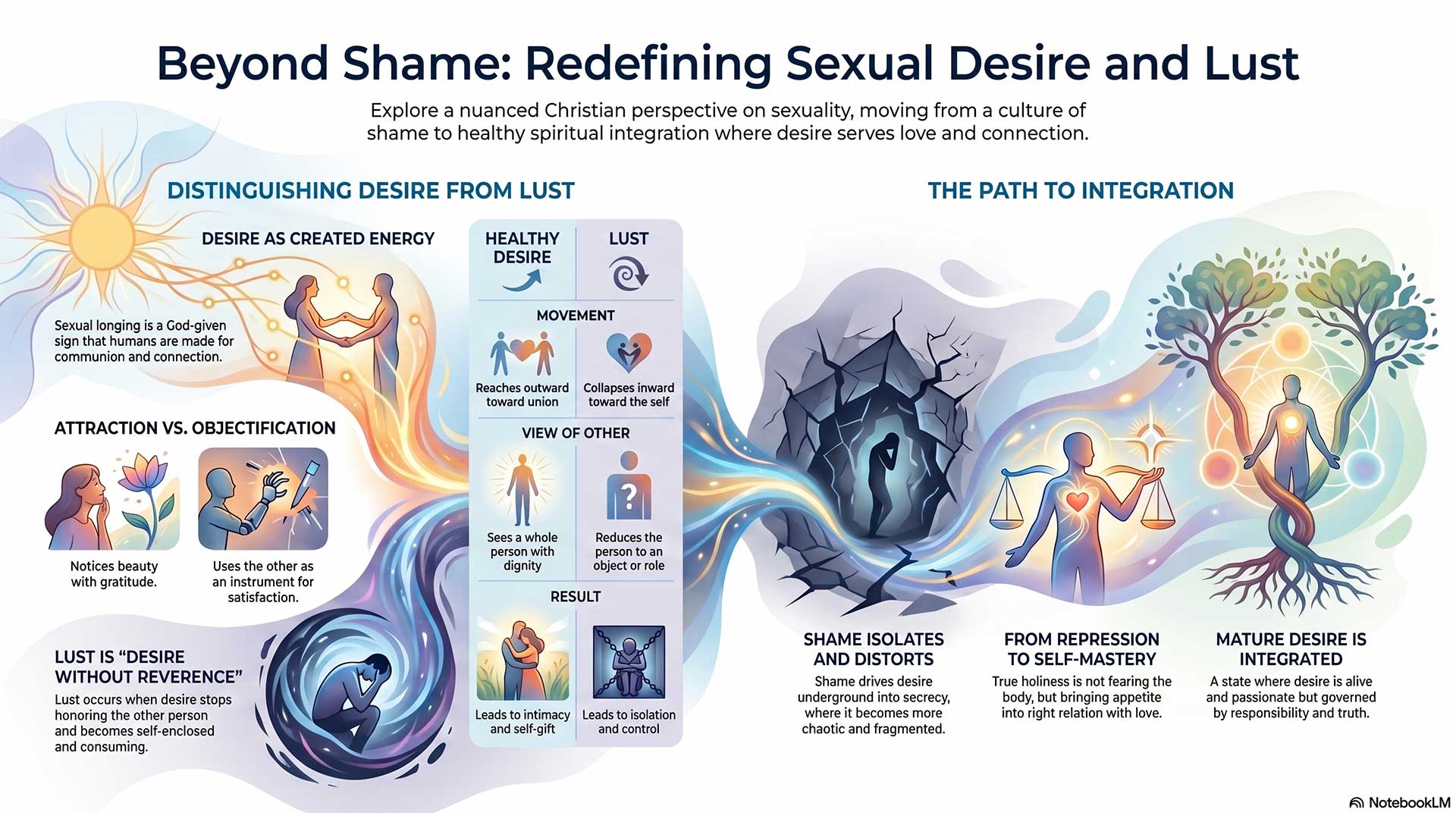
What made this conversation powerful is that it did not settle for the two easiest mistakes. It did not say, “If desire is natural, then anything goes.” And it did not say, “If desire is dangerous, then shame must be useful.” It refused both extremes. Instead, it kept returning to a harder but more honest path: desire is real, deep, God-given in origin, and capable of great beauty, yet it can also be twisted into selfishness, fantasy, concealment, and use. That is why it must be understood, not merely feared.
One of the clearest themes across the discussion was that shame is a poor teacher. It may silence people for a time, but it rarely makes them whole. More often, it drives desire underground, where confusion, secrecy, split selves, and hidden compulsions grow stronger. A faith that cannot speak about desire without panic will often produce hiding instead of maturity. A wiser faith will teach people how to name desire truthfully, carry it responsibly, and bring it into the service of love.
Another strong conclusion was that lust is not simply desire at full strength. Lust is desire that has lost reverence. It reduces another person instead of truly seeing them. That distinction is vital. Once Christians recover it, they can begin to teach with more care. Attraction is not yet objectification. Temptation is not yet consent. Longing is not yet moral collapse. Precision gives conscience room to breathe. It lets people grow in truth instead of drowning in vague guilt.
The most hopeful insight may be this: sexual desire is not only something to restrain. It is also something to form. At its healthiest, it can point toward union, delight, tenderness, self-gift, presence, and the deep human need not to live in isolation. Mature desire is not dead, and it is not wild. It is alive, governed, integrated, and joined to love.
So the deeper Christian question may not be, “How do we make people afraid of desire?” It may be, “How do we teach people to carry desire in a way that makes them more honest, more compassionate, more reverent, and more whole?” That is a better question, and perhaps a more faithful one too.
Short Bios:
Nick Sasaki
Moderator of the conversation. He raises the central tension: whether Christians have too often confused God-given sexual desire with its fallen distortions, and whether a healthier language could bring more honesty and less shame.
C. S. Lewis
Christian writer and moral thinker known for his clarity about human nature, temptation, virtue, and disordered desire. In this panel, he helps separate created appetite from its misuse and keeps moral seriousness in view.
Christopher West
Christian teacher known for his work on the theology of the body, embodiment, eros, and the sacred meaning of human desire. He argues that the body and its longings are part of creation’s meaning, not an embarrassment to faith.
Esther Perel
Psychotherapist and writer known for her insight into desire, intimacy, erotic life, fantasy, and modern relationships. She brings psychological realism and helps show how shame, silence, and fear can damage human connection.
Hitori Saito
Japanese spiritual teacher and writer whose view of life often treats desire, energy, and vitality in a more affirmative way. In this discussion, he challenges inherited shame and insists that strong life energy should be guided wisely, not treated as filthy from the start.
Curt Thompson
Christian psychiatrist and author known for his work on shame, healing, attachment, embodiment, and spiritual formation. He helps explain how shame fragments the self and how desire can be brought into truth, relationship, and wholeness.
Leave a Reply