
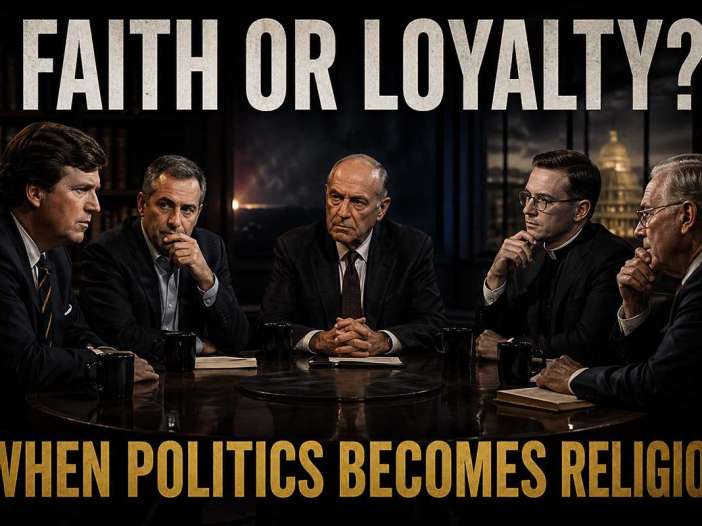
What if Tucker Carlson and top thinkers confronted whether faith has been quietly replaced by political loyalty?
What happens when faith, politics, and human conscience collide?
This conversation began with a simple observation: people do not just argue about policies anymore. They argue about meaning, identity, loyalty, and even God. A political disagreement can feel like a spiritual threat. A leader can become more than a leader. A belief can become a boundary that cannot be crossed.
At the center of this exploration is a deeper human tension. People want to believe. People want to belong. People want to protect what they love. But those same instincts can harden into something rigid — something that makes dialogue difficult and compromise feel like betrayal.
Through these five topics, we followed a path:
Faith becoming political identity.
Public voices wrestling with regret.
Religious conviction turning into non-negotiable conflict.
A businessman navigating a world of moral expectations.
And finally, the question of whether humanity can live together without demanding agreement.
This is not only about public figures. It is about all of us.
Every person faces the same quiet questions:
Where do I draw the line between belief and identity?
How do I admit I was wrong?
Can I stay true to what I believe without closing the door to others?
These are not abstract issues. They shape families, friendships, nations, and the future.
(Note: This is an imaginary conversation, a creative exploration of an idea, and not a real speech or event.)
Topic 1 — When Faith Becomes Political Loyalty
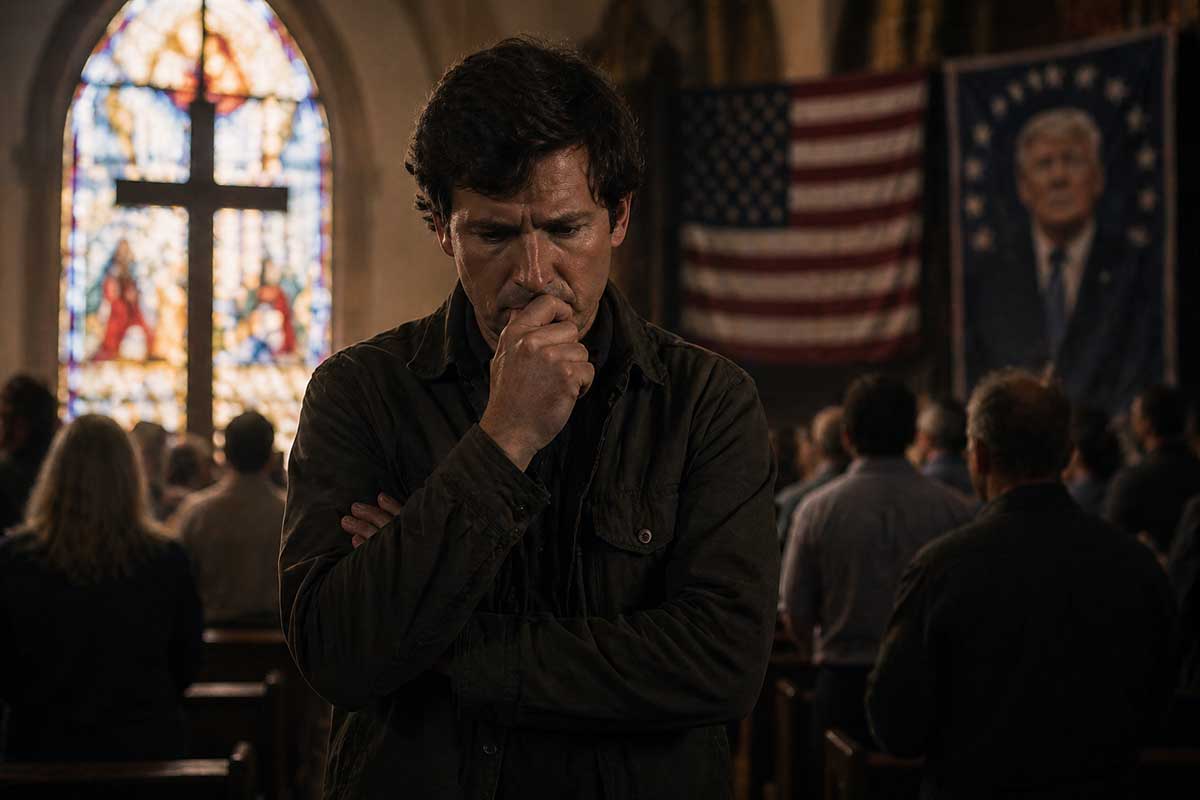
Opening
Nick Sasaki:
Welcome, everyone.
Today we begin with a difficult question: when does faith become political loyalty?
For many people, faith is the deepest part of life. It shapes conscience, family, sacrifice, hope, and moral courage. But once faith enters politics, something strange can happen. A leader becomes more than a leader. A party becomes more than a party. Disagreement begins to feel like betrayal. Criticism begins to feel like sin.
That is why this conversation matters.
We have Tucker Carlson, who represents the modern conservative Christian media world and its inner conflict.
We have Russell Moore, who has warned Christians about confusing the gospel with political power.
We have David French, who speaks often about law, conscience, and the danger of tribal politics.
We have Reinhold Niebuhr, the Christian realist who understood sin, power, and moral illusion.
And we have Dietrich Bonhoeffer, who lived through one of history’s most dangerous examples of faith being captured by politics.
Let’s begin.
Question 1
When does sincere faith become political identity?
Tucker Carlson:
It happens slowly. You don’t wake up one morning and say, “I’m replacing God with politics.” You tell yourself you’re defending your country, your family, your civilization, your faith. Then one day, you realize you’re defending a movement even when your conscience is uneasy.
Russell Moore:
Faith becomes political identity when Christians become more afraid of losing cultural power than of losing spiritual integrity. The test is simple: can your faith rebuke your own side? If it cannot, it has already been captured.
Reinhold Niebuhr:
Human beings rarely worship power honestly. They baptize it. They call self-interest righteousness, fear prudence, and tribal pride holiness. That is the oldest political sin.
David French:
The danger comes when politics becomes a substitute church. It gives people belonging, enemies, moral certainty, and a mission. That can feel religious, but it is not the same as faith.
Dietrich Bonhoeffer:
True faith stands before God alone. Political faith seeks safety in crowds. When a believer can no longer say no to his own movement, he is no longer free.
Question 2
Can a believer support a political leader without excusing that leader’s flaws?
David French:
Yes, but only with moral distance. You can vote for someone, support a policy, or prefer one outcome without surrendering your conscience. The problem begins when criticism of the leader becomes forbidden.
Tucker Carlson:
That’s the hard part. In media, people want clarity. They want heroes and villains. But real life is messier. You may support someone, then later feel sick about what that support helped create.
Russell Moore:
A Christian should never need a perfect politician. But Christians must never pretend corruption is virtue just because it helps their side win. That bargain damages the soul.
Bonhoeffer:
A flawed leader may be tolerated for limited reasons. But when people begin to explain away cruelty, dishonesty, or contempt for truth, they are no longer being practical. They are being discipled.
Niebuhr:
Politics always involves compromise. But there is a difference between compromise and idolatry. Compromise says, “This is imperfect.” Idolatry says, “This must not be questioned.”
Question 3
How can religious people stay loyal to God without turning politics into a sacred battlefield?
Russell Moore:
They must recover repentance. Not just national repentance. Not just the other side’s repentance. Personal repentance. A faith that cannot repent becomes ideology.
Tucker Carlson:
Maybe the answer is humility. Maybe religious people need to admit that they can be manipulated. I include myself in that. Faith does not make you immune to propaganda. Sometimes it makes you more vulnerable if someone knows which fears to touch.
Niebuhr:
Humility is not weakness. It is moral realism. The believer must know that sin exists not only in enemies, but also in the self, the tribe, the nation, and the church.
David French:
We need to separate conviction from domination. You can believe something deeply without trying to crush everyone who disagrees. That is the civic skill America is losing.
Bonhoeffer:
The church must be willing to stand alone. Not above the world in pride, but apart from the crowd in obedience. The question is not, “Did our side win?” The question is, “Did we remain faithful?”
Closing
Nick Sasaki:
This first conversation shows the real danger is not faith itself. The danger is faith losing its freedom.
When faith becomes political loyalty, people stop asking, “What is true?” and begin asking, “What helps my side?” When that happens, religion no longer softens the human heart. It hardens it.
But the better path is still possible: faith with humility, politics with limits, loyalty with conscience, and conviction without hatred.
Topic 2 — Guilt, Regret, and Public Responsibility
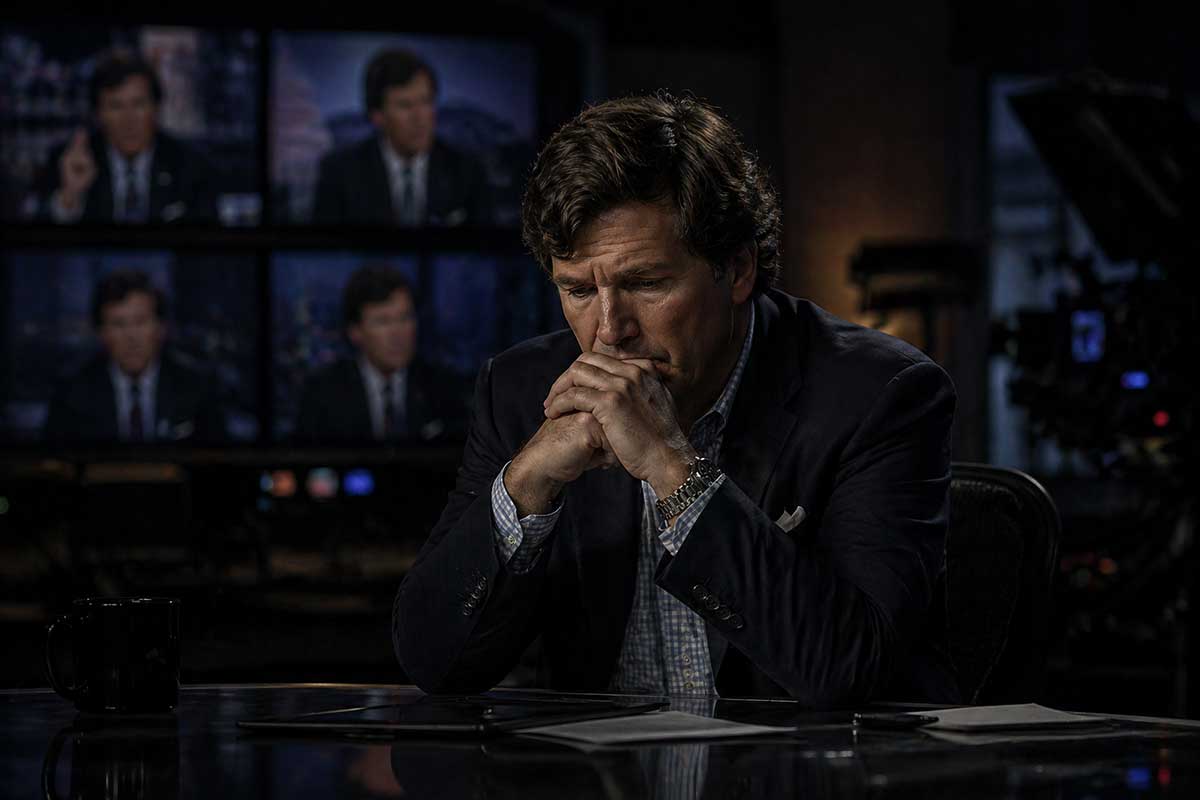
Opening
Nick Sasaki:
Welcome back.
Our first topic asked when faith becomes political loyalty. Now we move into something more personal: what happens when a public voice begins to feel regret?
This is not only about Tucker Carlson. It is about anyone with influence — a host, writer, preacher, politician, activist, or commentator — whose words shape how millions of people feel, fear, vote, and judge others.
When ordinary people change their minds, the damage may stay private. But when a public figure changes his mind, the past does not disappear. Old clips remain. Old arguments remain. Old loyalties remain. And the people who trusted that voice may still be living inside beliefs the speaker no longer fully holds.
So today we ask: what does guilt mean when your words helped create public consequences?
Our voices for this topic are Tucker Carlson, Hannah Arendt, James Baldwin, Jonah Goldberg, and Megyn Kelly.
Let’s begin.
Question 1
What does moral responsibility mean when your words helped shape millions of people’s beliefs?
Tucker Carlson:
It means you don’t get to hide behind “I was just asking questions.” That may be true sometimes. But if people trusted you, and your words moved them, then you were not just talking. You were leading, whether you wanted to admit it or not.
Hannah Arendt:
Public speech is never weightless. A person who speaks to millions participates in the formation of judgment. The failure is not only saying something false. The deeper failure is encouraging people to stop thinking.
James Baldwin:
The trouble is that people want innocence after they have helped build something. They want to say, “I did not mean it that way.” But history does not ask only what you meant. It asks what your words did.
Jonah Goldberg:
In media, there is always pressure to simplify. Your audience wants emotional clarity. But once you feed them certainty every night, it becomes hard to ask them later to accept doubt. That is part of the responsibility.
Megyn Kelly:
You can be wrong. Everyone can be wrong. But when you are wrong in public, you should correct yourself in public. Quiet regret is not enough when the original influence was loud.
Question 2
Is public regret enough, or must a public figure repair what they helped create?
James Baldwin:
Regret can be sincere and still be insufficient. The question is not, “Do you feel bad?” The question is, “Are you willing to tell the truth now, even when it costs you?”
Tucker Carlson:
That’s the hard part. If you built trust with an audience by saying one thing, then changing course feels like betrayal to them. But maybe the real betrayal is continuing to speak against your conscience just to keep them comfortable.
Megyn Kelly:
Repair has to be concrete. Say what changed. Say what you missed. Say where you were too loyal, too angry, too trusting, or too careless. People respect honesty more than perfect consistency.
Hannah Arendt:
Repair begins when the public figure helps restore judgment. Not merely reversing positions, but teaching people how to think again. The public mind must be invited out of slogans.
Jonah Goldberg:
There is a difference between apology and course correction. Apology looks backward. Course correction changes what you do tomorrow. The second one matters more.
Question 3
Can guilt become wisdom rather than self-punishment?
Tucker Carlson:
I think it can, but only if you don’t turn guilt into theater. People can perform regret too. The real thing is quieter. It changes what you refuse to say, what you question, and who you stop flattering.
Hannah Arendt:
Guilt becomes wisdom when it restores thought. The danger is not guilt itself, but the wish to escape from thinking. A person must learn to remain in conversation with his own conscience.
James Baldwin:
Guilt is useless if it only makes you feel tragic. The point is not to become noble in your own suffering. The point is to become more honest, more courageous, and less willing to lie for belonging.
Megyn Kelly:
Yes, but you have to keep working. Public people cannot just say, “I’ve grown,” and expect trust to return. They have to earn it in real time.
Jonah Goldberg:
Guilt can mature into humility. That might be the best outcome. The public figure learns to say, “I may be wrong,” before the damage is done, not only after.
Closing
Nick Sasaki:
This topic brings us to a painful truth: influence is never innocent.
A public voice can comfort people, warn people, educate people, or awaken people. But it can also harden people, frighten people, and trap them inside a story that becomes very hard to leave.
The better answer is not silence. It is more honest speech.
Guilt, at its best, is not self-hatred. It is conscience returning. It is the soul saying, “Do not keep walking the same road just because many people followed you there.”
That leads directly to Topic 3: God, Nation, and the Danger of “No Negotiation.”
Topic 3 — God, Nation, and the Danger of “No Negotiation”
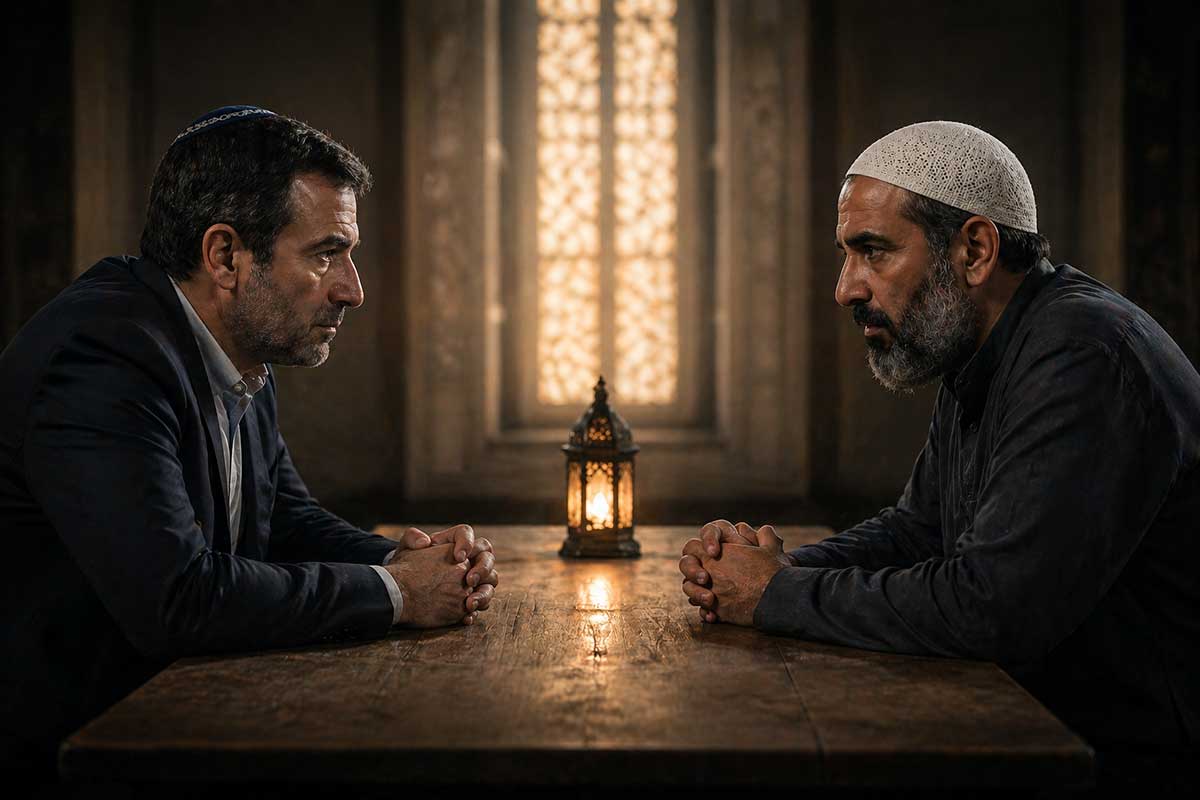
Opening
Nick Sasaki:
Welcome back.
Our first topic explored what happens when faith becomes political loyalty. Our second topic asked what guilt means when a public voice begins to question what he helped create.
Now we move deeper into the source of many human conflicts: what happens when people believe they are negotiating with other human beings, but secretly feel they are defending God?
This is where religion can become dangerous. Not because faith itself is dangerous, but because human beings can confuse God with tribe, scripture with fear, and conviction with control.
When people believe compromise is betrayal, every disagreement becomes holy war. Marriage becomes harder. Politics becomes harder. Nations become harder. Peace becomes harder.
Today we ask whether deep faith can remain humble enough to live with others.
Our voices are Karen Armstrong, Eboo Patel, Thich Nhat Hanh, Rabbi Jonathan Sacks, and Sun Myung Moon.
Let’s begin.
Question 1
Why do people become less willing to compromise when they believe God is on their side?
Karen Armstrong:
Because religion gives language to ultimate concern. That can produce compassion, sacrifice, and beauty. But when people fuse God with their own fear, they feel that compromise is not merely practical weakness. They feel it is spiritual betrayal.
Rabbi Jonathan Sacks:
The danger begins when people forget that God is larger than their group. Covenant creates identity, but it must not become contempt. A faith that cannot honor the dignity of the stranger has misunderstood its own God.
Eboo Patel:
Many people do not experience religion as theory. They experience it through family, memory, pain, and belonging. So when someone challenges their religious identity, they feel their whole life is under attack. That makes compromise emotionally difficult.
Thich Nhat Hanh:
When we cling to a view, we suffer. A religious view can become a prison. The teaching may be beautiful, but our attachment to being right can make us unable to hear the suffering of another person.
Sun Myung Moon:
God does not need human beings to hate in His name. The purpose of religion is to bring people back to one family under God. When religion divides brothers and sisters, it has not reached its mature purpose.
Question 2
Can religious conviction remain strong while still leaving room for humility?
Rabbi Jonathan Sacks:
Yes. Strong faith does not require certainty about every human judgment. The Bible itself is filled with argument, wrestling, and moral struggle. Faith becomes mature when it can say, “I know what I believe, but I do not know everything.”
Thich Nhat Hanh:
Humility is part of true practice. We breathe, we listen, we look deeply. The person across from us may hold part of the truth that our anger cannot see.
Karen Armstrong:
Every great religious tradition contains a warning against ego. The problem is not conviction. The problem is the ego dressing itself in sacred language. Humility asks us to notice when our God-talk has become self-protection.
Sun Myung Moon:
Conviction must grow into love. If your belief makes you unable to love your enemy, then your belief is incomplete. God’s heart is not narrow. God suffers for all His children.
Eboo Patel:
Interfaith work does not ask people to become less Christian, less Muslim, less Jewish, less Buddhist, or less Hindu. It asks them to become deeper practitioners of their own tradition while respecting the sacred dignity of others.
Question 3
What is the difference between defending God and defending your own group identity?
Karen Armstrong:
Defending God often means practicing compassion, restraint, and reverence. Defending group identity often means protecting status, fear, and memory. The language may sound the same, but the emotional energy is different.
Eboo Patel:
One test is whether your faith makes room for relationship. If you cannot sit at a table with someone different, share food, hear their story, and still recognize their humanity, then you may be defending a boundary more than God.
Sun Myung Moon:
God’s side is not simply my side. God’s side is the side of reconciliation. If my religion makes me proud against others, I must ask whether I am truly serving God or only serving my own fallen nature.
Thich Nhat Hanh:
When we defend an identity, we become tense. When we practice love, we become spacious. God does not need our anger. Human beings need our understanding.
Rabbi Jonathan Sacks:
The great spiritual error is believing that love of one’s own people requires hatred of another. Particular love is not the enemy of universal dignity. I can be faithful to my tradition without denying your humanity.
Closing
Nick Sasaki:
This topic reveals one of humanity’s deepest wounds.
Religion can teach mercy, patience, forgiveness, and love. But religion can also become a wall when people use it to protect fear, pride, and tribal identity.
The mature path is not weak belief. It is strong belief with humility.
A person can believe in God deeply without treating every disagreement as rebellion against God. A person can love their tradition without turning outsiders into enemies. A person can carry conviction without losing compassion.
Maybe that is the beginning of peace: not asking people to abandon faith, but asking faith to grow large enough to include the humanity of others.
Topic 4 — Trump the Businessman vs. Religious Absolutism
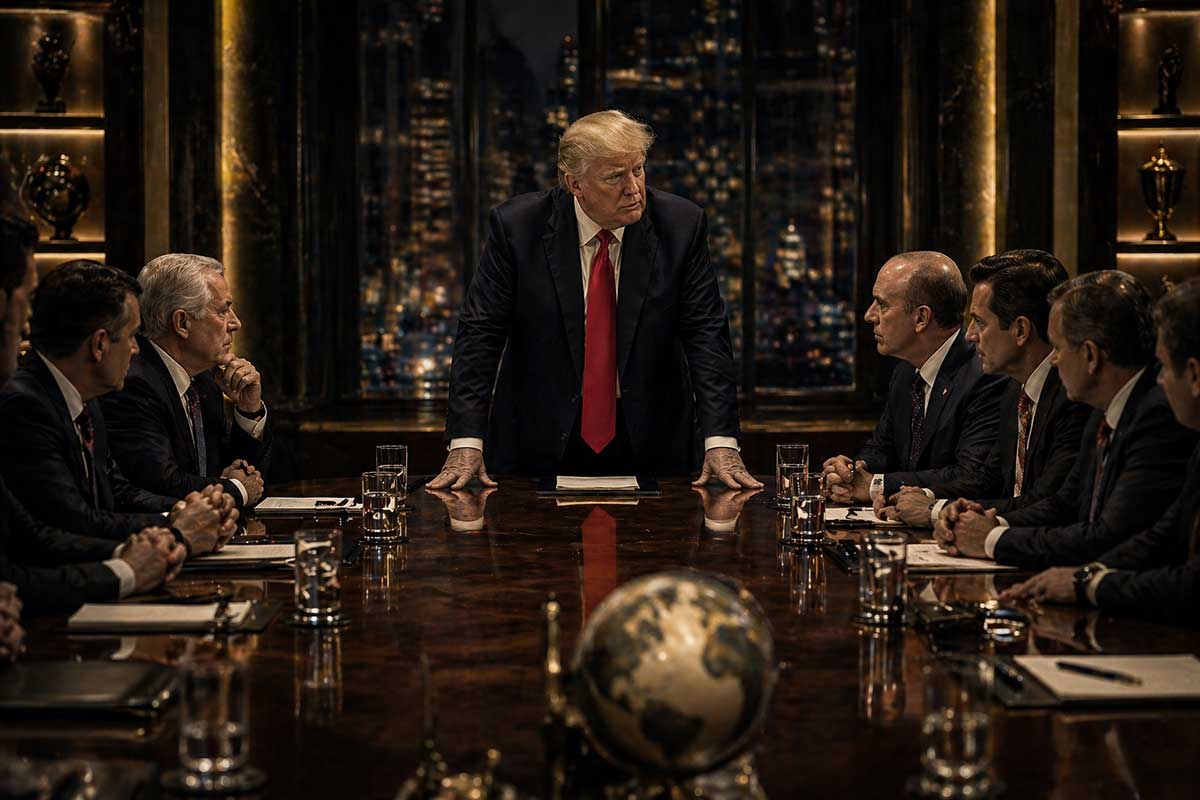
Opening
Nick Sasaki:
Welcome back.
So far, we have explored faith becoming political loyalty, public guilt, and the danger of people believing they cannot compromise because God is on their side.
Now we turn to President Trump.
Many people try to explain Trump as a religious leader, a conservative philosopher, or a traditional moral figure. But perhaps that misses something basic. Trump may be best understood as a businessman — someone who thinks in leverage, branding, pressure, deal-making, loyalty, public dominance, and winning room at the table.
That creates a strange tension.
Religious voters may look for moral certainty. Trump often works through negotiation. Religious movements may speak in absolutes. Trump often speaks like someone testing the price, pressure point, or advantage. His supporters may treat him as a sacred political figure, but he may see politics more like a high-stakes deal.
So today we ask: what happens when religious absolutism meets business negotiation?
Our voices are Donald Trump, Tucker Carlson, Tony Schwartz, Roger Fisher, and Robert Cialdini.
Let’s begin.
Question 1
Is Trump better understood as a negotiator than as a religious or ideological figure?
Donald Trump:
I’ve always been about making deals. You look at the room, you look at who has leverage, you see what people want, and you push. People can call it ideology, but a lot of it is just knowing how to win.
Roger Fisher:
A negotiator must separate interests from positions. The public often hears positions: slogans, threats, demands. The deeper question is: what interest is being served? Security? Status? Economic gain? Personal power?
Tucker Carlson:
That’s what makes it confusing for religious voters. They may think they are joining a moral crusade, but Trump may be playing a very different game. He is often not speaking like a pastor. He is speaking like a man testing strength.
Tony Schwartz:
Trump’s language is less about doctrine and more about dominance. He understands attention. He understands emotional reaction. He understands that people often follow whoever sounds strongest.
Robert Cialdini:
He uses influence cues very well: authority, social proof, scarcity, contrast, commitment, loyalty. Whether one admires or criticizes him, his method is closer to persuasion psychology than theology.
Question 2
Can a win-win business mindset soften political conflict, or does politics always turn negotiation into domination?
Roger Fisher:
A genuine win-win mindset requires listening to interests on both sides. The danger in politics is that public performance rewards humiliation of the opponent. A deal can solve a problem, but a spectacle often deepens conflict.
Donald Trump:
People say win-win, but you don’t get win-win by being weak. You have to be strong first. If they know you’ll walk away, then they come back with a better offer.
Tucker Carlson:
That may work in business. But in religion and politics, people do not always want a deal. They want moral vindication. They want to feel the other side was defeated, shamed, exposed.
Tony Schwartz:
The issue is that Trump’s style often turns negotiation into theater. The win is not only the agreement. The win is being seen as the winner. That changes the moral atmosphere.
Robert Cialdini:
Political audiences reward identity confirmation. A leader may make a practical deal, but the crowd often wants symbolic victory. That can make compromise look like betrayal.
Question 3
Why do religious voters sometimes expect moral purity from a leader whose real instinct is deal-making?
Tucker Carlson:
Because they are scared. They feel their country slipping away, their children changing, their churches losing influence, their values mocked. So they look for a fighter. Then they call the fighter God’s instrument.
Donald Trump:
People support me because I fight for them. They know the other side doesn’t respect them. They want someone who doesn’t fold. That’s not complicated.
Roger Fisher:
The mistake is confusing representation with sanctification. A leader may represent your interests without embodying your highest values. Mature citizens must keep that distinction clear.
Tony Schwartz:
Many supporters project meaning onto Trump. They see courage, revenge, protection, rebellion, even spiritual rescue. But projection tells us as much about the audience as about the leader.
Robert Cialdini:
Commitment plays a major role. Once people publicly defend a leader, they feel pressure to stay consistent. The more they sacrifice socially for him, the harder it becomes to admit discomfort.
Closing
Nick Sasaki:
This topic shows why Trump creates such conflict inside religious politics.
He may not be operating primarily as a theologian or moral teacher. He may be operating as a businessman, performer, and negotiator. But religious voters often place spiritual expectations on him. That creates disappointment, defense, confusion, and sometimes guilt.
The real question may not be whether Trump is sacred or evil. The deeper question is whether people can see him clearly.
A negotiator should be judged as a negotiator. A political leader should be judged by consequences. A religious person should not surrender conscience to either side.
If faith is real, it must be strong enough to say: “I may support this deal, but I will not worship the dealer.”
Topic 5 — A Future Beyond Religious Conflict
Opening
Nick Sasaki:
Welcome back.
We have reached the final topic.
We began with faith becoming political loyalty. Then we looked at guilt, public responsibility, religious certainty, and Trump as a businessman rather than a religious figure.
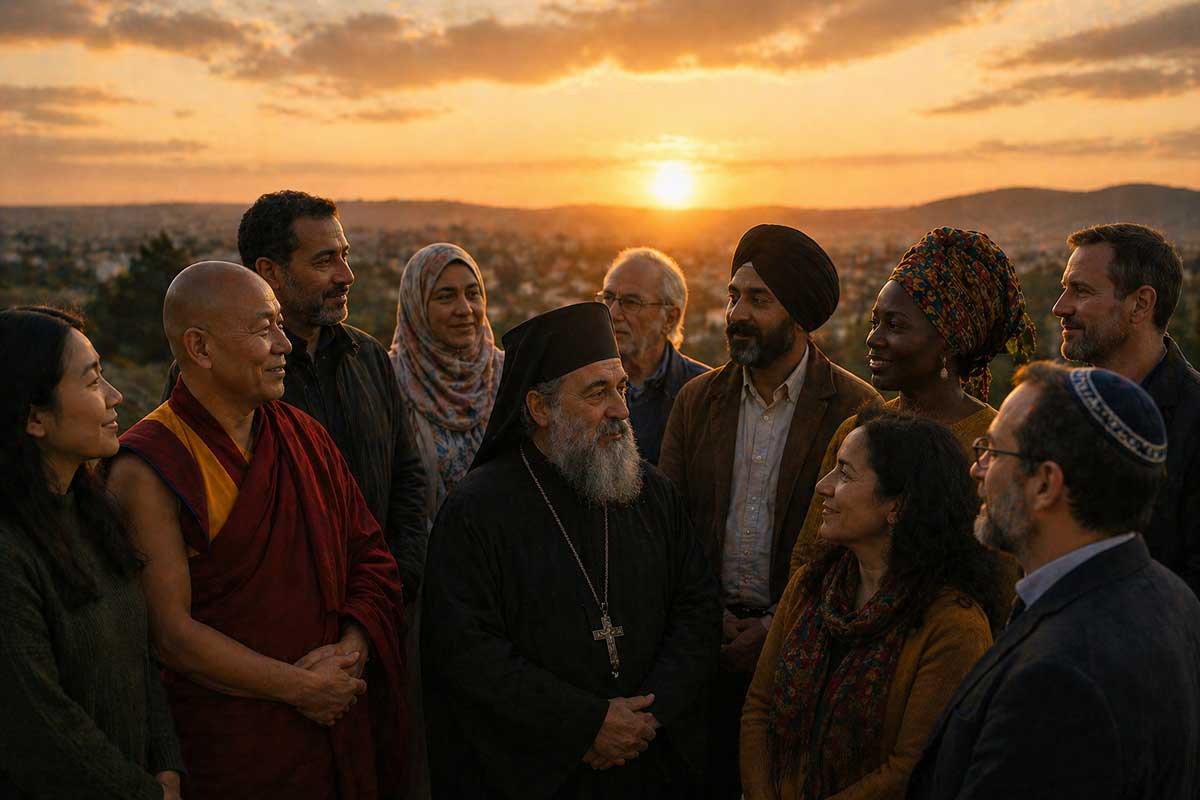
Now we arrive at the largest question: how can humanity live together without demanding that everyone believe the same thing?
This may be the real challenge of the future.
Christians will remain Christian. Muslims will remain Muslim. Buddhists will remain Buddhist. Jews will remain Jewish. Hindus will remain Hindu. Many people will remain secular. The answer cannot be forcing everyone into one belief system.
The deeper answer may be learning how to live with sacred difference.
Today our voices are the Dalai Lama, Pope Francis, Hamza Yusuf, Rabbi Jonathan Sacks, and Sun Myung Moon.
Let’s begin.
Question 1
What shared human values can religions agree on without erasing their differences?
Pope Francis:
We can begin with mercy. Before doctrine becomes argument, there is the suffering person. The hungry child, the lonely elder, the refugee, the wounded family, the person who feels unseen. A true religion must begin there.
Rabbi Jonathan Sacks:
We do not need sameness to build peace. We need dignity. The Bible teaches that every human being carries the image of God. That means my faith does not require your erasure.
Dalai Lama:
Kindness is very simple. Before we are Christian, Muslim, Buddhist, Jewish, Hindu, or secular, we are human beings who wish to be happy and do not wish to suffer. This is a good beginning.
Hamza Yusuf:
The Islamic tradition speaks deeply about mercy, justice, restraint, and accountability before God. These are values that can meet other traditions without losing their own soul.
Sun Myung Moon:
All people are children of God. The purpose of religion is not to divide God’s family forever, but to restore love between parents, children, brothers, sisters, nations, and enemies.
Question 2
Can humanity build peace around love, dignity, and fairness rather than doctrine?
Rabbi Jonathan Sacks:
Yes, if we understand that peace is not agreement on everything. Peace is the moral discipline of honoring the other person’s humanity when we disagree deeply.
Hamza Yusuf:
Doctrine matters. We should not pretend it does not. But doctrine must form humility, not arrogance. If belief makes a person unjust, cruel, or contemptuous, then something has gone wrong in the soul.
Pope Francis:
Love is not sentimental. Love requires action: feeding, forgiving, welcoming, protecting, listening. When love becomes concrete, enemies begin to look less like ideas and more like wounded neighbors.
Dalai Lama:
We can practice compassion without asking everyone to accept the same philosophy. Compassion can be taught, practiced, and lived. Peace begins in the mind, then in the family, then in society.
Sun Myung Moon:
Fairness is not enough without heart. Law can prevent violence, but love can heal resentment. The future must be built on the idea that humanity is one family under God.
Question 3
What kind of spiritual maturity allows people to say, “I believe deeply, but I can still live kindly with you”?
Hamza Yusuf:
It requires adab — spiritual courtesy, proper conduct, humility before God and restraint before people. A person can hold truth seriously without treating another soul with contempt.
Dalai Lama:
When we are secure inside, we do not need to attack so much outside. Inner peace helps outer peace. A person who has trained the heart can listen without fear.
Rabbi Jonathan Sacks:
Maturity means knowing that God is not honored by hatred. If I must destroy your dignity to protect my faith, then my faith has become too small.
Pope Francis:
It means seeing Christ in the wounded person, the outsider, the stranger, even the person who does not agree with me. Faith without tenderness becomes hard stone.
Sun Myung Moon:
True maturity is parental heart. Parents do not love only the child who agrees with them. God’s heart suffers for every side. The mature believer learns to love from that wider heart.
Closing
Nick Sasaki:
This final topic brings the whole conversation together.
The problem is not that people believe in God. The problem is when belief becomes pride, fear, tribe, or control.
Humanity does not need a future where every religion disappears. It needs a future where religion becomes more mature — less defensive, less angry, less hungry for victory, more willing to serve life.
Maybe the path forward is this:
Believe deeply.
Listen humbly.
Negotiate fairly.
Protect dignity.
Do not turn God into a weapon.
That may be one of the most serious spiritual tasks of our time: not proving that one side can defeat the other, but showing that human beings can still live as one family without becoming the same.
Final Thoughts
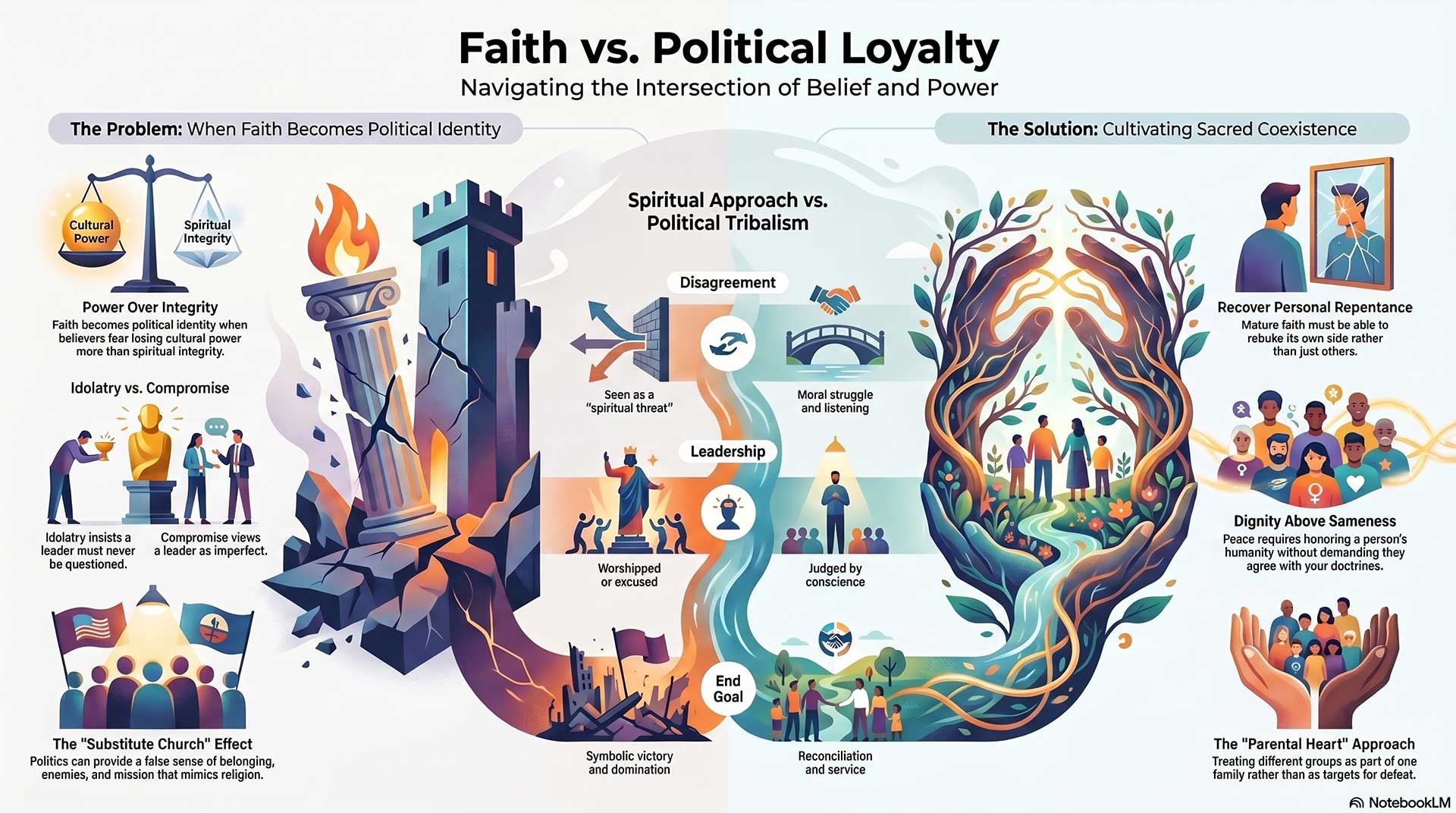
What stands out most is not conflict, but possibility.
Faith does not have to become tribal.
Politics does not have to become sacred war.
Influence does not have to lead to permanent damage.
Leadership does not have to be worshipped.
Difference does not have to become division.
But none of this happens automatically.
It requires a kind of maturity that is rare:
The courage to question your own side.
The humility to admit discomfort.
The discipline to separate belief from ego.
The strength to stay grounded when others demand certainty.
A person can believe deeply without needing to dominate.
A person can support a leader without surrendering conscience.
A person can feel regret without collapsing into self-blame.
A person can hold conviction without losing compassion.
That is the path forward.
Not weaker belief — but deeper belief.
Not less conviction — but more honest conviction.
Not forced agreement — but chosen respect.
If there is a future where humanity lives with less conflict, it will not come from everyone thinking the same way.
It will come from people learning how to live with difference without fear.
Short Bios:
Tucker Carlson — American media commentator known for shaping conservative political and cultural conversations.
Russell Moore — Christian ethicist focused on the relationship between faith, conscience, and public life.
David French — Constitutional lawyer and writer examining religion, law, and political culture.
Reinhold Niebuhr — Influential theologian known for his work on moral realism, power, and human nature.
Dietrich Bonhoeffer — German pastor who resisted Nazi control over the church and paid with his life.
Hannah Arendt — Political philosopher who studied responsibility, power, and the nature of evil.
James Baldwin — Writer and social critic who explored truth, identity, and moral courage in America.
Jonah Goldberg — Political commentator analyzing conservatism, media, and ideological movements.
Megyn Kelly — Journalist and media figure known for examining power, influence, and public accountability.
Karen Armstrong — Scholar of religion focused on compassion and the history of faith traditions.
Eboo Patel — Interfaith leader promoting cooperation across religious differences.
Thich Nhat Hanh — Buddhist teacher known for mindfulness, peace, and compassionate listening.
Rabbi Jonathan Sacks — Jewish thinker who wrote about dignity, difference, and moral responsibility.
Sun Myung Moon — Religious leader who emphasized global unity and interfaith harmony.
Donald Trump — Businessman and U.S. president known for negotiation, branding, and political influence.
Tony Schwartz — Writer who examined Trump’s personality and approach to power and attention.
Roger Fisher — Negotiation expert and co-author of “Getting to Yes.”
Robert Cialdini — Psychologist known for research on persuasion and influence.
Dalai Lama — Tibetan spiritual leader teaching compassion, ethics, and human unity.
Pope Francis — Head of the Catholic Church emphasizing mercy, humility, and care for the vulnerable.
Hamza Yusuf — Islamic scholar focused on ethics, tradition, and modern society.
Leave a Reply