

|
Getting your Trinity Audio player ready...
|
What if the Christine Lagarde Davos 2026 speech is really a blueprint for “resilience without hysteria” in a weaponized world?
Introduction by Christine Lagarde
At Davos 2026, I wanted to make one point very clear: we are living through profound change—but we must not let the volume of the moment turn change into panic. Europe’s challenge is to build autonomy and resilience without dramatizing every headline into a crisis of destiny. Because panic is not strategy. Panic is expensive. And panic creates the very fragility we claim to fear.
So I urged a different posture: signal discipline. Separate what is noisy from what is structural. Identify our weak points—dependencies, bottlenecks, single points of failure—and then build “Plans B,” not as slogans, but as executable redundancy: energy connections that hold, capital markets that mobilize European savings into European investment, supply chains that don’t collapse under pressure, and institutions that remain credible even when politics gets loud.
This series explores five tests of that posture. First, the anti-panic playbook—calm as a competitive advantage. Second, Plan B Europe—resilience you can execute. Third, signal discipline—governing when everything screams. Fourth, autonomy without isolation—de-risking without detaching. And fifth, the quiet powder keg—inequality as the internal stress that can break stability faster than any external shock. Europe’s strength will not be measured by our speeches, but by our ability to stay strategic when the world tries to make us reactive.
(Note: This is an imaginary conversation, a creative exploration of an idea, and not a real speech or event.)
Topic 1: The Anti-Panic Playbook — Calm as a Competitive Advantage
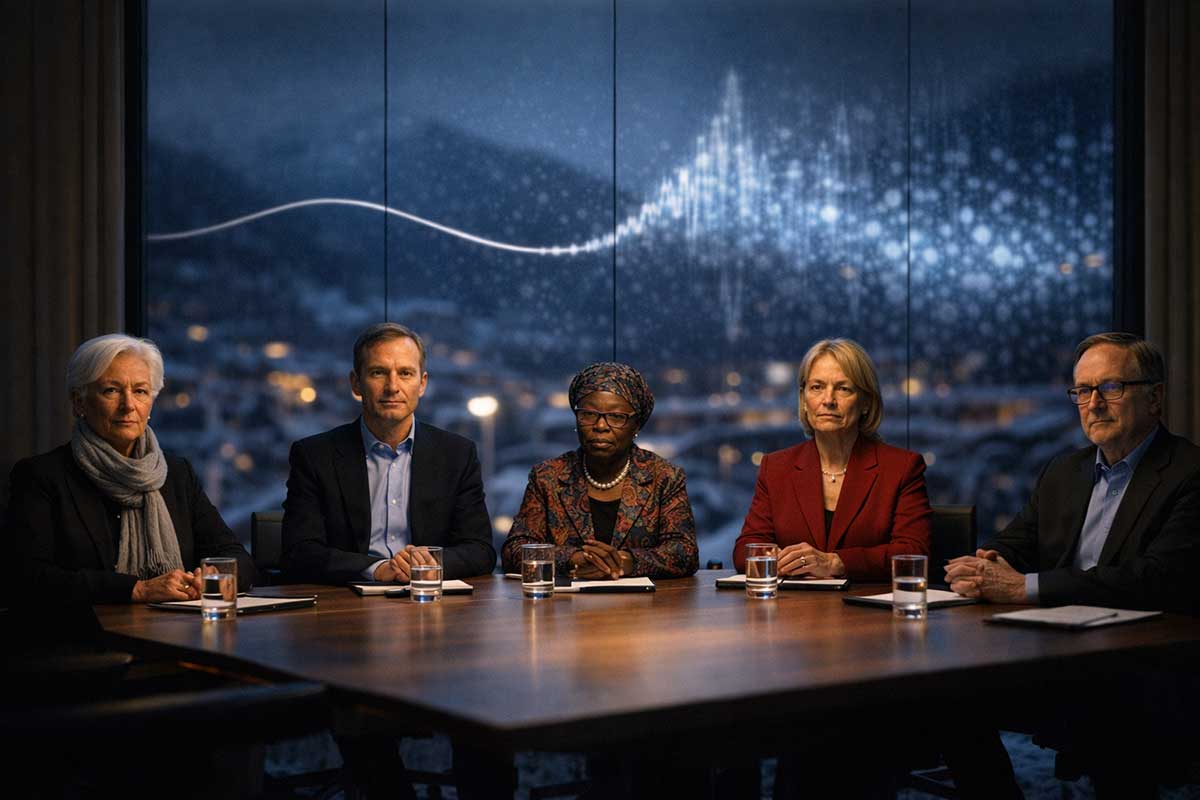
A Davos side room with thick carpet and thin air. Outside the glass: the hum of badges, cameras, and market metaphors. Inside: a roundtable that feels like a pressure chamber for Europe’s nervous system.
Gillian Tett sits with her notebook angled like a mirror—ready to reflect back whatever people think they’re saying.
Gillian Tett: Christine, you offered a counter-thesis to Mark Carney’s “rupture” framing. Not denial—just discipline: change, not rupture; autonomy and resilience without panic. Let’s start with the first uncomfortable question. In practical terms—this quarter, not “eventually”—what changes in how leaders plan when you treat this era as “change” rather than “rupture”?
Christine Lagarde: The difference is not rhetorical; it is operational. “Rupture” suggests discontinuity so radical that institutions freeze or overreact. “Change” acknowledges transformation but preserves agency. Practically, it means three things immediately: we map dependencies, we diversify them with realistic timelines, and we build buffers—financial, energy, and industrial—without triggering fear-driven policy. Calm is not complacency. Calm is the condition that allows competence.
Mark Carney: I respect the discipline, Christine, but “rupture” is not a mood—it’s a diagnosis. When the rules of trade, security, and financial alignment become instruments of coercion, you are no longer in incremental change. Planning this quarter requires admitting that the old assumptions—stable globalization, predictable alliances, neutral capital—are breaking. If leaders treat this as ordinary change, they will underbuild resilience and overtrust the system’s elasticity.
Kristalina Georgieva: I see both. What matters is how the frame affects action. “Rupture” can produce urgency, which we need, but it can also produce fatalism and policy whiplash. “Change” can preserve steadiness, but it can drift into slow motion. For this quarter, the practical shift is: build shock absorbers—fiscal buffers, contingency supply routes, and rapid response financing—while keeping cooperation alive wherever it still works.
Ngozi Okonjo-Iweala: From the trade side, the risk is that “rupture” becomes a self-fulfilling narrative that accelerates fragmentation. But the risk of “change” is that leaders underestimate how quickly trade can be weaponized. This quarter, governments must do two things at once: reduce critical vulnerabilities in supply chains and preserve trust in the rules-based system where possible. You don’t keep trade open by declaring it open—you keep it open by making coercion less profitable.
Adam Tooze: The frame matters because it determines which costs leaders are willing to pay upfront. “Rupture” says: pay now or collapse later. “Change” says: pay steadily to avoid panic costs. But the real issue is political economy. This quarter, planning changes when leaders accept that stability itself is a resource you must fund: through energy affordability, social support, and credible institutions. Panic is not just emotional; it’s a fiscal and social event.
Gillian taps her pen softly, as if marking a hidden pattern.
Gillian Tett: Good. Now the second question is where leadership gets exposed. When does “stay calm” become denial—and when does “rupture” become a self-fulfilling panic? I want each of you to name the tipping point. Not in theory—in the real world.
Mark Carney: “Stay calm” becomes denial when it delays the build-out of capacity—defense production, energy infrastructure, financial resilience—because the political class tells itself the old system will stabilize. “Rupture” becomes self-fulfilling panic when leaders respond with performative decoupling—breaking linkages without building substitutes—creating shortages, inflation, and social backlash that then forces even harsher policy. The tipping point is when rhetoric outruns capability.
Christine Lagarde: Calm becomes denial when it becomes a refusal to measure vulnerability. If you cannot name dependencies, you are not calm—you are blind. “Rupture” becomes self-fulfilling when it triggers indiscriminate fear policies: closing markets, punishing investment, politicizing central banking, or undermining institutions in the name of speed. The tipping point is institutional degradation—when urgency is used as an excuse to weaken the very mechanisms that create stability.
Kristalina Georgieva: Calm becomes denial when leaders dismiss warning signals as noise—energy price fragility, debt rollover risks, supply chain choke points, social polarization. “Rupture” becomes panic when leaders treat every shock as existential and respond with maximal measures that exhaust trust: sweeping tariffs, sudden bans, or abrupt fiscal swings. The tipping point is public fatigue. When people feel policy is lurching, they stop believing it.
Ngozi Okonjo-Iweala: Calm becomes denial when leaders ignore the slow erosion of the trading system—subsidy races, unilateral restrictions, and “friend-shoring” that quietly excludes the vulnerable. Rupture becomes self-fulfilling when the biggest economies normalize trade coercion as a domestic political tool. The tipping point is when rules become optional for the powerful. Once that spreads, fragmentation accelerates.
Adam Tooze: Calm becomes denial when it assumes legitimacy is automatic. It isn’t. The public’s tolerance for transition costs is finite. Rupture becomes self-fulfilling panic when leaders create scarcity by design—restricting flows without building capacity—then blame the era instead of their own choices. The tipping point is distribution. When policy costs concentrate on the already strained, panic becomes rational.
Gillian looks up, eyes sharp but voice even.
Gillian Tett: Third question. The whole Lagarde message—at least as you’re framing it—is autonomy and resilience without panic. But the world still requires cooperation. Trust is thinner, interdependence is real, and coercion is on the menu. So what’s the new rule for cooperation? What does “working together” look like when nobody fully trusts anyone?
Christine Lagarde: Cooperation must become modular and verifiable. We don’t rely on sentiment; we rely on architecture. Standards, transparency, reciprocal commitments, and mechanisms that reduce unilateral shocks. Autonomy is not the opposite of cooperation—it is the foundation for sustainable cooperation. When you are less vulnerable, you cooperate from strength, not from fear.
Ngozi Okonjo-Iweala: I would call it “cooperation with guardrails.” Keep trade open where it is mutually beneficial, but build resilience in critical areas and ensure dispute mechanisms are respected. The rule is: reduce dependency without criminalizing interdependence. If the system becomes purely transactional, smaller countries are crushed. We need predictable rules—or we invite permanent instability.
Mark Carney: Cooperation now requires a shared recognition of the new reality: that economic instruments are strategic instruments. The rule is: align where values and interests truly overlap, and be honest about where they don’t. Pretending alignment exists when it doesn’t produces vulnerability. Cooperation without realism is a trap.
Kristalina Georgieva: And it requires institutions that can act faster. When shocks travel at digital speed, slow coordination becomes dysfunction. The rule is: build rapid response compacts—liquidity lines, supply chain contingency agreements, and crisis coordination frameworks—so cooperation is not invented in the moment of panic. The best cooperation is pre-built.
Adam Tooze: I’d add a political rule: cooperation must be narratable to publics. If it looks like elite coordination against ordinary people’s interests, it dies. The new cooperation has to include domestic legitimacy as a design constraint. Otherwise, geopolitics will be decided by backlash politics.
Gillian closes her notebook—not like a conclusion, more like a deliberate pause.
Gillian Tett: Here’s what this table just revealed. “Rupture” can produce urgency; “change” can preserve competence. But the real enemy isn’t either word—it’s the mismatch between language and capacity. Panic happens when leaders are surprised and unprepared. Denial happens when leaders refuse to measure vulnerability.
She looks at Lagarde and Carney, then back to the group.
Gillian Tett: So the anti-panic playbook isn’t “stay calm.” It’s build resilience early, communicate honestly, and cooperate in ways that can survive distrust. Calm becomes competitive advantage only when it is backed by hard work.
Outside, Davos keeps talking. Inside, the room feels more dangerous and more hopeful at once—because the argument wasn’t about vibes. It was about whether Europe can build a future that doesn’t break every time history raises its voice.
Topic 2: Plan B Europe — Resilience You Can Execute

The Davos snow looks peaceful until you remember what snow does to cities: it reveals which systems are built for stress and which ones only work on fair-weather days. Inside a smaller conference room, the table is crowded with one thing that’s become the new European obsession—contingency.
Not drama. Not slogans. Plans B.
Gillian Tett (again, because she’s too perfect for this subject): Christine, you used a phrase that sounds simple but is actually revolutionary for Europe: not one plan—Plans B. Let’s get brutally concrete. What does “Plan B” mean in real levers—capital markets, energy, defense industry, supply chains? If you had to pick what gets built first, what is it?
Christine Lagarde: Plan B begins with autonomy over the fundamentals that allow a society to function under stress: energy security, financial stability, and industrial capacity. For Europe, the first build is integration—because fragmentation is vulnerability. Deeper capital markets so savings can fund investment. Energy interconnections and faster permitting so energy shocks don’t become political shocks. And resilience in critical supply chains, so essential inputs are not easily weaponized.
Ursula von der Leyen: I agree. Europe must act like a continent, not a mosaic. Plan B is not a bunker—it is a platform. First: make Europe easier to scale within, so companies don’t have to leave to grow. Second: mobilize investment, public and private, toward strategic capabilities—energy, critical materials, defense production. Third: build partnerships that diversify options without closing doors. That is resilience you can execute.
Mario Draghi: The first build is the capital and productivity engine. Europe cannot finance autonomy if it remains fragmented and under-investing. Plan B must convert Europe’s savings into risk capital at scale—without friction, without twenty-seven bottlenecks. That requires harmonizing insolvency, simplifying market rules, and building a truly integrated capital market. Without that, every other plan is underfunded.
Dani Rodrik: I’ll push back slightly. If Plan B is only “more markets,” you’ll build a machine that runs politically off a cliff. The first build is social legitimacy under stress. Resilience means citizens can absorb shocks without turning to extremes. That requires policies that protect people from volatility—skills, safety nets, regional investment—so the public stays on board while Europe reforms, retools, and rebalances.
Ian Bremmer: Think of Plan B as redundancy. When one line fails, the system still works. So the first build is removing single points of failure: energy chokepoints, supply chain concentration, and dependency on one security assumption. But Europe also needs decision-speed. Redundancy in assets is useless if the politics can’t mobilize quickly. Plan B includes a governance upgrade: fewer veto traps, more rapid coordination.
Gillian nods like someone watching a culture change in real time.
Gillian Tett: Here’s the tension, though. Every Plan B has a shadow: it can become fortress thinking. That leads to my second question. How do you build autonomy without turning Europe into a fortress economy—without making “resilience” an excuse for protectionism, subsidy races, and quiet isolation?
Dani Rodrik: The key is intent and design. Autonomy should be about preserving democratic choice, not closing off competition. You can have strategic industrial policy without blanket protectionism. But it must be disciplined: targeted, time-bound, transparent, and paired with domestic legitimacy. If autonomy becomes a vague banner, it will be captured by every interest group that wants permanent shelter.
Christine Lagarde: Exactly. Resilience is not hostility to openness; it is the ability to remain open without being naive. Fortress thinking is emotional. Resilience is structured. We should diversify supply chains, strengthen European capacity in strategic areas, and deepen partnerships—while keeping a commitment to rules, competition, and market integrity. The moment “autonomy” becomes a justification for undermining those, you weaken Europe.
Mario Draghi: A fortress economy would be a disaster for Europe because Europe’s prosperity is linked to openness. But openness without capacity is also a disaster. The answer is to build strength at home—energy affordability, scale, capital markets—so Europe competes rather than retreats. Strategic policy must be paired with competitiveness reforms. Otherwise you get subsidies without productivity, which is just expensive stagnation.
Ursula von der Leyen: Europe’s model is not isolation. Our independence must be cooperative by design. That means trade agreements, trusted partnerships, and a single market that works. Autonomy means we can withstand pressure and still choose openness. It is not about choosing walls. It is about strengthening foundations.
Ian Bremmer: And the world will test that distinction quickly. If Europe starts using resilience language to justify broad protectionism, partners retaliate, and Europe loses the very network power it needs. The smart version is “de-risk, don’t detach.” Build redundancy, diversify ties, and keep leverage symmetrical—so cooperation remains rational for everyone.
Gillian turns the page—because the last question is the one Europe always circles and rarely answers cleanly.
Gillian Tett: Third question. Europe’s resilience often fails on one thing: unity under stress. So what is the minimum unity threshold Europe needs to act like one system in a crisis? What must be unified—no exceptions—and what can remain national without breaking the whole machine?
Mario Draghi: The essentials must be unified: capital market rules and cross-border investment flow, energy interconnection and grid resilience, and defense procurement coordination. If these remain fragmented, Europe cannot act at scale or speed. You can keep cultural policies national, you can keep many social choices national, but the economic and strategic infrastructure must be European.
Christine Lagarde: Financial stability mechanisms must be coherent. In crises, fragmentation becomes contagion. Europe needs unified supervision and clearer common frameworks—especially for capital markets. The euro area has learned this lesson repeatedly: unity is not a moral preference; it’s a crisis requirement.
Ursula von der Leyen: And strategic investment must be coordinated. Europe can’t have twenty-seven separate industrial plans pulling in different directions. We need shared priorities and shared execution lanes—especially on critical materials, energy, and defense supply chains. National identities remain, but strategic vulnerability must be addressed together.
Dani Rodrik: I’ll add: the unity threshold must include social cohesion. If Europe’s response to crisis increases inequality between regions and classes, unity collapses politically even if institutions are unified on paper. Minimum unity includes a shared commitment to cushioning the blow—so resilience isn’t built on the backs of the already strained.
Ian Bremmer: Unity also needs decision-speed. If a crisis hits and Europe takes months to decide, the crisis decides for Europe. So the threshold is: mechanisms for rapid coordination and credible action. Not total centralization—just enough to move fast where speed determines outcomes: energy shocks, financial instability, and security escalation.
Gillian sits back, then speaks softly, like she’s describing a machine rather than a continent.
Gillian Tett: So Plan B Europe is not one plan. It’s a system of redundancies—funded, coordinated, and politically legitimate. The danger is that Europe confuses resilience with retreat, or unity with uniformity. But the opportunity is something bigger: if Europe can build a Plan B that functions under stress, it becomes less fragile—and paradoxically, more open—because it’s no longer negotiating with fear.
And that’s the real meaning of “without panic”: not a mood, but an architecture.
Topic 3: Signal Discipline — Governing When Everything Screams

The room feels like a control tower built for turbulence. Outside: Davos voices, cameras, the rumor-weather of markets. Inside: a roundtable, five glasses of water, and a single rule written on a whiteboard in neat handwriting:
DON’T CONFUSE VOLUME WITH TRUTH
Gillian Tett: Christine, your whole “no panic” doctrine depends on something most leaders quietly lack: signal discipline. In a world where politics, markets, and media amplify everything, what’s the real discipline for separating signal from noise—so governments don’t overreact, but also don’t drift?
Sara Eisen: The discipline starts with humility about the media environment. We’re swimming in incentives that reward extremes—headline urgency, instant reaction, algorithmic outrage. A leader needs a “two-speed” system: fast response for immediate risk, slow thinking for structural decisions. Signal is what persists under scrutiny. Noise is what spikes because it’s emotionally contagious.
Christine Lagarde: I would say: structure your attention. Signal discipline is not personality; it is process. You need a stable framework for identifying vulnerabilities—energy costs, financial stability, supply dependencies, social cohesion—and you revisit it regularly. The noise changes daily. The signal changes slowly, but dangerously. If you don’t institutionalize the distinction, you will be governed by the loudest moment.
Ray Dalio: I look at it like cycles. Noise is the surface. Signal is the underlying machine: debt dynamics, productivity, competitiveness, geopolitics, internal conflict. If leaders chase the surface, they will do the wrong thing at the wrong time. The discipline is to track the few variables that drive most outcomes—and ignore everything else unless it changes those variables.
Fareed Zakaria: There’s also a moral dimension: signal discipline is the courage to say “this matters” and “this doesn’t” even when people are screaming that you’re insensitive. The public is often reacting to a story. Leaders must respond to the story without letting the story drive strategy. Otherwise you get perpetual policy whiplash.
Yuval Noah Harari: And we must remember that noise is not random—it is engineered. Some noise is produced intentionally to weaken trust, exhaust attention, and trigger overreaction. So signal discipline includes information security for the mind. If a society loses shared reality, it loses the capacity for coordinated action, which is the foundation of resilience.
Gillian nods, then leans forward—the way she does when she’s about to turn theory into a scalpel.
Gillian Tett: Second question. How do leaders prevent overreaction while still moving fast enough to avoid strategic drift? Because “calm” can become paralysis, and “urgency” can become chaos. What’s the operational middle path?
Ray Dalio: You build contingency plans before the crisis forces your hand. Overreaction happens when leaders are surprised. Drift happens when leaders never commit. The middle path is rehearsed readiness: clear triggers, clear playbooks, and staged responses. Think of it like risk management in a portfolio—hedges, diversification, and rules for when to rebalance.
Christine Lagarde: Exactly. Calm is not stillness; calm is readiness. Preventing overreaction means you pre-commit to principles: preserve financial stability, protect the vulnerable, maintain credible institutions. Moving fast means you have prepared instruments—liquidity backstops, coordinated fiscal tools, energy contingency measures. Drift is what happens when politics improvises under stress.
Fareed Zakaria: I’d frame it as time horizons. Leaders should move fast on resilience-building and slow on punitive measures that are hard to reverse. Fast: strengthen supply chains, invest in energy security, deepen alliances. Slow: trade wars, sweeping bans, permanent decoupling. Overreaction is often the irreversible move made in an emotional moment.
Sara Eisen: Also: communications discipline is policy discipline. When leaders talk as if every day is emergency mode, markets and citizens behave as if it is. The middle path is to communicate in tiers: “Here’s what we know. Here’s what we’re watching. Here’s what we’re doing now. Here’s what would make us change course.” That transparency reduces panic and buys time.
Yuval Noah Harari: Speed without wisdom becomes self-sabotage. But wisdom without speed becomes irrelevance. The middle path is to protect the institutions that allow learning: independent data, credible journalism, transparent governance. When institutions are intact, societies can move quickly without becoming irrational, because they can correct mistakes without humiliation or conspiracy.
Gillian scribbles something and looks up.
Gillian Tett: Third question. In this era, credibility is a currency that devalues fast. What does credibility look like when uncertainty becomes permanent—when citizens feel every promise is provisional and every “truth” gets contested five minutes later?
Yuval Noah Harari: Credibility becomes the willingness to admit uncertainty without collapsing into relativism. People don’t demand omniscience; they demand honesty and consistency. A credible leader says: “This is what we know, this is what we don’t, and here is how we decide.” When you hide uncertainty, you create the conditions for mistrust.
Sara Eisen: Credibility is also not overpromising. The public is exhausted by grand narratives. If leaders repeatedly declare victory and then reality contradicts them, credibility dies. A credible posture is: modest claims, measurable goals, regular updates. The audience can smell spin now faster than ever.
Christine Lagarde: For institutions, credibility is coherence over time. It is not perfection; it is predictability. The public must believe that decisions follow a framework, not a mood. When uncertainty is permanent, you keep trust by keeping your method visible: why you act, what you prioritize, what would change your course. Credibility is the transparency of reasoning.
Fareed Zakaria: And credibility requires moral steadiness. In volatile eras, leaders often become performers. They chase applause from their faction and sacrifice the center. A credible leader keeps the social contract in mind: they protect stability, they defend dignity, they avoid scapegoating. When uncertainty is permanent, legitimacy becomes the anchor.
Ray Dalio: I’d add: credibility requires results that people can feel. If institutions say “we have a plan” but living standards erode, trust collapses. So credibility is execution—lower volatility, fewer shocks, more opportunity. In the end, reality is the referee. Narratives don’t survive contact with people’s lives.
Gillian pauses, letting the answers stack like layers.
Gillian Tett: So here’s what I’m hearing. Signal discipline is not just “ignore the noise.” It’s an architecture: attention frameworks, playbooks, staged responses, and communications that don’t inflame the room. It’s also a philosophy: admit uncertainty, protect institutions, and keep legitimacy visible.
She turns slightly toward Lagarde.
Gillian Tett: Christine, your “no panic” message isn’t about calming people down like a parent shushing a child. It’s about preventing the political system from becoming a reactive machine—because a reactive machine is easy to manipulate.
Christine Lagarde: Precisely. Panic is costly, and it is contagious. But denial is also costly, and it is seductive. Signal discipline is how Europe avoids both. It allows us to build autonomy and resilience steadily, with partners where possible, and without letting provocation dictate policy.
Fareed Zakaria: And in a way, that’s the real clash with Carney. Not about whether the world is serious—it clearly is. It’s about how to stay serious without becoming reckless.
Yuval Noah Harari: Because the future will contain more shocks. A society that cannot distinguish signal from noise becomes ungovernable.
Ray Dalio: And an ungovernable society makes bad choices, which creates more shocks.
Sara Eisen: Which then gets sold as “proof” that panic was justified.
Gillian closes her notebook again—not an ending, just a checkpoint.
Gillian Tett: Then Topic 3 is the hinge: if Europe can build signal discipline, it can move fast without flinching—and stay calm without sleeping. And that’s how resilience becomes real in a world that keeps trying to hijack attention.
Topic 4: Autonomy Without Isolation — How to De-Risk Without Detaching

This Davos room has the feel of a map room—except the map is invisible. It’s the web of dependencies that used to feel like “efficiency” and now feels like “exposure.” On the table is a single sheet of paper with a phrase written in tidy letters:
DE-RISK ≠ DECOUPLE
Gillian Tett: Christine, you’ve argued for autonomy and resilience without panic—meaning Europe must reduce vulnerabilities without turning inward. That sounds sensible until you try to do it. So let’s start with the first hard question: can interdependence be managed without becoming weaponized—or is weaponization now the default setting?
Anne-Marie Slaughter: Weaponization is more common because power competition is sharper, but it’s not inevitable everywhere. Interdependence can be managed if you design networks with trust zones—clear rules, transparency, and diversified nodes—so no single actor can choke the system. The default problem isn’t interdependence; it’s concentrated interdependence. That’s what becomes a weapon.
Christine Lagarde: I agree. We should not romanticize interdependence, but we also must not demonize it. Europe’s prosperity was built on openness. The task now is to ensure openness is resilient. Weaponization becomes default when dependencies are unbalanced. So we rebalance: diversify suppliers, strengthen European capacity in critical areas, and build partnerships with trusted countries. That is management, not retreat.
Lawrence Summers: I’m more skeptical. In a world where geopolitics drives economic decisions, weaponization will remain a persistent risk. The question is not whether it exists—it does. The question is whether Europe can build enough leverage and resilience to make weaponization costly and ineffective. That requires scale, speed, and a willingness to defend interests without hysteria.
Pascal Lamy: The trading system can survive, but only if major actors still see value in rules. If everything becomes transactional and coercive, we’re back to power politics in commerce. Europe’s role should be to anchor predictability: defend rules, use dispute mechanisms where possible, and build coalitions for open trade. But yes, we must also be realistic: rules alone do not deter coercion if dependencies remain.
Ngozi Okonjo-Iweala: The default can be managed if countries commit to transparency and predictable rules, but when trust erodes, you need insurance. That insurance is diversification—especially for critical goods and technologies—and an insistence that trade restrictions remain targeted and justified, not politically theatrical. Otherwise the system collapses into suspicion.
Gillian leans forward slightly.
Gillian Tett: Second question: what are the three dependencies Europe must reduce first—if we’re being honest? Energy, data, critical inputs, payments, defense supply chains—choose three, and tell me why those three outrank the rest.
Christine Lagarde: Energy remains foundational: affordability and security are prerequisites for competitiveness and social stability. Second, critical inputs—materials and components that can be choked off. Third, financial plumbing—payments and market infrastructure—because stability underpins everything. If Europe cannot function financially and energetically under stress, autonomy is theoretical.
Lawrence Summers: I’ll say energy, semiconductors/critical tech inputs, and defense-industrial supply chains. These are the levers most likely to be used in a hard-power world. If Europe is exposed there, it’s exposed everywhere.
Ngozi Okonjo-Iweala: Energy, critical inputs, and food/agriculture resilience. People underestimate food until it becomes a crisis and then politics goes unstable. You can manage a lot of economic discomfort, but food shocks ignite societies. And that instability then infects everything else.
Pascal Lamy: I would say energy, critical industrial inputs, and strategic technology—data and digital infrastructure included. Europe must ensure that openness does not mean losing control over the foundations of sovereignty: critical infrastructure and the rules governing it.
Anne-Marie Slaughter: I’ll emphasize data and digital infrastructure as one of the three. Power is increasingly exercised through networks, standards, platforms, and information flows. Europe must reduce dependency on systems it cannot shape. So: energy, critical inputs, and digital sovereignty—meaning secure infrastructure and governance frameworks.
Gillian nods as if counting the overlap: energy appears every time, like gravity.
Gillian Tett: Third question. How do you keep trade cooperation alive when politics keeps trying to turn it into leverage—tariffs, restrictions, threats, “friend-shoring” alliances that sometimes look like blocs? What’s the playbook for cooperation under distrust?
Pascal Lamy: Coalitions of the willing. Europe should work with partners who still value predictable trade—build agreements, align standards, and strengthen the institutions we have. We won’t get perfect global cooperation, but we can preserve functional cooperation in key sectors. The goal is to keep the system from unraveling entirely.
Ngozi Okonjo-Iweala: And we must protect dispute mechanisms and transparency. The more unilateral measures become normalized, the more trust collapses. So you create guardrails: targeted restrictions, clear justification, sunset clauses, and cooperation on resilience—so countries don’t feel they must hoard or retaliate reflexively.
Lawrence Summers: You also need deterrence. Cooperation survives when defection is costly. If one actor uses trade coercion without consequence, it becomes rational to imitate. Europe must be able to respond proportionally and predictably—otherwise it’s training the world to push harder.
Anne-Marie Slaughter: And we should invest in “interdependence that can withstand conflict.” That means redundancy, diversified partnerships, and shared norms. Cooperation can be built into networks—through standards and joint infrastructure—so it’s harder to weaponize without hurting oneself.
Christine Lagarde: Exactly. The objective is not to eliminate interdependence; it is to make it resilient and less asymmetric. Europe must de-risk with discipline: strengthen our capacity, diversify partners, preserve openness, and keep institutions credible. Autonomy without isolation means we remain connected—but not dependent, not naive, and not easily coerced.
Gillian sets her pen down, like she’s finished drawing the outline of a machine.
Gillian Tett: Then this topic is really about maturity. Europe is leaving behind the childhood fantasy that trade automatically produces peace—and avoiding the adolescent fantasy that cutting ties automatically produces strength. The adult version is harder: build resilience, keep doors open, and design networks so coercion doesn’t pay.
Outside the room, Davos continues to pulse with “big moves.” Inside, the argument lands in a quieter register: not about grand gestures, but about building a Europe that can stay open without being pushed around—because it has choices.
Topic 5: The Quiet Powder Keg — Inequality as Europe’s Stability Threat

Davos is built to talk about volatility like it’s a storm outside the window—something you observe, model, and eventually outsmart. But this room has a different feel. The instability isn’t “out there.” It’s inside societies, inside the social contract, inside the daily math of rent, food, energy, and dignity.
On the table is a simple line written on a card:
IF PEOPLE CAN’T LIVE, NOTHING HOLDS.
Gillian Tett: Christine, your whole argument is autonomy and resilience without panic—competence, not hysteria. But there’s a quiet reality that turns competence into a mirage: inequality. When the public feels the system is rigged, resilience collapses into backlash. So let’s start with the first hard question: why does inequality surge in “change” eras—and why does it become a security risk, not just an economic one?
Christine Lagarde: Inequality grows when shocks repeatedly hit the most vulnerable while assets and opportunities concentrate among those already insulated. In times of change—technological transitions, energy disruptions, geopolitical fragmentation—those with capital, education, and mobility adapt faster. Those without them experience volatility as punishment. It becomes a security risk because social cohesion is a form of national strength. If trust breaks, institutions weaken, and polarization becomes a vulnerability that external actors can exploit.
Daron Acemoglu: I’ll be blunt: inequality surges when institutions are shaped to favor certain groups—through market power, captured regulation, and policy that protects incumbents more than workers. Change eras create new rents—new platforms, new monopolies, new financial advantages. If institutions fail to spread the gains, inequality rises. It becomes a security risk because legitimacy is a strategic resource. When legitimacy collapses, you don’t get “calm adaptation.” You get conflict, populism, and brittle governance.
Thomas Piketty: And historically, when returns on capital outpace growth, inequality increases unless political choices intervene. Change eras often accelerate capital’s advantage—globalization, financialization, and now AI. Inequality becomes security risk because it creates a dual society: one that benefits from openness and one that experiences it as humiliation. Such societies become unstable—and instability invites authoritarian temptation and geopolitical weakness.
Esther Duflo: There’s also a psychological dimension. Inequality is not only about income—it’s about whether people feel their effort connects to outcomes. When prices rise, wages lag, and basic services feel degraded, people lose the belief that rules are fair. That is when misinformation spreads faster and social trust collapses. Security risk begins when the public no longer believes the system is working for them.
Raghuram Rajan: Exactly. Inequality erodes the middle—the stabilizing layer that holds democracies together. And when the middle erodes, politics becomes a fight between extremes. Then policymaking becomes impossible. External threats grow because internal cohesion weakens. Security risk isn’t only tanks and missiles. It’s whether a society can act together when pressured.
Gillian nods, then tightens the lens.
Gillian Tett: Second question: what policies actually bend inequality without killing growth—especially under debt pressure? Everyone says “invest in people.” Fine. But what works in practice—and what’s the trap?
Esther Duflo: What works is targeted, evidence-based policy: early childhood investment, education that matches labor market needs, health access, and direct support that reduces extreme hardship. The trap is designing policy as symbolism rather than mechanism—large announcements that don’t change lived reality. Also, avoid one-size-fits-all. Regions and groups face different constraints.
Daron Acemoglu: We also need to tackle market power. You can’t fix inequality if monopolies set wages and prices and capture politics. Competition policy, labor bargaining power, and fair taxation matter. Growth doesn’t come from letting a few firms extract rents; it comes from broad-based innovation and opportunity.
Thomas Piketty: Progressive taxation and wealth taxation can work if designed intelligently, paired with universal services—education, healthcare, infrastructure. The trap is pretending we can solve inequality without confronting the distribution of capital itself. If returns to capital continue to dominate, inequality will reassert itself, and resentment will grow.
Raghuram Rajan: Under debt pressure, you need reforms that increase opportunity and productivity—education, skills, entrepreneurship—but also reforms that strengthen community resilience: housing affordability, local investment, and policies that reduce the geographic concentration of prosperity. The trap is thinking fiscal policy alone solves it. The deeper issue is the structure of the economy: where good jobs exist, how people move, how communities survive shocks.
Christine Lagarde: And we must preserve stability while doing it. If inflation becomes entrenched, it is a tax on the poor. If public finances become unsustainable, the vulnerable pay when austerity returns. So bending inequality without killing growth requires disciplined, targeted investment and structural reforms—especially those that create jobs and affordability—while maintaining credible institutions. Stability and fairness must reinforce each other.
Gillian flips a page, and the question turns darker—because it touches the next decade directly.
Gillian Tett: Third question: if AI and capital concentration accelerate, what’s the new social contract that prevents backlash? I’m not asking for utopia. I’m asking: what’s the minimal promise the system must keep so people don’t revolt against it?
Raghuram Rajan: The minimal promise is that work retains dignity and that mobility remains possible. If AI makes careers unstable, societies need portable benefits, continuous reskilling, and pathways to new forms of work—not just gig precarity. If people feel disposable, backlash is inevitable.
Daron Acemoglu: The contract must include governance of technology. AI can be used to augment workers or to replace them while concentrating power. If policy choices allow the second path to dominate, inequality explodes. The minimal promise is: technology must raise broad productivity and wages, not just profits. That requires incentives, labor institutions, and regulation that shapes deployment.
Esther Duflo: The minimal promise is basic security plus hope. If people have a stable floor—healthcare, housing affordability, education access—and believe effort can improve their lives, they tolerate change. If the floor collapses, they reject the system. AI makes this urgent because it compresses time: dislocation can happen fast.
Thomas Piketty: The contract must also include ownership and participation. If a small elite owns the productive assets—data, platforms, AI models—while the majority rents their lives from them, democracy becomes fragile. The minimal promise is that prosperity is shared not as charity but as right: through public services, fair taxation, and mechanisms that broaden ownership.
Christine Lagarde: And it must include institutional trust. People must believe that the rules are not written only for the powerful. If the public loses faith in fairness, no amount of monetary stability will save political stability. The new social contract must ensure opportunity, protection against shocks, and a sense that change is guided—not suffered.
Gillian sits back, and for a moment the room feels heavier than any talk about tariffs or oil prices.
Gillian Tett: So the quiet powder keg isn’t just inequality itself. It’s the combination of inequality with repeated shocks—energy, housing, technology—plus the perception that elites are insulated while ordinary people absorb the risk.
She looks at Lagarde, then at the economists.
Gillian Tett: Christine, your anti-panic message depends on the public believing that calm leadership is competence, not indifference. So let me end with the simplest line in the room: if people can’t live, nothing holds. Resilience without panic requires—first—resilience for households, not just for balance sheets.
Christine Lagarde: I agree. Stability is not an abstract achievement. It is something citizens feel in their lives: affordability, opportunity, and fairness. If we want Europe to be resilient, we must protect social cohesion as carefully as we protect financial cohesion. Otherwise the greatest vulnerability will not come from outside pressure—but from inside fracture.
Outside, the world keeps changing. Inside, the group has named what makes change dangerous: not the speed of history, but the uneven way its costs are distributed.
Final Thoughts by Christine Lagarde
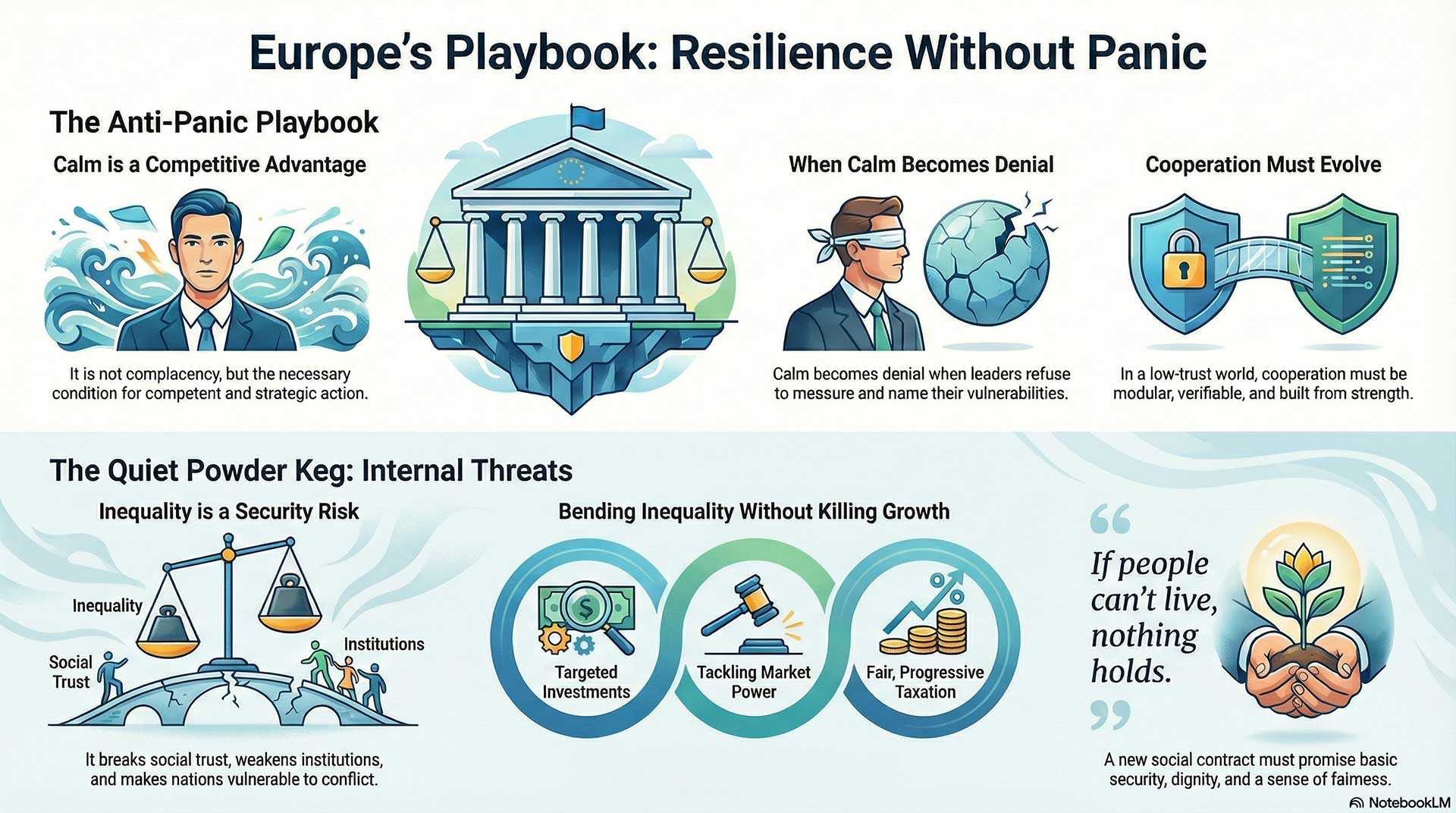
In times like these, the temptation is to live inside the drama—always responding, always reacting, always turning policy into performance. But Europe cannot afford performance. Europe needs preparation.
Resilience is built before the shock. Autonomy is built before the pressure. And trust is built before the next wave of uncertainty. That means reducing dependencies with discipline, strengthening Europe’s economic foundations, protecting social cohesion, and keeping institutions credible—so that we remain capable of acting, not merely coping.
And this is the most important point: calm is not complacency. Calm is competence. It is the ability to see clearly, choose deliberately, and execute steadily—without being hijacked by provocation, by fear, or by fatigue. If Europe can hold that posture, we will not only withstand change—we will shape it, while remaining open enough to cooperate where cooperation still matters, and strong enough to refuse coercion when it does not.
Short Bios:
Christine Lagarde — President of the European Central Bank, known for steering stability through uncertainty and arguing for European resilience without panic-driven overreaction.
Gillian Tett — Financial Times editor and trained anthropologist, famous for revealing the “hidden systems” behind markets, institutions, and power networks.
Sara Eisen — Business journalist and anchor known for translating market narratives into clear signal-vs-noise thinking and pressure-testing claims in real time.
Ray Dalio — Founder of Bridgewater Associates, focused on big-cycle dynamics (debt, power shifts, internal conflict) and how institutions can build shock absorbers.
Fareed Zakaria — Global affairs host and author who connects geopolitics, institutions, and public legitimacy—often emphasizing the difference between stories and strategy.
Yuval Noah Harari — Historian and public intellectual focused on information integrity, social cohesion, and how narrative systems shape power in modern societies.
Ursula von der Leyen — President of the European Commission, pushing “European independence” across trade, investment, energy, defense capacity, and strategic security.
Mario Draghi — Former ECB President and Italian Prime Minister, associated with crisis-era leadership and a blunt diagnosis of Europe’s competitiveness and scale gaps.
Dani Rodrik — Economist known for work on globalization’s tradeoffs, industrial policy, and the political foundations required for an economy to stay legitimate.
Ian Bremmer — Political risk analyst (Eurasia Group) who frames global events through incentives, constraints, and “what happens next” realism.
Ngozi Okonjo-Iweala — Director-General of the WTO, advocating for rules, transparency, and targeted resilience so trade doesn’t collapse into coercion.
Pascal Lamy — Former WTO Director-General, focused on preserving predictable trade rules and building coalitions that keep openness functioning under distrust.
Lawrence Summers — Economist and former U.S. Treasury Secretary, known for hard-nosed views on leverage, policy constraints, and economic statecraft.
Anne-Marie Slaughter — International relations scholar emphasizing networks, institutional design, and “managed interdependence” that can survive geopolitical strain.
Thomas Piketty — Economist focused on inequality, wealth concentration, and the political choices required to keep capitalism socially sustainable.
Daron Acemoglu — Economist known for institutional analysis of why nations succeed or fail, stressing competition, inclusion, and how power shapes outcomes.
Esther Duflo — Economist known for evidence-based anti-poverty policy and the practical mechanics of improving lives through targeted interventions.
Raghuram Rajan — Former central banker and economist focused on financial stability, the erosion of the middle class, and community-level resilience.
Leave a Reply