
|
Getting your Trinity Audio player ready...
|
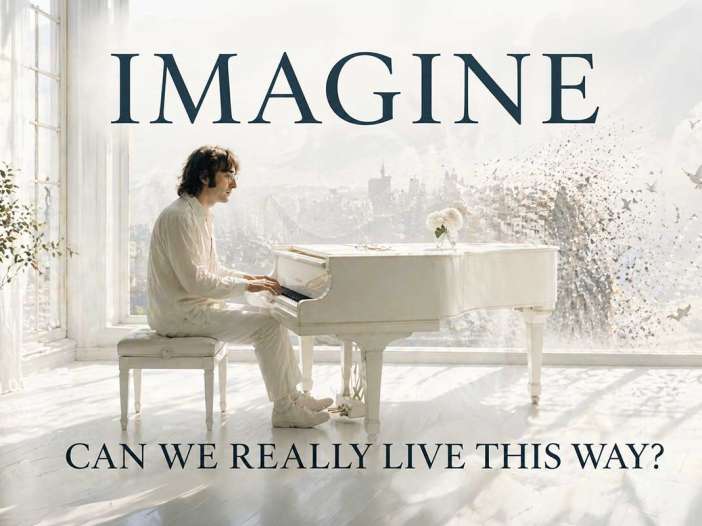
What if John Lennon and great minds confronted whether humanity is ready for Imagine?
John Lennon didn’t write Imagine as an argument.
He wrote it as an invitation.
A few simple lines ask humanity to picture a world without the divisions we usually treat as permanent: religion used as a wall, nations turned into weapons, possessions mistaken for identity.
But the deeper question is not whether Lennon’s dream was easy.
It is whether our current world is as realistic as we pretend.
In this imaginary conversation, Lennon gathers the voices he might have wanted around him: artists, philosophers, mystics, peacebuilders, and systems thinkers. Together, they test the dream behind Imagine—not to praise it blindly, but to ask what kind of human being would be able to live it.
(Note: This is an imaginary conversation, a creative exploration of an idea, and not a real speech or event.)
Topic 1 — Was Lennon’s Vision Naïve, Prophetic, or Unfinished?
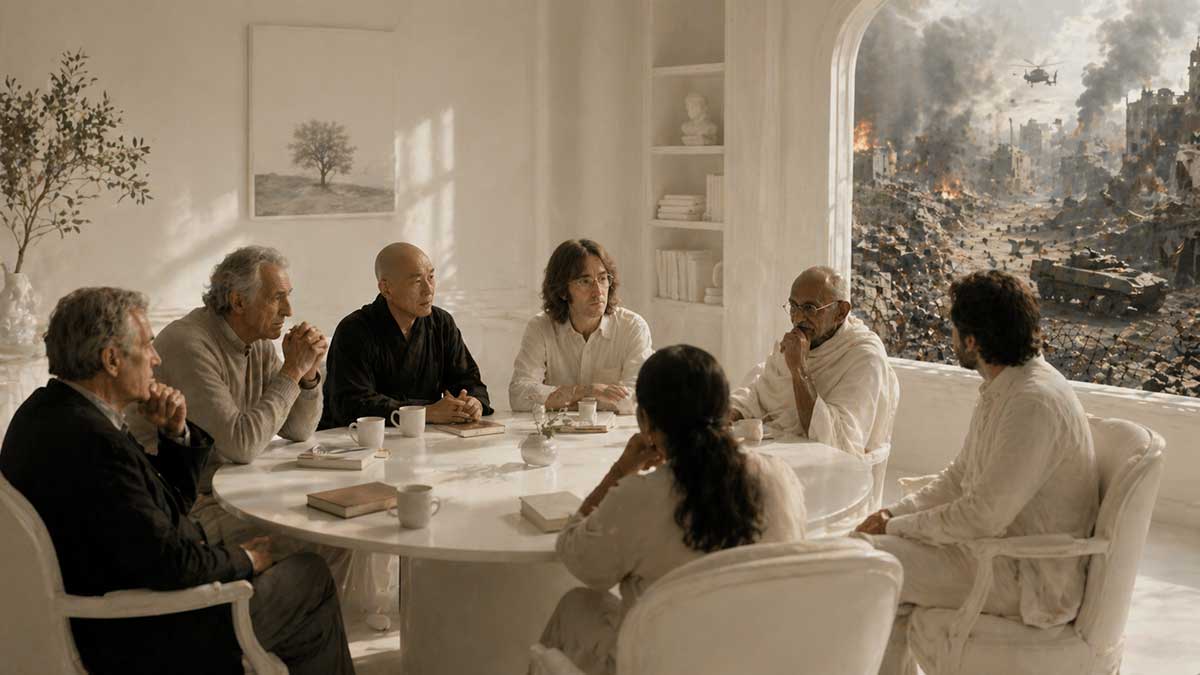
Participants:
John Lennon
Jean Houston
Aldous Huxley
Bertrand Russell
Alan Watts
Opening
John Lennon:
When I wrote the song, I wasn’t saying I had the answer. I was asking people to picture a world less chained to fear. People called it naïve, but maybe the real naïveté is thinking war, greed, and division are normal forever.
Question 1
Was Lennon asking humanity to believe in a perfect world, or to awaken a deeper human capacity?
Jean Houston:
John, I think you were calling forth a latent human capacity. The song works like an inner exercise. It asks people to step outside inherited assumptions and feel, for a moment, what a less divided consciousness might be like.
Aldous Huxley:
A perfect world may be impossible, but a widened perception is possible. The danger is confusing vision with blueprint. A song can open perception. It cannot administrate paradise.
Bertrand Russell:
The value lies in refusing fatalism. Human beings often defend misery by calling it realism. Peace requires reason, courage, and a willingness to question customs that have outlived their usefulness.
Alan Watts:
The song points to the illusion of separateness. People think they are isolated egos inside skins. From that illusion come fear, ownership, tribalism, and conflict. When the boundary softens, compassion becomes more natural.
John Lennon:
I wasn’t trying to sell heaven. I was trying to crack the wall. Just enough so people could see that maybe the world we inherited isn’t the only one possible.
Question 2
Is peace mainly a political problem, a spiritual problem, or a problem of consciousness?
Bertrand Russell:
It is all three, but politics matters. Wars are made by governments, institutions, and interests. Sentiment alone is too weak unless it becomes organized resistance to violence.
Alan Watts:
Politics is the shadow of consciousness. If people remain inwardly divided, they will build divided systems. The outer world keeps repeating the inner fracture.
Jean Houston:
Peace begins as a shift in consciousness, but it must move through culture, education, ritual, policy, and daily behavior. Inner change must become shared practice.
Aldous Huxley:
One must guard against spiritual vanity. Many people speak of peace yet remain addicted to control. Inner transformation is real only when it changes conduct.
John Lennon:
Peace isn’t just a slogan. I learned that the hard way. You can sing it, march for it, argue for it, and still have to face your own anger in the mirror.
Question 3
Why does this song still comfort some people and disturb others?
Alan Watts:
It comforts those who feel trapped by the world’s divisions. It disturbs those whose identities depend on those divisions.
Bertrand Russell:
People often love peace in theory but resent the criticism of the systems they identify with. The song names sacred attachments without flattery.
Aldous Huxley:
It is gentle in tone but radical in implication. That contrast is powerful. The melody soothes, but the propositions unsettle.
Jean Houston:
The song creates a moment of expansion. For some, that feels like hope. For others, it feels like loss—loss of certainty, tribe, hierarchy, and familiar meaning.
John Lennon:
Maybe that’s why it stayed alive. It doesn’t shout. It just keeps asking. And once people hear the question, they have to decide whether they want the answer.
Topic 2 — Religion, Spirit, and the Danger of Dogma
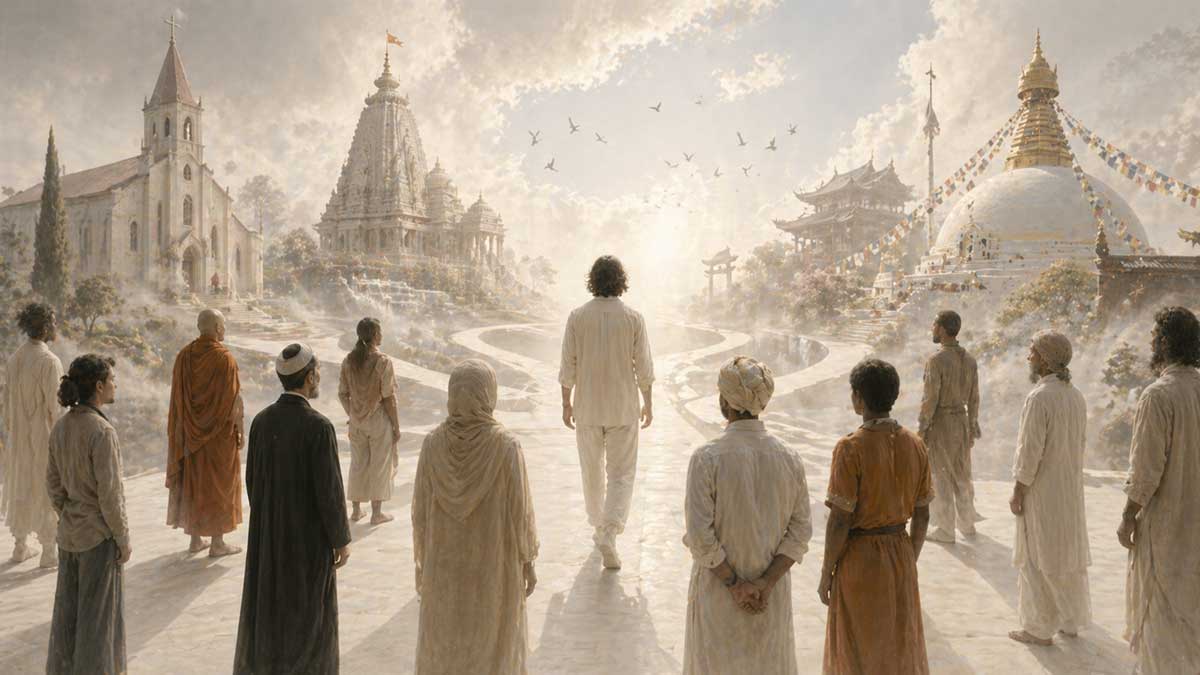
Participants:
John Lennon
Yoko Ono
George Harrison
Alan Watts
Mahatma Gandhi
Opening
John Lennon:
When I sang “no religion,” I knew people would hear danger in it. But I wasn’t trying to kill the soul. I was asking what happens when belief stops being love and starts becoming a weapon.
Question 1
When Lennon sang of a world without religion, was he rejecting God, or rejecting division in God’s name?
George Harrison:
I don’t hear it as rejecting God. I hear it as rejecting the boxes people build around God. The divine is not smaller than our labels, temples, or arguments.
Mahatma Gandhi:
Religion without humility becomes violence in sacred clothing. True faith should make one gentler, more truthful, more willing to serve. If religion divides us from compassion, it has lost its center.
Alan Watts:
The trouble begins when people confuse the menu with the meal. Words, doctrines, and rituals point toward something. Then people worship the pointer and fight over whose pointer is holy.
Yoko Ono:
John wanted peace to become simple enough to feel. He was not making an academic statement. He was cutting through symbols that had become heavy with blood, fear, and control.
John Lennon:
Yes. I wasn’t saying there’s nothing sacred. I was saying don’t murder people over your version of sacred.
Question 2
Can humanity keep spiritual depth without turning it into institutions, tribes, and conflict?
Alan Watts:
It can, but only when spirituality remains playful, direct, and experiential. The moment it hardens into ownership—my truth, my group, my salvation—it becomes another ego costume.
Yoko Ono:
Art can keep spirit open. Silence, presence, imagination, a shared act of peace—these can be spiritual without becoming cages.
George Harrison:
Practice matters. Chanting, prayer, meditation, service—these bring the heart closer to God. The danger is not practice. The danger is pride.
Mahatma Gandhi:
Institutions are not always the enemy. They can preserve wisdom and discipline. But they must remain servants of truth, never masters over conscience.
John Lennon:
Maybe the question is whether we can have spirit without the sales department. The moment someone says, “Only we’ve got it,” the trouble starts.
Question 3
What kind of faith remains when fear, guilt, and superiority are removed?
Mahatma Gandhi:
A faith of love remains. A faith that does not need to conquer, shame, or dominate. It becomes truth practiced through nonviolence.
George Harrison:
Devotion remains. Gratitude remains. A longing for God remains. Without fear, faith can become joy instead of pressure.
Yoko Ono:
Peace remains as a daily act. Listening becomes faith. Forgiveness becomes faith. Creating a space where another person can breathe becomes faith.
Alan Watts:
Wonder remains. When fear drops away, one no longer needs to prove the universe is on one’s side. One begins to see that one was never separate from it.
John Lennon:
Then maybe that’s what I was trying to get at. Not a world without spirit, but a world where spirit doesn’t need enemies to feel alive.
Topic 3 — Possessions, Ego, and the Dream of Shared Life
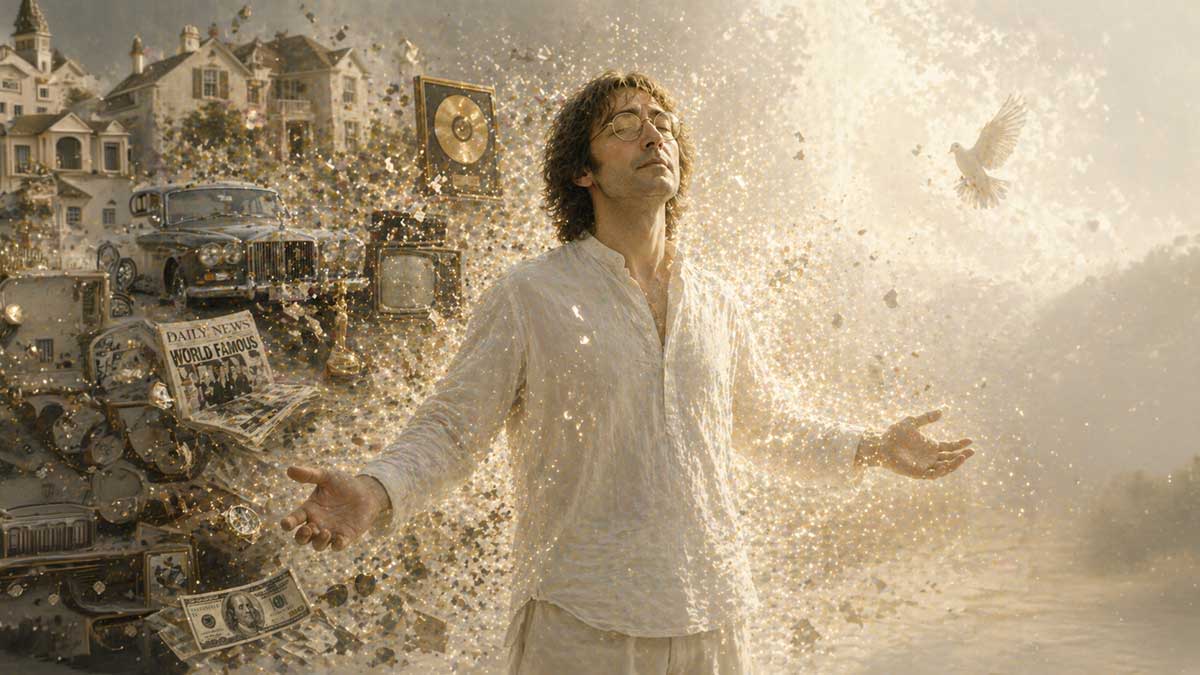
Participants:
John Lennon
Jean Houston
Mahatma Gandhi
Buckminster Fuller
Bertrand Russell
Opening
John Lennon:
When I sang “no possessions,” people laughed and said, “Easy for you, John.” Fair enough. I had money. I had houses. I had contradictions. But the line wasn’t me pretending to be pure. It was me asking: how much of what we own ends up owning us?
Question 1
Is “no possessions” a literal social vision, or a challenge to greed and ego?
Bertrand Russell:
Taken literally, it would require serious political and economic questions. But morally, the line attacks possessiveness more than ordinary use. A person may need a coat, a home, tools, privacy. The danger begins when ownership becomes domination.
Mahatma Gandhi:
I would hear it as a call to simplicity. The human being needs less than he imagines. Possession becomes a prison when it feeds vanity and separates us from the suffering of others.
Jean Houston:
The phrase is mythic language. It shocks the ordinary mind so that another possibility can enter. John is asking us to loosen the identity built around having, acquiring, defending, and comparing.
Buckminster Fuller:
The planet has enough resources if humanity designs intelligently. Scarcity is often badly organized abundance. The question is not merely who owns what, but whether our systems serve life or waste it.
John Lennon:
Yes, I wasn’t saying nobody can have a toothbrush. I was saying maybe we’ve built a whole civilization around clutching things and calling it freedom.
Question 2
Can people share more freely without losing responsibility, creativity, and motivation?
Buckminster Fuller:
Certainly, if the system rewards contribution rather than hoarding. Human creativity increases when basic survival fear decreases. When people are trapped in scarcity, imagination is spent on defense.
Bertrand Russell:
One must be careful. Human beings require incentives, but incentives need not be crude greed. Honor, curiosity, affection, craft, and public good have moved many people more nobly than money.
Mahatma Gandhi:
Responsibility grows when people see themselves as trustees, not owners in the absolute sense. Wealth should be held for service. Talent should be held for service. Life itself is held for service.
Jean Houston:
Sharing becomes possible when identity expands. If I experience another’s suffering as connected to my own life, generosity is no longer sacrifice in the narrow sense. It becomes participation in a larger self.
John Lennon:
Maybe people are more creative when they don’t feel they’re fighting everyone else for oxygen. The dream isn’t laziness. It’s less fear, less showing off, less worship of having.
Question 3
What would need to change inside human beings before economic justice could feel natural?
Jean Houston:
The imagination of the self would need to grow. People would need to experience themselves as relational beings, not isolated consumers. Justice becomes natural when the “I” becomes large enough to include the “we.”
Mahatma Gandhi:
Desire must be disciplined. Without self-restraint, no outer system can create justice. A greedy heart will corrupt the finest structure.
Bertrand Russell:
Education must change. Children should be taught cooperation, critical thinking, and sympathy, not merely competition. Civilization depends on habits of mind.
Buckminster Fuller:
Design must change too. Do not ask people to be saints inside systems built for selfishness. Build systems where doing the life-supporting thing is easier, cheaper, and more natural.
John Lennon:
So maybe the song was asking for both: a change of heart and a change of design. Less greed inside, less madness outside. A world where sharing doesn’t feel like losing.
Topic 4 — Nations, Borders, War, and One Human Family
Participants:
John Lennon
Martin Luther King Jr.
Mahatma Gandhi
Bertrand Russell
Buckminster Fuller
Opening
John Lennon:
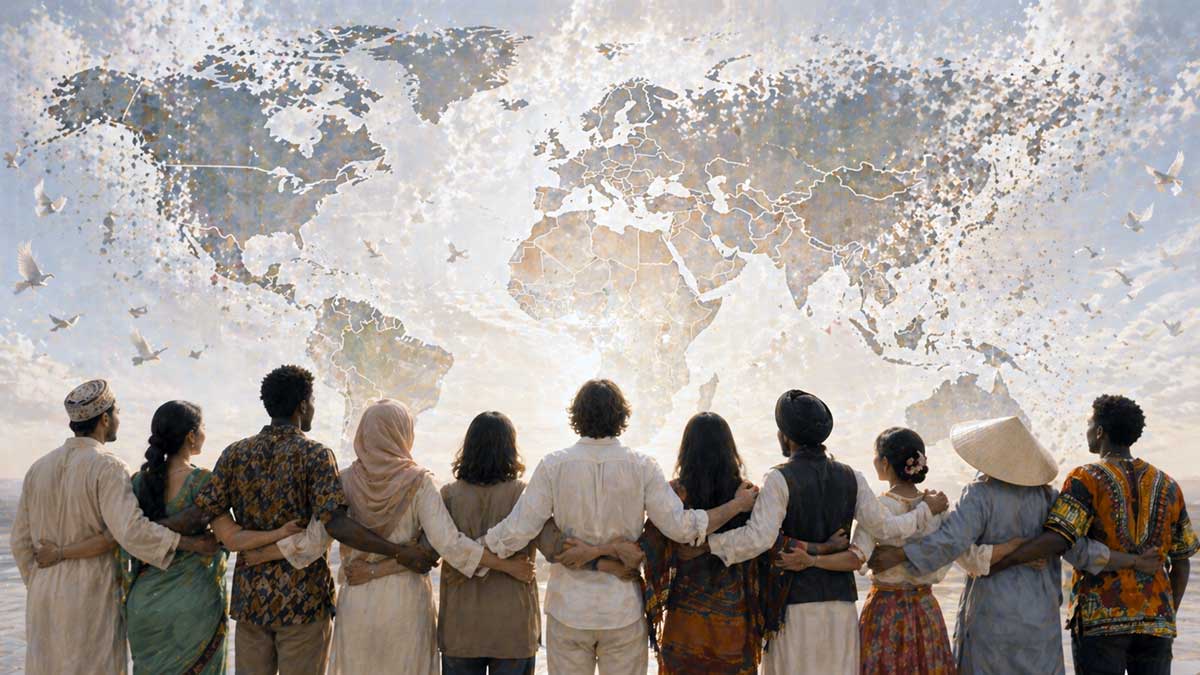
When I sang “no countries,” I knew that sounded impossible. People love their flags, songs, memories, and hometowns. I understand that. But I was asking whether love of home has to become hatred of someone else’s home.
Question 1
Do nations protect human identity, or do they turn identity into conflict?
Martin Luther King Jr.:
A nation can protect memory, law, and belonging. But when national identity becomes ultimate, it tempts people to forget the sacred worth of those outside its borders.
Bertrand Russell:
Nationalism has too often been a machine for persuading ordinary people to die for the ambitions of rulers. Love of country is not evil, but it becomes dangerous when reason is silenced by loyalty.
Mahatma Gandhi:
I loved India, but my love for India could not require hatred of England. True patriotism must be purified by truth and nonviolence. If it becomes contempt, it has already fallen.
Buckminster Fuller:
The planet does not operate as separate national machines. Air, water, energy, food, and technology form one connected system. Borders are political drawings placed over one living Earth.
John Lennon:
That’s the trouble, isn’t it? A flag can mean home, or it can become a wall inside the mind. The question is whether we can love where we came from without turning it into a weapon.
Question 2
Can humanity become one family without erasing culture, memory, and belonging?
Buckminster Fuller:
Yes, if unity is based on planetary coordination, not cultural sameness. Humanity needs whole-Earth thinking with local richness intact. The design failure is confusing unity with uniformity.
Mahatma Gandhi:
The family of humanity must contain many languages, customs, prayers, and ways of life. Love does not demand sameness. It demands reverence.
Martin Luther King Jr.:
The beloved community is not colorless or rootless. It is a moral order where difference no longer justifies domination. Justice protects difference from becoming hierarchy.
Bertrand Russell:
A sane world government, or at least sane international cooperation, would not require abolishing poetry, language, or local affection. It would require abolishing the permission to settle disputes by slaughter.
John Lennon:
That’s closer to what I meant. Not everybody eating the same breakfast and singing the same song. Just no more teaching children that people across a line are born to be enemies.
Question 3
What makes war feel normal to societies that claim to value peace?
Bertrand Russell:
Habit, propaganda, fear, and obedience. Most people do not desire war, but they are trained to accept the arguments of those who profit from it or gain authority through it.
Martin Luther King Jr.:
War becomes normal when conscience is separated from policy. A society may preach love in its houses of worship and still organize violence through its institutions.
Mahatma Gandhi:
Violence is often prepared in the heart before it appears on the battlefield. Anger, pride, humiliation, and fear gather silently. War is the outer form of inner disorder.
Buckminster Fuller:
War persists partly because old systems organize scarcity and competition. When people believe survival requires domination, violence appears rational. Better design can make cooperation the practical choice.
John Lennon:
Maybe that’s why I kept saying peace like a broken record. Not because it was easy, but because war had become too easy to accept. We need to make killing feel strange again.
Topic 5 — The Inner Revolution Behind the Song
Participants:
John Lennon
Yoko Ono
Jean Houston
Alan Watts
Martin Luther King Jr.
Opening
John Lennon:
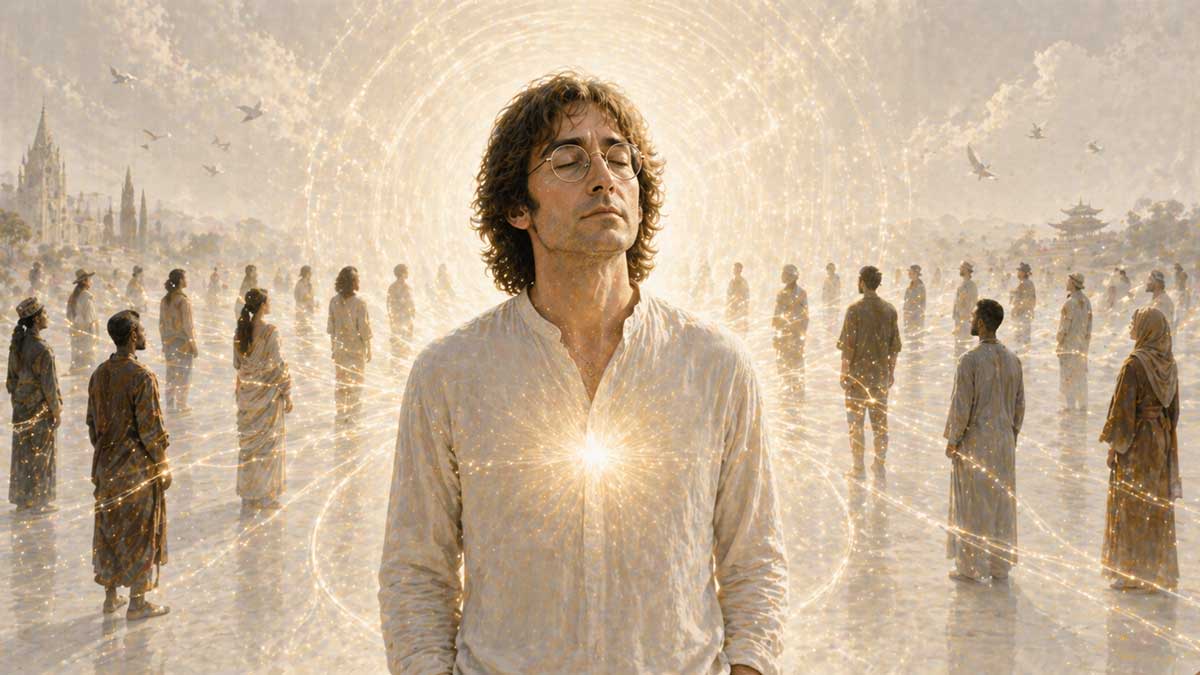
Maybe the whole song begins before politics. Before flags, churches, banks, and armies. It begins in the mind. Can a person picture peace long enough to stop worshiping fear?
Question 1
Can a song change consciousness before politics ever changes?
Jean Houston:
Yes. A song can enter where arguments cannot. It bypasses defenses and gives people a shared inner rehearsal of possibility. Before a society changes, it must first sense that another way of being is real.
Yoko Ono:
A song can become a room. People enter it together. They breathe differently inside it. That does not solve everything, but it creates a space where peace is no longer abstract.
Alan Watts:
Music dissolves the hard edge of the ego. For a moment, people stop defending their separate little worlds. They participate in rhythm, feeling, silence. That is already a small awakening.
Martin Luther King Jr.:
Songs have always carried movements. They give courage when policy has not yet moved. They remind people that the soul can refuse despair before history catches up.
John Lennon:
That’s what I hoped. Not that one song would fix the world. Just that it might sneak past the guards and plant a question where fear used to sit.
Question 2
What kind of inner freedom must happen before outer peace becomes possible?
Alan Watts:
The person must see through the illusion of the isolated self. So long as one feels separate from life, one must defend, compete, and possess. Inner freedom begins when the boundary relaxes.
Martin Luther King Jr.:
Inner freedom includes freedom from hatred. The oppressed must not become inwardly poisoned by the oppressor’s spirit. Justice without love can become another form of bondage.
Jean Houston:
It requires expansion of identity. People must become large enough inwardly to hold difference, uncertainty, grief, and hope. A small self cannot make a large peace.
Yoko Ono:
It requires silence. Listening. The courage to stop repeating inherited noise. Peace begins when we notice the violence already moving through our thoughts and language.
John Lennon:
Maybe peace starts when you stop needing an enemy to explain your pain. That’s not easy. I had plenty of anger. But I knew anger couldn’t be the final religion.
Question 3
What part of Lennon’s dream is still waiting for humanity to grow into it?
Martin Luther King Jr.:
The dream still waits for moral courage large enough to match our technology. We have built tools that connect humanity, but we have not yet built hearts disciplined enough to love across distance.
Jean Houston:
Humanity has not yet fully claimed its deeper capacities. We are still living below ourselves. The dream waits for a more mature imagination, one that can turn vision into daily practice.
Alan Watts:
People still cling to the game of separation. They know, secretly, that the self is larger than the ego, but they are frightened by the freedom this knowledge brings.
Yoko Ono:
The dream waits in small acts. A table where enemies sit down. A child taught not to hate. A silence held before revenge. Peace is not only global. It is intimate.
John Lennon:
Maybe the unfinished part is us. The song was never the world. It was a door. Every generation has to decide whether to keep singing outside it—or walk through.
Final Thoughts by Nick Sasaki
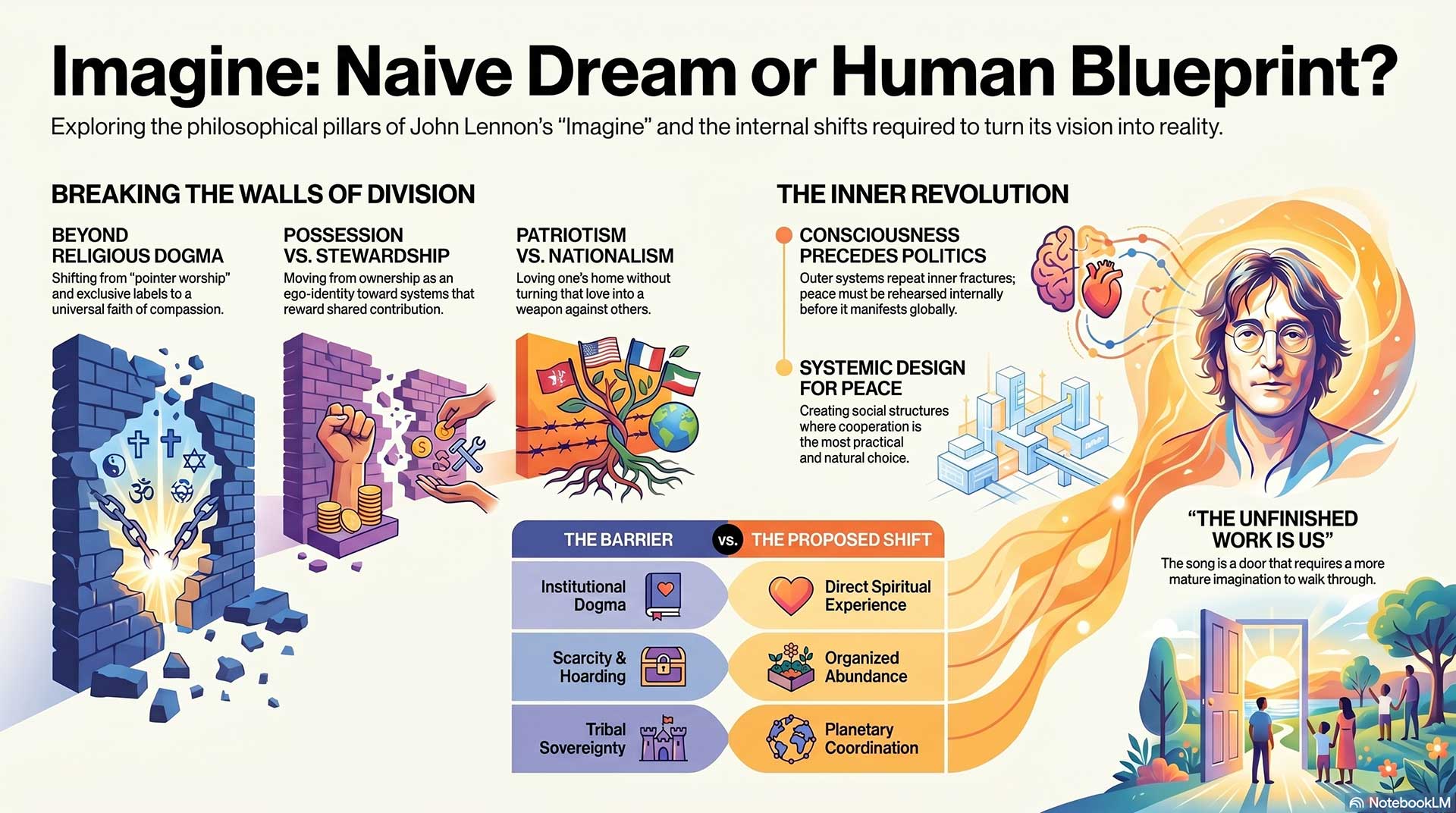
Maybe Imagine endures because it never tells us exactly what to do.
It simply removes the excuses one by one.
No heaven used to divide us.
No countries used to train us for war.
No possessions used to measure the soul.
And then it leaves us with the uncomfortable silence underneath:
What kind of person would I become if I stopped needing these walls?
Lennon’s song may never become a complete political program. It may never answer every objection. But it still does something rare.
It asks the human heart to rehearse peace before the world has agreed to it.
That may be the unfinished work.
Not just a new society.
A larger self.
Short Bios:
John Lennon: Co-founder of The Beatles, songwriter of Imagine, known for blending music with peace activism and cultural provocation.
Yoko Ono: Conceptual artist whose work in peace, imagination, and participatory art deeply shaped Lennon’s later philosophy.
Jean Houston: Pioneer in human potential and consciousness studies, exploring untapped human capacities and inner transformation.
Aldous Huxley: Author of Brave New World, exploring perception, spirituality, and the future of human society.
Bertrand Russell: Nobel laureate known for logic, anti-war advocacy, and defense of rational thought.
Alan Watts: Interpreter of Eastern philosophy for Western audiences, focused on identity, illusion, and unity.
Mahatma Gandhi: Leader of India’s independence movement, champion of nonviolence and moral discipline.
Martin Luther King Jr.: Advocate of nonviolent resistance and the “beloved community,” shaping modern justice movements.
George Harrison: Guitarist of The Beatles, deeply influenced by Indian spirituality and devotional practice.
Buckminster Fuller: Visionary thinker on global systems, sustainability, and humanity as one interconnected whole.
Leave a Reply