
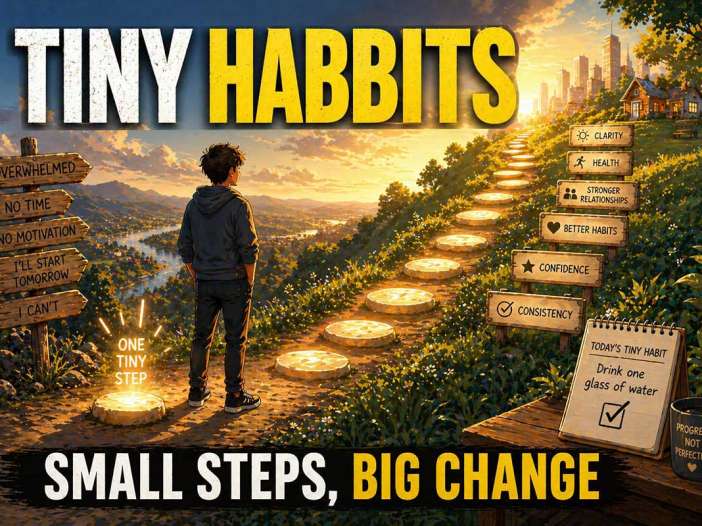
What if B. J. Fogg and top thinkers revealed why discipline fails and tiny habits actually work?
Today’s conversation centers on Tiny Habits by B. J. Fogg, a work that quietly challenges one of the most common assumptions about change: that it requires force, discipline, or dramatic effort.
Instead, Fogg proposes something almost disarmingly simple. Change begins when behavior becomes small enough to do, easy enough to repeat, and meaningful enough to feel like progress. From that foundation, consistency grows, identity shifts, and larger change becomes possible.
To explore this more deeply, we’re joined by a group of thinkers who approach human behavior from different angles. Albert Bandura helps us understand how belief in one’s own ability shapes action. Daniel Kahneman reveals how the mind actually operates in real moments, often far from rational intention. Charles Duhigg brings clarity to the mechanics of habit loops. And Nir Eyal explores how behavior is shaped by internal triggers and design.
This is not only a discussion about habits. It is a discussion about how people change, why they struggle, and what it really takes to begin again in a way that lasts.
(Note: This is an imaginary conversation, a creative exploration of an idea, and not a real speech or event.)
Topic 1: Why People Fail at Change: When the Problem Is Not the Person but the Design
Opening
B. J. Fogg:
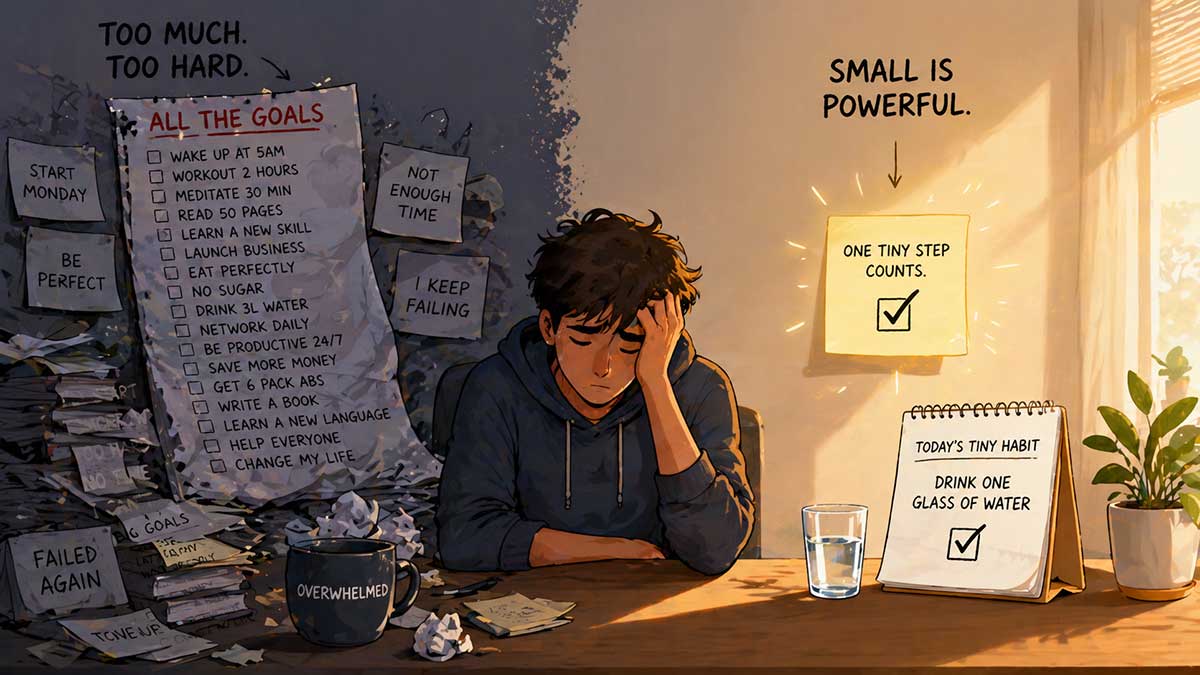
One of the most painful mistakes people make is believing that failed change means failed character. They try to exercise, eat better, pray more, write every morning, save money, call loved ones, or become more patient. Then life gets busy. Motivation drops. The new behavior disappears. And almost immediately, they turn the failure inward.
They say, “I’m lazy. I’m weak. I don’t follow through.” But in many cases, the person was not the real problem. The behavior was too big, too vague, too hard, or placed in the wrong moment. It was never given a fair chance to become part of life.
So for this first topic, I want us to look at failure differently. What if most people are not broken? What if their habits are simply badly designed? What if the first step in change is not trying harder, but removing shame and making the next action small enough to succeed?
Question 1
Are people really failing, or are their habit designs failing them?
B. J. Fogg:
Most of the time, the design is failing. People choose behaviors that depend on motivation staying high, but motivation is unreliable. It rises after inspiration, pain, guilt, or a new goal, then drops when real life returns. A good habit design does not require heroic motivation. It makes the behavior easy enough to do even on an ordinary day.
Charles Duhigg:
A habit needs a clear cue. People often choose a desired outcome, not a behavior. “I want to get healthy” is not a habit. “After I brush my teeth, I will do two push-ups” can become one. The brain needs a starting signal. Without that cue, the behavior remains an intention floating in the air.
Daniel Kahneman:
People overestimate the future self. They assume tomorrow they will be more disciplined, more rational, and less tired. But tomorrow’s self has the same mind, the same shortcuts, the same temptations, and the same limited attention. A good system does not depend on a fantasy version of the self.
Albert Bandura:
The deeper danger is what repeated failure does to belief. A person starts with hope, then loses confidence. They stop saying, “This method did not work,” and begin saying, “I do not work.” That is a serious psychological shift.
Nir Eyal:
Good design respects discomfort. Many habits fail because the old behavior solved an emotional problem. It soothed boredom, anxiety, loneliness, uncertainty, or stress. Unless the new behavior accounts for that, the person will return to what gives immediate relief.
Question 2
Why does self-blame feel so natural when behavior change breaks down?
Daniel Kahneman:
The mind likes simple stories. “I lack discipline” is painful, but it is easy to understand. The truth may involve sleep, stress, environment, timing, friction, social pressure, and invisible emotional triggers. That is harder to see, so the mind chooses a cleaner explanation.
Albert Bandura:
Self-blame can create passivity. When people believe the flaw is fixed inside them, they stop experimenting. They stop adjusting the situation. They stop asking, “What made this difficult?” They begin to treat failure as proof of identity.
B. J. Fogg:
That is why I care so much about helping people feel successful quickly. Success changes the emotional atmosphere around change. A tiny action followed by a good feeling can begin to repair years of discouragement.
Charles Duhigg:
People often miss the reward part of the loop. If the brain receives no reward, the behavior will not repeat easily. Then the person thinks the problem is discipline, when the real problem is that the habit loop was incomplete.
Nir Eyal:
Self-blame often hides the internal trigger. Someone says, “I wasted time again,” but the deeper question is, “What feeling was I trying to escape?” Until that feeling is named, the behavior keeps returning.
Question 3
How much change begins with making people feel capable again?
Albert Bandura:
A great deal. People need evidence that their action can matter. Self-efficacy is built through experience, not slogans. When a person succeeds in a small way, they receive proof that change is possible.
B. J. Fogg:
That is the heart of tiny habits. The behavior may look almost too small to matter, but the emotional effect can be large. “I did it” is not a minor feeling. It can become the seed of a new identity.
Daniel Kahneman:
A small success begins to change the story. The mind updates slowly, but it does update. The person who once thought, “I never follow through,” begins to gather counterevidence.
Charles Duhigg:
Once the loop begins working, the behavior requires less debate. The person no longer has to win an argument with themselves every day. The cue appears, the routine follows, and the reward reinforces the pattern.
Nir Eyal:
Capability returns when the next step is small enough to take without inner resistance. That may sound modest, but it is often the doorway back into agency.
Closing
B. J. Fogg:
What I hear in this conversation is that failure has been judged too harshly and studied too little. People often think change begins with pressure, discipline, or shame. But shame rarely creates a reliable path forward. It may create a burst of effort, but it does not create a trustworthy system.
A better question is not, “What is wrong with me?” A better question is, “What made this behavior hard to do?” Was the action too large? Was the prompt missing? Was the reward too weak? Was the person trying to change at a moment when life was already overloaded?
When we ask better questions, people become less ashamed and more curious. That curiosity matters. It allows them to redesign instead of condemn themselves.
So perhaps the first tiny habit is not physical at all. Perhaps it is the habit of replacing self-blame with design thinking. Not “I failed again,” but “This needs to be made easier.” That single shift can open the door to every change that follows.
Topic 2: The Exact Moment Behavior Happens: Motivation, Ability, and Prompt
Opening
B. J. Fogg:
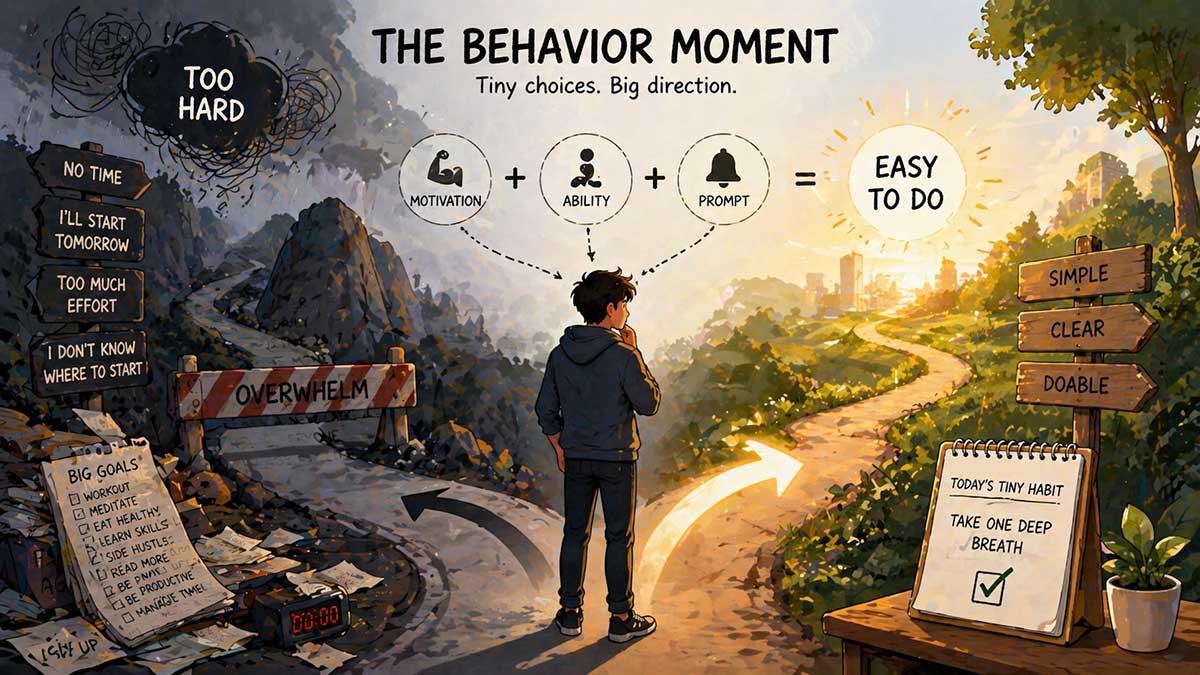
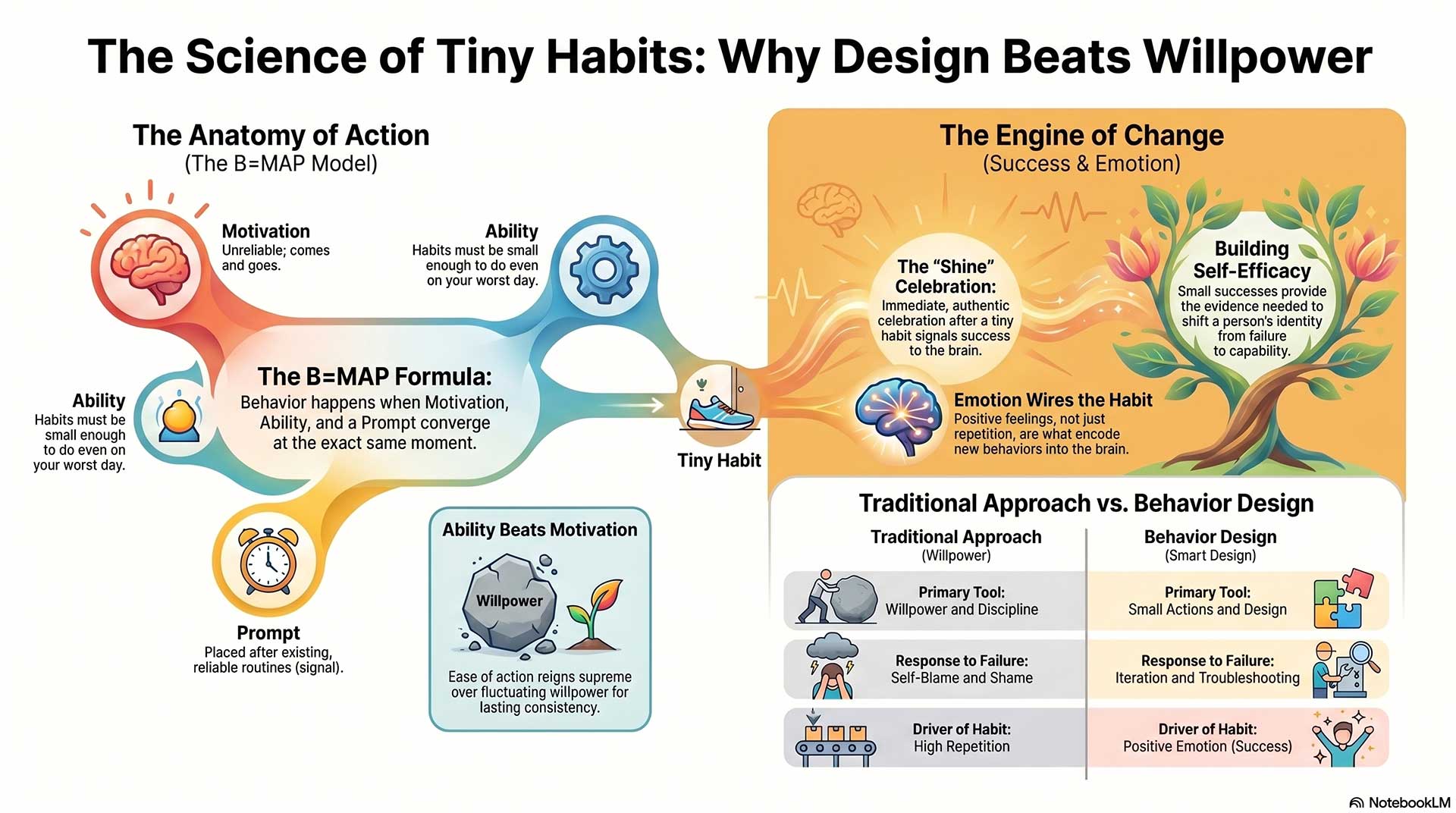
A behavior does not happen just because someone wants it. Wanting is only one part of the equation. For any behavior to occur, three things must come together at the same moment: motivation, ability, and a prompt.
If motivation is high but the action is too hard, the behavior may not happen. If the action is easy but there is no prompt, the behavior may not happen. If the prompt appears but the person has no desire and the action feels difficult, the behavior usually fails.
This matters because people often treat behavior as a moral test. They say, “If I cared enough, I would do it.” But behavior is more precise than that. It happens at a moment. And that moment can be shaped.
Question 1
What must be present at the exact moment someone acts?
B. J. Fogg:
The person needs enough motivation, enough ability, and a prompt. All three must converge. If one is missing, the behavior does not happen. This is why change becomes easier when we stop trying to force motivation and start making the action easier.
Daniel Kahneman:
The moment matters because the mind is often operating automatically. People do not calmly review their life goals before every action. They respond to cues, feelings, habits, and friction.
Charles Duhigg:
That is why the cue is so central. The cue tells the brain, “Begin now.” Without it, the routine may never activate.
Albert Bandura:
Ability also includes perceived ability. If a person believes the action is beyond them, they may not attempt it, even when the action itself is small.
Nir Eyal:
The prompt can be external, like a notification, or internal, like boredom or anxiety. A good habit design understands both.
Question 2
Why do prompts fail when motivation or ability is missing?
Charles Duhigg:
A prompt is not magic. A reminder can appear every day and still fail if the routine feels too difficult or unrewarding. Many people have reminders they ignore.
B. J. Fogg:
Exactly. If the prompt fires but the behavior is too hard, people feel annoyed, not helped. The answer is usually to shrink the behavior until it can be done.
Daniel Kahneman:
People also adapt to prompts. What once captured attention becomes background noise. The mind filters it out unless the prompt is tied to a clear and easy action.
Nir Eyal:
This is where many apps fail ethically and practically. They keep adding prompts, but they do not ask whether the prompt serves the person’s deeper intention.
Albert Bandura:
When prompts repeatedly fail, people may interpret that as personal failure. The system keeps reminding them of something they do not feel capable of doing.
Question 3
Can one tiny behavior interrupt years of automatic patterns?
B. J. Fogg:
Yes, if it is placed well. A tiny behavior can become a wedge. It does not need to solve everything immediately. It only needs to create a reliable beginning.
Albert Bandura:
Small actions can restore agency. A person who feels trapped by a pattern needs evidence that they can act differently, even in a very small way.
Daniel Kahneman:
Old patterns are powerful because they require little thought. A tiny behavior has a chance because it asks for very little attention and effort.
Charles Duhigg:
A small routine can begin changing the loop. Once the cue and reward become stable, the brain starts expecting the new pattern.
Nir Eyal:
The key is not to fight the old pattern directly every time. Give the person a new response that is easier to begin.
Closing
B. J. Fogg:
This topic brings us to the mechanics of change. Behavior is not mysterious. It may feel mysterious because it happens so quickly, inside real life, under pressure, emotion, fatigue, and distraction. But once we slow it down, we can see the moving parts.
Motivation matters, but it is unreliable. Ability matters because hard things disappear when life gets heavy. Prompts matter because no behavior begins without some signal.
The hopeful part is this: if behavior happens in a moment, then the moment can be redesigned. We can make the action smaller. We can place it after something already reliable. We can make the prompt clearer. We can help the person feel successful.
Change does not always begin with a dramatic decision. Sometimes it begins when the right small action meets the right moment.
opic 3: Emotion, Reward, and Self-Belief: Why Feeling Successful Matters
Opening
B. J. Fogg:
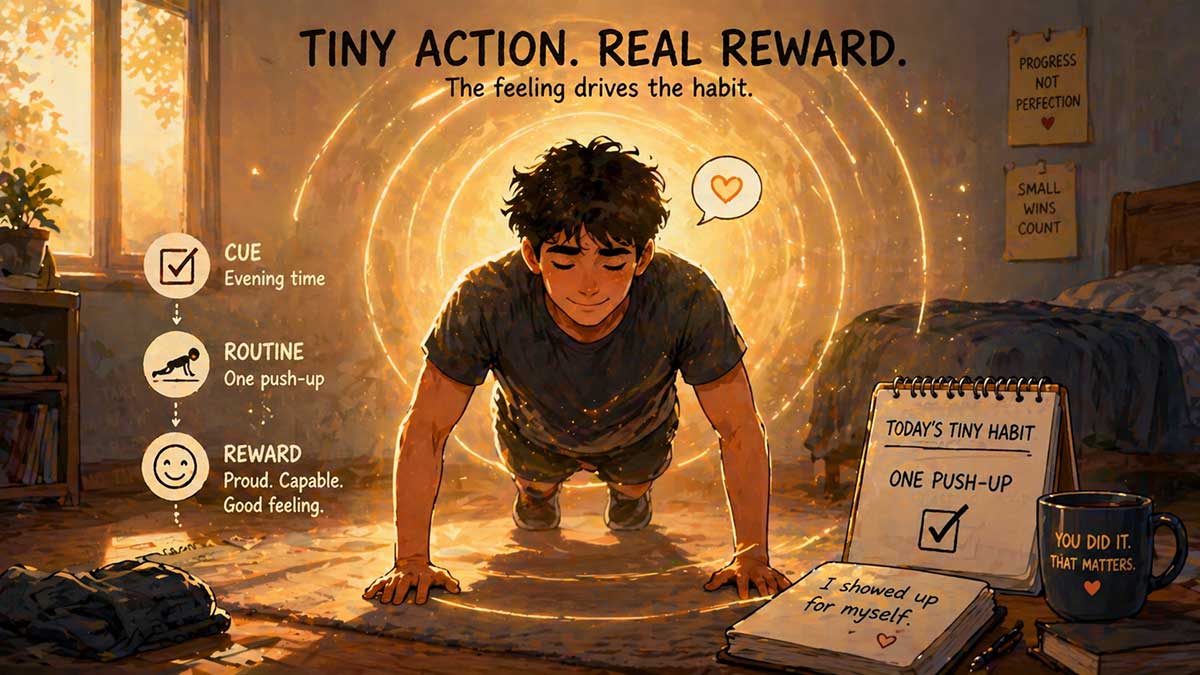
Many people believe habits are built by repetition alone. But repetition is not the whole story. What wires a habit into the brain is emotion. The feeling that follows the behavior teaches the brain whether this action is worth repeating.
This is why celebration matters. It is not childish. It is not decoration. It is a way of saying to the brain, “This worked. Remember this.” When people feel successful, they become more willing to repeat the behavior.
So the real question is not only, “What did I do?” It is, “How did I feel after I did it?” That feeling may decide whether the habit survives.
Question 1
Why does feeling successful matter more than trying harder?
B. J. Fogg:
Trying harder often creates tension. Feeling successful creates momentum. When people feel good immediately after a behavior, the brain begins to encode that behavior as something worth repeating.
Albert Bandura:
Success builds self-efficacy. A person does not become capable by being scolded. They become capable by experiencing themselves succeeding.
Charles Duhigg:
Reward is what closes the habit loop. Without reward, the behavior may remain effortful and unstable.
Daniel Kahneman:
The remembering self matters here. People do not only remember what they did. They remember how the experience felt. If change feels like humiliation, they avoid it.
Nir Eyal:
A behavior that relieves discomfort can become powerful. But healthy habits need emotional reinforcement too, or they lose to easier forms of relief.
Question 2
Can celebration create self-efficacy faster than discipline?
B. J. Fogg:
Yes. Discipline can help, but celebration creates emotional learning. When someone says, “Good job,” and actually feels it, the brain receives a signal of success.
Albert Bandura:
Self-efficacy grows through mastery experiences. Celebration helps mark the experience as mastery, even when the action is small.
Daniel Kahneman:
The mind is influenced by emotional highlights. A tiny habit with a positive emotional peak may be remembered more favorably than a larger effort filled with strain.
Charles Duhigg:
The reward does not need to be dramatic. It simply has to be meaningful enough for the brain to connect cue, routine, and payoff.
Nir Eyal:
The danger is fake celebration. If the celebration feels forced, it may not work. The emotion has to feel real to the person.
Question 3
Where is the line between genuine “shine” and fake positivity?
B. J. Fogg:
Genuine shine feels like authentic success. It can be quiet. It can be a smile, a breath, a small inner “yes.” Fake positivity tries to cover discouragement without changing the design.
Nir Eyal:
Fake positivity tells people to ignore discomfort. Genuine success helps people face discomfort with more confidence.
Albert Bandura:
True encouragement strengthens agency. Empty reassurance does not. People know the difference.
Daniel Kahneman:
The brain is sensitive to emotional mismatch. If the person says, “This is great,” but feels foolish or defeated, the story may not change.
Charles Duhigg:
Reward has to fit the loop. If the reward feels disconnected from the behavior, it will not reinforce the habit strongly.
Closing
B. J. Fogg:
This topic may be the most misunderstood part of behavior change. People often assume emotion is a side effect. In reality, emotion is one of the main engines. A tiny behavior without a positive feeling may fade. A tiny behavior connected to genuine success can grow.
That changes how we treat ourselves. We stop using shame as the main teacher. We stop waiting for massive progress before allowing ourselves to feel good. We begin rewarding the beginning.
Celebration does not deny that life is hard. It gives the brain a reason to try again. It teaches the person, “This is working. I can do this. I am becoming someone who changes.”
And maybe that is why tiny habits matter so much. The behavior may be small, but the feeling of success can be the first proof that a different life is possible.
Topic 4: Designing Habits Without Manipulating People: Freedom, Control, and Ethics
Opening
B. J. Fogg:
Once we understand that behavior can be designed, a deeper question appears. If we can shape behavior, who should be doing the shaping? And for what purpose?
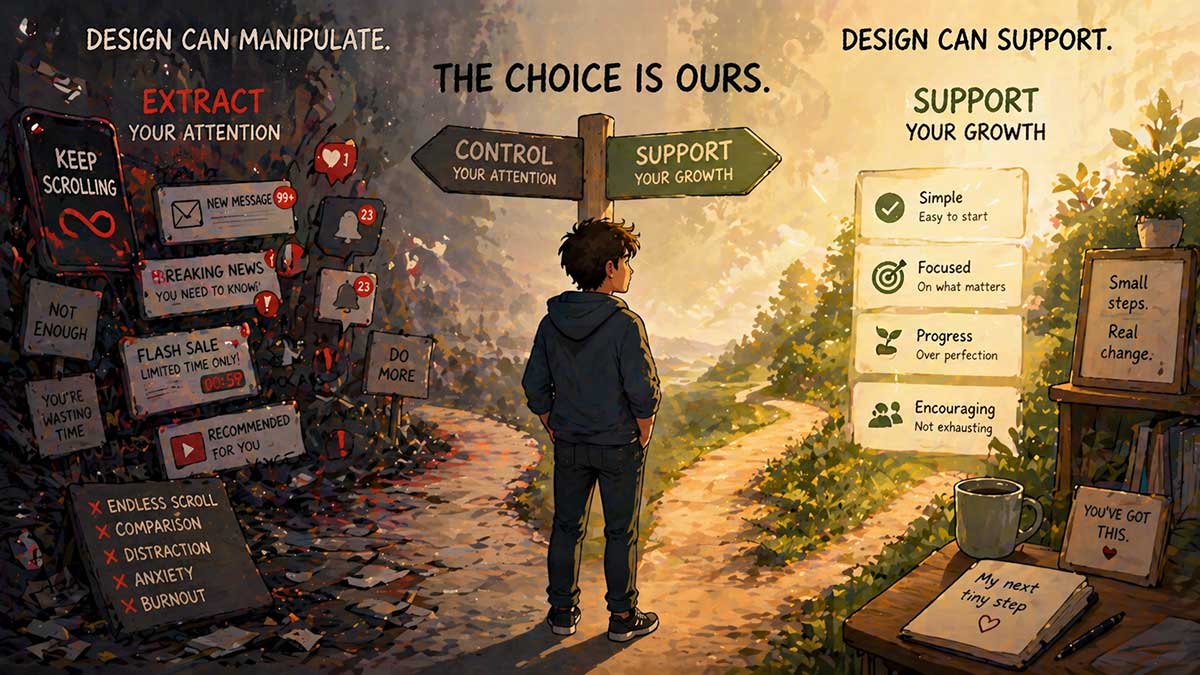
Design can help people live better lives. It can make healthy actions easier and more natural. But the same principles can also be used to capture attention, increase dependency, or push people toward actions they did not fully choose.
So this topic is not just about effectiveness. It is about responsibility. How do we design habits that support people without quietly taking control away from them?
Question 1
When does behavior design become persuasion instead of support?
Nir Eyal:
Design becomes persuasion when it pushes people toward actions they did not consciously choose. Support helps people do what they already want to do. The difference is alignment with the user’s own goals.
B. J. Fogg:
I focus on helping people do what they already want. The intention matters. If the design serves the person’s own aspirations, it can be empowering.
Daniel Kahneman:
The challenge is that people are not always aware of their own intentions. Automatic behavior can be influenced without conscious awareness. That creates ethical tension.
Charles Duhigg:
Habit loops can be built for almost anything. Companies have used cues and rewards to shape consumption patterns. The structure itself is neutral. The use is not.
Albert Bandura:
People need a sense of agency. If design bypasses awareness too often, it can weaken the feeling that one is choosing one’s own actions.
Question 2
Who should control the prompt: the person, the app, the company, or the culture?
B. J. Fogg:
Ideally, the person has the final say. External prompts can help, but they should support self-directed change, not replace it.
Nir Eyal:
External triggers are powerful, but internal triggers are more important. When a behavior becomes tied to an internal state, it becomes part of the person’s own pattern.
Daniel Kahneman:
People often underestimate how much external prompts influence them. Notifications, environment, and social cues shape behavior more than most realize.
Charles Duhigg:
Culture itself acts as a system of prompts. Social norms tell people when to act, what to value, and what to repeat.
Albert Bandura:
Agency grows when people recognize these influences and learn to shape them. Control does not require isolation, but it does require awareness.
Question 3
Can habit design protect freedom rather than reduce it?
Albert Bandura:
Yes, if it strengthens self-efficacy. When people feel capable of directing their actions, freedom increases.
B. J. Fogg:
Small habits can give people back a sense of control. They show that change is possible without overwhelming effort.
Nir Eyal:
Freedom is not the absence of influence. It is the ability to choose how to respond to influence. Good design can support that.
Daniel Kahneman:
The mind will always be shaped by systems, cues, and patterns. The question is whether those systems are aligned with the person’s long-term values.
Charles Duhigg:
When people understand how habits work, they can redesign their own loops. That knowledge can shift control back to the individual.
Closing
B. J. Fogg:
The more we understand behavior, the more careful we need to become. These tools are powerful. They can help someone exercise, connect with others, grow spiritually, or build a meaningful life. But they can also be used in ways that narrow attention and reduce choice.
So the goal is not to avoid design. The goal is to design with respect. Respect for the person’s goals, their limits, their emotions, and their right to choose.
A well-designed habit should feel like support, not pressure. It should feel like something that belongs to the person, not something imposed on them.
In the end, the best habit design does not control people. It helps them regain control of themselves.
Topic 5: What Tiny Habits Can and Cannot Fix: When Small Steps Need a Larger Life

Opening
B. J. Fogg:
Tiny habits are powerful, but they are not magic. A small behavior can begin change, restore confidence, and create momentum. But some human struggles are bigger than a single habit.
People may be facing grief, trauma, addiction, loneliness, family breakdown, poverty, spiritual despair, or social pressure. In those cases, a tiny habit may help open the door, but it may not be the whole house.
So our final topic asks a necessary question: where does tiny habit design work beautifully, and where do people need deeper support, community, healing, or structural change?
Question 1
Can tiny habits change deep trauma, addiction, loneliness, or despair?
Albert Bandura:
They can help restore agency, but we should not confuse a beginning with a cure. When someone feels powerless, a small successful action can matter deeply.
B. J. Fogg:
I agree. A tiny habit can be a starting point. It can help a person feel, “I can still do something.” That feeling is meaningful.
Nir Eyal:
In addiction or despair, the internal triggers are often intense. A tiny habit may create a pause, but the deeper pain needs care.
Daniel Kahneman:
People under distress have reduced mental bandwidth. The smaller the action, the more realistic it becomes. But the surrounding condition still matters.
Charles Duhigg:
For serious patterns, the loop may be reinforced by powerful rewards or relief. Replacing it often requires support beyond personal intention.
Question 2
When does someone need community, therapy, faith, or structural change beyond habit design?
Nir Eyal:
When the person is using behavior to escape pain they cannot safely face alone. At that point, the issue is not just habit. It is suffering.
Albert Bandura:
People develop agency through relationships and environments. Supportive communities can strengthen what an individual cannot sustain alone.
Charles Duhigg:
Many habits are social. If someone’s environment constantly reinforces the old loop, personal effort becomes much harder.
Daniel Kahneman:
Context is often underestimated. People like individual explanations, but behavior is shaped by systems, stress, scarcity, and social expectations.
B. J. Fogg:
Tiny habits are most effective when they are honest about scale. Sometimes the tiny behavior is simply asking for help, sending one message, or stepping into one supportive place.
Question 3
What is the smallest habit that can open the door to a larger life?
B. J. Fogg:
It depends on the person. For one person, it may be taking one deep breath after waking. For another, it may be writing one sentence, drinking one glass of water, or saying one kind word.
Albert Bandura:
The smallest action that restores agency is often the most important. It tells the person, “My action still matters.”
Charles Duhigg:
A keystone habit often begins small, but it changes how other choices feel. One small routine can reorganize the day.
Nir Eyal:
I would look for the moment of escape. When discomfort appears, what tiny action helps the person respond instead of react?
Daniel Kahneman:
A small habit becomes powerful when it changes the default. The person no longer needs to decide from zero each time.
Closing
B. J. Fogg:
Tiny habits should be understood with both hope and humility. Hope, because small actions can truly change people. Humility, because people are not machines, and life is not always simple.
A tiny habit can help someone begin again. It can give them a first win, a first breath, a first sign that change is still possible. But we should never use habit design to minimize real pain or ignore the larger forces shaping a person’s life.
Sometimes the smallest habit is not doing a push-up or drinking water. It is asking for help. It is calling a friend. It is sitting quietly for one minute instead of giving up. It is taking one step back toward life.
That may be the deepest promise of tiny habits: not that small steps solve everything, but that they can return a person to movement. And once movement returns, the future is no longer completely closed.
Final Thoughts by B. J. Fogg
If there is one idea I hope people carry from this conversation, it is this: change does not have to begin with struggle. It can begin with something so small that it almost feels too easy to count.
But that is exactly why it works.
A tiny habit gives people a first success. And success changes the emotional relationship to change itself. Instead of thinking, “I failed again,” a person begins to feel, “I can do this.” That feeling matters. It becomes the seed of confidence, identity, and momentum.
For too long, many people have tried to change through pressure, guilt, and self-criticism. But shame is a poor designer. It may push someone briefly, but it rarely builds a reliable path forward.
Tiny habits invite a different question. Not “How do I force myself to become better?” but “How can I make the next good action easier to do?”
That shift may look small. But for many people, it is the beginning of a new life.
Short Bios:
B. J. Fogg — Behavior scientist, Stanford researcher, and author of Tiny Habits, known for behavior design and the Fogg Behavior Model.
Albert Bandura — Psychologist best known for self-efficacy theory and social learning theory.
Daniel Kahneman — Nobel Prize-winning psychologist known for work on judgment, decision-making, and cognitive bias.
Charles Duhigg — Journalist and author of The Power of Habit, focused on habit loops and behavior change.
Nir Eyal — Author of Hooked and Indistractable, known for work on triggers, attention, and behavioral design.
Leave a Reply