
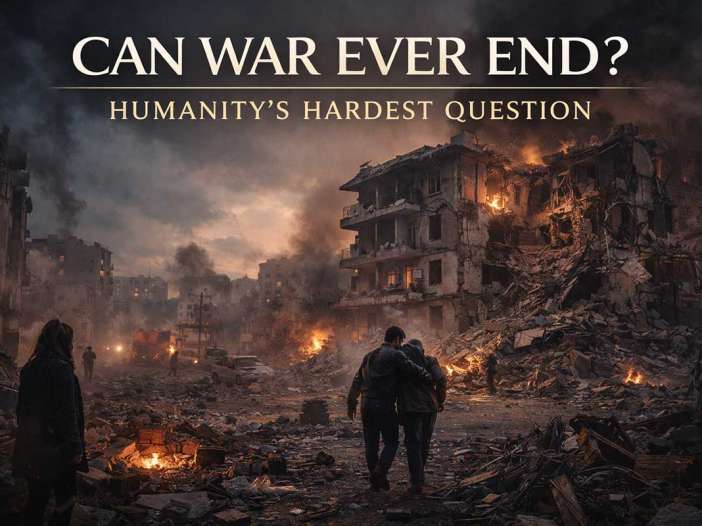
|
Getting your Trinity Audio player ready...
|
Introduction by
Introduction by Nick Sasaki
Welcome, everyone.
Tonight we take up one of the hardest questions any civilization can ask: can war ever end for good? Human beings have built cities, laws, religions, markets, science, diplomacy, and global institutions — yet we still have not solved violence at scale. Again and again, history reaches moments of horror so deep that people say, “Never again.” And again and again, somehow, war returns.
That is what makes this question so severe. We are not asking whether war is tragic. Humanity already knows that. We are asking why tragedy keeps rebuilding itself through intelligent societies, educated leaders, modern states, and even cultures that claim to value peace.
This question reaches into every layer of human life. It touches fear, power, pride, humiliation, memory, revenge, ideology, insecurity, and the stories nations tell about themselves. It asks whether war comes mainly from human nature, from broken systems, from failed institutions, from wounded identities, or from a deeper moral problem that politics alone cannot solve.
It also asks whether peace has been misunderstood. Perhaps peace is not only the absence of battle. Perhaps it is not only deterrence, treaties, or balance. Perhaps real peace asks more of us than we usually admit. It may require stronger institutions, wiser diplomacy, earlier prevention, deeper reconciliation, and even an inner transformation that makes hatred less easy to mobilize.
So in these five conversations, we will move from history to human nature, from institutions to conscience, from realism to hope. We will ask why war keeps returning, whether better systems can reduce it, whether moral and spiritual change are necessary, and what kind of future humanity could still build if perfect peace remains out of reach.
I do not want this conversation to begin with fantasy. I do not want it to begin with resignation either. I want it to begin with seriousness. War has survived every age of civilization. That means the answer, if there is one, will not be shallow.
Let us begin, then, with the first and hardest fact: if humanity keeps saying “never again,” why does history keep answering back?
(Note: This is an imaginary conversation, a creative exploration of an idea, and not a real speech or event.)
Topic 1 — Why Does War Keep Returning, Even After Humanity Says “Never Again”?
Participants:
Nick Sasaki, Thucydides, Carl von Clausewitz, Barbara Tuchman, John Keegan, Margaret MacMillan
Three questions for this topic:
Why do intelligent societies keep walking back into organized violence?
Is war caused more by fear, ambition, miscalculation, or human nature?
Why do “never again” moments fade so quickly?
Nick Sasaki
Welcome, everyone.
We begin with a hard fact of history: humanity hates war, remembers war, mourns war, promises after war that it must never happen again — and then, somehow, war returns.
It returns after treaties.
It returns after memorials.
It returns after mass graves, ruined cities, shattered families, and entire generations swearing that the lesson has been learned.
And yet the lesson never seems to hold for long enough.
So this first topic asks the question beneath all later questions: why does war keep coming back? Why do intelligent societies keep rebuilding the very thing they claim to fear? Is war rooted in power, fear, pride, misjudgment, culture, or something deeper in the human condition?
Thucydides, may I begin with you?
Thucydides
Yes.
War returns because the passions and calculations that produce it do not disappear with memory. Men remember suffering, but they also remember insult, danger, honor, advantage, and fear. Cities and nations do the same. The causes of war are not erased by eloquent mourning.
In my own account of the Peloponnesian War, I found that beneath speeches, treaties, and stated grievances, deeper forces were at work: fear, interest, ambition, insecurity, the desire not to appear weak, the temptation to strike before being struck.
This is why peace after war is often misunderstood. People think peace means the causes have been removed. Often peace means only exhaustion. Exhaustion is real, but it is not wisdom. When strength returns, memory weakens, and old rivalries can return in new language.
So the first answer is severe: war returns because the motives that generate war remain alive inside human communities even after the dead are buried.
Nick Sasaki
That is a brutal opening, but it feels true.
General Clausewitz, you wrote that war is the continuation of politics by other means. When people hear that, some take it as cynical. How do you mean it in relation to this question?
Carl von Clausewitz
I mean that war does not descend from the sky as pure madness. It grows out of political aims, political tensions, political fears, and political failures. That is why it returns. It belongs to the structure of organized human conflict, not only to moments of insanity.
Nations do not wage war merely because they are bloodthirsty. They wage war because they believe force may secure what diplomacy cannot, preserve what they fear to lose, or alter a balance that seems dangerous to them. War is terrible, yes, but it is also instrumental in the minds of those who choose it.
This is why “never again” often fails. The phrase is moral. The world that follows it is political. When leaders believe their interests, security, prestige, or survival are at stake, moral revulsion alone rarely governs their choice.
So I would say war returns because politics remains unresolved, and because force remains available as a final instrument.
Nick Sasaki
Barbara, your work often showed that societies are not only violent, but foolish. Not stupid in a simple way — foolish in the way they ignore warnings, repeat errors, and walk into disaster with educated people fully involved. When you hear Thucydides and Clausewitz, what do you add?
Barbara Tuchman
I add human folly, especially in organized form.
One of the most astonishing things in history is not merely that people are ambitious or fearful. It is that governments so often persist in policies that work against their own stated interests, even when warning signs are visible. They cling to prestige, illusion, habit, pride, bureaucratic momentum, or wishful thinking. They confuse will with reality.
War returns partly because leaders tell themselves stories they want to hear. They misjudge adversaries, overestimate control, underestimate cost, and assume the future will obey their plans. Once such errors harden inside institutions, they become difficult to correct. Advisers reinforce them. National myths protect them. Dissent is treated as weakness.
So when people say “never again,” they often imagine that memory itself will prevent repetition. But memory is selective. Vanity is inventive. States are very good at persuading themselves that the next catastrophe will be different from the last one.
Nick Sasaki
Professor Keegan, you often resisted reducing war to policy alone. You treated it as something lived, embodied, cultural, ritualized. When you hear “fear,” “politics,” “folly,” where do you push the picture further?
John Keegan
I push it toward culture and the human imagination.
War is not only a decision made in a cabinet room. It is also a social practice. Societies teach courage, loyalty, sacrifice, masculinity, vengeance, honor, national belonging, enemy images, and the romance of arms. Armies do not emerge from nowhere. They emerge from cultures that have made violence meaningful.
This matters because memory after war is never singular. Some remember horror. Others remember glory, endurance, sacrifice, fraternity, victory, identity. A nation may say “never again” and still preserve ceremonies, myths, and symbols that keep war morally available in the background.
So I would add that war returns not only because leaders calculate, but because societies often remain emotionally and culturally prepared to justify killing under the right banner.
Nick Sasaki
Margaret, your work on modern history often shows how nations slide, drift, or are maneuvered into war without fully seeing where they are going. Why does “never again” seem so fragile in real time?
Margaret MacMillan
Because in real time, history rarely feels like history.
After a great war, the lesson appears obvious. Looking backward, the mistakes look visible. The costs look undeniable. The rhetoric of “never again” feels morally and intellectually overwhelming. But people living later do not feel themselves to be reenacting the past. They feel themselves to be responding to immediate pressures, threats, alliances, domestic politics, wounded pride, military timetables, or opportunities.
That is one reason the promise fades. The emotional clarity of a postwar moment does not survive unchanged across generations. Those who lived through slaughter die. Those who inherit memory inherit it secondhand. Competing priorities enter. New crises arise. Old warnings begin to feel abstract.
War returns because human beings are local in their attention. They do not govern from the long memory of civilization. They govern from the short pressure of the moment.
Question 1
Why do intelligent societies keep walking back into organized violence?
Nick Sasaki
Let us go more directly now.
Why do intelligent societies — literate, advanced, self-conscious societies — keep walking back into organized violence? Not tribes in panic, not mobs in chaos, but states with universities, diplomats, churches, newspapers, economies, legal systems.
Why do they still end up here?
Thucydides?
Thucydides
Because intelligence does not cancel fear.
A sophisticated city can still feel threatened. A refined ruling class can still fear decline. A capable people can still misread another power’s intentions. Knowledge gives tools. It does not abolish anxiety.
And once fear enters competition between powers, intelligence may sharpen war rather than prevent it. Men use reason not only to avoid danger, but to justify preemption, alliance, escalation, and domination.
So intelligence without self-mastery may become more dangerous than ignorance.
Carl von Clausewitz
I would add that organized societies are especially capable of war because they can sustain it. Administration, logistics, taxation, command, planning, industry — these are achievements of civilization, yet they also enlarge the means of violence.
A state with institutions can persuade itself that it wages war rationally. That appearance of rationality is dangerous. It can make force seem like one instrument among others, usable when needed, manageable in cost, limited in scope. Often those expectations prove false, but not before the machine is in motion.
So advanced societies do not escape war by being advanced. They often become more efficient at entering it.
Barbara Tuchman
Yes, and one must not underestimate the force of self-flattery here.
Intelligent societies often believe they are too intelligent to make the old mistakes. That belief itself invites repetition. They think their intelligence, technology, diplomacy, and historical awareness immunize them. Then they discover that brilliance does not protect people from vanity, misperception, or institutional stubbornness.
There is something almost tragic in the spectacle of educated nations marching into ruin with articulate explanations.
John Keegan
I would add that organized violence gives such societies something they often crave in times of uncertainty: unity.
War can simplify moral life. It can draw sharp lines. It can concentrate scattered loyalties. It can make sacrifice feel meaningful. It can turn confusion into mission. That is one reason societies capable of reflection are still vulnerable to war. Reflection does not always satisfy the emotional hunger for belonging and clarity.
War can offer those in poisonous form.
Margaret MacMillan
And one should remember that leaders rarely announce war as war in the abstract. They announce defense, necessity, credibility, duty, deterrence, rescue, preemption, stability, national honor. Intelligent societies do not usually walk into violence saying, “We choose barbarism.” They walk into it saying, “Under these circumstances, we have no responsible alternative.”
That self-description matters. It is how modern societies keep crossing the line while preserving their moral self-image.
Nick Sasaki
That is powerful — war as a story of necessity, not cruelty, in the minds of those entering it.
Let me press each of you with one sentence.
Why do intelligent societies still go to war?
Thucydides
Because fear, honor, and interest outlast intelligence.
Carl von Clausewitz
Because politics continues, and force remains available when other instruments fail or seem too weak.
Barbara Tuchman
Because folly survives education.
John Keegan
Because cultures can keep violence meaningful even after horror is known.
Margaret MacMillan
Because immediate pressures erase long memory.
Question 2
Is war caused more by fear, ambition, miscalculation, or human nature?
Nick Sasaki
Now let’s turn to diagnosis.
When war returns, what is usually doing the deepest work? Fear? Ambition? Miscalculation? Human nature itself? Or does the answer shift too much from case to case?
Clausewitz?
Carl von Clausewitz
The answer shifts, but fear and political purpose are usually central.
Ambition matters, certainly. Miscalculation matters enormously. Human passions matter always. Yet wars do not usually begin as expressions of one pure cause. They begin where motives converge. A state fears encirclement, seeks advantage, misreads an opponent, overestimates military success, feels domestic pressure, and moves under the conviction that delay is dangerous. Such mixtures are common.
That is why neat explanations are often unsatisfying. War is not one passion. It is an event in which several passions and calculations suddenly align.
Thucydides
I agree.
If one asks for the deepest recurring cause among powers, I would still say fear. Not fear as cowardice, but fear of vulnerability, subordination, encirclement, humiliation, future weakness. Fear can make aggression appear prudent.
Ambition without fear may remain opportunistic. Fear with power becomes combustible.
Barbara Tuchman
I would place miscalculation higher than many would like.
Leaders often believe they can control the scope, duration, and consequences of force. They think the war will be short, the enemy divided, allies dependable, escalation containable, domestic support stable. Such assumptions have lured nations again and again into disasters they did not imagine.
Human nature provides the raw material, yes. But misjudgment is often the bridge from tension to catastrophe.
John Keegan
I would say human nature is too vague unless one names what is meant. Humans are capable of aggression, loyalty, imitation, fear, cruelty, and sacrifice. Culture teaches when and how these are honored or restrained. So I resist saying “human nature” as though it explains enough on its own.
War is human, yes, but always human in organized settings, with symbols, commands, training, narratives, and institutions.
Margaret MacMillan
I would place fear and miscalculation together near the center, with ambition never far behind.
Many wars are entered by leaders who think in defensive terms even when others experience them as aggressors. That is important. Almost every side has reasons, and those reasons are often bound up with genuine fear and genuine self-justification. That makes prevention difficult, because no one enters the room admitting that they are the villain in the next history book.
Nick Sasaki
Let me sharpen this.
If fear is so central, is lasting peace even possible in a world of separate states?
Thucydides
Possible for a time, yes. Secure forever, no.
As long as powers compare strength, fear one another’s rise, and interpret uncertainty through survival, conflict remains possible. That is not prophecy of endless war in every year. It is a warning that peace without trust, balance, or restraint rests on fragile ground.
Carl von Clausewitz
Peace is possible, but never merely by wishing away the political causes of war. It requires structures strong enough to manage rivalry without force.
Barbara Tuchman
And leaders wise enough not to mistake pressure for destiny.
Question 3
Why do “never again” moments fade so quickly?
Nick Sasaki
This final question may be the most painful.
Why do “never again” moments fade so quickly?
After a great war, the horror is visible. The graves are fresh. The cities are broken. The witnesses are alive. How does a civilization move from that clarity back into danger?
Barbara?
Barbara Tuchman
Because pain is vivid and memory is perishable.
The generation that suffers directly often understands the cost. But even within that generation, political ambition, national grievance, and self-interest begin rebuilding old patterns. Then time passes. Memory becomes ceremonial. Slogans survive where understanding weakens. People inherit the phrase “never again” without inheriting the felt reality that once gave it force.
And there is another problem. “Never again” is usually spoken about the last catastrophe, not the next form of danger. People prepare morally for repetition in familiar clothing. History returns dressed differently.
So the promise fades partly because memory cools, and partly because the next war never introduces itself honestly.
Margaret MacMillan
Yes, and I would add that postwar societies often hunger for normalcy. They want rebuilding, prosperity, domestic peace, private life. That is understandable. Yet in returning to ordinary life, they may neglect the long work needed to secure peace politically and institutionally.
The emotional revulsion remains, but it does not automatically become durable policy. That requires effort across generations, and democracies in particular are not always good at maintaining attention on distant danger without immediate crisis.
So “never again” fades because daily life returns, and with it the narrowing of focus.
John Keegan
There is also the matter of martial memory.
Societies do not remember war only as horror. They remember courage, comradeship, endurance, sacrifice, victory, redemption, national awakening. Memorial culture can keep both grief and glory alive at once. That ambiguity matters. It means the moral rejection of war is seldom complete.
A people may condemn war’s suffering and still honor its warrior myths. Under strain, those myths can become active again.
Carl von Clausewitz
And because political conflict does not stop for the sake of memory. New disputes arise before old lessons are securely institutionalized. A living state cannot dwell forever in mourning. It must make choices. If those choices are made in fear or haste, remembrance can be outrun by circumstance.
Thucydides
I would say simply: because the dead do not govern.
The living govern, and the living face new appetites, new fears, new rivalries. The memory of ruin restrains them only if it has become wisdom rather than ceremony. That transformation is rare.
Nick Sasaki
Let me ask each of you one final answer.
When a society says “never again,” what is the greatest danger hidden inside that phrase?
Thucydides
The belief that feeling the horror is the same as removing the cause.
Carl von Clausewitz
The illusion that moral revulsion alone can master political conflict.
Barbara Tuchman
The assumption that memory is self-sustaining.
John Keegan
The failure to see how war remains culturally available even after it is condemned.
Margaret MacMillan
The belief that history repeats only in visible form.
Nick Sasaki
Thank you.
What I hear in this first topic is that war returns not because humanity forgets suffering completely, but because memory alone is weaker than fear, ambition, misjudgment, political rivalry, and the cultural meanings that keep violence available. Thucydides tells us the old motives remain alive. Clausewitz reminds us that war grows out of unresolved politics, not mere madness. Tuchman shows how folly keeps surviving education and warning. Keegan reveals that war is not only strategic but cultural and emotional. MacMillan shows how quickly immediate pressures can outrun historical memory.
So the first lesson is severe but necessary: humanity does not fall back into war only because it fails to remember. It falls back into war because the conditions that generate war are stronger, more adaptive, and more persistent than the slogans spoken against it.
And that leads us straight into the next question:
Is war built into human nature itself, or into the political and social systems we might still change?
Topic 2 — Is War Rooted in Human Nature, or in Political Systems We Could Change?
Participants:
Nick Sasaki, Thomas Hobbes, Jean-Jacques Rousseau, Steven Pinker, Jonathan Haidt, Konrad Lorenz
Three questions for this topic:
Are humans naturally warlike, or conditionally warlike?
Could better institutions reduce war dramatically, or is conflict always waiting beneath the surface?
Is large-scale violence more biological, psychological, or political?
Nick Sasaki
Welcome back.
In our first topic, we asked why war keeps returning, even after humanity says “never again.” We heard about fear, ambition, folly, culture, and the failure of memory to hold against pressure.
Now we move to the deeper diagnosis underneath all of that.
When war returns, are we looking at something rooted in human nature itself? Or are we looking at systems — states, hierarchies, propaganda, insecurity, institutions, and social arrangements — that turn ordinary human conflict into organized mass violence?
This matters enormously. If war is buried deep in human nature, then peace may only ever be temporary management. If war is mainly produced by bad political systems, then perhaps humanity could one day outgrow it far more fully than history suggests.
So I want to begin with the starkest version of the question.
Mr. Hobbes, when you look at human beings, where do you place the source of conflict?
Thomas Hobbes
I place it in the natural vulnerability and rivalry of human beings when no sufficient common power restrains them.
Men are not demons by necessity, yet they are enough alike in strength and cunning that each may threaten the other. They desire safety, reputation, advantage, and means to secure the future. Where resources, honor, or trust are uncertain, they compete. Where they compete, they grow suspicious. Where they grow suspicious, they seek preemption. Thus conflict does not require monstrous evil. It requires insecurity.
This is why I spoke of a condition in which life becomes full of fear and danger when no stable authority keeps men in awe. War, in this sense, is not merely battle. It is the known disposition toward violence where no assurance of peace exists.
So I would say war is rooted in human nature as it appears under conditions of insecurity. Strong institutions may suppress this tendency. They do not erase the underlying problem.
Nick Sasaki
Rousseau, you stand almost opposite him in many people’s minds. When Hobbes says insecurity reveals the truth about man, how do you answer?
Jean-Jacques Rousseau
I answer that he describes corrupted man and then calls the corruption natural.
Human beings in the earliest and simplest conditions are not born into organized war. They possess self-preservation, yes, and pity too. They are not by nature eager for endless domination. War in the true sense belongs to societies, not isolated individuals. It arises with property, comparison, inequality, vanity, rank, possession, dependence, and the structures that place men in rivalry at scale.
A man alone may fight for survival. A society creates armies.
This distinction matters. If you begin with human beings already entangled in ambition, pride, and possession, you will conclude that violence is native to them. Yet these passions are intensified and distorted by social arrangements.
So I would say war is less the raw fruit of nature than the product of a certain civilization.
Nick Sasaki
Dr. Pinker, you entered this debate from another angle — long historical data. Your argument that violence has declined over long stretches unsettled many people. Where do you stand between Hobbes and Rousseau?
Steven Pinker
Somewhere in tension with both.
Human beings do have violent inclinations. We are capable of revenge, dominance, sadism, tribal loyalty, predation, and moralized hatred. That part is real. But we are also capable of self-control, empathy, reason, cooperation, norm enforcement, and institution-building. So the question is not whether humans are naturally violent or naturally peaceful in some pure sense. The question is which of our impulses gets amplified or restrained by circumstance.
Historical evidence suggests that institutions matter enormously. States, commerce, literacy, rights culture, cosmopolitan identification, and the long disciplining of revenge have all helped reduce many forms of violence. That does not mean war has vanished. It means human nature is not destiny in a simple way.
So I would say war is rooted in human capacities, yet shaped heavily by systems that can either inflame or inhibit those capacities.
Nick Sasaki
Dr. Haidt, your work on moral psychology adds another layer. When people talk about war, they often focus on aggression or fear. You focus a great deal on tribal belonging and moral certainty. What do you see?
Jonathan Haidt
I see human beings as groupish creatures who can be unusually kind within circles of belonging and unusually fierce across perceived moral boundaries.
People do not go to war only for gain. They go to war under stories of sacred duty, violated innocence, betrayal, purity, honor, survival, and righteous defense. Our moral psychology is built to bind groups together, and once groups are bound, they can become remarkably blind to the humanity outside the boundary.
That is one reason I would not reduce war only to state systems or only to individual aggression. There is a middle layer: tribal moral psychology. People want to feel they are good, loyal, brave, and protective of what is theirs. Leaders and institutions can weaponize that.
So war is psychological in a very social way. It depends on humans who can fuse morality with group identity.
Nick Sasaki
Professor Lorenz, your name is tied to aggression in biological thought. When you hear this conversation moving toward institutions and moral tribes, where do you insist biology still matters?
Konrad Lorenz
I insist it matters at the level of inherited drives and evolved dispositions.
Aggression is not an invention of culture. It has roots in the living organism. Across animal life, one finds territoriality, rivalry, dominance behavior, defensive violence, and tension that seeks discharge. Human beings are not exempt from this inheritance.
Yet human beings are more dangerous than many other animals for a special reason: our technical power outran our inhibitory instincts. Many animals possess rituals that prevent lethal escalation among their own kind. Humans developed distance, weapons, and collective violence on scales that bypass the old brakes. Culture may worsen this, yes. Politics may organize it, yes. But the fuel is not absent in the organism.
So I would say war cannot be understood if biology is treated as irrelevant or embarrassing. The beast is not the whole story, but it is in the room.
Question 1
Are humans naturally warlike, or conditionally warlike?
Nick Sasaki
Let’s take the central issue head-on.
Are humans naturally warlike? Or are they more conditionally warlike — capable of violence, yes, but pushed into organized conflict by particular settings?
Mr. Hobbes?
Thomas Hobbes
Naturally disposed toward conflict under uncertainty, yes.
I do not say every man desires battle at every moment. I say that in conditions where trust is thin and security doubtful, men are drawn toward suspicion, competition, and preemption. That is enough. One need not postulate constant bloodlust. One needs only the rational fear that another may strike, dominate, or deprive.
War follows from this condition as thunder follows certain weather.
Jean-Jacques Rousseau
And I would answer that he turns the weather of a damaged society into the sky of nature itself.
Humans can become warlike under conditions of inequality, competition, and political structure. That is true. Yet that only proves conditional warlikeness. It does not prove that war is our deepest native state. The leap from self-preservation to organized slaughter runs through institutions, not through bare biology alone.
Steven Pinker
I would phrase it this way: humans are naturally equipped for both violence and peace. We have inner demons, if you like, and better angels too. The environment, norms, and institutions determine which tendencies are favored.
So the answer is conditionally warlike, but with real built-in capacities for cruelty and aggression that cannot be wished away.
Jonathan Haidt
Yes, and I would add that the most dangerous condition is not raw anger alone. It is moralized tribal anger. Humans become especially warlike when they feel sacred values, group identity, and victimhood fusing together. Then violence can feel virtuous.
That is not accidental. It is tied to how social mammals like us bind groups and defend them.
Konrad Lorenz
I agree with the word “conditionally,” provided no one uses it to deny the inherited force of aggression. Conditions matter. They matter precisely because they activate something already present.
Nick Sasaki
Let me push you each with one sentence.
Are humans born for war?
Thomas Hobbes
Born for conflict under insecurity.
Jean-Jacques Rousseau
No — born capable of corruption into war.
Steven Pinker
Born with capacities that can support either war or peace.
Jonathan Haidt
Born groupish enough that war can become morally compelling.
Konrad Lorenz
Born with aggressive drives that civilization must learn to govern.
Question 2
Could better institutions reduce war dramatically, or is conflict always waiting beneath the surface?
Nick Sasaki
Now we move from diagnosis to possibility.
Could better institutions — stronger law, diplomacy, trade, norms, democracy, education, international order — reduce war dramatically? Or is violence always waiting underneath, ready to return when pressure rises?
Dr. Pinker?
Steven Pinker
Institutions can reduce violence dramatically. History gives strong evidence for that.
Leviathans — stable states with monopoly on force — reduce vendetta and clan violence. Trade makes other people more valuable alive than dead. Feminization softens honor cultures. Cosmopolitanism expands the circle of sympathy. Literacy, media, and rights discourse make cruelty more legible and less acceptable. None of this makes violence impossible. It changes the incentives and the moral environment.
So yes, conflict remains latent in human psychology. Yet institutions can alter its expression on a major scale. We are not prisoners of our worst impulses.
Thomas Hobbes
On this point, he is not far from me.
I too hold that strong institutions matter greatly. My whole argument turns on the need for a common power sufficient to restrain mutual fear. Without it, conflict multiplies. With it, peace becomes possible. The disagreement lies in what institutions are restraining. I say they restrain natural causes of conflict, not merely artificial distortions.
Jean-Jacques Rousseau
And I would answer that institutions can reduce war only if they do more than suppress force. They must also address inequality, domination, humiliation, and the social poisons that deform human beings.
A strong state that merely concentrates power may reduce some forms of violence and produce others. Peace without justice may be orderly on the surface and combustible underneath.
So yes, institutions matter. The question is what kind.
Jonathan Haidt
I think that is right.
Institutions do not float above psychology. They interact with it. Good institutions can channel competition into lawful forms, widen identity, reduce humiliation, reward cooperation, and slow moral panic. Bad institutions can harden tribal fear and reward demagogues.
So institutions matter immensely, but only if they understand the moral emotions they are trying to govern.
Konrad Lorenz
I would only warn that no institution should believe itself omnipotent. Aggression denied is not aggression abolished. Suppressed tensions can reappear in disguised and explosive forms. A civilization that grows proud of its peace may stop cultivating the disciplines needed to preserve it.
Nick Sasaki
That is strong.
If institutions can help so much, why do even advanced systems fail under enough pressure?
Steven Pinker
They fail when norms collapse, when leaders exploit fear, when institutions lose legitimacy, when economic shocks or identity threats rise, and when deterrents weaken. Peace is not self-maintaining. It depends on continual reinforcement.
Thomas Hobbes
And when fear returns, men quickly remember why force once seemed necessary.
Jean-Jacques Rousseau
And when inequality festers, institutions may become instruments of power rather than guardians of peace.
Question 3
Is large-scale violence more biological, psychological, or political?
Nick Sasaki
For this last section, I want to press the framework.
When we speak of war at scale, what layer is deepest? Biology? Psychology? Politics? Which one best explains organized violence?
Professor Lorenz?
Konrad Lorenz
If one asks what supplies the primal energy, I say biology.
Aggressive drives, territorial impulses, competitive instincts — these belong to our inheritance. A species without such capacities would not need so much management.
Yet biology alone does not build armies. So I do not say biology is sufficient. I say it is foundational.
Jonathan Haidt
I would say psychology sits at the bridge.
Biology gives capacities. Politics gives organization. Psychology turns capacities into felt identities, moral narratives, enemy images, loyalty, honor, humiliation, and sacred causes. That middle layer is where mass violence becomes emotionally sustainable.
People do not march into war as gene carriers or institutional abstractions. They march as moralized group members.
Thomas Hobbes
Politics deserves greater weight than that answer gives it.
Biology and psychology explain dispositions. Politics determines whether those dispositions are managed, armed, directed, and sustained through collective force. War at scale is not merely tribal emotion. It is organized public conflict.
So I say political structure is decisive in turning danger into war.
Jean-Jacques Rousseau
I would go further. Large-scale war is fundamentally political and social in form. Biology may supply passions. Psychology may shape attachment. Yet war in the full sense belongs to organized inequalities, collective identities, and institutions of power.
Nature did not invent the modern battlefield. Society did.
Steven Pinker
My answer is layered.
Biology supplies motives and capacities. Psychology supplies group cognition and emotion. Politics supplies coordination, legitimation, and machinery. Asking which one is deepest is useful only if we remember that war is the product of all three acting together.
Still, if forced to choose the most tractable layer — the one humans can actually improve most directly — I would choose political and institutional design.
Nick Sasaki
That may be the most practical answer in the room.
Let me ask each of you for one final sentence.
When people say war is “just human nature,” what do you most want to correct?
Thomas Hobbes
That human nature means bloodlust rather than insecurity under uncertainty.
Jean-Jacques Rousseau
That society is innocent and nature guilty.
Steven Pinker
That natural capacities for violence make peace historically or institutionally impossible.
Jonathan Haidt
That war is only about aggression rather than moralized group identity.
Konrad Lorenz
That civilization can ignore biology without paying a price.
Nick Sasaki
Thank you.
What I hear in this topic is that war cannot be pinned on one layer alone. Hobbes sees conflict rooted in insecurity among vulnerable beings. Rousseau insists that organized war belongs to distorted social order more than to pure nature. Pinker argues that humans contain both violent and peaceful capacities, and that institutions can shape which ones prevail. Haidt shows how tribal moral psychology turns group loyalty into righteous conflict. Lorenz reminds us that aggression is not a metaphor but part of the organism, and that culture only becomes dangerous when it forgets this.
So the second lesson is this: war is neither “just nature” nor “just system.” It emerges where biology, psychology, and political order meet — where fear becomes story, story becomes identity, and identity becomes organized force.
And that leads us to the next question:
Can diplomacy, trade, democracy, and global institutions actually make war obsolete — or only manage it for a time?
Topic 3 — Can Diplomacy, Trade, Democracy, and Global Institutions Actually Make War Obsolete?
Participants:
Nick Sasaki, Immanuel Kant, Woodrow Wilson, Kofi Annan, Henry Kissinger, John Mearsheimer
Three questions for this topic:
Can institutions really restrain war, or only manage it temporarily?
Do trade and democracy reduce war, or just shift competition into other forms?
Is permanent peace possible without a major change in world order?
Nick Sasaki
Welcome back.
In our first topic, we asked why war keeps returning, even after humanity says “never again.” In our second, we asked whether war is rooted in human nature or in systems we could change. Now we move to the political hope that has shaped so much modern idealism:
Can institutions actually tame war?
Can diplomacy, trade, democracy, law, collective security, and global organization do more than delay violence? Can they make war less normal, less rational, less available? Or do they simply decorate a world where power still decides in the end?
This question matters because much of modern peace thinking rests on it. We have built treaties, alliances, international courts, summit diplomacy, multinational bodies, economic interdependence, and democratic norms partly on the hope that organized cooperation can outgrow organized violence.
But has it? Or have we only changed the packaging?
Professor Kant, may I begin with you?
Immanuel Kant
Yes.
I begin from the conviction that peace is not the natural default among states, but neither is war an unalterable destiny. Peace must be constructed. It requires legal order, republican government, mutual accountability, and a federation of states committed to lawful coexistence.
When princes may drag peoples into war for private glory, conflict remains easy. When citizens must bear the cost, the threshold may rise. When states stand in lawful relation rather than mere rivalry, suspicion may be moderated. When commerce, diplomacy, and rights grow, the conditions of peace strengthen.
Yet one must be clear: peace is not a mood. It is an achievement of political reason. It depends on institutions that make war harder to choose and peace more rational to preserve.
So I would say institutions can do more than manage war. They can gradually civilize international life, though not without struggle and incompletion.
Nick Sasaki
President Wilson, your name is bound forever to one of the great modern attempts to turn that hope into world order. When you hear Kant, what sounds familiar to you?
Woodrow Wilson
Very much sounds familiar.
The old balance-of-power system was too often a machine for rivalry disguised as prudence. It allowed secret commitments, competitive armament, cynical diplomacy, and the treatment of war as a recurring instrument of statecraft. I believed, and still would argue here, that lasting peace requires something more open and principled: collective security, public agreements, institutional cooperation, and a moral reorientation in international affairs.
The key insight is simple. If aggression against one is treated as a concern of all, war becomes less attractive as policy. If nations are bound within a larger order of law and common responsibility, the lonely logic of arms may weaken.
Now, institutions will fail if states lack commitment. But that is not an argument against them. It is an argument for building them more seriously.
Peace must be organized, or war will remain organized instead.
Nick Sasaki
Secretary-General Annan, you spent years at the point where ideal aspiration meets brutal reality. When people ask whether institutions can really restrain war, what does experience teach you?
Kofi Annan
Experience teaches both hope and caution.
International institutions matter. They create channels for dialogue, norms against aggression, habits of consultation, frameworks for peacekeeping, sanctions, mediation, humanitarian response, and legitimacy. They do not eliminate conflict, but they often reduce its scale, delay its outbreak, or create openings where none would otherwise exist.
Yet institutions are only as strong as the political will behind them. They do not float above the world. They are made of states, and states bring fear, interest, pride, and inconsistency into them. So one must never confuse the existence of an institution with the success of peace.
Still, I would resist cynicism. Many wars have been prevented, shortened, or contained by diplomacy and international cooperation, even when the headlines remember only the failures.
Institutions do not make peace automatic. They make peace possible more often than raw power alone would allow.
Nick Sasaki
Dr. Kissinger, you often speak in a language of order, balance, and realism rather than moral optimism. When you hear Kant, Wilson, and Annan, where do you agree, and where do you resist?
Henry Kissinger
I agree that institutions can be useful. I resist the illusion that they supersede power.
Order among states depends first on some equilibrium of power, accepted limits, and a shared sense — however reluctant — of what cannot be pursued without intolerable cost. Institutions work best when they reflect a real underlying balance and a convergence of interest. They work poorly when they are asked to override fundamental strategic conflict by moral appeal alone.
War becomes less likely not merely when nations are instructed to be better, but when the structure of international order gives them reason to restrain themselves. Diplomacy matters greatly. Trade matters. Institutions matter. But these all operate within a world where power, insecurity, and competing interests remain decisive.
So I would say institutions can moderate conflict, codify understandings, and help preserve order. They do not abolish tragic choice.
Nick Sasaki
Professor Mearsheimer, you have been one of the sharpest critics of liberal hopes in international affairs. When people say democracy, trade, and institutions can move humanity beyond war, what is your answer?
John Mearsheimer
My answer is that they are mistaking a temporary arrangement for a permanent solution.
Great powers live in an anarchic system. There is no world government capable of reliably protecting them. That means survival remains the first goal. Once survival is primary, states must worry about relative power, the intentions of others, and shifts in the balance. Even well-meaning states cannot safely assume permanent trust.
Under those conditions, institutions have limited independent effect. They reflect the interests of powerful states more than they transform them. Trade can create interdependence, yes, but also vulnerability. Democracy does not erase strategic competition. Peace among some democracies in one historical period should not be turned into a universal law of history.
So I would say institutions manage conflict when conditions are favorable. When serious rivalry returns, power politics returns with it.
Question 1
Can institutions really restrain war, or only manage it temporarily?
Nick Sasaki
Let’s go straight to the center.
Can institutions actually restrain war in any deep way, or do they merely manage it for a while until power breaks through again?
Secretary-General Annan?
Kofi Annan
They can restrain it meaningfully, though not absolutely.
Mediation can prevent escalation. Peacekeeping can hold fragile ceasefires. Regional frameworks can build habits of consultation. International law can stigmatize aggression. Human rights norms can make atrocities less easily hidden or justified. Sanctions, monitoring, and multilateral pressure can change calculations.
These are not cosmetic effects. They save lives.
Now, is the restraint permanent? Not by itself. Peace requires maintenance. But “temporary” should not be used dismissively. If institutions repeatedly reduce violence, create cooperation, and prevent wars that might otherwise occur, then they are not trivial managers. They are civilizing forces, even if incomplete.
Henry Kissinger
That is fair, provided one remembers that these mechanisms are strongest when major powers tolerate or support them. Institutions rarely restrain the powerful against their deepest perceived interests. They are not gods. They are instruments operating within an order shaped elsewhere.
Immanuel Kant
Yet one should not underestimate the moral and historical significance of gradual restraint.
To say that law and institutions do not abolish conflict instantly is not to say they do not transform political life over time. Civilization itself consists in replacing immediate force with mediated order. Why should international life be exempt from that aspiration?
If states are left to pure rivalry, war remains normal. If lawful structures deepen, war may become increasingly illegitimate, increasingly difficult, increasingly irrational.
John Mearsheimer
That sounds noble, but the key phrase is “if lawful structures deepen.” In anarchy, they deepen only when great powers permit it. And great powers permit it only when it aligns with their interests.
That is the hard floor liberal theories often avoid.
Woodrow Wilson
Or perhaps realism too often mistakes what has been for what must always be.
You say institutions depend on power. Of course they do. But power can be educated, restrained, and reshaped by norms, public opinion, shared catastrophe, and institutional commitment. If every hopeful construction is dismissed because power still exists, then history can never improve by design.
John Mearsheimer
History can improve. It just cannot escape its structure.
Nick Sasaki
That is the tension exactly.
Let me ask each of you for one sentence.
What can institutions really do in relation to war?
Immanuel Kant
They can make peace more rational and war less lawful.
Woodrow Wilson
They can organize peace instead of leaving war to be the best-organized force in the world.
Kofi Annan
They can prevent, contain, and delegitimize violence more often than cynics admit.
Henry Kissinger
They can stabilize order when they rest on real power and accepted limits.
John Mearsheimer
They can help at the margins, but they cannot erase the logic of anarchy.
Question 2
Do trade and democracy reduce war, or just shift competition into other forms?
Nick Sasaki
Now let’s move to two of the great modern hopes: trade and democracy.
Many people believe that nations that trade deeply, and nations governed democratically, become less likely to fight. Is that true in a lasting sense? Or do trade and democracy merely change the style of rivalry?
President Wilson?
Woodrow Wilson
I would say they do reduce war, though not mechanically.
Democracy matters because citizens tend to bear the real costs of war. Trade matters because interdependence creates incentives for stability. Public diplomacy matters because secrecy and manipulation thrive where citizens are excluded. These things do not remove danger, but they can raise the threshold for force.
The mistake would be to demand perfection from them. If they do not end all conflict at once, critics declare them illusions. That is too harsh. The real question is whether they improve the moral and political conditions under which peace may last. I believe they do.
John Mearsheimer
I would answer that trade and democracy can help under certain favorable conditions, but neither overcomes core strategic competition.
Trade creates wealth, yes. It also creates dependency and vulnerability. States worry that interdependence can be weaponized. Democracy may shape domestic norms, but democratic states still pursue power, security, and survival in an anarchic system. When those interests sharpen, liberal ties often weaken.
So these factors may soften rivalry in good times. They do not abolish rivalry in hard times.
Henry Kissinger
I would add that trade can be a force for peace only when political order is already sufficiently stable. Otherwise it can become another arena of competition and leverage. Economic ties do not eliminate strategic distrust. They may sometimes intensify it if one side fears dependence.
Democracy, likewise, is not a universal solvent. Democracies may be more cautious with one another in certain historical settings, yet they are not beyond nationalism, misperception, or escalation.
Kofi Annan
Still, we should not overcorrect into pessimism.
Trade, communication, and democratic accountability have helped make many relationships less militarized than they once were. The world contains many rivalries that did not become wars partly because these ties existed. The effect is real, even if not absolute.
Peace is usually cumulative. It grows through many restraints together, not one.
Immanuel Kant
Indeed. Commerce softens manners not because merchants are saints, but because mutual dependence teaches prudence. Republican government slows the rush to war because those who pay the price have a voice. These are not fantasies. They are political mechanisms.
Nick Sasaki
Let me put it sharply.
Do trade and democracy create peace, or do they merely buy time?
Immanuel Kant
They create conditions favorable to peace.
Woodrow Wilson
They help create peace, if joined to law and common security.
Kofi Annan
They reduce the likelihood of war, though never alone.
Henry Kissinger
They can buy time and stability, which is valuable, but not final.
John Mearsheimer
Mostly they help under limited conditions, until harder strategic pressures reassert themselves.
Question 3
Is permanent peace possible without a major change in world order?
Nick Sasaki
This final question may be the one underneath all the others.
Is permanent peace possible without a major change in world order?
Not fewer wars. Not longer intervals. Not better crisis management. I mean permanent peace in any meaningful sense.
Professor Kant?
Immanuel Kant
Not without significant transformation, no.
Perpetual peace does not emerge from goodwill alone. It requires republican constitutions, lawful federation, public accountability, and a progressive moral-political development in which war becomes less legitimate and less usable. So yes, a major change is needed — not necessarily one world empire, but a deep legal and moral restructuring of relations among states.
Without such change, peace remains precarious.
Henry Kissinger
If by permanent peace one means the complete transcendence of tragic conflict in international life, I am skeptical.
History offers intervals of order, sometimes long and civilized, but they rest on balances, understandings, and restraints, not on the disappearance of ambition and fear. A world order can be improved. It cannot be made innocent.
So I would speak of stable order, not permanent peace.
John Mearsheimer
I agree strongly.
As long as the system is anarchic and great powers remain uncertain about one another’s intentions, competition will endure. Sometimes it will be muted. Sometimes intense. But the structural incentives do not vanish. Permanent peace would require a transformation so deep that it would no longer resemble the current state system.
Kofi Annan
And yet one must ask what our language permits us to hope for.
If “permanent peace” is too absolute, it can make real progress sound meaningless. I would rather ask whether humanity can build a world in which war is far less frequent, far less acceptable, far less devastating, and far more preventable. I believe yes. That is already an immense civilizational task.
Woodrow Wilson
Yes. Sometimes the perfect is used to excuse the inadequate.
If one cannot promise eternal peace, one may still labor to replace old systems of rivalry with stronger forms of cooperation and law. The impossibility of utopia does not justify resignation to recurrence.
Nick Sasaki
Let me ask each of you one final sentence.
If humanity wants war to become far less normal, what is the one thing it must build?
Immanuel Kant
A lawful international order grounded in accountable government.
Woodrow Wilson
A real structure of collective security.
Kofi Annan
Political will strong enough to sustain institutions before crisis becomes slaughter.
Henry Kissinger
A stable order accepted by major powers.
John Mearsheimer
A transformation of the anarchic system — without that, peace remains contingent.
Nick Sasaki
Thank you.
What I hear in this topic is that institutions, trade, democracy, and diplomacy matter greatly, but not in the simple heroic way people sometimes imagine. Kant argues that peace must be built through law and accountability. Wilson insists that peace must be organized, not merely desired. Annan shows that institutions do real work even when they fall short of perfection. Kissinger reminds us that they function best when backed by order and power. Mearsheimer keeps pressing the hardest realism: as long as anarchy endures, conflict remains structurally possible.
So the third lesson is this: institutions may not abolish war outright, but they can raise the threshold, narrow the legitimacy, and reduce the recurrence of violence — provided they are sustained by political will, real order, and a world not yet fully captured by fear.
And that leads us to the next question, perhaps the most morally demanding of all:
Would ending war require inner moral and spiritual transformation, not just better policy?
Topic 4 — Would Ending War Require Moral and Spiritual Transformation, Not Just Better Policy?
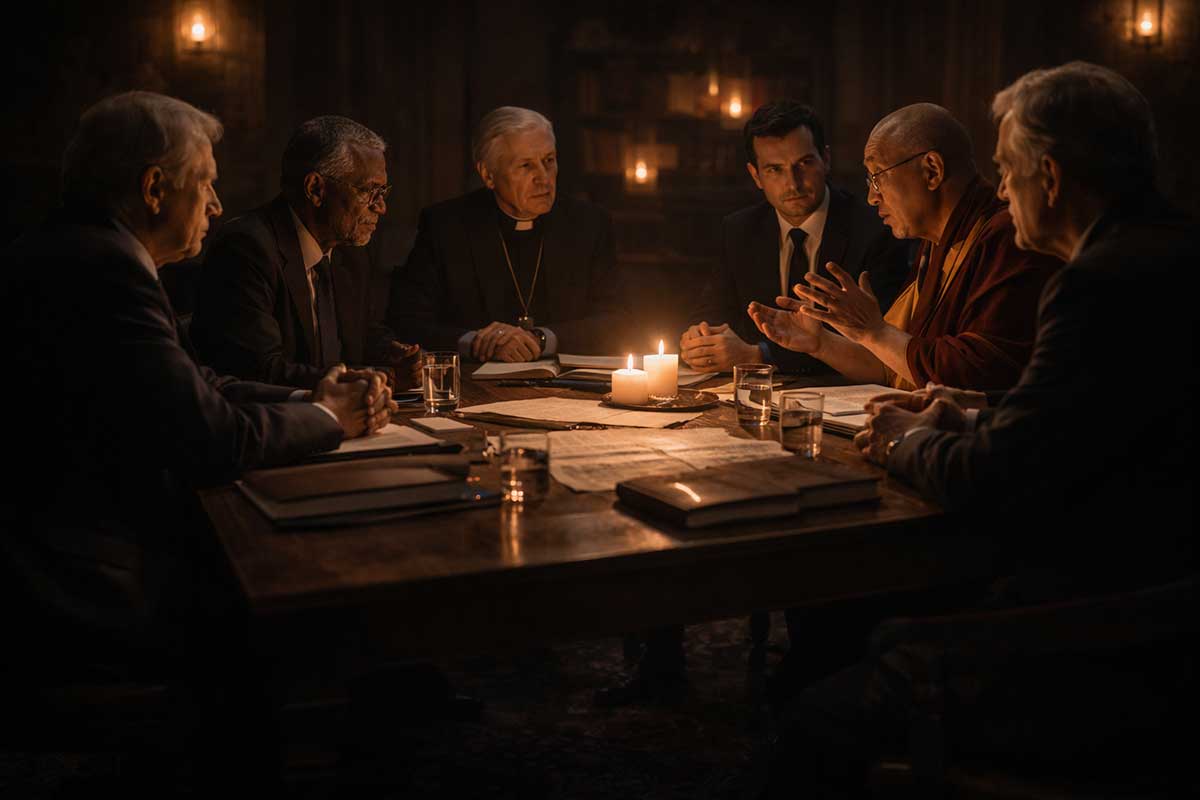
Participants:
Nick Sasaki, Mahatma Gandhi, Martin Luther King Jr., Reinhold Niebuhr, The Dalai Lama, Rev. Sun Myung Moon
Three questions for this topic:
Can war end without inner change in human beings?
Is nonviolence powerful enough for the real world of states and armies?
Does peace require forgiveness and reconciliation, not only deterrence?
Nick Sasaki
Welcome back.
In our first topic, we asked why war keeps returning. In the second, we asked whether war grows more from human nature or from systems. In the third, we asked whether institutions, trade, democracy, and diplomacy can make war obsolete.
Now we arrive at the question that many hard realists distrust and many idealists underestimate:
Would ending war require not only political reform, but moral and spiritual transformation?
In other words, even if we improve institutions, build treaties, strengthen diplomacy, and raise the costs of violence, do we still fail in the end unless the human heart changes? Unless pride, hatred, revenge, fear, humiliation, and the need to dominate are transformed at a deeper level?
This question is dangerous because it can sound naive. But it may be unavoidable. Policies are made by people. Armies are filled by people. Nations are moved by the emotions of millions of people. So if war is continually regenerated from within human beings, can it ever truly end from outside measures alone?
Mahatma Gandhi, may I begin with you?
Mahatma Gandhi
Yes.
I would say that war cannot end at its root unless something changes in the human being. You may postpone war through exhaustion, fear, law, or balance, but if hatred remains honorable, if domination remains attractive, if injury continues to demand revenge, then violence is only waiting for a new occasion.
This is why I placed such emphasis on nonviolence, not as passivity, but as soul-force. The aim was never only to resist one empire or one injustice. The aim was to show that the method by which we pursue justice shapes the world that follows. If one defeats violence by becoming violent in spirit, one plants the seed of the next conflict.
So yes, institutions matter. But institutions built by frightened, vain, and humiliated men will reflect those qualities. Peace must be written in the heart before it can be secured in law.
Nick Sasaki
Dr. King, when you hear Gandhi say peace must be written in the heart before it can be secured in law, how do you carry that forward?
Martin Luther King Jr.
I carry it forward by saying that peace is not merely the absence of war, just as nonviolence is not merely the absence of fighting.
A society may suppress violence outwardly and still remain inwardly at war — with its poor, with its races, with its enemies, with truth itself. Real peace requires justice, and justice requires a transformation in how we see the other human being. If I continue to see my enemy as less than human, then even if I sign a treaty today, I am preparing the next violence in my imagination.
Nonviolence, as I understood it, was not sentimental. It was a force that sought to break the cycle of humiliation and retaliation. It aimed not merely to defeat the opponent, but to awaken him, reconcile with him, and build a community in which neither side needed to return to the old pattern.
So I would say yes: better policy is necessary, but without moral transformation it remains too shallow to hold.
Nick Sasaki
Dr. Niebuhr, you spent much of your life warning idealists that sin, ego, and self-deception run deeper than they admit. When you hear Gandhi and King speak of inner change, where do you nod, and where do you push back?
Reinhold Niebuhr
I nod at the depth of the problem. I push back at the confidence of the cure.
There is no doubt that war is bound up with pride, fear, collective egoism, and the capacity of groups to justify what individuals might condemn. In that sense, the spiritual diagnosis is correct. Yet one must not imagine that a call to love, however true, will quickly master the stubbornness of collective self-interest. Nations are not saints. They are communities of memory, fear, ambition, and necessity. They often sin in concert more easily than individuals sin alone.
So yes, moral transformation matters. But the tragic aspect of history remains. One cannot build policy on the assumption that love will reliably govern states. Coercion, restraint, balance, and law remain necessary because virtue is never secure enough to stand alone.
I would say spiritual transformation is indispensable in principle and inadequate in practice unless joined to realism about power.
Nick Sasaki
Your Holiness, your language often speaks of inner disarmament. When people hear that in a world of armies and missiles, some think it sounds beautiful but remote. How do you answer that?
The Dalai Lama
I answer that outer peace without inner peace is unstable.
This does not mean that meditation replaces diplomacy or that compassion replaces institutions. It means the mind that builds institutions matters. If leaders are filled with anger, fear, hatred, and ego, they will use law itself as a weapon. If populations are fed by resentment and dehumanization, treaties become thin paper.
Inner disarmament means reducing the mental habits that make enemies necessary. It means seeing that the suffering of another nation is still suffering. It means recognizing interdependence. In the modern world, no people can destroy another without also injuring themselves in the larger human future.
So I would say moral transformation is not an ornament to peace. It is one of its conditions.
Nick Sasaki
Father Moon, your life and teaching placed a great deal of emphasis on reconciliation, enemy-love, and healing relationships at the root. When you hear this discussion, what do you most want to add?
Rev. Sun Myung Moon
I want to add that peace cannot come only from systems above us. It must grow through restored relationships among human beings.
War is not only a state problem. It is the enlargement of division already present in the human heart, in the family, in the tribe, in the nation. When people lose the capacity to see the other as brother or sister under God, they can justify almost any cruelty. Then politics magnifies that brokenness.
That is why enemy-love is not optional sentiment. It is the hardest medicine for history. If we love only those who resemble us, we never break the chain. Someone must stop the inheritance of hatred. Someone must take the first step toward reconciliation.
Without that spirit, peace agreements remain mechanical. With it, even impossible walls may begin to crack.
Question 1
Can war end without inner change in human beings?
Nick Sasaki
Let us go straight into the center.
Can war end without inner change? Could humanity, in principle, build a mostly peaceful world through deterrence, trade, institutions, and law — even if the average human being remains full of pride, grievance, fear, and ego?
Dr. Niebuhr?
Reinhold Niebuhr
A more peaceful world, yes. A redeemed world, no.
Structures can restrain behavior. They can redirect conflict, limit violence, and impose consequences. That is real and important. Yet if human beings remain inwardly governed by pride and fear, then every structure lives under pressure. Law becomes manipulation. Institutions become instruments of faction. Peace becomes contingent on favorable balances rather than moral truth.
So the answer is that peace can be managed outwardly without full inner transformation, but it cannot become secure in the deepest sense.
Mahatma Gandhi
I would answer more sharply.
If the human heart remains violent, the peace you describe is only a ceasefire managed by exhaustion or fear. It may last for a season. It has not yet conquered the root of war. The root is the willingness to deny the humanity of another when our interest is at stake.
As long as that remains, war survives in seed form.
Martin Luther King Jr.
I think both points must be held together.
Law cannot make a man love me, but it can stop him from lynching me, and that matters. Institutions matter. Restraint matters. Yet the beloved community requires more than restraint. It requires a reeducation of desire, imagination, and moral vision.
So no, war cannot end fully without inner change. But inner change must not be used as an excuse to neglect policy, law, and institutional struggle in the present.
The Dalai Lama
Yes, this is important. Compassion without structure becomes weak. Structure without compassion becomes cold and unstable. We need both.
Rev. Sun Myung Moon
And the deepest structures are also relational. The habits learned in family, community, and culture shape whether the human being is prepared for peace or prepared for enmity. So inner change must be cultivated, not merely praised.
Nick Sasaki
Let me ask each of you for one sentence.
Can war end without inner transformation?
Mahatma Gandhi
Not at the root.
Martin Luther King Jr.
Not fully, though law can hold back much evil in the meantime.
Reinhold Niebuhr
No enduring peace without it, but no practical peace by relying on it alone.
The Dalai Lama
No, because the untrained mind keeps rebuilding enemies.
Rev. Sun Myung Moon
No, because broken human relationships keep widening into history.
Question 2
Is nonviolence powerful enough for the real world of states and armies?
Nick Sasaki
Now we come to the criticism many people will be waiting to raise.
All of this sounds noble. But is nonviolence actually strong enough for the real world? A world of invading armies, dictators, ethnic hatred, nuclear weapons, and states that do not blush when they kill.
Gandhi, how do you answer the realist who says nonviolence is morally beautiful and politically insufficient?
Mahatma Gandhi
I answer that violence is often mistaken for strength because it acts quickly and dramatically. But violence solves little at the level of spirit. It compels, humiliates, and suppresses. It may win an immediate contest while losing the future.
Nonviolence is powerful because it refuses the enemy’s logic. It withdraws cooperation from injustice, exposes brutality, mobilizes conscience, and transforms struggle from a contest of weapons into a contest of legitimacy and endurance. That is not weakness. It is discipline of a high order.
Now, I do not say every people can practice it easily. It demands courage greater than armed reaction. But if humanity does not learn such courage, it will remain trapped inside an arms race of the soul as well as the battlefield.
Reinhold Niebuhr
I admire that witness, yet I remain cautious.
Nonviolence can work under some conditions, especially where conscience, publicity, shared norms, and political complexity create space for shame and restraint. But there are situations in which the adversary is not reachable through moral appeal in any timely way. In such cases, coercion may remain necessary to defend the innocent.
This is the tragic burden of politics. One may believe in love and still admit that force sometimes enters history as a lesser evil.
Martin Luther King Jr.
I would say nonviolence is more powerful than its critics admit and more demanding than its admirers often realize.
It is not mere refusal. It is organized pressure, disciplined sacrifice, strategic clarity, and moral confrontation. It can move structures. It can expose hidden violence. It can alter public conscience. But Reinhold is right that one cannot speak of it glibly. It requires conditions, leadership, sacrifice, and mass training in courage.
Still, I would warn that every time we assume violence is the only realistic language, we deepen the habit that keeps history bleeding.
The Dalai Lama
Even when force is used, hatred should not be glorified. That is one important point. There may be tragic circumstances where protection is necessary. But inner nonviolence — the refusal to delight in cruelty, vengeance, or dehumanization — remains essential.
Rev. Sun Myung Moon
Yes. Also, peace does not begin only at the moment of war. If societies wait until armies gather to ask about nonviolence, they have already neglected many earlier responsibilities. Education for peace, interreligious reconciliation, enemy-understanding, and healing of resentment must begin before crisis.
Nick Sasaki
So perhaps the real challenge is not whether nonviolence can replace every army tomorrow, but whether humanity can remain human without growing more nonviolent in spirit and method over time.
Let me ask each of you one sentence.
Is nonviolence strong enough for the real world?
Mahatma Gandhi
It is the deepest strength available to humanity, though the world has only partly tried it.
Martin Luther King Jr.
Yes, if practiced with courage, discipline, and justice rather than sentimentality.
Reinhold Niebuhr
Powerful in some contexts, insufficient as a sole doctrine for all political realities.
The Dalai Lama
Necessary in spirit, even when history remains imperfect in practice.
Rev. Sun Myung Moon
Strong enough to transform history only if rooted in real love for the enemy, not strategy alone.
Question 3
Does peace require forgiveness and reconciliation, not only deterrence?
Nick Sasaki
This final question may be the hardest of all.
Can deterrence, law, and policy ever secure real peace without forgiveness and reconciliation? Or do wounds that remain morally unresolved simply wait beneath the surface until the next crisis?
Dr. King?
Martin Luther King Jr.
I would say peace requires reconciliation or it remains too shallow to survive pain.
Deterrence may prevent attack. Law may punish crime. Policy may regulate behavior. All of that matters. Yet communities and nations carry memory. They carry humiliation, grief, inherited trauma, myth, and moral injury. If these are never addressed at the level of truth and reconciliation, they continue shaping the imagination of the next generation.
Forgiveness is not forgetting. It is not surrender. It is the refusal to let injury write the whole future.
Without that refusal, history keeps recruiting descendants into ancient battles.
Rev. Sun Myung Moon
Yes.
Peace requires heart. Not only the stopping of violence, but the healing of separation. Enemies must eventually see one another as human again. Otherwise treaties remain external and hatred remains internal.
Forgiveness is difficult because pride wants justice without restoration. But heaven’s way is restoration. Not cheap pardon, not denial of evil, but a transformation by which even former enemies may stand in one human family again. That is the only peace strong enough to endure.
The Dalai Lama
I agree, though I would phrase it as compassion joined to truth.
Forgiveness does not mean saying that harm was acceptable. It means refusing to become the continuation of the harm. In this way, reconciliation protects both future generations and one’s own mind.
A people can win externally and still remain imprisoned by hatred internally. That is not peace.
Reinhold Niebuhr
I agree that reconciliation is necessary for deep healing. My caution is only that in politics one must not demand spiritual perfection before building security. Forgiveness may unfold slowly. Institutions of restraint cannot wait for everyone to become wise.
So yes, reconciliation is essential to true peace. But deterrence remains necessary where trust has not yet matured.
Mahatma Gandhi
Deterrence without reconciliation is fear managing fear. It may hold for some time. But fear is a poor architect of the human future. Unless we touch the conscience, unless we seek truth, repentance, and restoration, peace remains external.
Nick Sasaki
Let me ask each of you for one final sentence.
What is the one thing peace cannot do without?
Mahatma Gandhi
Truth lived without hatred.
Martin Luther King Jr.
Justice joined to love.
Reinhold Niebuhr
Moral aspiration disciplined by realism.
The Dalai Lama
Compassion that disarms the mind.
Rev. Sun Myung Moon
Reconciliation strong enough to embrace even former enemies.
Nick Sasaki
Thank you.
What I hear in this topic is that better policy may restrain war, but it cannot uproot it by itself. Gandhi insists that violence must be confronted at the level of the spirit, not only the battlefield. King says peace requires justice, love, and the rehumanizing of the enemy. Niebuhr agrees with the diagnosis of pride and fear but warns that realism, coercion, and structure remain necessary in a fallen world. The Dalai Lama reminds us that outer disarmament without inner disarmament is unstable. Rev. Moon presses reconciliation further, saying peace must restore broken relationships, not merely freeze them.
So the fourth lesson is this: if humanity wants peace deep enough to last, it must do more than manage power. It must learn how not to reproduce hatred faster than it signs agreements.
And that leads us to the final question:
If war never fully ends, what is the most realistic path toward a less violent human future?
Topic 5 — If War Never Fully Ends, What Is the Most Realistic Path Toward a Less Violent Human Future?
Participants:
Nick Sasaki, Carl Sagan, Yuval Noah Harari, Samantha Power, Ban Ki-moon, Václav Havel
Three questions for this topic:
If total peace is unrealistic, what concrete progress is still possible?
How do nuclear weapons, AI, cyberwar, and biotechnology change the future of war?
What kind of civilization would be required to make war far less normal than it has been?
Nick Sasaki
Welcome back.
We have walked through history, human nature, political order, and the moral demands of peace. Now we come to the last question, and perhaps the most difficult one because it refuses both despair and fantasy.
Maybe war does not end completely. Maybe humanity never reaches a stage where violence disappears from history altogether. If that is true, then what is the most serious hope left? What does real progress look like?
Is it fewer wars?
Shorter wars?
Fewer civilians killed?
Better prevention?
Stronger global norms?
Less appetite for domination?
More shame attached to aggression?
Better tools for stopping escalation before it becomes slaughter?
This final topic asks not for utopia, but for direction.
Dr. Sagan, may I begin with you?
Carl Sagan
Yes.
My first answer is survival with wisdom.
For the first time in history, humanity has built weapons capable of ending civilization, perhaps even ending much of what evolution has achieved on this planet. Nuclear war altered the scale of moral responsibility. It made old habits of tribal conflict intolerably dangerous. Now new technologies — artificial intelligence, cyber systems, biotechnology — threaten to make the old instability even more lethal.
So if we ask what progress looks like, I would begin with this: humanity must reduce the probability of self-destruction. That means arms control, crisis restraint, scientific responsibility, international communication, and a stronger planetary consciousness. Our technologies have become global before our moral imagination has caught up.
A less violent future may not begin with perfect peace. It may begin with enough wisdom to see that in an age of civilization-ending tools, war can no longer be treated as a routine instrument of policy.
Nick Sasaki
Professor Harari, your work often looks at large systems and the way power changes with technology. When you hear Sagan speak of survival with wisdom, what do you add?
Yuval Noah Harari
I would add that the future of war may depend less on old armies alone and more on control of information, networks, infrastructure, and biological systems.
In earlier ages, war was about land, bodies, and visible destruction. In the coming era, states and powerful actors may try to hack societies from the inside, manipulate perception, disable systems, or alter the balance of power without formal declarations of war. AI may accelerate decision cycles. Cyberwar may create silent paralysis. Biotechnology may lower the barrier to catastrophic harm. The meaning of conflict is changing.
That means progress cannot be measured only by counting conventional wars. A world with fewer tank battles may still be full of domination and coercion.
So the realistic path forward requires building not just peace treaties, but resilient institutions, ethical constraints on technology, and global coordination strong enough to keep new forms of power from outrunning human responsibility.
Nick Sasaki
Ambassador Power, you have spent years close to the question of atrocity, prevention, and the unbearable cost of late response. When people ask what realistic progress looks like, what do you say?
Samantha Power
I say progress looks smaller than a dream and larger than cynicism.
It looks like earlier warning. It looks like stronger civilian protection. It looks like naming atrocity signs before the killing becomes normalized. It looks like governments, institutions, journalists, and citizens refusing to treat mass violence as background noise until the body count becomes unignorable. It looks like building habits of prevention instead of rituals of regret.
A great deal of war-related suffering comes not only from aggression, but from delay — delay in seeing, delay in naming, delay in responding, delay in believing victims, delay in mobilizing pressure.
So if war cannot be erased overnight, a more realistic hope is to reduce impunity, reduce scale, reduce abandonment, and shorten the distance between warning and action.
Nick Sasaki
Secretary-General Ban, your public life has often returned to cooperation, prevention, and the idea that global problems can no longer be solved as if they were local. What is the most realistic path in your eyes?
Ban Ki-moon
The realistic path is prevention joined to cooperation.
War rarely erupts from nowhere. There are signs: exclusion, humiliation, hate speech, arms buildup, climate stress, state failure, resource shock, breakdown of trust, weakening of law. A less violent future requires seeing these signals as shared responsibilities, not private troubles to be noticed only after bloodshed begins.
The world must move from reaction to prevention. That means diplomacy before crisis, development before collapse, education before radicalization, climate action before displacement becomes destabilization, and institutions strong enough to carry burden across borders.
Peace is not built only in negotiation rooms after war starts. It is built in the long quiet work that makes war less likely to begin.
Nick Sasaki
President Havel, your voice often carried moral seriousness without illusion. You spoke about truth, conscience, and the spiritual sickness of political life. When you hear all of this — prevention, resilience, technology, cooperation — what do you most want to protect from being lost?
Václav Havel
I want to protect responsibility of conscience.
Systems matter greatly. Institutions matter. Technology governance matters. But if individuals inside those systems become cynical, frightened, obedient to lies, or numb to suffering, then the machinery of peace becomes hollow. A less violent future cannot be built by procedures alone. It requires citizens, leaders, soldiers, thinkers, and ordinary people who do not surrender moral truth for convenience.
One of the roots of violence is the lie — the lie that the enemy is not human, that cruelty is necessary, that conscience is childish, that power is all that matters. A civilization that accepts those lies will always drift back toward organized brutality, no matter how elegant its institutions appear.
So the realistic path forward includes something unfashionable: moral seriousness.
Question 1
If total peace is unrealistic, what concrete progress is still possible?
Nick Sasaki
Let’s make this practical.
If total peace is too absolute a goal for the near horizon, what concrete progress should humanity actually pursue?
Ambassador Power?
Samantha Power
A shorter list than people may want, but one worth taking seriously.
Reduce civilian slaughter.
Strengthen early-warning systems.
Improve atrocity prevention.
Raise the political cost of aggression.
Protect displaced people faster.
Support accountability.
Build quicker multilateral response when warning signs appear.
These do not solve all violence. They save real lives. Too often people speak as though anything short of perfect peace is failure. That thinking becomes an excuse for passivity.
Ban Ki-moon
Yes. I would add: prevention in education, development, mediation, climate resilience, and institution-building. If states fail, if inequality deepens, if communities are abandoned, conflict finds easy recruits.
So progress is concrete when it lowers the conditions that make mobilized violence attractive.
Carl Sagan
I would add nuclear restraint near the top of the list. A species that has not solved war should at least learn not to gamble with extinction. Reducing arsenals, extending communication, improving verification, preventing accidental launch — these are not glamorous achievements, but they may be among the most important in human history.
Yuval Noah Harari
And new technologies must be governed before crisis rather than after catastrophe. Waiting for AI-driven military escalation, autonomous targeting, or engineered biological misuse to teach us lessons would be a terrible pattern. Humanity has a habit of moral delay. In this century, that delay could be fatal.
Václav Havel
Concrete progress should also include cultural truthfulness. If societies normalize lies, humiliation, and moral numbness, then technical peace measures rest on weak ground. Truth is not an abstract luxury. It is preventive infrastructure.
Nick Sasaki
Let me ask each of you for one sentence.
What is one achievable step toward a less violent future?
Carl Sagan
Make civilizational self-destruction much harder than it is now.
Yuval Noah Harari
Build global rules for technologies that can destabilize humanity faster than politics can react.
Samantha Power
Act earlier when warning signs appear.
Ban Ki-moon
Invest in prevention before collapse becomes war.
Václav Havel
Protect truth from the politics of convenience.
Question 2
How do nuclear weapons, AI, cyberwar, and biotechnology change the future of war?
Nick Sasaki
Now we have to face the future directly.
How do these technologies change war? Do they make peace more necessary, or war more likely in subtle new forms?
Professor Harari?
Yuval Noah Harari
They make the old human weaknesses more scalable.
Fear, pride, rivalry, ambition, and tribal thinking are ancient. What changes is the speed and reach with which those weaknesses can now be weaponized. AI may accelerate targeting, surveillance, deception, and command. Cyberwar can cripple a society without crossing a traditional border. Biotechnology can lower the threshold for catastrophic harm. Nuclear weapons remain the permanent reminder that one political failure can become species-level risk.
The danger is not only bigger explosions. It is decision systems outrunning human judgment.
A civilization that does not govern these tools well may discover that the old political mind is no longer fit for the weapons it commands.
Carl Sagan
Yes. The central issue is mismatch.
Stone Age emotions, medieval institutions, near-divine technology — that is a dangerous combination. The more powerful the tool, the less room there is for error, vanity, or improvisation. Nuclear weapons already made this clear. AI and biotechnology may deepen the lesson in forms less visible but equally grave.
This should teach humility. Sadly, technology often flatters power before it teaches consequence.
Samantha Power
There is another danger too: ambiguity.
A missile launch is visible. A cyberattack may be deniable. AI-generated disinformation may poison societies without a formal battlefield. Biological threats may blur accident and attack. That ambiguity can slow accountability and weaken collective response.
So the future of war may involve less clarity, not more. That raises the importance of trust, verification, and institutions capable of acting under uncertainty.
Ban Ki-moon
This is why international cooperation is not optional. No single nation can secure a world where cyber systems, biology, and autonomous technologies cross borders instantly. New tools require new norms, new agreements, and new habits of transparency.
Václav Havel
And new temptations.
Modern systems allow distance from consequence. A society can wound another through code, narrative, pressure, or hidden design and tell itself it has not truly waged war. Moral language becomes blurry. That blurring is dangerous. The conscience must become sharper as instruments become less visible.
Nick Sasaki
Let me ask the blunt version.
Do these technologies make permanent peace less likely?
Carl Sagan
They make failure more costly.
Yuval Noah Harari
They make unmanaged rivalry more dangerous.
Samantha Power
They make prevention and accountability harder, yet more urgent.
Ban Ki-moon
They make cooperation more necessary than ever.
Václav Havel
They make moral sleep more dangerous than before.
Question 3
What kind of civilization would be required to make war far less normal than it has been?
Nick Sasaki
This final question is the largest one.
If humanity truly wanted war to become far less normal — not eliminated by magic, but pushed far closer to the margins of history — what kind of civilization would that require?
Secretary-General Ban?
Ban Ki-moon
It would require a civilization that values prevention more than reaction and common security more than narrow prestige.
Such a civilization would invest in human dignity, education, mediation, climate stability, public trust, and international law. It would understand that humiliation and abandonment are not local moral failures only, but seeds of wider disorder.
A peaceful future requires systems that make cooperation politically normal, not exceptional.
Samantha Power
It would require a civilization that learns to care sooner.
One of the recurring tragedies in history is that people care intensely once destruction is undeniable, then explain afterward why no one could have known. That must change. A less violent future needs publics and leaders who are less tolerant of early warning being ignored and less willing to let distant suffering become someone else’s problem.
Carl Sagan
It would require planetary consciousness.
We remain one species on one fragile world. That fact is not poetry. It is strategy. A civilization that still treats war between major powers as ordinary politics in the age of extinction-capable weapons has not yet understood the conditions of its own survival.
To reduce war deeply, humanity must begin thinking at the scale its tools have already reached.
Yuval Noah Harari
I would say it would require two difficult achievements at once: strong local identities that do not become absolute, and strong global coordination that does not become tyranny.
Humans need belonging. They also need cooperation beyond the tribe. A future with less war must solve that tension better than past civilizations have. That is not easy. It may be one of the great political tasks of the coming century.
Václav Havel
And it would require souls not entirely colonized by fear and cynicism.
A civilization may become wealthy, efficient, networked, and technically brilliant, yet still remain morally primitive. If truth is cheap, if conscience is mocked, if dignity is negotiable, then violence will keep finding respectable language.
A less violent future requires responsibility in ordinary people, not only plans among elites.
Nick Sasaki
Let me ask each of you one final sentence.
What is the one quality a less violent civilization must have?
Carl Sagan
Planetary maturity.
Yuval Noah Harari
Global coordination without totalitarian control.
Samantha Power
Earlier moral response.
Ban Ki-moon
Preventive cooperation.
Václav Havel
Truthful conscience.
Nick Sasaki
Thank you.
What I hear in this final topic is a hard hope, not an easy one. Sagan says survival itself now depends on wisdom catching up to power. Harari warns that war is changing form and may become quieter, faster, and more invasive through code, data, and biology. Samantha Power insists that prevention and earlier response can save real lives even if perfection remains distant. Ban Ki-moon reminds us that peace is built before war through cooperation and shared responsibility. Havel says no system can carry peace for long if conscience collapses inside the people who inhabit it.
So the fifth lesson is this: if war never fully disappears, humanity still has a path — not a perfect one, but a real one. Make large-scale violence less legitimate. Make atrocity harder to ignore. Make self-destruction harder to trigger. Make truth stronger than propaganda. Make cooperation more normal than humiliation. Make the tools of the future harder to weaponize than the politics of the past.
And that may be the most honest answer this whole series can offer.
The end of war may be too large a promise for now.
But the shrinking of war — its moral authority, its frequency, its scale, its glamour, its political normality — that remains a human task.
The question was never only whether war can end forever.
The question is whether humanity can become the kind of civilization that no longer rebuilds it so easily.
Final Thoughts by Nick Sasaki
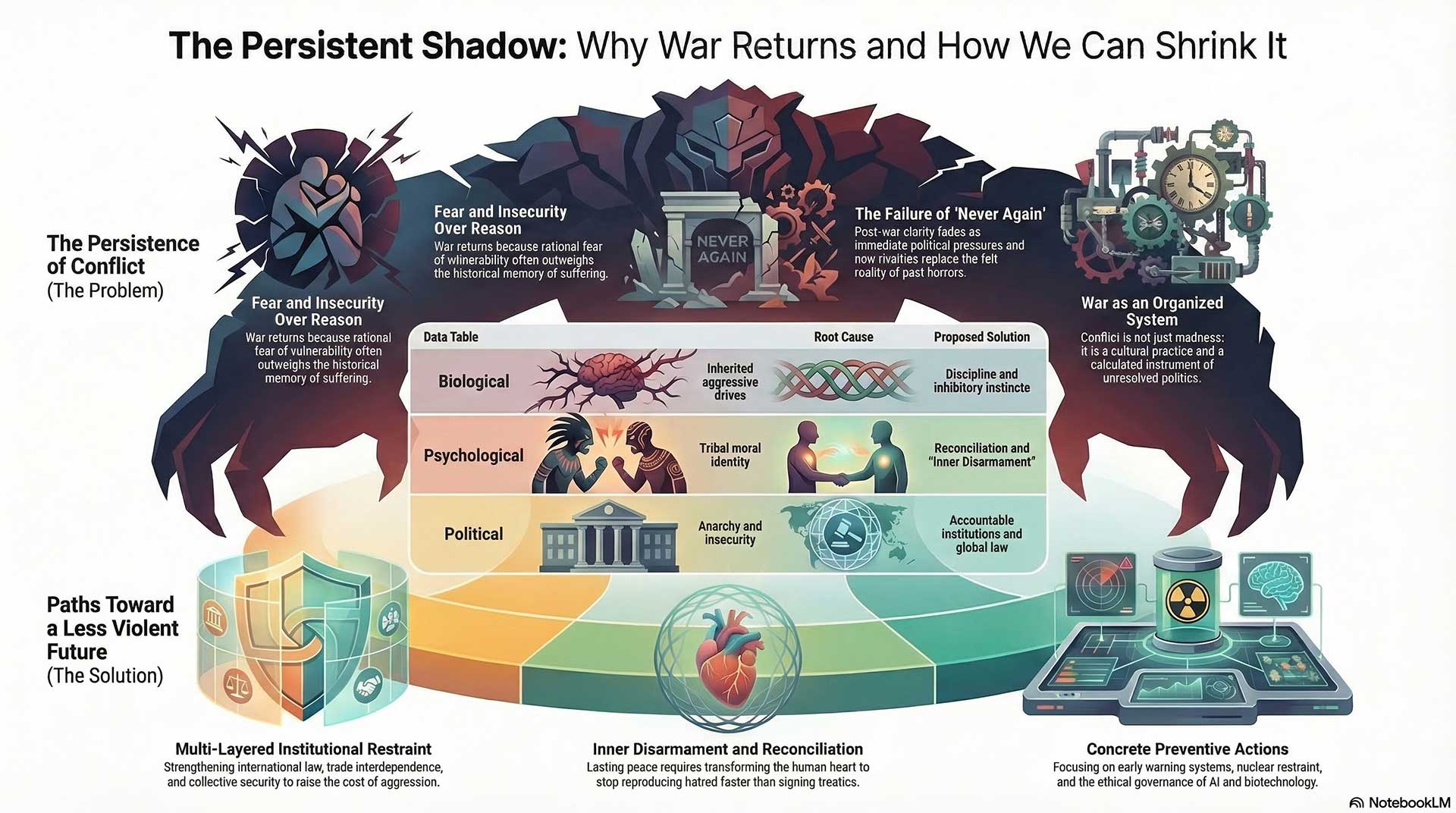
After all five conversations, I do not come away believing that war is simple, and I do not come away believing that peace is.
What I feel most strongly is that war survives because it can be rebuilt from many directions at once. It is rebuilt through fear between powers, through ambition in leaders, through folly in institutions, through tribal psychology, through cultural memory, through humiliation, through technology, through lies, and through the old human habit of turning insecurity into moral permission. That is why condemning war is never enough. The machinery that produces it has too many parts.
I also leave with a sharper sense that no single answer is large enough. Realism alone cannot save us, though it warns us against innocence. Institutions alone cannot save us, though they can restrain catastrophe. Moral appeal alone cannot save us, though without conscience and reconciliation peace remains thin and temporary. Inner transformation alone cannot save us, though without it hatred keeps regenerating faster than treaties can contain it.
That may be the hardest lesson of all: war is never only one kind of problem. It is political, psychological, biological, cultural, technological, and spiritual all at once. That is why humanity has not solved it. We keep trying to defeat it at one level while it survives through another.
And yet I do not end in despair.
I think real progress is possible. War may not vanish completely, but it can lose authority. It can lose glamour. It can lose legitimacy. It can become less frequent, less expansive, less normal, less easy to justify. Civilian slaughter can become harder to hide. Aggression can become costlier. Prevention can begin earlier. Reconciliation can become more serious. Technologies of mass destruction can be placed under stronger restraint. A civilization can learn, slowly, to make violence less available than it once was.
That is not a small hope. It is a demanding one.
So perhaps the final answer is not that war ends one day like a door closing forever. Perhaps the more realistic question is whether humanity can become the kind of civilization that stops rebuilding war so easily — in its politics, in its myths, in its fears, in its tools, and in its heart.
That task is still unfinished.
And until it is, peace will remain more than a dream. It will remain a discipline, a structure, a struggle, and a test of what sort of species we are willing to become.
Short Bios:
Leave a Reply