
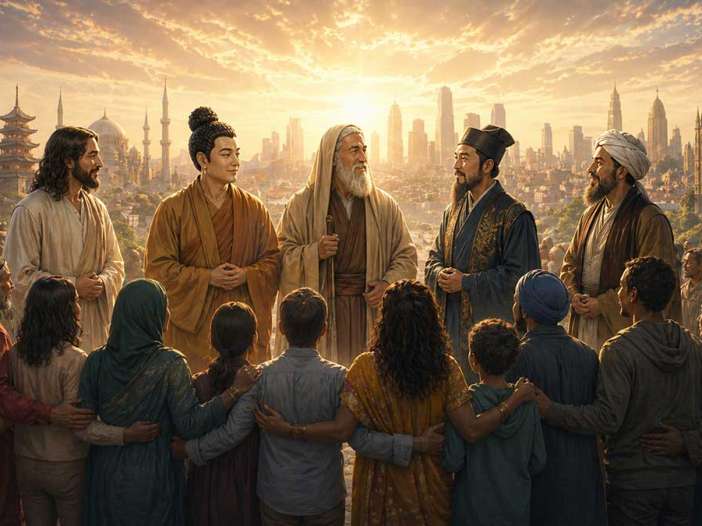
What if knowing God truly could end the idea of enemies forever?
Introduction by Nick Sasaki
What if the world’s greatest problem is not the absence of religion, but the absence of truly knowing God?
Humanity has never lacked words about God. We have scriptures, prayers, traditions, and teachings across every culture. We also have songs—like We Are the World and Imagine—that express a deep longing for unity and peace.
Yet the same world that sings about being one family continues to divide, hate, and even kill in the name of God.
So the question becomes unavoidable:
If God is the parent of all humanity, then why do we live as strangers, rivals, and enemies?
If every person is a child of God, then no one is outside the family. That means the person we fear, reject, or fight is not “the other.” They are our brother or sister.
This conversation brings together five voices—Jesus, Buddha, Moses, Confucius, and Rumi—not to debate religion, but to look deeper.
What does it mean to truly know God?
Why does humanity keep longing for one peaceful world?
Why does faith sometimes turn into violence?
What changes when the enemy becomes family?
And what must we actually practice to make peace real?
This is not just a discussion about belief.
It is a challenge about how we see each other—and how we live.
(Note: This is an imaginary conversation, a creative exploration of an idea, and not a real speech or event.)
Topic 1 — What Does It Mean to Truly Know God?

Opening — Nick Sasaki
What if the greatest tragedy is not that humanity forgot religion, but that humanity forgot God’s heart?
People know sacred names. They know prayers. They know scriptures. They know rituals. Yet the world still bleeds from hatred, revenge, pride, and war.
So the question is not only, “Do we believe in God?”
The deeper question is:
Do we see what God sees?
If every person is a child of God, then every person is our brother or sister. No one is outside the family. No enemy is outside God’s love.
Question 1
If people believe in God but do not see all people as God’s children, do they truly know God?
Jesus:
If someone says they love God but hates their brother, their heart is divided. To know God is not only to speak His name. It is to reflect His love.
Buddha:
A person may hold a sacred idea, yet still live in ignorance. If the mind is ruled by fear and anger, then belief has not become awakening.
Confucius:
A person who honors Heaven must honor people. The family is the school of virtue. If one cannot see others as kin, one has not understood the order of goodness.
Rumi:
The names are many, but the Beloved is one. If you wound another soul, you wound the house where God has placed His breath.
Moses:
To know God is to live under His command, not merely to claim His favor. The law was given so people would remember justice, mercy, and responsibility before Him.
Question 2
What is the difference between knowing God’s name and knowing God’s heart?
Rumi:
A name can sit on the tongue. God’s heart must burn in the soul. The name may divide when spoken with pride, but love returns all names to their source.
Jesus:
Many will say holy words, yet fail to love the least among them. God’s heart is known when compassion becomes action.
Moses:
God’s name is sacred, and it must not be used falsely. To use His name for hatred, cruelty, or conquest is to carry the holy into darkness.
Buddha:
A name can become attachment. The heart of truth is seen when selfishness falls away and compassion appears naturally.
Confucius:
To know the name without practicing virtue is empty. A noble person makes reverence visible through conduct, restraint, and care for others.
Question 3
Why does religious belief sometimes fail to create love, humility, and peace?
Moses:
Belief fails when people use God to bless their own pride. They ask God to support their tribe, instead of asking their tribe to obey God’s righteousness.
Buddha:
The root is ignorance. People cling to identity, doctrine, and fear. Then religion becomes another possession of the ego.
Jesus:
When faith loses love, it becomes judgment without mercy. True faith must soften the heart, not harden it.
Confucius:
Ritual without sincerity becomes performance. Teaching without self-correction becomes noise. Peace begins when the person reforms the self.
Rumi:
Religion becomes dangerous when the cup thinks it owns the wine. God is love, but the ego turns even love into a weapon.
Closing — Nick Sasaki
To truly know God is not only to know what people call Him.
It is to know His heart.
And if God’s heart sees every person as His child, then no person can be reduced to an outsider, enemy, or object of hatred.
This is where world peace must begin: not with a slogan, but with a transformation of sight.
To see another person as God sees them.
To see the stranger as family.
To see the enemy as a wounded brother.
To see humanity not as competing groups, but as one family under God.
Topic 2 — Why Do Scriptures and Popular Songs Keep Pointing to One Human Family?
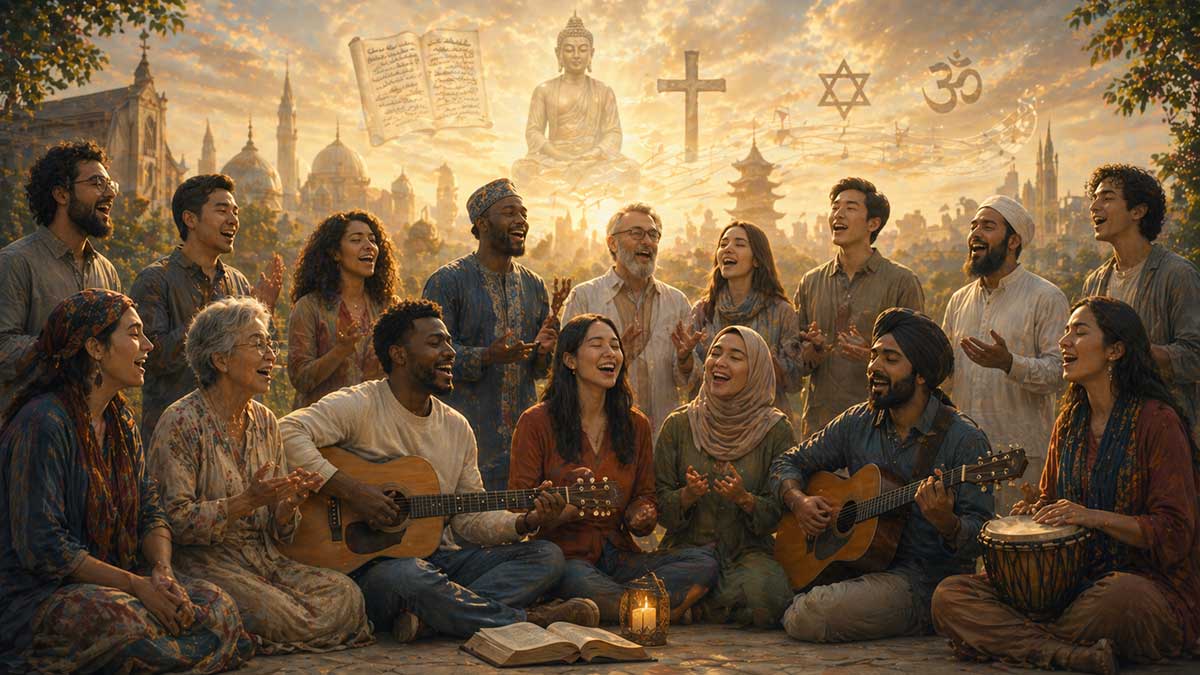
Opening — Nick Sasaki
Humanity keeps repeating the same dream in two different languages.
Scripture speaks of love, mercy, justice, peace, and the children of God.
Popular songs speak of unity, healing, hope, and a world where people stop seeing each other as enemies.
That is why songs like We Are the World and Imagine touch people so deeply. They are not just entertainment. They reveal a longing people carry inside: the longing to return to one human family.
So the question is not only why we sing about peace.
The deeper question is why humanity keeps recognizing peace as its original home, yet keeps living so far away from it.
Question 1
Why do the Bible, other scriptures, prayers, and popular songs keep returning to the dream of one peaceful world?
Confucius:
People return to this dream because harmony is written into the purpose of human life. A family is not complete when brothers fight endlessly. A society is not complete when people forget respect. The longing for peace is the longing for proper relationship.
Jesus:
The heart longs for the Father’s house. When people hear words of mercy, forgiveness, and love, something within them remembers where they belong. Peace is not strange to the soul. Hatred is the stranger.
Rumi:
Every song of peace is a bird trying to fly back to the garden. People may use different languages, but the ache is the same. The soul remembers the Beloved, and the Beloved calls all children home.
Moses:
God gave commandments so people would not destroy one another. The dream of peace returns because humanity knows the law is not meant for oppression, but for life. The holy path teaches people to choose life, not death.
Buddha:
All beings wish to be free from suffering. This wish appears in scripture, prayer, poetry, and song. When the heart is quiet, it does not ask for domination. It asks for release from hatred, fear, and pain.
Question 2
If humanity already sings, prays, and teaches peace, why do we still live with war?
Moses:
People hear the command, but they often harden their hearts. They remember God when seeking victory, but forget God when facing their own pride. Peace fails when obedience becomes selective.
Buddha:
The teaching may be pure, yet the mind remains restless. Desire, fear, anger, and attachment keep returning. People may speak of peace while clinging to the causes of conflict.
Jesus:
People pray with their lips, but their hearts may still guard resentment. Peace requires surrender. Many want God’s blessing without giving up hatred.
Confucius:
A society cannot be peaceful if the person is not disciplined. A ruler cannot bring peace if the family is broken. Words of peace must become habits, manners, education, and public virtue.
Rumi:
People sing of the ocean, yet still clutch the cup. They praise love, but fear losing themselves in it. War survives because the ego would rather be right than be healed.
Question 3
What truth are people longing for when they say, “We are the world,” or dream of no division?
Jesus:
They are longing for the truth that no child is forgotten by God. The hungry, the wounded, the stranger, and the enemy are all seen by the Father. To love them is to come closer to Him.
Rumi:
They are longing for the veil to fall. Beneath the names, nations, and wounds, there is one breath moving through all. The soul knows this before the mind argues against it.
Buddha:
They are longing to be free from separation. Much suffering comes from the illusion of a fixed self against others. Compassion grows when the boundary softens.
Moses:
They are longing for a world where life is sacred again. No nation, tribe, or ruler owns the value of another human being. The Creator gives life, and human pride must not cheapen it.
Confucius:
They are longing for a world where people treat one another with proper care. Not vague feeling, but lived duty: parents caring for children, leaders serving people, neighbors honoring neighbors, nations respecting nations.
Closing — Nick Sasaki
Scriptures and popular songs keep pointing to one human family because humanity has never fully forgotten what peace feels like.
The Bible and other sacred writings teach it.
Prayers ask for it.
Songs carry it into the public heart.
Yet the message must move from words into life.
If we sing We Are the World but treat others as strangers, we have not heard the song.
If we read scripture but cannot see God’s children in front of us, we have not understood the scripture.
The dream of one peaceful world is not naïve.
It may be the most original memory humanity has.
Topic 3 — Why Do People Kill God’s Children in God’s Name?
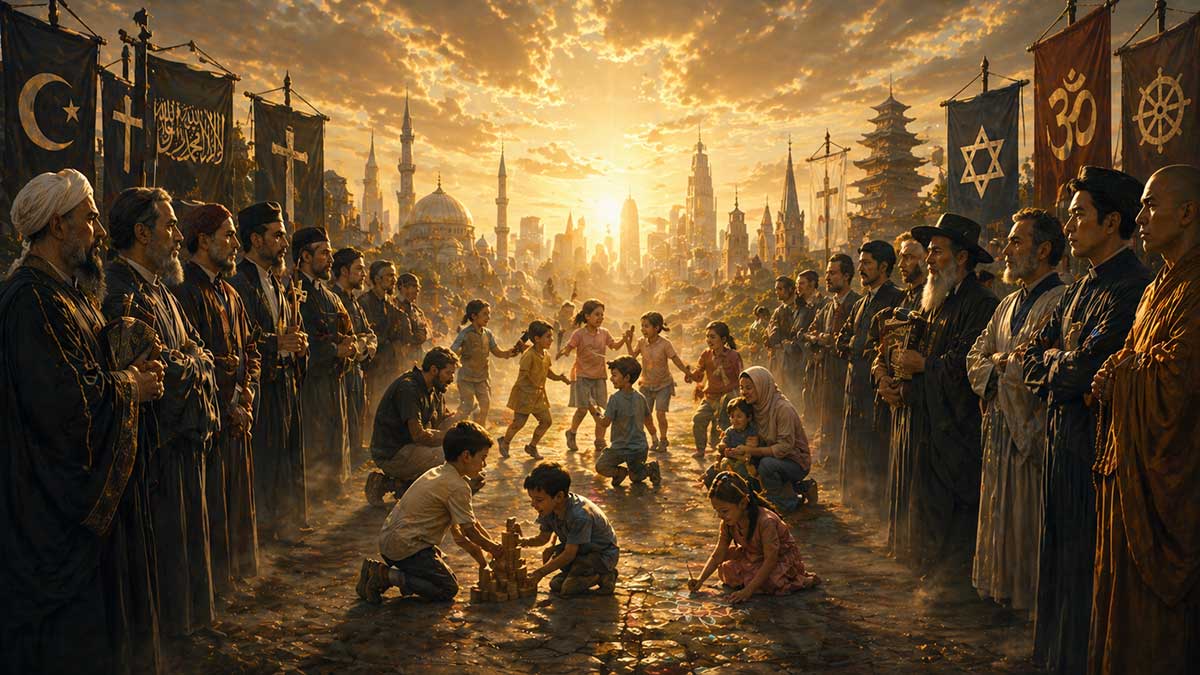
Opening — Nick Sasaki
If every person is a child of God, then every person is someone’s brother or sister in God’s family.
That makes religious violence one of humanity’s deepest contradictions.
People claim to defend God, but destroy the children God loves.
They raise sacred words over bloodshed.
They call war holy, even when it tears apart the very family God longs to restore.
This is not only a political problem or historical problem. It is a spiritual wound.
The question is painful, but necessary:
How can people use God’s name to justify what breaks God’s heart?
Question 1
How can anyone claim to serve God while destroying the children God loves?
Moses:
No one may use the name of God to cover murder, pride, or cruelty. To serve God is to stand under His judgment, not to place God under one’s ambition.
Jesus:
When love disappears, the name of God becomes empty on the lips. If a person cannot see the wounded one as a child of the Father, that person has forgotten the Father.
Buddha:
A mind ruled by hatred cannot see clearly. It may wear religious clothing, speak sacred words, and still remain trapped in ignorance.
Confucius:
When duty loses humanity, it becomes harshness. A person who claims righteousness but forgets compassion has broken the order of virtue.
Rumi:
The Beloved is not served by wounds made in His name. If you strike the soul of another, you strike a mirror where God’s light was waiting.
Question 2
What makes “holy war” one of humanity’s deepest spiritual contradictions?
Jesus:
To call hatred holy is to confuse darkness with light. God’s kingdom cannot be built by hearts that refuse mercy.
Moses:
When people call war holy, they must tremble. God is not a banner for human rage. His holiness exposes sin before it blesses a sword.
Rumi:
Holy war becomes a contradiction when the ego marches under God’s name. The tongue says “God,” but the heart says “me.”
Buddha:
Violence creates suffering, and suffering multiplies itself. A war may be given sacred language, yet the causes may still be craving, fear, and delusion.
Confucius:
War destroys family, ritual, trust, and order. If a leader calls destruction holy, he must first ask whether he has mastered himself.
Question 3
How do fear, pride, and group identity twist faith into violence?
Buddha:
Fear creates the illusion of separation. Pride protects that illusion. Group identity gives it a flag. Then people believe cruelty is loyalty.
Confucius:
When people love their own group without moral discipline, loyalty becomes narrow. True virtue does not excuse wrongdoing because it comes from one’s own side.
Jesus:
Pride turns faith into judgment. Fear turns neighbors into enemies. But perfect love casts out fear, and mercy reveals who truly belongs to God.
Moses:
A people must remember their covenant without worshiping themselves. When identity replaces obedience, even holy memory can become idolatry.
Rumi:
The ego loves uniforms. It says, “My people, my truth, my God.” Love says, “There is no stranger in the house of the Beloved.”
Closing — Nick Sasaki
The hypocrisy of killing in God’s name is not hard to see once we return to the first truth:
Every person is a child of God.
That means the victim is not merely an enemy.
The victim is a brother.
The victim is a sister.
The victim belongs to the same Parent.
So the question becomes unbearable:
How can we claim to love God while destroying God’s own family?
This is why world peace cannot begin only with treaties, slogans, or songs.
It must begin with a change in spiritual sight.
Until humanity sees every life as belonging to God, people will keep placing God’s name on human fear, pride, and revenge.
But the moment we see the enemy as God’s child, holy war loses its mask.
And the call to peace becomes not a dream, but a sacred responsibility.
Topic 4 — What Changes When the Enemy Becomes Your Brother?
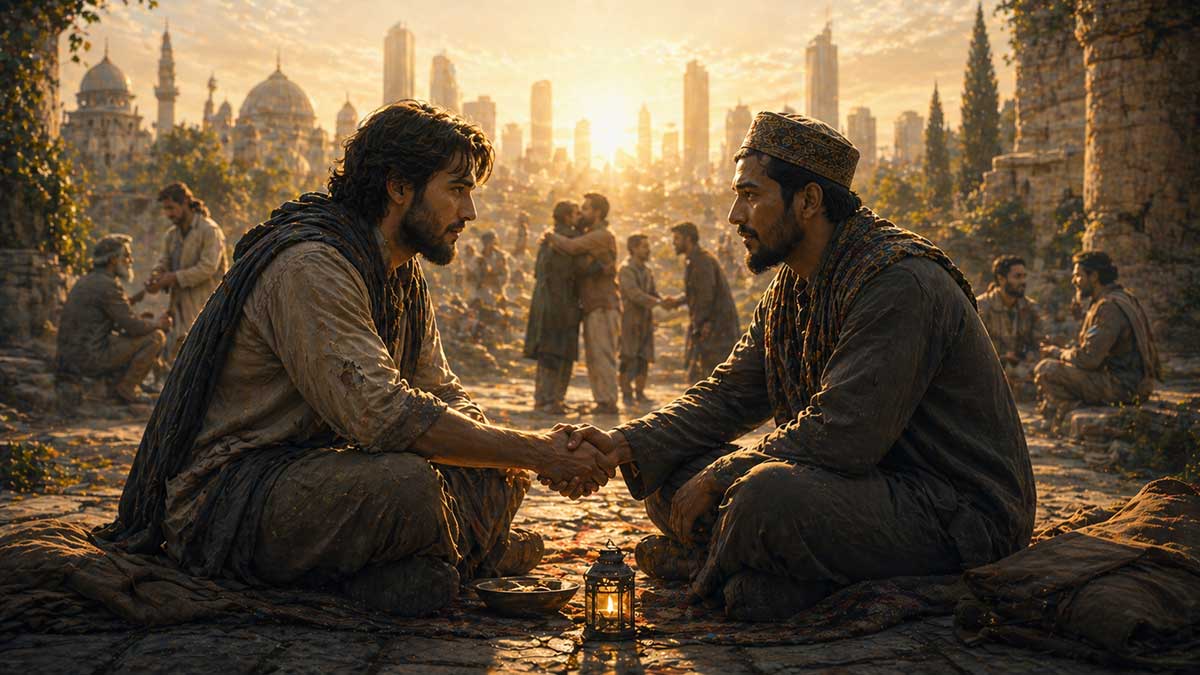
Opening — Nick Sasaki
The word “enemy” creates distance.
It allows us to imagine someone outside our family, outside our concern, outside our responsibility.
But what if that enemy is not outside the family at all?
What if the person we fear, hate, judge, or fight is still a child of God?
Then the enemy is not just “them.”
The enemy is our brother or sister.
That does not erase wrongdoing. It does not deny justice. But it changes the spirit in which justice must be pursued.
Because once the enemy becomes family, hatred can no longer pretend to be righteousness.
Question 1
What happens to hatred when the enemy is no longer “them,” but your brother or sister?
Jesus:
Hatred loses its false permission. You may still confront evil, but you cannot throw away the person. A brother may be lost, wounded, or wrong, but he is still not outside the Father’s love.
Confucius:
When the enemy becomes family, conduct must become more careful. Anger may arise, but virtue asks: how should I act if relationship still matters?
Moses:
Justice remains necessary, but revenge must be judged. The law was not given so people could indulge hatred. It was given so life could be protected under God.
Rumi:
Hatred melts when the face of the enemy becomes the face of kin. The heart begins to ask, “What sorrow made this soul forget love?”
Buddha:
Hatred cannot survive clear seeing. When we see that the enemy suffers, fears, and seeks happiness like ourselves, compassion begins to weaken hostility.
Question 2
Can justice still exist without dehumanizing the person who did wrong?
Moses:
Yes. Justice must name wrongdoing clearly. But judgment belongs under God’s law, not under human rage. The guilty person remains accountable, yet still human before the Creator.
Jesus:
Justice without mercy becomes another wound. Mercy without truth becomes avoidance. God’s way holds truth and mercy together.
Buddha:
Actions have consequences. To see someone with compassion does not mean ignoring harm. It means responding without hatred, so suffering does not multiply.
Confucius:
Justice must restore order, not merely punish. A wise society corrects wrongs while remembering the human bond that makes moral repair possible.
Rumi:
A wound must be cleaned, not worshiped. Justice is needed, but if the heart loves punishment more than healing, it has lost the Beloved’s fragrance.
Question 3
What kind of courage is needed to love across religion, nation, race, and history?
Confucius:
It takes disciplined courage. Sentiment is not enough. One must practice respect daily, especially toward those who are difficult to understand.
Buddha:
It takes courage to release the story of separation. The mind is trained by fear and memory. Compassion must be practiced until it becomes stronger than anger.
Jesus:
It takes the courage of the cross: to love without asking whether the other deserves it. Love is not weakness. It is the strength to remain faithful to God’s heart.
Moses:
It takes the courage to remember God above tribe. People must ask not, “Is this person from my side?” but, “What does righteousness require before God?”
Rumi:
It takes the courage to let love make you larger than your wound. The heart must become wide enough to hold grief without turning it into hatred.
Closing — Nick Sasaki
When the enemy becomes your brother, nothing becomes easy.
But everything becomes different.
Justice remains.
Protection remains.
Truth remains.
But hatred loses its throne.
The person who harmed you is no longer reduced to a monster. The stranger is no longer reduced to a threat. The opposing nation is no longer reduced to an object.
They are still God’s children.
They are still part of the same human family.
This is the turning point for world peace:
Not the denial of evil.
Not pretending conflict does not exist.
But refusing to forget who the other person is before God.
If humanity can reach that sight, then the word “enemy” begins to weaken.
And the word “brother” begins to heal the world.
Topic 5 — What Must Humanity Practice to Achieve World Peace?
Opening — Nick Sasaki
World peace cannot remain only a beautiful idea.
It cannot live only in songs, scriptures, prayers, speeches, or dreams.
If every person is a child of God, then peace must become something we practice.
In families.
In schools.
In religion.
In politics.
In business.
In how we speak, forgive, disagree, lead, and treat people who are different from us.
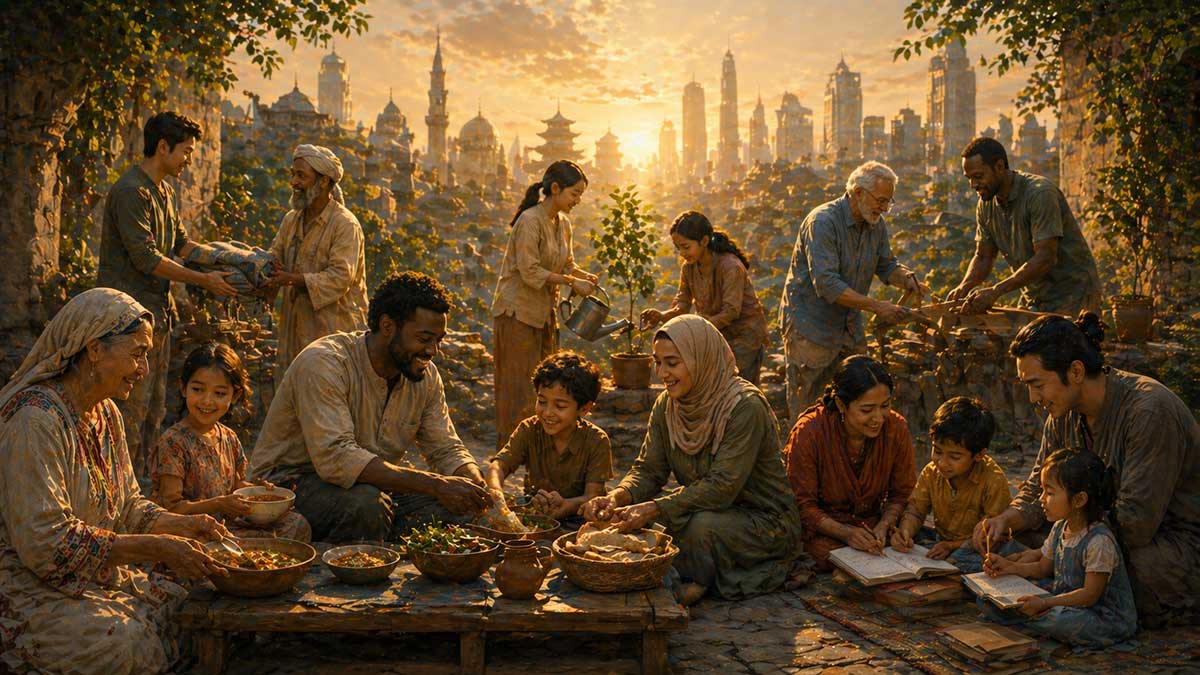
World peace begins when the truth of one human family becomes daily culture.
Question 1
What must families, schools, and religious communities teach so children grow up seeing all people as God’s family?
Confucius:
Children must first learn reverence at home. If a child learns respect for parents, siblings, elders, and neighbors, that child begins to understand order and care. But the family must not become narrow. The family should train the heart to extend respect outward.
Jesus:
Teach children that no one is invisible to God. Teach them to see the poor, the stranger, the wounded, and the enemy as beloved by the Father. A child who learns mercy early will not easily become cruel later.
Moses:
Teach them that life is sacred. Teach them that God’s name must never be used for hatred. Teach them commandments not as cold rules, but as a path that protects the dignity of every person before God.
Buddha:
Teach children to notice suffering. When they learn that anger, greed, and fear create pain, they begin to choose compassion. Peace education must train the mind, not only fill the memory.
Rumi:
Teach them that every face is a window to the Beloved. Let them see difference without fear. Let them feel wonder before another soul, so the heart does not grow small.
Question 2
What daily habits can turn belief in one human family into lived reality?
Buddha:
Pause before anger becomes speech. Notice the pain beneath judgment. Practice compassion in small moments, for the mind becomes what it repeats.
Jesus:
Forgive. Serve. Bless those who curse you. Feed the hungry. Visit the lonely. Love becomes real when it touches the person directly in front of you.
Confucius:
Practice courtesy, gratitude, restraint, and honest self-correction. Peace is built through repeated conduct. A gentle word, a respectful gesture, a kept promise—these form moral culture.
Moses:
Remember God before action. Ask whether your words honor life or cheapen it. Keep sacred time, teach your children, protect the vulnerable, and refuse falsehood.
Rumi:
Begin each day by asking, “Where did I forget love?” Then return. The path is not walked by grand claims, but by a thousand small returns to the heart.
Question 3
What would leadership look like if leaders saw every nation’s people as their own brothers and sisters?
Moses:
A leader would fear God more than applause. He would protect his own people without despising another people. He would know that power is judged by righteousness.
Confucius:
A leader would rule by virtue before force. If leaders corrected themselves first, society would trust them more deeply. The people follow the moral weight of those above them.
Jesus:
A leader would become a servant. He would not treat people as tools for ambition. He would seek the lost, protect the weak, and remember that greatness is measured by love.
Buddha:
A leader would reduce suffering. He would see war, hunger, humiliation, and fear as wounds to be healed. Wisdom would ask not only, “Can we win?” but “What suffering will this create?”
Rumi:
A leader would have a heart wider than the border. He would know that every flag covers mothers, fathers, children, tears, and prayers. He would not speak of enemies lightly.
Closing — Nick Sasaki
World peace is not achieved only by wishing for it.
It is practiced into existence.
A child learns it at the dinner table.
A student learns it in how history is taught.
A believer learns it in how scripture is lived.
A leader learns it in whether power serves love or ego.
If every person is a child of God, then world peace begins with one sacred practice:
Treat the person in front of you as family.
Not only when they agree.
Not only when they belong to your group.
Not only when they are easy to love.
But when they are different, wounded, angry, foreign, mistaken, or afraid.
That is where the dream becomes real.
That is where songs become life.
That is where scripture becomes action.
And that is where humanity begins to return to God’s heart.
Final Thoughts by Nick Sasaki
If there is one thread running through everything we have heard, it is this:
Humanity does not lack truth.
Humanity struggles to live it.
We already sing about unity.
We already read about love.
We already teach about peace.
But knowledge without transformation leaves the world unchanged.
If every person is truly a child of God, then peace is not optional—it is the natural result of seeing clearly.
The problem is not that peace is unrealistic.
The problem is that we continue to see others as less than family.
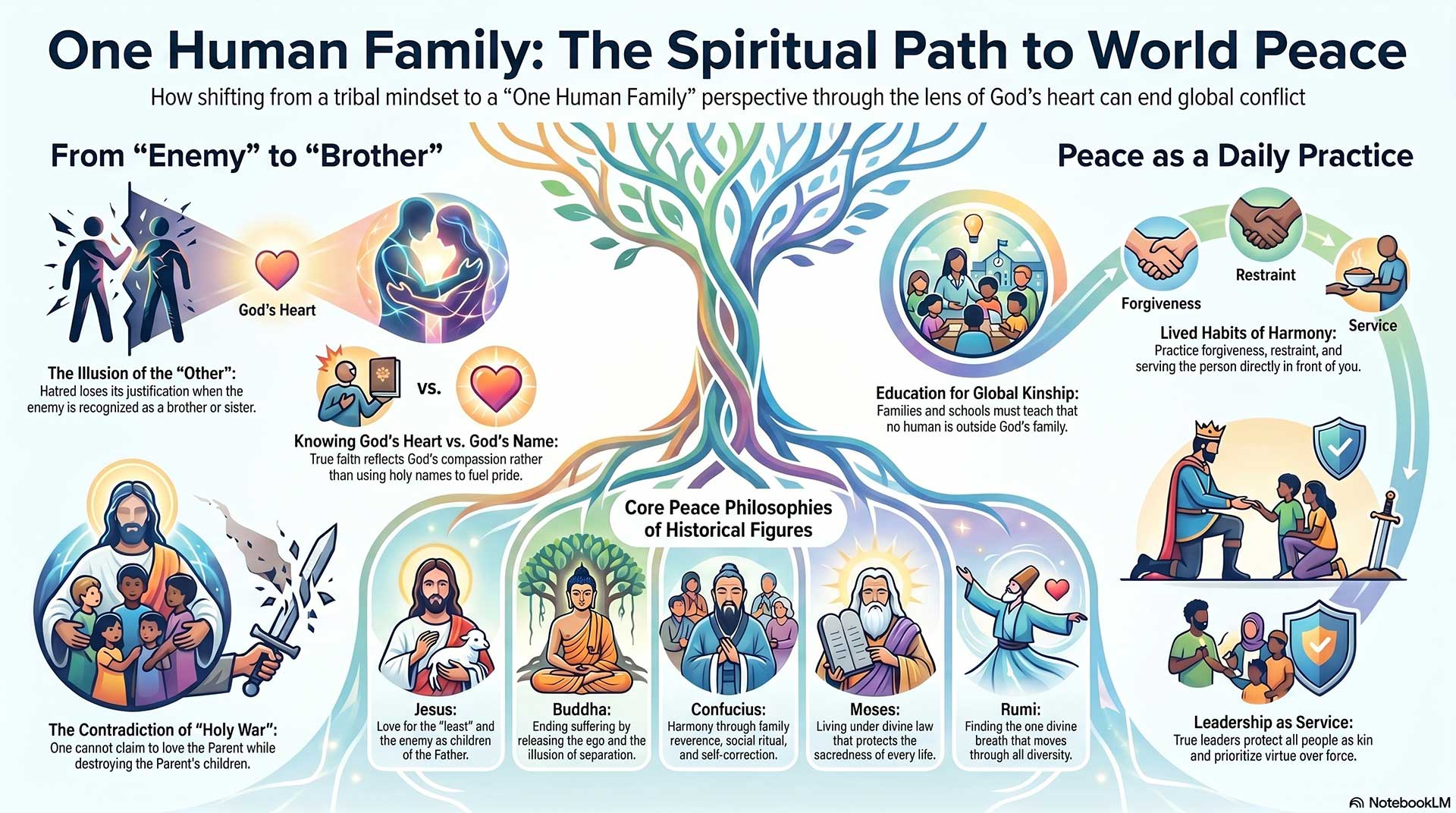
The moment we truly see another person as our brother or sister, something shifts:
Hatred loses its justification.
Violence loses its moral cover.
“Holy war” reveals itself as contradiction.
Peace then stops being a distant dream and becomes a daily responsibility.
Not something governments alone can create.
Something each person must practice.
In how we speak.
In how we judge.
In how we forgive.
In how we treat the stranger.
World peace may not begin in a global agreement.
It may begin in a simple, radical shift:
To see the person in front of you as someone who belongs to God.
And to live accordingly.
Short Bios:
Jesus: Central figure of Christianity, known for teaching love, forgiveness, and the idea that all people are children of God.
Buddha: Founder of Buddhism, who taught that suffering comes from ignorance and that compassion and awareness lead to peace.
Moses: Foundational prophet in Judaism, associated with divine law, moral responsibility, and the covenant between God and humanity.
Confucius: Chinese philosopher focused on ethics, family relationships, respect, and social harmony as the basis of a peaceful society.
Rumi: Persian poet and mystic who expressed the unity of all people through divine love beyond religious boundaries.
Nick Sasaki: Creator of Imaginary Talks and moderator of this conversation, exploring world peace through the belief that every person is a child of God—and therefore our brother or sister.
Leave a Reply