
|
Getting your Trinity Audio player ready...
|
What if 25 experts uncovered the emotional forces controlling every deal you make?
Introduction by Chris Voss
Most people think negotiation is about getting what you want.
That’s the surface.
Underneath, negotiation is about something far more human: fear, identity, trust, control, and dignity. Every difficult conversation—whether it’s in business, family, or within yourself—follows the same pattern. One side pushes. The other side resists. Words are spoken, but emotions decide.
The truth is simple, and uncomfortable:
You don’t win a negotiation when the other side says yes.
You win when the agreement actually works in the real world—without resentment, without regret, without collapse.
That’s why the tools in Never Split the Difference are not tricks.
They are ways of entering another person’s emotional world without losing your own footing.
Across these five conversations, we explored something deeper than tactics:
- Why facts fail when emotions are ignored
- How empathy can guide or distort influence
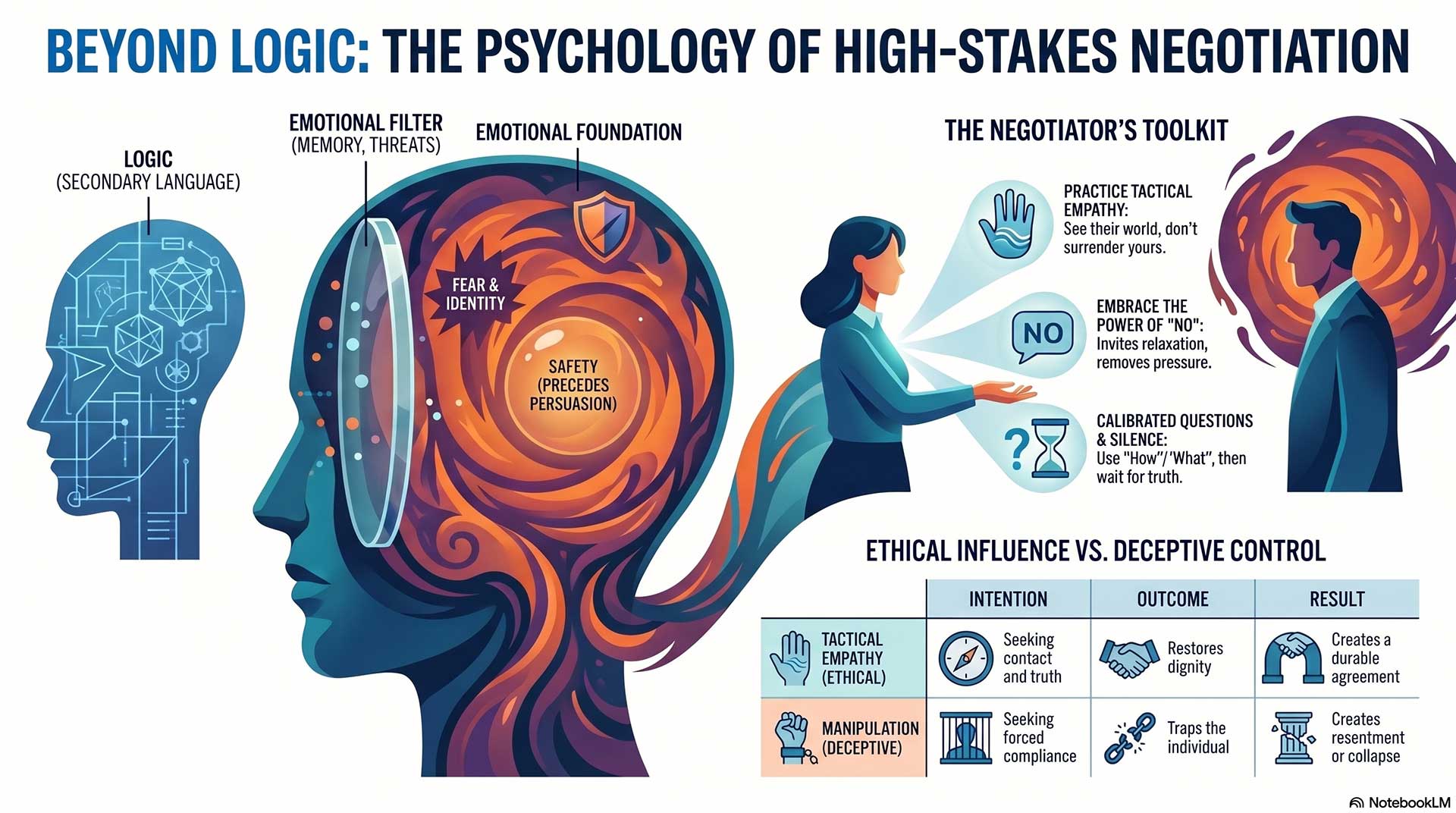
- Why the word “no” creates clarity and safety
- How questions and silence reveal truth
- And how negotiation shapes the life you choose to live
This is not about controlling others.
It is about seeing clearly—so you can act with precision, calm, and integrity when it matters most.
(Note: This is an imaginary conversation, a creative exploration of an idea, and not a real speech or event.)
Topic 1 — Negotiation Is Emotional Before It Is Logical

Opening — Chris Voss
Most people walk into a negotiation thinking the facts will win.
They prepare their numbers. They sharpen their arguments. They gather proof. Then they are shocked when the other person still says no.
That is where negotiation really begins.
People do not move because the facts are correct. They move when they feel heard, safe, respected, and in control. Fear speaks before logic. Pride speaks before logic. Identity speaks before logic.
So tonight, we are asking a simple but uncomfortable question:
What is really happening inside a negotiation before anyone says yes?
Question 1
Why do facts often fail to persuade?
Daniel Kahneman:
Facts fail because people do not process them neutrally. The mind receives facts through emotion, memory, bias, and threat perception. A perfectly accurate statement can still feel like an attack. Once that happens, the person is no longer evaluating information. They are protecting themselves.
Dale Carnegie:
A fact presented without warmth often sounds like criticism. People rarely change when they feel corrected. They change when they feel respected. You can be right and still lose the person.
Robert Cialdini:
Facts need a channel of influence. Credibility, liking, social proof, authority, and consistency shape whether a fact is accepted. The fact itself is rarely enough. The listener asks, “Who is telling me this, and what does it mean about me if I agree?”
Antonio Damasio:
Reason is not separate from emotion. Emotion gives value to facts. Without emotional meaning, facts are just data. A person changes direction when the facts connect to what they care about, fear, desire, or want to protect.
Chris Voss:
In hostage negotiation, the worst mistake is to argue with reality. The person already knows the facts at some level. What they need first is for the emotional pressure to come down. You label the fear. You mirror their words. You let them hear themselves. Then facts can enter.
Question 2
How do fear and identity shape every negotiation?
Chris Voss:
Fear is often the hidden negotiator at the table. Fear of looking weak. Fear of losing control. Fear of being trapped. When you ignore fear, it controls the conversation. When you name it calmly, it loses some of its grip.
Antonio Damasio:
Identity is deeply emotional. A proposal may seem logical, but if it threatens how someone sees themselves, they resist. They are not rejecting the deal. They are defending a self-image.
Daniel Kahneman:
Loss aversion is central here. People feel losses more strongly than gains. So a fair offer can still feel dangerous if it feels like surrender. The negotiator must learn what the other side believes they are losing.
Dale Carnegie:
No one wants to feel small. Many arguments continue because one person is trying to protect dignity. Give people a graceful way to agree, and many conflicts soften.
Robert Cialdini:
Consistency matters. People want to act in ways that match their prior commitments and public identity. If your proposal makes them feel inconsistent, they will resist it, even when it helps them.
Question 3
What makes someone feel safe enough to change their mind?
Dale Carnegie:
They need to feel that changing their mind will not humiliate them. Let them save face. Let them feel wise, not defeated. A person who feels honored can reconsider.
Chris Voss:
Safety comes from control. That is why “no” matters. When people can say no, they relax. Then they listen. Pushing for yes creates pressure. Inviting no creates space.
Daniel Kahneman:
Safety comes when the emotional system stops sounding an alarm. Once threat lowers, reflective thinking becomes possible. That is when new information can be weighed.
Robert Cialdini:
Safety grows when the change feels consistent with the person’s values. Do not make them abandon who they are. Show how the new choice expresses who they already want to be.
Antonio Damasio:
The body must believe the situation is survivable. Tone, rhythm, facial expression, and timing matter. The person senses safety before they explains it.
Closing — Chris Voss
The mistake is thinking negotiation is about getting someone to accept your logic.
It is not.
Negotiation is about entering the emotional world of another person without becoming trapped inside it. You listen until fear has a name. You ask until resistance reveals itself. You slow the moment down until the other person can think again.
Facts matter.
But facts do not walk into the room first.
Emotion does.
Topic 2 — Tactical Empathy Without Manipulation

Opening — Chris Voss
Tactical empathy is not being nice.
It is the discipline of seeing the world through the other person’s eyes without agreeing, surrendering, or pretending.
But that raises a serious question.
If empathy helps us influence people, when does it become manipulation?
That line matters. A negotiator can listen in a way that restores dignity, or listen in a way that traps someone. The method may look similar from the outside. The intention is different.
Tonight, we ask whether strategic listening can remain honest.
Question 1
Where is the line between empathy and manipulation?
Marshall Rosenberg:
The line is intention. Empathy seeks contact with the life inside another person. Manipulation seeks compliance. When I listen only to get my preferred outcome, I am no longer fully listening.
Chris Voss:
In negotiation, intention and execution both matter. Tactical empathy is not agreement. It is accurate recognition. You can say, “It sounds like you feel cornered,” without promising them everything they want.
Carl Rogers:
True empathy allows the other person to become more themselves. Manipulation tries to shape the other person into what we want. The listener must ask, “Am I giving this person more freedom or less?”
Adam Grant:
Influence becomes dangerous when curiosity disappears. If I already know what I want you to say, I may use listening as a tactic. Real persuasion begins with being willing to learn.
Brené Brown:
Empathy without boundaries can become self-abandonment. Strategy without care can become control. The ethical place is where I remain honest about my needs and still honor yours.
Question 2
Can listening be strategic without becoming fake?
Chris Voss:
Yes. Strategy does not make listening fake. It makes it disciplined. A doctor listens strategically. A therapist listens strategically. The issue is whether you are listening to understand reality or only to force your script.
Carl Rogers:
Authentic listening cannot be performed mechanically. The other person senses whether you are present. Technique may open the door, but presence is what lets someone walk through it.
Brené Brown:
People can smell emotional theater. If you mirror their words but your face says judgment, trust collapses. Strategic listening must include courage: the courage to stay in discomfort without rushing to fix or control.
Marshall Rosenberg:
Listening remains real when I connect to needs, not just words. Someone may say, “You never respect me.” The surface is accusation. The deeper need may be respect, safety, or consideration.
Adam Grant:
The best strategic listeners are not pretending. They are gathering better information while creating a better relationship. That is not fake. That is wisdom with care.
Question 3
How do you influence someone while still honoring their dignity?
Brené Brown:
Do not shame them into agreement. Shame produces compliance, secrecy, or rebellion. Dignity means the person can remain whole, even if the conversation is hard.
Adam Grant:
Ask questions that allow people to rethink without losing face. People resist being corrected, but they often welcome discovering a better answer for themselves.
Chris Voss:
Use calibrated questions. “How am I supposed to do that?” is powerful because it does not attack. It invites the other side to solve the problem with you.
Carl Rogers:
Honor dignity by trusting the person’s capacity to reflect. Do not rush them. People often need space to hear their own thoughts clearly.
Marshall Rosenberg:
Influence should be an invitation, not coercion. State your observation, feeling, need, and request. Then allow the other person’s humanity to remain present in their answer.
Closing — Carl Rogers
The deepest influence does not feel like force.
It feels like being seen clearly enough to become honest.
A person may change their position after a hard conversation, but the greater victory is this: they did not have to lose their dignity to do so.
That is the test of tactical empathy.
Did it produce compliance, or did it create truth?
Topic 3 — Power, Leverage, and Saying No

Opening — William Ury
Most people fear the word no.
They hear rejection. They hear failure. They hear the end of the conversation.
But in real negotiation, no can be the first honest word spoken.
A false yes creates illusion. A pressured yes creates resentment. A polite yes may hide fear. But no often reveals the boundary, the fear, the real objection, and the hidden path forward.
Tonight, we ask: when does no become the beginning of real power?
Question 1
Why can “no” create more safety than “yes”?
Chris Voss:
People feel safer when they can say no because no gives them control. When you push for yes, they feel trapped. When you invite no, they relax. That is when the real conversation starts.
William Ury:
No protects dignity. It says, “Here is where I stand.” A healthy no is not hostility. It is self-respect with a boundary.
Roger Fisher:
A forced yes rarely creates a durable agreement. If someone cannot say no, the negotiation lacks legitimacy. Real agreement requires freedom.
Gavin de Becker:
No is a survival word. People often sense danger before they can explain it. When someone’s no is ignored, their alarm system intensifies.
Jocko Willink:
No brings clarity. In leadership, unclear commitments create failure. A clean no is better than a weak yes that collapses later.
Question 2
How does a weaker person negotiate with someone who has more leverage?
Gavin de Becker:
First, they must trust their signals. Power often hides behind charm, urgency, or intimidation. If something feels unsafe, slow down. Do not let pressure dictate your timing.
Chris Voss:
Use calibrated questions. “How am I supposed to do that?” shifts the problem back to the stronger side without direct confrontation. It makes them think through your limits.
Roger Fisher:
Separate the people from the problem. Then look for objective standards. A weaker party gains strength when the discussion moves from personal pressure to fair criteria.
Jocko Willink:
Control what you can control: preparation, discipline, tone, patience. Do not panic. Do not react emotionally. Weak position does not mean weak behavior.
William Ury:
The weaker person needs a strong BATNA—their best path if no agreement happens. The ability to walk away changes the emotional balance.
Question 3
When is walking away the strongest move?
Roger Fisher:
Walk away when the agreement is worse than your best no-agreement option. Negotiation is not about reaching any deal. It is about reaching a wise agreement.
Jocko Willink:
Walk away when the mission is compromised. Ego wants to keep fighting. Discipline knows when the cost is too high.
Chris Voss:
Walk away when the other side refuses reality. If they will not acknowledge constraints, facts, or fairness, you are not negotiating. You are being used.
Gavin de Becker:
Walk away when your body keeps warning you. Many people override fear to appear polite. That can be dangerous. Safety outranks approval.
William Ury:
Walking away can be a deeper yes—to your values, your future, your dignity. No to one agreement may be yes to a better life.
Closing — Chris Voss
The word no is not the enemy.
The enemy is fear pretending to be agreement.
A negotiator who fears no becomes desperate. A negotiator who respects no becomes dangerous in the best sense: calm, patient, impossible to bully.
No tells you where the wall is.
Then the real skill begins.
Topic 4 — Calibrated Questions, Silence, and Control

Opening — Socrates
Many people try to control a conversation by speaking more.
They explain. They argue. They defend. They overwhelm.
But the wiser path is often quieter.
A question can enter places an argument cannot. Silence can reveal what pressure hides. The person who asks well does not merely collect answers. He helps the other person discover what they already fear, want, or refuse to admit.
Tonight, we ask: how does control shift when we stop pushing and start asking?
Question 1
Why are questions more powerful than arguments?
Chris Voss:
Arguments create resistance. Calibrated questions create movement. When you ask, “How am I supposed to do that?” you are not attacking. You are making the other side think through the problem.
Socrates:
An argument tells a person what to think. A question invites the person to examine whether their own thinking can stand. That discovery carries more force than correction.
Daniel Goleman:
Questions lower emotional threat. They signal curiosity instead of attack. Once threat drops, the brain can listen again.
Jim Camp:
The best questions protect you from chasing a false yes. Let the other person say no. Let them reveal the real problem. You cannot build a deal on politeness.
Nancy Kline:
A real question gives someone space to think. Many people have never been listened to long enough to hear their own answer clearly.
Question 2
How does silence change the emotional pressure in a conversation?
Nancy Kline:
Silence can be respect. It says, “I will not rush your thinking.” Many conversations fail because people interrupt the moment when truth is forming.
Chris Voss:
After a mirror or label, silence does the work. You say, “It sounds like you feel trapped,” then stop. The other person fills the space, often with the real issue.
Jim Camp:
Silence keeps you from rescuing the other side from discomfort. Most people talk too soon because they are uncomfortable. That gives away control.
Daniel Goleman:
Silence lets emotions settle. A pause can move someone from reaction to reflection. Timing matters as much as wording.
Socrates:
Silence is the friend of examination. A person may resist an idea spoken by another, yet become moved by a thought born inside himself.
Question 3
What makes someone reveal the truth without feeling attacked?
Chris Voss:
Labels help. “It seems like there’s something here that doesn’t feel right.” That gives them a path to speak without feeling accused.
Daniel Goleman:
Tone matters. A sharp question can sound like judgment. A steady question can sound like safety. People reveal more when they do not feel hunted.
Nancy Kline:
Do not fill the space with your assumptions. Ask clean questions. Then listen without preparing your comeback.
Jim Camp:
Give them permission to say no. Truth comes faster when people know they are not being trapped into agreement.
Socrates:
The question must seek truth, not victory. When the other person senses that you are trying to win over them, they defend. When they sense that you are seeking truth with them, they may join you.
Closing — Nancy Kline
A conversation changes when someone is finally allowed to think.
Not rushed.
Not cornered.
Not corrected before the sentence is finished.
The deepest control is not domination. It is the calm ability to create conditions where truth can appear.
A question opens the door.
Silence lets the person walk through it.
Topic 5 — Negotiating Life, Family, Work, and Purpose
Opening — Stephen Covey
A negotiation is not always across a conference table.
Sometimes it happens at the dinner table.
Sometimes in a marriage.
Sometimes between parent and child.
Sometimes inside one person’s own conscience.
The deeper question is not, “How do I get what I want?”
It is, “What kind of person am I becoming while I pursue what I want?”
Tonight, we ask how the lessons of negotiation apply to family, leadership, purpose, and the choices that shape a life.
Question 1
How do negotiation tools apply inside family conflict?
Esther Perel:
Family conflict is rarely only about the issue. It is about longing, recognition, loyalty, disappointment, and unmet needs. Tactical empathy works when it helps people say, “This is what I was really trying to tell you.”
Chris Voss:
In family conflict, people make the mistake of trying to win too fast. Label first. “It sounds like you feel ignored.” “It seems like this has been building for a long time.” Once people feel heard, they stop defending as hard.
Simon Sinek:
Trust is built when people feel safe enough to be honest. In a family, leadership is not rank. It is the willingness to protect the relationship while still telling the truth.
Jordan Peterson:
Do not use negotiation to avoid responsibility. Speak truthfully. Listen carefully. Clean up your own part of the conflict before demanding that others change.
Stephen Covey:
Seek first to understand. This is not a technique; it is a posture. When family members feel interpreted before they are heard, they withdraw. When they feel understood, cooperation becomes possible.
Question 2
When should peace matter more than winning?
Chris Voss:
Peace matters more when winning damages the long-term relationship. You can win the point and lose access to the person. That is a bad deal.
Stephen Covey:
Principled peace is not surrender. It is alignment with values. The question is: what result protects trust, conscience, and the future?
Esther Perel:
In intimate relationships, being right can become a lonely victory. Sometimes the need to win hides the fear of being vulnerable.
Jordan Peterson:
Peace without truth is fragile. But victory without compassion is dangerous. The aim is not shallow harmony. The aim is truthful peace.
Simon Sinek:
Leaders go last. In family and work, that means protecting the group from ego-driven conflict. The strongest person in the room is often the one who can pause first.
Question 3
What does “never split the difference” mean for a life decision?
Jordan Peterson:
Some choices cannot be averaged. You cannot half-live truthfully. You cannot partly accept a lie and expect your soul to remain untouched. There are moments when compromise becomes self-betrayal.
Simon Sinek:
It means know your why. If you do not know what you stand for, every pressure feels negotiable. Purpose gives you a line you will not cross.
Chris Voss:
In negotiation, splitting the difference can create a terrible outcome. In life, it is the same. If one person wants safety and the other wants danger, halfway is still danger.
Esther Perel:
But be careful. Some people call rigidity integrity. A life decision requires listening to the deeper desire beneath the position. Sometimes the real choice is not between two demands, but between two fears.
Stephen Covey:
The highest choices come from principle. Not impulse. Not ego. Not pressure. Principle tells us when to compromise, when to hold firm, and when to walk away.
Closing — Chris Voss
The hardest negotiation is not with a terrorist, a buyer, a boss, or a client.
It is with yourself.
Can you hear the fear beneath your own anger?
Can you name the pride beneath your own certainty?
Can you say no when approval is tempting?
Can you stay calm when someone you love misunderstands you?
Never split the difference does not mean never compromise.
It means never make peace with a false solution.
A real agreement protects dignity, truth, and the future.
Final Thoughts by Stephen Covey
What we have witnessed here is not a discussion about negotiation techniques.
It is a discussion about character.
A person who listens only to win will eventually lose trust.
A person who speaks only to be right will eventually stand alone.
A person who avoids conflict will eventually live with quiet resentment.
But a person who seeks to understand first—who balances courage with empathy—builds something stronger than agreement.
They build alignment.
In life, you are always negotiating:
With your spouse.
With your children.
With your colleagues.
With your own conscience.
The question is not whether you will negotiate.
The question is who you will become in the process.
Short Bios:
Chris Voss: Former FBI hostage negotiator and co-author of Never Split the Difference, known for tactical empathy and high-stakes negotiation strategies.
Daniel Kahneman: Nobel Prize-winning psychologist who revealed how bias and emotion shape decision-making.
Robert Cialdini: Author of Influence, known for identifying key principles that drive human persuasion.
Dale Carnegie: Pioneer of interpersonal communication, famous for How to Win Friends and Influence People.
Antonio Damasio: Neuroscientist who showed the deep connection between emotion and rational decision-making.
Carl Rogers: Founder of person-centered therapy, emphasizing empathy and authentic listening.
Marshall Rosenberg: Creator of Nonviolent Communication, focused on needs-based dialogue and compassion.
Brené Brown: Researcher on vulnerability, courage, and human connection.
Adam Grant: Psychologist studying generosity, influence, and rethinking.
William Ury: Co-author of Getting to Yes, expert on conflict resolution and negotiation frameworks.
Roger Fisher: Founder of principled negotiation and co-author of Getting to Yes.
Gavin de Becker: Expert on fear, intuition, and threat assessment, author of The Gift of Fear.
Jocko Willink: Leadership expert known for discipline, ownership, and decision-making under pressure.
Socrates: Classical philosopher known for using questions to uncover truth.
Daniel Goleman: Psychologist who popularized emotional intelligence in leadership and communication.
Jim Camp: Author of Start with No, focused on control and clarity in negotiation.
Nancy Kline: Creator of the Thinking Environment, emphasizing deep listening and space for thought.
Jordan Peterson: Psychologist known for exploring responsibility, truth, and meaning.
Simon Sinek: Author of Start With Why, focused on trust, purpose, and leadership.
Esther Perel: Therapist known for insights into relationships, desire, and conflict.
Stephen Covey: Author of The 7 Habits of Highly Effective People, focused on principle-centered living.
Carl Rogers: Pioneer of empathetic listening and human-centered dialogue.
Marshall Rosenberg: Advocate for compassionate communication rooted in human needs.
Adam Grant: Thinker on influence, generosity, and intellectual humility.
Antonio Damasio: Researcher on how emotion drives human reasoning and choice.
Leave a Reply