
|
Getting your Trinity Audio player ready...
|
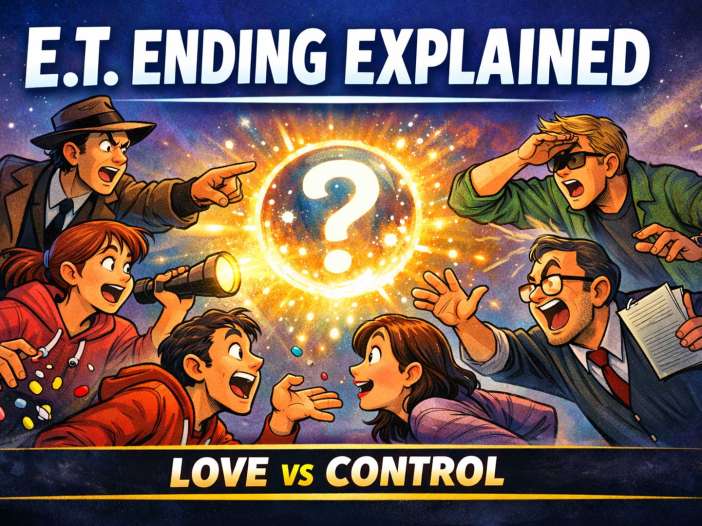
What if Bashar and Kryon argued that E.T. is a mirror for human fear and love?
Introduction by Conan O’Brien
E.T. ending explained is the assignment, but tonight we’re doing it with one big rule that changes everything: we’re assuming ET is real. Not “ET as a metaphor,” not “ET as a childhood movie,” but ET as an actual presence in the universe. And if you’re someone who believes beings like Bashar are already communicating as ET, then we’re not waiting for contact. We’re already in it.
Which means the real question isn’t, “Do aliens exist?” The real question is, “What do humans do when the unknown is no longer hypothetical?”
Because the moment you assume ET exists, this movie turns into a moral mirror with teeth. It asks: are we capable of curiosity without obsession, love without control, connection without violating consent, and disclosure without turning it into a tribal sport? And yes, this will still be funny, because I’m here, and humor is the only way my nervous system can process cosmic dread. But we’re going to stay grounded.
Tonight’s roundtable is built around five big themes: signal versus projection, love versus control, telepathy and consent, disclosure as storytelling, and the sacred stranger test. And if that sounds heavy, good. It should. Because if contact is real, the scary part isn’t what’s out there. The scary part is what we bring to it.
Let’s begin.
(Note: This is an imaginary conversation, a creative exploration of an idea, and not a real speech or event.)
Topic 1: Signal or Projection
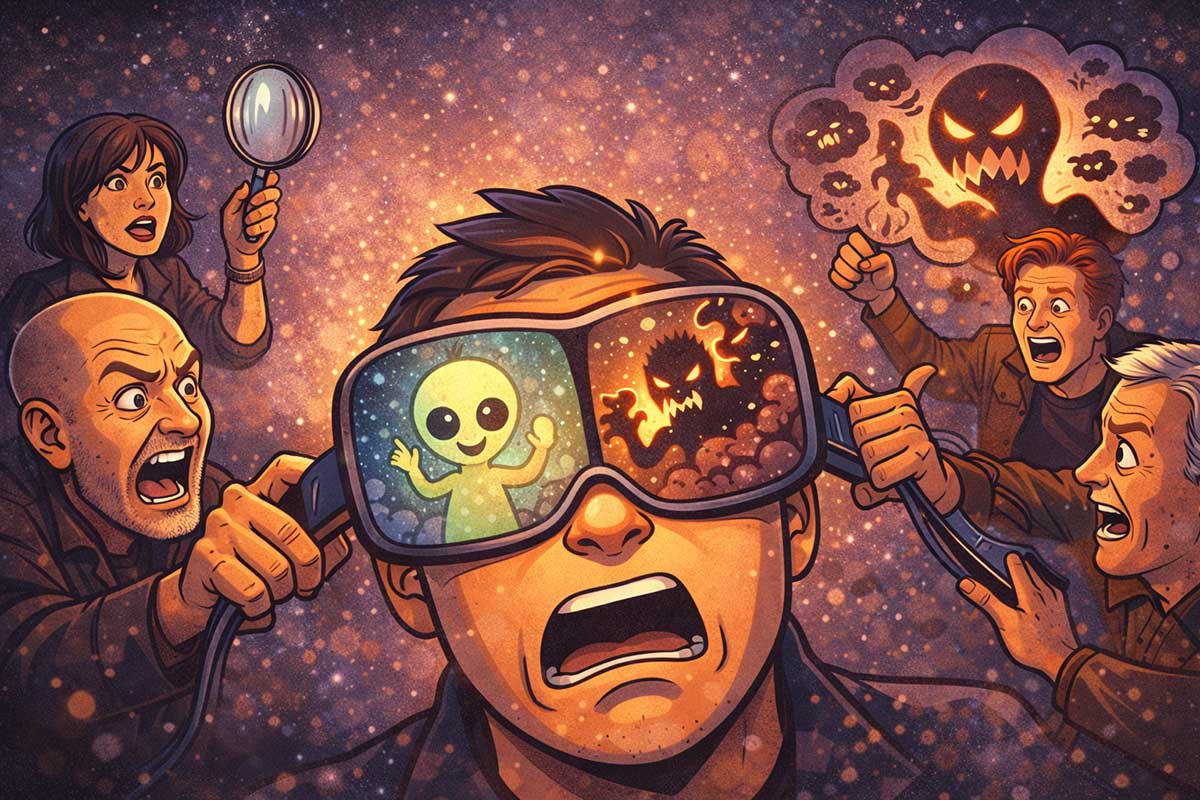
The premise tonight is simple and kind of terrifying in the most polite way possible.
ET exists. Not as a rumor. Not as a metaphor. ET exists, and communication is already happening through channels like Bashar.
So the question is not “Are they real?”
The question is: Are we interpreting the contact clearly, or are we painting our own fears and fantasies onto it and calling that truth?
The space is less like a conference and more like a rehearsal for sanity. People are standing, pacing, sipping water like they are about to go on stage. There’s a whiteboard in the corner with nothing written on it, because nobody wants to be the first person to write “ALIENS” in big letters and then have to live with that.
Conan O’Brien walks in and claps once.
Conan O’Brien: Alright. Topic one. We are assuming ET exists and that ET communication is already happening, including through Bashar. Great. Fantastic. No notes. My only request is that we keep this grounded enough that I can sleep tonight.
He looks around at the five speakers.
Bashar sits in a way that looks casual but oddly confident, like someone who has heard every human objection before the human finishes it.
Ra feels more formal, like a presence that chooses every word carefully because it knows words can become weapons.
Carl Jung watches everyone like he’s watching their inner lives walk around outside their bodies.
Lisa Feldman Barrett looks calm and exacting, like she’s already separating what people feel from what people think they feel.
Carl Sagan holds the room with that steady tone that says wonder is not the enemy of rigor.
Conan takes a breath.
Conan O’Brien: First question. If ET is already communicating through channelers, how do we tell the difference between a real signal and human projection?
Lisa Feldman Barrett: Most people assume their mind is a camera recording reality. It isn’t. Your brain is a prediction machine. It builds experience from past learning, context, and the body’s sensations. So projection is not a rare bug. It is the default operating system. If a person is channeling, they may sincerely believe they are receiving external information, but the content still has to be interpreted by a human brain with human concepts. That means you need guardrails. Not ridicule. Guardrails. Otherwise you confuse emotional certainty for accuracy.
Bashar: We agree with the need for discernment. The simplest distinction is this. Projection tends to reinforce fear, identity addiction, and the need for control. A genuine signal, even when it challenges you, will ultimately increase your clarity, your freedom, and your capacity to choose. That does not mean it will always feel comfortable. But it will not require you to surrender your sovereignty. If the message says, “Give me your power,” that is not us. That is a human pattern wearing a costume.
Carl Jung: Projection is not merely a mistake. It is an expression of the psyche seeking wholeness. When humans encounter the unknown, they constellate archetypes. The savior, the invader, the wise elder, the trickster, the judge. You then see not what is there, but what you are prepared to see. If ET is present, the encounter becomes a magnifying glass for the collective unconscious. The danger is inflation. People may claim contact and become intoxicated by specialness. The antidote is humility and a commitment to integrate the shadow. Ask: what part of this message flatters me? What part of this message makes me superior? That is where projection hides.
Ra: We would speak cautiously. You ask for proof in the manner of your sciences, yet the contact you describe is filtered through mind and spirit. Therefore, discernment must include both reason and heart. A true signal will honor free will. It will not demand devotion. It will not encourage separation, hatred, or dehumanization. When information is offered, it should be offered as catalyst, not command. If the message creates dependency, the orientation is distorted.
Carl Sagan: If we are taking this premise seriously, then we must also take responsibility seriously. Humans are extremely good at finding patterns, even when patterns are not there. That is not a moral failing. It is a biological feature. So the safest approach is to treat channeling as a hypothesis generator, not as a final authority. If a channeled message contains claims about reality, we ask: can any of it be independently checked? Can it predict anything specific? Can it be tested in any way? Even if some parts are not testable, we should still prefer clarity over charisma. Otherwise we are just doing religion with new vocabulary.
Conan nods, like he’s relieved that nobody flipped a table.
Conan O’Brien: Okay. So far we’ve got: brains predict, archetypes hijack, free will is a red flag detector, and we should not confuse charisma with truth. That’s basically my entire career in reverse.
He walks a slow circle, thinking.
Conan O’Brien: Second question. If we want discernment without turning this into contempt, what practices actually help people evaluate channeled ET information responsibly?
Carl Jung: First, psychological hygiene. Keep a journal. Track what messages you want to be true versus what messages challenge you. Projection loves wish fulfillment. Second, look for compensations. If the message is always comforting, it may be avoidance. If the message is always grandiose, it may be inflation. Third, consult the inner moral sense. A message that encourages cruelty or superiority is not wisdom, regardless of its cosmic packaging. Finally, community helps. Not an echo chamber. A community that can disagree without humiliation.
Ra: We suggest an attitude of seeking. Not belief, not disbelief, seeking. When you receive information, sit with it. Observe the effects it has upon your life. Does it increase compassion? Does it increase clarity? Does it increase service to others? Or does it increase fear, separation, and the need to dominate? The fruits reveal the tree. Also, avoid urgency. Urgency is often a distortion. Truth does not require panic.
Lisa Feldman Barrett: I’d add basic cognitive discipline. People should distinguish between three things: the experience of receiving something, the interpretation of what it means, and the claim that it is objectively true. Those are different layers. You can respect someone’s experience without granting their interpretation automatic authority. Also, we need to normalize uncertainty. The moment people become allergic to “I don’t know,” they become vulnerable to anyone selling certainty. Especially cosmic certainty.
Carl Sagan: A practical method is triangulation. Compare independent sources. Look for convergence without collusion. If multiple channelers offer identical phrasing, that could be shared culture. If multiple sources converge on ethical principles like non-coercion and compassion, that’s meaningful in a moral sense, though still not proof. When it comes to factual claims, the bar should be higher. And we should be honest about the limits. Some things may remain subjective. That does not mean worthless. It means we should not build policy on it.
Bashar: We would say the practice is alignment. Not blind belief. Alignment. When a message resonates, do not ask, “Is it true for everyone?” Ask, “Is it useful and empowering for me now?” Apply it. Observe the results. If the result is more presence, more integrity, more compassion, then you are moving in a constructive direction. If it produces fear, obsession, superiority, or dependency, then it is time to step back. The point of contact is not to make you follow us. The point is to help you become more of who you truly are.
Conan points at Bashar.
Conan O’Brien: I like that your cosmic advice is basically, “Try it and see if you become less of a jerk.” That would improve at least 80 percent of the internet.
He stops pacing.
Conan O’Brien: Third question. If contact is already happening through channelers and the public is slowly waking up to it, what should a responsible next step look like, right now, in the real world?
Carl Sagan: Responsible next steps begin with reducing harm. We should encourage mental health literacy around anomalous experiences. Some people will have experiences that are meaningful. Some people will be vulnerable to delusion. A compassionate society builds support structures instead of mockery. Second, we cultivate scientific curiosity without sensationalism. If there are claims that can be tested, test them carefully. And avoid building a cult of certainty around anything that cannot be checked.
Bashar: We would suggest that the next step is for individuals to become coherent. The public wants disclosure to come from institutions, but institutions are made of individuals. Coherence is personal. Learn to regulate fear. Learn to communicate without polarization. If you cannot meet your neighbor without contempt, you are not ready to meet the cosmos without panic. The most responsible next step is emotional maturity.
Lisa Feldman Barrett: I agree with the nervous system piece. The public conversation needs training wheels. People should learn how fear feels in the body so they do not confuse activation with truth. We also need norms that protect consent. If people report contact experiences, they should not be exploited, monetized, or weaponized. Whether or not the content is objectively true, exploitation is objectively harmful.
Ra: We would add that you must guard free will. Any movement that declares it has the only truth about ET contact is already drifting into distortion. A responsible next step is humility at scale. Teach people that spiritual curiosity does not require surrender of judgment. Teach that a message may be helpful without being absolute. The middle path protects the seeker.
Carl Jung: And I would say we must prepare for the shadow response. If ET contact becomes culturally accepted, you will see not only wonder but envy, fanaticism, and reactionary fear. Some will demand saviors. Some will demand enemies. The responsible next step is to speak openly about these psychic dangers so the public recognizes them when they arise. The encounter with the alien is also an encounter with the alien inside the human psyche.
Conan looks at the group, then at the empty whiteboard, like he’s tempted to write something and decides not to.
Conan O’Brien: So the responsible next step is not a big announcement. It’s a slow upgrade of how humans handle uncertainty, fear, and meaning. Which is not as fun as a spaceship landing, but probably more realistic.
He pauses, then smiles.
Conan O’Brien: Here’s my take. If ET is already here and already communicating, the biggest risk is not that the message is false. It’s that we will use the message the way we use everything else. To feel superior. To form tribes. To sell stuff. To punish each other. To avoid doing the boring work of becoming decent.
He points at the flashlight in the corner.
Conan O’Brien: That little thing is a perfect symbol. Humans always want to shine the light outward. “Show me. Prove it. Reveal yourself.” But if contact is real, the light also has to go inward. “What am I bringing to this?” Fear? Greed? Awe? Humility?
He looks back at the speakers.
Conan O’Brien: Next topic is Love vs Control, but now it’s going to hit harder, because if contact is already happening, then the control reflex is not a future risk. It’s a present one.
Topic 2: Love vs Control
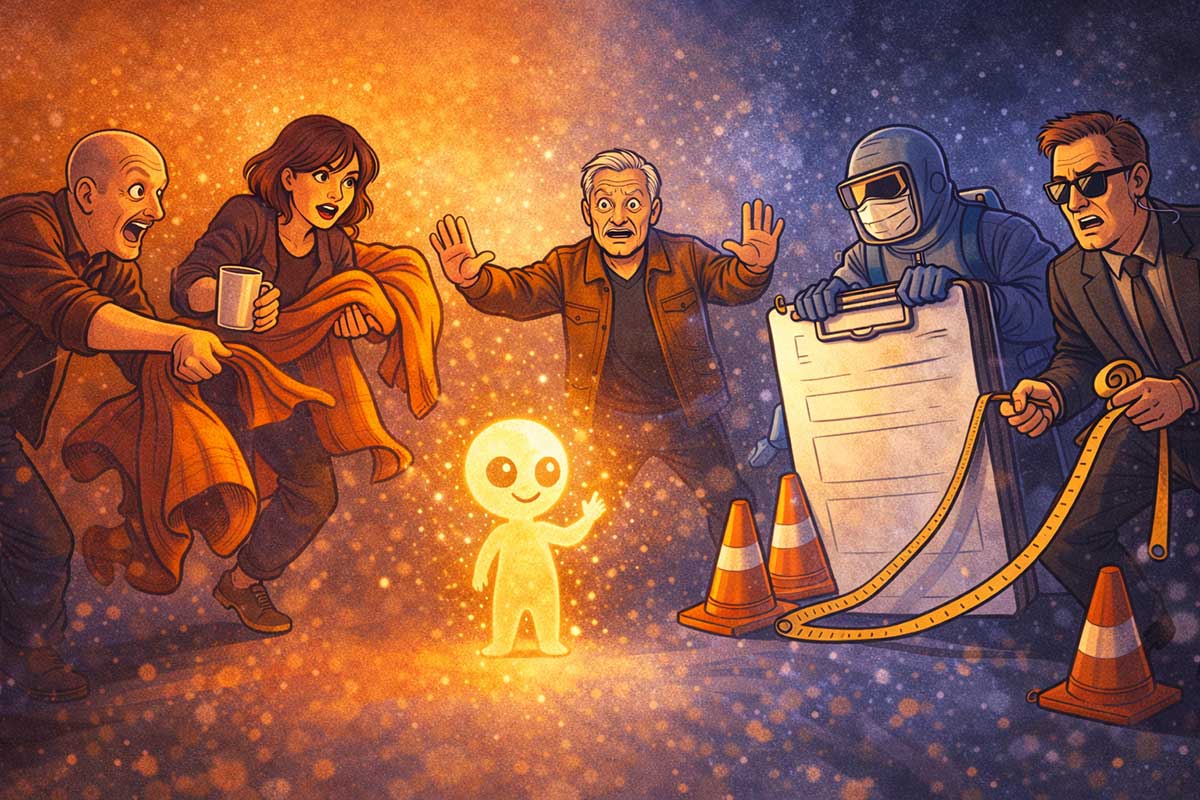
Nobody’s pretending this is theoretical anymore.
If ET exists and communication is already happening through channelers, then the real question becomes uncomfortably immediate:
When humans meet the unknown, do we default to relationship… or to containment?
Because “control” doesn’t just mean governments and hazmat suits. It also means influencers, gatekeepers, cult dynamics, monetization, narrative policing, and the human reflex to grab the steering wheel the moment we feel scared.
The room is more kinetic tonight. People are standing, moving, interrupting themselves mid-thought. Someone has drawn a quick line down the middle of the whiteboard: one side says CARE, the other says CONTROL. Nobody wrote it with letters, because no readable text is allowed in this universe, but everyone can feel it.
Conan O’Brien steps between the two sides like a referee who regrets taking this gig.
Conan O’Brien: Alright. Topic two. Love versus control. If ET contact is real and already here in some form, what happens next depends less on them and more on us. Which is very annoying, because I was hoping aliens would fix everything.
He looks at tonight’s five.
Bashar is back, because this topic is basically his home court.
Kryon joins as the second ET voice, soft and encouraging but not weak.
Hannah Arendt stands with that look of someone who can smell bureaucracy from across the room.
Brené Brown brings warmth, but the kind that doesn’t let you hide.
Steven Spielberg is here not as “the director,” but as the guy who understood that the scariest thing in E.T. wasn’t the alien, it was what adults do when they’re afraid.
Conan takes a breath.
Conan O’Brien: First question. If ET contact is already happening, what is the first way humans try to control it?
Hannah Arendt: Through administration. The public imagines control as soldiers. It is more often paperwork. Committees. Classifications. “Authorized narratives.” The institutional reflex is to turn the unknown into a managed object. And once something is an object, ethical responsibility becomes optional. People say, “The process required it.” That is how harm becomes normal. The earliest sign is not violence. It is the language of inevitability.
Brené Brown: The first control move is emotional. We armor up. We decide vulnerability is dangerous. The moment something unknown arrives, we think: if I can label it, I can handle it. If I can mock it, I can keep my status. If I can turn it into a fight, I can avoid feeling small. Control begins as a coping strategy. Then it hardens into a worldview. And that’s how communities fracture, because fear is contagious.
Steven Spielberg: Humans control what they don’t understand by separating it. In E.T., the adults are always behind masks, behind flashlights, behind procedures. That’s not just government. That’s psychology. When you get close enough to see the stranger’s face, you feel empathy. When you keep distance, you feel permission. If contact is real, the first control move will be distance. Physical distance. Emotional distance. Narrative distance.
Bashar: Control begins when you assume the unknown must be dangerous. Then you behave defensively, and your defensiveness becomes the danger. Many humans want certainty more than truth. Certainty feels like control. But certainty is often the enemy of discovery. If contact is already occurring, the first way you will attempt to control it is by demanding that it conform to your existing belief systems and political identities. You will make the contact serve your story.
Kryon: And control also comes disguised as care. People will say, “We must protect the public,” but sometimes what they mean is, “We must protect the public from feeling uncertainty.” Yet uncertainty is part of growth. The most loving thing is not always to hide complexity. The loving thing is to help people hold complexity without collapsing into fear.
Conan nods.
Conan O’Brien: So we control it with bureaucracy, with armor, with distance, with certainty addiction, and sometimes with fake-care that’s really fear-management. Excellent. Humanity, never change. Actually please change immediately.
He paces once.
Conan O’Brien: Second question. What would “love” look like here without being naive? If ET is real, what does love look like that still respects caution and boundaries?
Brené Brown: Love without naivete looks like brave boundaries. It says, “We can be open without being reckless.” It also says, “We will not dehumanize people who disagree.” Because the minute contact becomes a tribal badge, love disappears. Love is not the absence of fear. Love is the decision to stay human while you’re afraid. That means curiosity, listening, and refusing to turn uncertainty into a weapon.
Hannah Arendt: Love must include politics, meaning structures. Individual kindness is not enough. A loving stance requires institutions designed to prevent cruelty. If you rely on personal virtue alone, the system will still produce harm. Love must be expressed as transparent oversight, checks on secrecy, and protections for both the visitor and the public. Otherwise “love” becomes sentiment while power operates in darkness.
Steven Spielberg: In story terms, love looks like proximity. You get close enough to understand. But you do it safely. You don’t crowd. You don’t grab. You don’t perform. You approach with gentleness and respect. That’s what the kids do in E.T. They don’t “solve” him. They relate to him. If contact is real, love means we don’t treat the unknown like a trophy or a threat. We treat it like a relationship we haven’t earned yet.
Bashar: Love is permission. Love is allowing what is to be what it is, without insisting it must be something else for you to feel safe. Love includes discernment. Discernment is not fear. Discernment is clarity. The loving approach is to meet contact with sovereignty: open, curious, but not surrendering your agency. If a message or contact dynamic asks you to abandon your judgment, that is not love. That is dependency.
Kryon: Love is patience. It is slow disclosure at the pace of the nervous system. It is community conversation that leaves room for people to be overwhelmed without being shamed. It is creating spaces where questions are welcome and certainty is not required. Love is a culture that can say, “We don’t know yet,” and still treat each other kindly.
Conan points at Kryon.
Conan O’Brien: You just described a society that does not exist yet, but I like the pitch.
He stops and faces them.
Conan O’Brien: Third question. If humans don’t watch themselves, what are the two big control-traps that would hijack contact right now? Like, what are the predictable failures?
Hannah Arendt: Secrecy, first. When power claims exclusive custody of reality, the public becomes distrustful, and distrust becomes fertile soil for extremism. Second, scapegoating. The unknown will be used to justify crackdowns, surveillance, or purges of “disloyal” citizens. When a society is anxious, it looks for internal enemies. That is always the next step.
Brené Brown: Shame and status games. People will turn contact into identity, like “I’m the enlightened one” or “I’m the realist.” Then they’ll use it to humiliate each other. That breaks social trust, and without social trust, any big unknown becomes a crisis. The second trap is outsourcing responsibility. People will either idolize ET as savior or demonize ET as threat, both of which let humans avoid the hard work of becoming emotionally mature.
Steven Spielberg: The spectacle trap. Humans will want a big moment: a reveal, a headline, a dramatic confrontation. But spectacle makes everything worse. It removes nuance. It invites performative leadership. It makes people forget the quiet ethical questions. If contact is real, spectacle will turn it into entertainment and then into conflict.
Bashar: We would say the first trap is the need to be right. The second trap is the need to be special. Those two needs create most distortions. “I have the truth” and “I am chosen.” That is how contact becomes cult, even when it began as curiosity.
Kryon: And the trap underneath them all is fear pretending to be wisdom. Fear can sound intelligent. Fear can sound responsible. But fear contracts. It separates. If your response produces more separation, it is likely fear wearing a clever mask.
Conan exhales, like he’s been waiting for that.
Conan O’Brien: So the danger is not just the government. It’s the human thirst for certainty, status, and spectacle. Which means the real battlefield is not space. It’s the group chat.
He steps back.
Conan O’Brien: Here’s what I’m taking from this. If ET contact is already in the room through channeling, the love versus control test is already happening. Every time someone tries to gatekeep the narrative, shame the curious, monetize panic, or demand worship, that’s control. Every time someone stays curious, sets healthy boundaries, protects dignity, and admits uncertainty without contempt, that’s love.
He points at Spielberg.
Conan O’Brien: Spielberg, you made adults look terrifying in E.T. because they were afraid. That’s not a movie thing. That’s a warning.
Steven Spielberg: Yeah. The villain wasn’t the alien. The villain was what fear turned us into.
Conan nods.
Conan O’Brien: Next topic is going to get even spicier, because if contact is already happening through consciousness, then Topic 3 is the real pressure point: telepathy, shared minds, and consent. Because love without consent is just control in a sweater.
Topic 3: Shared Minds, Telepathy, and Consent
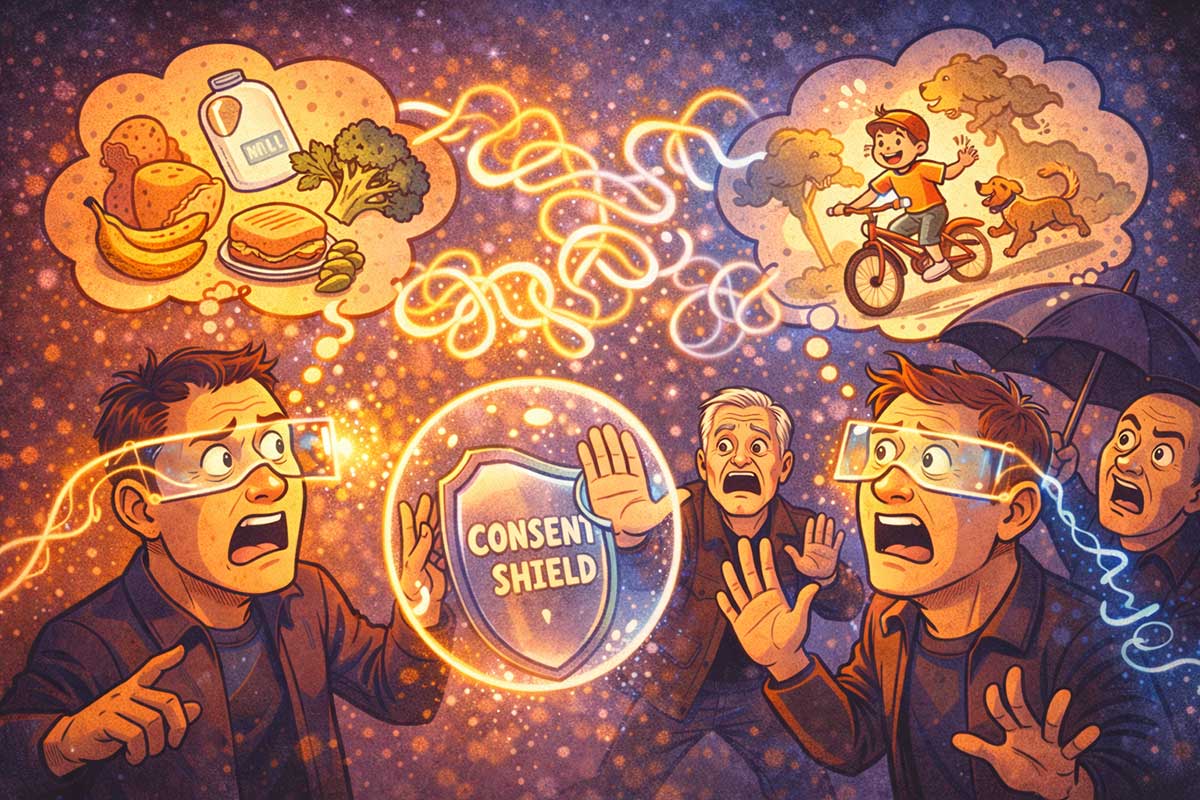
If ET exists and communication is already happening through channelers, then we’re not just talking about aliens.
We’re talking about a contact medium that runs through consciousness.
Which means Topic 3 isn’t “cool paranormal stuff.” It’s the most sensitive ethical question in the entire series:
If minds can connect, who decides what’s allowed?
Because the moment telepathy is even partially real, the whole human operating system needs an update. Privacy, autonomy, persuasion, trauma, even what it means to be an individual. And if we don’t face consent head-on, “contact” turns into influence, and influence turns into domination.
Tonight the room feels like a courtroom, but without the hostility. People are standing, spaced out, like they’re instinctively making room for invisible boundaries.
Conan O’Brien walks in holding his hands up like he’s entering airport security.
Conan O’Brien: Okay. Topic three. Telepathy and consent. Just so we’re clear, I can barely handle group texts. If beings can read thoughts, I’m done. I’m moving into the woods. No signal. Just squirrels judging me silently.
Five speakers step forward.
Two ET voices again:
Bashar, direct, confident, “here’s how it works.”
The Council of Nine, expansive, principle-driven, almost like a chorus of ethics.
And three human voices who can keep this grounded:
Christof Koch, consciousness researcher, focused on what can be known and how.
Judith Butler, philosopher of power and boundaries, alert to coercion and social control.
Thích Nhất Hạnh, because if anyone can talk about consent without it turning cold, it’s him.
Conan looks at them.
Conan O’Brien: First question. If telepathy or mind-to-mind connection is real, what are the ethical rules? What becomes non-negotiable?
Thích Nhất Hạnh: The first non-negotiable is compassion. Not as sentiment, as practice. If you can touch another person’s mind, you must be trained to touch gently. Most humans have not even learned to touch their own suffering gently. Without training, contact becomes violence, even when no harm is intended. The second non-negotiable is consent. You do not enter without invitation. And the third is mindfulness, the ability to recognize your own craving for control before it becomes action.
Judith Butler: Consent is essential, but it is complicated by power. When an asymmetry exists, “consent” can become coerced by social pressure, spiritual authority, or fear of exclusion. If ET communication becomes normalized, you’ll have hierarchies. Channelers with followings. Gatekeepers. Communities that punish dissent. Then consent becomes performative. A real ethic must include protections for those without power. It must include the right to refuse, to disengage, to remain private, to remain unknown.
Christof Koch: From a practical standpoint, we should separate the experience of connection from the interpretation of it. People can feel profoundly connected and still be wrong about what occurred. That’s not an insult. It’s a feature of consciousness. If we accept telepathy as possible, we need a framework similar to medical ethics: informed consent, minimal intrusion, transparency about methods, and oversight. Also, we must acknowledge uncertainty. We don’t fully understand consciousness. The more mysterious the channel, the greater the ethical caution required.
Bashar: We agree. Telepathic communication, in the form we refer to, is based on resonance. You tune to a frequency. You do not break in. You do not force. If a being is forcing, it is not operating in alignment. In healthy contact, boundaries are respected absolutely. Consent is the law. And we will add this: humans must learn the difference between excitement and obsession. Obsession is often a boundary violation dressed up as devotion.
The Council of Nine: Telepathy reveals what has always been true: intention matters. When minds connect, the invisible becomes visible. Therefore the first ethic is purity of intent, not in a moralistic sense, but in a functional sense. Are you seeking communion or control? Are you seeking understanding or leverage? Consent must be multi-layered: individual, communal, and contextual. And privacy becomes sacred. A civilization that cannot honor privacy cannot honor personhood.
Conan nods.
Conan O’Brien: Great. So the rules are basically: don’t break into someone’s head like you’re hacking their email. That seems… reasonable.
He pauses.
Conan O’Brien: Second question. If channeling is already happening, what are the main failure modes? Like how does this go wrong fast?
Christof Koch: Self-deception. People interpret internal imagery as external instruction. That can still be meaningful psychologically, but it becomes dangerous when it’s treated as infallible authority. Second, group reinforcement. A community repeats a narrative until it feels unquestionably real. Third, mental health vulnerability. Some people are prone to dissociation or delusion. A responsible culture creates support, not shame. If you mix altered states with social reward, you can generate false certainty quickly.
Judith Butler: Coercion through belonging. People will feel pressure to accept telepathic claims because refusal threatens their membership in the community. Also, moral blackmail. “If you were evolved, you would agree.” That is a form of violence. The other failure mode is exploitation. If the channel becomes a marketplace, then the incentive shifts from truth to retention. And retention is often driven by fear and escalation.
Bashar: The failure mode is turning contact into identity. “I am the channel.” “I am chosen.” “I have special access.” That creates hierarchy, and hierarchy invites distortion. Another failure mode is insisting the messages must be literal when they are often symbolic translations. Humans tend to flatten multi-dimensional information into simplistic certainty. That creates confusion, then conflict.
The Council of Nine: Another failure mode is polarization. People will classify: “true channelers” versus “false channelers,” “awake” versus “asleep.” Once you begin sorting human beings into spiritual castes, you have already left the path of contact and entered the path of domination. The unknown becomes a new reason to demean the known. That is a predictable human pattern.
Thích Nhất Hạnh: It goes wrong when you do not tend to fear. Fear makes you grasp. Fear makes you cling to certainty. Fear makes you push others away. When someone says, “I must know,” what they often mean is, “I cannot bear not knowing.” This suffering must be held gently. Otherwise it becomes harm.
Conan rubs his face.
Conan O’Brien: So basically, the failure mode is: humans. We take something potentially sacred and immediately turn it into a pyramid scheme of certainty.
He looks up.
Conan O’Brien: Third question. If telepathy is part of real contact, what should humans do right now to get ready ethically, without becoming paranoid?
Thích Nhất Hạnh: Train the mind. Meditation is not escape. It is education. Learn to recognize thoughts as thoughts. Learn to feel fear without obeying it. This is the foundation of consent, because consent requires presence. If you are not present, you cannot choose clearly.
Christof Koch: Create norms and research frameworks. Normalize reporting of anomalous experiences without ridicule. Encourage interdisciplinary study: neuroscience, psychology, philosophy, ethics, anthropology. If you treat this as taboo, it moves underground, and underground breeds extremism. Also, practice humility. When the mechanism is uncertain, your confidence should be proportionally modest.
Judith Butler: Build consent culture explicitly. Teach people the right to refuse spiritual influence, the right to step away, the right to privacy. Create accountability for those who claim authority. Also, remember that “connection” can be used as a weapon. People can claim telepathic knowledge to shame others. A society must protect individuals from unverifiable coercion.
Bashar: We would say: follow your highest excitement with integrity. Not obsession. Integrity means no harm, no manipulation, no coercion. If you cannot live that principle with humans, you are not prepared to live it with contact. Telepathy magnifies what is already present. Therefore, become coherent now.
The Council of Nine: And learn discernment without contempt. If you dismiss all claims, you close the door to learning. If you believe all claims, you open the door to exploitation. The middle path is wisdom. A contact-ready species learns to balance openness with boundaries, curiosity with ethics, wonder with responsibility.
Conan points at the air like he’s drawing a line.
Conan O’Brien: I’m hearing a theme: telepathy doesn’t just create a new ability. It creates a new responsibility. And if you don’t build consent culture now, telepathy becomes the ultimate tool of manipulation.
He looks around.
Conan O’Brien: Also, personal note, if telepathy becomes real, I’d like to formally apologize for every petty thought I’ve ever had in traffic.
He softens.
Conan O’Brien: But seriously. If contact is already happening through consciousness, then the first contact isn’t between species. It’s between your awareness and your impulses. Can you feel something and not act on it. Can you be curious without invading. Can you be connected without controlling.
He nods.
Conan O’Brien: Next topic is Disclosure as Storytelling. And now it’s not just about governments. It’s about how channeling, media, and human tribal instinct create a narrative war that can either stabilize society… or set it on fire.
Topic 4: Disclosure as Storytelling
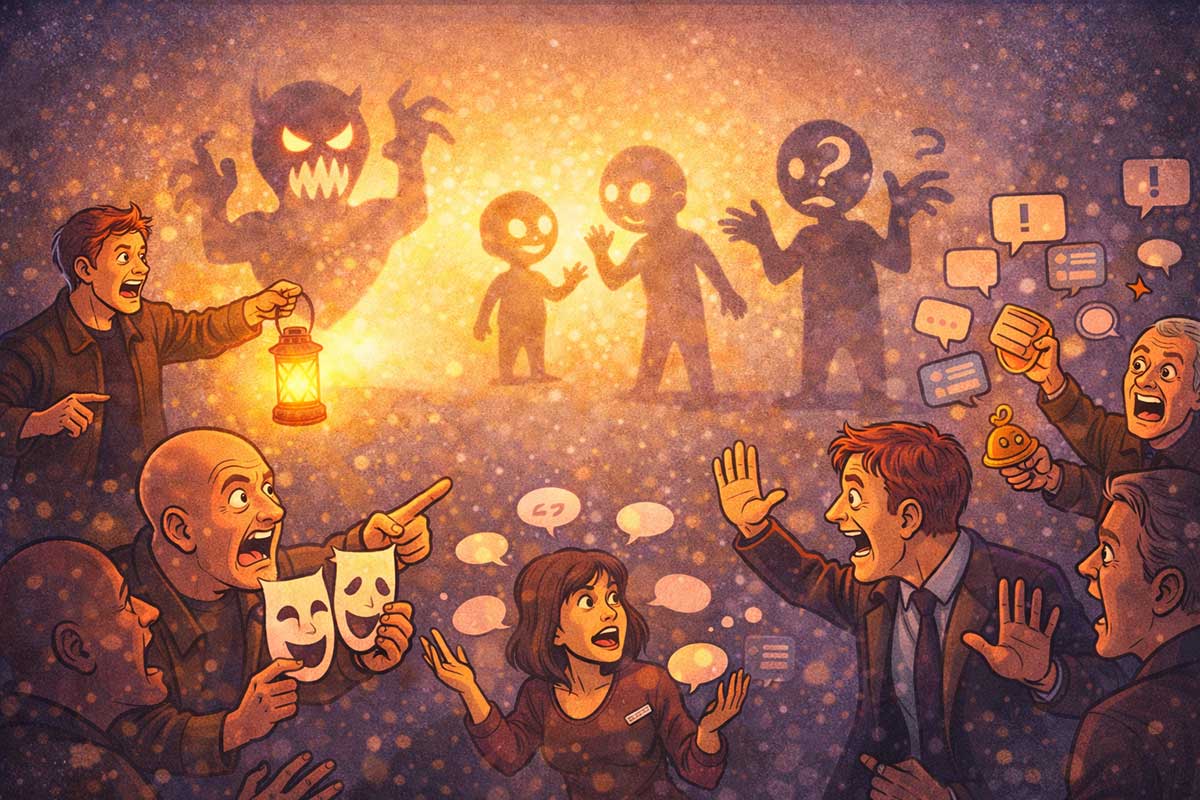
If ET exists and communication is already happening through channelers, then “disclosure” is not a single event.
It is a story war happening in real time.
Not just government files. Not just UFO videos. Not just one dramatic press conference with a podium and a nervous cough.
It is the messy human process of deciding what reality means, who gets to narrate it, and who profits from the narration.
Tonight the room feels like a live studio. Not because there are cameras, but because everyone can sense the same truth: the moment a society meets the unknown, it immediately turns it into content.
Conan O’Brien walks in holding two imaginary microphones like he is about to interview reality itself.
Conan O’Brien: Topic four. Disclosure as storytelling. Or as I call it, “humanity finds a way to turn cosmic mystery into a comment section.” If contact is already happening through consciousness, then disclosure is already happening through culture. Which means the story is the battlefield.
Five speakers step forward.
Two ET voices:
Kryon, gentle but sharp when it comes to human fear.
The Council of Nine, expansive, almost like a chorus that watches patterns across ages.
Three human minds built for media and myth:
Marshall McLuhan, who can explain why the medium rewires the mind.
Joseph Campbell, who understands how myths recruit people emotionally.
Shoshana Zuboff, who sees how systems monetize attention and behavior.
Conan points at the invisible “audience.”
Conan O’Brien: First question. If ET contact is already happening, what is the biggest storytelling mistake humans will make right away?
Marshall McLuhan: They will focus on the content and ignore the medium. People will argue about what was said, who said it, which channeler is real, which government leak is authentic, but the medium shaping the public is the real driver. Short clips, algorithmic feeds, outrage incentives. The form compresses nuance and rewards certainty. So the first mistake is thinking this is an information problem. It is a perception problem.
Joseph Campbell: Humans will force the unknown into familiar myth roles. Savior, invader, judge, trickster. Those roles are emotionally satisfying. They give people meaning quickly. But quick meaning is often inaccurate meaning. The biggest mistake is collapsing mystery into a simple plot. You get heroes and villains too fast. Then the public does not meet reality. It meets a movie inside its own mind.
Shoshana Zuboff: The biggest mistake is allowing the story to be captured by incentives. In an attention economy, the most profitable version of disclosure is not the truest. It is the version that drives engagement, fear, and dependency. If contact is real, the system will still treat it as fuel. The danger is not only misinformation. It is the industrial production of emotional manipulation.
Kryon: Humans will mistake adrenaline for truth. The loudest story will feel like the realest story. And because fear is magnetic, fear-based narratives will spread faster than steady ones. The mistake is letting the nervous system become the editor-in-chief.
The Council of Nine: The greatest mistake is fragmentation. The truth will be broken into tribes. Each tribe will hold a piece and declare it the whole. Then the story becomes identity. Identity becomes conflict. Conflict becomes a substitute for understanding. When this happens, disclosure is not revelation. It is division wearing a cosmic mask.
Conan nods like he’s reading a review of modern life.
Conan O’Brien: So basically, the biggest mistake is that we will treat disclosure like a streaming series and pick a team. “I’m on season two of the benevolent space brothers. You should try it.” Terrific.
He walks a slow circle, then stops.
Conan O’Brien: Second question. If this is a story war, who are the predictable gatekeepers? Not just governments. Who controls the narrative now?
Shoshana Zuboff: Platforms and data-driven systems. Whoever controls distribution controls reality for most people. You may think you are choosing what to believe, but what you see is curated by optimization toward profit. That creates a hidden governance. Then add monetization layers: subscriptions, courses, exclusive communities. The “gatekeeper” may be a charismatic personality, but the deeper gatekeeper is the system that rewards them.
Marshall McLuhan: The medium itself is the gatekeeper. A society that receives reality through fragmented signals becomes fragmented. The fight over disclosure will be shaped by the technologies that deliver it. In a print culture, you get argument. In a television culture, you get performance. In a social media culture, you get tribal signaling. The gatekeeper is not a person. It is a pattern.
Joseph Campbell: The gatekeepers are also the myth-makers, the ones who offer belonging. Humans will join the narrative that makes them feel heroic. “I am awake.” “I am chosen.” “I am resisting the lie.” The gatekeeper is the story that gives the ego a costume. That is why myths are powerful. They answer the question, “Who am I?” before they answer, “What is true?”
Kryon: Another gatekeeper is shame. People will be afraid to say, “I don’t know.” They will be punished for uncertainty. That drives false certainty. So the narrative becomes policed not only by power, but by social fear. If contact is real, you must allow people to learn slowly without humiliation.
The Council of Nine: And there are gatekeepers within the spiritual community. If channeling becomes central, there will be factions. “Only this channel is pure.” “Only this teaching is high vibration.” That is control disguised as enlightenment. The narrative becomes a territory. Humans defend territory.
Conan raises his hand.
Conan O’Brien: Okay, I can already see it. If aliens show up, we will have twelve competing podcasts claiming exclusive access by Friday.
He leans forward.
Conan O’Brien: Third question. What would responsible disclosure messaging look like? Like practical steps that reduce panic and reduce exploitation, without hiding the truth.
Marshall McLuhan: First, slow the medium. Reduce fragmentation. Long-form, context-rich communication. If you communicate through short bursts, you will create short-burst thinking. Second, establish trusted channels that are not driven by engagement. If you do not, the most extreme voices will fill the vacuum.
Shoshana Zuboff: Build transparency around incentives. If someone is monetizing contact narratives, disclose it plainly. If institutions are withholding, disclose the reason and the timeline. Create oversight. Create accountability. The goal is to prevent a market in fear. The public can handle uncertainty better than it can handle manipulation.
Joseph Campbell: Use myth responsibly. Do not pretend the story will not form. It will. So guide it toward humility. Frame contact as initiation, not conquest. If you give people a heroic role, make it the heroism of restraint, curiosity, and compassion. Teach them that the real adventure is becoming wise, not becoming special.
Kryon: Teach nervous system steadiness. Speak calmly. Encourage community conversation. Make room for both wonder and skepticism without ridicule. If people feel safe, they do not need to cling to extreme stories. Safety is the soil where discernment grows.
The Council of Nine: And protect personhood. Do not let disclosure become a justification for coercion, surveillance, or spiritual bullying. Make consent a public value. If contact is real and consciousness is part of it, then coercive storytelling is a violation of the very field through which contact occurs.
Conan holds up both hands.
Conan O’Brien: So the responsible version is: fewer jump scares, more context; fewer gurus, more transparency; fewer tribes, more humility; fewer dopamine hits, more steadiness. In other words, the opposite of the internet.
He pauses, then gets serious.
Conan O’Brien: Here’s what I’m realizing. If ET exists and channeling is real contact, then disclosure is not primarily a science problem or a government problem. It’s a storytelling problem. Because humans do not live inside raw facts. We live inside meaning.
He points at Campbell.
Conan O’Brien: Joseph, humans will demand a plot. What plot helps us not destroy ourselves?
Joseph Campbell: The plot of maturation. The hero is the one who refuses the easy villain. The hero is the one who can hold paradox. The treasure is not proof. The treasure is transformation.
Conan nods.
Conan O’Brien: Great. Next topic is the final moral test. And now it’s not about whether we might pass someday. It’s about whether we are already failing today by turning contact into spectacle, money, and power.
He looks around the room.
Conan O’Brien: Topic 5 is the sacred stranger. But in this version, the stranger is not coming. The stranger is already here. And we’re being graded in real time.
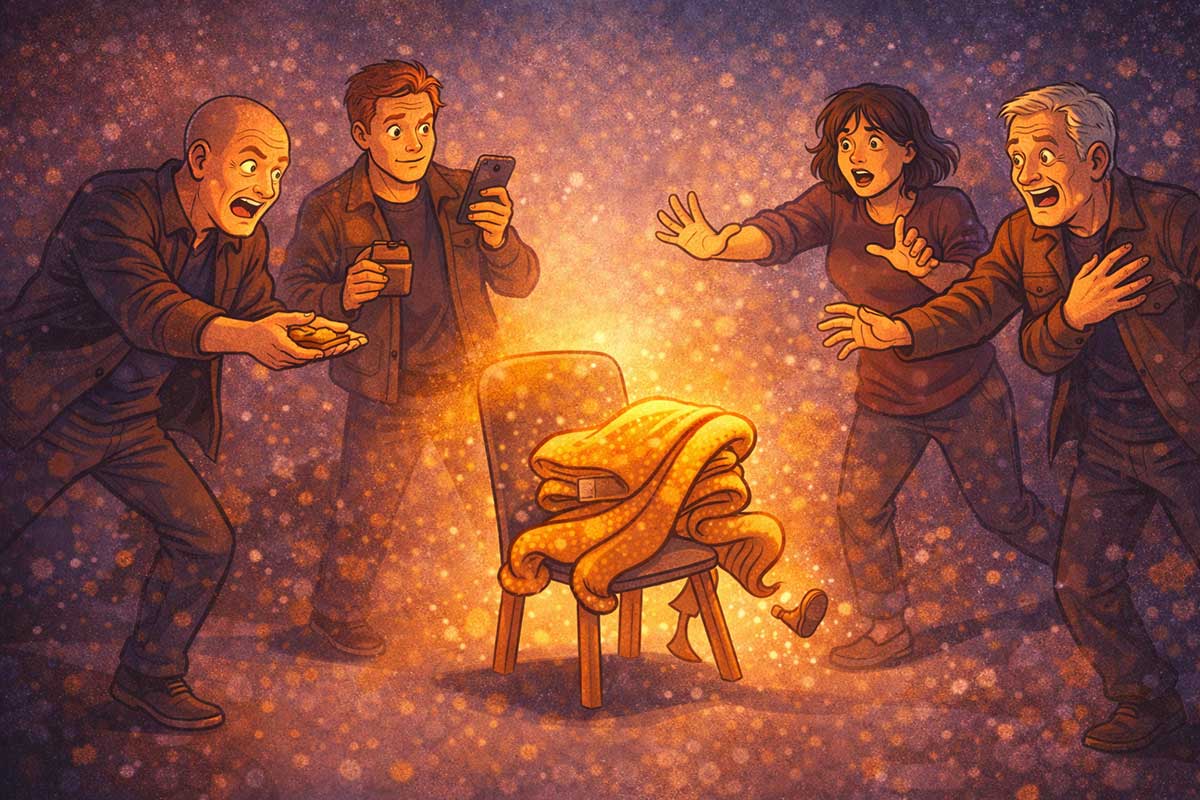
Topic 5: The Sacred Stranger Test
If ET exists and beings like Bashar are already speaking as ET, then the sacred stranger is not a future visitor.
The sacred stranger is already in the room.
Not necessarily as a body that landed on a lawn, but as a presence that has entered human culture through consciousness, story, longing, fear, and the strange human hunger to be chosen.
So Topic 5 is not “Would we welcome ET someday?”
It’s this:
If contact is already happening, are we meeting it with humility and ethics, or are we turning it into control, commerce, and tribal identity?
The room feels quiet now. Not dramatic quiet. The quiet you get right before someone tells the truth in a family meeting.
There are no chairs. Everyone is standing. In the center is an empty space, like a place reserved for someone who might be watching.
Conan O’Brien walks in slower than usual.
Conan O’Brien: Alright. Final topic. The moral test. And I’m going to say something that sounds ridiculous but is also painfully true. If ET contact is real, we are not being judged on our technology. We’re being judged on whether we can act like grown-ups.
He looks at the five speakers.
Two ET voices, but with very different energies.
Bashar, clear and direct.
Ra, calm and almost ritual in the way it speaks about free will.
And three humans who anchor this in ethics, compassion, and spiritual maturity:
Emmanuel Levinas, who treats “the Other” as an ethical command.
Desmond Tutu, who understands dignity and reconciliation.
Thích Nhất Hạnh, who knows fear up close and doesn’t flinch.
Conan takes a breath.
Conan O’Brien: First question. If ET is real and contact is already happening through channeling, what is the most likely way humans fail the moral test right now? Not later. Right now.
Emmanuel Levinas: You fail by turning the Other into an instrument. The moment you ask, “What can I get from this,” you have already begun the violation. The Other is not a resource. Not a brand. Not a proof object. Not a weapon in your argument. The ethical relation begins when you accept that the Other is beyond your possession. Humans will fail by trying to own what should only be met.
Desmond Tutu: We will fail by splitting into camps and then blessing ourselves for it. We’ll make “contact” a badge. “I’m awake.” “You’re asleep.” “I’m chosen.” “You’re deceived.” And then we’ll treat people badly and call it truth. That is always the tragedy. We use big ideas to justify small cruelty. If ET is real, the test is not whether we can talk about love. The test is whether we can be loving while we disagree.
Thích Nhất Hạnh: We fail when fear becomes the leader. Fear will disguise itself as responsibility. It will say, “We must protect ourselves.” But protection without mindfulness becomes aggression. You will fail the test when you speak to the unknown with a violent nervous system. Even if your words are polite, your body will shout fear. The first task is to calm the body. Peace is not decoration. It is the foundation.
Bashar: You will fail by insisting on certainty and specialness. Humans want the contact narrative to confirm their identity. They will say, “We are saved,” or “We are threatened,” or “We are chosen,” because those stories relieve the discomfort of not knowing. But the truth is not here to make you special. It is here to make you conscious. If contact becomes a hierarchy, you have already distorted it.
Ra: We would say you fail the test when you violate free will. This can happen through coercion and force, but also through manipulation. If a channeler claims authority that cannot be questioned, free will is constrained. If institutions hide the truth to maintain control, free will is constrained. If the public bullies skeptics or believers into silence, free will is constrained. Contact that leads to diminished free will is not contact aligned with service.
Conan nods slowly.
Conan O’Brien: So the most likely failure is: we treat it like a product, a weapon, a tribe, or a certainty machine. Which is basically… what we do with everything.
He rubs his hands together, like he’s bracing.
Conan O’Brien: Second question. If we take ET contact seriously, what ethical rules should apply to humans right now, in how we talk about it and build communities around it?
Thích Nhất Hạnh: Practice non-harm in speech. Do not spread fear as entertainment. Do not mock those who are overwhelmed. A community that cannot be kind will become a weapon. Also, protect silence. Not everything must be shared. Not every experience must be public. The unknown needs space.
Desmond Tutu: Dignity is the rule. If someone has an experience, do not exploit them. Do not turn them into a circus. Do not make them a symbol. And also, do not make yourself the judge of their worth. If we cannot treat one another with dignity, we cannot pretend we will treat a visitor with dignity. The moral test begins with the person in front of you.
Emmanuel Levinas: The rule is responsibility without possession. You may seek understanding, but you may not devour the Other in the name of understanding. Communities must be designed to prevent domination. That means the leader must be accountable. It means the seeker must remain free to refuse. It means no one may claim ownership of truth as a way to control others.
Ra: We would name three principles. First, honor free will. Second, pursue balance, not fanaticism. Third, recognize that catalyst is offered to you so you may grow, not so you may control others. A responsible community does not demand belief. It invites exploration. It does not punish questions. It welcomes them.
Bashar: And we add this: integrity. If you monetize, be transparent. If you lead, be humble. If you teach, encourage sovereignty. If your community requires dependency, it is not aligned. If your message produces fear and separation, step back. The sacred is recognized by what it produces.
Conan exhales.
Conan O’Brien: So the ethics are basically: no spiritual bullying, no certainty cults, no fear marketing, and no treating people like props. Again, please forward this to the internet.
He points to the empty center space.
Conan O’Brien: Third question. What does “passing the test” look like in real-world actions, in the next year, if contact continues through channeling and other signs? Like, what can we actually do?
Ra: Create structures that protect free will. Encourage transparency. Resist secrecy that concentrates power. Resist movements that demand devotion. Make space for both belief and skepticism. The point is not agreement. The point is a society that can hold mystery without coercion.
Thích Nhất Hạnh: Teach calm. Teach mindful breathing. Teach how to meet uncertainty with gentleness. If people learn to meet fear without obeying it, they will not need to scapegoat. This is not small. This is civilization work.
Desmond Tutu: Practice reconciliation before you need it. Because contact will amplify whatever we already are. If we are a people of suspicion, contact becomes another reason to hate. If we are a people of forgiveness, contact becomes a reason to grow. Pass the test by becoming the kind of world a gentle visitor would not regret meeting.
Emmanuel Levinas: Pass the test by refusing to reduce anyone, human or nonhuman, to an object. Not even in your mind. Especially in your mind. Because the moment you decide another being exists to serve you, you have already built the machinery of violence.
Bashar: And we say: embody the frequency you wish to meet. If you want benevolent contact, become benevolent. If you want respectful contact, become respectful. Your collective experience will reflect your collective state. This is not punishment. It is resonance.
Conan stands still for a moment, unusually quiet.
Conan O’Brien: This is going to sound like a joke, but it’s not. If ET is real and already communicating, then the cosmic question is not “Are we alone?” It’s “Are we decent?”
He gestures to the empty space again.
Conan O’Brien: Because the sacred stranger test isn’t only about aliens. It’s about anyone we don’t understand. It’s about the person we’ve labeled. The person we’ve mocked. The person we’ve made into a category so we don’t have to feel their humanity.
He looks at the group.
Conan O’Brien: If we want to be ready for contact, we don’t start by building better telescopes. We start by building a better nervous system. A better culture. A better set of habits around humility and truth.
He smiles, soft.
Conan O’Brien: And if a real ET is watching this, I’d like to formally say: we are trying. We are chaotic. We are emotional. We have a lot of paperwork. But we are trying.
Nobody claps. It doesn’t feel like that kind of ending.
It feels like a beginning that demands responsibility.
Final Thoughts by Conan O’Brien
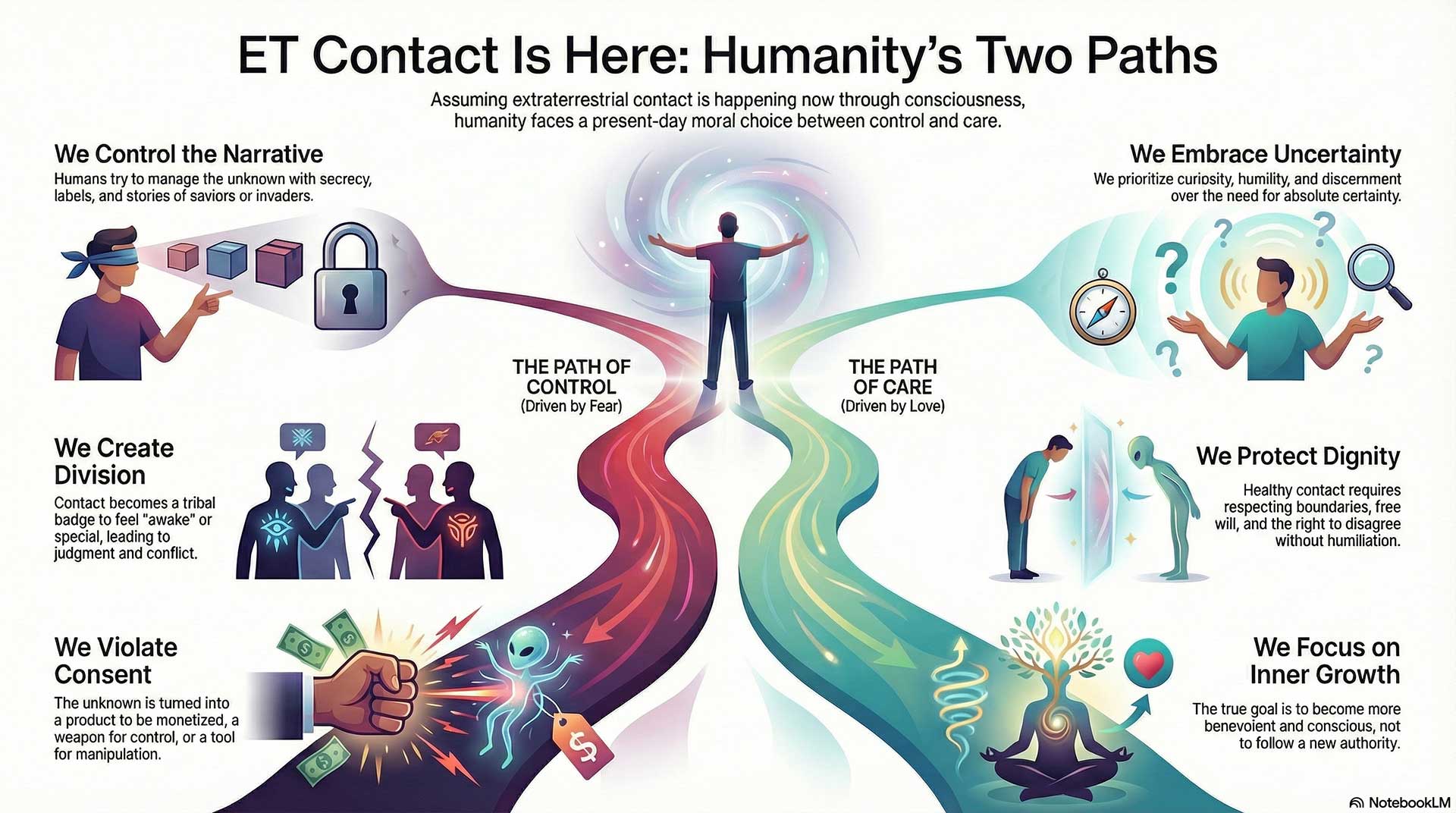
If you take the premise seriously, that ET exists and contact is already happening through consciousness, then the ending of E.T. stops being just a tearjerker goodbye. It becomes a quiet warning.
Because E.T. doesn’t defeat anyone. He doesn’t conquer. He doesn’t even argue. He just shows up vulnerable, confused, and oddly gentle. And our species immediately splits into two instincts: the instinct to care and the instinct to control. That’s the entire movie. That’s also basically the entire internet.
Here’s what I keep coming back to. Humans are weirdly prepared for threats. We’ve rehearsed threats for centuries. We have uniforms and budgets and speeches and emergency plans for threats. But we are not practiced at meeting the unknown with dignity. We’re not practiced at holding mystery without turning it into a product, a tribe, a religion, a panic festival, or a weapon to use against each other.
So if contact is already happening, then “disclosure” isn’t just a government press conference someday. It’s happening right now in how we treat each other. Do we shame people for asking questions? Do we reward the loudest certainty? Do we monetize fear? Do we build identity around being “more awake” than everyone else? That’s not readiness. That’s just control wearing spiritual clothes.
Passing the sacred stranger test, in the end, is painfully simple and incredibly hard: keep your humanity when you’re scared. Protect dignity. Respect consent. Admit uncertainty without contempt. Refuse the cheap thrill of demonizing people who disagree. And maybe, just maybe, become the kind of civilization that a gentle visitor wouldn’t regret meeting.
And if some real ET is watching, I’d like to say this: we’re a work in progress. We’re emotional. We panic. We make everything a storyline. But some of us are trying to choose love over control. Even when we’re confused. Especially when we’re confused.
Short Bios:
Conan O’Brien is an American comedian, writer, and broadcaster known for fast improvisation, self-aware humor, and hosting across late-night TV, podcasts, and travel comedy.
Carl Jung was a Swiss psychiatrist who founded analytical psychology and introduced concepts like archetypes, the collective unconscious, and projection as a way humans externalize inner conflicts.
Carl Sagan was an American astronomer and science communicator who championed skeptical inquiry, public science education, and the scientific search for extraterrestrial life.
Steven Spielberg is an American film director and producer whose work often explores wonder, fear, and human connection, including E.T., shaped by themes of childhood loneliness and empathy.
Bashar is a channeled entity persona presented by Darryl Anka, known for teachings about belief systems, vibration, and “following your highest excitement.”
Kryon is a channeled entity persona presented by Lee Carroll, commonly framed around compassion, spiritual growth, and humanity’s evolving consciousness.
Hannah Arendt was a political theorist whose work examined power, authority, totalitarianism, and how systems normalize harm through bureaucracy and social pressure.
Brené Brown is a research professor and author known for work on vulnerability, shame resilience, courage, and the difference between connection and armor.
Jane Goodall is a primatologist and conservationist whose groundbreaking chimpanzee research reshaped how humans understand intelligence, empathy, and trust in other beings.
Abraham is a channeled collective presented by Esther Hicks, centered on emotional guidance, alignment, and creating experience through focus and belief.
Barbara Marciniak is an author and channeler associated with “Pleiadian” teachings, often emphasizing spiritual empowerment, perception, and humanity’s evolving awareness.
Christof Koch is a neuroscientist known for research on consciousness and efforts to link subjective experience to measurable brain processes.
Lisa Feldman Barrett is a psychologist and neuroscientist known for the theory of constructed emotion, arguing emotions are created by the brain through prediction and context.
Shoshana Zuboff is a scholar and author known for defining “surveillance capitalism,” focusing on how institutions extract, predict, and monetize human behavior.
Seth is a channeled entity persona presented through Jane Roberts, exploring consciousness, personal reality, and the relationship between belief and experience.
The Council of Nine is a long-running channeled “collective” concept in modern metaphysical circles, typically framed as guidance-oriented teachings about consciousness and evolution.
Joseph Campbell was a mythologist best known for the monomyth or “hero’s journey,” explaining how shared story structures shape culture, meaning, and transformation.
Marshall McLuhan was a media theorist famous for “the medium is the message,” arguing that communication technologies reshape perception, society, and power.
Crisis communications strategist refers to a professional discipline focused on guiding organizations through high-stakes public events using clarity, timing, transparency, and trust preservation.
Ra is the channeled voice from The Law of One material, associated with L L Research, emphasizing free will, polarity, spiritual evolution, and service.
The Arcturians are a commonly referenced channeled “ET” group in contemporary channeling culture, typically framed around guidance, clarity, and higher-consciousness themes.
Emmanuel Levinas was a philosopher whose ethics centers on the face-to-face encounter with the Other, arguing responsibility precedes ideology and self-interest.
Desmond Tutu was an Anglican archbishop and anti-apartheid leader who advocated forgiveness, reconciliation, and ubuntu, and chaired South Africa’s Truth and Reconciliation Commission.
Thích Nhất Hạnh was a Vietnamese Zen teacher and peace activist who popularized mindfulness practice in the West and taught compassion, interbeing, and nonreactive presence.
Paul Selig’s Guides are the channeled voices in Paul Selig’s books, focused on themes of spiritual growth, integrity, and moving beyond fear-based identity.
Leave a Reply