
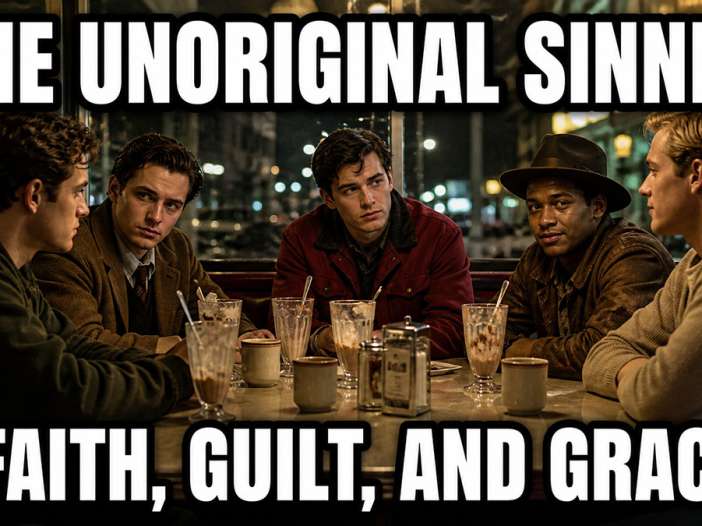
What if Tim Conroy and literature’s most restless young voices confronted the shame behind growing up?
Some conversations don’t begin with answers.
They begin with discomfort.
Five young men meet in a quiet Chicago diner—each carrying a different kind of wound.
Tim Conroy brings confusion shaped by faith and failure.
Holden Caulfield carries sharp disgust toward anything false.
Stephen Dedalus wrestles with intellect, identity, and religious pressure.
Huckleberry Finn trusts a simple inner compass over society’s rules.
Alyosha Karamazov holds a quiet, steady faith rooted in compassion.
They are not here to agree.
They are here because something in each of them refuses to settle for a shallow life.
Across melted ice cream and late-night coffee, they ask what it means to grow up without becoming fake… to face guilt without being crushed by it… to laugh without losing sincerity… to rethink God without losing truth… and to live with failure without becoming numb.
No one at the table is finished.
That is why the conversation matters.
(Note: This is an imaginary conversation, a creative exploration of an idea, and not a real speech or event.)
Topic 1: Growing Up Without Becoming Fake

The diner is quiet except for the low hum of a refrigerator and the soft clink of spoons against glass. Outside, Chicago glows in the distance. Inside, five young men sit around a table, half-finished ice cream melting in front of them.
Tim leans back, staring at the ceiling.
Tim Conroy:
You ever notice how nobody plans to become fake? It just… happens. One compromise, then another, and next thing you know, you’re saying things you don’t believe to people you don’t even like.
Holden Caulfield:
That’s all anybody does. The whole world is full of phonies. You get older, you either join them or you get crushed trying not to.
Huckleberry Finn:
I don’t know about all that. Seems to me folks just get told what’s right so many times they stop asking if it really is. I tried doing what people said was right once… felt wrong as anything.
Stephen Dedalus:
You speak of it as though it were accidental. It is not. It is systematic. Family, church, nation—they shape you long before you know you are being shaped. By the time you resist, you are already speaking their language.
Holden:
Yeah, and that language is mostly garbage.
Tim:
So what are you supposed to do? Walk away from everything? That sounds noble for about five minutes. Then you’ve got no job, no direction… nothing.
Stephen:
Better nothing than a life constructed from falsehood.
Huck (shrugs):
Depends what you call false. I ain’t got big ideas like you, but I know this—when I was told to turn Jim in, that was “right.” And I decided I’d go to hell instead. Felt better than doing what they said.
Holden looks at Huck, surprised for a moment.
Holden:
That’s the kind of thing people don’t do anymore. They just talk about it. Or write essays about it.
Tim (half-smiling):
Yeah, well, essays are safer than hell.
A quiet voice enters, steady and calm.
Alyosha Karamazov:
Perhaps the question is not whether you become part of the world, but what you bring into it. You cannot avoid living among others. The danger is not participation—it is forgetting your heart while you participate.
Stephen (leaning forward):
And how do you propose one remembers it? The pressures are constant. The expectations relentless.
Alyosha:
By refusing small lies. Not only the large ones. The small ones are what change a person.
Holden:
That’s the problem. You can’t even get through a normal conversation without lying a little. You say “nice to meet you” when it isn’t. You say “I’m fine” when you’re not. It’s all fake.
Tim:
So what, we’re supposed to go around telling the truth all the time? That sounds like a good way to lose every friend you have.
Huck (grinning):
Might help you find the real ones though.
Tim lets that sit for a second.
Tim:
Yeah… but what if there aren’t that many real ones?
Silence hangs for a moment.
Stephen:
Then you must become one yourself, even if you stand alone.
Holden (quietly now):
That’s easy to say. It’s lonely as hell actually doing it.
Alyosha:
Yes. It is lonely. But loneliness is not the same as emptiness. A person can be alone and still be full of love. What makes one empty is pretending.
Tim (softly):
So you’re saying the real danger isn’t failing… it’s pretending you didn’t?
Alyosha:
Something like that.
Holden stirs his melted ice cream.
Holden:
I just don’t want to wake up one day and realize I turned into one of those guys I can’t stand.
Huck:
Then don’t. Ain’t nobody forcing you.
Stephen:
That is naive. Forces are everywhere.
Huck:
Maybe. But there’s always that moment where you decide anyway.
Tim looks around the table.
Tim:
So growing up isn’t about having it figured out…
Holden:
Nope.
Stephen:
Certainly not.
Huck:
Not even close.
Alyosha (gently):
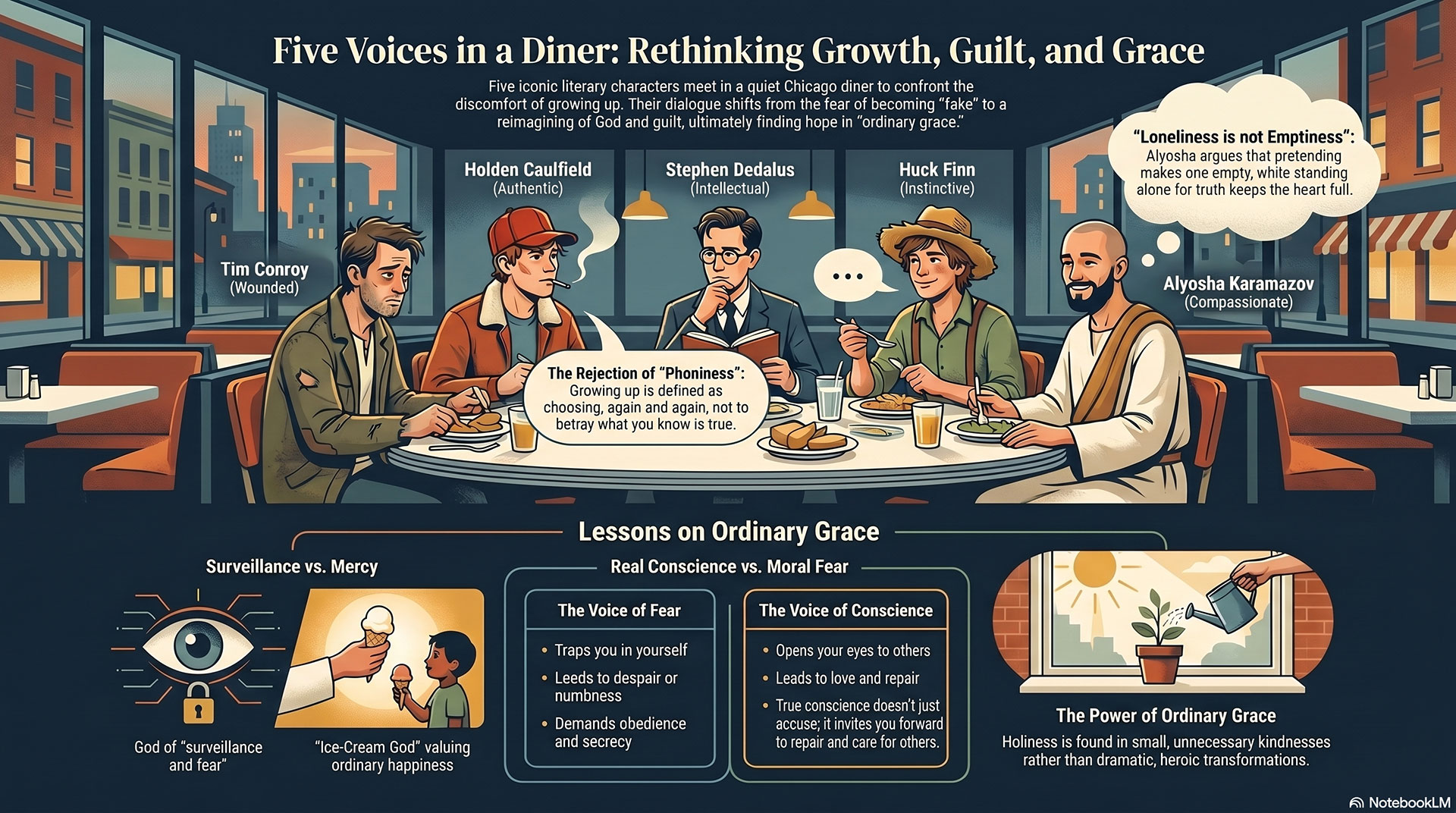
It is about choosing, again and again, not to betray what you know is true.
Tim exhales, almost relieved.
Tim:
That sounds harder than I hoped… but better than what I was afraid of.
No one laughs this time. But something settles.
Outside, the city keeps moving. Inside, five young men sit a little more honestly than before.
Topic 2: Catholic Guilt, Moral Fear, and Real Conscience

The diner is quieter now. The plates are mostly empty. Someone ordered coffee. The sweetness of melted ice cream has given way to something heavier.
Tim stares into his cup.
Tim Conroy:
You ever feel like you’re guilty before you even do anything? Like you’re already on the hook just for being… you?
Stephen Dedalus (without hesitation):
Yes. That is precisely how it begins. The soul is shaped to feel watched, judged, measured. Before action, there is already fear.
Holden Caulfield:
That’s what kills me about religion sometimes. It’s like they want you to feel lousy all the time. Like if you’re not miserable, you’re doing something wrong.
Tim:
Exactly. You start wondering—am I actually a bad person, or was I just trained to feel like one?
Huckleberry Finn:
I don’t know about all that training, but I remember feeling bad for helping Jim. Real bad. Like I was doing something terrible. And I couldn’t figure why, ’cause it didn’t feel wrong inside.
Stephen (turning to Huck):
That is the conflict. The voice imposed upon you versus the voice within you.
Huck:
Yeah. Took me a while, but I figured I’d stick with the one that didn’t make me feel like a coward.
Holden (leaning in):
See, that’s the part nobody explains. How do you know which voice is real? They all sound serious. They all sound like they’re right.
Tim nods slowly.
Tim:
Yeah… one voice says, “You’re selfish.” Another says, “You’re human.” One says, “You failed.” Another says, “Try again.” Which one’s God? Which one’s just… noise?
Alyosha folds his hands, thinking carefully.
Alyosha Karamazov:
A true voice of conscience does not only accuse. It also invites. It shows you what is wrong, but it does not leave you there. It calls you forward.
Stephen:
And what of fear? Fear has been the primary instrument of instruction. Hell, punishment, eternal loss.
Alyosha:
Fear may awaken a person for a moment. But it cannot guide a life. A conscience ruled only by fear becomes either crushed… or numb.
Holden:
Yeah, that’s it. People either feel everything and hate themselves, or they stop feeling anything at all.
Tim:
I think I’ve been both.
There’s a pause. No one interrupts.
Huck:
Seems to me if something makes you smaller, scared all the time… that ain’t helping you much. When I decided to help Jim, I thought I was going to hell—but I didn’t feel smaller. I felt… straighter, somehow.
Stephen (quietly):
Straighter.
Tim:
That’s a good word for it.
Holden:
So maybe guilt isn’t the problem… maybe it’s the kind of guilt.
Alyosha (nodding):
Yes. There is a guilt that traps you in yourself. And there is a guilt that opens your eyes to others. One leads to despair. The other leads to love.
Stephen:
But how does one distinguish them in practice? When one has been trained from childhood to fear, to confess, to doubt oneself?
Alyosha:
By what it produces in you. Does it make you hide? Or does it move you to repair, to care, to become more honest?
Tim:
So real conscience doesn’t just say, “You’re wrong”… it says, “Now go make it right.”
Holden:
That sounds a lot better than just sitting around feeling lousy all day.
Huck (smirking):
Yeah, feeling lousy don’t fix much.
Stephen (after a long pause):
Then perhaps the tragedy is not that we were taught guilt… but that we were not taught what to do after it.
No one speaks right away.
Tim looks down at his hands.
Tim:
You know what scares me?
Not that I’ll do something wrong… but that I won’t even know what “right” feels like anymore.
Alyosha looks at him, steady.
Alyosha:
If you still fear that, you have not lost it.
Tim lets out a slow breath.
Tim:
I hope you’re right.
The coffee has gone cold. But something in the room feels a little clearer, even if nothing is fully resolved.
Topic 3: Humor as a Defense Against Pain

The waitress passes by and leaves the check upside down on the table, as if even she knows nobody is ready to leave.
Tim picks it up, looks at the total, and laughs.
Tim Conroy:
There it is. Proof of sin. Five guys talk about God and guilt, and the bill still comes.
Holden Caulfield:
That’s about the only honest thing in this place.
Huckleberry Finn:
Ice cream costs more when folks get philosophical.
Tim:
That’s the first thing they should teach in school.
Stephen does not smile, but his eyes soften.
Stephen Dedalus:
Humor is often rebellion in disguise.
Holden:
Or disgust. Mostly disgust.
Tim:
Or panic with better timing.
Huck laughs.
Huck:
That sounds about right.
Alyosha Karamazov:
It can be mercy too.
Holden looks at him.
Holden:
Mercy? A joke?
Alyosha:
Yes. Sometimes laughter lets a wounded person breathe again.
Tim taps his spoon against the glass.
Tim:
That’s what I like about it. You can say something terrible, but if it’s funny, people let you live.
Stephen:
But do they hear you?
Tim pauses.
Tim:
Sometimes. Sometimes they only laugh, and you feel worse.
Holden:
That’s the worst. You say something real, everyone laughs, then you’re more alone than before.
Huck:
Maybe that depends on who’s laughing.
Tim:
Exactly. There’s laughing with you, and then there’s laughing so nobody has to care.
Alyosha nods.
Alyosha:
Laughter without love becomes cruelty. Laughter with love becomes shelter.
Stephen:
A clean distinction. Yet life rarely offers clean distinctions.
Tim:
No, but you can feel the difference. When someone makes a joke and suddenly the room feels warmer, that’s one thing. When someone makes a joke and somebody disappears inside himself, that’s another.
Holden stares at the melting ice cream.
Holden:
Most jokes at school were the second kind.
Huck:
Folks laughing at somebody weaker?
Holden:
Yeah. Or stranger. Or sadder. Then everybody pretends it’s harmless.
Tim:
That’s the great thing about “just kidding.” It’s the perfect hiding place for being rotten.
Stephen:
Then comedy too has its moral burden.
Tim:
Wonderful. One more thing to feel guilty about.
Huck grins.
Huck:
You’re pretty good at that.
Tim:
Catholic upbringing. Lifetime warranty.
For once, Stephen laughs quietly.
Stephen:
That is not without accuracy.
The small laughter fades, but it does not leave the room empty.
Alyosha:
Perhaps the question is whether humor protects the heart or hardens it.
Holden:
Mine probably does both.
Tim:
Same.
Huck:
Maybe that means you still got one.
Holden looks at Huck, caught off guard.
Holden:
That was either very wise or very annoying.
Huck:
Could be both.
Tim laughs, but softer this time.
Tim:
I think I joke so nobody notices how scared I am.
Stephen:
And yet you just told us.
Tim:
Yeah. Accidentally.
Alyosha:
Not accidentally.
Tim looks at him.
Alyosha:
A joke opened the door. Then truth walked through.
The table goes quiet again.
Holden:
So humor isn’t the enemy.
Stephen:
No. Evasion is.
Huck:
And meanness.
Tim:
And pretending nothing hurts.
Alyosha smiles faintly.
Alyosha:
Then good humor does not deny pain. It refuses to let pain become the whole story.
Tim looks at the empty dishes, the check, the cold coffee, the tired faces around him.
Tim:
So maybe the best joke is the one that keeps you human.
Holden:
That’s a pretty corny ending.
Tim:
I know.
Huck:
Still true, though.
No one argues.
For a moment, the diner feels lighter—not happy exactly, but less afraid of sadness.
Topic 4: The God We Were Taught vs. the God We Need

The diner lights flicker once, then settle. Outside, a bus sighs at the curb and pulls away into the dark.
Tim watches it go.
Tim Conroy:
You ever think maybe the problem isn’t God… but the version of God we were handed?
Stephen Dedalus:
Constantly. The God of childhood was not given to me as mystery. He was given as surveillance.
Holden Caulfield:
That’s exactly it. Like some old man in the sky keeping score.
Huck Finn:
I never understood why folks talk about God so mean. Like He’s just waiting for you to mess up.
Tim:
That was kind of the sales pitch where I came from.
Stephen:
Fear first. Wonder later, if at all.
Alyosha looks down at his hands.
Alyosha Karamazov:
A frightened image of God often creates frightened people.
Holden:
Or fake people.
Tim:
Or funny people who are secretly terrified.
Huck:
Or folks who do wrong and call it religion.
That lands hard. No one rushes past it.
Stephen:
Then what is left? If we reject the God of fear, are we rejecting God—or merely an idol?
Alyosha:
Perhaps an idol. A cruel image made from human fear is still a human image.
Holden:
That sounds nice, but how do you know the kinder version isn’t made up too?
Alyosha:
I do not always know. I trust love more than fear.
Stephen:
Trust is not proof.
Alyosha:
No. But neither is terror.
Tim looks at Alyosha with tired interest.
Tim:
So your God isn’t the one who catches you doing something wrong?
Alyosha:
He sees wrong, yes. But not as a policeman sees it. More like a father who grieves what wounds his child.
Holden:
I hate when people talk like that. Then sometimes I don’t.
Huck:
I like it better than the other one.
Stephen:
The difficulty is that one cannot simply replace one inheritance with another. The old image remains in the nerves.
Tim:
Yeah. That’s what nobody gets. You can stop believing something in your head, but your stomach still believes it.
Holden:
Exactly. Your stomach is religious as hell.
Huck laughs.
Huck:
Never heard it put that way.
Tim:
That’s theology where I come from.
Alyosha smiles, but his face stays serious.
Alyosha:
Then perhaps healing means teaching the body not to fear God.
Stephen:
And how is that done?
Alyosha:
Through mercy. Repeated mercy. Given and received.
Tim taps the table.
Tim:
That sounds too simple.
Alyosha:
Most deep things do.
Holden:
I don’t know. I still don’t trust religious people when they talk about mercy. They say mercy, then judge you five minutes later.
Huck:
Maybe mercy ain’t something to talk about too much. Maybe you just do it.
Stephen:
Action over doctrine.
Tim:
That sounds like Huck’s whole religion.
Huck:
Could be worse.
Alyosha:
It may be closer to God than many speeches about God.
Stephen studies Huck.
Stephen:
You follow conscience without metaphysics.
Huck:
I don’t know what that means, but maybe.
Holden:
It means you’re the least annoying person here.
Tim:
High praise from Holden.
Holden shrugs, embarrassed by his own softness.
Tim:
Maybe the God we need isn’t easier. Maybe He’s harder.
Stephen:
How so?
Tim:
The scary God lets you stay a child. Obey, confess, be afraid, repeat. A loving God might actually expect you to become honest.
Alyosha:
Yes.
Huck:
And kind.
Holden:
And not phony.
Stephen:
And free.
Tim looks at the melted ice cream in the glass dish.
Tim:
Maybe that’s why I like the idea of an ice-cream God.
Holden:
That sounds ridiculous.
Tim:
I know. But listen. Not a soft God. Not a stupid God. Just… a God who isn’t offended by ordinary happiness. A God who can sit with messed-up people in a diner and not be disgusted by them.
Alyosha’s expression changes, almost tender.
Alyosha:
That may not be ridiculous at all.
Stephen:
It is a rebellion against severity.
Huck:
Sounds like company.
Holden:
Sounds better than most sermons.
Tim smiles faintly.
Tim:
Then maybe the God we were taught was too small.
The table goes quiet.
Not empty quiet. Listening quiet.
Alyosha finally speaks.
Alyosha:
If God is real, He is not less merciful than the best mercy we have known.
Stephen looks away, unsettled but not dismissive.
Holden keeps staring at the table.
Huck finishes the last bite of ice cream.
Tim watches them all and feels, for once, that the word God has become less heavy in his mouth.
Topic 5: Ordinary Sin, Ordinary Grace

The diner is almost empty now. Chairs have been turned upside down on distant tables. The waitress wipes the counter slowly, giving them the mercy of not asking them to leave yet.
Tim looks at the empty ice-cream dish.
Tim Conroy:
You know what bothers me? I’m not even original in the ways I mess up.
Holden Caulfield:
That’s a cheerful thought.
Tim:
No, really. I used to think sin would be dramatic. Big temptation. Big fall. Thunder. Lightning. Something biblical. But most of the time it’s just being selfish when I could’ve been kind. Lying because truth would be uncomfortable. Acting brave when I’m scared.
Huck Finn:
That sounds like most folks.
Tim:
Exactly. I’m not a tragic sinner. I’m ordinary.
Stephen Dedalus:
Perhaps that is the deeper humiliation. Not wicked grandeur, but repetition. The same small betrayals.
Holden:
People act like they’re complicated, but half the time they’re just scared and lousy.
Alyosha Karamazov:
And still loved.
Holden glances at him.
Holden:
You always do that.
Alyosha:
Do what?
Holden:
Make it harder to hate everybody.
Huck grins.
Huck:
That is kind of annoying.
Tim smiles, then looks serious again.
Tim:
But what does grace actually mean if nobody changes? I mean, if I keep making the same mistakes, is grace just God looking the other way?
Alyosha:
No. Grace is not pretending wrong is harmless. Grace is being called back after wrong has harmed you and others.
Stephen:
A return, then.
Alyosha:
Yes. Again and again.
Tim:
That sounds exhausting.
Huck:
Better than being left out there alone.
Holden:
I hate that he’s right.
Stephen:
The difficulty remains: how does one accept mercy without becoming morally lazy?
Alyosha:
By receiving it as responsibility, not escape.
Tim leans forward.
Tim:
So grace says, “You’re forgiven, now go become less cruel.”
Alyosha:
Yes. Less cruel. More truthful. More capable of love.
Holden:
That’s the part nobody wants. Everybody wants to be forgiven. Nobody wants to become less of a jerk.
Huck:
Some folks do.
Holden:
Name three.
Huck:
I don’t know three. But I figure one is enough to prove it can happen.
Stephen watches Huck closely.
Stephen:
You possess a strange faith for one so suspicious of civilization.
Huck:
Maybe I trust people better one at a time.
Tim taps the table lightly.
Tim:
That may be the only way to trust them.
The waitress walks past and refills Tim’s coffee without asking. It is late. He does not need more coffee. She gives it anyway.
Tim looks at the cup.
Tim:
See, that’s the kind of thing I mean.
Holden:
Coffee?
Tim:
No. That little unnecessary kindness. She didn’t have to do it. We’ve been sitting here talking like depressed philosophers for two hours, and she still gives us coffee.
Huck:
Maybe that’s grace.
Stephen:
Grace as surplus kindness.
Alyosha:
Yes. The gift beyond what was required.
Holden looks toward the counter.
Holden:
That’s better than most religious definitions.
Tim:
Maybe religion should start there. Not with terror. Not with pretending. Just somebody giving a little more than the world demanded.
Alyosha’s face softens.
Alyosha:
That is close to the Kingdom of God.
Stephen does not argue. Holden does not joke.
Tim looks at each of them.
Tim:
So the conclusion is what? We’re all ordinary sinners, but we’re not doomed to become ordinary cowards?
Huck:
Sounds right.
Stephen:
We are shaped, but not imprisoned.
Holden:
We’re phonies sometimes, but we can still hate phoniness enough to stop.
Alyosha:
We fall, but we are called back toward love.
Tim nods slowly.
Tim:
Then maybe holiness isn’t being untouched by sin.
Alyosha:
No.
Tim:
Maybe it’s being touched by mercy enough times that you finally start passing it on.
No one speaks for a long moment.
Then Huck reaches for the check.
Huck:
I’ll pay my part.
Holden:
With what money?
Huck:
I didn’t say I had it. I said I’d pay it.
Tim laughs first. Then Holden. Then Stephen, reluctantly. Alyosha smiles.
The laughter does not erase anything. But it keeps the room human.
Outside, Chicago waits with all its small compromises, all its lies, all its ordinary chances to do better.
Tim stands, slips a few extra dollars under the coffee cup, and looks once more at the table.
Tim Conroy:
Maybe that’s enough for tonight.
And for once, no one corrects him.
Final Thoughts
They do not solve life.
No one walks out of the diner transformed into a saint.
No one finds a perfect definition of God, or a clean escape from guilt, or a permanent cure for hypocrisy.
But something shifts.
They begin to see that growing up is not about becoming flawless.
It is about becoming honest enough to recognize when they are not.
They realize that guilt can either trap a person in fear or guide a person back toward love.
That humor can hide pain, or gently reveal it.
That the image of God matters—not as doctrine, but as something that shapes how a person lives and treats others.
And perhaps most quietly important of all:
They begin to believe that ordinary people—people who fail in small, repetitive ways—are still capable of grace.
Not dramatic grace.
Not heroic transformation.
But small, steady acts: telling the truth, choosing kindness, refusing cruelty, staying human in a world that makes it easy not to.
They leave the diner with no grand resolution.
Just this:
You may not escape being an ordinary sinner.
But you do not have to become an ordinary coward.
And that may be enough to begin again.
Short Bios:
Tim Conroy: A young Irish Catholic man in 1960s Chicago, searching for meaning while wrestling with guilt, humor, and the fear of becoming ordinary and dishonest.
Holden Caulfield: A sharp, emotionally raw teenager who rejects phoniness and struggles to find authenticity in a world he distrusts.
Stephen Dedalus: An intellectual and artist driven to break free from religious, cultural, and familial constraints in pursuit of personal truth.
Huckleberry Finn: A boy guided by instinctive moral clarity, often choosing compassion over the accepted rules of society.
Alyosha Karamazov: A gentle, spiritually grounded young man whose faith centers on love, mercy, and the belief that people can grow toward goodness.
Leave a Reply