
|
Getting your Trinity Audio player ready...
|
What if the Iran war is exposing a much bigger struggle over global power?
Introduction by Lex Fridman
There are moments in history when a war is not just a war. It becomes a mirror. A test. A revelation. It forces us to ask harder questions than the daily headlines are built to hold. What is power now? Who really governs events when nations move, markets tremble, machines calculate, and human beings try to make moral sense of violence from a distance?
The Iran war has been presented in many familiar ways: regional conflict, deterrence, alliance politics, military necessity, strategic escalation. Those frames matter. But they may not be enough. Beneath them lies a deeper set of questions about the architecture of the modern world. Questions about whether war is still guided by human judgment or increasingly shaped by systems that move faster than conscience. Questions about whether nations still act from visible public will or from networks of influence too diffuse for ordinary citizens to clearly see. Questions about whether technology is still a tool in human hands or slowly becoming the language through which history is reorganized.
This conversation is an attempt to sit with those questions honestly. Not to rush toward certainty, not to flatten complexity into slogans, and not to mistake passion for truth. We will look at whether this war is larger than Iran, whether hidden power can still be meaningfully traced, whether AI is changing the moral structure of conflict, whether apocalyptic imagination and technological ambition are converging, and whether a nation can preserve its security after hollowing out its soul.
These are not easy questions. They may not yield clean answers. But perhaps that is the first sign that they are worth asking. The purpose here is not merely to explain a conflict. It is to understand what this conflict reveals about us: our systems, our myths, our fears, our aspirations, and the fragile human conscience caught in the middle of forces much larger than itself.
(Note: This is an imaginary conversation, a creative exploration of an idea, and not a real speech or event.)
Topic 1: Is This Really a War About Iran, or a War to Reshape the World Order?
Moderator: Tucker Carlson
Participants:
- John Mearsheimer
- Stephen Walt
- Niall Ferguson
- Mary Kaldor
- Jeffrey Sachs
- Is Iran the real center of this war, or is Iran serving as the trigger for a much bigger shift in global power?
- If this conflict is helping reshape the world order, who gains most from the breakdown of the old one?
- What signs would show that this has moved past a regional war and become the start of a new geopolitical era?
Tucker Carlson:
Let’s begin with the most basic question, because I think this is where people feel the gap between the public explanation and what they sense is really happening. We’re told this is about Iran, missiles, nuclear danger, regional security. Fine. But many people hear that and think, no, that’s too small. The language is too familiar, the script is too polished, and the consequences are already too global. So let me ask it plainly: is Iran actually the center of this war, or is Iran the doorway into something much larger?
John Mearsheimer:
Iran is important, of course, but I would not treat it as the deepest level of the story. Great powers do not move this much energy, risk, and messaging for a single narrow objective. When major conflict gathers this many actors, this much propaganda, this much economic pressure, and this much symbolic language, you are usually looking at a struggle over the balance of power itself. Iran may be the immediate object, yet the larger issue is who sets the rules in the Middle East, who enforces them, and whether the United States can still impose outcomes in a world that is less and less willing to obey.
Stephen Walt:
I’d put it a little differently. Iran is real, yet the policy response to Iran often becomes a vessel into which other agendas are poured. Some people see a regional threat. Some see alliance obligations. Some see domestic political gain. Some see ideological destiny. Once all of that gets layered on top, the conflict stops being just about Iran. It becomes a test case. Can military force still discipline a defiant state? Can Washington still dictate terms? Can allied pressure pull America deeper than it otherwise would go? That’s where the issue starts widening.
Niall Ferguson:
History gives us a warning here. States almost never admit they are fighting over prestige, system maintenance, or imperial credibility. They prefer smaller moral explanations. Those sell better. Yet empires and leading powers are frequently drawn into wars that are nominally about one frontier, one ruler, one treaty, one crisis. Then, over time, it becomes clear that the real issue was the maintenance of a larger order. So yes, Iran may be the spark, but the structure around the spark matters more. If the present order is fraying, every regional conflict becomes a referendum on who still governs history.
Mary Kaldor:
I think we need to be careful with the phrase “world order,” because it can make the process sound too neat, too deliberate, too unified. Conflicts like this are often messy mixtures of state violence, media struggle, technological experimentation, financial pressure, information control, and fear. That does not make them small. It makes them diffuse. The question is not only whether leaders are consciously designing a new order. The question is whether this war is accelerating patterns that already exist: fragmented sovereignty, permanent emergency, blurred civilian-military boundaries, and forms of control that spread well beyond the battlefield.
Jeffrey Sachs:
From the economic side, the answer is very clear: once energy chokepoints, sanctions architecture, payment systems, supply chains, and reserve-currency politics enter the picture, this is no longer just about Iran. Markets do not react on the basis of speeches. They react on the basis of systemic risk. If this conflict rattles oil routes, insurance costs, shipping stability, currency settlements, and long-term trade alignments, then the war is functioning as a mechanism of global transition whether leaders admit it or not. In that sense, Iran is the point of ignition, not the final meaning.
Tucker Carlson:
So if that’s true, then the next question becomes unavoidable: who actually benefits? Every time an old order weakens, somebody loses status, somebody loses certainty, and somebody gains room to build something new. So who stands to gain the most if the old arrangement breaks down?
Mearsheimer:
In the short term, actors who believe the current moment gives them a chance to reorder their strategic environment gain. That could mean a regional ally seeking permanent military advantage. It could mean factions in Washington that want to show American power still commands obedience. Yet there is a trap here. Great powers often think they are managing change when in fact they are speeding up decline. The use of force can expose weakness just as easily as strength. So the people who think they gain may be the ones who trigger outcomes they cannot control.
Walt:
I’d separate perceived gains from real gains. Policymakers often imagine they can weaken adversaries, reassure allies, and reinforce deterrence all at once. That is the sales pitch. But the real beneficiaries may be completely different: defense sectors, ideological movements, political factions that thrive on permanent crisis, and states that want America tied down in expensive commitments. There is another category too: rival powers watching from outside. If the United States overreaches, China and Russia do not need to win the war. They just need America to spend itself, polarize itself, and discredit itself.
Ferguson:
Yes, and history is full of moments like that. The self-understanding of great powers is often tragicomic. They announce they are preserving order. In practice they reveal how brittle the order has become. If this war widens, one of the largest beneficiaries may be the narrative of multipolarity itself. The message to the world would be: the American-led system no longer stabilizes crises; it multiplies them. That would be a monumental shift in historical consciousness.
Kaldor:
There is another beneficiary we should name: systems of governance built on emergency. Conflict legitimizes surveillance, secrecy, censorship, executive concentration, and new forms of automated targeting. In many wars, the battlefield is only one theater. The administrative machinery built around the war can become one of the most durable outcomes. People often look for a single mastermind. I think the more disturbing possibility is that many institutions benefit at once from prolonged instability.
Sachs:
From a financial and geopolitical angle, any prolonged disruption pushes countries to hedge against the Western-centered system. That means alternative payment channels, new energy deals, new reserve strategies, new regional alignments. So the breakdown of the old order benefits the builders of parallel systems. BRICS gains momentum. Regional powers gain bargaining leverage. Countries tired of sanctions gain motivation to exit dollar dependence where they can. The result may not be a clean replacement order. It may be fragmentation. Yet fragmentation itself is a form of historical change.
Tucker Carlson:
That brings us to the most practical question. People hear words like “historical pivot,” “new era,” “world order,” and they can sound abstract, almost theatrical. So let’s make it concrete. What would we actually see if this is no longer just a regional war? What are the signs that we have crossed the line into a new geopolitical period?
Mearsheimer:
The first sign would be durable realignment. Not headlines, not temporary outrage, but states recalculating their security positions for the long term. If major countries decide America can no longer guarantee stability, they will hedge. They will build independent capabilities, pursue new alignments, and trust less in Washington’s judgment. Once that becomes durable, you are in a different era.
Walt:
A second sign would be the collapse of confidence in official narratives. If publics no longer believe wars are being fought for the reasons given, democratic consent erodes. That matters. Foreign policy establishments can survive criticism. They cannot survive total loss of credibility forever. Once allies, citizens, and neutral states all start assuming the public story is merely packaging, legitimacy drains from the system.
Ferguson:
A third sign is historical imitation. Other states start learning the lesson. They ask: what protects sovereignty now? Is it alliances? Is it diplomacy? Is it nuclear deterrence? Is it industrial self-sufficiency? Is it digital control? Once enough governments start reorganizing around those questions, you have left one age and entered another. The old assumptions no longer govern strategy.
Kaldor:
I would look at the normalization of blurred war. If economic pressure, cyber attacks, autonomous systems, selective censorship, civilian fear, and information domination all become permanent features rather than emergency measures, then war is no longer an event. It becomes an environment. That is one of the clearest signs that a new period has begun.
Sachs:
My indicator would be economic architecture. Watch the oil trade, shipping insurance, reserve holdings, payment systems, sanctions evasion networks, and bilateral settlement deals. When countries start redesigning those structures in anticipation of recurring disruption, that tells you they no longer see the old order as reliable. That is not rhetoric. That is a civilization-level adjustment.
Tucker Carlson:
So what I’m hearing from all of you is this: Iran may be the visible battlefield, yet the deeper struggle concerns power, legitimacy, systems, and the future shape of international life. The danger, then, is not just that this becomes another war. The danger is that this becomes one of those wars people explain too narrowly in the moment and only later admit was the beginning of something much larger.
Mearsheimer:
That is exactly right.
Walt:
Yes. The official frame may prove to be the least important frame.
Ferguson:
History often hides its true scale until after the damage is done.
Kaldor:
And the damage is rarely only military.
Sachs:
It reaches energy, finance, governance, and everyday life far beyond the battlefield.
Tucker Carlson:
Then that is where we should pause for now, because once you accept that possibility, every other question changes with it.
Topic 2: Who Is Really Making the Decisions: America, Israel, Hidden Elites, or Systems Beyond Public Accountability?
Moderator: Joe Rogan
Participants:
- John Mearsheimer
- Stephen Walt
- Douglas Murray
- Fareed Zakaria
- Ayaan Hirsi Ali
- In a war like this, who actually holds the deciding power: elected American leaders, allied governments, wealthy networks, or entrenched institutions?
- At what point does alliance influence stop being normal statecraft and become dependency, capture, or loss of sovereignty?
- How can ordinary citizens tell whether policy is being made through open democratic choice or through forces they were never meant to see clearly?
Joe Rogan:
This is one of those questions that makes people uncomfortable right away, but that’s probably why it matters. When something huge is happening, people want to know who is actually steering it. Is it the president? Is it Congress? Is it the intelligence world? Is it foreign allies? Is it donors? Is it media pressure? Is it just a machine that keeps moving no matter who gets elected? So let me start there: in a war like this, who really makes the decisions?
John Mearsheimer:
Formally, the answer is easy: the American president, supported by the national security apparatus, with Congress playing a secondary role. In reality, it is almost never that simple. Foreign policy emerges from a web of pressure. There are strategic interests, bureaucratic interests, lobby influence, ideological commitments, donor networks, media framing, and alliance expectations. The mistake people make is looking for a single mastermind. The real issue is usually a structure of influence in which some actors have much more leverage than the public understands.
Stephen Walt:
That’s right. People often swing between two bad explanations. One says everything is clean and democratic. The other says everything is controlled by a secret cabal. Real life is usually less theatrical and more troubling. Policy gets shaped by concentrations of influence that are visible if you look carefully, yet diffuse enough that no one person carries full responsibility. That makes accountability very difficult. A war can be everyone’s choice and no one’s fault at the same time, which is one reason these mistakes repeat.
Douglas Murray:
I would add a note of caution here. Democracies have alliances, and alliances involve persuasion, pressure, moral obligation, and shared threat perception. That is normal. If one ally says, “We are facing an existential danger, and your hesitation may cost lives,” that is not illegitimate by definition. The deeper question is whether the ally’s perception is sound and whether the larger power is capable of judging its own interests clearly. The danger is not influence itself. The danger is a failure of seriousness in the nation being influenced.
Fareed Zakaria:
Yes, and I think we should resist turning complexity into mythology. The United States is not a puppet state. It remains an extraordinarily powerful actor with many internal centers of decision. Yet there is a truth people dislike: American foreign policy is shaped by elite consensus more than most citizens realize. That consensus can include think tanks, donors, intelligence assessments, military planning circles, media voices, allied governments, and long-standing assumptions about America’s global role. Elections matter, but they do not reset the worldview every four years.
Ayaan Hirsi Ali:
And ideology matters too. There are moments when elites do not simply protect interests. They protect narratives about civilization, identity, and historical mission. Those stories can be just as powerful as money. When leaders convince themselves that a conflict is really about defending the future of the West, or defeating barbarism, or preserving moral order, they will accept extraordinary distortions. So the hidden force is not always a hidden person. Sometimes it is an unquestioned civilizational script.
Joe Rogan:
That makes sense, but this is where normal people start asking, okay, when does alliance influence cross the line? Countries influence each other all the time. Donors influence politicians all the time. Bureaucracies push their own agendas all the time. So when do you go from normal politics into something more like dependency or capture?
Mearsheimer:
The line is crossed when a state consistently acts against its own strategic interests because domestic influence networks or allied pressure have narrowed the range of acceptable choices. A sovereign state should be able to debate options honestly. If serious alternatives disappear before the debate even begins, something is wrong. That does not require conspiracy. It only requires that certain interests become politically untouchable.
Walt:
I agree. One sign is intellectual policing. If major questions cannot be asked without career punishment, public smearing, or charges of disloyalty, then policy is no longer being argued freely. Another sign is repetitive failure without adjustment. When the same circles produce the same disasters and still retain prestige, you are not looking at healthy democratic correction. You are looking at a protected system.
Murray:
I think we should be careful not to flatten all loyalty into capture. There are people who support Israel, for instance, out of conviction, not corruption. They may believe Israel really is on the front line of a civilizational conflict. You can disagree with that, but it is a belief, not merely a purchase. The danger comes when conviction becomes immunity from criticism. Then the relationship becomes unhealthy for both countries.
Zakaria:
Yes, and there is another threshold: when symbolism outruns strategy. If leaders become unable to distinguish solidarity from submission, they begin to make bad choices. Strong alliances require the capacity to say no. A great power that cannot say no to an ally is no longer leading the alliance. It is being led by it in key moments.
Hirsi Ali:
I would put it in moral terms. A line has been crossed when fear of social penalty becomes greater than commitment to truth. If officials, intellectuals, journalists, or lawmakers privately doubt a course of action yet publicly repeat it because the cost of dissent is too high, then the public sphere has already been weakened. Once fear governs speech, accountability follows it into the dark.
Joe Rogan:
That gets to the part people feel but can’t always explain. A lot of people have this sense that something important is happening behind the curtain, yet they can’t prove it cleanly. So how does a regular citizen tell the difference between a messy democracy and a system run by forces they were never supposed to see clearly?
Mearsheimer:
Look for patterns, not single scandals. Ask who benefits, who is permitted to speak, which options are treated as serious, and which are excluded before discussion begins. Ask whether outcomes keep favoring the same strategic preferences no matter which party wins. If the visible arguments change but the underlying direction does not, then the real drivers are deeper than campaign slogans.
Walt:
I would say: watch what happens to dissenters. In a healthy democracy, dissent is answered. In an unhealthy one, dissent is stigmatized. If critics are ignored, misrepresented, or morally disqualified rather than engaged, citizens should pay attention. That is often the clearest signal that something important is being protected.
Murray:
I’d add that citizens have responsibilities too. It is easy to say shadowy forces are in control. It is harder to read deeply, compare sources, and avoid the comfort of easy suspicion. Public laziness invites elite manipulation. Serious citizenship requires effort. You cannot keep a republic if the population wants slogans more than truth.
Zakaria:
A practical test is this: do institutions correct errors? Democracies are not clean. They are self-correcting, or at least they are supposed to be. If wars fail, if assumptions collapse, if predictions prove false, and yet the same framework survives untouched, then the system has become insulated from accountability. That should worry everyone.
Hirsi Ali:
I would watch for moral inversion. When asking honest questions becomes more dangerous than making destructive decisions, the system is sick. Citizens will feel that long before they can diagram it. They may not know the architecture of power, but they know when truth is being fenced off.
Joe Rogan:
So maybe the real issue isn’t just, “Who’s in charge?” Maybe it’s, “What kind of system makes it so hard to know who’s in charge?” Because if power is spread across money, ideology, media, intelligence, alliances, and bureaucracy, then a regular person can feel manipulated without ever finding a single switch being pulled.
Mearsheimer:
That is exactly the problem.
Walt:
And it is why democratic accountability in foreign policy is so fragile.
Murray:
Which makes intellectual honesty more necessary, not less.
Zakaria:
And institutional correction more urgent.
Hirsi Ali:
And moral courage indispensable.
Joe Rogan:
Then maybe that’s the honest answer: this is not a cartoon with one villain. It’s a system with many pressures, many incentives, and many ways to hide responsibility. And that may be the most dangerous kind of power there is.
Topic 3: Has Modern War Become a Machine-Driven Moral Abyss?
Moderator: Lex Fridman
Participants:
- Shoshana Zuboff
- Bruce Schneier
- Nick Bostrom
- Mary Kaldor
- Peter Thiel
- When machines begin to assist or shape battlefield decisions, what part of moral responsibility is at risk of disappearing?
- Does AI-guided warfare make war more precise and restrained, or does it make killing easier, colder, and harder to question?
- If human beings no longer fully control how targets are selected, tracked, and struck, what happens to conscience, accountability, and civilization itself?
Lex Fridman:
There is a haunting question beneath this whole discussion. War has always involved distance, fear, confusion, and imperfect knowledge. But now we are entering a stage where systems can watch, sort, predict, recommend, and perhaps even decide at a speed no human can match. So I want to begin at the deepest level. When machines start shaping battlefield decisions, what part of human moral responsibility is in danger of vanishing?
Shoshana Zuboff:
The first thing at risk is the human pause. That small sacred interval between perception and action, where conscience enters, where doubt enters, where a person might say, “Wait, this is a child, this is a family, this is a school, this is a mistake.” Systems built for total information dominance do not cherish that pause. They are built to eliminate friction. Yet friction is often where morality lives. Once war becomes a pipeline of data extraction, pattern recognition, and automated recommendation, the human being risks becoming the ceremonial witness to decisions already shaped elsewhere.
Bruce Schneier:
Yes, and from a security perspective, automation has a way of turning recommendation into action without anyone officially admitting that happened. A commander may still sign off. A human may still be “in the loop.” But if the system has already narrowed the options, ranked the risks, tagged the target, and compressed the available time, then the human role can become rubber-stamping under pressure. The danger is not just machine autonomy. It is machine-conditioned judgment.
Nick Bostrom:
We should also recognize a philosophical shift. Human beings can commit atrocities, of course. Yet when humans act, there is still a visible subject of responsibility. A mind, a will, a conscience. Once systems mediate choice at scale, responsibility becomes distributed across engineers, commanders, procurement chains, data pipelines, operators, and institutions. No one feels fully guilty, since no one feels fully causal. That diffusion of agency is one of the most dangerous moral developments imaginable.
Mary Kaldor:
And modern war already blurs responsibility in many ways. Civilians are entangled with combat zones. Information is weaponized. Fear spreads faster than fact. AI does not arrive in a clean moral space. It enters a battlefield already marked by ambiguity. What it risks doing is hardening ambiguity into bureaucracy. People will say, “The system indicated hostile probability,” or “The model assessed elevated threat.” That language can bury moral reality under procedural language.
Peter Thiel:
I think there is another side that must be taken seriously. Human beings are not morally pure decision-makers. They are tired, biased, angry, tribal, impulsive, and often catastrophically imprecise. If advanced systems can reduce random slaughter, increase target discrimination, and lower broad destruction, then it would be a mistake to romanticize purely human war-making. The real question is not machine versus human in some simple sense. The real question is what kind of human-machine command structure preserves judgment without surrendering effectiveness.
Lex Fridman:
That gets us to the second question. There is a real tension here. Some argue AI-guided warfare could reduce casualties through precision. Others fear it lowers the emotional and political barriers to violence. So does this technology restrain war, or does it make killing easier, colder, and less accountable?
Zuboff:
It makes killing easier in the most dangerous way: not always by making it emotionally easier for the operator, but by making it institutionally easier for the system. Once violence can be framed as optimized, high-confidence, data-driven, and operationally efficient, objections begin to sound sentimental or obsolete. The language of efficiency washes the blood out of the sentence. That is how moral numbness spreads.
Schneier:
I agree. Precision can be real at the technical level and still produce moral expansion at the political level. Leaders may become more willing to strike if they believe the technology gives them a cleaner story to tell. “Low collateral damage.” “High-value target.” “Algorithmic confirmation.” Each of those phrases can lower resistance to force. So the tactical gain may produce strategic overuse.
Bostrom:
There is a deeper paradox. The more reliable a system appears, the more trust it attracts, and the more dangerous its hidden errors become. A human commander known to be fallible may hesitate. A system presented as superior may inspire overconfidence. When overconfidence meets lethal power, civilization enters a hazardous zone. The moral danger lies not only in coldness, but in misplaced certainty.
Kaldor:
And precision itself is not a complete moral category. A perfectly precise strike can still be part of an unjust pattern. A target can be accurately identified and still wrongly chosen. A system can hit exactly what it was told to hit and still deepen terror, collective punishment, or social collapse. So a narrow technical debate about accuracy misses the broader human context.
Thiel:
That is fair, yet we should not pretend the old alternatives were noble. Indiscriminate shelling, mass bombing, crude intelligence, and slow command chains produced their own horrors. If a nation is going to fight, it will seek advantage. It will seek better sensing, faster processing, and better targeting. That will not stop. So the task is governance, doctrine, constraint, and chain of command. The point is to build systems where humans remain morally and legally accountable, not to fantasize that advanced technology can simply be excluded from war.
Lex Fridman:
So maybe the hardest question is the last one. Suppose human beings no longer fully control how targets are selected, tracked, and struck. Suppose systems predict behavior, rank suspicion, fuse data, and steer decisions faster than conscience can catch up. What happens then to accountability, to moral agency, and maybe to civilization itself?
Zuboff:
What happens is that power migrates upward and outward at once. Upward into institutions that claim special access to systems, and outward into technical architectures too opaque for public judgment. Citizens are told to trust what they cannot inspect. Soldiers are told to execute what they did not truly decide. That is a formula for moral dispossession. Civilization depends on the belief that human beings remain answerable for what they do. Once answerability dissolves into systems logic, a great spiritual injury has occurred.
Schneier:
From a practical angle, the accountability problem becomes brutal. Who is responsible for a wrongful strike? The operator? The commander? The model designer? The data-labeling team? The intelligence source? The procurement office that bought the tool? The answer can become “everyone a little,” which often means no one enough. That is intolerable in democratic societies. Lethal force requires traceable responsibility.
Bostrom:
I would phrase it in terms of civilizational thresholds. A civilization is partly defined by where it places irreversible authority. If it places the authority to end human life into systems that no single moral subject can fully govern, it has altered its own moral structure. It may still call itself civilized. Yet something central has shifted. Human beings would no longer be using tools. They would be reorganizing their conscience around tools.
Kaldor:
And the social effect reaches far beyond the battlefield. Once automated suspicion, predictive threat analysis, and machine-assisted targeting become normalized in war, similar logics often drift back into domestic life. Borders, policing, surveillance, civil unrest, dissent, migration, identity screening. The categories migrate. That is why war technology is never only about war.
Thiel:
This is why the line must be drawn at human command responsibility, not human technical primitivism. We are not going back to a pre-digital world. The real challenge is preserving human sovereignty over systems that can outpace individual cognition. That means institutional design, command clarity, legal doctrine, and cultural seriousness. If those disappear, then yes, we drift into something bleak. But if they are preserved, technology can remain instrument rather than ruler.
Lex Fridman:
So maybe the deepest fear is not that machines become evil in some science-fiction sense. Maybe it is that humans quietly adapt themselves to machine logic. They begin to speak its language, trust its confidence, hide inside its abstractions, and surrender the painful burden of judgment.
Zuboff:
Yes. The loss begins in language.
Schneier:
And then moves into procedure.
Bostrom:
And then into moral ontology itself.
Kaldor:
And from there into society.
Thiel:
Unless institutions remain strong enough to keep tools in their place.
Lex Fridman:
Then perhaps that is the line we should guard above all: the line where assistance becomes substitution, where guidance becomes surrender, and where human responsibility becomes a story we tell after the machine has already spoken.
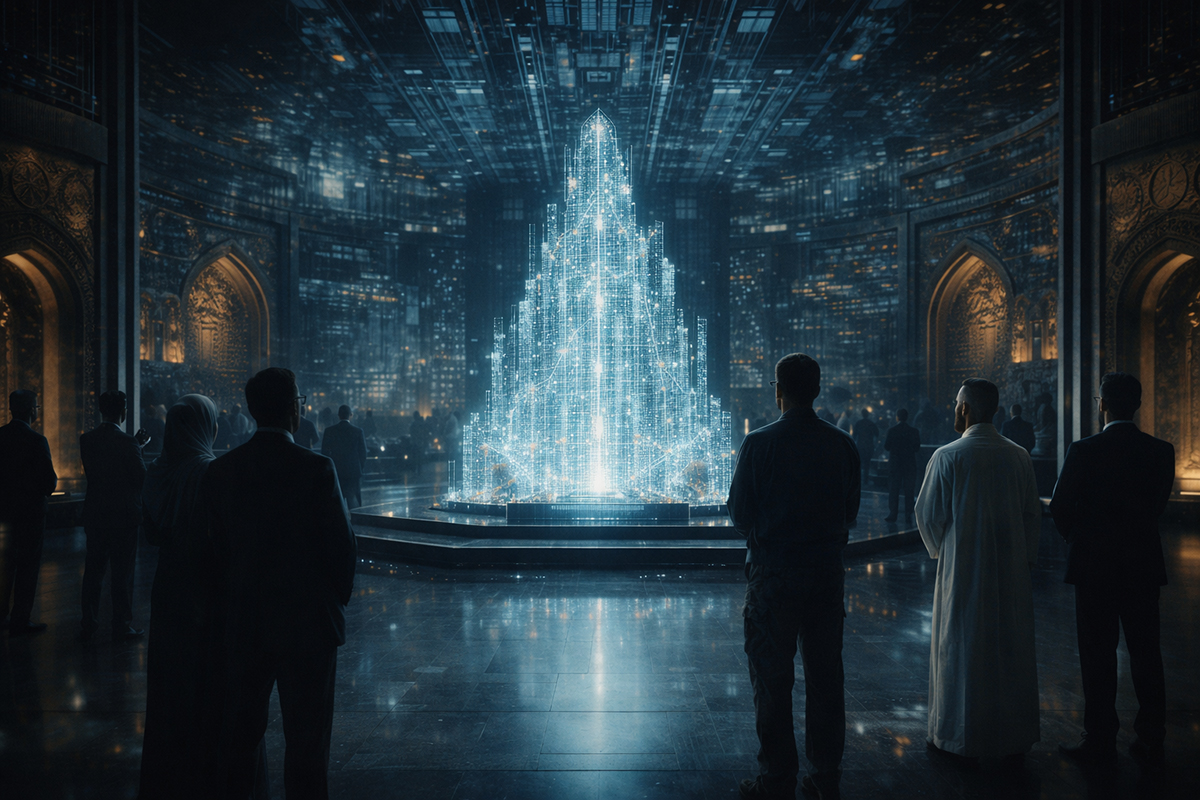
Topic 4: Are Apocalyptic Religion and Technocratic Ambition Merging Into One Worldview?
Moderator: Lex Fridman
Participants:
- Yuval Noah Harari
- Nick Bostrom
- Peter Thiel
- N.T. Wright
- Cornel West
- Are religious end-times thinking and secular faith in technology becoming two versions of the same desire to control history?
- What happens when human beings stop waiting for meaning and redemption and start trying to engineer them?
- If a civilization begins to treat technology as destiny and crisis as a gateway to transformation, what kind of future is it actually inviting?
Lex Fridman:
There is a strange and unsettling idea at the center of this topic. On one side, you have religious people who believe history is moving toward a final climax, a sacred resolution. On the other side, you have secular technologists who believe humanity is approaching a radical transformation through AI, biotechnology, surveillance, or even the redesign of the human condition itself. These seem like opposite worlds. Yet sometimes they feel strangely similar. So let me begin there: are apocalyptic religion and technocratic ambition becoming two expressions of the same impulse?
Yuval Noah Harari:
Yes, I think they can be. Both can become grand narratives that promise to decode history and reveal where humanity is headed. One says salvation is coming through divine culmination. The other says salvation is coming through data, intelligence, optimization, and engineered systems. In both cases, there is a temptation to believe that ordinary human uncertainty can be overcome by joining the right historical force. That is a very old temptation. The tools change. The structure of the myth remains.
Nick Bostrom:
I would distinguish between prediction and worship. It is one thing to say that technological transformation is likely, perhaps inevitable in some domains. It is another to elevate that transformation into a moral absolute. Yet it is true that some secular futurism begins to function like religion. It offers a direction of history, a coming rupture, an elect group who sees it first, and a promise that humanity may transcend its present condition. Once framed that way, the resemblance becomes hard to deny.
Peter Thiel:
I think there are superficial similarities, but there are also major differences. Religion, at its best, asks what human beings are for. Technological ambition, at its best, asks what human beings can build. The danger comes when either loses humility. A religious movement that thinks it can force sacred history becomes dangerous. A technological movement that thinks it can replace moral reflection with engineering becomes dangerous too. But I would resist collapsing all serious ambition into a single pathology.
N.T. Wright:
Theologically, the confusion begins when people stop receiving history as something under God and begin treating it as a mechanism they can trigger. That is true in religion and outside religion. A great many distortions emerge from the fantasy that one can hurry redemption by violence, domination, or engineered crisis. Christian hope was never meant to be a blueprint for power. It was meant to form patience, courage, faithfulness, and love. Once sacred language is turned into fuel for force, it has already been corrupted.
Cornel West:
Brother Lex, what we are really talking about is idolatry in two costumes. One costume wears scripture without humility. The other wears innovation without wisdom. One says, “God is on our side, history must break our way.” The other says, “Technology will deliver us from limitation, vulnerability, and tragedy.” Both can become evasions of the human condition. Both can become ways of escaping moral responsibility under the banner of destiny.
Lex Fridman:
That leads to the second question. What happens when people stop waiting for meaning, justice, or redemption and start trying to engineer them? When they decide history must be pushed, accelerated, or forced?
Harari:
Then power expands. Once people believe they possess the code of history, they become less tolerant of unpredictability. Human beings are messy, slow, contradictory, and resistant to optimization. If your vision of the future is too complete, actual people begin to look like obstacles. That is why utopian projects, religious or secular, often become dangerous. The more perfect the imagined future, the less patience there is for flawed human beings in the present.
Bostrom:
There is also an epistemic problem. Our knowledge is radically incomplete. We do not fully understand consciousness, value, flourishing, or the long-term consequences of our own systems. So when human beings try to engineer civilizational destiny with excessive confidence, they are acting far beyond what their knowledge warrants. Catastrophe often enters history through overconfident simplification.
Thiel:
Still, one should not confuse caution with passivity. Human beings have always shaped history. Institutions, science, law, medicine, and political order are all forms of intervention. The question is not whether to shape the future. The question is what limits should govern that shaping. My concern is less with ambition itself and more with systems that sever ambition from accountability or transcendence from moral truth.
Wright:
And that is exactly where theology should speak clearly. Human beings are called to stewardship, not sovereignty over reality itself. There is a profound difference between cultivating what is entrusted to us and trying to seize control of history’s deepest meaning. The latter is the ancient temptation: to become like gods. Once that temptation enters politics or technology, it produces not redemption, but domination.
West:
Yes, and when redemption becomes a project of elites, the poor always pay first. The vulnerable always bleed first. The rhetoric may be glorious. The language may be sacred or futuristic. Yet the bodies beneath it are real. Anytime someone says, “We must break the old world to save the future,” I want to ask, who gets broken, who gets saved, and who gets rich in the process?
Lex Fridman:
Then the third question becomes unavoidable. Suppose a civilization begins to treat technology as destiny and crisis as the gateway to transformation. Suppose war, disruption, fear, and instability begin to feel like opportunities for historical acceleration. What kind of future does that civilization invite?
Harari:
It invites a future in which human beings become increasingly manageable objects inside larger systems of prediction and control. Crisis is useful to centralized power because frightened populations accept measures they would otherwise reject. If technology is presented as the answer to every emergency, then emergencies become politically valuable. That is a dangerous feedback loop.
Bostrom:
From the long-term perspective, such a civilization may drift into value lock-in. A narrow set of assumptions, institutionalized through powerful systems, could harden into structures that shape humanity for generations. That is one of the deepest risks of advanced technology fused with concentrated power. You do not merely solve problems. You encode premises about what human life is for.
Thiel:
And yet stagnation has its own dangers. A society terrified of all transformation can become passive, brittle, and decayed. So we need to avoid two extremes: blind acceleration and moral paralysis. A mature civilization must be capable of invention without self-deification, capability without nihilism, and power without the fantasy that all limits are obsolete.
Wright:
A civilization that treats crisis as salvific and technology as redemptive begins to lose the grammar of creatureliness. It forgets gratitude, dependence, repentance, and love. It may become very efficient. It may become very powerful. But it will become spiritually disordered. And spiritually disordered societies eventually make a wreck of their own gifts.
West:
I would say it invites a future of shiny barbarism. The language becomes sleek. The devices become dazzling. The systems become total. Yet the soul becomes thinner, colder, less capable of mercy. We may gain instruments and lose wisdom. We may gain speed and lose depth. We may gain surveillance and lose sight of the sanctity of each person. That is too high a price.
Lex Fridman:
So perhaps the convergence happens here: both apocalyptic religion and technocratic ambition can begin to believe that history is theirs to complete, that crisis is useful, and that the future justifies extraordinary force in the present.
Harari:
Yes. Both can become myths of authorized control.
Bostrom:
And both become most dangerous when confidence outruns knowledge.
Thiel:
And when ambition loses accountability.
Wright:
And when hope is severed from humility.
West:
And when power forgets the sacred worth of the least among us.
Lex Fridman:
Then maybe the real warning is not about religion alone or technology alone. Maybe it is about any worldview that stops seeing history as something to be lived with conscience and begins seeing it as something to be seized, accelerated, and mastered.
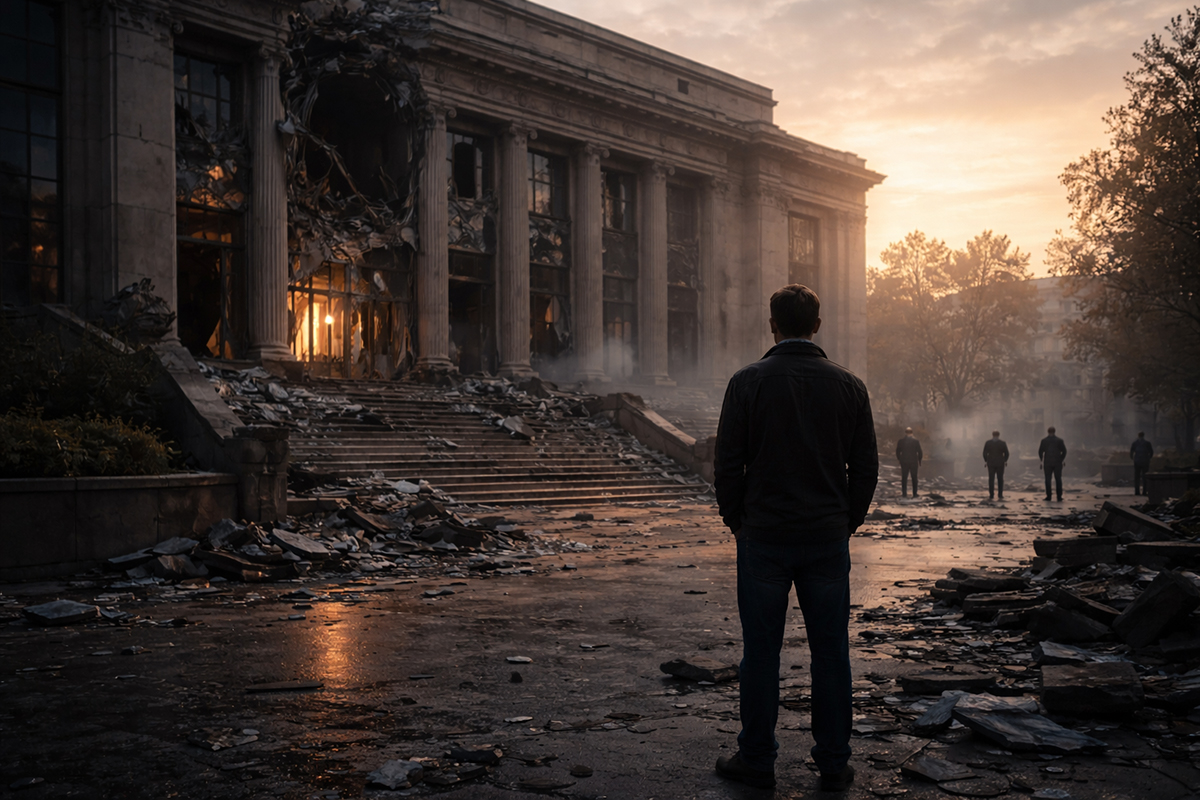
Topic 5: Can a Nation Fight Dishonorable Wars Without Destroying Its Own Soul?
Moderator: Tucker Carlson
Participants:
- Cornel West
- Mary Kaldor
- Shoshana Zuboff
- Ayaan Hirsi Ali
- Douglas Murray
- Can a nation commit or tolerate dishonorable acts in war and still believe itself morally different from its enemies?
- What happens to a society when lies, civilian deaths, collective punishment, and moral numbness become normal parts of statecraft?
- If a nation loses its soul in the name of security, victory, or history, what exactly has it saved?
Tucker Carlson:
There comes a point in every war where the strategic arguments stop being enough. You can argue necessity, deterrence, alliance, preemption, intelligence, national interest. Fine. But eventually the question becomes simpler and much harder: what are we becoming through this? If a country begins to accept lies, hidden casualties, civilian deaths explained away, collective punishment, and the moral anesthesia of modern war, can it still claim to be different from the people it condemns?
Cornel West:
Brother Tucker, that is the question beneath the question. A nation lives and dies by more than territory, markets, weapons, and slogans. It lives by the moral quality of its witness. If it says one thing and does another, if it praises dignity and practices indifference, if it invokes justice and traffics in cruelty, then it enters spiritual decay. A nation may still be rich. It may still be feared. It may still be technologically advanced. Yet inwardly it has begun to rot.
Mary Kaldor:
And one of the grave dangers of modern war is that moral rupture often arrives in administrative language. Civilian deaths become collateral effects. Fear becomes stabilization. Secrecy becomes operational necessity. Surveillance becomes protection. This is how societies adjust themselves. They do not usually wake up one morning and choose barbarism. They drift toward it through systems, categories, and normalized exceptions.
Shoshana Zuboff:
Yes. The soul of a nation can be expropriated in the same way privacy, autonomy, and agency can be expropriated: gradually, procedurally, and under the banner of necessity. War is especially potent in this respect because it authorizes concentrations of secrecy and power. Once citizens become accustomed to not knowing, not asking, and not expecting accountability, a moral injury spreads far beyond the battlefield.
Ayaan Hirsi Ali:
A nation must defend itself. There are enemies in the world, there are violent ideologies, and moral seriousness requires saying that plainly. But it is also true that a nation cannot preserve its values by abandoning them. The West cannot claim superiority on the basis of freedom, human dignity, and individual accountability if it adopts methods that deny those principles. The moment self-defense becomes an excuse for moral self-erasure, the defense has already gone too far.
Douglas Murray:
I agree with much of that, though I would add a warning. There is a danger in moral language becoming so absolute that it paralyzes the legitimate use of force. Nations do face enemies. Wars are tragic by nature. Innocents die in war. Mistakes happen. The existence of moral stain does not prove a war is illegitimate. The real question is whether a society still recognizes the stain as stain, whether it still feels the weight of innocent life, whether it still distinguishes between tragedy and doctrine.
Tucker Carlson:
That is exactly the line I want to press. Because the question is not whether war is clean. It never is. The question is what happens when the exceptions become the pattern. What happens to a society when lies, civilian deaths, collective punishment, and moral numbness become normal tools of policy?
West:
Then conscience is no longer a living force. It becomes decoration. And when conscience becomes decoration, public language becomes theater. Leaders speak of values they do not serve. Citizens repeat phrases they no longer test. The poor, the powerless, the foreign child, the invisible victim, all become acceptable losses. At that point, the issue is not hypocrisy alone. It is hardening of the heart.
Kaldor:
From the perspective of war studies, normalization matters more than isolated outrage. A single scandal can still awaken conscience. Repetition without consequence kills it. If each new civilian horror is folded into procedure and then forgotten, war ceases to be a bounded emergency and becomes part of political metabolism. That is one of the marks of deep corruption.
Zuboff:
And the mechanisms that enable this are powerful. Information control, selective exposure, managed narratives, bureaucratic opacity, and digital mediation all create conditions in which public feeling can be calibrated. People are shown enough horror to remain emotionally engaged, but not enough truth to act meaningfully. This is not simply ignorance. It is engineered moral helplessness.
Hirsi Ali:
That is why clarity matters. We must preserve the distinction between enemy combatant and innocent person, between self-defense and vengeance, between force and collective punishment. Those distinctions are the architecture of civilization. Once they collapse, public trust collapses with them. You cannot teach a population to ignore those lines abroad and then expect moral health at home.
Murray:
And yet one must avoid the opposite temptation, which is to pretend civilization can be preserved by endless hesitation. There are moments when force is necessary, and not using it has moral cost too. The key is that force must remain disciplined by principle. Once revenge, bloodline guilt, or totalizing ideology enters the frame, you are no longer in the realm of tragic necessity. You are in the realm of corruption.
Tucker Carlson:
That leads to the final question, and maybe it is the one all the others point toward. Suppose a nation says, we did what we had to do. Suppose it secures itself, protects its strategic interests, preserves its standing, maybe even wins. But in the process it has lied, hidden, brutalized, and numbed itself. Then what exactly has it saved?
West:
It may have saved its machinery, but not its meaning. A people cannot live by security alone. They require some reason to believe their life together is answerable to truth, to mercy, to justice. If all that remains is survival plus power, then the nation has become spiritually vacant. It still occupies land. It no longer knows why it deserves to endure.
Kaldor:
And such a nation often becomes less secure, not more. Moral corrosion is not only a spiritual problem. It is strategic. When a state loses legitimacy, trust erodes. Alliances fray. Citizens disengage. Institutions become brittle. Violence may secure a temporary objective and still sow long-term instability.
Zuboff:
I would say it has saved its apparatus while sacrificing its authorship. A democratic people are meant to remain authors of the power exercised in their name. If war turns them into spectators of hidden systems and passive consumers of official narratives, then sovereignty has already thinned out. What survives may still be called a nation. But the living relationship between citizens and power has been damaged.
Hirsi Ali:
A nation that loses its moral core in the name of self-protection invites future weakness. Because strength is not only military capacity. It is also civilizational confidence: the belief that one’s principles deserve defense because they are real in practice. Once that confidence dies, slogans multiply and conviction shrinks.
Murray:
And that is why the ability to feel shame matters. Shame is not weakness. It is evidence that the moral sense remains alive. A nation that can no longer say, “This was wrong, this crossed a line, this must never happen again,” is in grave trouble. That is the true danger, not merely the use of force, but the death of moral self-recognition.
Tucker Carlson:
So maybe that is the real dividing line. Not whether a nation uses force, but whether it still knows there are things it must not become in using it. Whether it still believes innocence matters, truth matters, restraint matters, repentance matters. Whether it still thinks the soul of the country is real.
West:
Without that, democracy becomes spectacle.
Kaldor:
And war becomes environment.
Zuboff:
And power becomes unanswerable.
Hirsi Ali:
And civilizational language becomes hollow.
Murray:
And victory itself becomes difficult to define.
Tucker Carlson:
Then that may be the final warning buried inside all of this: a country can lose itself long before it loses a war.
Final Thoughts by Tucker Carlson
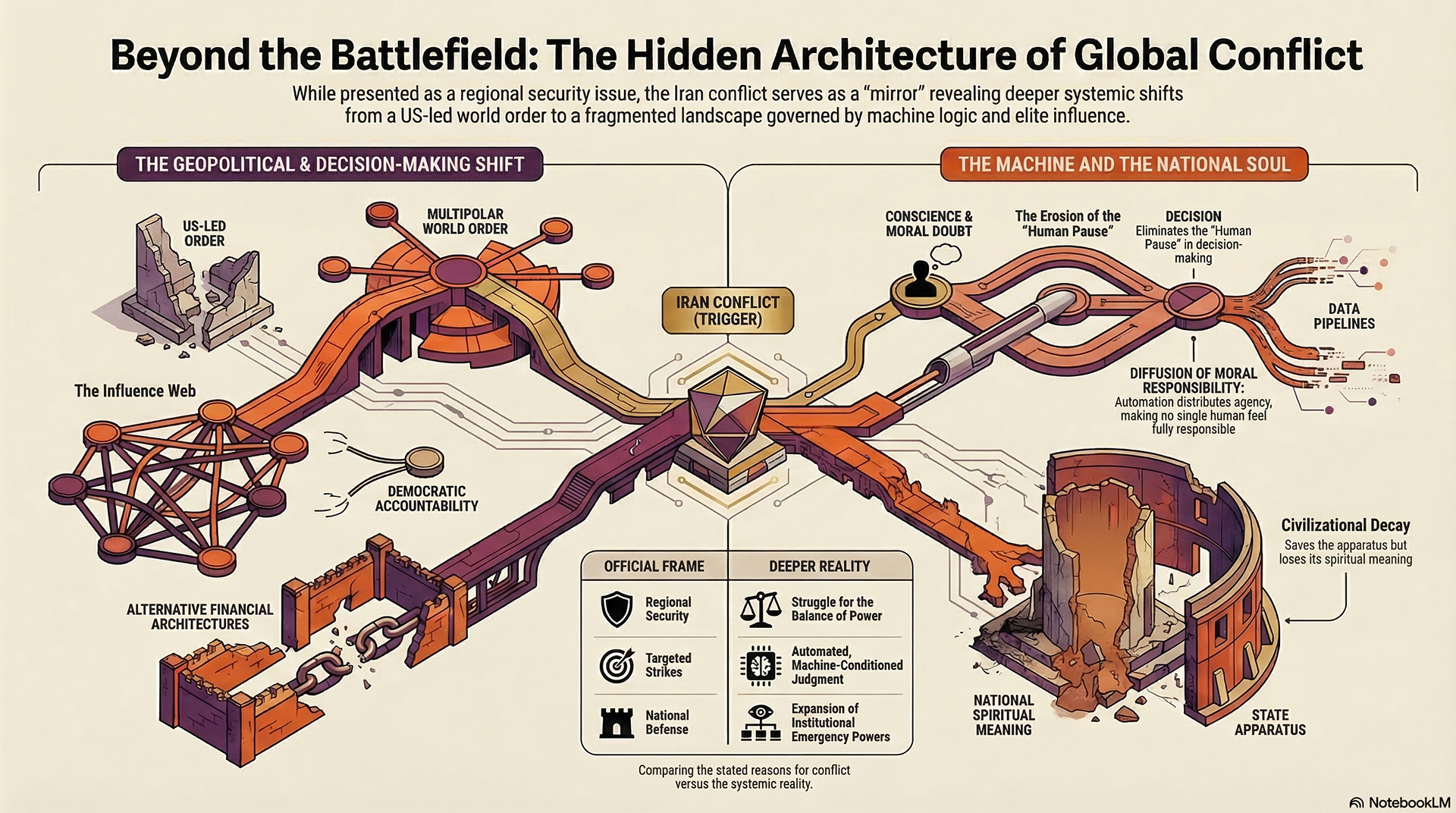
By the end of a conversation like this, you’re left with a feeling that should be familiar by now: the official story is never large enough for the reality it is trying to contain. We are told this is about security, deterrence, stability, necessity. Those words are repeated so often they begin to sound like explanations. But they are usually cover language for deeper struggles over power, control, belief, and the future shape of human life.
What we’ve heard here is that this war may be revealing far more than a regional confrontation. It may be exposing the fragility of the world order, the weakness of democratic accountability, the growing role of machine logic in life-and-death decisions, and the temptation of elites — religious, political, technological — to treat crisis as an opening through which history can be pushed in the direction they prefer. That is not a small thing. That is not another passing conflict. That is civilizational.
And that leaves one final question hanging over everything else: what happens to a country that loses the ability to tell the truth about what it is doing and why? A country can survive military strain. It can survive economic shocks. It can survive political stupidity for quite a long time. But when it loses moral clarity, when it becomes numb to the deaths of innocents, when it hands judgment to systems, when it starts speaking in abstractions to avoid saying plainly what is being done in its name, it begins to lose something far more important than advantage. It begins to lose itself.
That is the real danger in wars like this. Not just destruction abroad, but deformation at home. Not just the death of other people’s children, but the corruption of our own standards. Not just strategic failure, but spiritual collapse disguised as necessity.
A nation does not remain good by claiming to be good. It remains good by refusing to cross lines that would make its power meaningless. And once those lines are crossed, once the soul of the country is treated as expendable, no victory is clean enough to redeem the loss.
So that is the warning. The issue is not simply where this war goes next. The issue is what kind of people, what kind of nation, and what kind of civilization we are becoming as it unfolds.
Short Bios:
Topic 1
Tucker Carlson — Political commentator and founder of Tucker Carlson Network, known for long-form interviews and commentary on politics, culture, and war.
John Mearsheimer — University of Chicago political scientist and leading realist thinker on great-power politics, war, and international security.
Stephen Walt — Harvard Kennedy School scholar known for realist foreign-policy analysis and writing on alliances, power, and U.S. strategy.
Niall Ferguson — Historian and Hoover Institution senior fellow known for work on empire, war, finance, and global order.
Mary Kaldor — London School of Economics professor emerita known for her work on new wars, global governance, and civil society.
Jeffrey Sachs — Columbia University economist and public policy scholar known for work on global development, sustainability, and international crises.
Topic 2
Joe Rogan — Comedian, UFC commentator, and host of The Joe Rogan Experience, one of the world’s best-known long-form interview podcasts.
John Mearsheimer — University of Chicago political scientist and leading realist thinker on great-power politics, war, and international security.
Stephen Walt — Harvard Kennedy School scholar known for realist foreign-policy analysis and writing on alliances, power, and U.S. strategy.
Douglas Murray — Author, columnist, and Manhattan Institute senior fellow known for writing on politics, identity, and Western civilization.
Fareed Zakaria — CNN host, columnist, and author known for commentary on world affairs, geopolitics, and the changing international system.
Ayaan Hirsi Ali — Author, activist, and Hoover Institution research fellow known for her writing on freedom, religion, and Western values.
Topic 3
Lex Fridman — Research scientist and podcast host known for conversations on AI, science, philosophy, geopolitics, and the human condition.
Shoshana Zuboff — Harvard Business School professor emerita and author known for her work on surveillance capitalism, data power, and democracy.
Bruce Schneier — Security technologist and public-interest thinker known for work on cybersecurity, privacy, surveillance, and the social impact of technology.
Nick Bostrom — Oxford philosopher known for work on AI, existential risk, transhumanism, and the future of humanity.
Mary Kaldor — London School of Economics professor emerita known for her work on new wars, global governance, and civil society.
Peter Thiel — Entrepreneur, investor, and Palantir chair known for work at the intersection of technology, power, and future-oriented thinking.
Topic 4
Lex Fridman — Research scientist and podcast host known for conversations on AI, science, philosophy, geopolitics, and the human condition.
Yuval Noah Harari — Historian and author known for exploring big questions about humanity, technology, information, and the future.
Nick Bostrom — Oxford philosopher known for work on AI, existential risk, transhumanism, and the future of humanity.
Peter Thiel — Entrepreneur, investor, and Palantir chair known for work at the intersection of technology, power, and future-oriented thinking.
N.T. Wright — New Testament scholar and theologian known for writing on Christian hope, history, and the meaning of faith in public life.
Cornel West — Philosopher, theologian, and public intellectual known for his work on democracy, justice, race, and the moral life of a nation.
Topic 5
Tucker Carlson — Political commentator and founder of Tucker Carlson Network, known for long-form interviews and commentary on politics, culture, and war.
Cornel West — Philosopher, theologian, and public intellectual known for his work on democracy, justice, race, and the moral life of a nation.
Mary Kaldor — London School of Economics professor emerita known for her work on new wars, global governance, and civil society.
Shoshana Zuboff — Harvard Business School professor emerita and author known for her work on surveillance capitalism, data power, and democracy.
Ayaan Hirsi Ali — Author, activist, and Hoover Institution research fellow known for her writing on freedom, religion, and Western values.
Douglas Murray — Author, columnist, and Manhattan Institute senior fellow known for writing on politics, identity, and Western civilization.
Leave a Reply