
|
Getting your Trinity Audio player ready...
|
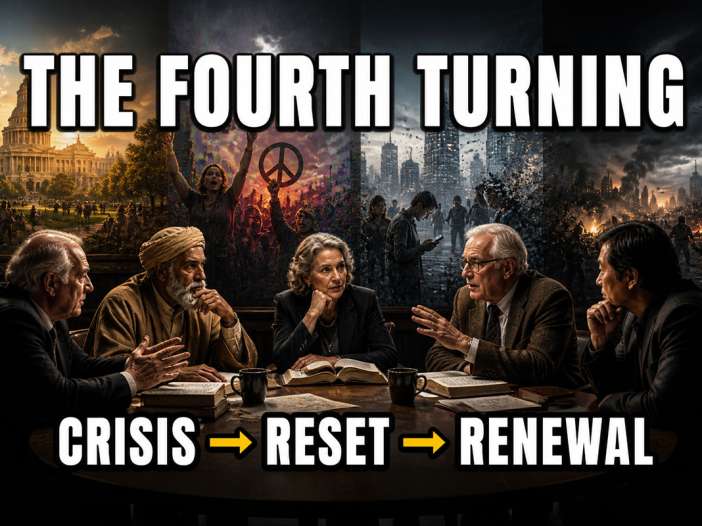
What if William Strauss and Neil Howe revealed that today’s chaos is part of a repeating cycle—and we are already deep inside it?
What if William Strauss and Neil Howe revealed that today’s chaos is part of a repeating cycle—and we are already deep inside it?
What if William Strauss and Neil Howe revealed that today’s chaos is part of a repeating cycle—and we are already deep inside it?
What if William Strauss and Neil Howe revealed that today’s chaos is part of a repeating cycle—and we are already deep inside it?
What if William Strauss and Neil Howe revealed that today’s chaos is part of a repeating cycle—and we are already deep inside it?
What if William Strauss and Neil Howe revealed that today’s chaos is part of a repeating cycle—and we are already deep inside it?
Introduction by Neil Howe
In The Fourth Turning, William Strauss and I argued that history moves through a recurring rhythm shaped by generations.
Not events alone.
Not leaders alone.
But the changing character of people as they move through life.
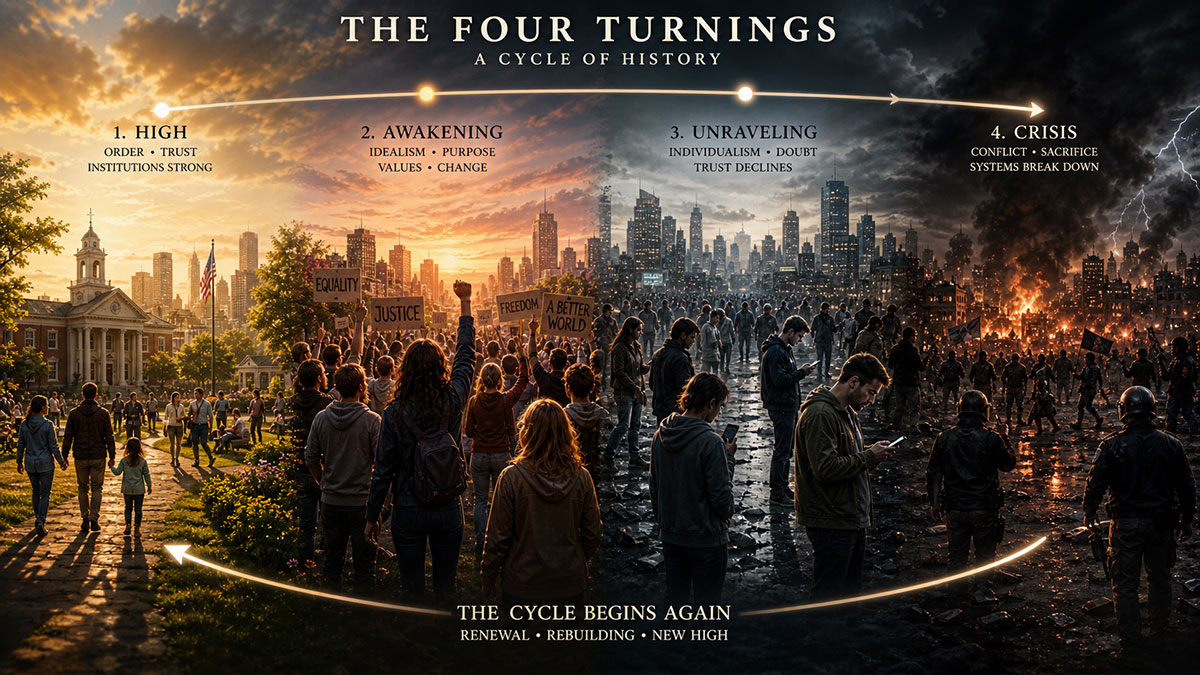
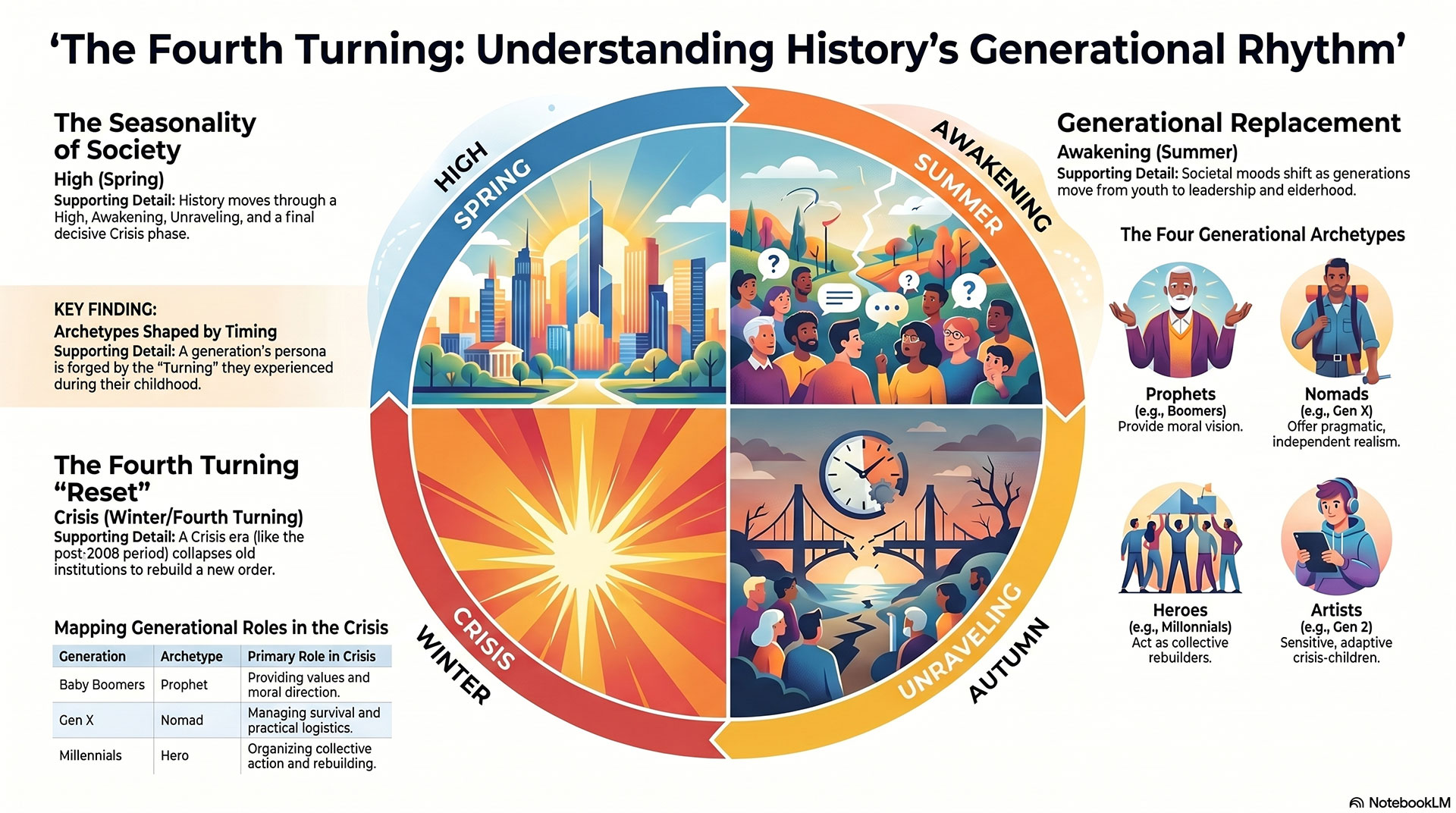
The pattern unfolds in four phases:
- A High, when institutions are strong and society feels confident
- An Awakening, when people challenge that order in search of meaning
- An Unraveling, when trust weakens and individualism rises
- A Crisis, when problems converge and force a decisive reset
Each generation is shaped in one phase and then leads in the next.
- Prophets grow up in stability and later drive moral vision
- Nomads grow up during upheaval and bring realism and independence
- Heroes grow up during fragmentation and are called to rebuild
- Artists grow up during crisis and become sensitive to process and healing
Our discussion has followed this structure:
- First, the cycle itself
- Then the present moment, and whether we are in a true crisis era
- Then the generational roles shaping that crisis
- Then the breakdown of institutions and the pressure toward conflict
- And finally, the possibility of renewal after the reset
If the theory holds, then the United States entered a Fourth Turning around the late 2000s.
That means we are not simply facing isolated problems.
We are living inside a historical convergence—one that may transform institutions, demand sacrifice, and ultimately reshape the system itself.
The question is not whether change is coming.
The question is what kind of change we are willing to build.
(Note: This is an imaginary conversation, a creative exploration of an idea, and not a real speech or event.)
Topic 1 — The Cycle: Why History Moves Through Four Turnings
Opening — William Strauss
A society does not move through time only by events.
It moves through memory.
One generation is raised in confidence. Another in rebellion. Another in distrust. Another in emergency. Then each carries that early experience into adulthood, leadership, family, and public life.
That is the heart of the Fourth Turning theory.
History is not a perfect circle. But it does have a rhythm: High, Awakening, Unraveling, Crisis.
The question is whether this rhythm reveals something real—or whether we are only finding patterns after the fact.
Question 1
Why do Strauss and Howe believe history moves through recurring generational cycles?
Neil Howe:
Generations are shaped by the mood of the era in which they grow up. Children raised during social confidence become different adults from children raised during upheaval. When those generations age into new roles, they reshape society in predictable ways.
Ibn Khaldun:
Every society carries a cycle of cohesion and decay. A people rise through shared hardship, then grow comfortable, divided, and dependent on inherited strength. The grandchildren often forget what built the house they live in.
Barbara Tuchman:
History repeats less through destiny than through human habit. Leaders ignore warnings. Institutions defend themselves. Citizens grow tired of responsibility. Then events punish what people refused to see.
Arnold Toynbee:
Civilizations face challenges. Their fate depends on whether they respond creatively. A cycle begins when the old response no longer works, yet leaders keep repeating it.
William Strauss:
Our claim is not that dates mechanically repeat. It is that generational replacement creates recurring public moods. As one generation moves from youth to midlife to elderhood, the whole society changes character.
Question 2
What separates a High, Awakening, Unraveling, and Crisis?
William Strauss:
A High comes after crisis. Institutions are strong, society feels confident, and personal life is often expected to fit public order. Postwar America is the clearest modern example.
Neil Howe:
An Awakening begins when people rebel against that order. The culture asks, “What about the individual soul?” Spiritual, moral, and cultural movements rise against institutional conformity.
Ibn Khaldun:
An Unraveling appears when shared discipline weakens. People still enjoy the benefits of an earlier order, but no longer carry the same obligation to preserve it.
Barbara Tuchman:
A Crisis arrives when postponement ends. Problems once treated as manageable become impossible to ignore. The society must choose, rebuild, fight, or fracture.
Arnold Toynbee:
The four phases describe a movement from unity, to inner revolt, to fragmentation, to decisive trial. The last phase is dangerous, but it can create renewal if a society answers the challenge with imagination.
Question 3
Is this pattern real history—or a useful story humans impose on history?
Barbara Tuchman:
All historical patterns require caution. The danger is making history too neat. Real events are messy, full of accident, stupidity, courage, and timing. Yet patterns can still warn us.
Arnold Toynbee:
A pattern is useful if it sharpens responsibility. It becomes dangerous if it excuses fatalism. No society should say, “The cycle will decide.” The response still belongs to human beings.
Neil Howe:
The theory is not a prophecy machine. It is a framework for seeing how generations respond differently to similar pressures. It helps explain why eras have different emotional climates.
Ibn Khaldun:
Cycles are not prisons. They are tendencies rooted in human nature: hardship creates strength, strength creates comfort, comfort creates forgetfulness, and forgetfulness invites crisis.
William Strauss:
The point is not to prove that every event fits. The point is to understand how collective memory changes. When memory changes, behavior changes. When behavior changes across generations, history turns.
Closing — William Strauss
The Fourth Turning theory begins with a simple observation:
People are shaped by the age in which they come of age.
Then, later, they shape the age their children must inherit.
A High gives order.
An Awakening challenges the soul.
An Unraveling weakens trust.
A Crisis forces decision.
Whether this is destiny or pattern, warning or mirror, one truth remains:
A society cannot understand its future if it forgets how each generation was formed.
Topic 2 — Where We Are: Did America Enter a Fourth Turning After 2008?
Opening — Neil Howe
A Fourth Turning does not usually announce itself.
It begins as financial panic, political anger, distrust, broken promises, and a feeling that the old answers no longer reach the wound.
For Strauss and Howe, the late 2000s marked the beginning of America’s Crisis era. The 2008 financial crash was not merely an economic event. It was a signal that public confidence, institutional trust, and the social contract had entered a new phase.
The question is whether America is passing through temporary instability—or a deeper historical reset.
Question 1
What evidence suggests America entered a Crisis era around the late 2000s?
William Strauss:
The late 2000s carried the mood of a Fourth Turning because private problems became public emergencies. Housing, debt, trust, politics, and global order began to shake together.
Ray Dalio:
From a cycle perspective, the signs were clear: debt stress, wealth gaps, political division, and rising rivalry between major powers. Those forces rarely stay separate. They merge.
Francis Fukuyama:
Trust in institutions had already been weakening, but after 2008 many citizens felt the system protected insiders first. That perception damaged legitimacy.
Yuval Noah Harari:
The deeper issue is the collapse of shared stories. People no longer agree on what progress means, who deserves trust, or what kind of future they are moving into.
Neil Howe:
The late 2000s changed the national mood. People moved from frustration to crisis expectation. They began to sense that normal reform might not be enough.
Question 2
How do debt, distrust, polarization, technology, and global rivalry combine into one crisis?
Ray Dalio:
Debt creates pressure. Inequality creates anger. Political conflict blocks compromise. External rivalry adds fear. When all of these rise together, the system becomes harder to manage.
Yuval Noah Harari:
Technology intensifies every fracture. Algorithms can turn fear into identity. Artificial intelligence, surveillance, cyberwar, and misinformation make social conflict faster and harder to contain.
Francis Fukuyama:
Polarization weakens institutional repair. People stop asking whether a policy works and start asking which side benefits. That makes even necessary reform feel like betrayal.
William Strauss:
A Fourth Turning is marked by convergence. Problems that once seemed separate begin to reinforce one another. Economic fear feeds political rage. Political rage weakens trust. Weak trust makes reform impossible.
Neil Howe:
The crisis becomes generational when younger people no longer expect the inherited system to work for them. That is when the future itself becomes contested.
Question 3
Are we moving toward collapse, transformation, or a forced national reset?
Francis Fukuyama:
Collapse is not inevitable. Institutions can be renewed. But renewal requires legitimacy, competence, and a public willing to accept shared rules again.
Ray Dalio:
The likely outcome depends on whether leaders manage conflict before it becomes extreme. Systems can restructure peacefully, but history shows that delay raises the cost.
Yuval Noah Harari:
The danger is that people seek simple answers in a complex crisis. A national reset can create renewal, but it can also create surveillance, authoritarianism, or permanent division.
Neil Howe:
Fourth Turnings usually end in a new institutional order. The old arrangements do not simply continue. The question is whether the reset is constructive or destructive.
William Strauss:
A Crisis era forces decision. Society may not choose collapse, but it can be pushed into transformation by events. The old order loses the ability to remain halfway alive.
Closing — Neil Howe
If America entered a Fourth Turning after 2008, then the present moment is not a random collection of problems.
It is a convergence.
Debt, distrust, cultural fracture, technological disruption, and global rivalry are pressing into one historical season.
That does not mean the ending is fixed.
But it does mean the center cannot simply hold by habit.
A Fourth Turning asks a nation whether it can rebuild before the old structure breaks completely.
Topic 3 — Generational Archetypes: Prophet, Nomad, Hero, Artist
Opening — Neil Howe
If history has a rhythm, generations are its carriers.
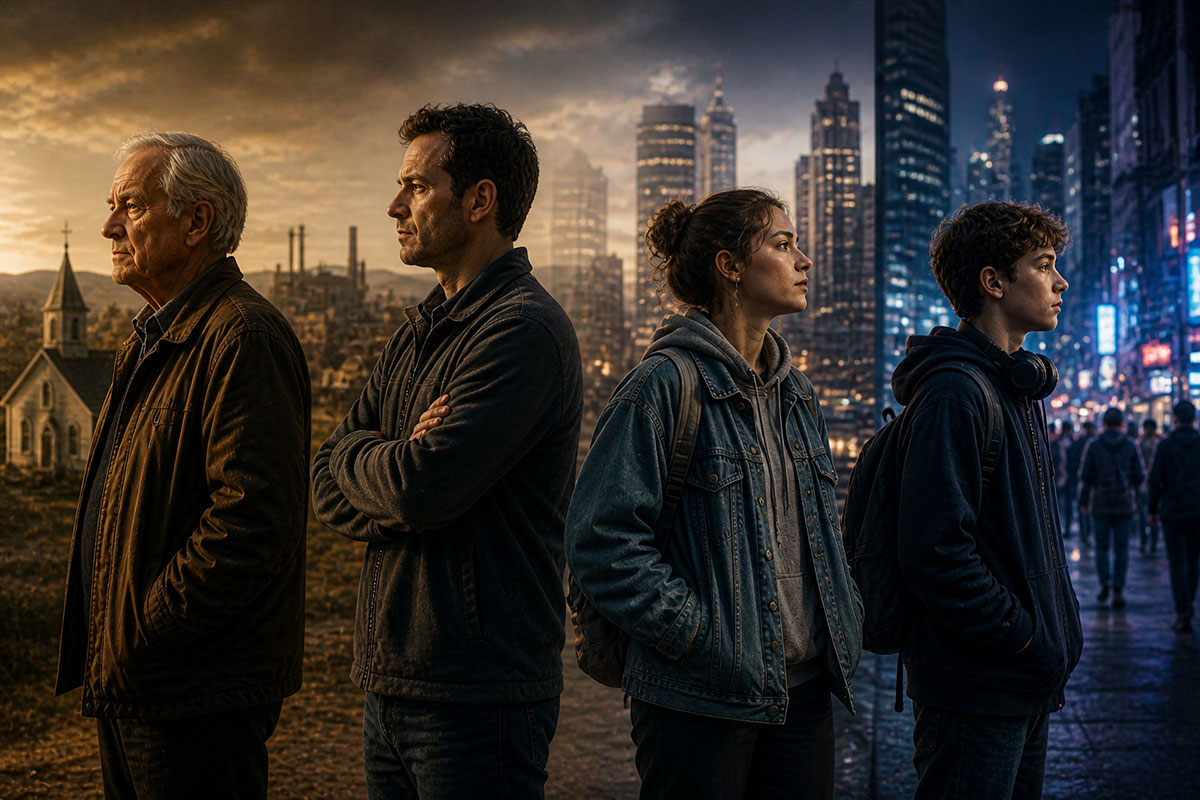
Each generation is shaped during one turning—and then comes of age in the next. That sequence creates recurring roles, not identical personalities, but recognizable patterns in how different age groups respond to crisis, order, and change.
Strauss and I described four archetypes that tend to repeat:
- Prophet (Visionary) — values-driven, moral, often polarizing
- Nomad (Pragmatic) — independent, skeptical, survival-oriented
- Hero (Civic) — team-oriented, institution-building, action-focused
- Artist (Adaptive) — sensitive, process-aware, shaped by crisis early
The question is not whether these categories are perfect.
The question is whether they help us understand why generations behave differently when history demands something from them.
Question 1
How do Prophet, Nomad, Hero, and Artist generations form across history?
Carl Jung:
A generation inherits not only circumstances, but psychological atmosphere. The unconscious absorbs the fears, hopes, and tensions of the time. Archetypes arise as responses to those conditions.
Erik Erikson:
Identity forms through tension. A generation raised in order develops differently from one raised in uncertainty. These early conditions shape how people later approach authority, risk, and meaning.
Neil Howe:
Each archetype is shaped in a different turning:
- Prophets are born after a crisis, raised in stability
- Nomads are raised during an Awakening, when order is questioned
- Heroes grow up during an Unraveling, when institutions weaken
- Artists are born into Crisis, shaped by collective stress
That sequence repeats as generations move through life stages.
Jean Twenge:
Cultural and technological shifts matter as well. Social media, economic pressure, and changing family structures influence how these archetypal tendencies express themselves in modern life.
Jonathan Haidt:
Moral frameworks are formed early. A generation exposed to safety tends to explore values. A generation exposed to instability tends to prioritize protection and coordination.
Question 2
What roles do Boomers, Gen X, Millennials, and Gen Z play in today’s crisis?
Neil Howe:
- Baby Boomers (Prophet) bring strong values, vision, and moral language—but also deep division.
- Gen X (Nomad) brings realism, skepticism, and survival instincts.
- Millennials (Hero) are positioned to organize, rebuild, and act collectively.
- Gen Z (Artist) is more cautious, adaptive, and shaped by instability from an early age.
Jean Twenge:
Millennials were raised with expectations of achievement and structure, then faced economic instability. Gen Z grew up with constant digital exposure and heightened awareness of risk, which shapes their caution.
Carl Jung:
Each generation carries a shadow. Prophets can become rigid. Nomads can become detached. Heroes can become overconfident. Artists can become overly dependent on stability. Balance requires awareness.
Erik Erikson:
The key challenge is generativity. Can each generation move beyond its own formation and contribute to something larger? Crisis accelerates that demand.
Jonathan Haidt:
Younger generations today show higher sensitivity to harm and fairness, but also higher anxiety. That combination may shape how they respond to crisis—seeking safety while being asked to take responsibility.
Question 3
Can Millennials truly become the rebuilding “Hero” generation?
Neil Howe:
History suggests they are entering that role. Hero generations are not defined by confidence in youth, but by what they are forced to do in midlife.
William Strauss:
Hero generations are shaped by challenge. The GI Generation did not begin as confident leaders. They became that through Depression and war. The same pattern may apply here.
Jean Twenge:
Millennials face structural barriers—debt, housing costs, economic instability—but they also show strong collaborative instincts. Those traits align with large-scale rebuilding.
Erik Erikson:
The question is whether they will resolve identity into commitment. A Hero generation must move from self-definition into shared purpose.
Carl Jung:
They must confront the shadow of the age—fear, fragmentation, illusion. If they integrate it, they can act with clarity. If not, they risk being overwhelmed by the very crisis they are meant to address.
Closing — Neil Howe
Generations do not choose the roles history assigns them.
But they do choose how they live those roles.
A Prophet can divide or inspire.
A Nomad can withdraw or guide.
A Hero can rebuild or overreach.
An Artist can heal or retreat.
The Fourth Turning depends on how these generations interact—not in theory, but in action.
And the central question remains:
Will this generation of adults build something stronger than what they inherited—or simply react to its collapse?
Topic 4 — Institutional Breakdown: Why Crisis Forces Conflict
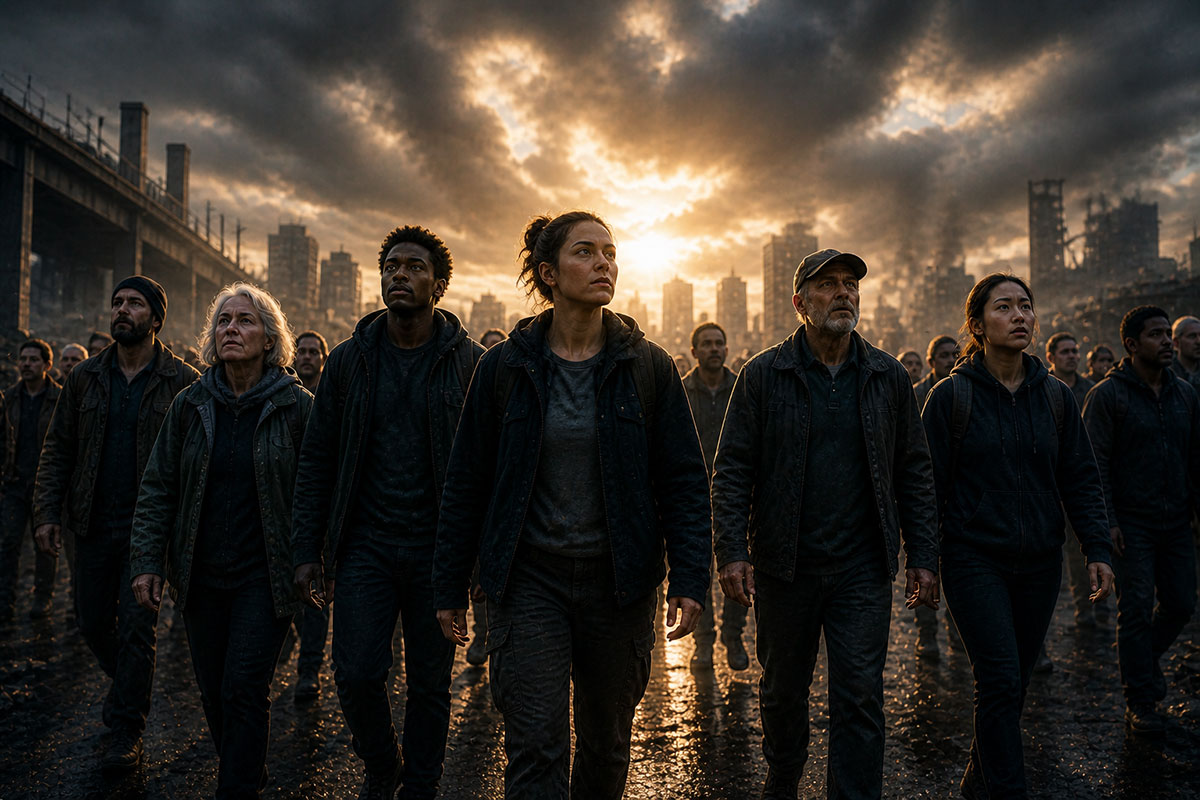
Opening — Hannah Arendt
Institutions do not collapse only when laws fail.
They collapse when people no longer believe those laws represent a shared world.
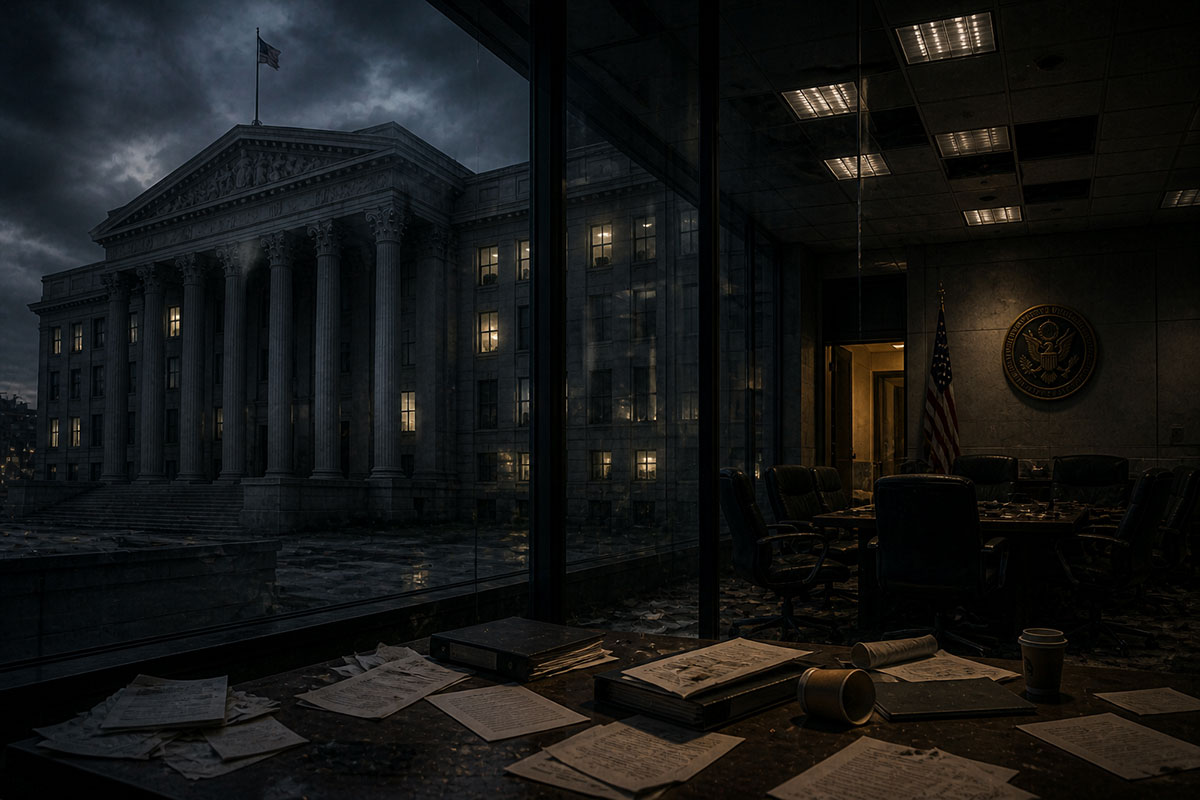
A Fourth Turning intensifies this danger. Economic pressure, political distrust, cultural division, and foreign threats begin to press against one another until compromise feels weak and confrontation feels inevitable.
The question is whether a society can pass through necessary restructuring without losing its moral center.
Question 1
Why do institutions lose legitimacy before a historical reset?
Francis Fukuyama:
Institutions lose legitimacy when people believe they no longer serve the public. Once citizens see the system as captured by elites, competence alone is not enough. Trust must be rebuilt.
Nassim Nicholas Taleb:
Fragile systems often look stable from the outside. They accumulate hidden risks, suppress small failures, and then break in a way that shocks everyone who thought the structure was solid.
Abraham Lincoln:
A nation may carry contradiction for a long time. But a crisis comes when that contradiction can no longer be postponed. In my time, the Union could not remain half committed to liberty and half dependent on slavery.
William Strauss:
In an Unraveling, people detach from institutions. In a Crisis, they demand those institutions either prove their worth or be replaced. Legitimacy becomes a life-or-death question.
Hannah Arendt:
Authority depends on shared reality. When truth itself becomes factional, institutions become mere instruments of competing groups. At that point, law remains, but common meaning has vanished.
Question 2
Why do crisis eras often lead to war, confrontation, or internal rupture?
Nassim Nicholas Taleb:
Pressure seeks release. If a system has no safe way to absorb shocks, conflict becomes the release mechanism. Fragility turns disagreement into rupture.
Abraham Lincoln:
Conflict came because compromise had reached its limit. Some questions cannot be settled by delay forever. A nation must eventually decide what it truly is.
Reinhold Niebuhr:
Crisis awakens collective pride. Groups begin to see themselves as innocent and their enemies as entirely guilty. That moral simplification is one of the first steps toward violence.
William Strauss:
Fourth Turnings concentrate unresolved problems. Economic fear, institutional weakness, and generational pressure converge. The public mood shifts from debate to decision.
Hannah Arendt:
When politics loses the ability to persuade, force becomes tempting. The danger is not only violence; it is the belief that violence can restore meaning.
Question 3
How can a society demand sacrifice without becoming cruel or authoritarian?
Reinhold Niebuhr:
Sacrifice must be joined to humility. No nation should ask people to suffer while pretending its leaders are innocent. Moral seriousness begins with confession, not triumphalism.
Abraham Lincoln:
A cause must be worthy of the sacrifice it demands. The burden placed on the living must serve a future that is more just than the past.
Hannah Arendt:
Sacrifice becomes dangerous when it erases the person. A society may need discipline in crisis, but it must not reduce citizens to tools of the state.
Nassim Nicholas Taleb:
Leaders who demand sacrifice should have skin in the game. Those who bear no risk should not command the suffering of others.
William Strauss:
The healthiest crisis leadership gives people a mission, not merely a burden. It asks for shared responsibility, but it also promises real renewal.
Closing — Hannah Arendt
Institutional breakdown is never only administrative.
It is spiritual, moral, and civic.
A society loses its center when citizens stop believing they share a common world. Conflict then begins to feel like the only language left.
Yet crisis can still be transformed.
If sacrifice is honest, if leadership is accountable, and if rebuilding protects human dignity, then a Fourth Turning can become more than collapse.
It can become the painful birth of a new public life.
Topic 5 — The New High: What Comes After the Reset?
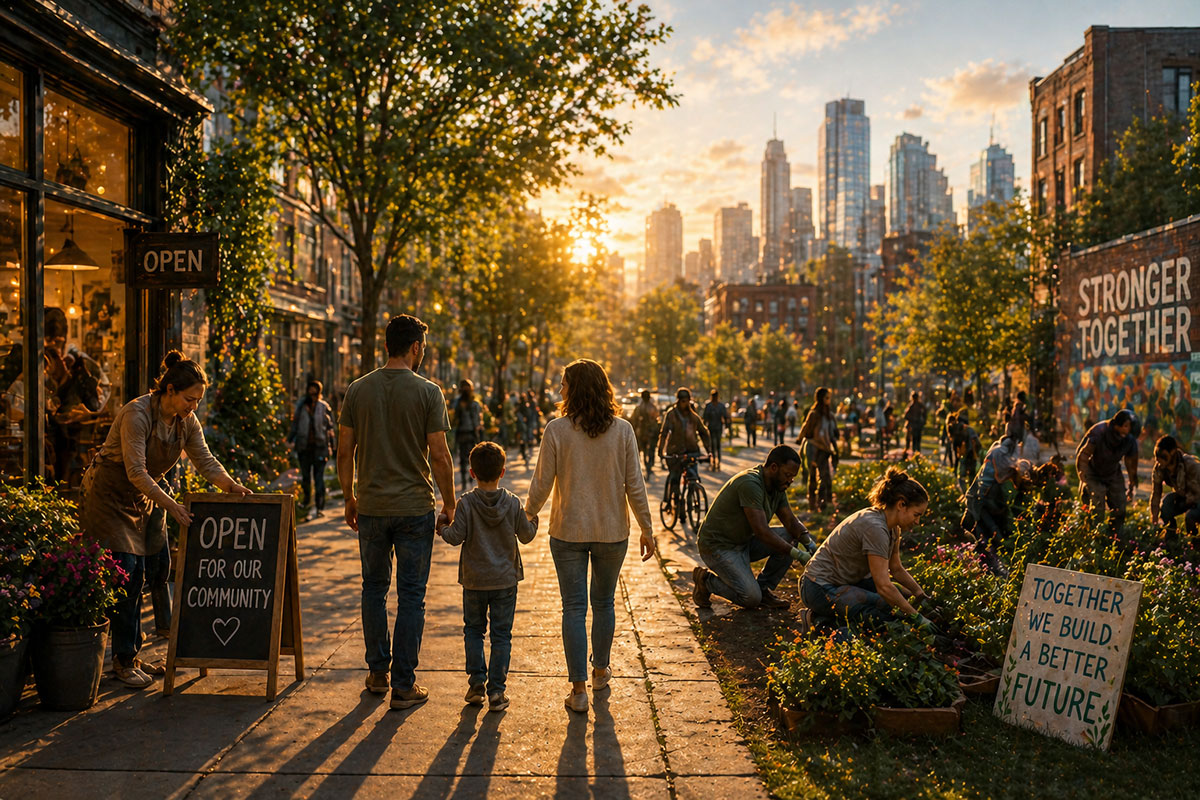
Opening — Jane Jacobs
After a crisis, people often want one thing above all: stability.
That desire is understandable. When trust has broken, when institutions have failed, when families and communities have lived under pressure, order can feel like mercy.
But a new High must be more than control.
It must restore trust without killing freedom. It must rebuild institutions without crushing local life. It must give people shared purpose without silencing conscience.
The question is not only what comes after the Fourth Turning.
The question is what kind of society deserves to come after it.
Question 1
What would a healthy post-crisis society look like?
Neil Howe:
After a Fourth Turning, society usually enters a new High. Institutions regain public confidence, civic life becomes stronger, and people accept shared rules again. The challenge is to make that unity wise rather than rigid.
Peter Drucker:
A healthy society is built on responsibility. Government, business, schools, families, churches, and local organizations each need a clear role. When every institution blames another, society weakens.
Martin Luther King Jr.:
A renewed society must be just, not merely orderly. Peace without justice is only quiet tension. A true new beginning must give dignity to those who were ignored before the crisis.
Alexis de Tocqueville:
The strength of America has often come from voluntary association—citizens forming groups, churches, charities, schools, and local efforts. A healthy future depends on people practicing freedom together.
Jane Jacobs:
Renewal begins where people live. Streets, neighborhoods, small businesses, sidewalks, parks, schools, and daily trust matter. A society cannot be healed only from the capital city.
Question 2
How can renewal avoid becoming rigid, conformist, or authoritarian?
Martin Luther King Jr.:
A society must never confuse unity with silence. Real peace includes moral tension. It allows protest, conscience, and truth to speak before order becomes oppression.
Alexis de Tocqueville:
Centralized authority grows tempting after chaos. People may surrender freedom for comfort. The defense against this is local participation, civic habits, and citizens who know how to govern themselves.
Peter Drucker:
Strong institutions must remain accountable. When organizations serve their own survival rather than human purpose, they become dangerous. Renewal must be measured by service, not scale.
Neil Howe:
A new High often brings confidence and conformity. That can stabilize society, but it can also suppress creativity and dissent. The memory of crisis must teach discipline without fear.
Jane Jacobs:
Healthy communities need messiness. People must be allowed to try, fail, argue, build, and adapt. Too much top-down order makes life look clean while draining it of intelligence.
Question 3
What must ordinary people build now so the next era begins stronger?
Peter Drucker:
Build competence. Learn useful skills. Create organizations that work. Raise children with responsibility. Renewal depends on people who can manage real tasks, not only express opinions.
Martin Luther King Jr.:
Build moral courage. The beloved community does not begin after the crisis ends. It begins when people choose love, justice, and truth in the middle of fear.
Alexis de Tocqueville:
Build civic habits. Join with others. Serve locally. Practice disagreement without hatred. Freedom weakens when citizens become spectators.
Neil Howe:
Build institutions worth trusting. Families, schools, local media, civic groups, and public systems must be repaired or remade. Criticism alone cannot carry the next era.
Jane Jacobs:
Build places where people meet face to face. A future cannot be held together by screens, slogans, and distant systems alone. Trust grows through repeated daily contact.
Closing — Jane Jacobs
A Fourth Turning may end with a reset, but renewal is not automatic.
A broken society can rebuild into fear.
It can rebuild into control.
It can rebuild into a shallow peace that hides old wounds.
Or it can rebuild into something wiser.
The new High should not be a return to the old normal. The old normal helped create the crisis.
A better future must be built from many small acts of responsibility: neighbors who know each other, institutions that serve, leaders who listen, families that endure, and citizens who refuse to give up on shared life.
After the reset, the real work begins.
Final Thoughts by Jane Jacobs
Crisis can give a society clarity.
It strips away illusions about what works, what matters, and what can no longer continue. It forces decisions that were delayed for years.
But clarity is only the beginning.
What follows can take very different forms.
A society may respond by tightening control, seeking safety above all else, and building systems that are strong but distant from everyday life.
Or it may respond by rebuilding trust—through institutions that serve, communities that function, and citizens who take responsibility for one another.
The difference is not abstract.
It appears in ordinary places:
- In neighborhoods where people know each other
- In schools that teach responsibility, not just information
- In local organizations that solve real problems
- In conversations that remain possible even when people disagree
A Fourth Turning does not end when the crisis fades.
It ends when people begin to trust again.
And that trust is not created by systems alone.
It is created by people who decide, in small ways, to rebuild a shared world.
Short Bios:
Leave a Reply