
What if Mel Robbins and leading voices on relationships revealed why chasing approval keeps us trapped?
Introduction by Mel Robbins
Why Trying to Control Others Keeps Us From Living Our Own Life
Most people do not call it control.
They call it caring.
They call it loyalty.
They call it effort.
They call it love.
They call it being responsible.
But underneath, many people are exhausted because they are trying to manage what was never theirs to manage.
They want someone to understand.
They want someone to apologize.
They want someone to choose them.
They want someone to notice their work.
They want family to approve.
They want friends to change.
They want partners to love them in exactly the way they need.
And when other people do not respond the way they hoped, life starts shrinking.
A person begins waiting.
Waiting for the text.
Waiting for the apology.
Waiting for the promotion.
Waiting for the approval.
Waiting for someone else to finally become the person they need them to be.
The Let Them Theory begins with a simple shift:
Let them.
Let people misunderstand you.
Let them judge you.
Let them leave you out.
Let them disappoint you.
Let them reveal who they are.
But this is not the end of the story.
The deeper part is:
Let me.
Let me choose peace.
Let me set the boundary.
Let me stop chasing.
Let me build confidence.
Let me grieve what I wanted.
Let me take responsibility for my own life.
This imaginary conversation brings together voices from psychology, relationships, purpose, habits, grief, ambition, and personal freedom. Together, they explore why human beings suffer so much when they try to control love, family, friendship, work, and approval.
The central question is not, “How do I make people change?”
The deeper question is:
What becomes possible when I stop abandoning myself to control someone else?
(Note: This is an imaginary conversation, a creative exploration of an idea, and not a real speech or event.)
Topic 1 - Let Them: The Freedom of Releasing Control

Participants
Mel Robbins, Brené Brown, Byron Katie, Ryan Holiday, Oprah Winfrey
Opening — Mel Robbins
Most people do not realize how much of their life is spent trying to manage other people.
We try to manage what they think.
We try to manage whether they like us.
We try to manage whether they approve, respond, stay, understand, apologize, or finally see our value.
And when they do not, we suffer.
We overexplain.
We chase.
We replay conversations.
We check our phones.
We wonder what we did wrong.
We try harder to get love, respect, attention, and certainty from people who may never give it the way we want.
The Let Them Theory starts with two simple words:
Let them.
Let them misunderstand you.
Let them leave.
Let them judge.
Let them choose differently.
Let them show you who they are.
But that is only half of it.
The second part is:
Let me.
Let me choose peace.
Let me stop chasing.
Let me tell the truth.
Let me set the boundary.
Let me build a life that does not depend on everyone’s approval.
Today we begin with the first and deepest question: why is it so hard to stop controlling other people, and what becomes possible when we finally do?
Question 1
Why do people exhaust themselves trying to control how others think, feel, choose, or respond?
Brené Brown
People try to control others when uncertainty feels unbearable.
If I can make you understand me, maybe I will not feel rejected.
If I can make you approve of me, maybe I will feel worthy.
If I can make you stay, maybe I will not have to face grief.
Control is often fear disguised as effort.
We call it care.
We call it loyalty.
We call it being responsible.
But underneath, we are often trying to avoid vulnerability.
The painful truth is that we cannot force real connection. We can only show up honestly, speak truthfully, and see what the other person does with that truth.
That is terrifying.
But that is where courage begins.
Ryan Holiday
The Stoics would say we suffer when we confuse what belongs to us with what does not.
Your actions belong to you.
Your words belong to you.
Your integrity belongs to you.
Your effort belongs to you.
Their response does not belong to you.
Their opinion does not belong to you.
Their maturity does not belong to you.
Their timing does not belong to you.
When we try to rule what belongs to another person, we enter a battle we cannot win.
Freedom begins when we return our energy to what is ours.
This does not mean we stop caring.
It means we stop assigning our peace to things we cannot command.
Oprah Winfrey
Many people are not really trying to control others.
They are trying to be seen.
They are saying, “Please recognize my value.”
“Please acknowledge my pain.”
“Please prove that I matter.”
“Please show me I am not easy to abandon.”
That longing is human.
But when your worth depends on someone else seeing clearly, you become trapped by their limits.
Some people cannot see you.
Some people will not see you.
Some people are too wounded to see anyone clearly.
Let them.
Your healing begins when you stop waiting for someone else to confirm what your soul already knows.
Byron Katie
The mind believes it knows what others should do.
He should call.
She should apologize.
They should understand.
My family should respect me.
My friend should care more.
Then we suffer.
Not because reality itself is unbearable, but because we are at war with reality.
The person did not call.
The apology did not come.
The family does not understand.
The friend does not care in the way you hoped.
When we argue with what is, we lose.
“Let them” is not weakness.
It is sanity.
It is the moment we stop fighting reality and begin meeting our own life.
Mel Robbins
The reason control is so addictive is that it gives the illusion of action.
Texting again feels like action.
Explaining again feels like action.
Checking again feels like action.
Trying harder feels like action.
But often, it is anxiety in motion.
The Let Them Theory interrupts that loop.
They did not invite you? Let them.
They are judging you? Let them.
They do not value your effort? Let them.
Then ask the real question:
What am I going to do now?
That question brings your energy back home.
Question 2
Is “let them” emotional maturity, or can it become avoidance?
Oprah Winfrey
It can be either.
Emotional maturity says, “I cannot control you, but I can be honest about what I need.”
Avoidance says, “I will pretend I do not care so I do not have to risk telling the truth.”
Those are very different.
“Let them” should never become a wall around the heart. It is not coldness. It is clarity.
You can say:
“I love you, and this hurts me.”
“I respect your choice, and I need distance.”
“I am no longer available for this pattern.”
That is not avoidance.
That is self-respect.
Brené Brown
Yes. “Let them” can become armor when people use it to avoid vulnerability.
“I do not care.”
“People are fake.”
“I am done with everyone.”
“They can do whatever they want.”
Sometimes that sounds strong, but it is really protection.
True letting go does not require pretending.
You may still feel hurt.
You may still grieve.
You may still want connection.
You may still wish things were different.
Emotional maturity is being able to say:
“This matters to me, and I still cannot control it.”
That is a braver place to stand.
Ryan Holiday
Avoidance is when we abandon our duty.
If a conversation must be had, have it.
If a boundary must be set, set it.
If an apology must be made, make it.
If a decision must be made, make it.
Stoicism is often mistaken for emotional detachment.
It is not detachment.
It is disciplined engagement with what is actually yours.
“Let them” does not excuse cowardice.
It asks: what is my role here?
Once you have acted with honesty, restraint, and courage, the rest is no longer yours to carry.
Byron Katie
Avoidance says, “I will not look.”
Freedom says, “I will look clearly.”
If someone hurts you and you say “let them” while secretly building a story—“They are cruel, I am unwanted, life is unfair”—the mind is still attached.
Letting them means seeing what happened without adding war to it.
They said no.
They left.
They disagreed.
They did not choose you.
Can you meet that without destroying yourself with the story?
That is not avoidance.
That is inquiry.
Mel Robbins
This is why I always say “let them” is only half the theory.
The second half is “let me.”
Let them be late. Let me decide whether I am waiting.
Let them gossip. Let me choose what I share.
Let them ignore my effort. Let me take my work somewhere it is valued.
Let them be emotionally unavailable. Let me stop begging for connection.
If you stop at “let them,” you might collapse into passivity.
The strength is in “let me.”
That is where responsibility begins.
Question 3
What changes inside a person when they stop chasing approval?
Ryan Holiday
They recover their attention.
Attention is life. What we attend to, we become.
When a person stops chasing approval, they can finally ask better questions.
What is worth doing?
What is honorable?
What is mine to build?
What does this moment require of me?
Approval is unstable.
Character is steadier.
A person who moves from approval to character becomes harder to manipulate.
They no longer need every room to clap before they know what matters.
Oprah Winfrey
They become available to their own life.
So much of life is missed when we are trying to be chosen.
You miss your own gifts.
You miss your own peace.
You miss the people who actually love you.
You miss the quiet voice inside saying, “This is not for you.”
When you stop chasing approval, you begin to hear yourself again.
You start asking:
What do I know?
What do I need?
What kind of life is calling me?
That is when life starts opening.
Byron Katie
They stop living in other people’s minds.
That is a very crowded place to live.
Do they like me?
Did I disappoint them?
Do they think I am good enough?
Will they finally understand?
When you return to your own business, there is space.
The breath.
The room.
The dishes.
The work.
The walk.
The present moment.
Approval is imagined safety.
Disapproval is imagined danger.
Peace is here.
Brené Brown
They develop belonging that is not purchased through performance.
Fitting in asks, “Who do you need me to be?”
Belonging says, “Here I am.”
When people stop chasing approval, they may lose some relationships. That can be painful.
But they gain integrity.
And integrity is where deeper belonging begins.
The people who can only love the edited version of you may not stay.
But the people who can meet the truthful version of you become much easier to recognize.
Mel Robbins
They stop waiting.
Waiting for permission.
Waiting for the apology.
Waiting for the invitation.
Waiting for someone to notice.
Waiting for someone to finally make them feel enough.
And they start moving.
Let them think what they think.
Let me take the class.
Let me write the book.
Let me leave the room.
Let me call the friend who actually shows up.
Let me stop abandoning myself for people who are not choosing me.
That is the freedom.
Not everyone will approve of your life.
Let them.
Then go live it.
Closing — Mel Robbins
The Let Them Theory is not about becoming cold.
It is about becoming free.
Free from chasing.
Free from overexplaining.
Free from needing everyone to understand.
Free from turning every rejection into a verdict on your worth.
But freedom does not mean you stop caring.
It means you stop controlling.
You let people reveal themselves.
You let reality become information.
You let disappointment show you where your energy belongs.
Then you say the words that bring your life back to you:
Let me.
Let me choose peace.
Let me honor my values.
Let me stop abandoning myself.
Let me build a life that does not require everyone’s approval.
That is where control ends.
And that is where life begins.
Topic 2 Relationships: When Love Becomes Control

Participants
Mel Robbins, Esther Perel, John Gottman, bell hooks, Gary Chapman
Opening — Esther Perel
Love often begins with wonder.
We meet another person and feel drawn to their mystery.
Their mind. Their voice. Their past. Their desire. Their way of seeing the world.
But somewhere along the way, mystery can turn into anxiety.
We no longer want to know them.
We want to manage them.
We want them to text at the right time, love in the right language, heal at the right speed, commit in the right way, and reassure us before we ever feel afraid.
This is where love begins to tighten.
Control often enters relationships disguised as care.
“I only want what is best for you.”
“I just need to know where this is going.”
“I am only asking because I love you.”
But love cannot breathe where one person is always trying to edit the other.
Today we ask: when does love become control, and can intimacy survive when we finally let another person be who they are?
Question 1
When does caring for someone cross into managing them?
Mel Robbins
Caring becomes managing when your peace depends on their behavior.
You are not just expressing love anymore. You are trying to reduce your own anxiety by controlling what they do.
You want them to call so you can feel secure.
You want them to change so you can feel hopeful.
You want them to understand so you can stop hurting.
That is human. I want to be clear about that. Everyone does this at some point.
But the moment you realize, “I am spending all my energy trying to get this person to become who I need them to be,” that is your signal.
Let them be who they are.
Then let me decide what I am available for.
That second part matters.
You do not let someone disrespect you and call it peace. You let them reveal their character, then you choose your boundary.
John Gottman
In relationships, caring becomes managing when influence turns into pressure.
Healthy couples influence each other all the time. They ask, they request, they share needs, they make bids for connection.
That is normal.
But when one partner cannot accept the other’s separate inner life, the relationship becomes strained.
A person may say, “I am trying to help,” but underneath there is criticism:
“You are not enough as you are.”
“You must become different before I can love you.”
“You must respond correctly before I can calm down.”
That creates defensiveness.
Stable love requires room for difference. Partners need to feel that they can be known without being corrected at every turn.
bell hooks
We must be careful with the word love.
Many people call control love because they were taught that possession is love.
Jealousy becomes love.
Monitoring becomes love.
Emotional pressure becomes love.
Sacrifice without respect becomes love.
But love is not domination.
Love is an action rooted in care, respect, responsibility, knowledge, and trust.
If I say I love you but I do not respect your freedom, then I am not practicing love. I am practicing attachment, fear, or ownership.
Caring crosses into managing when we stop honoring the other person’s humanity.
A beloved is not an object to arrange.
Gary Chapman
People often manage each other when they do not feel loved in the way they understand love.
One partner may need words of affirmation, but the other shows love through acts of service. One may need quality time, but the other thinks providing financially should speak for itself.
Then hurt grows.
Instead of saying, “I do not feel loved,” people say, “You never do anything right.”
That is where caring becomes managing.
A healthier path begins with clarity.
“This is how I receive love.”
“This is what helps me feel close to you.”
“This is what hurts me.”
But after we express that clearly, we cannot force the other person to respond.
We can invite love. We cannot manufacture it.
Esther Perel
Control often appears when desire meets fear.
We desire closeness, but fear abandonment.
We desire honesty, but fear what truth may reveal.
We desire commitment, but fear being trapped.
So we try to manage the uncertainty.
Who did you talk to?
What did you mean by that?
Why did you not answer sooner?
Do you still love me?
Sometimes these are valid questions. But when questions become surveillance, love becomes a courtroom.
The other person is no longer a partner. They become a suspect.
Intimacy needs honesty, yes. But it also needs space.
Without space, there is no desire. There is only compliance.
Question 2
How do we let someone be themselves without accepting disrespect?
bell hooks
Letting someone be themselves does not mean surrendering your dignity.
This is where many people misunderstand freedom.
To love someone is to see them clearly. If they are cruel, careless, dishonest, or emotionally unavailable, we do not have to rename that as “their truth” and endure it.
We can say:
“I see who you are choosing to be.”
“I will not control you.”
“I will not stay where love is not practiced.”
That is not punishment.
That is self-love.
Love and boundaries belong together. Without boundaries, love becomes self-abandonment.
Mel Robbins
This is exactly why “let them” is only half the theory.
Let them cancel again.
Let them speak to you that way.
Let them avoid the hard conversation.
Let them keep choosing the same pattern.
Then let me decide what happens next.
Let me leave the room.
Let me stop begging.
Let me stop explaining basic respect.
Let me choose people who choose me back.
The theory is not saying, “Put up with it.”
It is saying, “Stop fighting reality.”
If someone keeps showing you they are not willing to love you well, believe the evidence.
John Gottman
Respect is measurable in ordinary moments.
It is not only about major betrayal or dramatic conflict.
Respect appears in tone of voice, willingness to repair, attention to bids for connection, and the ability to accept influence from a partner.
When contempt enters a relationship, the bond is in danger.
Eye-rolling, mockery, superiority, name-calling, dismissiveness—these are not personality quirks. They are corrosive.
Letting someone be themselves does not mean tolerating contempt.
A healthy relationship allows difference, but it does not normalize degradation.
The question is not, “Can I change this person?”
The question is, “Can this relationship support mutual respect?”
Gary Chapman
A boundary should be spoken with firmness and love when possible.
For example:
“I love you, but I will not continue this conversation if you insult me.”
“I want this relationship, but I need honesty.”
“I am willing to work on this, but I cannot be the only one trying.”
That gives the other person a chance to respond.
But a boundary without action is only a wish.
If the behavior continues, the boundary must become real.
Love does not mean endless tolerance. Love tells the truth.
Esther Perel
A relationship requires both acceptance and negotiation.
There are things we must accept: temperament, history, difference, imperfection.
There are things we must negotiate: time, trust, sexuality, money, conflict, emotional safety.
And there are things we must not accept: humiliation, coercion, violence, repeated betrayal without repair.
“Let them” helps us stop trying to force transformation.
But it does not remove discernment.
In mature love, we do not ask, “How can I make you become who I need?”
We ask, “Can we create a relationship where both of us can remain whole?”
Question 3
What does secure love look like when neither person is chasing control?
John Gottman
Secure love looks calm, but not lifeless.
There is conflict, but conflict does not threaten the existence of the relationship.
Partners can say:
“I am upset.”
“I need something different.”
“I disagree.”
“I need comfort.”
“I made a mistake.”
And the relationship can hold it.
Neither person has to win every moment. Neither person has to disappear.
Secure love is built through thousands of small moments where partners turn toward each other.
It is not perfect harmony.
It is reliable repair.
Gary Chapman
Secure love is expressed in a language the other person can receive.
It is not enough to say, “They should know I love them.”
Love becomes secure when it is practiced in daily form.
Words of affirmation.
Quality time.
Acts of service.
Gifts.
Physical touch.
But this must be freely given, not demanded through fear.
When love languages become control, they sound like accusation:
“If you loved me, you would…”
When they become connection, they sound like invitation:
“This helps me feel close to you.”
That difference matters.
Mel Robbins
Secure love feels like you can stop auditioning.
You do not have to perform to keep them interested.
You do not have to shrink to keep them comfortable.
You do not have to chase basic communication.
You do not have to become someone else to be chosen.
And they do not have to do that for you either.
That is the freedom.
Let them have their mood.
Let them have their preferences.
Let them have their own growth process.
Let me stay honest about what I need.
Secure love is not two people controlling each other.
It is two people choosing each other without abandoning themselves.
bell hooks
Secure love is rooted in freedom.
Not the freedom to neglect each other.
Not the freedom to harm without consequence.
The freedom to be fully human.
To speak truth.
To grow.
To disagree.
To be seen in weakness.
To be accountable without being shamed.
Love is not merely a feeling. It is a practice.
Where there is domination, love is absent.
Where there is mutual care, trust, responsibility, respect, and knowledge, love can deepen.
To let someone be themselves is not to love less.
It may be the first act of real love.
Esther Perel
Secure love contains both closeness and separateness.
Many people want intimacy to erase distance. But desire needs distance. Curiosity needs distance. Growth needs distance.
I can love you and not own you.
I can choose you and still remain myself.
I can trust you without monitoring you.
I can miss you without panicking.
This is mature intimacy.
Two people stand near each other, not on top of each other.
They do not use love to imprison. They use love to become more alive.
Closing — Esther Perel
Love becomes control when fear takes over the relationship.
Fear of abandonment.
Fear of betrayal.
Fear of not being enough.
Fear that if we stop managing the other person, everything will fall apart.
But control does not create intimacy.
It creates tension, performance, resentment, and distance.
The Let Them Theory invites us into a harder and more honest form of love.
Let them be who they are.
Not who we hope they will become.
Not who they promised to be.
Not who we could make them become if we tried hard enough.
Then we must ask the deeper question:
Can I love this person as they are, without losing myself?
Sometimes the answer is yes, and love becomes freer.
Sometimes the answer is no, and leaving becomes an act of truth.
Either way, love matures when control ends.
Because real love does not say, “Become mine.”
Real love says, “Be real with me, and I will be real with you.”
Topic 3 - Friendship, Family, and the Pain of Being Misunderstood

Participants
Mel Robbins, Nedra Glover Tawwab, Susan Cain, Glennon Doyle, Maya Angelou
Opening — Maya Angelou
There is a special kind of pain that comes from being misunderstood by the people who know your name.
A stranger may misjudge you, and it stings.
A critic may dismiss you, and it hurts.
But when family, old friends, or the people who once held your heart refuse to see you clearly, the wound reaches deeper.
It says, “If they do not understand me, who will?”
But we must be careful.
Being misunderstood does not mean you are lost.
Being judged does not mean you are wrong.
Being unseen by one person does not mean you are invisible.
Sometimes the greatest freedom in life begins when we stop begging certain people to understand the person we are becoming.
Today, we ask what it means to let people misunderstand us, disappoint us, and still keep our dignity.
Question 1
Why does family judgment hurt more than criticism from strangers?
Nedra Glover Tawwab
Family judgment hurts deeply because family is often where we first learned who we were allowed to be.
In many families, love came with roles.
Be the responsible one.
Be the quiet one.
Be the successful one.
Be the one who never causes trouble.
Be the one who keeps everyone comfortable.
So when you start growing, setting boundaries, or making different choices, the family may react as if you are breaking a contract.
But many of those contracts were never spoken.
And many were never fair.
The pain comes from wanting approval from the same system you are trying to outgrow.
That is why “let them” matters.
Let them have their reaction.
Let them prefer the old version of you.
Let them misunderstand your boundary.
Then let me stop shrinking to keep my role.
Susan Cain
Family judgment hurts because it reaches the private self.
Strangers judge the public version of us. Family judges from memory.
They remember who we were at twelve, at fifteen, at twenty. They remember our awkwardness, our failures, our old patterns.
Sometimes they cannot see that we have changed because they are still relating to an earlier version of us.
For quieter, sensitive, or introverted people, this can be especially painful. They may have spent years adapting to family expectations, hiding parts of themselves to avoid conflict.
When they finally reveal who they are, they may hope for relief.
Instead, they are told, “You have changed.”
And the truth may be: yes, I have.
That does not mean I have betrayed you.
It may mean I have finally met myself.
Glennon Doyle
Family judgment hurts because we were trained to believe belonging means obedience.
Be good.
Be pleasant.
Be easy.
Be grateful.
Do not make anyone uncomfortable.
Then one day your soul says, “I cannot do this anymore.”
You tell the truth. You set the boundary. You choose the life that is actually yours.
And people say, “What happened to you?”
What happened is that you came back to yourself.
The pain is real because you may lose the comfort of being approved.
But sometimes the price of being approved is self-betrayal.
Let them be uncomfortable.
Let me be free.
Mel Robbins
This hits people so hard because family knows exactly where the buttons are.
One comment from a parent can send you right back to being a kid.
One look from a sibling can make you feel twelve again.
One family gathering can undo years of confidence if you are not grounded.
That is why you need a plan.
Do not walk into family dynamics expecting them to be different if they have shown you the same pattern for years.
Let them say what they say.
Then let me decide before I go in:
How long am I staying?
What topics are off limits?
What will I say if someone crosses a line?
How will I take care of myself afterward?
You do not need their permission to protect your peace.
Maya Angelou
Family pain often carries the ache of old longing.
We do not only want them to approve of today’s choice. We want them to repair yesterday’s wound.
We want the mother to finally say, “I saw how hard it was.”
We want the father to finally say, “I am proud.”
We want the sibling to say, “I understand now.”
We want the family to become the home we needed.
Sometimes that happens.
Sometimes it does not.
There is grief in accepting that.
But child, you can build a life where love does not require you to disappear.
Question 2
What boundaries are needed when “let them” means letting people disappoint us?
Mel Robbins
The first boundary is emotional.
You have to stop going to people for things they have repeatedly shown you they cannot give.
Stop going to the emotionally unavailable person for empathy.
Stop going to the critical person for encouragement.
Stop going to the chaotic person for stability.
Stop going to the person who gossips for safety.
Let them be limited.
Then let me go somewhere else for what I need.
That does not mean you hate them. It means you are done placing your heart in a place that keeps dropping it.
Nedra Glover Tawwab
Boundaries must be clear, specific, and repeatable.
People often say, “I need you to respect me,” but the other person may not know what that means, or may pretend not to know.
A clearer boundary sounds like:
“I am not discussing my marriage at dinner.”
“If you raise your voice, I will end the call.”
“I will visit for two hours, not the whole weekend.”
“I will not lend money again.”
Then comes the difficult part: follow-through.
A boundary without follow-through teaches people that your words are flexible.
“Let them” means you do not control their reaction.
“Let me” means you control your access, time, energy, and participation.
Susan Cain
For many people, especially those who dislike conflict, the most needed boundary is space.
Not every boundary needs a speech.
Sometimes the boundary is fewer visits.
Sometimes it is answering later.
Sometimes it is leaving a group chat.
Sometimes it is choosing not to share vulnerable news with people who cannot hold it kindly.
Quiet boundaries are still boundaries.
We often imagine boundaries as confrontation, but many boundaries are simply architecture.
You build a life with rooms that protect what is tender.
Glennon Doyle
The hardest boundary is the one that disappoints people.
Many of us are willing to set boundaries only if everyone understands and applauds them.
That is not a boundary. That is a group project.
A real boundary often comes with protest.
People may call you selfish.
They may say you are too sensitive.
They may rewrite the story.
Let them.
Your job is not to manage the public relations campaign around your healing.
Your job is to stay true to what you know.
If the old version of you was built to keep everyone else comfortable, the new version of you will look like a problem.
Be the problem.
Maya Angelou
A boundary is a way of saying, “I am also one of God’s children.”
It is not a weapon. It is a door.
Some may enter with respect.
Some may stand outside and shout.
Some may walk away.
Let them.
You do not have to open your home, your heart, or your history to everyone who demands entry.
Love can be generous, but it must not be careless with the soul.
Question 3
How can someone grieve the family or friendship they wished they had?
Susan Cain
Grief begins with admitting the truth quietly.
“This relationship may never become what I hoped.”
That sentence can be devastating.
Many people stay trapped not by the relationship as it is, but by the imagined relationship that might happen someday.
The friend who finally shows up.
The parent who finally understands.
The sibling who finally apologizes.
Hope can be beautiful, but it can also delay grief.
To grieve does not mean to stop loving.
It means to stop living inside a fantasy that keeps injuring you.
Maya Angelou
You grieve by telling the truth without letting bitterness become your home.
Yes, they failed you.
Yes, they may not have known how to love you.
Yes, you deserved tenderness you did not receive.
Say it.
But do not let their inability become the measure of your lovability.
There are people who will meet you with gentleness.
There are rooms where you will not have to beg to be understood.
There is a life waiting beyond the door of old disappointment.
Grief is not the end of love.
Sometimes grief is the bridge to a truer love.
Nedra Glover Tawwab
Grieving a relationship often requires changing your expectations.
If someone can only offer a ten-minute surface-level conversation, stop expecting emotional depth.
If a friend only calls when they need something, stop expecting mutual care.
If a parent cannot take accountability, stop returning to that conversation hoping this time will be different.
This is painful, but it is also freeing.
You can decide what kind of relationship is possible based on reality, not longing.
Sometimes the healthiest relationship is smaller than the one you wanted.
Smaller can still be peaceful.
Glennon Doyle
There is a holy grief in choosing yourself.
People think freedom feels like fireworks. Sometimes it feels like sobbing in your car after you leave the family gathering early.
It feels like missing the people who hurt you.
It feels like wanting to call the friend you know cannot hold your truth.
It feels like saying, “I love you, and I cannot keep abandoning myself for you.”
That grief does not mean you made the wrong choice.
It means you are human.
Keep going.
You are not losing love. You are losing the version of love that required you to vanish.
Mel Robbins
The practical part is this: build replacement support.
Do not just grieve what you did not get. Create what you need now.
Find the friend who can actually listen.
Find the therapist.
Find the community.
Find the mentor.
Find the people who make your nervous system exhale.
And stop testing the same people.
If someone has failed the same emotional exam ten times, stop handing them the test.
Let them be who they are.
Let me build the support system I deserve.
That is how you move forward.
Closing — Maya Angelou
To be misunderstood by family or friends can feel like exile.
But sometimes exile becomes the road back to your own soul.
You may have spent years translating yourself into a language others would accept.
You may have softened your truth, hidden your needs, laughed off your pain, and called it peace.
But peace that requires self-erasure is not peace.
Let them misunderstand.
Let them judge.
Let them prefer the version of you that asked for less.
Then let yourself live.
Let yourself grieve what was missing.
Let yourself protect what is tender.
Let yourself find people who do not require you to disappear to belong.
The family you wished for may never fully arrive.
The friendship you hoped for may not become what you wanted.
But love is larger than the places that failed to hold you.
And your life is still yours.
Topic 4 - Work, Ambition, and the Need to Prove Yourself

Participants
Mel Robbins, Adam Grant, Simon Sinek, James Clear, Sheryl Sandberg
Opening — Adam Grant
Work can give people meaning.
It can give structure to the day, dignity to effort, and a sense that our abilities matter somewhere beyond ourselves.
But work can also become a theater of approval.
We begin by wanting to contribute.
Then we want to be noticed.
Then we want to be respected.
Then we want to be impossible to ignore.
And before we know it, ambition stops being about service, craft, or growth. It becomes a desperate attempt to prove that we are enough.
The Let Them Theory enters this space with a difficult invitation.
Let them underestimate you.
Let them overlook you.
Let them promote someone else.
Let them misunderstand your value.
Then ask:
Let me do what with this information?
Let me improve.
Let me speak up.
Let me leave.
Let me build something of my own.
Let me stop measuring my worth through people who may never see it.
Today, we ask what ambition becomes when we stop chasing approval and start choosing meaningful work from a freer place.
Question 1
Why do careers make people so dependent on external validation?
Sheryl Sandberg
Careers make validation visible.
Titles are visible.
Promotions are visible.
Raises are visible.
Praise from leadership is visible.
Being invited into the room is visible.
So people start reading those signals as proof of value.
If I get chosen, I matter.
If I am promoted, I am respected.
If I am praised, I am safe.
If I am ignored, maybe I am falling behind.
This is especially intense for people who already feel they have to prove they belong. Women, minorities, first-generation professionals, immigrants, caregivers returning to work, people changing careers—many enter the workplace carrying invisible pressure.
So when they are overlooked, it does not feel like a neutral business decision. It can feel personal.
That is why “let them” is not easy at work.
But it is necessary.
Let them make their decision.
Then let me decide whether this room deserves my best energy.
Simon Sinek
Careers become validation traps when people forget the difference between achievement and purpose.
Achievement says, “I reached the target.”
Purpose says, “This is why the target matters.”
If people do not have a clear sense of why they are doing the work, then recognition becomes the substitute.
The applause becomes the meaning.
That is dangerous, because applause is unreliable. It depends on timing, politics, personalities, budgets, market cycles, and other people’s insecurities.
A person rooted in purpose still wants recognition. We are human. But they are not owned by it.
They can ask:
Did this work serve the mission?
Did I grow?
Did I help the people I said I cared about?
That gives ambition a healthier center.
James Clear
External validation is addictive because it gives quick feedback.
You get the compliment.
You see the metric.
You get the email.
You get the promotion.
The brain likes that.
But meaningful progress is often delayed. You may practice a skill for months before anyone notices. You may make better decisions long before results show up.
This is why systems matter.
If your entire work identity depends on outcomes, you will feel unstable. Outcomes are late and often outside your control.
But if you build a system around the kind of professional you want to become, you create steadier motivation.
Let them notice or not notice.
Let me keep the habit.
That is how small actions become real confidence.
Mel Robbins
Work is one of the easiest places to hand away your power.
You wait for the boss to notice.
You wait for the client to praise you.
You wait for the team to appreciate you.
You wait for the market to validate your idea.
And waiting feels responsible, but sometimes it is just fear.
Here is the truth: people are busy. People are biased. People are distracted. People miss things.
Let them.
Then let me advocate for myself.
Let me document my wins.
Let me ask for the raise.
Let me build skills.
Let me stop expecting silent excellence to be magically rewarded.
You can release control and still take action.
That is the point.
Adam Grant
We become dependent on validation when feedback becomes identity.
Feedback should be information.
Too often, we treat it as a verdict.
A rejection says, “This proposal did not land.”
But we hear, “I am not talented.”
A promotion goes to someone else.
We hear, “I am invisible.”
A colleague criticizes one decision.
We hear, “I am failing.”
The antidote is psychological flexibility.
Let feedback teach you without defining you.
External validation can guide growth, but it should never become the foundation of self-worth.
Question 2
How do we stay ambitious without becoming addicted to recognition?
James Clear
The key is to fall in love with the process, not just the reward.
If you only love the recognition, you will struggle whenever recognition disappears.
But if you love the daily act of getting better, you become harder to discourage.
A writer writes when no one is clapping.
An entrepreneur improves the offer before anyone buys.
A leader practices better listening before the culture changes.
A builder shows up before the results look impressive.
Recognition is a lagging indicator.
Identity comes first.
Ask, “What would the kind of person I want to become do today?”
Then do that.
Simon Sinek
Ambition becomes unhealthy when it is only self-referential.
“How do I win?”
“How do I get seen?”
“How do I become more important?”
Those questions shrink people.
Healthy ambition asks a broader question:
“Who is served by my growth?”
When ambition is connected to service, it becomes more durable.
A person can work hard without being consumed by ego. They can want excellence without needing superiority.
The goal is not to stop wanting success.
The goal is to connect success to contribution.
Sheryl Sandberg
One practical way to avoid recognition addiction is to define success before others define it for you.
What do I want to learn this year?
What kind of leader do I want to become?
What trade-offs am I willing to make?
What trade-offs am I not willing to make?
If you do not define that, the workplace will define it for you.
More hours.
More status.
More visibility.
More availability.
More sacrifice.
Ambition needs boundaries.
Without boundaries, ambition can become self-erasure with a better title.
Mel Robbins
You stay ambitious by telling yourself the truth.
Do I want this because it matters to me?
Or because I want someone to finally say I am enough?
That question will sting.
A lot of people are not chasing the promotion. They are chasing the parent who never praised them.
They are not chasing the title. They are chasing the ex who doubted them.
They are not chasing the audience. They are chasing proof that rejection did not break them.
Let them doubt you.
But do not build your entire life as a response to their doubt.
Let me build from desire, not revenge.
That is a very different life.
Adam Grant
Ambition stays healthy when it includes learning goals, not only performance goals.
Performance goals ask, “Did I win?”
Learning goals ask, “Did I improve?”
Performance goals are not bad. They help us aim.
But if they are the only goals, people become fragile. Every setback feels like a personal collapse.
Learning goals create resilience.
What did I learn from this pitch?
What skill did this failure expose?
What experiment can I run next?
That keeps ambition alive without making recognition the only fuel.
Question 3
What does real confidence look like when applause disappears?
Simon Sinek
Real confidence is quiet alignment.
It says, “I know why I am here. I know what I stand for. I know who I am trying to serve.”
Applause may come. It may not.
But the person remains oriented.
This does not mean they never feel doubt. Confidence is not the absence of doubt. It is the ability to move with doubt without letting it become the leader.
When applause disappears, purpose becomes audible again.
If there is no purpose, silence feels terrifying.
If purpose is present, silence becomes space to keep building.
Mel Robbins
Real confidence is what you do after no one claps.
Do you keep going?
Do you learn?
Do you rest instead of quitting?
Do you try again without making rejection mean you are worthless?
Confidence is not a personality trait. It is a relationship with yourself.
Every time you say, “I am going to do this,” and then you do it, you build trust with yourself.
That is confidence.
Let them ignore it.
Let me keep the promise I made to myself.
Sheryl Sandberg
When applause disappears, real confidence can ask for help without shame.
Many people think confidence means never needing support. That is not confidence. That is isolation dressed up as strength.
Confident people can say:
“I need feedback.”
“I need mentorship.”
“I do not know how to do this yet.”
“I want to grow.”
They do not confuse learning with weakness.
Workplaces need more people who can be both ambitious and teachable.
That combination is powerful.
James Clear
Real confidence is evidence-based.
You do not have to hype yourself up if you have proof that you show up.
The proof can be small.
I practiced today.
I made the call.
I wrote the page.
I improved the offer.
I handled the hard conversation.
I stayed consistent when it was boring.
Confidence comes from accumulated evidence.
Applause is borrowed evidence from other people.
Habits are personal evidence you can keep.
Adam Grant
Real confidence includes humility.
False confidence says, “I am always right.”
Real confidence says, “I can learn what I do not yet know.”
That matters when applause disappears because people who need constant praise often stop learning. They avoid feedback that threatens their self-image.
Confident humility allows someone to say:
“I have value, and I have room to grow.”
That is the healthiest professional identity I know.
Not dependent. Not arrogant. Open.
Closing — Adam Grant
Work can be a place where people discover what they are capable of.
It can also become a place where people endlessly audition for worth.
The Let Them Theory gives us a way out of that trap.
Let them overlook you.
Let them doubt you.
Let them misunderstand your work.
Let them reward someone else.
Let them reveal the culture of the room.
Then ask the question that returns agency:
Let me do what now?
Let me speak up.
Let me improve my craft.
Let me ask directly.
Let me build proof.
Let me find better rooms.
Let me stop turning every workplace signal into a verdict on my identity.
Ambition does not need to disappear.
It needs to be purified.
Less proving.
More purpose.
Less chasing.
More craft.
Less approval addiction.
More self-trust.
The goal is not to stop caring about success.
The goal is to stop letting success decide whether you are worthy.
That is where work becomes freer.
And that is where ambition can finally breathe.
Topic 5 - Let Me: Taking Back Responsibility for Your Own Life

Participants
Mel Robbins, Viktor Frankl, Martha Beck, Jay Shetty, Elizabeth Gilbert
Opening — Mel Robbins
“Let them” sounds simple.
Let them judge.
Let them leave.
Let them doubt you.
Let them misunderstand.
Let them make their own choices.
But the real work begins after that.
Because once you stop trying to control everyone else, you are left with the part that belongs to you.
Your choices.
Your habits.
Your boundaries.
Your healing.
Your next move.
That is where “let me” begins.
Let me stop chasing.
Let me tell the truth.
Let me choose peace.
Let me walk away when I need to.
Let me build the life I keep waiting for someone else to give me.
Today we ask: what happens when a person stops blaming others for their peace and begins taking responsibility for their own life?
Question 1
After saying “let them,” what does “let me” require from us?
Viktor Frankl
“Let me” requires the recognition that freedom is never separate from responsibility.
A person may not control every condition of life. They may be wounded by others. They may be betrayed, rejected, limited, or misunderstood.
Yet within every situation, there remains a space in which one can choose one’s attitude, one’s response, one’s next act.
“Let them” releases the illusion that others must change before I can live.
“Let me” accepts the burden and dignity of response.
Let me choose who I become in relation to what has happened.
This is not easy. But without responsibility, freedom becomes empty.
Martha Beck
“Let me” requires honesty with the body.
Your mind can lie for years.
Your body rarely does.
You say, “I am fine,” but your chest tightens.
You say, “I should stay,” but your energy disappears.
You say, “This is the responsible path,” but your inner life feels smaller every day.
“Let me” begins when you stop overriding the quiet truth inside you.
Let me notice what drains me.
Let me notice what feels true.
Let me stop living from obligation when my soul is begging for alignment.
A truthful life often begins as a very small physical sensation: relief.
Follow the relief.
Jay Shetty
“Let me” requires discipline.
Many people love the idea of freedom, but they do not love the daily practice that makes freedom possible.
Let me protect my morning.
Let me pause before reacting.
Let me stop scrolling through what hurts me.
Let me choose friends who grow me.
Let me speak kindly to myself.
Let me train my mind.
We cannot control other people, but we can train our attention.
The mind that chases everyone else’s opinion will never feel peaceful.
Responsibility means choosing where your attention lives.
Elizabeth Gilbert
“Let me” requires permission.
Not permission from the world. Permission from yourself.
Let me want what I want.
Let me create badly before I create well.
Let me disappoint people.
Let me begin again.
Let me be a beginner without making it a tragedy.
Many people are waiting for someone to hand them a slip that says, “You may now live.”
It is not coming.
You write it yourself.
And sometimes you write it with shaking hands.
Mel Robbins
“Let me” requires action.
This is where people get stuck.
They say, “I let them.”
But then they sit there staring at the closed door.
No. Now it is your turn.
Let me update the resume.
Let me call the therapist.
Let me stop texting first.
Let me go for the walk.
Let me set the boundary.
Let me open the laptop and start.
Peace is not a mood you wait for.
It is a choice you practice through action.
Question 2
Why is personal freedom frightening when we can no longer blame others?
Elizabeth Gilbert
Freedom is frightening because blame is strangely comforting.
If my life is stuck because of them, then I do not have to move.
My parents did this.
My ex did that.
My boss never saw me.
My friends abandoned me.
Some of that may be true. It may be painfully true.
But after a while, blame becomes a locked room.
It explains the prison, but it does not open the door.
Freedom asks, “Now what?”
That question can feel merciless.
But it can also save your life.
Viktor Frankl
Blame may describe causality, but it cannot create meaning.
A person may say, “This is why I suffer.” That may be correct.
But meaning asks a different question:
“What is life asking of me now?”
This question does not deny injustice. It does not excuse harm. It does not erase grief.
It places the human being back into relationship with the future.
One may not be responsible for the wound.
But one becomes responsible for the direction of one’s life after the wound.
That responsibility can be terrifying.
It is also the root of dignity.
Martha Beck
Freedom is frightening because it removes the script.
Many people live according to scripts they did not write.
Be successful.
Be nice.
Stay small.
Do not upset anyone.
Make the family proud.
Look normal.
When those scripts fall away, people often feel lost.
They say, “I do not know who I am.”
Good.
That means the false self is loosening.
The real self often appears first as confusion.
You do not need to know the whole path. You only need to take the next honest step.
Jay Shetty
Blame gives the mind an enemy.
Freedom gives the mind a mirror.
That is why it is hard.
When we stop saying, “They made me this way,” we must ask, “What pattern am I repeating? What habit am I feeding? What thought am I believing?”
This takes humility.
But it is not self-attack.
Responsibility is not saying, “Everything is my fault.”
Responsibility says, “My healing is now in my hands.”
That shift changes everything.
Mel Robbins
Freedom is scary because it means you cannot wait anymore.
You cannot wait for the apology.
You cannot wait for the perfect timing.
You cannot wait for everyone to agree.
You cannot wait until you feel confident.
You have to move before you feel ready.
That is why “let me” is so powerful.
Let me be scared and still make the call.
Let me be uncertain and still take the step.
Let me be hurt and still choose not to hurt myself more.
Blame keeps you looking backward.
Responsibility turns you around.
Question 3
What kind of person emerges when they stop controlling others and start leading themselves?
Jay Shetty
A peaceful person emerges.
Not a passive person.
Not a detached person.
A peaceful person.
This kind of person knows the difference between reaction and response.
They do not need to win every argument.
They do not need to correct every misunderstanding.
They do not need to be seen by everyone.
They protect their energy because they understand that energy is sacred.
They choose their words, their company, their habits, and their silence with care.
That is self-leadership.
Martha Beck
A truer person emerges.
They may look less impressive at first.
They may quit what once gave them status.
They may say no to what once made them useful.
They may disappoint people who benefited from their self-betrayal.
But inside, they become lighter.
They laugh more honestly.
They rest more deeply.
They create more freely.
They stop negotiating with their own soul.
That is the person who was waiting underneath all the performance.
Elizabeth Gilbert
A creative person emerges.
I do not only mean an artist. I mean someone who realizes life can be made.
They stop asking, “Who will allow me?”
They start asking, “What can I make from what is here?”
A friendship.
A morning ritual.
A business.
A book.
A home.
A second chance.
A quieter life.
A braver one.
Once you stop using other people’s reactions as a cage, your imagination returns.
You become available to possibility again.
Viktor Frankl
A responsible person emerges.
This person is not free from suffering.
No human being is.
But they are no longer only acted upon by life. They answer life.
They understand that each moment contains a question, and their conduct is the answer.
They stop asking only, “What do I want from life?”
They begin asking, “What does life ask from me?”
This is the transformation from victimhood into moral agency.
It is one of the deepest forms of human freedom.
Mel Robbins
The person who emerges is someone you can trust.
You trust yourself to leave when something is wrong.
You trust yourself to speak when something matters.
You trust yourself to recover when someone disappoints you.
You trust yourself to keep promises to yourself.
That is the real win.
The goal is not to become someone nobody can hurt.
The goal is to become someone who no longer abandons themselves when hurt happens.
Let them live their life.
Let me live mine.
That is where everything changes.
Closing — Mel Robbins
At the beginning, “let them” feels like losing control.
But over time, you realize it was never your control to begin with.
You could not control their opinion.
You could not control their timing.
You could not control their maturity.
You could not control their love.
You could not control whether they chose you.
But you can choose yourself.
That is the heart of “let me.”
Let me take responsibility for my peace.
Let me stop blaming people who will not change.
Let me build habits that support the life I want.
Let me grieve what did not happen.
Let me create what can still happen.
Let me become the person I keep waiting for someone else to rescue.
This is not coldness.
It is ownership.
The Let Them Theory begins by releasing other people.
But it ends by returning you to yourself.
Final Thoughts by Mel Robbins
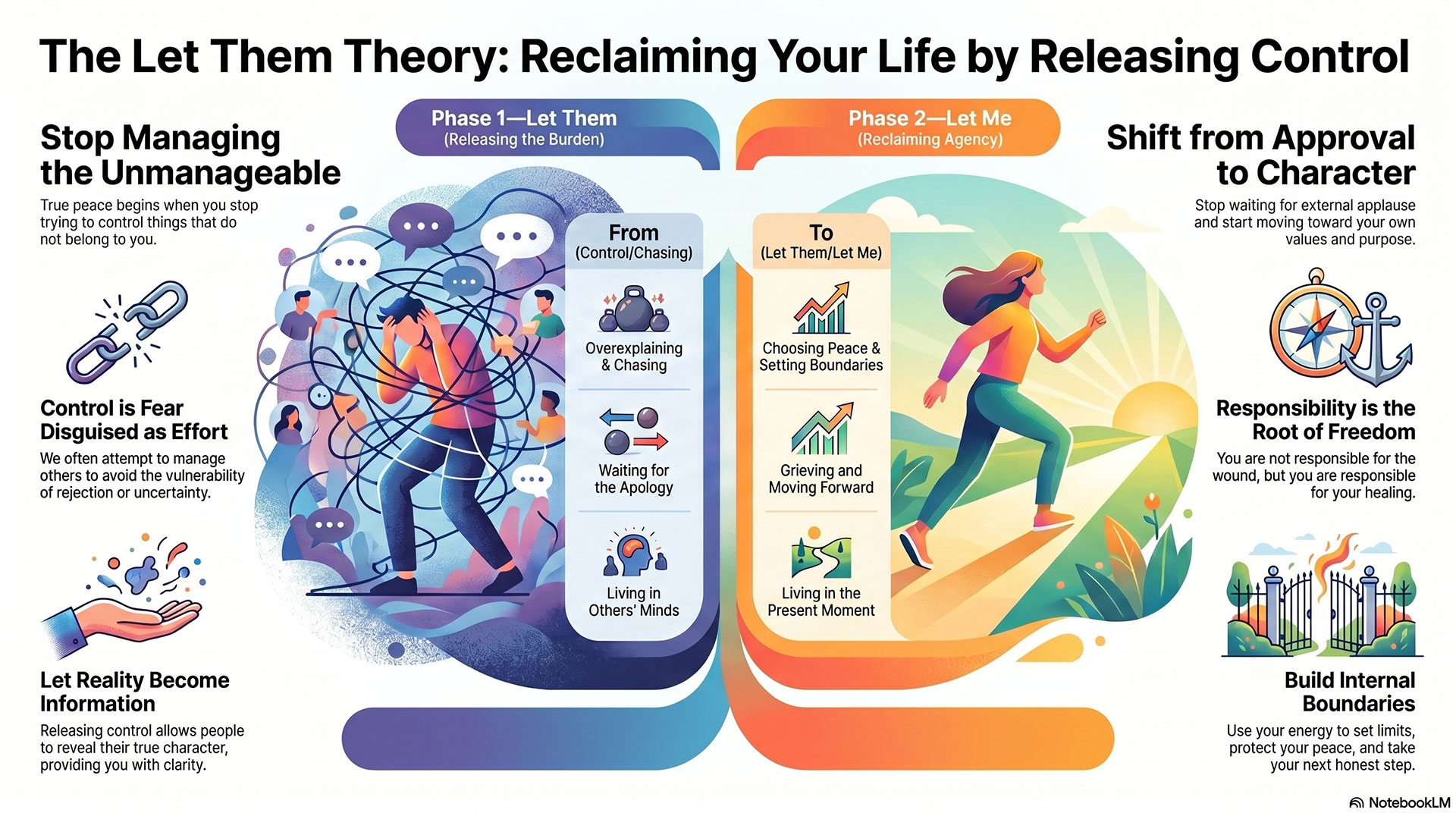
Let Them Live Their Life. Let Me Live Mine.
The Let Them Theory can sound simple at first.
Let them.
Two words.
But inside those two words is a difficult emotional practice.
It asks us to stop fighting reality.
It asks us to stop rewriting other people.
It asks us to stop waiting for everyone else to understand before we move forward.
It asks us to stop confusing someone else’s behavior with our own worth.
That is not easy.
When someone leaves us out, it hurts.
When family judges us, it hurts.
When a partner does not love us well, it hurts.
When work overlooks us, it hurts.
When friends misunderstand us, it hurts.
“Let them” does not mean we pretend the pain is not real.
It means we stop giving pain the right to run our life.
We let people show us the truth.
Then we respond from self-respect.
Let them be emotionally unavailable.
Let me stop begging for connection.
Let them gossip.
Let me choose what I share.
Let them overlook my work.
Let me build proof, speak up, or find a better room.
Let them misunderstand my boundary.
Let me stop shrinking to make them comfortable.
Let them live their life.
Let me live mine.
The power of this idea is not coldness. It is clarity.
We can still love people.
We can still care.
We can still grieve.
We can still hope.
But we no longer hand our peace to someone else’s maturity, timing, approval, or apology.
Freedom begins when we return to what belongs to us:
Our choices.
Our habits.
Our boundaries.
Our healing.
Our next honest step.
The people in this conversation do not all use the same language, but they point to the same truth:
A person becomes freer when they stop chasing approval and start living from self-trust.
The Let Them Theory begins by releasing others.
But it ends by returning you to yourself.
Short Bios:
Mel Robbins
Author, speaker, and creator of The Let Them Theory. She focuses on practical tools for emotional freedom, self-leadership, and daily action.
Brené Brown
Researcher and author known for her work on shame, vulnerability, courage, and belonging. Her voice brings emotional honesty to the question of control and approval.
Byron Katie
Author and spiritual teacher known for The Work, a method of questioning painful thoughts. She brings a direct inquiry into suffering, reality, and mental freedom.
Ryan Holiday
Writer and modern Stoic thinker. He brings the Stoic distinction between what is within our control and what is not.
Oprah Winfrey
Media leader and interviewer known for conversations on healing, worth, trauma, and personal transformation. She brings a soulful lens to being seen and choosing oneself.
Esther Perel
Psychotherapist and relationship thinker known for her work on intimacy, desire, and modern love. She brings insight into how love can turn into control.
John Gottman
Psychologist and relationship researcher known for studying marriage, conflict, repair, and emotional connection between couples.
bell hooks
Writer, critic, and thinker whose work on love, domination, care, and freedom offers a moral foundation for healthy relationships.
Gary Chapman
Author of The 5 Love Languages. He brings a practical lens on how people give and receive love differently.
Nedra Glover Tawwab
Therapist and author known for her work on boundaries, family patterns, and emotional health.
Susan Cain
Author of Quiet. She brings sensitivity to introversion, family expectations, and the hidden pain of being misunderstood.
Glennon Doyle
Author and speaker known for writing about truth, self-trust, family, identity, and the cost of people-pleasing.
Maya Angelou
Poet, memoirist, and moral voice. She brings wisdom on dignity, grief, resilience, and the courage to keep living truthfully.
Adam Grant
Organizational psychologist and author focused on work, motivation, generosity, learning, and the psychology of success.
Simon Sinek
Author and speaker known for purpose-driven leadership. He brings focus to work, meaning, and service beyond recognition.
James Clear
Author of Atomic Habits. He brings a practical view of identity, systems, habits, and confidence built through action.
Sheryl Sandberg
Business leader and author known for work on leadership, ambition, resilience, and women in the workplace.
Viktor Frankl
Psychiatrist, Holocaust survivor, and author of Man’s Search for Meaning. He brings a profound view of freedom, responsibility, and meaning in suffering.
Martha Beck
Author and life coach known for work on integrity, inner truth, and aligning life with the self.
Jay Shetty
Author, speaker, and former monk known for teachings on mindset, discipline, purpose, and attention.
Elizabeth Gilbert
Author of Eat, Pray, Love and Big Magic. She brings insight into creativity, courage, permission, and rebuilding life from within.
Leave a Reply